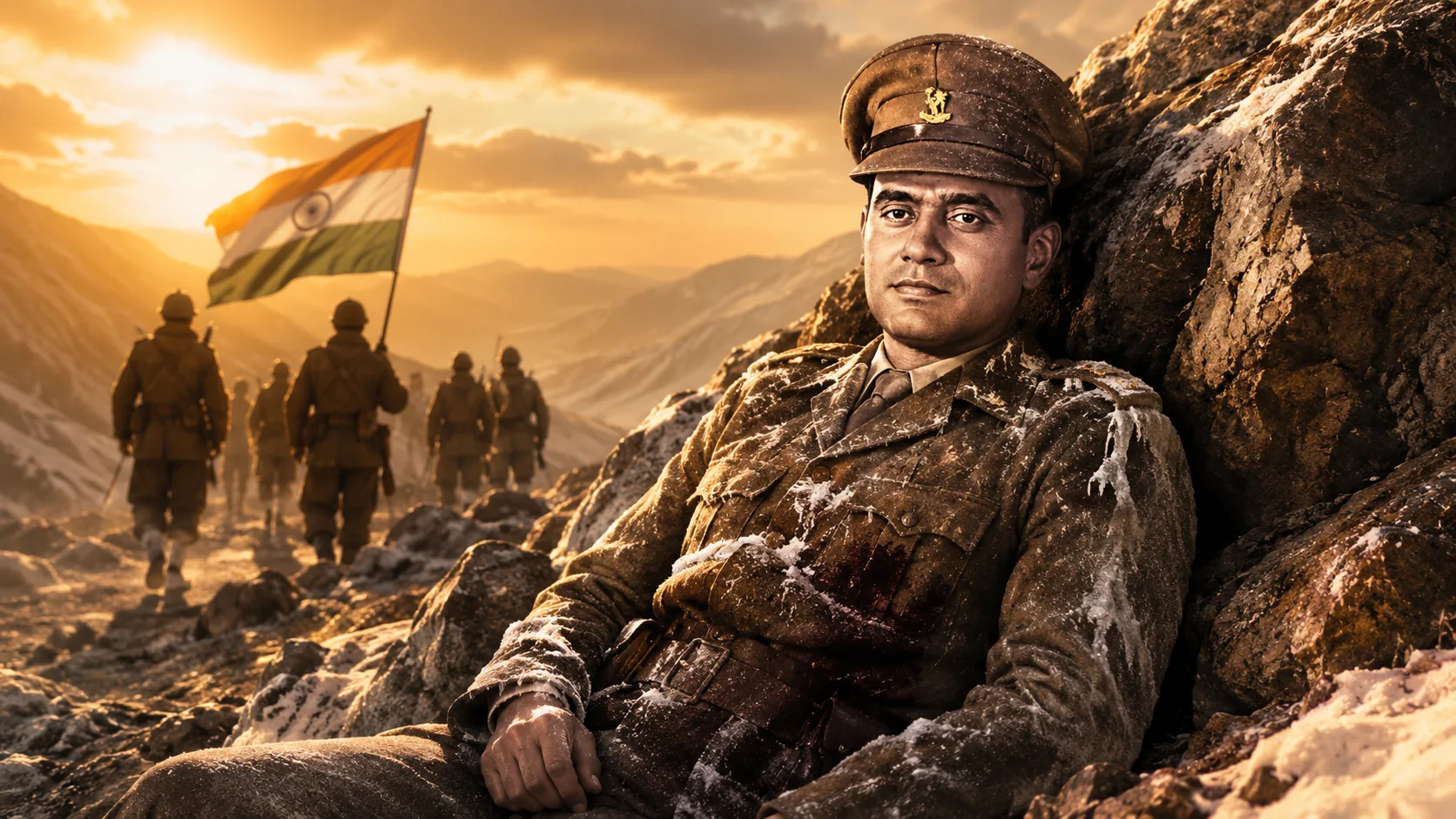
The war remembered for "Hindi–Chini bhai bhai," for Nehru's blunders, for the rout in the snows of NEFA and Ladakh, is the war of 1962. What follows is built deliberately on primary and participant evidence rather than later interpretive history — the Indian Army's own internal review, the memoirs of the men who fought and commanded, China's own statements, and the diplomatic record. Where historians disagree — and on 1962 they disagree sharply — this essay names who argued what rather than pronouncing a verdict.
Principal sources: the Henderson Brooks–Bhagat Report (1963), the Army's internal operations review; Brig. J. P. Dalvi's Himalayan Blunder (he commanded 7 Brigade and was captured); Maj. Gen. D. K. Palit's War in High Himalaya (Director of Military Operations at Army HQ); B. N. Mullik's The Chinese Betrayal (Director, Intelligence Bureau); Lt. Gen. B. M. Kaul's The Untold Story; Neville Maxwell's India's China War (its apportionment of blame contested, flagged below); John W. Garver's analysis of China's decision for war; and the U.S. State Department's Foreign Relations of the United States (FRUS), Vol. XIX.
The Architecture of Trust
In the decade after independence, India's China policy doubled as a sermon. Nehru believed the two ancient civilizations, freshly emerged from imperial subjugation, were natural partners in a post-colonial Asia. The slogan of the age — Hindi–Chini bhai bhai — expressed a genuine national mood, not merely state messaging.
The wager was formalised in the Panchsheel Agreement of April 1954, the Five Principles of Peaceful Coexistence. India recognised the Tibet Region as part of China that same year — surrendering the buffer British India had maintained — and secured no reciprocal settlement of the contested border. The criticism, made even by sympathetic analysts, is structural: India conceded a tangible strategic asset for an intangible goodwill, and left the one issue that would determine peace or war undefined.
The Road Across Aksai Chin
The clearest early evidence that the wager was failing lay in Aksai Chin, a high desert plateau in eastern Ladakh claimed by India. Between roughly 1951 and 1957, China built a military highway across it linking Xinjiang to Tibet — the logistical artery of its control over its western frontier. The Intelligence Bureau under Mullik tracked the intrusions; reconnaissance confirmed the completed road.
The political response was denial. In Parliament in 1959, Nehru dismissed reports of Chinese activity as "bazaar rumours," and waved away border concerns as coming "from Hong Kong and other odd places." Two events that year then hardened the conflict: the flight of the Dalai Lama to India after the Lhasa uprising, which Beijing read as interference; and the first lethal clashes, at Longju and the Kongka Pass.
“Not a Blade of Grass”
On 5 December 1961, during a Rajya Sabha debate on Aksai Chin, Nehru sought to minimise the territory's loss with a sentence that would shadow him permanently:
"Not a blade of grass grows there, 17,000 feet high, uninhabitable, and we didn't even know where it was."Jawaharlal Nehru, Rajya Sabha, 5 December 1961
The Congress MP Mahavir Tyagi rose, pointed to his bald head, and replied: "No hair grows on my head. Does it mean the head has no value?" The chamber laughed, Nehru among them. But the exchange became the most-quoted self-indictment of the Nehru era — a prime minister characterising national territory as worthless because it was barren, at the very moment a foreign army was occupying it.
The Forward Policy: A Posture Without the Means
By late 1961, under pressure to appear firm, the government adopted the Forward Policy: planting small Indian outposts in disputed areas, sometimes behind Chinese positions, to assert sovereignty by presence. The policy rested on a single assumption — that China would not respond with force — held most firmly by Defence Minister V. K. Krishna Menon and General B. M. Kaul.
The Henderson Brooks–Bhagat Report and the participant memoirs document the consequences. Forces were dispersed in what the report called "pennypackets" — small, mutually unsupporting posts. At Tawang, a depleted brigade faced the equivalent of two Chinese divisions; at Bomdila, a single battalion. 7 Brigade was pushed to the Namka Chu river — ground Dalvi recorded as indefensible — with men carrying on the order of 50 rounds each, one blanket, no winter clothing, and inadequate medical supplies at heights above 14,000 feet.
On the question of responsibility, the report faults the General Staff for failing to tell the government plainly that the policy could not be executed with the means available — singling out Kaul. Maxwell's India's China War goes further, arguing India's provocations triggered the war; this thesis remains disputed, and scholars such as Steven Hoffmann treat causation as more layered, weighing the 1959 Tibetan rupture and Chinese strategic calculation alongside Indian missteps. On 22 September 1962, Army HQ received the government's written order to evict the Chinese "as soon as possible." India had committed to an offensive it could not supply.
The Campaign: 20 October – 21 November 1962
China attacked on the morning of 20 October 1962, simultaneously in Ladakh and in NEFA. The synchronisation itself disproved the assumption of Chinese passivity. In NEFA, the Namka Chu positions were overrun within hours; Dalvi's brigade was destroyed and he was captured. After a pause, the Chinese resumed on 15 November and took Sela and Bomdila, precipitating a general collapse and the disintegration of a division. Several thousand Indian soldiers were taken prisoner; the administration of NEFA broke down.
In Ladakh, the defining episode was Rezang La, where Major Shaitan Singh and roughly 120 men of 13 Kumaon held against overwhelming numbers and fought nearly to the last; he received the Param Vir Chakra posthumously. Rezang La stands as the documentary counter-evidence that the failure was of direction and logistics, not of the fighting soldier.
A further consequential decision: India withheld the Indian Air Force from an offensive strike role, fearing Chinese reprisal against Indian cities. Air-power historians argue the popular fear was inverted — India's fighters, operating from low-altitude airfields, could carry far heavier payloads than Chinese aircraft flying from Tibetan strips, so grounding the strike force forfeited one of India's few genuine advantages. On 21 November 1962, having achieved its objectives, China declared a unilateral ceasefire, withdrawing in NEFA behind the McMahon Line while retaining Aksai Chin.
What China Actually Wanted — and Why It Stopped
The question that puzzles every reader of 1962 is the obvious one: China was winning decisively, the road to the Assam plains lay open, and yet it halted and pulled back. The answer is that China had not gone to war to take the eastern territory. The withdrawal was the planned final move of a limited war, decided in Beijing before the fighting began.
The most authoritative analysis, by John W. Garver, establishes that Mao's aims were political and psychological. China sought: to secure Aksai Chin in the west — the one piece it genuinely needed; to shatter the Forward Policy and impose a settled status quo; to deliver a punitive blow — to "teach India a lesson," in the candid framing of Chinese sources; and to answer the wider context of 1959–62, the Dalai Lama's asylum and perceived Indian alignment with Washington and Moscow.
Once those aims were met, holding NEFA offered only cost and risk. Logistics and terrain: the PLA's supply lines ran back over the Himalayas, and winter was closing the passes. The diplomatic window: the ceasefire came the day after the Cuban Missile Crisis ended; with the superpowers freed up and arms flowing to India, prolonging the war risked the very entanglement China had timed its attack to avoid. Political design: withdrawing voluntarily let China pose as the reasonable victor while keeping the prize. That Zhou Enlai signalled the ceasefire to India's chargé d'affaires on 19 November — before Nehru's appeal for U.S. air support — underlines that the decision was China's own design.
The Appeal to America
The most striking — and longest-suppressed — evidence of how completely the catastrophe broke India's posture lies in two letters Nehru sent to President John F. Kennedy on 19 November 1962. The texts remained classified by the Indian government for decades; they survive in the U.S. record. The architect of non-alignment privately begged the United States for direct military intervention, describing the situation as "really desperate" and warning the Chinese could take "the whole of eastern India." He requested twelve squadrons of supersonic all-weather fighters flown by U.S. pilots, a U.S.-manned radar network, and two squadrons of B-47 bombers.
B. K. Nehru, the Prime Minister's cousin and ambassador in Washington who delivered one of the messages, later wrote that he found the telegram so humiliating he could scarcely keep from weeping. Washington's response was constrained by the simultaneous Cuban Missile Crisis; it extended non-combat aid and planned, in the event of an air war, to position support — but the Chinese ceasefire overtook the question.
A persistent myth places a U.S. aircraft carrier steaming into the Bay of Bengal in 1962. That episode belongs to a different conflict — the deployment of the USS Enterprise during the 1971 war with Pakistan — and is frequently, but mistakenly, transplanted onto 1962.
Pakistan, and the Realignment of a Subcontinent
Pakistan, watching India humbled, drew its conclusions. President Ayub Khan used the crisis as leverage: even as the U.S. and Britain rushed aid to India, they had to press New Delhi over Kashmir to keep Pakistan from opening a second front. More durably, Pakistan concluded that India's enemy could be its friend, and began moving toward Beijing — producing the boundary agreement of 1963 and one of the world's most consequential strategic partnerships.
The most serious long-term consequence was nuclear. From the late 1970s and through the 1980s, China provided Pakistan substantial nuclear and missile assistance — including, according to declassified U.S. intelligence and proliferation scholarship, a tested warhead design and weapons-grade uranium. No prior state had handed a partner a complete weapon design. The line from the Himalayan defeat of 1962 to the nuclearisation of the subcontinent is indirect, but the strategic logic — China containing India by strengthening India's western rival — runs straight through it.
The Reckoning
The losses, material and otherwise: roughly 38,000 sq km of Aksai Chin, retained by China to this day (with an additional claim to some 90,000 sq km in the east); over a thousand soldiers killed and several thousand captured; the collapse of Nehruvian non-alignment as a credible doctrine; the resignation of Krishna Menon. Nehru himself was, by most accounts of those near him, broken by the defeat; he died in May 1964.
The Henderson Brooks–Bhagat Report remains officially classified more than six decades later — a silence the government has repeatedly defended as operationally sensitive, and which Maxwell's 2014 online release only partially pierced. Dalvi titled his witness account Himalayan Blunder; it was briefly banned on release, then permitted — itself an index of how unresolved the episode remains.
The Long Shadow
One quieter consequence inverted the war's diplomacy. Having appealed to Washington in extremis, India afterward quietly cooperated with U.S. intelligence against China — a turn documented in the CIA's own later-declassified history of the U-2 programme. Nehru first permitted U-2 reconnaissance to use Indian airspace on 11 November 1962; in 1963 the two governments agreed to develop an airfield at Charbatia, near Cuttack in Odisha (codenamed "Oak Tree") as a U-2 staging base, the first mission flying from it on 24 May 1964, days before Nehru's death. In parallel, India raised the Special Frontier Force ("Establishment 22"), a covert unit of Tibetan exiles founded on 14 November 1962; while it sat under Indian command, it was part of a broader Tibetan-operations effort the CIA equipped and supported, including the 1964 Nanda Devi mission to plant a sensor monitoring China's nuclear tests.
Diplomatic relations were not restored to ambassadorial level until 1976. A series of agreements stabilised the Line of Actual Control that 1962 created, and full-scale war has been avoided. But the LAC remains undefined and contested; the deadly clash at Galwan in June 2020 demonstrated that the fault line of 1962 is live, not historical. India lost more than ground in 1962. It lost the premise that good intentions could substitute for hard power, and that an adversary's restraint could be assumed rather than imposed.
"Not a blade of grass" — Rajya Sabha, 5 December 1961; Mahavir Tyagi's retort widely recorded (cf. Guha, India After Gandhi).
"Pennypackets," Tawang/Bomdila dispositions, Namka Chu supply state — Henderson Brooks–Bhagat Report (excerpts pub. Maxwell, 2014); Dalvi, Himalayan Blunder.
Nehru's 19 November 1962 letters to Kennedy; "really desperate"; twelve squadrons; B-47s — FRUS 1961–63, Vol. XIX; JFK Library.
Chinese objectives and the pre-planned withdrawal — John W. Garver, China's Decision for War with India in 1962.
Charbatia ("Oak Tree") and Tibet overflights — Pedlow & Welzenbach, The CIA and the U-2 Program, 1954–1974 (declassified).
China–Pakistan nuclear assistance — Nuclear Threat Initiative; National Security Archive declassified CIA records.