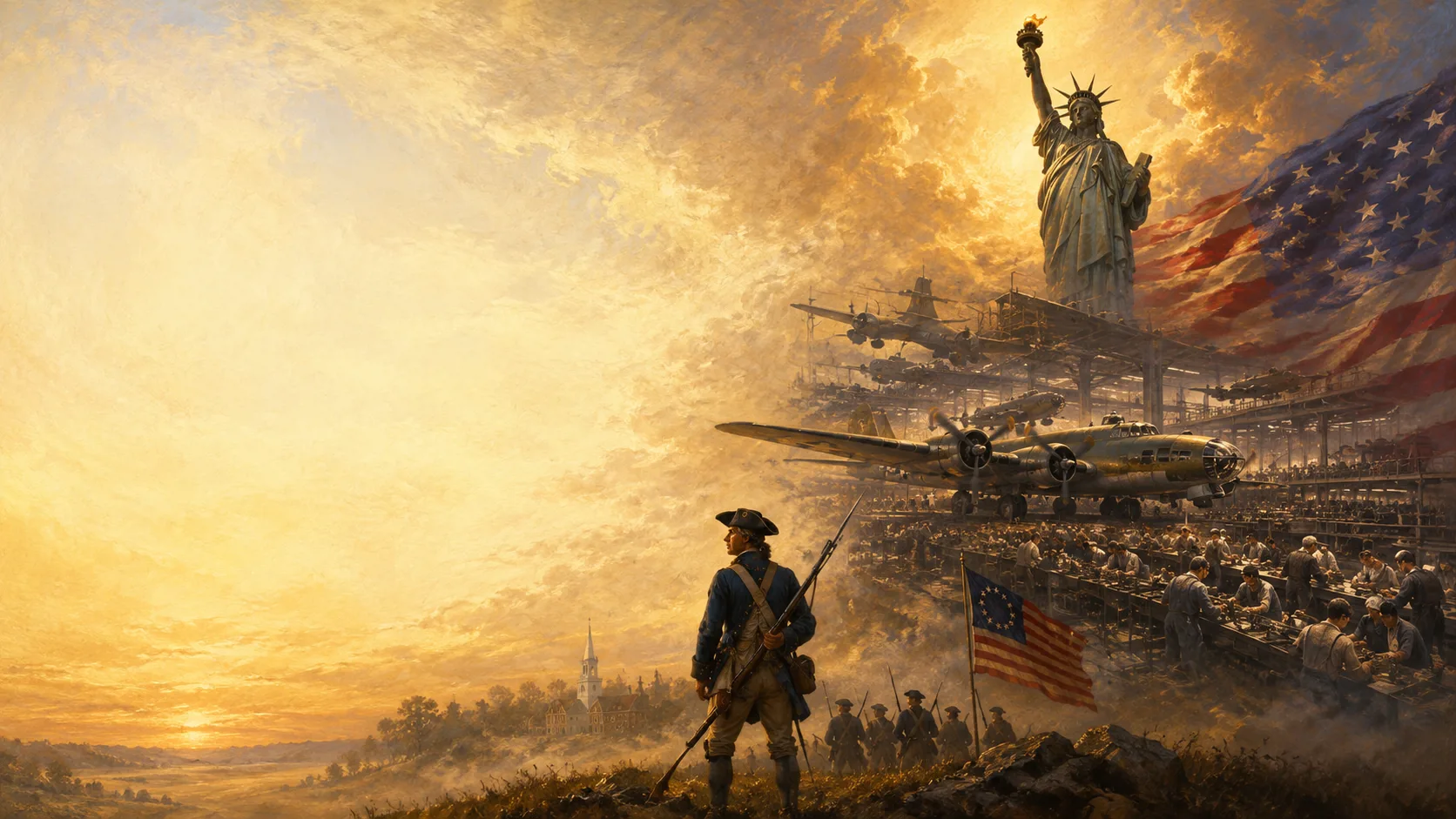
Overture
There is a country that began as an argument and became a promise. It was not carved from an ancient kingdom or handed down by a dynasty. It was declared — written into being one sweltering July by men who knew that if they lost, they would hang. From a single audacious sentence — that all men are created equal — a nation grew that would, within a hundred and seventy years, reach across two oceans to break the most monstrous tyranny the world had yet produced, and then rebuild the very enemies it had defeated.
This is the story of how a thin line of farmers with muskets became the arsenal that armed the free world. Every figure in it is drawn from the record, yet it reads like the most improbable drama ever staged — because it was. It is the story of a land that took in the tired and the poor of every other nation and forged them into a single people; a land that fell into the deepest economic pit of the modern age and climbed out with its democracy intact; a land that has never once, in two and a half centuries, failed to hold an election or to hand over power in peace.
A people who had never governed themselves were about to tell the most powerful empire on earth that kings were no longer necessary. The world thought them mad. They were merely early.
Act One — The Fire and the Word
The Shot Heard Round the World
Lexington Green, Massachusetts. Dawn, April 19, 1775.
Mist clings to the grass as some seventy militiamen — farmers, a blacksmith, a tavern keeper — stand in a ragged line on the village common. Down the road, out of the grey light, comes the tramp of hundreds of British regulars, the finest infantry in the world, bayonets fixed, marching to seize the colonists' hidden guns. A shot cracks. No one will ever know who fired it. In moments eight Americans lie dead on the green. The regulars march on to Concord — and there, at the North Bridge, the farmers fire back, and the redcoats break.
The long road back to Boston becomes a gauntlet. From behind every stone wall and barn, New England men pour fire into the retreating column. By nightfall the British have lost nearly three hundred men to an enemy they can barely see. The empire has met something new: a countryside in arms. Ralph Waldo Emerson would later call that first volley "the shot heard round the world," and he was right — the sound of it has not stopped echoing since.
Word races down the coast on lathered horses. A continent is choosing sides. In Philadelphia, a Congress of colonies that can agree on almost nothing agrees on one thing: they will fight. They need an army, and a man to lead it. They choose a tall, grave Virginia planter who says little in debate but whom everyone in the room instinctively trusts. His name is George Washington.
The Sentence That Made a Nation
Independence Hall, Philadelphia. Summer, 1776.
For more than a year they have fought a war without a country. Now, in a hot brick chamber with the windows shut against eavesdroppers, the delegates take the final, irreversible step. A red-haired Virginian of thirty-three, Thomas Jefferson, is handed the task of putting the case to paper. He writes, crosses out, writes again. What emerges is not a legal brief but a hymn to a radical idea.
We hold these truths to be self-evident, that all men are created equal, that they are endowed by their Creator with certain unalienable Rights, that among these are Life, Liberty and the pursuit of Happiness.
Consider the world into which those words are dropped. In 1776 nearly every human being alive is the subject of a king, an emperor, a sultan, or a tsar. China's Qianlong Emperor rules a third of humanity from a throne no commoner may approach. Catherine the Great commands tens of millions of Russian serfs bound to the soil. And here, on the ragged western edge of everything, two and a half million people declare that legitimate power does not descend from a crown — it rises, upward, from the consent of the governed. It is the most subversive sentence of the age.
They sign it knowing the price of failure is the gallows. "We must all hang together," Benjamin Franklin reportedly quips, "or most assuredly we shall all hang separately." Fifty-six men put their names to treason. Now they have to win.
The Long Odds
On paper it is hopeless. Britain has the most powerful navy on earth, a professional army, bottomless credit, and the money to hire some thirty thousand German soldiers to do its fighting. The Americans have no navy, no treasury, no trained officer corps — and an army whose men may walk home when their short enlistments expire, and often do. Washington will lose more battles than he wins. His genius is not in winning; it is in refusing to be destroyed.
The Delaware River. Christmas night, 1776.
The cause is dying. Beaten out of New York, chased across New Jersey, his army melting in the cold, Washington gambles everything. On a night of sleet and killing ice, he ferries twenty-four hundred desperate men across the black, churning Delaware and marches them nine miles through a blizzard to fall on the Hessian garrison at Trenton at dawn. The victory is small. Its meaning is enormous: the war is still alive. A week later he wins again at Princeton. A dead cause has a pulse.
Saratoga and the Turning of the World
The woods above the Hudson, New York. October, 1777.
The British plan for 1777 is elegant on a map: three armies converging on Albany to cut rebellious New England away from the rest. It dies in the American wilderness. General "Gentleman Johnny" Burgoyne marches south from Canada with some seven thousand five hundred men — and finds no one coming to meet him. His supporting columns turn back. His supplies fail. And waiting on the bluffs of Bemis Heights are the Americans, thousands of militia streaming in by the day, and among them the deadliest men on the continent: Daniel Morgan's Virginia riflemen, who can kill an officer at two hundred yards.
Twice the armies collide on the same blood-soaked ground. Morgan's marksmen pick the British officers out of the smoke. Benedict Arnold — years before his name becomes a curse — rides into the heart of the fighting like a man possessed. On October 17, surrounded and starving, Burgoyne surrenders an entire British army — the first time in its history it has ever happened. The news crosses the Atlantic and changes everything. In Paris, the King of France decides these Americans can actually win. France enters the war, bringing her army, her treasury, and — decisively — her navy. A colonial rebellion has become a world war Britain cannot win.
The World Turned Upside Down
Yorktown, Virginia. October, 1781.
Four years later the trap closes. Lord Cornwallis, chasing the war into Virginia, fortifies the little tobacco port of Yorktown and trusts the Royal Navy to keep his lifeline to the sea. It is a fatal trust. Washington, feinting at New York, marches his army and a French army more than three hundred miles south in the largest troop movement of the war. And off the Virginia Capes, the French fleet drives off the British ships. Cornwallis is sealed in — by land and by sea.
For weeks the allied guns pound the British works to rubble. On a moonless night, under the password "Rochambeau" — which the Americans hear as "Rush on, boys!" — Alexander Hamilton leads a bayonet charge that takes the last redoubt. The end comes on October 19. Some eight thousand British troops march out and lay down their arms. Tradition says their bands play a tune called "The World Turned Upside Down." It has.
Two years of negotiation remain, but the impossible has happened. In 1783 the greatest empire on earth signs a treaty recognizing the independence of the United States of America. And then Washington does the most revolutionary thing of all. Offered power for life, all but begged to become a king, he resigns his commission and goes home to his farm. Told that Washington means to surrender power voluntarily, a disbelieving King George III says that if he does, he will be "the greatest man in the world." He does. He is.
Act Two — A House Divided, and Made Whole
The Unfinished Sentence
The republic is born flawed. The same Declaration that proclaims all men equal is signed by men who hold other men in bondage. That contradiction is written into the nation's foundations, and it will not stay silent. For four score years the young country grows explosively westward — but with every new state comes the same searing question: will it be slave or free?
The words on the parchment prove impossible to contain. Frederick Douglass, born enslaved, teaches himself to read and turns Jefferson's own sentence into a hammer against slavery. A nation half-slave and half-free cannot, in Abraham Lincoln's phrase, permanently endure. By 1861 the argument can no longer be argued. It must be fought.
The Terrible Arithmetic
Gettysburg, Pennsylvania. July, 1863.
For three days, in the fields and peach orchards of a Pennsylvania town, the two halves of the country tear at each other in the greatest battle ever fought on American soil. When the guns fall silent, more than fifty thousand men are dead, wounded, or missing. It is the high-water mark of the rebellion, and its ebb. The Union holds.
Months later Lincoln stands on that ground to dedicate a cemetery and speaks for barely two minutes. He does not describe the battle. He redefines the country — casting the war not as a quarrel over union alone but as a test of whether a nation "conceived in Liberty, and dedicated to the proposition that all men are created equal" can long endure.
We here highly resolve that these dead shall not have died in vain — that this nation, under God, shall have a new birth of freedom — and that government of the people, by the people, for the people, shall not perish from the earth.
The war ends in 1865. Slavery is abolished by constitutional amendment. Lincoln does not live to see the peace; he is murdered days after the surrender. But the Union endures, and the sentence that made the nation is, at terrible cost, made a little more true. The work of fulfilling it will continue for a century and more — and continues still. That, in the end, is the American method: not a finished perfection, but a promise the nation keeps returning to redeem.
Act Three — The Golden Door
Give Me Your Tired, Your Poor
New York Harbor. The turn of the twentieth century.
They come by the millions, packed into the steerage decks of steamships, and the first thing many of them see through the salt haze is a copper woman lifting a torch. On her pedestal are the words of the poet Emma Lazarus:
Give me your tired, your poor, your huddled masses yearning to breathe free... I lift my lamp beside the golden door.
Beyond her rises Ellis Island, where between 1892 and 1954 some twelve million immigrants are inspected, questioned, and — for the overwhelming majority — admitted to a new life. Italians and Poles, Jews fleeing the pogroms of the Russian Empire, Irish, Greeks, Slovaks, Chinese, and a hundred nations more. They arrive with sewing kits and prayer books and almost nothing else, and they build the railroads, the steel mills, the garment shops, the cities.
This is the improbable American alchemy. Elsewhere in the world, nationhood means shared blood and shared centuries. America builds itself from strangers — a country bound not by ancestry but by an idea, one that any newcomer can adopt as fully as anyone born to it. The immigrant's child becomes the inventor, the general, the senator, the scientist. A nation of arrivals turns its diversity into its deepest strength. No other great power has ever tried to become a people this way. None has done it so well.
Act Four — The Deepest Pit
The Music Stops
Wall Street, New York. October, 1929.
The 1920s roar. The stock market climbs to giddy heights on borrowed money and boundless confidence. And then, over a few catastrophic days in late October, it collapses. Fortunes evaporate in hours. The paper wealth of a decade is wiped out. But the crash is only the beginning.
What follows is the Great Depression — the worst economic catastrophe in the nation's history. The numbers are almost impossible to feel at human scale, so let them land one at a time.
The scale of the Great Depression in the United States, 1929–1933
| Measure | 1929 | 1933 (the bottom) |
|---|---|---|
| Unemployment rate | about 3% | about 25% |
| Real output (GDP) | baseline | fell roughly 30% |
| Banks in operation | ~25,000 | ~11,000 failed |
| Stock market value | peak | lost nearly 90% |
By 1933 one American worker in four cannot find a job — and in that era, before any safety net exists, a lost job most often means a lost household income entirely. Roughly nine thousand banks fail, taking with them the savings of ordinary families. Farmers watch crop prices collapse and lose the land their grandfathers cleared. On the Great Plains, drought turns the topsoil to choking black dust and drives whole families west in overloaded jalopies toward a California that does not want them. Shantytowns of packing crates — bitterly nicknamed "Hoovervilles" — rise in the shadow of silent factories. Men who built the country line up for bread.
A Rendezvous with Destiny
Washington, D.C. March 4, 1933.
Into this darkness, at the very bottom, comes a new president in a wheelchair he does not let the public see. Franklin Delano Roosevelt is inaugurated with a quarter of the workforce idle and the banking system in free fall. His first sentence to a terrified nation is a line for the ages.
The only thing we have to fear is fear itself.
He does not wait. Within his first hundred days he closes the banks to stop the panic, then reopens the sound ones under federal guarantee — and money floods back. He signs law after law: relief for the hungry, jobs on public works, insurance for bank deposits, pensions for the old through a new thing called Social Security. Young men plant three billion trees and build the parks and roads a later generation will inherit. It is called the New Deal, and it does not, by itself, end the Depression. But it does something as important: it restores the people's faith that their democracy can act — that in a world where desperate nations are turning to dictators, the American answer to catastrophe is not a strongman but a Congress, an election, and a president who tells the truth. Across the ocean, other nations meet their despair with Hitler and Mussolini. America meets hers with a ballot box. It holds.
Act Five — The Arsenal of Democracy
The Sleeping Giant
Pearl Harbor, Hawaii. Sunday morning, December 7, 1941.
The country is still climbing out of the pit when the sky over its Pacific fleet fills with Japanese planes. In under two hours, the battleships of the United States Navy lie burning and broken in the mud of the harbor; more than two thousand Americans are dead. The next day a grim president calls it "a date which will live in infamy," and a nation that wanted no part of another world war is in it to the end.
Half a world away, the tyrannies believe they have timed things perfectly. Nazi Germany rules from the Atlantic to the gates of Moscow. Imperial Japan commands the Pacific. Hermann Göring sneers that the Americans are good only at making "razor blades and washing machines." It is the single greatest miscalculation of the century.
The Machine That Won
What the dictators do not understand is that they have just declared war on the most productive economy in the history of the world — and handed its idle Depression-era factories a purpose. The automobile plants of Detroit stop making cars and start making tanks and bombers. Assembly lines that built sedans now roll out warplanes. Shipyards learn to build a cargo vessel not in months but in days.
The output is beyond anything the enemy imagined possible.
The numbers of the arsenal. Between 1940 and 1945 American industry produces on the order of 300,000 aircraft, roughly 86,000 tanks, some 2.5 million military trucks and half a million Jeeps, thousands of warships and merchant vessels, and tens of billions of rounds of ammunition. Unemployment — a crushing 25 percent just years earlier — all but vanishes, falling to around one percent. By war's end the United States is out-producing every Axis nation combined, and arming its allies besides.
The Depression does not so much end as get buried under the sheer weight of production. The same factories that stood silent in 1933 now run around the clock. And the workforce that mans them is a portrait of the whole country: women pour into the shipyards and aircraft plants as "Rosie the Riveter"; African Americans, immigrants, farm boys, and clerks stand shoulder to shoulder on the line. A nation that had been on its knees rises to become the workshop of the free world.
The Longest Day and the Last
The beaches of Normandy, France. June 6, 1944.
Before dawn, the largest invasion fleet ever assembled crosses a grey and violent English Channel. Under a storm of fire, on beaches code-named Omaha and Utah, tens of thousands of young Americans wade ashore into the machine guns to begin the liberation of a continent. Many do not make it past the waterline. Those who do keep going. Within a year the Nazi tyranny that had darkened Europe is crushed between the Western allies and the Soviets, and Adolf Hitler is dead in a Berlin bunker as the American, British, and Soviet armies close in.
In the Pacific, the war is won island by bloody island, until in August 1945 a terrible new weapon born of a secret American laboratory ends it. The guns fall silent. The most destructive war in human history is over, and the United States stands, almost alone among the great powers, with its homeland untouched and its strength at flood tide.
The Greatest Generation's Gift
And here the American story turns one last time, in a way no empire before it ever had. Victory does not make the United States vengeful. It makes it generous. Rather than loot the defeated, America rebuilds them — pouring billions through the Marshall Plan into the shattered cities of its former enemies, midwifing democracies in Germany and Japan that endure to this day. At home, returning soldiers are sent to college and helped to buy homes, and out of that investment grows the largest, most prosperous middle class the world has ever seen.
In the space of a single lifetime, Americans had won their independence, freed the enslaved, taken in the world's outcasts, survived the deepest depression of the modern age, and then armed and led the coalition that saved civilization itself — and, having won, chose to build rather than to rule.
Coda — The Last Best Hope
Look back across the whole arc of it. A handful of quarrelsome colonies on the edge of an empire dared to say that ordinary people are fit to govern themselves. They fought long odds and won. They wrote a promise larger than they could yet keep, and then bled to make it truer. They flung open a golden door and turned the whole world's tired and poor into a single, striving people. They fell into an abyss and climbed out without surrendering their freedom to a dictator. And when the darkness came for everyone, they became the arsenal that beat it back — and then rebuilt the ruins.
It is the oldest continuous democracy on earth, and it remains, as it began, unfinished — an argument still being argued, a promise still being redeemed in every generation. That is not its weakness. It is the very secret of its strength. For the American idea was never a claim to have arrived. It was, and is, a direction: toward a more perfect union, toward liberty, toward the still-radical proposition that all people are created equal and are endowed with the right to life, liberty, and the pursuit of happiness.
A land where dreams come true — because it was built, from its first sentence, as a place where a dream could be written down, and where a free people could be trusted, at last, to make it real.
A note on the record: the figures in this narrative — troop strengths and casualties from Lexington through Yorktown, Depression-era unemployment and bank-failure data, and the wartime production totals of the "Arsenal of Democracy" — are drawn from standard scholarship and public archives (the American Battlefield Trust, the National Park Service, the Federal Reserve and FDR Library, the U.S. Census, and the National WWII Museum). Where sources differ, representative figures are given rather than false precision. The narrative voice is cinematic; the facts beneath it are not.