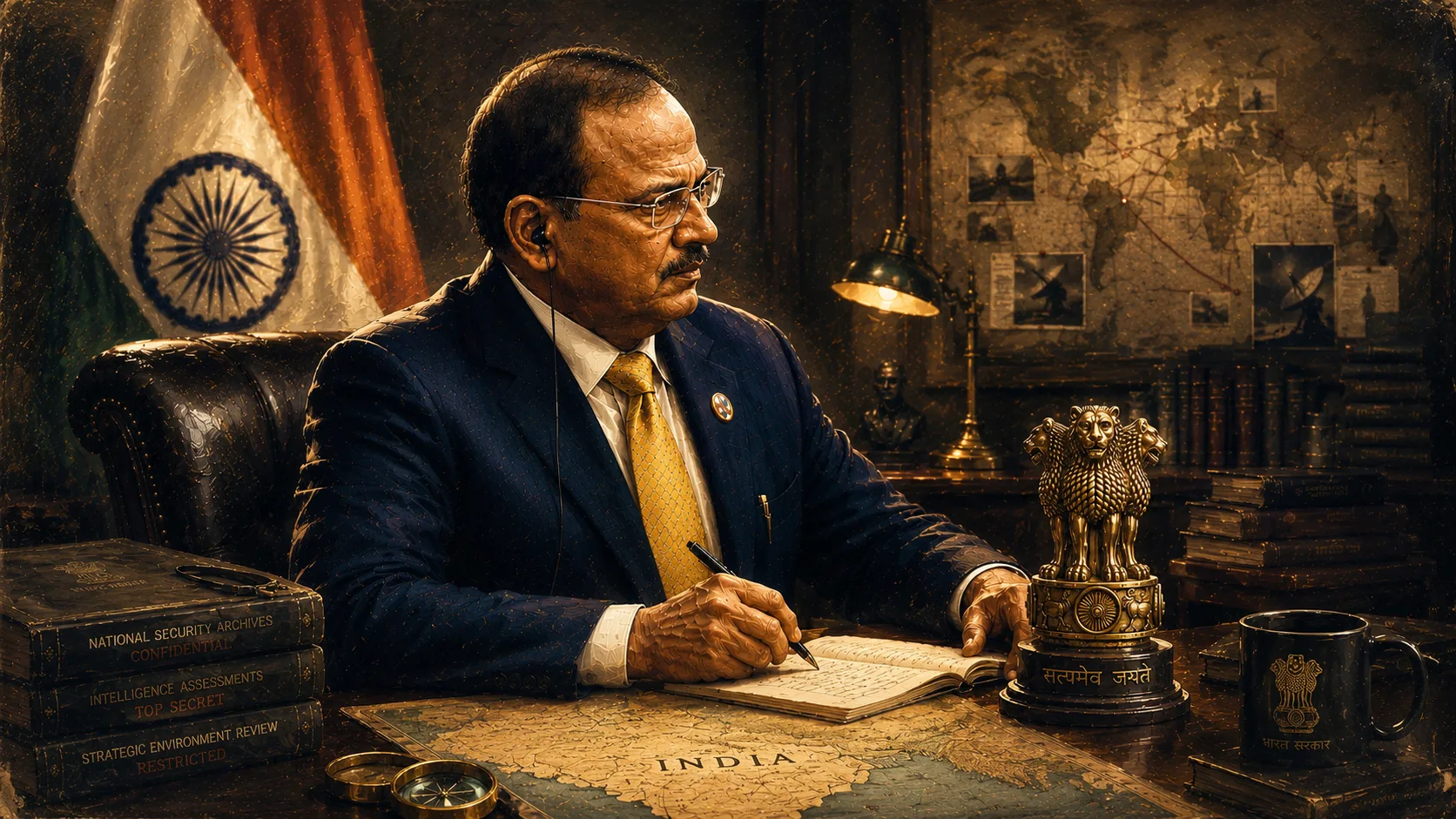
Prologue: The Man Who Was Not There
There is a particular kind of greatness that resists biography. The great general leaves battlefields; the great statesman leaves treaties; the great poet leaves verse. The great spy, if he is truly great, leaves almost nothing at all — no fingerprints, no photographs, no paper trail, only the absence where consequences should be traceable to a cause. Ajit Kumar Doval has spent the larger part of his eighty-one years cultivating precisely this kind of invisibility, and so any account of him is necessarily an act of reconstruction: piecing a portrait together from the few stones the river has left exposed.
What emerges, even from those few stones, is a figure who belongs as much to the older Indian imagination as to the modern state. Here is a man who lived as a Muslim in Lahore for years; who pulled a rickshaw through the lanes around the Golden Temple while the bullets of an insurgency cracked overhead; who walked into the courts of generals and warlords carrying nothing but his nerve — and who returned, each time, to a country that for most of its modern history had taught itself not to fight. To understand Doval is to understand a quiet argument he has been making for half a century: that a civilisation which forgets the kṣātra — the protective, martial, ordering force that classical Indian thought placed alongside the brahma, the force of knowledge and the sacred — does not become more peaceful. It merely becomes more vulnerable.
This is not a hagiography, though it is written with admiration. A serious portrait of a serious man must hold two things at once: the genuine grandeur of a life given wholly to the protection of a civilisation, and the honest acknowledgment that such lives are contested, that the very boldness his admirers call decisiveness his critics call something harder. We will give both their due. But we begin where he began — in the hills.
I. The Hills That Make Men Hard
He was born on 20 January 1945, in Ghiri Banelsyun, a small village folded into the steep green of Pauri Garhwal, then in the United Provinces of British India, today in Uttarakhand. The Garhwal hills have for centuries sent their sons into the Indian Army in numbers far out of proportion to their population; the Garhwali Brahmin community into which Doval was born carries within it that long martial inheritance, the reconciliation of the priestly and the soldierly that the plains so often keep apart.
His father, Major Gunanand Doval, served in the Bengal Sappers for some thirty-six years; his mother was Indra Doval. To grow up in such a household was to absorb discipline not as a doctrine but as an atmosphere. The boy was sent to the King George's Royal Indian Military School in Ajmer — now the Ajmer Military School — an institution built to forge exactly the kind of austere, physically rigorous, duty-bound temperament that would define him. He went on to Agra University, taking a master's degree in economics in 1967, standing first in his class. The following year, on his very first attempt, he cleared the Union Public Service Commission examination, and in 1968 he entered the Indian Police Service as an officer of the Kerala cadre.
His first postings were the ordinary apprenticeship of a young officer: Assistant Superintendent of Police in Kottayam, then, in early 1972, a few turbulent months in riot-hit Thalassery. He could have had an ordinary, distinguished career — a district, a desk, a pension. Instead, later that same year, he made the choice that would define the next four decades: he joined the Intelligence Bureau. He would not fully step out of the shadows until he was nearly seventy years old. Much later, in 1990, he would also pass through the 30th course of the National Defence College — the soldier-scholar formally completing his strategic education even as his field legend was already made.
II. The Apprenticeship in the Shadows
Mizoram: Breaking an Insurgency from Within
Doval's first great assignment carried him to the far northeast, to Mizoram, where the Mizo National Front under Laldenga was waging an armed secessionist war. Officially, between 1972 and 1977 he led the IB's Subsidiary Intelligence Bureau in Aizawl. In practice he spent those five years largely underground, working not against the insurgency from outside but inside it — turning commanders, splintering loyalties, hollowing the movement from within until the ground was prepared for negotiation. He is credited with peeling away six of Laldenga's seven senior commanders. To reach the insurgent leadership he is said to have operated for long stretches across the border in the Arakan hills of Burma, and even within Chinese-held territory — the deep field, far past the reach of any rescue. The groundwork he laid fed into the 1976 understanding and, eventually, the Mizoram Peace Accord of 1986 — to this day one of the most durable insurgency settlements India has achieved. For this and his subsequent work he was given the President's Police Medal in 1974, an honour normally reserved for officers with fourteen years of service; Doval received it in roughly seven.
Sikkim: The Quiet Integration
He also played a part in the intelligence groundwork surrounding the integration of Sikkim into the Indian Union in 1975 — one of those operations whose details remain deliberately obscure, but whose outcome reshaped the map of the eastern Himalaya, folding a Himalayan kingdom into the Republic. By the accounts that survive, his task was to read the sentiment on the ground, build local support for accession, and counter the foreign influences then swirling around the court of the Chogyal — including the suspicions attaching to the king's American consort, Hope Cooke. The referendum that followed returned an overwhelming majority for joining India. It was the same signature method as Mizoram: not the blunt instrument of force, but the patient cultivation of people and perception until the outcome ripened on its own.
Pakistan: Seven Years Inside the Enemy's House
The episode that has passed into legend is the seven years he spent in Pakistan. He learned to live as a Pakistani Muslim, principally in Lahore — mastering Urdu, the cadence of the streets, the etiquette of the mosque, the texture of a life not his own. He became, by all accounts, a genuine student of Pakistan: its history, its sectarian fault lines, its politics, the inner workings of its army and its Inter-Services Intelligence. The discipline this demanded is almost unimaginable: to maintain a false self continuously, for years, in a place where a single misstep means death. By his own telling, he had plastic surgery on his earlobes to erase the tell-tale marks of pierced ears that would have betrayed his Hindu origins.
The single most repeated anecdote of this period — one Doval himself has recounted in public — has the texture of myth, and is worth telling in something close to his own telling. Walking near a great mosque in Lahore, he was beckoned over by an old man with an arresting presence and a flowing white beard, a figure of evident standing in the community. The man looked at him a long moment and said, simply: you are a Hindu. Doval denied it. The old man drew him into a private room, shut the door, and pointed to his pierced ears — the tell-tale mark of a Hindu boy. Thinking fast, Doval said he had converted to Islam later in life. And then the story turns, as the best stories do: the old man's face softened, and he confided that he too was a Hindu in disguise, the sole survivor of a family slaughtered in a riot, who had hidden for years behind a Muslim identity to stay alive. He advised the young agent to have the earlobes surgically corrected — it is not safe to walk like that — and, before letting him go, opened a cupboard to reveal the small statues of Śiva and Durgā he still secretly worshipped, an old man spending his last years with the gods who had carried him through. Whether the account is literal in every particular hardly matters; it tells us how Doval understood his own work — as something lived among real human beings, in a country he never simply hated, threaded with mercy and menace in equal measure.
Other stories from this period read like parable too. Working in disguise, he is said to have gathered hair clippings from a barber shop frequented by Pakistani nuclear scientists; tested, the samples showed traces of enriched uranium — early human-intelligence confirmation of Pakistan's covert weapons programme. His standing brief, by most accounts, encompassed the ISI itself and the long shadow of Dawood Ibrahim. From 1983 to 1987 he served, openly this time, at the Indian High Commission in Islamabad, ostensibly heading its commercial section, in reality watching the machinery of the Pakistani state from within its capital. He kept watch, too, over the Sikh pilgrims who crossed into Pakistan and the separatist propaganda directed at them — the Khalistan project that Pakistan was then nurturing as a weapon against India.
Amritsar: The Rickshaw Puller at the Golden Temple
In 1988, that weapon was lodged in the most sensitive place imaginable. During Operation Black Thunder II, the Indian state moved to flush heavily armed Khalistani militants out of the Golden Temple complex in Amritsar. The legend — and it is, to be candid, a legend whose details are contested — has Doval going in alone and undercover as a rickshaw puller plying the lanes around the temple, then talking his way to the militants inside by presenting himself as a Pakistani ISI man sent to help their cause. Two days before the final assault, the story runs, he walked out of the complex carrying the true strength and positions of the men inside, and stayed in contact as the National Security Guard moved in, so that the shrine was cleared with minimal loss of life and minimal damage. For his role across the Punjab covert campaign he was awarded the Kirti Chakra — India's second-highest peacetime gallantry decoration, and the first ever given to a police officer.
Honesty compels a note here, the kind a serious profile owes its readers. Some careful journalists and former colleagues have questioned the most cinematic version of the Golden Temple story — pointing out that a joint director of the IB would not ordinarily be sent personally inside as a mole, that contemporaneous accounts of Black Thunder credit the police leadership of K. P. S. Gill and Julio Ribeiro and the NSG, and that Doval's name surfaces in the rickshaw-puller form mainly in later retellings. What is not in serious dispute is that Doval was a senior figure in the Bureau's Punjab operations during the years Khalistani militancy was broken, and that his covert work there was real and consequential; the cricketer's quip that each militant taken in that phase might be scored "caught Doval, bowled Gill" captures the division of labour better than the lone-hero version. The legend, in other words, has a true core wrapped in embellishment — which is exactly what one would expect of a spy's reputation, and exactly why the embellishment is itself part of the story.
The Hijackings, and a Lesson in Failure
Doval has said he was involved, in one capacity or another, in the resolution of every one of the fifteen hijackings of Indian Airlines aircraft between 1971 and 1999 — including the infamous IC-814 hijacking to Kandahar in 1999, where he was part of the three-man negotiating team under then-NSA Brajesh Mishra. Characteristically, he did not later dress that episode in triumph. He called the negotiation a diplomatic failure — the surrender of three imprisoned militants a wound the country should not have had to bear. It is a revealing habit of mind: the refusal to mistake the avoidance of immediate loss for genuine victory. The man who had spent his life in deception had no patience for the gentlest self-deception of all, the one a state tells itself to feel better about a bad bargain.
III. The Craft Itself: What the Spy Believed
Before we follow Doval up into the offices of state, it is worth pausing on the craft — on what half a century in the shadow-world taught him, and how he came to think a secret war should be fought. For all the legend, his method has a recognisable signature, and it is not the signature of the gunman.
The first principle is the turned enemy. Doval's most characteristic victories were not assassinations but conversions — taking the adversary's own men and making them his. In Mizoram he peeled away six of Laldenga's seven commanders. His most consequential single feat of this kind came in Kashmir in the mid-1990s, with a Pakistan-trained militant named Mohammad Yusuf Parray — Kuka Parray. By the accounts of intelligence men who were there, Doval, armed with detailed psychological profiles, met Parray and persuaded him to turn his guns around; Parray's outfit, the Ikhwan, became the spearhead of a counter-insurgency that hollowed out the Pakistan-sponsored militancy from the inside and made it possible to hold the 1996 Assembly elections in the Valley. Parray himself later became a legislator, and was eventually assassinated for his defection — a reminder of the human cost carried by the men a spymaster turns. It is the Arthaśāstra's oldest teaching: the most economical victory is the one won by bheda, by division, before a single blow is struck.
The second principle is knowledge before force — the conviction that intelligence is the true high ground. When the ISI and the JKLF killed four IB officers in the early 1990s, the Bureau's network in Kashmir effectively collapsed, and for years Indian operations ran blind. It was Doval — fluent in Urdu, deeply read in Islam and in Pakistan — whom the service turned to rebuild that network from the rubble. He understood that a state which cannot see cannot act wisely, and that the patient reconstruction of human intelligence, agent by agent, is worth more than any number of dramatic raids.
The third principle is psychological warfare — the battle for the mind. Those who have studied him call him a master of it: the manipulation of an adversary's perception, morale, and incentives until his will to fight erodes from within. His "double squeeze" against terror financing is psychological as much as economic — the calculated message that every adventure will cost more than it yields. So too is the doctrine of disproportionate response: the point of a hard counter-strike, in his thinking, is less the physical damage than the message it burns into the adversary's calculations.
And underneath it all runs a fourth, almost ascetic principle: the subordination of the self. The spy who lives for years as another man, who lets his own wife remain ignorant of his true work, who pulls a rickshaw or sweeps a barber's floor, has had to dissolve his ego almost entirely into the role. This is not the glamorous individualism of the screen spy; it is closer to a discipline, even a renunciation — the self offered up to the work. It is here, more than anywhere, that the figure of the spy and the figure of the yogi of statecraft begin to converge.
IV. The Kashmir Doctrine
No single theatre reveals the Doval method — and the controversy it attracts — more completely than Kashmir, the wound he has worked at longer than almost any living official.
His diagnosis of the problem is unsentimental and historical. Pakistan, he has said publicly, used the special status of Article 370 to catalyse terrorism in the Valley, and in 1988 launched what was code-named Operation Topac — a deliberate strategy, modelled on the proxy war Zia-ul-Haq's establishment had waged against the Soviets in Afghanistan, of diverting battle-hardened mujahideen into Kashmir, training disaffected local youth, raising a constellation of militant fronts, and bleeding India through what its own strategists called a thousand cuts. To Doval, decades of Indian policy had answered this not with a counter-strategy but with appeasement — a posture he traces back to the original decision to internationalise the dispute at the United Nations in 1947–48 rather than first clearing Pakistani forces from the ground.
From that diagnosis flows the Kashmir doctrine that bears his name, and which is, in essence, the defensive-offensive applied to an internal front. Its elements are by now visible in the public record. Deny the separatists their halo: strip the Hurriyat of the aura of legitimate representation, and treat its leaders not as statesmen-in-waiting but as instruments of a foreign operation. Choke the money: turn the National Investigation Agency loose on the hawala channels and terror-funding networks that sustained both militants and their political ecosystem. Erase the distinction between local and foreign terrorist: abandon the older, softer line toward "our own boys" and apply a single, unforgiving standard to anyone who takes up the gun. Refuse to overreact, but never appease: his calculation, stated plainly, was that the troublemakers could not sustain themselves indefinitely if denied oxygen, money, and legitimacy — that firmness, not concession, was the path to exhaustion of the insurgency. And finally, the political-constitutional capstone: the 2019 revocation of Article 370, the removal of the very instrument he believed Pakistan had exploited, during which Doval pointedly camped in the Valley himself, walking locked-down streets, eating with locals, putting his own body into the operation as he always had.
The results are claimed, and contested, along predictable lines. Admirers point to elections held, militancy ebbing, the Hurriyat reduced to irrelevance — even a former chief of the rival R&AW, A. S. Dulat, conceded that separatism and the Hurriyat had been all but "finished," though he argued the abrogation of 370 had been unnecessary, a fig leaf better left in place. Critics point to the human cost of the hardest version of the doctrine: the journalist's tally, in one six-month stretch, of around 130 militants killed under a directive not to yield to political pressure; the mass detentions; the communications blackouts; the charge that order was purchased at the price of consent. Both things can be true at once, and an honest profile says so. What is not in doubt is that the policy is recognisably his — patient, ruthless, psychologically calculated, contemptuous of appeasement, and willing to absorb moral controversy in pursuit of a defined strategic end.
V. The Scholar of Statecraft
In January 2005, Doval retired as Director of the Intelligence Bureau, the culmination of a career in which he had also founded the Multi Agency Centre and the Joint Task Force on Intelligence — institutional reforms aimed at making India's notoriously fragmented intelligence agencies actually share what they knew. For more than a decade before that he had headed the IB's Operations Wing, the sharp end of the service.
Retirement, for him, was not rest but a change of weapon. Around 2008 he helped establish what became the Rashtriya Raksha University. In 2009 he founded the Vivekananda International Foundation (VIF), a Delhi think tank named after the monk whose vision of a strong, self-confident, spiritually grounded India Doval has openly embraced. Through the VIF and in a steady stream of essays — on Maoist insurgency, on Chinese intelligence and its transformation "from a party outfit to cyber warriors," on internal security, on the strategic posture India ought to adopt — he laid out, in the open, the intellectual architecture of what would later be called the Doval Doctrine.
Its core was set out most clearly in February 2014, at the tenth Nani Palkhivala Memorial Lecture, in a typology of three postures. A nation may be purely defensive — the chowkidar, the watchman, who only ever guards and absorbs blows, and who, Doval argued, can never win because the attacker need only succeed once. A nation may be purely offensive — but against a nuclear-armed adversary this risks catastrophe. Between these lies what he champions: the defensive-offensive, the doctrine of going to the source of the harm rather than waiting endlessly at one's own gate. His most quoted line — delivered with characteristic bluntness — was a message to Pakistan: you do one more Mumbai, and you may lose Balochistan. The logic is the ancient logic of deterrence married to the older Indian principle that the daṇḍa, the rod of righteous force, exists precisely so that it rarely needs to fall.
To this he added a subtler, less martial idea — the "double squeeze." Most insurgents and terrorists, Doval has argued, are driven not by ideology but by money and incentive; deny them weapons, funds, and manpower, outspend their handlers, and raise the cost of every adventure until the ledger no longer balances. It is the economist's mind — the Agra first-ranker — operating inside the spymaster's world.
VI. The Architecture of Power
On 30 May 2014, the newly elected government of Narendra Modi appointed Doval India's fifth National Security Advisor. He was an unconventional choice — most previous NSAs had risen through the diplomatic service; Doval came from the world of operations. The decades that followed have made him the longest-serving NSA in India's history, now in his third consecutive five-year term, holding Cabinet rank since 2019 — the first NSA ever to do so.
It is worth pausing on how much authority has come to rest in this one quiet man, because it is unusual in the Indian system. As NSA he sits, ex officio, at the centre of a web of offices: he is the executive of the National Security Council; chairman, since October 2018, of the Strategic Policy Group, the first tier of the Council's three-tier structure and the nucleus of its decision-making; chairperson of the Defence Planning Committee; and head of the executive council of the Nuclear Command Authority — meaning the machinery that would manage India's nuclear arsenal in extremis runs, at the official level, through him. Few individuals in the history of the Republic have concentrated so much of the security state in a single pair of hands, and fewer still have held it so long.
VII. The Spymaster as Statesman
The list of episodes bearing his imprint is long, and a profile must be honest that responsibility in such matters is collective and often deliberately blurred. But the public record consistently places him at the centre of:
- The rescue of 46 Indian nurses trapped in Tikrit in 2014 after the fall of Mosul to ISIS — a crisis he flew into personally, securing their release through Kurdish authorities within days.
- The 2015 cross-border operation in Myanmar against NSCN-K militants following an ambush on Indian soldiers, and a parallel 2020 effort that saw militant leaders from the northeast handed over to India.
- The 2016 surgical strikes across the Line of Control after the Uri attack — the first time India publicly acknowledged striking inside Pakistan-administered territory.
- The 2019 Balakot airstrike after the Pulwama bombing — Doval was reportedly one of only seven people aware of the operation in advance — and the subsequent negotiations, conducted directly with the United States, to secure the return of the captured pilot, Wing Commander Abhinandan Varthaman.
- The security architecture behind the 2019 revocation of Article 370 in Jammu and Kashmir, where he made a point of walking the streets of a locked-down Kashmir himself.
- Operation Sindoor in 2025, the precision strikes on terror infrastructure following the Pahalgam attack, which Indian officials framed as measured and non-escalatory.
The Long Game with China
If Pakistan is where Doval's reputation for the sword was forged, China is where his patience is tested. As NSA he is also India's Special Representative on the India–China boundary question — the single designated channel through which the world's two most populous nations try to manage their long, undefined, and dangerous Himalayan frontier. He is widely credited, alongside then–Foreign Secretary S. Jaishankar and Ambassador Vijay Gokhale, with steering the 2017 Doklam standoff to a peaceful resolution through quiet diplomacy rather than escalation. Through 2024 and 2025 he carried the Special Representative talks through their twenty-third and twenty-fourth rounds in Beijing and Delhi, working — in the careful language of such meetings — to keep the border "quiet" and to restore what both sides call peace and tranquillity after the deadly clashes of recent years. Here the warrior shows his other face: the man who knows that against an adversary of China's weight, the deepest strength is often the discipline not to strike, to hold the line and wait, to let time and patience do what force cannot.
He has also become a near-permanent fixture in the world's capitals — Moscow, Washington, the Gulf — the man in the room when the cameras are switched off, preparing summits, defusing crises, carrying messages too sensitive for any other hand.
VIII. The Doctrine of the Inner Frontier
For all the headlines about strikes across borders, Doval's deepest conviction points inward. The greatest threat to a nation's security, he has insisted again and again, is not external aggression but internal weakness. "India's internal vulnerabilities," he has said, "are much higher than its external vulnerabilities." His essays return obsessively to the home front — to left-wing extremism, which he once called the country's gravest internal danger and which he claimed in 2025 had been pushed back to a fraction of the territory it held in 2014; to demographic and border infiltration; to the slow erosion of social cohesion that no army can defend against.
This is where the spymaster becomes the philosopher of governance. At the Sardar Patel Memorial Lecture of 2018, "Dream India 2030," he argued that India needed a decade of strong, stable, decisive government — leadership willing to take hard, unpopular decisions in the national interest rather than chasing the easy applause of populism. He returned to the same theme in October 2025, speaking on governance against the backdrop of toppled governments in Bangladesh, Sri Lanka, and Nepal: the rise and fall of great empires, he said, is really the history of their governance. Power, in his telling, is not an abstraction floating above a nation; it is the concrete strength of its institutions and the clarity of vision of those who govern. A state with confused, self-interested, or weak governance will fall, however large its army — and a state with clear-eyed, disciplined governance can rise from very little. It is Kauṭilya's insight, restated for the twenty-first century: the security of the realm begins not at the frontier but at the throne.
IX. The Sanātana Warrior
It is here, for a Dhārā readership, that Doval becomes most interesting — not as a collector of operations, but as a particular type, one our own tradition named long before the modern security state was invented.
Classical Indian thought never imagined that knowledge and force were enemies. The Ṛgveda speaks of the union of brahma and kṣatra — the sacred word and the protecting arm — as the twin pillars on which a stable order rests. The Arthaśāstra of Kauṭilya, to which Doval's admirers reflexively compare him, is precisely a treatise insisting that the wise ordering of a realm requires not only dharma but daṇḍa, not only righteousness but the disciplined capacity to enforce it; that the protection of the good is itself a moral act, and that the ruler who cannot defend his people fails them as surely as the tyrant who oppresses them. Kauṭilya devotes long passages to the gūḍhapuruṣa, the secret agent who lives in disguise among enemies — a figure Doval embodied so completely that one struggles to think of a closer modern correspondence anywhere in the world. The Bhagavad Gītā's entire frame is Arjuna's reluctance to fight and Kṛṣṇa's patient dismantling of that reluctance — the teaching that for the one whose duty is protection, withdrawal from righteous battle is not virtue but a failure of svadharma.
Doval's lifelong argument with his own civilisation is, at bottom, this argument. He has contended, again and again, that India's long centuries of subjugation flowed not from any deficiency of spirit or intellect but from a recurring failure of the kṣātra dimension — a failure to organise, to defend, to meet force with proportionate and intelligent force. When, in January 2026, he addressed the Viksit Bharat Young Leaders Dialogue and called on the young to "avenge our history" through national reconstruction — framing nation-building itself as a form of civilisational resurgence rather than a dwelling on past wounds — he was speaking in this register: the recovery of a protective, ordering energy that the tradition always held to be sacred, not opposed to the sacred. That he took his think tank's name from Swami Vivekananda is no accident; it is the same lineage of muscular, self-confident spirituality — strength as the precondition of dharma, not its enemy.
This is what makes the phrase Sanātana warrior more than rhetoric in his case. The genuinely interesting thing about Doval is not that he is fierce; many men are fierce. It is that his fierceness is yoked to a contemplative, almost ascetic temperament — the voracious reader, the man indifferent to luxury and allergic to the limelight, who quotes strategy and scripture in the same breath. He embodies the old ideal in which the warrior is also a jñānin of his craft: force disciplined by knowledge, knowledge made effective by force. The daṇḍa in the hand of one who has actually read the śāstra.
X. The Critics, in Fairness
A portrait that only praised would not be worth reading, and Doval is not without serious critics — their objections deserve to be set down plainly rather than waved away.
The constitutional scholar A. G. Noorani argued that the Doval Doctrine rests on three pillars he found troubling: the irrelevance of conventional morality to statecraft, an offensive posture freed from restraint, and a heavy reliance on military might. The activist Harsh Mander rendered the same three as "amorality, offence, and militarism" — the claim that the state's interest comes before individual moral scruple, that offence should be preferred to defence, and that force, effectively applied, is its own justification. Others worry about the sheer concentration of unelected power in one office, about the blurring of the line between the intelligence professional and the political actor, about a security-first vision of the nation that can crowd out other goods.
There is also the operational critique, which fairness requires noting: that the same tenure which produced Balakot and the surgical strikes also saw the security lapses that preceded them — the Pathankot airbase assault of 2016, the Uri attack later that year, the catastrophic Pulwama bombing of 2019, and the Pahalgam killings of 2025. A doctrine of pre-emption is judged partly by the attacks it fails to pre-empt, and critics argue that the spectacular retaliations have at times served to obscure the intelligence failures that made them necessary. The fair reply is that no security apparatus on earth stops every attack, and that the relevant test is the trend over time rather than any single breach — but the criticism is serious, and a clear-eyed admirer should hold it in view rather than wave it away.
These are not frivolous charges, and a thoughtful admirer should sit with them rather than dismiss them. The honest reply is not that they are wrong but that they describe the permanent dilemma of the kṣātra itself. The one who wields the daṇḍa always stands close to the edge where protection shades into excess; the Arthaśāstra is troubling for exactly the reasons Noorani found Doval troubling. The tradition's answer was never to abolish the protective force — a defenceless dharma is merely a beautiful corpse — but to bind it to dharma, to knowledge, to restraint, so that the rod falls justly and rarely. Whether Doval has kept that binding tight is precisely the question on which reasonable admirers and reasonable critics will continue to differ. To pretend the question does not exist would be to flatter him; to take it seriously is to honour the gravity of what he does.
XI. The Private Man
Of the inner life, almost nothing is offered to the public, and this reticence is itself a form of statement. He is married to Aruni Doval, who has kept resolutely out of view; in the legend, even she did not know, during the underground years, the true nature of the work of the man at her table. They have sons, among them Shaurya Doval, an economist and policy thinker associated with the India Foundation. Doval is, by every account, austere in his habits, abstemious, disciplined to the point of severity, and a relentless reader of history, strategy, and the classics. Universities have pressed honorary doctorates upon him — in science, in literature, in philosophy — but he has never sought the celebrity that his legend would easily sustain.
The popular culture that cannot resist him — the films, the Salman Khan Tiger franchise, the breathless "India's James Bond" headlines — captures the surface and misses the substance. The Bond comparison in particular is a category error. Bond is a fantasy of the West: the lone agent as glamorous individualist, all gadgets and appetite. Doval belongs to a different lineage entirely — closer to the guptacara of Kauṭilya, the trusted agent whose self is wholly subordinated to the protection of the realm, whose greatest performances are the ones no one will ever see, and whose reward is not recognition but the silent knowledge of a thing held safe.
Epilogue: The River and the Stones
To write about Ajit Doval is, in the end, to write about absence — about the attacks that did not happen, the disasters quietly averted, the long peace bought by men who will never be thanked because their work, done well, leaves no visible mark. He has spent a life in that paradoxical economy, where success is measured by the size of the silence it produces.
For a civilisation that is once again learning to stand upright in the world, he represents something older than any think tank or doctrine: the recovered conviction that to protect what is sacred is itself sacred, that knowledge without the strength to defend it is fragile, and that the kṣātra and the brahma were always meant to stand together. The hills of Garhwal have sent India many soldiers. They have rarely sent one who understood so completely that the deepest battles are fought not on the border but in the mind of a nation deciding, at last, that it is worth defending. The river will go on covering its stones. But some shapes, once seen, are not easily forgotten.
Notes and Sources
A note on sourcing. Much of Doval's life is, by its nature, undocumented: the work of an intelligence officer leaves deliberately little behind, and a great deal of what circulates about his field years rests on his own later recollections, on the testimony of former colleagues, and on press accounts that have hardened into legend through repetition. Where a claim is firmly established in the public record it is cited as such; where it is anecdotal or contested, the text says so. Readers should treat the most cinematic episodes as well-attested tradition rather than court-proof fact — the only honest way to write the life of a spy.
1. "Ajit Doval," Wikipedia, accessed June 2026; biographical details (birth, Pauri Garhwal, Ajmer Military School, Agra University, 1968 IPS Kerala cadre) corroborated across Infinity Learn and Business Standard profiles.
2. National Defence College, 30th Course (1990); "Ajit Doval," Wikipedia.
3. On Mizoram, the Subsidiary Intelligence Bureau posting at Aizawl, the turning of six of Laldenga's seven commanders, and the 1974 President's Police Medal: "Ajit Doval," Wikipedia; Indian Masterminds, "NSA Ajit Doval's Legend Has Been Growing With Time" (Dec 2024); Yatish Yadav, "Return of the Superspy," New Indian Express (June 2014).
4. On Sikkim and the role surrounding the Chogyal's court and Hope Cooke: Grokipedia, "Ajit Doval" (citing the 97.5% accession referendum); Nitish Rajput / Sovrenn biographical summary. This account is anecdotal and should be read with caution.
5. On the seven years in Pakistan, Lahore, Urdu fluency, and the earlobe surgery: Zee News, "Ajit Doval – The great Indian spy who spent 7 years in Pakistan as a Muslim" (Dec 2015); Republic World (Jan 2020).
6. The white-bearded Maulana anecdote is recounted by Doval himself at public events; see News24, "'Are You A Hindu?' When Ajit Doval Was Caught Off Guard By A Maulana in Pakistan"; RVCJ Media (Oct 2016); Republic World (Jan 2020), which quotes Doval's own narration. Anecdotal, by Doval's own telling.
7. The barber-shop uranium-hair story and the ISI / Dawood Ibrahim brief: Republic World (Jan 2020); Zee News (Dec 2015). Service at the Indian High Commission, Islamabad, 1983–87: "Ajit Doval," Wikipedia. The uranium anecdote is unverifiable and widely repeated.
8. On Operation Black Thunder II (1988), the rickshaw-puller/ISI-agent legend, and the Kirti Chakra as the first awarded to a police officer: "Ajit Doval," Wikipedia; Asianet Newsable, "Ajit Doval turns 77: Nine moments from the master spy's career" (Jan 2022).
9. The skeptical counter-account: Praveen Donthi / The Caravan, "What Ajit Doval did during Operation Black Thunder II" (Feb 2019), which quotes a former IB official ("No senior officer can think of going inside… We never send an outsider") and notes that contemporaneous accounts credit K. P. S. Gill, Julio Ribeiro, and the NSG; Shekhar Gupta's "caught Doval, bowled Gill" remark is quoted therein.
10. On the IC-814 (1999) negotiating team under NSA Brajesh Mishra and Doval's own characterisation of it as a diplomatic failure: "Ajit Doval," Wikipedia; Open magazine, "The Doval Doctrine: Never Say Never Again" (Aug 2017).
11. On turning Kuka Parray (Mohammad Yusuf Parray) and the Ikhwan counter-insurgency enabling the 1996 J&K elections, and Parray's later election and assassination: "Ajit Doval," Wikipedia; Open, "The Doval Doctrine" (Aug 2017); Indian Masterminds (Dec 2024); Yadav, New Indian Express (June 2014).
12. On the collapse of the IB's Kashmir network after the killing of four officers and Doval's role rebuilding it: Open, "The Doval Doctrine" (Aug 2017).
13. On Article 370 as "catalyst" and Operation Topac (1988): ThePrint, "This is the secret 'Operation Topac' on Kashmir that Ajit Doval referred to" (Sept 2019), quoting Doval's own remarks and citing Maj. Gen. (retd) G. D. Bakshi / Campose on Topac's design.
14. On the elements of the Kashmir doctrine — delegitimising the Hurriyat, NIA action on hawala/terror financing, parity of local and foreign terrorists, and the 370 revocation with Doval present in the Valley: Open, "The Doval Doctrine" (Aug 2017); Sunday Guardian, "Governor adopting Doval doctrine in Kashmir" (Nov 2018); Oneindia, "Doval doctrine: The menace called separatists" (May 2019); The Week, "Article 370: Path to abrogation" (Aug 2019).
15. On A. S. Dulat's "separatism… Hurriyat… all finished" remark and his view that abrogating 370 was unnecessary: National Herald / The Tribune / Outlook, reporting Dulat at the Jaipur Literature Festival (Jan 2023), drawn from his memoir A Life in the Shadows (HarperCollins, 2022). On the ~130 militants killed in a six-month stretch under the no-political-pressure directive: Open, "The Doval Doctrine" (Aug 2017).
16. On retirement as Director IB (Jan 2005), and the founding of the Multi Agency Centre and Joint Task Force on Intelligence, and a decade heading the Operations Wing: "Ajit Doval," Wikipedia.
17. On the Rashtriya Raksha University, the Vivekananda International Foundation (2009), and Doval's essays (incl. "Chinese Intelligence: From a Party Outfit to Cyber Warriors," VIF, 2013): "Ajit Doval," Wikipedia (writings list); VIF publications.
18. On the three postures (defensive / defensive-offensive / offensive) set out at the tenth Nani Palkhivala Memorial Lecture, February 2014, and the "one more Mumbai… lose Balochistan" line: "Ajit Doval," Wikipedia; Oneindia, "What is Doval's offensive defense and double squeeze policy for Pakistan" (Sept 2017); SIS-JNU blog, "A Look into India's National Security Strategy" (2022).
19. On the offices held ex officio — NSC executive, Strategic Policy Group chairman (Oct 2018), Defence Planning Committee chair, and Nuclear Command Authority executive council head: "Ajit Doval," Wikipedia; "National Security Advisor (India)," Wikipedia.
20. On the 2014 rescue of 46 Indian nurses from Tikrit via Kurdish authorities: Infinity Learn biography; "Ajit Doval," Wikipedia.
21. On the 2015 Myanmar cross-border operation (with Gen. Dalbir Singh Suhag) and the 2020 handover of 22 northeastern militant leaders: "Ajit Doval," Wikipedia; Asianet Newsable (Jan 2022).
22. On the 2016 surgical strikes following Uri: "Ajit Doval," Wikipedia; Education Masters biography.
23. On the 2019 Balakot airstrike (Doval among seven briefed in advance) and the talks with the US to secure Abhinandan Varthaman's release: "Ajit Doval," Wikipedia.
24. On Operation Sindoor (2025) after the Pahalgam attack, described by Indian officials as "measured and non-escalatory": "Ajit Doval," Wikipedia.
25. On the Special Representative mechanism on the India–China boundary question, the 2017 Doklam resolution (with Jaishankar and Gokhale), and the 23rd–24th SR rounds (Beijing, Dec 2024; Delhi, Aug 2025): "Ajit Doval," Wikipedia; DD News, "NSA Ajit Doval meets Chinese Foreign Minister Wang Yi" (Aug 2025); China MFA readout (June 2025).
26. On "India's internal vulnerabilities are much higher than its external vulnerabilities" and the left-wing-extremism claims: "Ajit Doval," Wikipedia (citing his writings and 2025 remarks).
27. On the Sardar Patel Memorial Lectures — "Dream India 2030" (2018) and the 2025 governance lecture referencing Bangladesh, Sri Lanka, and Nepal: transcript at Singju Post, "India's NSA Ajit Doval's Speech on Regime Changes" (Oct 31, 2025); National Herald, "Sardar Patel Memorial lecture" (Oct 2018); "Ajit Doval," Wikipedia.
28. On the Vivekananda International Foundation's naming and the January 2026 Viksit Bharat Young Leaders Dialogue ("avenge our history"): "Ajit Doval," Wikipedia.
29. On the critique by A. G. Noorani ("irrelevance of morality, extremism freed from calculation, reliance on military might") and Harsh Mander's "amorality, offence, militarism": "Ajit Doval," Wikipedia, summarising both critics.
30. On the security lapses preceding the major operations — Pathankot (2016), Uri (2016), Pulwama (2019), Pahalgam (2025) — and the "intelligence failure" critique: Grokipedia, "Ajit Doval" (criticism section); "Ajit Doval," Wikipedia.
31. On family (Aruni Doval; son Shaurya Doval and the India Foundation), honorary doctorates, and the "James Bond of India" / Tiger franchise framing: Education Masters biography; Storybasic biography; "Ajit Doval," Wikipedia.