The Threshold Nobody Crossed
There is a condition a kṣetra can fall into that has no equivalent in any other kind of holy place. The deity is present, fully and unmistakably present. The worship is correct. And the worshippers stand outside the door.
This is what obtained at Tiruvānaikkāval. Akhilāṇḍeśvarī, whose name means the sovereign of all the spheres, stood in her sanctum in an aspect so ugra that the people of the town made their prostrations from beyond the threshold and did not go in. Nothing was wrong with the shrine. Everything was wrong with the distance.
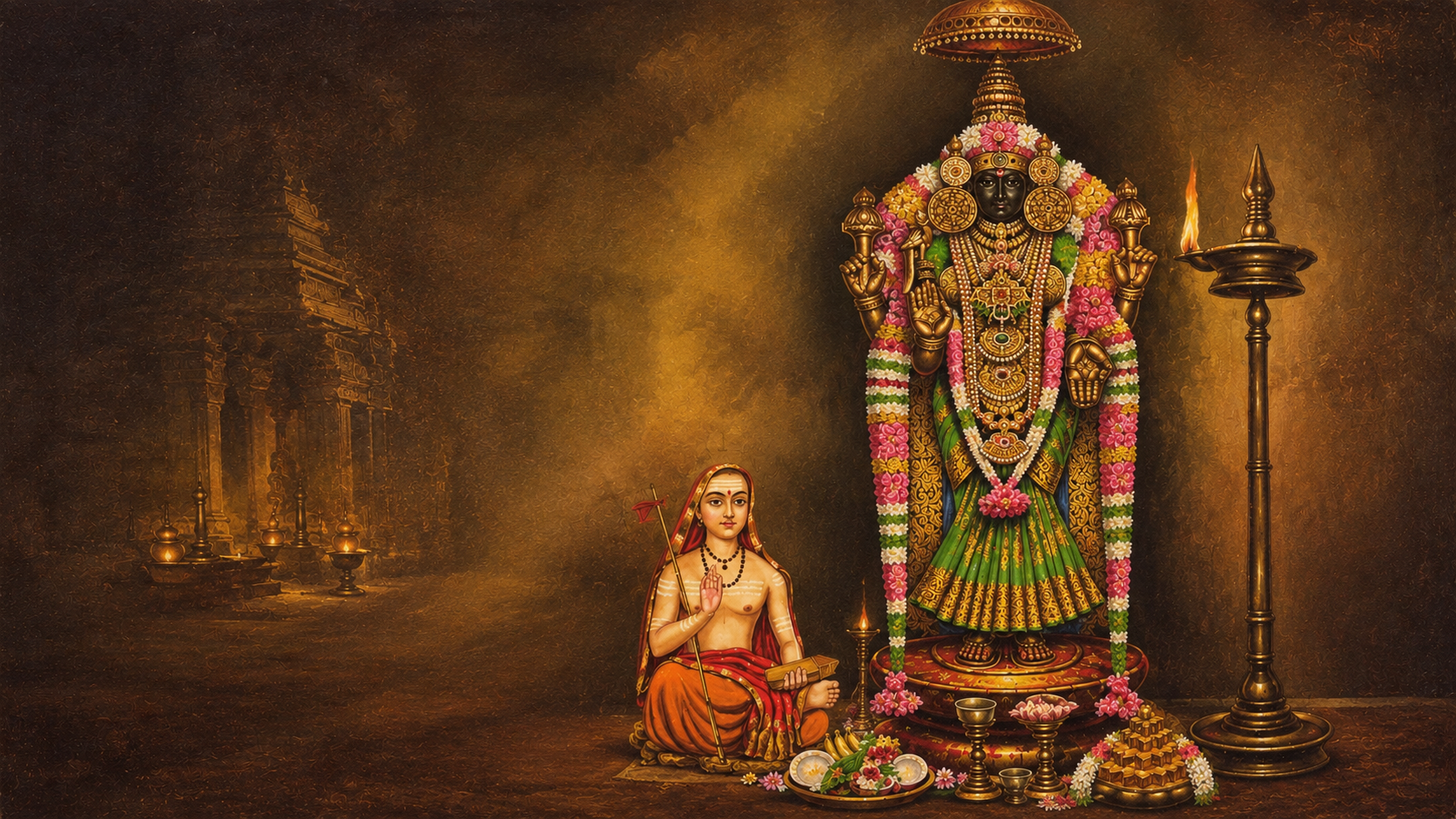
When Bhagavatpāda Śaṅkarācārya came to Tiruvānaikkāval, the townspeople put this before him, and what he did in answer is among the most precisely engineered acts recorded of him at any kṣetra. He set an image of Prasanna Gaṇapati facing her sanctum. And he made for the Devī a pair of ear-ornaments, tāṭaṅkas, with the Śrīcakra set within them, and placed them upon her ears.
The threshold has been crossed ever since.
The ornaments themselves do not last forever. Metal worn upon a living image in daily abhiṣeka wears, and when it wears it must be renewed. The renewal is not a repair job. It is a consecration in its own right, it has a name, Tāṭaṅka Pratiṣṭhā, and it is performed by the ācāryas of the Kāñcī Kāmakoṭi Pīṭham, who have carried it without interruption from the ācārya's own hand to the present. The sixty-third of them performed it in 1848. It has been performed within living memory, and it will be performed again.
What follows sets out the kṣetra, the difficulty the sanctum presented, what the two acts do in the grammar of Śrīvidyā, and why the rite has never been allowed to lapse.
Gajāraṇya
The water
Tiruvānaikkāval stands on the island between the Kāverī and the Kollidam, near Tiruchirappalli, within sight of Śrīraṅgam. It is one of the Pañcabhūta Sthalas, the five kṣetras in which Śiva is worshipped as one of the elements, and the element here is water. Kāñcī holds earth, Tiruvaṇṇāmalai fire, Kālahasti air, Cidambaram ether. Tiruvānaikkāval holds ap, and the liṅga is the Appu Liṅga.
The element is not symbolic. The sanctum of Jambukeśvara lies below the level of the ground, and water seeps into it perpetually from beneath. It is removed and it returns. A spring under the garbhagṛha keeps the liṅga company, and the abhiṣeka the shrine receives from the earth itself never stops.
The origin of the liṅga is of a piece with this. Ambā, taking the form of Akhilāṇḍeśvarī, came to the Jambu forest to perform tapas, and she formed a liṅga out of the water of the Kāverī and set it beneath the Venn Nāval tree, the white jambū, and worshipped it there. The liṅga she made of water is the liṅga the water still attends.
The elephant and the spider
Two gaṇas of Kailāsa, Mālyavān and Puṣpadanta, quarrelled and cursed one another: Puṣpadanta to be born an elephant, Mālyavān a spider. Both came to this forest and both continued their worship of Śiva at the liṅga beneath the jambū.
The elephant brought water from the Kāverī in its trunk and performed abhiṣeka every day. The spider spun a canopy of web above the liṅga, to keep the dry leaves from falling on it and to keep the sun off. Each worshipped by the only means its body allowed, and each act was complete worship.
The elephant, seeing the web, took it for dust and tore it away and washed the liṅga clean. The spider rebuilt. This continued until the spider, in its anger, went up into the elephant's trunk and bit, and both died there.
Śiva, moved by the devotion of the two, released them from the curse. And because an elephant had worshipped here, the place is Tiru Āṉai Kā, the holy elephant forest, which becomes Tiruvānaikkā and Tiruvānaikkāval. The Sanskrit name is Gajāraṇya.
The king who built the doorway low
The spider, for the killing, was born again as Kocceṅkaṇāṉ Cōḻa, the red-eyed king, and built seventy temples, of which this is one.
Remembering the enmity, he had the sannidhi of Jambukeśvara built with an entrance so low and so narrow that no elephant, not even a small one, could pass through it. The doorway is roughly four feet in height and two and a half in width, and every worshipper who enters the sanctum of the Appu Liṅga stoops to do so.
The door is a memory of an old quarrel, and the man who built it low had been the spider. Every pilgrim who bends to enter is bending inside another being's remorse.
The five prākāras
The temple occupies some eighteen acres and is enclosed by five prākāras, walls within walls, with gopuras standing over the cardinal approaches. The pilgrim passes through court after court before arriving at the inner enclosure, and the passage is graded: the outermost admits everything, and each wall admits less, until the last admits only a bowed head through a low door.
The graded passage is not incidental to a kṣetra of this kind. A pilgrim does not arrive at the Devī; a pilgrim is brought inward through stages, each of which sets aside a little more of the world outside, and by the time the innermost court is reached the approach has already done part of the work that the tāṭaṅkas complete. The walls do in masonry what the enclosures of the Śrīcakra do in geometry, and what the four offices of the day do in time. Tiruvānaikkāval states the same principle in three materials.
The Nava Tīrthas, nine sacred waters, belong to the kṣetra, and bathing in them on Citrā Paurṇamī carries its own fruit. In the Devī's own sannidhi is the Agastya Tīrtha, whose ṛṣi is Agastya and whose devatā is Akhilāṇḍeśvarī herself.
The shrine of Akhilāṇḍeśvarī stands in the fourth prākāra, facing east.
The Devī Who Came as a Student
Something at Tiruvānaikkāval is arranged differently from every other great Śaiva kṣetra of the south, and it governs everything that happens here.
The upadeśa
Ambā came to this forest to perform tapas, and when Śiva was pleased he appeared before her and gave her Śiva-jñāna. She received the upadeśa facing east. He gave it facing west.
The orientation is preserved in stone. Akhilāṇḍeśvarī's sannidhi faces east, in the posture of one receiving, and the whole kṣetra is on that account an upadeśa sthala, a place of teaching, before it is anything else.
No kalyāṇam here
Because at Tiruvānaikkāval the relation between the two is guru and śiṣyā, no Tirukkalyāṇam is performed. Elsewhere the marriage of Śiva and Ambā is among the central festivals of a Śaiva temple; here it is not celebrated at all. Nor does the Devī receive maṅgala snānam.
This is not a diminishment of the goddess. It is a statement about what kind of place this is. The relation being enacted here is the transmission of knowledge, and the temple declines to overwrite it with any other relation, however auspicious.
The offices of the day
The daily worship of Akhilāṇḍeśvarī moves through four aspects, and the sequence is worth setting out because it becomes important later.
The four daily aspects of Akhilandeswari
| Office | Aspect | Character |
|---|---|---|
| Morning | Lakṣmī | Prosperity |
| Noon | Durgā | Protective power |
| Evening | Sarasvatī | Knowledge |
| Night, after arthajāma | Vārāhī | Fierce guardianship |
At the noon worship the priest puts on the attire of a woman and performs the pūjā so dressed, in emulation of the Devī's own worship of Śiva at this place. The daily rite reenacts the upadeśa that founded the kṣetra: the officiant becomes, for that hour, the one who worships as she worshipped.
Note the last line of the table and hold it. Vārāhī has not been removed from the day. She has been given her hour.
The Difficulty of the Sanctum
Ugra
The aspect in which Akhilāṇḍeśvarī stood before the ācārya's coming is remembered as ugra, and specifically as Vārāhī. Her energy at this sthāna was of an intensity that human constitution could not receive at close range, and worship was accordingly conducted from outside the sanctum. The people did not stop worshipping. They stopped entering.
What ugra means
The English word fierce is a poor servant here, because it suggests anger, and anger is not what is meant.
Ugra in the Śākta vocabulary denotes intensity without mediation. It is not a moral quality of the deity and not a defect in her. It is a description of the relation between an unlimited power and a limited receiver: the power is not excessive in itself, since nothing in the Devī is excessive, but it arrives at the worshipper ungraded, and a finite constitution cannot take an ungraded arrival.
The distinction matters because it determines what the remedy must be. If the problem were anger, the remedy would be propitiation. If the problem is ungraded intensity, the remedy is structure: something interposed which does not reduce the power but articulates it, so that what arrives arrives in measure.
Nothing was subtracted from the Devi at Tiruvanaikkaval. Something was added between her and the worshipper, and that is a different operation entirely.
That Vārāhī remains in the night office of the shrine to this day is the proof. Had the ugra been abolished, she would not be there. She is there, and she is there at the hour appointed for her.
The Two Acts
Prasanna Gaṇapati
The ācārya established an image of Prasanna Gaṇapati directly opposite the Devī's shrine, so that the Vighneśvara stands facing his mother and she looks upon him.
Three things are working at once.
The aspect is named in the installation. Prasanna is the serene, the well-pleased, the graciously disposed. The image set before her is not Gaṇapati generically but Gaṇapati in the precise aspect that the sanctum required, and what she meets in her line of sight is composure.
The relation is filial. What is placed before the mother is her son, and the softening this works is not mechanical but relational: the goddess regards the child, and regarding the child is itself the change.
And the office is the removal of obstruction. Vighneśvara stands where obstruction stands. The obstruction at Tiruvānaikkāval was not in the Devī and not in the worshipper but in the passage between them, which is exactly where he was placed.
The garbhagṛha of Akhilāṇḍeśvarī and the garbhagṛha of Prasanna Gaṇapati are each built in the shape of the praṇava, the syllable Oṃ as it is written in the Tamil script. Two praṇavas face one another across the court. The ground plan states the remedy: what lies between the Devī and those who come to her is the syllable itself.
The tāṭaṅkas
The second act is the one the shrine is known by.
The ācārya fashioned tāṭaṅkas with the Śrīcakra set within them, and installed them upon the ears of Akhilāṇḍeśvarī. From that installation the aspect became benign, and the sanctum has been entered since.
Why the Ears
The choice of the ear is not an aesthetic one, and it is not arbitrary. In Śrīvidyā the tāṭaṅka is the single most doctrinally loaded ornament on the divine body, and two texts establish why.
The ear-ornaments are the sun and the moon
The Lalitā Sahasranāma, among the first constitutive descriptions of the Devī's form, names her thus:
This is identification, not comparison. The two ear-ornaments of the goddess are the solar and lunar discs. They are not jewellery that resembles the luminaries; they are the luminaries, worn.
To set the Śrīcakra within the tāṭaṅka, therefore, is to set the cakra within the orb of the sun and the orb of the moon. The Kāmakalā, the supreme figure of the tradition, identifies its two upper bindus with precisely these two orbs, the visarga, the primordial doubling from which manifestation proceeds. What the ācārya placed at her ears was placed at the seat the tradition had already assigned to it.
The tāṭaṅka holds the order of things
The Saundaryalaharī states the power of this ornament in its twenty-eighth verse.
The immunity of Śiva to kāla is an effect of the Devī's tāṭaṅka. The ornament is the emblem of her saubhāgya, her standing as the eternally auspicious, and it is the ontological warrant of his deathlessness. It is not an ornament among ornaments. It is the operative condition of an order.
The same ācārya composed the verse and performed the installation. The verse states what the tāṭaṅka is; the act at Tiruvānaikkāval uses it.
The ear that received the teaching
There is a further reason the ear is the right site at this kṣetra, and it is particular to Tiruvānaikkāval alone.
This is an upadeśa sthala. What founded the place is a transmission of knowledge: Ambā, seated facing east, received Śiva-jñāna from Śiva facing west. That is the constitutive event, and the entire temple is arranged around it, down to the orientation of her sannidhi and the daily noon pūjā in which the officiant takes on her attire to worship as she worshipped.
And upadeśa enters by the ear.
The whole vocabulary of the tradition insists on this. What is authoritative is śruti, the heard. A mantra is not acquired by reading it but by receiving it, and the receiving is karṇa-mūla, at the root of the ear, from a mouth to an ear with nothing in between. Upadeśa is not information transferred; it is sound placed in a particular ear by a particular guru, and it is by that placement that it becomes effective.
So at Tiruvānaikkāval the Devī's ear is not one feature of her body among others. It is the organ by which this kṣetra came into being. She is here because she was taught, and she was taught through the ear.
The acarya placed the diagram of the Devi's own body upon the very organ by which she received Siva-jnana. At a ksetra founded by an upadesa, he made an upadesa in metal, and hung it where every upadesa goes.
This is why the act at Tiruvānaikkāval is more tightly fitted to its place than any other of the ācārya's consecrations. The tāṭaṅka is at once the solar and lunar orb of the Śrīvidyā body, the warrant of Śiva's deathlessness in the Saundaryalaharī, and, here and only here, the site of the transmission that made the kṣetra. Three doctrines meet at one point on the goddess's head, and the ornament placed there answers all three at once.
There is a symmetry in it that ought to be stated plainly. Ambā received the teaching at this place through her ear; and it is through her ear, thereafter, that those who come to her are able to receive her.
What a Śrīcakra in an Earring Does
The Śrīcakra is not a symbol of the Devī. It is her body in diagram: nine interlocking triangles resolving into forty-three, arranged in nine enclosures, the āvaraṇas, ascending from the outermost square through the lotuses and the triangles to the central bindu, where Mahātripurasundarī is.
Two features of that structure govern what happened at Tiruvānaikkāval.
Every power has its station
The cakra is not a field of undifferentiated power. It is a hierarchy, and every śakti in it has an assigned station, a name, an enclosure, and a relation to the bindu. The fierce powers are not outside the diagram. They are inside it, placed.
The nine enclosures run inward in a fixed order, and each is a court of the Devī's own government.
The nine avaranas of the Sricakra
| Enclosure | Figure | Presiding Śakti |
|---|---|---|
| First | Bhūpura, the outer square with three lines | Prakaṭa yoginīs |
| Second | Sixteen-petalled lotus | Gupta yoginīs |
| Third | Eight-petalled lotus | Guptatara yoginīs |
| Fourth | Fourteen triangles | Sampradāya yoginīs |
| Fifth | Ten outer triangles | Kulotīrṇa yoginīs |
| Sixth | Ten inner triangles | Nigarbha yoginīs |
| Seventh | Eight triangles | Rahasya yoginīs |
| Eighth | The primary triangle | Atirahasya yoginīs |
| Ninth | The bindu | Mahātripurasundarī |
Nothing in that structure is loose. Every śakti has a wall, a direction, a name and a function, and the entire arrangement resolves upon a single point.
Vārāhī in particular is not an outsider to Śrīvidyā. She is Daṇḍanāthā, the staff-bearer, commander of the Devī's forces, and one of the two great officers of Lalitā's court alongside Śyāmalā the Mantriṇī, the minister. Her ferocity is not a flaw to be corrected. It is her office. A daṇḍanāthā who was not fierce would be no use to a sovereign.
Her form belongs to this kṣetra with unusual aptness. Vārāhī bears the face of the boar, and the boar in the tradition is what raised the earth-sphere out of the waters. At a kṣetra whose element is water, whose liṅga was made from river water and stands in a sanctum that fills from below, the goddess named sovereign of all the spheres, akhila-aṇḍa-īśvarī, stood in the aspect of the power that lifts a sphere out of water. The aspect was not foreign to the place. It was the place's own signature, arriving without measure.
In the cakra she stands where a commander stands, which is to say under a sovereign.
This is the whole of the ācārya's remedy, and it is elegant beyond ordinary description. The difficulty at Tiruvānaikkāval was Vārāhī standing unmediated. What the Śrīcakra does is not suppress Vārāhī. It restores her to her station, situating that ferocity within the ordered hierarchy where it belongs, subordinate to the benign at the bindu, exercising an office rather than filling the whole sanctum.
The acarya did not quiet the goddess. He gave the fierce power back its rank, and a power in its rank is approachable in a way the same power standing alone is not.
The night office confirms it. Vārāhī keeps her hour after arthajāma, guarding, which is what a daṇḍanāthā does. The four aspects of the day are the cakra's own graded order laid across the clock.
Worn, not faced
There is a second thing here that deserves attention, because it distinguishes Tiruvānaikkāval from every other place the ācārya established a Śrīcakra.
Ordinarily the Śrīcakra is installed as an object of worship. It is set before the deity or beneath her, and the worshipper faces it. The diagram stands between the worshipper and the goddess as something approached.
At Tiruvānaikkāval the cakra is not before her and not beneath her. It is on her. She wears it. The diagram of the Devī's body has been placed upon the Devī's body, at the two points where her body already is the sun and the moon.
The consequence is that the mediation is not something the worshipper must approach and pass through. It is constitutive of what the worshipper sees. There is no interval in which the ungraded intensity could arrive, because the grading is worn at the source. The Devī is seen already wearing her own order.
Where the Sricakra stands at three ksetras
| Kṣetra | Deity | Position of the Śrīcakra |
|---|---|---|
| Kāñcī | Kāmākṣī | Established before the Devī, faced by the worshipper |
| Kollūr | Mūkāmbikā | Beneath the vigraha as its pīṭha, her seat |
| Tiruvānaikkāval | Akhilāṇḍeśvarī | Within the tāṭaṅkas, worn upon her ears |
Before, beneath, upon. One instrument, three placements, each answering what its kṣetra presented.
An acarya's work at a place of teaching
It is worth pausing on what kind of act this was, given where it was performed.
The ācārya arrived at a kṣetra whose founding event was an upadeśa, and whose difficulty was that the goddess could not be approached. He did not resolve the difficulty by argument, and he did not resolve it by austerity. He resolved it by an act of ritual engineering: two objects, placed at two points, chosen for what they are in the śāstra and for what the sanctum required.
That is a particular understanding of the ācārya's office, and it is consistent across everything recorded of him at kṣetras. The bhāṣyas address the difficulty of a text. The stotras address the difficulty of approach in words. And at a shrine, where the difficulty is neither textual nor verbal but a matter of what stands where, the remedy is a matter of what stands where.
A wrong relation between a power and its receiver is corrected by placement, and placement is what the acarya supplied.
The Śrīcakra at the ears of Akhilāṇḍeśvarī is therefore upadeśa of the same order as anything he wrote, delivered in metal rather than in syllables, and legible to a townsman who had never opened a bhāṣya. The people who had prayed from the doorway were not asked to understand the cakra. They were asked to come in.
The Rite That Never Lapsed
Tāṭaṅka Pratiṣṭhā
An ornament worn on a living image in daily abhiṣeka wears. Water, milk, sandal, turmeric and the handling of centuries tell on worked metal, and there comes a point at which the tāṭaṅkas must be renewed.
Because of what these particular ornaments are, renewal cannot be a craftsman's errand. The Śrīcakra within them is consecrated; the ears they occupy are the sun and the moon; and the aspect of the Devī in the sanctum stands in a relation to them that the Saundaryalaharī describes as the root of an order. Their removal and replacement is therefore a pratiṣṭhā, performed with the full apparatus of consecration, and it carries its own name: Tāṭaṅka Pratiṣṭhā.
The custodianship of Kāñcī
The ācāryas of the Kāñcī Kāmakoṭi Pīṭham hold this office and have held it continuously since Bhagavatpāda first performed the installation, which the Pīṭham reckons at more than two and a half thousand years of unbroken transmission.
The record is specific where it can be. The sixty-third ācārya, Śrī Candraśekharendra Sarasvatī, had the tāṭaṅkas repaired and re-consecrated upon the Devī's ears in 1848. The Pīṭham's later ācāryas have performed the rite in their turn, and it has been performed in the present decade.
What this means in practice is worth stating plainly, because it is rare. A ritual act performed once at a single shrine has generated an obligation that a distinct institution, a hundred and sixty miles away, has discharged across the whole intervening span, through every political condition the south has passed through, without the chain breaking.
The tatankas are the acarya's act still being performed. Not commemorated, not recalled on an anniversary. Performed, by his own lineage, on the same ears.
Few things in the religious life of Bhārata are as concretely continuous. The ornament is renewed; the installation is not repeated but continued; and the sanctum stays open.
The Sanctum as It Stands
What the pilgrim meets today, in the order it is met, is the argument of the kṣetra laid out in stone and water.
The outer courts
Five walls, and a passage inward through each. Gopuras over the cardinal approaches. The temple occupies roughly eighteen acres, and the scale is not display; it is the length of the approach, deliberately made long.
The Appu Liṅga
The sannidhi of Jambukeśvara lies below ground level, entered through the low doorway that Kocceṅkaṇāṉ built. Water stands in the sanctum and returns whenever it is taken out. The liṅga is small, dark, perpetually wet, and the abhiṣeka performed upon it by the priests is a repetition of one the earth is already performing.
Beside it stands the Venn Nāval, the white jambū, from which the lord takes his name, Jambukeśvara, the lord of the jambū.
The Devī's sannidhi
In the fourth prākāra, facing east, in a garbhagṛha built in the shape of the praṇava. Akhilāṇḍeśvarī is seated, and the tāṭaṅkas are on her ears, and they are the first thing the tradition will tell a visitor about her.
No maṅgala snānam is performed for her, and no Tirukkalyāṇam is performed in this temple, because the relation enacted here is guru and śiṣyā and the shrine will not overwrite it.
Prasanna Gaṇapati
Directly opposite, in a garbhagṛha of the same praṇava shape, the son faces the mother. Two syllables of Oṃ across one court, and between them the line of sight along which the whole difficulty of this kṣetra once ran.
The hours
Lakṣmī at dawn, Durgā at noon with the officiant in a woman's attire, Sarasvatī in the evening, and Vārāhī in the night, after arthajāma, keeping guard.
The four offices are not four different goddesses visiting in turn. They are one goddess in four measures, and the sequence is a clock built to the same principle as the walls outside and the enclosures in her ears: the whole is never withheld, and it is never delivered all at once.
Dīkṣitar at the Sannidhi
The shrine has one more witness, and it belongs to the kṣetra's own vocation.
Muttusvāmī Dīkṣitar composed two works here, both in Sanskrit, and both in rāgas unusual in the southern repertoire: Jambūpate in Yamunākalyāṇī, addressed to the lord of the water liṅga, and Akhilāṇḍeśvarī rakṣamām in Dvijāvantī, addressed to the Devī.
The second has become the shrine's signature in sound, and the epithets in it are exact rather than ornamental. The Devī is addressed as unblemished and gentle, as the one skilled in the āgamas, as worshipped by Sarasvatī and honoured by the gods, and, among the names Dīkṣitar gives her, as the embodiment of the arts, the kalās.
That last is not a courtesy. It is the aspect the tāṭaṅkas made available. The Devī whom the townspeople would not approach is the Devī a composer addresses as gentle, and the interval between those two descriptions is exactly the ācārya's two acts. Dīkṣitar is singing to a goddess wearing a Śrīcakra in each ear.
Akhilāṇḍeśvarī is counted with Mīnākṣī of Madurai and Kāmākṣī of Kāñcī in the triad of the three great goddesses of the south. In the month of Mārgaḻi, Raṅganātha of Śrīraṅgam, close by on the same island, sends garments, ornaments and garlands to her as to a sister.
The Shape of the Method
Set the three kṣetras together and a single method is visible, adapted each time to what the place presented.
One method across three ksetras
| Kṣetra | What the sanctum presented | The acarya's instrument |
|---|---|---|
| Kāñcī | Kāmākṣī in unmediated intensity | Śrīcakra established before the Devī |
| Tiruvānaikkāval | Akhilāṇḍeśvarī as Vārāhī, sanctum entered by nobody | Prasanna Gaṇapati facing her, Śrīcakra set within her tāṭaṅkas |
| Kollūr | Svayambhū liṅga whose Śākta portion is the greater | Śrīcakra as the pīṭha beneath the vigraha, kalās set in its tāṭaṅkas |
In each the ācārya interposes a graded structure between an unmeasured presence and the one who comes to it. He adds nothing to the Devī and takes nothing from her. He supplies the articulation by which what she is can reach a finite receiver without harm, and he supplies it in the form the kṣetra asks for: standing before her, seated beneath her, or worn at her ears.
In two of the three the work is done at the ears, because the tradition has already placed the sun and the moon there, and where the luminaries are is where measure belongs.
And in each case the instrument is left in the custody of a lineage, so that the act does not become a memory. At Kollūr the krama the ācārya ordained is the krama by which the Devī is served. At Tiruvānaikkāval the ornaments he made are renewed on the same ears by his own successors. The method includes its own continuation.
Coda
A low door that a king built out of remorse, so narrow that every worshipper stoops. A liṅga made of river water, sunk below the ground, attended by a spring that will not stop. Five walls, each admitting less than the one outside it. An east-facing shrine in the fourth court, where a goddess sits in the posture of one receiving instruction, and across from her, in a sanctum shaped like the syllable Oṃ, her son, serene, looking back.
And in her ears, two ornaments, each carrying the diagram of her own body, renewed when they wear by men who trace their office to the hand that first put them there.
The town that once prayed from the doorway walks in. It has walked in for as long as anyone can account for, and the reason is nine enclosures of interlocking triangles, small enough to hang from an ear, in which every power, including the fiercest, knows its own station.
The Devī was never made less. She was made receivable, which is the only thing she ever needed to be made.
On Sources
The kṣetra's account, the tapas of Ambā and the making of the Appu Liṅga from Kāverī water beneath the Venn Nāval, the gaṇas Mālyavān and Puṣpadanta, and the tīrthas including the Agastya Tīrtha in the Devī's own sannidhi, are set out in the Tiruvānaikkāval Māhātmyam of the Gajāraṇya kṣetra. The shrine is among the Pāḍal Peṟṟa Sthalas, sung by the Nāyaṉmārs in the Tēvāram, and the building of the seventy temples by Kocceṅkaṇāṉ Cōḻa is recorded in the Nālāyira Divya Prabandham.
The doctrine of the tāṭaṅka rests on Lalitā Sahasranāma, tāṭaṅka-yugalī-bhūta-tapanoḍupa-maṇḍalā, and on Saundaryalaharī 28. The structure of the Śrīcakra, its nine āvaraṇas, and the station of Vārāhī as Daṇḍanāthā alongside Śyāmalā the Mantriṇī, are standard to the Śrīvidyā corpus. The Kāmakalā identification of the two upper bindus with the solar and lunar orbs belongs to the same body of teaching.
The installation of the Prasanna Gaṇapati and of the Śrīcakra tāṭaṅkas, and the continuing Tāṭaṅka Pratiṣṭhā, are recorded by the Kāñcī Kāmakoṭi Pīṭham, including the re-consecration performed by the sixty-third ācārya in 1848 and the performances of the rite by his successors.
The two compositions at this shrine are Muttusvāmī Dīkṣitar's Jambūpate in Yamunākalyāṇī and Akhilāṇḍeśvarī rakṣamām in Dvijāvantī.