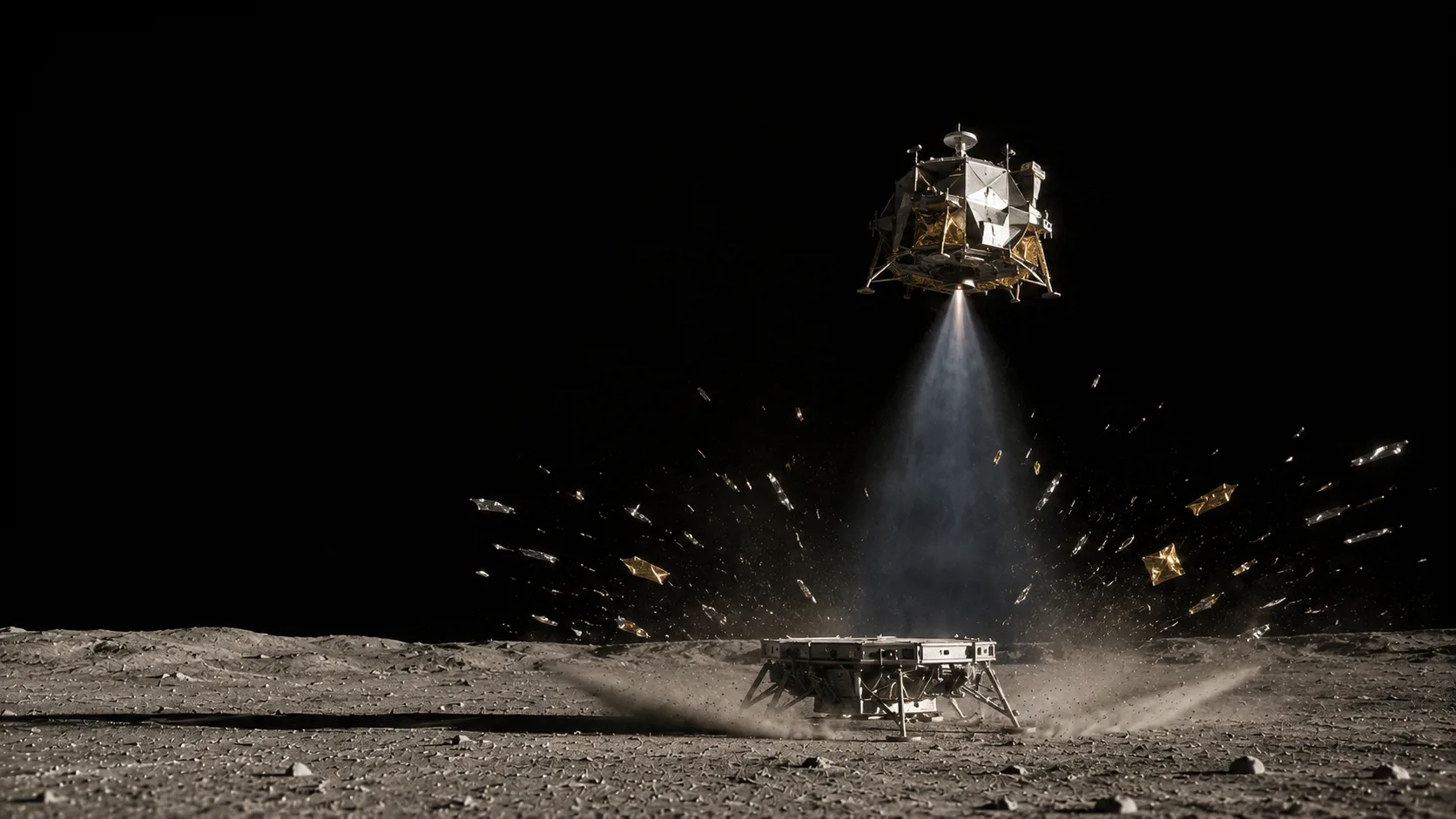
Three Ways to the Moon
By 1961 NASA had narrowed the problem to three candidate architectures, and the differences between them were not details. They implied entirely different launch vehicles, entirely different spacecraft, and entirely different levels of risk.
Direct Ascent. Build one enormous vehicle. Launch the entire spacecraft from Earth, fly it to the Moon, land the whole thing tail-first on the surface, and launch the whole thing back. Conceptually the simplest, and the version everyone had grown up with from science fiction illustrations.
Its problem was the launch vehicle. Landing a complete spacecraft on the Moon, with all the propellant needed to leave again and all the equipment needed to survive re-entry at Earth, meant putting something on the order of sixty-eight tonnes on the lunar surface. That required a launcher in the Nova class -- eight F-1 engines in the first stage rather than five, a vehicle substantially larger than the Saturn V, which did not exist, had not been designed, and could not plausibly be built and flown before 1970.
There was also an operational absurdity nobody liked to dwell on. The vehicle would land vertically, tail-down, on unknown terrain, with the crew perhaps twenty-five metres above the surface looking out of a window at the sky, unable to see the ground they were landing on, and afterwards required to climb down a ladder the height of an eight-storey building.
Earth Orbit Rendezvous. Launch two Saturn Vs. Put the spacecraft in Earth orbit with the first and a propellant tanker with the second, dock them, transfer propellant, and then fly the fuelled spacecraft directly to the Moon and back.
This was the preferred solution at Marshall Space Flight Center for a considerable time, partly for the obvious reason that it required twice as many Saturn Vs. Its technical weakness was that it required transferring cryogenic propellant between vehicles in orbit -- and that is a genuinely difficult problem involving boiling liquids in weightlessness, which nobody had solved then and which, remarkably, is still being worked on today. Still unsolved
Lunar Orbit Rendezvous. Launch one Saturn V. Fly the whole stack to the Moon and put it into lunar orbit. Then send only a small, dedicated landing craft down to the surface with two of the three crew, leaving the mother ship and the third man in orbit. When the surface work is done, launch only part of the lander back up, rendezvous, dock, transfer the crew, abandon the lander, and come home in the mother ship.
It sounded baroque. It required a rendezvous in lunar orbit, 384,400 kilometres from any assistance, at a moment when no American had ever performed a rendezvous of any kind anywhere. If the two vehicles failed to meet, the men in the lander would die and there would be nothing anyone could do.
And it was, by a very large margin, the lightest.
Why the Logarithm Decided It
The reason LOR wins is the same reason staging wins, applied one level deeper, and it is worth working through because it is the last great appearance of the rocket equation in this series.
Consider what you must decelerate to land on the Moon, and then re-accelerate to leave.
In Direct Ascent you land the entire spacecraft. That means the heat shield for Earth re-entry, the life support consumables for the whole mission, the main engine and its propellant for the return, the crew cabin for three, and the structure to hold it together -- all of it goes down to the lunar surface and all of it comes back up. Every kilogram of that has to be decelerated for the landing and accelerated again for the departure, and the propellant to do that has itself to be carried down.
In LOR you leave nearly all of it in lunar orbit, where it costs nothing to keep. Only a minimal vehicle descends: two people, a few hours of consumables, no heat shield, no deep space navigation, no long-duration systems. And that vehicle stages on the Moon -- the descent stage, having done its job, is abandoned on the surface and becomes the launch platform for the ascent stage, which need only carry two men and their samples back to orbit.
The three lunar mission architectures compared
| Measure | Direct Ascent | Earth Orbit Rendezvous | Lunar Orbit Rendezvous |
|---|---|---|---|
| Launch vehicles required | One Nova class, not built | Two Saturn V | One Saturn V |
| Mass landed on the Moon | About 68 tonnes | About 68 tonnes | 15 tonnes |
| Rendezvous required | None | In Earth orbit | In lunar orbit |
| If the rendezvous fails | Not applicable | Mission aborts, crew returns | Crew is lost |
| Unsolved technology needed | A far larger launcher | Cryogenic transfer in orbit | Rendezvous, never yet flown |
| Specialised lander needed | No | No | Yes |
| Development time | Longest | Long | Shortest |
Read the second row. Sixty-eight tonnes against fifteen. That factor of four and a half, propagated back up through the rocket equation to the launch pad, is the entire difference between a vehicle that could be built by 1969 and one that could not.
LOR was not a clever trick. It was the only arithmetic that closed.
Winning It
Houbolt had been arguing this since 1959, and the resistance was ferocious for reasons that were partly sound and partly not.
The sound objection was risk. LOR concentrates the mission's entire survival on one rendezvous performed further from Earth than anyone had ever been, with no rescue possible. That is a real objection and it was never fully answered; the programme simply accepted it.
The less sound objections were institutional. Marshall wanted more Saturn Vs. Some senior figures found the idea of leaving a man alone in lunar orbit while two others landed to be politically unattractive. Others, including some very senior engineers, appear simply to have disliked being told something by a man several grades below them.
The turning point came on 7 June 1962, at Marshall Space Flight Center, at the end of a day-long review. Wernher von Braun, who had been the most significant institutional advocate of Earth Orbit Rendezvous, stood up at the close of a six-hour meeting and announced that Marshall now supported Lunar Orbit Rendezvous.
It is, whatever else one thinks of von Braun, the single most creditable act of his American career. He reversed his own centre's position in public, on the technical merits, and in doing so ended the argument.
NASA announced the decision on 11 July 1962. Jerome Wiesner, President Kennedy's science adviser, continued to object, and did so at length in front of Kennedy himself during a visit to Huntsville in September 1962, in an exchange that took place partly on the tarmac in front of reporters. The decision stood.
Houbolt was later given a NASA Exceptional Scientific Achievement Medal. He was in Mission Control in July 1969, and von Braun turned to him at the moment of landing and told him it was his idea.
The Strangest Machine
The Lunar Module was built by Grumman at Bethpage on Long Island under Thomas Kelly, and it was the first true spacecraft ever constructed: the first crewed vehicle designed to operate exclusively in vacuum, which meant that for the first time in the history of flight, aerodynamic shape was irrelevant.
The result looks the way it does because nothing about it needed to be smooth. Every external feature is where it is for a structural or functional reason, and the machine is, in a sense, entirely honest.
Lunar Module, Apollo 11 configuration
| Parameter | Value |
|---|---|
| Total mass, fuelled | 15,103 kilograms |
| Descent stage, fuelled | About 10,300 kilograms |
| Ascent stage, fuelled | About 4,800 kilograms |
| Ascent stage dry mass | About 2,150 kilograms |
| Crew | Two, standing |
| Descent engine thrust, maximum | 45,040 newtons |
| Descent engine throttling range | About 10 to 1 |
| Ascent engine thrust | 15,600 newtons |
| Propellants, both stages | Aerozine 50 and nitrogen tetroxide |
| Skin thickness in places | 0.3 millimetres |
The mass hunt was relentless and it shows in every detail.
The crew flew standing up. Seats were deleted early, which saved their mass, and had a second benefit: standing men can be positioned much closer to the windows, so the windows could be made small and triangular rather than large, saving structure and pressure loading.
The cabin skin was chemically milled aluminium reduced in places to about three tenths of a millimetre -- thinner than a drinks can. In the crew compartment there were regions where a dropped tool would have punctured the pressure hull.
The thermal and micrometeoroid shield was aluminised Kapton and Mylar foil in multiple layers, and it was so thin that a technician could tear it with a fingernail. The wrinkled gold and black surfaces in every photograph of the LM on the Moon are not armour. They are foil.
The landing gear did not use hydraulic shock absorbers. Each leg contained a cartridge of crushable aluminium honeycomb which absorbed the landing energy by permanently deforming. It worked exactly once, which was all that was required.
The weight campaign became a running institutional obsession. Grumman ran a programme paying engineers a bounty for every kilogram removed. Wiring was rerouted to shorten runs. Structural members were drilled with lightening holes and then drilled again. The famous claim that they deleted seats is true; less well known is that they also removed the docking mechanism's heavier components, thinned the hatch, and at one point seriously discussed whether the crew needed both windows. Every kilogram removed from the LM was, by the compounding logic of the rocket equation, roughly a tonne removed from the Saturn V on the pad. Design record
An Engine That Could Be Turned Down
The descent engine posed a problem no rocket engine had faced. To land on an unknown surface with a human being flying it, the thrust must be variable -- and not slightly variable, but throttleable across a range of about ten to one, continuously, under manual control.
Rocket engines do not like being throttled. Reduce the propellant flow and the injector's ability to atomise and mix collapses, because atomisation depends on injection velocity. The engine goes rough, then unstable, then fails.
The answer, developed by Space Technology Laboratories, was the pintle injector, and it is one of the most elegant devices in the field.
Instead of a flat plate drilled with thousands of holes, a pintle injector has a single central post projecting into the chamber. One propellant is fed down the centre and emerges radially, in a flat sheet spraying outward like a disc. The other propellant flows around the outside of the post and emerges as an annular sheet moving axially. The two sheets collide in a ring, and that collision does the atomising and mixing.
Two properties follow, and both are exactly what a lander needs.
It is inherently stable, because the combustion occurs in a well-defined annular region rather than distributed across a broad injector face, which gives acoustic modes far less to couple with. Pintle engines are famously resistant to the instability that nearly destroyed the F-1.
And it throttles beautifully, because a sleeve can be moved mechanically along the pintle to change the width of the annular gap. Reduce the flow and shrink the gap at the same time, and the injection velocity stays high, so atomisation stays good, at ten percent thrust as at full.
The chamber was ablative rather than regeneratively cooled -- a silica-phenolic liner designed to char and erode away, carrying heat with it -- because regenerative cooling depends on propellant flow, and an engine whose flow varies by a factor of ten cannot rely on it.
That pintle injector, designed in the early 1960s for a lunar lander, is the direct ancestor of the injector in the Merlin engine that flies on the Falcon 9 today, which is why Falcon boosters can throttle deeply enough to land. Direct lineage
The Engine With No Second Chance
The ascent engine is the opposite design philosophy, taken to its limit.
It had one job: fire once, in lunar orbit's direction, and put two men back into orbit. If it failed, they were dead, with no possibility of rescue, and everybody involved knew it.
So it was made as simple as it is possible for a rocket engine to be.
It had no turbopump. Propellant was pushed to the chamber by helium pressure alone, which removed the single most complex rotating machine from the vehicle entirely.
It had no igniter. The propellants were hypergolic -- Aerozine 50 and nitrogen tetroxide ignite on contact -- so there was no spark, no cartridge, no sequence to get wrong. Open the valves and it burns.
It had no gimbal and no throttle. Thrust was fixed and attitude was controlled by the reaction control thrusters instead.
It had an ablative chamber, so there was no cooling circuit to fail.
What remained that could fail were the valves, and those were made redundant: parallel paths with series ball valves, so that a single valve failing in either state did not stop the engine from starting.
They achieved reliability by removing things. There was almost nothing left to go wrong, which was the entire design.
It worked every time it was used.
What Comes Next
The architecture was chosen, the vehicle existed, the engines worked. What remained was to fly it, and the first crew to sit inside an Apollo spacecraft never left the pad.
The next part is about 27 January 1967, and it is the hardest one in this series to write.
It covers the physical chemistry of what happened inside that cabin: why pure oxygen at above atmospheric pressure turns materials that merely smoulder in air into materials that burn explosively, how flammability limits shift with partial pressure, and why a cabin full of nylon netting, Velcro and unprotected wiring was a fuel-air arrangement that only needed a source.
It covers the hatch that opened inward, and could not be opened against internal pressure, and required at least ninety seconds to remove under ideal conditions.
And it covers what was changed afterwards: the sixty-forty nitrogen and oxygen ground atmosphere, Beta cloth in place of nylon, the rewiring, the materials testing programme, and a unified hatch that a man could open in seven seconds.
The programme did not succeed in spite of that fire. It is very likely that it succeeded because of what was learned from it, and that is an uncomfortable thing to have to say about three men who burned to death strapped into a spacecraft on the ground.
0 responses