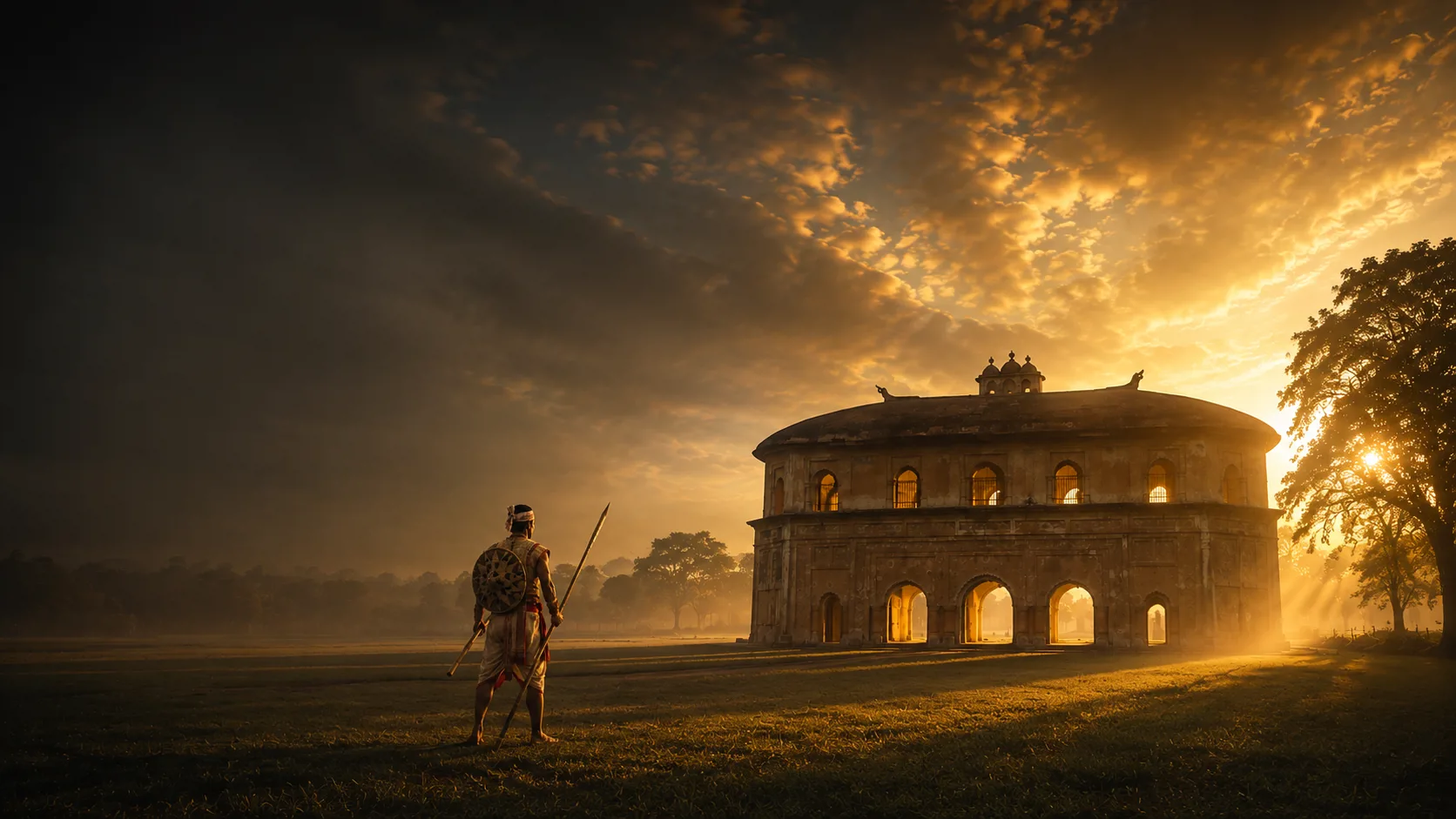
The Narrows
There is a stretch of the Brahmaputra west of Guwahati where the river, which for most of its course sprawls across the valley in braided channels miles wide, suddenly narrows. The Nilacala hills press in from the south, the Asvakranta ridge from the north, and the greatest river of eastern Bharatavarsa is forced through a gate barely a kilometre across. The water runs deep, fast and treacherous. The place is called Saraighat.
In the spring of 1671, on that water, the armies of Aurangzeb Alamgir were beaten. Not held, not fought to a standstill: beaten, broken, and driven back down the river by a smaller force under a commander so ill that he had to be carried onto the deck of his boat because he could no longer stand.
Eleven years later, at Itakhuli, the Mughals were expelled from the valley altogether and the frontier was fixed at the Manas. It stayed there for a hundred and forty-four years. Aurangzeb ruled another quarter-century and never came back. He died in 1707 in the Deccan, hunted by the Marathas, having lost the east as completely as he was losing the south.
The polity that did this was six centuries old by then, and the ground it stood on was older still. The story begins in the Mahabharata, on a hill above the river where the Devi is worshipped in a form found nowhere else on earth.
The Son of Brahma
The valley is the river. Everything that follows, the settlement and the agriculture and the temples and the wars and above all the way the wars were fought, is downstream of a single geological fact, and the fact is the Brahmaputra.
Where it begins
The river rises on the Angsi glacier in Burang county in southwestern Tibet, on the northern flank of the Himalaya at about five thousand metres, immediately east of the Indus-Tsangpo watershed and within the country of Kailasa and Manasarovara. Older tradition, and Swami Pranavananda who surveyed the region in 1939, gives instead the Chemayungdung glacier some ninety-seven kilometres southeast of Manasarovara. The two streams join within a short distance, and the question is one of headwater precedence rather than of place. Contested
Four great rivers rise out of that one small quarter of the earth: the Sindhu, the Satadru, the Karnali which becomes the Ghaghara, and this one. Kailasa stands at the centre of all four.
From its source the river runs east, which is the first strange thing about it. For roughly eleven hundred kilometres it flows the wrong way, west to east, at an average height of four thousand metres, running parallel to the Himalaya and behind it, through the highest and driest inhabited valley on earth. In Tibet it is the Yarlung Tsangpo, the purifier. It gathers some twenty-two significant tributaries there, the Raka Zangbo, the Nyang Qu, the river of Lhasa, and by the time it reaches the eastern end of Tibet it is already a major river that has not yet touched Bharatavarsa at all.
The Great Bend
Then comes the thing that has no equal anywhere on the planet.
Past Pi the river turns north and northeast, and then swings violently south around the peak of Namcha Barwa, seven thousand seven hundred and eighty-two metres, and cuts straight through the eastern end of the Himalaya. This is the syntaxial bend, the place where the mountain chain twists back on itself, and the river goes through the twist rather than around it, carving the Yarlung Tsangpo Grand Canyon, whose walls stand five thousand metres and more on either side, and which is by most reckonings the deepest gorge on earth. Contested
The river does this because it is older than the mountains. It is an antecedent river. It was already running its course when the Himalaya began to rise beneath it, and it cut down through the rising rock as fast as the rock came up. The Himalaya was raised across the Brahmaputra, and the Brahmaputra sawed through it. Settled
In roughly two hundred kilometres it falls from the roof of the world to the plains.
The entry into Bharatavarsa
It crosses into Arunachal Pradesh near Gelling and is called Siang, and lower down Dihang. It comes out of the mountains and turns southeast into the head of the Assam valley.
Then, just west of Sadiya, three rivers meet: the Dihang out of the north, the Dibang out of the Mishmi hills, and the Lohit out of the east. Below that confluence, and only below it, the river carries the name Brahmaputra. It runs some seven hundred kilometres west across Assam, leaves the country below Dhubri, becomes the Jamuna in Bengal, joins the Padma and then the Meghna, and goes into the Bay of Bengal through the largest delta on earth.
Of the three rivers that make it, the Lohit is the one that matters to the tradition, because the Lohit comes down out of Brahmakunda, and Brahmakunda is where the river was born.
The son of Brahma
The Brahmaputra is masculine, and it is the greatest masculine river in Bharatavarsa. It is not the only one, and the class it belongs to is worth knowing.
Sanskrit distinguishes nadi, feminine, from nada, masculine. The lexical tradition treats a nada as a natural watercourse marked by depth and cutting force rather than by breadth of reach, and rivers of that class take masculine forms and masculine personification. The Sindhu is a nada, and its gender in the Nadistuti Sukta of the Rgveda already stands apart from that of the rivers named around it; in Pashto it is Abaseen, the father river, and in Ladakh and Tibet it is Sengge Chhu and Sengge Zangbo, the lion river, masculine in both. The Sona, or Sonabhadra, is a nada, and the Puranic account betroths him to the Narmada. Damodara is a nada, and so is a whole set of the rivers of southern Bengal, the Ajay, the Rupnarayan, the Barakar and others. Within the Brahmaputra system itself the parent Yarlung Tsangpo is masculine, and so is the Lohit. Settled
The Brahmaputra belongs to that small and specific class and is by far the greatest member of it. What sets it apart within the class is not its masculinity but its parentage. The others are masculine; this one is the named son of a named god, and the name says so on its face. Brahmaputra is brahma and putra, the son of Brahma, and there is no ambiguity in the compound and no competing derivation.
That is a distinction of a rare kind. Brahma has almost no temples in Bharatavarsa, Puskara being the celebrated exception, and almost no living cult. He has one river.
How the river was born
The account is given at length in the Kalika Purana, in the eighty-second and eighty-third chapters, with a variant in the Padma Purana. The sage Santanu, not the Kuru king of that name but another, lived with his wife Amogha beside a lake called Lohita, on the mountain Gandhamadana at the skirts of Kailasa. Brahma came to that asrama, and the energy of the creator passed into Amogha, and what she bore was not a child in human form but jala-rupam tanayam, a son having the form of water. Santanu set the newborn down among the hills, and it grew there into the lake called Brahmakunda.
There it stayed, held in the rock, until Parasurama came.
The sequence is given in the Kalika Purana and repeated in the Yogini Tantra, which names the place a naditirtha, a river-crossing at which release is obtained. Rama Jamadagnya, at his father's word, struck off the head of his mother Renuka with the axe. Jamadagni, his anger satisfied, offered boons, and among the six his son asked was his mother's return to life, and she was returned to him. But the deed was not cancelled with her. The handle of the axe stayed fixed to his hand and would not come away. He went on pilgrimage across the whole country and no tirtha loosed it.
He came at last to Brahmakunda on the Lohit, and clove open the bank with the same axe to make a passage for the water, and went down into what came out. The axe fell from his hand. The son of Brahma went out of the kunda in a torrent, and the Purana holds that a bath in that water is by itself sufficient for release.
The text then says something that anyone who has stood on the bank recognises as observation rather than ornament: that the steady son of Brahma flooded Kamarupa, covering its pools and its holy places and hiding them away. The tirthas of the valley are under the water. That is why the pilgrim bathes in the Lauhitya itself, because the river has swallowed the shrines.
Lauhitya is the classical name, the red one, from the iron-red silt the water carries. In Assamese it is Luit, and affectionately Burha Luit, the old Luit. The salutation recited at the bath holds all the names together.
Makara Sankranti, the first day of Magh, is kept as the river's birthday. The kunda itself is Parsuram Kund, in the Lohit district of Arunachal Pradesh, set in a forest of rudraksa within the Kamlang reserve, and the mela held there at Sankranti draws pilgrims from every part of the country to the place where the axe came off.
The figure who opened Brahmakunda carries a second standing in the tradition. Parasurama is an acarya of Srividya in the Dattatreya transmission, and the Parasurama Kalpasutra is the principal ritual manual of that lineage, carrying the instruction on mantra, nyasa, homa and the worship of the Sricakra from Dattatreya to him. The axe that released the river and the Kalpasutra that governs the Sricakra come down under one name.
Ferocity
The other face of the son of Brahma is the one the valley lives with.
The river is roughly two thousand nine hundred kilometres long, of which some nine hundred and sixteen lie within Bharatavarsa, and it stands among the largest rivers on earth by discharge. It carries one of the heaviest sediment loads measured anywhere, which is the direct consequence of draining the youngest and fastest-rising mountains in the world. What comes down through the gorge is less water than suspended Himalaya.
It floods twice a year, which very few rivers do. The first flood is snowmelt in early summer. The second is the monsoon, and the valley sits under one of the heaviest rainfall regimes on the planet. Across Assam the river is not a channel but a braided system, splitting into dozens of threads around temporary islands, the chars, which appear and vanish between seasons and are farmed by people who know they are farming on loan. In flood the whole thing becomes an inland sea, in places twenty kilometres from bank to bank.
It eats land. The loss of entire villages to bank erosion in a single season is ordinary rather than exceptional. Majuli, the largest river island in Bharatavarsa and among the largest anywhere, and the monastic heart of the Ekasarana tradition, has lost more than half its area within living memory. Contested
And in 1950 came the Assam-Tibet earthquake, of magnitude around 8.6, among the largest ever recorded on land. It shook whole hillsides into the tributaries, raised the bed of the Brahmaputra by several metres in places, threw channels out of their courses, and drowned country that had been dry ground since the Ahoms surveyed it. The river has not settled since.
What the river made
The silt is why the valley is among the most fertile tracts in Bharatavarsa, and therefore why a kingdom of modest size could feed the paik levies through sixty-seven years of war. The flood is why Kaziranga exists in the form it does, the annual inundation being precisely what maintains the grassland that carries the rhinoceros. The water sets the timing of Bihu. The islands are why Majuli became the seat of the satras.
And the river is the entire military history of the country. An army cannot cross the valley, because the valley is water. It can only go up the valley, on the river itself or along the embankments beside it. Every invasion, from Bakhtiyar Khalji to Mir Jumla, came up the Brahmaputra, and every one of them was destroyed on it or beside it. The gate at Saraighat is a gate because the hills pinch the river there, and for no other reason.
No fortification raised by men on this frontier was ever as effective as the son of Brahma in flood.
Pragjyotisa, the City of Eastern Light
The oldest name of the country is Sanskrit and transparent: prak, eastern or prior, and jyotisa, light, luminary, the science of the heavens. The City of Eastern Light. The Kalika Purana gives the traditional derivation, that Brahma dwelling here created the stars, and so the city took the name Pragjyotisapura. Later scholarship read it as the city of eastern astronomy and pointed to the Navagraha temple on the Chitracala hill immediately east of Guwahati, a shrine to the nine planetary lords, which would make the name not figure of speech but municipal description.
Pragjyotisa enters the itihasa at the highest level, as a named actor in its central events.
Bhagadatta
In the Sabha Parva, at Yudhisthira's Rajasuya, Bhagadatta of Pragjyotisa comes to Indraprastha in person at the head of a vast retinue, described as including Kiratas, Cinas and the dwellers of the eastern shore. He is received with honour. He is not a tributary dragged to the sacrifice; he is a sovereign whose presence dignifies it.
In the Bhisma and Drona Parvas he fights at Kuruksetra on the Kaurava side, and he fights magnificently. He rides the elephant Supratika. He holds Arjuna himself at bay for the better part of a day, one of the very few warriors in the whole epic of whom that can be said. The poet calls him the friend of Indra and Indra's equal in battle, and treats his death as a grief rather than a triumph. He was already old by the time of the war, having been the ally of Pandu in the previous generation.
In the Asvamedhika Parva the line continues. Bhagadatta's son Vajradatta rules Pragjyotisa, and when Arjuna follows the sacrificial horse he must fight the young king for three days before receiving his submission.
Naraka
Behind Bhagadatta stands his father Naraka, Bhauma, the son of Bhumi the earth by Varaha. The Kalika Purana gives him a full career. He displaces the last of the Danava line, Ghatakasura, establishes his capital at Pragjyotisapura, and rules with enormous power. He seizes the jewelled earrings of Aditi, mother of the gods, and the Devas cannot recover them. He is finally slain by Sri Krsna, who thereby recovers the earrings and reopens the road to Pragjyotisa.
That event is remembered across Bharatavarsa every year at Naraka Caturdasi, the day before Dipavali. The festival of lights, kept in every Hindu household from Kanyakumari to Kasmira, carries within it the memory of a king of the Brahmaputra valley. The eastern frontier is not an appendix to the sacred geography. It is inside the festival calendar of the entire civilisation.
Before Naraka the tradition names an older line still, the Danava kings, of whom the first was Mahiranga Danava, held by the Kalika Purana to be the earliest ruler of the country, five reigns and an epoch before the Bharata war.
The Ramayana knows Pragjyotisa in the Kiskindha Kanda. The Visnu Purana puts the extent of the country at a hundred yojanas in every direction from Pragjyotisapura, the site of modern Guwahati. The Yogini Tantra and the Kalika Purana together fix the classical boundaries with unusual precision: the Karatoya in the west, Sadiya in the east, Kancanjangha to the north, the confluence country to the south.
That western boundary was never treated as literary decoration. Six centuries later, Ahom chroniclers and statesmen still held the Karatoya to be the natural frontier of the kingdom, and Ahom armies twice fought their way to it.
Kamarupa, Where Desire Regained Its Form
The second and more durable name of the country is Kamarupa, and the Kalika Purana explains it in a single stroke.
Siva, absorbed in tapas after the self-immolation of Sati, is disturbed by Kamadeva at the instance of the Devas. The third eye opens and Kama is burnt to ash, ananga, the bodiless one. It is on this soil that Kama later recovers his rupa, his form. Hence Kama-rupa, the land where desire regained its body.
The name encodes exactly what the region is within Sanatana Dharma: the place where matter and the divine are not held apart, where the body, fertility, the earth and the Goddess are not obstacles to the sacred but its vehicle. That is the theological signature of the whole eastern Sakta and Tantrika tradition, and it is stamped into the name of the land.
Kamarupa is attested early and hard. The king of Kamarupa is named in the Prayaga Prasasti of Samudragupta in the fourth century among the frontier rulers who paid homage, which establishes that by 350 CE Kamarupa was a recognised, substantial kingdom, significant enough that a Gupta emperor's court poet had to account for it. Settled
Kamakhya on the Nilacala
On the Nilacala hill above Guwahati stands the shrine that is the spiritual centre of gravity of the eastern quarter of Bharatavarsa, and by the reckoning of its own tradition, of the Sakta world entire.
The Sakta account holds that when Siva, maddened by grief, carried the body of Sati across the worlds, the cakra of Visnu severed it, and the parts fell to earth, each becoming a Sakti Pitha. At Kamakhya fell the yoni. The Kalika Purana names Kamakhya among the primary pithas, with Vimala at Puri, Tara Tarini near Brahmapur and Daksina Kalika at Kalighat, and adds that this was also the place where Sati came in secret to Siva, which is the sense in which the shrine is Kamakhya, she who is called by desire.
The pitha above all pithas
The claim made for Kamakhya is not that it is one great pitha among many. It is that it is the first of them.
The Kalika Purana, composed in this country between the ninth and eleventh centuries, glorifies Kamakhya as the yielder of all desire, the young bride of Siva, and the giver of liberation, and holds Kamarupa itself to be the foremost of pithas. The Yogini Tantra, the great Assamese Sakta work of the sixteenth and seventeenth centuries, is more explicit still, and states that the tantrapitha of Kamakhya is the oldest seat of the tantric tradition and the source from which it spread to the rest of the country.
Para, supreme. Sarvatantrasvarupini, she whose very form is the whole of tantra. The tradition does not rank Kamakhya highly. It places her at the head. Polemical
The claim receives corroboration from an unexpected quarter. Abhinavagupta of Kasmira, the greatest theoretician of the tantric traditions, states in the Tantraloka that Matsyendranatha, founder of the Kaula sampradaya, came from Kamarupa. The Kaula transmission is thus traced to this hill not by its own partisans but by the master of a different school writing at the far end of the country. Settled
There is a further and rarer mark of standing. Kamakhya is among the very few Devi shrines where the daily worship still includes the invocation of the sixty-four Yoginis, named one by one within the puja. That is the fossil record of a complete Yogini tradition, of which most of Bharatavarsa retains only ruined circular temples with empty niches. At Kamakhya it never stopped.
The descent into the garbhagriha
What is worshipped on the Nilacala is unlike anything else in the Hindu world.
There is no image in the sanctum. The garbhagriha lies below ground level and is reached by narrow steep stone steps into the dark. Inside is a natural cave. In the cave a sheet of rock slopes down from either side and meets in a yoni-shaped depression some ten inches deep. That hollow is kept permanently full by an underground spring that has never been known to fail. It is draped in silk and covered in flowers, and it is worshipped as the Devi herself.
No murti mediates. No sculptor's hand intervenes. The earth is the Goddess, and the worship is offered to the living rock and the water in it. Every other shrine in the Kamakhya complex on the hill repeats the same arrangement: a yoni-shaped stone, filled with water, below the level of the ground.
Ambubaci
Once a year, in Asadha, the doors close.
The tradition holds that the Devi menstruates. The spring in the cave is said to run red. For three days the temple is shut, no worship is performed, ploughing and sowing stop across the region, cooking is restrained in observant households, and the earth is left alone because the earth is resting. On the fourth day the doors open with purification rites, and hundreds of thousands come for darsana and for the raktavastra, the red cloth of the Devi, which is given as prasada and kept in the household for the year.
The gathering is the Ambubaci Mela, and it is among the largest religious congregations in eastern Bharatavarsa. Sadhus, tantrikas and kaula lineages that keep to themselves for the rest of the year come down to the hill for it.
A great world tradition, at one of its supreme shrines, shuts its doors for three days to honour the menstruation of the Divine Mother, and treats it not as defilement but as the highest auspiciousness of the year.
There is nothing comparable in any Abrahamic tradition, all of which have historically treated the same biological reality as ritual impurity requiring separation and cleansing. What Ambubaci asserts is that the generative power of the feminine is not a concession made to nature by the sacred but is the sacred itself, and that fertility, blood and earth are one substance with divinity. Sanatana Dharma is the only civilisation known to have built a pilgrimage of this scale around saying so. Polemical
The ten Mahavidyas on the hill
The Nilacala does not carry one temple. It carries a system.
Around the main shrine stand the temples of the Dasa Mahavidya, the ten great forms of Wisdom: Kali, Tara, Sodasi or Tripurasundari, Bhuvanesvari, Bhairavi, Chinnamasta, Dhumavati, Bagalamukhi, Matangi and Kamala. Three of them, Tripurasundari, Matangi and Kamala, are housed within the main temple itself; the remaining seven have their own shrines on the hill. The complex is therefore not a single sanctum but a mapped theology in stone, in which the whole Mahavidya scheme is laid out across a hillside and can be walked.
Scholarship has suggested that the worship at Nilacala moved through three phases under successive dynasties: the yoni under the Mlecchas, the yogini under the Palas, and the Mahavidyas under the Koches. Contested The important point is that no phase displaced the one before it. The yoni is still the sanctum, the sixty-four Yoginis are still named daily, and the ten Mahavidyas stand on the hill around them. Nothing was discarded.
Both modes of worship are current at Kamakhya, the Daksinacara or right-hand path and the Vamacara or left-hand, which is unusual and is part of why the shrine occupies the position it does in the tantric world.
Naraka and the stairway
The Purana binds the shrine to the kings.
Naraka, established at Pragjyotisapura, was granted the protection of Kamakhya and became formidable through it. The account then records his fall. He denied the sage Vasistha, who had come to the hill to worship, entry to the Devi, and Vasistha cursed him: that Kamakhya would withdraw from his kingdom, that without her he would not stand, and that the Devi would thereafter be worshipped on the Nilacala by the Vamacara path. Vasistha vowed to remain in Kamarupa until Naraka was destroyed, and established his asrama at Sandhyacala. That asrama is still there, in the Beltola quarter of Guwahati, and is still called Vasistha Asrama.
The tradition adds one more episode, and it is the one every Assamese child knows. Naraka asked the Devi to marry him. She set a condition: that he raise a temple to her on the Nilacala within a single night, with a stairway running up the hill to it. He very nearly did it. As the last of the work was going up, a cock crowed and the night was declared over. The unfinished stone stairway on the hillside is the Mekhelaujua Path, and it is still walked.
Then Sri Krsna came east, and Naraka fell, and Vasistha's curse took effect, and the shrine went down into the earth. What Visva Simha found in ruins nine centuries later, and what Nara Narayana raised again in 1565, stands on that account.
The temple itself
The present structure is the accumulated work of many centuries, built and rebuilt across the eighth to seventeenth, and the result is a style found nowhere else, called the Nilacala type: a hemispherical, beehive-shaped dome on a cruciform base, the lower part in stone and the sikhara in brick, ringed by a set of smaller angasikharas in the charchala manner.
Four chambers stand in line from east to west.
The four chambers of the Kamakhya temple, east to west
| Chamber | Description |
|---|---|
| Garbhagriha | Below ground, reached by steep steps; the natural cave and the yoni-shaped cleft fed by the perennial spring; no image |
| Calanta | Square chamber on twelve pillars, entered by the northern Ahom-type dochala door; holds the movable images of Kamesvari and Kamesvara, Batuk Bhairava, and the inscriptions of Nara Narayana and Cilarai; its north gate opens to the Saubhagya Kunda |
| Pancharatna | Rectangular hall with flat roof and five sikharas, the central one slightly larger; holds Camunda and the altar of Manasa |
| Natamandira | Apsidal hall with a ridged roof in the Ahom manner of the Rang Ghar; carries inscriptions of Rajesvara Simha of 1759 and Gaurinath Simha of 1782, with Kamarupa-period stone sculpture in high relief set into its walls |
The building is therefore a physical record of the whole political history of the valley. Kamarupa-period sculpture is embedded in walls that the Ahoms raised, around a Koch reconstruction of 1565, over a Kamarupa ground plan, above a cave that predates all of it. Every dynasty that ruled this country added to the same shrine, and none of them tore down what the last had built.
Kendukalai
The Koch period leaves one episode in which the shrine's power is remembered rather than argued.
Nara Narayana, who had rebuilt the temple, learned that the Devi came each evening in the form of a woman and danced within the closed garbhagriha for the chief priest Kendukalai alone. The king desired to see it. The priest refused, knowing what it would cost, and then gave way under pressure and made an opening in the wall of the sanctum through which the king might look.
The Devi knew. The Purana-inflected account ends with the priest destroyed and the Koch line barred: the descendants of Nara Narayana were told never again to look upon Kamakhya, and the tradition holds that the Koch royal house has kept that prohibition since.
Whatever is made of it, the meaning of the episode is the meaning the tradition intends. The Devi at Kamakhya is not the property of the king who builds her temple. The relation runs the other way.
The demolition and the rebuilding
The upper structure of the temple was destroyed by Islamic invasion. The tradition names Kalapahar, the general in Sulaiman Karrani's service notorious for a career of temple demolition across eastern Bharata. Some recent work instead places the destruction during Husain Shah's invasion of the Kamata kingdom in 1498, on the ground that the reconstruction of 1565 precedes Kalapahar's eastern campaign of 1568 and that he is not known to have come as far east as Guwahati. Contested
The dispute is over which Islamic campaign smashed the shrine, not over whether one did. An argument about the name of the perpetrator does not soften the act. A pilgrimage centre that had stood for the better part of a thousand years, named in the Hevajra Tantra and the Kalika Purana, was reduced to rubble by iconoclasts acting on doctrine.
It was rebuilt. Visva Simha of the Koch line found the ruins and revived worship at the site. His son Nara Narayana, with his brother the general Sukladhvaja, called Cilarai, completed the reconstruction in 1565 out of the scattered stone of the original. The architect Meghamukdam is said to have failed twice to raise the dome with the old blocks before succeeding. Nara Narayana's inscription survives in the mandapa. The Ahom kings built further upon it through the seventeenth and eighteenth centuries, and the royal house took Sakta initiation, and Gadadhar Simha raised the Umananda on the island in the river below.
Destroyed by iconoclasts, rebuilt by kings, still worshipped in unbroken continuity this morning. That sentence is the history of Bharatavarsa in miniature.
On the reputation
A particular vocabulary attaches itself to Kamakhya in outside writing. From the early colonial period onward the shrine has been described as a seat of sorcery, of witchcraft, of the sinister and the transgressive, and the valley itself as a country of magic. That framing was manufactured by observers who found aniconic yoni worship, the invocation of Yoginis, blood offering, and Vamacara practice unintelligible, and who reached for the language of the occult because the language of religion was one they reserved for themselves.
What is actually at Kamakhya is a fully articulated Sakta and tantric system, textually grounded in the Kalika Purana, the Yogini Tantra and the Kamakhya Tantra, with a defined liturgy, a hereditary priesthood, a festival calendar and a theology of the generative principle as the ground of the real. Animal bali continues there as it continues at Sakta shrines across Bengal, Odisha and Nepal, within a shared and ancient ritual grammar. The sensational literature is about the observers and not about the shrine. Polemical
Why the highest
The case for Kamakhya as the foremost of the pithas rests on four things standing together, and no other shrine holds all four.
The part that fell there is the generative organ, the source, which the Kalika Purana treats as the centre of creation itself and not as one limb among many. The form of worship is aniconic and natural, a cleft in living rock fed by a spring, with no image and therefore no possibility of the Devi being reduced to a made thing. The textual claim is explicit and old, with the Kalika Purana and the Yogini Tantra both naming this pitha as supreme and this hill as the origin of the tantric transmission. And the continuity is unbroken: the yoni, the sixty-four Yoginis, the ten Mahavidyas and both the right and left paths are all still current on the same hillside, through Mlecchas, Palas, Koches, Ahoms, iconoclasm, demolition and colonial rule.
Ambubaci is the summary of all of it. Once a year the doors of the highest Sakti Pitha close because the Mother is bleeding, and a whole country stops ploughing out of respect, and then the doors open and the red cloth is given away.
Sankara in Kamarupa
The tradition that Adi Sankara came to this country is preserved in the digvijaya literature, and it carries one of the strangest passages in the whole record of his travels.
The encounter
The Madhaviya Sankaravijaya of Vidyaranya, the fullest and most widely received account of the Acarya's life, places him in Kamarupa in its fifteenth and sixteenth sargas. Verse 15.158 records his arrival in the country and his victory in debate over one Abhinavagupta, named there as the author of a Saktibhasya. The sixteenth sarga opens with the defeated tantrika, called an unsurpassed mantrika, turning from argument to abhicara, and the twenty-odd verses that follow tell how he laid a wasting disease upon Sankara, and how Padmapada turned the working back upon the man who sent it.
The recensions do not agree with one another. The abridgement published by Sringeri gives the name as Navagupta and the place as Karmapura, where the Sanskrit reads Abhinavagupta and Kamarupa. And this Abhinavagupta is not the Kasmira master of the same name, the Trika Saiva who lived around 950 to 1016 and wrote the Tantraloka. The chronology forbids it, the Kamarupa figure is a Sakta rather than a Saiva, and no work called Saktibhasya is known from the Kasmira acarya. The two are constantly conflated in popular writing. Contested
Beneath the marvel the episode preserves a historical situation. An Advaitin out of Kerala arrives in the eighth century at the strongest independent Sakta and tantric centre in Bharatavarsa, and finds waiting for him a school confident enough to have written its own commentary on the Brahmasutras from the standpoint of Sakti. Kamarupa was not a periphery receiving doctrine from the centre. It was a rival capital of thought, and it argued back.
What he left
The Astadasa Sakti Pitha Stotra attributed to him fixes eighteen seats of the Devi across Bharatavarsa in six short verses, running from Sankari in Lanka to Sarasvati in Kasmira. The fourth verse opens on this country.
The Devi is named there Kamarupa, after the country rather than after the hill, and Hariksetra is read as the Nilacala. She stands in the recitation between Prayaga and Jvalamukhi, and the stotra closes by calling these eighteen seats hard to obtain even for the yoginis, and enjoins the recitation at evening for the destruction of every enemy and the removal of every disease.
The verses did what no local text could do. The Kalika Purana and the Yogini Tantra made the case for Kamakhya to people who already stood inside the Sakta world of the east. A short Sanskrit stotra carrying Sankara's name took Kamarupa to every part of the country at once, and fixed it inside a pilgrimage circuit that a Tamil or a Maratha or a Kasmiri devotee would recite from memory. A stotra travels where a shrine cannot. It has been argued that this stotra is the earliest literary notice identifying Kamakhya as a Sakti pitha, and that from the eighth century onward it altered how the shrine was understood across Bharatavarsa and quickened the formalisation of Vedic observance at Kamakhya and at Manikarnesvara. Contested
A sculpture of the Acarya is set into the wall of the Kamakhya temple, and a mandapa within the complex carries his name.
Kamarupa in the Historical Record
From the fourth century CE, Kamarupa is documented state. Three successive dynasties ruled it, the Varmans, the Salastambhas, and the Palas of Kamarupa, and all three traced their descent from Naraka and Bhagadatta, and all three issued Sanskrit copper-plate charters of high literary quality.
Bhaskaravarman
The apex is Bhaskaravarman, roughly 600 to 650 CE, last of the Varmans and one of the most consequential rulers of seventh-century Bharata.
His Nidhanpur copper plates are a masterwork of Sanskrit chancery prose and verse: elaborate genealogical eulogy, ornate prasasti, and the renewal of land grants originally made by his ancestors to Brahmana scholars. The inscription declares that he revealed the light of Arya dharma by dispelling the accumulated darkness of the Kali age through the judicious application of his revenues. Royal patronage of learning is stated there as a cosmological duty, not a courtesy.
Bhaskaravarman allied with Harsavardhana of Kannauj against Sasanka of Gauda. Banabhatta's Harsacarita devotes a celebrated passage to the embassy. Bhaskaravarman's envoy Hamsavega arrives at Harsa's camp with gifts, and the catalogue Bana gives is a portrait of the kingdom's economy and arts: dukula silks, finely woven cane mats and cages, citrapata painted cloths, a royal umbrella set with gems, black aloe-wood, musk. Silk, cane and painting. The muga and pat silk of the Brahmaputra valley and its cane and bamboo craft are on this evidence at least fourteen centuries old and were prestige exports at the imperial level. Settled
The Chinese pilgrim Xuanzang came at Bhaskaravarman's invitation and stayed at his court. The Si-yu-ki gives the first outsider's description of the country: entered after crossing the Karatoya, low-lying and moist, crops regular, coconut and jackfruit abundant and much liked, the circumference of the kingdom reckoned at some seventeen hundred li, which takes in the whole Brahmaputra valley, the Surma valley, and parts of north Bengal. The hills, he records, ran eastward as far as the borders of China. He also notes the king's own position: Bhaskaravarman was a devout follower of the Vedic path who nonetheless treated the Buddhist pilgrim with the greatest honour, which is the ordinary Indic pattern in which patronage never required conversion.
The Tang envoy Wang Xuance came too. Bhaskaravarman supplied his mission, gave him a map of the country, and asked in return for an image of Laozi and a rendering of the Daoist canon. A seventh-century king on the Brahmaputra, curious about Chinese metaphysics, requesting texts.
Bhaskaravarman's seal has been recovered from the ruins of Nalanda, alongside two of Harsa's. Kamarupa was inside the network of the great Indic universities, not outside it.
A persistent formula describes Kamarupa as the place where Aryan and non-Aryan cultures met. The formula is an artefact of nineteenth-century race theory and the record does not support it. What the sources show is a single continuous Indic civilisation whose Sanskritic and vernacular registers were always in conversation, exactly the relationship found between Sanskrit and Tamil, Sanskrit and Telugu, Sanskrit and the Prakrits, everywhere in Bharatavarsa. The Kiratas of the Mahabharata are not foreigners in the epic. They are in the epic, in Yudhisthira's assembly hall.
1206: Bakhtiyar Khalji Is Destroyed on the Barnadi
In the first years of the thirteenth century Muhammad bin Bakhtiyar Khalji had done more damage to the intellectual heritage of humanity than arguably any single individual before him. Polemical He had sacked Nalanda, among the foremost universities in the world, nine centuries old, whose library burned for months. He had destroyed Odantapuri and Vikramasila and killed their monks and scholars. He had overrun Gauda. His method was not war in any recognisable sense but the systematic extermination of a knowledge civilisation.
In 1205 and 1206, having taken Bengal, he turned toward Tibet. The route lay through Kamarupa.
The Persian chronicle Tabaqat-i-Nasiri of Minhaj-i-Siraj, written to glorify these campaigns, preserves the account. Khalji was guided by Ali Mech, a local chieftain who had converted to Islam the year before and at once turned his knowledge of the country against it. Khalji wrote to Prithu, king of Kamarupa, announcing his intention to march through. Prithu asked him to postpone. Khalji came anyway, with a cavalry force put at ten to twelve thousand horse.
What followed was the first demonstration of the military doctrine that would define this country for the next six hundred years.
Prithu did not meet the cavalry in open field, where horse archers were supreme. He withdrew, stripping the country of supplies as he went, and let the invading army march ten days along the Barnadi, deeper into a land of mud, water, forest and no forage.
Then he closed the gate. Kamarupi forces raised bamboo stockades across the line of retreat. The great stone bridge at Silsaku, by which Khalji had entered the plains, was broken behind him. The invaders, exhausted and hemmed in by defences they could neither burn nor climb, were driven onto the river. A horseman found what looked like a ford and the army followed. The water was deep. Minhaj's own chronicle records that of that cavalry, roughly a hundred reached the far bank.
Khalji, the destroyer of Nalanda, crawled back to Bengal a broken and diseased man, reduced during the retreat to killing and eating his own horse. He died shortly afterwards.
The event is carved in stone. The Kanai Barasi Bowa rock inscription at North Guwahati is dated Saka 1127, 1206 CE, and records in a few flat and devastating words that in the thirteenth day of the month of Madhu, the Turks who came into Kamarupa perished. It stands there still. Settled
A century and a half before Vijayanagara was founded, the man who had extinguished Nalanda was annihilated on the eastern frontier by bamboo, water, patience and geography.
The strategic grammar established here, draw the invader in, deny him supply, use the river and the rain and the bamboo, strike when he is spent, pursue him to destruction, is the doctrine the Ahoms would inherit, systematise, and use to break the Mughal empire.
Prithu resisted further invasions and defeated Ghiyasuddin Iwaz as well. He was finally overcome around 1228 by Nasiruddin Mahmud, son of Iltutmish, and by tradition took his own life rather than be captured.
In that same year, 1228, on the far eastern edge of the same valley, a Tai prince came down out of the Patkai hills.
Sukapha Crosses the Patkai
Chao Lung Siu-Ka-Pha, Sukapha, was a prince of the Tai house of Mong Mao, in the country where Yunnan, upper Burma and the Shan states meet. Around 1215 he left with a following variously given at nine thousand: warriors, women, two elephants, three hundred horses, and, critically, his priests, his chronicles, his rice and his gods.
He did not arrive anywhere for thirteen years. The march across the Patkai is one of the great migrations of Asian history and it was made at the pace of a people rather than an army: stopping, planting, harvesting, moving on. At the crossing of the Irrawaddy, and again after crossing the Patkai onto the banks of the Buridihing, he halted and performed Me-Dam-Me-Phi, the ancestor rite, invoking his forefathers and Lengdon, lord of heaven, for success in the land ahead.
In 1228 he entered the Brahmaputra valley. In 1253 he established his capital at Charaideo, Che-Rai-Doi, the shining city on the hill, on the last spur of the Naga hills before the plain. He ruled until 1268.
What he did in those forty years made everything else possible, and it stands among the most successful acts of statecraft in the history of Bharatavarsa.
He did not conquer a population. He absorbed one.
The valley he entered held Morans, Barahis, Chutiyas, Kacharis, Nagas and others. Sukapha's standing policy, recorded in the Buranjis and visible in the archaeology, was intermarriage, incorporation and shared cultivation. His own followers married local women. Local chiefs received rank in his system. There was no separate Tai quarter, no conquering caste, no religious imposition. Within a few generations the Ahoms had taken up the local language so thoroughly that Assamese, not Tai, became the language of the court and eventually of the chronicles themselves.
That is why the kingdom lasted six hundred years, longer than any other dynasty in the recorded history of the subcontinent, while empires ruling by force fractured within two or three generations. It did not sit on top of the country. It became the country.
The contrast with the other outsiders entering Bharatavarsa in the same centuries is the whole point. The Turkic and Afghan invasions came with a theology of conquest that required the destruction of whatever it found: Nalanda burned, Somanatha sacked repeatedly, Kamakhya's sikhara thrown down. Sukapha came with a theology of ancestors, which required only that his own dead be honoured, and which therefore had no quarrel with anyone else's gods. Within three centuries his descendants were performing Vedic coronation, endowing Sakta temples, patronising Vaisnava satras, and still offering rice-beer and flowers at the Dam-khuta post in the kitchen. Nothing was destroyed. Everything was added.
What the Ahoms Worshipped
Phuralung
The Ahoms brought a Tai religious system, known today as Phuralung. Its structure matters, because the ease of everything that followed depends on it.
Above all stands a formless supreme: Phuratara, the creator, and Lengdon, king of heaven, with Khaokham lord of the waters, Ai-Lengdin lord of the earth, and Janchaihung guru of the gods. The Ahom conception was aniconic. There were no images. A tradition already worshipping a formless supreme had no theological wall to climb into Saiva, Sakta and Advaitic frames.
The descent account holds that Lengdon sent his grandsons Khunlung and Khunlai down to earth by a golden chain, and that Gasingpha, god of knowledge, instructed them to perform four worships through the year: Umpha, Phuralong, Me-Dam-Me-Phi and Rik-khwan. From those two descended the royal line, which is why the king is Swargadeo, lord of heaven, a title later rendered exactly into Sanskrit as Swarganarayana.
Dam and Phi
Ancestor worship is the heart of the faith. On death a person becomes a Dam, a spirit of the departed, who is honoured, fed and propitiated. After fourteen generations, twenty-one in the case of the Bailung priestly clan, a Dam becomes a Phi, a god, worshipped by the whole community.
In every traditional Ahom house, in the kitchen of the principal room, stands the Dam-khuta or Pho'kam post where the ancestors dwell. The Mohan clan sets it in the west, the Deodhai and Bailung in the east, and the clans sleep with their heads oriented so as never to point their feet at the post. Offerings are rice, meat, fish, home-brewed rice beer, betel and the chinkara flower.
The governing belief is stated in the tradition with great directness: neither the roof, nor the walls, nor the gods above can protect a household that is not protected by its own ancestors.
Three hereditary priestly clans carried the rites. Deodhai, descended from the Sun, Khun Ban. Mohan, descended from the Moon, Khun Tun. Bailung. They chanted in the Tai-Ahom language from manuscripts, the Phralung and the Banfi, and they kept the calendar, the omens and the chronicles.
Rik-khwan was the war rite. Before battle the soldiers took bamboo fish-traps to a great pond, took whatever the water yielded, cooked and ate it in a prescribed manner, and were held thereafter to be long-lived and undefeatable. Whatever is made of the metaphysics, the sociology is unmistakable: a communal rite, performed with bamboo implements, that welded a levied peasant militia into a body which believed itself invincible. Armies have been built on less.
The Ahom kings were not cremated. They were interred in maidams, vaulted brick chambers beneath great earthen mounds, at Charaideo, with their possessions and provisions. The field of royal maidams there is the Ahom necropolis, six centuries of Swargadeos under the grass on the hill where Sukapha built his capital. In 2024 the Charaideo Moidams were inscribed on the UNESCO World Heritage List.
The convergence
The distance between this and Sanatana Dharma was very short.
A tradition whose supreme is formless. A tradition whose central obligation is the feeding and honouring of the ancestors, generation by generation, without which the dead cannot be released and the living cannot prosper. A tradition in which the king is lord of heaven, holding the mandate of the ancestors.
That is pitr-yajna. That is sraddha and tarpana. That is the doctrine that the pitrs must be sustained by the living until they attain their loka, which every Hindu household in Bharatavarsa performs at Mahalaya Amavasya. Dam becoming Phi is preta becoming pitr. The Ahom and the smarta Hindu were doing the same thing under different names, and on meeting, they recognised each other. Polemical
So the Hinduisation of the Ahom monarchy, formalised under Suhungmung in the early sixteenth century with the title Swarganarayana, was never a conquest of one religion by another and was never experienced as such. The Swargadeos took Sanskrit names and Vedic coronation, endowed Kamakhya, built Siva temples, and from the late seventeenth century the royal house was formally Sakta. Through all of it the Deodhais and Bailungs went on chanting in Tai at the Dam-khuta, and the kings went to Charaideo to perform Me-Dam-Me-Phi before great undertakings.
There was no rupture, because none was needed.
The Buranjis
The Ahoms brought with them something no other dynasty of Bharatavarsa possessed to the same degree: an institutional obsession with keeping records.
The Buranjis, a Tai word meaning roughly a store of instruction for the ignorant, were state chronicles maintained continuously, written first in the Tai-Ahom script and language and later in Assamese. They were kept by the state, by the great noble families and by the satras. They record dates, embassies, quarrels, harvests, omens, battle dispositions, treaty texts and the exact words of council debates.
Their value has a specific property. The Buranjis can be cross-checked against Persian sources and they hold up. Shihabuddin Talish, who came with Mir Jumla as the campaign's news-writer, produced the Fathiyya-i-Ibriyya, and where his eyewitness account and the Buranjis describe the same battles they generally confirm one another. Talish's account of the naval fighting also matches that of an unnamed Dutch sailor who was present. Settled
The colonial claim, repeated in Bharatiya textbooks to this day, was that this civilisation had no sense of history, only sacred story. The Buranjis are a six-hundred-year running refutation, produced continuously in tens of thousands of folios, on the eastern frontier of the country the Company called ahistorical. Much of the corpus was lost, dispersed or left to rot after 1826, and its recovery and publication by S. K. Bhuyan in the twentieth century was one of the great acts of Bharatiya scholarly restitution.
The Paik System
The Ahom state ran on a machine of remarkable elegance, reorganised into its classical form by Pratap Simha between 1603 and 1641.
Every able-bodied man between roughly sixteen and fifty was a paik, and owed the state not tax in coin but labour and military service. Paiks were organised into a got of four, later three. At any moment one man of each got was on duty to the state, and the others farmed the absent man's land as well as their own. The rotation let the state mobilise a quarter of its entire adult male population without collapsing the agricultural economy, which is the single hardest problem in pre-modern warfare.
The command structure was decimal and clean.
Ahom military command structure under the paik system
| Officer | Paiks commanded |
|---|---|
| Bora | 20 |
| Saikia | 100 |
| Hazarika | 1,000 |
| Rajkhowa | 3,000 |
| Phukan | 6,000 |
Paiks were grouped into khels, functional guilds cutting across geography. There were khels of boatbuilders, gunsmiths, goldsmiths, archers and masons, and of elephant-catchers, a role in which a portion of the Moran people formed the Hati Chungi Khel. The state thus commanded not only manpower but organised specialist industry.
Above this sat the great officers. Two dated to Sukapha himself, the Burhagohain and the Borgohain. Suhungmung added the Borpatrogohain. Pratap Simha created the two great executive offices: the Borphukan, viceroy of the west with his seat at Guwahati and command of the frontier facing the Mughals, and the Borbarua, chief of the east. These five, sitting in the Mel or council, could make and unmake kings, and did. The Ahom monarchy was never an absolutism. It was a monarchy embedded in an aristocratic constitution, with the great officers holding a real veto.
Bamboo as a Weapon System
To understand how the Ahoms defeated the Mughal empire, it is necessary to understand that they built a military-industrial complex out of a grass.
Bamboo grows in the Brahmaputra valley faster than almost anywhere on earth, some species more than a metre a day. It is free, infinitely renewable, requires no forge, no ore, no fuel and no skilled metallurgy, and can be worked by any villager with a dao. Its tensile strength along the grain rivals mild steel. It floats. It does not rust. It splits into blades that will go through a boot sole. And it can be deployed by an entire mobilised population, simultaneously, in a matter of days.
The Ahoms turned this into doctrine.
The characteristic Ahom fortification was not a stone fort but the garh, an earthen embankment faced and crowned with dense live bamboo, backed by ditches and belts of thorn. Persian accounts record with evident frustration that the Ahoms made their forts inaccessible by interposing impediments of every kind, hedges of trees, bamboo and prickly thorn. A live bamboo rampart cannot be effectively breached by artillery, because round shot passes through and the culms spring back. It cannot be burnt in a climate with two hundred and fifty centimetres of annual rainfall. It cannot be scaled, being a wall of spikes. It cannot be undermined, the root mat being a solid interlocked mass. And it repairs itself, growing back faster than a besieger can cut it. The Mughals brought the most advanced siege artillery in Asia into the valley and found it close to useless.
The panji was the second weapon: the sharpened bamboo stake, fire-hardened, set at an angle in concealed pits or sown in mud and grass across the approaches to a position. Silent, invisible, unlimited in quantity, lethal to horses and crippling to men. Cavalry, the arm on which the entire Turco-Mughal military system rested, simply cannot operate across ground that has been panjied. The Ahoms could deny a plain to horsemen in a single night using villagers and knives.
Bamboo rafts lashed into pontoon bridges could be thrown across a channel in hours and cut in minutes, giving Ahom infantry a tactical mobility across the braided river that the Mughals, dependent on boats and ferries, could not match. Bamboo carried the arrows, the frames of the shields, the fish-traps of the Rik-khwan rite, the storage of powder, the stilts of the houses and the scaffolding of the temples.
The Ahom war machine was built out of what the land freely gave, by people who understood the land completely. An empire could not buy it, import it, or replicate it.
The Navy
The Brahmaputra is not a river in the sense that the Yamuna is a river. In flood it is a moving inland sea, in places twenty kilometres across, its channels shifting between seasons, its islands appearing and vanishing. Majuli, the great mid-river island, is among the largest river islands on earth.
An army cannot cross the valley. It can only go up the valley, on the water or along embankments beside the water. Whoever holds the river holds the country.
The Ahoms understood this from the first and built accordingly. The Naosaliya Phukan commanded the naval establishment. Royal dockyards, the barnaohats, stood at Sakbari near Garhgaon, Saraibari on Majuli, Negheri at Dergaon, Dighalighat at Jaipur, and the Barnausal at Rangpur. The heavy war-boats were the bacharis, strong, deep and durable, mounting heavy guns and carrying seventy to eighty men. Alongside them ran a whole taxonomy of lighter craft, the chara nao, the magari nao or crocodile boat, the tulunga nao, panchoi, kapikal, haikali and jap nao, each with a role. Talish records Ahom boats fitted with naval artillery and concedes their effectiveness. At the height of the Mughal wars the Ahom fleet is reported at figures in the tens of thousands of vessels. Contested
The tactical doctrine that emerged was, in modern terms, a small-boat swarm against a big-ship force. The Mughal fleet had larger vessels and heavier guns, but heavy guns on a large hull must be aimed by turning the hull, and a large hull turns slowly in a fast narrow channel. A cloud of small, fast, shallow-draft Ahom boats could close inside the Mughal turning circle, get under the arc of the guns, and convert an artillery duel into a boarding melee, which the Ahoms man for man always won.
That is precisely what happened at Saraighat.
The Ali, Guns, Elephants, Infantry
The Ahoms built great raised embanked highways, the ali: the Dhodar Ali, the Borbari Ali, the Naga Ali and others, some running over a hundred kilometres. Each served three purposes at once. They were all-weather roads above the flood line, they were dykes controlling inundation, and they were military earthworks, ready-made linear defences that could be crowned with bamboo and held.
Firearms were in Ahom hands early. Assamese accounts place the manufacture of guns in the valley before Turbak's invasion of 1532, associating them with the earlier Chutiya conquest, which would put indigenous gunnery at least contemporary with and possibly prior to its arrival with the Sultanate armies. Contested The Ahoms cast their own barrels and made their own weapons: the hilai matchlock, the bortop heavy cannon, the light swivel gun. This was not a lightly armed force facing a gunpowder empire. It was a gunpowder state facing another gunpowder state, on ground of its own choosing.
The elephant arm was formidable, because the valley bred and caught elephants reckoned the finest in the country. The Hastividyarnava, the great illustrated Sanskrit treatise on elephant science, was composed by Sukumar Barkaith under the patronage of Siva Simha and his queen Phulesvari Kunwari, and is at once a scientific text and one of the masterpieces of Assamese manuscript painting.
The infantry was the foundation, and the enemy's testimony on it is the best evidence available. Shihabuddin Talish recorded that one Assamese soldier was more than a match for ten of the imperial troops. Ram Simha of Amber, after Saraighat, is recorded saying that every Assamese soldier was expert in rowing a boat, in shooting an arrow, in digging a trench and in handling a gun and cannon, and that he had seen no such versatility anywhere else in the country.
That is the commander of the defeated army describing the men who beat him, and what he describes is not an elite warrior caste but a universally competent militia, because the paik system trained the whole adult male population in exactly those four skills.
The Doctrine
The Ahom strategic doctrine did not materially change between 1206 and 1682.
Never meet the imperial army in open country in the dry season, where its cavalry and artillery are superior; yield ground instead. Draw it east, up the valley and away from Bengal, since every mile lengthens its supply line and shortens the defender's. Strip the country while withdrawing, denying forage, boats and grain. Let the monsoon fight, because from June the valley becomes water, roads vanish, camps flood, and cholera and malaria do what no battle could. Then attack, on the water, at night, in small boats, everywhere at once, and pursue without stopping to the Manas.
Mir Jumla took the capital and still lost. That is the doctrine working exactly as designed.
Suhungmung and the First Sultanate Wars
Suhungmung, the Dihingia Raja, who ruled from 1497 to 1539, is the hinge of Ahom history. Before him a strong regional kingdom in upper Assam; after him an imperial state.
He annexed the Chutiya kingdom around 1523, bringing Sadiya and the whole upper valley under Ahom rule and creating the office of Sadiyakhowa Gohain to govern it. He broke the power of the Kachari kingdom, taking the plains to the Dhansiri by 1531 and pushing to the Kalang by 1536. He subdued the Baro-Bhuyan chiefs of central Assam and settled the Naga frontier in 1535. Under him the kingdom expanded for the first time since Sukapha and roughly doubled.
He was the first Ahom king to take a Sanskrit title, Swarganarayana, and from him the kings are known as Swargadeo. Under him the Buranjis begin to be written in Assamese and the great offices were opened to non-Ahoms. The Ahom kingdom became, in his reign, the Assamese state.
Turbak
The Islamic invasions came three times. The first, in 1527, was thrown back with the capture of horses and cannon. A second reached the Brahmaputra and was destroyed, the Borpatrogohain killing the commander Bit Malik and taking his guns.
The third was serious. In April 1532 Turbak, a commander out of Gaur, came with a large army of cavalry, infantry, elephants and a heavy artillery train.
It went badly at first. Turbak beat the Ahom prince Suklen at Singri and wounded him, and the Ahoms fell back on Sala, where they were beaten again. The invading army camped at Kaliabar and the campaign looked like succeeding.
Suhungmung then did the thing that decided the war. He correctly diagnosed the defeat as naval, and built a fleet. By June 1533 the Ahoms had assembled seven hundred ships, and the Kachari army, recently their enemy, joined them against the common invader.
At the Battle of Duimunisila Turbak's force was mauled, losing heavily in men and twenty-eight ships. A stalemate settled on the Dikrai with the armies facing each other across the water. Then the Ahoms attacked and beat the invaders in battle after battle.
The final action was fought near the Bharali. Turbak was killed. Husain Khan, the general who had come up to reinforce him, was killed. And the Ahom army under Ton-kham pursued the remnant west, past the Manas, past Koch Hajo, all the way to the Karatoya, the classical western boundary of Kamarupa named in the Kalika Purana.
They had gone home, to the frontier the Puranas gave them.
The captured soldiers of Turbak's army were not killed. They were settled in the country and became the first significant Muslim population of the kingdom, called Garia because they had come from Gaur. Assamese Muslims are called Goria still. The same pattern had followed 1206 under Prithu. It can be read as magnanimity, and it is. It can also be read, as many have read it, as the recurring strategic naivety of a civilisation that has never fully absorbed the fact that its adversary's doctrine does not reciprocate. Both readings sit in the record. What does not sit in the record is the sanitised version in which there was no invasion at all. Polemical
Srimanta Sankaradeva
While the Ahom state was becoming an empire, the deepest transformation in the region's history was carried out by a man with no army.
Sankaradeva was born at Bordowa in 1449 and lived by tradition until 1568, nearly twelve decades. He made two long pilgrimages across Bharatavarsa, spending years at Puri, Vrndavana, Badarikasrama, Gaya, Dvaraka and Ramesvaram, and returned to plant in the valley a movement that reshaped every dimension of its life.
Ekasarana Nama Dharma, the dharma of exclusive refuge in the Name, placed its whole weight on sravana and kirtana, the hearing and singing of the name and deeds of Bhagavan understood as Krsna, the one supreme reality. His anchor was the Bhagavata Purana, portions of which he rendered into Assamese.
The Kirtana Ghosa is his masterwork, a cycle of narrative kirtanas for congregational singing and to this day the most widely recited text in Assam, and beside it stand the Gunamala, the Bhakti Pradipa, the Rukmini Harana and the Ajamila Upakhyana. The Borgeets, songs celestial, composed in the Brajavali literary register and set to raga but freed from tala, open worship. He composed some two hundred and forty, most of which were lost in a fire, and thirty-four survived by oral transmission; tradition holds that after that loss he composed no more. His disciple Madhavadeva composed over two hundred further. The Ankiya Nat and its performance tradition, Bhaona, created Assamese theatre. Sattriya, developed within the monasteries, is now recognised as one of the classical dance traditions of Bharatavarsa.
The institutional achievement is the greatest of them. The satra is the monastery; the namghar is the prayer-hall that stands at the centre of every Assamese village. The namghar is not only religious. It is the village assembly, the court of first resort, the school, the theatre, and the granary of social memory. Sankaradeva gave the valley a village-level civic institution rooted in bhakti, and it is arguably the single strongest reason Assamese society came through the catastrophes of the eighteenth and nineteenth centuries with its identity intact. Polemical
Madhavadeva, who lived from 1489 to 1596, composed the Nama Ghosa, nearly a thousand verses on the supremacy of the Divine Name in Kali Yuga, which stands beside the Kirtana Ghosa as the second pillar of the tradition.
The movement opened participation across every social division and drew in Kacharis, Nagas, Miris and Koches. Ritualists of the day complained of him to Suhungmung, who summoned him and Madhavadeva to court to answer; he defended his position from the Bhagavata and the Vaisnava sastra and was let go.
Sankaradeva is routinely described as an anti-caste reformer, in vocabulary borrowed wholesale from nineteenth-century Company ethnography. What he actually asserted, squarely from within sastra, is that bhakti is available to all and that birth confers no monopoly on the Divine Name, which is not a rejection of varna or jati but a restatement of a position the Bhagavata itself takes, and which Ramanuja, Basava, Kabir, Namadeva, Tukarama and Annamayya all take. The rigid hereditary hierarchy that the English word denotes is a colonial administrative manufacture, built by the ethnographers and hardened by the decennial census. Reading it backwards into fifteenth-century Assam obscures both what Sankaradeva said and what he was arguing against.
The relationship between the satras and the throne was not always calm. Pratap Simha demolished the Kalabari and Kuruabahi satras, and Gadadhar Simha, a committed Sakta, moved hard against Vaisnava Gosains whose institutions were sheltering paiks from state service. The quarrel was over manpower and political authority, the perennial conflict between crown and monastery found equally in medieval Europe and in Tibet, rather than a theological war. It left a wound nonetheless, and that wound became, a century later, the conflict that destroyed the kingdom.
The Frontier With the Mughals
The Mughals reached the eastern frontier under Jahangir. The buffer between the two powers was the Koch kingdom, which after the death of Nara Narayana in 1587 split into Koch Bihar in the west and Koch Hajo in the east. The Mughals absorbed Koch Hajo, and the empires now touched.
The wars ran, with interruptions, for sixty-seven years, across nearly twenty distinct campaigns, and the frontier moved back and forth across the Kamrup region a dozen times.
Under Pratap Simha the Ahoms fought the Mughals to a standstill. He is the architect of the classical Ahom state: the reorganised paik system, the creation of the Borphukan and Borbarua, the fortified frontier. The Mughals were repulsed at Samdhara in 1616 and fighting continued for two decades, ending at Duimunisila with the defeat of a combined Mughal and Koch force.
The result was the Treaty of Asurar Ali in 1639, negotiated between Allah Yar Khan for the Mughals and Momai Tamuli Borbarua for the Ahoms, fixing the border at the Barnadi on the north bank and Asurar Ali on the south. It held for over twenty years, kept in place by the personal good faith of the two negotiators.
Momai Tamuli Borbarua had risen from common birth to become the highest executive officer of the kingdom, and he reorganised the paik census. His youngest son was named Lachit.
Mir Jumla, 1662
When Shah Jahan fell ill and his sons began the war of succession, the Ahom king Jayadhwaj Simha did what any frontier power would do and took his chance. He expelled the Mughals from Guwahati, drove them beyond the Manas, raided towards Dhaka and carried off a large number of Mughal subjects.
Aurangzeb meanwhile won the succession war by imprisoning his father and killing his brothers. His general Mir Jumla, having chased Shah Shuja into Arakan, was made subahdar of Bengal, and in 1661 Aurangzeb ordered the annexation of the Ahom kingdom.
The Ahoms had a diplomatic argument they deployed in every subsequent negotiation, and it was a good one: they had taken western Assam from the Koches, not from the Mughals, and the Mughal claim was to an inheritance the empire had never possessed. Aurangzeb was not interested in the argument.
Mir Jumla marched in November 1661, took Koch Bihar on 19 December and annexed it outright, then turned east with, by Talish's account, over twelve thousand cavalry, thirty thousand infantry, a heavy artillery train and a fleet, with Portuguese and Dutch gunners among the flotilla. He divided his army, one wing up the north bank under his own command, one up the south bank under Sayyid Nasiruddin Khan, and the navy in the middle of the river.
The Ahom defence collapsed. The frontier forts fell almost without a fight. Guwahati was taken on 4 February 1662, and by 7 February the old treaty line had been crossed. Simalugarh fell. Jayadhwaj Simha fled his capital for Namrup in the far east. On 17 March 1662 Mir Jumla entered Garhgaon, taking the treasury, the royal insignia and some hundred elephants, and plundering the royal maidams at Charaideo, breaking into the tombs of the Swargadeos for their gold, which the Buranjis never forgave.
The kingdom had been conquered. Its capital was held. Its king was a fugitive in the jungle.
One cause of the collapse was internal. Jayadhwaj Simha had appointed Manthir Bharali Barua, a Kayastha of the Bejdoloi family, as viceroy of western Assam and commander-in-chief, the first non-Ahom to hold supreme command, which the Tai-Ahom nobility had regarded as its exclusive right. The resentment among the hereditary commanders corroded the defence at the moment it was needed. A kingdom that had thrived for four centuries on assimilation was in its worst hour undone in part by a flare of the very exclusivism it had spent four centuries dissolving.
Then the rains came.
From June the doctrine took over. The valley turned to water. The Mughal army, victorious and in possession of the capital, found itself unable to move more than a few miles from Garhgaon and Madhupur, its supply line to Bengal cut repeatedly across hundreds of miles of hostile river. The Ahoms, reorganised and now fighting the war they knew, harried them without pause with night attacks on the water, ambushes on the embankments, and the destruction of foraging parties.
Disease did the rest. Cholera, malaria and dysentery went through the imperial camp. Horses died of the wet. Talish, who was there, described the swamp and reed country as an obstacle beyond the army's power to overcome. Thousands died. Mir Jumla himself fell seriously ill in December and his soldiers refused to advance another mile.
The conqueror of Assam was besieged in the capital he had captured, by rain.
Ghilajharighat
The treaty signed at Tipam on 23 January 1663 was extorted by a dying general from a frightened king, and its terms are the great humiliation of Ahom history.
Terms imposed on the Ahom kingdom at Ghilajharighat, 23 January 1663
| Term | Detail |
|---|---|
| Hostage of the royal house | Ramani Gabharu, aged six, to the imperial harem, together with the daughter of the Tipam Raja |
| Immediate indemnity | Twenty thousand tolas of gold, six times that weight in silver, forty elephants |
| Deferred indemnity | Three hundred thousand tolas of silver and ninety elephants within twelve months |
| Hostages | Six sons of the chief nobles, held against payment |
| Annual tribute | Twenty elephants |
| Territory | The country west of the Bharali on the north bank, and the corresponding tract on the south |
| Status | Acceptance of tributary status under the Mughal empire |
A girl of six, sent into the harem of the man who had imprisoned his own father and killed his own brothers. Ramani Gabharu was Lachit Borphukan's niece. She was later married to Aurangzeb's son Muhammad Azam Shah under the name Rahmat Banu Begum and never saw the Brahmaputra again.
Mir Jumla died on the way back to Dhaka in March 1663, before reaching his capital.
Jayadhwaj Simha died within months, of grief, as the chronicles record, and there is no reason to doubt them. He is said to have declared on his deathbed that he could not eat, could not sleep, and could not bear what he had done to his daughter and his kingdom.
That grief is the engine of everything that follows.
The Vow of Chakradhwaj Simha
Jayadhwaj's cousin Chakradhwaj Simha came to the throne and refused from the first day to accept the treaty.
Death is preferable to a life of subservience to foreigners.
He refused the tribute. He refused the elephants. He declared that he would not eat from a golden plate or take his full state until Guwahati was recovered. Then he did the harder thing and prepared, methodically, for seven years: rebuilding the paik levies, rebuilding the fleet, recovering the treasury, fortifying the eastern approaches.
He also concluded that his cousin had been defeated because the ancestral rites had been neglected, and went to Charaideo to celebrate Me-Dam-Me-Phi in full state, under the supervision of the Langcheng Borgohain, with the Deodhais, Mohans and Bailungs officiating.
He then appointed as Borphukan, viceroy of the west and commander of the frontier, the youngest son of Momai Tamuli Borbarua: Lachit.
In August 1667 the Ahom army moved. Lachit stormed Guwahati and drove the imperial garrison back down the river, capturing the faujdar Firoz Khan. The treaty of Ghilajharighat was dead in fact.
Chakradhwaj Simha had his gold plate.
Ram Simha of Amber
Aurangzeb's answer was to send a Hindu king to destroy a Hindu kingdom.
On 19 December 1667 he commissioned Ram Simha I of Amber, son of Mirza Raja Jai Simha, head of the Kachhwaha house and one of the greatest Rajput nobles of the empire, to reconquer Assam. Ram Simha set out on 27 December. The force was enormous: some four thousand of his own troopers, fifteen hundred ahadis, five hundred barqandazes, thirty thousand infantry from Bengal, artillery, a fleet of forty ships, and the contingents of twenty-one Rajput thakurs, with Koch Bihar under Pran Narayan pressed into alliance behind them.
This is the central tragedy of the period, and the standard textbook treatment obscures it.
Ram Simha was in disgrace. In 1666 Shivaji Maharaj had escaped from Agra while under his surety, and Aurangzeb never forgave him. The Assam command was not an honour but an exile with a fair chance of death. Aurangzeb had found a use for a suspect Rajput: send him two thousand miles east into a country that killed armies, to break the last independent Hindu kingdom of the northeast, and whichever way it went the empire gained.
So a Rajput of Amber, whose ancestors had defended dharma, was sent by an iconoclast emperor to conquer the land of Kamakhya and Pragjyotisa, in the same decade in which the Marathas were raising the standard of Hindavi Svarajya in the Deccan.
The empire's most effective weapon against Indic resistance was always other Indics, bound in by mansab, marriage, hostage and rank. Aurangzeb did not fight Assam with Turks. He fought it with Rajputs.
The Buranjis and the Rajput tradition both suggest Ram Simha knew what he was doing and hated it. He negotiated obsessively and wrote letters and tried, over more than a year, every avenue short of fighting. When he finally fought and was beaten, his recorded reaction is not bitterness but something close to admiration, and the passage on the versatility of the Assamese soldier reads like a man describing people he wishes he had not been ordered to kill.
The Marathas in the Deccan and the Ahoms on the Brahmaputra fought the same empire at the same moment, at the two opposite ends of Bharatavarsa, and both won. Had the two theatres ever been coordinated, the seventeenth century would have ended differently. Speculative
Alaboi
Ram Simha reached the frontier at Rangamati in February 1669 and came up to Sualkuchi by April. A long grinding season of skirmishes followed, forts taken and lost, with no decision.
He tried everything. He offered Lachit an enormous sum to withdraw. He had an arrow shot into the Ahom camp carrying a letter designed to look as though Lachit had accepted it, calculated to make Chakradhwaj Simha execute his own commander for treason. The king, to his lasting credit, and the Burhagohain Atan Burhagohain, saw through it.
He also pressed for a decisive battle on land, where his cavalry told, and eventually the Ahom court, impatient, ordered one.
On or about 5 August 1669 the armies met at Alaboi, near present-day Dadara in Kamrup. The Ahoms had dug a defensive line and the Rajput and Mughal horse broke it. In open ground the Ahom infantry was cut to pieces. Roughly ten thousand Assamese soldiers died at Alaboi, the worst day in the military history of the kingdom.
The line held long enough to prevent a general breakthrough and Lachit extracted what was left, but the field army was gutted and the strategic position at the start of 1671 was as bad as it had ever been.
Alaboi is the proof that the Ahoms did not win because their enemy was incompetent. Fighting on ground of the empire's choosing, they lost catastrophically. The victory that came eighteen months later was not luck. It was the correct application of a doctrine by a commander who understood that the kingdom could only be saved on the water.
Momai Kata Garh
Between Alaboi and Saraighat comes the episode that made Lachit Borphukan a permanent figure in the moral imagination of Bharatavarsa.
The Ahoms were fortifying the north bank at Agiathuri, throwing up an earth-and-bamboo rampart against a landing. The work had to be finished in a night. Lachit put his maternal uncle in charge of a section.
He went out to inspect it and found the section barely begun, the men idle, the uncle indifferent. He drew his sword and beheaded him.
Dexotkoi momai dangor nohoi. My uncle is not greater than my country.
The rampart is called Momai Kata Garh, the fort where the uncle was beheaded. It is still there.
The act was brutal and was meant to be. An army that had just lost ten thousand men at Alaboi, digging in the dark against the return of the imperial fleet, had to be told in terms that could not be misunderstood that no man's kinship, rank or blood would protect him from the requirements of the defence of the country.
The contrast with what was happening across the rest of Bharatavarsa in the same decades is the whole moral of the episode. The Mughal system made its conquests by turning kinship, marriage and rank into instruments of submission, a daughter to the harem here, a mansab there, a brother set against a brother. The answer given at Momai Kata Garh was that the country outranks the family. That is the sentence on which states are built and empires break.
Saraighat, 1671
The war had exhausted both courts. Aurangzeb wanted it finished and so did the Ahom king, and both commanders were ordered to force a decision.
Ram Simha chose the water, which in hindsight was his error, but he had run out of alternatives. His admiral Munnawar Khan led a massive naval assault up the Brahmaputra to force the gate at Saraighat, seize Guwahati and open the valley.
The Ahom position was desperate. The army had not recovered from Alaboi. And Lachit Borphukan was gravely ill, so ill that he could not stand.
The Mughal fleet came up the narrows with heavier ships and heavier guns. The Ahom boats began to give way, and then the line broke and the boats started falling back downriver.
What happened next is recorded in the Buranjis and has been retold in Assam for three and a half centuries. Lachit had himself carried from his sickbed onto a boat and rowed out in front of the retreating fleet, into the middle of the channel, facing the oncoming armada. He told the men, in substance, that the king had entrusted this country to him, that he would not run from it, that anyone who wished to flee could flee and explain it to the Swargadeo, and that he was going to die there.
The fleet turned around.
The battle that followed was exactly the engagement the Ahom navy had been designed and drilled for over a century and a half. In the narrows the great Mughal vessels could not manoeuvre and their guns could not be brought to bear on small fast targets closing inside the turning circle. The Ahom light boats swarmed them, closed, grappled and boarded, and the artillery duel became a hand-to-hand melee on decks, where the Assamese infantry did what Talish had said it would do.
Munnawar Khan was killed in the melee, and senior officers went down with him. With their admiral dead, their formation broken and the cream of their naval force destroyed, the Mughals broke off and ran. Ram Simha's land forces, stripped of naval support and with the river entirely in Ahom hands, had no option but to retreat. Lachit pursued them all the way to the Manas before halting to consolidate. Ram Simha withdrew to Rangamati. His campaign was over.
It was the last serious attempt by the Mughal empire to conquer Assam. Settled
Lachit Borphukan died on 25 April 1672, about a year after the victory, at Kaliabor, never having recovered from the illness he rose out of to save the country. He was forty-nine. His maidam stands at Holongapar near Jorhat. His birthday, 24 November, is observed across Assam as Lachit Divas, and the gold medal for the best cadet of the National Defence Academy carries his name, which puts a Bharatiya hero exactly where he belongs, in front of the young men who will command the country's armies.
Joymoti at Jerenga Pathar
The victory was nearly thrown away.
After Chakradhwaj Simha and his successor Udayaditya Simha, the kingdom fell into the worst internal crisis of its history. Under Sulikphaa, the Loraa Raja, real power passed to Laluksola Borphukan, Lachit's own brother, who launched a systematic terror against the royal house between 1679 and 1681. Because Ahom custom required a king to be physically unblemished, his method was mutilation: princes were blinded, had their ears slit, or their limbs maimed, to disqualify them from the throne forever. It is the darkest passage in the Buranjis.
And to secure Mughal backing for his usurpation, Laluksola handed Guwahati back to the Mughals in 1679, surrendering in one act of treason everything his brother had died to win.
The prince Gadapani fled into the Naga hills. Unable to find him, Laluksola's men took his wife.
Joymoti Konwari, daughter of the Laithepena Borgohain, was brought before the court and interrogated about her husband's whereabouts. She refused. She was taken to the open field at Jerenga Pathar near Sivasagar and tied to a thorn tree, and the chaudangs, the royal executioners, flogged her for fourteen days, and each time they asked where Gadapani was, she said no.
She died on 27 March 1680.
She had two young sons, Lai and Lechai. She had every human reason to speak. She knew that her husband was the only man left who could pull the kingdom out of the hands of the mutilators, and she made the same calculation Lachit had made about his uncle, except that the life on the scale was her own.
She was right. Within months Laluksola was killed by his own retainers. The ministers, shamed into action, sent out search parties for Gadapani, who came down out of the Naga hills, took the throne in August 1681 as Supatphaa, Gadadhar Simha, and founded the Tungkhungia line that ruled to the end. The first act of his reign was to order the reconquest of Guwahati.
Her elder son Lai became Rudra Simha. He built the Joysagar tank at Sivasagar in 1697, among the largest man-made tanks in Bharatavarsa, on the ground where his mother was killed, and the Joy Dol temple on its bank, and set a golden image of her within it.
She is remembered as Sati Joymoti. In 1935 her story became the first Assamese feature film ever made, by Jyoti Prasad Agarwala. That the Assamese chose her, not a king and not a battle, for the first film in their language says what that society understands about itself.
Itakhuli, 1682
Gadadhar Simha began preparations in March 1682, with command going to the Dihingia Alun Borbarua.
The advance in June and July went in three columns in the classical pattern: the north bank under Holou Deka-Phukan and the Namdangia Phukan, the south bank under the Garhgayan Sanikoi Neog Phukan and the Khamrak Charingia Phukan, and the navy up the middle under the Bandar Borphukan and the Champa Paniphukan.
The Mughal position was rotten. The faujdar Mansur Khan was ill and his troops disaffected. Ali Akbar, commanding at Itakhuli, attacked the Ahom works at the Sarania fort and was thrown back with heavy loss. On 17 July 1682 Mansur Khan abandoned his fort, and the Ahoms closed on Itakhuli and besieged it.
On 15 August 1682 a naval battle was fought at Paniduar between the Dihingia Rajkhowa and Jayanta Simha, ending in Jayanta's defeat and surrender, leaving the Itakhuli garrison without naval support. At dawn the next morning Ali Akbar abandoned Itakhuli, joined Mansur Khan at Guwahati and slipped away to Rangamati by boat in secret. The cavalry under Indradaman, Dalan Simha and Kabir Khan retreated overland and were pursued by the Borbarua, by land and water, all the way to the Manas.
The spoils were enormous: pearls, gold, silver, copper, brass, lead, weapons and animals. Gadadhar Simha came down to Guwahati in person to distribute rewards and titles.
That was the end. The Manas became the boundary between the Mughal empire and the Ahom kingdom and stayed the boundary until 1826, a hundred and forty-four years. Aurangzeb lived another twenty-five years and never launched another expedition, being by then wholly consumed in the Deccan where the Marathas were bleeding him to death.
The two ends of Bharatavarsa had held.
Rudra Simha and the Building Century
Joymoti's son, Rudra Simha, who ruled from 1696 to 1714, was the greatest of the Swargadeos, and under him the kingdom reached the height of its power and cultural production.
He founded a new capital at Rangpur, modern Sivasagar, and built on a scale the region had not seen. He extended Ahom overlordship over the Kacharis and Jaintias, reorganised the administration, and introduced systematic land survey and measurement.
And he conceived the design that might have changed the course of the century. Rudra Simha planned to invade Bengal, not as a raid but as a war of expulsion and as the settling of the account of 1663. He spent years building a grand alliance across the east and northeast, the Kacharis, the Jaintias, Tripura, Manipur and the hill states, intending to drive the Mughal power out of Bengal altogether. He had assembled an army at Guwahati and was on the point of moving when he died at North Guwahati on 27 August 1714, aged forty-nine. The alliance dissolved with him.
In 1714 the Mughal empire was in accelerating collapse, the Marathas were about to enter their expansionist phase under the Peshwas, and Bengal was the richest province on earth under an increasingly independent governor. A united northeastern confederation striking west into Bengal in 1715, in the same decade that Balaji Visvanatha was consolidating Maratha power in the west, would have met the crumbling imperial structure from both sides. Instead Bengal fell to the Company at Plassey forty-three years later, and everything followed from that. Speculative
The half-century after him, under Siva Simha, Pramatta Simha and Rajesvara Simha, was the great age of Ahom building.
The Rang Ghar is a two-storeyed royal pavilion for viewing sports and Bihu games, with a roof shaped like an inverted Ahom war-boat, standing on a raised plinth in the middle of the Rupahi Pathar. It was first raised in bamboo and wood under Rudra Simha and rebuilt in brick by Pramatta Simha between 1744 and 1751, and it is widely held to be among the oldest surviving amphitheatres in Asia. Contested It was built with the Ahom mortar of rice paste, eggs, snail-lime and black lentil, which has held for two hundred and eighty years.
The Kareng Ghar and Talatal Ghar at Rangpur form the royal palace complex, a seven-storeyed structure of which several storeys are underground, with two tunnels running to the Dikhow river and to Garhgaon, built as a military fortification as much as a residence.
The Siva Dol, Visnu Dol and Devi Dol on the bank of the Sivasagar tank were built by Queen Ambika, consort of Siva Simha, in 1734. The sikhara of the Siva Dol rises about thirty-two metres and is among the tallest Siva temples in Bharatavarsa.
Siva Simha's queen Phulesvari Kunwari, a devout Sakta, attempted to compel Vaisnava Gosains of the satras to submit to Sakta ritual observance. It was an act of religious coercion within the Hindu fold that caused deep and lasting bitterness, and it is one of the direct causes of the conflict that destroyed the kingdom fifty years later. The Ahom kings were capable of serious misjudgement.
Was the Country Ever Taken
By the Delhi Sultanate, never. Bakhtiyar Khalji in 1206, the Bengal Sultanate's incursions of 1527 and 1529, and Turbak's invasion of 1532 were all destroyed. Khalji's army was annihilated to a hundred survivors. Turbak was killed at the Bharali and his army pursued to the Karatoya.
By the Mughal empire, momentarily, and it did not hold. Mir Jumla took Garhgaon in March 1662 and extracted the Treaty of Ghilajharighat in January 1663. That is the one and only occasion in six hundred years on which a foreign power held the Ahom capital, and it lasted ten months and killed the general who achieved it. Within four years Guwahati was retaken, within eight the imperial fleet was destroyed at Saraighat, within nineteen the empire was pushed permanently behind the Manas. Assam is the only major region of the subcontinent that the Mughal empire attempted seriously to annex and comprehensively failed to hold. Polemical
By the Portuguese, never. Portuguese activity in the Bay of Bengal through the sixteenth and seventeenth centuries was intense, at Chittagong, at Hooghly and along the Arakan coast, and individual Portuguese gunners and shipmen appear in the region as mercenaries, some serving in Mir Jumla's fleet. As a colonial power the Portuguese never got up the Brahmaputra. Neither did the Dutch, though a Dutch sailor left an account of the naval fighting of 1662, nor the French. The valley stayed closed.
By the British, in 1826, and only after the Ahom state had already destroyed itself, and only at second hand. The Company never defeated the Ahom kingdom in battle. It acquired the country by treaty from a third party, the Burmese, who had themselves overrun a land already gutted by thirty-six years of civil war. The kingdom was not conquered by Europe. It collapsed, and Europe walked into the ruin.
What the Eastern Gate Was Holding
While the rest of Bharatavarsa burned, the valley was holding the eastern gate, and that was not passivity but the job itself.
Had Kamarupa fallen in 1206, Bakhtiyar Khalji's stated objective was Tibet, and the target beyond it the Buddhist monastic civilisation of the Himalaya, which had received the refugees and the manuscripts out of the burning of Nalanda and Vikramasila. The surviving Indic Buddhist textual tradition went north through exactly the corridor Khalji was trying to open. What was saved on the Barnadi was not only Assam. Polemical
Had the Ahoms fallen in 1671, Aurangzeb was fighting a two-front civilisational war, the Marathas in the Deccan and the Ahoms in the east. A collapse of the eastern front in 1671 would have released the imperial resources tied up in the valley for two decades, armies, treasure and the attention of the emperor, for the Deccan at precisely the moment Shivaji Maharaj was most vulnerable, in the years between the Agra escape and the coronation at Raigad in 1674. Saraighat bought time for Hindavi Svarajya. The two theatres were not separate wars but one war with two fronts, and the men on each probably never knew the other existed. Polemical
And the third thing is less dramatic and more important. In the centuries when the great temple-universities of the Gangetic plain lay in rubble, when Kasi and Mathura were demolished and rebuilt and demolished again, when Somanatha had been sacked six times, the Brahmaputra valley was continuously performing Sanatana Dharma. Ambubaci was kept every year at Kamakhya. The Kalika Purana and Yogini Tantra tradition was transmitted unbroken. Sankaradeva and Madhavadeva produced in the sixteenth century one of the greatest bodies of devotional literature, music, drama and dance in any language of Bharatavarsa, while the north was under the Sultanate and then the Mughals. Sanskrit scholarship continued under royal patronage into the eighteenth century. Hundreds of satras and thousands of namghars sustained village religious, civic and artistic life without interruption. Six centuries of state chronicles were written and kept.
The valley was not sitting out the crisis of Bharatavarsa. It was one of the places where Bharatavarsa continued to happen.
The Unravelling
The kingdom that no empire could break broke itself.
The Moamoria wars
The Moamoria were the disciples of the Moamara satra, drawn largely from the Moran, Chutiya, Kachari and Ahom peasantry of upper Assam. Their grievances were real and had accumulated for a century: the crushing weight of paik service, the state's periodic pressure on Vaisnava institutions, which Phulesvari's coercion of the Gosains had never allowed anyone to forget, and immediately the humiliations inflicted on Moamoria leaders by the Borbarua Kirti Chandra.
The rising began in 1769 in the reign of Laksmi Simha. It was not a disturbance. The Moamorias took the capital. They were driven out and came back. In 1783 they took Rangpur again and held it for years, striking coins in their own names and establishing a parallel state under Bharath Simha and Sarbananda Simha. The conflict ran for thirty-six years, ending only in the reign of Kamalesvara Simha around 1805.
The suppression was pitiless, and so was the fighting on both sides. The reprisals against the Marans after the first recapture were a massacre, and the figures the chronicles give for the worst phases are so large that unburied bodies are said to have fouled the rivers. Whatever the exact numbers, and they should be handled with caution, the outcome is not in doubt. Something approaching half the population of the kingdom perished, the paik system was destroyed beyond repair, and the economy ceased to function. Contested
In 1792 the king Gaurinath Simha, unable to hold his own capital, appealed to the East India Company. Cornwallis sent Thomas Welsh, who restored Rangpur to the Ahom king in 1794 with a small British force and then, having taken a good look at the country, wrote a detailed report on it.
The invitation of 1792 is the door opening.
Manor Din
Into the vacuum came the Burmese, invited by Ahom factions fighting over the throne. They came first in 1817, took what they wanted and left. They came again in 1819 and deposed Chandrakanta Simha. They came a third time and stayed, ruling the country directly from 1821 to 1825.
The Assamese call those years Manor Din, the days of the Burmese. In Manipur, under the same occupation, the period is called Chahi-Taret Khuntakpa, the seven years of devastation.
By every account it was the worst thing that ever happened to the Brahmaputra valley: systematic killing, mass enslavement and deportation, mutilation as policy, the burning of villages, the destruction of satras. Refugees fled west into Bengal and into the hills in tens of thousands. A country already halved by the Moamoria wars was gutted again, and there are districts of upper Assam whose demography has never fully recovered.
Chandrakanta Simha fought on, was deceived by Burmese promises, and was seized and confined at Rangpur. Purandar Simha, his rival, had nothing to resist with. By 1824 the kingdom was in the exact sense a shell: no army, no treasury, no administration, and a population that had been dying for fifty-five years.
Yandabo
Burmese expansion finally collided with the East India Company, and the first Anglo-Burmese war of 1824 to 1826 was fought largely over Assam and Manipur. The Burmese lost. The Treaty of Yandabo, signed on 24 February 1826, required Burma to renounce all claims to Assam, Manipur, Cachar and Jaintia, and the country passed to the East India Company.
The Assamese were not parties to the treaty that disposed of Assam. The country changed hands between two foreign powers in a village on the Irrawaddy, without a single Assamese signature.
The Company experimented briefly with indirect rule and installed Purandar Simha as a tributary king of upper Assam in 1833. He could not meet the tribute, which nobody could have met from that ruined country, and in 1838 he was deposed and upper Assam annexed outright.
Six hundred and ten years after Sukapha crossed the Patkai, the Ahom kingdom ended. Members of the royal house were pensioned. Chandrakanta Simha received five hundred rupees, went to Calcutta to plead for the restoration of his kingdom, was refused, and died at Guwahati in 1839.
What Followed Under the Company
Within two years of Yandabo the Company had identified the commercial prize. Indigenous tea, long known to the Singpho and Khamti, was announced as a discovery by Robert Bruce and developed by his brother Charles, and the Assam Company was floated in 1839. The plantation system that followed was built on land seized under wasteland grants, millions of acres taken on the fiction that the country was empty, and worked by labour brought under indenture from Chota Nagpur, Bihar and Odisha under conditions and mortality rates among the worst in the empire. Land that had supported a free peasantry organised in khels became a plantation economy owned in London.
In 1836 the Company abolished Assamese as the language of administration and education and imposed Bengali in its place. It took forty years of Assamese campaigning, with the support of American Baptist missionaries who had learned the language, before the decision was reversed in 1873. Four decades of a language being informed by an imperial administration that it did not exist.
The Buranjis, a six-hundred-year state historiographical tradition, were dispersed, allowed to rot, and in some cases destroyed. Their recovery in the twentieth century, largely through the labour of S. K. Bhuyan, was the reconstruction of a national memory out of fragments.
And from the late nineteenth century the administration's encouragement of large-scale agricultural settlement from eastern Bengal into the valley set in motion demographic changes whose consequences have dominated the politics of Assam for a century and are with the state today. This was not an accident of migration. It was policy, made in Shillong and Calcutta, in the interest of revenue.
The Ahom kingdom was never beaten by a foreign army. It was destroyed by an internal war over faith and manpower, invaded in its weakness by a neighbouring predator, and then transferred by treaty to a European trading company that dismantled its land system, denied its language, and let its archive rot.
There is no glory anywhere in that final century, and no benevolence either. There was a well-documented commercial operation conducted on the wreckage of a civilisation, by men who wrote it up in their reports as progress.
Why the Country Is Called Asama
The classical name of the country was Kamarupa, with Pragjyotisa as its epic name. The name Assam is comparatively recent and enters with the Ahoms.
The reconstruction accepted by most modern linguists, following Banikanta Kakati in Assamese: Its Formation and Development of 1941 and Grierson before him, runs as follows. The Tai newcomers called themselves Tai, but were called Asam, Asam or Acam by the people of the country. From that came the modern Assamese Ahom, the name of the Tai people. The epithet applied to the rulers was then transferred to the land they ruled, so that Kamarupa was replaced by Asam, and this in turn was Sanskritised. An alternative derivation from the Bodo-Dimasa Ha-Sam, the land of the Shams, reaches the same destination by another road. Contested
The attestations track this exactly. The Ain-i-Akbari of the late sixteenth century calls the kingdom Asham. The seventeenth-century Assamese Sankara-carita uses Asam for the community. The Dutch cartographer Joh van Leenen has Assam in 1661 and Tavernier has Asem in 1678.
And the Sanskritised form is this.
Sama is equal, level, the same. A-sama is that which has no equal. The word carries a secondary sense of uneven, and some have taken that as a reference to a terrain of hills interspersed with valleys, but the primary sense, the one the tradition preserved and the one the people meant, is peerless.
Modern philology is probably right that the Sanskrit form is a later rendering of a native name connected with the newcomers rather than an original Sanskrit coinage. That settles which sound came first.
It leaves untouched the question of why, out of the range of Sanskrit forms available for rendering the name of their country, the people of this valley chose the one that means unequalled.
Because it was true, and because they knew it was true. They had annihilated the man who burned Nalanda. They had killed Turbak and chased his army to the Karatoya. They had broken the fleet of Aurangzeb at Saraighat and pushed the Mughal empire behind the Manas for a hundred and forty-four years. They had held a single throne, in a single line, for close to six hundred years, which places the Ahom house among the longest-lived dynasties in the subcontinent. They had, alone among the major regions of Bharatavarsa, never been ruled by a Sultanate and never held by the Mughals.
The Sanskritisation is not a philological accident. It is a judgement passed by a people on their own history, and it is the most precise one-word summary of that history that could have been chosen.
The Reckoning
In itihasa: Bhagadatta of Pragjyotisa stands in Yudhisthira's Rajasuya assembly and holds Arjuna at bay at Kuruksetra. Naraka Bhauma's fall to Sri Krsna is commemorated every year in every Hindu household at Naraka Caturdasi. Vajradatta contests the Asvamedha horse. The eastern frontier is a named actor in the central events of the epics.
In tirtha: Kamakhya on the Nilacala is one of the primary Sakti Pithas, the yoni-pitha, where the Devi is worshipped aniconically in living rock and where the tradition alone among the religions of the world honours the menstruation of the divine as the supreme auspiciousness. Umananda on Peacock Island carries a Siva temple built by Gadadhar Simha. Hajo holds the Hayagriva Madhava. The Navagraha on Chitracala gave the country its name of eastern light.
In sastra and sahitya: the Nidhanpur plates of Bhaskaravarman; the Kalika Purana and the Yogini Tantra, composed in this country and canonical for the whole Sakta world; the Hastividyarnava; six centuries of Buranjis; and the entire corpus of Sankaradeva and Madhavadeva, which produced a classical dance form, a classical music tradition and a theatre.
In dharma-raksa: 1206, the destroyer of Nalanda annihilated on the Barnadi. 1533, Turbak killed at the Bharali and pursued to the Karatoya. 1667, Guwahati retaken. 1671, the imperial fleet destroyed at Saraighat. 1682, the empire expelled behind the Manas, permanently.
In the model of assimilation: a Tai prince walked into the Brahmaputra valley in 1228 with foreign gods, a foreign language and a foreign script, and within three hundred years his house was performing Vedic coronation, endowing Sakta temples, patronising Vaisnava satras, and still offering rice-beer at the Dam-khuta. Nothing was destroyed. Everything was added. That is what Bharatavarsa does, and it is exactly what the invading theologies of the same centuries could not do and did not wish to do.
On the hill at Charaideo the maidams sit under the grass, thirty and more great green mounds, six centuries of Swargadeos on the last spur before the plain begins. At Momai Kata Garh the rampart still stands. At Jerenga Pathar the field is still there. At Saraighat the river still runs fast through the narrows. At Holongapar, Lachit's maidam sits in the trees. On the Nilacala, this morning as every morning, the Devi is being worshipped in a cleft of wet rock as she has been worshipped since before anyone thought to write it down.
Six hundred years. Never taken by a Sultanate, never held by the Mughals, never colonised by the Portuguese or the Dutch or the French, surrendered at last only by a treaty signed on the Irrawaddy by two foreign powers over a country too exhausted by its own civil wars to have a voice at the table.
Asama. Unequalled. It was not a boast. It was an accounting.
References
The history of this country can be checked across four independent bodies of evidence: the Sanskrit Puranic and Tantric corpus, the Assamese Buranjis, the Persian chronicles of the invading side, and the epigraphic record. What follows is the material on which the account rests.
Sanskrit primary sources
Sanskrit primary sources and their bearing on this account
| Work | Bearing |
|---|---|
| Mahabharata, Sabha Parva | Bhagadatta of Pragjyotisa at Yudhisthira's Rajasuya, with his Kirata and Cina retinue |
| Mahabharata, Bhisma and Drona Parvas | Bhagadatta at Kuruksetra on the elephant Supratika, and his engagement with Arjuna |
| Mahabharata, Asvamedhika Parva | Arjuna against Vajradatta, son of Bhagadatta, at Pragjyotisa |
| Ramayana, Kiskindha Kanda | The earliest naming of Pragjyotisa among the directions of the search |
| Kalika Purana, an Upapurana composed in Kamarupa, ninth to eleventh centuries | The core text: Naraka and the Bhauma line, the yoni fallen on Nilacala, Kamakhya as the yielder of desire and giver of liberation, the Vasistha curse and the Vamacara ordinance in chapter 81, and the birth and release of Lauhitya in chapters 82 and 83 |
| Yogini Tantra, Assam, sixteenth to seventeenth centuries | The supremacy of the Kamakhya tantrapitha, the four Kamarupa pithas, and the classical boundaries of the country |
| Kamakhya Tantra | Liturgy and worship of the Nilacala shrine |
| Hevajra Tantra, eighth century | The earliest textual naming of Kamakhya as an established pilgrimage centre |
| Visnu Purana | The extent of the country reckoned at a hundred yojanas from Pragjyotisapura |
| Padma Purana | The variant account of the birth of Lauhitya from Amogha |
| Mahabhagavata Purana | The placing of the Mahavidyas within the Kamarupa narrative |
| Banabhatta, Harsacarita, seventh century | The embassy of Hamsavega and the catalogue of Kamarupa's silk, cane, painted cloth and aloe-wood |
| Sukumar Barkaith, Hastividyarnava, eighteenth century | Elephant science under the patronage of Siva Simha and Phulesvari Kunwari |
| Astadasa Sakti Pitha Stotram, attributed to Sankara | Six verses fixing the eighteen seats of the Devi; Kamarupa at Hariksetra in the fourth |
| Sankaradeva, Kirtana Ghosa, Gunamala, Bhakti Pradipa | The Ekasarana corpus |
| Madhavadeva, Nama Ghosa | The second pillar of the Ekasarana corpus |
The Buranjis
The Ahom state, family and satra chronicles, in Tai-Ahom and Assamese, are the indispensable Assamese-side record. Most of the working corpus was edited and published by S. K. Bhuyan through the Department of Historical and Antiquarian Studies in Assam from the nineteen-thirties onward, and it is on his editions that all subsequent work rests.
Principal Buranjis used
| Chronicle | Coverage |
|---|---|
| Ahom Buranji, from the Tai-Ahom, edited by G. C. Barua | The dynasty from Sukapha's departure from Mong Mao |
| Deodhai Asam Buranji, edited by S. K. Bhuyan | The priestly-clan chronicle, with the Tai religious and ritual material |
| Assam Buranji of Harakanta Barua Sadaramin, edited by S. K. Bhuyan | A late composite chronicle carrying the kingdom to its end |
| Kamrupar Buranji, edited by S. K. Bhuyan | The western frontier, the Mughal wars and the Guwahati command |
| Padshah Buranji, edited by S. K. Bhuyan | The Ahom record of Mughal affairs, including the Ghilajharighat terms |
| Tungkhungia Buranji, edited by S. K. Bhuyan | Gadadhar Simha to the annexation, 1681 to 1826 |
| Satsari Asam Buranji, edited by S. K. Bhuyan | A gathering of seven chronicles |
Persian chronicles
These are hostile witnesses, which is what makes them useful. Where a chronicler writing to glorify a campaign records its failure, the record can be relied on.
Persian sources
| Work | Bearing |
|---|---|
| Minhaj-i-Siraj Juzjani, Tabaqat-i-Nasiri, about 1260, translated by H. G. Raverty | The only narrative source for Bakhtiyar Khalji's Kamarupa expedition and its destruction, including the hundred survivors |
| Shihabuddin Talish, Fathiyya-i-Ibriyya, also titled Tarikh-i Mulk-i Asham, 1663 | Eyewitness account of Mir Jumla's invasion; the terrain, the flooding, the disease, the Ahom navy and infantry |
| Mirza Nathan, Baharistan-i-Ghaybi, translated by M. I. Borah | The Jahangir-period campaigns on the eastern frontier |
| Abul Fazl, Ain-i-Akbari, late sixteenth century | The kingdom named as Asham, the earliest firm attestation of the name |
Epigraphy
Inscriptions
| Inscription | Bearing |
|---|---|
| Kanai Barasi Bowa rock inscription, North Guwahati, Saka 1127 | Contemporary record of the destruction of the Turks in Kamarupa in 1206 |
| Nidhanpur copper plates of Bhaskaravarman | The Varman genealogy from Naraka and Bhagadatta, and the renewal of grants to Brahmana scholars |
| Prayaga Prasasti of Samudragupta, fourth century | Kamarupa named among the frontier kingdoms rendering homage |
| Nara Narayana's inscription in the Kamakhya mandapa, 1565 | The date and authorship of the reconstruction |
| Rajesvara Simha, 1759, and Gaurinath Simha, 1782, in the natamandira | The Ahom additions to the Kamakhya complex |
| Kamarupa Sasanavali, the collected Kamarupa charters, edited by P. N. Bhattacharyya | The corpus of Varman, Salastambha and Pala grants |
Travel and external accounts
External observers
| Source | Bearing |
|---|---|
| Xuanzang, Si-yu-ki, seventh century, translated by Samuel Beal | Kamarupa under Bhaskaravarman: extent, climate, crops, the king's observance |
| The mission records of Wang Xuance, Tang dynasty | Bhaskaravarman's supply of the mission, the map, and the request for the Daoist canon |
| The anonymous Dutch sailor's account of the 1662 river fighting | An independent European check on Talish's naval narrative |
| Jean-Baptiste Tavernier, Les Six Voyages, 1676 | The seventeenth-century European attestation of the name as Asem |
| Swami Pranavananda, Exploration in Tibet, 1939 | The Chemayungdung headwater tradition and the Brahmakund identification |
Modern scholarship
Secondary literature
| Author and work | Bearing |
|---|---|
| Edward Gait, A History of Assam, 1906 | The colonial-era foundation, still the standard narrative frame, to be read with full awareness of its assumptions about the country it was written to administer |
| Kanaklal Barua, Early History of Kamarupa, 1933 | The pre-Ahom kingdom from the inscriptions |
| P. C. Choudhury, The History of Civilisation of the People of Assam to the Twelfth Century | The Kamarupa period in depth |
| S. K. Bhuyan, Lachit Barphukan and His Times, 1947 | The standard study of the Saraighat campaign from the Buranjis |
| S. K. Bhuyan, Anglo-Assamese Relations 1771 to 1826 | The Moamoria collapse, the Welsh expedition and the road to Yandabo |
| Jadunath Sarkar, History of Aurangzib | The Mughal side of the eastern wars |
| N. N. Acharyya, The History of Medieval Assam | The Ahom state and the sixteenth-century wars |
| S. L. Baruah, A Comprehensive History of Assam, 1985 | The single most useful modern survey |
| Amalendu Guha, Medieval and Early Colonial Assam | The paik system, the khels and the agrarian order |
| Maheswar Neog, Early History of the Vaisnava Faith and Movement in Assam, 1965 | Sankaradeva, the satras and the Ekasarana tradition |
| Banikanta Kakati, Assamese: Its Formation and Development, 1941 | The etymology of the name, following Grierson |
| Banikanta Kakati, The Mother Goddess Kamakhya, 1948 | The standard monograph on the shrine and its worship |
| Dinesh Chandra Sircar, The Sakta Pithas, 1948 | The pitha lists and their textual history |
| R. C. Hazra, Studies in the Upapuranas | The chapter-by-chapter analysis of the Kalika Purana, including the Lauhitya chapters |
| Jae-Eun Shin, on the Naraka and Bhagadatta lineage claims | How the Kamarupa dynasties constructed descent from the epic line |
| Hugh Urban, on Kamakhya and Assamese Sakta tantra | The modern academic treatment of the shrine, including the colonial construction of its reputation |
| Yasmin Saikia, Fragmented Memories | Tai-Ahom identity and the afterlife of the kingdom |
| D. C. Goswami, on Brahmaputra hydrology and sediment transport | The discharge and sediment figures |
0 responses