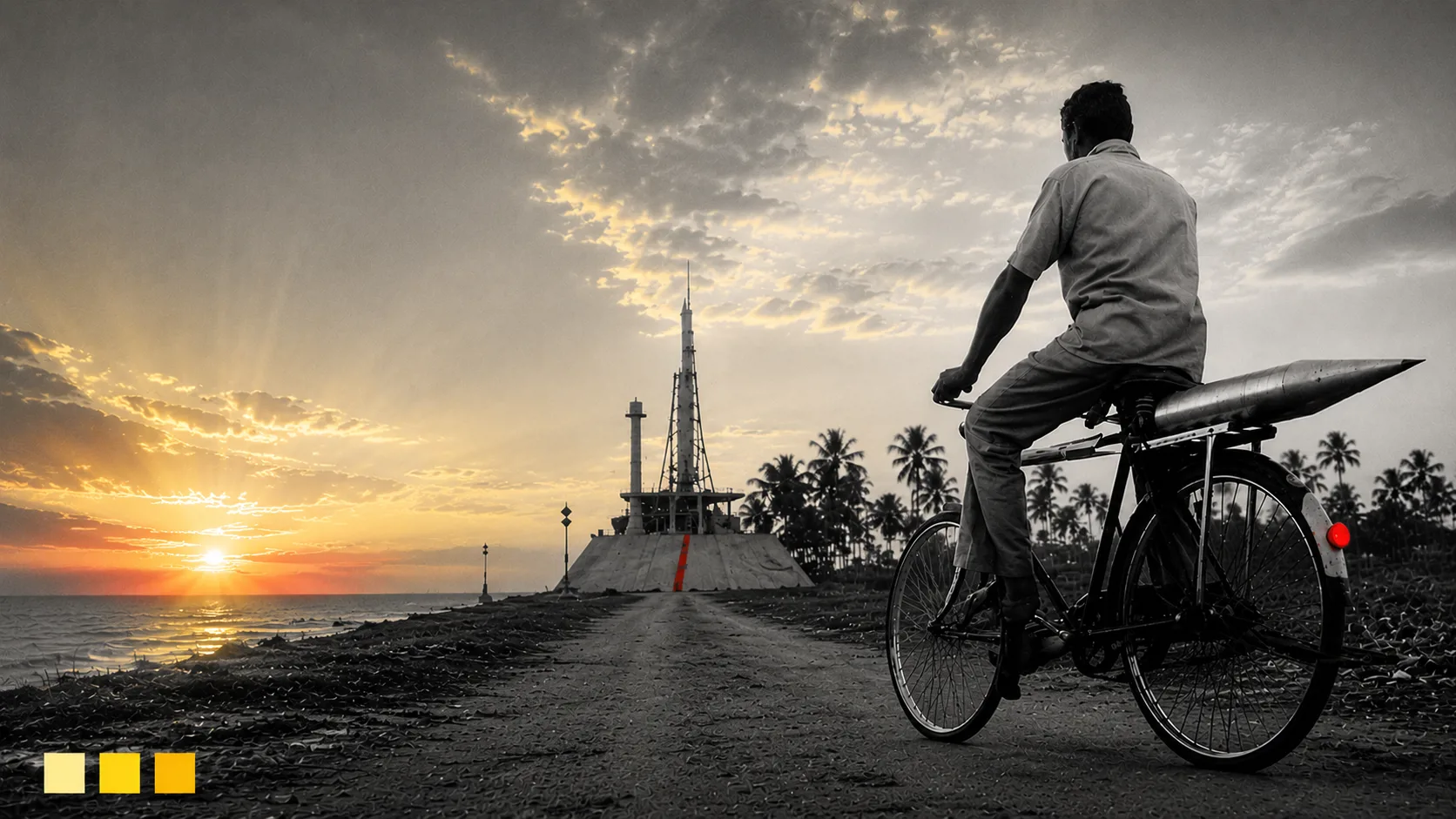
I. The Bicycle and the Church
On 21 November 1963, a sounding rocket rose from a coconut grove on the Kerala coast and reached about 200 kilometres before falling back into the Arabian Sea. It was an American Nike-Apache. The payload was French. The launch pad was a concrete slab. The tracking equipment had been begged from three countries. And the rocket's nose cone had been carried to the pad on the back of a bicycle, because the village of Thumba did not have a vehicle suited to the task and nobody thought this was strange enough to stop for.
The photograph survives. It is the most-reproduced image in the history of Indian science, and it is reproduced so often that it has become difficult to see. What it shows is not charming. It shows a nation with an idea and no infrastructure, improvising the gap.
Thumba was chosen for a reason that had nothing to do with convenience and everything to do with physics. The geomagnetic equator -- the line where the Earth's magnetic field runs horizontal to the surface -- passes almost directly over it. Above that line sits the equatorial electrojet, a river of current flowing through the ionosphere roughly a hundred kilometres up, and in 1963 the electrojet was one of the genuinely open questions in upper-atmospheric physics. If India wanted to enter space science through a door where it could contribute rather than observe, this was the door. Vikram Sarabhai did not select Thumba because it was near anything. He selected it because the sky above it was scientifically interesting and nobody else had a better claim to study it.
The village had a church. St. Mary Magdalene's, on the highest ground, with a congregation of fishing families whose land the rocket range would consume. The story of what followed has been told so often that it has acquired a gloss of inevitability, which it does not deserve. Sarabhai went to Bishop Peter Bernard Pereira. The bishop asked for time. On the following Sunday he stood before his congregation and -- the accounts agree on this, and it is worth pausing over -- he asked them whether they would give their church, their homes, and their fishing ground to their country for a purpose he could not fully explain to them and which would not benefit them in their lifetimes.
They said yes.
The church became the first office of the Thumba Equatorial Rocket Launching Station. The bishop's room became the workshop. The prayer hall held the instrumentation. A cattle shed nearby was converted into a laboratory. Today the church is a museum, and the men who worked there -- Sarabhai, Kalam, Aravamudan, Muthunayagam -- have become the founding generation of something that now lands spacecraft on the Moon.
It is tempting to read this as a parable about faith and science, which is how it is usually read, and which is not wrong but is thin. The more useful reading is about cost. What Thumba established, in its first year, was a specific institutional habit: when the resource is absent, substitute intelligence. There is no vehicle for the nose cone; there is a bicycle. There is no assembly building; there is a church whose bishop can be persuaded. There is no launch complex; there is a slab of concrete and a coconut grove that the sea breeze will not disturb too badly.
This habit is not a virtue that Indians possess innately. It is a discipline that a specific institution imposed on itself and then transmitted, deliberately, for sixty years. It is the reason a Mars orbiter cost less than a film about being lost in space. Everything that follows in this essay is, in one sense, an elaboration of the bicycle.
The man who set the terms
Vikram Ambalal Sarabhai was thirty-four when he founded the Physical Research Laboratory in Ahmedabad in 1947, in the rooms of the Ahmedabad Education Society, funded substantially by his own family's textile fortune. He had studied cosmic rays at Cambridge under a supervisor who thought the field was finished. He returned to a country that was, in the year of his laboratory's founding, being partitioned.
The Sarabhai doctrine -- the sentence that every account of ISRO quotes, and which deserves to be quoted again because its logic is more radical than its familiarity suggests -- was set down in the late 1960s:
"There are some who question the relevance of space activities in a developing nation. To us, there is no ambiguity of purpose. We do not have the fantasy of competing with the economically advanced nations in the exploration of the Moon or the planets or manned space-flight. But we are convinced that if we are to play a meaningful role nationally, and in the community of nations, we must be second to none in the application of advanced technologies to the real problems of man and society."
Read carelessly, this is modesty. Read carefully, it is something much harder.
Sarabhai is not saying India should be humble. He is saying India should be second to none -- but at a different game than the one the superpowers were playing. He is making a strategic claim about where the leverage actually is. In 1969, the year of Apollo 11, the argument that a country with a per-capita income under \$100 should build rockets was not obviously winnable. Sarabhai won it by refusing the terms of the debate. He did not argue that India could afford prestige. He argued that India could not afford to be dependent -- on foreign satellites for its weather warnings, foreign transponders for its broadcasts, foreign goodwill for its maps.
The distinction matters enormously for what comes later, and it is where most commentary on ISRO goes wrong. Sarabhai's doctrine is not a vow of poverty. It is a doctrine about strategy under constraint: do the thing that the constraint makes possible, and do it better than anyone. The constraint in 1969 was money, and the thing it made possible was applications. When the constraint changed -- when India in 2013 could afford a Mars mission on a budget that would not cover a mid-tier Hollywood second unit -- the doctrine did not break. It scaled. The discipline was never "stay small." The discipline was "extract maximum from minimum," and that discipline is indifferent to the size of the minimum.
The successor nobody planned for
Sarabhai died on 30 December 1971, at Kovalam, aged fifty-two. He had been Chairman of the Atomic Energy Commission and the architect of the space programme simultaneously. He did not live to see a single Indian satellite launched by an Indian rocket. The organisation he built has now been running for fifty-five years on a doctrine he articulated in a paragraph.
The succession mattered as much as the founding, and it is the part of the story that gets left out.
Satish Dhawan was at Caltech when he was asked to take ISRO. He was an aeronautical engineer of the first rank -- a fluid dynamicist, Director of the Indian Institute of Science -- and he set a condition before accepting: that the Institute would not be abandoned, and that he would run both. He was given it.
Sarabhai had supplied the doctrine. Dhawan supplied something an organisation needs even more, which is a culture, and cultures are transmitted by what leaders do rather than what they say. Nearly every institutional habit this essay will credit to ISRO -- the honest failure report, the small team, the derivative vehicle, the willingness to fly again after losing two in a row -- is Dhawan's, and Chapter III is where he installs it.
The launch range at Sriharikota bears his name. He is the least famous of the founders internationally and arguably the most consequential.
II. Aryabhata and the Borrowed Rocket
India's first satellite was named for a mathematician who died around 550 CE.
The choice was Sarabhai's in spirit though he did not live to make it; the naming came in 1975, and the shortlist reportedly included Maitri and Jawahar. Indira Gandhi chose Aryabhata. The man had, in the Āryabhaṭīya, computed π to four decimal places, given a table of sine differences that is functionally a trigonometric table, and -- this is the part that matters for a satellite's name -- asserted that the apparent westward motion of the stars was caused by the Earth's rotation, using an image of a boat moving downstream past stationary trees.
He was arguing, in the sixth century, that the ground beneath the observer moves. It is a reasonable thing to write on the side of a spacecraft.
The satellite went up on 19 April 1975, from Kapustin Yar in the Astrakhan Oblast, on a Soviet Kosmos-3M. It was a 26-faced polyhedron, 1.4 metres across, 360 kilograms, carrying three experiments: X-ray astronomy, solar neutron and gamma-ray detection, and ionospheric physics. It was built at Peenya, near Bangalore, in an industrial shed.
Four days after launch, the power system failed. The experiments stopped. The satellite transmitted for another few days on backup and then went quiet, and it stayed in orbit, dead, for seventeen years before re-entering in 1992.
This is the fact that Indian accounts tend to hurry past and that foreign accounts tend to linger on, and both are making the same error, which is to think the science was the point.
The science was not the point. Aryabhata's purpose was to establish that a group of Indian engineers, working in a shed outside Bangalore, could design, integrate, test, and qualify a spacecraft to the standard where a foreign launch authority would put it on top of a rocket. That standard was met. The vehicle reached orbit and functioned. The power system's failure was a subsystem fault of exactly the kind that afflicted every early space programme, including both superpowers'.
What Aryabhata actually taught was less about X-rays than about the shape of the problem. India could build the payload. India could not lift it. And the entity that lifted it -- the USSR, under a 1972 agreement that traded launch services for the use of Indian ports for Soviet tracking ships -- did so for reasons that were about Soviet interests in the Indian Ocean, not Indian interests in space.
Sarabhai had seen this precisely. Dependence on a foreign launcher is not a technical inconvenience. It is a permanent hand on the throat. Whoever owns the rocket decides what flies, when, and whether. In 1975 the hand was friendly. There was no guarantee it would stay that way, and -- as Chapter V will show -- it did not.
The shed at Peenya
It is worth dwelling on where Aryabhata was built, because the location is the argument.
There was no spacecraft integration facility in India in 1972. There was an industrial estate at Peenya, on the outskirts of Bangalore, and ISRO took sheds in it. The clean room -- and a satellite must be assembled in a clean room, because a single fleck of debris in the wrong place is a short circuit that cannot be repaired once the vehicle is on orbit -- was improvised. Engineers have described sealing the shed, filtering the air, and working in conditions where the ambient temperature was whatever Bangalore was offering that afternoon.
The thermal vacuum chamber, in which a spacecraft must be baked and frozen under vacuum to prove it will survive orbit, had to be built because there was not one. The vibration table, which shakes the vehicle to launch loads to prove nothing will shear off during ascent, likewise.
The team was young. U. R. Rao, who led it, was in his early forties; most of his engineers were in their twenties and thirties, and many of them had never seen a spacecraft. They were building one from first principles, from textbooks, and from what a handful of them had learned abroad.
This is a specific management fact and not merely a colourful one. A satellite is a systems-engineering problem before it is a physics problem. It requires that hundreds of interfaces -- power, thermal, data, structural, attitude -- be specified, controlled, and verified by people who agree on what the interfaces are. The hard part is not any single subsystem. The hard part is the discipline of the interface document. What Rao's team learned at Peenya was that discipline, and having learned it once, they had it permanently. Every Indian satellite since is a descendant of what that shed taught.
Bhaskara-I followed in 1979, again on a Soviet vehicle, this time carrying television cameras and a microwave radiometer for Earth observation: crops, forests, hydrology, ocean state. The applications programme had begun. And it had begun on someone else's rocket, which was intolerable, and which the next chapter was about ending.
III. SLV-3, and the Man Who Failed First
What a solid rocket actually is
Before the failure, the physics -- because the failure is unintelligible without it.
A rocket engine is a device for making a mass go backwards quickly. That is the whole of it. Newton's third law does the rest. The figure of merit is specific impulse, written Isp, and it measures how much impulse you extract per unit of propellant consumed. Expressed in seconds -- the convention, and a slightly confusing one -- it is the number of seconds that one kilogram of propellant can produce one kilogram-force of thrust. Higher is better. It is, functionally, the fuel economy of the rocket.
And it is governed by a relationship that is brutally simple in form and brutally unforgiving in practice:
Isp ∝ √(Tc / M)
The specific impulse goes as the square root of the combustion chamber temperature divided by the molecular weight of the exhaust. That is the entire game. You want the gas coming out of the nozzle to be hot and light. Hot, because temperature is kinetic energy and you are converting it into directed velocity. Light, because for a given energy, a lighter molecule moves faster -- the same energy shared among fewer nucleons gives more speed per particle.
The tyranny of the fraction is that the temperature is under the square root and so is the molecular weight, and molecular weight has a much larger dynamic range. You can perhaps double your chamber temperature with heroic materials engineering. You can reduce your exhaust molecular weight by a factor of ten by choosing hydrogen. This single fact -- that M is the lever, not Tc -- is why the cryogenic engine exists, why it was denied to India, and why Chapters V through VII are the dark spine of this essay.
A solid rocket motor is the oldest and simplest form. The fuel and the oxidiser are mixed together into a rubbery composite and cast into the motor casing as a single grain. Ignite one end and it burns. Indian and most modern solids use a formulation of roughly this shape: HTPB (hydroxyl-terminated polybutadiene) as the fuel and binder -- a synthetic rubber that both holds the grain together and burns; ammonium perchlorate (NH₄ClO₄) as the oxidiser, typically 68-70% by mass, which is where the oxygen comes from; and aluminium powder, typically 16-18%, which is there for a specific reason worth understanding.
Aluminium burns to Al₂O₃ at about 3,000 K and releases enormous energy per unit mass. It raises Tc hard. But Al₂O₃ is a solid -- those are the brilliant white smoke trails you see on a solid booster, condensed alumina particles -- and solid particles in the exhaust are a loss mechanism. They do not expand in the nozzle the way gas does; they lag the flow; they carry away heat. So the aluminium is a bargain: you accept a two-phase-flow efficiency penalty in exchange for a large temperature gain. The optimum is around 16-18%, and every solid motor designer in the world lands in roughly the same place, because the physics does not care about nationality.
Solid Isp tops out around 250-270 seconds in vacuum. This is not good. What solids offer instead is thrust density and simplicity: no pumps, no plumbing, no valves, no ignition sequence beyond an igniter. You can store one for a decade and fire it on a second's notice. The reason this matters -- and the reason the SLV-3 story has a shadow over it -- is that those exact properties are what a ballistic missile wants. A liquid rocket is a laboratory instrument. A solid rocket is a weapon that can also do science. The technologies are not adjacent; they are identical.
The price of simplicity is that a solid cannot be throttled and cannot be shut off. Once lit, it burns until the grain is gone. Everything you want to control about the thrust must therefore be designed into the geometry of the grain before you cast it. This is the elegant part. Burning proceeds perpendicular to the exposed surface, at a rate governed by the chamber pressure through Vieille's law (also called Saint-Robert's law):
r = a·pⁿ
where r is the linear burn rate, p is chamber pressure, and n is the pressure exponent, typically 0.3-0.4 for composite propellants. Thrust is proportional to the total burning surface area. So if you cast the grain with a simple cylindrical hole down the middle, the burning surface is a cylinder that grows as it burns outward -- the area increases, the thrust rises through the burn. That is progressive burning. If instead you cast the bore as an eleven-pointed star, the initial surface is enormous (all those points and valleys), and as the points burn away the surface area shrinks toward a plain circle. That is regressive: high thrust off the pad, tapering as the vehicle lightens and the dynamic pressure builds.
The star grain is the reason a solid-fuelled first stage can be made to behave. And note that n < 1 is not an accident of chemistry -- it is a stability requirement. If n exceeded 1, a small pressure rise would increase burn rate faster than the nozzle could vent it, which would raise pressure further, which is a bomb. Every solid propellant formulation in use is chosen partly to sit safely below that line.
Why anything needs four stages at all
One more result, and it explains the entire architecture of every rocket in this essay.
Konstantin Tsiolkovsky, a deaf schoolteacher in Kaluga, working essentially alone, wrote it down in 1903:
Δv = Isp · g₀ · ln(m₀ / mf)
The velocity change a rocket can achieve equals its exhaust velocity times the natural log of the ratio of its starting mass to its final mass.
The logarithm is the tyrant. To reach low Earth orbit you need roughly 9.4 km/s of Δv once you account for gravity and drag losses. With a solid motor at Isp = 260 s -- exhaust velocity about 2.55 km/s -- the required mass ratio is e^(9.4/2.55) ≈ 40. Forty to one. For every kilogram that reaches orbit, thirty-nine kilograms must have been thrown away.
But those thirty-nine kilograms are not all propellant. Some of them are tank. And here is the problem: a single-stage vehicle must carry its empty tankage, its engines, its structure -- everything -- all the way to orbit. The dry mass never goes away. It sits in the denominator of the mass ratio, and with a mass ratio of forty required, the structure must be under about 2.5% of the total. Nothing can be built that light. Not in 1979. Not now.
So you stage. You throw the tank away as soon as it is empty. The moment the first stage's propellant is gone, its casing, its nozzle, and its structure become pure parasitic mass -- so you cut them loose and let a smaller, lighter vehicle continue. Each stage only has to lift what remains.
This is why SLV-3 had four stages to lift forty kilograms. Not because four is elegant. Because the logarithm demanded it, and Tsiolkovsky had proved it in Kaluga seventy-six years before Kalam stood on a beach in Andhra Pradesh watching it happen.
Everything else in launch vehicle design -- the strap-ons, the cryogenic upper stage, the Oberth spiral to Mars -- is an attempt to negotiate with that logarithm.
SLV-3
The Satellite Launch Vehicle-3 was four solid stages, 22 metres tall, 17 tonnes, designed to put 40 kilograms into a 400-kilometre orbit. Forty kilograms. A large dog.
Its project director was a 40-something engineer from Rameswaram named A. P. J. Abdul Kalam, who had come to the space programme via aeronautics at MIT Madras and a hovercraft project at DRDO that had gone nowhere.
The first launch was on 10 August 1979.
The vehicle lifted. The first stage burned correctly. And then, during second-stage flight, the vehicle went out of control and fell into the Bay of Bengal, about 560 seconds after liftoff. The Rohini payload never reached orbit.
The cause was traced to a leaked valve in the second stage's Reaction Control System -- the small thruster set that holds the vehicle's attitude. It had drained its supply of red fuming nitric acid before the stage needed it. The stage was left without attitude control, tumbled, and the mission was over. A valve.
What happened next is the part of the story that matters institutionally, and it is usually told as an anecdote about Kalam's character when it is really about ISRO's.
Satish Dhawan, the Chairman, took Kalam to the post-launch press conference and announced the failure himself. He took responsibility for it publicly, in the first person, before the press and the country. He said the team had worked hard, that they had not achieved the objective, and that he backed them.
The next launch, on 18 July 1980, put Rohini RS-1 into orbit. India became the sixth nation able to launch its own satellite with its own vehicle. Dhawan sent Kalam to the press conference to announce the success alone.
The lesson Dhawan taught with that sequence is one that most engineering organisations state and almost none practise: failure is absorbed upward, credit is distributed downward. An organisation that does this can afford to take real risks, because engineers who will not be destroyed for an honest failure will report bad news early, when it is still cheap. An organisation that does the reverse gets engineers who hide problems until the problems arrive on their own schedule. Nearly everything ISRO subsequently did well -- including, forty-three years later, reading its own Chandrayaan-2 crash report with enough honesty to fix it -- traces to a norm that Dhawan established at a press conference in 1979.
The two failures nobody remembers
Between SLV-3's success in 1980 and PSLV's in 1994 sits a vehicle almost nobody outside ISRO discusses, and it is the most instructive object in the whole launcher genealogy.
The Augmented Satellite Launch Vehicle was SLV-3 with two strap-on boosters added to the base and the whole stack restructured -- an attempt to lift 150 kg to low orbit instead of 40. It was explicitly a bridge: a way to learn strap-on technology and the closed-loop guidance that PSLV would need, on a cheap vehicle, before betting a large programme on it.
ASLV-D1 flew in March 1987. The first stage failed to ignite. The vehicle fell into the sea.
ASLV-D2 flew in July 1988. It went unstable during first-stage flight and was lost.
Two vehicles, two total failures, consecutive. In an organisation with a different culture this is where the programme dies -- where a ministry asks what exactly it is funding, where a chairman decides that his successor can carry the risk, where the engineers who signed the flight-readiness reviews find themselves reassigned.
ISRO flew ASLV-D3 in May 1992. It worked. ASLV-D4 in 1994 worked.
And what those four flights bought was not the 150 kg. Nobody needed the 150 kg. What they bought was strap-on separation dynamics, closed-loop guidance in a live vehicle, and the specific knowledge of what a stack does when the boosters and the core interact badly -- all of it learned on a small cheap rocket, before PSLV, which was carrying the entire Earth-observation programme on its back.
The ASLV failures are the most valuable failures in the history of Indian spaceflight, and they were valuable precisely because Dhawan's norm from 1979 was in force: you may fail, if you tell us why. The engineers who lost D1 and D2 were the engineers who flew D3 and D4, and several of them were the engineers who flew PSLV.
There is a way of accounting for this that most organisations never learn. ASLV's two crashes cost a few tens of crores. The knowledge they produced protected a programme worth thousands. Failure on a small vehicle is not waste; it is the cheapest form of tuition available, and the only alternative is to buy the same lesson later at full price on a vehicle that matters.
Thrust vector control, or: how you steer something you cannot throttle
One more piece of physics before leaving the solids, because it is the question a careful reader will already have.
If a solid motor cannot be throttled or shut down, and if it is bolted rigidly to the vehicle, how do you steer?
You do not steer with the motor. You steer the exhaust. Several methods exist and ISRO has used most of them. Secondary injection thrust vector control -- SITVC -- injects a fluid (ISRO used strontium perchlorate solution) through ports in the nozzle wall, downstream of the throat. The injected fluid creates an oblique shock in the supersonic exhaust, which deflects the flow, which vectors the thrust by a few degrees. No moving parts in the gas path. It is used on PSLV's first stage to this day.
The alternative, on liquid stages, is to gimbal the entire engine on hydraulic actuators, which is what the Vikas stages do.
And on the upper stages, in vacuum, where there is no air to push against and the main motor may be finished burning, you need something else entirely: small thrusters firing pure attitude control, using their own supply of propellant.
Which is precisely what failed on SLV-3's first flight. The Reaction Control System leaked its red fuming nitric acid away, and a vehicle that could not point could not fly, and 22 metres of rocket went into the Bay of Bengal because of a valve in a small tank feeding thrusters that produce almost no thrust at all.
This is the recurring shape of spaceflight failure, and it is worth naming because it explains Chandrayaan-2 as well. Rockets almost never fail because the big thing was wrong. They fail because the small thing was wrong and the big thing had no way to compensate.
The shadow
SLV-3's technology went on to become the first stage of Agni, India's intermediate-range ballistic missile, which first flew in 1989. Kalam directed that programme too.
There is no point being coy about this. A four-stage solid rocket that can place 40 kg in orbit is, with a different payload and a different flight profile, a missile. The nations that were watching Thumba in 1963 with amusement were watching Sriharikota in 1980 with something else. The Missile Technology Control Regime was established in 1987, seven years after Rohini RS-1 and two years before Agni's first flight, and while it was not created for India, India was very much among the states it was created about.
Whether one regards this as India acquiring a legitimate deterrent or as the space programme's original sin depends on priors this essay will not adjudicate. What is not in dispute is the consequence: from the late 1980s onward, every technology transfer India sought would be read through the missile lens. That is the door through which Chapter V arrives.
IV. The Village That Watched
In 1975 and 1976, for one year, 2,400 villages across six Indian states received television.
The Satellite Instructional Television Experiment used NASA's ATS-6 satellite, loaned to India under an agreement Sarabhai had negotiated before his death. The satellite parked over the Indian Ocean and broadcast directly to community receivers -- a chicken-wire parabolic dish, ten feet across, feeding a single television set in a village square. Direct-to-home, in 1975, in villages that in many cases did not have reliable electricity. Where there was no grid, there were batteries and, in some sites, diesel.
The content was agricultural extension, health and hygiene, family planning, teacher training, and national integration programming. The programmes were produced in Hindi, Telugu, Kannada, Oriya, and Marathi at studios in Delhi, Cuttack, and Hyderabad.
Arthur C. Clarke, who had proposed geostationary communications satellites in 1945, called SITE the largest sociological experiment ever conducted.
The evaluations were mixed and honest about being mixed -- ISRO's own studies found real gains in some areas and negligible ones in others. What SITE unambiguously established was operational: it proved that satellite broadcast could reach the Indian village directly, cheaply, without laying a metre of cable. That finding is the foundation of INSAT, and INSAT is the foundation of the claim that ISRO earns its budget.
What the doctrine looks like in numbers
What SITE actually cost, and what it taught
There is a detail about SITE that is worth recovering because it inverts the usual reading.
ATS-6 was loaned. NASA provided the satellite for one year, free. At the end of the year it was repositioned back over the Americas and the villages went dark.
Read cynically, this is India being given a toy and having it taken away. Read correctly, it is Sarabhai's strategy executing exactly as designed. India could not build ATS-6. India could build the ground segment, the receivers, the studios, the programme production, the evaluation apparatus, and the institutional knowledge of how to run a national broadcast service -- and it could acquire all of that in a year, on someone else's satellite, for the cost of the ground equipment alone.
When the satellite left, the capability stayed. INSAT followed within a decade, on India's own account.
That is what you do when you are poor and clever: you borrow the expensive thing briefly and keep the knowledge permanently. It is the same move as Vernon, seven years later, with an engine instead of a satellite.
The evaluations of SITE's content effects were mixed, and ISRO published them mixed. That honesty is itself worth noting -- a programme that had every political incentive to declare a triumph instead published studies showing that some things worked and some did not.
INSAT
The INSAT series began in 1983 and became one of the largest domestic communications systems in the Asia-Pacific. Its successors and the meteorological satellites that followed -- Kalpana-1, the INSAT-3D series -- did something that can be measured in a way that space programmes usually cannot.
On 29 October 1999, a super cyclone made landfall near Paradip in Odisha. Winds around 260 km/h. The official death toll was approximately 9,887. Other estimates run higher.
On 12 October 2013, Cyclone Phailin made landfall near Gopalpur, roughly 150 kilometres from where the 1999 storm had come ashore. Comparable intensity -- a Category 4-equivalent system. The death toll in Odisha was 44.
Nearly ten thousand, and then forty-four. The storms were of comparable violence. What changed between them was that in 2013 India had INSAT-3D and Kalpana-1 watching the Bay of Bengal continuously, the IMD tracking the system days out with satellite-derived intensity estimates, and a state government that evacuated roughly a million people because it had been told, with enough confidence and enough warning, exactly where the storm would hit.
That is the Sarabhai doctrine, cashed. Not as a slogan -- as approximately nine thousand and eight hundred people who went home afterwards.
The rest of the applications programme runs on the same logic. Bhuvan and the Cartosat/Resourcesat lines feed land records, urban planning, and the mapping of every rural road built under the national employment guarantee scheme. The Potential Fishing Zone advisories -- derived from ocean colour and sea-surface temperature data from Oceansat and INSAT -- are broadcast to fishing communities and materially reduce the fuel burned searching for fish. NAVIC, the regional navigation constellation, exists specifically because of an event in 1999: during the Kargil conflict, India sought high-precision GPS data over the conflict zone and was refused. NAVIC is the institutional memory of that refusal, converted into seven satellites.
The instrument on the boat
The Potential Fishing Zone advisory deserves more than a clause, because it is the clearest small example of what the whole apparatus is for.
The physics: phytoplankton contain chlorophyll, chlorophyll absorbs blue and red light and reflects green, and a satellite radiometer looking at the ocean can therefore measure chlorophyll concentration from orbit by looking at the colour of the water. Phytoplankton is the base of the marine food chain. Where there is chlorophyll there is zooplankton, and where there is zooplankton there are fish. Cross-reference that with sea-surface temperature -- because most commercially fished species have a preferred thermal band, and the fronts where warm and cold water meet concentrate life -- and you can draw, on a map, the places where fish probably are.
INCOIS turns this into an advisory. The advisory is disseminated in local languages, by SMS, by radio, by electronic display boards at landing centres.
Now consider what that means to the man it is for. He owns a boat with an outboard motor. His single largest operating cost is fuel. Without the advisory he leaves harbour and searches -- burning fuel to find fish, on knowledge, instinct, and what worked last week. With the advisory he has a bearing and a distance.
Assessments of the programme have found meaningfully reduced search time and fuel consumption per trip, and higher catch per unit effort. Whatever the precise figure, the shape of the benefit is not in dispute: it is a direct transfer of value from an orbiting radiometer to the fuel budget of a man in a small boat who will never think about the satellite and does not need to.
That is the entire Sarabhai doctrine compressed into one transaction. Not a demonstration. Not a flag. A fisherman with more money at the end of the week because a spacecraft looked at the colour of the sea.
Note the pattern, because it will recur. NAVIC was not built because India wanted a navigation system. It was built because India was denied one and concluded that the denial would happen again. The same sentence, with different nouns, describes the cryogenic engine.
V. The Cryogenic Ambush
Why hydrogen
Return to the fraction: Isp ∝ √(Tc/M). Molecular weight is the lever.
Burn hydrogen with oxygen and the product is water. Steam, at high temperature -- and at the ~3,200 K of a rocket chamber, substantially dissociated into H, OH, and H₂ fragments, which is why the effective exhaust molecular weight comes out lower than water's 18. Run the mixture deliberately fuel-rich -- around 5.5:1 oxidiser-to-fuel by mass, rather than the stoichiometric 8:1 -- and the excess hydrogen brings the mean molecular weight down toward 10-13 g/mol. You lose some chamber temperature. You gain more from the reduced M than you lose from the reduced Tc, because of exactly how those two terms sit inside that square root. The optimum is fuel-rich, and every hydrogen engine ever flown runs there.
Result: vacuum Isp around 440-465 seconds.
Compare: solid, ~250-270 s. Storable hypergolic (UDMH/N₂O₄), ~310-320 s. Kerosene/LOX, ~330-350 s.
That gap is not incremental. Feed it back into Tsiolkovsky and notice where Isp sits. The mass ratio enters as a logarithm, which means buying velocity by adding propellant is an exercise in diminishing returns: to double your Δv at fixed Isp, you must square your mass ratio. But Isp sits outside the log, as a linear multiplier. Improving specific impulse by 40% improves Δv by 40%, full stop, with no logarithmic penalty extracted at the door.
This is the single most important asymmetry in launch vehicle design. It is why the upper stage -- where every kilogram of dry mass is a kilogram not delivered to orbit -- is where hydrogen earns its keep, and why every serious geostationary launcher on Earth has a hydrogen upper stage.
For India in 1990 the arithmetic was concrete. To place a 2,000-2,500 kg communications satellite into geostationary transfer orbit required a cryogenic upper stage. Without one, India would buy Arianespace launches for its own INSAT satellites -- forever, in hard currency, at the vendor's schedule and the vendor's price.
Why it is so hard
Hydrogen is a magnificent propellant and a hostile substance.
It is only liquid below 20.3 K. Twenty degrees above absolute zero. This is not merely "cold"; it is a regime where most engineering intuition stops applying. Steels become glass. Elastomers become ceramics. Lubricants become solids. Nearly every material property in the standard tables is quoted at 293 K and is a fiction at 20 K.
It is absurdly un-dense. Liquid hydrogen is 71 kg/m³ -- one-fourteenth the density of water, one-sixteenth that of liquid oxygen. A hydrogen tank is enormous for the mass it holds. Large tanks mean large surface area, which means large structural mass and large heat leak, and the structure you add to contain it eats part of the Isp advantage you bought. Cryogenic stage design is a fight between the exhaust physics giving you performance and the tank geometry taking it back.
It leaks through things that are not holes. The H₂ molecule is the smallest in existence. It permeates elastomers, diffuses along grain boundaries, and finds paths through weld microstructure that no other fluid would notice.
It embrittles the metal that contains it. Hydrogen embrittlement is the failure mode that defines the field. Atomic hydrogen diffuses into the crystal lattice of high-strength steels and nickel alloys and accumulates at dislocations and grain boundaries. The mechanisms are still argued over -- hydrogen-enhanced decohesion, hydrogen-enhanced localised plasticity -- but the effect is not: a component that passed every test in air fails under load in a hydrogen environment, often suddenly, often at a stress far below its rated strength. You cannot design around it with a safety factor. You must select materials that are resistant (certain austenitic stainless steels, specific superalloys), and you must find that out by testing in hydrogen, at temperature, which requires a hydrogen test facility, which is itself a major national asset.
And then there is the turbopump. This is where the discipline concentrates its difficulty.
To burn propellant at the rate a rocket demands, you must deliver it to the chamber at pressures well above chamber pressure -- for CE-20's ~6 MPa chamber, the pump discharge is substantially higher. Pressure-feeding from the tank would require tank walls thick enough to be a submarine hull. So you use a turbopump: a turbine driven by hot gas, spinning a pump impeller on a common shaft, at tens of thousands of RPM.
Now consider that shaft. At one end, a turbine in combustion gas at high hundreds of kelvin, possibly over a thousand. At the other end, an impeller in liquid hydrogen at 20 K. The temperature gradient across a single rotating shaft can approach 3,000 K over a span you could measure with a ruler.
Everything about this is a problem. The shaft's two ends want to be different lengths -- differential thermal contraction over that gradient is not a rounding error, it is millimetres in a machine with clearances measured in microns. Bearings cannot be lubricated conventionally; the oil would freeze. So the bearings are cooled and lubricated by the propellant itself -- liquid hydrogen, a fluid with essentially no viscosity, running through a bearing at 40,000 RPM, providing a film that must not fail even momentarily. The seals separating the hot turbine side from the cold pump side must maintain that separation at those speeds, across that gradient, through the thermal transient of startup, with a leak path that must not admit hydrogen to the hot side because hydrogen meeting hot oxygen-rich gas is how engines are lost. Purge circuits -- helium, which stays gaseous at 20 K -- are threaded between the seals to keep the two fluids from ever meeting.
And the startup transient is its own discipline. Before you can pump liquid hydrogen you must chill down the entire feed system, or the first hydrogen to arrive will flash to gas against warm metal and the pump will cavitate and destroy itself within a revolution or two. So you bleed cryogen through the system for minutes beforehand, watching the temperature march down, and only when the metal is cold do you have a machine that will accept propellant. Then you must light the chamber and spin the turbopump up together, in a coupled sequence where the pump needs turbine gas to spin and the turbine needs chamber combustion to make gas, and the whole thing must climb from zero to full power in seconds without the mixture ratio wandering into a region that melts the injector face.
There is no way to buy your way through this. There is no way to reason your way through it either. There is only the test stand, and the number of times you are willing to destroy a very expensive machine while learning what it does. Every nation that has a hydrogen engine has a wall of failed hardware behind it.
This is why cryogenic technology was the thing denied. Not because it is a weapon -- it is nearly the opposite of a weapon. A missile must sit in a silo for years and launch in minutes; a cryogenic stage must be loaded hours before flight and boils off continuously. Hydrogen is the most useless possible missile propellant. It is a pure space-access technology.
It was denied precisely because it is hard to master and impossible to shortcut. Denying India cryogenics did not stop India building missiles -- India already had solid motors and hypergolics, which are what missiles use. Denying India cryogenics stopped India from competing in the commercial launch market. The technology chosen for embargo was the one with no military application and enormous commercial value. That fact deserves to sit exactly where it is, undecorated.
The ambush
In January 1991, ISRO signed with Glavkosmos, the Soviet space agency's commercial arm, for two KVD-1 cryogenic engines plus full transfer of the technology -- designs, materials specifications, manufacturing processes. Approximately ₹235 crore. The KVD-1 was a good engine, a staged-combustion design with a lineage back to the RD-56 built for the Soviet lunar programme.
The United States objected, citing the Missile Technology Control Regime, and argued that cryogenic upper-stage technology constituted missile technology transfer.
The objection had a stated rationale and an evident one. The stated rationale was MTCR compliance. The evident one is that a cryogenic upper stage's application is geostationary launch, and geostationary launch was a market. India's own experts, and a number of foreign ones, made the technical argument that hydrogen is worthless in a missile. The argument did not prevail.
In May 1992, the US imposed sanctions on both ISRO and Glavkosmos under the Missile Technology Control Act. The USSR had dissolved five months earlier. The Russian Federation under Yeltsin, in the middle of an economic collapse and dependent on Western credit and IMF support, was not in a position to hold the line.
In July 1993, Russia formally abrogated the technology transfer. The revised deal: Russia would supply the finished engines -- eventually seven KVD-1s were delivered -- but no designs, no manufacturing know-how, no drawings.
India was left with a small number of engines it could fly and could not reproduce.
The stated purpose of the sanctions was non-proliferation. The effect was to remove a competitor from the commercial launch market for a decade. India began indigenous cryogenic development immediately.
The twenty-two years, in detail
The interval between the abrogation and CE-7.5's success is usually compressed into a sentence. It should not be, because what happened inside it is the actual story of how a technology is acquired without a teacher.
India flew the seven Russian KVD-1 engines it had been sold -- designated KVD-1M in Indian service -- on the early GSLV vehicles. That fleet's record is a chronicle of the difficulty.
GSLV-D1, April 2001: reached orbit, but the satellite was placed lower than intended. Partial failure. GSLV-D2, May 2003: success. GSLV-F01, September 2004: success. GSLV-F02, July 2006: one of the four liquid strap-ons lost thrust immediately after liftoff. The vehicle veered and was destroyed by range safety. Total loss. GSLV-D3, April 2010: the first flight of the indigenous CE-7.5. The vehicle flew correctly through the first two stages. The cryogenic stage ignited -- and the fuel booster turbopump stopped, in flight, seconds in. The vehicle tumbled and was lost. GSLV-F06, December 2010: not a cryogenic failure at all -- a connector between the strap-on and the core came loose, the control system lost its command path, and the vehicle broke up under aerodynamic load about fifty seconds after liftoff.
Two failures in a year. The programme was suspended. And the D3 failure in particular was the one that hurt, because it was the indigenous engine, on its first flight, failing in the turbopump -- the exact component the whole preceding chapter has explained is the hardest thing in the discipline.
The investigation found the fuel booster turbopump had stopped due to a seizure, with the failure traced to the behaviour of the turbopump's seals under flight conditions that ground testing had not fully reproduced. Read that sentence against the physics: the seals, across the 3,000 K gradient, at 40,000 RPM, lubricated by a fluid with no viscosity. The place the textbook says it is hardest is the place it broke.
ISRO's response was not to redesign in a hurry. It was to build more ground test capability -- because the failure was fundamentally a testing failure, a case where the ground simulation had not been faithful enough to catch what flight would do -- and then to test until the machine had no more secrets.
It took four years.
On 5 January 2014, GSLV-D5 flew, the CE-7.5 upper stage lit and burned to completion, and GSAT-14 went where it was supposed to go.
There is a photograph from the range that day of ISRO engineers who are not behaving with any dignity whatsoever. They had been trying for twenty-two years.
CE-7.5 -- staged combustion, 73 kN vacuum thrust, Isp around 454 seconds.
Twenty-two years. That is what the ambush cost, and the cost was paid in the currency of a decade of Indian commercial launch revenue that went to Arianespace instead.
But the interval between 1992 and 2014 contains something worse than delay, and it is the subject of the next chapter.
VI. The Fabrication
In November 1994, S. Nambi Narayanan was arrested by the Kerala Police on charges of espionage.
He was, at that moment, one of the two or three most consequential propulsion engineers in India. He had built the Vikas engine. He was heading the cryogenic project -- the effort to do domestically what Glavkosmos had just been forced to stop supplying. He was arrested, interrogated for fifty days, and accused of selling India's cryogenic secrets to Pakistan through two Maldivian women.
The case was fabricated. This is not an opinion, a sympathetic reading, or a partisan position. It is the finding of the Central Bureau of Investigation, the finding of the Supreme Court of India in two separate judgments, and the basis on which the Republic of India awarded him the Padma Bhushan. What follows is the evidentiary chain, laid out in order, because a claim this serious should rest on the record rather than on indignation.
The record
The charge. In October 1994, a Maldivian woman named Mariam Rasheeda was detained in Thiruvananthapuram on a visa overstay -- an offence for which the ordinary remedy is deportation. From that detention grew an allegation that she and another Maldivian woman, Fauzia Hassan, had obtained secret drawings of ISRO's cryogenic engine from Indian scientists and passed them to Pakistan. Nambi Narayanan and D. Sasikumaran of ISRO were arrested, along with others including a Russian contact and a labour contractor. The press reported it as a honeytrap. It was carried for weeks.
The CBI investigation. The case was transferred to the CBI. In 1996 the CBI filed its closure report before the Chief Judicial Magistrate, Ernakulam. Its finding was that the allegations were not proved and were false. The CBI found no evidence of espionage. It found that the documents allegedly sold were not the documents alleged, and in significant part were not secret. It recommended discharge of all the accused. The Chief Judicial Magistrate accepted the closure report and discharged them.
The state's refusal. The Government of Kerala, then under a different administration, decided to continue the investigation through the state police despite the CBI's closure.
The Supreme Court, 1998. In K. Chandrasekhar v. State of Kerala, the Supreme Court quashed Kerala's attempt to reopen. It held that the state could not resile from its consent to the CBI investigation and proceed afresh. The discharge stood.
The National Human Rights Commission. The NHRC took up Narayanan's complaint and in 2001 found in his favour, directing the State of Kerala to pay him ₹10 lakh in interim compensation. Kerala litigated the award.
The Supreme Court, 2018. This is the judgment that settles it. In S. Nambi Narayanan v. Siby Mathews & Others -- a bench of Chief Justice Dipak Misra, Justice A. M. Khanwilkar, and Justice D. Y. Chandrachud -- the Court found:
- That his arrest was unnecessary and the criminal proceedings against him malicious.
- That he had suffered "mental cruelty" -- the Court's phrase -- over twenty-four years.
- That his liberty and dignity, "basic to his human rights," had been jeopardised.
- The Court awarded ₹50 lakh in compensation against the State of Kerala, over and above the NHRC's ₹10 lakh, leaving him free to pursue further civil remedies.
- And it constituted a committee under Justice D. K. Jain, former Supreme Court judge, to examine the role of the Kerala police officers who had built the case and to recommend action.
The Court's language was not the hedged language of a tribunal splitting a difference. It said the case was a fabrication and that the fabricators had destroyed a man.
The Jain Committee and after. In April 2021 the Justice Jain Committee submitted its report to the Supreme Court. On 14 April 2021 the Court directed a CBI probe into the involvement of the police officers in the conspiracy.
What followed is instructive about how hard it is to hold state officers to account even after the highest court in the country has called their case a fabrication. Five former police and Intelligence Bureau officials sought and obtained anticipatory bail from the Kerala High Court in 2021 -- protection against arrest before it could happen.
The CBI appealed. In 2022 the Supreme Court set aside those anticipatory bail orders and sent the applications back, holding that the High Court had not dealt with the Justice Jain Committee report at all and had not examined the allegations against each officer individually. The men who built the case had been granted protection by a court that had not read the report establishing what they built.
The proceedings continue. Siby Mathews -- the DIG who headed the Kerala Police special team that arrested Narayanan, later ADGP -- has been an accused in the fabrication case and has litigated against the CBI's attempt to cancel his anticipatory bail.
The compensation, totalled. It is worth assembling, because the number is a measure of institutional acknowledgement accumulating slowly across a quarter-century:
- 1998 -- Supreme Court: ₹1 lakh.
- 2001 -- NHRC: ₹10 lakh interim.
- 2018 -- Supreme Court: ₹50 lakh, payable within eight weeks.
- 2021 -- Government of Kerala, settling his civil suit in the Thiruvananthapuram sub-court on the recommendation of former Chief Secretary K. Jayakumar: a further ₹1.3 crore.
The essential point for this essay is that the Indian state has formally moved from "the espionage case was false" to "the espionage case was manufactured, and we are pursuing those who manufactured it."
The Padma Bhushan. In 2019, the Government of India awarded S. Nambi Narayanan the Padma Bhushan, the nation's third-highest civilian honour.
The politics
There is a dimension to this case that the engineering account leaves out, and it should not be left out, because it explains how a fabrication of this scale stayed airborne.
The case detonated inside Kerala's Congress politics. The fallout was severe enough that K. Karunakaran resigned as Chief Minister of Kerala in March 1995 -- brought down, in significant part, by the affair. That is the measure of what the case was worth to people who had nothing to do with rockets: it was a weapon, and it worked, and a Chief Minister was removed with it.
Once a case has that kind of political utility, its truth becomes almost irrelevant to its momentum. There were now people whose careers depended on it being real. That is very likely why the Government of Kerala tried to continue investigating after the CBI had closed the case as false, and it is why the Supreme Court had to intervene in 1998 to stop them.
The press was not a bystander. The story ran as a honeytrap -- Maldivian women, secrets, ISI -- for weeks, on front pages, with the accused named and their faces printed. There is no version of this in which the newspapers were misled innocents; the material was extraordinary and it was not checked. Narayanan's neighbours threw stones at his house because they read the newspaper.
And note what the story offered the reader. Not "a scientist may have been careless with documents," which is dull. It offered a civilisational accusation: that India's space scientists -- the small number of Indians the country was most confident about -- were traitors selling the nation to Pakistan for money and women. It is difficult to design a story better calibrated to injure national self-belief.
What was actually destroyed
Recite the sequence with dates attached, and it stops looking like coincidence and starts looking like a schedule.
- Jan 1991 -- India signs with Glavkosmos for cryogenic engines and technology transfer.
- May 1992 -- US sanctions ISRO and Glavkosmos.
- Jul 1993 -- Russia abrogates the technology transfer. Engines only. No know-how.
- 1993-94 -- India commits to indigenous cryogenic development. Nambi Narayanan heads it.
- Nov 1994 -- Nambi Narayanan is arrested for selling cryogenic secrets.
- Jan 2014 -- India's indigenous cryogenic engine flies successfully.
The man who was leading India's response to the cryogenic embargo was arrested, on cryogenic espionage charges, roughly a year after the embargo bit -- and the technology he was leading took a further twenty years to arrive.
I want to be careful here, because the temptation is to overclaim and overclaiming would weaken a case that does not need it.
What is established beyond argument: the case was false; it was malicious; the Supreme Court said so; the state is now prosecuting those who built it.
What the record does not yet name is the hand behind it. The Court found malice and identified the men who executed the fabrication. It has not adjudicated who wanted it done. Narayanan's own position -- held by the man who paid for it, and who has more standing on the question than anyone alive -- is that foreign intelligence agencies were involved and the object was to cripple India's cryogenic programme.
The circumstantial case for that is not thin, and it does not depend on speculation. It depends on dates.
One fact belongs in the record here, because it inverts the charge completely. In the months before the case broke, Glavkosmos -- having been forced by Washington to cancel the formal technology transfer -- was reportedly moving cryogenic production technology to India anyway, routing hardware and documentation through Kerala Hi-tech Industries and flying it in by indirect routes.
Note the direction. The clandestine traffic in cryogenic technology in 1994 ran into India, not out of it. Narayanan was accused of selling India's cryogenic secrets at a moment when India did not yet possess them and was, if anything, on the receiving end of someone else's -- and the arrest arrived precisely when that inbound channel was the last route left to a programme the United States had spent two years trying to strangle. The case did not merely destroy a man. It closed the channel.
What is fair to say, and what this essay says: whoever set it in motion, the effect was precise. It removed India's leading propulsion engineer from the cryogenic programme at the exact moment the cryogenic programme was India's answer to a sanctions regime that had just cost it a technology transfer. It demoralised the team around him for years -- colleagues have described the atmosphere afterwards as one in which working on cryogenics felt professionally dangerous. It gave the Indian public a story in which their space scientists were traitors. And it delivered, to whoever benefited from India's absence from the geostationary launch market, an additional decade of that absence.
An effect that precise, produced by an accident, is a remarkable accident.
The man
What was taken from him is worth stating plainly, because the wrong lesson from this chapter would be that Nambi Narayanan is a symbol. He is not a symbol. He is a propulsion engineer who was very good at his job.
He went to Princeton in the late 1960s on a NASA fellowship, took his master's in chemical rocket propulsion in under a year under Luigi Crocco, and turned down a job in the United States to return to a country that could not pay him. He learned French so that he could work with SEP at Vernon. He led the team that absorbed the Viking engine -- and Chapter VII is about what "absorbed" means, because it is the opposite of what his accusers alleged him to have done in reverse.
He was arrested at the height of his powers, held for fifty days, and denied. He has described being made to stand for long hours; he collapsed during the interrogation. He was released, discharged, vindicated, and vindicated again, and it took twenty-four years, and by the time the Supreme Court awarded him fifty lakh rupees he was seventy-six years old and had spent a third of his life proving a negative.
His wife, Meena, suffered a mental breakdown during the ordeal. His neighbours had thrown stones at his house. His children grew up as the children of a man the newspapers had called a traitor.
He wrote a memoir, Ready to Fire: How India and I Survived the ISRO Spy Case. The title has an unbearable double meaning if you know what a launch commit is. In 2022 a film was made of it -- Rocketry: The Nambi Effect -- and a great many Indians learned for the first time that the traitor they half-remembered from the newspapers of their childhood had never existed.
There is a detail from the arrest that ought to be more famous than it is. When the police came, Narayanan's first concern -- by his own account and those of colleagues -- was not for himself. It was that the interrogation was aimed at getting him to implicate others higher in ISRO. The pressure was to name names. Had he broken and named them, the espionage case would have metastasised upward through the organisation, and the damage would not have been to one man's career but to the institution.
He did not name anyone, because there was nobody to name.
Fifty days. A man in his fifties, one of perhaps three people in the country who understood what he understood, being worked on by officers who needed a case. And what he protected by not breaking was the cryogenic programme itself -- which is to say the thing that eventually flew, in 2014, on GSLV-D5, twenty years later.
He was not merely a victim of the ISRO spy case. He was, in the most literal sense available, the reason it failed to achieve what it was built to achieve.
And here is the thing that ought to end this chapter. When he was finally free, he did not leave. He stayed, and he consulted, and he gave interviews in which he talked about the engines. Asked repeatedly, over the years, what he wanted, his answer kept coming back to the same place: not the money, not even the apology -- that the guilty be named, and that the cryogenic programme should not have been stopped.
The Vikas engine flew on the rocket that put Chandrayaan-3 on its way to the Moon in July 2023. Nambi Narayanan was ninety-one years old and watched it fly.
VII. The Vikas Inheritance
What "absorbing" a technology means
In 1974, India signed with the Société Européenne de Propulsion for access to the Viking engine -- the workhorse of Ariane's early stages. The agreement sent Indian engineers to Vernon, in Normandy, to work alongside SEP's teams.
The word usually used for what followed is "transfer," and it is the wrong word. What ISRO did at Vernon was something more demanding and considerably more Indian in character, and it is the exact refutation of what Narayanan was later accused of.
Roughly fifty Indian engineers went to France. They did not receive a package. They worked on the engine, in French, inside a live programme, for about a year -- and the deal ISRO struck was that India paid the salaries of its own engineers while they did SEP's work, in exchange for the education. They came back and built Vikas at LPSC.
The distinction is this. To be given a design is to possess drawings you cannot modify, because you do not know which dimensions are load-bearing and which are arbitrary. Every real engine has a hundred numbers in it that exist because somebody's test stand blew up in 1971 and the number was changed and it never blew up again. The drawing records the number. It does not record the reason. Possess the drawing without the reason and you can manufacture the engine exactly as specified forever, and the day you need to change anything -- uprate the thrust, requalify with a domestic alloy, lengthen the burn -- you are helpless, because you do not know which of those hundred numbers you are allowed to touch.
To absorb a design is to acquire the reasons. Then the drawing becomes editable. Then it is yours.
Vikas is the proof. It is not a Viking. It has been uprated repeatedly, requalified with Indian materials, extended in burn duration, adapted to a high-altitude variant with a larger nozzle expansion ratio, and clustered. The L110 stage of the LVM3 uses two Vikas engines burning in parallel for over two hundred seconds. The Viking that SEP flew in 1979 could not do that. India did not copy an engine. India learned an engine and then took it somewhere its originators had not.
Vikas, physically
Vikas burns UDMH (unsymmetrical dimethylhydrazine, (CH₃)₂N-NH₂) -- in the Indian variant, a UDMH-based fuel designated UH25, blended with hydrazine hydrate -- against N₂O₄ (nitrogen tetroxide) as oxidiser.
These are hypergolic: they ignite on contact. No igniter, no spark, no ignition sequence. Bring the two fluids together in the chamber and combustion begins in milliseconds.
This property is worth understanding as a design philosophy rather than a chemistry fact. An igniter is a component. A component can fail. In a multi-stage vehicle, upper-stage ignition happens in vacuum, minutes into flight, at the end of a coast, with the engine cold-soaked -- and if the igniter does not fire, the mission is over and there is nobody to ask why. Hypergolics delete the failure mode by deleting the component. The propellants are the igniter. This is also why hypergolics dominate spacecraft manoeuvring systems and why they were on the Apollo lunar module ascent stage: when there is exactly one chance to light the engine, you want an engine that cannot fail to light.
The price is that both fluids are vicious. UDMH is a carcinogen and absorbs through skin. N₂O₄ is a lung poison. Ground crews handle them in fully encapsulated suits -- the "SCAPE" suits familiar from launch-pad photography. And there is a slower price: the ignition is so prompt that if the two propellants pool before lighting, you get a pressure spike -- a hard start -- which is a bomb with a nozzle. Preventing it is a matter of injector design and valve-sequencing precision, getting the two fluids to meet already atomised, in the right ratio, in the right order, in the right milliseconds.
Vikas uses a gas-generator cycle. A small fraction of the propellant is burned in a separate, deliberately fuel-rich pre-burner to make relatively cool gas -- cool enough not to destroy turbine blades -- which drives the turbopump. That gas is then dumped overboard through an exhaust duct without passing through the main chamber. It has done its work; its remaining chemical energy is thrown away.
This is called an open cycle, and the dumped gas is a real efficiency loss, a few percent of Isp. The alternative -- staged combustion, or closed cycle -- routes the pre-burner exhaust into the main chamber so nothing is wasted. It is more efficient and dramatically harder: the pre-burner gas must be delivered to a chamber that is already at high pressure, which means the pre-burner must run at higher pressure still, which means the turbopump must work against a much harder back-pressure, which means the entire machine runs hotter and tighter with less margin everywhere.
ISRO's choices across its engine fleet map this trade with unusual clarity. Vikas: gas generator -- proven, robust, adequate, and flying. CE-7.5: staged combustion -- the harder cycle, inherited conceptually from the KVD-1 lineage ISRO had studied before the transfer was cancelled. CE-20: gas generator -- and here is the interesting one, because CE-20 is the newer engine and ISRO chose the simpler cycle for it deliberately. Gas-generator hydrogen gives up a little Isp against staged combustion, and in exchange it is easier to develop, easier to qualify, easier to uprate, and easier to build repeatedly without heroics.
That is not a retreat. That is the bicycle. Take the efficiency loss you can afford; buy back schedule, reliability, and cost with it. It is the same calculation the aluminium in the solid grain represents, and the same calculation that will, in Chapter IX, put a spacecraft around Mars for ₹450 crore.
CE-20 produces about 200 kN vacuum thrust at roughly 443 seconds Isp, and it is the engine of the LVM3 upper stage -- the vehicle that carried Chandrayaan-3.
LVM3, and the shape of an inheritance
Look at the LVM3 -- India's heavy lifter, formerly GSLV Mk III -- as an assembly of everything the preceding chapters described:
- S200: two solid strap-on boosters, roughly 205 tonnes of HTPB composite each, among the largest solid motors flying anywhere. This is the SLV-3 lineage, scaled up across forty years.
- L110: the core stage, two Vikas engines burning in parallel, ignited after the solids have already lifted the vehicle. This is the Viking inheritance, absorbed at Vernon in 1974, uprated and clustered in ways SEP never did.
- C25: the cryogenic upper stage, one CE-20, 28 tonnes of LOX/LH₂. This is the technology denied in 1992, whose lead engineer was arrested in 1994, which flew in 2014 and matured into an engine ISRO deliberately built simpler than the one it inherited.
Three stages. Three separate refusals to accept a denial. The vehicle is a physical record of the argument.
And the flight sequence has a detail worth noticing: LVM3 lifts off on the solids alone and lights the liquid core stage more than a hundred seconds into flight, in the air. This is unusual. It exists because it lets the vehicle be assembled from motors that already existed at sizes that already worked, rather than requiring a new engine sized for the whole job. It is, again, the derivative over the original -- a vehicle designed around the parts bin rather than around the blank sheet, and better for it.
The anatomy
The organisation that does all this is not a single place, and its distribution is itself a piece of the story.
VSSC at Thiruvananthapuram -- the launch vehicles, grown out of the church at Thumba. LPSC at Valiamala and Mahendragiri -- the liquid and cryogenic engines; Narayanan's institution. URSC at Bangalore -- the satellites, grown out of the shed at Peenya. SAC at Ahmedabad -- the payloads and applications, Sarabhai's own PRL lineage. SDSC SHAR at Sriharikota -- the range, named for Dhawan. IPRC at Mahendragiri -- the propulsion test complex, where the engines are destroyed until they stop being destroyed. ISTRAC and the Deep Space Network at Byalalu -- the ears.
Five states. The programme was distributed deliberately, and the effect over sixty years has been to seed aerospace engineering across the country rather than concentrate it in one capital.
VIII. Workhorse
The Polar Satellite Launch Vehicle is the most quietly remarkable object in this essay.
It first flew in 1993 and failed. It flew again in 1994 and worked. Since then it has flown more than fifty times with two failures and one partial. It is not the biggest launcher, not the most efficient, and not the most modern. It is simply the one that goes.
Its architecture is a compromise made into a virtue: four stages, alternating solid and liquid. First stage, the S139 solid -- 138 tonnes of HTPB composite, one of the largest solid boosters flying, with six strap-on solids on the standard variant. Second stage, liquid, a single Vikas. Third stage, solid. Fourth stage, liquid -- twin small engines burning MMH/MON, throttleable, restartable.
Nobody would design this from scratch on a blank sheet. It exists because ISRO had a large solid motor from the SLV/ASLV line and a good liquid engine from the Vikas line, and building a vehicle from what you already have qualified is faster and cheaper than building the theoretically optimal vehicle from nothing.
And the alternation, having been forced, turns out to be good. Solids give brute thrust cheaply where you need to get off the pad. Liquids give control and efficiency where you need precision. And that fourth stage -- small, restartable, throttleable -- is the reason PSLV became the world's rideshare workhorse. It can shut down, coast, reorient, restart, and drop a satellite into a slightly different orbit, and do it again, and again.
On 15 February 2017, PSLV-C37 deployed 104 satellites in a single flight -- three Indian, 101 foreign, mostly Planet Labs' Dove cubesats -- a record that stood for years. The satellites had to be dispensed in a choreographed sequence with enough relative velocity to avoid recontact and not so much as to scatter them uselessly. The fourth stage did the choreography.
The commercial consequence is a small, hard number. PSLV became the launcher of choice for anyone with a small satellite and a budget, and Antrix -- and now NSIL -- sold that capacity to customers across dozens of countries, including, repeatedly, the United States. The country that in 1992 sanctioned India to keep it out of the launch market spent the 2010s buying rides.
Why Sriharikota
The range is on a barrier island off the Andhra coast, and every element of that sentence is a physics decision.
East coast, because you launch eastward to collect the Earth's rotation. At Sriharikota's latitude the surface is moving east at roughly 400 metres per second, and a vehicle launched east starts with that velocity already in hand -- free Δv, subtracted directly from what the rocket must supply. Launch west and you must pay it back twice.
Low latitude -- about 13.7° N -- because for a geostationary mission the plane change required to reach the equatorial plane is proportional to your launch latitude, and plane changes are the most expensive manoeuvre in orbital mechanics. Every degree closer to the equator is propellant not spent. This is the same reason Kourou is in French Guiana and the Cape is in Florida rather than Massachusetts.
An island, because the first stage falls somewhere and it should fall in the sea.
And eastward over the Bay of Bengal, because the downrange track must not cross populated land.
Thumba was chosen for the electrojet overhead. Sriharikota was chosen for the rotation underneath. Both are the same habit -- read the physics, then pick the place, rather than picking the place and arguing with the physics afterwards.
The failures, and the fairing
PSLV's record is not spotless, and the blemishes are informative.
PSLV-D1, September 1993, the maiden flight: a software error in the guidance during second-stage separation, compounded by a stage-separation problem. Lost.
PSLV-C39, August 2017: the vehicle flew perfectly. Every stage burned. The trajectory was nominal. And the heat shield failed to separate -- the aerodynamic fairing that protects the satellite through the atmosphere and is jettisoned once above it. The satellite was released, correctly, on time, inside the closed fairing. The IRNSS-1H navigation satellite went to orbit sealed in a can and was useless.
PSLV-C61, May 2025: a third-stage failure. The vehicle did not reach orbit.
The C39 fairing failure is worth sitting with, because it is the purest possible illustration of the point made back in Chapter III. Every difficult thing worked. The solids lit. Vikas burned. The guidance guided. The vehicle reached space. And a separation mechanism whose entire job is to let go -- a job so conceptually trivial that a layman would not think to list it among the risks -- did not let go, and the mission was worth nothing.
Rockets do not fail at the hard parts. The hard parts get the attention, the analysis, the test programmes, the review boards. Rockets fail at the parts nobody was worried about. Which is the deepest argument for Chandrayaan-3's philosophy, and we will get there.
Antrix-Devas, briefly
No honest account of ISRO's commercial arm can skip this, and most do.
In 2005 Antrix -- ISRO's commercial arm -- contracted with a private company, Devas Multimedia, to lease S-band transponder capacity on two satellites. The deal was cancelled in 2011 amid controversy over the allocation of scarce S-band spectrum, its valuation, and the process by which it was awarded. Devas pursued international arbitration and won awards against India running into hundreds of millions of dollars; India has contested them, Indian courts have found fraud in Devas's incorporation and ordered its winding up, and the enforcement litigation has proceeded across multiple jurisdictions for over a decade.
Adjudicating that mess is beyond this essay and beyond most of the people who write confidently about it. What it belongs here to establish is narrower: ISRO is not a temple. It is a large state organisation, and where large state organisations touch commercial spectrum and private counterparties, they generate exactly the kind of dispute that other large state organisations generate. An account of ISRO that presents an unbroken line of frugal saints is not a tribute; it is a press release, and the reader can feel the omission even when they cannot name it. The engineering culture described in this essay is real and is documented in the flight record. It does not confer immunity from procurement scandals, and it never claimed to.
The deepest lesson of PSLV is the one that generalises. ISRO's constraint was never intelligence; it was capital. Capital constraints punish novelty and reward reuse. So ISRO built one good solid motor and one good liquid engine and then made everything out of them: SLV to ASLV to PSLV to GSLV to LVM3, each vehicle inheriting qualified hardware from the last, each new element introduced one at a time so that when something failed you knew what it was. The organisation optimised for the derivative rather than the original, and that is not a lack of ambition. It is what ambition looks like when it is being honest about its bank balance.
IX. The Frugal Sky
The numbers
Chandrayaan-1 (2008): approximately ₹386 crore. Mangalyaan / Mars Orbiter Mission (2013): approximately ₹450 crore -- about \$74 million at the time. Chandrayaan-2 (2019): approximately ₹978 crore including launch. Chandrayaan-3 (2023): approximately ₹615 crore.
For comparison: NASA's MAVEN, a Mars orbiter that arrived at Mars within days of Mangalyaan, cost about \$671 million. The film Gravity had a production budget of roughly \$100 million. Interstellar, about \$165 million.
Modi's line -- that India reached Mars for less than the cost of a Hollywood movie -- was a politician's line, and it was also true, and it was true with room to spare.
Now let us try to break it
An argument this good attracts objections, and the objections deserve to be met at full strength rather than waved at. There are three serious ones.
Objection 1: Mangalyaan was only an orbiter. You are comparing a cheap mission class to expensive ones.
Partly fair, and it does not survive contact with the comparison. MAVEN is also an orbiter. It arrived at Mars within a week of Mangalyaan. Same mission class, same destination, same year. \$671 million versus \$74 million. That is a factor of nine between two orbiters.
The honest concession: MAVEN carried a heavier, more capable science payload -- around 65 kg versus Mangalyaan's 15 kg -- and was designed for a more demanding investigation of atmospheric escape. Mangalyaan's five instruments were modest. Nobody at ISRO claimed otherwise; the mission's stated primary objective was explicitly technology demonstration, with science as secondary.
But note what that concession actually concedes. It says India got to Mars for a ninth of the price with a quarter of the payload. That is still a factor of two or three in payload-normalised cost, in a domain where nobody achieves a factor of two.
And the framing misses the point anyway. Mangalyaan was not competing with MAVEN on science. It was answering a different question -- can India build, launch, navigate, and operate an autonomous spacecraft across 300 days and 200 million kilometres, and make it do the right thing at the far end with nobody able to help it? -- and the cheapest correct answer to that question is worth more than an expensive one. The five instruments were, in a sense, cargo. The mission was the mission.
Mangalyaan also did science that mattered anyway: it measured the deuterium-to-hydrogen ratio in the Martian atmosphere, which is the fingerprint of how much water Mars has lost to space; it returned over a thousand images including full-disk views that no other Mars orbiter's tighter orbit could produce; it imaged Phobos; it observed the 2018 global dust storm. Designed for six months, it worked for about eight years. Nobody expected that either.
Objection 2: It is just cheap labour. ISRO engineers earn a fraction of NASA's.
This is the strongest objection and it is straightforwardly, quantitatively insufficient.
Yes, Indian engineering salaries are perhaps a fifth to an eighth of American ones. Accept the largest plausible figure: labour arbitrage buys a factor of five to eight on the labour component. But labour is not the whole cost of a spacecraft -- call it a third to a half, generously. Apply an eight-fold labour advantage to half the cost and you get roughly a 45% reduction. You need 90%.
Where does the rest come from? It is documented, and it is not mysterious:
- Modular reuse. Mangalyaan's bus was derived from Chandrayaan-1's, which drew on the IRS/INSAT heritage. The most expensive thing in spaceflight is a new design; ISRO's second-most-important cost discipline is not designing things.
- Schedule compression. Mangalyaan went from approval to launch in about fifteen months. This is the counterintuitive one. A long schedule is not free -- it costs a standing army of engineers, facilities, and management for every month it runs. NASA's schedules are long partly because its review culture is heavy, and that heaviness is a real cost. ISRO ran a small team, hard, briefly. Time is money in the most literal accounting sense.
- Testing philosophy. ISRO tested less than NASA would. This is a genuine risk-tolerance difference and should be named as such rather than dressed up. ISRO accepted a higher probability of failure in exchange for a much lower cost -- and made that trade explicitly, on a technology-demonstration mission where failure was survivable.
- Vertical integration and domestic supply. ISRO builds much of what a Western prime would subcontract, without the margin stack of a multi-tier contractor chain. A NASA mission's price includes the profit of a prime, the profit of its subcontractors, and the profit of theirs. ISRO's price includes the cost of the metal and the salary of the man who cut it.
- Working hours. K. Radhakrishnan, ISRO's chairman during Mangalyaan, attributed part of the cost to the fact that his engineers worked eighteen to twenty hours a day for fifteen months. This should be recorded honestly rather than romanticised: it is a real input, it produced a real result, and it is not obviously a model anyone should want to institutionalise. The bicycle has a cost and some of it was paid by people who did not sleep.
The labour objection explains perhaps half. The other half is method.
Objection 3: The six Earth-orbit burns prove the launcher was too weak. That is a limitation you are rebranding as cleverness.
This one is my favourite, because it is the best evidence for the thesis and it is routinely offered against it.
The facts are as stated. PSLV-XL could not throw Mangalyaan onto a direct Mars trajectory. It lacked the Δv. So ISRO put the spacecraft into a highly elliptical Earth orbit and then performed six perigee-raising burns between 6 and 30 November 2013, walking the apogee outward from about 23,000 km to nearly 200,000 km, before a final burn committed it to the trans-Mars trajectory.
Why does that work? Because of the Oberth effect, and the Oberth effect is one of the loveliest results in astrodynamics.
Kinetic energy is ½mv² -- quadratic in velocity. A given Δv applied when you are already moving fast adds more energy than the same Δv applied when you are moving slowly, because energy goes as the square. In an elliptical orbit you move fastest at perigee, lowest and deepest in the gravity well. So a burn at perigee is worth more than the same burn anywhere else. The propellant does not know this. The physics does.
Each of ISRO's six burns was executed at perigee. Each raised apogee. Each subsequent orbit was more elliptical, which made the next perigee pass faster, which made the next burn worth still more. They were climbing a ladder where each rung made the next one easier.
Now: is this ideal? No. It costs weeks of mission time, six opportunities for something to go wrong, and it demands navigation precision across a month of manoeuvres. A bigger rocket would have thrown the thing to Mars in one burn.
But run the counterfactual properly. India in 2013 did not have the option of a bigger rocket. LVM3 had not flown operationally. The real choice was not PSLV-with-spiral versus GSLV-direct. The real choice was PSLV-with-spiral versus not going.
Given that choice, ISRO reached across two centuries and picked up a piece of orbital mechanics that Hermann Oberth wrote down in 1927, and used it to make an inadequate rocket sufficient. When the constraint could not be removed, they went around it, using physics.
That is the bicycle. In 1963, the nose cone needed to reach the pad and there was no truck, so it went on a bicycle. In 2013, the spacecraft needed to reach Mars and there was no rocket big enough, so it went on the Oberth effect. The gap between the resource and the requirement was closed with intelligence rather than money -- twice, fifty years apart, by the same organisation.
The multi-burn spiral is not the asterisk on India's Mars mission. It is India's Mars mission.
And the mission worked. Mangalyaan entered Mars orbit on 24 September 2014, on the first attempt -- something no other nation or agency had managed. The USSR failed repeatedly. The United States failed at Mars before it succeeded. The European Space Agency's Beagle 2 was lost. India arrived first time, on a spiral, for \$74 million. Designed for six months, it operated for about eight years.
The twelve minutes nobody could help with
One more piece of physics, because the Mars Orbit Insertion burn is where the mission was actually won and it is usually reduced to "it arrived."
To be captured by Mars you must slow down. The spacecraft approaches on a hyperbolic trajectory -- a path that, left alone, passes the planet and continues into solar orbit forever. To convert that hyperbola into an ellipse around Mars, you must shed energy, which means firing the engine against your direction of travel, at the right moment, for the right duration, at the right attitude.
Fire too little and you fly past. Fire too much and you hit the planet. Fire at the wrong attitude and you do something worse than either.
Now add the constraint that makes it real. Mars was about twelve light-minutes from Earth. A command sent from Bangalore arrives twelve minutes later. Telemetry from the spacecraft is twelve minutes old when it reaches the screen. A round trip is twenty-four minutes. The burn takes about twenty-four minutes.
This means there is no controlling it. By the time you see the burn start, it is already half over. By the time any correction you send arrives, the spacecraft has finished and its fate is determined. The entire manoeuvre must be executed by the spacecraft, autonomously, from a stored sequence, with no human able to intervene in any way.
And the engine had been dormant for roughly ten months. It had performed the Earth-departure burns in December 2013 and then sat cold in vacuum until September 2014. Liquid engines are not obviously trustworthy after that. ISRO test-fired it for four seconds a few days before arrival -- a genuinely nervous decision, since a bad test-fire would have doomed the mission just as thoroughly as a bad insertion -- and it lit.
Then the real burn. Twenty-four minutes, autonomous, behind Mars, out of contact for part of it, watched by a room full of people in Bangalore who could do precisely nothing.
Roughly half of all missions ever sent to Mars have failed. India's first one did this, on a spacecraft that had reached Mars by climbing a ladder of six perigee burns because its rocket was too small, and it worked.
What Chandrayaan-1 found
Chandrayaan-1 (2008) cost about ₹386 crore, and part of that built India's Deep Space Network at Byalalu -- the dish infrastructure without which none of the subsequent missions, Mars included, could have been flown at all. The mission's budget bought a permanent national capability, which is a category of expenditure that never shows up in the cost-per-mission comparisons.
It carried eleven instruments, five Indian and six from ESA, NASA, and Bulgaria. Among them was NASA's Moon Mineralogy Mapper -- M³ -- an imaging spectrometer.
The Moon was supposed to be dry. This was settled. The Apollo samples had been analysed for decades and the consensus was a body that had been baked, outgassed, and left bone-dry for four billion years.
M³, flying on an Indian spacecraft, found the spectral signature of water and hydroxyl across the lunar surface, strengthening toward the poles. The finding was announced in September 2009.
And there is a detail here that Indian accounts are entitled to press. The Moon Impact Probe, an Indian instrument package deliberately crashed near the lunar south pole on 14 November 2008, carried a mass spectrometer, and its data also indicated water -- before M³'s announcement. The MIP's finding was not published at the time. The discovery is properly credited to Chandrayaan-1 as a mission and to M³ as the instrument that made the definitive spectroscopic case, but the Indian probe saw it first and was slow to say so.
That is a lesson about scientific publication rather than about spacecraft, and ISRO has learned it since.
The consequence, though, is the thing. Chandrayaan-1 established that the lunar poles hold water. Water is drinkable, breathable, and -- split into hydrogen and oxygen -- is rocket propellant, which is to say the lunar poles are a fuel depot. Every serious lunar plan on Earth today, American, Chinese, or Indian, is aimed at the polar volatiles.
Which is why, fifteen years later, everyone was trying to land at the south pole. India found the reason the race exists.
Aditya-L1
Launched September 2023, Aditya-L1 sits at the first Sun-Earth Lagrange point, about 1.5 million kilometres sunward.
L1 is one of five positions where the gravitational pull of the Sun and Earth combine with the orbital motion of a small body such that it keeps station with the Earth. Park a spacecraft at L1 and it orbits the Sun with the same one-year period as the Earth despite being closer in, because the Earth's gravity subtracts from the Sun's just enough to slow it to match.
The value is that from L1 you see the Sun continuously -- never occulted by the Earth, never interrupted by night -- which for a solar observatory is the whole ballgame. Aditya-L1 watches the corona and the solar wind, and it is a warning system: coronal mass ejections that reach Earth damage satellites and power grids, and a spacecraft a million and a half kilometres upstream sees them coming.
It cost roughly ₹400 crore.
Chandrayaan: the honest failure
Chandrayaan-1 (2008) carried NASA's Moon Mineralogy Mapper alongside its Indian instruments and produced one of the most significant lunar findings in decades: direct spectroscopic evidence of water molecules and hydroxyl on the lunar surface, concentrated toward the poles. India's first lunar mission changed what humanity knew about the Moon. It also deliberately crashed the Moon Impact Probe near the south pole, planting the tricolour.
Chandrayaan-2 (2019) was to land. The orbiter reached lunar orbit and works to this day, returning excellent data. The Vikram lander began its descent on 6 September 2019 and crashed.
The failure analysis found a chain: during the braking phase, the five engines produced slightly more thrust than modelled. The errors accumulated. The guidance software attempted to correct, but the correction demanded attitude rates beyond what the design permitted; the software's constraints were tight and its ability to absorb a large dispersion late in descent was limited. The lander deviated, could not recover within the remaining altitude, and struck the surface at high velocity.
The country watched it live. The Chairman, K. Sivan, was filmed weeping.
What ISRO did next is the argument of this entire essay in one mission. It read the failure honestly. Then it rebuilt Chandrayaan-3 around a philosophy it stated openly as "failure-based design" rather than success-based design: instead of asking what must go right, ask what can go wrong, and survive all of it.
The changes were specific and they map one-to-one onto the failure:
- Larger landing zone. The target ellipse was widened from 500 m × 500 m to 4 km × 2.4 km. Do not demand precision you cannot guarantee; demand only what you can.
- More fuel. Substantial margin added for dispersions.
- Stronger legs, qualified for a higher impact velocity.
- Four engines instead of five, with the throttleable centre engine removed -- deleting the thrust-dispersion mode that started the chain.
- Software rewritten to tolerate large deviations rather than to execute a narrow nominal.
- Additional sensors, including a laser Doppler velocimeter.
- And the decision that says everything: the lander was designed so that if all sensors failed and all but two engines failed, it could still land -- provided the software worked.
They did not build a better lander. They built a lander that did not require everything to work.
On 23 August 2023 at 18:04 IST, Vikram landed at roughly 69° south. India became the fourth nation to soft-land on the Moon -- after the Soviet Union, the United States, and China -- and the first ever to land near the south polar region, the terrain everyone wants because that is where Chandrayaan-1's water is.
The site was named Shiv Shakti Point.
The Pragyan rover rolled down the ramp and spent one lunar day -- about fourteen Earth days -- working. Its laser-induced breakdown spectroscope fired at the regolith, vaporised it, and read the emission spectrum of the plasma, confirming sulphur in situ along with aluminium, calcium, iron, chromium, titanium, manganese, silicon and oxygen. First in-situ elemental measurements ever made at the lunar south pole.
The lander was not designed to survive the lunar night. Fourteen Earth days of darkness at close to -200 °C is a thermal problem you solve with radioisotope heaters or you do not solve at all, and ISRO -- making the same trade it always makes -- chose not to pay for it. Vikram and Pragyan were put to sleep at sunset. ISRO tried to wake them at the next lunar dawn, as it had said it would, and they did not answer, exactly as expected.
That is not a failure. That is a mission that did everything it was built to do and then stopped, on schedule, because nobody had bought it a heater it did not need.
Cost: about ₹615 crore. Roughly \$75 million. Less than Gravity by a quarter of a billion dollars.
Four days earlier, on 19 August, Russia's Luna-25 -- the return of the programme that put Sputnik and Gagarin and Luna 9 in the sky -- had crashed into the Moon attempting the same region.
There is no schadenfreude available in that juxtaposition and it would be unworthy to reach for any. What is available is a fact about method. Both missions were hard. One agency had recently failed at this exact task, published the reasons, and redesigned around them. The other had not flown a lunar mission in forty-seven years. The difference on 23 August 2023 was not money and it was not heritage. It was that one organisation had a culture in which an engineer could say this will not work and be thanked for it -- a culture Satish Dhawan built at a press conference in 1979, when he stood up and took the blame for a valve.
X. Need Dictates Strategy
The false problem
There is a criticism of ISRO that recurs so reliably it has become a genre. It says: Sarabhai forswore the Moon. He said explicitly that India would not fantasise about competing in lunar exploration or human spaceflight. India has now been to the Moon twice and is building a crew capsule. Therefore ISRO has abandoned its founder's doctrine, and the applications programme -- the cyclone warnings, the fishing advisories -- is now a fig leaf for prestige.
The criticism sounds rigorous. It is not. It rests on a misreading of what a doctrine is.
Sarabhai was not writing scripture. He was making a strategic judgment about a specific country in a specific decade under specific constraints. In 1969, India's per-capita income was under a hundred dollars, its literacy rate was around 34%, and it had recently imported wheat under PL-480 to avoid famine. In that country, at that moment, a Moon programme would have been indefensible, and Sarabhai -- who was not a mystic but a manager with a physics degree and a textile fortune's worth of practical sense -- said so.
An organisation's ambitions are answerable to its circumstances. Circumstances change. When they do, the ambitions should change, and an organisation that refuses to update because a founder wrote a sentence in 1969 is not being faithful. It is being inert.
What must not change is the discipline. And the discipline did not change. That is the entire case, and it is visible in the numbers rather than in the rhetoric.
Sarabhai's real doctrine was never "stay poor" or "stay small." It was: extract the maximum from the minimum, and never be dependent. Apply that to 1969 and you get SITE -- because the maximum available was a borrowed satellite and the pressing need was the village. Apply the identical doctrine to 2013 and you get Mangalyaan on a PSLV via an Oberth spiral for \$74 million -- because the constraint had loosened but the habit had not, and the pressing need had become demonstrating that India could operate in deep space before others wrote the rules of that space without her.
The frugality is the through-line. Chandrayaan-3 landed on the Moon for less than Chandrayaan-2 cost, which was itself less than a fifth of what any comparable programme spends. India is not doing prestige missions the way prestige missions are done. India is doing them the way India does things -- which is to say, on a bicycle.
And this is where the ten thousand years arrives, and it arrives as fact rather than as flourish.
In 1700, by Angus Maddison's estimates, India accounted for roughly a quarter of world GDP. By 1950, it accounted for roughly 4%.
That collapse was not a natural disaster.
It was the outcome of a millennium in which the subcontinent was raided, occupied, and finally administered as a supply of raw material and a captive market. The mechanism in the final phase is well documented and worth stating concretely rather than gesturing at. Bengal's textile industry -- which in 1750 was among the most sophisticated manufacturing complexes on Earth, exporting muslin of a fineness that Europe could not reproduce -- was systematically destroyed: tariffs of 70-80% on Indian cloth entering Britain, free entry for Lancashire's cloth into India, and by the mid-nineteenth century the weavers of Dhaka had gone back to farming. India entered the eighteenth century as the world's workshop and left the nineteenth as a supplier of raw cotton to the mills that had replaced it.
Dadabhai Naoroji sat down and did the arithmetic. In Poverty and Un-British Rule in India (1901) he computed the annual drain -- the portion of India's product extracted each year without return: Home Charges, remittances, the salaries and pensions of an administration India was compelled to pay for, the interest on debt India was compelled to hold. He put it at £30-40 million a year in the currency of the time and argued that this, not any deficiency of the Indian, was the mechanism of Indian poverty. Modern estimates compounding the transfer over the full period run into the tens of trillions of dollars. Naoroji published the arithmetic in 1901. It has never been refuted; it has only been ignored.
And the famines. Bengal in 1770, when perhaps a third of the population of the province died. The great famines of the 1870s and 1890s. Bengal again in 1943, when between two and three million people starved to death in a province of a functioning empire in the middle of a war, in a year when there was food, while the shipping that could have moved it was allocated elsewhere. These were not failures of rainfall. They were outcomes of policy -- of grain exported from starving provinces, of relief withheld on doctrine, of shipping allocated elsewhere while a province died. The impulse to file them under weather is not scholarship. It is the last defence of an administration that kept excellent records.
A civilisation that had produced Aryabhata's heliocentric intuition, Bhāskara's calculus-adjacent work on instantaneous motion, Nāgārjuna's logic, Suśruta's surgery, and the concept of zero itself -- as a number, not a placeholder -- arrived at 1947 with a life expectancy of thirty-two years and a literacy rate of twelve percent.
Sixteen years later, a nose cone went to a launch pad on a bicycle.
Sixty years after that, a lander touched down near the lunar south pole where no one had ever landed, for less money than a studio spends on a film about space.
The point is not that the civilisation is old. Many civilisations are old. The point is what the interval demonstrates about what the poverty was. If a nation goes from twelve percent literacy to the lunar south pole in seventy-six years, then the poverty was never a statement about the people. It was a statement about what had been done to them. The capability was always there. It had been sat upon.
And when the sitting stopped, the thing that came out was not a copy of what the rich countries had built. It was cheaper, stranger, and in several specific respects better -- because a civilisation that had been stripped of capital had spent a thousand years developing the only asset that cannot be looted, which is the habit of solving the problem with what is actually in the room.
That is not a metaphor. That is a bicycle, a bishop, a star-shaped grain of rubber and perchlorate, a French engine understood rather than bought, an old German's 1927 paper about burning at perigee, and a lander built on the assumption that most of it would fail.
What is coming
Gaganyaan will put Indian crew in orbit on an Indian vehicle.
Human-rating is a discipline, not a label. An LVM3 that is acceptable for a satellite is not acceptable for a crew, and the difference is quantified: the loss-of-vehicle probability that a communications satellite tolerates is not one you may impose on a person. So every subsystem is requalified to a higher standard, margins are widened, redundancy is added, and -- the defining element -- you must add the ability to escape.
The Crew Escape System is a solid-motor tower on top of the capsule whose job is to detect a failing vehicle and pull the crew off it faster than the failure can propagate. It must work from the pad, where there is no altitude and no time, through the whole of ascent, in every aerodynamic regime, against failure modes that include the vehicle beneath it exploding. It is a rocket that exists to save you from a rocket. ISRO flew TV-D1, the first Test Vehicle Abort Mission, in October 2023: the vehicle ascended, the abort was triggered near transonic conditions, the escape system fired, the crew module separated, and the parachutes brought it down to the Bay of Bengal for recovery.
Then the uncrewed orbital flights, with the humanoid robot Vyommitra instrumented in the seat, before anybody's daughter gets in.
Note the sequencing, because it is the culture again. India is not flying crew until it has demonstrated, on real hardware, the ability to save them from the thing it is flying them on. The organisation that read its own crash report honestly in 2019 is the same one deciding what "ready" means here.
The private opening of 2020 represents the largest structural change since Sarabhai, and it deserves more than a clause because it is a deliberate act of self-limitation by an organisation that did not have to perform one.
The architecture has three parts. IN-SPACe is the regulator and authoriser -- the single window through which a private company gets permission, and, crucially, access to ISRO's facilities. NSIL is the commercial arm that owns and operates ISRO-developed assets and sells services. And ISRO itself is meant to retreat, over time, from routine operations toward the frontier.
The results so far are real but early. Skyroot flew Vikram-S in November 2022 -- a suborbital sounding rocket, modest, and the first privately built Indian vehicle to fly. Agnikul flew Agnibaan SOrTeD in May 2024, using a rocket engine that was 3D-printed as a single piece -- a regenerative-cooled semi-cryogenic engine printed rather than assembled, which is a genuinely novel manufacturing claim and not merely an Indian one.
What makes this structurally interesting is what ISRO is giving away. A state monopoly with sixty years of accumulated capability is being asked to hand its technology to companies that will compete with it, use its test stands, and hire its engineers. Organisations do not do this willingly. ISRO has largely done it -- transferring the SSLV to industry, opening the range, licensing the technology.
The bet is that ISRO's own doctrine requires it. If the discipline is extract maximum from minimum, then an ISRO that spends its people on routine PSLV launches for commercial customers is misallocating the scarcest resource it has. Let industry fly the satellites. Send the state agency to Venus.
Whether the ecosystem matures fast enough to make that trade safe is the open question of the next decade.
And the honest counterweight, because this essay has earned the right to be believed only if it says the uncomfortable thing too: ISRO's launch cadence is low. The Department of Space's annual budget is in the region of ₹13,000 crore -- roughly \$1.6 billion, against NASA's \$25 billion -- and a low budget buys a low flight rate. ISRO flies a handful of launches a year where SpaceX alone flies over a hundred. Frugality per mission is not the same as capability per year, and an honest accounting notes that India's total mass to orbit annually remains modest.
The frugality argument is about cost per achievement, and it survives every test in this chapter. It is not an argument that India currently out-launches anyone, and nobody at ISRO claims it is.
Bhāratīya Antarikṣa Station is planned for around 2035. A crewed lunar landing is targeted for around 2040. Chandrayaan-4 is to return samples. Shukrayaan goes to Venus. Aditya-L1 already sits at the first Lagrange point watching the Sun. NISAR, built jointly with NASA, is now the most expensive Earth-observation satellite ever flown -- and the fact that it is a joint mission with the agency of the country that sanctioned ISRO in 1992 is a sentence worth reading twice.
Whether these arrive on schedule is not knowable and is not, in the end, the interesting question.
The interesting question -- the only one worth asking -- is whether the discipline survives the money. ISRO is about to be better funded than it has ever been, and every space agency in history has responded to abundance by becoming expensive. The bicycle was not a choice; it was a constraint, and constraints are load-bearing. Remove them and organisations bloat, because bloat is the default and frugality is the exception that requires maintenance.
If ISRO in 2040 lands a crew on the Moon for a tenth of what anyone else would spend, Sarabhai's doctrine will have survived -- not because it was preserved unchanged, but because it was understood well enough to be applied to a situation he did not live to imagine.
That is what a living tradition is, and the word is chosen deliberately, because it is the same structure by which everything else in this civilisation has survived.
A tradition that transmits only conclusions is dead on arrival -- it can be refuted the first time the world changes, and the world changes constantly. What survives ten thousand years is not a set of answers. It is a method for generating answers, held by people who understood the method well enough to apply it to conditions the originator never imagined. The tradition is the reasoning, not the sentence.
So when ISRO went to the Moon -- which Sarabhai said it would not do -- it was not breaking with him. It was doing to Sarabhai what Sarabhai's civilisation had always done with its founders: taking the reasoning seriously enough to apply it correctly to a situation the founder did not live to see, and reaching a conclusion he had not reached, by the method he had taught.
Not the repetition of the founder's sentences. The transmission of the founder's reasoning, to people facing problems he never saw, who then do things he explicitly said they would not do -- and do them in a way he would recognise instantly as his own.
He said India would not fantasise about the Moon.
India did not fantasise. India went, on a budget, with a lander designed to survive its own failure, and left a rover in the regolith near the south pole with the national emblem on its wheels, printing the Ashoka Chakra into the lunar dust with every rotation.
Sixty years earlier, a bishop had asked his congregation to give up their church for something he could not explain to them.
They said yes. This is what they bought.