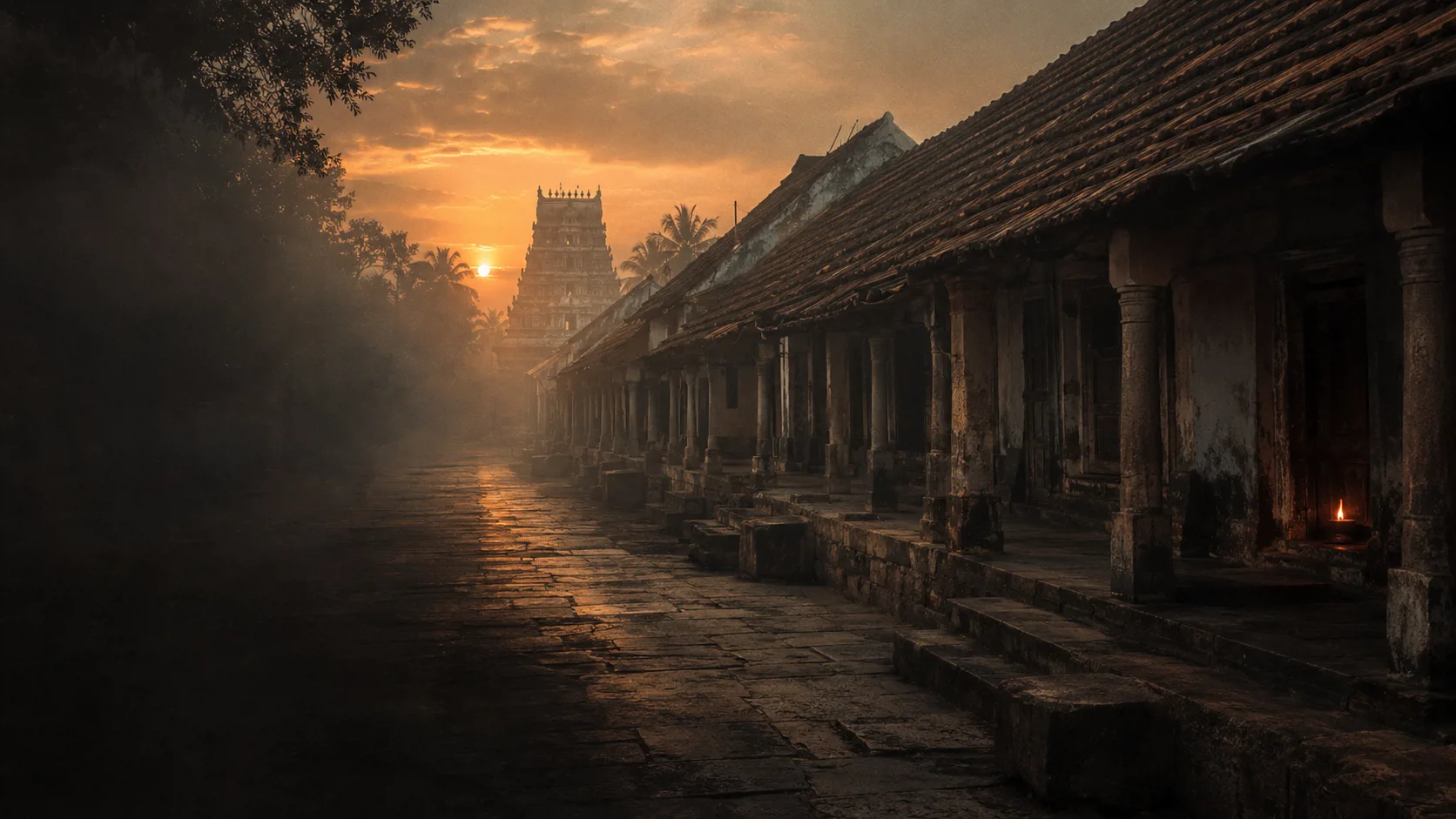
To understand a loss, you must first see what was lost. The standard telling of the Tamil Brahmin departure begins in the twentieth century, with quotas and protests and an exodus, and so it can never quite explain why the leaving should grieve anyone. This chronicle begins where it should — two millennia earlier, in a land that built one of the most sustained and self-aware civilizations on earth, in which Tamil and Sanskrit, temple and verse, king and priest and poet were not enemies but a single living weave. Only against that height does the modern severing reveal its true shape: not the correction of an injustice — though injustice there was — but the deliberate unpicking of a thousand-year synthesis, and the slow emptying of the people who had been its keepers. This is the chronicle of Tamil Nadu. The vanishing of its Brahmins is the bass note beneath every movement.
Part One — The Land That Was Built
I. The deep antiquity
The Tamil country is not young. By the time of the Sangam age — roughly the last centuries BCE into the early centuries CE — it possessed a literature of startling maturity, among the oldest bodies of classical literature in any living language. Three ancient dynasties — the Chera, Chola, and Pandya — already ruled the land the poets named Tamilakam.
It matters to state at the outset a fact the later mythmakers would labour to erase: there was no moment at which an alien "Aryan" civilization arrived to conquer a pristine "Dravidian" one. From the earliest layers we can read, the Tamil world was already in conversation with the wider Indic sphere — its kings performing Vedic sacrifices, Sanskrit and Tamil flowing together like the two rivers of a single delta. The synthesis was there, in the ground, from the beginning.
II. The age of temples
If one civilization had to stand for the whole, it would be the Cholas. After Vijayalaya seized Thanjavur around 848 CE, under Rajaraja I (985–1014) and his son Rajendra I (1014–1044) it became one of the great empires of the medieval world, its navy crossing the Bay of Bengal to Southeast Asia. Rajaraja's Brihadeeswarar temple at Thanjavur, a mountain of granite raised a thousand years ago, still stands as the defining monument of the Dravidian temple style — built by a Tamil king, to a Tamil land's God.
And here the chronicle delivers the fact that detonates the entire "Brahmin invader" thesis. The brahmadeya — the Brahmin-settlement village with its self-governing assembly, the sabha — was not an external imposition. It was a Tamil royal institution. The Pallava and Chola kings deliberately invited Brahmin families to settle, endowed them with land, and chartered their assemblies. The Uttaramerur inscriptions of the tenth century record, in extraordinary detail, the constitution of one such village assembly — an experiment in local self-government carved into temple stone at the order of a Tamil emperor.
The Brahmin village in the Tamil land was not a colony planted by invaders. It was a charter granted by Tamil kings.
This is the indigenous truth the twentieth century would invert. For a thousand years the Brahmin in Tamil Nadu lived where a Tamil king had asked him to live, tended a temple a Tamil king had built, recited in a Sanskrit that Tamil poets had long since married to their own tongue. To call this a foreign occupation is not a reading of history; it is a reversal of it.
How to weigh this section — Settled — The Chola imperial dates and reach; the Brihadeeswarar temple; the brahmadeya as an institution created and endowed by Pallava and Chola kings; the Uttaramerur inscriptions documenting a Brahmin-village assembly's constitution.
Contested — How egalitarian Chola society was overall (it had real hierarchies and bonded labour). The narrower point stands: the Brahmin presence was royally sponsored and indigenous, not an external conquest.
III. The saints, and the land's own answer to caste
Between roughly the sixth and ninth centuries the Tamil country produced one of the most powerful religious movements in Indian history — the Tamil bhakti tradition, the sixty-three Nayanars who sang of Shiva and the twelve Alvars who sang of Vishnu. Their hymns — the Tevaram, the Nalayira Divya Prabandham — were composed in Tamil and remain in daily liturgical use in the temples of the south to this day.
Two things cut against the later propaganda. First, the courts embraced and enshrined this Tamil-language devotion — the saints' images installed in stone within the great temples by royal order; the sacred was sung in Tamil and Sanskrit both, without contradiction. Second, the bhakti saints came from every rung of society — potters, fishermen, hunters, washermen, and those the orthodoxy counted as untouchable — carrying a genuine, organic critique of caste exclusivity. The Tamil land generated its own answer to hierarchy, from inside its own devotional tradition, more than a thousand years before any rationalist arrived to announce that the only cure was to break the gods.
How to weigh this section — Settled — The Nayanars and Alvars (6th–9th c.); the Tamil-language Tevaram and Divya Prabandham; royal enshrinement of the saints; the saints' diverse social origins, including the lowest castes.
Contested — How far bhakti dismantled caste versus softening it within a continuing order. That it offered an indigenous devotional critique of caste exclusivity is well-attested; that it abolished caste is not claimed.
IV. The seamless centuries
What the Cholas built and the saints sang, the centuries sustained. The great mathas — the Kanchi Kamakoti Peetham foremost in the Tamil country — preserved Sanskrit scholarship, ritual, and philosophy across generations. The agraharams, the Brahmin temple-streets, were working institutions: schools of recitation, keepers of a textual inheritance reaching back to the Vedas. This was the world that endured, more or less intact, into the nineteenth century — in which the Tamil Brahmin was a rooted figure, custodian of a particular knowledge within a far larger Tamil whole. He was not the whole. But he was woven into it so deeply that to pull his thread, later, would be to unravel a portion of the fabric itself.
Part Two — The Theory and the Animus
V. An idea imported from above
The unravelling began as a theory descending from the colonial study. In 1856 the Scottish missionary-linguist Robert Caldwell published his comparative grammar of the Dravidian languages. The linguistic finding was sound: Tamil and its sisters form a family distinct from Sanskrit. But Caldwell wrapped it in a story — that Sanskrit and the Vedic order had been carried south by Aryan Brahmin colonisers who subjugated a pristine Dravidian civilization. This was not a finding. It was a hypothesis with a future in politics, and it would become the founding myth of everything that followed.
Beside Caldwell ran the Aryan-race theorizing of Max Müller. Müller himself, late in life, recoiled from the racial reading, insisting "Aryan" named a family of languages, never a race or a bloodline. The correction came too late. In the Tamil south the race-version was seized not to understand the past but to weaponize it: the Brahmin, custodian of a tradition his own Tamil kings had endowed, reimagined overnight as a foreign invader. Because this single myth is the foundation of a century of politics, it cannot merely be named. It must be taken apart.
VI. The myth dismantled
The Aryan-Dravidian theory makes a specific, falsifiable claim: that a fair-skinned Aryan race swept in around the mid-second millennium BCE, militarily destroyed the Indus civilization, drove the Dravidians south, and imposed the Brahmin upon a conquered people. Almost every load-bearing element has collapsed under modern evidence.
There was no invasion. Wheeler's "massacre at Mohenjo-daro" has been abandoned — the remains reflect flood and disease, not battle. The Indus cities were not stormed; they were gradually abandoned as the climate dried and the Ghaggar-Hakra (Sarasvati) system failed. And the oldest texts are silent where the theory most needs them: the Rig Veda preserves no memory of a homeland or an invasion, and the Sangam literature preserves no Aryan-Dravidian war. A conquest with no trace in the archaeology, the victors' scripture, or the victims' literature is no conquest at all.
There was no pure race to invade. Ancient-DNA research dissolves the binary the theory needs. The subcontinent's population emerges from the mixing of several deep components — an Ancient Ancestral South Indian lineage, an Iranian-farmer-related lineage present in the Indus civilization itself, and later a Steppe-pastoralist component — none a tidy "race." The Rakhigarhi genome, from an Indus-era woman, carried no Steppe ancestry at all. There is no biological "Dravidian race" that an "Aryan race" displaced.
A conquest with no trace in the archaeology, none in the victors' scripture, and none in the victims' literature is no conquest at all.
What honestly remains. Honesty requires drawing the line precisely. What genetics has not overturned is the milder model that replaced the invasion: a gradual migration of Steppe-pastoralist peoples in the second millennium BCE, plausibly carrying Indo-European language. That picture remains mainstream and is debated; some Indian press badly overstated the findings as having "debunked" everything. But the decisive point: both readings annihilate the movement's myth. Invasion never happened; migration was admixture, not domination. Either way there was no Aryan overlord and no subjugated Dravidian — and by recorded Tamil history the Brahmin was an indigenous, royally-endowed figure.
The mirror-myth: Kumari Kandam
There is a final irony. To furnish the Dravidian race a grander pedigree, the movement reached for a second invented continent: Kumari Kandam, a sunken Tamil motherland — placed in 1920s schoolbook maps as sober geography. It is borrowed from the very colonial science the movement claims to resist: the zoologist Philip Sclater proposed a lost continent, "Lemuria," in 1864 to explain lemur fossils; plate tectonics killed it. Tamil revivalists grafted Lemuria onto Pandyan flood-legends and renamed it. Two facts puncture it: the geology is settled (Gondwana broke up hundreds of millions of years before humans existed), and the very name is half Sanskrit — kaṇḍam from khaṇḍa. A movement that denounces Sanskrit as foreign named its sacred homeland with a Sanskrit word, on the authority of a discarded British guess.
How to weigh this section — Settled — Caldwell's 1856 grammar; Müller's disavowal of the racial "Aryan." The invasion model is discredited: no Mohenjo-daro massacre, climate-driven Indus decline, no invasion memory in the Rig Veda or Sangam, no pure race in the genetic record (Rakhigarhi lacks Steppe ancestry). Kumari Kandam/Lemuria is debunked pseudo-geology.
Contested — The migration model — a gradual 2nd-millennium-BCE Steppe movement carrying Indo-European language — remains mainstream and is NOT debunked; "DNA disproved Aryan migration" overstates it. It still describes admixture, not conquest.
Characterization — That both the Aryan-invasion and Kumari Kandam myths are colonial-era pseudo-science adopted for political pedigree is a strong, defensible argument.
VII. Rank by learning, not by arms
By the late nineteenth century, under the Madras Presidency, Tamil Brahmins held positions far out of proportion to their roughly three percent of the population. This is true and should not be softened. But the mechanism is everything. The ascendancy flowed from a centuries-old culture of literacy meeting an examination system that rewarded it. There was no Brahmin army, no Brahmin throne — in two thousand years the Tamil country had Chera, Chola, Pandya, Pallava, Nayaka kings, and not one Brahmin kingdom. A studious minority had adapted fastest to a new colonial order. The movement's founding sleight of hand was to collapse the distinction — to speak of "Brahmin domination" as though over-representation in a clerkship were the same crime as a ruling caste holding a nation down by the sword.
A people that rose by reading was charged with the crimes of a people that rules by the sword — crimes it had never, in two thousand years, committed.
Varna, jati, and the colonial hardening
The movement's whole vocabulary turns on a word it rarely examines: caste. The classical scheme of varna is, on one influential reading, a description of vocation rather than a frozen birth-hierarchy, and quite distinct from the thousands of endogamous jati groupings that became lived caste. On this account the rigid, ranked, enumerated "caste system" the world pictures was substantially hardened by colonial administration — above all the decennial census from the 1870s, which forced fluid communities into fixed, counted, ranked boxes. This is a serious scholarly position with scholars on both sides; it does not erase the genuine, grievous cruelties of caste-as-practiced, above all against Dalits. But it bears on the Dravidian story, because that movement built its case on caste as the eternal essence of "Brahminism" — while the colonial state, and the very census that fed the reservation arithmetic, were themselves modern engines of the rigidity in question.
How to weigh this section — Settled — Brahmin over-representation in Madras Presidency institutions was real and arose through literacy and English education; no Brahmin kingdom ever ruled the Tamil country.
Contested — The "varna-as-vocation, rigid jati-caste as colonial hardening" thesis — substantial backing and substantial opposition among historians. Presented as a serious position, not as proven.
Characterization — "The British created caste" overstates it; "colonial census and administration significantly rigidified and ranked it" is widely argued. The cruelties of caste-as-lived, especially against Dalits, are not in dispute.
VIII. The animus made flesh
The theory found its prophet in E. V. Ramasamy — "Periyar" — who built the Self-Respect Movement and the Dravidar Kazhagam on an explicitly anti-Brahmin program. His acts must be weighed exactly, because the gap between the documented and the merely attributed is the gap between an indictment that holds and one a critic can dismiss.
The idol-breaking of 1953 — documented
On 27 May 1953 Periyar publicly smashed an idol of Ganesha at Tiruchirapalli, the culmination of an announced campaign. His stated aim was to "eradicate the gods" he held responsible for hierarchy, beginning with Ganesha "because it is he who is worshipped before undertaking any task." A complaint was filed; the courts dismissed it, reasoning that an unconsecrated idol was, in law, no different from a shop doll. For those who revered the image their ancestors had carried in procession for a thousand years, it was desecration, and it was meant to be felt as such.
The 1973 Karaikudi speech — documented, and eliminationist
The gravest charge is not hostile paraphrase. In a 1973 speech at Karaikudi, recorded in the Collected Works of Periyar E.V.R. compiled by his own successor K. Veeramani, Periyar set out a chilling calculus: that wherever a Brahmin was found he should be killed and destroyed, and that if some non-Brahmins died in the attempt, the arithmetic was acceptable — for even at a cost of three in a hundred, the Tamil Brahmin would be "eliminated." This is preserved in the movement's own canon. To call it eliminationist is not exaggeration but description.
Wherever we find a Paapaan, we must kill and destroy him… Tamil Brahmins will be eliminated. We will definitely go to this level.
— attributed to Periyar, Karaikudi 1973, as printed in the movement's own Collected Works
What must be flagged, not asserted
Two related claims do not meet that standard. The famous line — "if you see a snake and a Brahmin, kill the Brahmin first" — is widely attributed but its authenticity is disputed even by Periyar's critics; treat it as attributed, not verified. And in a separate 1957 case, Periyar was charged with urging people to kill Brahmins and burn their houses — yet a review of the three speeches submitted to that court found those particular speeches did not contain such exhortations. The honest summary: the 1973 speech is real and damning on its own; the snake aphorism is unverified; the 1957 record is mixed.
How to weigh this section — Settled — The 27 May 1953 idol-breaking and dismissed case; the 1973 Karaikudi speech as printed in Veeramani's Collected Works of Periyar, with its explicit eliminationist content.
Contested — The "snake and a Brahmin" line (authenticity disputed); the 1957 prosecution, whose charged speeches were found NOT to contain the killing exhortation.
Characterization — "Eliminationist" fairly describes the 1973 text on its face. Defenders read Periyar's violent rhetoric as deliberate shock-provocation — an account of intent that does not soften the words.
Part Three — The Severing
IX. The nation that was nearly demanded
The movement was, in its formative decades, openly a secessionist project. In 1939 Periyar convened the Dravida Nadu Conference and raised "Dravida Nadu for Dravidians"; in 1940 the Justice Party resolved for a sovereign Dravida Nadu, and a secession committee formed that June at Kanchipuram — the very town whose temples and ancient matha embody the civilization of Part One.
And it sought its allies accordingly. Through the 1940s Periyar backed the Muslim League's demand for Pakistan and expected reciprocal support for Dravidistan. Jinnah, in an interview with the Governor of Madras, proposed India be split four ways — Hindustan, Pakistan, Bangalistan, Dravidistan — and offered Periyar his sympathy. In 1947 Jinnah declined to act on it. The demand persisted until 1963, when, after the China war made secession untenable, Parliament passed the Sixteenth Amendment criminalizing it and Annadurai dropped the claim. As recently as 2021 the senior DMK leader A. Raja stated publicly that Periyar supported a separate nation "till his last breath." One is entitled to ask what it means that a sacred temple-land was very nearly bargained into a separate state by men who proposed to dissolve its religion along the way.
How to weigh this section — Settled — The 1939 Dravida Nadu Conference; the 1940 sovereignty resolution and Kanchipuram secession committee; Periyar's alignment with the Muslim League and Jinnah's four-way partition proposal; Jinnah's 1947 refusal; the 1963 Sixteenth Amendment and Annadurai's abandonment of the demand; A. Raja's 2021 confirmation of Periyar's lifelong separatism.
Contested — How achievable Dravidistan ever was; defenders read it as leverage for autonomy rather than genuine intent to leave India.
X. The crimes against a community
What the rhetoric promised, the decades delivered in a lower key — a long attrition. From 1967 the Dravidian parties governed almost without interruption. The state assumed control of the great temples through its religious-endowments apparatus. Traditional Sanskrit learning lost patronage. And the community cast as the oppressor found public life narrowing around it. Alongside the institutional pressure ran something cruder — documented episodes of humiliation and assault, the cutting of the kudumi and the sacred thread — that fed a partial exodus. The departure was over-determined: pulled by opportunity for the fortunate, pushed by hostility for the rest. Both were real; the standard account remembers only the first.
The arrest of the Kanchi Acharya, 2004
The single most shocking blow came on the night of 11 November 2004 — Diwali. The head of the Kanchi Kamakoti Peetham, whose lineage reaches into the civilization of Part One, was arrested over the murder of Sankararaman, a temple manager who had accused the mutt of financial wrongdoing. Jayendra Saraswathi and later his junior Vijayendra Saraswathi were charged with conspiracy. The arrest of a sitting Shankaracharya on a murder charge, on the most auspicious night of the Hindu year, sent a shock through Hindu India that has not faded. Nine years later, on 27 November 2013, a Puducherry court acquitted all twenty-four accused — scores of witnesses turned hostile, the victim's own family failed to identify the accused, and the judge found no incriminating evidence.
Honesty requires a hard qualification, and it strengthens the larger argument. This episode does not slot cleanly into "the Dravidian ideology hunts Brahmins." The arresting government was Jayalalithaa's AIADMK, led by a chief minister who was herself an Iyengar Brahmin; the case is widely read as personal animus, and Karunanidhi's DMK initially welcomed the arrest before retreating from it. The wound — the spectacle of the community's holiest living institution treated as a criminal conspiracy — was entirely real. Its proximate cause was murkier and more personal than the cleanest telling allows.
How to weigh this section — Settled — State control of temples via the endowments apparatus; documented episodes of assault (tuft- and thread-cutting) contributing to a partial Brahmin departure; the Kanchi seer's Diwali 2004 arrest and the November 2013 acquittal of all accused on collapsed evidence.
Contested — The motive behind the Kanchi arrest — personal vendetta by Jayalalithaa (a Brahmin) versus institutional anti-Hindu intent; the evidence leans toward the former. The relative weight of "pull" versus "push" in the exodus is genuinely debated.
Characterization — That the long Dravidian era was hostile to the Brahmin-led religious order is fair as lived experience; that every action against a Hindu institution was a single coordinated campaign is not supported.
XI. The house against itself
Before the movement's contradictions of principle, there are its contradictions of conduct. The Dravidian story is one of a noble, unified ideology marching across a century; the actual record is a chain of feuds in which the ideology was repeatedly the costume worn by personal ambition.
Periyar and Anna: the founding rupture
The first break came from the founder. In 1949 Periyar, then about seventy, married Maniammai, his assistant, who was thirty-two — a gap of nearly four decades. The match scandalized the senior ranks, and the manner compounded it: Periyar declared he trusted none of his lieutenants enough to inherit the Dravidar Kazhagam, and would instead install Maniammai. Coupled with a secretive meeting Periyar held with Rajaji — a Brahmin, the very emblem of what the movement opposed — the affront was too much for C. N. Annadurai. On 17 September 1949, Anna broke away and founded the DMK, declaring the "disgrace" Periyar had brought upon the Kazhagam.
Historians supply the qualification: the marriage was the trigger and pretext more than the sole cause — Anna's own ambitions and ideological differences were already pulling the two apart. But that only sharpens the point. The movement's foundational schism was a collision of personal ambition and personal scandal, dressed afterward in the language of principle.
MGR and Karunanidhi: the icon who called the icon corrupt
The next rupture was uglier, an open charge of corruption between two men now both revered as Dravidian demigods. After Anna's death in 1969, M. Karunanidhi took the DMK and the chief ministership. M. G. Ramachandran — MGR, the party treasurer — fell out with him, publicly alleged the leadership was corrupt and demanded members declare their assets. On 11 October 1972 he was expelled for "anti-party activities"; days later he founded the breakaway AIADMK, pointedly inserting "Anna" into its name to claim that he, not Karunanidhi, was the true heir to Annadurai. Every chief minister of Tamil Nadu since 1967 has come from one of these two warring children of a single quarrel.
The feud as the only constant
The pattern never broke. After Jayalalithaa's death in 2016 the AIADMK dissolved into open factional war — and an observer's verdict on it is the epitaph for the whole movement's claim to ideology: the rival factions, it was noted, have "no ideological or political disagreements between them" at all. The fight is purely for the inheritance. Within the DMK's own first family, Karunanidhi's sons Alagiri and Stalin waged their own succession war. A movement that began by breaking from its founder over a marriage and a throne has spent its whole life breaking over thrones — which tells you what was always at the center, and what was always only the costume.
How to weigh this section — Settled — Periyar's 1949 marriage to Maniammai (he ~70, she 32) and his choice of her as successor; Anna's 17 September 1949 breakaway founding the DMK; MGR's 1972 corruption allegations against Karunanidhi, his October 1972 expulsion and founding of the AIADMK; the post-2016 AIADMK factional war and the Alagiri–Stalin DMK succession fight.
Contested — Whether the Periyar marriage was the true cause of the Anna split or its trigger/pretext for a rupture already driven by ambition and ideology — historians lean toward the latter, which this section adopts.
Characterization — Reading the chain of splits as proof that "the ideology was always a costume for power" is interpretation; the splits, their dates, and stated causes are fact.
XII. The hypocrisies
A movement is fairly judged against its own stated principles. By that test, the Dravidian establishment carries contradictions it has never resolved.
The enemy that no longer lives there
The Tamil Brahmin population has dwindled to a remnant; the community cast as the oppressor has mostly gone. Yet the rhetoric does not retire. In September 2023, Udhayanidhi Stalin — Karunanidhi's grandson, the dynasty's fourth generation — compared Sanatana Dharma to dengue, malaria, and corona and called for its "eradication," and, challenged, refused to apologize, invoking Periyar and Karunanidhi as his warrant. A hundred years on, with the supposed dominators reduced to a sliver and scattered across the world, the language of extermination is still deployed against the faith itself.
When the enemy has gone and the war goes on, the war was never really about the enemy.
The devotee at the ballot box
Here is the contradiction that lives in the led. Walk through any town at dawn and you see them: the faithful with vibhūti on the brow or a dot of kumkum between the eyes, stopping at the street-corner shrine, lighting the morning lamp. Tamil Nadu remains one of the most visibly devout Hindu societies on earth. And a great many of these same devout Hindus return, election after election, to vote for parties whose founding scripture calls for breaking their idols and whose ministers liken their faith to a disease. They wear the ash of Shiva to the polling booth and cast a ballot for the men who would scrub it off. Whatever else this is, it is not the behaviour of a people who believe the ideology they are voting for — which raises the question the movement now exists to avoid: is there any ideology left in Dravidian politics at all, or only the machinery of power wearing an ideology's old clothes?
The conversions, and the question of whose project this is
There is a further line of critique, to be stated at exactly its evidentiary weight. The movement's animus was never confined to Brahmins; at its rationalist core it was against the Hindu order as such. Critics argue this hostility has run in parallel with Christian missionary activity, and point to the open affiliations of movement figures — Udhayanidhi Stalin has publicly identified himself as Christian — as evidence that the war on "Sanatana" serves interests beyond Tamil self-respect. This is a serious and contested charge. The narrow, documented part: a movement that presents itself as the voice of an indigenous people has, in its leadership and its targets, often aligned against the indigenous religion of that same people, while treating Abrahamic faiths with a tenderness it never extends to the temple. Whether that is a coordinated conversion project, as its sharpest critics allege, the evidence does not let one assert as fact — so it is offered here as the question it honestly is.
The challenger who is no challenger
Even the apparent revolt against the establishment is the establishment in a new costume. The actor Vijay's party, Tamilaga Vetri Kazhagam, rose to contest the 2026 election as a frontal opponent of the DMK, campaigning against "one-family" rule. Yet TVK draws its lineage straight from the Dravidian fount: Vijay invokes Periyar, Anna, and Ambedkar, names the BJP his "ideological enemy," and warns that "you can't oppose Anna and Periyar and expect to win here." Observers describe his platform as a modern version of Dravidian ideology. So the great alternative to the Dravidian parties is another Dravidian party. He fought the DMK, but he is one of them — no different in creed, only in face.
How to weigh this section — Settled — The DMK's three-generation family succession (Karunanidhi → Stalin → Udhayanidhi); Udhayanidhi's September 2023 remarks and refusal to apologize; Tamil Nadu's continued mass Hindu observance; Vijay/TVK's self-declared descent from Periyar, Anna and Ambedkar and its frontal-but-intra-Dravidian opposition to the DMK in the 2026 election.
Contested — Whether dynastic succession is hypocrisy or ordinary party politics; whether "eradicate Sanatana" targets a principle or a people; whether the anti-Hindu drive constitutes a coordinated Christian-conversion project — alleged by critics, not established as fact. TVK's 2026 result/role is not reliably settled.
Characterization — The "devotee voting against his own faith" and "no ideology left, only machinery" framings are pointed interpretation; the underlying facts are real.
XIII. What survived
Honesty requires conceding what the movement's defenders get right. Caste-as-lived produced real and grievous injustice, above all against Dalits, and confronting it was a legitimate and overdue aim. The Dravidian project delivered measurable inclusion — temple entry, mass schooling, the midday meal — that lifted millions. Any telling that says the movement was nothing but cruelty is propaganda in the other direction.
But the ledger has a second side the standard account suppresses. A community that rose by learning rather than conquest — that in two thousand years founded no kingdom and raised no army — was recast as a conqueror, charged with crimes it never committed, on the strength of a racial myth the evidence has since demolished. It was subjected, in its founder-adversary's recorded words, to eliminationist rhetoric. It watched its sacred images broken as theatre, its holiest living seat arraigned as a conspiracy, and its very faith likened to a disease. And it was thinned, across a century, from the soil of one of the most sacred Hindu landscapes on earth.
And yet — this is the truest part — they are still here. Against a hundred years of pressure designed to erase them, Brahmins still live in Tamil Nadu. The Vedic recitation has not fallen silent. The temples still stand; the lamps are still lit at dawn; the festival calendar still turns; the mathas still ordain their successors. Dharma, which the powerful spent a century vowing to eradicate, persists in the very land that vowed it. One may read this as the resilience of a tradition too deeply rooted to pull out, or, as many in the community quietly believe, as something closer to grace: that a civilization this sacred does not vanish merely because men in office will it gone.
And those who left did not fall. Driven out with little but what they carried in their heads — the one inheritance no order could confiscate — the emigrant Tamil Brahmins rebuilt, in Chennai and Bangalore and New Jersey and the Bay Area, lives of quiet dignity founded on exactly the two things for which they had been hated: knowledge and work. And they did it without shedding what they were told to be ashamed of — the morning sandhya, the festivals observed half a world from the river, the children taught the verses. A people that was supposed to be a relic of oppression turned out to be a tradition of endurance.
This is the chronicle entire: a land that built a civilization of extraordinary depth, and a movement that, mistaking the keepers of one thread for usurpers of the whole, spent a century trying to pull it — and a thread that, frayed and scattered and grieving, did not break. The wrong done to the many and the wrong done to the few are both real, and the second is the one almost never spoken aloud. But the last word is not the wrong. The last word is that the lamps are still lit — in the old streets that were meant to fall silent, and in a hundred new cities across the world — and that whoever lights them is still, after everything, exactly who they always were.
A note on method & sources — This chronicle separates settled fact, contested interpretation, and political characterization, and marks them as it goes. Documented claims — the Cholas, the brahmadeya and Uttaramerur, the Nayanars/Alvars, the 1953 idol-breaking, the 1973 Karaikudi speech in the movement's own Collected Works, the Dravida Nadu/Jinnah record, the 1949 and 1972 splits, the 2004 Kanchi arrest and 2013 acquittal, the 2023 remarks — are stated plainly. The Aryan-Dravidian theory is dismantled only as far as the evidence allows: the invasion model is discredited, the migration model remains live and is flagged as such. Disputed or attributed claims — the "snake and Brahmin" line, the 1957 charged speeches, the varna-versus-colonial-caste thesis, the conversion allegation — are marked, not asserted. The aim is the whole story, weighed.