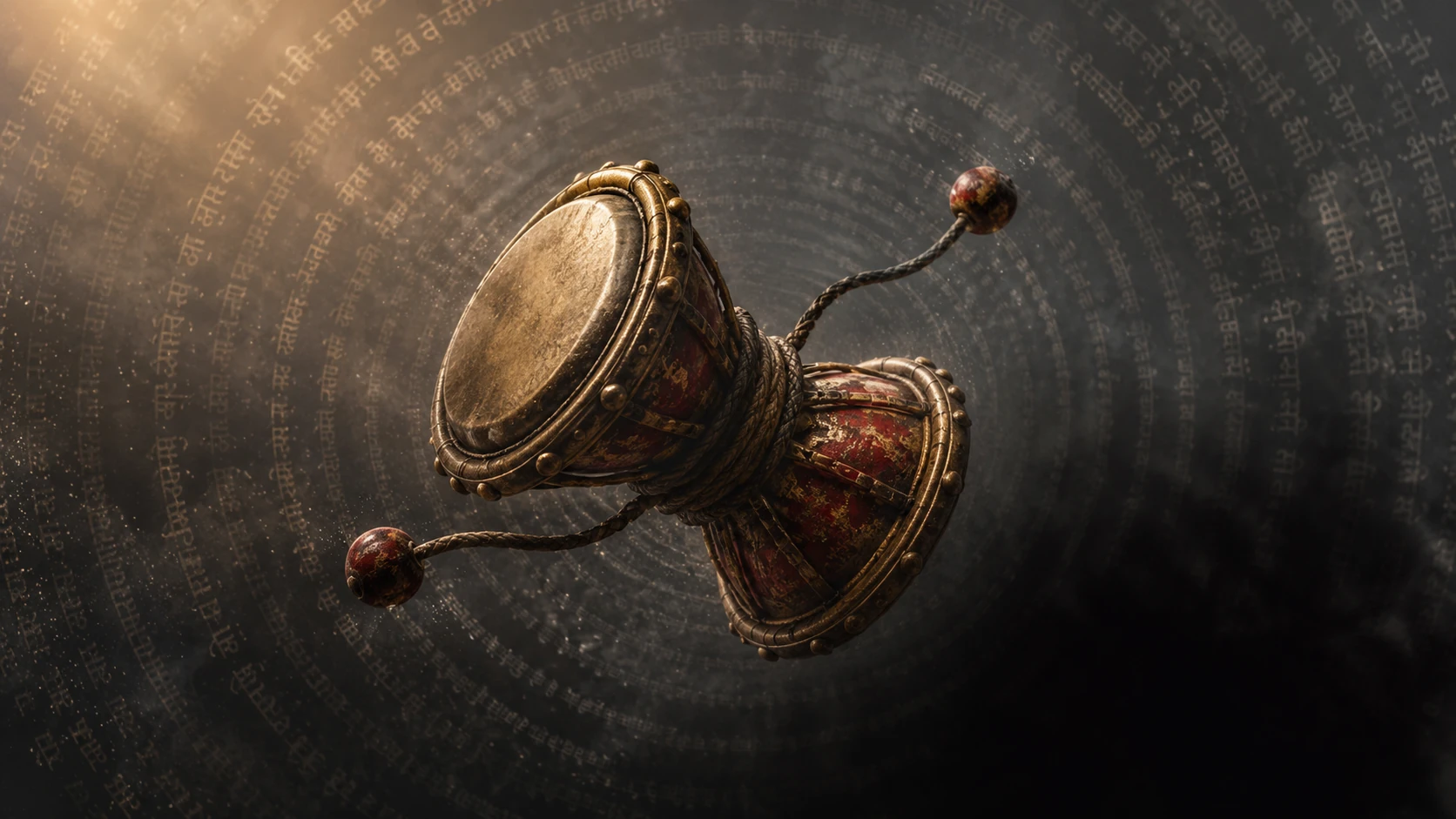
There is a sentence in the Sanskrit grammatical tradition that no other civilisation has been able to write, because no other civilisation put its science of language and its science of the Self into the same mouth. The sentence is this: the alphabet is not a convention. It is not a human agreement about which scratch shall stand for which noise. It is an ordered emanation, struck out of the drum of Śiva at the end of his dance, and its order is the order in which the world came to be.
Fourteen short strings of sounds — अ इ उ ण्, ऋ ऌ क्, and so on to ह ल् — stand at the head of Pāṇini's Aṣṭādhyāyī. Every student of Sanskrit memorises them in the first week and then, for the most part, treats them as a lookup table: a compression scheme, an index, plumbing. The plumbing is real, and it is astonishing plumbing. But the tradition that transmitted these fourteen lines never regarded them as merely useful. It called them the Māheśvara Sūtras — the aphorisms of Maheśvara — and it held that a man who understood their sequence understood the sequence of creation.
This essay takes both claims seriously at once: the technical claim, which can be demonstrated on paper in an afternoon, and the metaphysical claim, transmitted most fully in the Nandikeśvara Kāśikā, which cannot be demonstrated that way and was never meant to be. They are not rivals. The argument of the following pages is that they are the same claim, spoken at two depths.
I · The Drum — the end of the dance
The scene is fixed in a single verse, prefixed to the Nandikeśvara Kāśikā and repeated at the opening of a hundred commentaries and a thousand classrooms:
नृत्तावसाने नटराजराजो ननाद ढक्कां नवपञ्चवारम् ।
उद्धर्तुकामः सनकादिसिद्धानेतद्विमर्शे शिवसूत्रजालम् ॥
nṛttāvasāne naṭarājarājo nanāda ḍhakkāṃ navapañcavāram |
uddhartukāmaḥ sanakādisiddhān etad vimarśe śivasūtrajālam ||
At the ending of the dance, the King of Dancers sounded his drum nine-and-five times, wishing to lift up Sanaka and the other perfected ones. This net of Śiva-sūtras is for their contemplation.
Maṅgala-śloka, Nandikeśvara Kāśikā

Four things in that verse deserve to be read slowly, because they are not ornament.
At the ending of the dance. Not during. The tāṇḍava is the cosmic process itself — the five acts of emission, maintenance, withdrawal, concealment and grace. The sounds come after, when the process has run its course. Grammar is not made in the middle of the world's becoming; it is what remains legible when the becoming completes. The tradition is telling us that language is a residue of cosmology, not a tool laid over it.
Nine-and-five. Nava-pañca-vāram. The verse will not simply say "fourteen." It splits the number, in the manner of Sanskrit numerical compounding, and in doing so it makes the reader perform the addition — a small act of participation, the first of many the text will demand.
Wishing to lift up Sanaka and the others. The four mind-born sons of Brahmā, eternally youths, the archetypal recipients of the highest instruction. The drum was not struck for philologists. It was struck as an act of anugraha — grace — for beings already advanced enough that an alphabet was sufficient instruction. That is a very high claim about what an alphabet is.
This net of Śiva-sūtras is for their contemplation. Vimarśa — not "study," not "reference," but reflective self-awareness, the term that Śaiva thought reserves for consciousness turning upon itself. And jāla, a net: the fourteen strings are woven, they catch things, and one enters them at any point and finds oneself connected to every other point.
The same tradition gives Pāṇini himself a lineage in one line, and it is worth noticing where the grammar is said to have come from:
येनाक्षरसमाम्नायमधिगम्य महेश्वरात् ।
कृत्स्नं व्याकरणं प्रोक्तं तस्मै पाणिनये नमः ॥
yenākṣarasamāmnāyam adhigamya maheśvarāt |
kṛtsnaṃ vyākaraṇaṃ proktaṃ tasmai pāṇinaye namaḥ ||
Salutation to that Pāṇini, who — having received the ordered recitation of sounds from Maheśvara — set forth the whole of grammar.
Traditional benedictory verse
The word to hold is akṣarasamāmnāya. Samāmnāya is the term used for the Veda itself: a handed-down, fixed, orally transmitted sequence. Not a list — a recitation. The sounds are not inventory; they are liturgy. And akṣara carries its own double: "syllable," and "the imperishable."
The Pāṇinīya Śikṣā, the phonetic manual attached to the Pāṇinian school, says the same thing without narrative:
त्रिषष्टिश्चतुःषष्टिर्वा वर्णाः शम्भुमते मताः ।
प्राकृते संस्कृते चापि स्वयं प्रोक्ताः स्वयम्भुवा ॥
triṣaṣṭiś catuḥṣaṣṭir vā varṇāḥ śambhumate matāḥ |
prākṛte saṃskṛte cāpi svayaṃ proktāḥ svayambhuvā ||
Sixty-three, or sixty-four, are the sounds held in Śambhu's doctrine — in the natural tongue as in the refined, uttered by the Self-existent himself.
Pāṇinīya Śikṣā 3
"In Śambhu's doctrine" — śambhumate. The phonetic inventory of Sanskrit is filed, by the phoneticians themselves, under Śiva. This is not a late devotional accretion pasted onto a dry technical corpus. It is in the technical corpus, at its head, in its own vocabulary. `Settled`
II · The Text — the fourteen, as they stand
Before interpretation, the object. Here are the fourteen sūtras with their final markers separated, so that the machine is visible.
The fourteen Maheshvara Sutras with their sounds and markers
| # | Sūtra | IAST | Sounds released | Marker |
|---|---|---|---|---|
| 1 | अ इ उ ण् | a i u ṇ | the three simple vowels | ण् |
| 2 | ऋ ऌ क् | ṛ ḷ k | the two vocalic liquids | क् |
| 3 | ए ओ ङ् | e o ṅ | the two guṇa diphthongs | ङ् |
| 4 | ऐ औ च् | ai au c | the two vṛddhi diphthongs | च् |
| 5 | ह य व र ट् | ha ya va ra ṭ | aspirate + three semivowels | ट् |
| 6 | ल ण् | la ṇ | the fourth semivowel | ण् |
| 7 | ञ म ङ ण न म् | ña ma ṅa ṇa na m | the five nasals | म् |
| 8 | झ भ ञ् | jha bha ñ | two voiced aspirates | ञ् |
| 9 | घ ढ ध ष् | gha ḍha dha ṣ | three voiced aspirates | ष् |
| 10 | ज ब ग ड द श् | ja ba ga ḍa da ś | five voiced unaspirates | श् |
| 11 | ख फ छ ठ थ च ट त व् | kha pha cha ṭha tha ca ṭa ta v | voiceless aspirates + unaspirates | व् |
| 12 | क प य् | ka pa y | the two remaining voiceless stops | य् |
| 13 | श ष स र् | śa ṣa sa r | the three sibilants | र् |
| 14 | ह ल् | ha l | the aspirate, a second time | ल् |
Two irregularities are visible immediately and both will matter enormously later. ण् appears twice as a marker, at sūtras 1 and 6. And ह appears twice as a sound, at the beginning of the consonants (sūtra 5) and again, alone, at the very end (sūtra 14). Nothing else repeats. A tradition that produced the most economical formal system of the ancient world did not repeat two items by accident.
The string, as one line

Read the fourteen as the single continuous recitation they are, and the spans become visible:
The principal pratyaharas and the spans they name
| Pratyāhāra | Spans | Names |
|---|---|---|
| ac | अ → औ | every vowel |
| hal | ह (5) → ह (14) | every consonant |
| ik | इ उ ऋ ऌ | the four simple non-a vowels |
| ec | ए ओ ऐ औ | the four diphthongs |
| yaṇ | य व र ल | the four semivowels |
| jhaṣ | झ भ घ ढ ध | the voiced aspirated stops |
| śal | श ष स ह | the sibilants and h |
III · The Machine — how fourteen lines carry a grammar
Pāṇini's Aṣṭādhyāyī is about four thousand rules. It derives, from roots and affixes, any well-formed utterance of the language — and it does so in a notation so compressed that a single rule of three words can govern thousands of forms. That compression is bought with the fourteen sūtras, through three devices declared in the grammar's own opening chapter.
One — the marker is not a sound. Two rules establish that certain elements in the teaching-form of the language are diacritical rather than phonetic:
हलन्त्यम् — hal antyam (1.3.3): a final consonant, in the instructional utterance, is an it — a marker.
उपदेशेऽजनुनासिक इत् — upadeśe'j anunāsika it (1.3.2): in the instructional utterance, a nasalised vowel is a marker.
तस्य लोपः — tasya lopaḥ (1.3.9): and the marker disappears.
So the fourteen consonants ण् क् ङ् च् ट् ण् म् ञ् ष् श् व् य् र् ल् are silent scaffolding. They exist only to be pointed at.
Two — first sound plus final marker names the span. The whole apparatus turns on one rule:
आदिरन्त्येन सहेता ॥ १.१.७१ ॥
ādir antyena sahetā
An initial sound, together with a final marker, [denotes itself and everything intervening].
Aṣṭādhyāyī 1.1.71
Take the first sound अ and the marker च् of sūtra 4: you get ac, which names every sound from अ to औ — every vowel in the language, in one syllable. Take ह of sūtra 5 and the marker ल् of sūtra 14: you get hal, every consonant. Take इ and क्: ik, the four vowels इ उ ऋ ऌ. Take य and ण् of sūtra 6: yaṇ, the four semivowels.
These abbreviations are the pratyāhāras. The grammatical tradition counts forty-one of them in actual service in the Aṣṭādhyāyī, out of a somewhat larger set the string could in principle yield. `Contested` The exact tally varies by how one counts markers that do double duty; the number is a bookkeeping question, not a doctrinal one.
Three — the rule that shows the whole thing working. Here is the most quoted line in Sanskrit grammar, three words long:
इको यणचि ॥ ६.१.७७ ॥
iko yaṇ aci
In place of ik, [there is] yaṇ, when ac follows.
Aṣṭādhyāyī 6.1.77
Unpacked: the vowels इ उ ऋ ऌ become the semivowels य व र ल respectively when any vowel follows. That is why dadhi + atra becomes dadhyatra, madhu + atra becomes madhvatra, dhātṛ + aṃśa becomes dhātraṃśa. Four correspondences, an entire class of junctures across the whole language, in five syllables — and the correspondence is positional: the first member of ik maps to the first of yaṇ, the second to the second, an ordering guaranteed by the sequence in the fourteen sūtras and by nothing else.
Two more rules of the same kind open the grammar itself. वृद्धिरादैच् — vṛddhir ādaic (1.1.1): the term vṛddhi denotes आ and the sounds of aic, namely ऐ and औ. And अदेङ् गुणः — adeṅ guṇaḥ (1.1.2): the term guṇa denotes अ and the sounds of eṅ, namely ए and ओ. Sūtras 3 and 4 of Śiva's drum exist precisely so that these two grades of vowel-strengthening can each be named in a single breath.
Why grammar at all
Patañjali, opening the Mahābhāṣya, asks the blunt question — what is grammar for? — and answers with a compound that has been quoted ever since: रक्षोहागमलघ्वसन्देहाः प्रयोजनम्. Rakṣā, the protection of the Vedic word from corruption. Ūha, the ability to modify a mantra correctly when ritual requires it. Āgama, the injunction to study. Laghu, economy — the shortest road to mastery. Asandeha, the removal of doubt about meaning. Grammar is one of the six vedāṅgas because a tradition transmitted by sound has to defend sound with a science.
IV · The Proof — why this order and no other
Here is the question that separates admiration from understanding. The sounds of Sanskrit could be arranged in an unimaginable number of sequences. The traditional varṇamālā — the arrangement children learn, क ख ग घ ङ and so on by place of articulation — is beautifully systematic and is not the order used here. Why does the drum give this order, which looks, at first glance, scrambled?
Because this order is the one that permits the required sets to be named as contiguous spans, and it is the shortest such order.
Every rule of the grammar needs to refer to some set of sounds: all vowels, all consonants, all semivowels, all nasals, the sibilants plus h, the voiced aspirates. A pratyāhāra can only name a set if that set sits together in the string. So the string has to be sequenced such that every set the grammar will ever need forms an unbroken run. That is a hard combinatorial constraint, and satisfying it while keeping the string as short as possible — that is, adding as few duplicate entries as possible — is harder still.
The fourteen sūtras satisfy it, with exactly one duplicated sound: ह. That is the price. One repeated letter. `Settled`
Formal analysis in our own time has confirmed what the tradition asserted: that no shorter arrangement can do the work, and that the duplication of h is not merely acceptable but necessary given the sets Pāṇini needs. `Settled` The result was proved, not assumed, and it stands as one of the very few places where a claim about an ancient Indian technical text has been converted into a theorem. It is worth saying plainly what that means: Pāṇini, or the tradition behind him, solved an optimisation problem in formal language design roughly twenty-four centuries before there was a field with that name.
The doubled ण् marker is the second irregularity, and it has been chewed over by commentators for two millennia. Because ण् closes both sūtra 1 and sūtra 6, the abbreviation aṇ is ambiguous: it can mean the three vowels अ इ उ, or everything from अ through ल — all vowels plus all semivowels. Pāṇini uses it in both senses, and the tradition resolves each occurrence by context and by interpretive maxims (paribhāṣās). `Contested` Modern readers sometimes present this as a flaw. It is better read as a deliberate purchase: an ambiguity resolvable by rule is cheaper than an extra marker carried through the whole system.
Set that aside for a moment and notice what has just been established. The order of the Māheśvara Sūtras is necessary. It could not have been otherwise. The tradition says: this is because it is the order in which the world came out. The formalist says: this is because it is the unique minimal solution to a set-covering problem. Both statements say the sequence is not arbitrary. They disagree only about what kind of necessity it is.
V · Śikṣā — how a sound is born
Before the metaphysical reading, one more piece of the technical apparatus, because the metaphysical reading will turn out to be its exact inversion.
Śikṣā, the first of the six limbs of the Veda, is phonetics. The Taittirīya Upaniṣad opens its instructional portion by announcing it: शीक्षां व्याख्यास्यामः। वर्णः स्वरः। मात्रा बलम्। साम सन्तानः। — "We shall expound Śikṣā: sound, accent, quantity, effort, uniformity, junction." Six categories, and every one of them is about the body producing air and the air producing form.
The Pāṇinīya Śikṣā then gives the most remarkable description of speech-production in ancient literature, and it begins not at the lungs but at the Self:
आत्मा बुद्ध्या समेत्यार्थान् मनो युङ्क्ते विवक्षया ।
मनः कायाग्निमाहन्ति स प्रेरयति मारुतम् ॥
ātmā buddhyā sametyārthān mano yuṅkte vivakṣayā |
manaḥ kāyāgnim āhanti sa prerayati mārutam ||
The Self, meeting objects with the intellect, yokes the mind with the desire to speak. The mind strikes the bodily fire, and that fire drives the wind.
Pāṇinīya Śikṣā 6
The chain is: ātman → buddhi → manas → kāyāgni → mārut — Self, intellect, mind, digestive fire, breath — and only then does breath, striking the points of articulation, become sound. Speech is the last link of a metaphysical chain, not the first link of a physical one. Consciousness is upstream of phonetics.
Hold that. In the reading we come to now, the chain runs the other way: sound is upstream of the elements, the organs, the breaths, the mind. The two are not in contradiction. They are the two directions of one movement — sṛṣṭi outward, laya back — which is precisely why the string begins and ends with ह.
VI · Nandikeśvara — the Kāśikā and its claim
The Nandikeśvara Kāśikā — also transmitted as the Kāśikā of Nandikeśvara, and not to be confused with the well-known Kāśikāvṛtti commentary on the Aṣṭādhyāyī — is a short work of some twenty-seven verses attributed to Nandikeśvara, the attendant and teacher-figure of Śiva. It carries a commentary by Upamanyu. Its date is unsettled and its authorship is traditional rather than documented. `Contested`
Its method is simple and its ambition is total. It takes each of the fourteen sūtras in sequence and assigns to it a stage of manifestation — from the attributeless absolute, through the appearance of māyā, the constitution of Īśvara, the will to expand, the five elements, the subtle qualities, the organs of action, the organs of knowledge, the vital breaths and the inner instrument, Prakṛti and Puruṣa, the three guṇas — and finally the withdrawal of the whole into the silence from which it came.
The reader who arrives from a philological training will want to know whether this is "in" the text or "read into" it. That question, put that way, already contains a foreign premise: that a text has one meaning, that this meaning is what its historical author intended, and that anything further is imposition. Sanskrit hermeneutics does not grant the premise. A sūtra is defined as an utterance of minimal syllables and maximal capacity; a mantra operates at levels its reciter need not comprehend; the same akṣara is simultaneously a phoneme, a syllable, and the imperishable. The Aṣṭādhyāyī's use of the fourteen sūtras is one adhikāra, one domain of application. Nandikeśvara's is another. Neither cancels the other, any more than a chemist's account of a lamp cancels the fact that it is lit for worship.
VII · The Emanation — the fourteen as cosmogony

१ · अ इ उ ण् — a i u ṇ — the three simple vowels
अ is the inner principle, the cause of origin of all worlds and all sounds: the attributeless Brahman, dwelling in all objects and coloured by none. इ is citkalā — the ray or portion of consciousness — which is māyā. उ is Īśvara: इ joined to अ, the absolute qualified by māyā, and therefore the Lord standing as the universe. And ण् is the sheer is-ness of that Lord — existence itself, the marker that does not sound because being is not an item among beings.
Before creation there was no world; Brahman stood as अ. इ, by its proximity to अ, becomes the cause of the world — and, it goes without saying, of every remaining sound.
That अ should be the absolute is not Nandikeśvara's invention. अ is the sound the throat makes when it is simply open; every other vowel is a modification of it; it is inherent in every Devanāgarī consonant. Kṛṣṇa says it himself in the enumeration of his glories:
अक्षराणामकारोऽस्मि द्वन्द्वः सामासिकस्य च ।
akṣarāṇām akāro'smi dvandvaḥ sāmāsikasya ca |
Among sounds I am the sound a; among compounds, the dvandva.
Bhagavadgītā 10.33
And the definition of Īśvara here is textbook Advaita: the absolute conditioned by māyā, māyopādhika-caitanya — the same Consciousness that, conditioned by ignorance in the individual, appears as jīva. The Kāśikā puts in three vowels what the Vedāntic manuals take a chapter to establish. `Settled`
Read the sūtra beside the Māṇḍūkya and a further symmetry appears. There, अ उ म् — the three constituents of ॐ — are the waking, dreaming and deep-sleep aspects of the Self, with the silent fourth beyond all three. Here अ इ उ with the silent ण् gives absolute, māyā, Lord, and being. The first stroke of the drum is a variation on ॐ. `Speculative`
२ · ऋ ऌ क् — ṛ ḷ k — the vocalic liquids
ऋ is Parameśvara. ऌ is māyā. क् is the act — the creation of the world by Parameśvara, resorting to māyā.
The elegance here is in the marker. क् is the first sound of कृ, the root to do, to make, from which come karman, kartṛ, kriyā, kṛti — deed, doer, action, work. The consonant that closes the second sūtra is the phonetic seed of doing itself. Where sūtra 1 gave the three terms of the situation, sūtra 2 gives the verb.
ऋ and ऌ are the two sounds of Sanskrit that sit exactly on the boundary between vowel and consonant — vowels made of r and l, liquids that carry syllabic weight. They are the hinge. It is at the hinge that the tradition places the act of creation.
३ · ए ओ ङ् — e o ṅ — guṇa
ए ओ ङ् symbolises the union of māyā and Īśvara, of the created and the Creator: Advaita.
This is the most technically beautiful of the fourteen, because the metaphysics is enacted by the phonology and not merely asserted alongside it. In Sanskrit, अ + इ yields ए, and अ + उ yields ओ. This is the rule आद्गुणः (6.1.87), the first thing any student learns about sandhi.
Now recall sūtra 1: अ is Brahman, इ is māyā, उ is Īśvara. Then ए is literally Brahman-plus-māyā, and ओ is literally Brahman-plus-Īśvara — not by analogy, but by the operative rule of the language. The doctrine of non-duality is written into the vowel system as a law of combination: the two do not stand side by side, they fuse into a third that is neither and is one.

And the grammatical name for this fusion is guṇa — "quality," but also "enhancement." The absolute is not diminished by the union. It is qualified.
४ · ऐ औ च् — ai au c — vṛddhi
ऐ औ च् is the Brahman who held the entire universe within himself and who, out of compassion, wishes to expand that universe — which is nothing other than himself — and so manifests.
Again the grammar carries the theology. The technical name of this pair, given by Pāṇini in the very first rule of the Aṣṭādhyāyī, is vṛddhi — and vṛddhi means growth, increase, expansion. ऐ is आ + इ; औ is आ + उ. The अ of the first sūtra has lengthened to आ before combining. The absolute has stretched.
Sūtra 3 gave union. Sūtra 4 gives swelling — and the motive assigned to it is karuṇā, compassion. The universe is not an accident, a fall, or a punishment. It is an act of self-enlargement performed by a fullness that has nothing to gain. This is the same movement the Upaniṣads record when the One desires: may I be many. Nothing external is added; what expands is what already was.
Four strokes of the drum, and the metaphysical preliminaries are complete: the absolute, the veiling power, the Lord, the act, the union, the expansion. Now the world.
५ · ह य व र ट् — ha ya va ra ṭ — the five gross elements
From ह, space. From य, air. From व, water. From र, fire. From ट्, earth. Maheśvara is verily these elements.
This is the point at which a sceptical reader should sit up, because the assignment is not idiosyncratic. It is the standard bhūta-bīja correspondence of the entire Tāntrik and Āgamic corpus, used in ritual, in nyāsa, in yoga, in iconography, in Prapañcasāra and Śāradātilaka and the ritual manuals of every sampradāya: हं for ākāśa, यं for vāyu, वं for ap, रं for agni, लं for pṛthivī. Any practitioner who has ever performed bhūta-śuddhi has recited exactly this series. `Settled`

So the fifth Māheśvara Sūtra is not being given an interpretation by Nandikeśvara. It is being recognised as an instance of a correspondence the tradition already held on entirely independent grounds. That is a different kind of evidence, and a much stronger one.
Note also that the sūtra runs subtle to gross, in exactly the sequence of the Vedāntic pañcīkaraṇa: space, then air, then fire, water, earth.
६ · ल ण् — la ṇ — earth, alone
ल ण् is earth — the support of all the elements, the cause of matter; from matter, food; from food, the seed; from the seed, the embodied Self. Put simply: ल ण् is the basis and the primal cause of all creatures.
The grammatical reason for isolating ल in its own one-letter sūtra is severe and purely technical: yaṇ must cover the four semivowels य व र ल as a contiguous run, while ह must precede them for other pratyāhāras, and ल must be the last of the four for the positional mapping in इको यणचि to work. The system forces ल to stand alone.
And what the tradition sees in that enforced solitude is the ground beneath everything. The Gītā gives the same descent in a single verse:
अन्नाद्भवन्ति भूतानि पर्जन्यादन्नसम्भवः ।
यज्ञाद्भवति पर्जन्यो यज्ञः कर्मसमुद्भवः ॥
annād bhavanti bhūtāni parjanyād annasambhavaḥ |
yajñād bhavati parjanyo yajñaḥ karmasamudbhavaḥ ||
From food beings come to be; from rain, food; from sacrifice, rain; and sacrifice arises from action.
Bhagavadgītā 3.14
Earth, food, seed, creature. The chain of the sixth sūtra is the chain of the annamaya sheath, stated in the same order the Taittirīya uses when it walks the student down into the body before walking him back out into bliss.
७ · ञ म ङ ण न म् — ña ma ṅa ṇa na m — the five subtle qualities
ञ is sound; म, touch; ङ, form; ण, taste; न with the marker म्, smell — the qualities present in the elements of the fifth sūtra within every object.
These are the tanmātras: śabda, sparśa, rūpa, rasa, gandha, the five subtle essences of Sāṅkhya, each the specific quality of one element — sound of space, touch of air, form of fire, taste of water, smell of earth. Five nasals for five subtleties: the nasals are the sounds in which the breath does not exit cleanly but resonates in a cavity, the least "solid" of the consonants. The tradition put the subtle qualities in the resonant sounds.
A serious reader will notice an ordering question. Sāṅkhya derives the gross elements from the tanmātras; here the gross elements come at sūtra 5 and the tanmātras at sūtra 7. The Kāśikā's framing resolves this by treating the seventh sūtra not as the causal antecedent of the fifth but as the account of what inheres in the elements as their distinguishing properties — the elements as encountered, with their qualities enumerated. `Contested` Commentators differ, and the difference is a real one within the tradition rather than a defect in it.
८ · झ भ ञ् — jha bha ñ — organs of action, first pair
झ भ ञ् is the speech and the hands of the virāṭ — the cosmic form — of the Self, and is of the nature of consciousness itself.
The eighth sūtra begins the organs, and it begins them with the two that are peculiarly human: vāk and pāṇi, speech and hand. Every other faculty in the list is shared with the animals. These two are what a creature that makes and a creature that names possess.
The phrase "of the virāṭ" is doing precise work. The virāṭ puruṣa is the cosmos considered as a single body — the form of the Puruṣa Sūkta, from whose mouth, arms, thighs and feet the functional orders of society arise. The Kāśikā is saying that the organs enumerated in sūtras 8 through 11 belong first to the cosmic body and only derivatively to yours; your hand is a local instance of the universal capacity to act. "And of the nature of consciousness itself" closes the door on any materialist reading: the organ is not a mechanism that consciousness operates but a mode in which consciousness appears.
९ · घ ढ ध ष् — gha ḍha dha ṣ — organs of action, remainder
घ — the feet. ढ — the organ of excretion. ध — the generative organ. All of creatures, all born of Brahman.
With sūtra 8 this completes the five karmendriyas: vāk, pāṇi, pāda, pāyu, upastha. The list is standard, and its inclusion of locomotion, elimination and generation alongside speech and manufacture is a mark of the tradition's realism. There is no squeamishness here and no hierarchy of dignity among the organs. The clause is flat: all born of Brahman.
This is worth pausing on, because a certain kind of modern commentary presents Indic thought as world-denying. The Kāśikā, in the middle of an explicitly Advaitic exposition, assigns the anus and the genitals their letters in the same breath as it assigns the absolute its letter. What is denied is not the world's existence but its independence.
१० · ज ब ग ड द श् — ja ba ga ḍa da ś — organs of knowledge
ज — the ears. ब — the skin. ग — the eyes. ड — the nose. द — the tongue. These five sounds are the originators of the five organs of sense in all creatures.
The five jñānendriyas. Note the sequence: ear, skin, eye, nose, tongue — hearing first. In an oral civilisation this is not incidental. The ear is the organ of the Veda; śruti, the name of revelation itself, means that which is heard. When the tradition orders the senses, it puts the one that receives scripture at the head, and it does so consistently, from the Upaniṣadic lists to the Sāṅkhyakārikā to the ritual nyāsa that touches the ears before the eyes.
११ · ख फ छ ठ थ च ट त व् — kha pha cha ṭha tha ca ṭa ta v — the breaths and the inner instrument
ख फ छ ठ थ originate, in order, the five vital airs — prāṇa, the inward-moving; apāna, the downward and outward; vyāna, the circulating; udāna, the upward, of head and throat; samāna, the digesting and assimilating. Through च, ट and त arise the faculties of the inner organ.
The longest of the fourteen, and the one where the two directions of the whole system meet.
Recall the Pāṇinīya Śikṣā: the mind strikes the bodily fire, the fire drives the wind, the wind becomes sound. Breath produces sound. Here the drum says the reverse: sound produces breath. ख फ छ ठ थ — five aspirated stops, the sounds in which the breath is most audibly released — are named as the origin of the five prāṇas.
These are not two theories, one of which must be wrong. Phonetics describes the descending arc: consciousness, intention, breath, articulation, audible sound. Cosmogony describes the same arc as it looks from the origin: from the primordial vibration, the world of breath and organ and body. The Ṛgveda already had the structure:
चत्वारि वाक् परिमिता पदानि तानि विदुर्ब्राह्मणा ये मनीषिणः ।
गुहा त्रीणि निहिता नेङ्गयन्ति तुरीयं वाचो मनुष्या वदन्ति ॥
catvāri vāk parimitā padāni tāni vidur brāhmaṇā ye manīṣiṇaḥ |
guhā trīṇi nihitā neṅgayanti turīyaṃ vāco manuṣyā vadanti ||
Speech is measured in four quarters; the Brāhmaṇas who are wise know them. Three lie hidden in the cave and do not stir; the fourth is what men speak.
Ṛgveda 1.164.45
Three-quarters of speech never becomes audible. What we hear — vaikharī in the later terminology, with madhyamā, paśyantī and parā behind it — is the last quarter, the surfaced part. A grammar of the audible quarter, if it is a true grammar, will carry the structure of the other three.
On the three sounds for the inner instrument: the classical antaḥkaraṇa is fourfold — manas (deliberation), buddhi (determination), ahaṅkāra (appropriation), citta (retention). Some recensions of the Kāśikā tradition read citta as included within manas and thus take a threefold inner organ; others distribute differently. `Contested`
१२ · क प य् — ka pa y — Prakṛti and Puruṣa
Of क is born Prakṛti, the basic cosmic material, the root of all beings. Of प is born Puruṣa, the Self, conscious energy. Both are without beginning and without destruction, and their conjunction is what stands as the world.
The twelfth sūtra names the two ultimate categories of Sāṅkhya. And the Gītā, which subsumes Sāṅkhya rather than refuting it, says exactly this:
प्रकृतिं पुरुषं चैव विद्ध्यनादी उभावपि ।
विकारांश्च गुणांश्चैव विद्धि प्रकृतिसम्भवान् ॥
prakṛtiṃ puruṣaṃ caiva viddhy anādī ubhāv api |
vikārāṃś ca guṇāṃś caiva viddhi prakṛtisambhavān ||
Know that both Prakṛti and Puruṣa are without beginning; know too that the modifications and the qualities are born of Prakṛti.
Bhagavadgītā 13.19
A question presses. If the Kāśikā's whole reading is Advaitic — and it has said so at every stage — how can it end by positing two eternal realities? The answer is the standard one of the integrating tradition: Sāṅkhya's duality is an accurate description of the field of manifestation, valid entirely within it, and the non-dual account does not contradict it but locates it. Prakṛti is Īśvara's māyā-power under another name — which is why the sequence has already given māyā twice, at sūtras 1 and 2, before Prakṛti appears at sūtra 12. Prakṛti is not a second absolute. It is māyā named from inside the world it produces.
And note the marker: य्, the sound of yat, yoga, yuj — joining. The sūtra that names the pair closes with the letter of union.
१३ · श ष स र् — śa ṣa sa r — the three guṇas
Of श is born rajas. Of ष, tamas. Of स, sattva.
Three sibilants for three strands. The ūṣman sounds — "the heated," the sounds made of pure friction, breath forced through a narrowing without full closure — are given to the three guṇas, which are precisely the tensions within Prakṛti that make anything happen at all. The physics of the sound matches the metaphysics of the assignment: friction, not closure; tendency, not thing.
सत्त्वं रजस्तम इति गुणाः प्रकृतिसम्भवाः ।
निबध्नन्ति महाबाहो देहे देहिनमव्ययम् ॥
sattvaṃ rajas tama iti guṇāḥ prakṛtisambhavāḥ |
nibadhnanti mahābāho dehe dehinam avyayam ||
Sattva, rajas, tamas — the qualities born of Prakṛti — bind fast in the body, O mighty-armed, the imperishable dweller in the body.
Bhagavadgītā 14.5
The order given is rajas, tamas, sattva, not the conventional sattva, rajas, tamas. The sequence of the drum is fixed by grammatical necessity — श ष स in that order so that śal and śar can name the sibilant sets — and the assignment simply follows the string. That the tradition allowed the technical order to govern rather than rearranging the doctrine to look tidier is itself a mark of good faith: this is a reading of a fixed text, not a text bent to fit a reading.
१४ · ह ल् — ha l — withdrawal
Having imparted the supreme knowledge to all of that, He — the embodiment of abundant grace, the Witness, the one who has transcended the principles — is ह ल्. And He disappeared.
The fourteenth stroke is two sounds, and one of them has been heard before.
The ह that opened the manifest world at sūtra 5, as ākāśa, the first and subtlest element, returns at sūtra 14 to close it. Between the two ह's lies every consonant in the language — which is exactly what the pratyāhāra hal says: ह plus the marker ल् names the entire consonantal world. The whole of manifestation is bracketed between an opening breath and a closing one. The duplication that formal analysis identifies as the minimum necessary cost of the system is, in the Kāśikā's reading, the return of the beginning to itself. `Settled` for the formal fact; `Speculative` for the identification of the two.

The Śaiva schools of Kashmir developed this further, and their development is worth setting beside the Kāśikā because it arrives independently at the same figure. In the phonematic emanation of Trika thought — the mātṛkā, the "little mother" who is the alphabet as the goddess of manifestation — अ is Śiva as pure light and ह is the last unfolding, the fullness at the far end of emission. Take the first, take the last, add the point of resonance, and you have written अहम् — aham, I am. The alphabet, read from end to end and sealed, spells the Self. Abhinavagupta calls this the pūrṇāhantā, the perfect I-ness that contains the universe rather than opposing it. `Settled` as a doctrine of that school.
Vasugupta's Śiva Sūtras — a different text entirely, and often confused with these, so the distinction should be stated plainly: seventy-seven aphorisms of Trika Śaivism revealed on the Mahādeva mountain, not the fourteen sound-strings of the grammarians — put the same insight in three words at 1.4: ज्ञानाधिष्ठानं मातृका, "the ground of knowledge is the alphabet-goddess." Two traditions, different texts, different centuries, one conclusion: the letters are not about the world; the letters are how the world is held.
And then: He disappeared. Not "he concluded." The drum stops. The dancer is gone. What remains in the hand of Sanaka, and of Pāṇini, and of every student since, is fourteen lines of sound with nobody standing behind them — which is the only way an apauruṣeya teaching can be left.
VIII · The Objection — is this reading into the text?
The objection must be stated at full strength or answering it is worthless. It runs thus:
Pūrvapakṣa. The order of the fourteen sūtras is fully explained by phonological and formal considerations. Every position in the string is determined by the requirement that the pratyāhāras Pāṇini needs be contiguous. This has been demonstrated rigorously. There is therefore no residue for a metaphysical explanation to account for. The Kāśikā's assignments are edifying but arbitrary: given fifty-seven sounds and a doctrine with fifty-seven-odd categories, a correspondence can always be manufactured. That the assignments sometimes strain — the elements before their subtle causes, three sounds for a fourfold inner organ — is the expected signature of such manufacture.
Siddhānta. Three replies, of increasing force.
First, the objection assumes that a formal explanation and a teleological one compete for the same explanatory slot. They do not. That the string is the minimal solution to a covering problem explains why no other string would work. It does not explain why the sets to be covered are these sets — why the language distinguishes exactly these classes, why the semivowels behave as a class at all, why the nasals form a natural group. The formal account takes the phonology as given and optimises over it. The tradition is making a claim about the phonology itself.
Second, the correspondences are not free-floating. The critical one — ह य व र ल to space, air, water, fire, earth — is attested across the entire Āgamic and Tāntrik corpus, in ritual practice, independently of any grammatical text, and predates or parallels the Kāśikā rather than depending on it. When an interpretation's central move is a correspondence the tradition already held for other reasons and used daily in worship, "manufactured to fit" is not an adequate description. `Settled`
Third — and this is the reply that matters — the objection imports a theory of textual meaning that the tradition does not hold and was never obliged to hold. Bhartṛhari opens the Vākyapadīya by stating the position:
अनादिनिधनं ब्रह्म शब्दतत्त्वं यदक्षरम् ।
विवर्ततेऽर्थभावेन प्रक्रिया जगतो यतः ॥
anādinidhanaṃ brahma śabdatattvaṃ yad akṣaram |
vivartate'rthabhāvena prakriyā jagato yataḥ ||
Brahman is without beginning or end, the imperishable whose essence is the Word; it appears in the form of objects, and from it proceeds the process of the world.
Vākyapadīya 1.1
If the ultimate reality is of the nature of the Word, then a science of the Word is not a description of a human convention that happens to be useful. It is an examination of the structure of reality at the level where reality is articulate. Under that premise, the discovery that the sounds of the language fall into a uniquely optimal order is not a curiosity about a well-designed notation. It is evidence.
The objection, in the end, is not an argument. It is the assertion of a rival metaphysics — that language is arbitrary sign, that formal elegance is coincidence or human cleverness, that the world is not of the nature of meaning — presented as though it were the neutral default. It is not neutral. It is a position, held by some, denied by this tradition with its eyes open, and the denial has never been refuted. It has only been declined. `Polemical`
IX · Transmission — what was nearly lost, and why
These fourteen lines survived because a specific class of people memorised them, chanted them daily, taught them without fee, and transmitted them for well over two thousand years with a fidelity that has no parallel in the human record. The Aṣṭādhyāyī reached us in a form so exact that its rules can be run as a program.
That transmission was not left undisturbed. When the British administration set out to reorganise Indian education in the nineteenth century, the institutions it displaced were precisely the ones that carried this: the pāṭhaśālā, the village and temple schools, the endowments that supported Sanskrit learning and the Brāhmaṇa families who staffed them. The displacement was deliberate and its rationale was stated in the open by its architects — a class of intermediaries was wanted, and a functioning indigenous system of knowledge transmission was in the way. What was attacked was not a religion in the abstract. It was a chain of teachers. `Settled`
The effect on grammar was severe and is still with us. Sanskrit went from being the working technical language of a civilisation — the medium of its mathematics, medicine, law, poetics, astronomy and philosophy — to being a "classical" subject, which is to say a museum subject, taught in translation, examined in English, and rarely spoken. A discipline that had produced Patañjali, Bhartṛhari, Kaiyaṭa, Bhaṭṭoji Dīkṣita and Nāgeśa Bhaṭṭa in unbroken succession was reclassified as antiquarian interest.
And yet the fourteen sūtras did not go. They are still the first thing taught in every traditional vyākaraṇa course from Kāñcī to Vārāṇasī. They are recited before the study begins, at speed, as a single breath-unit, the way they were struck. The chain thinned; it did not break. That it did not break is the achievement of exactly the families and institutions that the nineteenth century worked hardest to make irrelevant, and any honest account of why we can still read Pāṇini has to say so.
Patañjali gave the reason for the work in a sentence that his tradition never let go of: one word, correctly known and rightly used, becomes a wish-fulfilling cow in this world and the next. He did not mean it as a figure of speech.
X · Coda — the drum falls silent
Read the fourteen sūtras once more as a single movement.
An absolute, unqualified, having nothing outside itself, at अ. A power of appearance, arising in its proximity. Their union, enacted in the very rule by which the vowels combine. An expansion — vṛddhi, growth — undertaken out of compassion by a fullness that needs nothing. Then space, air, water, fire, earth. Then earth alone, bearing everything. Then the qualities that make the elements perceptible. Then hands and speech, feet and the organs of elimination and generation. Then ear, skin, eye, nose, tongue. Then the five breaths and the inner instrument that thinks. Then the two eternal terms, matter and spirit. Then the three strands whose tension makes anything move.
And then ह ल्: the breath that opened it, returning; the Witness who has transcended the principles; and silence.
Every one of those fourteen strokes is also a load-bearing member of the most rigorous formal grammar produced before the twentieth century. Not a decorative gloss on it — a load-bearing member. Remove any sound from its position and rules fail across the whole Aṣṭādhyāyī.
That is the thing worth carrying away. In this civilisation, the technical and the sacred were not two departments that occasionally sent each other polite notes. A man could spend his life on the correct derivation of a verbal form and know that he was doing theology; another could spend his life in meditation and know that his tradition's account of the absolute was written in the same fourteen lines his nephew was memorising for the grammar examination. The ḍamaru is a small drum with two heads, narrow at the waist, sounded by knotted cords that strike alternately from either side. It makes one sound out of two strikes. That is not a bad description of the whole arrangement.
Fourteen times, at the end of the dance. Then he set it down.
Notes on sources and method
Primary texts cited. Pāṇini, Aṣṭādhyāyī 1.1.1, 1.1.2, 1.1.71, 1.3.2, 1.3.3, 1.3.9, 6.1.77, 6.1.87. Patañjali, Vyākaraṇa-Mahābhāṣya, Paspaśāhnika. Pāṇinīya Śikṣā 3, 6. Taittirīya Upaniṣad 1.2. Ṛgveda 1.164.45. Bhagavadgītā 3.14, 10.33, 13.19, 14.5. Bhartṛhari, Vākyapadīya 1.1. Vasugupta, Śiva Sūtras 1.4. Nandikeśvara Kāśikā with the commentary of Upamanyu.
The metaphysical exposition in section VII follows the Nandikeśvara Kāśikā tradition. Where recensions differ — notably on the threefold or fourfold inner instrument at sūtra 11, and on the relation of sūtra 7 to sūtra 5 — the divergence is flagged in place rather than smoothed over.
The formal optimality of the sequence has been established in modern work on the algebra of the śivasūtra string; the result is that no shorter arrangement satisfies Pāṇini's required pratyāhāras and that the repetition of h is necessary. This is cited as external corroboration of a claim the tradition made first, not as its warrant.
Epistemic pills. `Settled` — attested, uncontroversial within and outside the tradition. `Contested` — the tradition itself carries more than one reading. `Speculative` — a resonance proposed here, offered as such. `Polemical` — a position taken, and taken deliberately.
On two texts named "Śiva Sūtra." The fourteen sound-strings treated here are the Māheśvara Sūtras or Akṣarasamāmnāya, prefixed to the Aṣṭādhyāyī. Vasugupta's Śiva Sūtras are a separate scripture of the Trika school in three unmeṣas. The two are related in spirit and unrelated in text.
॥ इति शिवम् ॥