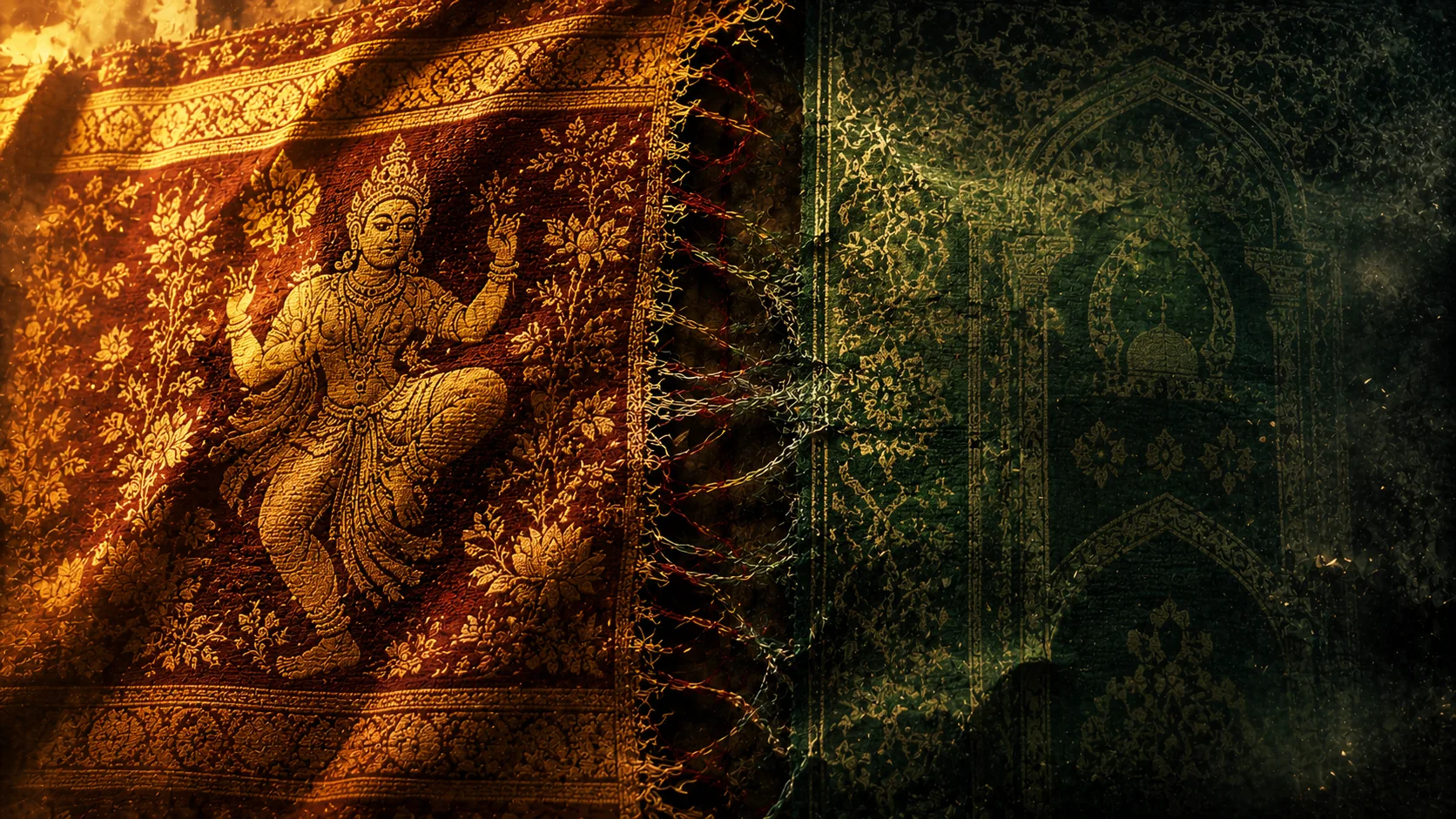
There is a particular comfort in the phrase Ganga-Jamuni tehzeeb. It arrives with the weight of antiquity and the warmth of a grandmother's anecdote — the Muslim weaver who stitches the goddess's robes, the Hindu artisan who shapes the Muharram tazia, two rivers braided into one shimmering, eternal stream. It is the sort of phrase one is meant to receive, not interrogate. To ask where it came from feels almost rude, like asking a host for the receipt.
So let us be rude.
Because when you actually go looking for this ancient confluence in the historical record — when you ask the simple questions a publication like this one is obliged to ask — something curious happens. The river of antiquity turns out to be remarkably short. Its headwaters lie not in the medieval Doab but in the twentieth century, somewhere in the anxious years between a wartime caliphate and a country about to be cut in half. And the people it was designed to soothe were, on inspection, almost entirely on one side of the bank.
The distinction this essay rests on. Cultural mixing — demonstrable, ordinary, and roughly what happens anywhere two communities share a marketplace for ten generations. The doctrine of tehzeeb — the claim that this mixing constituted a deliberate, symmetrical, mutually-beneficial spiritual partnership, lovingly maintained by both parties as a conscious civilisational ideal. The first is history. The second is a press release. This essay accepts the first and audits the second.
I · The Sweetmeat Defence
What the phrase actually means.
Start with the words, because the words are doing more work than they admit. Ganga-jamuni is, in its oldest and most literal sense, a craftsman's term — a metalworker's word for an object worked in two metals at once, gold and silver, brass and copper, the warm river and the cool one running side by side in a single vessel. It is a description of alloy. The leap from "this thaali is made of two metals" to "two civilisations achieved spiritual union" is a leap of several centuries and a great deal of wishful thinking, and it is a leap nobody seems to want to show their working for.
The respectable scholarly definition is more modest, and worth stating fairly. As commonly used, the term denotes the composite high culture of the central Gangetic plains — the Doab, Awadh, Lucknow, Delhi, Hyderabad's old city — a fusion of Hindu and Muslim elements expressed in speech, cuisine, dress, music, manners, and the built environment. Documented That such a fusion existed is not seriously in dispute. People who live beside each other for centuries exchange recipes, vocabulary, melodic modes, and architectural tricks. Khariboli absorbed Persian; the qawwali took root; the Lucknawi nawab learned to keep a Hindu minister and a Hindu festival on the calendar. Nobody serious denies the alloy.
The quarrel is not with the alloy. The quarrel is with the advertising.
II · A Suspiciously Recent Antiquity
When the river was actually dug.
Here is the inconvenient bit. If Ganga-Jamuni tehzeeb describes a thousand-year-old shared civilisation, one would expect the phrase — or some recognisable cognate of the idea — to appear somewhere in that thousand years of prolific, self-documenting literary production. Persianate India was not shy about describing itself. The chroniclers, the court poets, the tazkira-writers left mountains of paper.
And the phrase is essentially absent from all of it. Contested As a slogan of composite nationhood, it cannot be reliably traced before the early twentieth century. The lawyer and author J. Sai Deepak, who has made dismantling the concept something of a personal industry, dates its emergence as a public-discourse construct quite precisely to the years between 1916 and 1923 — "not before, nor after." One need not accept his polemical framing to notice that the dates are doing something specific.
More instructively, the historian Richard Eaton — no Hindu-nationalist, and one of the most respected scholars of pre-modern South Asia alive — locates the origin of the very notion of a self-conscious "composite culture" firmly within modernity, and specifically within the colonial period that ended in Partition. Eaton's argument is not that Hindus and Muslims never shared anything; it is the methodological point that we should stop projecting a twentieth-century ideal backward onto a pre-colonial past that did not think in those terms. The shared culture is real. The idea of it as a named, defended, ideological inheritance is a modern manufacture — assembled, by Eaton's reckoning, largely as an enterprise of the Indian national movement.
The shared culture is the artifact. The doctrine of the shared culture is the forgery. The trouble is that the forgery is signed in the same ink.
This is the crucial move, and it is why the topic generates so much heat. To say "the phrase is recent" sounds like nit-picking over terminology. It is not. The terminology was built to carry a political load, and the load is what is actually in dispute.
III · Cui Bono
The conspiracy, stated plainly and then tested.
Now to the sharp claim — the one usually whispered: that the tehzeeb was a creation, and not one made for the benefit of Hindus. It is worth stating the charge at full strength before deciding how much of it survives contact with evidence.
The charge runs like this. The phrase crystallised in precisely the years of the Khilafat agitation (1919–1924), when the Indian National Congress, under Gandhi, yoked the independence movement to a pan-Islamic cause: the restoration of the Ottoman Caliph. A movement launched, as critics note with some justice, in significant part to defend a foreign Islamic institution rather than purely to win Indian freedom. The "composite culture" rhetoric, in this reading, was the emollient — the reassuring story Hindus were told to keep them inside a coalition whose immediate energies were being spent on a Turkish sultan's throne.
And here the critics land their best blow, the one even a fair-minded reader should sit with. Polemical The composite culture, they argue, was asymmetric by design. The Hindu was asked to absorb, adopt, and accommodate — to learn the courtly Urdu, to adjust the festival, to admire the adab. The traffic of "tolerance" ran, overwhelmingly, in one direction. In its most acid formulation: it is tehzeeb only so long as it remains Islamic in its terms. The lamp-lighting and coconut-breaking that get cited as proof of Muslim accommodation, the argument continues, were not the conqueror graciously adopting the native's customs — they were the converted native's refusal to fully surrender his own.
So where does the audit actually land? Roughly here. The lived mixing was real and partly reciprocal. But the twentieth-century doctrine built on top of it was indeed a political instrument, it did emerge in a moment of coalition-management, and the burden of "tolerance" it prescribed did fall disproportionately on the majority community, which was expected to prove its secular bona fides by perpetual accommodation. The conspiracy theory is wrong about the past and uncomfortably close to right about the rhetoric.
IV · The Nehruvian Lamination
How a slogan became a state religion.
If 1916–1923 dug the channel, the post-1947 decades poured the concrete. Here the critics are on firm, almost boring, factual ground — because the Nehruvian state was perfectly open about what it was doing. The project of a "secular, composite, pluralist" India was the explicit ideological architecture of the new republic, and the composite-culture idea was its founding aesthetic.
The intellectual scaffolding was already in place. Tara Chand's Influence of Islam on Indian Culture (1922 — note the date once more) had supplied the academic charter for "Composite Culture," emphasising assimilation and synthesis, and even floating the philosophically dubious claim that Islamic tawhid and Shankara's Advaita were somehow kindred. Doubtful That equation — flattering, ecumenical, and on inspection simply incorrect — tells you everything about the genre's method: find a surface resemblance, declare a deep unity, change the subject before anyone checks.
From there the doctrine became curricular, official, unfalsifiable. To question it was not to raise a historiographical point; it was to out yourself as a communalist. The phrase had completed its journey from metalworker's noun to court poet's metaphor to national-movement slogan to, finally, a kind of loyalty oath. The alloy had become an altar.
V · Lights, Camera, Tehzeeb
Why Bombay never let it die.
And then there is the dream factory, which kept the whole apparatus warm long after the politics had cooled. If you have ever felt a lump in your throat at a chandelier-lit Lucknawi kotha, a ghazal dissolving into the night, a nawab of impeccable courtesy and impeccable melancholy — you have been the target of a very specific, very beautiful, and very deliberate genre.
It has a name: the Muslim social. It flourished in the 1950s and 60s and limped on into the early 80s — Chaudhvin Ka Chand (1960), Mere Mehboob (1963), Bahu Begum (1967), and its twilight masterpiece Umrao Jaan (1981) — built almost entirely from ghazals, qawwalis, Urdu poetry, and the gauzy nostalgia of a vanished nawabi elite. Scholars of the genre are admirably candid about its function: Bombay cinema explored these worlds, they note, expressly in the light of the secular-nationalist state project associated with the Congress-led freedom movement — the Nehruvian state project. The films were not merely entertainment. They were the cultural wing of an ideology, doing in song what the textbook did in prose.
Notice what the genre quietly accomplished. It made "Muslim culture" synonymous with refinement itself — with poetry, courtesy, exquisite manners, doomed elegance — while, as the filmmaker M.S. Sathyu tartly observed, there was never any such thing as a "Hindu social" or a "Christian social." The majority's culture was the unmarked default, the wallpaper; the minority's was the tehzeeb, the thing with the lovely name and the chandeliers. One side got to be civilisation. The other side got to be the audience, dabbing its eyes, grateful to be allowed in.
The genius of the Muslim social was to make the majority weep with gratitude at a refinement it was simultaneously being taught it did not itself possess.
This is why the river never runs dry. Politics can be argued with; ghazals cannot. You can footnote J. Sai Deepak and you can footnote Richard Eaton, but you cannot footnote "In aankhon ki masti ke." The song has already won the argument before the argument begins. The most durable propaganda is the kind that makes you cry.
VI · The Honest Confluence
What a publication like this should actually say.
So — myth, or not? The honest answer is the unsatisfying one, and it is worth saying without satirical varnish.
There was a real, centuries-long interchange between Hindu and Muslim life in northern India. Weavers really did dress the gods; Hindu craftsmen really did build the tazia; the language in your mouth is itself an alloy. To deny this is its own form of myth-making, and the hardest-edged "civilisational hoax" polemics tip into exactly that denial.
Contested. The strongest versions of this thesis — that the entire composite culture is a "civilisational hoax" papering over centuries of one-sided predation, that medieval Hindu-Muslim coexistence was merely a predator's "temporary truce" with its prey — come from explicitly polemical Hindu-nationalist writing and should be read as argument, not settled fact. They marshal real grievances (iconoclasm, asymmetric conversion, the genuinely top-down nature of much "syncretism") but they fold them into a totalising story that ignores genuine bottom-up exchange — the Bhakti and Sufi cross-pollination, the shared shrines, the village-level borrowing that no court ordered. A confluence audited honestly has silt from both banks. This essay rejects the "everything was harmony" myth without buying the "nothing was ever shared" counter-myth.
But the doctrine of Ganga-Jamuni tehzeeb — capital-T, the named, defended, sanctified national ideal — is a twentieth-century construction. It was assembled in a period of acute communal coalition-management, given academic robes in the 1920s, made into state ideology after 1947, and scored for orchestra by Bombay. Its burden of accommodation fell, by design, mostly on one community. And it was sold, brilliantly, as something ancient and neutral and beyond question — which is the one thing it has never been.
The phrase, in the end, was never a description of the past. It was an instruction about the future, addressed to a specific reader, written in a metalworker's borrowed vocabulary so that it would gleam like something old. The confluence is real. The temple they built on its banks is not.
Which leaves only the smallest, rudest question of all — the one we began with, and the only one that ever mattered: when someone hands you a river and calls it eternal, it is always worth asking who was standing upstream.
Notes & Sources
This essay argues a position. Where the evidence is genuinely contested — the strong "hoax" thesis in particular — it is flagged as such rather than smuggled in as fact. Readers are invited to consult the cited sources and disagree in print. Dhārā welcomes the rejoinder.
Notes & sources
| # | Source and note |
|---|---|
| 1 | Standard scholarly definition (composite high culture of the Doab; weavers, tazia): overview drawn from encyclopedic and journalistic summaries. Wikipedia, "Ganga-Jamuni tehzeeb"; The Hindu, "Syncretic ethos in weaves and crafts," 18 Jul 2018. |
| 2 | The 1916–1923 dating and the Khilafat framing are J. Sai Deepak's, as quoted and critiqued in The Wire, "The War on Ganga-Jamuni Tehzeeb," Jul 2025. Cited as a stated position, not endorsed as settled chronology. |
| 3 | Richard Eaton's location of "composite culture" within colonial modernity and the national movement: summarised from the Argumentative Indians symposium, "Is Ganga-Jamuni Tehzeeb a Myth?", Oct 2022. |
| 4 | On the pedantic-becomes-political dynamic: The Wire, ibid., 2025. |
| 5 | The "asymmetry" thesis and the "tehzeeb only so long as it is Islamic" formulation: paraphrased from polemical Hindu-nationalist commentary. Explicitly flagged as contested argument. |
| 6 | The "civilisational hoax" / "predator and prey" framing: Dharma Dispatch, "The Civilisational Wound and the Cultural Hoax Called Ganga-Jamuni Tehzeeb," Feb 2020. A polemical source, cited to represent the strong-form thesis, not as a neutral authority. |
| 7 | Tara Chand, Influence of Islam on Indian Culture (1922); the tawhid/Advaita equation noted as philosophically inexact even by sympathetic commentators (Awaz the Voice, Nov 2025). |
| 8 | On the "Muslim social" genre, its films, and Sathyu's "no Hindu social" critique: Wikipedia, "Muslim social"; Women Dastangos of India, "From Moonlight to Lament," Sep 2025. |
| 9 | The explicit linkage of the genre to "the Nehruvian state project": Ishtiaq Ahmed, review essay, New Age Islam, summarising scholarship on Islamicate genres in Bombay cinema. |