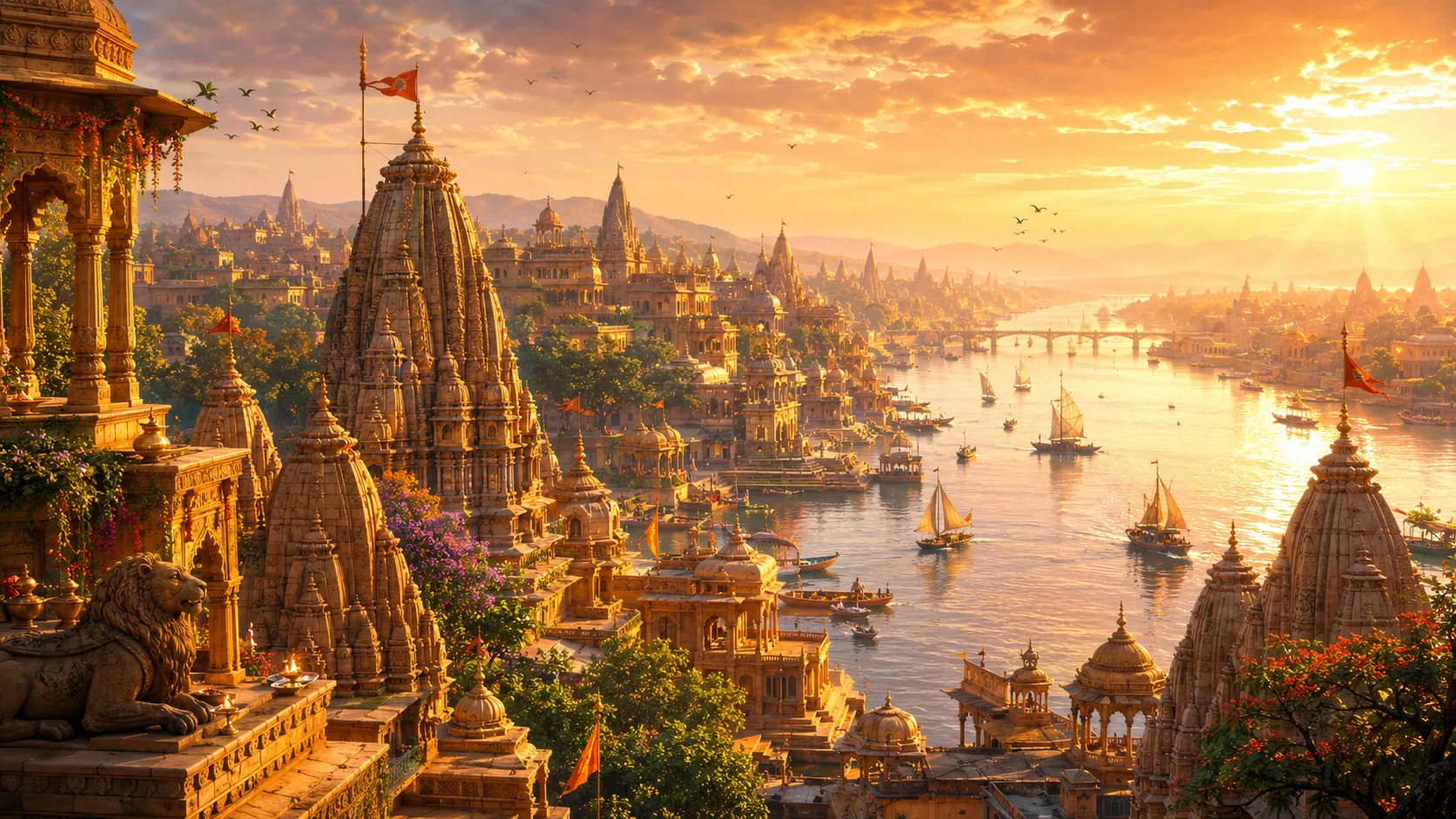
A Note to the Reader
This study is long by design. The Gupta age cannot be honoured in a few pages, because its greatness was not of one kind but of every kind at once — political, military, economic, mathematical, literary, sculptural, architectural, medical, philosophical, and spiritual. To compress it is to falsify it. What follows is intended to be read either whole, as a single sustained argument about what a civilization at its summit looks like, or consulted in parts, as a reference on any single dimension of the empire. The nineteen major divisions each stand on their own; together they compose, as far as a single essay can, a complete portrait.
A word on stance. This is written from within the Sanātana civilizational tradition, not as a hostile outsider's dissection of it. That does not mean the suspension of scholarly honesty — the reader will find the genuine debates, the uncertainties of chronology, the social tensions of the age, and the hard questions of decline all faced squarely. It means rather that the achievements of this civilization are treated as the achievements of a living tradition with its own integrity and its own roots, owing its greatness to its own Vedic and Śāstric foundations rather than to any external tutelage. The Guptas were not made great by foreign contact; they were the flowering of a seed that had been growing on Indian soil for two thousand years and more.
Contents
A reference in nineteen movements. This study may be read whole, as one sustained argument about what a civilization at its summit looks like, or consulted in parts. Parts I–V trace the rise and the sovereigns; VI–VIII the body of the empire, the dharmic kings, and the adversaries; IX–XIII the fourfold gold of science, literature, art, and faith, and the life of the people; XIV the science of war and statecraft; XV the monuments; XVI–XVII the comparison with the world's and India's great ages; XVIII–XIX the fall and the immortal aftermath. Four appendices give the chronology, the primary sources, a note on historiography, and the bibliography.
Part I — The Before: The World the Guptas Inherited
Before the gold, the long preparation: five centuries of vigorous, creative, polycentric life, out of which the classical synthesis would crystallize.
The False Image of the "Dark Age"
There is a habit, inherited from European historiography, of imagining that between the fall of one great empire and the rise of the next there must lie a "dark age" — a void of chaos and cultural sterility. This image is drawn from the European experience after Rome, and it does not fit India. When the Mauryan empire dissolved in the decades following the assassination of the last Maurya, Bṛhadratha, around 185 BCE, the subcontinent did not descend into darkness. It entered, instead, nearly five centuries of vigorous, creative, polycentric life — an age of competing kingdoms, expanding trade, maturing language, and religious ferment, out of which the classical synthesis of the Guptas would eventually crystallize.
To understand why the Gupta age shines so brightly, one must first understand the long and productive twilight that prepared it. A golden age does not arise from nothing. It is the harvest of seeds sown over centuries by lesser-known hands.
The Successors of the Mauryas
The immediate heirs to Mauryan power in the Gangetic heartland were the Śuṅgas (c. 185–73 BCE), founded by the Brahmin general Puṣyamitra Śuṅga, who is remembered both as a patron of the Brahmanical revival — performing the Aśvamedha and sponsoring the renewal of Vedic ritual — and, in Buddhist tradition, with hostility. Under the Śuṅgas and their successors the Kāṇvas, the heartland remained a centre of Sanskritic culture. It was in this period that the great railing and gateways of the Bhārhut and Sāñcī stūpas were carved — among the earliest masterpieces of Indian narrative sculpture, the artistic ancestors of the Gupta serenity to come.
In the Deccan, the mighty Sātavāhana dynasty (roughly 1st century BCE to 2nd century CE) built a bridge between the north and the south, patronizing both Brahmanism and Buddhism, issuing inscriptions in Prākrit, and overseeing the carving of the early caves of the Western Ghats and the magnificent expansion of the Amarāvatī stūpa, whose flowing, crowded, energetic relief style is one of the three great schools of early Indian sculpture.
The Coming of the Outsiders — and Their Absorption
The northwest of the subcontinent, always the gateway, saw in these centuries a succession of incoming peoples — and here lies one of the most important and most misunderstood patterns in Indian history. Wave after wave entered: the Indo-Greeks (Yavanas), heirs of Alexander's eastern conquests, whose king Menander (Milinda) became the subject of a famous Buddhist dialogue, the Milindapañha; the Indo-Scythians or Śakas; the Indo-Parthians; and finally, most powerfully, the Kuṣāṇas.
The decisive fact about all of them is that they were absorbed. They entered as conquerors and were, within a generation or two, drawn into the gravitational field of Indian civilization — adopting its religions, its languages, its artistic forms, its gods. The Indo-Greek king Heliodorus erected a pillar at Vidiśā in honour of Vāsudeva (Viṣṇu), calling himself a Bhāgavata. The Kuṣāṇa emperor Kaniṣka, though a great patron of Buddhism, struck coins bearing Śiva and a whole pantheon of Iranian, Greek, and Indian deities. This is the deep pattern of Sanātana civilization: it did not merely resist the outsider; it digested him. The "foreign" dynasties of the northwest became, in the space of decades, Indian dynasties. This is the essential background against which the Gupta achievement must be read — for one of Samudragupta's and Chandragupta II's great tasks would be the final reckoning with the last unabsorbed remnant of these incomers, the Western Śakas.
The Kuṣāṇa Apogee and the Economic Foundation
The Kuṣāṇa empire under Kaniṣka I (whose accession is variously dated, most commonly to 127 CE) reached from Central Asia deep into the Gangetic plain, with great cities at Puruṣapura (Peshawar) and Mathurā. The Kuṣāṇa age was one of extraordinary economic vitality. It sat astride the Silk Road, and Indian goods — spices, fine cotton textiles, ivory, precious stones, and above all pepper — flowed west to an insatiable Roman market. The Roman author Pliny the Elder famously complained that the empire was being drained of its gold to pay for Eastern luxuries, and the Periplus of the Erythraean Sea, a Greek merchant's handbook of the first century CE, documents in precise detail the brisk trade between Roman Egypt and the ports of western and southern India.
This matters enormously for understanding the Guptas, because the gold that would later flow into the Gupta treasury, and the gold from which the Guptas would strike the most beautiful coinage in Indian history, was in large part Roman gold — the accumulated bullion of centuries of a favourable balance of trade. India before the Guptas was already one of the richest regions on the face of the earth. The Guptas did not create this wealth from nothing; they inherited a deep reservoir of prosperity and learned to govern it well.
The Maturing of Sanskrit and the Intellectual Inheritance
Equally important was the intellectual and linguistic preparation. The centuries before the Guptas saw Sanskrit mature from the language of Vedic ritual into the supple, codified, universal vehicle of learning and high literature that it would be in the classical age. The great grammarian Pāṇini had, centuries earlier, given Sanskrit its astonishingly rigorous grammatical architecture in the Aṣṭādhyāyī; the commentators Kātyāyana and Patañjali (the latter's Mahābhāṣya a monument of linguistic science) had extended his work. By the early centuries CE, Sanskrit was ready to become the language of empire, science, and poetry that it would be under the Guptas.
In philosophy, the foundational sūtra texts of the great systems — the ṣaḍ-darśanas — were taking shape. In this period the Yoga-sūtras of Patañjali, the foundations of Nyāya and Vaiśeṣika logic and atomism, the Sāṅkhya enumeration of reality, and the Mīmāṃsā science of ritual interpretation were being composed and systematized. The Mahāyāna revolution in Buddhism produced the towering figure of Nāgārjuna and the Madhyamaka philosophy of emptiness. The two great epics, the Rāmāyaṇa and the Mahābhārata, were reaching their monumental final forms, and the Dharmaśāstra tradition — the science of law and social order — was being codified in texts like the Manusmṛti. This vast intellectual inheritance was the soil. The Gupta age was the flower.
The Political Vacuum of the Third Century
But the political order did not hold. The Kuṣāṇa empire, pressed from the west by the rising power of the Sāsānian Persians (who under Ardashir I and Shapur I built an aggressive new empire after 224 CE), fragmented in the third century CE. By around 250–300 CE, northern India had returned to a condition of political fragmentation. The Gangetic Doab — the fertile, populous core of the plain, the indispensable base of any north Indian empire — lay open, divided among small kingdoms, oligarchic republics, and local chiefs, with no single power commanding it.
History, like nature, abhors such a vacuum. Into it, from the region of Magadha — the same sacred Bihar geography from which the Mauryas had risen six centuries before, the land of the Buddha's enlightenment and Mahāvīra's teaching — a hitherto obscure family would step. Their rise would be one of the most consequential in the history of the world.
Part II — Origins and Foundation: The Seed-Kings and Chandragupta I
Within three generations, an obscure family of regional kings rose to imperial paramountcy — a trajectory of astonishing rapidity.
The Problem of Origins
Few great dynasties have origins as genuinely obscure as the Guptas. This obscurity is itself historically significant: it tells us that the family rose from relatively modest beginnings to imperial paramountcy within three generations — a trajectory of astonishing rapidity. Unlike the Mauryas, whose founder Candragupta's story (however legendary) was preserved, or later dynasties that fabricated elaborate divine and solar-lunar genealogies, the early Guptas in their own first inscriptions make no grand claims. The candour is refreshing and, to the historian, valuable.
The question of the dynasty's varṇa has been debated for more than a century, and honesty requires admitting it is unresolved. The name-element -gupta was, in the Dharmaśāstra convention, associated with the Vaiśya order, which led early scholars such as those of the colonial period to assign the Guptas Vaiśya origins. Others have argued, on the basis of later matrimonial alliances and the family's evident Brahmanical learning and patronage, for a higher status. Some have proposed a Brahmin or Brahma-Kṣatra origin. The truth is that the surviving evidence does not permit certainty Contested, and the dynasty's overwhelming subsequent grandeur rendered the question irrelevant in its own time. What is certain is that they were devout patrons of the Sanātana tradition, that they styled themselves parama-bhāgavata (supreme devotees of Viṣṇu), and that they performed the great Vedic sacrifices. Their legitimacy, in the end, rested not on birth but on conquest, dharma, and achievement.
Śrī Gupta and Ghaṭotkaca
The dynasty's own records — chiefly the great Allahabad inscription of Samudragupta — name two ancestors before the first imperial sovereign. The founder was Śrī Gupta (or simply Gupta), who may have flourished in the latter half of the third century CE, perhaps around 240–280 CE. His son was Ghaṭotkaca. Both are given only the title mahārāja ("great king").
This title is the key to their status. In the protocol of the period, mahārāja was frequently the style of a subordinate or regional ruler — a feudatory — in contrast to the imperial mahārājādhirāja ("great king of kings"), which denoted paramount, independent sovereignty. The deliberate distinction in the later inscriptions, which call Śrī Gupta and Ghaṭotkaca merely mahārāja but Chandragupta I mahārājādhirāja, tells us that the first two were local potentates of limited territory and very possibly subordinate to some larger power, while the third was the true founder of independent imperial sovereignty.
There is a tantalizing fragment of external evidence for Śrī Gupta. The Chinese Buddhist pilgrim Yijing (I-tsing), writing in the late seventh century, recorded a tradition that a king named "Che-li-ki-to" (which scholars have reconstructed as Śrī Gupta) had, some five hundred years before his time, built a temple for Chinese Buddhist pilgrims near Mṛgaśikhāvana and endowed it with the revenue of villages. If this identification holds — and it is debated Speculative — it would place Śrī Gupta in the latter third century CE and confirm both his historicity and his role as a regional patron-king. These were the seed-kings: modest, pious, local. The third generation transformed everything.
Chandragupta I: The Founder of Imperial Sovereignty
Chandragupta I (reigned c. 319/320 – c. 335 CE) is the true architect of Gupta greatness — the man who transformed a regional principality into an empire and a mahārāja's holding into a mahārājādhirāja's realm. He must be carefully distinguished from his far more famous Mauryan namesake of six centuries earlier; the shared name is a coincidence of the common Sanskrit royal name Candragupta ("protected by the moon").
His master-stroke was a marriage. He wedded Kumāradevī, a princess of the Licchavis.
The Licchavi Alliance: The Marriage That Made a Dynasty
To understand the magnitude of this alliance, one must understand who the Licchavis were. They were not a parvenu power but one of the most ancient and prestigious lineages in all of India — a gaṇa-saṅgha, an oligarchic republic of immense antiquity centred on Vaiśālī in the region of Mithilā (north Bihar). The Licchavi confederacy reached back nearly a thousand years; it was prominent already in the time of the Buddha and Mahāvīra in the sixth–fifth centuries BCE. To marry a Licchavi princess was to graft the young Gupta line onto one of the most venerable stocks in the subcontinent.
The political dividends were immense. The Licchavi connection extended Gupta influence northward into Mithilā and toward Nepal, and lent the upstart dynasty an aura of ancient legitimacy that no amount of mere conquest could buy. So conscious was Chandragupta I of the value of this union that he commemorated it in an extraordinary way: he issued a series of gold coins depicting himself and Queen Kumāradevī together on the obverse, both named, with the legend "Licchavayaḥ" ("the Licchavis") on the reverse, often above the figure of a seated goddess. This is one of the most remarkable issues in the history of coinage — a sovereign publicly and permanently crediting his queen's lineage as a co-foundation of his sovereignty. It was an act of political genius and of evident pride.
The pride was inherited. Chandragupta I's son and successor would, for the rest of the dynasty's history, glory in the epithet Licchavi-dauhitra — "the daughter's son of the Licchavis" — proclaiming his maternal descent as a badge of honour in his formal inscriptions. In a patrilineal society, the prominence given to this maternal line is striking testimony to the prestige of the Licchavi name.
The Inauguration of the Gupta Era
Chandragupta I marked the new dignity of his house by assuming the full imperial title Mahārājādhirāja and, most significantly, by inaugurating a new calendrical era. The Gupta Era (Gupta Saṃvat) begins in 319/320 CE, the conventional date of his coronation. The founding of an era is among the most assertive acts a sovereign can perform: it is a claim to mark a new beginning in time itself, a declaration that history is to be reckoned from one's own accession. The Mauryas had not done it; the Guptas did. By the time of his death around 335 CE, Chandragupta I held a compact but powerful kingdom across the strategic core of the eastern Gangetic plain — Magadha, Prayāga (Allahabad), and Sāketa (Ayodhyā) — the indispensable base from which his son would build a continental empire.
The foundation was complete. What was needed now was a conqueror of genius. The Guptas had bred one.
Part III — Samudragupta: The Conqueror-Sage and the Forging of Empire
He conquered not merely widely, but intelligently — applying a different policy to every adversary, by a single coherent design.
The Indian Napoleon — and Why the Comparison Falls Short
Samudragupta (reigned c. 335 – c. 375 CE) is the towering figure of the Gupta age and one of the supreme conquerors in the history of the world. The Victorian historian Vincent Smith bestowed on him the title "the Indian Napoleon," and the phrase has stuck. But the comparison, while capturing his military genius, badly understates the man — for Napoleon was a soldier and administrator, while Samudragupta was, in addition, a poet, a musician, a scholar, and a patron of learning who consciously embodied the Sanātana ideal of the philosopher-king. A truer description would be the cakravartin-kavi: the world-conqueror who was also a master of the arts of peace. He did not merely defeat Napoleon's number of enemies; he did so while composing poetry good enough that his court called him kavirāja, "king among poets."
The Prayāga Praśasti: A Conqueror's Monument
Nearly everything we know of Samudragupta's reign radiates from a single, extraordinary document — one of the most important inscriptions in all of Indian history: the Prayāga Praśasti, the Allahabad Pillar Inscription, composed by his court poet and minister Hariṣeṇa.
The choice of medium was itself a masterful political statement. Hariṣeṇa's eulogy was engraved upon an Aśokan pillar — one of the very columns on which the great Maurya had inscribed his edicts of Dharma six centuries earlier. By inscribing his conqueror's panegyric on the Mauryan monument, Samudragupta laid explicit claim to the Mauryan imperial mantle, asserting that he was the legitimate successor to Aśoka's paramountcy over the subcontinent. The Gupta era thus literally wrote itself onto the Mauryan inheritance.
The Praśasti is a work of high Sanskrit literary art, composed in elegant alternating prose and verse (the campū style), and it is simultaneously a panegyric, a political manifesto, and a meticulous military gazetteer. Its damaged but largely legible text is the foundational source for the political geography of fourth-century India. It is, in effect, Samudragupta's autobiography of conquest — and it reveals not a mere marauder but a strategist of profound sophistication.
A Doctrine of Differentiated Conquest
The genius of Samudragupta lay not merely in that he conquered but in how he conquered. The Praśasti reveals that he applied entirely different policies to different regions, according to a coherent grand strategic design. This is not the indiscriminate expansionism of a barbarian war-leader; it is the calibrated statecraft of a master who understood that different territories required different instruments. The inscription organizes his conquests into distinct categories, and each category corresponds to a deliberate policy:
The Kings of Āryāvarta — Violent Uprooting and Annexation. In the northern heartland — the Gangetic plain that was the demographic, agricultural, and ideological core of empire — Samudragupta's policy was total. The Praśasti says he "violently exterminated" (the phrase is prasabhoddharaṇa, "forcible uprooting") a list of northern kings — Acyuta, Nāgasena, Gaṇapatināga, the Nāga rulers, the rulers of Kota, and others — and annexed their kingdoms directly into the empire. Here there was no question of tribute or vassalage. The heartland had to be held outright and permanently; in the core, there could be no rival thrones. This was the foundation: a solid, directly administered imperial heartland stretching across the whole northern plain.
The Kings of Dakṣiṇāpatha — Capture, Then Grace (grahaṇa-anugraha). Samudragupta's most audacious campaign was his great march into the south — the Dakṣiṇāpatha expedition. He led his army down the eastern seaboard of the peninsula, defeating in succession a dozen southern kings, named in the inscription with their kingdoms: Mahendra of Kosala, Vyāghrarāja of Mahākāntāra, Mantarāja of Kurāla, Mahendragiri of Piṣṭapura, Svāmidatta of Koṭṭūra, Damana of Eraṇḍapalla, Viṣṇugopa of Kāñcī, Nīlarāja of Avamukta, Hastivarman of Veṅgī, Ugrasena of Pālakka, Kubera of Devarāṣṭra, and Dhanañjaya of Kusthalapura — a campaign reaching as far south as Kāñcī in the Tamil country.
And here is the strategic masterstroke: having defeated these kings, he did not annex their territories. The Praśasti's formula is grahaṇa-mokṣa-anugraha — "capturing, then releasing and favouring." He captured these southern kings, then released them and reinstated them on their thrones as tributaries. The logic is impeccable. The far south was too distant from the Gangetic base to garrison and administer directly; an attempt to do so would have overextended the empire fatally. But a southern king who had been captured and then graciously released and restored would be a grateful, secure, and non-threatening tributary, sending tribute and acknowledging Gupta paramountcy without requiring a single Gupta soldier to remain. Samudragupta extracted submission without assuming the impossible burden of administration. This is the difference between a conqueror and a strategist.
The Forest Kings (Āṭavika-rājas) — Reduction to Servitude. The chieftains of the densely forested tracts of central India — the aṭavi country, vital because it controlled the lines of communication between the northern heartland and the Deccan — were, the inscription says, reduced to servitude (paricārakīkṛta, "made into servants"). This secured the wild interior and the strategic corridors of the empire.
The Frontier Kingdoms (Pratyanta-nṛpati) — Tribute and Obedience. The kingdoms along the periphery of the directly-ruled empire — named as Samataṭa (southeast Bengal), Ḍavāka and Kāmarūpa (Assam), Nepāla (Nepal), Kartṛpura, and others — submitted as tributary border states, paying all the taxes demanded, obeying the emperor's commands, and coming to perform homage.
The Tribal Oligarchies (gaṇa-saṅghas) — Submission. Most poignant of all, the surviving ancient gaṇa-saṅghas — the oligarchic republics that had preserved a tradition of non-monarchical government in India since before the Mauryas — now submitted to Gupta paramountcy. The inscription names the Mālavas, Ārjunāyanas, Yaudheyas, Mādrakas, Ābhīras, Prārjunas, Sanakānīkas, Kākas, Kharaparikas, and others. These proud republics, some with martial traditions stretching back a thousand years, now paid tribute and obeyed Gupta commands. With their submission, the long age of the Indian republics effectively drew toward its close; the future belonged to the imperial monarchy.
The Foreign and Distant Powers — Diplomatic Suzerainty. Finally, and most grandly, the Praśasti claims that powers beyond the frontiers of direct or tributary control sought Samudragupta's favour through diplomacy and self-submission. It names the Daivaputra-Ṣāhi-Ṣāhānuṣāhi (the remaining Kuṣāṇa rulers of the northwest, whose very title echoes the Persian shāhānshāh), the Śakas (the Western Kṣatrapas), and the ruler of Siṃhala (Sri Lanka) and "all the dwellers in the islands." These, the inscription says, sought to serve him, offered their daughters in marriage, and requested charters bearing the Garuḍa seal confirming them in the enjoyment of their own territories — that is, they sought formal recognition as Gupta vassals. The claim regarding Sri Lanka has striking independent corroboration: Chinese sources record that the Sri Lankan king Meghavarṇa sent an embassy to Samudragupta seeking permission to build a monastery for Sinhalese pilgrims at Bodh Gayā — a request that confirms the diplomatic deference the Praśasti describes.
The Aśvamedha: The Sovereignty of Heaven and Earth
Having constructed this vast, layered structure of empire — a directly-ruled heartland, a belt of tributary frontier kingdoms and submitted republics, a south of grateful released vassals, and a periphery of diplomatically deferential foreign powers — Samudragupta crowned his achievement with the supreme Vedic rite of imperial sovereignty: the Aśvamedha, the horse-sacrifice.
The Aśvamedha was no ordinary ritual. By ancient convention, it could be undertaken only by a sovereign of unchallenged, paramount power, for it involved releasing a consecrated horse to wander for a year, followed by the king's army; any ruler through whose territory the horse passed had either to submit or to fight. To complete the rite was to proclaim oneself the paramount sovereign, the cakravartin whose chariot-wheels rolled unobstructed to the horizons. The rite had lain largely dormant for centuries — a measure of how rare true paramountcy had become. Samudragupta revived it, and he commemorated it by striking special Aśvamedha-type gold coins, depicting the sacrificial horse before the yūpa (sacrificial post) on the obverse and, on the reverse, the chief queen, with legends proclaiming him the king "of irresistible valour" who, "having conquered the earth, now wins heaven." The performance of the Aśvamedha was the religious and ideological capstone of his political achievement: it sanctified his conquests within the framework of Sanātana Dharma and presented him not merely as a successful general but as the cosmically legitimate emperor of Bhārata.
The Whole Man: Conqueror, Poet, Musician, Sage
Hariṣeṇa is at great pains to present Samudragupta not as a mere warlord but as the complete embodiment of the Sanātana royal ideal — a man as great in the arts of peace as in those of war. The Praśasti praises him as a poet whose compositions earned him the title kavirāja ("king of poets"); as a patron of learning who delighted in the company of scholars and supported the śāstras; and as a man of profound compassion, "whose mind was occupied with providing for the support, the protection, and the uplift of the poor, the helpless, the miserable, and the suffering."
Most evocatively of all, one of the most famous of all Gupta coin types depicts Samudragupta seated, playing the vīṇā — the great Indian lute — his weapons set aside, absorbed in music. No other ancient emperor in world history chose to portray himself on his coinage in this way: not as a warrior, not as a god, but as a musician lost in the beauty of sound. It is an image of breathtaking confidence and cultivation. Here was a man who had conquered the subcontinent and who wished to be remembered, in part, for the music he played. In that single image is concentrated the whole meaning of the Gupta golden age: power and beauty, conquest and contemplation, the sword and the vīṇā held in perfect balance. This is the cakravartin ideal made flesh — world-sovereignty wedded indissolubly to dharma, learning, and art.
Part IV — Chandragupta II Vikramāditya: The Meridian of the Golden Age
While Rome was sacked by the Goths in 410, India stood at the serene summit of its classical achievement.
The Disputed Succession and the Devīcandragupta
The transition from Samudragupta to his most famous son was not, it seems, entirely smooth — and the evidence for the complication is one of the most fascinating episodes in Gupta studies. A fragmentary Sanskrit drama, the Devīcandraguptam, attributed to the dramatist Viśākhadatta (author of the famous Mudrārākṣasa), survives only in quotations in later works, but it preserves a remarkable tradition. According to it, Samudragupta was succeeded first by an elder son, Rāmagupta, a weak king who, besieged by a Śaka ruler, agreed to the humiliating demand of surrendering his queen, Dhruvadevī, to the enemy. His younger brother, Chandragupta, disguised himself as the queen, entered the enemy camp, and slew the Śaka king — afterward also removing the disgraced Rāmagupta, marrying Dhruvadevī, and ascending the throne himself.
For a long time this was dismissed as mere literary invention, but the discovery of independent corroborating evidence — coins bearing the name of Rāmagupta, and inscriptions naming Dhruvadevī (Dhruvasvāminī) as the queen of Chandragupta II — has persuaded most scholars that there is a genuine historical kernel here Contested: a brief, troubled reign of an elder brother, a Śaka humiliation, and a palace revolution that brought the abler younger brother to power. However the details are judged, the essential outcome is clear: by about 375–380 CE, the throne had passed to the greatest of the Gupta kings after Samudragupta.
Vikramāditya: The Archetype of the Ideal King
Chandragupta II (reigned c. 375/380 – c. 415 CE) took the title Vikramāditya — "the Sun of Valour" — and that name would resound through Indian civilization for the next fifteen centuries as the very archetype of the perfect monarch. So luminous was his memory that the legendary Vikramāditya of folklore — the just and brilliant king of the Vetāla tales (Vikram and Betāl), the Siṃhāsana Dvātriṃśikā (Thirty-Two Tales of the Throne), and a thousand later stories — drew its essential image from him, even as it accreted legends from other sources. Around his historical court crystallized the immortal tradition of the Navaratna, the "Nine Gems" — the nine supreme luminaries of learning and art who, tradition holds, adorned his assembly, with the poet Kālidāsa foremost among them. If Samudragupta forged the body of the empire, Chandragupta II perfected its soul. Under his long and brilliant reign, the Golden Age reached its full meridian.
The Conquest of the West: The Final Reckoning with the Śakas
Chandragupta II's supreme military achievement was the destruction of the Western Kṣatrapas — the Śaka satraps who had ruled the rich western provinces of Mālwa, Gujarat, and Kāṭhiāwāḍ for nearly three centuries, since the time of the great satrap Rudradāman in the second century CE.
The strategic and symbolic significance of this campaign can hardly be overstated. The Western Kṣatrapas were the last unabsorbed remnant of the foreign-origin dynasties that had entered through the northwest — the final living vestige of the Śaka incursions. To extinguish them was to complete the work of "digesting the outsider" that Sanātana civilization had been carrying on for half a millennium. Moreover, the Śaka kingdom controlled the western seaports — above all Bharukaccha (Broach) and the harbours of Gujarat — through which flowed the immensely lucrative maritime trade with the Roman world, Persia, and Arabia. To conquer the Śakas was to seize control of the western gate of Indian commerce.
The campaign, which reached its climax around 409 CE, ended with the complete extinction of the Western Kṣatrapa dynasty and the annexation of all its territories. The empire now reached the Arabian Sea. Chandragupta II commemorated the conquest with a brilliant numismatic stroke: he issued silver coinage in the style and weight of the old Śaka coins he had displaced, retaining the format to which the western population was accustomed — a gesture of administrative continuity and political wisdom, easing the absorption of the new provinces. He assumed the proud titles Śakāri ("enemy of the Śakas") and Vikramāditya, and the new western metropolis of Ujjayinī (Ujjain) — already a sacred city, a centre of the worship of Mahākāla Śiva, and the prime meridian of Indian astronomy — became a second capital and the great intellectual hub of the empire. It is no accident that the literary and scientific glory most associated with Vikramāditya is connected with Ujjayinī.
The Iron Pillar: The Reach to the Northwestern Frontier
The famous Iron Pillar of Delhi — now standing in the Qutb complex, a marvel of ancient metallurgy that has resisted rust for over sixteen hundred years — bears a Sanskrit inscription praising a mighty king named simply Candra, whom the overwhelming weight of scholarly opinion identifies with Chandragupta II. The inscription records that this king defeated a confederacy of enemies in the land of Vāhlīka (Bactria), having crossed the seven mouths of the Indus (Sindhu), and that the southern ocean is still perfumed by the breezes of his valour. This points to Gupta military reach extending far to the northwest, across the Indus toward the Bactrian frontier — the empire at its furthest territorial extent. That the pillar itself, of nearly pure wrought iron, has stood essentially rust-free for sixteen centuries is, as we shall see, an enduring testimony to the metallurgical genius of the age.
Marriage Diplomacy and the Vākāṭaka Alliance: Statecraft of the Highest Order
Chandragupta II was as consummate a diplomat as his father had been a general — and his handling of the Deccan demonstrates statecraft of the very highest order. The dominant power of the central Deccan was the Vākāṭaka dynasty, the great Brahmanical kingdom that were the Guptas' chief contemporaries and the patrons of the Ajanta caves. Rather than confront them, Chandragupta II bound them to his house by blood: he married his daughter, the Gupta princess Prabhāvatīguptā, to the Vākāṭaka king Rudrasena II.
The consequences were extraordinary. When Rudrasena II died young, leaving infant sons, Prabhāvatīguptā ruled the Vākāṭaka kingdom as regent for some two decades — a Gupta princess governing the most powerful state of the Deccan, issuing her own land-grant charters, in which she proudly traced her descent from the Gupta line. This meant that during the very years in which Chandragupta II was waging his great war against the Śakas in the west, the entire Deccan flank of the empire was secured — not by garrisons, but by the regency of his own daughter over the neighbouring great power.
The strategic elegance of this is worth pausing on, for it is a textbook execution of the classical maṇḍala ("circle of kings") theory of Kauṭilya, which holds that the power beyond one's immediate rival is one's natural ally. The Śakas lay to the west; the Vākāṭakas lay beyond them to the south. By allying with the Vākāṭakas, Chandragupta II pinned and neutralized the southern flank, isolating the Śakas, who were then destroyed by the imperial army with no fear of a stab in the back from the Deccan. The southern frontier was won by a marriage before the western frontier was won by the sword. This is the integration of diplomacy and war at the highest level of strategic art.
Fa-Hien: An Eyewitness to a Civilization at Its Summit
We are extraordinarily fortunate that the reign of Chandragupta II was witnessed and recorded by an outside observer of intelligence and integrity — the Chinese Buddhist pilgrim Fa-Hien (Faxian), who travelled across the Gupta empire between roughly 405 and 411 CE in search of authentic Buddhist scriptures. His memoir, the Record of Buddhist Kingdoms, is one of the most precious documents in all of Indian history, because it gives us something inscriptions and coins cannot: a description of the lived texture of daily life in the empire at its very zenith, from the pen of a disinterested foreign eyewitness who had no reason to flatter.
What did Fa-Hien see? He described a land of remarkable peace, prosperity, and good order. He reported that the people were numerous, contented, and prosperous; that a traveller could journey freely across the length of the realm without a passport, without registration, and without fear of molestation. He found the administration mild and humane: the king governed without corporal punishment or mutilation, and criminals were punished chiefly by fines, graduated according to the offence, with even repeat offenders of serious crimes suffering, at most, the loss of a hand rather than death. The death penalty appears to have been essentially absent. Taxation was light: those who cultivated the royal lands paid a portion of the produce as rent and were otherwise free to come and go as they pleased; the king's officers and servants drew regular salaries.
He found the cities of the Gangetic plain rich and flourishing, and he singled out Pāṭaliputra, the old Mauryan capital, still a great and prosperous metropolis. And he recorded a detail that, more than any battle or any coin, captures the true meaning of a golden age: the wealthy and charitable householders of the cities had established free hospitals (the word he uses describes houses of charity for dispensing medicine), where the poor, the orphaned, the crippled, and the diseased of the whole country could come to receive treatment, medicine, food, and care without any cost whatsoever, funded entirely by private benevolence. These are among the earliest free public hospitals recorded anywhere in the history of the world.
The truest test of a golden age. Free hospitals for the destitute — medicine, food, and care at no cost, funded by private benevolence within a framework of public order. Fa-Hien recorded them around 410 CE, in the very years Rome was being sacked by the Goths.
Let this detail be weighed. A civilization is proven golden not merely when its armies triumph and its poets sing, but when its ordinary sick and destitute are clothed, fed, and healed at no charge, as a matter of course, by the spontaneous benevolence of its people within a framework of public order and peace. At the very moment Fa-Hien was recording these free hospitals and passport-free roads in India, the Western Roman Empire was disintegrating into chaos — Rome itself was sacked by Alaric's Goths in 410 CE, in the very years of Fa-Hien's journey. While one classical civilization collapsed into its long dark age, another stood at the serene summit of its achievement. The contrast is one of the most striking in world history.
Part V — Kumāragupta I and Skandagupta: The Last Great Sovereigns
He made the earth tremble in battle — and then went to his mother to announce the victory, as Kṛṣṇa once came to Devakī.
Kumāragupta I: The Long Peace and the Founding of Nālandā
The empire passed in about 415 CE to Kumāragupta I (reigned c. 415 – c. 455 CE), and his reign of forty years is, in its quiet way, one of the most impressive in the dynasty — for to hold a great empire intact and prosperous for four decades is an achievement at least as difficult as to win one. Stability sustained over a generation is harder than territory seized in a campaign, and it is more precious, because it is under such a long peace that the deepest cultural flowering occurs. The reign of Kumāragupta I was, by the evidence of its coins and inscriptions, an age of continued and undisturbed prosperity across the vast empire he inherited.
Kumāragupta I, like his grandfather, performed the Aśvamedha sacrifice, reaffirming the paramount sovereignty of the Gupta house. He issued an abundant and varied gold and silver coinage, including beautiful types depicting himself feeding a peacock (the vehicle of his namesake deity Kumāra-Kārttikeya) and as a rhinoceros-slayer and tiger-slayer. The sheer volume and wide distribution of his coinage testify to the economic vitality of his long reign.
His most consequential legacy, however, was institutional and enduring beyond all his coins and conquests. Tradition and the archaeological-epigraphic evidence credit the foundation of the great monastic university of Nālandā to his reign. From this seed would grow the most celebrated centre of higher learning in the ancient world — a vast residential university that, for the next seven centuries, would draw thousands of students and teachers from across India and from China, Korea, Tibet, Central Asia, and Southeast Asia. Nālandā would become the intellectual heart of the Buddhist and broader Indic world, its libraries (the famed Dharmagañja, "Treasury of Truth," with its three great multi-storeyed buildings) holding a collection of manuscripts so vast that, when the institution was finally destroyed centuries later, the conflagration of its books is said to have burned for months. That this fountain of world learning was founded under Kumāragupta I is among the noblest of the Gupta legacies.
The Gathering Storm
But in the closing years of Kumāragupta's long and prosperous reign, a shadow fell across the northwestern horizon. A new and terrible people appeared at the frontiers of the empire — the Hūṇas, known to history as the Hephthalites or "White Huns," a fierce nomadic power that was part of the same vast convulsion of the Eurasian steppe that, in the same century, hurled Attila's Huns against the Roman world. At the same time, a domestic revolt by a people called the Puṣyamitras shook the empire from within. The aged Kumāragupta faced, at the end of his reign, the first great crisis the dynasty had known since its founding. The defence of the empire fell to the crown prince — and produced the last truly heroic figure of the Gupta line.
Skandagupta: The Last Hero of the Golden Age
Skandagupta (reigned c. 455 – c. 467 CE) is the magnificent twilight figure of the Gupta age — the sovereign who, by his valour, held back the gathering deluge so that the golden light might endure for one generation more. His reign is documented by two of the most important inscriptions of the period, the Bhitarī Pillar Inscription and the Junāgaḍh Rock Inscription, which together reveal a king of heroic energy and dharmic devotion.
The Bhitarī inscription records that even before his accession, during the final crisis of his father's reign, Skandagupta restored the fallen fortunes of his lineage (nihatasya vaṃśasya), defeating the rebels and the invaders. In its most famous and moving passage, it describes the decisive clash with the Hūṇas: when Skandagupta met them in battle, it says, the earth itself trembled from the violence of the encounter. And then it gives an image of extraordinary tenderness and power: after his victory, Skandagupta went to his mother — who, the inscription implies, had been a widow in distress — to announce his triumph, and the scene is deliberately framed as an echo of the god Kṛṣṇa coming to his mother Devakī after slaying the tyrant Kaṃsa. The poet casts the victorious prince as a divine deliverer restoring his afflicted mother's joy. It is one of the most humane and affecting passages in all of Indian epigraphy.
Skandagupta's victory over the Hūṇas was decisive. He hurled them back from the heartland of the empire and held the frontier, buying the Gupta realm decades of survival that it would otherwise have lost. For a generation, by his valour, the deluge was held at bay.
The Repair of the Sudarśana Lake: Dharmic Kingship in Action
The Junāgaḍh Rock Inscription of Skandagupta's reign records an act that reveals the other face of his kingship — not the warrior but the dharmic protector of his people's welfare. The great Sudarśana Lake in the Kāṭhiāwāḍ region of Gujarat — a vast artificial irrigation reservoir originally constructed in the time of the Mauryan emperor Candragupta and improved under the Śaka satrap Rudradāman — burst its embankments in catastrophic floods after torrential rains. The destruction of so vital a source of irrigation threatened the prosperity of the whole region.
Skandagupta ordered the dam repaired, at enormous expense, for the welfare of his subjects, appointing a capable governor, Parṇadatta, and his son Cakrapālita to oversee the immense engineering work, which was completed in a remarkably short time. The inscription frames the act explicitly as one of royal duty — the protection and nurture of the prajā (the subjects). Here is the Sanātana ideal of prajāpālana in its fullest expression: a king who, with one hand, hurls back the barbarian invader from the frontier and, with the other, rebuilds the irrigation works on which his farmers' lives depend. The warrior and the welfare-king are one.
The Hidden Cost: The Debasement of the Coinage
But the Hūṇa wars, though victorious, had been ruinously expensive, and the evidence of their cost is written silently in the metal of the Gupta coinage. Numismatists observe that, beginning in this late period, the gold content of the Gupta dīnāra steadily declined — the once-pure gold coins giving way to issues of increasingly debased alloy. This progressive debasement is the unmistakable fiscal fingerprint of an empire spending down its accumulated treasure to fund unending and costly frontier warfare. Skandagupta won his battles, but the long defence drained the imperial treasury. He held the frontier, but the structural foundations of imperial wealth were being consumed in the effort. With his death around 467 CE, the heroic age of the Guptas came to its close. After him, no king of comparable stature would arise, and the long decline would begin.
Part VI — The Expanse of the Empire: The Body of Bhārata United
An empire held not by the brute occupation of every province, but by the calibrated science of statecraft.
Before turning to the science, art, and faith that fill the golden age with meaning, it is worth pausing to grasp the sheer physical magnitude of what the great Guptas had built — the body of the empire over which this civilization flourished. For the achievements of the mind and spirit were sustained by a political order of continental scale, and it is only when one sees the map whole that the conquests of Samudragupta and Chandragupta II assume their true proportion.
The Empire at Its Peak
At its greatest extent, under Chandragupta II Vikramāditya in the early fifth century CE, the Gupta empire — counting both its directly-ruled provinces and its belt of tributary and subordinate states — held sway over the greater part of the Indian subcontinent north of the Vindhyas, and exercised paramount influence well beyond. From the mouths of the Indus and the shores of the Arabian Sea in the west to the deltas of Bengal and the Bay of Bengal in the east; from the foothills of the Himālaya and the frontier of the Punjab and the lands across the Indus in the north and northwest, down to the Narmadā and the edge of the Deccan plateau in the south — this was the heartland of the empire. It was the largest and most powerful state India had seen since the Mauryas six centuries earlier, and the most culturally radiant the subcontinent would ever know.
It is essential, however, to understand that the Gupta empire was not a uniform, uniformly-administered bloc like a modern nation-state. It was, in the classical Indian manner, a graded structure of concentric zones of authority, and to picture it rightly one must see these zones distinctly.
The Directly-Ruled Core (the Imperial Provinces)
At the heart lay the directly-administered imperial territory — the lands governed by the emperor's own appointed governors (uparikas) and district officers (viṣayapatis), divided into provinces (bhuktis) and districts (viṣayas). This core embraced the whole of the fertile Gangetic plain — the indispensable agricultural and demographic engine of empire — together with the lands won by conquest:
- Magadha (south Bihar), the ancestral homeland and sacred core, with the great city of Pāṭaliputra.
- The central Gangetic Doab and the lands around Prayāga (Allahabad), Sāketa/Ayodhyā, Kāśī (Vārāṇasī), and Mathurā.
- Eastern Mālwa and the western provinces of Gujarat, Kāṭhiāwāḍ, and the region of Ujjayinī (Ujjain) — won from the Śakas by Chandragupta II, and giving the empire its second capital and its window on the western sea.
- Large parts of Bengal (the region of Puṇḍravardhana and beyond), as the Dāmodarpur copper-plates attest.
This directly-ruled core was the empire proper — the territory from which the imperial revenue was drawn and over which the writ of the mahārājādhirāja ran without intermediary.
The Tributary and Subordinate Belt
Surrounding the core lay a broad belt of tributary kingdoms and subordinate frontier states (pratyanta-nṛpatis) which acknowledged Gupta paramountcy, paid tribute, obeyed imperial commands, and rendered homage, but retained their own ruling houses and internal self-government. The Prayāga Praśasti names many of these: the border kingdoms of Samataṭa (southeast Bengal), Ḍavāka and Kāmarūpa (Assam), Nepāla (Nepal), and Kartṛpura (the sub-Himālayan northwest), together with the once-proud oligarchic republics — the Mālavas, Yaudheyas, Ārjunāyanas, Mādrakas, Ābhīras, and others — now reduced to tributary obedience. Beyond these again, in the southern peninsula, lay the kings of the Dakṣiṇāpatha, defeated and released by Samudragupta to rule as deferential vassals.
The Frontiers and the Allies
Beyond the tributary belt lay the empire's frontiers and its diplomatic sphere. To the south, the great Vākāṭaka kingdom of the Deccan — bound to the Guptas not by subjection but by the marriage alliance of Prabhāvatīguptā — formed a friendly allied power that secured the entire southern flank. To the west and northwest lay the frontier with the lands across the Indus, toward which Chandragupta II's arms reached (as the Iron Pillar records) and from which, in the next century, the deadliest threat would come. To the far south lay the independent Tamil kingdoms; across the sea to the southeast lay Siṃhala (Sri Lanka), a deferential diplomatic friend.
The Meaning of the Map
To see this whole structure is to understand the genius of the Gupta political achievement. The empire was not held by the brute occupation of every province — that way lay the fatal overextension that destroys empires. It was held by a supple, graded system: a powerful directly-ruled heartland of unmatched agricultural wealth, ringed by a belt of tributary states bound by defeat and tribute, secured on its most dangerous flank by a great allied power bound by marriage, and acknowledged even by distant foreign realms. It was an empire built not merely by the sword but by the calibrated science of statecraft — and at its peak it united, under the aegis of a single Sanātana civilization, very nearly the whole of northern Bhārata and the better part of the subcontinent. This was the body; the chapters that follow describe the soul that animated it.
Part VII — The Dharmic Sovereigns: The Sanātana Character of the Gupta Emperors
The Gupta throne was, by its own profession, a Sanātana throne — its power consecrated within the eternal dharma.
The Gupta emperors were not merely conquerors and administrators; they were, in their own self-understanding and in the testimony of their inscriptions and coins, embodiments of the Sanātana ideal of dharmic kingship. To understand the golden age is to understand the spiritual and civilizational character of the men who ruled it — for the Gupta peace was, in the deepest sense, a dharmic order, presided over by sovereigns who saw themselves as the protectors and patrons of the eternal tradition. Let us draw together, ruler by ruler, the Sanātana character of each of the great Guptas.
The Vaiṣṇava Devotion of the Dynasty
Before considering the individual kings, one must grasp the religious identity of the house as a whole. The imperial Guptas were, predominantly, devout Vaiṣṇavas — devotees of Viṣṇu (Bhagavān Vāsudeva). Their dynastic emblem was the Garuḍa, the divine eagle who is the mount and standard of Viṣṇu, which they bore upon their banners, their seals, and their coins. Several of the sovereigns took the proud religious title parama-bhāgavata — "supreme devotee of the Lord" — proclaiming their personal surrender to Viṣṇu. And they revived and performed the most ancient and prestigious of the Vedic royal rites, the Aśvamedha (horse-sacrifice), reasserting the sacral, Veda-rooted foundation of their sovereignty. The Gupta throne was thus, by its own profession, a Sanātana throne — its power consecrated within the framework of the eternal dharma.
Chandragupta I: The Founder's Piety
Of the religious character of Chandragupta I, the founder of imperial sovereignty, the record is sparse, but the pattern of the dynasty he established — the Vaiṣṇava devotion, the assumption of dharmic titles, the alliance with the ancient and prestigious Licchavi line — set the spiritual tone for all who followed. His honouring of his queen Kumāradevī's lineage, and the joint coinage that commemorated their union, reflect the dharmic ideal of the gṛhastha (householder) king who honours the bonds of marriage and lineage as sacred.
Samudragupta: The Cakravartin-Sage
In Samudragupta the Sanātana royal ideal achieves its fullest classical expression — the cakravartin (universal sovereign) who is at once conqueror, sacrificer, scholar, poet, and protector of the poor. His revival of the Aśvamedha, after centuries of dormancy, was a profound act of dharmic and civilizational restoration: it proclaimed him the legitimate paramount sovereign within the Vedic order and consecrated his conquests as the fulfilment of a sacred duty rather than mere ambition. Yet the Prayāga Praśasti is at pains to present him not as a destroyer but as a protector: his mind, it says, was devoted to "the support, the protection, and the uplift of the poor, the helpless, the miserable, and the suffering" — the very definition of the dharmic king as prajāpālaka, the shepherd of his people. He was a kavirāja, a king among poets, and a master of the vīṇā, depicted on his coins absorbed in music — the image of the king whose power is wedded to learning and to art, the Sanātana ideal of the ruler who is cultivated in the sixty-four arts. And though himself a devout follower of the Vedic-Vaiṣṇava path, his catholic generosity is shown in his granting permission to the Sinhalese king to build a Buddhist monastery at Bodh Gayā — the strength that protects all the branches of the tradition.
Chandragupta II Vikramāditya: The Ideal King Embodied
If Samudragupta is the cakravartin-sage, Chandragupta II is the archetype of the dharmic ideal king — so much so that his title Vikramāditya became, for fifteen centuries, the very name of the perfect monarch in the Indian imagination. He bore the title parama-bhāgavata, supreme devotee of Viṣṇu, and the Garuḍa standard that the Iron Pillar inscription describes as his emblem, set up "in devotion to Viṣṇu" upon a hill. His reign embodied the dharmic ideal not only in personal piety but in the flourishing of the whole civilizational order under his protection — the age of Kālidāsa, the age of the Navaratna, the age in which the Sanātana renaissance reached its meridian. His patronage was famously catholic: a Vaiṣṇava by personal devotion, he presided over an empire in which Buddhism, Jainism, and every stream of the Sanātana tradition flourished freely. He was the king under whom the realm most nearly approached the ancient ideal of Rāma-rājya — the reign of perfect righteousness, peace, and plenty — as the testimony of Fa-Hien attests.
Kumāragupta I: The Devotee and the Patron of Learning
Kumāragupta I, whose long reign sustained the golden peace for forty years, bore a name sacred to the war-god Kumāra-Kārttikeya (Skanda), son of Śiva, and his coins depict him feeding the peacock that is that deity's vehicle — a token of his personal devotion. Like his grandfather, he performed the Aśvamedha, reaffirming the Vedic sovereignty of the house. But his supreme act of dharmic kingship was the patronage of learning: the foundation of the great university of Nālandā in his reign was an endowment to the life of the mind and spirit that would nourish Asia for seven centuries. In funding the highest learning of his age — Buddhist as well as Brahmanical — he embodied the dharmic king's duty to sustain vidyā (knowledge) as one of the highest forms of royal merit.
Skandagupta: The Protector in the Hour of Trial
In Skandagupta, the Sanātana ideal of the king as protector (rakṣaka) of the dharmic order against the forces of chaos finds its most heroic embodiment. When the Hūṇa invader threatened to overwhelm the realm, it was Skandagupta who, as the Bhitarī inscription records, "made the earth tremble" in battle and hurled back the barbarian, restoring the fallen fortunes of his line — and the poet deliberately likened him to Kṛṣṇa, the divine protector, returning victorious to his mother. In repairing the Sudarśana Lake for the welfare of his subjects, he fulfilled the other half of the dharmic king's duty: not only to defend the realm from its enemies but to nurture the prosperity and well-being of the prajā. The Junāgaḍh inscription frames his kingship explicitly in these dharmic terms — the sovereign as the tireless guardian of his people's safety and sustenance. He also records his devotion in the establishment of an image of Viṣṇu, continuing the Vaiṣṇava piety of his house even amid the crisis of invasion. In him, the warrior and the dharmic protector are perfectly one.
The Composite Portrait
Drawn together, these portraits compose a single, coherent ideal — the Sanātana conception of kingship made flesh across five generations. The Gupta sovereign was, at his best, a devotee of the divine (parama-bhāgavata), a performer of the sacred Vedic rites (the Aśvamedha), a protector of his people (prajāpālaka), a destroyer of the realm's enemies (the heroic Kṣatriya), a patron of learning and the arts (the founder of Nālandā, the king of poets, the master of the vīṇā), and a generous guardian of every branch of the tradition (Vaiṣṇava in devotion, catholic in patronage). This is the cakravartin ideal of the Dharmaśāstras and the epics realized in history — the king who holds the wheel of sovereignty precisely because he upholds the wheel of dharma. The greatness of the Gupta age was inseparable from the dharmic character of the men who ruled it: their power was great because, in the Sanātana understanding, it was righteous power, exercised in the service of the eternal order.
Part VIII — The Adversaries: Who the Guptas Fought, and Whence They Came
The Hūṇas were the enemy this civilization could not absorb in time — too ferocious, too alien, striking when the empire's strength was already draining.
An empire is defined in part by its enemies, and the wars of the Guptas can be understood only if we know clearly who their adversaries were, where they came from, and why they came against the Sanātana realm. The Gupta sovereigns faced two fundamentally different kinds of enemy: rival Indian powers within the subcontinent, who contended for paramountcy within a shared civilization; and foreign invaders from beyond the northwestern passes, who came from outside that civilization to plunder, conquer, and — in the most dangerous case — to destroy. The distinction matters profoundly, and we shall consider each kind in turn.
The Internal Rivals: Contenders Within the Sanātana World
The enemies Samudragupta "violently uprooted" in the Gangetic heartland — kings such as Acyuta, Nāgasena, Gaṇapatināga, and the various Nāga rulers — were Indian dynasts, rival powers within the subcontinent contending for the same prize of north Indian paramountcy. The Nāgas in particular were a significant indigenous power of central and northern India in the period before Gupta supremacy. These were not foreign invaders but rival claimants within the Sanātana political world; the wars against them were wars of unification — the bringing of the fragmented heartland under a single paramount throne — rather than wars of civilizational defence. The same is true of the southern kings of the Dakṣiṇāpatha campaign and the many tributary and republican peoples (the Mālavas, Yaudheyas, and the rest): all were Indian powers, absorbed or subordinated into the imperial order. Among these internal contenders we may also count the troubling, semi-legendary episode of the elder brother Rāmagupta's reign and the dynastic crisis it provoked.
But it is the foreign enemies — the invaders from beyond the frontiers — who pose the question the reader most wishes answered: who tried to invade the Sanātana realm from outside, and from what lands did they come?
The Śakas: The Last of the Old Invaders
The first great foreign adversary was the dynasty of the Western Kṣatrapas, commonly called the Śakas. These were the descendants of the Scythians — a people of Central Asian, Iranian-speaking, nomadic origin who, centuries before the Guptas, had been pushed out of their Central Asian homelands (in the broad region north of the Iranian plateau and around the Aral Sea) by other migrating peoples, and had poured down through the northwestern passes into India in the last centuries BCE, in the same series of incursions that had brought the Indo-Greeks and Indo-Parthians. By the time of the Guptas, the Śakas of western India — the Western Kṣatrapas, ruling Mālwa, Gujarat, and Kāṭhiāwāḍ for nearly three centuries from their base at Ujjain — had been largely Indianized, adopting Indian names, religions, and customs; they were the last surviving remnant of the old wave of foreign invaders who had entered through the northwest and been, over the centuries, gradually absorbed into Indian civilization.
The destruction of the Śaka kingdom by Chandragupta II (culminating around 409 CE) was therefore an event of deep civilizational significance: it was the completion of the long process by which Sanātana civilization had digested the incomers of the northwest. With the extinction of the Western Kṣatrapas, the last unabsorbed political vestige of the old Scythian incursions was erased, and the rich western provinces and seaports passed into the Sanātana imperial fold. The earlier humiliation of the Gupta house by a Śaka ruler — the episode preserved in the Devīcandragupta tradition, in which the young Chandragupta slew the Śaka king who had demanded the surrender of the queen — gave this final reckoning the added character of an avenging of dynastic honour.
The Hūṇas: The Deadliest Enemy from the Steppe
But the most dangerous foreign enemy the Guptas ever faced — the enemy that ultimately broke the empire — were the Hūṇas. Who were they, and whence did they come? Their story is one of the great dramas of world history, for the Hūṇas were part of a vast convulsion of the Eurasian steppe that shook civilizations from China to Rome in the same fateful centuries.
The Hūṇas who invaded India are identified with the Hephthalites, often called the "White Huns" (a name given them by Byzantine and Persian writers). They were a fierce, nomadic, horse-borne people who emerged from the great grasslands of Central Asia — the steppe and mountain country to the north of the Iranian plateau and the northwest of India, in the broad region of modern Afghanistan, the Pamirs, and the lands beyond the Oxus (Amu Darya) river. They were part of the same enormous wave of steppe-nomad migration and upheaval that, in these very centuries, hurled the Huns of Attila against the Roman world in the west (sacking and terrorizing Europe in the fifth century) and that pressed ferociously against the Sāsānian Persian empire in between. The Hephthalites indeed warred against and for a time dominated the Persians, killing the Sāsānian emperor Pērōz in battle around 484 CE — a measure of their terrible power. Whether the Hephthalite "White Huns" were ethnically and linguistically identical to Attila's European Huns is debated by scholars, but they were unquestionably part of the same broad steppe-nomad phenomenon and the same era of upheaval.
The Hūṇas came against the Sanātana realm for the reasons steppe-nomads have always descended upon settled civilizations: for plunder, for the rich agricultural lands and wealthy cities of the plains, and for conquest and dominion. They came from outside the Sanātana civilizational world entirely — not as rival claimants within it, like the Indian dynasts, nor even as semi-absorbed old settlers like the Śakas, but as wholly alien invaders bent on conquest and, in the case of their cruelest leader, on the destruction of the indigenous religious institutions. Their method of war was that of the steppe: terrifying mobility, the mounted archer, the capacity to strike with overwhelming speed and to absorb defeat and return. This was the same kind of enemy, and the same kind of war, that broke the Western Roman Empire and convulsed Sāsānian Persia — the perennial, civilization-threatening assault of the horse-nomad upon the settled world.
The Two Hūṇa Wars
The Hūṇa assault came in two great waves. The first, in the closing years of Kumāragupta I and the reign of Skandagupta (c. 455 onward), was met and decisively defeated by Skandagupta, who hurled the invaders back and held the frontier for a generation — buying the golden age decades of survival. The second and more devastating wave, around the turn of the sixth century, came under the Hephthalite chieftains Toramāṇa and his son Mihirakula — the latter remembered as a tyrant of singular cruelty and a fierce persecutor of Buddhism, who broke through into central India and did lasting damage to the cultural fabric of the northwest. This second wave was finally broken around 528 CE by a confederacy of Indian kings led by Yaśodharman of Mālwa and the Gupta Narasiṃhagupta Bālāditya, who defeated Mihirakula and shattered Hūṇa power in India. But the cost was mortal: the Hūṇa wars had exhausted the empire's treasury and ravaged its richest provinces, and from this blow the Guptas never recovered.
The Pattern of the Sanātana Realm and Its Invaders
Seen whole, the wars of the Guptas reveal an enduring pattern in the history of the Sanātana civilization. From within, the subcontinent's own dynasties contended for paramountcy — a contest within a shared civilization, resolved by unification under a dharmic emperor. From without, through the northwestern passes — the perennial gateway of invasion — came wave after wave of foreign peoples from the Central Asian steppe and the Iranian world: Scythians, Parthians, Kuṣāṇas, Śakas, and finally the Hūṇas. The genius of Sanātana civilization had long been its capacity to absorb such incomers, digesting the Indo-Greek and the Śaka and the Kuṣāṇa into itself over the generations. The Hūṇas were the enemy this capacity could not absorb in time — too ferocious, too destructive, too alien, and striking at the very moment when the empire's strength was already being drained. They were turned back, at last, and broken; but the effort of breaking them broke the golden age as well. It is one of the recurring tragedies of the settled, civilized world that its golden ages are so often ended not by any failure of their own genius, but by the iron necessity of defending themselves against the peoples of the steppe.
Part IX — The Substance of the Gold I: Mathematics, Astronomy, and the Sciences
Every computer, every equation, every calculation on earth today runs on a system that matured in Gupta India.
We have followed the dynasty's rise and the deeds of its kings. We come now to the deeper question, the one that truly justifies the superlative "golden": what was actually created in these two centuries that the world had not possessed before, and that the world has never since been able to do without? For an age earns the name golden not by the breadth of its conquests — many empires conquered more — but by the permanence of its contributions to the common stock of human civilization. By that measure, the Gupta age stands among the two or three most consequential epochs in the entire history of the human species. And nowhere is this clearer than in mathematics.
The Greatest Gift: Zero and the Decimal Place-Value System
The single most consequential intellectual achievement of Gupta India — and one of the most consequential of any time or place — was the perfection of the decimal place-value number system with a symbol for zero (śūnya).
It is difficult, from within a civilization that takes these things for granted, to grasp the magnitude of this achievement. Consider the alternatives. The Romans, masters of engineering and law, were saddled with a numeral system (I, V, X, L, C, D, M) in which simple multiplication was a torment and which had no concept of zero at all. The Greeks, for all their geometric genius, used letters of the alphabet for numbers and never developed a true positional system. Every ancient civilization struggled against the limits of its notation — except India.
The Indian system rested on two linked revolutions. The first was positional notation in base ten: the insight that a digit's value depends on its position — that the "3" in 30 means something different from the "3" in 300 — so that just ten symbols can express any number however large, with perfect economy. The second, and the true stroke of genius, was the treatment of zero (śūnya) as a number in its own right — not merely a blank space or a placeholder dot, but a full mathematical entity that could be operated upon, a number representing "nothing" that was nonetheless something. It is no coincidence that this conceptual leap occurred in the civilization whose philosophers had, for a thousand years, meditated deeply on the nature of the void, of emptiness, of śūnya and pūrṇa (the void and the plenum), of being and non-being. The mathematical zero is, in a profound sense, the child of Indian metaphysics — the abstract contemplation of nothingness made calculable.
The consequences for the history of the world are beyond measure. This system — ten digits, place value, and zero — is the foundation of all subsequent mathematics, all modern science, all engineering, all finance, and all computation. It travelled from India westward to the Arab world, where the mathematician al-Khwārizmī wrote a treatise on calculation using the "Hindu" numerals in the ninth century; the Arabs themselves called the system al-ḥisāb al-hindī, "the Indian reckoning," and the numerals al-arqām al-hindiyya, "the Indian numerals." From the Arab world it passed, centuries later, to medieval Europe — where they were called "Arabic numerals" only because Europeans received them through Arab intermediaries, though the Arabs had always named their true source. Every digital device on earth, every spacecraft, every financial transaction, every scientific calculation performed anywhere in the world today runs upon a number system that was brought to maturity in classical, Gupta-era India. There is no greater single gift from one age to all the ages that followed.
Āryabhaṭa: The Supreme Scientist of the Classical World
The towering figure of Gupta-era science is Āryabhaṭa (born 476 CE), who composed his masterwork, the Āryabhaṭīya, at the city of Kusumapura (identified with Pāṭaliputra) at the astonishing age of twenty-three. Working at the very close of the high Gupta period, in a compact work of only 121 verses, this young genius set out a system of mathematics and astronomy so advanced that it places him securely among the greatest scientific minds of the ancient world — the peer, and in several respects the superior, of any astronomer of Greece or Alexandria.
Consider what Āryabhaṭa achieved:
The rotation of the Earth. Āryabhaṭa asserted that the Earth rotates upon its own axis, and that it is this rotation that produces the apparent daily motion of the stars and the heavens across the sky. He gave a vivid and exact analogy: just as a man in a moving boat sees the trees and objects on the bank appear to move backward, so a person on the rotating Earth sees the fixed stars appear to move westward. This is a correct and profound physical insight, reached a full millennium before Copernicus would have to argue the same point against the entrenched authority of a stationary Earth in Europe.
The value of π. Āryabhaṭa gave a value for π (the ratio of a circle's circumference to its diameter) of 3.1416 — accurate to four decimal places, the finest approximation achieved anywhere in the ancient world. Still more remarkably, he described this value with a word (āsanna, "approaching" or "approximate"), which has been read as an intimation that he understood π to be irrational — that no exact ratio could ever capture it — an insight not rigorously proven in Europe until the eighteenth century.
The true cause of eclipses. Against the popular mythological explanation that eclipses were caused by the demon Rāhu swallowing the sun and moon, Āryabhaṭa gave the correct scientific account: a lunar eclipse occurs when the Moon passes into the shadow of the Earth, and a solar eclipse when the shadow of the Moon falls upon the Earth. He even calculated the size of the Earth's shadow and could predict the circumstances of eclipses mathematically. To privilege physical mechanism over myth, within a deeply religious civilization, is the very mark of the scientific spirit.
The length of the year. Āryabhaṭa calculated the length of the sidereal year — the time for the Earth to complete one orbit relative to the fixed stars — as 365 days, 6 hours, 12 minutes, and 30 seconds. The modern value differs from his by only a few minutes. This is a level of observational and computational precision that staggers the imagination given the instruments available to him.
The foundations of trigonometry. Āryabhaṭa developed and tabulated the sine function, which he called jyā (or ardha-jyā, "half-chord"). The subsequent history of this single word is a perfect emblem of the transmission of Indian science to the world: jyā was rendered into Arabic as jība, which was later misread by a Latin translator as the Arabic word jaib ("bay" or "fold"), which he duly translated into Latin as sinus ("bay, fold, bosom") — whence the English word "sine."
A word's journey. Sanskrit jyā → Arabic jība → misread as jaib ("fold, bay") → Latin sinus → English sine. Every student who writes "sin θ" is using, in unwitting mistranslation, a term coined in Gupta India.
Varāhamihira and the Astronomical Synthesis
The other great astronomical figure associated with the Gupta court — traditionally numbered among the Navaratna of Vikramāditya — is Varāhamihira (c. 505 – 587 CE), one of the most encyclopedic minds of the age. His Pañca-siddhāntikā ("Treatise on the Five Astronomical Schools") preserved and synthesized the five major astronomical systems then current in India, including the Sūrya Siddhānta. His vast Bṛhat Saṃhitā ("Great Compendium") is one of the most remarkable books of the ancient world — a true encyclopedia ranging across astronomy, planetary motion, the calendar, the prediction of eclipses and comets, meteorology and the forecasting of rainfall, architecture (vāstu-vidyā), the cutting and valuation of gemstones, the casting of images, perfumery, agriculture, and much else. It is a window onto the entire scientific and practical knowledge of the Gupta world. Varāhamihira's Bṛhat Jātaka remains, to this day, one of the foundational classical texts of Indian astrology (jyotiṣa).
The astronomical tradition the Guptas nurtured did not die with the dynasty; it became the foundation of a continuous tradition of mathematical astronomy that ran through Brahmagupta in the seventh century — who first set out the formal arithmetical rules for operating with zero and with negative numbers — and Bhāskara II (Bhāskarācārya) in the twelfth, whose Līlāvatī and Siddhānta-śiromaṇi are masterpieces of medieval mathematics, and onward to the astonishing Kerala school of the fourteenth to sixteenth centuries, which developed infinite series for π and for the trigonometric functions, anticipating key elements of the calculus two centuries before Newton and Leibniz. The seed planted in the Gupta age grew into a mathematical tradition of a thousand years' continuous fertility.
Medicine and Surgery: The Healing Sciences
The Gupta age also saw the consolidation into their classical forms of the great medical traditions of Āyurveda. The two foundational compendia — the Caraka Saṃhitā, the great treatise on internal medicine, and the Suśruta Saṃhitā, the great treatise on surgery — reached the developed recensions in which they have come down to us during the broad classical period of which the Gupta age is the centre.
The achievements of the Suśruta surgical tradition are nothing short of astounding. The texts describe and classify a vast array of surgical instruments; they detail procedures for the removal of cataracts, the setting of fractures and dislocations, the suturing of wounds, lithotomy (the removal of bladder stones), caesarean delivery, and the management of obstructed labour. Most famous of all is the procedure of rhinoplasty — the surgical reconstruction of the nose using a flap of skin from the cheek or forehead, a technique developed in India to repair the mutilation of noses (a punishment of the age) and one of remarkable sophistication. So advanced was this Indian technique that when British surgeons in the eighteenth century observed it being practised in India and reported it in the Gentleman's Magazine in 1794, it was taken up by European surgery — the modern "Indian method" of rhinoplasty derives directly from this ancient tradition. The classical Indian physicians understood the importance of hygiene and cleanliness in the operating environment, employed intoxicants and herbal preparations for anaesthesia, and commanded a vast pharmacopoeia of mineral and herbal medicines. This was, in its time, the most advanced surgical tradition on the face of the earth.
Metallurgy: The Rustless Iron
We have already met the supreme monument of Gupta metallurgical science: the Iron Pillar of Delhi. Standing over seven metres tall and weighing more than six tonnes, forged of nearly pure wrought iron in the Gupta age, it has stood exposed to the open air of the Delhi plain for over sixteen hundred years and has scarcely rusted. Modern metallurgists who have studied it have determined that its extraordinary corrosion resistance arises from a thin protective passive layer of a complex iron-phosphate compound that formed on its surface — a consequence of the particular composition of the iron (high in phosphorus, low in sulphur) and the masterful forge-welding technique by which it was made. To produce, by hand, a single mass of iron of this size, purity, and corrosion-resistance, in the fourth or fifth century CE, represents a level of metallurgical skill that was not equalled in Europe until the modern industrial age.
The rustless pillar. Over seven metres, six-plus tonnes of nearly pure wrought iron, standing in the open Delhi air for sixteen centuries almost without rust — its surface protected by a thin passive layer of iron-phosphate compound formed from the particular composition and forge-welding of the metal.
Indian iron and the famous Indian crucible steel (later known as wootz, the ancestor of "Damascus steel") were prized across the ancient world from Rome to China. The rustless pillar still stands in the Delhi air, silent and unblemished, the most eloquent possible testimony to the science of the age that made it.
Part X — The Substance of the Gold II: Literature, Language, and Thought
For simile, Kālidāsa — the gold standard against which all later poetry measured itself, and never surpassed.
The Age of Kālidāsa
If the mathematics of the Gupta age remade the material world, its literature remade the inner world of Sanātana civilization — and at the centre of that literary glory stands one supreme name: Kālidāsa. Universally regarded as the greatest poet and dramatist in the history of the Sanskrit language, and counted by tradition as the foremost of the Navaratna of Vikramāditya's court, Kālidāsa occupies in Indian civilization a place comparable to that of Homer among the Greeks or Shakespeare among the English — though, given his antiquity and the perfection of his art, the comparison perhaps does more honour to them than to him.
The greatness of Kālidāsa lies not in any single quality but in an unmatched fusion of them: the limpid perfection of his Sanskrit, never strained and never slack; his incomparable gift for the upamā (simile), so celebrated that it became a proverb — Upamā Kālidāsasya, "for simile, Kālidāsa" (as a famous verse ranks the special excellences of the great poets); his profound sensitivity to the moods of nature, which he weaves inseparably into the emotions of his characters; and above all his serene, mature, deeply humane vision of love, longing, duty, and reconciliation. His surviving works are the unchallenged classics of the tradition:
Abhijñānaśākuntalam ("The Recognition of Śakuntalā") is his supreme masterpiece and the most famous play in the Sanskrit language. The drama of the hermitage-maiden Śakuntalā, loved and then — through a curse — forgotten by King Duṣyanta, and at last recognized and restored to him, is a work of such tenderness, psychological depth, and lyric beauty that when Sir William Jones first translated it into English in 1789, it created a sensation across Romantic Europe. Goethe himself was so moved that he wrote a famous epigram declaring that in this one work were united the blossoms of spring and the fruits of autumn, heaven and earth — all that could charm, satisfy, and nourish the soul. The play's influence on European Romanticism was real and lasting.
Meghadūtam ("The Cloud Messenger") is a khaṇḍakāvya (short lyric poem) of such perfect beauty that it founded an entire genre. Its conceit is simple and sublime: a yakṣa (a demigod attendant of Kubera), exiled far from his beloved, sees a great monsoon cloud drifting northward and beseeches it to carry a message of love and longing to his wife in the distant Himalayan city of Alakā. The poem follows the cloud's imagined journey across the whole breathtaking landscape of India — its rivers, mountains, cities, and forests rendered in verse of incomparable richness — before delivering the message of yearning. Its meter (the stately mandākrāntā), its geography, and its emotional architecture made it the model for countless later dūta-kāvyas (messenger-poems) across many Indian languages.
Raghuvaṃśam ("The Dynasty of Raghu") and Kumārasaṃbhavam ("The Birth of Kumāra") are his two great mahākāvyas (epic poems). The former narrates, in nineteen cantos of magnificent verse, the entire lineage of the solar dynasty of Ayodhyā — the line of Rāma — and is a treasury of the ideal of righteous Kṣatriya kingship. The latter recounts the courtship of Śiva and Pārvatī and the birth of their son Kumāra (Kārttikeya), containing some of the most beautiful descriptive and devotional poetry in the language. His remaining works — the play Vikramorvaśīyam ("Urvaśī Won by Valour"), the early drama Mālavikāgnimitram, and the seasonal poem Ṛtusaṃhāram ("The Garland of Seasons") — complete a corpus of unrivalled range, from the sportive to the sublime. For a thousand years and more, Kālidāsa's Sanskrit was the gold standard against which every later poet measured himself, and never surpassed.
The Wider Literary Firmament
Kālidāsa, though supreme, did not stand alone. The Gupta age and its immediate aftermath were extraordinarily rich in literature of every kind.
In drama, the period gave us Viśākhadatta, whose Mudrārākṣasa ("The Signet Ring of Rākṣasa") is a brilliant political play of intrigue centred on Cāṇakya's statecraft — a work that is, in effect, the Arthaśāstra rendered as gripping theatre — and the Devīcandraguptam, the very play that preserves the tradition of Rāmagupta and the young Chandragupta II. The age also produced Śūdraka, to whom is attributed the Mṛcchakaṭika ("The Little Clay Cart"), a wonderfully warm and realistic social drama of love between a poor Brahmin and a courtesan, full of vivid low-life characters and humane comedy, unique in the Sanskrit dramatic corpus for its breadth of social sympathy.
In narrative and fable, the Gupta age saw the shaping into classical form of the Pañcatantra, the great collection of interwoven animal fables framed as a manual of practical wisdom (nīti) for princes. The subsequent career of this book is one of the most astonishing in literary history: translated into Pahlavi (Middle Persian), then into Arabic as Kalīla wa Dimna, then into Syriac, Greek, Hebrew, Latin, and eventually nearly every language of Europe and Asia, it became, after the Bible, one of the most widely translated and influential books in the history of the world — the ultimate source of countless fables that Europeans would later receive as "Aesop's" or as the tales of La Fontaine. The wisdom-literature of Gupta India circled the globe.
In the realm of sacred and traditional literature, the Gupta age was the great period of the compilation and redaction of the Purāṇas into their classical forms — the vast encyclopedic texts (the Viṣṇu Purāṇa, Vāyu Purāṇa, Matsya Purāṇa, and others) that codified cosmology, genealogy, mythology, sacred geography, and the modes of devotional worship that define classical Hinduism. The two great epics, the Rāmāyaṇa and Mahābhārata, reached the settled forms in which they would anchor the moral and religious imagination of the civilization for all subsequent ages. It was, in the deepest sense, the age in which Sanātana Dharma assumed the classical shape it has held ever since.
Sanskrit as the Language of Empire and Cosmos
Underlying all of this was the triumph of Sanskrit itself. The Gupta age marks the definitive ascendancy of Sanskrit as the language of administration, inscription, learning, and high literature across the empire and far beyond it. Where earlier dynasties — the Mauryas, the Sātavāhanas, the Kuṣāṇas — had issued their inscriptions largely in the various Prākrits (the regional vernaculars), the Guptas made classical Sanskrit the language of imperial record, as the elegant Sanskrit of the Prayāga Praśasti and the other Gupta inscriptions attests. This was a deliberate cultural and political choice, an assertion that the empire was the bearer of the high Sanskritic tradition.
The consequences extended far beyond India's borders. The prestige of Gupta civilization carried Sanskrit, and the whole apparatus of Sanskritic kingship, religion, art, and learning, across the seas to Southeast Asia — to the kingdoms of Funan, Champa, and Śrīvijaya, and onward to the great civilizations of Cambodia (which would one day raise Angkor Wat) and Java (which would build Borobudur and Prambanan). The script, the gods, the epics, the political ideals, and the Sanskrit language of Gupta India became the foundation of a vast "Indianized" cultural world stretching from Afghanistan to Bali — what scholars have called the Sanskrit Cosmopolis. The Gupta age was the radiant centre from which this civilizational light streamed outward across half of Asia.
Philosophy and the Life of the Mind
The Gupta age was equally a period of profound philosophical activity, in which the great systems of Indian thought were refined and elaborated. The six classical darśanas (Nyāya, Vaiśeṣika, Sāṅkhya, Yoga, Mīmāṃsā, and Vedānta) continued their development through commentary and debate. The Yogācāra (Vijñānavāda) school of Mahāyāna Buddhism reached its height with the great brothers Asaṅga and Vasubandhu — the latter's Abhidharmakośa one of the supreme achievements of Buddhist scholasticism — who flourished in this very period and are associated by tradition with Gupta patronage. The great university of Nālandā, founded under Kumāragupta I, became the supreme arena of philosophical debate, where the subtlest minds of the age contended across the boundaries of Buddhist and Brahmanical thought, refining the tools of logic and epistemology to an extraordinary sharpness. The intellectual confidence of the age — its willingness to host, fund, and honour rigorous debate among rival schools — is itself one of the surest signs of a true golden age. A civilization sponsors the free contention of ideas only when it is secure in its own foundations.
Part XI — The Substance of the Gold III: Art, Sculpture, and Architecture
Gupta art achieved stillness — the visual expression of meditative equipoise, the classical norm of Indian art.
The Classical Norm: The Serene Ideal in Stone
In the visual arts, the Gupta age achieved what is universally acknowledged as the classical norm of Indian art — the moment of perfect equilibrium toward which all earlier Indian sculpture had been tending and from which all later sculpture would descend. The earlier schools — the powerful, fleshy, energetic figures of Mathurā; the Hellenized, drapery-heavy realism of Gandhāra; the fluid, crowded narrative of Amarāvatī — were, in the Gupta age, resolved and transcended in a single, supreme synthesis: a sculptural ideal of serene inward calm, restrained and refined grace, smooth idealized form, and an aura of transcendent spiritual peace. Where earlier art had emphasized energy and abundance, Gupta art achieved stillness — the visual expression of meditative equipoise.
The supreme embodiment of this ideal is the Sārnāth Buddha — the celebrated seated image, carved in the fine cream sandstone of the region, depicting the Buddha in the moment of preaching the First Sermon (the dharmacakra-pravartana), his hands raised in the gesture of turning the wheel of the law. Everything about the image speaks of perfect inward serenity: the eyes are gently downcast in meditation; the face bears an expression of infinite, tender compassion and calm; the body is idealized and smooth, the musculature subsumed into a pure rhythmic form; and the drapery — and here is the Gupta genius — is rendered so fine, so diaphanous, that it seems almost not to exist, a gossamer sheath that reveals rather than conceals the serene form beneath, adorned only by the great decorated halo behind the head. It is, by wide consent, the single most influential and most perfect image of the Buddha ever created. From this Sārnāth ideal, Gupta sculptural style radiated outward to shape the Buddhist art of all of Asia — the cave-temples of China, the temples of Southeast Asia, the Buddhas of Java and beyond all bear its imprint. India's classical serenity became Asia's.
Nor was this perfection confined to Buddhist imagery. The Gupta age produced equally magnificent images of the Hindu deities — the great Viṣṇu images, the powerful relief of Viṣṇu reclining on the serpent Śeṣa (Anantaśayana) at the Deogarh temple, the images of the boar-incarnation Varāha rescuing the Earth-goddess (a magnificent example at Udayagiri), and the developing iconography of Śiva, Durgā, and the whole Sanātana pantheon. The Gupta age is, in effect, the age in which the classical iconography of the Hindu gods — the forms in which they would be worshipped for the next fifteen hundred years — was definitively established.
The Painting of Ajanta
If the sculpture of the age survives in abundance, its painting survives in one supreme and miraculous site: the caves of Ajanta. The later caves of this great complex of Buddhist rock-cut monasteries and prayer-halls, excavated and painted in the late fifth century under the patronage of the Vākāṭakas — the Guptas' close kinsmen and contemporaries — preserve the high-water mark of ancient Indian painting and one of the supreme achievements of painting anywhere in the ancient world.
The Ajanta murals cover the walls and ceilings of the caves with a teeming, glowing world of figures — scenes from the Jātaka tales of the Buddha's previous lives, celestial beings, princes and courtesans, musicians and dancers, animals and flowers — rendered with a grace of line, a subtlety of modelling, a richness of colour, and above all a profound humanity and emotional depth that have never been surpassed. The most celebrated single figure, the Padmapāṇi Bodhisattva — the compassionate being holding a blue lotus, his head gently inclined, his expression suffused with a tender, melancholy compassion for all suffering creatures — is one of the most beautiful images ever painted by human hand, the very embodiment of karuṇā (compassion) in pigment. The Ajanta paintings prove that the classical achievement of the age was as complete in the fragile medium of paint as in enduring stone.
The Birth of the Hindu Temple
Perhaps the most far-reaching achievement of Gupta architecture was nothing less than the birth of the structural Hindu temple as a developed and enduring architectural form. Before the Gupta age, Indian sacred architecture had been dominated by the Buddhist stūpa and by rock-cut sanctuaries. It was in the Gupta period that the free-standing, structural temple — built up of dressed stone or brick, housing the deity in an inner sanctum — emerged in the classical form from which the entire subsequent thousand-year tradition of Hindu temple architecture would grow.
The essential elements were established in this age. At the heart of the temple was the garbhagṛha (the "womb-chamber," the small, dark, sacred inner sanctum housing the image of the deity), fronted by a porch (maṇḍapa) and, increasingly, surmounted by a tower. The early Gupta temples were modest and flat-roofed — the elegant little Temple No. 17 at Sāñcī is a perfect early example of restrained classical proportion — but they soon developed the crucial vertical element: the śikhara, the rising tower over the sanctum that would become the defining feature of the North Indian (nāgara) temple.
Two surviving monuments are of supreme importance. The Daśāvatāra Temple at Deogarh (early sixth century) is the masterpiece of late Gupta temple architecture — a stone temple, once crowned by a śikhara, with magnificent sculptured panels on its outer walls (including the celebrated Anantaśayana Viṣṇu), representing the mature flowering of the form. The brick temple at Bhītargāon (in Uttar Pradesh) is the finest surviving early example of a Gupta temple built in brick and crowned with a tall śikhara, demonstrating the form's development in the medium of terracotta and brick. From these Gupta beginnings would flow the entire majestic river of later Hindu temple architecture: the soaring towers of Khajurāho and Bhubaneswar, the great Dravidian gopurams and vimānas of the South, the sun-temple of Konārk, the whole stone testament of Sanātana devotion across the subcontinent. It all began here, in seed and first flowering, in the Gupta age.
Part XII — The Substance of the Gold IV: Religion and the Sanātana Renaissance
A tradition nourishes every branch growing from its common root only when it is utterly secure in its own foundations.
The Confident Reassertion of Sanātana Dharma
The Gupta age is, above all in the religious sphere, the age of the great Brahmanical renaissance — the confident, creative reassertion and synthesis of the Vedic-Purāṇic tradition into the integrated form recognizable as classical Hinduism. After centuries in which Buddhism and Jainism had been ascendant in royal patronage, the Gupta sovereigns presided over and embodied a renewed flourishing of the Sanātana tradition in its theistic, devotional, Purāṇic form.
The Gupta kings were themselves devout adherents of the Sanātana path. The dynasty was predominantly Vaiṣṇava — devotees of Viṣṇu — and took as its imperial emblem the Garuḍa, the divine eagle who is Viṣṇu's mount, which appears on their banners, seals, and standards. Several of the kings bore the title parama-bhāgavata, "supreme devotee of the Lord (Bhagavān Viṣṇu)." They performed the great Vedic sacrifices — most notably the Aśvamedha, revived by Samudragupta and repeated by Kumāragupta — reasserting the most ancient and prestigious rites of the Vedic tradition as the sacral foundation of their sovereignty. The whole apparatus of classical theism — temple worship (pūjā), image-worship of the deity in the garbhagṛha, the iconography of Viṣṇu, Śiva, and the Goddess, the devotional ethos of bhakti (loving surrender to a personal God) — crystallized in this age into the forms that have governed Hindu worship ever since.
The Generosity of Strength: Catholic Patronage
And yet — and this is among the noblest features of the age — the Gupta renaissance of the Sanātana tradition was emphatically not a sectarian or persecuting movement. It was the generosity of strength, not the narrowness of insecurity. Though personally devoted to Viṣṇu, the Gupta sovereigns extended their patronage and protection with remarkable breadth across the whole spectrum of Indian religious life. Buddhism flourished under their rule — it was Kumāragupta I who founded Nālandā, the greatest Buddhist university in history; it was in Gupta India that Fa-Hien found monasteries thriving and well-endowed across the land. Jainism was honoured and supported, its great councils and its art (the Jain images of Mathurā and elsewhere) continuing to flourish. The various streams of the Sanātana tradition itself — Vaiṣṇava, Śaiva, and Śākta (the worship of the Goddess, then rising in prominence) — all developed freely and were all patronized.
This catholic generosity is the mark of a civilization utterly secure in its own foundations. A tradition nourishes every branch growing from its common root only when it has no fear that any branch threatens the tree. The Gupta age could fund the Buddhist university and perform the Vedic sacrifice, raise the Viṣṇu temple and paint the Bodhisattva at Ajanta, honour the Jain and the Śaiva and the Śākta alike, because it understood all of these as flowerings of a single Sanātana civilizational soil. The unity was not uniformity but harmony — the one expressing itself confidently as the many. This generous pluralism within a confident dharmic order is itself one of the supreme achievements of the golden age, and one of the most enduring legacies of the classical Sanātana ideal.
The Codification of Dharma
The age also saw the consolidation of the Dharmaśāstra tradition — the science of righteous living, law, and social order. The great metrical smṛti texts, including the redactions of the Yājñavalkya Smṛti and the Nārada Smṛti, were given their classical form in this broad period, codifying the norms of personal conduct, civil and criminal law, property, inheritance, and the duties of the varṇas and āśramas. The Yājñavalkya Smṛti in particular, with its more systematic and juristically refined treatment of law, became a foundation of the later Indian legal tradition through its great commentary, the Mitākṣarā. This codification of dharma provided the moral and legal architecture of the classical Sanātana social order — an order whose tensions and complexities we shall consider honestly in the following part, but whose aspiration was the integration of every dimension of life within a single, coherent vision of cosmic and social righteousness.
Part XIII — The People and Their World: Society, Economy, and Daily Life
A civilization is proven golden when its ordinary sick poor are healed at no cost — as a matter of course.
A golden age means little if its gold reaches only the palace and the temple. The truest test of the Gupta achievement is the life of its ordinary people — and here the combined testimony of Fa-Hien, the inscriptions, the seals, the coins, and the literature lets us reconstruct, in remarkable detail, a picture of prosperity, order, and humane living that bears comparison with any society of the ancient world.
The Agrarian Foundation
The bedrock of everything was the land. The Gangetic plain under the Guptas was among the most fertile and productive agricultural regions on earth, and its surplus was the foundation on which the whole edifice of empire, science, art, and religion was raised. Agriculture was diverse and sophisticated: rice, wheat, barley, pulses, sugarcane, oilseeds, cotton, and a wide range of fruits and vegetables were cultivated, with irrigation supplied by wells, tanks, canals, and reservoirs — the great Sudarśana Lake, repaired by Skandagupta, being only the most famous of many such works. The state's relationship to the cultivator was, by the testimony of Fa-Hien, notably mild: those who worked the crown lands paid a share of the produce (commonly reckoned around one-sixth, the traditional dharmic share) and were otherwise free. Land was the primary form of wealth, and the elaborate system of land-grants recorded in the copper-plate inscriptions gives us our most detailed window onto the rural economy.
Cities, Crafts, and the Guilds
Upon this agrarian foundation rose a vigorous urban and commercial life. The great cities of the empire — Pāṭaliputra (still the premier metropolis), Ujjayinī (the western capital and intellectual centre), Prayāga, Vārāṇasī (Kāśī, the eternal sacred city), Mathurā, Vaiśālī, Sāketa — were prosperous, well-ordered centres of administration, trade, learning, and worship, adorned with temples, monasteries, public buildings, and the mansions of wealthy merchants.
Crafts and trade were organized through the institution of the śreṇī (guild) — associations of craftsmen and merchants of remarkable sophistication and autonomy. The guilds regulated their crafts, set standards and prices, and governed their members; but most strikingly, they functioned as banks and trusts. The inscriptions record instances of pious donors depositing a permanent endowment with a guild, which would then pay perpetual interest on the capital to fund a specified charity — the maintenance of a temple lamp, the feeding of Brahmins, the upkeep of a monastery. The famous Mandasor inscription of the silk-weavers' guild records how a body of silk-weavers who had migrated from the Lāṭa region (Gujarat) to Mandasor built and later repaired a magnificent temple of the Sun-god, and the inscription movingly describes the prosperity, piety, and civic pride of this guild of artisans. That a guild of weavers could fund a great temple, and that guilds could serve as perpetual banking trusts, tells us of an economy of deep sophistication, monetization, and surplus.
The Beauty of the Coinage
The economy ran on the most beautiful coinage in the history of India. The Gupta gold dīnāra is numismatic art of the very first rank — and simultaneously a sustained proclamation of imperial ideology that passed through every merchant's hands. The obverse of these coins depicts the king in a magnificent variety of poses, each charged with meaning: the archer type (the king with bow, the standard imperial image); the lion-slayer and tiger-slayer types (the king as the protector who destroys the beasts that threaten his people); the horseman type; the unforgettable vīṇā-player type (Samudragupta absorbed in music); the aśvamedha type (the sacrificial horse, proclaiming paramount sovereignty); the king feeding a peacock. The reverse typically bears a goddess — Lakṣmī (fortune and prosperity) enthroned on a lotus, the river-goddess Gaṅgā, or Durgā seated on her lion. The whole coinage is a continuous visual hymn to the ideal of dharmic kingship — the king as warrior, protector, sacrificer, patron of the arts, and devotee of the gods — circulating through the daily economic life of the empire. The abundance of gold testifies to wealth; the beauty of the dies testifies to art; the iconography testifies to the confident ideology of the golden age.
A Mild and Just Order
The single most valuable testimony to the quality of daily life is, again, that of Fa-Hien — precisely because he was a foreigner with no motive to flatter, comparing what he saw with his own great civilization of Jin-dynasty China. His portrait, gathered across his years of travel, is of a society governed with remarkable mildness and humanity: travel safe and unrestricted, without passports or fear of robbery; punishment by graduated fines rather than mutilation or death; light taxation; a flourishing of charitable institutions, above all the free hospitals for the poor and sick funded by the benevolence of wealthy citizens. The standards of personal security, public order, and social welfare that he describes would not be matched in many parts of the contemporary world — certainly not in the collapsing Roman West — for a thousand years and more. By any reasonable comparative standard of the ancient world, the Pax Gupta of the Gangetic plain represents one of the high points of humane civilization in human history before the modern age.
An Honest Account of the Complexities
A scholar's portrait, however, must be honest about the tensions and inequalities of the social order, for no real society is a utopia, and the Gupta age was a real society. Three complexities in particular deserve candid treatment.
First, the caste order. The classical varṇa-jāti system was firmly established, and the Dharmaśāstra codifications of the age (the smṛti texts) gave it elaborate theoretical articulation. Social distinctions were real and, in the case of the most marginalized, harsh: Fa-Hien specifically noted the segregated and stigmatized position of the caṇḍālas, who were required to live apart from the main settlements and to signal their approach. The classical social order, for all its sophistication and its ideal of integrated dharmic function, contained within it real hierarchies and real exclusions, and intellectual honesty requires that these not be airbrushed away. At the same time, it must be understood within its historical context: the rigidity and the comparison must be made against the actual condition of the labouring and enslaved classes in other contemporary civilizations — the slave-economies of Rome, for instance — and not against an anachronistic modern standard that no ancient society anywhere could have met.
Second, the position of women, which is a subject of genuine scholarly nuance rather than simple narrative. On the one hand, the smṛti literature of the period prescribes increasing restrictions on women's independence and codifies a patriarchal order. On the other hand, the historical record gives us Prabhāvatīguptā, a Gupta princess who ruled the Vākāṭaka kingdom as sovereign regent for two decades, issuing her own land-grant charters in her own name — a woman wielding real political power at the highest level. We find women active as donors in inscriptions, women of learning and cultivation celebrated in literature, and a rich tradition of women's participation in music, dance, and the arts. The reality was plural, varying greatly by region, class, and circumstance, and it resists any single flattening generalization in either a romanticizing or a denigrating direction. The truth was, as truths usually are, complex.
Third, the trend toward land-grants and incipient feudalization. The Gupta age saw a marked increase in the practice of granting villages — together with their revenues, and increasingly with administrative and judicial rights over them — to Brahmins (brahmadeya or agrahāra grants) and to temples and monasteries, and later to secular officials. In its immediate effect this was a noble thing: it funded learning, religion, and the maintenance of the sacred and intellectual life of the civilization. But in its long-term structural effect, as we shall see when we come to the decline, it steadily alienated royal revenue and authority to local grantees, and over generations it planted the seeds of the localized, land-based, decentralized order that would characterize the post-Gupta centuries. The very generosity of the golden age contained, in embryo, one of the structural causes of its eventual political dissolution.
These complexities do not diminish the achievement; they render it real. The Gupta age was not a flawless utopia but a living human civilization at the summit of its powers — and by the comparative standards of the ancient world in which it actually existed, the quality of life, the security, the prosperity, the public order, and the humane mildness of its governance constitute an extraordinary and genuine achievement, fully worthy of the name golden.
Part XIV — Yuddhanīti and Rājanīti: The Gupta Science of War and Statecraft
The mark of the master is not that he reaches for the sword, but that he knows which instrument each adversary requires.
The military and political success of the Guptas was not the product of brute force or lucky genius alone. It rested upon a sophisticated and ancient science of statecraft and war — rājanīti and yuddhanīti — rooted in the Arthaśāstra tradition of Kauṭilya and in the deep Indian theorization of power, strategy, and the art of the possible. To understand how the Guptas built and held their empire is to understand one of the most refined traditions of statecraft in the ancient world.
The Four Instruments: Sāma, Dāna, Bheda, Daṇḍa
Classical Indian political science prescribes four instruments, or upāyas, by which a king deals with rival powers: sāma (conciliation, alliance, peaceful persuasion); dāna (gifts, subsidy, the buying of goodwill); bheda (division, the sowing of dissension among one's enemies); and daṇḍa (force, the rod, war). The mark of the master statesman is not that he relies on any one of these — least of all on naked daṇḍa — but that he selects the right instrument for the right adversary and the right circumstance. The application of force where conciliation would serve, or of conciliation where force is required, is the error of the incompetent ruler. The genius of the great Guptas lay precisely in this discrimination.
We have already seen Samudragupta's campaigns analysed in these terms, and they constitute a near-perfect demonstration of the doctrine in action. Against the kings of the heartland (Āryāvarta), where permanent control was essential, he applied daṇḍa in its fullest form — annihilation and annexation. Against the distant kings of the south (Dakṣiṇāpatha), where permanent occupation was impossible, he applied daṇḍa followed by sāma — the brilliant "capture and release" policy (grahaṇa-mokṣa-anugraha), defeating them in the field and then conciliating them into grateful tributaries. Against the forest chiefs and frontier kingdoms, he applied a calibrated mixture of daṇḍa and the imposition of tribute, securing submission without the cost of direct rule. And against the distant foreign powers — the Kuṣāṇa remnants, the Śakas, the Sinhalese — he relied upon sāma and the prestige of his power, accepting their diplomatic submission, their gifts (dāna flowing toward him), and their requests for recognition. A single reign thus deployed all four instruments, each precisely where it would yield the maximum result for the minimum cost. This is statecraft of the very highest order.
The Rājamaṇḍala: The Circle of Kings
The deepest strategic concept of the Kauṭilyan tradition is the rājamaṇḍala, the "circle of kings" — the theory of the geopolitics of neighbouring states. Its central insight is that, in the natural state of competing kingdoms, one's immediate neighbour is one's natural rival and potential enemy (ari), because adjacency breeds friction and competition; but the state beyond one's neighbour — the neighbour's neighbour, who shares a hostile frontier with one's own enemy — is one's natural ally (mitra). From this follows a whole geometry of concentric circles of friends and foes, and a strategic doctrine of reaching past one's immediate enemy to ally with the power beyond him, so as to catch the enemy between two fires.
The supreme illustration of this doctrine in Gupta history is Chandragupta II's Vākāṭaka alliance, which we have already examined and which deserves to be recognized as a textbook masterpiece of maṇḍala strategy. The Śaka Western Kṣatrapas lay to the west of the Gupta heartland — the immediate enemy. The Vākāṭakas of the Deccan lay beyond the Śakas, to the south. By marrying his daughter into the Vākāṭaka royal house and (through her long regency) effectively allying with the power beyond his enemy, Chandragupta II isolated the Śakas, pinned them between the Gupta heartland to their northeast and the friendly Vākāṭaka realm to their south, and then destroyed them with the imperial army, secure against any interference from the Deccan. The southern flank was won by diplomacy and marriage before the western war was ever fought. No clearer execution of the rājamaṇḍala doctrine exists in Indian history.
The Composition and Character of the Army
The Gupta military retained the classical fourfold structure of the ancient Indian army — the caturaṅga ("four-limbed"), from which, incidentally, the game of chess (caturaṅga) takes its name and its four piece-types. The four limbs were infantry (patti), cavalry (aśva), war-elephants (gaja), and chariots (ratha).
But the Gupta age saw a significant evolution in the relative importance of these arms, reflecting the changing character of warfare. The chariot, the prestige weapon of the Vedic and epic age, had by now declined into a largely ceremonial role, ill-suited to the realities of contemporary battle. In its place, cavalry rose dramatically in importance — a development driven in part by contact with the horse-borne peoples of Central Asia and by the demands of fighting fast-moving mounted enemies like the Hūṇas. The Gupta kings are frequently depicted on horseback on their coins, and the mounted archer became a decisive arm. The war-elephant remained the great prestige weapon and the shock-instrument for breaking enemy formations and storming fortifications — a living tank whose psychological and physical impact could decide a battle. And the infantry, armed with bow, sword, spear, and shield, remained the numerous foundation of any army.
The Guptas enjoyed a crucial material advantage: the superb iron and steel produced by the metallurgy of the age. The same metallurgical mastery that produced the rustless Iron Pillar produced excellent weapons — swords, spearheads, arrowheads, and armour of high-quality Indian iron and the famous Indian crucible steel that was prized from Rome to China. The Gupta soldier was, in all likelihood, among the best-armed in the world. The kings themselves were celebrated as master warriors — expert archers and fearless lion-hunters, as their coins proclaim — embodying the Kṣatriya ideal of the warrior-king who leads from the front.
The Hūṇa Wars and the Problem of the Steppe
Skandagupta's wars against the Hūṇas represented a different and far harder kind of warfare — the perennial and tragic struggle of the settled, civilized empire against the fast, mobile, ferocious horse-nomad of the steppe. This is one of the recurring structural dramas of Old World history: the same struggle that pitted Rome against the Huns of Attila, Persia against successive nomadic waves, and China against the Xiongnu and their successors. The steppe nomad enjoyed terrible advantages — mobility, the ability to concentrate and disperse with bewildering speed, a whole population trained from childhood to the horse and the bow, and the capacity to absorb defeats and return.
That Skandagupta met the Hūṇas in pitched battle and defeated them decisively, holding the northwestern frontier for a generation, is a testament to the still-formidable strength and skill of the Gupta military machine at its height. But such wars against the steppe were, by their nature, ruinously expensive and ultimately almost impossible to win permanently — for the steppe produced enemies without end, and each victory only postponed the next invasion. The debased gold coinage of the late Gupta period is the silent fiscal record of the crushing cost of this defence. The Guptas won the battles, as Rome sometimes won its battles against the Huns; but the structural, generational challenge of the nomadic frontier — the same challenge that broke or transformed every great sedentary empire of the ancient world — would, in the end, prove too costly for the Guptas to sustain indefinitely. There is no dishonour in this; it is the common fate of the world's great civilizations when they meet the horse-peoples of the steppe at the wrong moment in the cycle of their strength.
The Architecture of Administration
The Gupta empire was held together by an administrative system that was, by deliberate design, more decentralized than the bureaucratic colossus of the Mauryas — and this was a source of strength as much as of eventual weakness. Where the Mauryan state, as described in the Arthaśāstra, aspired to a minutely centralized control of every aspect of economic and social life through a vast bureaucracy of spies and officials, the Gupta state governed with a lighter hand, partnering with local society rather than seeking to supplant it. This lightness of touch is precisely what produced the mild, humane order that Fa-Hien admired.
The empire was organized hierarchically. At the summit stood the emperor, the mahārājādhirāja, often associated with grand additional titles (paramabhaṭṭāraka, paramēśvara). The empire was divided into provinces, the bhuktis, each governed by a viceroy or governor (the uparika), frequently a prince of the royal blood — a wise practice that kept the great provinces in loyal hands. The bhuktis were subdivided into districts, the viṣayas, each administered by a district officer (the viṣayapati). And beneath the district lay the basic and enduring unit of Indian life: the grāma (village), which enjoyed a considerable degree of local self-government through its headman and village council.
The most distinctive feature of Gupta administration was the genuine partnership between the imperial state and local civil society at the district level. The copper-plate inscriptions (notably the Dāmodarpur plates from Bengal) reveal that the district administration was conducted in association with a board of leading local citizens — the chief banker or guild-president (nagara-śreṣṭhin), the chief merchant or caravan-leader (sārthavāha), and the chief artisan or guild-head (prathama-kulika) — who sat alongside the royal officer in the management of district affairs, particularly in matters concerning land. This institutionalized partnership between the crown and the leading men of commerce and craft gave the administration deep roots in local society and a legitimacy that no purely bureaucratic imposition could command. Power was real, but it was exercised through and with local society, not merely upon it. Herein lay both the supple strength of the Gupta order at its height — and, as the central power weakened, the latent centrifugal tendency that would contribute to its dissolution.
Part XV — The Monuments of the Sovereigns: Building and Endowment, Ruler by Ruler
The age built more than any one king — and that is part of what made it golden.
The reader rightly wishes to know what each emperor built — what temples, monuments, and enduring works of stone and institution each sovereign raised, by which their greatness might be read in the landscape itself. Here, however, the scholar must be especially honest, for the question is harder than it appears. Much of the surviving art and architecture of the Gupta age cannot be securely attributed to a named individual emperor: it is datable, on stylistic and other grounds, to "the Gupta period" broadly, but not to a specific reign, because the monuments themselves rarely bear a royal building-inscription naming their patron. We must therefore distinguish carefully between what is securely attributed to a particular sovereign by direct evidence (chiefly inscriptions), and what is more loosely "of the period" or attributed by tradition. To pretend to a precision the evidence does not support would be to betray the very scholarship this study aims to serve. Let us proceed ruler by ruler, marking the distinction throughout.
Chandragupta I
Securely attributed: No surviving monument or temple can be firmly attributed to the founder of imperial sovereignty. His great "monument" is institutional and numismatic rather than architectural: the inauguration of the Gupta Era and the remarkable joint gold coinage with Queen Kumāradevī, which survives as the enduring memorial of his reign and the Licchavi alliance. The architecture of his reign, if any survives, cannot be distinguished from the general production of the early period.
Samudragupta
Securely attributed: Samudragupta's supreme and certain monument is the Prayāga Praśasti itself — the great eulogy inscribed by Hariṣeṇa upon the Aśokan pillar at Allahabad (Prayāga). This is securely his, and it is one of the most important inscribed monuments in all of Indian history. By deliberately appropriating a Mauryan pillar of Aśoka for his own imperial record, Samudragupta made the very monument a statement of his claim to the Mauryan imperial mantle. His Aśvamedha sacrifice, commemorated on special gold coins, was a great ritual "monument" of the reign, though the sacrificial site itself does not survive. His celebrated coin-types — above all the vīṇā-player type — are securely his and constitute miniature monuments of imperial art.
Of the period / traditional: No surviving temple is firmly attributed to his personal patronage by direct evidence.
Chandragupta II Vikramāditya
Securely attributed: Two monuments of the first importance are securely connected with Chandragupta II.
First, the famous Iron Pillar of Delhi (originally erected elsewhere, traditionally on a hill, and later moved to its present site at the Qutb complex). Its Sanskrit inscription records that it was set up as a standard (dhvaja) of the god Viṣṇu upon a hill (Viṣṇupada) by a mighty king named Candra, identified by the overwhelming weight of scholarship with Chandragupta II Settled. The pillar is thus both a securely-attributed royal monument and the supreme surviving testimony to Gupta metallurgical genius — and a declaration of the emperor's Vaiṣṇava devotion.
Second, the Udayagiri cave-shrines (near Vidiśā, in eastern Mālwa) are directly associated with his reign by inscription: an inscription at the site records excavation in his reign, and one of his ministers is recorded as the patron of a cave there. The Udayagiri caves are of supreme importance, for they contain the magnificent relief of Viṣṇu as the Boar (Varāha) rescuing the Earth-goddess from the cosmic ocean — one of the masterpieces of Gupta sculpture, and one that some scholars read as an allegory of the emperor himself "rescuing" and unifying the earth. The Udayagiri complex is the most securely "royal" body of Gupta religious art we possess, tied directly to the court of Chandragupta II.
Kumāragupta I
Securely attributed (institutional): The supreme monument of Kumāragupta I's reign is the great monastic university of Nālandā, whose foundation tradition and the epigraphic-archaeological evidence assign to his reign. Though the great surviving brick structures of Nālandā that the visitor sees today were built and rebuilt over the following centuries under later dynasties (especially the Pālas), the foundation of the institution under Kumāragupta I makes it, in origin, his monument — and what a monument: the greatest centre of learning in the ancient world, enduring for seven centuries. His abundant and beautiful coinage is also securely his.
Skandagupta
Securely attributed: Skandagupta is unusually well-served by securely-attributed inscribed monuments, because his great public works are recorded in his own inscriptions.
The Junāgaḍh Rock Inscription records his repair of the Sudarśana Lake dam in Gujarat — a major work of public engineering and irrigation, securely his by direct epigraphic evidence, and a model of dharmic kingship in stone and water. The same inscription records that he caused a temple of Viṣṇu (as Cakrabhṛt) to be erected near the restored lake. The Bhitarī Pillar Inscription is itself his securely-attributed monument, recording his victories and his establishment of an image of Viṣṇu (named Śārṅgin) in memory of his father, together with the endowment of a village for its maintenance. Skandagupta thus leaves us the clearest record of any Gupta sovereign of specific acts of building and religious endowment.
The Great Monuments "of the Period"
Beyond what can be tied to a named sovereign, the Gupta age produced a body of supreme architectural and artistic monuments that are securely "of the period" — among the greatest achievements of Indian civilization — but whose attribution to a specific emperor the honest scholar cannot make. These belong to the golden age as a whole rather than to any one king's building-account:
- The Sārnāth Buddha and the great schools of Gupta sculpture at Sārnāth and Mathurā — masterpieces of the age, but products of workshops and local patronage, not securely tied to a named emperor's commission.
- The Daśāvatāra Temple at Deogarh — the masterpiece of late Gupta temple architecture — "of the period" (early sixth century) but not attributable to a named Gupta sovereign's patronage.
- The brick temple at Bhītargāon and the elegant flat-roofed Temple No. 17 at Sāñcī — landmark early temples of the period, similarly not tied to a named royal builder.
- The paintings and later caves of Ajanta — the supreme surviving Gupta-age paintings — were patronized not by the Guptas themselves but by their kinsmen and allies the Vākāṭakas (notably under the minister Varāhadeva and local rulers), and so belong to the broader Sanātana golden age of which the Guptas were the radiant centre, rather than to the imperial Guptas directly.
The Honest Sum
The truthful conclusion is this. The Gupta emperors' securely-attributed monuments are, for the most part, their inscriptions (the Prayāga Praśasti, the Junāgaḍh and Bhitarī inscriptions), the Iron Pillar and the Udayagiri caves of Chandragupta II, the public irrigation work and Viṣṇu temples of Skandagupta, the institutional foundation of Nālandā under Kumāragupta I, and their incomparable coinage. The great body of Gupta temple architecture and sculpture that defines the age's artistic glory — Deogarh, Bhītargāon, Sāñcī 17, the Sārnāth and Mathurā Buddhas — is securely of the golden age but cannot, on present evidence, be assigned to the building-account of any single named emperor. This is not a deficiency in the achievement but a reminder of how the golden age actually worked: its monuments arose not only from royal command but from a whole flourishing society of guilds, ministers, local patrons, devotees, and allied dynasties, all building together within the confident dharmic order over which the Gupta sovereigns presided. The age built more than any one king; that is part of what made it golden.
Part XVI — In the Company of Giants: The Guptas Among the World's Great Ages
By the test that ultimately matters — the permanent gift to mankind — the Gupta age stands at the very front rank.
How does the Gupta Golden Age stand when placed honestly beside the other supreme epochs of human civilization — the ages that the whole world agrees to call golden? The comparison is not an exercise in vanity but in calibration: only by setting the Guptas beside Periclean Athens, Augustan and high imperial Rome, Tang China, and the Islamic Golden Age can we measure the true dimensions of what they achieved. And the verdict of such a comparison is striking: by the decisive measure — the permanent contribution to the common civilizational inheritance of mankind — the Gupta age stands not merely among these giants but at the very front rank of them.
Versus Periclean Athens
The Athens of Pericles in the fifth century BCE is the West's archetypal golden age, and deservedly so: in a single dazzling burst of perhaps two generations, this one Greek city gave the world tragic and comic drama, the beginnings of systematic philosophy, the historical method of Herodotus and Thucydides, the sculpture of Phidias, the architecture of the Parthenon, and the seed of democratic self-government. It is a glory that needs no diminishing.
And yet the comparison reveals the special magnitude of the Gupta achievement in two respects. First, scale and duration: Periclean Athens was a single city-state of perhaps a quarter-million people, and its golden age was tragically brief — barely fifty years before the catastrophe of the Peloponnesian War shattered Athenian power forever. The Gupta achievement was continental in scale and bicentennial in duration, sustained across the vast and populous expanse of northern India for two centuries. Second, and more profoundly, the depth of the permanent legacy: dazzling as Athens was, its mathematical and scientific legacy, for all the brilliance of later Greek geometry, did not include anything as universally and permanently world-transforming as the Indian decimal system and zero, which underlie every calculation made on earth today. Athens dazzles the eye across the centuries; the Guptas work, unseen, inside every computation performed anywhere in the world at this moment. Athens gave the West its self-image; the Guptas gave the whole world its arithmetic.
Versus Rome
Rome is the great counter-example and the most instructive comparison of all, because of an accident of chronology. The supreme achievements of Rome were law, military organization, engineering, and administrative scale — the capacity to impose a single order across the whole Mediterranean world and to govern it through written law and built infrastructure. These are real and immense achievements, and in the domain of jurisprudence and the engineering of empire Rome has much that India did not match.
But consider the timing, which is one of the most arresting coincidences in world history. At the very moment when the Gupta age stood at its serene meridian — when Fa-Hien was admiring the free hospitals and passport-free roads of India around 405–411 CE — the Western Roman Empire was in its final agony. Rome itself was sacked by Alaric's Goths in 410 CE, in the very years of Fa-Hien's journey, and within two generations the Western Empire would be extinguished, plunging Western Europe into a genuine dark age in which literacy collapsed, cities emptied, the classical heritage was very nearly lost, and the level of material and intellectual life would not recover for the better part of a millennium. While one great classical civilization was thus collapsing into darkness, another — the Sanātana civilization of the Guptas — stood at the very summit of its classical achievement, secure, prosperous, learned, and serene. The Pax Gupta of the Gangetic plain was, in its time and by the testimony of an independent witness, arguably the most civilized large-scale human order then existing anywhere on the face of the earth. Rome bequeathed law and roads, which is much; the Guptas bequeathed the number system that runs all of modern civilization, a living religious and philosophical tradition, and a classical canon of literature and art that has never died — and they did so while Rome was falling.
Versus Tang China
Tang China (seventh to ninth centuries CE) is the great East Asian benchmark of cosmopolitan brilliance — an age of magnificent poetry (Li Bai and Du Fu), of imperial grandeur, of religious and artistic flowering, of a capital at Chang'an that was the greatest city in the world. It is a worthy and genuine peer to the Gupta age, and the comparison between these two Asian golden ages is one of mutual honour.
But the comparison reveals something of profound importance about the direction of influence. Tang China, for all its glory, was in significant measure a great importer and student of Gupta-rooted Indian civilization. The single most transformative cultural force in Tang and pre-Tang China was Buddhism — and Buddhism flowed from India to China, carried by exactly the pilgrims whose records illuminate Gupta India for us. Fa-Hien came to India seeking the true scriptures during the Gupta golden age; the even more famous Xuanzang came in the seventh century, studied for years at Nālandā (the university the Guptas founded), and returned to China laden with manuscripts that he spent the rest of his life translating; Yijing followed. Indian Buddhist art, Indian astronomy and mathematics, Indian medicine, and Indian metaphysics all flowed eastward to enrich the Chinese world. In the great exchange between these two Asian civilizations during their respective golden ages, the predominant flow of high religious and scientific culture ran from India to China. The Guptas were, in a real and demonstrable sense, among the teachers of Asia's golden ages.
Versus the Islamic Golden Age
The Islamic Golden Age (roughly the eighth to thirteenth centuries CE), centred on Abbasid Baghdad and later on Córdoba, Cairo, and the cities of Central Asia, was one of the supreme intellectual epochs of human history — an age of brilliant achievement in mathematics, astronomy, medicine, philosophy, and the translation and preservation of the heritage of antiquity. Its greatness is beyond dispute, and Sanātana civilization honours real achievement wherever it is found.
But the foundations of the Islamic Golden Age in the mathematical sciences were, by the explicit testimony of its own greatest practitioners, built directly upon Indian — that is, upon Gupta-rooted — foundations. The decimal place-value system and zero, the indispensable basis of all the Islamic world's mathematical achievement, came from India; the Arabs called the numerals al-arqām al-hindiyya, "the Indian numerals," and the system al-ḥisāb al-hindī, "the Indian reckoning," naming their true source without ambiguity. The foundational work of al-Khwārizmī on the decimal system was, in effect, an exposition of the Hindu art of calculation. Indian astronomy entered the Islamic world through the translation of the Sanskrit Siddhānta texts (the Arabic Sindhind), which seeded the whole Islamic astronomical tradition. The Islamic Golden Age, in other words, took the seed-corn of Gupta Indian science and grew from it a magnificent harvest of its own — and then transmitted that harvest, including its Indian core, onward to a reawakening Europe, which received the Indian numerals as "Arabic" only because of the route by which they arrived. This is not nationalist embellishment; it is the plain, documented transmission-history of mathematics, acknowledged by the Islamic and European traditions themselves.
The Verdict of Comparison
When the comparison is complete, the conclusion is inescapable. By the only test that ultimately matters across the long span of history — what did this age contribute to the permanent, irreplaceable stock of human civilization? — the Gupta Golden Age stands among the two or three most consequential epochs in the entire history of the human species. The number system on which all science, commerce, and computation depend; the rotation of the earth and the true cause of eclipses established by Āryabhaṭa a thousand years before Europe; the surgical and medical traditions that gave the modern world the technique of rhinoplasty; the most refined classical language in human history brought to perfection by its supreme poet Kālidāsa; the serene Buddha image that shaped the religious art of half the earth; the classical form of the Hindu temple from which a thousand years of sacred architecture would flow; the confident synthesis of Sanātana Dharma into the living form it holds to this day — these are not the regional curiosities of a vanished kingdom. They are load-bearing pillars of world civilization itself, and they were raised in the two golden centuries of the Guptas.
Part XVII — In the Lineage of Sanātana Greatness: The Guptas Among India's Empires
When later Indians imagined perfect kingship they remembered Vikramāditya; perfect poetry, Kālidāsa; a realm of justice, Rāma-rājya.
If the Guptas stand among the giants of world history, they also occupy a special and central place within the long, continuous, self-renewing lineage of the great Sanātana empires of India itself. For the history of Bhārata is not the history of a single empire that rose and fell, but of a civilization that flowered again and again, in age after age, in dynasty after dynasty — each a fresh expression of the same enduring Sanātana soul, never a foreign imposition, always a flowering of the same ancient Vedic root. To see the Guptas in this lineage is to understand their particular genius.
The Mauryas: The Great Unifiers
The Mauryas (c. 322–185 BCE) were the first and the archetypal empire-builders — the great unifiers and administrators who first bound the vast subcontinent under a single paramount throne, guided by the matchless political science of Kauṭilya's Arthaśāstra. Theirs was the genius of organization, of centralized administration, of the engineering of a unified imperial state on a continental scale for the first time. The Guptas consciously claimed the Mauryan mantle — Samudragupta deliberately inscribed his praśasti upon an Aśokan pillar, asserting himself the heir to Aśoka's paramountcy. But the Gupta genius was different in kind: where the Mauryas built the most centralized administrative body India had yet known, the Guptas built a subtler, more decentralized, and far more culturally and spiritually radiant order. If the Mauryas perfected the body of imperial India, the Guptas perfected its mind and its soul. The Mauryan age gave India unity and administration; the Gupta age gave it its classical civilization.
The Sātavāhanas and Vākāṭakas: The Deccan Bridge
The Sātavāhanas and, in the Gupta age itself, the Vākāṭakas sustained and propagated Sanātana civilization across the Deccan, bridging the northern heartland and the southern peninsula. The Vākāṭakas in particular — the Guptas' great contemporaries, kinsmen by marriage, and allies — were the patrons of the supreme paintings of Ajanta, and their partnership with the Guptas illustrates the cooperative, civilizational unity that could bind the great Sanātana powers of north and south. The golden age was not the achievement of the Guptas alone but of a whole constellation of contemporary Sanātana kingdoms working, in art and statecraft, in concert.
The Imperial Cholas: The Maritime and Temple-Building Glory
The Imperial Cholas (ninth to thirteenth centuries CE) of the Tamil south were the great maritime and temple-building empire of Sanātana civilization. Where the Guptas had presided over the birth of the structural Hindu temple, the Cholas brought it to a monumental maturity unmatched anywhere — raising the soaring Bṛhadīśvara temple at Tanjāvūr, a mountain of granite crowned by a single colossal capstone, one of the supreme architectural achievements of mankind. And where the Guptas had been primarily a land power, the Cholas became the greatest naval power in Indian history, projecting their fleets across the Bay of Bengal to conquer Śrīvijaya and carry Sanātana civilization, its temples, and its bronze-casting genius across the seas to Southeast Asia. The Cholas extended into the maritime and monumental dimension what the Guptas had founded in the classical.
Vijayanagara: The Civilizational Bulwark
The Vijayanagara Empire (1336–1646 CE) occupies a place of special honour in the lineage as the great civilizational bulwark — the empire that arose, in a darker and more embattled age, with the conscious and explicit mission of preserving and defending Sanātana Dharma against the pressures of the time. Its very founding was a deliberate act of dharmic restoration, and for three centuries it stood as the great southern citadel of Sanātana civilization, its capital at Hampi one of the most magnificent cities in the world, its patronage sustaining temple, literature, music, and learning across the south. If the Gupta age was the golden age of confident, untroubled flowering — greatness in a time of security — Vijayanagara was the golden age of heroic preservation under siege: greatness as resistance, as the conscious guarding of a sacred inheritance. The two represent two faces of civilizational strength: the serene and the defiant.
The Marāṭhās: The Great Reclaimers
The Marāṭhās (seventeenth and eighteenth centuries CE), under the inspired vision of Chatrapati Śivājī and his ideal of Hindavī Svarājya (self-rule of the people of Bhārata), were the great reclaimers — the resurgent Sanātana power that broke a long period of alien dominance and restored self-rule across vast tracts of the subcontinent, reviving the dharmic ideal of kingship and the protection of temples, cows, Brahmins, and the Sanātana order. They proved that the civilizational vitality first expressed in classical form by the Guptas remained, after more than a millennium, capable of renewing itself and reclaiming its own land.
The Special Place of the Gupta Age
Within this magnificent lineage, the Gupta age holds a place that is unique and central: it is the classical summit, the age that set the standards to which all the others looked back. It was the Gupta age that fixed the classical form of Sanskrit literature in Kālidāsa, the classical iconography of the gods in sculpture, the classical form of the temple in architecture, the classical achievement of science in Āryabhaṭa, and above all the very ideal of the dharmic cakravartin — the world-sovereign who is also poet, patron, sacrificer, and protector of the people. Every subsequent Sanātana empire, in raising its temples and honouring its poets and conceiving its ideal of righteous kingship, was in some measure looking back to the model the Guptas had established. When later Indians imagined an age of perfect kingship, they remembered Vikramāditya; when they imagined perfect poetry, they remembered Kālidāsa; when they imagined a realm of justice, peace, and plenty, they reached for the image of Rāma-rājya — and the Gupta peace was the nearest the historical world had come to embodying it. The Gupta age is, in the truest sense, the touchstone of Sanātana civilization's memory of its own greatness — the golden standard against which all its later gold was measured.
Part XVIII — The Fall: How a Golden Age Ends
The very generosity that made the age golden had planted the seeds of its political undoing.
Golden ages rarely end in a single thunderclap of catastrophe. More often they erode — worn away by the slow convergence of many forces, external and internal, military and economic and structural, until the great edifice, undermined in a dozen places at once, at last subsides. So it was with the Guptas. The decline of the empire, like that of Rome, was a death by many converging causes, and to understand it is as instructive as to understand the rise — for the seeds of the fall were sown, in part, by the very practices that had made the age golden.
The Hūṇa Hammer Returns
The proximate and most violent cause of the decline was the second and far more devastating wave of Hūṇa invasions. Skandagupta had hurled back the first wave and held the frontier for a generation; but after his death the dam he had built began to give way. In the closing decades of the fifth century and the opening decades of the sixth, the Hephthalite Hūṇas returned in overwhelming force under two ferocious chieftains, father and son: Toramāṇa and Mihirakula.
Toramāṇa broke through the northwestern defences and carved out a substantial kingdom in western and central India, his power reaching into Mālwa in the heart of the subcontinent by the early sixth century; an inscription records his rule at Eran. His son Mihirakula, who ruled from a base in the northwest (around Sākala, modern Sialkot), is remembered in the Indian and Chinese sources alike as a tyrant of singular cruelty and a fierce persecutor of Buddhism, whose depredations did lasting damage to the monasteries and the cultural fabric of the northwest. For a time it seemed that the Hūṇa flood might overwhelm the whole north.
The tide was eventually turned. Around 528 CE, a confederacy of Indian kings — led by the formidable Yaśodharman of Mālwa (whose Mandasor inscriptions boast, in ringing Sanskrit, of having humbled the Hūṇa who had bowed to no one else) together with the Gupta king Narasiṃhagupta Bālāditya — decisively defeated Mihirakula and broke the back of Hūṇa power in India. The invaders were checked and their kingdom shattered. But the victory, like Skandagupta's before it, came at a catastrophic cost. The Hūṇa wars had ravaged the rich northwestern and western provinces, devastated the cities and monasteries, disrupted trade, and — most fatally — exhausted the military and financial strength of the Gupta empire. The empire survived the Hūṇas, but it was mortally weakened by them.
The Exhaustion of the Treasury
Beneath the drama of invasion ran the quieter but no less deadly process of economic and fiscal exhaustion, and its record is written, as we have noted, in the metal of the coinage. The progressive debasement of the Gupta gold dīnāra — the steady dilution of its gold content with baser metal across the later reigns — charts with brutal clarity the spending-down of the accumulated imperial treasure to meet the unending costs of frontier defence. An empire is, in the final analysis, a fiscal organism: it lives on the flow of revenue, and when that flow is consumed faster than it is replenished, the organism starves, however brave its armies.
Two further blows compounded the fiscal crisis. First, the disruption of the western trade routes: the very ports and trade-arteries of the west that Chandragupta II had conquered, the source of so much of the empire's wealth, were thrown into chaos by the Hūṇa convulsions across Central Asia and the western frontier, choking a vital revenue stream. Second, and more broadly, the decline of the Roman Empire in the West and the disruptions of the era reduced the long-distance trade that had pumped gold into India for centuries. The reservoir of bullion that the Guptas had inherited and husbanded was draining away, and the wars ensured it could not be refilled.
The Centrifugal Drift: The Paradox of Feudalization
But the deepest cause of the Gupta dissolution was structural and internal, and it carries a profound historical irony — for it grew directly out of one of the noblest practices of the golden age itself. We have seen that the Gupta age was marked by a steadily increasing practice of land-grants: the gift of villages, together with their revenues and, increasingly, with administrative and judicial authority over them, to Brahmins (agrahāra and brahmadeya grants), to temples and monasteries, and in time to secular officials in lieu of salary. In its immediate purpose this was an act of piety and culture — it funded the learning, the religion, the temples, and the sacred and intellectual life that were the very glory of the age.
But in its long-term structural effect, this generous practice was a slow poison to imperial unity. Each grant alienated a piece of royal revenue and a portion of royal authority permanently to a local grantee. Over generations, the accumulation of such grants steadily hollowed out the fiscal and administrative power of the central throne and transferred it to a proliferating class of local lords — Brahmin grantees, temple establishments, and especially the secular officials and governors who, holding their offices and their granted lands across generations, gradually transformed themselves from appointed imperial agents into hereditary local potentates. The administrative decentralization that had been the supple strength of the Gupta order at its height became, as the central power weakened, the very solvent of its unity. The provinces, the feudatories, and the local lords, who in the days of strong kings had been bound to the imperial centre, now began to assert their independence. The empire did not so much shatter under external blows as quietly dissolve from within, its component parts hardening into independent kingdoms as the cohesive force of the centre faded. The very generosity that had made the age golden had planted the seeds of its political undoing.
The Failure of the Succession
Finally, there was the simple, brutal failure of leadership. The line of great kings ran out. After Skandagupta, the dynasty produced no sovereign of comparable stature — only a parade of lesser and often short-lived rulers (Purugupta, Kumāragupta II, Budhagupta, Vainyagupta, Bhānugupta, Narasiṃhagupta, Kumāragupta III, Viṣṇugupta, and others, in a sequence so tangled that scholars still labour to reconstruct its precise order). Some of these later Guptas were able men who won real victories — Budhagupta maintained a substantial realm, and Narasiṃhagupta Bālāditya helped break Mihirakula — but none possessed the genius to reverse the converging tides of invasion, fiscal exhaustion, and internal fragmentation. Succession disputes further sapped the dynasty's strength. The throne that had been filled, for a century and a half, by an almost unbroken succession of extraordinary men, now passed among the ordinary, and the empire drifted without the strong hand at the centre that alone could have held it together.
By around 550 CE, the process was complete. The imperial Guptas had faded into the status of one regional dynasty among many in the eastern Gangetic plain (the so-called "Later Guptas of Magadha" carrying the name onward in diminished form), while powers like the Maukharis of Kanauj, the Maitrakas of Valabhī in the west, the Gaudas of Bengal, and a host of others asserted independent sway over the fragments. The great empire — the empire of Samudragupta's conquests and Chandragupta II's glory, of Kālidāsa and Āryabhaṭa and the Sārnāth Buddha — was, as a political fact, at an end.
Part XIX — The Aftermath and the Immortal Legacy
The empire fell, as all empires must. But the gold did not tarnish — it was poured into forms that time cannot corrode.
The Political Sequel
The immediate political sequel to the Gupta collapse was the fragmentation of northern India into a mosaic of competing regional kingdoms. There would be one last brilliant, fleeting attempt at reunification under Harṣavardhana of Kanauj (reigned 606–647 CE), the gifted king whose court was adorned by the great prose-poet Bāṇabhaṭṭa (whose Harṣacarita and Kādambarī are masterpieces of ornate Sanskrit prose) and whose realm was visited and lovingly described by the Chinese pilgrim Xuanzang. Harṣa's reign was a genuine late-classical afterglow, a last warming of the Gupta embers. But it was personal, not institutional: his empire was held together by his own ability and died with him, leaving no enduring structure. After Harṣa, the north entered the long age of the regional powers — the three-cornered "tripartite struggle" for the imperial city of Kanauj among the Gurjara-Pratīhāras, the Pālas of Bengal and Bihar (great patrons of Buddhism and of Nālandā's continued glory), and the Rāṣṭrakūṭas of the Deccan. The political unity that the Guptas had given the north would not be recovered for centuries.
What Did Not Fall: The Essential Distinction
And here we arrive at the single most important truth about the end of the Gupta age — the truth most often missed by those who reason from the European analogy of the fall of Rome. The Gupta political empire fell; the Gupta civilizational achievement did not. This distinction is everything, and it marks the profound and decisive difference between the Indian and the Roman experience of the "fall" of a classical order.
When Rome fell, the Western world suffered a genuine and catastrophic civilizational collapse. Literacy itself nearly vanished outside the monasteries; the cities emptied and decayed; the aqueducts and roads crumbled; the knowledge of Greek was lost in the Latin West for seven hundred years; the classical heritage of philosophy and science was very nearly extinguished and would have to be painstakingly recovered, centuries later, in fragments, partly through the mediation of the Arabs — who had themselves received much of it, including the number system, from India. The fall of Rome was a true descent into a dark age.
Nothing of the kind happened in India. When the Gupta empire dissolved, the civilization it had brought to its classical summit did not collapse — it continued, unbroken, to flourish and to grow. Consider:
The Sanskrit language did not decay into illiteracy; it remained the living, vigorous vehicle of learning, literature, and law, and would produce masterpieces for a thousand years more. Nālandā did not close — the university the Guptas founded flourished under the Pālas for another six centuries, drawing students from across Asia, until its final destruction in the late twelfth century. The mathematical tradition did not die with Āryabhaṭa — it was carried forward and surpassed by Brahmagupta in the seventh century (who first formalized the arithmetic of zero and negative numbers), by Bhāskarācārya in the twelfth, and by the astonishing Kerala school of the fourteenth to sixteenth centuries, which developed infinite series anticipating the calculus. The temple architecture born under the Guptas did not cease — it matured into the supreme glories of Khajurāho, Konārk, Bhubaneswar, Tanjāvūr, and a thousand other sacred sites, the greatest age of Hindu temple-building coming after the Guptas, growing from the seed they had planted. The classical canon of Sanskrit literature established by Kālidāsa governed and inspired poets for a millennium. The synthesis of Sanātana Dharma achieved in the Gupta age became the permanent form of the living tradition, carried forward by the great Ācāryas — Śaṅkara, Rāmānuja, Madhva — and flowing on, unbroken, to the present day.
The Guptas, in other words, did not bequeath to history a golden age that ended and was lost. They bequeathed a classical standard that became permanent — a summit that, once attained, remained forever the reference point, the touchstone, the remembered ideal toward which the civilization would continually return and against which it would forever measure itself. The political empire was a vessel; what it carried was imperishable.
The Final Reckoning
This is the ultimate meaning of the Gupta Golden Age, and the reason it deserves the reverence of the scholar, the historian, and every lover of Sanātana civilization. It was not a brief and brilliant flare that lit the sky and died into darkness. It was the moment in which a great and ancient civilization, drawing on two thousand years of its own Vedic and Śāstric inheritance, achieved — simultaneously, and each at the highest level the ancient world would ever see — mastery of the practical arts and the transcendent ones: mastery of mathematics and of metaphysics, of statecraft and of sculpture, of war and of poetry, of medicine and of music, of the conquest of the earth and the contemplation of the eternal. And having achieved this summit, it had the genius to make its achievement immortal — to fix it as the classical form of a civilization that would carry it forward, unbroken, across all the centuries that followed.
The empire fell, as all empires must fall; the wheel of time turns, and no political order endures forever. But the gold of the Gupta age did not tarnish, because it was poured into forms that time cannot corrode. It is there in the zero at the foot of every column of figures calculated anywhere on earth this very day. It is there in the serene, downcast, infinitely compassionate eyes of every image of the Buddha carved in the spirit of Sārnāth, from the caves of China to the temples of Japan. It is there in the monsoon cloud that still, in the imagination of every reader of Kālidāsa, drifts northward across the mountains and rivers of Bhārata bearing a lover's message of longing. It is there in the soaring śikhara of every Hindu temple that lifts its stone toward heaven, descendant of the modest first temples of Deogarh and Bhītargāon. And it is there, most eloquently of all, in the great Iron Pillar that still stands in the open air of Delhi, exposed to sixteen hundred monsoons and sixteen hundred summers, and that remains — silent, unblemished, untarnished, and golden still — the perfect emblem of an age whose glory the rust of time has never been able to touch.
The Gupta age was India's classical summit. It is the gold against which all later gold is measured. And in the deepest sense, it has never ended — for a civilization that remembers its own greatness, and that still lives by the standards that greatness established, carries its golden age within it always.
Smṛti — a Dhārā long-form study of Sanātana civilization.
Appendix A — Chronology of the Imperial Guptas
The dates of the Gupta sovereigns are reconstructed chiefly from their inscriptions (dated in the Gupta Era, beginning 319/320 CE), their coins, and synchronisms with external sources. Scholars differ on details, especially for the later, more obscure reigns; the dates below follow the broad mainstream consensus and should be understood as approximate.
Chronology of the Imperial Guptas
| Sovereign | Approx. Reign (CE) | Defining Achievement |
|---|---|---|
| Śrī Gupta | c. 240–280 | Founder of the line; mahārāja (regional king) |
| Ghaṭotkaca | c. 280–319 | mahārāja; consolidated the family holding |
| Chandragupta I | c. 319/320–335 | Licchavi marriage; first mahārājādhirāja; inaugurated the Gupta Era |
| Samudragupta | c. 335–375 | The great conqueror ("Indian Napoleon"); Prayāga Praśasti; Aśvamedha; the vīṇā coins |
| Rāmagupta | c. 375 (brief, disputed) | The weak elder brother of the Devīcandragupta tradition |
| Chandragupta II Vikramāditya | c. 375/380–415 | Destroyed the Western Śakas; Vākāṭaka alliance; Navaratna; meridian of the golden age; Fa-Hien's visit |
| Kumāragupta I | c. 415–455 | Forty-year peace; performed the Aśvamedha; foundation of Nālandā |
| Skandagupta | c. 455–467 | Repelled the first Hūṇa invasions; repaired the Sudarśana Lake; the last hero |
| Purugupta, Kumāragupta II, Budhagupta, Vainyagupta, Bhānugupta, Narasiṃhagupta Bālāditya, Kumāragupta III, Viṣṇugupta, and others | c. 467–550 | The later, lesser kings; the long decline; the second Hūṇa wars and the defeat of Mihirakula (c. 528) |
By around 550 CE the imperial Guptas had faded into one regional dynasty among many.
Appendix B — The Principal Primary Sources
A reference study should make plain the evidence on which our knowledge rests. The Gupta age is known to us through five great classes of source:
1. Inscriptions (epigraphy). The foundation of Gupta political history. Pre-eminent is the Prayāga Praśasti (Allahabad Pillar Inscription) of Samudragupta, composed by Hariṣeṇa — the master-source for the empire's expansion. Others of the first importance: the Bhitarī and Junāgaḍh inscriptions of Skandagupta (the Hūṇa wars and the Sudarśana Lake); the Mehrauli Iron Pillar inscription of "Candra"; the Mandasor inscriptions (the silk-weavers' guild; Yaśodharman's defeat of the Hūṇas); the Udayagiri cave inscriptions; the land-grant copper-plates (the Dāmodarpur plates of Bengal being especially revealing of administration); and the charters of Prabhāvatīguptā.
2. Coins (numismatics). The Gupta gold dīnāras and silver coins are both economic evidence and ideological documents. Their types (archer, lion-slayer, vīṇā-player, aśvamedha, etc.), legends, and metallic content (including the tell-tale debasement of the later issues) illuminate the dynasty's chronology, ideology, religion, and economic fortunes.
3. Foreign travellers' accounts. Supremely, the memoir of the Chinese pilgrim Fa-Hien (Faxian), who travelled the empire c. 405–411 CE — our one great eyewitness to daily life at the zenith. Later, Xuanzang (7th c.) and Yijing (late 7th c.) illuminate the afterglow and the institutions (especially Nālandā) the Guptas founded. Chinese dynastic histories preserve records of embassies (e.g. the Sri Lankan mission of Meghavarṇa).
4. Literature. The works of Kālidāsa and his contemporaries; the Devīcandraguptam of Viśākhadatta (for the Rāmagupta episode); the scientific texts of Āryabhaṭa and Varāhamihira; the law-books (smṛtis); the redacted Purāṇas (which preserve dynastic genealogies, however schematically). These illuminate the intellectual, religious, and social world.
5. Art and archaeology. The sculpture of Sārnāth and Mathurā, the paintings of Ajanta, the temples of Deogarh, Sāñcī, and Bhītargāon, and the excavated remains of cities and monasteries (above all Nālandā) are primary evidence for the civilization's material and spiritual achievement.
It is the convergence of these independent classes of evidence — a conqueror's inscription confirmed by his coins, a court drama corroborated by numismatics, a foreign pilgrim's report aligned with epigraphy — that gives the modern reconstruction of the Gupta age its solidity.
Appendix C — A Note on Sources and Historiography
A word is owed to the reader on the sources from which a study of this kind is built, and on the spirit in which they have been used.
The foundation of all serious Gupta history is primary: the inscriptions, the coins, the seals, and the contemporary travel-records. These are not matters of interpretation but of hard evidence — the actual words the Guptas caused to be carved in stone, the actual coins they struck, the actual testimony of those who walked their roads. The reconstruction offered in this study rests, first and last, upon this primary base. Where the primary evidence is firm, this study has spoken firmly; where it is uncertain or admits of more than one reading — the dynasty's origins, the order of the later kings, the historicity of particular traditions — this study has said so plainly, rather than manufacturing a false precision.
For the secondary literature, this study has drawn upon the great tradition of Indian historical scholarship rooted in respect for the civilization it studies — the tradition of R.C. Majumdar and his colleagues, and of those modern scholars who have approached the Sanātana past as its inheritors rather than as its hostile auditors. The reader will find below a guide to further reading in this spirit. The aim throughout has been to let the Guptas, through their own inscriptions and coins and through the witness of their contemporaries, testify to their own greatness — and to interpret that testimony within the civilizational tradition to which the Guptas themselves belonged.
Appendix D — Bibliography and Further Reading
The following is a guide to further reading, organized by category. Pride of place belongs to the primary sources, which are the bedrock of all genuine knowledge of the age; the secondary works listed are drawn from the tradition of scholarship that approaches the Sanātana past with knowledge and sympathy.
Primary Sources: Inscriptions, Coins, and Records
- John Faithfull Fleet, Corpus Inscriptionum Indicarum, Volume III: Inscriptions of the Early Gupta Kings and Their Successors — the foundational corpus of the Gupta inscriptions, including the Allahabad (Prayāga) Pillar Inscription of Samudragupta, the Bhitarī and Junāgaḍh inscriptions of Skandagupta, the Mehrauli Iron Pillar inscription, and the land-grant charters. The indispensable primary source.
- The Prayāga Praśasti (Allahabad Pillar Inscription) of Samudragupta, composed by Hariṣeṇa — the single most important text for the empire's expansion.
- John Allan, Catalogue of the Coins of the Gupta Dynasties (British Museum) — the standard early catalogue of Gupta coinage.
- A.S. Altekar, The Coinage of the Gupta Empire — the major modern study of the Gupta coins, their types, legends, and chronology.
- Fa-Hien (Faxian), A Record of Buddhistic Kingdoms (his own travel memoir, c. 405–411 CE) — the great eyewitness account of daily life in the empire at its zenith; available in the classic translations of James Legge and of H.A. Giles.
- Xuanzang (Hsüan-tsang), Si-Yu-Ki: Buddhist Records of the Western World (trans. Samuel Beal) — the seventh-century pilgrim's record, illuminating the institutions (above all Nālandā) the Guptas founded.
- The Purāṇas (especially the dynastic sections of the Viṣṇu, Vāyu, and Matsya Purāṇas) — for traditional dynastic genealogy.
General and Standard Histories of the Gupta Age
- R.C. Majumdar (general editor), The History and Culture of the Indian People, published by the Bharatiya Vidya Bhavan — especially the volume Vol. III: The Classical Age, which is the standard comprehensive treatment of the Gupta and post-Gupta period from this tradition. The foundational secondary work for this study.
- R.C. Majumdar, Ancient India — his single-volume survey, a standard reference.
- R.C. Majumdar and A.S. Altekar (eds.), The Vākāṭaka–Gupta Age — the major collaborative study of the period and its two great allied dynasties.
- S.R. Goyal, A History of the Imperial Guptas — a detailed scholarly monograph devoted specifically to the dynasty.
- K.P. Jayaswal, History of India, 150 A.D. to 350 A.D. and his Hindu Polity — the latter a classic study of ancient Indian political institutions and self-government.
- Tej Ram Sharma, A Political History of the Imperial Guptas and his Personal and Geographical Names in the Gupta Inscriptions — close studies grounded in the epigraphic record.
Polity, Statecraft, and Yuddhanīti
- Kauṭilya, Arthaśāstra (trans. R. Shamasastry; also R.P. Kangle's edition and translation) — the foundational classical text of Indian statecraft and the science of war underlying the Gupta political system.
- K.P. Jayaswal, Hindu Polity — on the institutions of kingship and the republics.
- U.N. Ghoshal, A History of Indian Political Ideas — on the dharmic theory of kingship.
Art, Architecture, and Temple Tradition
- Stella Kramrisch, The Hindu Temple — the classic study of the meaning and form of the temple, whose structural birth belongs to the Gupta age.
- Percy Brown, Indian Architecture (Buddhist and Hindu Periods) — standard survey covering the Gupta temples of Deogarh, Sāñcī, and Bhītargāon.
- R.C. Majumdar (ed.), The Classical Age (as above) — its chapters on Gupta art and architecture.
- Studies of the Sārnāth and Mathurā schools of Gupta sculpture and of the Ajanta paintings (the Vākāṭaka-age murals).
Religion, Literature, and the Sanātana Tradition
- Meenakshi Jain, whose works on the continuity and resilience of the Sanātana tradition, on temple history, and on the integrity of India's civilizational memory provide an authentic interpretive frame; see in particular her writings on Indian temples and on the rebuttal of colonial and reductionist narratives.
- A.B. Keith, A History of Sanskrit Literature and The Sanskrit Drama — standard references for Kālidāsa and the literature of the classical age.
- M. Krishnamachariar, History of Classical Sanskrit Literature — a comprehensive traditional survey.
- Editions and translations of Kālidāsa (the Abhijñānaśākuntalam, Meghadūtam, Raghuvaṃśam, Kumārasaṃbhavam).
Science, Mathematics, and Astronomy
- Āryabhaṭa, Āryabhaṭīya (with the translation and commentary of K.S. Shukla and K.V. Sarma, Indian National Science Academy).
- Varāhamihira, Bṛhat Saṃhitā and Pañca-siddhāntikā.
- Bibhutibhushan Datta and Avadhesh Narayan Singh, History of Hindu Mathematics — the classic study of Indian mathematics, including the decimal system and zero.
- George Gheverghese Joseph, The Crest of the Peacock: Non-European Roots of Mathematics — on the Indian origins of the place-value system and its transmission to the world.
On the Adversaries and the Hūṇas
- Upendra Thakur, The Hūṇas in India — the standard monograph on the Hephthalite invasions and their impact.
- The relevant chapters in Majumdar's The Classical Age and in the studies of the later Guptas (for Toramāṇa, Mihirakula, and Yaśodharman).
A Note on Method
Readers seeking the original evidence are encouraged to begin with the primary sources — above all Fleet's Corpus and Fa-Hien's memoir — for there is no substitute for the testimony of the age itself. The secondary works above are offered as guides to that testimony, chosen from the tradition of scholarship that reads the Sanātana past with the knowledge of an heir. Exact editions, publishers, and dates should be verified against library catalogues, as many of these works exist in multiple editions and reprints across more than a century of publication.
A Closing Word
This study has aimed at completeness without pretending to finality. The Gupta age rewards a lifetime's study, and on many points — the dynasty's origins, the precise chronology of the later kings, the exact sequence of Samudragupta's campaigns, the historicity of particular traditions — honest scholars continue to differ, and new inscriptions or hoards may yet refine the picture. What is not in doubt is the magnitude of the achievement: that here, in the Gangetic heartland of Bhārata, between roughly 320 and 550 CE, a great civilization reached a summit of simultaneous excellence in nearly every field of human endeavour that has rarely been equalled and never, in the breadth of its permanent legacy to mankind, been surpassed. To study the Gupta age is to study what a civilization looks like when it is fully, confidently, and creatively itself. That is why it is called golden.