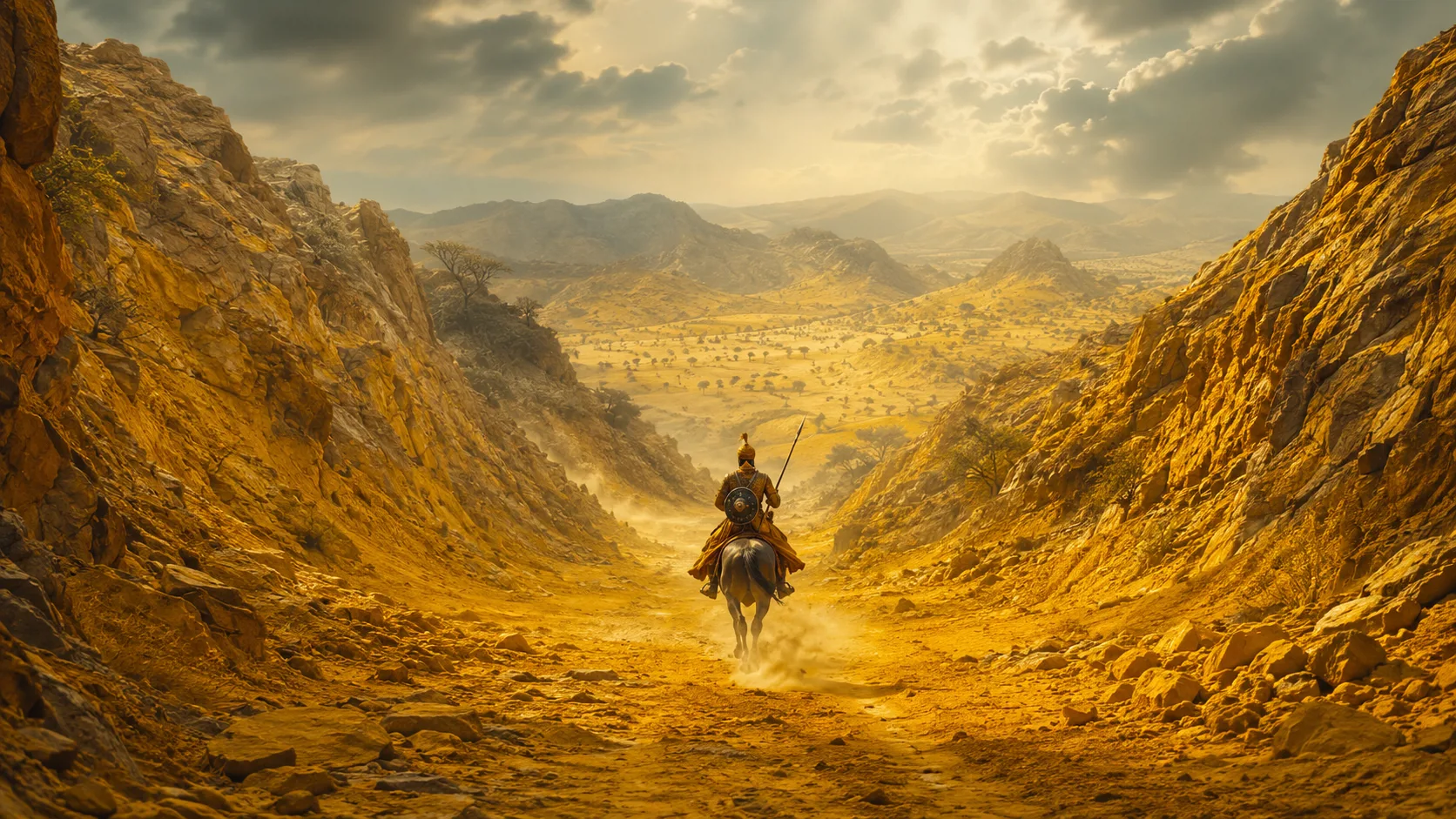
The Colour of the Ground
The Aravalli is among the oldest fold mountain systems on earth, its orogeny dated to something in the order of two thousand million years ago, worn down since from an alpine spine into a long low corrugation of quartzite and schist running north-east from Gujarat towards Delhi. In its southern reaches, west of the Banas, the rock breaks into a maze of ridges and blind valleys, thorn scrub, dhok and salar and khejri, dry watercourses that fill for eight weeks and then vanish. It is poor country. It grows millet, not wheat. It hides men extraordinarily well.
Roughly forty kilometres north of Udaipur and some seventeen south-west of the town now called Nathdwara, two ridges lean towards each other and leave between them a defile about a kilometre long. It runs from the south and bends towards the north-east. At its narrowest a horse struggles; two men walking abreast press shoulders. At the northern mouth the ground drops away and opens into an undulating plain that widens towards the village of Khamnor and, beyond it, towards Molela of the terracotta plaques.
The rock and the soil of this defile are yellow. Not the ochre of most of Rajasthan but a specific saturated yellow, the colour of turmeric ground fresh in a stone mortar. Iron and sulphur compounds in the weathered schist give it the tint, and monsoon water running off the ridge concentrates it in the bed of the pass. In the vernacular of the country, turmeric is haldi and a mountain defile is a ghati.
Haldighati. The Turmeric Pass. The name is a farmer's name, flatly descriptive, given by people who walked through it with goats and noticed what colour their feet had turned.
Two other derivations circulate locally. One holds that turmeric was once cultivated on the terraces above the pass. Another, offered by pandits of the Nathdwara country, connects haldi to the older Sanskrit haridra and to the yellow of the wild rose and safflower once grown for dye in the Badshahi Bagh nearby. Neither displaces the soil. The Archaeological Survey's own notice on the site takes the colour of the earth as the source of the name, and the earth is still there to be looked at.
There is a second name for the ground, and it belongs to the plain rather than the pass. Where the defile opens out near Khamnor lies a shallow depression that fills after rain. It is called Rakta Talai. The Pool of Blood. That name is not descriptive of geology.
Guardians of the Defile
A pass in Bharatavarsha is never merely a gap in rock. It is a threshold, and thresholds have keepers.
The country on both sides of Haldighati is dense with shrines, and their arrangement is legible to anyone who knows how sacred geography works in this land. On the approaches stands the shrine of Bherunath, the Bhairava of the locality, and on a hill not far off the Mahakali of Kaloda, and on another the hill-goddess Varai Mata. The pattern repeats across the whole southern Aravalli: a fierce male guardian at the road, a goddess on the height, a village mother in the grove.
The question of what Bhairava is has been badly answered for two centuries, and the mis-answer matters here more than usual. Bhairava is not a devil. There is no devil in this civilisation to be. The category itself is an import, and it does not translate.
Bhairava is Rudra in his terrible aspect, the form Siva takes when the function required is not creation or preservation but the enforcement of a boundary. His office is kshetrapala, protector of the field, and the field means a defined territory whose limits he holds. He is armed, he is dark, he is attended by a dog, he is offered liquor and iron and red cloth rather than milk and flowers, and he is worshipped at gates, at crossroads, at cremation grounds and at the mouths of passes. Every one of those is a place where one order ends and another begins. The terror in the icon is the terror of a frontier, and it is directed outward, at whatever attempts to cross without right.
The goddess on the hill is the same principle in the feminine. Durga, Kali, Mahakali of Kaloda, Varai Mata, and above all in Mewar the clan mother Banamata, are not benevolence and not malevolence. They are Sakti, the power by which anything at all is able to act, worshipped by a warrior lineage in the aspect that grants victory and accepts blood.
Above these local guardians stands the deity who actually rules Mewar. At Kailashpuri, some twenty-two kilometres north of Udaipur, in a walled complex of a hundred and eight shrines built and rebuilt from the tenth century onward, is the four-faced black marble linga of Ekalinga. The four faces look to the four quarters, Surya and Brahma and Visnu and Rudra, and the whole of Mewar is held to be his estate.
The Maharana does not own Mewar. Ekalinga owns Mewar. The Maharana administers it as Diwan, the deputy who signs on behalf of the sovereign. That is not a courtesy title and it is not decoration. It is the constitutional theory of the state, established in tradition by Bappa Rawal in the eighth century and maintained without interruption until the house lost its kingdom in the twentieth. The Rana's seal is the deputy's seal. The land is temple land. A king who administers cannot alienate the estate, because it is not his to alienate.
A king who owns his kingdom may sell it. A king who holds it in trust for a deity has nothing to sell and no authority to surrender.
That clause governs everything that happened at Haldighati in 1576. The refusal of the next twenty-one years follows from a legal position about property.
One further custom of Mewar explains who fought in the pass. No Maharana of Mewar takes the throne until a chieftain of the Bhils cuts his own thumb and marks the new ruler's forehead with his blood. The tilaka of installation is applied by the forest people, not by the court. In the arms of the house, the shield bearing the sun of Ekalinga is supported on one side by a mailed Rajput and on the other by a Bhil with a bow. The Bhils were not auxiliaries hired for a campaign. They were a constitutional party to the kingship, and they turned out at Haldighati as men defending their own compact.
Haridra and Rakta
A pass named for turmeric and a plain named for blood lie four hundred metres apart, and the pairing raises a question that anyone standing on the ground eventually asks. Is this auspicious country or ruined country. Blessed earth or cursed earth.
The question is worth answering properly, because the answer is one of the load-bearing differences between this civilisation and the ones that came to conquer it.
What turmeric is
Haridra is not a spice in the ritual grammar of Bharatavarsha. It stands among the foremost of the mangala dravyas, the substances that make a thing auspicious by contact.
The rhizome is ground and smeared on a bride and a bridegroom before the marriage, and the rite is named for it. It is mixed with lime to make kumkuma, and the kumkuma marks the forehead of a goddess and of every married woman. It goes on the threshold of a house and on the lintel and on the first page of an account book. Knotted into a piece of cloth with a few grains of rice, it is the physical form of an invitation to a wedding, so that a family in a village learns of a marriage by being handed a pinch of turmeric. A whole root, wrapped and tied, stands in for Ganapati in domestic rites when no image is available, and turmeric is offered to Gauri and to Laksmi in nearly every household observance in the country.
Its properties are also practical, and the tradition never separated the two: it closes wounds, it keeps grain, it will not let a cut go septic. A substance that heals, preserves and marks a boundary was going to become the substance of auspiciousness in any civilisation paying attention.
So the pass is named, by farmers, after one of the most auspicious materials in the domestic religion of the people who named it. That is the base state of the ground.
What a battlefield is
Against that stands Rakta Talai, and against it stands a general principle that most religious systems hold: a place of violent death is polluted. Death carries asauca, ritual impurity, which attaches to the dead person's kin for a fixed period and to the ground where a body lies. A cremation ground is not somewhere a household conducts its business. By that reasoning the plain at Khamnor, where perhaps five hundred men died in four hours and were left where they fell, should be the most defiled acre in the district.
It is not, and the reason is a distinction the tradition makes very sharply and that the modern vocabulary of devils and blessings cannot express at all.
The opening line of the Gita names the same acre twice. Kuruksetra is the place, the geography, the ground where the killing will happen. Dharmaksetra is what that same ground is, because of what is being decided on it. The verse does not say that a battlefield is redeemed afterwards by a good outcome. It says that a field on which dharma is contested is already a field of dharma before the first arrow flies.
A ksatriya who dies facing the enemy in a dharmayuddha does not incur the impurity of ordinary death. His is the one death in the whole system that needs no expiation, that is not mourned in the manner of other deaths, and that the sastras describe as opening the gate directly. The blood on such ground is not contamination. It is offering.
That is why Rakta Talai has chatris on it and not a fence. The cenotaphs standing in that shallow depression, one for each place where a named man went down, are not graves and they are not warnings. They receive vermilion and coconut and cloth. People go there and ask for things.
The jhunjhar
Rajasthan carries this logic further than most of the country, and the local form of it answers the question exactly.
A warrior who is struck a mortal blow, who is decapitated or run through, and who goes on fighting after he should have fallen, becomes in the Rajasthani reckoning a jhunjhar. The jhunjhar is not a ghost in the sense of an unquiet dead thing to be pacified and dismissed. He is a deified hero. Shrines to jhunjhars stand at field edges and crossroads across Marwar and Mewar, red-painted, hung with bangles and cloth, and the village petitions them for rain, for cattle, for a child's fever, for the safety of a journey.
The men who died at Rakta Talai are in that class. So is Bida Jhala, who died wearing another man's crown. So is Hakim Khan Sur, whose grave lies in the same field as the Rajput cenotaphs, unmoved and untouched for four and a half centuries, an Afghan buried among the men he charged with.
The fierce dead in this civilisation become protectors. That is the whole answer. There is no mechanism here by which violent death produces a devil, because there is no devil for it to produce. What a violent death in dharma produces is a guardian, and a guardian gets a shrine, and the shrine gets flowers.
A tradition that turns its dead soldiers into village deities has decided something permanent about whether the ground they died on is good.
The evidence of the ground itself
Three things standing within a few kilometres settle the matter better than any argument.
At Balicha there is a cenotaph over a horse, in white marble, visited continuously since the sixteenth century. Nobody raises a monument to an animal on ground they consider cursed.
At Khamnor, on the same soil that was fought over, the Badshahi Bagh still grows the Chaitri rose, and the district still distils it into rose water and cooks the petals into gulkand. A delicate thing is grown and distilled on the field of the killing, and has been for centuries. The people who farm there have never behaved as though the earth were spoiled.
And seventeen kilometres away is Nathdvara. In 1672, when the image of Srinathji had to be moved out of Braj ahead of Aurangzeb's demolitions, and the carriers were looking for the safest ground in Bharatavarsha to set a god down on, they brought him to within a morning's walk of Haldighati and stopped. A cart is said to have sunk to its axle at Sihad and the halt was read as the deity choosing. Whatever is made of that, the choice was made in favour of this country and not against it, by people whose entire responsibility was to judge where a god would be safe.
Haldi over rakta
The reading that this land actually makes of its own ground is therefore straightforward, and the two names carry it between them.
The turmeric is the permanent condition. It was there before the battle, it is in the rock, it comes from iron and sulphur laid down when the Aravalli was young, and no event of human scale touches it.
The blood was four hours on one June morning. The monsoon broke a few days later, as it does every year, and washed the plain, and the ground went back to the colour it had always been.
Mewar did not name that place after the worst thing that happened there. Rakta Talai names the depression, a few acres of it, and the whole pass and the whole district and the whole memory take the name of the turmeric. That is a civilisation choosing, deliberately and with the evidence in front of it, to file a catastrophe under auspiciousness.
The House and the Rock
The Guhila line, later the Sisodia, claims descent from the Suryavamsa through Rama of Ayodhya by way of the Guhadatta who settled in the hills of Mewar, and the claim was current long before it became politically useful. Bappa Rawal took Chittaur from the Mori in the eighth century and set the dynasty on the rock that would define it for eight hundred years.
Chittaur is not a fort in the ordinary sense. It is a hill, a flat-topped mesa a hundred and eighty metres above the plain and some five kilometres long, walled around its entire circumference, holding within its walls temples, tanks, palaces, granaries, a resident population and its own agriculture. It is a city that cannot be stormed and must be starved. Sieges of Chittaur are measured in months.
The rock produced a distinctive politics. Where other Rajput houses learned accommodation, Mewar learned the arithmetic of a place that can hold out. Rana Hammir recovered it in the fourteenth century and took the title Rana. Rana Kumbha in the fifteenth built or rebuilt thirty-two fortresses including Kumbhalgarh, whose wall runs thirty-six kilometres over the ridges and whose gates stand at the head of ravines, and he also wrote treatises on music and composed a commentary on the Gitagovinda. Rana Sanga in the sixteenth carried the marks of eighty wounds, had lost an arm and an eye, and rode against Babur at Khanwa in 1527 at the head of one of the largest Rajput confederations ever assembled.
Khanwa was the hinge. Sanga's confederacy was broken not by Rajput inferiority in courage or numbers but by field artillery and matchlocks employed behind a screen of tied carts, a system Babur had brought from Central Asia and which no Indian army of the day was organised to answer. The lesson of Khanwa was gunpowder, and Mewar did not learn it. Fifty years later, in a defile in the Aravalli, the same lesson would be administered again by the grandson of the man who taught it.
Chittaur fell three times, and each fall entered the memory of the country as scripture rather than chronicle. In 1303 before Alauddin Khalji, when the women of the fortress went into the fire. In 1535 before Bahadur Shah of Gujarat, when they went in again. And in 1568 before Akbar.
That third siege is the immediate ancestor of Haldighati and must be seen clearly.
Chittaur, 1568
Akbar invested the rock in October 1567 with a siege train, engineers, and sabats, covered approach trenches driven forward under fire, wide enough for mounted men. Udai Singh, Pratap's father, had already withdrawn into the hills on the advice of his council, leaving the defence to Jaimal of Bednore and Patta of Kelwa. The strategic judgement was correct and the country never forgave it.
The garrison held for four months. Jaimal was hit in the leg by a shot fired from Akbar's own matchlock and fought on carried on the shoulders of another man. When the breach could no longer be held the fires were lit, the women of the fortress went into them, and the surviving men opened the gates and came out to die in the open.
What followed was not a soldier's decision taken in the heat of a storm. The fort had fallen; the fighting men were dead. Akbar ordered a general massacre of the population. The figure recorded in the imperial accounts themselves is thirty thousand. The men killed were the peasants and artisans of the surrounding country who had come inside the walls, and who had assisted the defence by working the walls and carrying earth. The account that the sacred threads of the slain were gathered up and weighed belongs to the Rajput record rather than to the imperial one. Contested
The number thirty thousand is not a Rajput claim inflated in grief. It is Abul Fazl's, entered into the Akbarnama as a statement of what the emperor accomplished. The imperial court regarded the figure as creditable and recorded it in that spirit. The temples of the hill were broken, and the great gates and the bronze candelabra were carried away to Agra.
Akbar then had statues of Jaimal and Patta carved in stone, mounted on elephants, and placed outside the gate of his fort at Agra. The gesture is often read as chivalry. It is more precisely read as accountancy: the defeated enemy is monumentalised at the door as a permanent notice of what the empire absorbs.
Chittaur was never again the seat of its house. Udai Singh, in the hills, had already begun in 1559 to build a new city beside a lake in a bowl of the Aravalli, on the advice of a hermit he met on the ridge. He called it Udaipur. When he died in 1572 the capital of Mewar was a city under construction, the ancestral rock was in enemy hands, the fertile eastern belt of the kingdom was lost, and what remained was hill country, forest, and the western passes.
That was the estate Pratap inherited.
Bharatavarsha in the Year 1576
To understand what a defile in the Aravalli meant, the whole subcontinent in that decade has to be brought into view. It was not a quiet time anywhere.
Eleven years before Haldighati, in January 1565, the confederated Deccan sultanates had destroyed the field army of Vijayanagara at Talikota. The city itself, which Persian and Portuguese visitors had described as the equal of anything in the world, was entered and systematically demolished over five months. What stands at Hampi today is the result of that deliberate work: the ruin is the monument. With Vijayanagara went a patron of Sanskrit and Telugu and Kannada letters, of the Vaisnava and Saiva mathas of the peninsula, and of the temple economy of the south, on a scale the peninsula would not see assembled again. The Nayaka successors at Madurai, Tanjavur and Ginjee inherited fragments and did what they could with them.
In the north, Akbar's consolidation was nearly complete. Malwa taken in 1561. Gondwana in 1564, where Rani Durgavati fought her own last action and killed herself rather than be taken. Chittaur in 1568, Ranthambhor and Kalinjar in 1569, Gujarat in 1572 and 1573, and Bengal in the very year of Haldighati, where the Karrani sultan was destroyed at Rajmahal three weeks after the fighting in the pass.
In the east, beyond the Brahmaputra, the Ahom kings held Asama and would go on holding it. In Odisha the Gajapati line had gone under to the Bengal sultanate in 1568 and the Jagannatha shrine at Puri had been assaulted; the image had been carried into hiding and brought back. On the western coast the Portuguese had held Goa since 1510 and the Inquisition had been operating there since 1560, taking testimony, seizing property, and burning people in the Terreiro do Sabaio.
And yet the interior life of the civilisation in that decade was not in retreat. It was in one of its great flowerings.
The intellectual and devotional life of Bharatavarsha in the decades around 1576
| Figure or work | Region | Circumstance |
|---|---|---|
| Tulsidas, Ramcaritamanasa begun 1574 | Kasi and Ayodhya | Rama's story in Avadhi, put into the mouths of people who could not read Sanskrit |
| Surdas, Sursagar | Braj | Krsna bhakti in Braj bhasa, at the Vallabha seat on Govardhan |
| Mirabai, of the house of Mewar itself | Mewar and Dvaraka | Sisodia queen turned wandering singer, whose padas were current across the north |
| Ekanatha, Bhagavata and Bhavartha Ramayana | Maharastra | Marathi commentary that carried Vedanta to villages |
| Purandaradasa, died 1564 | Karnataka | The pedagogy of Carnatic music fixed into its permanent form |
| Vallabha and Caitanya lineages, consolidating | Braj, Bengal, Gujarat | Two systems of Krsna theology building institutions that would outlast every sultanate |
| Madhusudana Sarasvati, active | Kasi | Advaita's most formidable polemicist, defending the tradition in argument |
Two things follow from that table, and both bear on Haldighati.
The first is that the transmission of Sanatana Dharma had already, by 1576, decentralised itself out of reach of any single conquest. When Vijayanagara was destroyed, the tradition it patronised did not die, because the tradition was also in a weaver's song in Braj and a farmer's recitation in Avadhi and a kirtana in a Bengal courtyard. An empire can burn a city. It has a much harder time with a metre.
The second is that the political situation of the Hindu kingdoms had become one of near-universal accommodation. Amber had given a daughter to Akbar in 1562 and its princes had risen to the highest commands in the empire. Marwar, Bikaner, Bundi, Jaisalmer had followed. The Kachhwaha of Amber were not traitors in the simple sense; they had made a calculation that survival through service preserved more than resistance destroyed, and by their own measure they were vindicated, since the house of Amber ended the century richer, larger and more powerful than it began.
Against that near-universal calculation, one house said no. That is the whole significance of Mewar, and it is why the argument over a four-hour skirmish in a mountain pass has never cooled in four hundred and fifty years.
Akbar's religious policy in this period is often produced as a mitigating context. The jizya was abolished in 1564, the pilgrim tax before it, Hindu officers rose to the highest ranks, and after 1575 the Ibadat Khana at Fatehpur Sikri heard debates from Brahmanas, Jains, Zoroastrians and Jesuits. All of this is true and none of it was available to the population of Chittaur in 1568. A policy of toleration administered from above, revocable at will, granted to the submissive and withdrawn from the resisting, is a policy about the convenience of the state. Aurangzeb reimposed the jizya in 1679 with a stroke of the pen, which is the measure of how deep the concession went.
The Man Who Inherited the Refusal
Pratap Singh was born at Kumbhalgarh on 9 May 1540, in the years when his father Udai Singh was still fighting to recover his own throne from the usurper Banbir. He was the eldest son of Jaiwanta Bai of the Songara Cauhan. He was raised in the hills rather than in a court, among Bhil boys as much as among Rajput ones, and he learned the country the way a hunter learns it, which is to say by the ravine and the water source rather than by the map.
The succession of 1572 was not smooth. Udai Singh had in his last years favoured Jagmal, a younger son by a favoured queen, and had indicated him as heir. The senior nobles of Mewar refused. At the cremation ground, with the funeral of the old Rana still burning, the Cundawat chief Krsnadas and the Jhala chief Man Singh of Bari Sadri physically moved Jagmal off the seat and put Pratap on it. The coronation was performed at Gogunda on 28 February 1572.
Jagmal rode to Akbar, received the jagir of Jahazpur, and served the empire against his brother. Two other brothers, Sakti Singh and Sagar Singh, also went over at various points. The house was divided before the war began, which is the ordinary condition of dynastic politics everywhere and no less true of Mewar for being inconvenient.
What Pratap did on taking the seat was to make a set of vows, and the vows are the most misunderstood element of the whole affair. Rajput tradition records that he swore not to sleep on a bed but on straw, not to eat off metal but off leaf plates, and to let his beard grow untrimmed, until Chittaur was recovered. His nobles took the vows with him, and the tradition of eating from leaf plates and sleeping on a straw layer beneath the mattress is said to have been maintained in the house of Mewar for generations afterward.
These were not gestures of grief. A vow of this kind in the ksatriya idiom is an instrument of policy. It converts a political objective into a religious obligation binding on the man who took it and on everyone who took it with him, removing the option of quiet renegotiation later. Pratap made it structurally impossible for himself to accept terms, and he did it in public, in front of the men whose sons would die for the decision.
Six Embassies and a Word That Would Not Be Said
Akbar did not want this war. That is not a compliment to him; it is a statement about cost. Mewar had already been broken open in 1568 and its best land taken. What remained was hill country whose revenue would never repay a campaign in it. What Akbar wanted was the word.
Between 1572 and late 1573 the imperial court sent envoy after envoy into the Aravalli. The chronicles differ on the exact count, and six missions is the figure that appears in the fuller reconstructions, though four named envoys are securely attested.
The imperial embassies to Maharana Pratap, 1572 to 1573
| Envoy | Standing | Outcome |
|---|---|---|
| Jalal Khan Qurchi | Personal servant of Akbar, sent first and possibly more than once | Refused; returned with nothing |
| Man Singh of Amber | Kachhwaha prince, June 1573, grandson of Bharmal, nephew by marriage to the emperor | Received with courtesy, refused on substance, and departed in anger |
| Bhagwant Das of Amber | Head of the Kachhwaha house, October 1573, the senior Rajput at court | The nearest thing to success; a robe accepted, and by Abul Fazl's account the boy Amar Singh sent to court |
| Todar Mal | The empire's revenue architect, sent last as the practical negotiator | Returned without result; the diplomatic track closed |
The terms on offer were the standard imperial settlement, and every other Rajput house had taken them. Recognition of Akbar as paramount. Personal attendance at court, the physical act of the ruler presenting himself and performing obeisance. A contingent supplied to imperial campaigns. And, for the closest houses, a daughter given in marriage to the imperial family.
Pratap would concede a great deal of the substance. He would not concede the person. He would not go to Fatehpur Sikri and stand in the ranks of the mansabdars, and he would not give a daughter of the house of Mewar to the Timurid line.
The reason is not pride in the ordinary sense, though pride was present. It is the doctrine of the Diwani. A ruler who administers the estate of Ekalinga cannot perform the obeisance of a subordinate to another sovereign, because the sovereignty is not his to transfer. He would be signing away property held in trust. Every other Rajput house had a king who owned his kingdom and could therefore trade it. Mewar had a deputy who could not.
The episode of Man Singh's embassy has hardened into a fixed scene: a feast prepared at the Udai Sagar embankment, Pratap absent from it, a message sent that the Rana was unwell, Man Singh understanding the insult perfectly, and a parting exchange in which each promised to meet the other in the field. Rajput bardic sources give it in full detail. It appears in no contemporary Persian chronicle. The particulars survive in the Rajput record alone, and the fact beneath them stands on its own: Man Singh went into Mewar as an envoy and came out an enemy, and three years later he asked for the command against Pratap and got it.
One further point of friction runs through the correspondence and the chronicles treat it almost as an aside. Pratap possessed a war elephant named Ramaprasada, of exceptional size and reputation. Akbar wanted it. Elephants of the first rank were imperial property by convention, and the demand was made. It was refused. In a dispute already about whether Mewar's things were Mewar's to keep, an elephant is not a trivial object; it is the same argument in a smaller and more portable form.
By the close of 1573 the diplomatic file was shut. It took two and a half more years to open the military one, because Akbar had Gujarat and then Bengal to finish first.
Why the Empire Wanted a Poor Country
Three reasons, and the first is the one usually given.
Gujarat had been annexed in 1573. Its ports, Khambhat and Surat and Diu's neighbourhood, were the commercial mouth of northern India and the embarkation for the Hajj. The land route from Agra and Ajmer down to those ports ran along the eastern edge of the Aravalli, and the flank of that route was Mewar. A hostile power in those hills could raid a caravan road indefinitely and never be caught. Securing the Gujarat road required either Mewar's submission or Mewar's destruction.
The second reason is the Rajput system itself. Akbar's arrangement with the Rajput houses was the load-bearing wall of the empire's northern structure. It worked because it was universal. A single house holding out in the hills, visibly unpunished, was a standing advertisement that the terms were optional. Every mansabdar of Rajput blood in the imperial service, and there were many at the highest ranks, had a personal stake in demonstrating that the refusal did not pay. That is why the command went to Man Singh and not to a Turani general. The empire needed a Rajput to break a Rajput, and it needed the fact widely known.
The third is the oldest and the least written down. The Sisodia claim of primacy among Rajput houses was accepted across Rajputana; the Rana of Mewar was first in precedence and everyone knew it. As long as the first house had not bowed, the bowing of the others was incomplete. Akbar was not collecting a province. He was collecting a signature.
The Preparation of Mewar
Pratap had between three and four years to prepare, and what he did with them was more radical than anything he did on the day of the battle.
He evacuated the plains. The order went out that the fertile open country of eastern and central Mewar was to be abandoned: fields left unsown, wells rendered unusable, grain moved or destroyed, cattle driven west into the hills, villages emptied of their people. The population was moved into the western uplands and the forests of the Chappan. Cultivation was forbidden in the belt an imperial army would have to cross.
This is scorched earth practised against one's own country, and it is worth understanding what it cost. Mewar's revenue was already halved by the loss of the eastern belt in 1568. Pratap now voluntarily destroyed the productivity of what remained accessible, converting his kingdom into a logistical desert and his subjects into refugees, on the calculation that an imperial army in that country would have to carry every grain of its own food and every bundle of fodder for its horses over the passes.
The calculation was exactly right, and the proof arrived at Gogunda a day after the battle, when a victorious imperial army found itself eating its own baggage animals.
He moved his operational base. Kumbhalgarh, thirty-six kilometres of wall on the ridge, remained the fortress of last resort and the treasury and the family's refuge. But a fortress is a trap when the enemy has siege artillery, as Chittaur had proved. Pratap shifted his working headquarters forward to Gogunda, a town in a bowl of hills behind the Haldighati defile, from which the pass could be watched and the western country reached quickly.
He made the compact with the forest explicit. Rana Punja, chief of the Bhils of Merpur, brought his men in. Bhil archers with the long bow and iron-tipped arrow are not shock troops and were never used as such, but as scouts, as ambushers, as the eyes on every ridge, as the men who roll stones into a defile and vanish, they had no equal in that country and no counter. Bhil intelligence meant that no imperial column ever moved in the Aravalli unobserved, in 1576 or in the twenty years after.
He gathered the disinherited. Ram Shah Tanwar had been king of Gwalior until Akbar took it, and had come to Mewar with his three sons and his surviving retainers. Hakim Khan Sur was an Afghan of the line of Sher Shah, whose family the Mughals had dispossessed of Hindustan itself, and he came in with his contingent and a reputation with firearms. Ramdas Rathore was the son of that Jaimal who had died in the breach at Chittaur.
The presence of Hakim Khan Sur and his Afghans in Pratap's van is a fact that both of the crude readings of this war stumble over. It was not a war of Hindu against Muslim; Afghans died for Mewar and Rajputs killed for the empire. It was a war between a civilisational order rooted in the land and an imperial project that required every such order to submit and be absorbed. Men found themselves on one side or the other of that question for reasons of lineage, dispossession, calculation and honour, and the sorting did not follow the lines that later polemic prefers. Hakim Khan Sur died in the pass and is buried at Rakta Talai among the men he fell beside.
And he paid for it, at first out of a treasury that was very nearly empty and later out of one man's private fortune, which is a story that belongs after the battle rather than before it.
The Imperial Army Takes the Field
On 3 April 1576 at Ajmer, Akbar formally appointed Man Singh of Amber to the command of the expedition against Mewar. Asaf Khan, Ghiyas-ud-din Ali, was named second in command and the emperor's own bakhshi with the force, which is to say the paymaster and the eye of the court on the general.
The army mustered at Mandalgarh on the north-eastern approach and sat there for over two months, drawing in contingents, collecting supplies, waiting.
Its strength is the most contested number in the affair. The imperial establishment given to Man Singh is reported at five thousand. With Rajput contingents, Sayyid horse from Barha, Shaikhzada infantry, Badakhshi troops, matchlockmen and camp followers, the usual modern reconstruction puts the fighting force at around ten thousand. The figures of eighty thousand and a hundred thousand that circulate in popular retellings belong to Akbar's total campaign commitment against Mewar over the following six years, not to the column that entered the pass, and they should not be applied to 18 June.
Reported strengths at Haldighati and the confidence attaching to each
| Force | Common figure | Assessment |
|---|---|---|
| Mughal fighting strength in the pass | 10,000 | Broadly accepted; built from an imperial core of about 5,000 plus Rajput and allied contingents |
| Mewar cavalry | 3,000 | Consistent across Persian and Rajput reconstructions |
| Bhil archers | 400 | The standard figure; some accounts give 2,000 and count the wider levy |
| Mewar total under arms | 20,000 or 22,000 | Contested; almost certainly a count of the whole kingdom's levy, not the force present |
| War elephants, Mughal | Unknown, present in number | Attested in the fighting; no reliable count |
| War elephants, Mewar | Around 100 in some accounts | Contested; Ramaprasada and a few others are named, the remainder is inference |
What the numbers conceal is more decisive than what they show. The imperial force was a combined-arms army: horse archers trained in the Central Asian manner to shoot from the saddle at speed, matchlockmen, elephants, and an artillery train. The Mewar force was cavalry, almost purely, armed for shock, with the straight double-edged khanda for the moment of contact, supported by foot archers on the flanks.
One imperial advantage did not enter the pass. Heavy guns cannot be dragged through a defile a kilometre long and at points barely wide enough for a horse. Man Singh's artillery stayed with the baggage. That single fact of terrain is what made a three-to-one disparity survivable for four hours, and Pratap had chosen the ground precisely for it.
The Ground, Read as a Soldier Reads It
The Mughal army left Mandalgarh and moved south-west. It crossed the Banas and camped at Molela, on the northern side of the hills, some way out from the mouth of the defile. Between the imperial camp and Gogunda, where Pratap sat, lay the Haldighati pass.
Anyone who walks the ground can see the tactical problem in about ten minutes.
The defile runs roughly a kilometre, south to north-east, between steep quartzite ridges. Its floor is broken and stony. At its narrowest points a body of horse must string out almost single file, and a column of ten thousand men entering it would be strung out for kilometres, unable to deploy, unable to support its own head, and vulnerable along its whole length to anything on the heights.
At the northern end the ground opens. It does not open into a plain immediately; it undulates, breaks, and then widens gradually towards Khamnor and the depression that would be named Rakta Talai. Beyond that lies proper open country.
This gives each commander a straightforward doctrine, and both of them knew it.
For Pratap, the pass is everything. Fight at the mouth, with the enemy's column jammed behind it and unable to bring weight forward. Numbers do not count when they cannot be deployed. Bhil archers on the ridges above shoot down into a mass that cannot answer. Elephants are useless in a defile. Guns are absent. In the pass, three thousand Mewari horse are worth ten thousand imperial troops and possibly more.
For Man Singh, the pass is a death trap and the open ground is victory. Get the enemy out of the defile and onto the widening plain, where the horse archers can work at distance, where the elephants can be brought up, where the reserves can be committed on a flank, where three-to-one means three-to-one.
Everything that happened on 18 June 1576 is the working out of those two doctrines against each other, and the decisive event of the day is the moment when one of them broke.
Both dates 18 June and 21 June 1576 appear in circulation. The 18th is the reading of the Persian sources and is the date adopted in most modern reconstructions and by the Archaeological Survey's notice at the site. The 21st appears in some later Rajput chronology and in a good deal of popular writing. Settled in favour of 18 June, with the divergence noted.
The season matters too. Mid-June in the southern Aravalli is the last and worst stretch before the monsoon. Daytime temperature above forty-two degrees. Watercourses reduced to pools. Men fighting in mail and quilted armour, horses in barding, elephants requiring hundreds of litres a day. The battle lasted about four hours and ended around midday, and heat was a third army on the field, fighting both sides.
The Orders of Battle
Both commanders drew up in the classical order, which was substantially the same order in Persian and in Sanskrit military theory: a screen, a van, a centre with the commander and the standard, two wings, a reserve, and a rear guard. The Sanskrit tradition calls the arrangement a vyuha; the Persian names the parts harawal, qalb, altamash, and the rest. The vocabularies differ. The geometry does not.
The imperial array
At the very front, a screen of about eighty-five horsemen under Sayyid Hashim of Barha. Badauni, who was present with the vanguard, records the imperial camp's own nickname for this detachment, which translates roughly as the chickens of the front line, and the joke tells the purpose exactly: they were bait, sent forward to be hit so that the shape and weight of the enemy's first blow could be read.
Behind the screen, the harawal, the vanguard proper: the Kachhwaha Rajputs under Jagannath, and the Central Asian troops under the bakhshi Asaf Khan, with Ghiyas-ud-din Ali. Abdul Qadir Badauni rode here.
Behind the van, an advance reserve of substance under Madho Singh Kachhwaha, positioned to feed forward into whatever the van could not hold.
The centre, the qalb, under Man Singh in person, mounted on an elephant with the imperial standard, from which the whole field could be seen.
On the right, the Sayyids of Barha, the hereditary shock troops of the Mughal establishment, with a reputation for standing when other formations did not.
On the left, Mulla Qazi Khan with the Shaikhzadas and Badakhshi troops.
In the rear, the rear guard under Mihtar Khan, an officer of the household and the emperor's news-writer with the army, whose function was administrative and whose intervention would decide the day.
The array of Mewar
The van, about eight hundred horse, under Hakim Khan Sur with his Afghans, Bhim Singh of Dodia, and Ramdas Rathore, son of Jaimal of Chittaur. Rawat Netsi and Krsnadas Cundawat rode with this division.
The right wing, about five hundred, under Ram Shah Tanwar, the dispossessed king of Gwalior, with his three sons Salivahana, Bhavani Singh and Pratap Singh Tanwar, and with the minister Bhamashah and his brother Tarachand.
The left wing, about four hundred, under Bida Jhala of Bari Sadri and his clansmen.
The centre, about thirteen hundred, under the Maharana himself on Cetaka, with the sun standard of the house and the household troops.
The Bhil archers under Rana Punja in the rear and, more importantly, on the ridges flanking the defile, where their arrows could reach a column in the pass and nothing in the pass could reach them.
And in the ranks, carrying arms and fighting, the bards and the priests. The Caranas and Bhats of Mewar did not follow the army to compose afterwards. They fought in it. So did temple servants and household Brahmanas. That detail, recorded on both sides, describes a society at war rather than an army at war.
The two arrays at Haldighati, division by division
| Position | Mewar | Mughal Empire |
|---|---|---|
| Screen | None; Bhil archers on the flanking heights | About 85 horse under Sayyid Hashim of Barha |
| Van | About 800 under Hakim Khan Sur, Bhim Singh Dodia, Ramdas Rathore | Kachhwaha under Jagannath with Asaf Khan and Ghiyas-ud-din Ali |
| Right | About 500 under Ram Shah Tanwar and his three sons, with Bhamashah | The Sayyids of Barha |
| Left | About 400 under Bida Jhala | Mulla Qazi Khan with Shaikhzadas and Badakhshi troops |
| Centre | About 1,300 under Maharana Pratap on Cetaka | Man Singh on elephant with the imperial standard |
| Reserve | None available | Advance reserve under Madho Singh Kachhwaha |
| Rear | Bhil archers under Rana Punja | Rear guard under Mihtar Khan |
| Artillery | None in the pass | Present with the baggage, not brought through the defile |
The asymmetry that decides everything is in the reserve row. Man Singh had two bodies of troops uncommitted when the fighting began. Pratap had none. Every man Mewar possessed was in the first line, because there were not enough men to do anything else. A force with no reserve can win in the first hour or not at all.
The First Hour
The imperial column began to move towards the pass in the early morning. Pratap did not contest the far side. He let the head of the column come through the defile and begin to spill out onto the broken ground at the northern mouth, and he held his own force back in the folds behind that mouth, out of sight.
Then he charged.
The Mewar van under Hakim Khan Sur went straight into Sayyid Hashim's screen and obliterated it. The eighty-five horsemen sent forward as bait performed their function completely: they were ridden over, Hashim himself went down wounded, and the survivors ran back into the van behind them.
The van did not hold either. Eight hundred Rajput and Afghan horse coming downhill at the charge with the khanda drawn, into a formation still deploying out of a defile with its own rear jammed behind it, is the single most effective thing a heavy cavalry force can do, and it worked. Jagannath Kachhwaha was wounded. The imperial vanguard broke backwards.
Ram Shah Tanwar's right went into the imperial left. Mulla Qazi Khan was wounded, the Shaikhzadas and the Badakhshi troops gave way, and the imperial left dissolved. Badauni, in the middle of it, watched formations of the imperial army run.
The distance the imperial troops fell back is given in the chronicles at five or six kos, which is something between fifteen and twenty kilometres, and that figure should be read as the panic of the broken units rather than as a general withdrawal of the army. Some of them ran and kept running.
For perhaps an hour, in the mouth of the pass, Mewar was winning outright.
Only the imperial right held. The Sayyids of Barha took the weight of Bida Jhala's left wing and did not break, and it was around that unbroken formation that everything afterwards was rebuilt.
The wounding of Sayyid Hashim, of Jagannath Kachhwaha, of Mulla Qazi Khan and of Shah Mansur in the first phase is recorded on the imperial side. Four named senior officers wounded and two divisions broken in the opening of a battle by a force one third the size is not a detail a court chronicle invents. Where the sources of the winning side record their own disorder, the record can be trusted.
The Hour That Lost It
Then the battle turned, and it turned on ground rather than on courage.
The broken imperial left and van fell back to the north-east, and the Mewar right and van followed them. That was the correct instinct and the fatal error. Pursuit drew the Mewar formations out of the mouth of the pass, off the broken ground where the defile protected their flanks, and out onto the widening plain by Khamnor.
The moment they were on open ground, every advantage reversed. The imperial horse archers had space to work, wheeling and shooting at distance against an enemy armed for contact. The elephants could be brought forward. Above all, Man Singh could see the whole field from his howdah, and he had two uncommitted reserves.
He committed them. Madho Singh's advance reserve went forward into the gap. Man Singh moved the centre up. And he sent word to Mihtar Khan in the rear to bring the rear guard forward and cover the exposed flank.
Mihtar Khan did more than that. As the rear guard came up, he had it proclaimed through the ranks that the emperor himself had arrived on the field with the imperial army behind him.
It was untrue. Akbar was at Ajmer. But an army that has just seen two of its divisions broken, that is fighting an enemy of terrifying commitment in appalling heat, and that suddenly hears that the emperor is watching, does not stop to verify. The running men turned around. The formations that were dissolving re-formed. The whole imperial line steadied and came forward.
Mihtar Khan's shout is the single most consequential act of the day. A rumour, correctly timed, did what eighty-five picked horsemen and a broken vanguard could not.
On the Mewar side there was nothing to answer it with. No reserve, no second line, no fresh formation to feed in, and no possibility of disengaging back into the pass, because the whole army was now committed forward on open ground with imperial cavalry working around its flanks.
The Mewar charge had spent its momentum. Horses that had gone forward at the gallop in that heat could not do it again. Men whose horses were killed under them fought on foot with the khanda in the press. The battle degenerated from manoeuvre into slaughter at close quarters in the shallow depression by Khamnor, and it was during those hours that the depression acquired the name it still carries.
Rajput Against Rajput
In the press by Khamnor a problem arose that no other battle of the age presented in quite this form. A large part of the imperial army was Rajput and the whole of the Mewar army was Rajput, and they were dressed alike, armed alike, mounted alike, and mixed together.
Badauni, riding with the vanguard as an archer and unable to tell which Rajputs he should be shooting at, put the question to Asaf Khan. The answer he received and recorded is one of the most quoted sentences of the sixteenth century in India: shoot into them regardless, because whichever side the dead fall on, it is a gain for Islam.
That sentence is often reproduced to make a point about Akbar's court, and the point it actually makes is sharper and less comfortable. Asaf Khan was second in command of an army whose general was a Hindu Rajput, whose front division was Kachhwaha, and whose fighting strength was roughly half Rajput. He said what he said in front of an army composed that way, and no one recorded any objection. The Rajputs of the imperial service were the instrument of the empire's expansion and they were, in the assessment of the emperor's own bakhshi standing in the middle of them, expendable in a manner their Muslim colleagues were not.
Badauni's Muntakhab-ut-Tawarikh was written in secret, was not shown to Akbar, and was suppressed until the reign of Jahangir. It is hostile to Akbar's religious experiments, sour about his officers, and entirely without the courtly obligation that governs Abul Fazl. Where Badauni records something to the empire's discredit he has no motive to invent it, and where he records his own presence in the vanguard at Haldighati he is the only eyewitness on either side whose account survives.
Arrows shot blind into a mixed melee killed men on both sides, and the casualty figures at the end of the day carry the mark of it.
The Elephants
Both armies brought elephants forward onto the plain, and for a period the fighting in the centre was decided by animals rather than men.
Mewar's Ramaprasada, the elephant Akbar had demanded and been refused, was brought into action against the imperial elephants Gaja Mukta and Rana Madara. Elephant against elephant is a contest of pushing and tusk work with the mahouts steering and archers shooting from the backs of both, and it is decided when one animal turns. Ramaprasada's mahout was shot. An elephant that loses its driver in the middle of a fight is uncontrollable and, in practice, capturable, and Ramaprasada was taken.
Mewar had no answer to the imperial elephant corps. It is at this point that the story of Cetaka's armour belongs.
Rajput tradition holds that Pratap's horse went into the battle wearing a fitted mask shaped like the head and trunk of an elephant calf, the purpose being that a war elephant, trained to charge horses, would hesitate before what appeared to be a young member of its own kind. The device is Contested as an item of equipment attested in a contemporary source, is depicted in the Mewar painting tradition, and is reproduced in every statue of Pratap and Cetaka in Rajasthan. It stands on the Mewar tradition rather than on a contemporary inventory, and it is entirely coherent as tactics for a commander who knew he would have to close with elephants and had no elephants of his own to spare for the purpose.
The Charge at the Standard
What Pratap did next has no tactical justification and every strategic one.
With his wings breaking, his van spent, and no reserve to commit, he took the household troops of the centre straight at the imperial standard, at Man Singh's elephant, in a decapitation charge. A general killed in his howdah ends a battle regardless of the state of the rest of the field, and it was the only card left in the hand.
The accounts converge on the essentials. Cetaka came up against the elephant and, in the manner Marwari horses were trained for, put its forehooves onto the animal's head or trunk, lifting Pratap high enough to strike into the howdah. Pratap threw. The spear killed the mahout. Man Singh, in the howdah, was low or shielded and was not hit. The elephant, driverless, turned away and carried the standard out of reach, and with it the last opportunity of the day.
The animal carried a sword or blade fixed to its trunk, a common fitting on imperial war elephants, and as it turned that blade opened Cetaka's leg.
Whether Man Singh was in the howdah at the moment of the strike, whether he ducked, and whether Pratap's spear or a sword stroke killed the mahout, vary from telling to telling. Contested in detail, Settled in outline. What is not variable is that the mahout was killed, that Man Singh survived, and that the strike came close enough to be recorded on both sides.
Around the Maharana the household troops were being cut apart. Ram Shah Tanwar died on the field and his three sons died with him, so that the line of the Tanwar of Gwalior ended in a Mewari depression on a June morning. Hakim Khan Sur died with his Afghans. Ramdas Rathore died, as his father Jaimal had died at Chittaur eight years before. Bhim Singh of Dodia died. Rawat Netsi, Man Songara, Sankaradasa, Rama Sandu, the roll of the Mewar nobility runs on for a page.
Pratap himself was wounded, and the accounts speak of seven wounds, some of them from spear thrusts. He was still fighting, still mounted, still recognisable by the sun standard and the royal umbrella above him, and precisely because he was recognisable, the whole weight of the imperial pursuit was converging on that point.
The Man Who Took the Umbrella
Bida Jhala, chief of Bari Sadri, commanding the shattered left wing, rode to the Maharana and did the thing his clan is remembered for.
He took the royal insignia. The chatra, the umbrella of sovereignty carried above the ruler, and the standard with it, were transferred from Pratap to Jhala. Then Jhala rode away from the Maharana with the umbrella above his own head, drawing the imperial pursuit after the emblem.
Every man on that field who was hunting for the Rana was hunting for an umbrella. The pursuit followed the umbrella. Bida Jhala was surrounded and killed under it, and a good number of his clansmen died around him, and while that was happening the man they were actually looking for was riding west into the hills.
The Jhala did not die for Pratap. He died as Pratap, which is a harder thing and requires the deliberate surrender of one's own name in the last minutes of a life.
The house of Mewar granted the Jhala of Bari Sadri the right to bear the royal insignia in perpetuity. It is one of the very few instances in Rajput heraldry of a subordinate house carrying a sovereign emblem, and it is carried on account of one hour on 18 June 1576.
Cetaka
The horse was a Marwari, of the breed the Rathore had developed in the desert, distinguished by the inward-curving ears that touch at the tips. Mewar tradition names three brothers, Cetaka, Nataka and Ataka, of which Nataka went to Sakti Singh and Ataka was injured in training. Cetaka was blue-grey enough in coat to be called the blue horse, and the Dingal poets of Rajasthan address Pratap by that fact alone, as the rider of the blue horse, with no further identification needed.
With its hind leg opened by the elephant's blade, the horse carried a wounded man in full armour out of the killing ground at Khamnor, west through the broken country, running on three sound legs and bleeding.
At the village of Balicha a watercourse crossed the line of retreat. The horse jumped it. On the far side it went down and did not get up.
That is where the pursuit story acquires its most human element. Two imperial horsemen had followed the Maharana out of the field. What arrived instead of them, according to the Mewar tradition and the Dingal text Sagata Rasau, was Sakti Singh, Pratap's own estranged brother, who had ridden out of the imperial army after the two pursuers, killed them both, and came upon his brother standing over a dying horse in a dry riverbed.
Sakti Singh gave Pratap his own mount and sent him on towards Gogunda and the hills. The reconciliation of the brothers at Balicha is Contested in the strict evidentiary sense, resting on Rajput sources rather than Persian ones, and it has never been doubted by anyone in Mewar.
The cenotaph at Balicha stands where the horse fell. It is small, white marble, unremarkable as architecture. What it is, is a monument raised by a king to an animal at the exact coordinates of the animal's death, and four and a half centuries of Rajasthanis have not stopped visiting it.
The Count at Evening
The fighting ended around midday. It had lasted roughly four hours.
Badauni, on the field the next morning while the army inspected the ground, records about five hundred dead in all, of whom around a hundred and fifty were Muslims of the imperial army and the rest Hindus. Abul Fazl's figures in the Akbarnama run to a hundred and fifty imperial dead against five hundred of Mewar's.
Both sets of numbers require the same correction, and it is the correction that Asaf Khan's remark makes necessary. Badauni's Hindu dead are not all Mewaris. A large proportion of the imperial army was Rajput; those Rajputs were in the thick of the melee; and imperial archers, on the bakhshi's own instruction, were shooting into that melee without distinguishing. An unknown but substantial number of the Hindu dead counted in Badauni's total fell fighting for the empire, some of them killed by their own side.
Working from that, the reconstruction offered by Kesri Singh Mundiyar gives something in the region of two hundred and seventy-five dead on the imperial side against two hundred and twenty-five of Mewar's. Mewari sources give sixteen hundred killed and wounded for their own army, which is a plausible figure once the wounded are included and would represent losses above a third of the force engaged.
Casualty reports at Haldighati and their provenance
| Source | Mewar losses | Mughal losses | Note |
|---|---|---|---|
| Abul Fazl, Akbarnama | 500 dead | 150 dead | Court chronicle; the emperor's official record |
| Badauni, eyewitness | About 500 total dead on the field, of whom roughly 150 Muslim | Included in the same total | Does not separate imperial Rajput dead from Mewari dead |
| Kesri Singh Mundiyar, reconstruction | About 225 | About 275 | Corrects Badauni's Hindu total for imperial Rajput dead |
| Mewari tradition | 1,600 dead and wounded | Not given | Counts wounded; consistent with a force of 3,400 badly mauled |
Five hundred dead is a small battle. Panipat and Talikota killed in the tens of thousands. The disproportion between the size of Haldighati and the size of its afterlife is the central puzzle of the subject, and the answer is not in the casualty column.
Who Won
The question has a precise answer once the tests are separated.
There are three tests that can be applied to any battle, and they can give three different results.
The first is possession of the field. At the end of the fighting the Mewar army had withdrawn and the imperial army stood on the ground. By that test, and it is the oldest and most formal of the three, Man Singh won at Haldighati. Denying this is not patriotism; it is the surrender of a much stronger argument for a much weaker one.
The second test is achievement of the object. The object of the expedition, stated in the appointment at Ajmer and understood by everyone in the imperial camp, was to end the resistance of Mewar by killing or capturing Pratap and reducing the kingdom to obedience. Pratap left the field alive. His family in the hills was untouched. His treasury at Kumbhalgarh was intact. His army lost perhaps a third of its strength and its command cadre and remained an army. Not one element of the object was achieved. By this test the expedition failed completely, and the empire's own reaction proves that the empire assessed it the same way.
The third test is the consequence. Haldighati did not end the war. It opened a campaign that ran for another twenty-one years, cost the empire six major expeditions and an unrecoverable quantity of money and reputation, and ended with Mewar unsubmitted and Pratap dead in his own capital as an independent ruler. By this test the outcome was not merely a failure but a strategic reverse.
The three tests applied to Haldighati
| Test | Result | Basis |
|---|---|---|
| Possession of the field at close of fighting | Mughal Empire | Mewar withdrew; the imperial army held the ground and inspected it next morning |
| Achievement of the stated campaign object | Mewar | Pratap alive and free, family safe, treasury intact, kingdom unsubmitted |
| Strategic consequence over the following decade | Mewar | Six further expeditions, Dewair in 1582, most of Mewar recovered by 1585 |
The formula that has attached itself to the battle in Indian writing puts it as well as it can be put: an inglorious success for the empire and a glorious defeat for Mewar. A field lost and a war won is a specific and well-known category in military history, and Haldighati belongs in it.
The controversy that flared in Rajasthan from 2017 onwards, over textbook language declaring Pratap the victor, is Polemical in its handling by every party to it. The revisionist claim that Mewar won the field on 18 June is not supportable. The older textbook claim, that Haldighati was a Mughal victory and therefore the end of the matter, is far more misleading, because it takes the narrowest of the three tests and silently drops the two that decided history. A schoolbook that says the Mughals won at Haldighati and stops there has told the truth in a way that produces a false understanding, which is the most durable kind of error.
The Victory That Ate Its Own Baggage Animals
The best evidence for how the empire assessed the battle is what the imperial army did the next morning.
On 19 June the army moved through the defile and out the other side towards Gogunda. It found the capital of Mewar empty. The population had gone into the hills with everything portable, exactly as Pratap had ordered years before. What remained in the town were about twenty men, some guards of the Rana's palaces and some priests of the temples, who had chosen to stay and defend the shrines. They came out and fought and were killed, all of them, which is what Badauni records, and it is a passage he could have omitted.
Man Singh occupied Gogunda. He then had his victorious army dig deep trenches around it and raise a wall high enough that horsemen could not jump it.
An army that has just won a decisive battle does not entrench against the enemy it destroyed. That earthwork is a confession, made in soil, by the men who made it.
Then the empire's real defeat began, and it had nothing to do with fighting. There was no food. The evacuated country produced nothing. Every convoy from the north had to come through country in which every ridge held a Bhil with a bow, and the convoys did not arrive. The imperial force in Gogunda ate the mangoes on the trees, and then ate its own pack animals.
Man Singh held Gogunda through the summer and withdrew to Ajmer in September, having achieved the capture of a town its owners had abandoned, the killing of twenty temple guards, and the acquisition of one elephant.
Ramaprasada was sent to Akbar as the trophy of the campaign, escorted by Badauni. The emperor renamed it Pir Prasad. The Rajput tradition holds that the elephant refused food and water in imperial hands and died. That story is Contested, and the fact that it was told, and told about an animal, is a fair index of what the campaign yielded.
When Man Singh returned to court Akbar refused him admission to the presence. Asaf Khan and Qazi Khan were excluded likewise, for a considerable period. The emperor who had ordered a massacre of thirty thousand at Chittaur and recorded it with satisfaction shut his door on the general who had won at Haldighati, and no assessment of the battle's outcome is more authoritative than that one.
The Twenty-One Years
What followed is the part of the story that gets abbreviated into a sentence in the textbooks and that actually contains the whole meaning.
In September 1576, Akbar came himself. He moved into Mewar with the court, ostensibly on hunting expeditions, and occupied Udaipur and the southern country of the Vagad. Pratap and his household went deeper into the hills. The emperor stayed until the spring, took what could be taken, and returned to Fatehpur Sikri in May 1577 with the essential problem exactly where he had found it.
Then came the expeditions of Shahbaz Khan Kamboh, in 1577, 1578 and 1579. These were not raids. They were full campaigns with siege trains, and they took things. Kumbhalgarh fell in April 1578, its thirty-six kilometres of wall reduced by artillery and its garrison overwhelmed, and with it went the treasury and the fortress of last resort. Gogunda, Udaipur, Mandalgarh, the central districts, all passed under imperial thanas, garrison posts planted across the country at every road junction and water source. The count of these posts is given at thirty-six.
By 1579 Maharana Pratap held no fort, no capital, no treasury and no revenue. He had, in the estimate that circulates in the Rajasthani sources, some seven thousand men. He and his family moved between the ravines of the Chappan and the forests of the Aravalli, sleeping under rock, moving at night, one step ahead of columns whose commanders never once managed to fix him.
The years between 1578 and 1582 are the hardest years and are documented mainly in the Rajput tradition, which reports them in domestic detail: bread made from grass seed and the flour of wild plants; the family moving so often that no shelter was used twice; the incident in which a wildcat snatched a piece of bread from the hand of Pratap's daughter, and the child's hunger and her father's reaction to it are said to have brought him the closest he ever came to sending terms to Akbar. These episodes carry no Persian corroboration and are Contested as reportage. They are also the memory a people kept, and what a civilisation chooses to remember about its worst years is itself historical evidence of a kind.
It was in these years that Prithviraj Rathore of Bikaner, a poet and a mansabdar in Akbar's own service, is said to have written to Pratap in Dingal verse when word reached the imperial court that the Rana was considering submission. The letter asked, in the idiom of the bardic tradition, whether the sun of the Hindu was really to set, and reminded him that the whole of Rajputana was watching one man. Pratap's reply, also in verse, is said to have restored the matter. The exchange survives in the Dingal corpus and is Contested as documentary evidence and unimpeachable as an index of what the war meant to Rajputs serving in the enemy's army.
Bhamashah
Around 1578 or 1579, at the low point, the minister Bhamashah of the Kavadia line, whose family had served Mewar as treasurers for generations and who had fought on the right wing at Haldighati beside Ram Shah Tanwar, came to the Maharana in the hills and gave him his entire private fortune.
The figures reported are twenty-five lakh rupees and twenty thousand gold coins, and the assessment attached to them is that this was enough to keep twenty-five thousand men in the field for twelve years. The precise figures are Contested; the transfer is not, and the consequence of it is visible in the record, because within three years Pratap had an army again.
Bhamashah was a Jain merchant-official, not a Rajput, and he handed over the accumulated capital of a family to a fugitive with no fort and no prospect. Mewar's memory of him is not that of a donor. He is called the second founder, and his name is spoken in Rajasthan in the same sentence as the Rana's.
Dewair, 1582
Between the fall of Kumbhalgarh and the autumn of 1582, Pratap did the thing that decides long wars and that almost never gets a battle name. He rebuilt.
Bhamashah's treasure paid for horses and arms. The Bhils held the country's intelligence system for him without payment. The evacuated population in the hills provided recruits who had nothing left to go back to. And the doctrine changed completely. There would be no more Haldighatis. The Mewar army stopped seeking battle and started dismantling the occupation, cutting the roads between the thirty-six posts, destroying convoys, isolating garrisons and letting hunger do to the empire's soldiers in Mewar what it had done to them at Gogunda in 1576.
By 1582 the imperial hold on Mewar consisted of thirty-six isolated posts in a countryside that fed none of them and gave them no information. Akbar's attention, meanwhile, had gone north and east: the rising of the imperial officers in Bengal and Bihar in 1580 and 1581, and the confrontation with his half-brother Mirza Hakim at Kabul.
On Vijayadasami of 1582, at the festival on which a ksatriya army traditionally takes the field, Pratap moved against the post at Dewair, in a pass between the ranges north of Kumbhalgarh.
He split his force into two columns. He led one. His son Amar Singh, then about twenty-three, led the other.
The Mughal commander at Dewair is named as Sultan Khan, described in the Rajput accounts as a relative of Akbar. Amar Singh came at him and drove a spear through him with a force that the tradition records as having passed through the man and into the horse beneath him, killing both. The garrison broke.
The collapse propagated through the whole occupation. Isolated posts whose relief had already been impossible now had no reason to hold, and the thirty-six thanas came down. The Rajasthani accounts give a figure of thirty-six thousand imperial soldiers who surrendered or withdrew, which is a symmetry too neat to accept literally and a scale of collapse that the subsequent map confirms.
James Tod, whose Annals collected the bardic tradition of Rajasthan in the early nineteenth century and framed it in the classical vocabulary his own education supplied, called Haldighati the Thermopylae of Mewar and Dewair her Marathon. The comparison is imported and the arithmetic behind it is sound: one battle that was lost and had to be, one battle that was won and settled the war.
The Recovery
What followed Dewair was not a campaign so much as a reoccupation.
Kumbhalgarh came back. Gogunda came back. Udaipur came back. Bassi, Jawar, Madariya, Mohi, Chappan, the western and central districts, all returned to the Rana between 1582 and 1585. Akbar sent Jagannath Kachhwaha in 1584 in a final attempt, and the expedition achieved nothing.
After 1585 the imperial armies stopped coming. The north-west had become the emperor's problem: Kabul after the death of Mirza Hakim, the Yusufzai country where an imperial force was destroyed in the passes in 1586 and Birbal was killed, then Kashmir, then Sindh, then the Deccan. Akbar moved his court to Lahore for over a decade. Mewar dropped out of the imperial calculation.
And Pratap, in the last twelve years of his life, was again the ruler of a kingdom. Not the kingdom he inherited: Chittaur remained imperial, and so did Mandalgarh and the fertile eastern belt. But the hills, the west, the centre, the passes and the people were his, and he governed them.
He sent his son to remind Amber of the account. Amar Singh took a force into Kachhwaha territory and struck at Malpura, in the country of the man who had commanded at Haldighati, and came back with its wealth.
Cavand
For a capital, Pratap built a new one. Cavand, in the hills south-east of Udaipur, was a small place and it became the seat of Mewar in about 1585 and remained so for roughly twenty-five years.
What happened at Cavand is the part of Pratap's record that gets left out of the martial retellings and that a civilisational account cannot leave out.
He rebuilt the apparatus of a Hindu kingdom. Temples were raised, the Camunda shrine among them. Poets, painters, musicians, scholars and craftsmen who had scattered during the years of occupation came in and were maintained. The court scholar Cakrapani Misra composed for this court the Visvavallabha, a Sanskrit treatise on horticulture, water and the making of gardens, together with the Muhurtamala on the determination of auspicious time and the Rajyabhiseka Paddhati on the ritual of royal consecration.
Those three titles were written in a capital less than a decade old, by a king who had been a fugitive four years before. A manual of consecration is a statement that there is a throne to consecrate. A treatise on gardens is a statement that there will be time enough for trees to grow. A work on the reckoning of auspicious hours is a statement that ordinary life, with its marriages and its housebuildings and its first ploughings, has resumed and needs its calendar.
The painters of Cavand established a workshop whose style is recognisable, and the great Ragamala series produced there in 1605, in the reign of Amar Singh, by the painter Nisaradi, is the earliest firmly dated set of paintings surviving from Mewar and the ancestor of everything the Mewar school did afterward. The workshop that produced it was assembled in Pratap's Cavand.
A king is measured by the wars he survives. A civilisation is measured by whether, having survived, it goes back to writing books about gardens.
The Nineteenth of January, 1597
Pratap died at Cavand on 19 January 1597, at fifty-six, of injuries sustained in a hunting accident.
The Rajput tradition preserves the deathbed scene, and preserves it because of what was said rather than what was done. The nobles were called. The dying Rana had noticed that in the recovered prosperity of Cavand his chiefs had begun to build in permanent materials, and he took from them a renewal of the old vow: that the house of Mewar would not sleep at ease, would not build for comfort, would not treat the settlement as final, while Chittaur remained in other hands. The straw beneath the mattress and the leaf beneath the plate were to continue.
Amar Singh gave the undertaking. The account is Contested as verbatim record and consistent with everything else the man did in twenty-five years.
Of Akbar's reaction there is a tradition that belongs to the Dingal poets rather than to the chronicles. The Carana Durasa Adha, present at the imperial court when the news of Pratap's death was brought in, is said to have observed the emperor's face and then composed on the spot a verse in praise of the dead enemy, on the theme that this was the one man who had never given Akbar his head, his daughter or his person. The report that Akbar's eyes filled is Speculative and unverifiable. That a Rajput bard stood in the Mughal court and publicly praised the emperor's unconquered enemy on the day the news arrived is the more interesting fact, and it says what the war had come to mean inside the imperial system itself.
The Vindication of 1615
The war did not end in 1597. Amar Singh fought Jahangir for eighteen more years, through repeated imperial expeditions, until in 1615 a treaty was concluded.
Its terms are the reason the whole struggle counts as a victory.
Terms of the settlement between Mewar and the Mughal Empire, 1615
| Provision | Effect |
|---|---|
| The Maharana was never required to attend the imperial court in person | The single point on which Pratap had refused every embassy was conceded in perpetuity |
| No matrimonial alliance was demanded or given | Alone among the major Rajput houses, Mewar did not send a daughter to the Timurid line |
| Chittaur was returned to Mewar, on condition that its fortifications not be repaired | The ancestral rock came back, disarmed |
| A prince of Mewar, not the Maharana, would represent the house at court | The obeisance was delegated, and therefore was not the Diwani's obeisance |
| Mewar supplied a contingent to imperial campaigns | The practical accommodation that had never been the point at issue |
Every other Rajput house had entered the imperial system through a marriage and a personal submission. Mewar entered it through neither, having fought for thirty-nine years across two generations for exactly those two exemptions, and having got them.
That is what the four hours in the turmeric pass were for.
The Anatomy of the Four Hours
Separating why the field was lost from why the war was won is the whole analytical value of the subject, because the two answers are almost entirely unrelated.
Why Mewar lost the field
The structural cause was the absence of a reserve. Pratap put every man he had into the first line because three thousand four hundred was every man he had. An army without a second line has exactly one attempt. It either breaks the enemy in the opening or it is broken, because it cannot restore a situation, cannot exploit a success, and cannot disengage in order. Man Singh had two uncommitted bodies and used both.
The avoidable cause was the pursuit. The Mewar van and right, having shattered the imperial screen, van and left, followed them out of the mouth of the defile and onto the open ground at Khamnor. Every advantage Pratap had spent four years constructing was located inside that pass, and his own victorious divisions carried themselves out of it in under an hour. A commander cannot easily stop a successful charge, and this one was not stopped.
The systemic cause was a mismatch of weapon systems fifty years old and never corrected. Mewar fought as heavy shock cavalry, armoured, closing to contact with the khanda, which in the pass or in the first collision on open ground is devastating and after twenty minutes is spent. The imperial army fought as a combined-arms force: mounted archers who never had to close, matchlockmen, elephants, and a command position elevated above the field. Against a system that can hurt at a distance and refuse contact, shock cavalry has one charge and no second act. Khanwa in 1527 had taught this lesson to Rana Sanga and the lesson was not institutionalised in Mewar in the half century that followed.
The situational causes compounded it. Heat above forty degrees in armour, with horses that had already galloped once and could not do it again. No Mewari answer to the imperial elephant corps once Ramaprasada was taken. And a morale operation, Mihtar Khan's false announcement of the emperor's arrival, that reversed a rout, against which Mewar had nothing to offer because Mewar had no unrevealed strength to invent.
There is a final cause peculiar to the ksatriya order and it cuts both ways. The Rajput ruler fights in the line and is visible in it, under an umbrella, beneath a standard, identifiable at three hundred paces. That visibility is what makes men fight the way the men at Rakta Talai fought. It also concentrates the entire enemy effort on a single point, forces the best troops of the army to spend themselves shielding one man, and requires in the end that a chief take the umbrella off his king's head and die under it himself.
Causes of the tactical defeat, ordered by weight
| Cause | Character | Avoidable |
|---|---|---|
| No reserve of any kind | Structural, a function of total available manpower | No |
| Pursuit out of the defile onto open ground | Operational, the decisive error of the day | Yes |
| Shock cavalry against combined arms | Systemic, uncorrected since Khanwa in 1527 | Yes, over years, not on the day |
| Loss of Ramaprasada and elephant disparity | Material | No |
| Heat and the expenditure of horses in one charge | Situational | Partly |
| Mihtar Khan's rumour of the emperor's arrival | Moral operation by the enemy | No |
| Exposure of the ruler at the point of contact | Doctrinal, inseparable from the order that made the army fight | No |
Why the empire lost the war
The foundational cause was the evacuation. Pratap destroyed his own countryside as a weapons system, and it worked from the first day. A field army in the southern Aravalli had to import every kilogram it ate over passes commanded by archers who were never seen. Gogunda in the summer of 1576 is the proof: a victorious army, in possession of the enemy capital, reduced to eating its own transport.
The second cause was the absence of a centre of gravity. Empires reduce kingdoms by taking the thing the kingdom cannot lose. After 1579 Mewar had already lost all of them. Chittaur was gone in 1568, Kumbhalgarh in 1578, Gogunda and Udaipur with them, the treasury with the fortress. From that point Pratap possessed nothing an imperial army could take, and therefore nothing an imperial army could threaten. A siege train is useless against a man who owns no walls.
The third was intelligence. The Bhil compact gave Mewar total observation of its own territory and gave the empire none. Every column that entered was tracked from the hour it crossed the boundary. No column ever located Pratap. That asymmetry alone converts a superior force into a blind one.
The fourth was the economics of attention. Six expeditions in six years against a fugitive with seven thousand men, while Bengal rose, while Kabul had to be settled, while the Yusufzai destroyed an imperial force in the passes in 1586, while Kashmir and Sindh and finally the Deccan called. An empire's capacity to concentrate is finite, and Mewar's method was designed to require concentration indefinitely. Akbar could have finished Mewar only by giving it the years he had to give elsewhere.
The fifth was money, and it came from a quarter the imperial planners never considered. Bhamashah's transfer of a merchant family's accumulated capital to a landless king in the hills refinanced a war the empire had assumed was financially over. A civilisation in which the trading classes will fund the resistance of a ruler who has nothing to give them in return is a civilisation that cannot be defeated by bankrupting its kings.
And the sixth was political, and it was the empire's own doing. Akbar needed a fast, visible, demonstrative punishment to keep the Rajput settlement intact. What he got was a twenty-one year advertisement, watched by every Rajput house in his service, that the settlement was optional and that a man could refuse it and die in his own capital as a free ruler. The demonstration ran in reverse for two decades.
The field belonged to Man Singh before noon. The country never belonged to him at all, and it was the country that was the object.
What Haldighati Did to Sanatana Bharata
The battle changed nothing on the map. Its consequences for the civilisation are of a different order and are best taken one at a time.
It established that submission was a choice
Before 1576 the Rajput accommodation with the empire could be presented, and was presented by those who made it, as an inevitability. Resistance was impossible; therefore service was realism.
Pratap destroyed the premise by surviving. Not by winning at Haldighati, which he did not, but by being alive and independent in 1597 with most of his kingdom recovered. After that demonstration, every Hindu ruler who submitted did so knowing that the alternative was survivable, and the moral character of the choice changed permanently. This is why the Rajput houses in imperial service were so uncomfortable about Pratap, and why one of their own poets wrote to him from inside the imperial establishment to beg him not to yield.
It transmitted a working doctrine of resistance
The Mewar system of the years after 1578 is a complete and coherent method: abandon the plains, deny the enemy food, hold no fixed position, use forest people for intelligence, strike at supply and communication rather than at armies, accept the loss of forts, refuse the loss of the countryside, and outlast.
Almost exactly a century later, the same method appears in the western Ghats under Sivaji, in a country of the same character, against the same empire, with the same results. The Marathas would take it further than Mewar ever did, from survival to liberation, and would end by breaking the empire outright and restoring Hindu sovereignty from the Kaveri to the Indus.
The transmission is not merely typological. When Sivaji was consecrated at Raigad in 1674, the genealogy prepared for the rite by Gaga Bhatta of Kasi traced the Bhosale line to the Sisodia of Mewar. Whatever the descent is worth as pedigree, its selection is a statement: the Maratha liberation understood itself, at the moment of its own coronation, as a continuation of the refusal made in the Aravalli.
The Mewar and Maratha methods are usually filed under guerrilla warfare, a term borrowed from nineteenth-century Spain that carries the wrong connotations of irregularity and improvisation. What Pratap and later Sivaji practised was not irregular. It was a disciplined system with a doctrine, a logistics policy, an intelligence service and a clear theory of victory, executed by standing forces under permanent command. The Sanskrit military tradition has its own vocabulary for war in difficult country, and the practice at Kautilya's kutayuddha, war by stratagem, sits closer to what was actually done than any imported term.
It preserved a working Hindu polity in the hills
Cavand matters more than Haldighati. For the twenty-five years after 1585, and for the century after that, Mewar maintained an unsubmitted Hindu court with its temples, its Sanskrit scholarship, its painting workshop, its music, its consecration rites and its calendar of festivals, in a period when the north's great shrine cities were under a regime that could revoke its own tolerance at any moment.
The proof of the value of that arrangement came in 1672. When Aurangzeb's demolition programme reached Braj, the image of Srinathji was moved out of Govardhan and carried west, and the place it was brought to for safety was Mewar. The Rana of the day gave it sanctuary at Sihad, and the village became Nathdvara, the door of the Lord. It stands seventeen kilometres from the Haldighati pass.
That is the return on the investment made on 18 June 1576. Because one house had refused in 1576, there existed in 1672 a piece of Bharatavarsha into which a threatened deity could be carried. Kasi Visvanatha was pulled down in 1669 and Kesavadeva at Mathura in 1670, and Srinathji was not, and the reason is a line on a map that a defeated army in a turmeric pass had held open.
It bound the forest to the throne
The Bhil compact is the most quietly radical thing in the whole account. A Hindu kingdom of the highest ksatriya pretension made forest people constitutional partners, gave them the right to make the king, placed a Bhil bowman on the state's own arms beside a Rajput in mail, and relied on them absolutely for twenty-one years of war.
The nineteenth-century administrative machinery that classified Bhils as a criminal tribe, and the modern reading of Indian society that sees only a static hierarchy of oppression, both have to explain Mewar and neither does. The relationship between varna and jati as functional categories, and the rigid hereditary apparatus later assembled and enumerated by colonial census officials, are not the same thing, and Mewar's history is one of the plainest demonstrations available.
It became the civilisation's own account of itself
Haldighati passed almost immediately out of history and into the register in which Bharatavarsha stores what it means to keep. The Dingal poets took it. The Caranas of Rajasthan carried it in performance across the desert for three centuries. Painters of the Mewar workshop rendered it. Village women sang it. The image of the rider on the blue horse became fixed and inexhaustible.
By the time the freedom movement needed a vocabulary in the twentieth century, it did not have to invent one. Pratap was already there, fully formed, requiring no explanation to anyone from a Rajasthani village or a Bengali classroom. The battle had done what the great pieces of itihasa do, which is to convert an event into an instrument for thinking with.
The Evidence and Its Weaknesses
An account of Haldighati is only as good as its handling of the sources, and the sources are unusually lopsided.
The principal sources for Haldighati and what each can carry
| Source | Position | Value and limitation |
|---|---|---|
| Abul Fazl, Akbarnama | Akbar's minister and official historian, not present | Chronology, appointments, imperial intent; systematically shaped to the emperor's credit |
| Abdul Qadir Badauni, Muntakhab-ut-Tawarikh | Present in the vanguard as an archer; wrote in secret, suppressed until Jahangir | The only surviving eyewitness account; hostile to Akbar, which makes its admissions of imperial disorder reliable |
| Nizamuddin Ahmad, Tabaqat-i-Akbari | Mughal official, near-contemporary | Independent corroboration of the Persian outline |
| Jahangir, Tuzuk-i-Jahangiri | The next emperor, recording the Mewar settlement | Contradicts Abul Fazl on whether Amar Singh ever attended Akbar's court |
| Dingal bardic corpus, including Sagata Rasau | Carana poets of Rajasthan, oral then written | Preserves the Mewar side entirely; composed to praise, and dates unstable |
| Amarakavya Vamsavali and the Mewar court chronicles | Mewar court compilations of later date | Detail available nowhere else; interested and late |
| Muhnot Nainsi ri Khyat | Seventeenth-century Marwar administrator | The best of the Rajasthani chronicle tradition; a century after the event |
| Shyamaldas, Vir Vinod | Nineteenth-century Mewar state history | The first systematic collation of the Mewar records |
| James Tod, Annals and Antiquities of Rajasthan | Company political agent, 1829 onward | Rescued a vast bardic corpus from loss; framed it in an imported romantic vocabulary and took bardic figures at face value |
| Gaurishankar Hirachand Ojha, Rajputana ka Itihas | Rajasthani historian working from inscriptions and records | The critical reconstruction on which most later work rests |
The asymmetry is severe and runs in one direction. Everything reported from the Persian side was written by the losers of the war and the winners of the battle, for a court whose favour depended on the report. Everything reported from the Mewar side was, for the first two centuries, sung rather than filed.
No Mewar equivalent of Badauni survives. No dispatch from Pratap survives, and no muster roll, and no working paper of the Mewar administration from the war years is known, for the sufficient reason that during those years there was no fixed place to keep papers in.
A history of Haldighati is therefore built by triangulating a hostile eyewitness, an official chronicle, and a body of poetry, and the honest procedure is to say which is carrying each claim.
Claims about Haldighati carried on thin evidence, with the reason stated
| Claim | Standing | Reason |
|---|---|---|
| The elephant mask fitted to Cetaka | Contested | Present in the Mewar visual and bardic tradition; no contemporary textual attestation |
| Sakti Singh's rescue of Pratap at Balicha | Contested | Rests on Sagata Rasau and Mewar tradition; absent from the Persian record |
| Pratap's vows of straw and leaf plate | Contested | Rajput chronicle tradition; the continuing household custom is the main corroboration |
| Man Singh's insulted departure from the Udai Sagar feast | Contested | Bardic; no Persian corroboration, though the enmity that followed is documented |
| Ramaprasada refusing food and dying in imperial hands | Contested | Rajput tradition; the capture and renaming are attested, the death is not |
| Bhamashah's figures of twenty-five lakh and twenty thousand gold coins | Contested | The transfer is firm, the arithmetic is traditional and unaudited |
| The figure of thirty-six thousand imperial troops lost at Dewair | Contested | Symmetrical with the thirty-six posts; the collapse is real, the number is rhetorical |
| Mewar strength of twenty or twenty-two thousand at Haldighati | Contested | Conflates the kingdom's total levy with the force present in the pass |
| Prithviraj Rathore's verse letter and Pratap's reply | Contested | Preserved in the Dingal corpus; date and transmission uncertain |
| Akbar's grief at the news of Pratap's death | Speculative | A Carana report of a facial expression, four centuries old |
| The soil of the pass owing its colour to spilled blood | Polemical | Devotional embellishment; the iron and sulphur are older than the battle by an epoch |
The Mewar case does not rest on the elephant mask or the thirty-six thousand. It rests on the map of 1585, on the terms of 1615, and on the fact that an emperor shut his door on the general who won.
The Ground as It Stands
The pass is still there and it has not been improved into meaninglessness.
The road through Haldighati is narrow and the yellow rock stands on both sides of it, and the soil still stains what touches it. At Khamnor the depression called Rakta Talai holds a cluster of cenotaphs, chatris raised over the places where men fell, and among them is the grave of Hakim Khan Sur, the Afghan who died in the van of a Rajput army. Four kilometres off, at Balicha, is the white marble cenotaph over a horse.
There is a museum, a memorial to Pratap on the ridge, and the Badshahi Bagh nearby where roses are still grown and distilled into the water and the preserve the district is known for. Seventeen kilometres away is Nathdvara, where the image that fled Aurangzeb's demolitions has been served without interruption since 1672.
The whole meaning of the thing is legible in that arrangement of sites within a twenty kilometre circle: a pass where a battle was lost, a pool named for the blood, an Afghan buried among Rajputs, a grave for a horse, a garden of roses, and a sanctuary for a god who had to run for his life from Braj and found a door open in Mewar.
The Turmeric and the Blood
Haldighati was a small battle. Five hundred dead, four hours, one defile in an old worn range, no city taken and no dynasty overthrown. Measured as battles are usually measured, it does not belong in the first rank of anything.
Measured by what it settled, it belongs among the few that matter.
It settled that the imperial terms could be refused. It settled that a kingdom is not the same thing as its forts, and that a king who loses every fort has not necessarily lost. It settled that the countryside, the forest people, the merchant with his ledger and the priest who stays behind in an empty town are components of a defence system and not its incidental victims. It produced a doctrine of war that a century later broke the empire that had produced the problem. It kept a piece of ground unsubmitted into which, ninety-six years afterwards, a threatened deity could be carried.
And it did all of this while losing.
That is the specific contribution of Haldighati to the self-understanding of Sanatana Bharata, and it is why the memory has never faded while a hundred larger victories have. This civilisation has always known, from the Bhagavadgita onward, that the fruit of the action is not the measure of the action. The Rana of Mewar walked into a pass on a June morning with three thousand horse against ten thousand, knowing the arithmetic, and did it anyway, and lost, and was right.
The earth in the defile is the colour of the substance this land smears on a bride, on a threshold and on the forehead of a god. On one morning in 1576 it took a different colour for a few hours, and then the rain came as it does every June and washed the plain, and the ground went back to yellow.
It is still yellow. Whoever wishes to may go and look.
0 responses