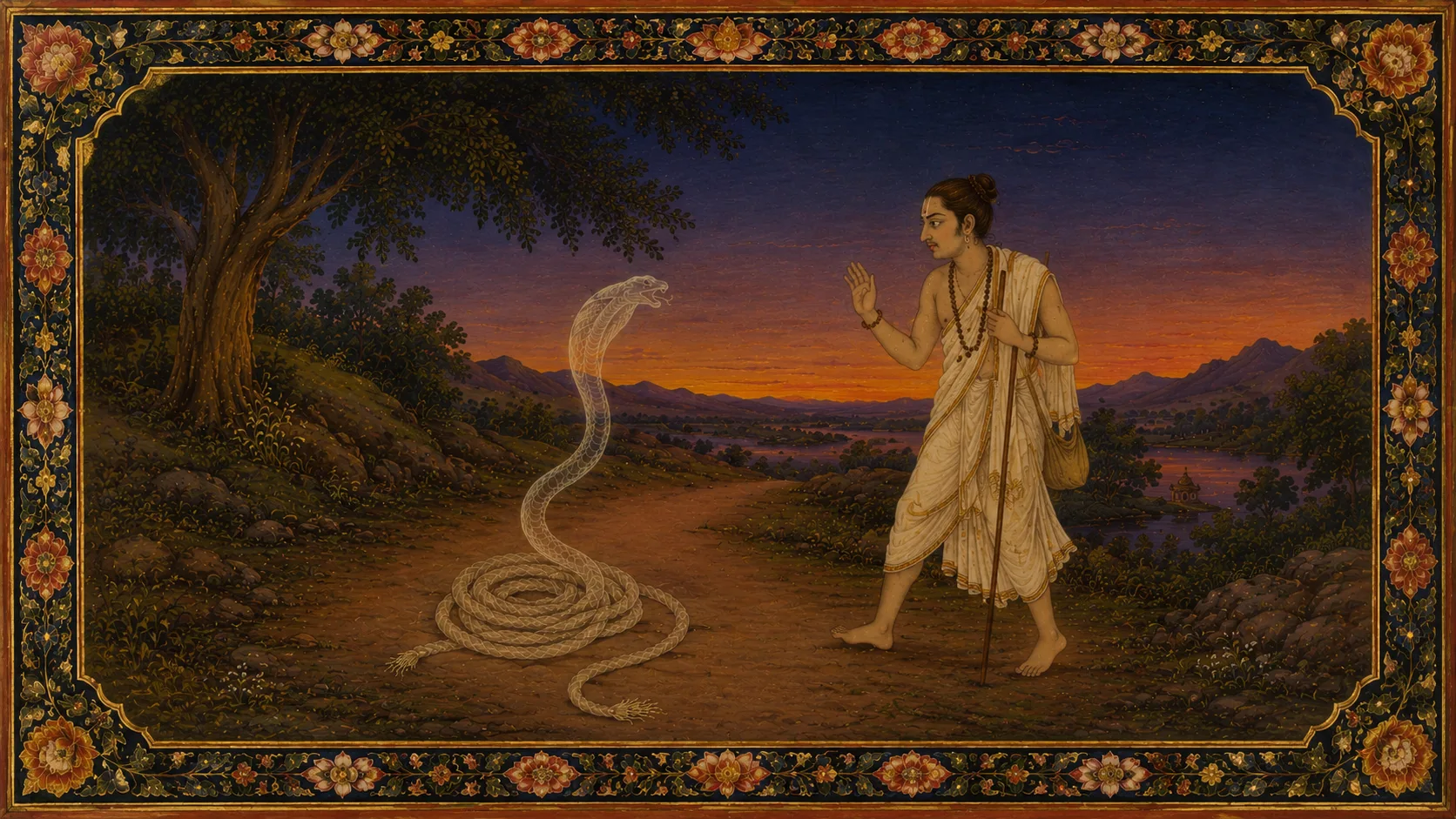
You believe Śaṅkara. Not as a theory — with your whole weight. Ekam eva advitīyam: One only, without a second. And yet this morning you lit a lamp and asked for something. The contradiction is not subtle and it will not leave you alone: if there is no second, to whom did I just pray — and if I am That, why am I on my knees? This essay does not soften that question. It takes the verses themselves, and Śaṅkara's own commentary on them, and drives each one into a scene from your actual life, until the question breaks. Not comfort. A finishing blow.
First, the trap almost everyone tries
Every sincere seeker attempts the same escape, and it fails the same way. The reasoning runs: "There is no second, so there is no God to pray to. I am Brahman. Let me drop this childish reaching." Within the hour he is furious at a driver who cut him off. The "Brahman" who was going to abide cannot abide a lane change. So let us begin exactly where that escape breaks — with the great utterance the seeker tries to seize.
अहं ब्रह्मास्मीति । तस्मात्तत्सर्वमभवत् ॥
Śaṅkara presses the point: "I am Brahman" is not the ego enlarging itself into divinity. It stands only after the conviction "I am this body, this name, this angry commuter" has been sublated — cancelled by knowledge, the way the snake is cancelled when the rope is seen. The failed reversal keeps the commuter and crowns him God. Śaṅkara says the reverse: the commuter must first dissolve; only in the space he vacates does "I am Brahman" mean anything at all.
In your day. The man who cut you off — notice who is offended. Not Brahman, but the one who takes himself to be a body with a schedule and a dignity to defend. That offended one is exactly the body-identification Śaṅkara says must be sublated. Your anger is not a failure of your Advaita; it is a reading — a live instrument telling you precisely where you still stand. Every flash of "how dare he, to me" is the ego announcing its address. You cannot leap past this by declaring "I am Brahman." The declaration is true, and the anger proves you have not yet cancelled the one it is not yet true for.
The one who says "I am God, I need not bow" has not transcended the ego. He has enthroned it.
Then who is God? — the "second" dissolves
Now the burning question head-on. If Brahman alone is, who is the God you worship? Śaṅkara's whole system opens with the answer, in the very first lines of his commentary on the Brahmasūtra — the adhyāsa-bhāṣya, on superimposition.
This is the rope and the snake. In dim light the rope is seen as a snake; the fear is real, the sweat is real, the leap back is real — but the snake is not. Śaṅkara's razor point: while you see the snake, saying "there is no snake" changes nothing. The words are true and useless together, because the snake goes only when the rope is seen, not when its absence is asserted. Now apply it. The "second" — God-as-other — is Brahman with the snake of separation laid over it by māyā. Īśvara is not a second thing beside Brahman. Īśvara is Brahman itself, seen through the mist of not-yet-knowing — the same rope, still looking like a snake to eyes not yet clear.
Śaṅkara's teaching — Īśvara through *upādhi*. Across the Brahmasūtra-bhāṣya, Śaṅkara holds that the one Brahman, associated with limiting adjuncts (upādhi) — the way clear space seems divided by the walls of many pots — appears as if it were the Lord set over against separate souls. The division is in the adjuncts, never in Brahman. Īśvara is therefore not a second reality beside Brahman; He is Brahman itself as apprehended through the adjunct of the not-yet-knowing mind. (BSB 1.1.11; 2.1.14; 3.2.11–21.)
Hold that phrase — as if (iva). Śaṅkara never says there are many. He says the One appears as if many, purely through upādhi — the adjuncts of body, mind, name. The worshipper and the worshipped are one Reality wearing two adjuncts. So the prayer does not cross a gap. It travels from Brahman, through the form of a seeker, to Brahman, along a road drawn inside Brahman. There is no second to concede. There never was one in the room.
In your day. Your child is feverish at 2 a.m. and you pray. The cold voice sneers: hypocrite — where is your non-duality now? Answer it with Śaṅkara. The one reaching (you), the one reached for (Īśvara), and the fever itself are all the one Reality appearing as if three, through upādhi. Your reaching is not a betrayal of "no second." It is the One, wearing the adjunct of a frightened parent, turning toward itself under the adjunct of the Lord. You do not need to stop praying to honour Advaita. You need only know what the praying is.
Duality is not conceded by worship. Duality is the form the non-dual wears in order to worship its way back to itself.
Why you still cannot feel it
Here is the real ache of every honest seeker: to believe it and yet not experience it. Śaṅkara has a precise name for that exact gap. Take the greatest utterance:
Śaṅkara reads tat tvam asi as no command to become Brahman, nor to meditate on it, but as the statement of an already-accomplished identity between the innermost "thou" (tvam) and "That" (tat). It reveals a fact, not a task. So why don't you feel it? Because you hold it as parokṣa-jñāna — indirect knowledge, fire known from distant smoke — not yet aparokṣa, the fire in your own hand. And the reason it hasn't ripened is not a defect in the teaching. It is that the mind receiving it is muddy.
यमेवैष वृणुते तेन लभ्यस्तस्यैष आत्मा विवृणुते तनूं स्वाम् ॥
Śaṅkara glosses this pointedly: the Self is not seized by cleverness or the mere retention of many texts. It is won by the seeker who, free of desire (niṣkāma), longs for the Self alone — and to that one the Self "reveals its own form." Being "chosen" is not arbitrary favour; it is the ripeness that single-minded, desireless seeking makes in the seeker. Not the clever mind, then, but the mind emptied of craving. A muddy pond cannot show the moon; not because the moon is dim, but because the surface heaves. And here, at last, we see what worship is for: japa, pūjā, surrender, karma offered to Īśvara are not attempts to reach a far God. They are the settling of the water — cittaśuddhi, purification of the mind — until the moon, always overhead, appears on a surface at last grown still.
In your day. You already know "That thou art." You can recite it, defend it, believe it — and still be wrecked by a careless word from a colleague. That wreckage is the mud. The colleague did not disturb Brahman; he disturbed the pond. So the morning japa you were tempted to abandon as "unnecessary for one who knows" is the one thing you cannot afford to drop — it is not for reaching God, it is for stilling the water in which the God you already are will finally become visible. You do not pray to inform the Lord. You pray to quiet the one who prays.
You do not worship to become Brahman. You worship to dissolve the one who thinks he is not.
The two standpoints — where the whole knot was tied
The entire dilemma was one confusion: you put "no second" and "I must worship" on the same plane. Śaṅkara never does. He holds two standpoints of the one Brahman — pāramārthika (absolute) and vyāvahārika (transactional) — and refuses to let either devour the other.
न मुमुक्षुर्न वै मुक्त इत्येषा परमार्थता ॥
This is the hinge of everything. Gauḍapāda declares the summit — no seeker, no bound, no free. And Śaṅkara immediately guards it: the empirical order is not thereby abolished; it holds on its own level until the rope is seen. The summit-truth does not cancel the climb; it describes where the climb ends. To read "there is no seeker" as "so I need not seek" is the exact error of the failed reversal — dragging a pāramārthika fact down into vyāvahārika life, where it does not function, like spending a foreign note in the wrong country. The note is real. The country is wrong.
अयमात्मा ब्रह्म ॥
Hold all four together and the architecture is complete. Prajñānaṁ brahma — the awareness reading this line is Brahma. Ayam ātmā brahma — this very self, not a distant one. Tat tvam asi — the fact, already accomplished. Ahaṁ brahmāsmi — its ripening on the tongue, only after the body-idea is cancelled. Not one of them tells you to stop bowing. They tell you what is bowing.
In your day. At the office you operate cause and effect all day — deadlines, consequences, a mistake that costs money. You would never say "there is no second" to a missed payroll. That is vyāvahārika, and it is fully binding while you stand in it. The pāramārthika truth — no second, no doer — is equally total on its own plane. They never collide, because they are never on the same floor. Your whole suffering was demanding to live on the top floor while your feet were planted on the ground floor. Śaṅkara is not asking you to deny either. He is asking you to stop confusing which floor you are standing on.
The reversal, corrected
The seeker's instinct is to flip the frame — from "a body climbing toward Brahman" to "I am Brahman, only forgotten." The instinct is right; only the form is fatal, because "I am God, so I need not bow" hands the crown to the ego. Here is the same flip corrected by Śaṅkara's own principle of sublation — dissolving the ego instead of feeding it. It can be held precisely like this:
"The only 'I' that has ever been is Brahman. This person — reading, working, grieving, reaching — is Brahman appearing as if separate, through upādhi, not yet seeing what he already is. So this appearance does the one intelligent thing available to it: through worship and enquiry it stills its own water, not to reach a distant God, but until the face already reflected there grows clear."
The failed reversal put the ego on the throne. This one removes it. The first inflates; the second surrenders — and surrender is what "reveals its own nature to the one whom It chooses." So tomorrow, when you light the lamp, nothing in the outer act need change. You do not stop bowing to prove your Advaita. You bow knowing: not a message across a gap, but the One turning toward itself; not a second conceded, but Brahman, still wearing the form of a seeker, doing the single thing that ends seeking.
And to the last quiet fear — "I only believe, I still cannot see" — Śaṅkara's answer is not a scolding but a law. The dawn is not manufactured by the sleeper; it is let in by one who stops clutching the dark. Belief not yet ripened into sight is not a lesser thing — it is the seed with the whole tree folded inside, waiting only on the patient water of practice. The pond, left to settle, will show the moon. It has no choice. The moon was never the problem.
The second you feared to concede was never there to concede. There is only the One — reaching, through the long grammar of a human day, for the recognition of itself. Keep bowing. It is Brahman that bows, and Brahman to whom the bow is made; and one morning, in no particular dawn, the water will still, and there will be no one left to ask the question — only the answer, wearing your face.