कालः सुप्तेषु जागर्ति कालो हि दुरतिक्रमः ॥
Four quarters, four statements about what Time does and to whom. The verse is carried in the Mahabharata and has never left the language. It is often read as consolation offered to the suffering, which is a small misreading beside the one that matters. The beings being cooked in this account, the creatures being gathered in, the sleepers being watched - these are not the occupied. They are the occupiers. Bharata is what endured. The Empire is what Time was working on the whole time, and it did not notice, because that is the nature of the process. Each of these four books takes one quarter and reads the British occupation of Bharata against it.
This book takes the second quarter.
Saṃharati is built from sam, together, and hṛ, to take or seize. It is a drawing-in: the tortoise pulling its limbs beneath the shell, the sun withdrawing its rays at dusk, a hand closing on what was spread open. From it comes saṃhāra, the dissolution that answers sṛṣṭi, creation. The tradition is precise here. The end of things is not imagined as a scattering. It is imagined as a gathering.
On the afternoon of the thirteenth of April 1919 a brigadier of the British Army believed he was performing one. He said so afterward, under no duress, to a committee of inquiry: the object had been a moral effect throughout the Punjab, and the people in the walled field were the medium through which it would be delivered.
He had the direction wrong. What was gathered in that field was the Raj.
Amritsar is the hinge at which the moderate half of India stopped believing. The men who had spent sixty years quoting the Crown's own promise back at the Crown put it down and did not pick it up again, and a boy of eleven in Lyallpur came for a bottle of the earth. The Empire fired sixteen hundred and fifty rounds into an enclosure and struck itself. Then it passed an Act to place the whole matter beyond the reach of any court - which did not save it either, and which recorded in statute, permanently and in its own hand, that the thing had no defence available to it.
He thought he was the instrument of the dissolution. He was inside one.
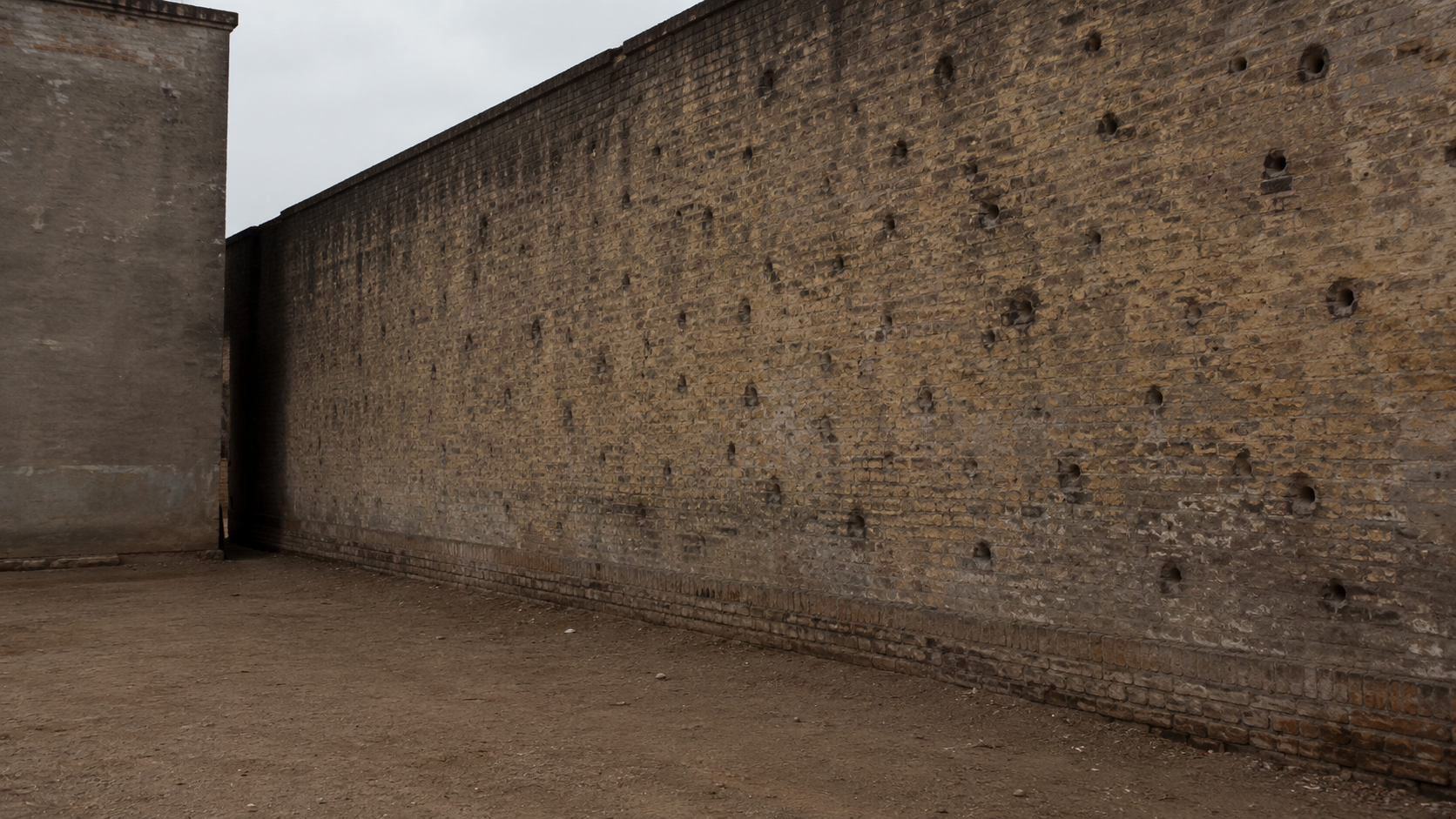
The Jallianwala Bagh was not a garden. The name survived from a time when it had been one; by 1919 it was about six acres of hard open ground behind the houses near the Golden Temple, used for meetings and for grazing, walled on all sides by the backs of buildings. There was a well in it. There were five or six exits, most of them gaps a man could pass through sideways, and one main entrance down a lane so narrow that two people walking abreast had to turn their shoulders.
Somewhere between fifteen and twenty-five thousand people were inside it on the afternoon of the thirteenth of April. Some had come for the meeting. Many had come for Baisakhi and the cattle fair and had drifted in because a crowd was there. There were children. There were men who had walked in from villages that morning and had no idea that a proclamation had been read in parts of the city forbidding assembly.
At about half past four Brigadier-General Reginald Dyer entered the lane with fifty riflemen — Gurkhas, Sikhs, Baluchis — and forty more men carrying only kukris. He had brought two armoured cars mounted with machine guns and left them in the street outside, because they would not fit down the lane.
He gave no order to disperse. He did not read the proclamation. He deployed his riflemen on the raised ground at the entrance, and within thirty seconds of entering he ordered them to fire.
They fired for about ten minutes. When men ran for the far walls he directed the fire toward the walls; when they crushed toward the narrow exits he directed it toward the exits, because that was where the density was. People went into the well to escape the bullets and drowned or were crushed by the people who came after them; more than a hundred bodies were taken out of it afterward. The firing stopped when the ammunition was nearly gone. One thousand six hundred and fifty rounds had been expended, and the troops had been ordered to aim.
Then he marched his men out and left.
He arranged nothing for the wounded. A curfew took effect at eight, which meant that anyone who came into the streets to look for a son or a father could be shot, so the wounded lay in the Bagh through the night in April cold and many of them died there who need not have.
The official count, arrived at by a government with no appetite for a large one, was three hundred and seventy-nine dead and about eleven hundred wounded. The Congress inquiry put the dead near a thousand. Contested The bodies were never all identified, because a substantial number of them belonged to villagers whose families were forty miles away and did not learn for days that there was a reason to come.
What he said about it
The remarkable thing is not the massacre. Massacres occur. The remarkable thing is Dyer's evidence to the committee of inquiry the following November, given under no duress whatever, in the calm of a hearing room in Lahore.
He was asked whether he had considered dispersing the crowd without firing. He said he thought he could have dispersed them, but that they would have come back and laughed at him, and he would have made what he called a fool of himself.
He was asked about the armoured cars. He said that if they could have got down the lane he would have used the machine guns.
He was asked what his object had been. He said it was not merely to disperse the meeting. It was to produce a sufficient moral effect, from a military point of view, throughout the Punjab — to strike terror, as he put it elsewhere, into the whole of the province. The people in the Bagh were not, in his conception, the target. They were the medium. The message was for everybody else.
And he said that he had made up his mind before he arrived: that if he found the crowd assembled, he would fire on it.
He was not cornered into these admissions. He volunteered them, in the manner of a professional explaining his reasoning to colleagues who would understand it, and the reason he did so is that he did not believe he had done anything requiring a defence. He had suppressed a rebellion. That the rebellion did not exist was not, to him, material; his standing orders were about effect, and the effect had been achieved.
He was right about the effect. He was wrong about how long it would last.
He was not cornered into these admissions. He volunteered them.
The province
Amritsar was not an isolated incident, and treating it as one is the oldest evasion in the literature. Martial law ran across five districts of Punjab from April into June, and the Bagh was its opening, not its whole.
On the nineteenth of April, Dyer issued an order concerning Kucha Kaurianwala, the lane where Marcella Sherwood had been beaten nine days earlier. Any Indian passing through it would do so on his hands and knees. A picket was posted at each end to enforce it, and men were made to crawl the length of it on their bellies, prodded with rifles when they rose. The lane was residential. The people who lived in it could not leave their houses or return to them except by crawling, and for the several days the order stood, families in that lane were effectively imprisoned in their own rooms because the alternative was to be made to move like an animal in front of their neighbours.
A whipping post was set up in the same lane, and men were flogged at it in public without trial.
Elsewhere the officers of martial law improvised. There were the salaaming orders, requiring Indians to dismount from any vehicle and salute a European officer on sight. There were the punishments the files themselves call fancy — men made to rub their noses on the ground, to skip, to stand in the sun for hours. At Lahore, students of the colleges were made to march several miles a day, in the heat, to be counted, for having been students.
And at Gujranwala on the fourteenth and fifteenth of April, when disturbances followed news of Amritsar, the Royal Air Force was sent. Aircraft flew over the town and the villages around it — Dhulla, Chuharkana, Akalgarh — and dropped bombs and fired machine guns into crowds and into a settlement from the air.
This was 1919. Aerial bombardment of civilians was, at that date, a thing so new that the world had not yet worked out what it thought about it. Britain worked it out on Punjab.
Meanwhile the summary tribunals sat, handing down death sentences and transportations at a rate that had to be substantially unwound afterward by a commutation exercise. The commutations are sometimes read as conscience. They were arithmetic: the sentences had been passed by courts that would not survive a day of scrutiny, and quietly reducing them was cheaper than defending them.
Every one of these acts was reported upward. And at the top of the province, in Lahore, sat Michael O'Dwyer, Lieutenant-Governor of the Punjab, who had spent his tenure holding that firmness was the only language the Punjabi understood, who had presided over the recruitment drives that sent Punjab's men to the war in numbers no other province matched, and who — on receiving the news from Amritsar — telegraphed Dyer that his action was approved.
Remember him. He has twenty-one years to live.
The finding
The Disorders Inquiry Committee under Hunter reported in March 1920. Its majority found that Dyer had acted on a mistaken conception of his duty, that he had been wrong not to give warning, and that continuing to fire as long as he had was unjustified. The phrase to hold on to is mistaken conception of duty. It converts a decision taken in advance and executed to plan into an error of judgment, and an error of judgment is not a crime. The finding was not a failure to convict. It was the instrument by which conviction was made unnecessary. Its three Indian members dissented, saying this was far too gentle, and were ignored.
Dyer was relieved of his command. He was not court-martialled. He was not prosecuted. He was not charged with anything at all. The Army Council decided he should be required to resign, and he went home to England on his pension.
The arithmetic needs no adjectives. A brigadier had killed several hundred unarmed people on his own initiative, stated on the record that he had intended to do it before he arrived and had done it to terrorise a province, and the total consequence to him was early retirement.
The reward
That is not the disgraceful part. This is.
When the case came before Parliament in July 1920, the House of Commons supported the government, and the Secretary of State for War called the killing monstrous and without precedent in the modern history of the Empire - an objection, note, to the method rather than to the possession of the country in which the method was used. That is the version of the story the Empire likes to tell about itself: that when the truth came out, decent men in Westminster condemned it.
Then the House of Lords divided on a motion deploring the treatment Dyer had received — and carried it, one hundred and twenty-nine to eighty-six. The upper house of the British legislature formally recorded that the wronged party in the Jallianwala Bagh was Dyer.
And the Morning Post opened a subscription for him. It was not a discreet arrangement among a few cranks. It ran in a national newspaper under the description of him as the man who saved India, and the British public — clergymen, widows, retired officers, ordinary readers, along with some very well-known names — sent in more than twenty-six thousand pounds. In the money of the time it was a fortune, several times what a senior official earned in a decade. They gave it as a gesture of thanks.
He lived out his life in Somerset and died in 1927 in his own bed, and no court in any country ever heard the matter. He was never charged. He was never tried. There is no judgment anywhere on earth bearing his name, and that is not an oversight - it is the achievement the Indemnity Act was drafted to secure.
So the plain answer is that justice, in the form a court can deliver, never touched him.
What did touch him arrived without a summons. From 1921 he was struck by a series of strokes that left him partly paralysed and unable to speak clearly, and he spent his last six years in a chair, in a country lane, in a body that had stopped obeying him. His biographer records that near the end he said he only wanted to die and know from his Maker whether he had done right or wrong. Contested Whether or not the words are exact, the shape of them is worth holding: a man who had told a committee of inquiry, without hesitation and without being pressed, that he had decided to fire before he arrived, spent his last years unable to be certain.
The rest was slower and more complete. The Morning Post, which had raised his purse and printed him as the man who saved India, was absorbed into another paper in 1937 and ceased to exist. The India he was thanked for saving was gone twenty years after him. And his name - which in 1920 a British newspaper and its readers offered as a name of honour - passed into the English language as a byword for what the Empire was, and is now taught that way in the schools of the country that paid him.
He was not judged. He was outlived, and then reclassified.
So the question of whether the British nation approved of Jallianwala Bagh is not open, and does not depend on inference. It was put to the country in the most direct terms available in 1920 — a parliamentary vote and a public collection — and the country answered.
The Act
In September 1919, before Hunter had even reported, the Indian Legislative Council passed the Indemnity Act.
Its provision was simple. No suit, prosecution or other legal proceeding could be brought against any officer of the Crown in respect of any act done in connection with the disorders, provided it had been done in good faith and in the belief that it was necessary. The sentences passed by the martial law tribunals were simultaneously validated, so that men convicted by courts that would not have withstood a day of ordinary scrutiny stayed convicted.
The government did not defend what had been done in Punjab. It did not have to. It removed the acts from the reach of law altogether, retroactively, by statute — so that the widow of a man shot in the Bagh had no court to go to, and the man flogged in Kucha Kaurianwala had no cause of action, and the villagers bombed at Chuharkana had no standing to be heard anywhere in the Empire.
This is what an indemnity is. It is not an acquittal, because an acquittal requires a trial. It is a declaration by power that the question shall not be asked.
And that is the whole of the argument. The Raj did not, in Punjab, break its own laws. It shot people, and then it wrote a law making the shooting unreachable, and then it voted the shooter its sympathy and sent him money. There was no crisis of British legality in April 1919, because British legality performed exactly as it had been built to perform. The atrocity was not a failure of the system. It was an output.
It is not an acquittal, because an acquittal requires a trial. It is a declaration by power that the question shall not be asked.
Thirty-six years earlier
None of this should have surprised anyone, because the British in India had already stated the principle out loud, in public, at length, in their own newspapers — and had won.
In 1883, Courtenay Ilbert, the Law Member of the Viceroy's Council, introduced a bill to correct what looked like a small anomaly. Indian judges in the districts had risen high enough in the service to hold sessions and magistracies, but were barred from trying any European British subject. An Indian judge could sentence an Indian to hang and could not fine an Englishman. Ilbert proposed to remove the bar.
The response of the European community in India was not an argument. It was an insurrection.
Planters came down from Assam. Defence associations were formed and funded within weeks. The Anglo-Indian press ran a campaign of a violence that startled even its own readers, and its central contention was stated without embarrassment, over and over, in print: that no Englishwoman could be expected to give evidence before a native judge, that the men of the ruling race could not be placed at the mercy of a subject one, that the whole basis of British rule in India was the recognised superiority of the European and that anything which unsettled it unsettled everything. There was serious talk, in Calcutta clubs, of seizing the Viceroy and putting him on a boat.
The government surrendered. In January 1884 the bill was passed in a mutilated form: a European brought before an Indian judge could demand a jury of which at least half were European. The bar was preserved by another route, which was the point.
So it is on the record, in the Empire's own language, decades before Dyer: that the law in India was understood by the people who ran it to be racially constituted, and that when this was challenged, they said so directly, publicly, and successfully.
Indians drew two lessons. The first was about the promise of 1858 — that the Queen's word about race being no bar had a shelf life of twenty-five years and could be revoked by a few thousand planters raising a subscription. The second was practical: if that small a minority could organise and force a Viceroy to retreat, then organisation worked. Two years later, in 1886 — with the encouragement and midwifery of a retired officer of the Indian Civil Service who considered such a body the safest available outlet for educated Indian discontent — the Indian National Congress held its first session.
The instrument of protest and the instrument of management were, from the beginning, the same institution. That will matter later.
The measure
Set the two documents side by side, since both are public and neither is disputed.
In 1858 the Crown promised the people of India that race would be no bar to office in her service, and that their ancient rights and usages would be respected.
In 1919 the same Crown's government shot them in an enclosed field to make a moral impression on a province, bombed their villages from aircraft, made them crawl in the street outside their own doorways, flogged them without trial, and then passed an Act to place all of it beyond the reach of any court, while its upper house voted the commander its sympathy and its public sent him a purse.
There is no version of the intervening sixty-one years in which the first document was ever meant.
Two people who were in Amritsar that April understood this without needing the argument spelled out.
One was a boy not quite twelve, in a village in Lyallpur district, who heard what had happened and — as his family always afterward told it — slipped away from school, made the journey to Amritsar, and came back with a small bottle of earth from the Bagh that he kept for the rest of his short life.
The other was an orphan of nineteen from the Central Khalsa Orphanage, who said afterward that he had been in the Bagh itself that afternoon, carrying water for the crowd.
The first would be hanged in twelve years. The second would wait twenty-one, and then find Michael O'Dwyer.
0 responses