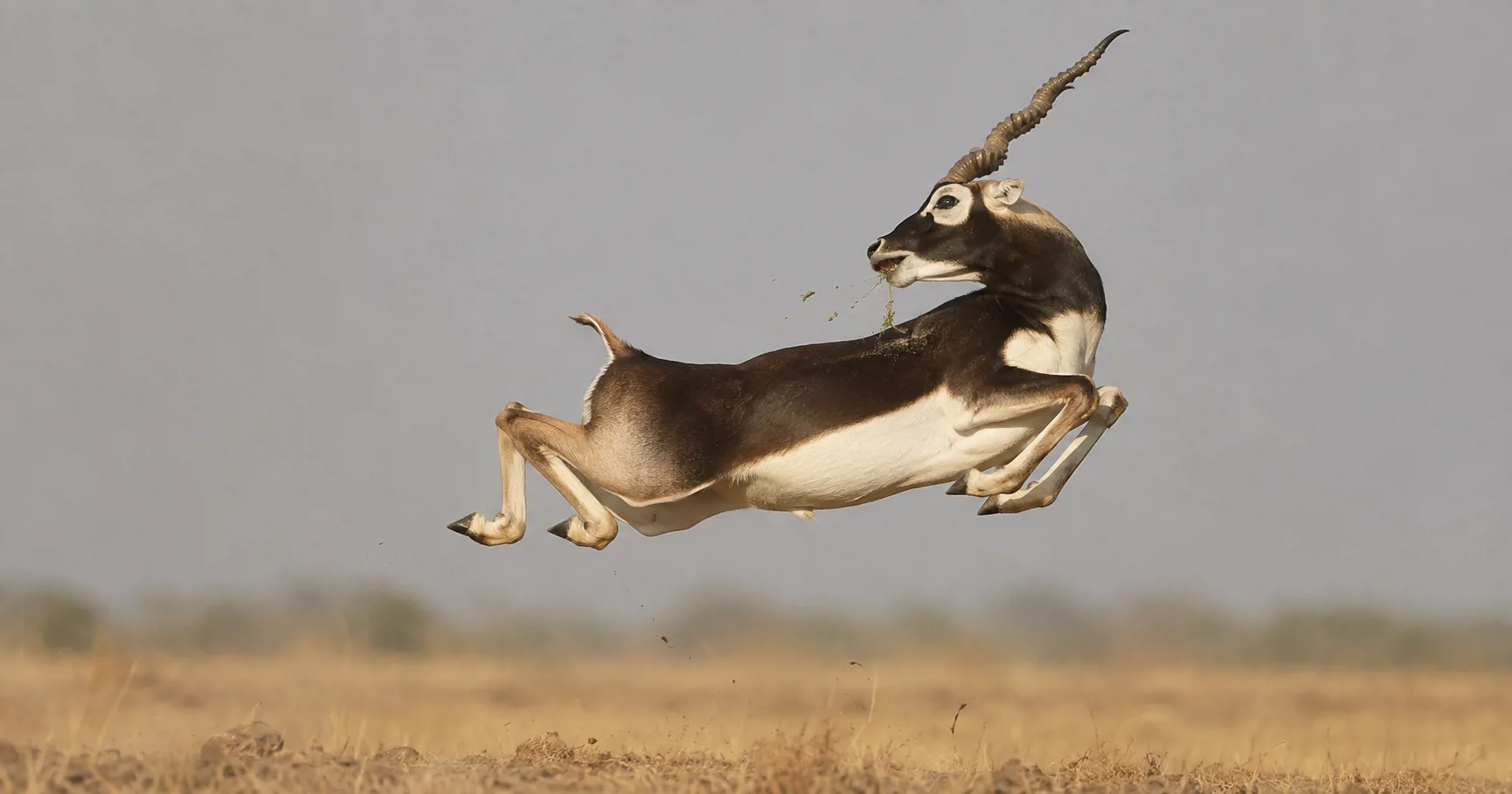
Kālidāsa's play Abhijñānaśākuntalam—The Recognition of Śākuntalā—opens with King Duṣyanta hunting a deer through a forest. The deer leaps; the king pursues; the chariot bounces; the chase is in full motion. And then Kālidāsa writes one of the most famous descriptions in Sanskrit literature.
grīvābhaṅgābhirāmaṃ muhur anupatati syandane datta-dṛṣṭiḥ
paścārdhena praviṣṭaḥ śarapatana-bhayād bhūyasā pūrva-kāyam |
darbhāir ardha-ava-līḍhaiḥ śrama-vivrtam ukhair vartmanā vāha-śoṇya
paśyod-aplutya yātī paya-rītim asau bhūmau khe vā prayogaḥ
"Beautiful with the bend of his neck, again and again he turns his eye to the pursuing chariot. Out of fear of the falling arrow, his hind half almost enters his fore half. Tufts of darbha grass, half-chewed, drop from his open mouth. Look! Now bounding high, he goes more in the sky than on the earth."
It is twelve lines describing approximately three seconds of motion.
This is the Kālidāsan method. The compressed image. The arrested moment. The attention that lingers where most narration would hurry. The verse is in the demanding vasanta-tilaka meter, but it never feels metrically forced. The grammar is doing exactly the work the meaning needs.
What is the poet doing?
He is teaching us how to see the deer. The play's plot turns on King Duṣyanta's ability, later, to recognize—to truly see—the woman Śākuntalā he meets and marries. The verb abhijñā in the play's title means "recognition" in a strong sense: re-cognition, knowing-again, the perception that something seen now is what one already knew.
Duṣyanta's tragedy will be that he fails this recognition. He marries Śākuntalā in a forest, abandons her, and later, under the influence of a sage's curse, fails to recognize her when she arrives at his court bearing his child.
The opening hunt sequence prefigures this. The deer is described in such detail because the king is not seeing it—he is shooting at it. The poet's eye is doing the work the king's eye fails to do. We the audience see what the character cannot.
This kind of structural irony, sustained over twelve lines of compressed image, is what makes Kālidāsa exceptional. Many Sanskrit poets can produce a striking image. Kālidāsa produces images that are doing work—working at the level of theme, of character, of the play's deepest concerns.
Goethe famously praised Śākuntalā in a quatrain that has been quoted to death. The praise is correct but uninteresting. What matters is what the play actually does, line by line, and how it does it.
The discipline of restraint is everywhere in Kālidāsa. The famous cloud-messenger poem (Meghadūta) is built on the most minimal premise possible: an exiled lover asks a cloud to carry a message to his beloved. The whole poem is the route the cloud will take. The lover is barely present. The beloved is barely present. The poem is mostly weather and landscape.
And yet the longing accumulates. By the end, the absence of the beloved is so densely present in the described landscape that one realizes the landscape has been the lover's mind all along.
This is what restraint looks like when it is being practiced by a master. Less is doing more. The reader is asked to bring something. The poem rewards the bringing.