Prologue: The Stone That Remembers
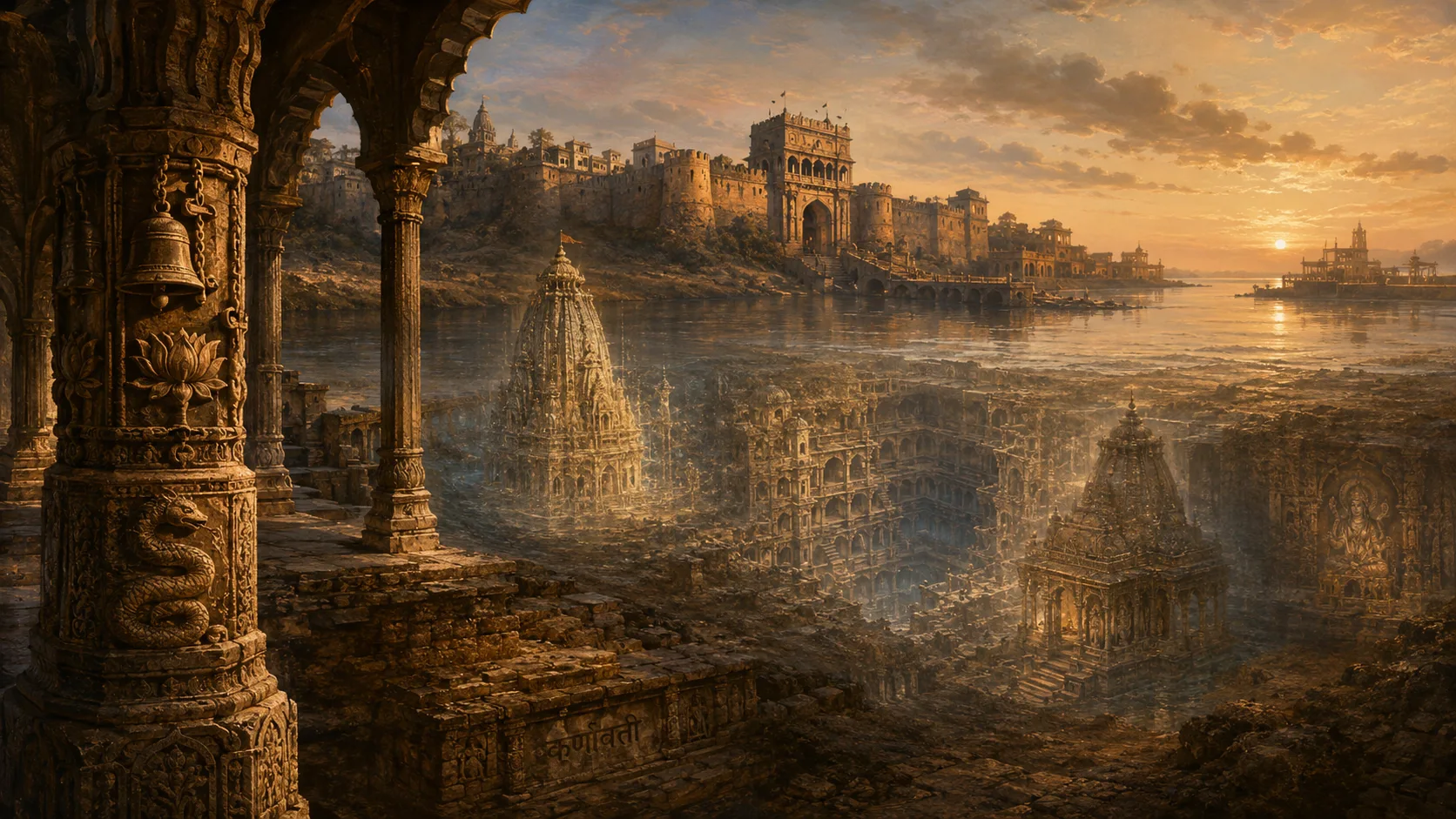
Walk into the great mosque at the heart of the old city, on a hot afternoon when the light falls slantwise through the courtyard, and look up at the pillars. There are three hundred of them holding the roof, and they are wrong. They are too alive. Across their faces climb lotus medallions and creeping vines, bells hanging from carved chains, dancers caught mid-turn, a serpent coiled in the shape the yogis call the sleeping fire. In one high window, if the eye knows where to rest, the syllable Oṃ has been cut into the stone. This is forbidden in the house that surrounds it — the faith that raised these walls forbids on pain of punishment the carving of any living form, any god, any face. And yet here are the gods, hundreds of them, holding up the roof of a building meant to declare their defeat.
The pillars are wrong because they are stolen. They were carved by other hands, for other altars, in another age, and they were torn from temples broken for the purpose and set here to bear a conqueror's roof. They are the last witnesses of a city that stood on this ground before the city that stands here now — a Sanātana city, with a Hindu king's name, that was unmade so thoroughly that most who live above it have never heard the name it carried.
This is the story of that city. Every scene in it is true.
Act One — The River and the Dock
Begin four thousand years before the mosque, on the same coast.
The tide comes in along the Gulf, and in a brick basin cut into the earth at Lothal, men are warping a ship to its berth. The basin is engineered — sluice and spillway, a lock to hold the water when the tide runs out — and it is, as far as the spade has ever found, the oldest dock in the world. Bales come off the deck: cotton, spun and woven on this plain by people whose names are lost but whose craft is not, because that craft never stops. It is being practised on this same ground when the Veda is chanted, when the Buddha walks, when the first Sanskrit drama is staged, and it will still be practised here when steam engines arrive to do it by machine. The loom is the one unbroken thread that runs the whole length of this story, under every king and every conqueror, and it starts here, in the Harappan dawn, by the sea.
The sea matters, and so does its distance. Inland, eighty kilometres up a monsoon-fed river called the Sābarmatī, lies the ground where the city will rise. It is not the coast. It never will be. The wealth of the sea will travel to it overland, from the great ports of the Gulf — Khambhat, Bharuch, and later Surat — along roads worn deep by bullock-trains carrying cloth out and silver in. This single fact will decide everything about how the city lives and how it dies: the riches come from the sea, but the armies will always come from the land, down out of the northwest by the desert passes, and the city's walls, when it has them, will face inland — because it is from inland that the killers always come.
Act Two — The King Who Carved His Name
By the tenth century there is a town on the riverbank called Āśāval, after a chief of the Bhīla people named Āśā — forest-born, ancient, of the land's own deep stock. The Persian scholar al-Bīrūnī, cataloguing the world from afar, knows it by name. The mound where Āśā's hall stood is still there in the modern city, behind a gate called Astodia, and a small sign still names it: the mound of Āśā the Bhīla. The land remembers even him.
Then, in the eleventh century, comes the king.
His name is Karṇa — Karṇadeva, of the Chaulukya line the people call Solaṅkī, ruling the rich Gujarāt plain from the old capital at Pāṭan. He takes the riverbank from the Bhīla chief, and what he does next tells the whole difference between the builders and the breakers who will follow. He does not raze. He founds. He lays out a city and gives it his own name — Karṇāvatī, the city of Karṇa — and he fills it with the marks of dharma: a great tank dug and lined with stone, the Karṇasāgara; a temple to the Sun, called Koṭyarka; shrines to the Mother in her several forms, Kocharabā and Jayantī. A city, a reservoir, the Sun, the Goddess. This is how a Sanātana king signs the earth — not by smashing what stood there, but by raising something meant to last a thousand years.
And his people know how to make things last a thousand years. This is the secret at the centre of the story, the thing the looters will covet and never be able to copy.
Act Three — How the Golden Age Built
To understand the grief that is coming, stand first inside the glory, and watch the masons work.
It is the age of Karṇa's son, Siddharāja Jayasiṃha, and of Kumārapāla after him — the high noon of the Chaulukyas, when the court at Pāṭan holds the great scholar Hemacandra and the workshops of Gujarāt perfect a way of building so fine it will be carried, centuries later, across the world. They call it now the Māru-Gurjara style. Watch what it is.
The masons take golden sandstone and white marble and they dress each block to a tolerance that needs no mortar. The stones lock — face to face, gravity and friction holding them, the joints so true that a blade cannot enter. And this is not crude work for lack of cement; it is genius. This is earthquake country, and the mortarless joints let the building breathe when the ground shakes — flexing, settling, riding the tremor instead of cracking under it — while the stepped stone platform spreads wide at the base to drink the shaking down into its mass. A thousand years from now, after empires have come and gone, the Sun-temple at Modhera will still be standing on those terraces, having outlived every dynasty that ever taxed it, because the men who laid it knew exactly what the earth would one day try to do to it.
Watch them raise a temple. A high plinth first, brick faced in stone. Then the gate of glory, the kīrti-toraṇa, free-standing, carved like lace. Behind it the halls open one into the next along a single sacred line — the assembly hall, the inner hall, and at the end the womb-chamber, the garbha-gṛha, dark and small, over which climbs the curving tower, the śikhara, tier on tier, every inch of the outer wall a crowd of gods and dancers and elephants and the wide-eyed face of glory the craftsmen call kīrtimukha.
And then watch them do the thing only Gujarāt does best. In a dry land, they build downward to the water — the stepwell, a temple turned inside out and sunk into the earth, flight after flight of carved galleries descending seven storeys to the water-table. At Pāṭan, the queen Udayamatī — grandmother of the king who built Karṇāvatī — orders such a well, the Rāṇī-kī-Vāv, and her masons fill its descending walls with a parliament of sculpture so vast and so fine that a thousand years on it will be lifted onto the nation's own banknote. This is the civilization standing on the Sābarmatī. This is what is about to be hunted.
Remember the mortarless joint and the seven-storey well. The men who broke this culture could carry off its gold in a night. Its genius they could only envy, loot, and never make.
Act Four — The Night Somanātha Burned
Now the desert wind turns cold, and the story darkens, and it darkens first not at Karṇāvatī but at the sea-edge of the same Gujarāt, at a temple whose fate will shadow the city's whole bloodline.
The year is 1025. Out of Afghanistan, across the deserts of the northwest, rides Mahmud of Ghazni with thirty thousand horse — not to rule, never to rule, only to take. His target is Somanātha on the Saurāṣṭra coast, one of the twelve Jyotirliṅgas, among the richest and holiest shrines in all of Bhārata, its treasury swollen by centuries of devotion, its liṅga of Śiva the heart of a faith.
They come to the walls and the defenders meet them. Brahmins, soldiers, ordinary devotees — they hold the ramparts across days of assault, falling in their thousands, certain to the last that the god will not let his house be taken. The arrows come in storms; the walls are scaled; by the time the call to prayer rises over the broken battlements the sand is black with the dead. Mahmud walks into the sanctum, into the holiest dark, and he takes a mace to the liṅga of Śiva and shatters it with his own hands. The treasure goes onto the camels — millions in coin. And then the final cruelty, the one that earns him his title across the Islamic world, "the idol-breaker": the broken fragments of the god are carried back across the deserts to Ghazni and set into the steps of his mosque, so that for centuries the faithful will grind the shards of Śiva under their heels on the way to prayer.
On the throne of Gujarāt in that hour sits Bhīma — Bhīma the First, and mark him, for he is the father of the king who will build Karṇāvatī. The conqueror's chroniclers, writing to flatter their master, will sneer that Bhīma "fled." They lie. Bhīma reads the raider exactly: a plunderer who holds no ground, who will be gone the moment the camels are loaded, who wants nothing more than for a king to throw an army onto his spears in open field. Bhīma will not give him the gift. He pulls back, intact — his host whole, his dynasty whole — to the fort at Kanthkot, and he lets the storm blow itself out across the desert, where hunger and the harrying of the tribes kill more of Mahmud's men than any battle would have. The Ghaznavid takes his gold and his legend and never holds a single foot of Gujarāt. Bhīma keeps the land.
And then Bhīma does the thing that is the truest answer any civilization ever gave to a looter: he rebuilds. He and Bhoja of Mālwā raise Somanātha again in stone. The temple will be broken again, and raised again, and broken again, six times across the centuries, and it stands today — because this is the one lesson the breakers never learn — a thing that refuses to stay dead cannot be looted. The raider got a night of fire and a stairway of shame. The king got the future, and a son named Karṇa, who would carve his own name into a city on the river.
Act Five — The Long Night Falls
For two centuries more the river-city lives in its golden age, and then the age ends, as ages do, from the north.
In 1299 the armies of Alāuddīn Khaljī of Delhi pour into Gujarāt under his generals Ulugh Khān and Nuṣrat Khān. The last Hindu king of the line, a second Karṇa of the Vāghelā branch, meets them in battle near Āśāpallī — on the very ground — and loses. A Jaina monk writes it down: the king defeated, the reign ended, the door thrown open. The temples of Gujarāt begin their long entry into the catalogue of the broken, the great shrines and the small ones alike, most of them falling unrecorded because no chronicler thought a provincial god worth a line of ink.
The province passes to Delhi, and then — as Delhi itself is shattered by Tīmūr's invasion at the century's end — to a breakaway governor who crowns himself sultan. His line is called the Muẓaffarids. His grandson is the man who will take the river-city's name away.
Act Six — The Morning the Name Was Taken
26 February 1411. A cool morning on the east bank of the Sābarmatī.
Sultan Aḥmad Shāh stands on the ground of Āśāval and Karṇāvatī and lays a foundation stone at a place that will be called Mānek Burj. A week later, on the fourth of March, he speaks the words that move a kingdom: this is the capital now. And he gives the city a new name, his own name, written across the face of the old one like a hand pressed over a mouth — Aḥmadābād, the abode of Aḥmad.
The court poets will sweeten it later into a fable. The sultan, they will say, was camped on the riverbank when he saw a hare turn and chase his own hound, and marvelled that ground could breed such courage even in a rabbit, and chose the spot for its magic. It is a charming story and it is a lie of omission. No one founds a capital on empty magic ground. He founds it here because everything is already here — the river, the cotton, the weavers, the merchants, the roads running down to the ports, four hundred years of Hindu wealth piled up and waiting to be inherited by a man who did not build it. The hare did not make the ground precious. The labour of the conquered made it precious. He simply signed his name across the top.
A burned temple can be rebuilt. A looted treasury can be refilled. But a name pressed down over a name reaches forward through time, and teaches a child the conqueror's word for home before she ever learns there was another.
Act Seven — The Quarry of the Gods
Watch now how the new city is built, because the method is the wound.
First the citadel, the Bhadra, rising on the riverbank from 1411 — palaces and audience halls and a parade ground behind heavy walls. Even its name is a captive: Bhadra is the Goddess Bhadrakālī, whose shrine stood on this ground, and the conqueror takes the site but cannot scrub the Goddess's name off the stone. To this day the fort carries Her name like a prisoner carries a memory.
Then the great mosque — the Jāmi Masjid, finished and consecrated on the fourth of January, 1424, the largest mosque in the subcontinent in its age. And here is the scene to stand inside, the scene from the prologue, now understood. The masons who raise it do not carve fresh stone. They go out to the temples — the standing, breathing temples of the conquered city, Karṇa's Sun-temple among them, the Goddess shrines, the Jaina sanctuaries dense with three centuries of devotion — and they pull them down. The dressed pillars, the carved capitals, the lotus ceilings cut by Māru-Gurjara hands, are carted to the mosque and stood up again to hold a foreign roof. Three hundred temple pillars, still wearing their bells and vines and dancers and the coiled sleeping-fire, are made to carry the weight of the building raised to proclaim that the gods they depict have lost.
Somewhere in the structure a black slab is set that was once the base of a Jaina image, turned and buried in the masonry. In an upper window the Oṃ survives, overlooked. The guidebooks of a later, gentler-tongued age will call all this a lovely "synthesis," a marriage of two styles. It is no marriage. A marriage is freely entered. This is the carved body of a murdered civilization, dismembered and reassembled to ornament the house of those who killed it. The grace is real. The grace was always Hindu. It was taken at the point of a sword.
And of Karṇa's own Sun-temple, the Koṭyarka, of the Goddess Karṇamukteśvarī, of the great tank Karṇasāgara — not one stone stands where it was set. They are simply gone, dissolved into the foundations of the city that took their king's name away. East of the mosque the sultan and his son and his grandson lie in their tomb, at rest among the masonry of the people they unmade.
Act Eight — The Lord of Two Forts
If the founder is remembered for a hare, his great-grandson is remembered for fire, and his long reign — fifty-two years, from 1458 — is the one the conqueror's chronicles call the golden age. Let the golden age be shown exactly as it was.
His name is Mahmūd, and his title is Begaṛhā, "the lord of two forts," earned by the two Hindu strongholds he swallowed. The first is Junāgaṛh, taken in 1470, its raja Maṇḍalik forced at the sword's edge to abandon his gods and take the conqueror's faith. The second is Pāvāgaṛh, the hill-fortress of the Khīchī Cauhāṇ Rajputs above Champāner, and its fall is a scene worth the slowing of time.
Mahmūd lays siege in April 1483, and the hill does not break. Month after month it holds — through the monsoon, through the dry, through twenty months of it — until his soldiers notice the one weakness: at dawn the defenders, exhausted, leave the walls for an hour to bathe and dress. On a chosen morning the assault comes in that hour. The wall is breached. The Rajputs spill out in a last charge and it is not enough; the Rāval and his minister fall wounded into the conqueror's hands. They are offered the bargain every Hindu king in this story is offered — the gods or the head. They choose the gods. They are put to death. The Rāval's two daughters are taken into the sultan's harem; his small son is carried off, converted, renamed.
And then Mahmūd climbs the sacred hill of Pāvāgaṛh to the temple of Kālikā Mātā — a Śakti-pīṭha, one of the holiest seats of the Goddess in the west — and tears the tower from Her sanctuary, and builds his new capital below the broken shrine. But hold on this image, because it carries the whole defiance of the story in a single frame: the tower is thrown down, the city is built, the city is abandoned within fifty years and stands empty for five centuries as a ghost — and through every one of those centuries, atop the hill, the Goddess is still worshipped. The pilgrims never stop climbing. Her tower is broken; Her worship is not. The breaker took the stone. He could not take the prayer.
His sword runs the same line across the land. In 1473 he rides to Dvārakā, the sea-city of Kṛṣṇa himself, and throws down its temples and kills its defenders. Into Kutch, into Sindh, against the Rajputs, against the coast. The Jaina records of his own time weep openly — temples broken, festivals forbidden, monks hounded, whole communities fleeing Gujarāt to live. His own court chronicle records the victories and leaves the weeping out. That space between the two — the conquest written down, the grief written out — is the exact space this account exists to fill.
For the city itself, he builds the wall: ten kilometres around, twelve gates, a hundred and eighty-nine bastions, six thousand battlements. The gates still stand, naming the quarters of the modern city — Delhi Gate, Rāypur, Kāṅkariyā — the broken teeth of his circuit, raised, like his mosques, on the labour and the rubble of the land beneath.
The breakers, named — Mahmud of Ghazni shattered Somanātha (1025). Alāuddīn Khaljī's generals took Gujarāt (1299). Aḥmad Shāh renamed the city and quarried its temples (1411–24). Mahmūd Begaṛhā razed the Goddess on Pāvāgaṛh and walled the city on its rubble (1458–1511).
What they could not break — Somanātha, six times rebuilt, stands today. The Goddess of Pāvāgaṛh is worshipped still, above the conqueror's dead city. The loom never stopped. The name Karṇāvatī never died.
Act Nine — Two Empires, One From the Sea, One From the Land
The Sultanate's century turns to dusk, and the danger comes now from both directions the geography always promised.
From the sea, white sails: the Portuguese, rounding into the Indian Ocean, hungry for the cloth-trade. In 1509 they break a combined fleet off Diu and begin to throttle the coast — Diu, Daman, the shipping of the ports — striking always at the harbours, never able to reach the inland city. From the land, the old direction, comes the greater power: the Mughals. The last real sultans are children; the kingdom is carved among quarrelling nobles, and one of them, besieged by his rivals, makes the oldest mistake in the story — he invites the emperor in.
Akbar needs no second asking. In 1572 he marches down from Fatehpur Sīkrī, and the puppet-sultan falls into his hands almost without a fight. Akbar rides to Khambhat and looks for the first time on the sea; he breaks the last rebel holdouts at Surat and Champāner; and he carries the final sultan of Gujarāt back to Agra in a cage of honour, and raises a victory-gate, the Buland Darwāza, to remember it by. The city becomes a jewel in the Mughal crown — the seat of the richest province of the richest empire on earth.
For a hundred and thirty-five years the Mughal peace makes the looms roar. The cloth of Ahmedabad goes out across the world; an English traveller in 1626 gapes at it, a "megapolis" heaped with silk and spice and gold thread. The emperor Jahāngīr comes and stays nine months, his empress Nūr Jahān running the city from behind the curtain. His son, Prince Khurram — soon to be Shāh Jahān, soon to build the Tāj Mahal — governs here, raises a marble pavilion, lays a garden of roses along the river. The monuments are real, and some are beautiful. But beneath every one of them the engine is unchanged and unmistakable: the Hindu and Jaina merchants whose guilds finance the trade, the weaving castes whose hands make the cloth. The names cut into the gates are Persian. The hands that fill the treasuries behind them are the same hands that wove at Lothal. The conquerors rule the city. The people are the city.
Act Ten — The Return of the Sons of the Soil
Now comes the turn the colonial histories work hardest to hide, and it must be shown for what it truly was.
As the Mughal empire rots from within after 1707, a power rises in the south and west to break it — the Marāṭhās, the great Hindu resurgence kindled by Chhatrapati Śivājī Mahārāj, sworn to a single burning idea: Hindavī Svarājya, the self-rule of the Hindus in their own land. When that power reaches Gujarāt, the British chroniclers and the historians schooled in their frame will write it down as a raid, an invasion, marauders falling on the province. It is the central lie, and it inverts the truth exactly. The Marāṭhās do not come as invaders to Gujarāt. They come as liberators, to a land held by foreign sultans and foreign emperors for four hundred years, to return it to rule by the faith and the people that built it.
The dying Mughal order does not yield gently, and the decades of the handover are hard — the failing imperial officers clutching and bleeding the city even as their empire collapses around them. But the tide is one way. In 1738 the city is shared between a Mughal officer and the Marāṭhā chief Damājī Rāo Gāekwāḍ; by 1753 the combined armies of the Peśvā and the Gāekwāḍ take it outright. After four centuries, the river-city is ruled again by the sons of its own soil. The Gāekwāḍs of Baroda will stand among the foremost Hindu royal houses of the west for two hundred years more. What the colonial textbook files under "the decline" is in truth the painful, contested sunrise of the Hindu recovery — the dawn breaking against the last darkness of a foreign empire that would not admit it was already dead.
Act Eleven — The Last Conqueror, and the Loom That Beat Them All
The dawn does not last, because a new kind of conqueror is already on the roads — not from the desert this time, but from across the western sea, in counting-houses and red coats.
In 1818 the British break the Marāṭhā confederacy in war, and with it the last great indigenous power of the subcontinent — and that, precisely, is the true foreign conquest of this ground: not the joining of the Hindu restoration but the crushing of it. They hold the city for a hundred and twenty-nine years, wire it into an empire that drains its wealth across the ocean, run a railway through it, throw an iron bridge across the Sābarmatī.
But the deepest answer the city ever gives to all its conquerors comes now, and it comes from the loom — the one thread unbroken since Lothal. In 1853 a Gujarātī Brahmin named Ranchhoḍlāl Chhoṭālāl, thrown out of a government post on a charge he denies, decides to bring the machine age to the cotton of his ancestors. His first set of English machinery burns and sinks with the ship that carries it. He simply orders it again. And on the thirtieth of May, 1861, his mill at Shāhpur begins to turn — sixty-three workers, two thousand five hundred spindles, Indian-owned, Indian-financed, drawing its capital from the very merchant castes that had carried this land's cloth for three thousand years.
The thing catches like fire in dry grass. The Calico Mills, the houses of Sārābhāī and Lālbhāī whose Arvind looms will one day clothe half the world in denim — by the new century there are dozens of mills, by mid-century near a hundred, and the city wins the name it still wears with pride: the Manchester of the East. And see what it means: the cotton that fed the Harappan dock and the Chaulukya guilds, that filled the Sultanate's treasury and the Mughal's and drew the ships of Europe, is now spun by steam in mills owned by the descendants of the men who spun it by hand four thousand years before. Every empire that ruled this city is gone. The weaver is still here. The weaver was always the city.
Act Twelve — The River and the Salt March
To this city of looms, in 1915, Mohandās Gāndhī returns from across the ocean and builds an āśrama on the bank of the Sābarmatī — the same river that drew King Karṇa nine hundred years before. He makes it a headquarters of the agitation against British rule. In 1918 he intervenes in the Ahmedabad mill-workers' dispute. And from this riverbank, on the twelfth of March, 1930, he sets out on the march to the coast at Dāṇḍī — toward the same Gujarāt sea whose ports had carried this land's cloth since before history — to gather a fistful of salt and break the empire's salt monopoly, an act that draws the world's attention to the independence movement.
The river takes the scene in stride, as it has taken every other. It has carried a Hindu king's city, a sultan's renaming, a Mughal's rose-garden, and the return of the sons of the soil; now it carries this too. The independence it serves will come in 1947, and the foreign empire that broke the Marāṭhā restoration will at last withdraw — though the manner of that going, and the men who shaped its terms, belong to a reckoning beyond the bounds of this city's story.
Epilogue: The Name Beneath the City
The city today is vast — the largest in Gujarāt, an engine of mills and medicine and finance, its medieval heart named in 2017 the first World Heritage City in all of Bhārata. The Bhadra citadel still stands. The gates still hold their old names. The carved screen of the Sīdī Saiyyad mosque, the tree-of-life cut in stone by Hindu hands, has become the emblem of the city. And a short way out, the Sun still climbs over Modhera's thousand-year terraces, and the Rāṇī-kī-Vāv still descends seven storeys into the dark, the Chaulukya genius outlasting every empire that ever taxed it.
And under all of it, in the bedrock of the name itself, lies Karṇāvatī. It was never wholly killed. It lived in the Sanskrit, in the memory of those who knew the ground had borne a king's name before a sultan's. And in this age the call has risen to lift it back into the daylight — to set it beside Prayāgrāj and Sambhājīnagar, the undoing of conquerors' names, the long correction of a civilization remembering itself. The question is not settled, and this telling does not settle it. It only lays the ground bare, layer by layer, and lets the layers speak.
For under the mosque are the pillars of the temple. Under the sultan's name is the king's. Under the king is the Bhīla mound, and under the mound the Harappan loom, and through every one of those layers runs the single unbroken thread — the weaver, the river, the Goddess whose name even the citadel could not erase, and the king whose name a conqueror pressed his own over and called it his.
The pillars in the mosque are wrong because they remember. They have been holding up the wrong roof for six hundred years, waiting, in the patient way of stone, for the city above them to remember too.
The erasure was thorough. It was not complete. The older name did not die. It waited, the way names wait, beneath the city — for the city to say it again.
A Note on Truth
Nothing in this telling is invented. The cinematic frame is a way of seeing, not a license to embroider: every scene rests on the record. The Harappan dock at Lothal; the Bhīla town of Āśāval named by al-Bīrūnī; the Chaulukya foundation of Karṇāvatī with its tank and Sun- and Goddess-temples; the Māru-Gurjara engineering of mortarless seismic joinery, stepped plinths, and the descending stepwell at Pāṭan; the sack of Somanātha in 1025 under Bhīma I and the temple's repeated rebuilding; the Khaljī conquest of 1299; the founding of the city on 26 February 1411 and its consecration on 4 March; the Jāmi Masjid raised by 1424 from spoliated temple stone; Mahmūd Begaṛhā's reign, the twenty-month siege and fall of Pāvāgaṛh in 1484, the razing of the Kālikā Mātā shrine, and the city wall of 1486 recorded in the Mirāt-i-Aḥmadī; the Mughal conquest of 1573; the Marāṭhā recovery of the city by 1753; the British defeat of the Marāṭhās in 1818; the Shāhpur Mill of 30 May 1861; Gāndhī's āśrama and the Salt March of 1930; and the 2017 UNESCO inscription — all are matters of record. The withdrawal of Bhīma I is rendered as the strategy it was, not the cowardice the conqueror's chroniclers alleged; the Marāṭhā arrival is rendered as the Sanātana restoration it was, not the invasion the colonial histories named it. Where the temple-origin of the mosque's pillars is described, it rests on the visible spoliated Hindu and Jaina carving documented across early-Sultanate building in western Bhārata, with site-by-site attribution still debated by architectural historians. The drama is in the telling. The facts are the facts.