The Walk
Three miles past Jamrud the plain ends.
Not gradually. The road turns west out of the Peshawar valley — out of orchards, out of irrigated wheat, out of the smell of woodsmoke and cattle — and the Khyber Hills take you in at a cleft called Shadi Bagiar, and the sky narrows to a strip.
The walls are shale and limestone. Six hundred to a thousand feet, and they do not slope. They stand. They are the colour of old bone in the morning and the colour of rust an hour before dark, and there is nothing growing on them but thorn in the cracks. The floor underfoot is the bed of a stream that carved this passage and is mostly not there — a dry course of rounded stone, dust between the stones, and in the wet months a brown rush that fills the corridor wall to wall and then vanishes in a day.
In summer the rock holds the heat until an hour past midnight and gives it back. In winter the wind comes down the corridor out of the Kabul valley, forty miles of it without a break, and men who have stood a night at the top of the pass describe a cold that has nothing to do with the temperature.
You climb.
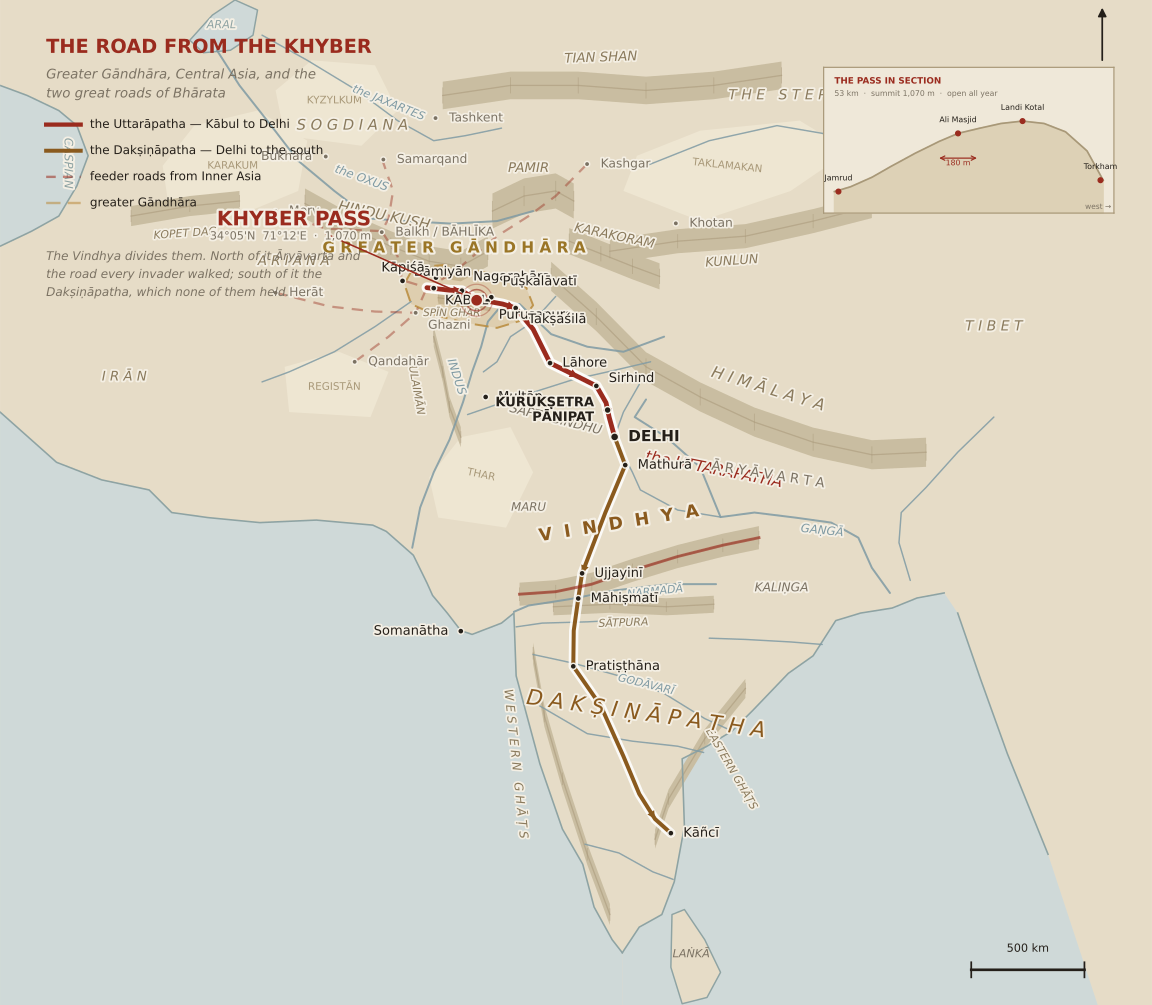
The first ascent is steep and short, and then the gradient eases and the corridor begins to bend north-west. Eight miles in, the ground rises to a shoulder and there is a fort on it — Ali Masjid, at three thousand one hundred and seventy-four feet, sitting exactly where the gorge shuts to its tightest. Here the corridor closes to a hundred and eighty metres, and in places to a width where two fully laden camels could not pass one another going opposite ways. The cliffs come in overhead. The sound changes; hooves and voices come back off the rock a half-beat late.
Whoever is on those heights owns every man on the floor. There is no cover. There is no room to deploy. A column entering that stretch is a rope being fed into a mill.
The British called it the Key to the Pass, and they paid for it twice. Anandapala's archers were on those cliffs in 1008. Nasir Khan's Mughal garrison sat there in the winter of 1738 with the corridor sealed shut, and Nadir Shah came up the road, and looked at it, and did not attack.
Five miles of that. Then the walls fall back.
At the village of Zintara the gorge opens into a valley a mile and more across, and there is grass, and there are villages, and there are terraces of thin cultivation on the slopes, and the sky comes back. Ten miles on lies Landi Kotal, three thousand five hundred and eighteen feet — the highest ground on the whole road, a market town on a plateau where the caravans have unloaded for two thousand years and where, on any given afternoon, you can buy tea, rifles, hashish, cloth from Karachi and electronics smuggled from the Gulf.
Then it goes down. Past Landi Khana, past the frontier post at Torkham, and out — into the bare Loya Daka plain, and beyond it the Kabul river, and along that river a road running north-west to Jalalabad and on to Kabul itself.
Thirty-three miles, end to end. Fifty-three kilometres. Highest point one thousand and seventy metres.
That is all it is. And for three thousand years it has been the most consequential thirty-three miles on the surface of Asia.
What Lies at Either End
A pass is worth nothing by itself. It is worth exactly what stands at its two mouths.
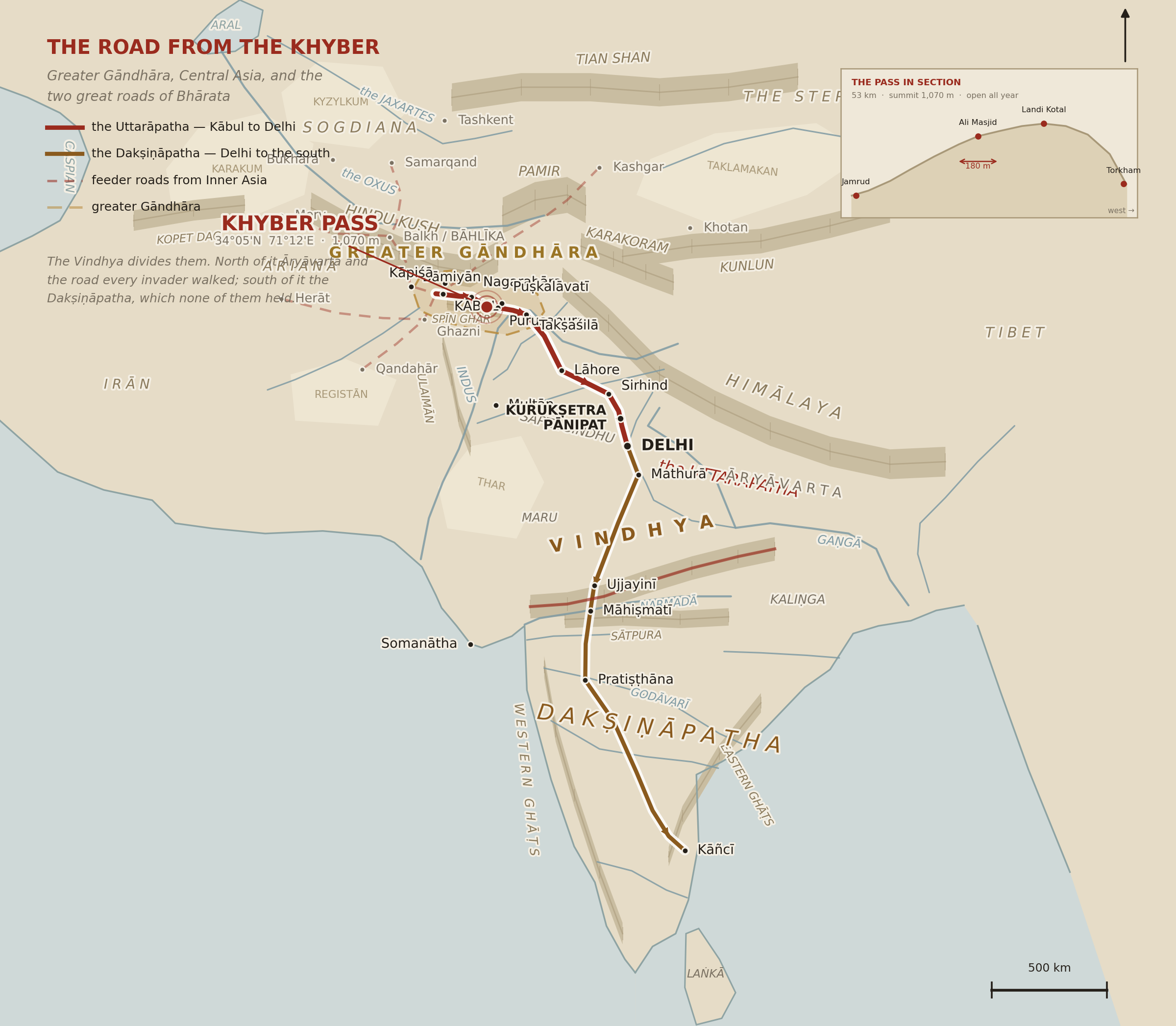
East, at Jamrud, eleven miles on, lies Puruṣapura — Peshawar — in a valley watered by the Kabul and the Bara and the Swat, growing wheat and sugarcane and fruit, wintering warm, and holding since antiquity one of the great cities of Bhārata. This was Kaniṣka's capital. His stūpa stood here, and Chinese pilgrims six hundred years later still recorded its height in tones of disbelief.
Puruṣapura is the heart of Gāndhāra — one of the mahājanapadas, the country of Gāndhārī and of Śakuni. Pāṇini composed the Aṣṭādhyāyī at Śalātura, on the Indus, a short ride from where this road comes out of the hills. Puṣkalāvatī stood on the Swat. Takṣaśilā stood beyond the river, the greatest concentration of learning between the Ganga and the Mediterranean.
An army emerging at Jamrud is therefore not emerging into a wilderness. It is emerging into grain, fodder, water, roads, and cities.
And from Puruṣapura a single road runs east. It crosses the Indus at the fords of Ohind and Attock. It reaches Takṣaśilā. Then it runs down through the Sapta Sindhu, the land of the five rivers, past Lahore, and holds its line east-south-east across the Punjab plain. It is the Uttarapatha, the northern road, and it is older than any empire that has used it. The British would eventually resurface it and call it the Grand Trunk Road.
Follow it far enough and it brings you to the Yamuna. And on the way, a hundred and fifty miles short of Delhi, it crosses a flat expanse of ground between the Yamuna and the desert, wide open, well watered, with no obstacle on it worth the name.
That is Kurukṣetra, and the plain of Panipat at its edge.
West, at Torkham, the road drops to the Kabul river and runs to Jalalabad and then to Kabul — and Kabul is the reservoir. Every road worth having converges there. Ghazni and Qandahar to the south. Bactria, Balkh, Bukhara and Samarqand to the north across the Hindu Kush. Herat and the Iranian plateau to the west.
So the Khyber is not a door in a wall. It is a valve between two systems — the wheat and the cities of the Indus on one side, and the whole horse-breeding, grass-rich, restless mass of Inner Asia on the other.
Whoever held Kabul could reach Puruṣapura in twelve days.
What It Costs to Cross
The pass is famous for being easy. It is not easy. It is possible, which in that country is a rarer thing.
Consider what it takes to move an army through.
Water. The Khyber stream is seasonal and unreliable. A force of twenty thousand men with horses, camels and elephants needs water measured in hundreds of thousands of gallons a day, and there is not that much water in the corridor. Armies crossing the Khyber have always been racing a clock they did not set.
Fodder. There is nothing to graze. Every mouthful for every animal must be carried, which requires more animals, which require more fodder. This is the arithmetic that has killed more invasions than any defender.
The defile. Between Ali Masjid and Zintara the column must string out to a thread. A force that takes hours to file through a gap it could not defend if attacked is a force that has surrendered its formation for the duration. Commanders hate this ground for good reason.
The heights. A hundred men on the cliffs above Ali Masjid with bows, or later with jezails, can hold up thousands and cost them badly, and cannot easily be got at. Every column that has come through has had to detach flanking parties to clear and hold the ridges as it moves — slow, exhausting, and it does not always work.
The people. The hills belong to the Afridi, the Shinwari, the Mullagori and the Shalmani, and they have never been governed by anyone from outside on any lasting basis. Their view of an army in the pass has been consistent across every century: it is a thing that carries goods and can be relieved of them at night. The Mughals paid tolls. The British paid allowances and finally gave up and raised the Khyber Rifles out of the Afridis themselves, hiring the ambush to guard the road.
The winter. The pass does not close, which is its great advantage. But at Landi Kotal in January men freeze, and the wind through the corridor takes the shelter out of any camp pitched in it.
Against all that, one fact outweighs everything. Wheels go through. A cart goes through. A siege train goes through. Artillery goes through, and after 1526 that mattered more than anything else on the list. The Karakoram will take a yak. The Baroghil will take a man in July. The Khyber will take a wagon in February.
That is the whole secret. Not that it is gentle — that it is the only low, all-season, wheel-capable road between Inner Asia and the Indian plain that comes out at a city.
The Other Doors
There are others. They explain by contrast why this one was chosen.
The north-western approaches compared
| Route | Character | Season | Wheeled traffic | Where it lands |
|---|---|---|---|---|
| Karakoram and Pamir | 14,000 ft and above | Weeks in summer | No | Ladakh, Gilgit |
| Chitral, Bajaur, Swat | Wooded, ambush country | Most of the year | Barely | Upper Swat |
| Khyber | Low defile, one bad choke | All year | Yes | Puruṣapura and the Indus fords |
| Kurram and Peiwar Kotal | Higher, narrower | Most of the year | Difficult | Kohat, Bannu |
| Tochi and Gomal | Caravan roads | Most of the year | Partly | Dera Ismail Khan |
| Bolan and Khojak | Southern gates | All year | Yes | Sindh and the delta |
| Makran coast and sea | No mountains at all | All year | Not applicable | Debal, lower Indus |
Seven or eight doors, then. And to the north of the Khyber itself, running parallel to it through Mullagori country, there is a track called the Tsatsobi — a bad road, a hard road, a road no one would choose.
Remember it.
The Crossings
The Persians, from about 518 BCE
The first crossings that leave a record in stone. Darius takes Gāndhāra, and afterwards a satrapy his inscriptions call Hinduš. Around 515 BCE he sends Scylax of Caryanda to sail down the Indus and report on it.
Persian authority reaches the river and stops. Behind it comes the apparatus of an empire that faces west — tribute, satraps, a garrison on the Indus, and the Aramaic script, out of which the scribes of Gāndhāra will shape Kharoṣṭhī.
Settled that the Achaemenid frontier ran to the Indus. Contested which road the armies used, though the Kabul valley and this corridor are the obvious answer.
The Macedonians, 327 BCE
Winter, in the high camp at Alexandria-in-the-Caucasus, near modern Begram.
Alexander splits his army. Hephaestion and Perdiccas take the greater part of it — the baggage, the siege train, the wagons, everything with a wheel on it — and go down the Kabul valley and through the Khyber to the Indus, with orders to bridge the river at Ohind.
Picture what that column looks like on this road. Weeks of it. Oxen and carts in the defile below Ali Masjid, strung out over miles, flanking parties working the ridges, the whole apparatus of a Macedonian field army feeling its way down a corridor where it cannot form line. That is the Khyber's real service in the most famous invasion in the popular memory. It carried the wagons.
Alexander himself goes north the hard way — Kunar, Bajaur, Swat. Massaga. Ora. The rock of Aornos, which he takes because he cannot bear to leave it untaken. It costs him a season.
Then the Jhelum, and Porus, and an elephant line that mauls his cavalry before it breaks. Then the Beas, where the army stops and refuses to go further, and the campaign ends not in a defeat but in a mutiny.
He does not go back through the Khyber. He goes down the Indus, takes a wound among the Mallavas that nearly finishes him, and marches out through the Gedrosian desert, where thirst and heat destroy a large part of everything he still had.
The pass let him in. It did not let him out.
Candragupta and Cāṇakya, 321 to 303 BCE
Within twenty years the Macedonian garrisons are gone from the Punjab and the Indus. Seleucus Nicator comes east to recover the lost provinces and does not recover them.
In 303 BCE he cedes to the Maurya, by treaty, Gāndhāra, Paropamisadae, Arachosia and Gedrosia. Kabul. Qandahar. The approaches to Herat. Balochistan. He takes five hundred war elephants and a marriage alliance and goes home to fight Antigonus with them.
For the next hundred years and more the Khyber is not a frontier at all. It is an interior road on a highway that runs unbroken from Puruṣapura through Takṣaśilā to Pāṭaliputra under one administration, with rest-houses and wells and a courier service. Aśoka's edicts stand at Shahbazgarhi and Mansehra on the Gāndhāra side of the river, and at Kandahar in Greek and Aramaic, which is a way of saying — this is the interior of my country, and here is what I want the people at the far edge of it to know.
The Greeks, Śakas, Pahlavas and Kuṣāṇas, about 180 BCE to the third century
Bactrian power spills east down the same road. Demetrius. Then Menander — the Milinda of the Milindapañha, who arrives as a Greek king and appears in the tradition as an interlocutor in a philosophical dialogue and a patron. The envoy Heliodorus comes to the court of Vidiśā and raises a Garuḍa pillar there, describing himself on it as a Bhāgavata.
Śakas and Pahlavas follow. Then the Kuṣāṇas, and under Kaniṣka the pass has its golden age — not as a war road but as an artery. Puruṣapura becomes an imperial capital. The Gāndhāra workshops produce their sculpture. Caravans move north over the Hindu Kush and east to the Ganga. Monks and manuscripts go up the corridor toward Bactria and on to Kashgar and Dunhuang and eventually to Luoyang, and the transmission of Indian thought into China runs through this gorge for four hundred years.
Kaniṣka's coins carry Śiva. Nothing about this period is a conquest. Every one of these arrivals is taken in and made a participant.
The Hūṇas, late fifth and early sixth century
And then it stops.
The Alchon groups come down through Bactria and the Kabul valley. Toramāṇa, and after him Mihirakula.
What they do to the north-west is not raiding. The monastic and scholarly establishment of Gāndhāra — the densest concentration of learning in the ancient world outside Alexandria — is destroyed. Faxian, arriving early, had found it flourishing. Xuanzang, arriving a century after the Hūṇas, walks through the same country and records ruins, empty foundations, monasteries with no one in them.
Takṣaśilā never recovers. Some part of what was lost there was never written down anywhere else, and is simply gone.
Skandagupta checks an earlier wave. Around 528, Yaśodharman of Mālava and Narasiṃhagupta Bālāditya break Mihirakula between them, and the Sondani pillar records it in the language of a man who knows what he has ended. The Hūṇas cease to be a power in Bhārata.
But the north-west is not what it was. The lamp in Gāndhāra has gone out, and when the next armies come down that road there will be no Takṣaśilā to stand in their way.
Sabuktigin and Mahmūd of Ghazni, 986 to 1030
The Hindu Shahis of Kabul and Waihind hold this corridor. Their country straddles it. They are, in the plainest sense, the garrison of the Khyber, and they do not sit in it and wait.
Jayapāla marches on Ghazni — twice, in the 980s and again in the 990s, carrying the war to the enemy's capital across the mountains in winter. Both campaigns fail, the second when weather destroys his army in the passes. The frontier falls back to Peshawar.
The twenty-seventh of November, 1001. Mahmūd meets Jayapāla near Peshawar with fifteen thousand horse. The Shahi army is broken and Jayapāla is taken alive and paraded. He is later released. He returns to his own people, abdicates in favour of his son, has a pyre built, and burns himself on it rather than survive the disgrace.
In 1008 his son Anandapāla does what should have been done a generation earlier. He assembles a confederacy — the kings of Ujjain, Gwalior, Kālañjara, Kanauj, Delhi and Ajmer send troops, and the women of the Punjab reportedly sell their ornaments to pay for it. The armies meet at Waihind on the Indus. For most of a day the Shahi side has the better of it; thirty thousand Gakkhar irregulars go into the Ghaznavid centre on foot and cut it up badly. Then Anandapāla's elephant takes fire from naphtha and bolts, and the army sees its king leaving the field, and that is the battle.
Trilocanapāla fights on into the 1020s and is killed. Bhīmapāla is the last.
Then, for thirty years, Mahmūd comes through this pass again and again — seventeen campaigns. Nagarkot. Thanesar. Mathurā, where the temples are burned over twenty days. Kanauj. And in 1026, Somanātha, where the shrine is taken and the liṅga broken and the doors carried to Ghazni, and the killing inside the temple runs into the tens of thousands.
Understand what is going back up this road behind him each time. Not only gold and elephants. Slaves — men, women and children roped in columns, moved through the defile at Ali Masjid and over the top at Landi Kotal in winter, in numbers so large that his own chroniclers record the collapse of the Ghazni slave market, and Central Asian buyers coming down to purchase Indians at prices that had never been so low.
His chroniclers write all of this with satisfaction, because to them it is the record of a career. It requires no interpretation. It requires only to be read.
Muhammad Ghori, 1175 to 1206
He tries the other doors first. In 1175 he comes through the Gomal and takes Multan. In 1178 he pushes toward Gujarat and is met at Kāyadara by the Cāḷukya army under the regent Naikidevi, ruling for her boy king Mūlarāja, and is beaten and driven back across the desert with heavy loss.
So he shifts to the Khyber road, and takes Peshawar, and takes Lahore.
In 1191, at Tarāīn. Pṛthvīrāja Cauhāṇa's army comes up and the Rajput wings roll the Ghurid flanks in. Ghori himself, in the centre, is nearly killed; he takes a lance and is carried off the field by a young Khalji horseman who holds him on the saddle. His army breaks and runs, and is pursued forty miles.
He is let go.
In 1192, Tarāīn again, the same ground. He has spent a year rebuilding, and this time the army is different — mounted archers, ten thousand of them, trained to shoot at the trot and never close. Through a whole day they ride at the Rajput line and away from it and shoot it to pieces, and refuse to be brought to grips. At evening, when the Indian army has been in armour since dawn without water, the heavy cavalry goes in and it is over. Pṛthvīrāja is taken and killed.
What follows takes fifteen years. Delhi. Ajmer. Kanauj. And Nālandā, Vikramaśilā and Odantapurī — the great monastic universities of the east, seven hundred years of unbroken institutional learning — sacked and burned by Bakhtiyar Khalji's column, the monks killed where they were found, the libraries put to the torch and, in the account that survives, burning for days.
March 1206. Ghori is on the road home, camped at Dhamiak on the Jhelum, sixty miles short of the Indus. He is stabbed to death in his tent at prayer.
He never reached the pass.
The Mongols, 1221 to 1306
In 1221 Chingiz Khan comes down to the Indus in pursuit of Jalāl ad-Dīn Khwārazmshāh, destroys him on the riverbank, watches him swim his horse across, and turns back.
For eighty years after that, Mongol columns come at this frontier and are held. Balban fortifies the approaches and garrisons the Sindh-Sagar doab. And between 1297 and 1306 the armies of Delhi break five successive Mongol invasions — at Jaran-Manjur, at Kili, at Amroha, on the Rāvī — with a standing field army, permanent frontier commands at Dipalpur and Multan, and depth behind the pass instead of a line across it.
Whatever else may be said of that regime, this is the plain record. The most formidable cavalry in the world came at this corridor five times in a decade and did not get through.
Timur, 1398
He comes down from Kabul in the autumn and crosses the Indus at Attock on the twenty-fourth of September, 1398.
By December he is outside Delhi with a hundred thousand prisoners taken on the march. Before the battle he decides he cannot fight with them at his back, and orders every one of them killed. His own chroniclers give the figure and do not soften it.
Delhi is stormed and sacked over several days. What is not burned is loaded.
He is gone by January 1399 — fifteen weeks in India, start to finish — going back up the Uttarapatha and through the pass with elephants, treasure, and the craftsmen and masons of Delhi, whom he takes to Samarqand and sets to building the Bibi Khanum mosque, which is still there.
Behind him the Sultanate comes apart into pieces — Jaunpur, Malwa, Gujarat, the Bahmanis — and the dynasty that next holds Delhi holds it as his nominees.
He did not conquer India. He broke it and left.
Bābur, 1504 to 1526
He takes Kabul in 1504, which is the thing that matters, and then spends twenty years looking east.
From 1519 he probes through the Khyber — five times, feeling for the state of the Punjab, taking Bajaur, taking Bhera, taking Sialkot, going back. Each time the road is a little better known.
In 1526 he comes through it for the last time with twelve thousand men and something no one on the other side has — field artillery, and matchlock infantry, and a way of using them.
The twenty-first of April, 1526, at Panipat. He digs in behind a line of carts chained wheel to wheel, with gaps for the guns and flanking parties of horse-archers to sweep around the enemy's wings. Ibrāhīm Lodi's army, many times his size, with a hundred elephants, comes on in a mass into a front too narrow for it, and is shot standing, and cannot get out of its own way, and the flanking horse comes in behind it. It is over before the afternoon.
Bābur does not go home.
That is what is new. Every army for a thousand years has come through this pass and gone back through it. This one stays, and becomes a dynasty, and rules for three hundred years — and under Aurangzeb turns the machinery of that state against the people it governs. The temples of Kāśī, Mathurā and Somanātha destroyed by imperial order. The jizya reimposed. The Ninth Guru executed in Delhi for refusing conversion. A war in the Deccan that runs for twenty-seven years and never ends.
In 1555 Humāyūn comes back through the same pass with Persian troops after fifteen years of exile, and the road runs in reverse for once.
Nādir Shāh, 1738 to 1739
Now the set piece.
In the late autumn of 1738 the Mughal governor of Kabul, Nasir Khan, does everything right. He puts a garrison at Ali Masjid and blocks the defile. This is the correct defence of the Khyber, executed correctly, on the best ground in the corridor, by a competent soldier.
Nādir Shāh brings his army down to the mouth of the pass and looks at it.
Then he does not attack it.
He detaches a force to demonstrate at the entrance — to be seen, to make noise, to hold the garrison's eyes on the road in front of them. And he takes the main body of his army north, out of the corridor entirely, onto the Tsatsobi track through the Mullagori hills. A bad road, a hard road, a road for smugglers and goats, and one no one had any reason to expect an army to attempt in winter.
They go over it, and come down at Barikab, and the Mughal garrison at Ali Masjid — dug in, supplied, holding an impregnable defile — discovers a Persian army standing behind it on the road home.
There is no battle for the pass. There is nothing left to fight for.
The twenty-fourth of February, 1739, at Karnal. The imperial army of Hindustan, a hundred thousand strong or more, is broken in a few hours by fifty-five thousand Persians using mounted musketry it has no answer to.
The twentieth of March. Nādir enters Delhi. On the twenty-second a rumour runs through the city that he is dead, and Persian soldiers are killed in the bazaars, and he rides out to the Sunehri Masjid on Chandni Chowk and gives the order and sits there while the city is put to the sword from morning until the afternoon.
Then he loads what is left. The Peacock Throne. The Koh-i-Nūr. Treasure enough that on getting home he suspends taxation in Persia for three years.
And he goes back through the Khyber.
The Mughal empire survives him on paper for another hundred and twenty years. As a power it ends on the road at Karnal.
Ahmad Shāh Abdālī, and the flag at Attock, 1748 to 1767
Nine times through this pass in nineteen years. Lahore. Delhi. In 1757 the sack of Mathurā and Vṛndāvana, where the killing runs for days and the Yamuna is described by eyewitnesses as running discoloured.
And then, in the spring of 1758, something happens on this road that has not happened in seven hundred years.
The Maratha armies come north. Raghunāthrāo and Malhārrāo Holkar, at the head of the confederacy that had been built for exactly this purpose — the restoration of Hindavī Svarājya, Sanātana sovereignty over Sanātana ground — take Sirhind, take Lahore, drive the Afghan garrisons out of the Punjab, take Peshawar, and plant their standard on the Indus at Attock.
The eastern mouth of the Khyber passes into the hands of an Indian power that has marched fifteen hundred miles from the Deccan to hold it.
From Shivaji, who made that purpose a state; through Sambhaji, who was tortured for forty days at Aurangzeb's order and would not renounce it; through Chimājī Appā, who threw the Portuguese out of Vasai; to a Maratha flag over the Indus — the line is unbroken, and it is a line of reconquest.
Abdālī's answer comes on the fourteenth of January, 1761, at Panipat. The Maratha army fights there through a morning and most of an afternoon, breaks the Afghan centre and very nearly wins, and then Viśvāsrāo, the Peshwā's son, is shot from his elephant, and Sadāśivrāo Bhāu goes down into the fighting to find him and is never seen again, and the line dissolves. The losses on that field are among the heaviest in Indian history, and they fall on both sides.
Abdālī wins, and cannot stay. His army mutinies for its arrears within weeks and demands to go home, and he takes it back up through the pass, as he has eight times before.
Ten years later Mahādjī Śinde holds Delhi.
Haṛi Singh Nalwā, 1837
Raṇjīt Singh takes Peshawar — 1818, and for good in 1834. The valley is governed from the Indian side for the first time in eight hundred years.
Then his general Haṛi Singh Nalwā goes one step further and does the thing nobody has done. In the winter of 1836 and 1837, in fifty-four days, he builds a fort at Jamrud — in the mouth of the pass itself — and garrisons it.
April 1837. An Afghan army comes down the Khyber with artillery to take it out. The garrison is small and short of water. Nalwā comes up with what he can gather and fights them in the gate for four days, and is hit, and dies of it, and orders his death concealed until relief arrives.
The fort holds.
No Afghan army ever entered the Punjab again.
The British, 1839 to 1919
They come at it three times.
In 1842, the retreat from Kabul. Sixteen thousand people, an army and its followers, leave the city in January under a promise of safe passage and are destroyed in the defiles between Kabul and Jalalabad over seven days in the snow. The number who reach Jalalabad is in the handful.
The twenty-first of November, 1878. The Battle of Ali Masjid opens the second war, fought over the exact ground described at the beginning of this account. The Treaty of Gandamak the following May hands control of the Khyber to Britain.
The twelfth of November, 1893. A civil servant named Mortimer Durand draws a line on a map through Pashtun country, from the Pamirs to Balochistan, cutting tribes and valleys in half. No Afghan government has ever recognised it. It is the border to this day.
Then 1919 — the third war, and the last.
And then the engineering. They blast and widen the road. And between 1920 and 1925 they build the Khyber Pass Railway — broad gauge, thirty-four tunnels, ninety-two bridges and culverts, up a gradient so severe that trains climb it pushed and pulled by two locomotives at once, through a switchback at Changai where the line reverses direction four times to gain height. It opens to Landi Kotal on the second of November, 1925.
It is built against a Russian invasion that never comes. It carries almost no commercial traffic in its life.
All of it — road, railway, forts, the Khyber Rifles, the whole apparatus — is paid for out of Indian revenue and garrisoned largely by Indian soldiers, and none of it is a defence of Bhārata. It is a glacis for an empire in a chess game with St Petersburg.
The same administration that built this road spent the same century dismantling the systems through which Bhārata transmitted its knowledge of itself. The Brāhmaṇa lineages that had carried that transmission for millennia, and that had been among the most systematically targeted communities under every prior invasion, were displaced from the institutions of instruction. Sanskrit was pushed out of administration and education. And Indian society was reassembled on paper into a shape convenient to rule. Among the fabrications of that century was caste — a Portuguese word, casta, with no Sanskrit equivalent, describing a rigid birth-locked enumerated hierarchy that the British census manufactured from 1871 onward and Risley's Ethnographic Survey codified. It is not varṇa, which is functional order and in which no varṇa stands above another. It is not jāti, which is local community. Megasthenes at the Mauryan court around 302 BCE recorded seven groups, and recorded explicitly that membership was not by birth; he also recorded that Indians were all free, that no Indian army had ever invaded another nation, and that foreigners were protected. Prinsep's count at Benares in 1843 produced one hundred and seven castes in a single city — a figure produced by the act of counting. Settled
And in 1947, having built the road, the British handed the pass, the railway, the forts, Peshawar and the whole of Gāndhāra out of Indian hands entirely.
1947 and after
Weeks after Partition, in October 1947, tribal lashkars raised in the Khyber and Mohmand country are moved through Peshawar, put on lorries, and launched into Kashmir. The mechanism is three thousand years old — irregulars out of the pass country, thrown east. The target is new.
Everything Pakistan has since attempted in Kashmir is a variation on that operation.
In 1979 the Soviets go into Afghanistan and the Khyber becomes the artery of the war against them, weapons up and refugees down, in numbers that reshape the whole frontier economy.
After 2001, NATO supplies its Afghan war along this road — Karachi, the Grand Trunk Road, Peshawar, the Khyber, Torkham. Container convoys through the defile at Ali Masjid, burning periodically. Pakistan closes the route when it wants leverage, most spectacularly for seven months after Salala in 2011.
The Field at the End of the Road
Follow the Uttarapatha east from the pass and it takes you, every time, to the same place.
Between the Yamuna and the desert there is a stretch of flat, open, well-watered ground with nothing on it to hinder cavalry and no way around it for an army coming from the north-west. It is the last obstacle-free ground before Delhi, and any force that wants Delhi must cross it, and any force that wants to stop them must stand on it.
This is Kurukṣetra, the dharmakṣetra, and the plain of Panipat at its edge — where the tradition holds that the great war was fought, and where the Bhagavadgītā was spoken between two armies.
Four times the fate of Hindustan has been settled on that ground or within a day's march of it, and every one of those four followed an entry through the north-western corridor.
Tarāīn, 1191 and 1192. Ghori beaten, and Ghori returning with mounted archers a year later — and after the second day, the Delhi Sultanate.
Panipat, the twenty-first of April, 1526. Bābur behind his chained carts with guns in the gaps — and after it, the Mughals.
Panipat, the fifth of November, 1556. Hemacandra Vikramāditya — Hemu — who had fought twenty-two battles and won them, and taken Agra and Delhi, and been crowned at Purana Qila as the first Hindu sovereign of Delhi in three and a half centuries. He holds the field most of the day. Then an arrow takes him in the eye and he goes down in the howdah, and his army, seeing the empty elephant, breaks. He is brought to Akbar unconscious and killed. Had that arrow gone a hand's breadth wide, the next three hundred years would have a different name.
Panipat, the fourteenth of January, 1761. The Marathas and Abdālī, and the heaviest single day of loss in Indian military history.
The pass poses the question. That field has always answered it.
The Road Today
The Khyber lies in Khyber District, Peshawar Division, Khyber Pakhtunkhwa, Pakistan. Until 2018 it was Khyber Agency, part of the Federally Administered Tribal Areas, run by a Political Agent under the Frontier Crimes Regulation of 1901 — collective punishment, no ordinary courts, government by subsidy and jirga. The Twenty-fifth Amendment of the thirty-first of May, 2018 abolished FATA, and the office of Political Agent was wound up that June after a hundred and sixteen years.
The district runs to about 2,576 square kilometres, with tehsils at Bara, Jamrud, Landi Kotal and Mulagori, headquarters at Landi Kotal. Population about 1.15 million in 2023, some 99.6 per cent Pashto-speaking. Recorded literacy around 38 per cent; for women, about 17 per cent.
The N-5 highway, part of Asian Highway 1, runs the length of it to Torkham.
The railway is dead. Scheduled services ended in the 1980s. The Khyber Safari tourist train ran on and off until 2006, when the monsoon took out track and bridges, and the floods of 2008 finished it. Rails have been lifted for scrap in places. The tunnels are still there, and the stations, and the switchback at Changai, empty.
The Khyber Pass Economic Corridor — a World Bank scheme of about 483 million dollars, approved in June 2018 and signed in December 2019 — was to build a forty-eight kilometre four-lane expressway from Peshawar to Torkham as part of a projected Peshawar to Kabul to Dushanbe motorway. As of 2026, ground has not been broken. The Bank rates the project Moderately Unsatisfactory. Bids have been cancelled repeatedly for exceeding cost. Pakistan has asked for a thirty-six month extension and a restructuring that deletes the link road and splits the work into three lots. Eight years on, the motorway exists on paper. Settled
Torkham sits on the Durand Line, which Kabul has never recognised. Pakistan shut all Afghan crossings on the twelfth of October, 2025 after border fighting, and Torkham stayed closed for more than four months, with trade stopped and thousands stranded on both sides. It reopened partially for deportees in late March 2026, shut again within a day when a Frontier Corps soldier was hit by fire from the Afghan side, and reopened under conditions in early April 2026 after a ceasefire brokered by Turkey and Qatar. Commercial traffic has been on and off throughout.
The gate that Alexander's wagons ground through, that Mahmūd drove his slave columns up, that Nādir Shāh walked around, and that Nalwā died in, is now a border post that closes when two of the poorest states in Asia shoot at each other across a line drawn in 1893 by a British civil servant with a pen.
The Pass at Night
Stand at Landi Kotal after dark and there is not much to see. Lights strung along the bazaar. Lorries idling for the morning run down to Torkham, drivers asleep in the cabs. The wind coming up the corridor.
Below and to the east the road drops away into the dark toward Ali Masjid, where the walls come in and the sound changes, and beyond that toward Jamrud and the lights of Peshawar on the plain.
Everything went through here. The wagons of a Macedonian army in winter. Aśoka's couriers. Monks with palm-leaf manuscripts headed for Bactria and Dunhuang and, eventually, China. Kaniṣka's caravans. The Hūṇas. Mahmūd, seventeen times, and behind him the roped columns walking north. Timur's loaded elephants, and Delhi's stonemasons walking beside them to Samarqand. Bābur's guns. Nādir Shāh's decoy force, making noise at the mouth of the pass while the real army went over the hills to the north. Abdālī, nine times out and nine times back with nothing held. A Maratha standard on the Indus at Attock. Nalwā's fifty-four-day fort in the gate. A British railway built against an invasion that never came. Container convoys with American ammunition.
Thirty-three miles of shale and limestone, a dry streambed, a defile a hundred and eighty metres wide, and a market town on a plateau at three and a half thousand feet.
It is still there. The lorries still run. And in the morning, when the light comes down the corridor from the north-west, the walls above Ali Masjid go the colour of old bone, exactly as they did for every army that ever looked up at them and wondered who was on the top.