The Act
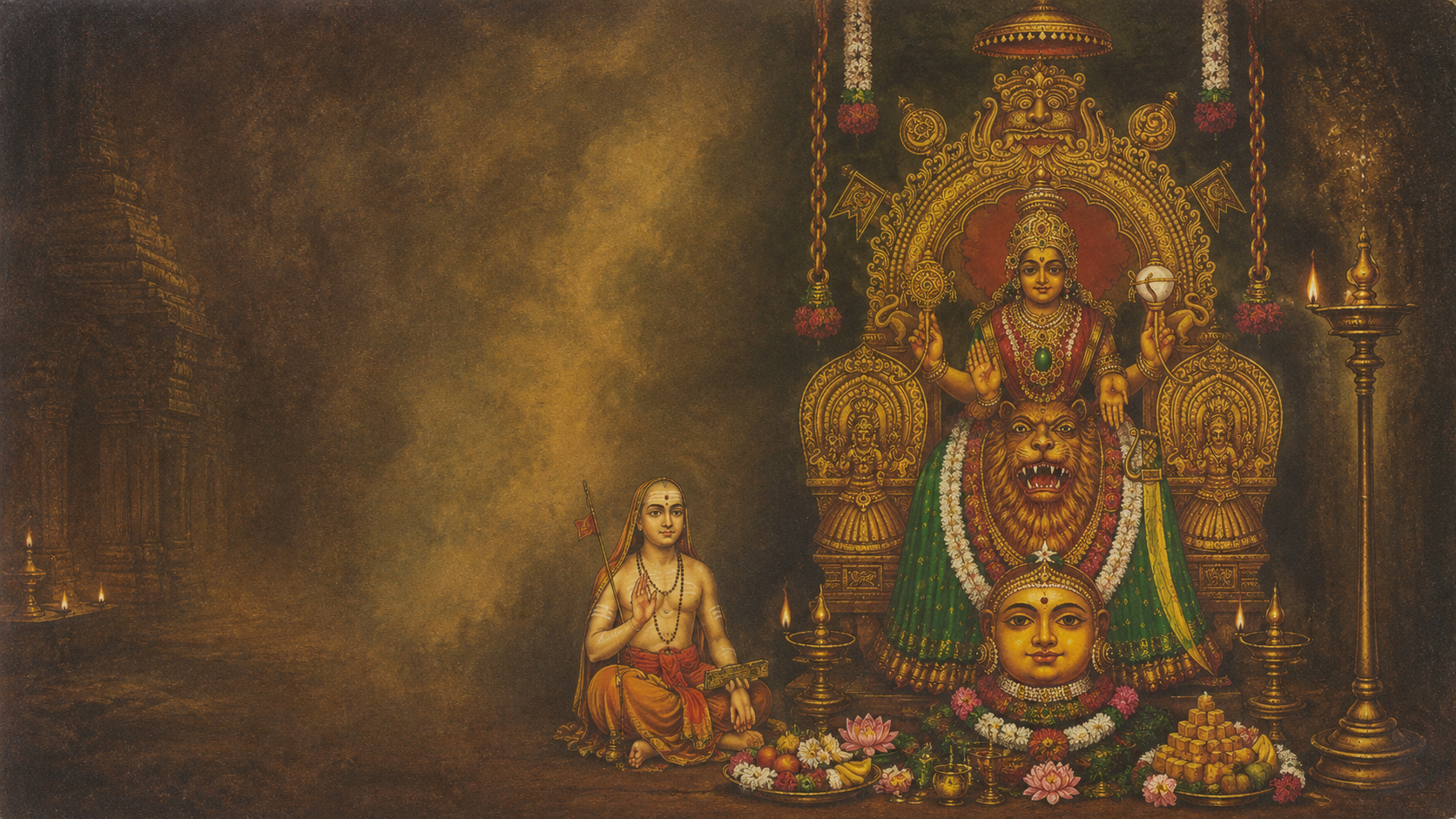
There is a sentence spoken at Kollūr quietly and without argument, in the manner of things too well known to need defending: that when Bhagavatpāda Śaṅkarācārya consecrated the Devī here, he did not merely install an image. He performed kalā-pratiṣṭhā, and he set those kalās in the ear-ornaments of the goddess.
The sentence is worth slowing down over, because it is exact.
Pratiṣṭhā is normally predicated of an image, a liṅga, a yantra, a kalaśa. Ornaments are what a consecrated deity receives, not ordinarily what a consecration enters. And kalā is not a loose word for power or splendour. It is a precise term, with a determinate function in the Āgamas and a still more determinate one in Śrīvidyā, and it does not mean what an English rendering of it would suggest.
Reconstruct the grammar the sentence assumes, what a kalā is, why the installing of kalās is an operation distinct from prāṇa-pratiṣṭhā, and why of all sites upon the divine body the ears are where such an operation belongs, and the sentence stops being a pious flourish. It becomes a technical description, and a remarkably economical one.
What follows sets out that grammar, the kṣetra in which the act was performed, and the shrine's long life since.
Kolāpura on the Sauparṇikā
Kollūr stands in the Udupi district of coastal Karnataka, in the narrow drenched apron of land between the Western Ghats and the western ocean, the country that belongs to Paraśurāma, reclaimed from the sea by the axe. The temple sits at the foot of the peak the Sanskrit sources call Kuṭakācala and Kannada calls Koḍacādri, on the bank of a river named Sauparṇikā.
Each of the three coordinates carries theological weight. None is decorative.
The river
The Sauparṇikā takes its name from Suparṇa, Garuḍa, who performed austerity on its bank and attained his end there. The river descends from the Ghats through medicinal forest, and the water carries the virtue of the herbs it passes over, which is why bathing in it is the necessary first act of the pilgrimage rather than an optional courtesy.
The ritual logic of the whole site is established there. At Kollūr the pilgrim is prepared by the landscape before being admitted to the deity. Mountain, river and forest are not scenery around a shrine. They are its outer āvaraṇas.
The mountain
Koḍacādri rises to roughly one thousand three hundred and forty metres and stands in view of the temple as a presence rather than a prospect. Two sites on it carry consequence: Ambāvana, the goddess's grove, and Citramūla, the cave. The ācārya's tapas was performed at both. Near the summit stands a small shrine of the Devī and a stone structure known as the Sarvajñapīṭha.
The relation of peak to plain is not incidental. The goddess belongs to the mountain, and the temple below is where she consented to be reached. The pilgrimage has a vertical structure even for those who never climb. The deity in the sanctum is the accessible terminus of a power whose seat is above and behind.
The name
Kollūr is Kolāpura, the city of Kola Maharṣi, who performed austerity here and received the vision of Śiva. The tradition places a ṛṣi at this site before any other name attaches to it, and the point is structural rather than antiquarian.
The svayambhū liṅga was already here, already worshipped. The ācārya arrived at a place that was holy before him. What he established was a form and a procedure by which what was already present could be approached, and any reading of the kalā-pratiṣṭhā has to begin from that.
The work at Kollur is regulative, not creative. It does not bring the Devi. It arranges the conditions under which she can be received.
The māhātmya
The greatness of the Kollūr kṣetra is set out in the Skanda Purāṇa, which carries the account of Kola Maharṣi's austerity, of the asura destroyed here, and of the goddess's assimilation into the liṅga. The western coast has its own body of māhātmya literature, transmitted in the Sahyādrikhaṇḍa, and Kollūr stands within it.
Mūkāmbikā and the Grammar of the Name
The account that gives the goddess her name runs as follows.
An asura, called Kaumhāsura or Kaumāsura in the local recensions, undertook severe austerity directed at Śiva, seeking a boon that would render him invincible. Śiva, bound by the logic of tapas, appeared and offered the boon. At the decisive instant the Devī, who is the power of speech itself, struck the asura mute. He could not articulate the request. Deprived of the boon and enraged, he was afterwards destroyed by the goddess, who had gathered into herself the powers of all the gods for the purpose. Because she made him mūka, she is Mūkāmbikā.
The modality of the intervention is the whole point. The goddess does not overcome the asura by superior force at the moment of the boon. She overcomes him by removing his access to speech. The weapon is vāk.
This makes Mūkāmbikā, uniquely among the great goddesses of the south, a deity whose defining act is an operation upon language. It is the reason, coherent rather than coincidental, that Kollūr is the great southern shrine for vidyārambha, for the first letters written by a child, for musicians and dancers and reciters. She who took away speech is she who gives it.
And a goddess defined by the śruti and vāk axis, by hearing and utterance, is a goddess for whom ornamentation of the ears is not arbitrary.
The Garbhagṛha
Darśana at Kollūr is layered, and the layers are the doctrine. What the pilgrim sees at the threshold is not one object but three registers of presence, arranged from the floor of the sanctum backwards and upwards.
The mūlavar
The central object of worship is not in the first instance an image of a goddess. It is a svayambhū liṅga, jyotirliṅga in character, udbhava: risen of its own accord from the ground of the sanctum, and low, barely standing above the floor. This is the mūla-mūrti, the reason the kṣetra exists, and it was here before any hand touched it.
A line of gold, the svarṇarekhā, runs down its length and divides it unequally. The narrower right portion is the seat of the Trimūrti, Brahmā, Viṣṇu and Maheśvara. The wider left portion is the seat of the Tridevī, Mahākālī, Mahālakṣmī and Mahāsarasvatī. Śakti's portion is the greater.
The refusal of symmetry is the theological statement. The standard Ardhanārīśvara icon divides the divine body equally, left half feminine and right half masculine, in exact complementarity. The Kollūr liṅga declines that balance. It asserts that in this kṣetra the manifest weight lies on the Śākta side, that the goddess is not the consort-half of a dyad but the predominant reality, with the masculine trinity held on the narrower side of the line.
The golden face
In alaṅkāra the liṅga carries a svarṇa-mukha, a face of gold, the gift of Cennammājī of Keladi and among the shrine's principal ornaments. Because the liṅga is udbhava and low, the face stands almost at the floor of the sanctum, garlanded, serene, looking out at the height of a kneeling worshipper.
The gesture is precise. The aniconic receives a countenance without ceasing to be aniconic. Nothing is added to the stone and nothing is concealed; a face is laid upon what has no face, so that what cannot be looked at can be looked at.
The mulavar wears a face. That is not decoration of the linga. It is the first step of the same descent the kalas complete.
The vigraha upon the Śrīcakra
Behind the liṅga and raised above it stands the pañcaloha image, cast in the five metals: seated, four-armed, three-eyed, bearing śaṅkha and cakra in the upper hands with abhaya and varada below, crowned, and wearing the tāṭaṅkas. She is seated upon the Śrīcakra.
Here the descent is complete. What is formless in the liṅga and faced in the gold mask is fully embodied in the bimba: limbs, attributes, ornaments, a seat of interlocking triangles beneath.
Two distinct installations meet upon this one image, and they should not be run together. The Śrīcakra is the pīṭha, laid beneath the vigraha as her seat, so that the embodied form rests upon the diagram rather than upon bare stone. The kalās are in the tāṭaṅkas, set in the ear-ornaments of that same seated form. Seat below, digits at the ears.
At Kollur the Sricakra is what she sits upon. The kalas are what she wears. One act gives the form its ground; the other gives it its measure.
The two are complementary and neither substitutes for the other. A yantra beneath establishes the field in which the form stands; the kalās at the ears establish the proportion in which that form is received. This is why the Kollūr act cannot be described simply as the installing of a Śrīcakra, which is only half of what was done.
The attendant Devīs and the gopada
Mahākālī and Mahāsarasvatī stand in their own niches to either side, the two of the three whose seat is the greater half of the liṅga given separate form. Towards the left of the sanctum is the gopada, the mark of a cow's hoof in the stone.
The Śaṅkara Siṃhāsana stands to the western side, adjacent to the sanctum rather than within it, marking the seat of the ācārya's meditation.
The gradient
The three registers of presence in the Kollur sanctum
| Register | Form | Position |
|---|---|---|
| Svayambhū liṅga with svarṇarekhā | Aniconic, self-manifest, unequal division | Lowest, risen from the floor, foremost |
| Svarṇa-mukha | A face laid upon the formless | Upon the liṅga, near floor level |
| Pañcaloha vigraha on Śrīcakra | Fully embodied, four-armed, ornamented | Behind and raised above |
The sanctum is therefore not a room containing a deity. It is a gradient, and the gradient runs in exactly the direction the doctrine of kalā describes: from an unmeasured self-manifest presence, through a countenance, to a form with ears that can carry the digits of sun and moon.
The floor plan is the argument. What the Āgama prescribes in sequence, Kollūr holds in space, all three registers visible at once from a single position at the threshold.
The Ācārya at Kuṭakācala
The account
Bhagavatpāda performed tapas on Koḍacādri. The Devī, pleased, appeared and asked what he desired. He asked her to accompany him to Kerala, where he wished to establish her worship. She consented on one condition: he must walk ahead, and must not turn until the destination was reached. He agreed. They set out, and the sound of her anklets behind him was his assurance of her presence.
At the place now called Kollūr the Devī stilled the sound of her anklets. He turned. And she, having chosen the ground, would go no further, instructing him to install her there, in the form in which he then beheld her.
The Kerala telling adds a coda. At the ācārya's entreaty the Devī conceded a presence in Kerala as well, and is at Chottanikkara in the morning and at Kollūr by midday.
The coda is not decoration. It is the means by which a Malayali devotional world holds a Kannada shrine, and it holds. Kollūr's architecture carries Kerala inflections, its calendar draws Malayali pilgrims in numbers that dwarf local attendance, and the shrine sits within the reckoning of Kerala's hundred and eight Durgālayas and hundred and eight Śivālayas at once, a double membership that the liṅga's dual character alone makes possible.
The structure of the act
The stilling of the anklets is the Devī's own doing. She chooses the ground, and the turning is the occasion she makes for choosing it. What follows is not a compensation for something lost but the establishment of the thing intended: the goddess seated where she wished to be seated, and the ācārya's authority exercised in arranging her worship rather than in determining her location.
He does not command the Devi. He arranges the conditions under which she can be approached, and that is the whole of the acarya's office at a ksetra.
That is exactly the shape of a kalā-pratiṣṭhā.
The lineage that carries it
The Kollūr connection is not narrative alone. It is institutional and unbroken, held through the Śṛṅgeri Śāradā Pīṭham, the ācārya's own foundation, and expressed in ritual prerogative and priestly succession.
The Sringeri Sarada Pitham and Kollur
| Link | Character |
|---|---|
| Jagadguru visits across generations | Recorded in the Vijaya-yātrā accounts of the Pīṭham |
| Marble image of Ādi Śaṅkara at the Śaṅkara Pīṭha within the temple | Installed by Jagadguru Śrī Bhāratī Tīrtha Mahāsvāmī |
| Golden chariot dedicated to the Devī | 2005 |
| Maṅgala-dravya for the Suvāsinī Pūjā at Śāradā Navarātri | Furnished by Śṛṅgeri |
| Incoming priest assuming charge as uttarādhikārī | Travels to Śṛṅgeri for the Jagadguru's blessing before taking office |
Worship at Kollūr follows the paddhati the shrine names the Vijayāgama, ordained by the ācārya, and it is by that krama that the Devī is served to this day.
The recoverable question about kalā-pratiṣṭhā is therefore not an antiquarian one. It is what a continuous ritual lineage at this shrine understands itself to be carrying, and the answer is legible in the Āgamas and in the Śrīvidyā corpus.
Kalā
The word kalā is among the most heavily loaded terms in the Sanskrit religious vocabulary, and its range is not accidental. The senses cohere around a single idea: a portion, a graded fraction of a whole, particularly of a luminous or vital whole. The moon's digit. The sixty-fourth part of an art. The fractional descent of an infinite power into finite manifestation.
Kalā in Vedānta
The Praśna Upaniṣad, on which Bhagavatpāda wrote his bhāṣya, devotes its sixth praśna entirely to the sixteen kalās of the puruṣa. Sukeśā Bhāradvāja is asked about the person of sixteen parts. The answer traces the emission of prāṇa, śraddhā, the elements, the senses, mind, food, strength, austerity, mantra, action, the worlds and name, sixteen in all, from the puruṣa, and then, in the closing image, describes their return: as rivers flowing to the ocean lose name and form and are simply called ocean, so the sixteen kalās of the knower move to the puruṣa, and their names and forms dissolve.
Within the ācārya's own exegetical world, then, kalā is the technical name for the graded fractions by which the undivided descends into the divided and the divided is reabsorbed. A kalā is a rung on the ladder between the unconditioned and the manifest. The Chāndogya's sixteen-part account of manas built from food runs along the same axis.
The consequence is direct, and it governs everything that follows. To perform kalā-pratiṣṭhā is not to add power to an object. It is to fix a determinate fraction of an unlimited power at a determinate place. It is fundamentally an act of measure, and only derivatively an act of empowerment.
Kalā in the Āgamas
Ritual literature makes the same point operational.
In Śaiva Siddhānta cosmology kalā names the five great divisions of the adhvan, the cosmic path: Nivṛtti, Pratiṣṭhā, Vidyā, Śānti, Śāntyatīta. The second is itself called Pratiṣṭhā, and the coincidence is etymological rather than verbal. Pratiṣṭhā is establishment, foundation, the fixing of a thing in a place where it will stand.
More directly, the Āgamas prescribe kalā-nyāsa within image consecration. The Kāmika Āgama, treating installation, distinguishes the nyāsa proper to the śivaliṅga from that prescribed for images, for anthropomorphic bimbas, and it is for images that kalā-nyāsa is set out in detail. The officiant identifies the mūla-mantra, the brahma-mantras and the thirty-eight kalā-mantras with his own body from head to foot; installs the deity within his heart; brings the form out from the heart; and installs it in the image through nyāsa, followed by sannidhāna and sannirodhana, the bringing near and the sealing in.
The thirty-eight are the kalās of the five Brahma-mantras.
The thirty-eight kalas of the Pancabrahma mantras
| Brahma-mantra | Kalās |
|---|---|
| Sadyojāta | 5 |
| Vāmadeva | 13 |
| Aghora | 8 |
| Tatpuruṣa | 4 |
| Īśāna | 8 |
Their function in the rite is to constitute the subtle body of the deity within the image, the graded articulation by which an unlimited presence becomes an approachable one.
Two consequences follow, and both bear directly on Kollūr.
The first is that kalā-pratiṣṭhā is a distinct operation from prāṇa-pratiṣṭhā. Prāṇa-pratiṣṭhā animates. Kalā-nyāsa articulates: it establishes the internal proportion by which the animation is distributed and bounded. An image with prāṇa and no kalā structure would be, in Āgamic terms, alive but unarticulated. Present without measure.
The second is that the Āgamas assign kalā-nyāsa to images as distinct from the liṅga. At Kollūr the object that is svayambhū is the liṅga, and the object the ācārya installed is the pañcaloha bimba. The shrine's own division of ritual labour and the Āgamic distinction are the same distinction. The act, as the tradition names it, is exactly the act the Āgama prescribes for exactly the object it was performed upon.
Kalā in Śrīvidyā
In Śrīvidyā the kalās reach their finest articulation. The moon has sixteen, the sun twelve, fire ten. The fifteen tithis of a fortnight are the fifteen Nityā goddesses of the innermost enclosures of the Śrīcakra, with the sixteenth, Mahātripurasundarī, as the hidden unwaning digit that neither waxes nor wanes and from which the fifteen proceed. The fifteen-syllabled pañcadaśī vidyā and its sixteen-syllabled completion encode the same structure.
The Kāmakalā, the supreme figure of the tradition, two bindus above and one below, identifies the upper pair with the solar and lunar orbs, the visarga, the primordial doubling from which manifestation issues.
That identification is the hinge on which the whole matter turns.
Why the Ears
Kalā-pratiṣṭhā is a coherent and prescribed Āgamic operation. Why then is its site the ear-ornaments of the goddess? The answer, once assembled, is unexpectedly tight.
The tāṭaṅkas are the sun and the moon
The Lalitā Sahasranāma, among the first and most fundamental descriptions of the divine body, names the Devī thus:
This is not simile. It is identification, placed among the constitutive features of the divine body. The two earrings of the goddess are the solar and lunar discs.
And what are the sun and the moon in the vocabulary already established? They are the bearers of the kalās, twelve and sixteen. The moon's digits are not attributes of the moon. In this system they are what the moon consists of.
To set kalās in the tāṭaṅkas of the Devī, therefore, is to set the digits of sun and moon in the orbs of sun and moon. The operation is the ritual enactment of a canonical Śrīvidyā identification.
There is no other ornament on the divine body of which this could be said. Not the necklace, not the girdle, not the anklets. The tatankas alone are, by name and by doctrine, kala-bearing objects.
Designed from first principles within Śrīvidyā, a kalā-pratiṣṭhā goes to the ears. There is nowhere else for it to go.
The tāṭaṅka as the seat of sovereign power
The Saundaryalaharī makes an extraordinary statement in its twenty-eighth verse.
The deathlessness of Śiva is an effect of the Devī's tāṭaṅka.
The tāṭaṅka is the emblem of her saubhāgya, her standing as the eternally auspicious, and the ontological guarantor of Śiva's own immunity to kāla. It is the most powerful single ornament in the tradition. To work upon it is to work upon an operative condition of the cosmos.
That the same ācārya composed the Saundaryalaharī and performed the kalā-pratiṣṭhā at Kollūr is not an ornamental coincidence. The verse states the doctrine; the rite enacts it. One hand wrote and worked.
The ear-and-tongue axis
The goddess of Kollūr is defined by an act performed upon speech. She silences, she restores, and she presides over vidyārambha, over akṣara, over saṅgīta and nṛtya. Her devotees are those who need language to work: children beginning letters, singers, reciters, the mute.
The pairing of vāk and śruti is structural rather than associative. Revelation is heard, and the ear is the organ of the Veda. A goddess whose signature act is upon utterance is a goddess whose ears carry theological charge. The kalās set in Mūkāmbikā's tāṭaṅkas are the graded measures by which the unlimited parā vāk descends through paśyantī and madhyamā into the vaikharī that a child can write and a singer can sound.
Measure as the proper work of the ears
Kalā-pratiṣṭhā is the fixing of a fraction. It is measure rather than augmentation.
At Kollūr the object of worship is a svayambhū liṅga whose Śākta half is explicitly the larger. The iconography asserts a preponderance of raw Śakti at this site. What such a site poses to its worshippers is not insufficiency of power. It is unmediated abundance of it.
And the ācārya's office at every kṣetra is the proportioning of that abundance for human reception. He does not increase the Devī's power. He renders it receivable: the Śrīcakra at Kāñcī before Kāmākṣī, the tāṭaṅkas at Tiruvānaikkāval, the Vijayāgama krama at Kollūr, and at Kollūr the kalās set in the ears of a goddess whose liṅga is majority Śakti.
That is the right rite in the right place: a graded, fractional, ear-located measuring of an unlimited presence into a form a pilgrim can stand before.
The Same Method at Tiruvānaikkāval
The Kollūr act is not isolated. The ācārya worked the ears of the Devī elsewhere, by the same principle and to the same end, and the parallel is worth setting out because it shows a method rather than an episode.
At Tiruvānaikkāval, Akhilāṇḍeśvarī stands at the Jambukeśvara temple near Tiruchirappalli, one of the Pañcabhūta Sthalas and the shrine of the water element. Her aspect there was ugra to a degree that worshippers approached the sanctum only from outside. Bhagavatpāda installed a Prasanna Gaṇapati facing her shrine, and then fashioned and set upon her ears ear-ornaments bearing the Śrīcakra. The fierce aspect became benign, and the goddess has been approachable since.
The Kāñcī Kāmakoṭi Pīṭham holds the tāṭaṅkas of Akhilāṇḍeśvarī in continuing custodianship. When they wear, they are repaired and re-consecrated upon the Devī's ears by the ācāryas of the Pīṭham, the sixty-third among them having performed this in 1848. The rite has a name, Tāṭaṅka Pratiṣṭhā, and a living calendar, and it has never lapsed.
Set the two side by side and the method is plain.
One method across three ksetras
| Kṣetra | Difficulty of the sanctum | The acarya's instrument |
|---|---|---|
| Kāñcī | Kāmākṣī in unmediated intensity | Śrīcakra established before the Devī |
| Tiruvānaikkāval | Akhilāṇḍeśvarī in ugra aspect, sanctum unapproachable | Prasanna Gaṇapati opposite, Śrīcakra tāṭaṅkas upon the ears |
| Kollūr | Svayambhū liṅga whose Śākta portion is the greater | Śrīcakra as the pīṭha beneath the bimba, and kalās set in its tāṭaṅkas |
The instrument varies with what the kṣetra presents. The principle does not vary at all. In each the ācārya interposes a graded structure between an unmeasured presence and the worshipper.
The placement of that structure is worth stating exactly, because the three are often conflated. At Kāñcī the Śrīcakra stands before the Devī, established in front of her. At Tiruvānaikkāval the Śrīcakra is within the ear-ornaments themselves, inset into the tāṭaṅkas that Akhilāṇḍeśvarī wears. At Kollūr the Śrīcakra is beneath, serving as the seat of the vigraha, while what the tāṭaṅkas carry is the kalās.
Placement of the interposed structure at each ksetra
| Kṣetra | What is interposed | Where it is placed |
|---|---|---|
| Kāñcī | Śrīcakra | Before the Devī |
| Tiruvānaikkāval | Śrīcakra | Inset within the tāṭaṅkas |
| Kollūr | Śrīcakra as pīṭha, and separately the kalās | Beneath the vigraha, and in its tāṭaṅkas |
In two of the three the ears carry the work, because the ears are where the tradition already locates the sun and the moon and therefore the digits they consist of.
What is remembered at Kollur and at Tiruvanaikkaval is one hand doing one thing twice, in the two places that required it.
The Historical Sediment
The shrine's long life beneath and after the consecration is documented, and it deserves setting out on its own terms.
Epigraphy and patronage
An inscription of 1481 found at the site describes the source of the Śakti worshipped here and identifies the Devī in liṅga form as Ādiśakti. Patronage by the Alupa dynasty, who ruled the Tuḷu coast for centuries, belongs to the earlier record of the shrine's standing in the region.
Stone record-keeping at forest and mountain kṣetras tends to begin when a state apparatus arrives with an interest in recording endowments. The epigraphic horizon marks the entry of Kollūr into political visibility, not the beginning of its worship, which the liṅga itself and the māhātmya both place far earlier.
Vijayanagara and the Keladi Nāyakas
Kṛṣṇadevarāya visited the shrine, and the golden mask he presented remains among the treasury's most valued objects. Epigraphs of Vijayanagara patronage stand at the site.
More consequential still, the Keladi Nāyakas, who ruled the Malnāḍ and coastal tracts from the sixteenth into the eighteenth century, held Mūkāmbikā as kuladevatā. Under their patronage Śaṅkaṇṇa Nāyaka and Śivappa Nāyaka undertook renovation and endowed maintenance. The dynasty dedicated its victories to the goddess and celebrated them before her, which sets Mūkāmbikā in the royal register as a goddess of victory alongside her office as goddess of learning. The svarṇa-mukha that the liṅga wears in alaṅkāra is Cennammājī's gift, and the temple's architectural character, including its sanctum structure, reflects the Keladi period.
Cennabhairādevi, the long-reigning Jaina queen of Gersoppa whom Portuguese records call the Pepper Queen, endowed the shrine substantially, including the gold-plating of the tower. That a Jaina sovereign stood among Kollūr's major patrons says something exact about the texture of religious life on this coast, and it receives less attention than it deserves.
Loss and re-accumulation
The eighteenth century brought sustained upheaval to the coast, and the shrine lost gold, silver and gems of great value in the course of it. Much of what stands today is of later date, and the treasury reflects re-accumulation rather than continuity.
High-status gifting has continued into the present, and it matters because it shows the shrine's unbroken function as a place where public standing is deposited before the Devī: emeralds attributed to a Rāṇī Cennamma, a golden sword from a former Chief Minister of Tamil Nadu, a silver sword from a former Chief Minister of Karnataka. Endowment is one of Kollūr's ancient offices, not a modern overlay upon a devotional core.
The Kerala Axis and the Goddess of Letters
No account of Kollūr is adequate that treats it as a Karnataka temple merely because it stands in Karnataka.
The Chottanikkara arrangement distributes the goddess rather than moving her, and the effects are visible in every register of the temple's life: the double reckoning among Kerala's Durgālayas and Śivālayas that the svarṇarekhā liṅga licenses, the decisive share of Malayali pilgrims, and the Kerala inflection in architectural idiom, ritual vocabulary and the sociology of the priesthood.
It is on this axis that the shrine's vocation is clearest.
Vidyārambha at Kollūr, the child's first letters traced in rice or written on the tongue with gold, is among the most consequential of the temple's rites and is performed in great number on the appointed days. The goddess who muted an asura is the goddess who opens a child's speech. The Sarasvatī Maṇḍapa serves as the space in which musicians and dancers offer their art as worship, and a great many of Kerala's classical performers regard an offering at Kollūr as a necessary act early in a career. The Lakṣmī Maṇḍapa at the rear, with its pillars, completes the ritual architecture.
Here the kalā theme closes its circle in the least expected way. Kalā, in ordinary Sanskrit and in every modern Indian language descended from it, means art. The sixty-four kalās are the sixty-four arts. A shrine at which kalā-pratiṣṭhā was performed is a shrine at which the arts are installed, and Kollūr is, as plain observable fact, one of the great art-consecrating shrines of Bhārata.
The kalas are established at Kollur in the children who write their first letters there, in the singers who make their first offering, in the dancers who dedicate a career. The rite performed at the ears of the image is performed again every morning at the threshold.
What the Act Says
In the life of the shrine
The kalā-pratiṣṭhā establishes the relation between an unmeasured presence and the ordered worship that reaches it. The Kollūr liṅga was here before the ācārya, self-manifest and independent. The accessible Devī, the one with a face and ornaments and a pūjā schedule, stands in the form she does because of what was done at her ears and beneath her seat.
That relation is not stated only in narrative. It is carried in institutional fact: the Śṛṅgeri connection, the priest's journey to the Jagadguru before assuming office, the Navarātri maṅgala-dravya, the Vijayāgama krama by which she is served. What the account describes, the calendar performs.
In doctrine
The goddess in her own nature is unmeasured. What stands between her and the worshipper is a graded, fractional, deliberately bounded descent. That measure is not a diminishment but a mercy, because an unlimited presence is not a more generous presence but an unapproachable one. The ācārya's work is not to bring the divine but to proportion it. And the proportioning is lodged at the ears, in the orbs of sun and moon, at the junction where śruti becomes hearable and parā vāk becomes a syllable a child can copy.
The svarṇarekhā says the same thing in stone: the Śākta portion is the larger. At a kṣetra where the goddess's preponderance is the visible datum, a doctrine of graded descent is not an elegance. It is the condition of worship.
The kala-pratistha is not an ornament upon Kollur's theology. It is Kollur's theology, stated in the vocabulary of ritual.
Coda
What the pilgrim encounters is this.
A river that has run through medicinal forest, in which one bathes before anything else. A mountain that is the goddess's seat, standing in view of her temple, with a grove and a cave upon it where the ācārya sat. A stone that came up out of the ground of its own accord, older than any human decision, with a line of gold along it dividing the trinity from the triple goddess, and giving the goddess the larger share. Behind that stone and above it, a small figure of five metals seated upon a diagram of interlocking triangles, four-armed, wearing gold, wearing earrings. To the west, an empty seat.
And in front of it, on the appointed morning, a child holding a stylus, with an adult's hand closed around the child's hand, forming the first letter.
The earrings on that figure carry the kalās, and the ācārya set them there. What the Saundaryalaharī asserts of the tāṭaṅka, what the Lalitā Sahasranāma asserts of the sun and the moon in the Devī's ears, what the Praśna Upaniṣad asserts of the sixteen kalās and their reabsorption, and what the Kāmika prescribes for the consecration of an image, are one teaching, and at Kollūr they are fastened to one place on the western coast where a river comes down out of the Ghats.
The child forming the letter is receiving a fraction. That is the whole of it, and it is enough.
On Sources
The Kollūr māhātmya, the austerity of Kola Maharṣi and the destruction of the asura are carried in the Skanda Purāṇa and in the māhātmya literature of the western coast transmitted in the Sahyādrikhaṇḍa.
The doctrine of kalā as fractional descent rests on Praśna Upaniṣad VI with Bhagavatpāda's bhāṣya, and on Chāndogya VI. The five kalās of the Śaiva adhvan, among them Pratiṣṭhā, belong to the Siddhānta cosmology. Kalā-nyāsa, and the thirty-eight kalā-mantras of the Pañcabrahma, are prescribed in the Kāmika Āgama, which distinguishes the procedure for images from that for the liṅga.
The Śrīvidyā material, the sixteen kalās of the moon and twelve of the sun, the fifteen Nityās and the hidden ṣoḍaśī, and the Kāmakalā, is standard to the tradition. The identification of the Devī's ear-ornaments with the solar and lunar orbs is Lalitā Sahasranāma, tāṭaṅka-yugalī-bhūta-tapanoḍupa-maṇḍalā. The power of the tāṭaṅka is Saundaryalaharī 28.
For the shrine's later history: the inscription of 1481 at the site; the record of Vijayanagara and Keladi Nāyaka endowment; and the accounts of the Śṛṅgeri Śāradā Pīṭham's Vijaya-yātrās, which record the Jagadgurus' worship at Kollūr across generations. The Tāṭaṅka Pratiṣṭhā at Tiruvānaikkāval is documented in the records of the Kāñcī Kāmakoṭi Pīṭham, including the re-consecration of 1848.