धर्मो रक्षति रक्षितः -- Dharma protects those who protect it.
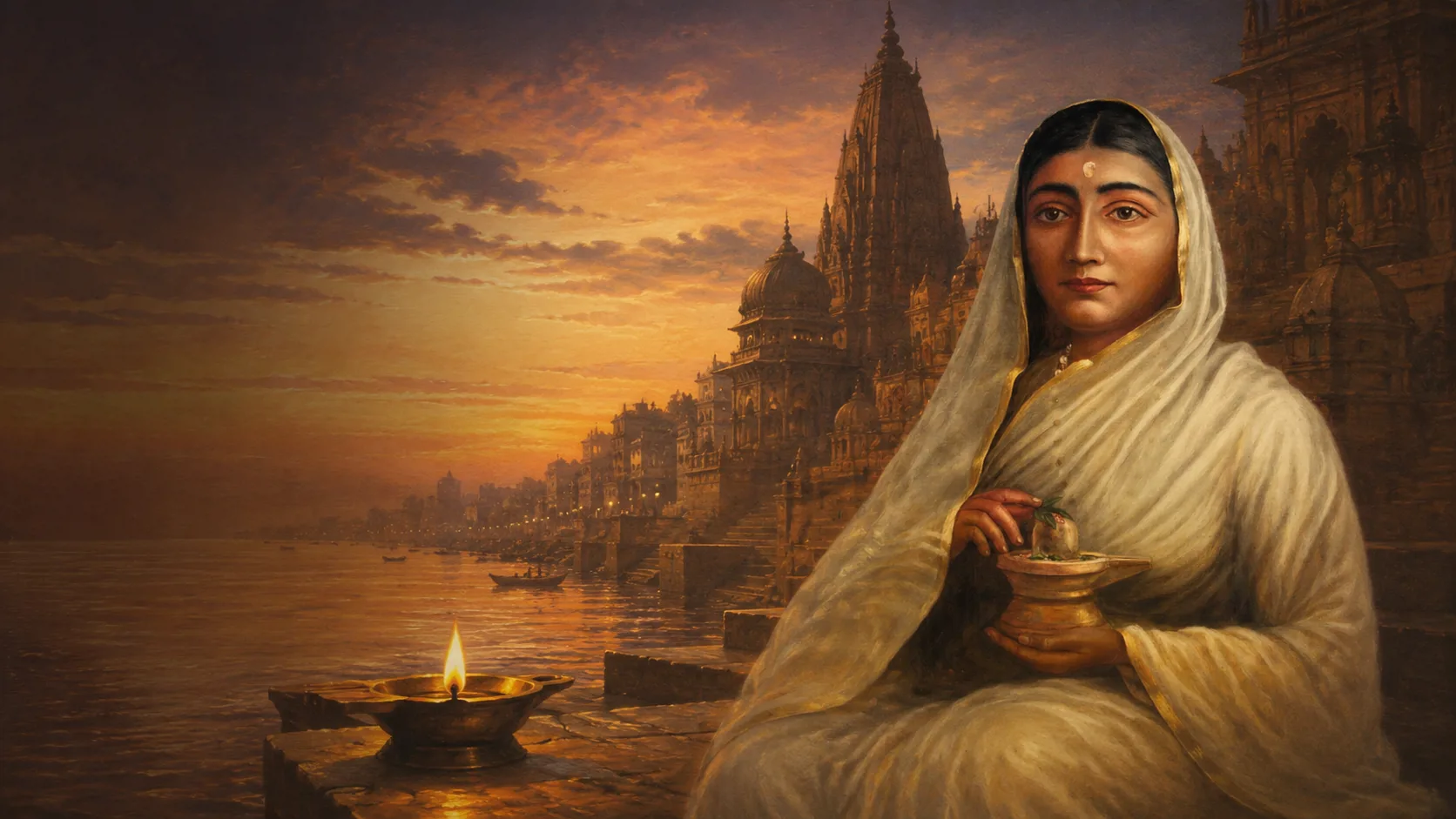
There is a particular kind of greatness that leaves no scar upon the earth. It raises no boastful inscription cut into rock to intimidate the centuries, levels no city, enslaves no people. It leaves instead the low, steady sound of a temple bell at dusk; the cool of a stone step worn smooth by two hundred years of pilgrims' feet; the flame of a single lamp that has not gone out. This was the greatness of Ahilyābāi Holkar (१७२५-१७९५), the widowed queen of Malwa who ruled from a modest palace on the Narmadā and, in an age when the sacred geography of Bhārata lay broken and desecrated, quietly set about putting it back together -- one tīrtha, one ghāṭ, one śikhara at a time.
She fought no wars of conquest. She annexed no neighbour. She built herself no monument. And yet by the time she died, the spiritual spine of the subcontinent -- from Kedārnāth in the Himālaya to Rāmeśvaram on the southern sea, from Somnāth in the west to Purī in the east -- had been re-threaded by her hand. To understand her is to understand something essential about how Sanātana Dharma survives its winters: not always through the sword of the warrior, but often through the resolve of one steady soul who simply refuses to let the lamp go dark.
This is the story of that soul, and of the civilisation she reconsecrated.
I. The Shepherd's Daughter Who Learned to Read
Ahilyā was born on the last day of May, 1725, in the village of Choṇḍī in what is now Maharashtra's Ahmednagar district. Her people were Dhangars -- a pastoral, shepherding community -- and her father, Mankoji Shinde, was the paṭil, the headman, of a small village. Hers was not a household of queens, and by every convention of her age she should have vanished into anonymous village life, unlettered and unremembered.
Her father did something that would alter the course of a subcontinent's spiritual history. In an era when almost no girl of any rank was taught her letters, Mankoji Shinde taught his daughter to read and write. It was a quiet act of defiance against custom -- a village father's private rebellion -- and from it flowed one of the most extraordinary lives in the annals of Bhārata. She who could read could later correspond with scholars, review the accounts of a kingdom with her own eyes, and compose verses of her own. Literacy was the first seed; everything else grew from it.
Fate, as it so often does in the lives of the great, arrived on the road. Malhār Rāo Holkar -- himself a shepherd's son who had risen through the armies of the Peśvā to become the ruler of Malwa -- halted at Choṇḍī on his way to Pune and saw the child at temple service, wholly absorbed in her devotions. Struck by her bhakti and her composure, he chose her as bride for his own son, Khaṇḍerāo. They were married around 1733, both of them children -- she perhaps eight, he a little older.
What followed was not the idle life of a pampered daughter-in-law. Malhār Rāo, discerning in the young woman a mind equal to any at his court, drew her into the work of governance. From the 1750s he kept her actively involved in the finances of the kingdom, in diplomacy, in the tangled negotiations that bound the Holkars to the Peśvā and to the crumbling Mughal throne. She was schooled, in effect, in statecraft, warfare, and administration by one of the ablest chieftains of the age. When her hour came, she would not be unprepared.
II. The Long Tempering of Grief
Greatness in the Sanātana imagination is rarely handed to the untried. It is forged -- and Ahilyābāi was forged in a furnace of successive griefs that would have broken a weaker spirit utterly.
First her husband. Khaṇḍerāo fell in 1754 at the siege of Kumher Fort, giving his life in the campaigns by which the Marāṭhā confederacy was carrying the banner of Hindavī Svarājya across the north -- the long labour of reclaiming Bhārata for its own dharma. She was widowed young, and by the iron custom of the time a widow's life was meant to contract into shadow and silence. Tradition holds she resolved upon satī -- and that her father-in-law, Malhār Rāo, stayed her hand, telling her that her dharma lay not on the funeral pyre but in the living work of the kingdom that would one day need her. Whether the account is literal or the crystallisation of a deeper truth, it names something real: her life was pulled back from the edge of extinction and turned toward service.
Then, in 1766, Malhār Rāo himself -- her mentor, her shield, the pillar of the whole dynasty -- died. Within a year, the final blow: her only son, Māle Rāo, upon whom the succession rested, was gone too. In the space of little more than a decade she had lost husband, guardian, and heir. The house of Holkar stood, in dynastic terms, hollowed out. And at its centre stood a widow the world expected to disappear.
She did the opposite. On 11 December 1767, with the sanction of the Peśvā, Ahilyābāi was formally installed as the ruling queen of the Holkar realm. She moved her capital downriver to Maheśvara on the banks of the sacred Narmadā, and there she took up a reign that would last twenty-eight years and become, in the memory of Bhārata, almost the definition of what righteous rule looks like.
There is a spiritual grammar to this arc worth naming plainly. The tradition speaks of vairāgya -- the detachment that comes not from cowardice or withdrawal but from having passed through loss and emerged with the ego burned clean. Ahilyābāi ruled as one who had already surrendered everything the world could take from her. That is precisely what made her incorruptible. A ruler with nothing left to lose for herself governs for something larger than herself.
III. The Empress Renunciate: Governance as Dharma
What distinguished Ahilyābāi from other able administrators -- and the eighteenth century had a few -- was that she grounded governance explicitly and unashamedly in dharma. Her rule was not merely efficient; it was righteous in the technical, Sanātana sense: ordered toward the moral and cosmic good, and answerable to something higher than the treasury.
She lived, though a sovereign, as an ascetic. She rose before dawn for her worship of Śiva -- she was a devout Śaiva her whole life -- and she wore the plain white of a widow to the end. Despite commanding a private fortune reckoned in the crores, she chose to reside in a modest two-storey wāḍā rather than any opulent palace, holding her wealth as a trust to be discharged rather than a treasure to be enjoyed. Contemporaries and later historians alike reached for the same phrase: the Philosopher Queen, the rāja-ṛṣi made real -- the sage upon the throne.
Her genius as a ruler lay in a combination of qualities that rarely coexist: firmness and accessibility. She held open durbar -- public audience -- regularly, and any subject could approach her directly. Farmers, merchants, artisans, widows, the wronged and the poor: no courtier could filter or distort what reached her ears. She ran the administration with meticulous personal attention, reviewing the state's accounts herself, supervising the building of roads and the digging of irrigation works, maintaining a professional army that in the early years she often accompanied into the field in person.
Her justice was, in the words of the old state records, soft but speedy -- practical yet spiritual, restraining yet reforming. And it was impartial to the point of severity with her own house. The most famous episode of her reign concerns a capital transgression and her willingness to sentence her own family under the law rather than bend it -- a queen who would not exempt her own blood from the justice she demanded of others. This is not the anecdote of a soft ruler. It is the mark of a sovereign for whom dharma stood above dynasty, above affection, above self.
Nor was her dharma of the narrow or exclusivist kind. Devout Śaiva though she was, her devotion never curdled into sectarianism. She endowed ghāṭs used by pilgrims of every persuasion, built rest-houses open to all travellers regardless of faith or origin, and extended her charity across community lines. She worked to end oppressive customs against widows -- having been one, and having been nearly consumed by those customs herself. She founded schools and pāṭhaśālās. She raised Maheśvara into a living seat of learning, craft, and devotion, and rebuilt its weaving industry with such care that the Maheśvarī sārī she nurtured clothes and sustains weavers to this day.
Later ages, reaching for the highest praise their own idioms allowed, would confirm the verdict. Jawaharlal Nehru described her reign as almost legendary -- a period during which perfect order and good government prevailed and the people prospered. The Scottish soldier-historian John Malcolm, no easy flatterer of Indian sovereigns, wrote that her rule was pure and benevolent, and that she left a name dear to all classes of her subjects. Her people needed no historian's certificate. They called her Lokamātā -- Mother of the People -- and Devī Ahilyā, and they worshipped her memory as that of a saint.
IV. Yajña in Stone: The Reconsecration of the Tīrthas
And yet, remarkable as her governance was, it is not the first thing Bhārata remembers when it speaks her name. For that we must turn to what she did with her private wealth -- and here we arrive at the true heart of her significance to Sanātana Dharma.
The Holkars, unusually and to their lasting honour, kept their private fortune strictly separate from the public treasury. Ahilyābāi honoured this distinction with monastic rigour: the roads and wells and works of the state she funded from the state's revenues, but her vast programme of temple-building she financed from her own inherited wealth, so that not a rupee of the people's taxes went to it. From that personal fortune she undertook what can only be called a yajña in stone -- a sacrifice offered not into the fire, but into the living body of the land itself.
Consider the roll of the places she touched, and the map of Bhārata redraws itself before you as a single unbroken pilgrimage:
- In the north -- Kedārnāth and Badrīnāth high in the Himālaya; Haridvāra, Ṛṣikeśa, Śrīnagar; Naimiṣāraṇya, the forest of the sages; Prayāga at the confluence; and the Viṣṇupada temple at Gayā, restored in 1787, where the faithful offer piṇḍa to their ancestors.
- In the east -- Kāśī and Purī.
- In the west -- Somnāth, Dvārakā, Nāsik, Mahābaleśvara; and Mahākāleśvara at Ujjain, another of the twelve jyotirliṅgas.
- In the south -- Rāmeśvaram on its island; Śrīśailam; Uḍupi; Gokarṇa on the western sea.
- And beyond even these, temples and dharmaśālās as distant as Kāṭhmāṇḍū.
Where she could not build, she endowed; where she could not endow, she repaired. And where the shrine itself was beyond her reach, she sent the very water of the Gaṅgā -- gathered at Gaṅgotrī and carried across the whole breadth of the land -- to temples as far south as Kerala and Karnataka, so that no sanctum, however distant from the mother-river, should thirst for her waters.
She understood that a tīrtha is not only its temple. The pilgrim must descend safely to the water, so she built ghāṭs -- among them the great Daśāśvamedha Ghāṭ at Vārāṇasī, where the evening āratī still blazes. The wayfarer must have shelter, so she built dharmaśālās. The traveller must have water, so she dug wells and step-wells and tanks. The road itself must exist, so she built roads. The entire circulatory system of the tīrtha-yātrā -- the ancient network of arteries through which Sanātana devotion flows across the subcontinent -- she cleaned, mended, and set moving again after generations of neglect.
There is a precise word for what she grasped in her bones. A temple is not merely a building; its consecration is a saṃskāra upon the land -- a rite that makes a place holy and binds heaven to a particular patch of earth. To rebuild a desecrated shrine is therefore not masonry. It is prāyaścitta -- expiation, the setting-right of a wound in the moral and cosmic order. This was the work of her life, and she performed it as an act of worship.
V. Kāśī Viśvanātha: The Wound and the Healing
Of all her works, one stands as the crown -- and it answers directly the question with which so many come to her story: yes, the Kāśī Viśvanātha temple at which pilgrims worship to this day was built by Ahilyābāi Holkar. But to understand what that reconstruction meant, we must not avert our eyes from the wound that preceded the healing.
Kāśī -- Vārāṇasī, Avimukta, the city that Śiva never forsakes -- is among the oldest continuously living sacred sites on earth, and the Viśvanātha jyotirliṅga at its heart is among the very holiest in all of Sanātana Dharma. For millennia the faithful have come to die within its bounds, believing that here the cycle of birth and death is cut.
In 1669, the emperor Aurangzeb issued the order to demolish the ancient Viśvanātha temple. It was torn down, and upon its very ground the Gyānvāpī structure was raised in its place -- the fragments of the old temple visible in the new construction as a deliberate statement of conquest. This was not the incidental damage of war. It was calculated erasure: an attempt to unmake the sacred identity of the holiest city of the Hindus, to sever a civilisation from its own centre.
For one hundred and eleven years, the wound stood open. Generations of Hindus lived and died without the temple that had defined their holiest city.
Then, in 1780, Ahilyābāi Holkar commissioned its reconstruction, raising the temple anew at its site beside the Gyānvāpī. (A minority of accounts place the work at 1776; the Holkar state records and the weight of tradition give 1780. The date shifts by a few years in the telling; the deed is unquestionably hers.) After more than a century of absence, the jyotirliṅga of Viśvanātha once again received the veneration that was its due. The temple that stands there now -- the one whose grand corridor was opened to the pilgrim-throngs in our own decade -- is her temple. In the nineteenth century Mahārājā Ranjīt Siṃh would clothe its śikhara in gold; but the sanctum itself, the restored beating heart of Kāśī, is Ahilyābāi's gift to every generation of Hindus that has followed her. A statue of her stands within the complex today, placed there in plain acknowledgement that when the temple lay in ruins, it was she who raised it up.
Pause on the symmetry, for history keeps a longer ledger than any tyrant imagines. The one who ordered Kāśī's destruction is remembered for a demolition. The one who restored it is remembered for a lamp that never went out. Across the arc of centuries, it is the builder and not the breaker whose name the pilgrims bless.
At Somnāth -- that first among jyotirliṅgas, ravaged again and again across a thousand years of assault, from Maḥmūd of Ghaznī onward -- she raised a Śiva temple so that the devotees' faith might have a living home while the ancient site itself lay broken. Tradition holds she had the original liṅga safeguarded within her new shrine, out of reach of the desecrators. At Mahākāleśvara in Ujjain, at Gayā, at shrine after shrine, the same pattern repeats: where iconoclasm had cut the thread of worship, she tied it again. Of the twelve jyotirliṅgas -- the twelve pillars of light that anchor Śaiva devotion across the whole of Bhārata -- more than one owes its living continuity, in part, to this single widow's resolve.
VI. The Dharmic Meaning of a Single Life
What, then, is Ahilyābāi's true significance to Sanātana Dharma? It is larger than the sum of her temples, and it repays quiet contemplation.
First -- she is the living proof that dharma outlasts its enemies. By the eighteenth century the sacred order of Bhārata had absorbed centuries of assault. Its shrines were rubble, its tīrthas neglected, its very continuity seemed severed. Ahilyābāi's life demonstrates that a civilisation is never truly destroyed so long as even one soul retains both the memory of what was holy and the will to restore it. She embodies the deepest Sanātana intuition about time itself -- that dharma is not a brittle thing that shatters once and forever, but a seed that waits out its winter and rises again in season. धर्मो रक्षति रक्षितः: she protected dharma, and in protecting it, secured her own imperishable place within it.
Second -- she reconciled power with renunciation. The white sari, the modest wāḍā, the pre-dawn worship, the fortune spent on the land rather than the self -- these were not the affectations of a ruler performing humility. They were the outward form of an inner truth: that sovereignty, rightly understood, is seva, service, a burden held in trust and discharged toward the good of all. She governed as one who knew that the only true throne is dharma, and that a ruler is merely its temporary steward. In her, the ancient ideal of the sage-king ceased to be a text and became a woman one could point to.
Third -- and this is her subtlest gift -- she restored not buildings but *continuity itself*. Bhārata, as the sages knew and as we are again remembering, is not merely a political map. It is a sacred geography -- a living body knit together by rivers and shrines, by pilgrim-roads and festivals, by the shared memory of a people who have walked the same yātrās for thousands of years. From Kāśī to Rāmeśvaram, from Somnāth to Gayā, the civilisational idea of Bhārata has always travelled along the threads of devotion. Every ghāṭ Ahilyābāi built, every dharmaśāla she endowed, every pot of Gaṅgā-water she sent across the land, was one such thread re-tied. She made herself a channel through which the past could flow unbroken into the present -- and so when a pilgrim today climbs the Daśāśvamedha Ghāṭ at dusk, or shelters on the road to Kedārnāth, or bows before the liṅga at Kāśī, the blessing runs backward, unbroken, to her hand.
The Marāṭhā chroniclers called her Sādhvī -- a holy woman -- and the honorific Puṇyaśloka, "she whose very name is a verse of merit," attached itself to her memory. Three centuries after her birth, in 2025, the whole of Bhārata paused to remember her anew, and found her ideals -- governance wedded to dharma, development with a human face, strength held in humility -- speaking directly to its own present hour.
VII. The Lamp That Did Not Go Out
Ahilyābāi Holkar passed from this world on the thirteenth of August, 1795, in her seventieth year, at Maheśvara on the banks of the Narmadā she loved. She left behind no empire enlarged, no rival humbled, no fortress raised to overawe posterity, no inscription boasting of her own greatness. She left instead a land re-sanctified -- its holy places standing once more, its pilgrim-roads open, its lamps rekindled and burning.
We remember conquerors for what they took. We remember Ahilyābāi for what she gave back. In the long memory of Sanātana Dharma -- which measures greatness not by the territory a ruler seized but by the dharma a ruler preserved -- hers is among the most luminous names of the last thousand years. The shepherd's daughter who became Lokamātā understood a truth that the tyrants of her age, for all their armies, never grasped: you cannot destroy what someone is willing to rebuild.
The lamp she lit at Kāśī is still burning. That is her monument, and it needs no stone.
यत्र नार्यस्तु पूज्यन्ते रमन्ते तत्र देवताः -- Where women are honoured, there the very gods rejoice. Bhārata honoured her; and in her, it rejoices still.