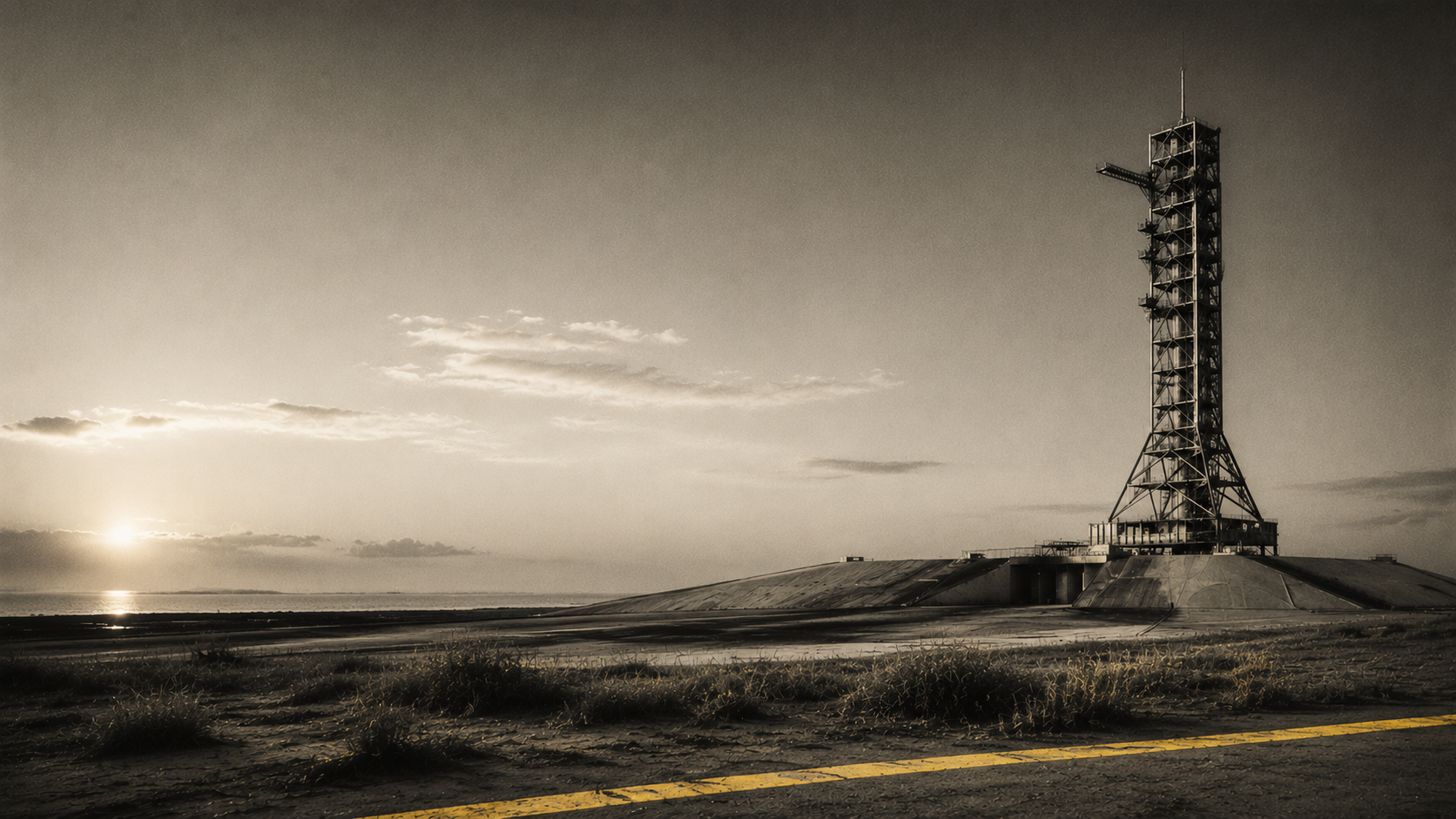
Huntsville
The German team spent five years at Fort Bliss, Texas, firing captured V-2s at the White Sands Proving Ground and being, by their own accounts, thoroughly bored. They were prisoners of peace, as von Braun put it: employed, unclassified, underfunded, and given nothing important to do.
In 1950 the group moved to Redstone Arsenal at Huntsville, Alabama, a former chemical weapons plant on the Tennessee River, and were given an actual assignment: build the Army a ballistic missile capable of carrying a nuclear warhead 200 miles.
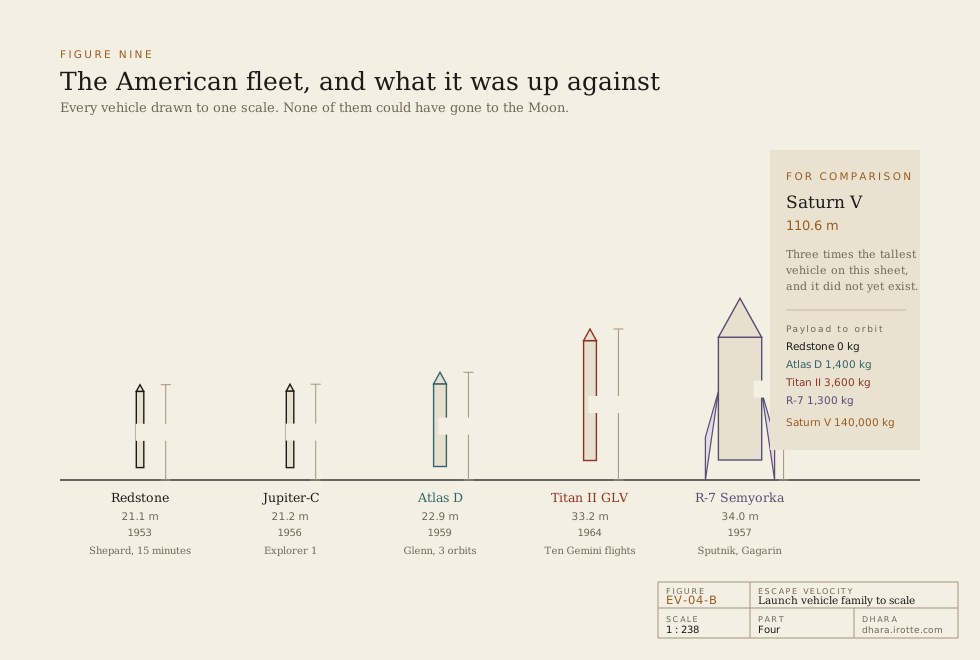
The result, the Redstone, was the A-4's direct descendant and looked it. Twenty-one metres tall, alcohol and liquid oxygen, a single engine of about 350,000 newtons, a gyroscopic guidance platform, and the same basic architecture the same men had drawn on the Baltic. The engine, the A-7, was a Rocketdyne development of the A-4's chamber, with a single flat injector plate in place of the eighteen cups -- the design Walter Thiel had been working on when the RAF killed him.
Chrysler built it. It first flew in August 1953. It was, by the standards of what came later, a small and unglamorous weapon, and it did two enormous things.
It launched the first American satellite. And it launched the first American into space.
The Redstone's performance was improved by a fuel called hydyne, blended at the direction of von Braun's team in 1957: sixty percent unsymmetrical dimethylhydrazine, forty percent diethylenetriamine. It offered roughly eight percent more specific impulse than alcohol. It was also toxic, and the engine had to be run at a different mixture ratio, and it was never used on a crewed flight -- Alan Shepard's Redstone burned alcohol, because the team judged the man-rating of a new propellant not worth the performance. That judgement, made repeatedly across the next decade, is why the American programme killed nobody in flight until 1986.
The Sand in the Fourth Stage
In September 1956 a Jupiter-C -- a Redstone with a lengthened tank and three upper stages of clustered solid-fuel rockets -- flew from Cape Canaveral to an altitude of 1,097 kilometres and a range of 5,300 kilometres. It was easily capable of placing a small payload into orbit.
Its fourth stage was filled with sand.
Major General John Medaris, commanding the Army Ballistic Missile Agency, had ordered the inert loading personally and had it verified before flight, because he did not trust von Braun not to orbit a satellite. The United States had assigned the satellite mission to the Navy's Vanguard programme, and an Army launch would have violated a presidential decision.
The reasoning behind that decision is worth understanding, because it looks like pure bureaucratic stupidity and was not.
Eisenhower's administration wanted a satellite to overfly the Soviet Union. The legal question of whether a state's sovereignty extended upward indefinitely was unsettled, and the answer mattered enormously, because the entire future of photographic reconnaissance from orbit depended on it. The strategy was to establish the precedent of freedom of space with an unambiguously civilian and scientific satellite, launched by a civilian rocket, under the banner of the International Geophysical Year -- and thereby make it awkward for the Soviets to object when the reconnaissance satellites followed.
Launching it on an Army ballistic missile designed by former German weapons engineers would have wrecked that framing.
So Vanguard was chosen, and Vanguard was a research vehicle from the Naval Research Laboratory with almost no development history behind it, and it was not ready.
Whether the humiliation of 6 December 1957 was worth the legal precedent has been argued ever since. The precedent did hold. The Soviets never formally protested overflight, in large part because they were doing it themselves. And the reconnaissance programme that followed, Corona, returned more intelligence in its first successful mission than the entire U-2 campaign had. Contested
Why Theirs Were Bigger
Sputnik was launched by the R-7, designed under Sergei Korolev, and the R-7 was an enormous machine: four tapered strap-on boosters clustered around a central core, thirty-two combustion chambers in total counting the verniers, five million newtons of thrust, kerosene and liquid oxygen throughout.
The Americans had nothing of that size and would not for years. The reason was not that Soviet engineers were better. It was thermonuclear physics.
The first Soviet hydrogen bomb design was heavy. Their strategic requirement, written in 1954, was for a missile capable of throwing 5,400 kilograms to 8,000 kilometres. American warhead designers, by contrast, achieved miniaturisation faster, and the requirement written for the Atlas fell steadily -- from an early figure of several tonnes down to about 1,400 kilograms as the warhead shrank.
Why Soviet launch vehicles were larger than American ones in the 1950s
| Factor | Soviet Union | United States |
|---|---|---|
| Warhead mass to be thrown | About 5,400 kilograms | Falling toward 1,400 kilograms |
| Consequent missile size | Very large | Progressively smaller |
| Forward basing available | None | Bombers and missiles in Europe and Turkey |
| Required range | 8,000 kilometres | Reducible by basing |
| Side effect | A vehicle that could orbit tonnes | Vehicles that could barely orbit kilograms |
The strategic logic ran the other way too. The United States had allies ringing the Soviet Union and could base intermediate-range weapons in Britain, Italy and Turkey. The Soviet Union had no comparable basing and therefore needed genuine intercontinental range from its own territory.
The result is one of the great ironies of the period. Soviet inferiority in warhead engineering produced superiority in launch vehicles, and for four years that superiority looked, to the rest of the world, like general technological supremacy.
Explorer
After Vanguard's failure, the restriction on the Army was lifted within days. Medaris and von Braun had told the Secretary of Defense they could orbit a satellite in sixty days if released. They were released on 8 November 1957.
On 31 January 1958, a Juno I -- the same Jupiter-C, this time with a live fourth stage -- placed Explorer 1 into orbit.
The satellite weighed 13.9 kilograms, against Sputnik's 83.6. But it carried an instrument: a Geiger counter built by James Van Allen of the University of Iowa, intended to measure cosmic ray flux.
The instrument behaved strangely. At low altitude it counted as expected. At higher altitude it read zero, which was impossible. Van Allen's graduate student Carl McIlwain worked out the answer: the counter was not reading zero because there was no radiation. It was saturating and shutting down because there was vastly more radiation than the instrument could register.
Explorer 1 had discovered the radiation belts that now carry Van Allen's name -- the first major scientific discovery of the space age, made by the second satellite ever launched, by an instrument that failed by being overwhelmed.
The photograph taken at the National Academy of Sciences at two in the morning, of Van Allen, William Pickering and von Braun holding a model of the satellite over their heads, is the founding image of American spaceflight.
NASA was created that October, absorbing the National Advisory Committee for Aeronautics, and von Braun's Huntsville group was transferred to it in 1960 as the Marshall Space Flight Center.
The Balloon
The Atlas is the strangest large vehicle the United States has ever flown, and the strangeness was structural.
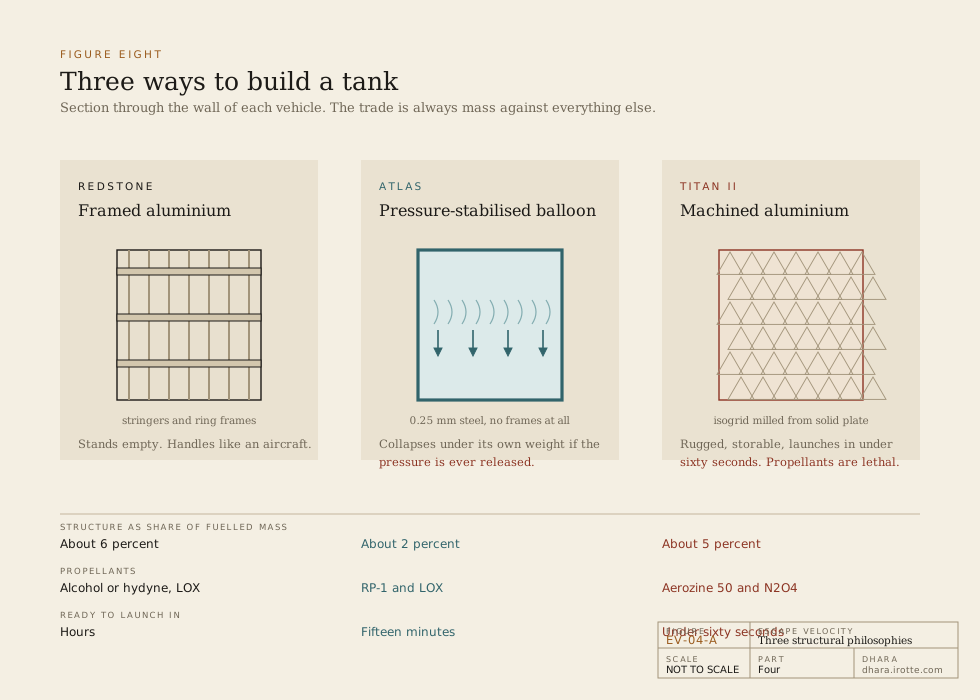
Karel Bossart, a Belgian engineer at Convair, asked the obvious question about rocket tanks and gave an answer nobody else was willing to accept. A conventional tank is a pressure vessel with internal ribs and stringers to carry structural loads. Bossart proposed removing them all.
The Atlas tank was stainless steel, type 301, with a wall thickness varying between about 0.25 and 1 millimetre. There were no internal frames, no stringers, no ribs of any kind. The tank derived its entire structural strength from internal pressure, exactly as a party balloon does. Pressurised to about four atmospheres, it could carry the thrust of the engines and the aerodynamic loads of flight.
Unpressurised, it could not support its own weight. An empty, depressurised Atlas standing on the pad would buckle and collapse into a heap of foil.
The operational consequence was that an Atlas was never allowed to be unpressurised, ever, from the moment it left the factory. Nitrogen bottles were permanently attached during transport and storage. A dedicated stretching fixture held the vehicle in tension whenever the pressure was off for maintenance. Ground crews were trained on the point relentlessly, because a single valve left open destroyed the vehicle. At least one Atlas was lost exactly that way. The payoff was extraordinary: the Atlas structure was roughly two percent of its fuelled mass, a figure conventional aluminium construction has never approached.
The Atlas had a second oddity: stage-and-a-half. It carried three engines -- two boosters and a central sustainer -- all of which were ignited on the ground. About two and a half minutes into flight, the two booster engines and their surrounding skirt were jettisoned as a unit, and the sustainer continued alone on the same tanks.
This was not elegance. It was distrust. Nobody in 1955 was confident that a large engine could be reliably started in flight, in vacuum, after minutes of cold soak. So the Atlas lit everything on the ground and threw away what it no longer needed. The full solution -- an engine that starts in vacuum on command -- arrived with the J-2 a decade later, and it is what made the trans-lunar injection burn possible.
Atlas carried John Glenn into orbit on 20 February 1962. Glenn later remarked that he had sat on top of a machine he had watched blow up repeatedly.
Poison in a Silo
The Titan II solved a completely different problem, and its answer was chemical rather than structural.
The military objection to Atlas and to the first-generation Titan I was that both burned liquid oxygen, which cannot be stored in a missile. It boils constantly. A cryogenic missile must be fuelled immediately before launch, which takes fifteen minutes or more, and fifteen minutes is a long time when the warning of an incoming attack is measured in the same units.
Titan II went to storable hypergolic propellants. The fuel was Aerozine 50, an equal blend by weight of hydrazine and unsymmetrical dimethylhydrazine. The oxidiser was nitrogen tetroxide.
Hypergolic means they ignite spontaneously on contact. There is no igniter, no spark, no starting sequence, and no possibility of a hard start caused by propellant accumulating before ignition. You open the valves and the engine is running. Both liquids sit at room temperature indefinitely, so the missile could stand fuelled in its silo for months and launch in under sixty seconds.
The cost was toxicity of a serious order. Nitrogen tetroxide reacts with the water in human lung tissue to form nitric acid. Hydrazine is a carcinogen and absorbs through skin. The ground crews worked in fully encapsulated suits with independent air supply, and the propellants were referred to in the trade by the collective name that captures the attitude precisely.
Structurally, Titan II was conventional and rugged: aluminium alloy tanks with machined stiffening, capable of standing empty and unpressurised, transportable, and tolerant of handling. It carried all ten crewed Gemini flights.
Three American structural philosophies, 1957 to 1963
| Vehicle | Structure | Propellants | Sea level thrust | Crewed use |
|---|---|---|---|---|
| Redstone | Conventional aluminium, A-4 lineage | Alcohol or hydyne, and liquid oxygen | 350,000 newtons | Two suborbital Mercury flights |
| Atlas | Pressure-stabilised stainless balloon tank | RP-1 kerosene and liquid oxygen | 1,600,000 newtons | Four orbital Mercury flights |
| Titan II | Machined aluminium, conventional framing | Aerozine 50 and nitrogen tetroxide | 1,900,000 newtons | Ten Gemini flights |
Three vehicles, three philosophies, all flying at once. The Atlas bought mass ratio and paid with fragility. The Titan bought responsiveness and paid with poison. The Redstone bought reliability and paid with performance. Every launch vehicle designed since has made a version of one of those three trades.
Fifteen Minutes
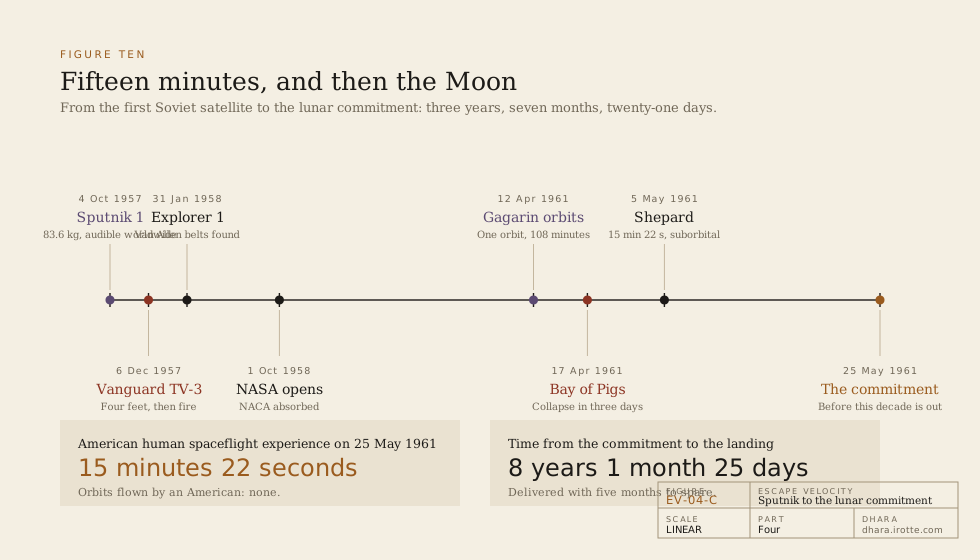
On 12 April 1961 Yuri Gagarin completed one orbit of the Earth aboard Vostok 1 and landed by parachute in a field in Saratov oblast, having separated from his capsule at seven kilometres as the design intended.
Five days later the Bay of Pigs landing began. By 19 April it had collapsed completely, with 1,200 men captured.
On 5 May, Alan Shepard flew a Redstone on a suborbital arc to 187 kilometres, weightless for about five minutes, downrange 486 kilometres, total flight time fifteen minutes and twenty-two seconds. He did not orbit. The Redstone could not have orbited him.
That was the entirety of American human spaceflight experience on 25 May 1961, when John Kennedy addressed a joint session of Congress on urgent national needs and asked for a commitment to landing a man on the Moon and returning him safely to the Earth before the decade was out.
The state of American spaceflight at the moment of the lunar commitment
| Question | The answer in May 1961 |
|---|---|
| Total American time in space | 15 minutes 22 seconds |
| Americans who had orbited the Earth | None |
| Spacecraft capable of carrying two people | None, in design only |
| Rendezvous or docking ever attempted | Never, by anyone |
| Vehicle capable of a lunar mission | None, not designed |
| Engine of the required size | None, in early development |
| Mission architecture chosen | Not chosen, three candidates in dispute |
| Certainty that a human could survive a week in space | None |
Read that table and the scale of the commitment becomes clear. It was not an acceleration of an existing programme. Nearly every item required was, in May 1961, either non-existent or unproven.
The decision was not made because anyone had established it was feasible. It was made because a technical panel had reported that a lunar landing was sufficiently far off that Soviet advantages in throw weight would not be decisive, and therefore it was the first goal in the space competition that the United States had a genuine chance of winning. Documented
The funding followed. NASA's budget in 1960 was about half a billion dollars. By 1966 it was 5.9 billion, roughly 4.4 percent of the entire federal budget. Apollo eventually cost about 25.4 billion dollars of the day and employed, at its peak, some 400,000 people across 20,000 firms and universities.
A country that had accumulated fifteen minutes of human spaceflight promised the Moon inside nine years, and then delivered it with five months to spare.
What Comes Next
The vehicles in this part were all, in the end, too small. A Redstone could throw a man on a fifteen-minute arc. An Atlas could put him in orbit. A Titan II could put two of them in orbit with enough manoeuvring propellant to practise rendezvous.
None of them could throw forty-five tonnes at the Moon, and no amount of refinement was going to get them there. That required an engine of a size nobody had built, in numbers nobody had clustered, burning propellant faster than any machine in history.
The next part goes inside the F-1.
It covers the gas generator cycle and how it differs from staged combustion and expander cycles. It covers the 178 brazed Inconel tubes that formed the chamber wall itself, and how a surface with 3,300 kelvin on one side survived because there was kerosene at 300 kelvin on the other. It covers the turbopump that developed 41,000 kilowatts from a machine the size of a small car.
And it covers the crisis that nearly killed the entire programme: combustion instability, chambers destroying themselves in milliseconds through acoustic modes at two thousand cycles per second, and the extraordinary decision to detonate small bombs inside running engines to prove that a disturbance could be damped within four hundred milliseconds.
It took about two thousand tests. It is the finest engineering story America has, and almost nobody has heard it.
0 responses