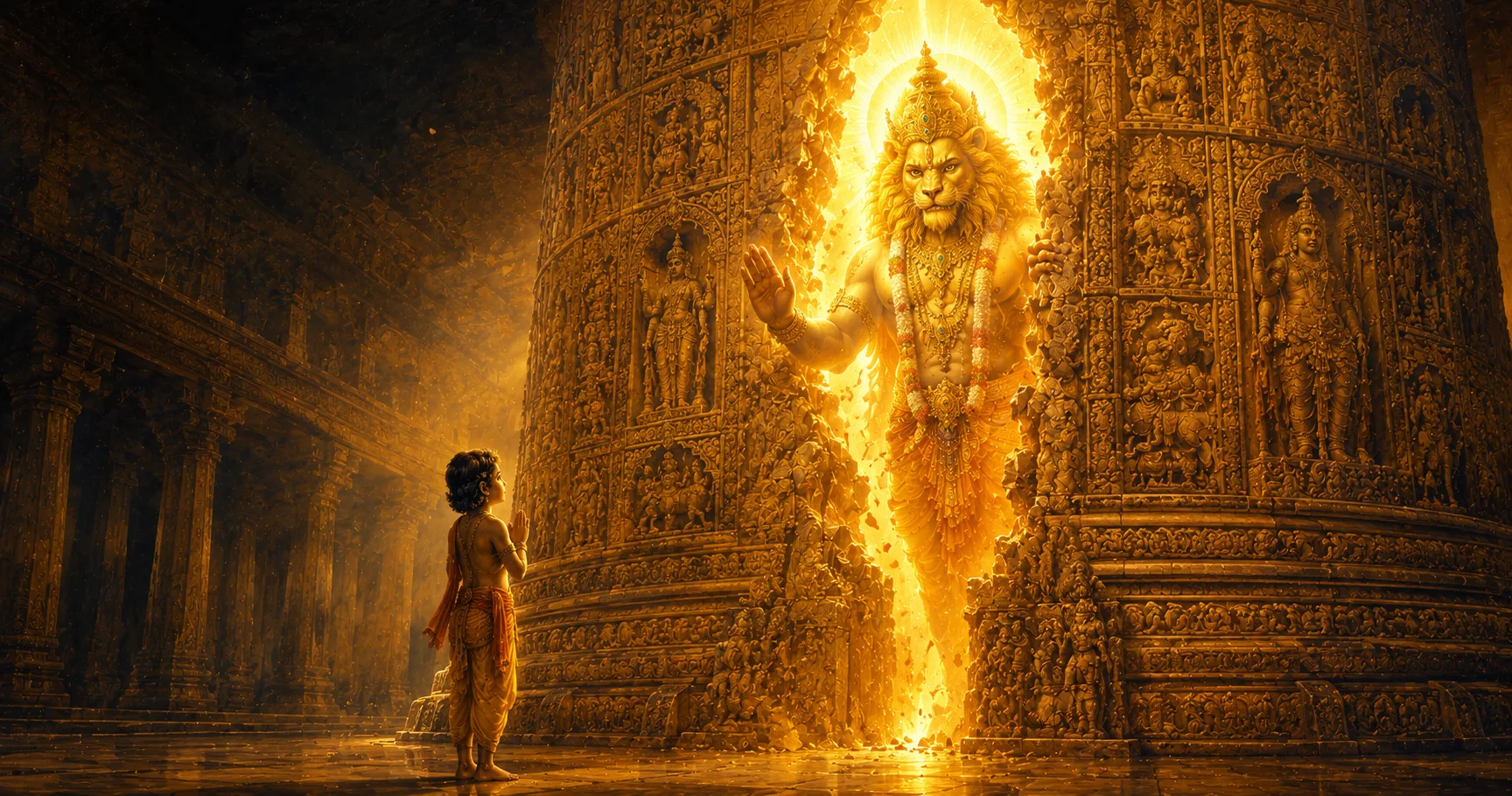
I. The Hour Before the Pillar
Every child of Bharata knows the pillar. The demon king asks where the god is hiding, the hall shakes, the stone splits along a seam nobody had seen, and out of the crack comes a shape that no taxonomy will hold: neither beast nor man, killing at neither day nor night, on neither earth nor sky, with neither weapon nor bare intent. The story is painted on every temple wall from Ahobilam to Simhachalam. It is one of the great terrors of the Sanatana imagination, and it is not what the Nrsimha-tapaniya Upanisad is about.
The Upanisad opens somewhere else entirely. It opens before the pillar, before Hiranyakasipu, before the boon, before the worlds, in the hour when nothing had yet been arranged, when there was as yet no direction in which a demon could stand and no hall in which a column could be raised. There is only Prajapati, and heat.
The text belongs to the Atharvaveda and comes in two halves that do not sound alike. The first, the Purva-tapaniya, moves through five sections called upanisads and is occupied entirely with a single mantra: how it was found, what its syllables carry, how it is transmitted, and what it does to the one who holds it. The second, the Uttara-tapaniya, moves through nine khandas and abandons the mantra's grammar for something colder and higher, the anatomy of Om and the four quarters of the Self, in language so close to the Mandukya that the two texts seem cut from one cloth.
Both halves were commented upon. The Anandasrama edition, the thirtieth volume of that series, prints the Purva-tapaniya with a bhasya ascribed to Sankaracarya, carries that bhasya into the first khanda of the Uttara, and then hands the remaining eight khandas to a Dipika by Vidyaranya. Two hands, then: the acarya who dismantled every form, and the minister-sannyasin whose brother's kingdom at Vijayanagara was at that moment the last wall standing between the Deccan and its erasure.
Between them those two hands made of a lion something neither half of the text achieves alone.
II. A Commentator Who Bows First
The bhasya does not begin with an argument. It begins with a namaskara: om namo bhagavate laksminrsimhaya. Salutation to the Lord, to Nrsimha who is with Laksmi. The commentator whose signature move everywhere else is to strip the divine of attribute until nothing remains but pure awareness here opens by naming a god, giving him a consort, and bowing. Not to Brahman. To Laksmi-Nrsimha, who holds the terror and the fortune together in one body.
Then two verses of intent, and the first of them names the whole enterprise.
छन्दः · Chandas
अनुष्टुप् (anustubh), the ordinary sloka of thirty-two syllables in four padas of eight. The commentator opens his work in the same metre as the mantra he is about to expound. That is not accident; it is the first argument of the bhasya, made before a word of argument is spoken.
मूलम् · Mulam
प्रणम्योपासनागर्भां तद्व्याख्यां श्रद्धयाऽऽरभे ॥ १ ॥
pranamyopasanagarbham tadvyakhyam sraddhaya 'rabhe ||1||
पदच्छेदः · Padacchedam
प्रणम्य । उपासना-गर्भाम् । तत्-व्याख्याम् । श्रद्धया । आरभे ॥
pranamya | upasana-garbham | tat-vyakhyam | sraddhaya | arabhe ||
अन्वयः · Anvayam
पदार्थम् · Padartham
Padartha for the first mangala verse of the bhasya
| पदम् | IAST | व्याकरणम् | తెలుగు | English |
|---|---|---|---|---|
| यत् | yat | सर्वनाम, षष्ठी-सम्बन्धे | ఎవరి | whose |
| नाम्ना | namna | नामन्-शब्दः, तृतीया एकवचनम् | పేరుతో | by the name |
| उपनिषत् | upanisat | प्रथमा एकवचनम् | ఉపనిషత్తు | the Upanisad |
| ख्याता | khyata | ख्या-धातोः क्तप्रत्ययः, स्त्रीलिङ्गम् | ప్రసిద్ధమైనది | is renowned, is famed |
| तपनम् | tapanam | द्वितीया एकवचनम् | తపనుడిని | the Tapana, the Burning One |
| तम् | tam | तत्-सर्वनाम, द्वितीया | ఆయనను | him |
| विभुम् | vibhum | द्वितीया एकवचनम् | సర్వవ్యాపిని | the all-pervading |
| गुरुम् | gurum | द्वितीया एकवचनम् | గురువును | the Guru |
| प्रणम्य | pranamya | प्र + नम्-धातोः ल्यबन्तम् | నమస్కరించి | having bowed |
| उपासनागर्भाम् | upasanagarbham | बहुव्रीहिः, द्वितीया स्त्रीलिङ्गम् | ఉపాసనను గర్భంలో ధరించిన | having upasana in its womb |
| तद्व्याख्याम् | tadvyakhyam | षष्ठीतत्पुरुषः, द्वितीया | దాని వ్యాఖ్యానాన్ని | the exposition of it |
| श्रद्धया | sraddhaya | तृतीया एकवचनम् | శ్రద్ధతో | with faith |
| आरभे | arabhe | आ + रभ्-धातुः, लट् उत्तमपुरुष एकवचनम्, आत्मनेपदम् | ఆరంభిస్తున్నాను | I begin |
तात्पर्यम् · Tatparyam
ఏ దేవుడి పేరు మీద ఈ ఉపనిషత్తుకు "తాపనీయం" అనే పేరు వచ్చిందో, ఆ తపనుడికి, సర్వవ్యాపి అయిన గురువుకు నమస్కరించి, శ్రద్ధతో ఈ వ్యాఖ్యానాన్ని మొదలుపెడుతున్నాను. ఇది కేవలం అర్థాన్ని విడమరిచే వ్యాఖ్యానం కాదు; ఉపాసనను తన గర్భంలో మోస్తున్న వ్యాఖ్యానం.
Having bowed to that Tapana by whose name this Upanisad carries the title Tapaniya, and who is the all-pervading Guru, the commentator begins his exposition with faith. And he names what kind of exposition it will be: one that carries upasana in its womb.
व्याख्या · Vyakhya
The load-bearing word is upasanagarbham, and it is a bahuvrihi: that which has upasana for its womb. Not a commentary which mentions upasana, or tolerates it, or accommodates it for the weak. A commentary gestating it.
The vow announces at the outset that meditative worship will not be treated here as a concession made on the way to something better. It is the thing being born. Everything that follows in the Purva-tapaniya -- the seed-letters, the ledgers of fruit, the transmission from hand to hand -- is licensed by this single compound in the first verse.
The second load-bearing word is tapanam. The title Tapaniya is not decorative. It is a patronymic of sorts: the Upanisad is named after the Burning One, and the bhasya establishes the derivation before it establishes anything else. What Prajapati will shortly perform is tapas, and the god who is seen at the end of that heat is the Tapana. Text, practice and deity are locked together by a shared root before the exposition begins.
विवरणम् · Vivaranam
The choice to open in anustubh is the quiet signature of a commentator who knows what he is about to defend. The mantra at the centre of this Upanisad is an anustubh of thirty-two syllables. By writing his own vow of intent in that metre, the commentator places himself inside the form he is expounding rather than outside it, looking down. It is a small gesture and it sets the terms for one hundred and fifty pages.
III. The King of Samans, and the Triple Power
The second verse of intent moves from the commentator to the cosmos, and does it in one sentence.
छन्दः · Chandas
अनुष्टुप् (anustubh). Four padas of eight, the whole verse turning on three past participles in the second line: jatam, sthitam, linam.
मूलम् · Mulam
जातं यस्मिन्स्थितं लीनं नमस्तस्मै त्रिशक्तये ॥ २ ॥
jatam yasmin sthitam linam namas tasmai trisaktaye ||2||
पदच्छेदः · Padacchedam
जातम् । यस्मिन् । स्थितम् । लीनम् । नमः । तस्मै । त्रि-शक्तये ॥
jatam | yasmin | sthitam | linam | namah | tasmai | tri-saktaye ||
अन्वयः · Anvayam
पदार्थम् · Padartham
Padartha for the second mangala verse of the bhasya
| पदम् | IAST | व्याकरणम् | తెలుగు | English |
|---|---|---|---|---|
| आनुष्टुभात् | anustubhat | तद्धितान्तम्, पञ्चमी एकवचनम् | అనుష్టుప్పులో ఉన్నవాడి నుండి | from him who abides in the anustubh |
| सामराजात् | samarajat | षष्ठीतत्पुरुषः, पञ्चमी | సామాలకు రాజైనవాడి నుండి | from the king of samans |
| नारसिंहात् | narasimhat | पञ्चमी एकवचनम् | నారసింహుడి నుండి | from the Narasimha |
| इदम् | idam | प्रथमा एकवचनम्, नपुंसकलिङ्गम् | ఈ | this |
| जगत् | jagat | प्रथमा एकवचनम् | జగత్తు | world |
| जातम् | jatam | जन्-धातोः क्तप्रत्ययः | పుట్టింది | was born |
| यस्मिन् | yasmin | यत्-सर्वनाम, सप्तमी | ఎవరిలో | in whom |
| स्थितम् | sthitam | स्था-धातोः क्तप्रत्ययः | నిలిచి ఉంది | stands |
| लीनम् | linam | ली-धातोः क्तप्रत्ययः | లయమవుతుంది | dissolves |
| नमः | namah | अव्ययम् | నమస్కారం | salutation |
| तस्मै | tasmai | तत्-सर्वनाम, चतुर्थी | ఆయనకు | to him |
| त्रिशक्तये | trisaktaye | बहुव्रीहिः, चतुर्थी एकवचनम् | మూడు శక్తులు కలవాడికి | to him who has the three powers |
तात्पर्यम् · Tatparyam
అనుష్టుప్పులో నిలిచిన, సామాలన్నిటికీ రాజైన నారసింహుడి నుండే ఈ జగత్తు పుట్టింది; ఆయనలోనే నిలిచి ఉంది; ఆయనలోనే లయమవుతుంది. సృష్టి, స్థితి, లయం అనే మూడు శక్తులు ఆయనవే. ఆ మూడు శక్తులు కలవాడికి నమస్కారం.
Birth, standing and dissolution are named in a single line, and the being who performs all three is identified not as a philosophical absolute but as samaraja, the king of chants. The mantra and the god are welded together in the second verse of the commentary, before the Upanisad has been allowed to speak a word.
व्याख्या · Vyakhya
The three participles are the three functions that Vedanta ordinarily assigns to Brahman as the cause of the world: janma, sthiti, bhanga, the triad of Badarayana's second sutra. What the verse does is attach that triad not to an unqualified absolute but to a mantra-deity with a metre attached to his name.
Anustubhat. From him who is in the anustubh. The ablative is doing heavy work: the world is not merely described by the mantra, it issues from it. The first upanisad of the Purva-tapaniya will make this explicit when Prajapati creates with the mantra rather than praying with it, and the second mangala verse has already committed the commentator to that reading.
Trisakti, of triple power, is the bahuvrihi that holds the verse together and quietly answers an objection nobody has yet raised. If creation, maintenance and dissolution are three functions, the ordinary devotional habit is to distribute them among three deities. The verse refuses the distribution. One being, three powers, and the salutation is singular.
विवरणम् · Vivaranam
Read together, the two vows say something precise about what kind of book is beginning. The first establishes that the exposition will carry upasana in its womb. The second establishes that the object of that upasana is not a departmental deity but the cause of the world in all three of its motions.
Between them they close off the later escape route in which the lion is a devotional preliminary and the philosophy arrives afterwards to correct it. The philosophy has arrived first, in the second verse, and it has arrived saying that the lion is the cause.
IV. What Prajapati Saw
The first upanisad of the Purva-tapaniya begins where the Nasadiya begins, in a condition for which the language has no comfortable tense. Sato bandhum asati niravindan hrdi pratisya kavayo manisa: the seers, searching in their hearts with wisdom, found in the non-existent the bond of the existent. The bhasya takes asat not as absence but as Brahman before name and form, unavailable to any predicate, and cites asad va idam agra asit to fix the sense. What the seers found there was bandhu, the connecting joint, the seam. Not a cause standing outside its effect, but the place where the two are already one thing.
Then Prajapati performs tapas, and the sentence arrives on which the entire text stands.
छन्दः · Chandas
गद्यम् (gadya). The kandika is prose, not verse, and the Upanisad's own rhythm carries it: three short clauses in the aorist, each opening with sa, each shorter than the last.
मूलम् · Mulam
तेनैव सर्वमिदमसृजत यदिदं किंच ॥
tenaiva sarvam idam asrjata yad idam kimca ||
पदच्छेदः · Padacchedam
तेन । एव । सर्वम् । इदम् । असृजत । यत् । इदम् । किम् । च ॥
tena | eva | sarvam | idam | asrjata | yat | idam | kim | ca ||
अन्वयः · Anvayam
पदार्थम् · Padartham
Padartha for the seeing of the mantraraja
| पदम् | IAST | व्याकरणम् | తెలుగు | English |
|---|---|---|---|---|
| सः | sah | तत्-सर्वनाम, प्रथमा | ఆయన | he, Prajapati |
| तपः | tapah | द्वितीया एकवचनम् | తపస్సును | tapas, concentrated heat |
| अतप्यत | atapyata | तप्-धातुः, लङ् प्रथमपुरुषः, आत्मनेपदम् | తపించాడు | performed, burned |
| तप्त्वा | taptva | तप्-धातोः क्त्वान्तम् | తపించి | having performed tapas |
| एतम् | etam | द्वितीया एकवचनम् | ఈ | this |
| मन्त्रराजम् | mantrarajam | षष्ठीतत्पुरुषः, द्वितीया | మంత్రాలకు రాజైన దానిని | the king among mantras |
| नारसिंहम् | narasimham | तद्धितान्तम्, द्वितीया | నారసింహ సంబంధమైనదానిని | the one belonging to Nrsimha |
| आनुष्टुभम् | anustubham | तद्धितान्तम्, द्वितीया | అనుష్టుప్పులో ఉన్నదానిని | set in the anustubh metre |
| अपश्यत् | apasyat | दृश्-धातुः, लङ् प्रथमपुरुषः | చూశాడు | saw |
| तेन | tena | तत्-सर्वनाम, तृतीया | దానితో | by that |
| एव | eva | अव्ययम्, अवधारणे | మాత్రమే | alone, precisely |
| असृजत | asrjata | सृज्-धातुः, लङ् प्रथमपुरुषः | సృష్టించాడు | created |
| यदिदं किंच | yad idam kimca | अव्ययसमुदायः | ఇక్కడ ఏదైతే ఉందో అదంతా | whatever there is here |
तात्पर्यम् · Tatparyam
ప్రజాపతి తపస్సు చేశాడు. ఆ తపస్సు ఫలితంగా అనుష్టుప్ ఛందస్సులో ఉన్న నారసింహ మంత్రరాజాన్ని ఆయన చూశాడు. దానిని కల్పించలేదు, రచించలేదు; చూశాడు. తరువాత ఆ మంత్రంతోనే ఈ జగత్తునంతటినీ సృష్టించాడు. మంత్రం ప్రార్థన కాదు; సృష్టికి పనిముట్టు.
Prajapati performed tapas, and out of that heat he saw the mantra. Not devised it, not composed it, not received it from a higher authority. Saw it, the way the rsis are always said to see, the way one sees a thing that was already standing in the dark before the lamp arrived. And having seen it, he did not worship with it. He made with it.
शाङ्करभाष्यम् · Sankara-bhasya
स प्रजापतिरेतं प्रकृतं सर्वेनाम्नोपात्तं सतो बन्धुमित्यनेन गूढाभिप्रायेण सूचितं "ज्योतिश्चरणाभिधानात्" [ब्र० सू० १-१-२४] इति न्यायेन मन्त्रराजं प्राकरणिकमन्त्राणां राजानं प्रधानभूतं सामराजं वा ।
नारसिंहं नृसिंहसंबन्धिसामादि । तद्धितात् । नृसिंहगायत्र्यादिशङ्कायां तद्व्यावृत्त्यर्थमानुष्टुभमित्यनुष्टुप्छन्द उपाधिकमृग्विशेषमाह । अपश्यद्दृष्ट्वानित्यभिप्रायः ।
sa prajapatir etam prakrtam sarvenamnopattam sato bandhum ity anena gudhabhiprayena sucitam "jyotiscaranabhidhanat" [Br.Su. 1-1-24] iti nyayena mantrarajam prakaranika-mantranam rajanam pradhanabhutam samarajam va |
narasimham nrsimha-sambandhi-samadi | taddhitat | nrsimha-gayatryadi-sankayam tad-vyavrttyartham anustubham ity anustup-chanda upadhikam rg-visesam aha | apasyad drstvanity abhiprayah |
भाष्यार्थः · Bhasyarthah
ప్రజాపతి తపస్సు చేశాడు. "మనస్సును, ఇంద్రియాలను ఏకాగ్రం చేయడమే పరమ తపస్సు" అనే స్మృతి ప్రమాణం ప్రకారం ఇక్కడ తపస్సు అంటే ఏకాగ్రతే. ఆయన మంత్రరాజాన్ని చూశాడు -- ఈ ప్రకరణంలోని మంత్రాలన్నిటికీ రాజైనదానిని, లేదా సామాలకు రాజైనదానిని. "నారసింహం" అంటే నృసింహుడికి సంబంధించిన సామం మొదలైనవి; ఇది తద్ధిత ప్రత్యయంతో వచ్చిన రూపం. నృసింహ గాయత్రి మొదలైనవాటి మీద అనుమానం రాకుండా ఉండటానికే "ఆనుష్టుభం" అనే మాట వాడారు; అనుష్టుప్ ఛందస్సు అనే ఉపాధి కలిగిన ఒక ప్రత్యేకమైన ఋక్కు అని అర్థం. "అపశ్యత్" అంటే "చూసి" అనే అభిప్రాయం.
Three things are settled here in a few lines. Tapas is defined as one-pointedness and not as mortification. Mantraraja is given two admissible readings, chief among the mantras of this context or king of the samans, and the commentary declines to choose. And the word anustubham is shown to be doing exclusionary work: without it the Nrsimha-gayatri could be taken for the mantraraja, so the metre is named to fence the referent.
भाष्यविवरणम् · Bhasya-vivaranam
The bhasya is exact about what tapas means here, and it forecloses the ascetic caricature immediately by quoting the maxim that the concentration of mind and senses into a single point is the highest austerity: manasas cendriyanam ca aikagryam paramam tapah. Not fasting, not standing on one leg. The gathering of the whole scattered apparatus of attention into one burning aperture.
On mantraraja the commentary asks why the word king is used and answers with the ordinary logic of kingship. A king is chief among men not merely in rank but in function, being the one through whom the rest operate. So this mantra is chief among mantras because the others draw their operating power from it. The bhasya reinforces the point by citing Badarayana at jyotiscaranabhidhanat, and notes that the mantra is called narasimha by relation to Nrsimha and anustubha by the metre that carries it, because the anustubh alone can carry what has to be carried.
The verb is the whole passage. Apasyat, third person singular aorist of drs. Sruti's standing claim about itself is that it was seen and not made, apauruseya, and the claim is normally asserted about the Veda as a corpus. Here it is asserted about one mantra, in a narrative, with a named seer, at a specified moment.
विवरणम् · Vivaranam
The sentence is short and its consequence is not. If the mantra was the instrument of creation, then it is not an address directed at the world from outside it. It is the thing the world was extruded through. Reciting it is therefore not petition but re-entry: the practitioner is placing himself back into the aperture the cosmos came out of.
Everything the Purva-tapaniya will claim afterwards -- the ledgers of fruit, the conquest of the seven worlds, the crossing of samsara -- follows from this single aorist. The claims are large because the premise is large. A mantra that made the world can plausibly be said to unmake a man's bondage to it.
V. The Cosmos in Four Feet
Having established how the mantra was found, the Upanisad lays the cosmos across its four padas.
छन्दः · Chandas
गद्यम् (gadya). Prose, but prose built on a rigid four-part frame: the same verb janiyat closes each of the four clauses, and the fourth clause breaks the pattern by adding a fifth statement about the knower.
मूलम् · Mulam
शब्दगन्धस्पर्शरूपगणसेवितमन्तरिक्षं तत्साम्नो द्वितीयं पादं जानीयात् ।
वसुरुद्रादित्यैः सर्वैर्देवैः सेवितं दिवं तत्साम्नस्तृतीयं पादं जानीयात् ।
ब्रह्मस्वरूपं निरञ्जनं परमव्योम्नि कं तत्साम्नश्चतुर्थं पादं जानीयात् । यो जानीते सोऽमृतत्वं च गच्छति ॥
sabda-gandha-sparsa-rupa-gana-sevitam antariksam tat samno dvitiyam padam janiyat |
vasu-rudra-adityaih sarvair devaih sevitam divam tat samnas trtiyam padam janiyat |
brahma-svarupam niranjanam parama-vyomni kam tat samnas caturtham padam janiyat | yo janite so 'mrtatvam ca gacchati ||
पदच्छेदः · Padacchedam
शब्द-गन्ध-स्पर्श-रूप-गण-सेवितम् । अन्तरिक्षम् । तत् । साम्नः । द्वितीयम् । पादम् । जानीयात् ।
वसु-रुद्र-आदित्यैः । सर्वैः । देवैः । सेवितम् । दिवम् । तत् । साम्नः । तृतीयम् । पादम् । जानीयात् ।
ब्रह्म-स्वरूपम् । निरञ्जनम् । परम-व्योम्नि । कम् । तत् । साम्नः । चतुर्थम् । पादम् । जानीयात् । यः । जानीते । सः । अमृतत्वम् । च । गच्छति ॥
sabda-gandha-sparsa-rupa-gana-sevitam | antariksam | tat | samnah | dvitiyam | padam | janiyat |
vasu-rudra-adityaih | sarvaih | devaih | sevitam | divam | tat | samnah | trtiyam | padam | janiyat |
brahma-svarupam | niranjanam | parama-vyomni | kam | tat | samnah | caturtham | padam | janiyat | yah | janite | sah | amrtatvam | ca | gacchati ||
अन्वयः · Anvayam
पदार्थम् · Padartham
Padartha for the four quarters of the saman
| पदम् | IAST | व्याकरणम् | తెలుగు | English |
|---|---|---|---|---|
| ससागराम् | sasagaram | बहुव्रीहिः, द्वितीया स्त्रीलिङ्गम् | సముద్రాలతో కూడినది | having oceans |
| सपर्वताम् | saparvatam | बहुव्रीहिः, द्वितीया | పర్వతాలతో కూడినది | having mountains |
| सप्तद्वीपाम् | saptadvipam | बहुव्रीहिः, द्वितीया | ఏడు ద్వీపాలు కలది | having the seven islands |
| वसुंधराम् | vasumdharam | उपपदसमासः, द्वितीया | భూమిని | the earth, bearer of wealth |
| साम्नः | samnah | सामन्-शब्दः, षष्ठी एकवचनम् | సామానికి | of the saman |
| पादम् | padam | द्वितीया एकवचनम् | పాదాన్ని | quarter, foot of the metre |
| जानीयात् | janiyat | ज्ञा-धातुः, विधिलिङ् प्रथमपुरुषः | తెలుసుకోవాలి | let him know |
| शब्दगन्धस्पर्शरूपगणसेवितम् | sabda-gandha-sparsa-rupa-gana-sevitam | बहुव्रीहिगर्भः तत्पुरुषः, द्वितीया | శబ్ద గంధ స్పర్శ రూప గణాలచే సేవించబడినది | attended by the hosts of sound, scent, touch and form |
| अन्तरिक्षम् | antariksam | द्वितीया एकवचनम् | అంతరిక్షాన్ని | the mid-region |
| वसुरुद्रादित्यैः | vasu-rudra-adityaih | द्वन्द्वः, तृतीया बहुवचनम् | వసువులు రుద్రులు ఆదిత్యులచే | by the Vasus, Rudras and Adityas |
| सेवितम् | sevitam | सेव्-धातोः क्तप्रत्ययः | సేవించబడినది | served, attended |
| दिवम् | divam | द्यो-शब्दः, द्वितीया | స్వర్గాన్ని | heaven |
| ब्रह्मस्वरूपम् | brahma-svarupam | बहुव्रीहिः, द्वितीया | బ్రహ్మస్వరూపమైనది | that whose very nature is Brahman |
| निरञ्जनम् | niranjanam | नञ्-बहुव्रीहिः, द्वितीया | నిర్మలమైనది, మలినం లేనిది | stainless, without smear |
| परमव्योम्नि | parama-vyomni | कर्मधारयः, सप्तमी | పరమాకాశంలో | in the supreme sky |
| कम् | kam | द्वितीया एकवचनम् | ఆనందాన్ని | bliss |
| अमृतत्वम् | amrtatvam | भावे त्वप्रत्ययः, द्वितीया | అమృతత్వాన్ని | the state of deathlessness |
| गच्छति | gacchati | गम्-धातुः, लट् प्रथमपुरुषः | పొందుతాడు | goes to, attains |
तात्पर्यम् · Tatparyam
సముద్రాలు, పర్వతాలు, ఏడు ద్వీపాలతో కూడిన భూమిని ఆ సామానికి మొదటి పాదంగా తెలుసుకోవాలి. శబ్దం, గంధం, స్పర్శ, రూపం అనే గణాలచే సేవించబడే అంతరిక్షాన్ని రెండో పాదంగా తెలుసుకోవాలి. వసువులు, రుద్రులు, ఆదిత్యులు మొదలైన దేవతలందరూ సేవించే స్వర్గాన్ని మూడో పాదంగా తెలుసుకోవాలి. పరమాకాశంలో ఉన్న, నిర్మలమైన, బ్రహ్మస్వరూపమైన ఆనందాన్ని నాలుగో పాదంగా తెలుసుకోవాలి. ఇలా తెలుసుకున్నవాడు అమృతత్వాన్ని పొందుతాడు.
A metre of four lines is being told that its first line is the earth, its second the atmosphere, its third the heaven, and its fourth the unstained Absolute beyond all three. The mantra is not about the cosmos. The mantra is the cosmos, folded into thirty-two syllables and made portable.
शाङ्करभाष्यम् · Sankara-bhasya
यथाकथंचिदुपासनारूपे प्राप्ते ससागरामिति प्रथमत एव सागरसंकीर्तनेन सागरपूर्विकामुपासनां द्योतयति । अत एव न पृथ्वीविशेषणं सागर इति केचिद्व्याचक्षते ।
ततश्च प्रथमतः सागरं क्षीरोदार्णवं ध्यात्वा तच्छायिन्युपविष्टे वा तस्मिन्पञ्चाङ्गन्यासमृक्सामयोः कृत्वा तस्मिन्नेव सपर्वतामित्याद्युपासनां सह सागरेण वर्तनं यस्या उपासनायास्तां ससागरां जानीयादित्यनुषङ्गः ।
yatha-kathamcid upasana-rupe prapte sasagaram iti prathamata eva sagara-samkirtanena sagara-purvikam upasanam dyotayati | ata eva na prthvi-visesanam sagara iti kecid vyacaksate |
tatas ca prathamatah sagaram ksirodarnavam dhyatva tac-chayiny upaviste va tasmin pancanga-nyasam rk-samayoh krtva tasminn eva saparvatam ity ady-upasanam saha sagarena vartanam yasya upasanayas tam sasagaram janiyad ity anusangah |
भाष्यार्थः · Bhasyarthah
ఈ స్మృతి ప్రమాణం వల్లా, ఇది సామరాజం కావడం వల్లా, దాని ఉపాసనలో క్రమాన్ని ముందుగా సూచిస్తూ చెబుతున్నాడు. ఉపాసనా స్వరూపం సామాన్యంగా ఏర్పడిన తరువాత, "ససాగరాం" అని మొదటే సముద్రాన్ని పేర్కొనడం ద్వారా ఉపాసన సముద్రంతోనే మొదలవుతుందని సూచిస్తున్నాడు. అందుకే "సాగరం" అనేది భూమికి కేవలం విశేషణం కాదని కొందరు వ్యాఖ్యానిస్తారు. కాబట్టి ముందుగా సముద్రాన్ని క్షీరసముద్రంగా ధ్యానించి, దానిలో లేదా దాని ఛాయలో కూర్చుని ఋక్కుకూ సామానికీ పంచాంగ న్యాసం చేసి, అక్కడే "సపర్వతాం" మొదలైన ఉపాసనను చేయాలి. సముద్రంతో కలిసి సాగే ఉపాసన ఏదో దానినే "ససాగరా" అని తెలుసుకోవాలి -- ఇదీ అన్వయం.
The commentary treats a descriptive phrase as a rubric. Sasagaram is not scene-setting; it is the instruction that the meditation starts at the ocean, and the bhasya records that some press this so far as to deny that sagara qualifies the earth at all. It then supplies what the sruti leaves out: the ocean is to be taken as the ksirodarnava, the practitioner is seated in it or in its shadow, and the five-limbed nyasa is performed before the ascent through the quarters begins.
भाष्यविवरणम् · Bhasya-vivaranam
The bhasya works through the arrangement with the patience of a man defending a difficult position. Why is the earth described with oceans, mountains and seven islands rather than simply named? Because the upasana must begin from the widest and grossest object available, so that the mind has something it can actually hold. Why is the ocean placed first? Because the meditator begins from the milk-ocean and settles the earth upon it. Some, the commentary notes, take sasagara differently; it weighs the alternative and does not pretend the question is closed.
On the fourth quarter the bhasya is careful with the word kam. It is the neuter of bliss, the same kam that the Chandogya joins to kham in kam brahma kham brahma, and its presence prevents the fourth pada from being read as a mere negation. Three positives govern it: Brahman by nature, stainless, and bliss. The fourth quarter is not the absence of the first three. It is what they were made of.
Then the objection the passage invites: if the fourth quarter is already Brahman, the first three are decoration. The reply is structural. The one who knows the fourth has not skipped the first three; he has passed through them. Immortality is not the reward for reaching the fourth. It is what the fourth is, once the ladder beneath it has been climbed rather than kicked over.
विवरणम् · Vivaranam
This is one of the most audacious constructions in the Upanisadic literature, and its audacity is architectural rather than rhetorical. The Vedic tradition already possessed a scheme in which the Purusa is measured by quarters, three in heaven and one here below. What this passage does is take that scheme and map it onto a metrical unit, so that the vertical structure of the cosmos and the horizontal structure of a verse become the same structure seen from two angles.
The practical consequence is that a man who has memorised thirty-two syllables is carrying a working model of the universe in his mouth, and the ascent through the worlds is available to him as an ascent through the lines of a verse he already knows.
VI. Thirty-Two Syllables
The mantra itself is shorter than the argument that surrounds it, and the Upanisad is in no hurry to say it whole.
छन्दः · Chandas
अनुष्टुप् (anustubh). Four padas of eight syllables. Eleven epithets in the accusative and a single finite verb in the first person.
मूलम् · Mulam
नृसिंहं भीषणं भद्रं मृत्युमृत्युं नमाम्यहम् ॥
nrsimham bhisanam bhadram mrtyumrtyum namamy aham ||
पदच्छेदः · Padacchedam
नृसिंहम् । भीषणम् । भद्रम् । मृत्यु-मृत्युम् । नमामि । अहम् ॥
nrsimham | bhisanam | bhadram | mrtyu-mrtyum | namami | aham ||
अन्वयः · Anvayam
पदार्थम् · Padartham
Padartha for the thirty-two syllables of the mantraraja
| पदम् | IAST | व्याकरणम् | తెలుగు | English |
|---|---|---|---|---|
| उग्रम् | ugram | विशेषणम्, द्वितीया एकवचनम् | ఉగ్రుడైనవాడిని | the fierce one |
| वीरम् | viram | विशेषणम्, द्वितीया | వీరుడిని | the heroic one |
| महाविष्णुम् | mahavisnum | कर्मधारयः, द्वितीया | మహావిష్ణువును | the great Visnu |
| ज्वलन्तम् | jvalantam | ज्वल्-धातोः शतृप्रत्ययः, द्वितीया | మండుతున్నవాడిని | the blazing one |
| सर्वतोमुखम् | sarvatomukham | बहुव्रीहिः, द्वितीया | అన్ని వైపులా ముఖాలున్నవాడిని | he whose faces are turned everywhere |
| नृसिंहम् | nrsimham | कर्मधारयः, द्वितीया | నృసింహుడిని | the man-lion |
| भीषणम् | bhisanam | विशेषणम्, द्वितीया | భయంకరుడిని | the terrifying one |
| भद्रम् | bhadram | विशेषणम्, द्वितीया | మంగళకరుడిని | the auspicious one |
| मृत्युमृत्युम् | mrtyumrtyum | षष्ठीतत्पुरुषः, द्वितीया | మృత్యువుకే మృత్యువైనవాడిని | the death of death |
| नमामि | namami | नम्-धातुः, लट् उत्तमपुरुष एकवचनम् | నమస్కరిస్తున్నాను | I bow, I salute |
| अहम् | aham | अस्मद्-सर्वनाम, प्रथमा | నేను | I |
तात्पर्यम् · Tatparyam
ఉగ్రుడు, వీరుడు, మహావిష్ణువు, మండుతున్నవాడు, అన్ని వైపులా ముఖాలున్నవాడు, నృసింహుడు, భయంకరుడు, మంగళకరుడు, మృత్యువుకే మృత్యువు అయినవాడు; ఆయనకు నేను నమస్కరిస్తున్నాను. మంత్రం ఏదీ అడగదు. ఒక భంగిమను చేసి ఆగిపోతుంది.
Eleven names and a verb of prostration. The mantra does not ask for anything. It performs a posture and stops.
श्रुतिसंवादः · The Catechism
The Purva-tapaniya never sets the mantra down as a continuous sloka. It builds it. The first upanisad distributes the eleven words across the four padas of the anustubh by position, ugram as the opening of the first, jvalam of the second, nrsim of the third, mrtyum of the fourth, and so on through the eleventh. Then the second upanisad turns each word into a question put to Prajapati by the gods, and each answer is sealed with a verse from the Veda. The sequence runs through the whole of the second upanisad. The first of the eleven sets the pattern for the rest.
स होवाच प्रजापतिर्यस्मात्स्वमहिम्ना सर्वाँल्लोकान्सर्वान्देवान्सर्वानात्मनः सर्वाणि भूतान्युद्गृह्णात्यजस्रं सृजति विसृजति विवसयत्युद्ग्राह्यत उद्गृह्यते ।
स्तुहि श्रुतं गर्तसदं युवानं मृगं न भीममुपहत्नुमुग्रम् । तस्मादुच्यत उग्रमिति ।
sa hovaca prajapatir yasmat svamahimna sarval lokan sarvan devan sarvan atmanah sarvani bhutany udgrhnaty ajasram srjati visrjati vivasayaty udgrahyata udgrhyate |
stuhi srutam gartasadam yuvanam mrgam na bhimam upahatnum ugram | tasmad ucyata ugram iti |
शाङ्करभाष्यम् · Sankara-bhasya
स प्रजापतिस्तान्देवान्परमेश्वरोपासनानिष्ठान्विवक्षितार्थप्रष्टॄन्दृष्ट्वोत्तरमुवाच । एवमुत्तरोत्तरप्रश्नोत्तरेष्वपि योज्यम् ।
यस्मात्स्वमहिम्ना स्वतन्त्रशक्त्या मायया तस्या आत्मतन्त्रत्वादेव स्वातन्त्र्यम् । स्वमहिम्नेति च वचनं सर्वशक्तिमत्तृतीयपादाद्यपदानुषङ्गं दर्शयति ।
sa prajapatis tan devan paramesvaropasana-nisthan vivaksitartha-prastrn drstvottaram uvaca | evam uttarottara-prasnottaresv api yojyam |
yasmat svamahimna svatantra-saktya mayaya tasya atma-tantratvad eva svatantryam | svamahimneti ca vacanam sarva-saktimat-trtiya-padadya-padanusangam darsayati |
भाष्यार्थः · Bhasyarthah
మొదటి పదాన్ని ఇక్కడ వ్యాఖ్యానిస్తున్నారు -- మూల నృసింహ వ్యూహంలోనూ, ద్వాత్రింశ నృసింహ వ్యూహంలోనూ ఉన్న "ఉగ్రం" అనే పదాన్ని. "ఇతి" అనే శబ్దం ప్రశ్న ముగిసిందని సూచిస్తుంది. ఆ దేవతలు పరమేశ్వరోపాసనలో నిష్ఠ కలవారని, వివక్షితమైన అర్థాన్ని అడుగుతున్నారని చూసి ప్రజాపతి సమాధానం చెప్పాడు. ఇదే క్రమాన్ని తరువాతి ప్రశ్నలు సమాధానాల్లో కూడా అన్వయించుకోవాలి. "స్వమహిమ్నా" అంటే స్వతంత్రమైన శక్తితో, మాయతో; ఆ మాయ ఆత్మను మాత్రమే ఆశ్రయించి ఉండటం వల్లనే దానికి స్వాతంత్ర్యం. "స్వమహిమ్నా" అనే మాట మూడో పాదంలోని మొదటి పదమైన "సర్వశక్తిమత్" అనేదాన్ని ఇక్కడికి అనుషంగంగా తెచ్చుకోవాలని చూపిస్తుంది.
Two things are established in the first sentence and hold for all eleven. The commentary notes that the same word is being expounded in two arrangements at once, the root vyuha and the thirty-twofold vyuha, so the epithet is never merely descriptive; it is a position in a structure. And the answer given to the gods is declared to be the model: evam uttarottara-prasnottaresv api yojyam, apply the same construction to every succeeding question and answer. The catechism is therefore not eleven separate etymologies but one method run eleven times. The gloss on svamahimna is the substantive point: his own greatness is svatantra-sakti, maya, and maya's independence is said to follow from its resting on nothing but the Self.
भाष्यविवरणम् · Bhasya-vivaranam
The sequence is not decorative and the bhasya treats it as an argument in miniature. It opens with ugra, fierce, and closes the list of epithets with bhadra, auspicious. Between them stands bhisana, terrifying, placed immediately before bhadra so that the two adjectives touch. The mantra refuses the consolation of separating them. What terrifies and what blesses are not two beings, and are not even two moods of one being; they are one act seen from the two sides of a boundary. Ferocity is what benevolence looks like when it arrives at a demon.
Mrtyumrtyu is a sasthi-tatpurusa and the compound is doing something a simple epithet could not. Not the one who defeats death, which would leave death standing as an opponent worth naming, but the one who is death's own death, which leaves nothing on the other side of the balance. It is the same logic Hiranyakasipu's boon could not survive, worked in vocabulary: a category cancelled by being made to devour itself.
Sarvatomukha, faces turned in every direction, is the epithet that quietly does the philosophical work. A god with faces everywhere has no back. There is no angle from which he can be approached unseen and, equally, none from which he is absent. The word converts the mantra from an address into a description of the field the addresser is standing in.
विवरणम् · Vivaranam
The verb closes the argument. Namami aham: first person singular, present indicative, no optative, no benedictive, no request. Every mantra of the ordinary petitionary kind ends in an imperative or a dative of purpose. This one ends in a description of what the speaker is doing while he speaks.
Which is consistent with the cosmology already established. If the mantra is the instrument the world was made through, there is nobody outside it to petition and nothing outside it to ask for. The only available act is the one the verb names.
VII. The Gods Came Running
The second upanisad tells the only story the Purva-tapaniya tells, and it is not the story of the pillar.
छन्दः · Chandas
गद्यम् (gadya). Prose in three movements: a narrative aorist, an injunction drawn from it, and a triad of present indicatives that state the result without hedging.
मूलम् · Mulam
तेन वै सर्वे मृत्युमजयन् सर्वे पाप्मानमतरन् संसाराच्च अतरन् ।
तस्माद्यो मृत्योः पाप्मभ्यः संसाराच्च बिभीयात् स एवं मन्त्रराजं नारसिंहमनुष्टुभं प्रतिगृह्णीयात् ।
स मृत्युं जयति स पाप्मानं तरति स संसारं तरति ॥
tena vai sarve mrtyum ajayan sarve papmanam ataran samsarac ca ataran |
tasmad yo mrtyoh papmabhyah samsarac ca bibhiyat sa evam mantrarajam narasimham anustubham pratigrhniyat |
sa mrtyum jayati sa papmanam tarati sa samsaram tarati ||
पदच्छेदः · Padacchedam
तेन । वै । सर्वे । मृत्युम् । अजयन् । सर्वे । पाप्मानम् । अतरन् । संसारात् । च । अतरन् ।
तस्मात् । यः । मृत्योः । पाप्मभ्यः । संसारात् । च । बिभीयात् । सः । एवम् । प्रति-गृह्णीयात् ।
सः । मृत्युम् । जयति । सः । पाप्मानम् । तरति । सः । संसारम् । तरति ॥
tena | vai | sarve | mrtyum | ajayan | sarve | papmanam | ataran | samsarat | ca | ataran |
tasmat | yah | mrtyoh | papmabhyah | samsarat | ca | bibhiyat | sah | evam | prati-grhniyat |
sah | mrtyum | jayati | sah | papmanam | tarati | sah | samsaram | tarati ||
अन्वयः · Anvayam
पदार्थम् · Padartham
Padartha for the giving of the mantra to the gods
| पदम् | IAST | व्याकरणम् | తెలుగు | English |
|---|---|---|---|---|
| उपाधावन् | upadhavan | उप + धाव्-धातुः, लङ् प्रथमपुरुष बहुवचनम् | పరుగెత్తుకుంటూ వెళ్ళారు | they ran up to |
| तेभ्यः | tebhyah | तत्-सर्वनाम, चतुर्थी बहुवचनम् | వాళ్ళకు | to them |
| प्रायच्छत् | prayacchat | प्र + दा-धातुः, लङ् प्रथमपुरुषः | ఇచ్చాడు | he gave, he handed over |
| वै | vai | अव्ययम्, अवधारणे | నిజంగా | indeed, verily |
| मृत्युम् | mrtyum | द्वितीया एकवचनम् | మృత్యువును | death |
| अजयन् | ajayan | जि-धातुः, लङ् प्रथमपुरुष बहुवचनम् | జయించారు | they conquered |
| पाप्मानम् | papmanam | पाप्मन्-शब्दः, द्वितीया | పాపాన్ని | evil, the principle of sin |
| अतरन् | ataran | तॄ-धातुः, लङ् प्रथमपुरुष बहुवचनम् | దాటారు | they crossed over |
| संसारात् | samsarat | पञ्चमी एकवचनम् | సంసారం నుండి | from samsara |
| बिभीयात् | bibhiyat | भी-धातुः, विधिलिङ् प्रथमपुरुषः | భయపడితే | should he fear |
| प्रतिगृह्णीयात् | pratigrhniyat | प्रति + ग्रह्-धातुः, विधिलिङ् प्रथमपुरुषः | స్వీకరించాలి | let him receive, let him accept as a gift |
| जयति | jayati | जि-धातुः, लट् प्रथमपुरुषः | జయిస్తాడు | he conquers |
| तरति | tarati | तॄ-धातुः, लट् प्रथमपुरुषः | దాటుతాడు | he crosses |
तात्पर्यम् · Tatparyam
దేవతలు భయపడి ప్రజాపతి దగ్గరకు పరుగెత్తుకుంటూ వెళ్ళారు. ఆయన వాళ్ళకు అనుష్టుప్ ఛందస్సులోని నారసింహ మంత్రరాజాన్ని ఇచ్చాడు. దానితోనే వాళ్ళందరూ మృత్యువును జయించారు, పాపాన్ని దాటారు, సంసారాన్ని దాటారు. కాబట్టి మృత్యువుకు, పాపాలకు, సంసారానికి భయపడేవాడు ఈ మంత్రరాజాన్ని ఇలాగే స్వీకరించాలి. వాడు మృత్యువును జయిస్తాడు, పాపాన్ని దాటుతాడు, సంసారాన్ని దాటుతాడు.
The immortals of the Veda arrive at their father's door at a run because something is coming for them that their divinity does not cover. Prajapati does not lecture them, does not initiate them into non-duality, does not tell them that fear is unreal because the fearer is unreal. He hands them a mantra.
शाङ्करभाष्यम् · Sankara-bhasya
तेभ्यो देवेभ्यः प्रीतः प्रजापतिरेतं मन्त्रराजमित्याद्यानुष्टुभमित्यन्तं सर्वमुक्तार्थं प्रायच्छत्प्रादात्तेन प्रदानेन वै स प्रजापतिर्मृत्युमजयद्देवा अपि मृत्युमजयन् ।
एतदुक्तं भवति । तेन प्रदानेन प्रजापतिर्मृत्युमजयत्तेन स्वीकारेण देवा मृत्युमजयन्निति ।
tebhyo devebhyah pritah prajapatir etam mantrarajam ity ady anustubham ity antam sarvam uktartham prayacchat pradat tena pradanena vai sa prajapatir mrtyum ajayad deva api mrtyum ajayan |
etad uktam bhavati | tena pradanena prajapatir mrtyum ajayat tena svikarena deva mrtyum ajayann iti |
भाष्यार्थः · Bhasyarthah
ఆ రెండు రకాల దేవతలు ప్రజాపతి దగ్గరకు పరుగెత్తుకుంటూ వెళ్ళారు. "ఉప" ఉపసర్గతో కూడిన "ధావ్" ధాతువు ఇక్కడ పూజ అనే అర్థాన్ని ఇస్తుంది. దగ్గరకు వచ్చి స్తుతి, శుశ్రూష, దక్షిణలతో ప్రజాపతిని పూజించారు. వాళ్ళ మీద ప్రసన్నుడై ప్రజాపతి "ఏతం మన్త్రరాజం" నుండి "ఆనుష్టుభం" వరకు చెప్పినదంతా ఇచ్చాడు. ఆ ఇవ్వడం వల్లనే ప్రజాపతి మృత్యువును జయించాడు; దేవతలు కూడా మృత్యువును జయించారు. అంటే -- ఇవ్వడం వల్ల ప్రజాపతికి, స్వీకరించడం వల్ల దేవతలకు మృత్యుజయం కలిగింది.
The bhasya makes two moves in quick succession. First it refuses to let upadhavan mean merely running: with the preverb upa, the root denotes worship, and the gods are said to have arrived with praise, service and daksina. Fear brought them, but they came as worshippers and not as claimants. Second, it distributes the victory over death across both parties and specifies the instrument for each. Prajapati conquers by the giving, the gods by the accepting. Transmission is not a delivery mechanism attached to the vidya; it is itself the act in which death is defeated, at both ends of the hand.
भाष्यविवरणम् · Bhasya-vivaranam
The bhasya's attention goes to a single verb: pratigrhniyat. Let him receive it. The word is the technical term for accepting a gift, and its presence changes the logic of the passage entirely. The mantra is not something one finds in a text, or reasons one's way to, or reconstructs from first principles. It is something given, and therefore something taken, hand to hand, from one who already holds it. Prajapati did not publish it. He gave it, to petitioners who had come running.
The commentary then raises the objection its own reading invites. If the giving is a dana, then the ordinary rules of gifting should apply, and one might expect a dakshina, a stipulation, a condition; and the bhasya refuses to let the analogy run away. What is transmitted here is not property changing owners. The word dana is admitted only far enough to establish that the mantra passes through a person, and that a mantra which has not passed through a person has not been received at all.
There is a hard doctrine buried in the courtesy. This vidya is not democratic in the sense of being self-serve. It is entirely democratic in the sense of who may come running. The passage sets no qualification except fear: yo mrtyoh papmabhyah samsarac ca bibhiyat, whoever fears death, evil, and the wheel. That is the entrance requirement, and the gods themselves met it by being afraid.
विवरणम् · Vivaranam
The three results are stated twice, once in the aorist for the gods and once in the present indicative for the man who follows them, and the grammatical shift is the whole point. What happened once to the devas is not a myth about the past. It is a present-tense operation available to anyone who accepts the same gift on the same terms.
The order in which the three fears are named and defeated is itself deliberate: death, then evil, then samsara. Death is the fear that brings a man to the door; evil is what he discovers he must deal with once he is inside; samsara is the structure that produced both. The Upanisad lets the practitioner start with the crudest of the three, because that is the one that actually makes people run.
The immortals of the Veda arrive at their father's door at a run, and he does not tell them that fear is unreal. He hands them a mantra.
VIII. The Anatomy of a Sound
The third upanisad turns the mantra inside out and examines its letters, settling the meaning of each seed-sound and defending each assignment. This is the portion most easily dismissed as arbitrary and least safely dismissed. The letter ha is established not by resemblance but by denotation: the bhasya rules that the word akasa expresses it, on the joint authority of the agama corpus and of the Upanisads. Having fixed the referent, it then produces as darsana, as scriptural sighting, one of the most famous verses in the Veda, to show what the seated one in that syllable is.
छन्दः · Chandas
जगती (jagati), the twelve-syllable pada, in the older Mandala manner where the final pada runs over its count. The verse is Rgveda 4.40.5 and stands also at Kathopanisad 5.2, which is why the bhasya can use it without argument: both the Rk and the Upanisadic tradition have already ratified it.
मूलम् · Mulam
नृषद्वरसदृतसद्व्योमसदब्जा गोजा ऋतजा अद्रिजा ऋतं बृहत् ॥
nrsad varasad rtasad vyomasad abja goja rtaja adrija rtam brhat ||
पदच्छेदः · Padacchedam
नृ-सत् । वर-सत् । ऋत-सत् । व्योम-सत् । अब्-जाः । गो-जाः । ऋत-जाः । अद्रि-जाः । ऋतम् । बृहत् ॥
nr-sat | vara-sat | rta-sat | vyoma-sat | ab-jah | go-jah | rta-jah | adri-jah | rtam | brhat ||
अन्वयः · Anvayam
पदार्थम् · Padartham
Padartha for the hamsah sucisad verse
| पदम् | IAST | व्याकरणम् | తెలుగు | English |
|---|---|---|---|---|
| हंसः | hamsah | प्रथमा एकवचनम् | హంస | the swan, the moving one |
| शुचिषत् | sucisat | उपपदसमासः, सद्-धातोः क्विप् | శుభ్రమైన చోట కూర్చున్నవాడు | seated in the bright, in the pure |
| वसुः | vasuh | प्रथमा एकवचनम् | వసువు | the Vasu, the dweller |
| अन्तरिक्षसत् | antariksasat | उपपदसमासः | అంతరిక్షంలో ఉన్నవాడు | seated in the mid-air |
| होता | hota | हु-धातोः तृच्, प्रथमा | హోతృడు | the invoking priest |
| वेदिषत् | vedisat | उपपदसमासः | వేదిక మీద ఉన్నవాడు | seated at the altar |
| अतिथिः | atithih | प्रथमा एकवचनम् | అతిథి | the guest |
| दुरोणसत् | duronasat | उपपदसमासः | ఇంట్లో ఉన్నవాడు | seated in the house |
| नृषत् | nrsat | उपपदसमासः | మనిషిలో ఉన్నవాడు | seated in man |
| वरसत् | varasat | उपपदसमासः | శ్రేష్ఠమైనదానిలో ఉన్నవాడు | seated in the excellent |
| ऋतसत् | rtasat | उपपदसमासः | ఋతంలో ఉన్నవాడు | seated in truth, in cosmic order |
| व्योमसत् | vyomasat | उपपदसमासः | ఆకాశంలో ఉన్నవాడు | seated in the sky |
| अब्जाः | abjah | उपपदसमासः, जन्-धातोः डः | నీటిలో పుట్టినవాడు | born of water |
| गोजाः | gojah | उपपदसमासः | గోవుల నుండి పుట్టినవాడు | born of cattle, of rays |
| ऋतजाः | rtajah | उपपदसमासः | ఋతం నుండి పుట్టినవాడు | born of truth |
| अद्रिजाः | adrijah | उपपदसमासः | పర్వతం నుండి పుట్టినవాడు | born of the rock |
| ऋतम् | rtam | प्रथमा एकवचनम् | ఋతం | Truth, the order of things |
| बृहत् | brhat | विशेषणम्, प्रथमा | మహత్తరమైనది | vast, great |
तात्पर्यम् · Tatparyam
శుభ్రమైన చోట కూర్చున్న హంస, అంతరిక్షంలో ఉన్న వసువు, వేదిక మీద ఉన్న హోతృడు, ఇంట్లో ఉన్న అతిథి; మనిషిలో, శ్రేష్ఠంలో, ఋతంలో, ఆకాశంలో ఉన్నవాడు; నీటి నుండి, గోవుల నుండి, ఋతం నుండి, పర్వతం నుండి పుట్టినవాడు -- అదే మహత్తరమైన ఋతం. ఒక్కొక్క చోట ఒక్కొక్క పేరు; కూర్చున్నవాడు మాత్రం ఒక్కడే.
Twelve seats and four births, and in every one of them the seated one is the same. The verse is a catalogue of locations that turns out to be a catalogue of one occupant.
शाङ्करभाष्यम् · Sankara-bhasya
यस्मादेवं तस्मादाकाशशब्दवाच्यं हकारं बीजं विद्यात् । बीजनिदानं मूलकारणं तद्बुद्ध्योपासीत तद्वाचकं वा निपातरूपेण ।
स चायं वाच्यवाचकसंबन्धो लोके प्रसिद्ध इति । यथा प्रणवाक्षरं ब्रह्मवाचकत्वाद्ब्रह्मबुद्ध्योपास्यमभूत्तद्वच्छक्तिबीजम् ।
yasmad evam tasmad akasa-sabda-vacyam hakaram bijam vidyat | bija-nidanam mula-karanam tad-buddhyopasita tad-vacakam va nipata-rupena |
sa cayam vacya-vacaka-sambandho loke prasiddha iti | yatha pranavaksaram brahma-vacakatvad brahma-buddhyopasyam abhut tadvac chakti-bijam |
भाष्यार्थः · Bhasyarthah
బీజాక్షర నిర్ణయాన్నీ, దాని మీద ఆధారపడిన ఫలవంతమైన ఉపాసననూ చెప్పడానికి ఆ నిర్ణయాన్ని చెబుతున్నాడు. "ఆకాశ" అనే శబ్దం హకారాన్ని సూచిస్తుంది; ఇది ఆగమ శాస్త్రాలన్నిటిలోనూ, ఆగమ స్వరూపమైన ఉపనిషత్తులలోనూ ప్రసిద్ధం. కాబట్టి ఆకాశ శబ్దం చెప్పే హకారాన్నే బీజంగా తెలుసుకోవాలి. బీజానికి మూలకారణమైనదానిని ఆ భావనతో ఉపాసించాలి, లేదా దానిని సూచించే నిపాత రూపాన్ని ఉపాసించాలి. వాచ్యం -- వాచకం అనే ఈ సంబంధం లోకంలో ప్రసిద్ధమే. ప్రణవాక్షరం బ్రహ్మను సూచిస్తుంది కాబట్టి బ్రహ్మ భావనతో ఉపాస్యమైనట్టే, శక్తిబీజం కూడా అలాగే ఉపాస్యమవుతుంది.
The argument is not that ha sounds like something. It is that ha is what the word akasa denotes, on the joint authority of the agama corpus and of the Upanisads, which the bhasya classes as agama in form. From there the reasoning is ordinary semantics: a denoter may be worshipped under the idea of the denoted, and the tradition already does this without controversy in the case of the pranava. The seed-letter is admitted on exactly the same footing as Om, not on a lower one. It is at this point that the hamsah sucisad verse is brought in as the nidarsana, the scriptural sighting which shows that the one seated in every seat is one.
भाष्यविवरणम् · Bhasya-vivaranam
The bhasya unpacks the verse clause by clause and at every clause identifies the seated one as the Supreme Self. Seated in the bright: seated in the purified intellect. Seated in the mid-air: the vital breath, from which the whole atmospheric order hangs. Seated at the altar: the deity of the offering. Seated in the house: dwelling in the body as a guest dwells in a house he does not own. Then seated in man, in the excellent, in truth, in the sky; and then the four births, from water, from cattle, from rta, from the mountain, each read as a mode of worship in which the same one is reached by a different road.
And then the letter ha is placed back into the mantra, having been shown to carry all of that.
This is the answer to the standing charge that mantric syllabary is arbitrary noise, superstition dressed in Sanskrit. The bhasya's position is the exact opposite. A bija is a compressed sentence, and the compression is lossless only for one who has been taught the expansion. The syllable does not mean by convention, the way a word does; it means by containing, the way a seed contains a tree.
विवरणम् · Vivaranam
Which explains, retrospectively, why the second upanisad insisted on pratigrhniyat. A dictionary can transmit a convention. Only a teacher can transmit an expansion. The insistence on hand-to-hand transmission is not guild protectionism; it follows from what the tradition thinks a seed-syllable is.
The verse also settles the register of the whole enquiry. The commentary is not asserting that ha means hamsa because it sounds like it. It is asserting that the Veda has already said, at length and in a hymn of unquestioned standing, that the one who moves through all the seats is one; and that the syllable is the handle by which that whole statement is picked up.
IX. Where the Sun Does Not Burn
The fifth upanisad is the longest, running through six adhyayas, and it builds toward the passage the bhasya treats as the summit of the Purva-tapaniya.
छन्दः · Chandas
गद्यम् (gadya). Prose built entirely on the relative yatra, repeated seven times in a descending series of negations, and then released into a string of positive epithets that carry no negation at all.
मूलम् · Mulam
यत्र न नक्षत्राणि भान्ति यत्र नाग्निर्दहति यत्र न मृत्युः प्रविशति यत्र न दुःखम् ।
सदानन्दं परमानन्दं शाश्वतं शान्तं सदाशिवं ब्रह्मादिवन्दितं योगिध्येयं यत्र गत्वा न निवर्तन्ते योगिनः ॥
yatra na naksatrani bhanti yatra nagnir dahati yatra na mrtyuh pravisati yatra na duhkham |
sadanandam paramanandam sasvatam santam sadasivam brahmadivanditam yogidhyeyam yatra gatva na nivartante yoginah ||
पदच्छेदः · Padacchedam
यत्र । न । नक्षत्राणि । भान्ति । यत्र । न । अग्निः । दहति । यत्र । न । मृत्युः । प्रविशति । यत्र । न । दुःखम् ।
सदा-आनन्दम् । परम-आनन्दम् । शाश्वतम् । शान्तम् । सदा-शिवम् । ब्रह्म-आदि-वन्दितम् । योगि-ध्येयम् । यत्र । गत्वा । न । निवर्तन्ते । योगिनः ॥
yatra | na | naksatrani | bhanti | yatra | na | agnih | dahati | yatra | na | mrtyuh | pravisati | yatra | na | duhkham |
sada-anandam | parama-anandam | sasvatam | santam | sada-sivam | brahma-adi-vanditam | yogi-dhyeyam | yatra | gatva | na | nivartante | yoginah ||
अन्वयः · Anvayam
पदार्थम् · Padartham
Padartha for the supreme abode
| पदम् | IAST | व्याकरणम् | తెలుగు | English |
|---|---|---|---|---|
| परमम् | paramam | विशेषणम्, प्रथमा नपुंसकम् | పరమమైన | supreme, highest |
| धाम | dhama | धामन्-शब्दः, प्रथमा | ధామం, నివాసం | abode, seat, station |
| मन्त्रराजाध्यायकस्य | mantrarajadhyayakasya | षष्ठीतत्पुरुषः, षष्ठी एकवचनम् | మంత్రరాజాన్ని అధ్యయనం చేసేవాడికి | of the one who studies the king of mantras |
| यत्र | yatra | अव्ययम् | ఎక్కడ | where |
| तपति | tapati | तप्-धातुः, लट् प्रथमपुरुषः | తపింపజేస్తుంది | burns, gives heat |
| वाति | vati | वा-धातुः, लट् प्रथमपुरुषः | వీస్తుంది | blows |
| भान्ति | bhanti | भा-धातुः, लट् प्रथमपुरुष बहुवचनम् | ప్రకాశిస్తాయి | they shine |
| दहति | dahati | दह्-धातुः, लट् प्रथमपुरुषः | కాలుస్తుంది | burns, consumes |
| प्रविशति | pravisati | प्र + विश्-धातुः, लट् प्रथमपुरुषः | ప్రవేశిస్తుంది | enters |
| दुःखम् | duhkham | प्रथमा एकवचनम् | దుఃఖం | sorrow |
| सदानन्दम् | sadanandam | बहुव्रीहिः | ఎప్పుడూ ఆనందమైనది | ever-blissful |
| परमानन्दम् | paramanandam | कर्मधारयः | పరమానందమైనది | of supreme bliss |
| शाश्वतम् | sasvatam | विशेषणम् | శాశ్వతమైనది | everlasting |
| शान्तम् | santam | शम्-धातोः क्तप्रत्ययः | శాంతమైనది | at peace, stilled |
| सदाशिवम् | sadasivam | कर्मधारयः | ఎప్పుడూ శుభమైనది | ever-auspicious |
| ब्रह्मादिवन्दितम् | brahmadivanditam | तृतीयातत्पुरुषः | బ్రహ్మ మొదలైనవారిచే నమస్కరించబడినది | saluted by Brahma and the rest |
| योगिध्येयम् | yogidhyeyam | षष्ठीतत्पुरुषः, ध्यै-धातोः यत्प्रत्ययः | యోగులు ధ్యానించదగినది | to be meditated on by yogins |
| गत्वा | gatva | गम्-धातोः क्त्वान्तम् | వెళ్ళి | having gone |
| निवर्तन्ते | nivartante | नि + वृत्-धातुः, लट् प्रथमपुरुष बहुवचनम्, आत्मनेपदम् | తిరిగి రారు | they return |
तात्पर्यम् · Tatparyam
మంత్రరాజాన్ని అధ్యయనం చేసేవాడికి చెందిన పరమధామం అది. అక్కడ సూర్యుడు తపింపజేయడు, గాలి వీయదు, చంద్రుడు ప్రకాశించడు, నక్షత్రాలు వెలగవు, అగ్ని కాల్చదు, మృత్యువు ప్రవేశించదు, దుఃఖం లేదు. అది ఎప్పుడూ ఆనందం, పరమానందం, శాశ్వతం, శాంతం, సదాశివం; బ్రహ్మ మొదలైనవారు నమస్కరించేది; యోగులు ధ్యానించేది. అక్కడికి వెళ్ళిన యోగులు తిరిగి రారు.
The passage moves by subtraction, and the order of the subtractions is a cosmology being dismantled from the top.
शाङ्करभाष्यम् · Sankara-bhasya
तदेतत्स्थानमृचाऽभ्युक्तम् । विष्णोर्यत्परमं पदमिति । यच्छब्देन क्षीरोदार्णवस्थानं परामृश्यते । परमपदप्रत्यभिज्ञानात् ।
सूरय उपासका उपासनाभेदेन तादात्म्यमुपासनया चेतसायुज्यं फलं ततश्च विष्णुरेव परमं पदम् । उभयत्रापि विष्णोरिति षष्ठीनिर्देशः शिलापुत्रकस्य शरीरमितिवद्द्रष्टव्यः ।
tad etat sthanam rcabhyuktam | visnor yat paramam padam iti | yac-chabdena ksirodarnava-sthanam paramrsyate | parama-pada-pratyabhijnanat |
suraya upasaka upasana-bhedena tadatmyam upasanaya cetasayujyam phalam tatas ca visnur eva paramam padam | ubhayatrapi visnor iti sasthi-nirdesah silaputrakasya sarnram iti-vad drastavyah |
भाष्यार्थः · Bhasyarthah
అందుకే ఈ పరమధామం ప్రసిద్ధం -- విద్యతో కూడిన మంత్రరాజాన్ని అధ్యయనం చేసేవాడికి, జపించేవాడికి, అనుష్ఠానం చేసేవాడికి చెందిన స్థానం అది. క్షీరసముద్ర స్థానమైన అక్కడ సూర్యుడు తపింపజేయడు, గాలి వీయదు. ఆ స్థానాన్నే "విష్ణోర్యత్పరమం పదమ్" అనే ఋక్కు చెప్పింది. "యత్" అనే శబ్దంతో క్షీరసముద్ర స్థానాన్నే మళ్ళీ చెబుతున్నారు; ఎందుకంటే పరమపదం అక్కడే గుర్తించబడుతుంది. "సూరులు" అంటే ఉపాసకులు; ఉపాసనా భేదం వల్ల తాదాత్మ్యం, ఉపాసన వల్ల చిత్త సాయుజ్యం ఫలం; కాబట్టి విష్ణువే పరమపదం. రెండు చోట్లా "విష్ణోః" అనే షష్ఠీ నిర్దేశం "శిలాపుత్రకస్య శరీరమ్" అన్నట్టుగా చూడాలి.
The last sentence carries the weight. 'The body of the stone-statue' is the standard grammarians' example of a genitive that does not divide its terms: the statue does not possess a body, it is the body. By invoking it, the bhasya rules that the supreme step of Visnu is not a place Visnu owns and a devotee might reach separately. Visnu and the supreme step are one referent named twice. The identity of the worshipped form with the goal is thereby stated in the technical vocabulary of case-syntax rather than asserted devotionally.
भाष्यविवरणम् · Bhasya-vivaranam
First the sun, the ruling light of the visible order. Then the wind, the mover of everything that moves. Then the moon and the stars, the whole calendar of time by which sacrifice and season are computed. Then fire, the mouth of the gods, the one element by which anything is ever conveyed anywhere. Then death. Then sorrow. When the list ends, the ordinary instruments of the cosmos have all been retired, and what remains is described only in positives that carry no measurement.
The bhasya connects the abode first to the milk-ocean of the earlier upasana and then to tad visnoh paramam padam, the supreme step of Visnu, and it holds the two frames together without collapsing either. For the one who worships with form, this is the highest stride of Visnu, and the identity of the worshipper's chosen deity with the goal is total. There is no exchange at the summit in which the personal form turns out to have been a training aid. The form arrives intact, and what is subtracted is the universe around it.
Yatra gatva na nivartante. Having gone where, they do not return. The formula is the one the Gita will use and the one the Katha holds out to Naciketas. Here it is attached to a man who has done nothing more exotic than study a mantra of thirty-two syllables every day.
विवरणम् · Vivaranam
The negations are not chosen at random and they are not merely poetic. Each item struck off the list is an instrument of measurement. Sun and moon and stars measure time; wind measures motion; fire measures the passage of offerings from one world to another; death measures the span of a life; sorrow measures the distance between what is and what was wanted.
Strike out every instrument and what is left cannot be located, timed, or compared. That is why the positives that follow are all unmeasured: ever, supreme, everlasting, stilled. The passage is not describing a place with unusual weather. It is describing what remains when the apparatus that produces places has been withdrawn.
X. The Ledger of Fruits
Then comes the passage most easily mistaken for inflation, and the one the bhasya defends hardest. The one who studies this mantra daily is said to conquer Bhur, Bhuvar, Svar, Mahar, Jana, Tapas and Satya, and then all the worlds; and immediately after, a second ledger credits him with the fruit of the agnistoma, the ukthya, the sodasin, the vajapeya, the atiratra, the aptoryama and the asvamedha, with all the kratus the srauta tradition knows.
Seven worlds and seven sacrifices. To a certain temperament this reads as inflation, the kind of promise a text makes when it is competing for adherents. The bhasya reads it as a statement about cost.
The commentary first observes that the seven-world list is stated twice over, and takes the repetition as the marker closing the section rather than as emphasis piled on emphasis. Then it confronts the sacrificial ledger directly, and the objection it raises against itself is the sharp one: if recitation yields the fruit of the asvamedha, the asvamedha becomes pointless, and a sruti that makes another sruti pointless has argued itself into incoherence. The answer is adhikara-bheda, difference of qualification. The great sacrifices depend on an apparatus, on wealth, on ritual assistants, on the body's capacity to sustain a year of observance, on a social order remaining stable long enough for the rite to complete. The mantra depends on none of it. What the passage establishes is not that the sacrifices are worthless but that their fruit has been made reachable by a road requiring no cattle, no gold, no assembly of priests, and no permission.
On that reading the phalasruti stops being a sales pitch and becomes a democratisation. A man with nothing, in a century when everything could be taken, retains access to the whole of the Vedic result through thirty-two syllables no invader can confiscate.
Vidyaranya, three hundred years and one civilisational catastrophe later, would have known exactly what that was worth.
XI. The Book Turns
The Purva-tapaniya ends, the Uttara-tapaniya opens, and with the first sentence the concerns have shifted. The mantra recedes. Om advances. Worship and reception and fruit give way to quarters and states and witnesses, and the sentences begin to sound like the Mandukya reciting itself from memory.
The bhasya on the first khanda takes up the letters of Om and maps them onto the ascending order of cosmic persons: a to Virat, u to Hiranyagarbha, m to Isvara. It then runs the same mapping across the four levels of speech -- vaikhari the articulated, madhyama the intermediate, pasyanti the seeing, para the supreme -- and to secure the fourth it reaches for the Veda's most quoted line about the nature of language. The decisive step in that discussion is a refusal: the three persons are not to be called Om-natured merely by courtesy.
छन्दः · Chandas
त्रिष्टुप् (tristubh), four padas of eleven. The verse is Rgveda 1.164.45, from the Asya Vamasya hymn, the single most cited authority in the tradition on the stratification of speech.
मूलम् · Mulam
गुहा त्रीणि निहिता नेङ्गयन्ति तुरीयं वाचो मनुष्या वदन्ति ॥
guha trini nihita nengayanti turiyam vaco manusya vadanti ||
पदच्छेदः · Padacchedam
गुहा । त्रीणि । निहिता । न । इङ्गयन्ति । तुरीयम् । वाचः । मनुष्याः । वदन्ति ॥
guha | trini | nihita | na | ingayanti | turiyam | vacah | manusyah | vadanti ||
अन्वयः · Anvayam
पदार्थम् · Padartham
Padartha for the four quarters of speech
| पदम् | IAST | व्याकरणम् | తెలుగు | English |
|---|---|---|---|---|
| चत्वारि | catvari | संख्यावाचकम्, प्रथमा नपुंसकम् | నాలుగు | four |
| वाक् | vak | वाच्-शब्दः, प्रथमा एकवचनम् | వాక్కు | speech |
| परिमिता | parimita | परि + मा-धातोः क्तप्रत्ययः | కొలవబడినది | measured out, apportioned |
| पदानि | padani | प्रथमा बहुवचनम् | పాదాలు | quarters, steps |
| विदुः | viduh | विद्-धातुः, लिट् प्रथमपुरुष बहुवचनम् | తెలుసుకుంటారు | they know |
| ब्राह्मणाः | brahmanah | प्रथमा बहुवचनम् | బ్రాహ్మణులు | the brahmanas |
| मनीषिणः | manisinah | मनीषा + इनिः, प्रथमा बहुवचनम् | మనీషులు, వివేకవంతులు | the wise, those of discernment |
| गुहा | guha | तृतीया एकवचनम्, अधिकरणार्थे | గుహలో | in the cave, in the secret place |
| त्रीणि | trini | संख्यावाचकम्, प्रथमा | మూడు | three |
| निहिता | nihita | नि + धा-धातोः क्तप्रत्ययः | ఉంచబడినవి | set down, deposited |
| इङ्गयन्ति | ingayanti | इङ्ग्-धातुः, णिजन्तम्, लट् | కదులుతాయి | they stir, they move |
| तुरीयम् | turiyam | द्वितीया एकवचनम् | నాలుగోదానిని | the fourth |
| वदन्ति | vadanti | वद्-धातुः, लट् प्रथमपुरुष बहुवचनम् | పలుకుతారు | they speak |
तात्पर्यम् · Tatparyam
వాక్కు నాలుగు పాదాలుగా కొలవబడింది. వివేకవంతులైన బ్రాహ్మణులు ఆ నాలుగింటినీ తెలుసుకుంటారు. మూడు పాదాలు గుహలో ఉంచబడి కదలకుండా ఉంటాయి. మనుషులు పలికేది నాలుగోది మాత్రమే.
Three quarters of all speech lie in the cave and do not move. What comes out of a human mouth is the fourth, the surface, the leavings.
शाङ्करभाष्यम् · Sankara-bhasya
यद्येवं तर्हि कालत्रयपरिच्छिन्नं तदपरिच्छिन्नं च सर्वमनूद्य पुनः सर्वमेतदोंकार एवेति वक्तव्यं न तु जगदेकदेशमेवानूद्यायमोंकार एवायमप्योंकार एवेति वचनमुपपन्नम् ।
अतो विराड्हिरण्यगर्भाव्याकृतसन्मात्रशरीराणां प्रत्येकं सर्वात्मकप्रणवात्मत्वमेवात्रोच्यते ।
yady evam tarhi kala-traya-paricchinnam tad-aparicchinnam ca sarvam anudya punah sarvam etad omkara eveti vaktavyam na tu jagad-eka-desam evanudyayam omkara evayam apy omkara eveti vacanam upapannam |
ato viradd-hiranyagarbhavyakrta-san-matra-sarirapam pratyekam sarvatmaka-pranavatmatvam evatrocyate |
भाष्यार्थः · Bhasyarthah
"అలాగైతే విరాట్టూ హిరణ్యగర్భుడూ ఓంకారంలో ఒక భాగం మాత్రమే కాబట్టి, ఉపచారంగా మాత్రమే వాళ్ళను ఓంకార స్వరూపులు అన్నారు" అంటే -- కాదు. అలా అంటే శ్రుతి అర్థాన్నే వదిలేసినట్టవుతుంది. అలాగైతే, మూడు కాలాలచే పరిచ్ఛిన్నమైనదానినీ, పరిచ్ఛిన్నం కానిదానినీ చెప్పి, "ఇదంతా ఓంకారమే" అని ఒకసారి చెబితే సరిపోయేది; జగత్తులోని ఒక్కొక్క భాగాన్ని చెప్పి "ఇదీ ఓంకారమే, ఇదీ ఓంకారమే" అని పదే పదే చెప్పడం సరిపోదు. కాబట్టి విరాట్టు, హిరణ్యగర్భుడు, అవ్యాకృతం, సన్మాత్రం -- వీటిలో ఒక్కొక్కటీ సర్వాత్మకమైన ప్రణవ స్వరూపమేనని ఇక్కడ చెబుతున్నారు.
The objection and its refusal are the whole point. Caution wants Virat and Hiranyagarbha to be Om-natured in a weakened sense, upacarat, by courtesy, because each is only a part of what Om covers. The bhasya rejects the weakening on grammatical grounds: if only a portion were meant, the sruti would not have repeated the identification separately for each. Repetition proves that each is being called the whole. Which is why the ascent through the letters is not a climb from lesser to greater realities but a climb through statements each of which is already total.
भाष्यविवरणम् · Bhasya-vivaranam
The bhasya uses the verse to establish that the mantra which was the entire subject of the Purva-tapaniya has itself been operating at the fourth level all along, and that the ascent now being described is an ascent back through the three that do not stir. Vaikhari is the fourth, the audible; madhyama and pasyanti are the two that lie in the cave with the third; and para is the level at which speech and the thing spoken have not yet separated.
The commentary is careful not to let this devalue what came before. The audible quarter is not false. It is the only quarter with a door in it. The three that do not stir are reached by going through the one that does.
विवरणम् · Vivaranam
This is the hinge of the entire book. The first half taught a mantra with a form, a name, a metre, a lion. The second half is about to take that mantra apart into a syllable with no lion in it at all, and then take the syllable apart into a silence.
Nothing is being retracted. The staircase is being climbed.
XII. Where the Hand Changes
And then the commentary changes hands.
Sankara's bhasya accompanies the Purva-tapaniya entire and follows the Uttara-tapaniya through its first khanda. There it stops. The Uttara-tapaniya then begins again from its first khanda under a different hand, and for the remaining eight the Dipika of Vidyaranya carries the text alone to the end. Two commentaries on one Upanisad, laid end to end, with the seam left visible.
The attribution of the Purva-tapaniya bhasya to Adi Sankara has been questioned in modern text-critical scholarship, on grounds of vocabulary, of the unusual density of upasana and mantra material, and of the absence of the Nrsimha-tapaniya from the list of Upanisads the acarya certainly commented upon. The tradition transmits it under his name and the Anandasrama editors print it so. What can be said from the commentary itself, without adjudicating the hand, is that its method is unmistakably of that school: the objection raised against oneself, the appeal to adhikara-bheda, the refusal to let a phalasruti stand unexamined, the citation of Badarayana at the load-bearing joints. Whoever held the pen had been trained in the same room.
Vidyaranya's closing colophon names him with full formality as the disciple of Sankarananda, himself a paramahamsa parivrajakacarya. The lineage is asserted deliberately. Whatever the fourteenth century made of the authorship question, the Dipika presents itself as the continuation of a single line of transmission, picking up a text where the earlier hand set it down.
XIII. The Fourth of the Fourth
The first khanda of the Uttara-tapaniya ends on three words that overturn the settlement the Mandukya had reached.
छन्दः · Chandas
गद्यम् (gadya). Two compounds and a copula understood. The shortest sentence in the book, and the one that carries the most weight.
मूलम् · Mulam
पदच्छेदः · Padacchedam
अन्वयः · Anvayam
पदार्थम् · Padartham
Padartha for isvaragrasas turiyaturiyah
| पदम् | IAST | व्याकरणम् | తెలుగు | English |
|---|---|---|---|---|
| ईश्वरः | isvarah | प्रथमा एकवचनम् | ఈశ్వరుడు | the Lord, the causal person |
| ग्रासः | grasah | ग्रस्-धातोः घञ्, प्रथमा | మింగడం, గ్రాసం | the swallowing, the mouthful |
| ईश्वरग्रासः | isvara-grasah | षष्ठीतत्पुरुषः | ఈశ్వరుడిని మింగేది | that which swallows Isvara |
| तुरीयः | turiyah | संख्यापूरणम्, प्रथमा | నాలుగోది | the fourth |
| तुरीयतुरीयः | turiya-turiyah | षष्ठीतत्पुरुषः | నాలుగోదానికే నాలుగోది | the fourth of the fourth |
तात्पर्यम् · Tatparyam
ఈశ్వరుడిని కూడా మింగేది ఏదో, అదే తురీయానికి తురీయం. మాండూక్యం నాలుగు పాదాలను చెప్పి తురీయంతో ఆగిపోతుంది. ఈ ఉపనిషత్తు ఆ నాలుగింటినీ ఒప్పుకుని, వాటిని దాటి ఇంకొకటి ఉందని చెబుతుంది. కారణపురుషుడైన ఈశ్వరుడు కూడా అక్కడ మిగలడు.
The Mandukya establishes four quarters, and turiya, the fourth, is the end of its road. The Uttara-tapaniya accepts all of it and then names something past it.
विद्यारण्यदीपिका · Vidyaranya-dipika
ईश्वरमपि कारणात्मानं स्वासाधारणवृत्त्यारूढः सन्ग्रसतीतीश्वरग्रासः । यस्मात्तुरीयतुरीय ईश्वरमपि ग्रसति तस्मात्तस्यैवाऽऽत्मशब्दयोग्यता ।
तस्मात्स एवाऽऽत्मा तस्मात्स एव विज्ञेयस्तदनुभवार्थमेव प्रयत्नोऽनुष्ठेय इत्यर्थः ॥ १ ॥
isvaram api karanatmanam svasadharana-vrttyarudhah san grasatity isvara-grasah | yasmat turiya-turiya isvaram api grasati tasmat tasyaivatma-sabda-yogyata |
tasmat sa evatma tasmat sa eva vijneyas tad-anubhavartham eva prayatno 'nustheya ity arthah ||1||
भाष्यार्थः · Bhasyarthah
"ఆత్మ తెలుసుకోదగినది కాదు" అనే శంకను ఊహించి, కారణాత్మ అయిన ఈశ్వరుడిని కూడా సంహరించేది బ్రహ్మరూపమైన ఈ ఆత్మేనని, కాబట్టి ఆయనే తెలుసుకోదగిన పరమేశ్వరుడని చెబుతున్నాడు -- "ఈశ్వరగ్రాసః" అని. తనకే ప్రత్యేకమైన వృత్తిలో నిలిచి కారణాత్మ అయిన ఈశ్వరుడిని కూడా మింగుతాడు కాబట్టి "ఈశ్వరగ్రాసుడు". తురీయతురీయుడు ఈశ్వరుడిని కూడా మింగుతాడు కాబట్టి "ఆత్మ" అనే శబ్దం ఆయనకే సరిపోతుంది. కాబట్టి ఆయనే ఆత్మ, ఆయనే తెలుసుకోదగినవాడు; ఆయనను అనుభవించడం కోసమే ప్రయత్నం చేయాలి.
The Dipika settles the word atman by an argument about eligibility. Isvara is legitimately Brahman, being the causal self in whom dissolution occurs; but the term atman belongs properly to whatever is not itself swallowed, and only the fourth of the fourth meets that condition. Grasa is therefore not rhetoric. It is the test by which the referent of the word atman is fixed, and the closing clause turns the whole metaphysics into an instruction: effort is to be undertaken for the sake of experiencing him, and for nothing else.
भाष्यविवरणम् · Bhasya-vivaranam
The Dipika is careful here. Isvara, being himself the causal self, the one in whom dissolution occurs, is legitimately called Brahman; but the Self is beyond even him, and so the word grasa is used. What is beyond a cause does not defeat that cause or replace it. It consumes it, the way waking consumes a dream without ever having quarrelled with it.
The choice of grasa over any of the available words for transcendence is the whole argument. Atita, gone beyond, would leave Isvara standing behind the one who passed him. Nirasa, rejection, would make the ascent a repudiation. Grasa is a word from the vocabulary of eating: the mouthful, what is taken in and becomes the eater. Isvara is not left behind and not denied. He is metabolised.
विवरणम् · Vivaranam
The lion has moved. In the Purva-tapaniya he was the object of a mantra: fierce, blazing, faced in all directions, bowed to in the first person singular. Here he is not an object at all. He is the appetite that takes even the highest object.
This is the moment the two halves of the book lock together. The Purva-tapaniya alone would leave Nrsimha a great deity among deities, worshipped with a powerful mantra. The Uttara-tapaniya alone would leave the lion a figure of speech. Together they say what neither says apart: that what a man worships as ugram viram mahavisnum is the same thing that eats Isvara at the end of the fourth state.
XIV. The Body as Altar
By the third khanda the Dipika does what no summary of Advaita Vedanta would predict. It stops explaining and starts prescribing.
What it gives is a full nyasa. The mantraraja is broken into its eleven epithets, each set between the seed am and the seed hum and placed one after another on the body of the practitioner: am ugram hum, am viram hum, am mahavisnum hum, am jvalantam hum, am sarvatomukham hum, am nrsimham hum, am bhisanam hum, am bhadram hum, am mrtyumrtyum hum, am namami hum, am aham hum. Around it are arranged the salutations, the offering of a handful of flowers, the invocation of Narayana, and a Nrsimha-gayatri in which the sun-verse of the Rgveda is turned toward the lion.
This is the same author who governed the intellectual life of Vijayanagara and whose name is attached to the most systematic survey of philosophical positions the tradition produced. He is writing hand-placements.
The apparent contradiction dissolves the moment the architecture of the whole text is held in view. The Purva-tapaniya gave a mantra and a form. The Uttara-tapaniya took the form apart until even Isvara was swallowed. And having reached that summit, the Dipika comes back down the stair and puts the mantra on the body, syllable by syllable, because the summit was never a place of arrival for a being who still has a body, a day, a mouth, and a span of years to fill.
The nyasa is not a relapse into ritual after the philosophy has been done. It is the philosophy issued as instruction to someone who has to wake up tomorrow.
XV. Woven, and Woven Through
The ninth khanda closes the Upanisad on a verse about weaving.
छन्दः · Chandas
अनुष्टुप् (anustubh), with the final phrase doubled. The repetition of upadrastaram anvajed iti is the standard sruti signal that a text has ended; nothing follows the witness, and the grammar says so by refusing to go on.
मूलम् · Mulam
अनुज्ञामद्वयं लब्ध्वा उपद्रष्टारमन्वजेदित्युपद्रष्टारमन्वजेदिति ॥ ९ ॥
anujnam advayam labdhva upadrastaram anv ajed ity upadrastaram anv ajed iti ||9||
पदच्छेदः · Padacchedam
अनुज्ञाम् । अद्वयम् । लब्ध्वा । उपद्रष्टारम् । अनु । अजेत् । इति ॥
anujnam | advayam | labdhva | upadrastaram | anu | ajet | iti ||
अन्वयः · Anvayam
पदार्थम् · Padartham
Padartha for the closing verse of the Uttara-tapaniya
| पदम् | IAST | व्याकरणम् | తెలుగు | English |
|---|---|---|---|---|
| ओतम् | otam | वे-धातोः क्तप्रत्ययः, द्वितीया | నేయబడినది | the woven, what is spread out |
| ओतेन | otena | तृतीया एकवचनम् | నేయబడినదాని ద్వారా | by means of the woven |
| जानीयात् | janiyat | ज्ञा-धातुः, विधिलिङ् | తెలుసుకోవాలి | let him know |
| अनुज्ञातारम् | anujnataram | अनु + ज्ञा-धातोः तृच्, द्वितीया | అనుమతినిచ్చేవాడిని | the one who gives permission |
| अन्तरम् | antaram | विशेषणम्, द्वितीया | లోపల ఉన్నవాడిని | the inner one |
| अनुज्ञाम् | anujnam | द्वितीया एकवचनम् | అనుమతిని | permission, sanction |
| अद्वयम् | advayam | नञ्तत्पुरुषः, द्वितीया | ద్వైతం లేనిదానిని | the non-dual |
| लब्ध्वा | labdhva | लभ्-धातोः क्त्वान्तम् | పొంది | having obtained |
| उपद्रष्टारम् | upadrastaram | उप + दृश्-धातोः तृच्, द्वितीया | దగ్గరుండి చూసేవాడిని | the witness who looks on from near |
| अन्वजेत् | anvajet | अनु + अज्-धातुः, विधिलिङ् | అనుసరించాలి | let him go after, let him follow |
तात्पर्यम् · Tatparyam
నేయబడిన దీని ద్వారానే నేతను తెలుసుకోవాలి; లోపల ఉండి అనుమతినిచ్చేవాడిని తెలుసుకోవాలి. ద్వైతం లేని ఆ అనుమతిని పొంది, దగ్గరుండి చూసే సాక్షిని అనుసరించాలి. "సాక్షిని అనుసరించాలి" అని రెండోసారి చెప్పడం ఉపనిషత్తు ముగిసిందని సూచిస్తుంది.
The image is a cloth on a loom. What is spread out is not to be discarded in order to find the thread; it is known by the thread, and the thread is the Pranava.
विद्यारण्यदीपिका · Vidyaranya-dipika
अनुज्ञामनुज्ञारूपमात्मानमित्यर्थः । तमनुज्ञाप्रणवेन जानीयादविकल्पमद्वयमात्मानमविकल्पप्रणवेन लब्ध्वा गुरुप्रसादतो ज्ञात्वेति तुरीयखण्डार्थ उक्तः ।
अनुशासनखण्डार्थमाह -- उपद्रष्टारमन्वजेदिति । ओतादियोगैः शुद्धान्तःकरणोऽनुशासनखण्डोक्तप्रकारेणानुशिष्ट उपद्रष्टृरूपेणावस्थितो भवेदित्यर्थः ॥ इति नवमः खण्डः ॥ ९ ॥
anujnam anujna-rupam atmanam ity arthah | tam anujna-pranavena janiyad avikalpam advayam atmanam avikalpa-pranavena labdhva guru-prasadato jnatveti turiya-khandartha uktah |
anusasana-khandartham aha -- upadrastaram anvajed iti | otadi-yogaih suddhantahkarano 'nusasana-khandokta-prakarenanusista upadrastr-rupenavasthito bhaved ity arthah || iti navamah khandah ||9||
भाष्यार्थः · Bhasyarthah
తురీయ ఖండం, అనుశాసన ఖండం -- ఈ రెండింటిలో చెప్పిన అర్థం కోసం శ్లోకాన్ని తీసుకువస్తున్నాడు. "ఓతం" -- నేయబడిన ఆత్మను "ఓతేన" అంటే ప్రణవం ద్వారా, చెప్పిన విధంగా తెలుసుకోవాలి; అలాగే అనుమతినిచ్చే అంతరాత్మను తెలుసుకోవాలి. "అనుజ్ఞా" అంటే అనుజ్ఞా స్వరూపమైన ఆత్మ అని అర్థం. అవికల్పమైన ప్రణవం ద్వారా అవికల్పమైన అద్వయ ఆత్మను పొంది, అంటే గురు ప్రసాదం వల్ల తెలుసుకుని -- ఇది తురీయ ఖండార్థం. తరువాత అనుశాసన ఖండార్థాన్ని చెబుతున్నాడు -- "ఉపద్రష్టారమన్వజేత్" అని. "ఓతం" మొదలైన సాధనల వల్ల అంతఃకరణం శుద్ధమై, అనుశాసన ఖండంలో చెప్పిన విధంగా అనుశిష్టుడైనవాడు ఉపద్రష్ట రూపంలో నిలిచి ఉంటాడు -- ఇదే అర్థం.
One gloss here corrects the obvious English reading. Otena is not 'by the woven fabric' but otena pranavena, by the Pranava which does the weaving. Om is the warp; the Self is what is woven on it; and the instrument by which the woven is known is the thread itself. The Dipika then adds what the verse does not say aloud: the undifferentiated Pranava is obtained guru-prasadatah, through the grace of the teacher. The book that began with a mantra handed to frightened gods ends with the same transaction, stripped of everything except the giving.
भाष्यविवरणम् · Bhasya-vivaranam
Otam otena: the woven, by means of the weaving. The Dipika fixes the instrumental precisely, glossing otena as pranavena: the thread is Om. The Self is what is woven on it, and the instrument by which the woven is known is the thread and not the cloth.
Then anujnatr, the one within who gives permission. The word is chosen instead of the more usual karta or prerayitr with deliberate precision. The inner one does not do the states and does not push them; he permits them. Without his sanction no state arises and no experience is licensed to occur, but the sanction is not an act. It is the standing consent of what is simply present.
Anujnam advayam labdhva: having obtained the non-dual permission. Not having earned it, not having extracted it. Obtained, the way the gods obtained the mantra in the second upanisad of the first half. The book began with a gift received at a run and it ends with a permission received in stillness, and both are labdha rather than made.
विवरणम् · Vivaranam
The final instruction of a text that opened with a lion coming out of a pillar is to walk quietly toward something that is only watching. Upadrastr, the one who looks on from close by: not a judge, not an agent, not a rewarder. The witness.
And it is doubled, because sruti doubles what it has finished saying. There is nothing after the witness, and the verse demonstrates the fact by having nowhere to go.
XVI. The Signature
The peace-invocations are recited, the Upanisad ends, and then the Dipika signs itself in three verses. The second is the one that carries the argument of the whole volume in a single line.
छन्दः · Chandas
अनुष्टुप् (anustubh). The commentator closes in the metre of the mantraraja, as the bhasya opened in it a hundred and fifty pages earlier.
मूलम् · Mulam
तेजसे महते भूयान्नमः नृसिंहरूपिणे ॥ २ ॥
tejase mahate bhuyan namah nrsimharupine ||2||
पदच्छेदः · Padacchedam
तेजसे । महते । भूयात् । नमः । नृसिंह-रूपिणे ॥
tejase | mahate | bhuyat | namah | nrsimha-rupine ||
अन्वयः · Anvayam
पदार्थम् · Padartham
Padartha for Vidyaranya's closing salutation
| पदम् | IAST | व्याकरणम् | తెలుగు | English |
|---|---|---|---|---|
| सत् | sat | अस्-धातोः शतृ, समासपूर्वपदम् | ఉనికి | being |
| चित् | cit | समासपदम् | చైతన్యం | consciousness |
| आनन्द | ananda | समासपदम् | ఆనందం | bliss |
| संपूर्ण | sampurna | सम् + पॄ-धातोः क्तप्रत्ययः | పూర్ణమైన | full, complete |
| प्रत्यक् | pratyak | अव्ययीभावगर्भम्, समासपदम् | లోపలికి తిరిగినది | turned inward, the inner |
| एकरस | eka-rasa | बहुव्रीहिः | ఒకే రుచి కలది | of a single savour |
| आत्मने | atmane | चतुर्थी एकवचनम् | ఆత్మకు | to the self |
| तेजसे | tejase | तेजस्-शब्दः, चतुर्थी | తేజస్సుకు | to the splendour |
| महते | mahate | महत्-शब्दः, चतुर्थी | మహత్తరమైనదానికి | to the great |
| भूयात् | bhuyat | भू-धातुः, आशीर्लिङ् प्रथमपुरुषः | అగుగాక | may there be |
| नमः | namah | अव्ययम् | నమస్కారం | salutation |
| नृसिंहरूपिणे | nrsimharupine | बहुव्रीहिः, चतुर्थी | నృసింహ రూపం కలవాడికి | to him whose form is Nrsimha |
तात्पर्यम् · Tatparyam
సత్తు, చిత్తు, ఆనందంతో నిండిన, లోపలికి తిరిగిన, ఒకే రుచి కలిగిన ఆత్మ ఎవరిదో; నృసింహ రూపం ఎవరిదో; ఆ మహత్తరమైన తేజస్సుకు నమస్కారం అగుగాక. అరూపమైన ఆత్మను, సింహరూపాన్ని ఒకే వాక్యంలో పక్కపక్కన పెట్టాడు; ఆ వాక్యంలో ఎక్కడా ఇబ్బంది కనిపించదు.
The formless and the lion are placed in apposition in a single sentence, and the sentence does not strain.
व्याख्या · Vyakhya
The first compound is the entire vocabulary of nirguna Vedanta compressed into one word: being, consciousness, bliss, fullness, inwardness, single savour. Every term in it is a term the tradition uses precisely when it wants to exclude form. And the dative that governs it is nrsimharupine: to him whose form is Nrsimha.
There is no transition between the two, no concessive particle, no api, no argument. The author does not feel the need to justify placing them together, because by the end of this volume the justification has been given twice over: once by the bhasya, which showed that upasana is the womb rather than the crutch, and once by the Uttara-tapaniya, which showed that what the worshipper reaches at the top of the ascent is what he was bowing to at the bottom.
In the surrounding verses the same modesty is at work. Vidyaranya calls his own commentary timirapaha, remover of darkness, and in the same breath says he did not earn it: gurvanugraha-labdha, obtained by the grace of the teacher. The third verse bows not to the god but to the teachers, and specifies the currencies of the bow: devotion, mind, speech, act.
विवरणम् · Vivaranam
Then the colophon, naming him disciple of Sankarananda, and the Dipika is finished.
A book that began with a commentator bowing before he argued ends with a commentator bowing after he has finished arguing, and in both cases the bow is to a form. Between those two salutations the entire apparatus of Advaita has been deployed at full strength.
XVII. What the Bhasya Proves
The standing caricature of Advaita, repeated by its admirers as often as by its critics, is that it is a philosophy of dismissal: that form is a mistake, that worship is a crutch, that the temple is for those who cannot manage the argument, and that the acarya's real work was to clear the ground of images so that a proposition could stand on it.
The Nrsimha-tapaniya bhasya makes that caricature unsustainable.
Here is a text that is almost entirely mantra and upasana: seed-syllables, metrical cosmology, transmission from teacher to pupil, ledgers of fruit, and eventually hand-placements on the body. It is exactly the material the caricature says this school existed to supersede. And the commentary does not supersede it. It defends it clause by clause, raises the sharpest available objection against every claim, answers each with the tools of Vedanta rather than the tools of apologetics, and declares in its first verse of intent that the whole exposition is pregnant with upasana.
The reason is structural, and both halves of the book are needed to see it. The Purva-tapaniya hands a man a mantra with a face on it, because a man who is afraid of death cannot meditate on the negation of predicates, and the gods themselves, when afraid, did not ask for one. The Uttara-tapaniya then takes that same mantra up through the letters of Om, past Virat and Hiranyagarbha, past Isvara who is swallowed, to the fourth of the fourth where nothing remains to be afraid of. Neither half works alone. A mantra without the ascent is a charm. The ascent without the mantra is a diagram of a staircase handed to someone standing at the bottom of a shaft.
Vidyaranya carried the second half at a moment when Bharata's temples were being pulled down within a week's ride of where he sat. He did not write a defence of images and he did not write their obituary. He wrote a Dipika that dissolves Isvara into the witness in the second khanda and puts the lion's eleven names back onto the practitioner's body in the third. That is not inconsistency. That is a civilisation which had worked out, long before it was tested, that the roof does not despise the ladder.
And so the text that never once tells the story of the pillar has told it after all, in its own idiom. Something was hidden inside a hard, ordinary, unpromising thing. It was addressed with the correct word. And it came out.
सन्दर्भाः · References
The edition. Nrsimhapurvatapaniyopanisat, with the bhasya ascribed to Sri Sankaracarya, and Nrsimhottaratapaniyopanisat, with the Dipika of Sri Vidyaranya; edited by Vinayak Ganesh Apte, Anandasrama Sanskrit Series 30, Anandasrama Press, Poona. All Devanagari in the verse and commentary blocks above is transcribed from this edition.
The text and its divisions. The Nrsimhatapaniya belongs to the Atharvaveda. The Purvatapaniya is divided into five upanisads, the fifth running through six adhyayas. The Uttaratapaniya is counted in the colophons as the sixth upanisad and is divided into nine khandas. Sankara's bhasya covers the Purvatapaniya entire and the first khanda of the Uttaratapaniya; Vidyaranya's Dipika covers the Uttaratapaniya in all nine khandas. Vidyaranya's colophon names him disciple of Sri Sankarananda, paramahamsa parivrajakacarya.
Passages cited within the two commentaries.
Verses and sutras quoted by the commentators, with their sources
| पाठः | Source | स्थानम् | Bearing |
|---|---|---|---|
| सतो बन्धुमसति निरविन्दन् | ऋग्वेदः, नासदीयसूक्तम् | 10.129.4 | On the condition before creation, in the bhasya on Purvatapaniya 1 |
| असद्वा इदमग्र आसीत् | तैत्तिरीयोपनिषत् | 2.7.1 | Fixing asat as Brahman before name and form |
| ज्योतिश्चरणाभिधानात् | ब्रह्मसूत्रम् | 1.1.24 | Establishing the covert reference of the mantraraja |
| कार्ये बादरेरस्य गत्युपपत्तेः | ब्रह्मसूत्रम् | 4.3.7 | On the going that does not return |
| मनसश्चेन्द्रियाणां च ऐकाग्र्यं परमं तपः | स्मृतिः | quoted, unattributed in the edition | Defining tapas as one-pointedness |
| स्तुहि श्रुतं गर्तसदं युवानम् | ऋग्वेदः, रुद्रसूक्तम् | 2.33.11 | Sealing the epithet ugram, Purvatapaniya 2 |
| प्र तद्विष्णुः स्तवते वीर्याय | ऋग्वेदः | 1.154.2 | Sealing the epithet nrsimham, Purvatapaniya 2 |
| भीषास्माद्वातः पवते भीषोदेति सूर्यः | तैत्तिरीयोपनिषत्, आनन्दवल्ली | 2.8.1 | Sealing the epithet bhisanam, Purvatapaniya 2 |
| भद्रं कर्णेभिः शृणुयाम देवाः | ऋग्वेदः | 1.89.8 | The santi of the bhasya, and again sealing bhadram |
| हंसः शुचिषद्वसुरन्तरिक्षसत् | ऋग्वेदः; कठोपनिषत् | 4.40.5; 5.2 | Darsana for the seed-letter, Purvatapaniya 3 |
| तद्विष्णोः परमं पदम् | ऋग्वेदः | 1.22.20 | Identifying the paramam dhama, Purvatapaniya 5 |
| चत्वारि वाक्परिमिता पदानि | ऋग्वेदः, असीयवामीयसूक्तम् | 1.164.45 | The four levels of speech, Uttaratapaniya 1 |
| गायत्रमेतदह्नर्भवति | न्यायः | maxim cited in the bhasya | Justifying the naming of the metre |
| शिलापुत्रकस्य शरीरम् | व्याकरणदृष्टान्तः | standard example | The non-dividing genitive in tad visnoh paramam padam |
| माण्डूक्योपनिषत् | माण्डूक्योपनिषत् | 2 to 7 | The four quarters, taken up at Uttaratapaniya 1 and 2 |
On the attribution. The ascription of the Purvatapaniya bhasya to Adi Sankara is transmitted by the tradition and printed as such in the Anandasrama edition; it has been questioned in modern text-critical scholarship on grounds of vocabulary and of the density of upasana and mantra material. The question is discussed in the body above and is not settled here.