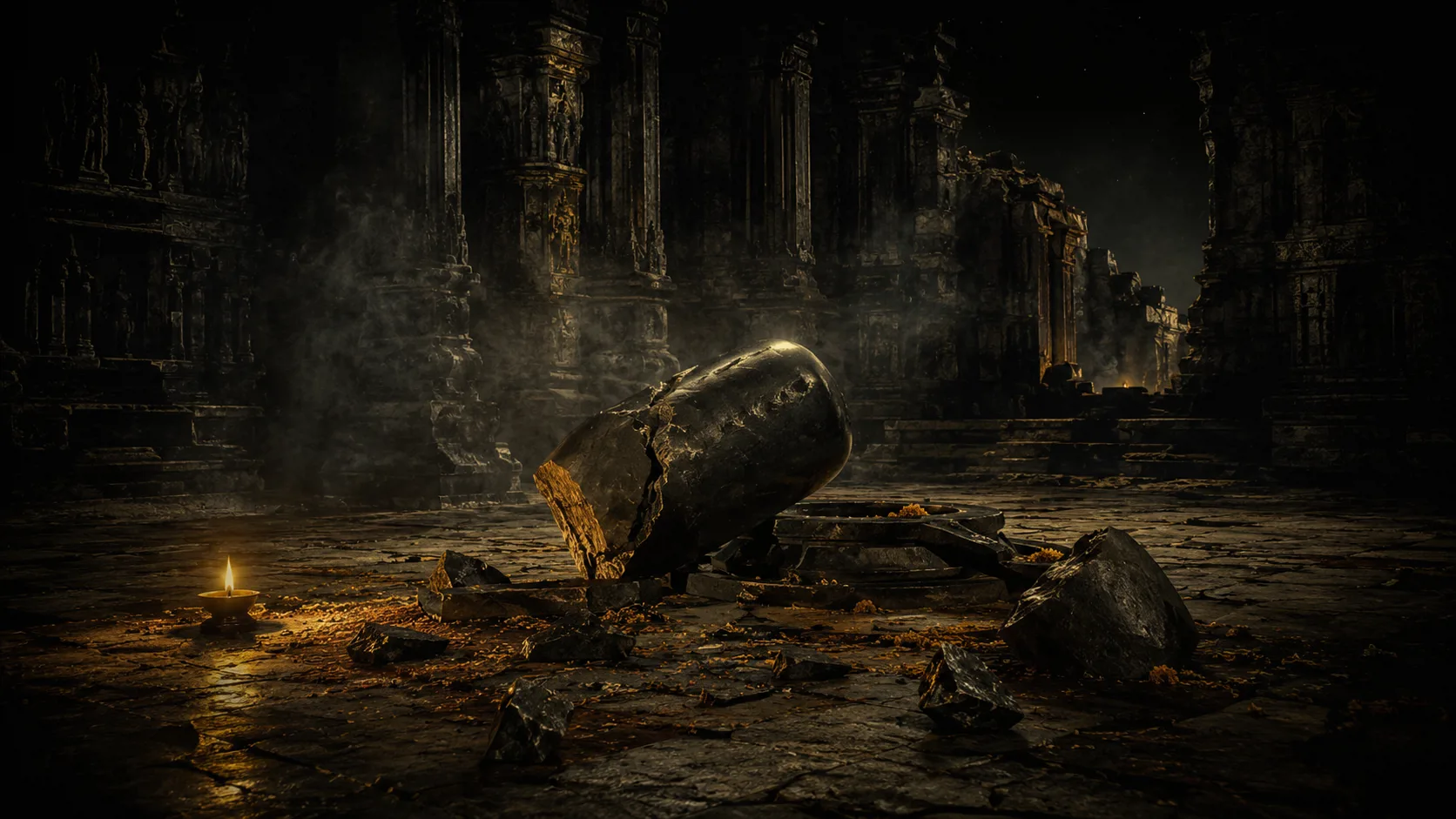
There is a particular cruelty in a conqueror who does not even want your land — who comes only to break what you hold sacred and carry off what you have built, year after year, and then retire across the mountains to spend it, and return when the spending is done. Mahmud of Ghazni was that conqueror. Seventeen times across twenty-seven years he descended from his capital at Ghazni in the highlands of Afghanistan into the plains of Bhāratha, and seventeen times he left them poorer — the temples thrown down, the treasuries emptied, the artisans and women driven back over the passes in slave-coffles so vast that the chroniclers say they crashed the price of slaves in the markets of Central Asia. He took the title but-shikan, the idol-breaker, and he wore it with pride, for the breaking of the idol was, to him and to the historians who glorified him, the highest meaning of the whole enterprise. His raids were not the building of an empire. They were the systematic looting and desecration of a civilisation, conducted as an act of faith and financed as a business.
And as before, the indictment needs no embellishment from the victims, because the conqueror's own court historians recorded it all as triumph. Al-Utbi, Mahmud's own secretary, wrote the Tarikh-i-Yamini celebrating the massacres and conversions; later Persian and Arab chroniclers — Ibn al-Athir and the rest — recorded the fifty thousand dead at Somnath and the smashing of the lingam as glories of Islam. The Persian scholar al-Bīrūnī, who came to Bhāratha in Mahmud's own train and loved its learning even as he served its plunderer, left the most honest verdict of all. What follows is built, once again, on the testimony of the conqueror's own side.
Where We Are on the Timeline
The years are 1000–1027. Three centuries have passed since Sindh fell, three centuries in which the Gurjara-Pratihāras and their allies held the conquest at the desert's edge. Now that shield has weakened, and a new and more terrible raider comes down through the passes — not to govern, but to plunder. The Hindu Shahis hold the northwestern gate; the Chandelas raise Khajuraho; the Cholas in the south under Rajaraja and Rajendra reach the height of their power and build their soaring temples. The seas are still empty of any European. The blow falls, as ever, from the northwest.

Setting the Stage: The Bhāratha That Stood There
The Bhāratha of the year 1000 was one of the wealthiest and most creative civilisations on earth — which is precisely why Mahmud came for it. The temples he looted were not merely houses of god; they were the treasuries, banks, and cultural centres of their regions, accumulating the offerings of centuries in gold, jewels, and art. To the north, the Hindu Shahi dynasty held the crucial frontier of Gandhāra and the Punjab — the gate through which every overland conqueror had to come. In the centre and east, the Chandelas of Bundelkhand were raising the incomparable temples of Khajuraho, and the Paramāras of Malwa under Bhoja made their court a beacon of Sanskrit learning. And in the deep south, untouched and unreachable by Mahmud, the Chola empire under Rajaraja I and his son Rajendra reached its zenith, building the towering Brihadishvara temple at Thanjavur and sending fleets across the Bay of Bengal. This was no decadent or dying world. It was a civilisation at one of its highest points — in temple-architecture, in bronze-casting, in mathematics and astronomy, in poetry and philosophy.
The seas remained Bhāratha's own; the Chola navy was the master of the eastern ocean, and no European sail had been seen. The threat was singular and it was overland: the highland war-machine of Ghazni, hungry for the wealth of the plains and sanctified in its hunger by the doctrine that looting the infidel and breaking his idols was holy work.
Two theories of war, and the economics of the raid
Mahmud's wars sharpen the contrast this chronicle traces. The Hindu kings fought, by the dharma-yuddha ethic, to defend their realms and would have made peace once a battle was decided. Mahmud fought a war with no peace possible, because its object was not a settlement but perpetual extraction and desecration — there was always another temple to break, another year's loot to gather. His chroniclers frame each raid explicitly as jihad, and the destruction of temples and idols as its sacred purpose; the immense plunder was, in their telling, the just reward of the holy warrior. The dual engine — faith and profit, the idol broken for God and the gold taken for Ghazni — drove seventeen invasions and made Mahmud's capital, on the backs of Bhāratha's looted wealth and enslaved artisans, one of the most glittering cities of the Islamic world. The splendour of Ghazni was the emptied treasure of Bhāratha's temples.
The Hindu Shahis: the gate that would not stop bleeding
The first and most constant resistance came from the Hindu Shahi dynasty, who held the northwestern frontier and who, the chroniclers themselves record, were almost the only kings to oppose Mahmud again and again across the decades. In 1001 near Peshawar, the Shahi king Jayapala met Mahmud in battle and was defeated; Al-Utbi, Mahmud's own secretary, records that thousands of Hindus were massacred and many taken captive. Jayapala was captured and ransomed — and then, broken by the humiliation of having been paraded and ransomed like a chattel, the old king mounted his own funeral pyre and immolated himself rather than live with the shame. It is a terrible image, and an honourable one: a king who would not survive the dishonour of his people's defeat.
His son Anandapala fought on, and around 1008 he raised a great confederacy of Hindu kings — by the chroniclers' account, contributions came from across northern Bhāratha, and Hindu women are said to have sold their jewels and spun and sold yarn to fund the war against the invader. The confederacy met Mahmud in a hard battle near the Indus; it was on the edge of victory when, by the tradition, the elephant carrying Anandapala's son and commander panicked and bolted, the line wavered, and the day was lost. The Shahis were pushed back, their kingdom dismembered raid by raid, until the dynasty was extinguished — but they had stood at the gate longer and more often than anyone, and their long doomed resistance bought the rest of Bhāratha years. The chronicle honours them.
THE HINDU SHAHIS — JAYAPALA AND ANANDAPALA — The Shahi kings were the wardens of the northwestern gate, and they paid for it with their dynasty. Jayapala fought Mahmud and his father before him, was beaten, ransomed, and chose the fire over the shame. Anandapala rallied a confederacy of Hindu kingdoms and very nearly won, funded — the conqueror's own chroniclers say — by the jewels and labour of Hindu women who would not see the invader triumph. They lost in the end to a better war-machine and the ill-luck of a bolting elephant, not to any failure of courage or will. The later sneer that the Shahis were weak is the conqueror's own minimising; in truth they resisted longer than any, and the chronicle remembers them as the first long line of defenders at the gate of the long wound.
The seventeen raids: a civilisation looted by the year
With the Shahi shield broken, Mahmud's raids drove deep into the heartland, and they followed a pattern as methodical as a harvest. Nagarkot (1009), its temple-treasury stripped. Thanesar (1014), sacred to the Hindus, sacked and its deities carried off. Mathura (1018) — the birthplace of Kṛṣṇa, one of the holiest cities of Bhāratha, with temples that Mahmud's own court historian admitted were of incomparable beauty and could not have been built for less than enormous sums and the labour of centuries — plundered, burned, and despoiled of an immense treasure. Kannauj (1019), the great imperial city, taken and its temples thrown down. Jwalamukhi, its priests put to the sword. City after city, temple after temple, year after year — the radiant centres of a civilisation's devotion and wealth reduced to ashes and silence, and their gold and their people carried back across the mountains.
The human toll rode in the slave-coffles. Tens of thousands of captives — artisans, women, children — were driven back over the passes to be sold; the chroniclers record that the markets of Ghazni and Central Asia were so flooded with the enslaved of Bhāratha that their price collapsed. This was not incidental damage. It was the design: the wealth, the gods, and the people of a civilisation, harvested annually for a generation, to enrich and sanctify a highland kingdom that did not even mean to stay.
Show full table
| Invasions of Bhāratha, 1000–1027 | Seventeen |
|---|---|
| Killed at Somnath (Ibn al-Athir) | ~50,000 |
| Temples reportedly destroyed in the Somnath campaign | ~1,000 in the district |
| Gold carried from Somnath | ~6.5 tons-equivalent in treasure |
| Major temple-cities sacked | Nagarkot, Thanesar, Mathura, Kannauj, Somnath |
| Captives driven to Ghazni | So many the slave-price collapsed |
Somnath, 1025: the breaking of the god
The climax of the seventeen raids, and the act that fixed Mahmud's name in the memory of Bhāratha for a thousand years, was the sack of Somnath in the winter of 1025–26. Somnath, on the Saurashtra coast of Gujarat, was one of the holiest shrines of Śiva in all Bhāratha — a great fortified temple housing a celebrated jyotirliṅga, its wealth the accumulated devotion of ages, its sanctity drawing pilgrims from across the land. Mahmud crossed the Thar desert with his cavalry to fall upon it.
The defenders fought and died for their god. The Muslim chroniclers themselves record the scene: band after band of Hindus threw themselves into the defence of the temple, and when the walls were breached, some clasped their hands and wept and begged the conqueror to spare the shrine, and others fought on until they were cut down; some fled to boats to escape across the sea and were pursued and killed or drowned. By the count of Ibn al-Athir, the slain at Somnath exceeded fifty thousand. And then Mahmud came to the idol itself. The chronicles say he was offered a vast ransom to spare it and refused, declaring that he would be remembered as the breaker of idols and not the seller of them — and that he raised his mace or battle-axe and struck the great liṅga himself, shattering it. The fragments, by the accounts, were carried back to Ghazni and set into the steps of the city's great mosque, so that the holiest stone of Somnath would be trodden underfoot by the faithful entering to pray. The famous carved gates of the temple were carried off across the desert with the gold.
He was offered a fortune to spare the god, and he answered that he would be remembered as the breaker of idols, not the seller of them. He broke it with his own hand. The chronicle has remembered — but not as he meant.
THE DEFENDERS OF SOMNATH — Fifty thousand died at Somnath, by the conqueror's own count, in the defence of their temple. They were not, for the most part, professional soldiers; they were the people of a holy city who would not abandon their god, who fought and wept and fought again and were slaughtered band after band, and who, some of them, chose to drown in the sea rather than fall to the idol-breaker. They could not save the shrine. But the chronicle records that they did not simply flee it either: they died for what was sacred to them, in numbers that even the conqueror's admiring historians could not help but record. The fifty thousand of Somnath are martyrs of the long wound, and their temple outlived the man who broke it many times over.
The witness for the defence: al-Bīrūnī
One member of Mahmud's own train left a verdict that damns his master more completely than any victim could. The great scholar al-Bīrūnī, brought to Bhāratha in Mahmud's wake, learned Sanskrit, studied the sciences and philosophy of the land, and wrote the Kitāb al-Hind, one of the most remarkable works of observation in the medieval world. And he recorded, with sorrow, what Mahmud's raids had done. Mahmud, he wrote, had utterly ruined the prosperity of the country, and the Hindus had become like atoms of dust scattered in all directions, and a deep hatred of all foreigners — and Muslims especially — had taken root, so that the sciences of the Hindus had fled far away from the places the conqueror's hand had touched. This is the testimony of a Muslim scholar in Mahmud's own service: that the idol-breaker had not spread civilisation but shattered it, not won hearts but poisoned them, and driven the learning of Bhāratha into hiding. The conqueror's own most brilliant companion judged the conquest a catastrophe.
What the idol-breaker could not do
Mahmud died in 1030, the richest king of his age, his capital glittering with the looted gods of Bhāratha. And here, as in every chapter, the deeper reckoning begins where the conqueror's triumph ends. For all seventeen raids, Mahmud took almost no permanent territory in Bhāratha beyond the Punjab; the heartland he bled, he never held. His empire fragmented within a generation of his death. And the civilisation he had tried to break by breaking its idols did exactly the thing his whole theology said was impossible: it endured, and it rebuilt.
Somnath is the proof, and it is why the temple, not the man, is the true subject of this chapter. Mahmud broke the shrine in 1025; the Hindus rebuilt it. It was broken again by later conquerors and rebuilt again — by the Chaulukya kings, by Kumarapala, again and again across the centuries, each desecration answered by a reconstruction, the god replaced upon the altar by the descendants of the slain. The temple was destroyed and raised, by the reckoning of its own history, six times and more, and stands today on the Saurashtra coast, rebuilt yet again after the freedom of Bhāratha in 1947 — the living refutation of the idol-breaker's boast. He smashed the liṅga and set its fragments in his mosque-steps to be trodden underfoot; a thousand years later Ghazni is a provincial town and Somnath is a place of living worship, and most of the pilgrims who light their lamps there have never heard his name.
That is the answer of Bhāratha to the idol-breaker, and it is the chronicle's recurring answer to all conquest: you may break the idol, but you cannot break the hand that carves the next one, nor the memory that knows where the altar stood, nor the faith that will rebuild it a seventh time on the ashes of the sixth. Mahmud came seventeen times to break the gods of Bhāratha. The gods are still here. To the third hammer-blow — Muhammad Ghori, Tarain, and the founding of permanent rule at Delhi — the chronicle turns next.
Notes & Sources
Al-Utbi, Tarikh-i-Yamini — the contemporary chronicle by Mahmud's own secretary, celebrating the campaigns and the captives taken. The seventeen raids (1000–1027): the sackings of Nagarkot, Thanesar, Mathura (1018), Kannauj (1019), Jwalamukhi, and others; the slave-coffles and the collapse of slave-prices in Central Asian markets. The Hindu Shahis: Jayapala's defeat near Peshawar (c.1001), ransom, and self-immolation; Anandapala's confederacy (c.1008) and its narrow defeat. The Sack of Somnath (1025–26): the defence and slaughter (Ibn al-Athir's ~50,000 slain; the eyewitness-style accounts preserved by Malleson and others); Mahmud's personal breaking of the jyotirliṅga; the fragments set in the steps of the Ghazni mosque; the carried-off gates and treasure. Al-Bīrūnī, Kitāb al-Hind — the scholar in Mahmud's train recording the ruin of the country and the Hindus scattered "like atoms of dust." The repeated rebuildings of Somnath down to 1947.
Method, repeated: the atrocities rest on Mahmud's own court chroniclers and on his own companion al-Bīrūnī; contested figures are flagged as the chronicles' own, often rhetorical, numbers; the Hindu Shahis and the defenders of Somnath are honoured without reserve. The indictment is of the conqueror and the doctrine that sanctified plunder and desecration — not of ordinary Muslims today. Throughout, the land is Bhāratha.