Everything before this chapter was a wound that healed. Alexander came and went; the Arabs took Sindh but were held three centuries at the desert's edge; Mahmud raided seventeen times and never stayed. The civilisation had been hurt, repeatedly, grievously — and each time it had closed over the injury, rebuilt the temple, expelled the garrison, and gone on. This chapter is where that stops. With Muhammad Ghori and the second battle of Tarain in 1192, the raid becomes the reign: a conquering power plants itself permanently at Delhi and does not leave, and the Delhi Sultanate that begins here will rule, in one dynasty or another, for over three hundred years. The yoke is fitted in this chapter. The long wound, properly speaking, becomes the long subjugation here.
And it is fitted, characteristically, not by superior virtue but by superior ruthlessness and one fatal seam in the defence — exploited, as it will be again and again across this chronicle, by an invader who understood that the kingdoms of Bhāratha were more easily divided than beaten. The sources, once more, are substantially the conquerors' own: the Persian chroniclers Minhāj-i-Sirāj (the Tabaqāt-i-Nāsirī), Hasan Nizāmī, and the later tradition, all of whom record the victories, the temple-destructions, and the slaughter of Nalanda as triumphs of the faith.
Where We Are on the Timeline
The years are 1191–1206. Mahmud's raids ended in 1027; for a century and a half the plains recovered and the Punjab passed back and forth. Now a new power from the highlands of Ghor comes — and this one means to stay. The land is held by the great Rajput houses: the Chauhāns (Chāhamānas) of Ajmer and Delhi under Prithvīrāj, the Gāhaḍavālas of Kanauj under Jayachandra, the Chandelas, the Paramāras. In the east, the Sena kings rule a wealthy, cultured Bengal under the aged Lakshmana Sena. The seas are still Bhāratha's own; no European has come. This is the hinge of the whole chronicle — the moment the wound stops closing.

Setting the Stage: The Bhāratha That Stood There
The northern Bhāratha of the late twelfth century was militarily strong and politically divided — and the division, not the strength, decided its fate. The dominant power was the Chauhān king Prithvīrāj III, ruling from Ajmer and Delhi, a warrior of real ability who had subdued rivals across Rajasthan. His great rival was Jayachandra (Jaichand) of the Gāhaḍavāla dynasty at Kanauj, one of the richest kingdoms of the plain. The Chandelas held Bundelkhand, the Paramāras Malwa, the Solankis Gujarat. In the east, the Sena dynasty ruled Bengal — a prosperous, sophisticated kingdom and a great patron of Sanskrit letters, whose king Lakshmana Sena presided over a court that the poet Jayadeva, author of the Gīta Govinda, had adorned. And studding the eastern plain stood the crown jewels of the civilisation's mind: the monastic universities of Nalanda, Vikramaśīla, and Odantapurī — Nalanda already seven hundred years old, the greatest centre of learning in Asia, drawing scholars from China, Tibet, Korea, and across the Buddhist world.
This was a civilisation at the height of its intellectual and artistic life. Its weakness was singular and, in this chronicle, recurring: it was a family of kingdoms, proud and rivalrous, with no habit of common cause. Prithvīrāj and Jayachandra were enemies; their feud, the tradition holds, ran so deep that when the foreign invader came, the seam between them became the road by which he entered. The strength of Bhāratha was real — Tarain would prove the Rajput could beat the Turk in the field. The fatal thing was that the Rajputs could not, or would not, unite even against an enemy who threatened them all.
Two theories of war, and the price of chivalry
Tarain also shows, more sharply than any chapter so far, the terrible asymmetry of the two war-ethics — and this must be stated carefully, because it is about the nobility of the defender, never his fault. By the dharma-yuddha code, Prithvīrāj fought to defeat his enemy, not to annihilate him; when he beat Ghori at the first Tarain, he let the wounded invader withdraw, as the code of honourable war required, expecting the matter settled. Ghori operated by no such code: defeated, he went home, executed the officers who had fled, drilled his army through the winter, and returned the next year to win by a dawn surprise attack. The point is not that the Rajput ethic was foolish — it was the mark of a civilisation that had made war humane. The point is that it met a creed of war that recognised no such limits, and that the conqueror turned the defender's very honour into a weapon against him. This is the tragedy at the heart of the long wound's beginning: nobility, meeting a foe who saw nobility only as an opening.
The two battles of Tarain
The clash came over the frontier fortress of Tabarhinda (Bhatinda). In 1191, at the first battle of Tarain (near Thanesar in modern Haryana), Prithvīrāj's Rajput army met Ghori's and broke it. The Ghurid centre was routed, Ghori himself was wounded by Prithvīrāj's general and nearly killed — saved, the chronicles say, only by a young Khalji horseman who bore him from the field. It was a clear Rajput victory; the Turk had been beaten decisively in open battle, proof that the conqueror was not invincible and the defenders not outmatched. Prithvīrāj retook Tabarhinda after a long siege. And then he made the error the dharma-code invited and the situation could not afford: he did not pursue Ghori into the Punjab and finish him, but let him go.
Ghori used the year he had been given. He returned home, replaced and punished the commanders who had failed, and assembled a far larger and better-disciplined army — by the chronicle-figures some hundred and twenty thousand, heavy on the swift mounted archers the Rajput host could not match. In 1192, at the second battle of Tarain, on the same field, Ghori declined the honourable pitched battle Prithvīrāj offered and instead harassed the Rajput army with mobile horse-archers, wore it down, and fell on it at dawn before it had formed. The Rajput confederacy — weakened, the sources stress, by the absence of Jayachandra of Kanauj, whose rivalry with Prithvīrāj kept him from the field — was broken. Prithvīrāj was captured.
What was done to him is recorded by the conquest's own tradition: the captured king was carried off to Ghazni and there, after a time, blinded and put to death. The Chauhān king who had beaten the invader in fair fight a year before, and spared him, was repaid with mutilation and execution. The contrast between the two men's conduct — the one who released his beaten enemy, and the one who blinded and killed his — is the whole moral distance between the two theories of war, written in a single pair of lives.
Show full table
| First Tarain (1191) | Rajput victory; Ghori beaten & spared |
|---|---|
| Second Tarain (1192) | Ghori wins by dawn surprise; Prithvīrāj taken |
| Prithvīrāj Chauhān's fate | Blinded and executed at Ghazni |
| Chandawar (1194) | Jayachandra of Kanauj defeated and killed |
| Delhi made the capital of the conquest | 1193 |
| Nalanda, Vikramaśīla, Odantapurī | Destroyed, c. 1193–1200 |
PRITHVĪRĀJ CHAUHĀN — Prithvīrāj is honoured here as the king who proved the conqueror could be beaten — who broke Ghori's army at the first Tarain and spared the wounded invader by the honourable code of his people. His defeat the next year owed nothing to cowardice and everything to two things outside his character: a more ruthless enemy who fought by no code, and the failure of the kingdoms of Bhāratha to stand together. The bards remembered him in the great epic cycle of his name, and Bhāratha remembers him still — not as the man who lost the second Tarain, but as the warrior who won the first, and whose only "fault" was to fight an honourable war against an enemy who would not. The chronicle lays no blame on Prithvīrāj. It lays the blame where it belongs: on the invader who repaid mercy with the executioner's blade, and on the disunity that no single king could cure alone.
The murder of Nalanda
With Prithvīrāj dead and Delhi made the capital in 1193, Ghori's slave-general Qutb-ud-dīn Aibak consolidated the north, and another of Ghori's commanders, Ikhtiyār al-Dīn Muhammad Bakhtiyār Khalji, drove east into Bihar and Bengal. What Bakhtiyār Khalji did there is one of the single greatest catastrophes in the intellectual history of the human species, and the chronicle must dwell on it, because it is the clearest proof of what the conquest meant beyond the battlefield.
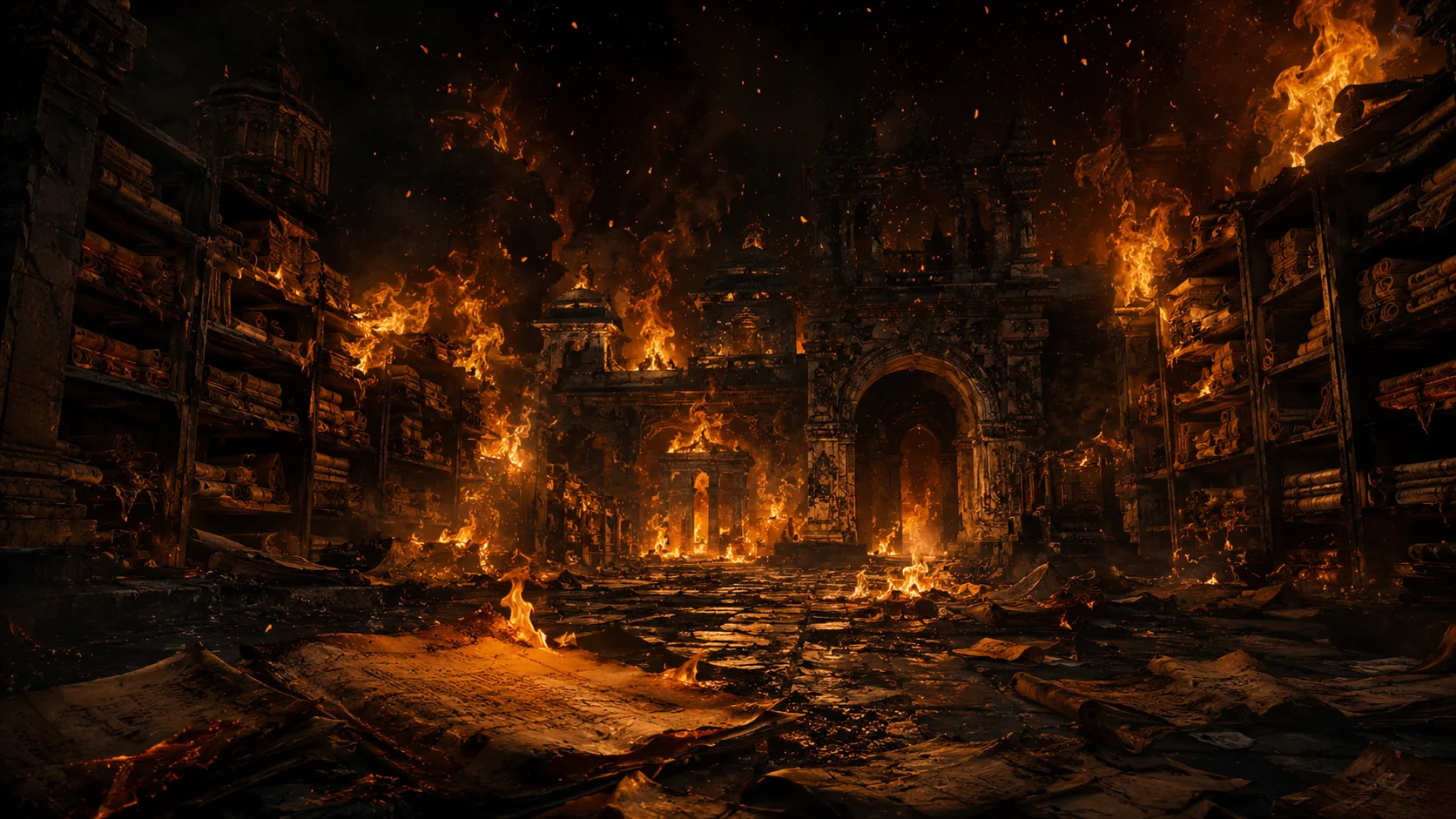
Around 1193, Bakhtiyār Khalji's horsemen fell upon Nalanda — the monastic university that had been the lamp of learning in Asia for seven centuries, where ten thousand students and teachers had studied logic, medicine, mathematics, astronomy, grammar, and philosophy, whose library was so vast it was housed in a complex remembered as the "Mountain of Jewels" and the "Sea of Learning," holding hundreds of thousands of manuscripts — the accumulated knowledge of a civilisation. The Persian chronicle of Minhāj-i-Sirāj records that the place was taken to be a fortress, its black-robed monks slaughtered, and its great library set ablaze. The collection was so immense, the tradition holds, that it burned for months; the smoke hung over the hills. And when the conquerors, finding the endless shelves, asked what the books were and whether any treated of the Qur'an, there was no one left alive who could read them, for every monk who could had been killed. Vikramaśīla and Odantapurī, the sister universities, were destroyed in the same campaign.
A few hundred horsemen, in a single season, killed a university that had taught the world for seven hundred years. The library burned for months. There was no one left who could read the books to the men who burned them.
This is the act that, more than any battle, defines the difference between a wound and an amputation. Temples could be, and were, rebuilt; a kingdom lost could be regained. But the murder of Nalanda destroyed something that could not be replaced — the living transmission of a vast body of knowledge, the unbroken teacher-to-student lineages of seven centuries, the manuscripts of which many existed in no other copy. The destruction of the great universities of the east dealt Buddhist learning in the land of its birth a blow from which, in that region, it never recovered. It is the single most irreparable loss in this entire chronicle, and it was accomplished, almost casually, by a raiding general who is said to have set out merely to plunder and found a university in his path.
LAKSHMANA SENA AND THE BENGAL THAT WAS OVERRUN — The Bengal that Bakhtiyār Khalji's raid struck was no backwater but a wealthy and deeply cultured kingdom under the aged Lakshmana Sena, a patron of Sanskrit poetry whose court had given the world Jayadeva's Gīta Govinda. The chronicles tell — perhaps with exaggeration, to magnify the conqueror's daring — that Bakhtiyār Khalji seized the Sena capital of Nabadwip in a lightning raid with a small advance party. Whatever the precise truth of that famous story, the Sena kingdom was overrun, the old king withdrew eastward, and the Senas fought on from a reduced realm for years more. Lakshmana Sena and the civilisation of Sena Bengal are honoured here: a refined and learned kingdom, the patron of one of the loveliest works in all Sanskrit, struck down as Nalanda burned nearby.
The yoke, and the seam that fitted it
Ghori himself did not live to enjoy the empire he had founded; he was assassinated in 1206. But his slave-general Qutb-ud-dīn Aibak made himself master of the conquered Bhāratha and founded the line — the Slave or Mamluk dynasty — that became the Delhi Sultanate, the subject of the next chapter. The raid had become a reign. For the first time since the wound began at Sindh five centuries before, a conquering power held the heart of northern Bhāratha and meant to keep it.
The chronicle must name the seam honestly, because the conqueror used it and will use it again and again, and because naming it is the opposite of blaming the defenders for it. Bhāratha did not fall at Tarain because its warriors were weak — they had won the year before. It fell because it was many kingdoms and not one, and because the invader grasped that the surest road into a divided house is the quarrel between its brothers. The rivalry of Prithvīrāj and Jayachandra; the failure of the Rajput houses to combine; the absence of Kanauj from the field at the second Tarain — these were the cracks, and the conqueror drove his wedge into them. Disunity was the door. It is named here not as a flaw in the character of the defenders — they were as brave as any people who ever lived — but as the strategic wound through which the long subjugation entered, so that the lesson is never lost: against a foe who fights as one, a civilisation that will not unite gives away in politics what it has won in the field.
What the founding of the yoke could not do
The yoke was fitted, and it was real, and it would hold for centuries — this chronicle will not pretend the Delhi Sultanate was anything but a genuine and lasting conquest. And yet even here, at the moment of the deepest defeat so far, the pattern of survival is already visible beneath the catastrophe. The Sultanate held the plains; it never held all of Bhāratha. The Rajputs, beaten at Delhi, withdrew into the forts of Rajasthan and fought on for centuries, never wholly subdued. The deep south lay entirely beyond the conqueror's reach and would soon raise, in Vijayanagara, an empire that shielded the peninsula for two hundred years. And the civilisation whose lamp had been put out at Nalanda kept its deeper knowledge alive by the very means the next chapters will celebrate — in the memorised Veda that needed no library, in the ten thousand temples and maṭhas beyond the conqueror's reach, in the unbroken lineages of teachers in the free south and the forts of the west.
Nalanda was the worst single loss in this whole book, and it is right to grieve it without consolation. But even Nalanda did not kill the learning of Bhāratha — only that one great vessel of it. The conqueror had taken Delhi and fitted the yoke. He had not taken Bhāratha, and the dharma he meant to break was, even now, being carried in memory and stone beyond his reach, southward and into the hills, to wait. To the Slave Kings who now made the conquest a settled government — Aibak the temple-breaker, Iltutmish, and Balban the terror — the chronicle turns next.
Notes & Sources
Minhāj-i-Sirāj, Tabaqāt-i-Nāsirī — the principal Persian chronicle of the early Sultanate, our main source for Ghori's campaigns and the destruction of the eastern universities. The two battles of Tarain (1191, 1192): Prithvīrāj's victory and sparing of Ghori at the first; Ghori's dawn surprise victory at the second, aided by the disunity of the Rajput kings (the absence of Jayachandra of Kanauj); Prithvīrāj's capture, blinding, and execution at Ghazni. Chandawar (1194): Ghori's defeat and killing of Jayachandra of Kanauj; Aibak's consolidation; Delhi made the capital (1193). The destruction of Nalanda, Vikramaśīla, and Odantapurī (c. 1193–1200): Bakhtiyār Khalji's sack of the great monastic universities, the slaughter of the monks, and the burning of the library, recorded in the Tabaqāt-i-Nāsirī; the famous detail that no one survived who could read the books. Lakshmana Sena and Bengal: the Sena kingdom, its patronage of Sanskrit letters (Jayadeva's Gīta Govinda), and its overrunning by Bakhtiyār Khalji's raid on Nabadwip. The founding of the Sultanate: Ghori's assassination (1206) and Aibak's establishment of the Slave (Mamluk) dynasty.
Method, repeated: the conquest's atrocities rest on its own Persian chroniclers; contested figures and famous anecdotes are flagged as the sources' own; Prithvīrāj, Lakshmana Sena, and the defenders are honoured without reserve, and "disunity" is named as the strategic seam the invader exploited, never as a fault in the defenders' courage. The indictment is of the conquest — not of ordinary Muslims today. Throughout, the land is Bhāratha.