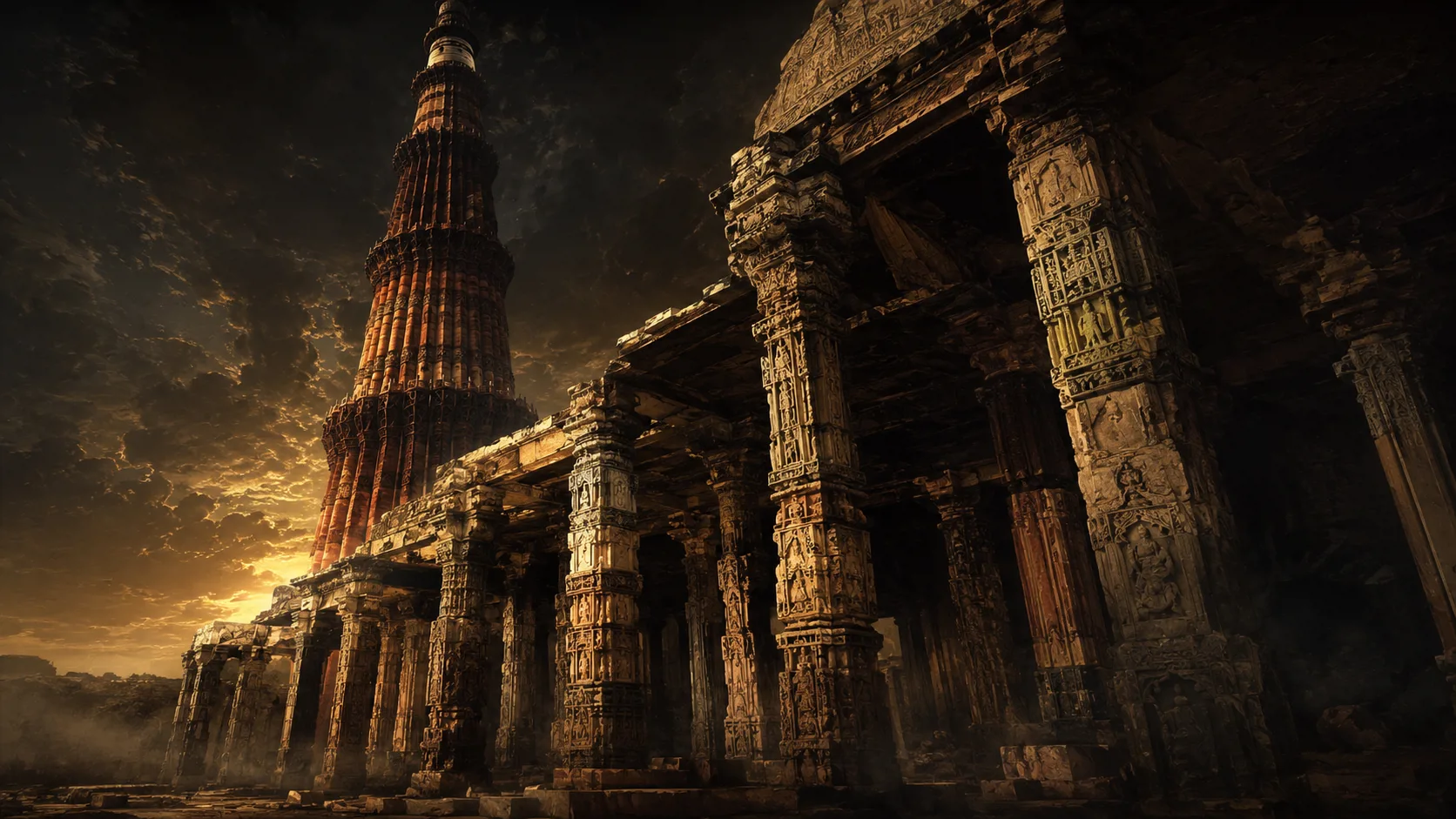
The dynasty that first governed conquered Bhāratha from Delhi is called, with a bluntness the centuries have worn smooth, the Slave dynasty — because its founder and several of its greatest sultans had begun life as purchased Turkic slaves, military bondsmen raised up by their masters to command armies and, in the end, to seize thrones. There is a grim irony the chronicle should not pass over: the men who reduced the free people of Bhāratha to subjection, who enslaved its artisans and women by the tens of thousands, were themselves slaves — a self-perpetuating military caste of bondsmen-generals, the mamlūks, who ran the conquest as a kind of armed corporation. For eighty-four years this line held Delhi, and in those years three men above all gave the conquest its lasting shape: Aibak the iconoclast, who built its first monuments from the bones of broken temples; Iltutmish, who turned a war-camp into a state; and Balban, who taught it to rule by fear.
This chapter is, in part, a correction. The Slave dynasty is too often compressed into a line in a list of dynasties, a name to be memorised between Ghori and the Khaljis. But it was in these eighty-four years that the conquest became a government — that the breaking of temples became state architecture, that the subjugation of the Hindu became settled law, that the Sultanate learned to survive both Hindu revolt and Mongol invasion and so to endure. To understand the long wound one must understand how the conquest dug in, and it dug in here. The sources remain the conquerors' own — above all Minhāj-i-Sirāj, who lived under these sultans and wrote the Tabaqāt-i-Nāsirī in their praise, and the inscriptions the sultans themselves cut into their mosques.
Where We Are on the Timeline
The years are 1206–1290. Ghori's conquest is now a permanent state: the Delhi Sultanate, ruled by a line of former slaves who had seized it. To the west and south, the Rajputs hold their forts and the southern kingdoms — Yādavas, Kākatīyas, Hoysalas, Pāṇḍyas — remain wholly free and rich, soon to be the Sultanate's next prey. Beyond the northwest passes, a new terror has appeared that menaces conqueror and conquered alike: the Mongols of Chinggis Khan. The seas are still Bhāratha's own. The yoke is now being riveted into an administration.

Setting the Stage: The Bhāratha That Stood There
By the thirteenth century the political map of Bhāratha had a hard new fact at its centre — a Muslim sultanate at Delhi commanding the Gangetic plain — but the greater part of the land remained free, and this is essential to the chronicle's running truth. The Rajput kingdoms of the west, beaten at Delhi, had not surrendered; from Mewar, Ranthambore, Gwalior, and a hundred forts they remained defiant and frequently in revolt. The whole of the south — the wealthy Yādava kingdom of Devagiri, the Kākatīyas of Warangal with their fabulous diamond-wealth, the Hoysalas of Dwārasamudra with their jewelled temples, the Pāṇḍyas of Madurai — lay entirely beyond the Sultanate's reach, untouched, brilliant, and soon to be the target of its southern raids. Bengal in the east was held by the conquest but seethed. The Sultanate was a powerful wedge driven into the north, not the master of the subcontinent.
And over the northwestern horizon loomed the age's great terror: the Mongols. Chinggis Khan's world-shaking conquests had reached the Indus by the 1220s, and for the rest of the century the Mongol shadow lay over Delhi as heavily as it lay over Baghdad and Persia. When the Sultanate fought off the Mongols, it was not defending Bhāratha — it was defending its own loot. The Slave kings repelled the Mongol not to spare the Hindu but to keep the plunder, the throne, and the occupation for themselves; one set of foreign predators kept another off its kill. There was no shield of Bhāratha here, only a bigot guarding his own stolen ground against a rival raider. The chronicle grants the occupier nothing for it. The seas, meanwhile, remained entirely Bhāratha's own; no European had come, and would not for three centuries.
Aibak: the Might of Islam, built from broken temples
Qutb-ud-dīn Aibak, the Turkic slave whom Ghori had raised to command and who became, after his master's assassination in 1206, the first Sultan of Delhi, ruled only four years before dying in a polo accident at Lahore in 1210. But in those four years, and in the campaigns before them, he set the architectural and symbolic template of the conquest, and it was a template of desecration made permanent in stone.
At Delhi, Aibak raised the first great mosque of the conquest and named it, without euphemism, the Quwwat-ul-Islam — the "Might of Islam." Its own Persian foundation-inscription, still legible, records exactly how it was built: from the materials of twenty-seven Hindu and Jain temples, demolished for the purpose, their carved pillars and stones — the work of generations of Bhāratīya craftsmen — re-erected to hold up the house of the conquering faith. Beside it Aibak began the Qutb Minar, the towering "victory tower" celebrating the Islamic conquest of Bhāratha, its very purpose, in the words of the chroniclers, to make the permanence of Muslim rule visible to the newly conquered. The message was deliberate and it was theological: the temples thrown down, the mosque raised on their stones, the tower of victory over all. At Ajmer, Aibak raised another mosque on the ruins of a Sanskrit college and temple, known to this day by a name that records its haste — the "Adhai Din ka Jhonpra."
The chronicle must hold two facts together here, as honest history requires. Aibak's own court flatterer, Hasan Nizāmī, called him Lakh Baksh — "giver of hundreds of thousands" — for his lavish generosity, and later admirers paint him a magnanimous founder. And the same man demolished twenty-seven temples to build a single mosque and named it the Might of Islam. Both are recorded. The generosity was real, to his own followers and faith; the iconoclasm was real, to the conquered and theirs. A history that prints only the "giver of lakhs" and omits the twenty-seven temples has been written by the conqueror's admirers. This chronicle prints both, and lets the inscription on the mosque speak for itself.
Show full table
| Temples demolished to build the Quwwat-ul-Islam mosque | 27 (per its own inscription) |
|---|---|
| Aibak's reign as Sultan | 1206–1210 |
| Iltutmish's reign | 1211–1236 |
| Sultanate policy on temples | Reconstruction forbidden; repair only on payment of jizya |
| Balban's reign of "blood and iron" | 1266–1287 |
| Mongol assaults on the northwest | Repeatedly, through the century |
Iltutmish: the conquest becomes a state
The true architect of the Sultanate as a durable institution was Aibak's own slave and son-in-law, Shams-ud-dīn Iltutmish (r. 1211–1236) — himself a Turkic slave, sold as a boy, who rose to the throne. Where Aibak had been a conqueror, Iltutmish was a builder of government. He defeated his rivals, secured a patent of legitimacy from the Abbasid Caliph (binding the Delhi conquest into the wider Islamic world-order), introduced the silver tanka and the gold coinage that would run for centuries, organised the iqtā land-revenue system by which the conquest fed itself from the toil of the Hindu peasantry, and created the Chihalgani — the corps of forty great slave-nobles who formed the ruling military caste. He completed Aibak's Qutb Minar. And he held the northwestern frontier against the first great Mongol threat when Chinggis Khan's pursuit of a fleeing prince brought the Mongols to the Indus.
Under Iltutmish the conquest hardened from a military occupation into a working imperial state — with a coinage, a bureaucracy, a revenue system, a recognised place in the Islamic world, and a capital that was now one of the great cities of Asia. That is the achievement the chronicle records, and it records too what the achievement rested on: a Hindu majority governed as dhimmī subjects, taxed by the jizya, their temples — by the settled policy of the Sultanate that took shape in this era — forbidden to be rebuilt where destroyed, and permitted repair only on payment of the tax. The state was real and capable. It was also a machine for the permanent subordination of the conquered, and the more capable it became, the more efficiently it subordinated them.
RAZIA SULTANA — A WINDOW, AND A WARNING — Iltutmish was succeeded, remarkably, by his daughter Razia (r. 1236–1240), one of the very few women to rule a medieval Islamic state in her own name. Her competence is not the point and earns the occupier no credit; she ran the same machine of conquest and jizya as the men, and the chronicle notes her reign only to show the nature of the dynasty that destroyed her — a ruling slave-caste that would not be commanded by a woman and killed her for it. The Chihalgani, the corps of slave-nobles her father had built, would not be ruled by a woman; they conspired, deposed, and killed her within four years. Her brief reign is noted here not to soften the dynasty but to show its nature: a state powerful enough to be governed by a woman of talent, and a ruling slave-caste merciless enough to destroy her for it. The same Chihalgani would soon throw up the man who ruled by terror — Balban.
Balban: the throne of fear
After a generation of weak successors and the strangling grip of the Chihalgani, power was seized by Ghiyās-ud-dīn Balban (r. 1266–1287) — yet another former slave, one of the Forty himself, who climbed to the throne and then, characteristically, broke the very corps that had raised him. Balban's name is bound, in the memory of the Sultanate, to a single doctrine: rule by terror. He governed on the explicit theory that the sultan's power rested on the awe and dread of his subjects, that mercy was weakness and fear was order. He surrounded the throne with an elaborate, terrifying ceremonial borrowed from Persian kingship, forbade laughter in his court, and crushed every challenge with a severity the chroniclers — who admired him — record with relish.
His "blood and iron" policy fell hardest on those near at hand who would not submit. When the Mewatis — the defiant population of the forests and ravines around Delhi, who raided the capital's outskirts and would not be tamed — defied him, Balban answered with extermination: the chronicles record forests cleared and the resisting population of whole districts put to the sword in their thousands, the roads made safe by terror. Rebels were trampled by elephants, flayed, and their bodies displayed; the governor of Bengal who revolted was hunted down and his followers impaled in a long avenue of stakes as a lesson. Balban broke the over-mighty Chihalgani by poison and execution until the corps that had made sultans was no more. He held the Mongol frontier with a hard hand. And he passed on to his successors a throne made absolute by fear — a model of conquest-kingship as naked domination that the Khaljis and Tughlaqs, in the next chapter, would carry into the free south.
He forbade laughter in his court and ruled by dread, on the doctrine that the awe of the king was the only order. The conquest had learned to govern, and the lesson it had learned was terror.
THOSE WHO WOULD NOT BE GOVERNED — The honour of this chapter belongs to the unbroken resisters: the Rajput houses of Mewar, Ranthambore, and Gwalior who fought the Sultanate from their forts decade after decade and were never wholly subdued; the Mewatis who raided the gates of Delhi itself and whom Balban could suppress only by massacre, not by submission; the southern kingdoms still wholly free; and the countless villages that paid the jizya under protest and kept their gods and their dharma alive beneath the conqueror's settled rule. The Sultanate's own chronicles, in recording the ferocity needed to hold the land — the terror, the massacres, the avenues of stakes — testify against themselves to a people that would not be quietly ruled. A conquest that must govern by such fear has not won the hearts of the conquered; it has only, for a time, mastered their bodies. The resistance the terror was meant to break outlived the terror.
What the Slave Kings could not do
By 1290 the Slave dynasty gave way to the Khaljis, but it had done the lasting work: it had made the conquest a state, riveted the yoke into an administration, and proved that a Muslim sultanate could survive in Bhāratha against both Hindu revolt and Mongol invasion. This was a real and durable achievement of domination, and the chronicle does not minimise it. The Sultanate would endure, in one dynasty or another, for three centuries more.
And yet, measured against the conquest's own aim — to possess Bhāratha and break its dharma — the Slave Kings failed at the deepest level, and their very methods are the proof. A state that must forbid laughter in its court, line its roads with impaled rebels, massacre whole districts to make the highways safe, and rule by the explicit doctrine of terror, is a state that has not been accepted by the people it rules. The Rajputs were beaten but unbroken, fighting on from their forts for centuries. The south was untouched and would soon raise Vijayanagara to shield it. The temples were thrown down at Delhi, but the Quwwat-ul-Islam was built, tellingly, by Hindu craftsmen whose carving covers its surfaces — the conqueror could command the hands of Bhāratha but not replace them, could break the temple but had to hire the temple-builder to raise his mosque. The dharma went on in ten thousand villages beneath the jizya, in the free south, in the defiant forts. The slaves had become kings and made the conquest a government. They had not made the conquered into anything but the conquered — a people biding its time. To the Khaljis and Tughlaqs, who now carried the settled conquest's terror into the deep south, the chronicle turns next.
Notes & Sources
Minhāj-i-Sirāj, Tabaqāt-i-Nāsirī — the contemporary court chronicle of the Slave dynasty, written under and in praise of these sultans. Aibak and the Quwwat-ul-Islam mosque: its construction from the materials of 27 demolished Hindu and Jain temples, per its own surviving Persian foundation-inscription; the Qutb Minar as a tower of victory; the Adhai Din ka Jhonpra mosque at Ajmer; the "Lakh Baksh" epithet from Hasan Nizāmī, set against the iconoclasm. Iltutmish (1211–1236): the Abbasid investiture, the silver tanka and gold coinage, the iqtā system, the Chihalgani, the completion of the Qutb Minar, and the holding of the Mongol frontier. The temple policy of the Sultanate: the forbidding of reconstruction and the permitting of repair only on payment of jizya. Razia Sultana (1236–1240): her able reign and her overthrow and killing by the Chihalgani. Balban (1266–1287): the "blood and iron" doctrine, the Persianate ceremonial of awe, the massacres of the Mewatis and the suppression of the Bengal revolt, recorded admiringly by the chroniclers.
Method, repeated: the dynasty's iconoclasm and terror rest on its own inscriptions and chroniclers; the "generous founder" image is recorded alongside the temple-destruction, not in place of it; the unbroken resisters — Rajputs, Mewatis, the free south — are honoured. The indictment is of the conquest-state and its methods — not of ordinary Muslims today. Throughout, the land is Bhāratha.