By Nag Rotte
When a river is dammed, the water does not perish. It is held, raised, given a boundary, and made to serve. This is the meaning the Upaniṣad gives to the word सेतु—a bund, an embankment, a bridge—and it is the word Bhagavatpāda chose to name the constitution he gave to the four thrones of Sanātana Dharma.
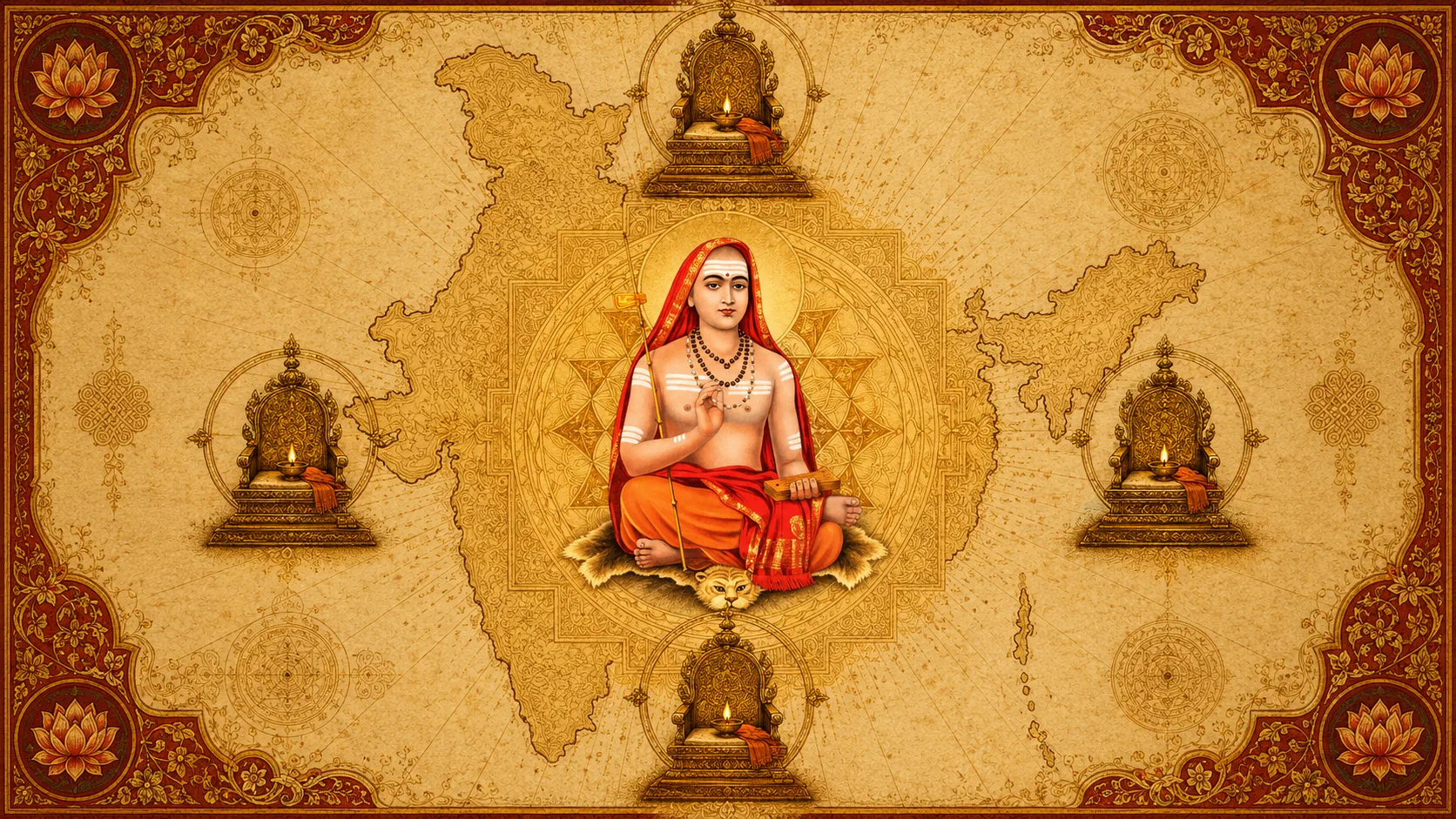
Ādi Śaṅkarācārya did not merely refute the doctrines of his age and re-establish the supremacy of the Veda. Having accomplished that, he did something a philosopher alone need not do: he built institutions to outlast his own body, and then he wrote them a law. That law is the Mathāmnāya-Setu, also titled the Mahānuśāsanam—the Great Commandment. It is, in the most exact sense of the word, a constitution: a founding instrument that names the four (and the residuary further) monastic empires, allots to each its Veda, its quarter of Bhārata, its deity and goddess and sacred river, its lineage of titles, and its qualifications for succession; and that fixes, above the Ācāryas themselves, the boundary-law by which the whole order is preserved from the chaos of intermingling.
To read the Mahānuśāsanam only as an administrative charter, however, is to see the embankment and miss the river it holds. Every verse of it moves on two planes at once. On the outer plane it is juridical—it establishes denominations, territories, and offices. On the inner plane the very same words are a map of realisation, for the titles it confers on the renouncer—Tīrtha and Āśrama, Vana and Araṇya, Giri and Parvata, Sāgara, Sarasvatī, Bhāratī and Purī—are, on Bhagavatpāda's own reading, not surnames but states of the Self. The charter of the four empires is simultaneously the itinerary of the one who has crossed all four āśramas. This study follows both currents together, as the text demands.
प्रथमः — The Setu: Why a Bridge, Why a Law
The title itself is a compound worth unfolding, because Bhagavatpāda's tradition takes the naming of a thing to disclose its nature. मठ (maṭha) is the monastery—the seat of the ascetic and his pupils. आम्नाय (āmnāya) is the receptacle of revelation, the śruti handed down by repetition; it is enumerated among the thousand names of Śiva, and its synonym śrutisāgara, the ocean of revelation, stands among the names of Viṣṇu. And सेतु (setu) is the bund. The whole may thus be rendered: the Great Commandment and Charter for the League of the Revelation-Receptacle Monasteries.
Why setu? Here the constitutional metaphor is not the commentator's invention but Śaṅkara's own. In his commentary on the Bṛhadāraṇyaka, Bhagavatpāda explains that the Ātman itself is the Setu—the boundary that keeps the divisions of caste and order of life apart, "so that the different worlds, from the earth to the world of Brahmā, do not run into one another." Were the Almighty not to divide them as a dam divides waters, their limits would be obliterated. The four maṭhas are a setu in exactly this sense: they preserve the two paths of Dharma—the path of engagement marked by attachment, and the path of detachment marked out for renunciation—and they hold the divisions of varṇa and āśrama from collapsing into the chaos of intermingling. And if the maṭhas are the setu that holds Dharma, then this Commandment is the setu that holds the maṭhas: it preserves the four chartered monasteries from running into one another.
A constitution is a boundary that gives water somewhere to go.
One grammatical objection is worth answering at the outset, because its answer tells us how the text thinks. If आम्नाय is singular, how can the title mean revelation-receptacle monasteries, in the plural? The answer lies in verse forty-eight, where the single word वेद (veda) is used for all four Vedas together. Just as veda in the singular embraces the fourfold Veda, so āmnāya in the singular embraces the four revelation-receptacle monasteries. The one contains the four; the four are folded within the one. This is not a scribe's carelessness. It is the text signalling, in its very first word, that the four thrones are one throne seen in four quarters—a single sovereignty of Dharma refracted through the four directions of Bhārata.
It is worth pausing on why a jñānī who has renounced the world should trouble himself to write a governing instrument at all. The renouncer has, by definition, laid down action; the Self needs no bylaws. But Bhagavatpāda's concern was never his own realisation—that was accomplished. His concern was the preservation of the means of realisation for the ages that would follow him, in a Kali-yuga he knew would erode every boundary it could reach. A living tradition of Self-knowledge requires an unbroken lineage of realised teachers; an unbroken lineage requires institutions that can hold and transmit; and institutions, left without law, decay into property, faction, and the ambition of unworthy men. The Setu is therefore not a contradiction of renunciation but its farthest reach: the realised sage, having crossed, builds the crossing-place for others and gives it a law so that it will still be standing when he is gone. The constitution is an act of compassion disguised as an act of administration.
Two paths, the śruti says, are established in the Vedas: the one made of duty and marked by attachment, the other clearly marked out for detachment. The whole edifice of the four maṭhas exists to keep these two paths distinct and both alive—the path of the householder in his varṇa and āśrama, and the path of the renouncer who has stepped beyond both. Were the setu to fail, the paths would run together; the householder would mistake his rites for the goal, and the renouncer would lose the tradition through which alone Self-knowledge is transmitted. The four thrones stand at the four quarters precisely as embankments stand along a river: not to stop the water, but to give it a channel deep enough to reach the sea.
द्वितीयः — The Four Thrones and the Supremacy of the Sāma
Bhagavatpāda divided the whole of Bhārata into four Dharma-empires, each with a maṭha at its head, each maṭha a capital. The scheme is elegant and total: to each quarter a Veda, and to each Veda a monastery, a deity, a goddess, a sacred stream, a great sentence of the Upaniṣads, a gotra, and a lineage of ascetic titles.
The allotment of Vedas to quarters follows the śruti of the four faces of Brahmā: from the eastern mouth the Ṛg, from the southern the Yajur, from the western the Sāma, from the northern the Atharva. Accordingly Bhagavatpāda gave the Ṛg to Govardhana in the east, the Yajur to Śṛṅgeri in the south, the Sāma to Śāradā in the west, and the Atharva to Jyotir in the north.
The tradition preserves the founding chronology with precision, reckoned in the Yudhiṣṭhira Era, the four maṭhas established and their first Ācāryas consecrated on distinct dates by Bhagavatpāda's own hand.
The founding of the four thrones in the Yudhishthira Era with BCE equivalents
| Maṭha · Realm | District & river | Established | First Ācārya consecrated |
|---|---|---|---|
| Śāradā · Dvārakā (W) | Jāmnagar, Gujarāt; W. sea & R. Gomatī | Kārtika Kṛṣṇa Pañcamī, YE 2648 = 490 BCE | Sureśvara (Viśvarūpa) — YE 2649 = 489 BCE |
| Govardhana · Puruṣottama (E) | Puri, Orissa; Bay of Bengal | Kārtika Śukla Pañcamī, YE 2652 = 486 BCE | Padmapāda — YE 2655 = 483 BCE |
| Jyotir · Badarikāśrama (N) | Chamoli; R. Alakanandā | YE 2646 = 492 BCE | Toṭaka (Pratardana) — YE 2654 = 484 BCE |
| Śṛṅgeri · Rāmeśvara (S) | Chikmagalūr, Karṇāṭaka; R. Tuṅgā | Phālguna Śukla Navamī, YE 2648 = 490 BCE | Hastāmalaka (Pṛthivīdhara) — YE 2654 = 484 BCE |
The first four Ācāryas were the great disciples of Bhagavatpāda under their renunciate names: Viśvarūpa, who as Maṇḍana Miśra had once contended that such asceticism was against the law of the Hindus and, defeated, became a saṁnyāsī disciple under the name Sureśvara; Padmapāda, Toṭaka, and Hastāmalaka. That Bhagavatpāda himself had ascended the Omniscient Seat—the Sarvajña-pīṭha in Kashmir—is recorded in the Śaṅkara-Digvijaya and the Guruvaṁśa-Kāvya, and it is on that ascent that the charter's own claim rests: the one who has occupied the seat of omniscience installs, on his four thrones, four who are to be known as omniscient in their turn.
Why is the West called प्रथम, the first?
Here the text pauses over a question it says "puzzles the minds of scholars, sages and ascetics too." By the order of the Vedas' origin, the Ṛg is first; and the Ṛg was allotted to Govardhana in the east. Why, then, did Bhagavatpāda not name Govardhana the first revelation-receptacle? Why is Śāradā of Dvārakā, which received the Sāma, called prathama paścimāmnāya?
The resolution is drawn straight from the mouth of the Lord. In the Gītā, Kṛṣṇa declares, "Among the Vedas I am the Sāma-Veda." The Sāma is the superlative manifestation of the Almighty among the Vedas. The śruti of the Praśna Upaniṣad confirms the hierarchy of the syllable Auṁ: he who meditates on its first letter a, identical with the Ṛk-mantras, is led after death to human birth as a prominent Brahmin; he who knows its second letter u, identical with the Yajus, is led to the world of the Moon; but he who knows its third letter m, identical with the Sāma-mantras, is lifted by the Sāma—freed from sin—to the world of Brahmā, which is called Satya. Through the Ṛk one attains the world of men, through the Yajus the world of the Moon, and through the Sāma the world of Brahmā. The Sāma leads highest; therefore the seat to which the Sāma was allotted is named first—not by chronology of origin, but by supremacy of attainment. The prathama of the West is a statement about the summit, not the source.
This single ruling is a lesson in how the whole charter must be read. Its order is never merely administrative. Beneath every juridical arrangement lies a spiritual proportion, and the proportion here is the ladder of the syllable itself, rising from the human world to Satya.
The four great sentences and the completeness of the scheme
To each throne the charter assigns one of the four Mahāvākyas—the great sentences in which the Upaniṣads compress the whole of Vedānta. To Śāradā of the West, Tat tvam asi, "That thou art," from the Chāndogya; to Govardhana of the East, Prajñānaṁ Brahma, "Consciousness is Brahman," from the Aitareya; to Jyotir of the North, Ayam Ātmā Brahma, "This Self is Brahman," from the Māṇḍūkya; to Śṛṅgeri of the South, Ahaṁ Brahmāsmi, "I am Brahman," from the Bṛhadāraṇyaka. These four are traditionally correlated as the sentence of instruction, the sentence of definition, the sentence of contemplation, and the sentence of realisation—the pupil is told That thou art, learns that the Real is Consciousness, contemplates that this very Self is Brahman, and awakens to I am Brahman. The four thrones thus divide among themselves not merely the four Vedas and the four quarters, but the fourfold movement of the teaching itself, from the first hearing to the final identity. A pupil who circumambulated the four maṭhas would trace, in geography, the entire arc of Vedāntic instruction.
The completeness extends downward into gotra and territory. Śāradā's gotra is Avigata; Govardhana's is Kāśyapa, and its lands are the eastern realms of Aṅga, Baṅga, Kaliṅga, Magadha, Utkala and beyond. Jyotir's gotra is Bhṛgu, its lands the northern divisions of Kuru, Kāśmīra, Kāmboja and Pāñcāla. Śṛṅgeri's gotra is Bhūr-Bhuvaḥ, its lands the southern realms of Andhra, Draviḍa, Karṇāṭaka and Kerala; Śāradā's own territories run west through Sindhu, Sauvīra, Saurāṣṭra and Mahārāṣṭra. Nothing of Bhārata is left unassigned. The four Dharma-empires together are coextensive with the sacred land itself—there is no quarter of Jambudvīpa that does not fall under the protective jurisdiction of one of Bhagavatpāda's thrones. This totality is itself doctrinal: the charter does not carve out a sect within a plural landscape; it constitutes the whole of Sanātana Bhārata as a single Dharma-polity under four regents.
तृतीयः — The Titles as Two-Layered Law
We come now to the heart of the matter, and to the feature that most sharply distinguishes the Mahānuśāsanam from any ordinary institutional charter. When it defines the ten titles of the Daśanāmī order, it does not define them as surnames. It defines them as attainments. Each name is at once the denomination of a class of renouncers and a description of the interior condition that earns the name. The Daśanāmī order is, on this reading, a taxonomy of realisation wearing the dress of an administrative register.
Consider first the denomination of the excellent ascetics of the western seat—the कीटवार, Kīṭavāra. A shallow reading takes kīṭa as "insect" and stops there, which the text calls "contrary to the context, since the main object of the renouncer is to extend Brahma-vidyā and cause people to attain salvation." Bhagavatpāda's own hermeneutic rule governs: where the meaning of a word is doubtful, it is ascertained by reference to definite use elsewhere, or by irrefutable logic. Read by that rule, kīṭa and jantavaḥ mean the non-discriminating people of the world whose discerning wisdom is covered by ignorance, born of the antagonism of desire and repulsion, and who therefore revolve endlessly as small creatures subject to birth and death. The Kīṭavāra is thus the one whose mercy precludes beings from becoming such creatures—who lifts them out of the round by freeing their wisdom from ignorance. The insect is not the ascetic; the insect is what the ascetic saves the world from becoming.
The verse that follows names the celibate of the western seat स्वरूप, Svarūpa: one who knows one's own Self properly, complies with one's own Dharma, and revels in one's own self-delight. Already the pattern is complete—an outer denomination for the order, and an inner definition keyed to the Self. Every subsequent title repeats this double movement.
Let us take the ten titles in turn, holding both planes together—what the name marks in the institution, and what it marks in the sādhaka.
Tīrtha (तीर्थ) — Western Seat
Outwardly a "shrine," the crossing-place. Inwardly: one who takes the holy dip in the great sentence Tat tvam asi, as in the confluence of three rivers, with the passion for the knowledge of Reality. The Tīrtha is not one who visits the crossing; he is one who has crossed—and the water he crosses in is the Mahāvākya itself.
Āśrama (आश्रम) — Western Seat
Outwardly an "order" of life. Inwardly: the extreme renouncer, steadfast in the adoption of the ascetic āśrama, excluded from the shackles of hope, freed from being subject to life and death. The name of the fourth stage of life becomes the name of the one who has exhausted the shackles the stages were meant to loosen.
Vana (वन) — Eastern Seat
Outwardly a "wood." Inwardly: vanam means the adorable—for the Supreme Self is that which all beings adore, being their indwelling Self. On Bhagavatpāda's reading of the Kena, whoever meditates on Van, the Supreme Self, is prayed to by all beings as they pray to Van itself. To be Vana is to dwell where all reverence finally arrives.
Araṇya (अरण्य) — Eastern Seat
Outwardly a "forest." Inwardly: one who, renouncing this whole world, revels always in the supreme bliss of Nandana—the joy that is the product of the "cleft-entrance," the door made in the crown of the head through which the Supreme Self entered the body, as a king enters his city. The forest-dweller's true forest is the innermost aperture of the Self.
Giri (गिरि) — Northern Seat
Outwardly a "hill." Inwardly: one who lives on the hills, ever engaged in the study of the Gītā, sober, of firm prudence—gambhīra-acala-buddhi. The mountain is not his address but his mind: unmoved, grave, immovably fixed.
Parvata (पर्वत) — Northern Seat
Outwardly a "mountain." Inwardly: one who resides in the mountain valley, whose knowledge is mature, who knows specifically the quintessence and the essencelessness of things—sārāsāraṁ vijānāti. To be Parvata is to have discerned what is pith from what is husk in the whole of experience.
Sāgara (सागर) — Northern Seat
Outwardly the "ocean." Inwardly: one who gathers the gem of knowledge from the deep sea of Substance and never exceeds his own limits—maryādāṁ na laṅghayet. The ocean's greatness in this title is not its vastness but its restraint: it holds its shore. The renouncer named Sāgara is boundlessly deep and perfectly bounded at once.
Sarasvatī (सरस्वती) — Southern Seat
Outwardly the "goddess of learning and speech." Inwardly, on Bhagavatpāda's dense gloss: svar is the Sun, which is Brahman, the generator of Śrī, the supreme cosmic power. The Sarasvatī is the steadfast omniseer ever engaged in the knowledge of the generator of Śrī, who expounds the Śrī-vidyā and strikes upon the essencelessness of the world-sea. He is kavīśvara—a radiant seer made steadfast, who no longer slips from his omniseership as ordinary seers slip on account of obstacles.
Bhāratī (भारती) — Southern Seat
Outwardly the goddess of speech. Inwardly: one who is full of the bulk of knowledge, and who, abandoning the burden of everything, does not know the load of distress—duḥkha-bhāraṁ na jānāti. The name of the goddess who bears speech becomes the name of the one who has set down every burden but knowledge.
Purī (पुरी) — Southern Seat
Outwardly a "city." Inwardly: one who is filled up with the knowledge of Reality, remaining absorbed in the pūrṇa-tattva, the plenary Real, ever fond of the Supreme Self. The city is the fullness itself—the plenitude in which the knower dwells as a citizen of the Whole.
Set side by side, the ten titles are seen for what they are: not ten families but ten faces of the single accomplished renouncer. He crosses in the Mahāvākya (Tīrtha), settles into renunciation (Āśrama), becomes the adored (Vana) and revels at the crown-aperture (Araṇya); his mind is the unmoved hill (Giri), his discernment sifts pith from husk (Parvata), his depth keeps its shore (Sāgara); he is the radiant steadfast seer (Sarasvatī), the burden-less bearer of knowledge (Bhāratī), and the citizen of the plenary Real (Purī). The administrative register, read inwardly, is the ascent of one soul.
Ten names, one renouncer; the register of the order is the itinerary of the Self.
The same double logic governs the celibate-names and the sampradāya denominations of each seat: the eastern भोगवार Bhogavāra, "that which precludes the human being from the objects of sense-enjoyment," whose celibate प्रकाश Prakāśa is "skilled in the practice of yoga, knower of the self-luminous, enlightened with the knowledge of Reality"; the northern आनन्दवार Ānandavāra, the order that precludes beings from worldly pleasure, whose celibate आनन्द Ānanda is the knower of the Absolute who "amuses in self-delight"; the southern भूरिवार Bhūrivāra, the order that precludes beings from the excess of golden wealth, whose celibate चैतन्य Caitanya "knows the Universal Spirit as unperceivable, infinite, undecaying and pure." In every case the denomination names a preclusion—a holding-back of beings from bondage—and the celibate-name names an attainment. The order is defined by what it saves the world from; the man is defined by what he has become.
The four grades of the Paramahaṁsa
The inner reading of the titles opens onto the charter's deepest teaching about realisation itself: that Self-knowledge is not a single event but a graded ripening, and that the seat of Śaṅkara is reserved for the highest grade alone. The commentary draws this from Bhagavatpāda's own reading of the Śvetāśvatara. Take the case of the sage Śvetāśvatara. Having renounced the world, he observed austerity and concentration of mind and organs. Then he heard the traditional description of the Supreme Reality from the mouth of his spiritual master—he obtained initiation into the Great Sentence of the Vedānta. This first stage makes him an ordinary Paramahaṁsa, one who has merely received the Mahāvākya. By subsequent thinking, profound and repeated meditation, reverence, and constant practice, he realised "I am the Supreme Self"—and thereby became कवि, Kavi, the omniseer. Making that realisation steadfast, unshaken by any obstacle, he became कवीश्वर, Kavīśvara—the radiant seer made permanent, who no longer slips from omniseership as ordinary seers slip. And only when a Kavīśvara acquires the seat of Jagadguru does he become मनीषी, Manīṣī—the omniscient lord.
The Paramahaṁsa is therefore of four grades: the one who has only obtained the Mahāvākya; the Kavi-Paramahaṁsa who has realised; the Kavīśvara-Paramahaṁsa whose realisation is steadfast; and the Manīṣī-Paramahaṁsa who, being steadfast, occupies the world-teacher's throne. This is why not every Paramahaṁsa can sit upon a seat of Śaṅkara, and why not every Paramahaṁsa is a Manīṣī. Initiation is a beginning, not an arrival. The Kūrma Purāṇa is invoked to the same end: there are three kinds of renouncer—the Jñāna-saṁnyāsī who is always absorbed in his own Self, the Veda-saṁnyāsī who always studies the Veda, and the Karma-saṁnyāsī who constantly thinks the Supreme Self—and among them the Jñāna-saṁnyāsī is supreme. The throne belongs to him.
This gradation carries a hard corollary the charter does not soften: the Self is not attained by reasoning, nor by the study of the Vedas and their subsidiaries however extensive, nor by mere power of comprehending texts, nor by much hearing of scripture, nor by austerity or sacrifice. So Bhagavatpāda insists, following the Kena and the Muṇḍaka. The Vedas and Vedāṅgas are not themselves the knowledge of the Supreme Self, nor even its direct constituents; they are its "legs," revealing and protecting the rites and the knowledge, serving as means to the attainment of Self-knowledge but never substituting for it. From this the charter concludes what the household scholars of the age would not accept: that the office of Manīṣī can belong to no householder pandit, however learned, but only to the realised renouncer—for action and Self-knowledge are contradictory, and the man engrossed in action cannot have absorption in the Self. It is on exactly this ground that the charter vests the power of removal in the Manīṣiṇaḥ alone. A realised lord cannot be appointed or unseated by the ignorant; "much-knower Lord cannot be appointed by a servant having non-discriminating wisdom." The internal law of the order is, at bottom, the epistemology of Advaita: only the one who knows can recognise, install, or remove the one who knows.
चतुर्थः — The Great Commandment: Sovereignty, Qualification, Succession
With the four thrones named and their titles defined, the charter turns to its properly constitutional core: the महानुशासनम्, the Great Commandment. Here the language is that of empire and law. The Ācāryas are installed as sovereigns of Dharma; their qualifications, their duties, their limits, and their succession are fixed with the precision of a governing instrument.
The qualification for the throne
योगज्ञः सर्वशास्त्राणां स मदास्थानमाप्नुयात् ॥
The decisive word is योगज्ञ, yogajña. Bhagavatpāda defines yoga as knowledge, and the jñānī as the yogī; yogajña therefore means the knower of the Supreme Self who is ever established in his own Self. The throne is not an office of learning merely. A man might master the Veda and its six limbs and still not qualify, for the qualification is realisation established and made steadfast. The seat of Śaṅkara is reserved for the one who is settled in the Self, not merely conversant about it.
The Manīṣī and the removal of the unworthy
अन्यथारूढपीठोऽपि निग्रहार्हो मनीषिणाम् ॥
This verse installs the safeguard that has no equal in ordinary succession law: a restrictive covenant binding the office itself. On one side, the Ācārya holding a seat is restrained from transferring it to an unqualified person. On the other, the holders of the remaining three seats are commanded to remove such an unqualified ascender. The word निग्रह, nigraha, carries the full range Bhagavatpāda gives it elsewhere—to restrain, control, overpower, remove, chastise—"to bring one under his own control." And the removers are the मनीषिण्, the Manīṣiṇaḥ: not householder scholars, but the omniscient lords, the Ācāryas themselves. The point is pressed with care. A Śaṅkarācārya can be neither appointed nor removed by lay scholars, who are, in Bhagavatpāda's frame, deemed ignorant; he can be installed only by a seated Ācārya's consecration, and removed only by the other Ācāryas, jointly or severally—and only where they are unanimous, since even a single dissent among the three tilts the balance in favour of the disputed occupant.
The internal jurisprudence is exact. The three may remove an unqualified ascender under verse forty-nine—yet they may never interfere in one another's apportionments under verse forty-five, which restrains each from altering another's boundaries, from collecting the Dharma-tax in another's empire, and above all from meddling in another's succession. The harmony of the two is this: interference in a lawful succession is forbidden, but the removal of an unlawful occupant is a duty. The League of Śaṅkarācāryas is the sole forum; grievances are settled among the four by mutual deliberation, never carried before any outside tribunal.
One seat, one Ācārya
तत्तत्पीठे क्रमेणैव न बहु युज्यते क्वचित् ॥
Succession runs by consecration—अभिषेक—from the outgoing Ācārya to the incoming, and the throne is single and indivisible. It cannot be transmitted by the mere execution of a will, for the four are brother-monasteries founded by one person under one instrument; a will creating a new mechanism of succession is void ab initio. Yet the charter provides for every contingency. In extreme exigency, verse forty-seven allows a single Ācārya to hold the power of all four seats to save them from extinction—but he must exercise each separately, under its own distinct law, never amalgamating them; the modern parallel is a governor of one State charged with the duties of another. And verse fifty commands, as eternal law, that the monastery must never be extirpated, whatever the multitude of impediments. If a seat falls vacant without a qualified natural successor, it passes into the joint custody of the other three, who are bound to install a worthy renouncer rather than let the throne lapse.
The mechanism of succession in practice
The charter's succession law is not abstract; it has governed the four thrones through their whole history, and the tradition preserves the record of its working. In the normal course, a Śaṅkarācārya is installed by the outgoing Śaṅkarācārya through consecration on the concerned seat, at the end of his rule. Where an Ācārya cannot perform this duty himself, he may confer his authority upon one of the other three to perform it in his place. The charter also holds firm against the two easy corruptions of succession. A seat cannot pass by mere execution of a will, for a will creating a new mechanism of succession is void against the Commandment; a testament may at most name a preferred candidate or empower a seated Ācārya to consecrate, but the successorship is complete only when a seated Śaṅkarācārya has actually consecrated the man on the seat. And more than one Ācārya may never be appointed to a single throne. Thus if a Śaṅkarācārya dies without consecrating a successor, the seat does not fall vacant into lay hands; it passes, for all practical purposes, into the joint custody of the other three, who are bound to consecrate a worthy renouncer from among the natural successors, or—if none is qualified—to select a worthy renouncer unanimously and consecrate him. The monastery is never permitted to lapse; verse fifty forbids it as eternal law.
The gravest provision is the removal of a usurper. If a man ascends a seat without the prescribed qualifications—by misrepresentation, by fraud, or through the failure of an outgoing Ācārya to perform his duty—the other three Śaṅkarācāryas are empowered by verse forty-nine to remove him, provided they are unanimous; a single dissent leaves the balance with the occupant. Removal can be effected only by seated Śaṅkarācāryas, never by former ones, for by relinquishing his seat a man ceases to be Śaṅkarācārya. And the power is to be exercised, in the words of the Commandment, "rarely and sparingly," subject to the restraint of verse forty-five against interference. The order is built to be self-correcting, but the correction is a last resort, hedged with the requirement of unanimity precisely so that it cannot become a weapon of faction among the thrones.
The Dharma-samrāṭ and the lotus-leaf
Two verses together confer, and then discipline, the sovereignty of the Ācārya.
विहितश्रोपकाराय पद्मपत्रनयं व्रजेत् ॥
The renouncer keeps no wealth for himself. Yet Bhagavatpāda confers upon the four Ācāryas the full figurative regalia of Indra, king of the gods—the sovereign umbrella, the crown, the throne, the chowrie—not for their pleasure but for the protection and propagation of Dharma. The title conferred is nothing less than धर्मसम्राट्, Emperor of Dharma. And the discipline of that title is the image of the lotus-leaf: it lies upon the water, sustained by it, wetted by nothing. The Ācārya holds empire and touches none of it. It is on exactly this ground that the charter can call these four Śiṣṭas, distinguished preceptors, though they hold wealth—for in the practical sense they are wealthless, holding all as endowment for Dharma and nothing for themselves.
The renouncer as omniscient lord
अहमेवेति विज्ञेयो यस्य देव इति श्रुतेः ॥
This is the verse that lifts the office out of mere administration into the order of incarnation. Bhagavatpāda cites the Śvetāśvatara: only that great soul realises the substance of these teachings who has as much steadfast devotion in the spiritual master as in the self-luminous Supreme Lord. Because of that śruti, each of the four Ācāryas duly ascended on the four seats "must be known as Śaṅkara himself"—an incarnation of Bhagavatpāda. This is why the commentary can defend the word Manīṣī as "omniscient lord": the Paramahaṁsa Parivrājaka who has crossed all four āśramas, whose ignorance is destroyed and to whom nothing remains unknown, becomes omniscient, for "when ignorance is removed by knowledge he becomes all." The throne is not a chair; it is the visible seat of an omniscience, and the one who occupies it worthily is, for the faithful, Śaṅkara returned.
He who protects another as the highest authority wields lordship over him.
From this flows the remainder of the Commandment with iron consequence. The Ācāryas yoke the people of their territories to their own Dharma and move constantly, never fixing the monastery as permanent residence, "for the stability of their own empires." They protect the varṇāśrama-dharma in their apportionments; where great loss of Dharma is caused, the Ācārya gives up lethargy and acts at once. They are entitled to receive offerings and to collect the Dharma-tax from their people, exactly as a king takes tax for the sake of the land—for "the foundation of human beings is Dharma, and it depends on the Ācārya; therefore the rule of the Ācārya is above all." People of all four varṇas worship their Guru-pīṭha according to their apportionment; they bow before both Ācārya and king and disdain neither. And after suffering the punishment awarded by the Ācārya, the sinner becomes pure and attains heaven like a virtuous man—for the Ācārya's daṇḍa is not vengeance but purification.
The conduct of the Ācārya as a source of Dharma
The charter makes a claim about the Ācārya's own conduct that raises it to the level of scripture itself. Verse sixty-one declares, on the authority of Manu and Gautam, that the conduct of the excellent personality whose acts are commanding in nature—the विशिष्ट-शिष्ट, the distinguished preceptor—is itself known as Dharma, like its source the Vedas. The three classical authorities are marshalled in order. Gautam and Manu: the Veda is the source of law, and so too is the tradition and practice of the excellent preceptors; where authorities of equal force conflict, either may be followed at pleasure. Vasiṣṭha: the sacred law has been settled by the revealed texts and by tradition; on the failure of those two, the practice of the śiṣṭas, the distinguished preceptors, is authority. Baudhāyana: the sacred law is taught in each Veda; the sacred law taught in the tradition stands second; the practice of the śiṣṭas stands third.
Who, then, is a śiṣṭa? The definition is exacting, and the charter gives it in full. Vasiṣṭha: he whose heart is free from desire is called a śiṣṭa. Baudhāyana: the śiṣṭas, forsooth, are those who are free from envy, free from pride, contented with a store of grain sufficient for ten days, free from covetousness, and free from hypocrisy, arrogance, greed, perplexity and anger; who, in accordance with the sacred law, have studied the Veda together with its appendages, know how to draw inferences from it, and are able to adduce as proof express texts of the revelation. This is no honorary title. It is a specification of character so severe that the objection at once arises: since the four Śaṅkarācāryas possess wealth, how can they be reckoned śiṣṭas, who must be free from covetousness and content with ten days' grain? The reply returns to the lotus-leaf. The four keep no wealth for themselves; they hold it as endowment for the protection and propagation of Dharma, never for their own pleasure, exactly as verse fifty-four commands—so that in the practical sense they are wealthless. For that reason they are termed viśiṣṭa-śiṣṭa, excellent distinguished preceptors. And the śiṣṭa here is no ordinary man of any stage of life, but the excellent renouncer alone, for Bhagavatpāda glosses śiṣṭa as jñānī, the knower of the Self. Only the realised renouncer who has made his realisation steadfast can be the knower of the Self, and only such a one's conduct rises to the authority of Dharma. Thus the Ācārya's very way of living—not merely his rulings—becomes, for the people of his empire, a source of the sacred law second only to the Veda and its tradition.
The ten names and the Daṇḍī-Daśanāmī order
The titles the charter defines are the source of the entire Daśanāmī order of ascetics—the "ten-named"—that traces its origin to Śaṅkarācārya. The four principal disciples, all Brahmins, gave rise to the tenfold division: Tīrtha and Āśrama under the western seat, Vana and Araṇya under the eastern, Giri, Parvata and Sāgara under the northern, and Sarasvatī, Bhāratī and Purī under the southern. Of these, tradition regards the Tīrtha, Āśrama, Sarasvatī and Bhāratī orders as the Daṇḍī-Saṁnyāsīs proper—the legitimate representatives of the fourth āśrama's mendicant life.
The discipline of the Daṇḍī is exacting, and the charter's world preserves its particulars. The Daṇḍī carries a small daṇḍa, a wand with several projections, to which is attached a piece of cloth dyed with red ochre in which the Brahmanical cord is enshrined. He keeps himself distinct from the rest of the community; he receives disciples only from among Brahmins; he leads an austere life. He does not touch fire, or metal, or any vessel made of metal; it is equally impossible for him to handle money. He shaves his hair and beard, and wears one long unsewn reddish cloth thrown about the person. Though on principle penniless, he does not beg; his dependence on the kindness of others is of the most absolute character, yet he is not reduced to want, for he is fed by the Brahmins and the Gosāins. He sleeps on the ground. Once or twice a day he goes round to collect food and alms, which he must not ask for but must receive contentedly as given—and by the stated rule he must not approach a house until the regular meal-time is passed, so that what remains over is the portion of the mendicant. The staff, the ochre cloth, the refusal of fire and metal and money, the single unsewn garment, the alms taken only after the householder has eaten—each is a visible sign of the complete detachment the inner titles named.
The significance the charter's world assigns to the दण्ड is precise and limited, and worth stating exactly. The daṇḍa is the mark of legitimacy: it distinguishes the true Daṇḍī-Saṁnyāsī of the fourth āśrama's mendicant life, and its absence distinguishes the Atīt, the A-daṇḍī, who does not carry the staff. Upon it, in the red-ochre cloth, the Brahmanical cord—the yajñopavīta—is enshrined; the staff thus carries, gathered into itself, the sign of the twice-born status the renouncer has transcended and subsumed. Beyond this the text does not go. The wider symbolism the tradition reads into the ekadaṇḍa—the single staff of the Advaitin as emblem of the one non-dual Brahman, set against the triple staff of the dualist, or the daṇḍa as the mastery of speech, mind and body drawn into one—belongs to the Yati-dharma literature and the saṁnyāsa paddhatis, not to this charter, which names the staff only as the badge of the legitimate Daṇḍī and the enshrinement of the cord.
The rest of the ten—the Vanas, Araṇyas, Puris, Giris, Parvatas, Sāgaras and half of the Bhāratīs—are reckoned the Atīt or A-daṇḍī orders, reputed to have fallen to some extent from the strict purity of Daṇḍī practice yet still looked upon as religious avatars, their theories founded on the Advaita Vedānta of their founder Śaṅkarācārya. The main distinction is that the Atīt does not carry the staff; he differs also in his use of clothing, money and ornaments, his methods of preparing food, and his admission of members from any order of Hindus. Some lead an ascetic life; others mix freely in the world, carry on trade, and acquire property; most are celibate, but some marry and are then known as Saṁyogī or Gharbārī Atīts. They wear ochre garments and carry a rosary of rudrākṣa sacred to Śiva. It is these Atīt orders that are organised into the great Akhāṛās—six principal ones: the Pañcāyatī Akhāṛā (Mahā-Nirvāṇī) at Prayāg, the Pañcāyatī Nirajanī at Prayāg, the Akhāṛā Atal, the Bhairava (Juna) Akhāṛā, the Ānanda Akhāṛā, and the Agni Akhāṛā—with a seventh principal Akhāṛā known as Avāhan, and fifty-two sub-mathiyās among them; the Armed Nāgās also belong to this sect. These Akhāṛās fought several pitched battles against the armies of alien rulers to protect the eternal Dharma and the dignity of the four Divine Seats, and preserved the idols of the temples from being defiled and destroyed; during the reign of the alien rulers, one account records, there were three lakh idols in the possession of the Atal Akhāṛā alone. To this day the Daśanāmīs hold the highest allegiance to the four principal Seats of Bhagavatpāda and their Śaṅkarācāryas. The taxonomy of titles that read as an inner map of realisation is, on the outer plane, the constitutional charter of the whole renunciate order of Sanātana Dharma—its lineages, its insignia, and its armed defenders.
The seal of the fourfold order
With this, Bhagavatpāda draws the outer charter to its close in a single sealing verse—a declaration that the fourfold structure is not a convenience of administration but the very settlement of Dharma.
सम्प्रदायाश्च चत्वार एषा धर्मव्यवस्थितिः ॥
The verse is a formula of completeness, and its architecture is deliberate: मठाश्चत्वार—four maṭhas; आचार्याश्चत्वार—four Ācāryas; सम्प्रदायाश्चत्वार—four sampradāyas. Three times the number four is struck, binding seat to teacher to denomination in a single triadic knot, and the whole is then named धर्मव्यवस्थितिः, the settled order of Dharma. The word vyavasthiti is precise: not a suggestion, not a custom, but a fixed constitutional settlement. The Ācāryas are called धुरन्धर, dhurandhara—the yoke-bearers, those who carry the axle-burden of a cart. It is the same image the charter has used throughout: the Ācārya is not the owner of the empire but its beast of burden, harnessed to Dharma, bearing its weight for the sake of the world and taking none of its ease. Four seats, four yoke-bearers, four orders—and this quadruple symmetry, the verse declares, is the constitution of Dharma itself. Only after the outer fourfold order is thus sealed as dharma-vyavasthiti does the charter turn inward, to the receptacles that have no walls.
पञ्चमः — The Residuary Āmnāyas: The Monasteries Without Walls
The charter does not end at four. It names a fifth, sixth, and seventh āmnāya—and here the two planes of the text fold entirely into one, for these later revelation-receptacles have, the commentary states plainly, no physical existence. They are विज्ञानैक-विग्रह—in experiential form. They are monasteries without walls.
Their purpose is compassionate. The Upaniṣads bar a long roster of persons from procedural renunciation—the impotent, the vile, the deaf, the fool, the mute, the outcast, the salaried teacher, the atheist, the child, the sinner, the twice-fallen revolving renouncer, and many more. Yet the same Upaniṣads make provision for आतुर-संन्यास, "desirous renunciation," for all those otherwise disqualified—renunciation resorted to at the time of impending death, by mind and speech alone. The residuary āmnāyas are the inner refuge of exactly these souls: the ones for whom the outer path is closed, given an inner path that no disqualification can bar.
It is worth marking precisely what the charter says of renunciation and what it leaves to other texts. On the doctrine of संन्यास it is full and exact: it fixes who is qualified to renounce and who is barred; it fixes that only the Paramahaṁsa Parivrājaka who has crossed all four āśramas is entitled to be initiated with the Great Sentence, and that this highest renunciation is, in Bhagavatpāda's cited commentaries, the special entitlement of the Brahmin; it fixes, on the authority of the Nārada-Parivrājaka Upaniṣad, the stages from which one may renounce—after student, householder and hermit, "or he may do otherwise," renouncing from the student's life itself or from any later stage; and it opens, through the residuary āmnāyas, the path of desirous renunciation for the disqualified. But of the saṁnyāsa-svīkāra itself—the ceremony of taking renunciation, the praiṣa formula by which the aspirant grants safety to all beings, the offering of the ritual implements into water, the giving of the daṇḍa and the ochre cloth, the whispering of the praṇava—the charter says nothing. That vidhi belongs to the Jābāla and Nārada-Parivrājaka Upaniṣads and the saṁnyāsa paddhatis, which the charter invokes for its rulings but never reproduces. The Mahānuśāsanam legislates the eligibility and the fruit of renunciation; the rite of renunciation it presumes and points to, but does not contain.
The names decode inward. Sumeru means "excellent," for the Supreme Self excels all. Its denomination Kāśī is glossed by Bhagavatpāda's own etymology—"Kāśī is that which illumines; it is the omni-illuminator; he who knows this Kāśī, the Supreme Self, becomes self-luminous." The fifth realm's deity is Nirañjana, the stainless, its goddess Māyā, the deluding power of the Self, its Ācārya Īśvara, and its sacred stream the mind itself—for the mind cannot think the Supreme Self unless first enlightened by the luminous Self.
The sixth āmnāya dispenses with even a named maṭha: its shrine is परमात्मा मठो महान्, "the Supreme Self is the great Monastery," and its receptacle is His Own Self. Its sacred stream is the Triputī—the Ājñā-cakra, the confluence of the three subtle channels Iḍā, Piṅgalā and Suṣumnā, "which bestows all merits." Here the geography of pilgrimage has become the geography of the subtle body; the confluence of rivers is the confluence of the breaths.
The seventh is subtlest of all: निष्कल, Niṣkala, meaning detachment, the driving out of worldly attachment; its monastery Sahasrārka-dyuti, the shine of a thousand suns; its titles the Pādukās of the Śrī Guru—the very footprints of the Master, which are self-illumination and detachment, the impressions the feet of the Supreme Self leave upon the world. Its sacred stream is the hearing of scripture, "the destroyer of decrepitude and death." Its realm is realisation itself; its Ācārya, the Sadguru; its deity, Viśvarūpa, the Supreme Self.
There is a tender jurisprudence in this. The outer path of procedural renunciation is, of necessity, exclusive—it demands qualifications of birth, body, learning and conduct, and it bars those who cannot meet them. A constitution that offered only the outer path would leave the disqualified with no road to the Self at all. The residuary āmnāyas close that gap. They extend the highest end—Self-knowledge, salvation—to precisely those whom the outer order cannot admit, and they do so through a renunciation of mind and speech that no bodily disqualification can obstruct. The Jābāla Upaniṣad's ruling is decisive: if a man is desirous, let him renounce by mind and speech. Where the outer maṭha has walls and gates, the inner maṭha is the Self, which turns none away.
Gathered for reference, the complete attribute-set of the seven āmnāyas as this edition transmits them:
The four physical thrones with their full attributes
| Attribute | Śāradā (W) | Govardhana (E) | Jyotir (N) | Śṛṅgeri (S) |
|---|---|---|---|---|
| Āmnāya | Paścima (1st) | Pūrva (2nd) | Uttara (3rd) | Dakṣiṇa (4th) |
| Veda | Sāma | Ṛg | Atharva | Yajur |
| Realm | Dvārakā | Puruṣottama | Badarikāśrama | Rāmeśvara |
| Deity | Siddheśvara | Jagannātha | Nārāyaṇa | Ādivarāha |
| Goddess | Bhadrakālī | Vimalā | Pūrṇagiri | Kāmākṣī |
| First Ācārya | Viśvarūpa | Padmapāda | Toṭaka | Hastāmalaka |
| Sacred stream | Gomatī | Mahodadhi | Alakanandā | Tuṅgabhadrā |
| Celibate name | Svarūpa | Prakāśa | Ānanda | Caitanya |
| Sampradāya | Kīṭavāra | Bhogavāra | Ānandavāra | Bhūrivāra |
| Mahāvākya | Tat tvam asi | Prajñānaṁ Brahma | Ayam Ātmā Brahma | Ahaṁ Brahmāsmi |
| Gotra | Avigata | Kāśyapa | Bhṛgu | Bhūr-Bhuvaḥ |
| Titles | Tīrtha, Āśrama | Vana, Araṇya | Giri, Parvata, Sāgara | Sarasvatī, Bhāratī, Purī |
The three experiential receptacles which have no physical existence
| Attribute | Fifth Āmnāya | Sixth Āmnāya | Seventh Āmnāya |
|---|---|---|---|
| Monastery | Sumeru | Supreme Self | Sahasrārka-dyuti (Niṣkala) |
| Denomination | Kāśī | Satva-toṣa | Satśiṣya |
| Realm | Kailāsa | Ocean of sky | Realisation (Anubhūti) |
| Deity | Nirañjana | Paramahaṁsa | Viśvarūpa |
| Goddess | Māyā | Mānasī Māyā | Cicchakti |
| Ācārya | Īśvara | Cetana | Sadguru |
| Sacred stream | Mind (Mānasa) | Triputī (Ājñā-cakra) | Hearing of scripture |
| Titles | Truth & knowledge | Yoga (knowledge) | Pādukās of the Śrī Guru |
On the provenance of the residuary āmnāyas. The three experiential receptacles above are drawn faithfully from verses 66–75 of the Śāradā Bhāṣyam edition, where they form the Śeṣāmnāya (Residuary-Revelation) section. The reference reader should know that this section is the least textually stable part of the charter: across recensions it varies in both extent and name. The edition's own comparative table records these verses as 66–75 in Kameshwar Nath Mishra's edition, as 39–47 in Baldev Upadhyay's, and as a separately-titled "Jñāna-Gocara Āmnāya" (01–10) in Rajgopal Sharma's edition. The four physical thrones are carried uniformly by every recension; the fifth, sixth and seventh experiential receptacles rest on a narrower and more variable manuscript footing, and some traditional lineages treat only the four maṭhas as the core of Bhagavatpāda's charter. The table records what this edition transmits, not a settled pan-recension text.
Read together, the three residuary āmnāyas complete the charter's inner architecture. The four outer thrones stand in the four quarters of Bhārata, with walls and rivers and territories. The three inner thrones stand nowhere and everywhere—in the illumining Self, in the Supreme Self as its own monastery, in the thousand-sunned realisation whose only geography is the footprint of the Guru. The constitution of the Dharma-empire is, at its summit, a constitution of the interior. What began as an instrument of governance ends as an instrument of grace: the same document that fixes the Dharma-tax and the law of succession also throws open, to the impotent and the outcast and the dying, the one monastery that has no threshold.
षष्ठः — The Living Charter: Sudhanvā's Copper-Plate and the Four Jagadgurus
A constitution is proved by its enactment. The Mahānuśāsanam does not stand alone; it stands beside the copper-plate charter of the sovereign King Sudhanvā, who by the tradition of Yudhiṣṭhira had acquired the sovereignty of Bhāratavarṣa, and who set his royal seal to the whole arrangement. The copper-plate is the state's ratification of the sage's constitution—the temporal power acknowledging the Dharma-empire, the king bowing his crown before the Guru-pīṭha.
In Sudhanvā's own words, Bhagavatpāda—"the black bee of the lotus-feet," the superior incarnation of Lord Śiva, embodiment of the sixty-four fine arts, saviour of Vedic principles consistent with Varṇāśrama—having conquered all the quarters and defeated all disputants, established four Dharma-capitals in the names of Govardhana, Jyotir, Śāradā and Śṛṅgeri, in the realms of Jagannātha, Badarī, Dvārakā and the Ṛṣi's Śṛṅga. He consecrated Toṭaka on the Jyotir-maṭha "for protecting the distinct laws of Dharma owing to the superiority of the yogis in the north"; Hastāmalaka in the āśrama of Ṛṣi Śṛṅga; Padmapāda in Bhogavardhana; and Sureśvara on the Śāradā-pīṭha at Dvārakā—"so that in the western direction, which is full of all disputants, giant disputants may not grow again." And he charged the four to protect their own realms according to the distinct law of their monasteries, and to illumine the Vedic path. The king closes with a benediction that is also a constitutional guarantee: "Let the indomitable Preceptor Power run in the world uninterrupted, like our Royal Power."
The plate is not only a founding narrative; it is independent testimony to the doctrine of verse fifty-one. It certifies the first four Ācāryas as themselves omniscient—Viśvarūpa (Sureśvara) and Padmapāda are named omniscients; to Hastāmalaka all the texts, scriptures and knowledge were as clear as the tamarind on one's palm, so that he too was an omni-knower; and Toṭaka is called yogī, steadfast in the knowledge of the Supreme Self—in other words, omniscient. What the Commandment declares in principle—that the worthy occupant of a seat is Śaṅkara himself—the sovereign's charter records as accomplished fact of the first four. The throne-holder's identity with Bhagavatpāda is thus attested from two directions at once: from within, by the śruti Śaṅkara cites; and from without, by the royal seal of the age.
The final movement of the charter widens the frame to the sweep of the yugas. The office of Jagadguru, Bhagavatpāda declares, is not new with him; it is the recurring seat of the world-teacher across the four ages.
द्वापरे व्यास एव स्यात् कलावत्र भवाम्यहम् ॥
Read with verse fifty-one—which decrees that the true successor of Bhagavatpāda shall be called "Śaṅkara"—the meaning is complete. As Brahmā, Vasiṣṭha, and Vyāsa each founded a line whose successors held the seat in the founder's name across their age, so through the whole of the Kali-yuga the post of Jagadguru is held by Śaṅkara through his incarnations. The four seated Ācāryas are not merely his appointees; they are his continued presence. The charter, in its last breath, dissolves the distance between the founder and his line: the throne is one, the age is one, and the "I" that speaks in the Commandment speaks equally through every worthy successor until the age is done.
The commentary presses the point with a genealogist's rigour, and the detail matters. There was not one Vasiṣṭha in the Tretā but many: the first Jagadguru of that age was a Vasiṣṭha, and his successors held his seat in his name exactly as the Śaṅkarācāryas hold theirs. The Bhāṣyam records some thirty bearers of the name—Vasiṣṭha Devarāj, contemporary of Trayyāruṇa and Triśaṅku and Hariścandra; Vasiṣṭha Āpava, contemporary of Kārtavīrya Arjuna; the Vasiṣṭha contemporary with Daśaratha and Rāma; Vasiṣṭha Maitrā-Varuṇa; Vasiṣṭha Śakti; the hymn-seer sages and the ṛṣis of the ninth maṇḍala of the Ṛg—down through some thirty names, with others recorded besides; and just so the tradition counts at least twenty-eight Vyāsas in the several Dvāpara ages. The lesson is not antiquarian. It establishes that the recurrence of a single named office through a whole age is the very pattern of the Jagadguru-pīṭha, of which the four Śaṅkarācāryas are only the Kali-yuga instance. And because Brahmā, Vasiṣṭha, and Vyāsa are themselves names of Lord Śaṅkara—as the Sahasranāmas attest, and as the Purāṇas equate Kṛṣṇa-Dvaipāyana Vyāsa with Maheśvara and Hṛṣīkeśa alike—the four world-teachers of the four ages are, at bottom, one: for between Śiva and Viṣṇu there is no difference, and it is Viṣṇu himself that is exalted by the praise of Śiva. The single sovereignty of the Guru runs, unbroken and one, from the Satya-yuga to the end of Kali.
One further record deserves the reference-reader's notice, for it shows the charter's law of titles working itself out in history. A surviving fragment of the Mathāmnāya-Setu, preserved in later editions, records that the title of the first consecrated Ācārya of Śāradā Maṭha was Āśrama, of Govardhana Maṭha was Araṇya, of Jyotirmaṭha was Parvata, and of Śṛṅgeri Maṭha was Bhāratī. And from a close analysis of Govardhana's own Ācārya-paramparā-stotra it becomes clear that the titles of its first through eighteenth Ācāryas were Araṇya, and of its nineteenth through one hundred and forty-fourth, Tīrtha. The titles the charter defines were thus not frozen labels but living successions, shifting within a seat across the centuries even as the seat itself endured—the letter of the constitution unfolding through the long body of its history.
This is why the Mahānuśāsanam remains, to this day, received as authoritative by the tradition it governs, its every verse binding upon the four monasteries. It is not a relic of governance but the living law of a living empire of Dharma. Its authority has never depended on any temporal power; the tradition of Dharma it establishes has run unbroken since its inception, honoured by every dispensation that has held Bhārata, and the modern polity too leaves the functioning of the maṭhas to their own ancient law, guaranteeing to them the freedom to determine their own rites, their own succession, and their own governance. The Scriptures that govern the fundamental doctrines and origin of the four maṭhas are the Mathāmnāya, and the Mathāmnāya is accepted as authoritative by the tradition—a document that answers, from within, only to Bhagavatpāda who issued it.
And so the whole vast instrument returns, at its close, to the single word of its title. सेतु—the bund, the embankment, the bridge. The four thrones are the setu that holds Dharma from the chaos of intermingling; the Commandment is the setu that holds the four thrones apart from one another; and behind them both stands the Ātman, which is the Setu of all the worlds, the boundary from earth to Brahmaloka, "from whom the self-effulgent Self is not different." To read the Mahānuśāsanam to its depth is to see that its administration and its metaphysics are one act. The Self, dividing the worlds so that they do not run together, is the same Self that here divides the four quarters into four Dharma-empires so that the one knowledge may be preserved and transmitted through all of them. The constitution of the four thrones is the Self, in the person of Bhagavatpāda, giving itself a boundary—so that the river of Sanātana Dharma, held and raised and given a channel, may reach the sea it was always seeking.
On the scope of this charter. The Mathāmnāya-Setu is a constitutional instrument, and its limits are as instructive as its contents. It legislates the institutional order of the four-plus-three āmnāyas: their attributes, the qualifications and duties of the Ācāryas, territorial jurisdiction, the Dharma-tax, the law of succession, and the removal of the unworthy. The duties it assigns are duties of governance. It does not, and by its nature does not undertake to, prescribe the Ācārya's personal dinacaryā or daily anuṣṭhāna, his private rites of worship, or the funerary and samādhi observances at his passing. Nor does it give the saṁnyāsa-svīkāra—the rite of taking renunciation—of which it fixes only the eligibility and the fruit; nor the deeper symbolism of the daṇḍa, which it names only as the badge of the legitimate Daṇḍī. Those belong to the ritual paddhati texts of the maṭhas, the Yati-dharma-saṅgraha and saṁnyāsa manuals, the Jābāla and Nārada-Parivrājaka Upaniṣads, the Dharmasūtras, and the biographical Śaṅkara-Digvijaya literature. The charter fixes only what the office is and how it is held, transmitted, and preserved.
Primary text: Mathāmnāya-Setu / Mahānuśāsanam, with the Śāradā Bhāṣyam of Parameśvara Nāth Miśra (Shankaracharya Memorial Trust, Dwarka, 2001). Verse numbering and glosses follow that edition. Sanskrit given in Devanāgarī; transliteration in IAST; renderings drawn from the Bhāṣyam. Supporting citations: Śaṅkara-bhāṣyas on Bṛhadāraṇyaka, Praśna, Kena, Muṇḍaka, Aitareya and Śvetāśvatara Upaniṣads; Bhagavad-Gītā; Viṣṇu- and Śiva-Sahasranāma; the Dharmasūtras of Gautam, Vasiṣṭha and Baudhāyana; and the copper-plate charter of King Sudhanvā (Yudhiṣṭhira Era 2663).
॥ ॐ तत् सत् ॥