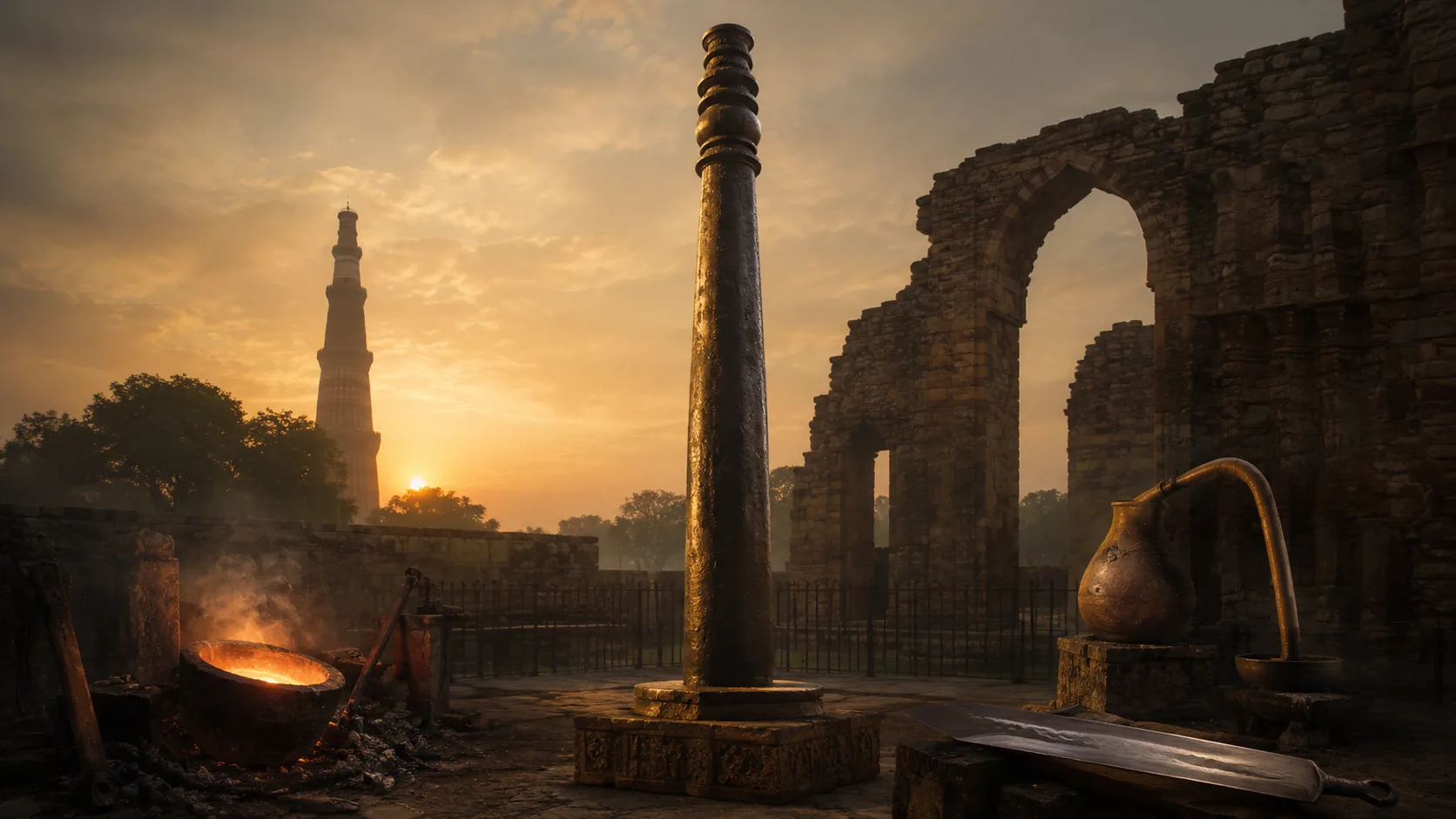
There stands in Delhi, in the courtyard of the Qutb complex, a single shaft of iron some seven metres tall and close to six tonnes in weight, raised in the age of the Guptas around the year four hundred of the common era. It has stood in the open air, through sixteen centuries of monsoon and heat, of wet season and dry, and it has not rusted. A film no thicker than a twentieth of a millimetre has formed upon its surface and has protected it ever since. Iron, of all the common metals, is the one that most wants to return to the earth as rust; that a pillar of it should stand essentially uncorroded after sixteen hundred years is not a curiosity but a profound problem in materials science — and one whose solution was not understood, even by those who marvelled at the pillar, until the closing year of the twentieth century.
The pillar is the most visible monument of a tradition that ran far wider and far deeper than this single object. It is the tradition of metallurgy in Sanātana Bhārata: the winning, refining, alloying, and working of metals to a standard that, again and again across two and a half thousand years, stood at the summit of what any civilization on earth had achieved. This was the steel that the world would call Damascus and would spend centuries failing to reproduce. This was the zinc that European chemistry, in its maturity, still considered all but impossible to extract, and which the furnaces of Rajasthan were producing on an industrial scale while Europe had not yet begun. This was a science recorded not only in the products that survive in the ground but in a literature of disciplined Sanskrit verse, the rasaśāstra and the śilpaśāstra, in which the working of substance was set down with the same care the same civilization gave to grammar, to astronomy, and to the nature of the self.
To tell this story honestly is to tell two stories at once. The first is the story of the achievement — of how, by what means, and to what astonishing degree the metallurgists of Bhārata mastered their materials. The second is the story of what was done to that achievement: how a living, world-leading industry was, within the span of a single colonial century, dismantled — its ore carried off to be smelted in distant mills and sold back to the land that produced it at many times the price, its foundries shuttered, its craftsmen scattered. Both stories are true. Both rest on evidence. Neither will be softened here.
Winning the metal: the bloomery and the chemistry of iron
Before there can be a steel or a rust-proof pillar, there must be iron, and iron does not occur in usable form in the ground. It hides in its ores — chiefly the oxides hematite and magnetite — locked to oxygen, and the whole art of the ironmaker is the art of persuading that oxygen to leave. The smiths of Bhārata accomplished this in the bloomery, a tall clay furnace charged in alternating layers of iron ore and charcoal, into which air was driven by bellows through clay nozzles near the base. The achievement looks simple only to those who have never had to do it.
What happens inside the furnace is a precise sequence of chemistry. The charcoal, burning in a deliberately air-starved heat, does not pass cleanly to carbon dioxide but to carbon monoxide, the hungry, oxygen-seeking gas that is the true agent of the work. That gas rises through the descending charge and strips the oxygen from the ore in three descending stages, hematite yielding to magnetite, magnetite to ferrous oxide, ferrous oxide at last to metallic iron — all of it accomplished below the melting point of iron, so that the metal never flows but gathers instead as a spongy, glowing mass called the bloom, riddled with trapped slag that the smith must then beat out at the forge.
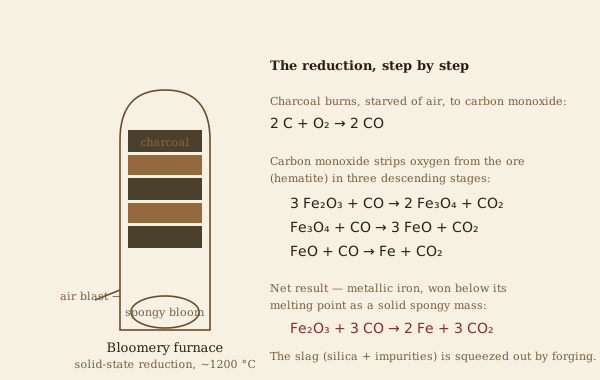
The bloomery furnace and the reduction of iron. Carbon monoxide, generated from charcoal in an air-starved heat, strips oxygen from the ore in three descending stages, yielding metallic iron as a solid spongy bloom below its melting point.
The net reaction. Stripped to its essence, the smelting of iron from hematite is a single transfer of oxygen from the ore to the carbon of the charcoal, carried by carbon monoxide: Fe₂O₃ + 3 CO → 2 Fe + 3 CO₂
From the bloomery came wrought iron — soft, tough, low in carbon, and, when made from the right ores, remarkably resistant to rust. It is wrought iron of exceptional quality that stands in the Delhi pillar. But the bloomery was only the foundation. Upon it the metallurgists of Bhārata raised two achievements that would carry their reputation across the world: a steel of unmatched quality, and a control of carbon so fine that the modern eye, equipped with the electron microscope, still struggles to credit it.
Where it was used. Every iron object of the civilization began here — tools, ploughshares, weapons, temple beams, the wrought-iron stock for the Delhi pillar and the great forge-welded cannon and beams of later centuries.
Carbothermic reduction — the same chemistry, Fe₂O₃ + 3 CO → 2 Fe + 3 CO₂, that runs inside every modern blast furnace, only at vastly greater scale and with the iron now melted rather than won as a solid bloom.
Solid-state reduction demands finer control than melting does — the smith must read heat and air by eye and ear alone. The bloomery is a chemistry laboratory run on craft judgment.
The pillar that would not rust
Return now to the iron column in Delhi, for it is time to understand exactly what it is. The pillar was raised in the Gupta age, bears an inscription in the Sanskrit of that period, and was most likely first erected elsewhere — the evidence points to Udayagiri — before being moved to its present site. It was made not by casting but by forge-welding: lumps of hot wrought iron hammered together, one upon the next, the whole mass built up by hand and by hammer into a single towering shaft. To forge-weld six tonnes of iron into a column seven metres tall, by hand, to a finish that has survived sixteen centuries, is already an extraordinary feat of the smith's craft. But the marvel for which the pillar is famous is not its making. It is its refusal to rust.
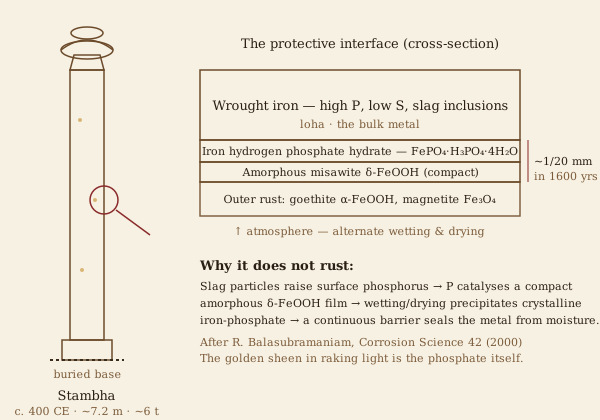
The Delhi iron pillar (c. 400 CE) and a cross-section of the protective interface. High phosphorus and low sulphur in the wrought iron catalyse a compact film of amorphous misawite (δ-FeOOH) and, critically, a crystalline iron-phosphate layer that seals the metal from moisture. In sixteen centuries the film has grown a mere twentieth of a millimetre.
For centuries the resistance of the pillar was a genuine mystery, and many explanations were offered — the dry climate of Delhi, the mass of the iron, some special purity of the metal. None withstood scrutiny, for the pillar is not pure; it is heterogeneous wrought iron laced with slag, exactly the kind of metal that ought to corrode readily. The true explanation was established only in the year 2000, by the metallurgist R. Balasubramaniam of the Indian Institute of Technology at Kanpur, in a study that has become a landmark in the science of corrosion. It is worth setting out with care, because it reveals that the ancient smiths had achieved, by craft and by choice of material, a piece of protective chemistry that modern science can only now fully describe.
Why the pillar does not rust — the mechanism. The wrought iron of the pillar is unusually high in phosphorus and low in sulphur, a consequence of the ancient process, which used no lime flux and so left the phosphorus in the metal. In ordinary iron this would be a defect. Here it is the secret. The sequence runs in three stages: slag particles + high P → rapid initial corrosion enriches the surface with phosphorus
The significance of this can hardly be overstated. The ancient smiths did not, of course, possess the vocabulary of oxyhydroxides and passive films. But by their selection of phosphorus-rich ore, their flux-free process, and their forge-welding technique, they produced precisely the conditions under which this self-protecting layer forms. They engineered, in effect, a corrosion-resistant iron — and they did so a millennium and a half before the chemistry of it could be written down. The pillar is not a lucky accident of a dry climate. It is, in Balasubramaniam's own words, a living testimony to the skill of the metallurgists of ancient Bhārata.
यन्त्रेण रचितं लोहस्तम्भं कालजयङ्करम् । न जातु म्लायते यस्य तेजः सूर्यसमप्रभम् ॥ — yantreṇa racitaṃ loha-stambhaṃ kāla-jayaṅkaram; na jātu mlāyate yasya tejaḥ sūrya-sama-prabham. — "The iron pillar wrought by skill, conqueror of time, whose lustre, equal to the sun's, never fades." — — composed in the classical idiom to mark the Stambha; not an ancient citation [VERIFY: This is an editorial verse composed for the article, not a quotation from a source text. Mark as such or replace with the pillar's actual Gupta inscription before publishing.]
Where it was used. Monumental columns and temple ironwork across Bhārata — the Delhi pillar, the Dhār pillar, the iron beams of the Konārk Sun Temple — all show the same phosphate-protected durability in the open air.
Passive-film corrosion protection; weathering steels and phosphate-conversion coatings rest on the same principle the pillar embodies — a stable surface layer that seals the metal. The mechanism was formally described only in 2000.
The smiths controlled an outcome whose chemistry they could not name. The knowledge lived in the choice of ore and the manner of the work — encoded in practice, awaiting science to read it.
The corrosion-resistance mechanism of the Delhi pillar — the role of high phosphorus, the catalysis of misawite, and the protective crystalline iron-phosphate film — is established in peer-reviewed metallurgical science. Settled The pillar's original location at Udayagiri and the details of its forge-welded manufacture are well-supported reconstructions. Contested
Ukku: the steel that armed the world
If the pillar is the most visible monument of Bhāratīya metallurgy, its most influential product was a steel. The Tamil called it urukku, the Kannada and Telugu ukku — the word means simply "melted metal," "steel" — and from those southern words the English "wootz" descends. For two thousand years this steel flowed out of the workshops of the south, across the Arabian Sea, into the forges of Persia and the Levant, where it was worked into the blades that the Crusaders met and feared: the watered, rippling, impossibly keen swords that Europe knew as Damascus steel. The blades were forged in Damascus and elsewhere in West Asia, but the steel in them was born in Bhārata. Europe would spend the better part of a thousand years trying, and failing, to reproduce it.
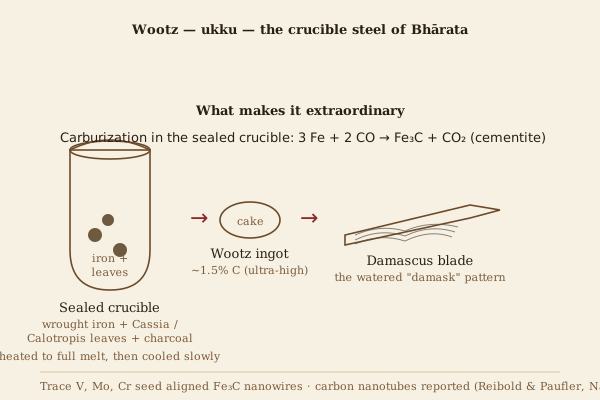
The wootz process: wrought iron sealed in a crucible with carbon-rich leaves and charcoal, melted, then cooled slowly to an ultra-high-carbon ingot of roughly 1.5% carbon, later forged into the watered-pattern Damascus blade. Trace vanadium and other elements seed the aligned carbide structure; carbon nanotubes have been reported in surviving blades.
To understand why wootz was so prized, and so hard to copy, one must understand the central difficulty of steel itself. Steel is iron with a little carbon dissolved in it, and the amount of carbon decides everything. Too little, and the metal is soft wrought iron, easily bent. Too much — above about two percent — and the metal becomes cast iron, hard but glass-brittle, shattering under a blow. Useful steel lives in a narrow band between these extremes, and the finest sword steel must be hard enough to hold a razor edge yet tough enough not to break against shield or blade. Wootz carried an extraordinarily high carbon content, around one and a half percent, near the very edge of what should be workable at all. By every ordinary expectation such a steel should have been too brittle for a sword. That it was not is the heart of the mystery.
The iron–carbon problem. Carbon in iron forms a hard compound, iron carbide or cementite, Fe₃C. In the sealed crucible, carbon from the charcoal and the leaves diffuses into the molten iron: 3 Fe + 2 CO → Fe₃C + CO₂
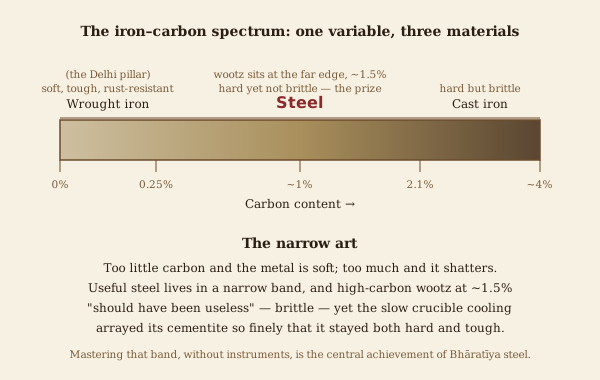
One variable, three materials. The carbon content alone separates soft wrought iron from useful steel from brittle cast iron. Wootz sits at the far high-carbon edge of the workable band, where mastery of cooling and forging was needed to keep an ultra-high-carbon steel from shattering.
The modern recovery of the wootz secret is itself a remarkable story, and it confirms rather than diminishes the ancient achievement. In the closing years of the twentieth century the metallurgist John Verhoeven, working with the bladesmith Alfred Pendray, finally reproduced true wootz blades — and found that the key lay in trace impurities. Minute quantities of vanadium and other carbide-forming elements, present in particular Indian ores at levels of a few thousandths of a percent, were essential: they seeded the fine, banded array of carbides that gave the steel its pattern and its properties. Without those trace elements, no amount of skill could produce the true damask. The ancient smiths had, by using the right ore and the right process, harnessed an alloying effect so subtle that it could not even be detected, let alone understood, until the age of the electron microscope. In 2006, researchers reported finding carbon nanotubes and cementite nanowires in a surviving Damascus blade — nanoscale structures, formed inadvertently by the ancient recipe, of a kind that twenty-first-century materials science prizes among its own frontier achievements.
उक्कुरिति प्रथितं तीक्ष्णलोहं जलधारेव चित्रितम् । यस्य धारां न सहन्ते रिपवः सङ्ग्रामभूमिषु ॥ — ukkur iti prathitaṃ tīkṣṇa-lohaṃ jala-dhāreva citritam; yasya dhārāṃ na sahante ripavaḥ saṅgrāma-bhūmiṣu. — "The keen steel renowned as ukku, patterned as if with flowing water, whose edge no foe can withstand upon the fields of battle." — — editorial verse in classical idiom evoking the wootz tradition [VERIFY: Editorial composition, not a source citation. Replace with an attested Tamil/Sanskrit reference to ukku, or mark clearly as composed, before publishing.]
Where it was used. Sword and dagger blades above all — the Damascus blades of West Asia were forged from imported wootz ingots — alongside fine tools and edged instruments. A two-thousand-year export industry from southern Bhārata.
Ultra-high-carbon steel and microalloying: the deliberate use of trace elements (V, Mo, Cr) to control carbide structure, and the nanoscale ordering of phases — exactly the levers modern advanced-steel design pulls, anticipated by the crucible.
An alloying effect at a few thousandths of a percent, invisible to any pre-modern test, was reliably harnessed by ore-choice and craft. The smiths controlled what they could not see — and it took electron microscopy to find out how.
The ultra-high-carbon nature of wootz, its export as the basis of Damascus steel, the Verhoeven–Pendray reproduction, and the role of trace vanadium are established in the metallurgical literature. Settled The 2006 report of carbon nanotubes in a Damascus blade is published in Nature and corroborated by later work, though the precise mechanism of their formation remains under study. Contested
The deep mines: gold and the state science of metal
Steel and iron were the muscle of the civilization; gold was its measure of value and its sacred metal, and the winning of it reveals a different face of Bhāratīya metallurgy — the face of organized, deep, systematic mining, and of a state that treated the science of metals as an instrument of governance.
In the greenstone belts of Karnataka lie some of the deepest ancient mine workings anywhere on earth. At Kolar, at Hutti, at Maski, the old miners drove narrow shafts far down into the hard rock in pursuit of the gold-bearing quartz reefs, and the traces they left — wood, charcoal, ash, broken pottery — have allowed modern radiocarbon dating to place episodes of this mining in the early centuries of the common era, with the use of gold in the region reaching back toward pre-Harappan times. To mine quartz at depth is no small thing. The rock is too hard to dig, and so the miners used fire-setting: a fire built against the rock face, then quenched with water, so that the sudden contraction cracked the stone and allowed it to be broken away. The charcoal and ash in the shafts are the signature of that technique.
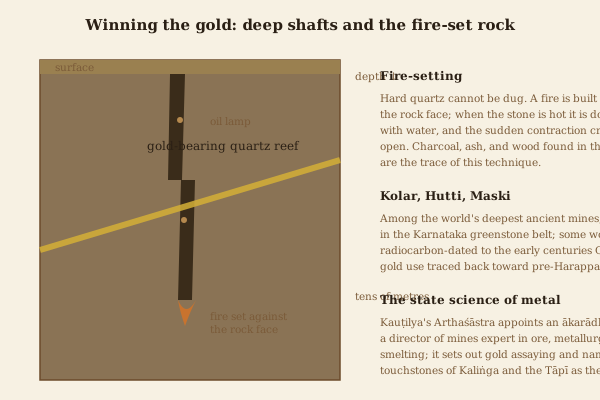
Deep gold mining in the Karnataka greenstone belt. Narrow shafts followed the gold-bearing quartz reefs down into hard rock, broken open by fire-setting — heating the face and quenching it to crack the stone. The Arthaśāstra regulated this as a state science, appointing an expert director of mines and codifying the assaying of gold.
What lifts this from craft to science is the textual and institutional record that surrounds it. The Arthaśāstra of Kauṭilya, composed around the fourth century before the common era, treats mining as a foundation of the kingdom's wealth and legislates for it in detail. It appoints an ākarādhyakṣa, a superintendent or director of mines, who is required to be expert in the science of metal-bearing veins in the earth, in metallurgy, and in the art of smelting — a named office demanding genuine technical mastery. The text identifies kinds of gold ore, prescribes methods for processing them, and sets out tests for ascertaining the purity of gold, naming the touchstones of the Kaliṅga country and the Tāpī river as the truest for assaying. This is not folklore. It is the administrative apparatus of a metallurgical economy, with its experts, its assays, its standards, and its quality control, set down in a treatise on statecraft two and a half thousand years ago.
आकराध्यक्षः शुल्बधातुशास्त्ररसपाकज्ञः । खनिं विद्यात् सुवर्णस्य धातुं च परिशोधयेत् ॥ — ākarādhyakṣaḥ śulba-dhātu-śāstra-rasa-pāka-jñaḥ; khaniṃ vidyāt suvarṇasya dhātuṃ ca pariśodhayet. — "The superintendent of mines, knowing the science of ores, metals, and their smelting, shall identify the gold-bearing vein and refine the metal." — — after the office of the ākarādhyakṣa, Arthaśāstra 2.12 [VERIFY: Editorial composition in the idiom of Arthaśāstra 2.12; replace with the verified text or keep marked as composed before publishing.]
Where it was used. Gold for coinage, ornament, ritual, and the treasury of the state; the deep mines of Karnataka supplying a metal economy regulated, taxed, and assayed under royal administration.
Deep hard-rock mining, fire-setting (used in European mines into the modern era), ore assaying and the touchstone test for gold purity — and, in the Arthaśāstra, something like a mining ministry with technical qualification requirements.
That a fourth-century-BCE treatise demands metallurgical expertise of its director of mines, and codifies assaying, shows metallurgy was not only practised but institutionalized as a science of the state.
The antiquity and depth of the Karnataka gold mines, the use of fire-setting, and the Arthaśāstra's detailed treatment of mining, smelting, and gold assaying are well established. Settled The earliest dates for some workings, and the precise dating of the Arthaśāstra's composition, are subjects of ongoing scholarship. Contested
The metal that boils as it is born: zinc
Of all the metallurgical achievements of Sanātana Bhārata, the one that most deserves the word impossible — the one that the chemistry of the age said could not be done, and which was done anyway — is the extraction of metallic zinc. To understand why this ranks at the very summit of pre-modern metallurgy, one must understand a cruel quirk of the metal's nature, a trap that defeated every other civilization for centuries.
Most metals are won by heating their ore with charcoal until the metal, freed from its oxygen, melts and runs down to be collected. This works because most metals, once freed, remain liquid or solid at the temperature of their reduction. Zinc will not oblige. The temperature required to free zinc from its ore — to reduce zinc oxide with carbon — is around the same temperature at which zinc boils, about 907 degrees. So at the very instant the metal is liberated, it is not a liquid to be poured but a vapour, a gas rising off the charge. And the moment that hot zinc vapour meets the air of the furnace, it burns — it re-oxidizes instantly back to a white ash of zinc oxide, the very compound one started from. The metal escapes up the chimney as smoke and is lost. This is why brass, an alloy of copper and zinc, was made in the ancient world long before pure zinc ever was: brass could be made by heating copper with zinc ore directly, the zinc passing into the copper without ever having to exist as free metal. To capture zinc itself, as a metal in the hand, demanded something far cleverer than smelting.
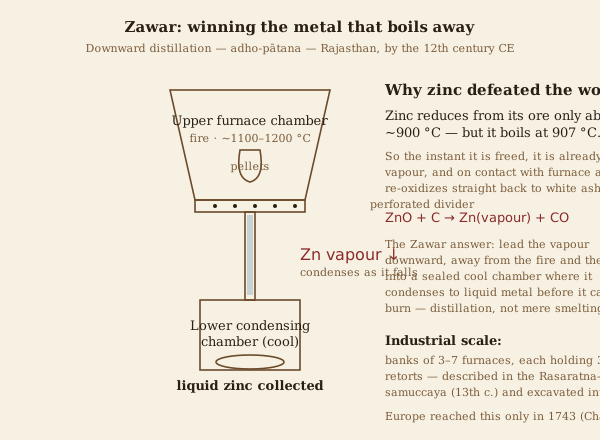
The Zawar solution: downward distillation. Because zinc emerges as a vapour that would burn on contact with furnace air, the vapour is led downward through a tube, away from the fire, into a sealed cool chamber where it condenses to liquid metal before it can re-oxidize. Banks of such furnaces, each holding dozens of retorts, operated on an industrial scale by the twelfth century.
The answer, perfected at the mines of Zawar in Rajasthan, was distillation — and not merely distillation but downward distillation, a technique of real sophistication. The roasted ore, ground and mixed with charcoal and rolled into small pellets, was packed into brinjal-shaped clay retorts. These were set in the upper chamber of a furnace, mouth downward, each retort fitted with a tube that passed down through a perforated floor into a separate, cooler chamber below. When the furnace was fired, the zinc was reduced and rose as vapour — but instead of escaping upward into the flames and air, it was forced downward through the tube, away from the heat, into the sealed lower chamber, where it cooled and condensed into liquid metal that could be collected. The vapour never met the open air. The metal was caught before it could burn. It is one of the most elegant pieces of chemical engineering in the pre-modern world.
The reaction, and the trap. The reduction of zinc oxide by carbon is straightforward to write: ZnO + C → Zn↑ + CO
Nor was this a matter of a few experimental vessels. The furnaces of Zawar were an industry. Excavation has revealed banks of furnaces, each holding dozens of retorts, operated in a coordinated, repeatable, production-scale process — and the technique is described in the alchemical and metallurgical literature of the period, most notably the thirteenth-century Rasaratnasamuccaya, which sets out the apparatus and the method. The mines themselves were worked with care: well-lit galleries, drainage, clean water for the miners, organized transport of ore and timber. This was not the secret of a single workshop but the standing technological capacity of a civilization, recorded in its texts and run at scale.
रसकं द्रावयेद्यन्त्रे अधःपातनयोगतः । जायते जसदं शुद्धं यद्विना न हि काञ्चनम् ॥ — rasakaṃ drāvayed yantre adhaḥ-pātana-yogataḥ; jāyate jasadaṃ śuddhaṃ yad vinā na hi kāñcanam. — "Let the zinc-ore (rasaka) be melted in the apparatus by the method of downward distillation; pure zinc (jasada) is produced, without which there is no [mock] gold." — — in the idiom of the Rasaratnasamuccaya, on adhaḥpātana (downward distillation) [VERIFY: Paraphrase in the textual idiom; verify exact wording, chapter and verse against a critical edition of the Rasaratnasamuccaya before publishing.]
Where it was used. Production of metallic zinc for brass ("mock gold" and "mock silver" utensils and coinage), for medicinal preparations of the rasa tradition, and as a traded metal. An industrial operation at Zawar supplying a wide region.
Retort distillation of zinc — the recovery of a metal through its vapour phase, condensed in isolation from oxygen. The exact principle of Champion's 1743 process and, in spirit, of modern thermal zinc production.
To win a metal that exists, at the moment of its birth, only as a burning vapour required reasoning about phase and reactivity that no other civilization completed for six hundred more years. This is the summit.
The downward-distillation extraction of metallic zinc at Zawar, its industrial scale, its description in the Rasaratnasamuccaya, and its priority over European zinc production are established by the British Museum–led excavations and subsequent scholarship. Settled Mining at Zawar has been traced to around the fifth century BCE, with the regular production of distilled metallic zinc placed variously from about the ninth to the twelfth century CE; the precise earliest date is debated. Contested
The intractable bronze: the metal mirror and the high-tin art
Bronze is the alloy of copper and tin, and the ordinary bronze of the ancient world carried perhaps a tenth part of tin — enough to harden the copper while keeping it workable. Push the tin much higher and the metal changes character entirely. As the tin rises past about a fifth of the whole, a hard, pale, brittle compound forms within the alloy, and the bronze becomes, by ordinary methods, unworkable: it shatters under the hammer rather than yielding to it. Most of the ancient world, encountering this brittleness, simply stopped. The smiths of southern Bhārata did not.
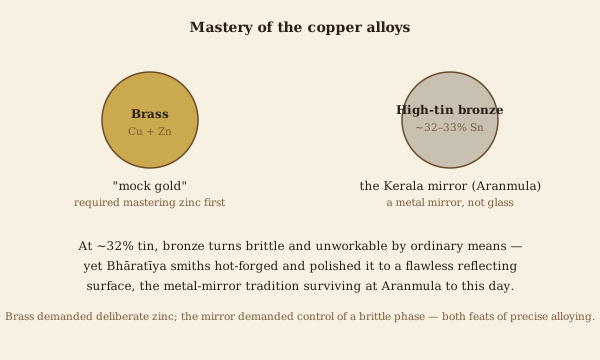
Mastery of the copper alloys. Brass (copper with zinc) demanded the prior conquest of zinc itself. High-tin bronze — beta bronze near 23% tin, and the delta bronze of the Aranmula mirror near 33% — is ordinarily brittle and unworkable, yet was hot-forged, quenched, and polished into vessels of astonishing thinness and into a true metal mirror.
The archaeometallurgist Sharada Srinivasan has traced, through both excavation and the study of surviving craft, a distinctively Bhāratīya mastery of high-tin bronze reaching back to the early first millennium before the common era and, in its roots, toward Harappan times. From the Iron Age burial sites of Adichanallur in Tamil Nadu and the Nilgiri hills come bowls and vessels of high-tin beta bronze, close to twenty-three percent tin — a composition approaching the pure brittle intermetallic phase — that were nonetheless heavily hot-forged and then quenched, some worked to a rim thinness of less than two-tenths of a millimetre. To forge a near-brittle alloy to such delicacy required taking the metal through a narrow window of high temperature, within which the otherwise unworkable phase becomes briefly malleable, and then locking in the structure by quenching. These rank among the earliest such vessels known anywhere, and they overturned an older assumption that the skilled high-tin bronze craft had spread to Bhārata from elsewhere; the evidence points the other way.
The living survivor of this tradition is the Aranmula kaṇṇāṭi of Kerala — a mirror not of silvered glass but of solid high-tin delta bronze, around a third tin, polished to a flawless reflecting surface by a family craft that still guards its precise method. To make a mirror of metal, from an alloy the textbook calls unworkable, by hot-forging and patient polishing alone, is a feat of control over phase and temperature as fine in its way as the steel or the zinc. The same command of a brittle, high-tin composition runs from the Iron Age bowls to the mirror still made today.
Where it was used. Fine bowls and ritual vessels of the South Indian Iron Age; bells and cymbals; and the Aranmula metal mirror of Kerala, made by a continuous family tradition into the present day.
Thermomechanical processing of brittle intermetallic alloys — taking a material through a narrow temperature window where it can be deformed without fracture, then quenching to fix the structure. Advanced, and ancient.
Working a metal the modern textbook calls unworkable, reliably and to a mirror finish, demands a craftsman's command of phase behaviour — the knowledge, without a phase diagram, of exactly how far the metal can be pushed and how.
The Iron Age high-tin beta bronze vessels of Adichanallur and the Nilgiris, their early date, and the surviving high-tin bronze mirror craft of Aranmula are established by archaeometallurgical analysis. Settled The proposed continuity of the tradition from Harappan times is a supported but still-developing reconstruction. Contested
The breathing image: Chola bronze and the lost-wax art
If the high-tin mirror is the most exacting of the copper crafts, the most sublime is the cast bronze image — and above all the bronze of the Cholas, the dynasty under whose patronage, between the ninth and thirteenth centuries, South Indian bronze casting reached a height that the world has placed among the supreme achievements of metallurgical art. The Naṭarāja, Śiva as the cosmic dancer within his ring of flame, is the emblem of this tradition; a cast of it stands today before CERN in Geneva, the dancing god set before the great machine that probes the dance of matter.
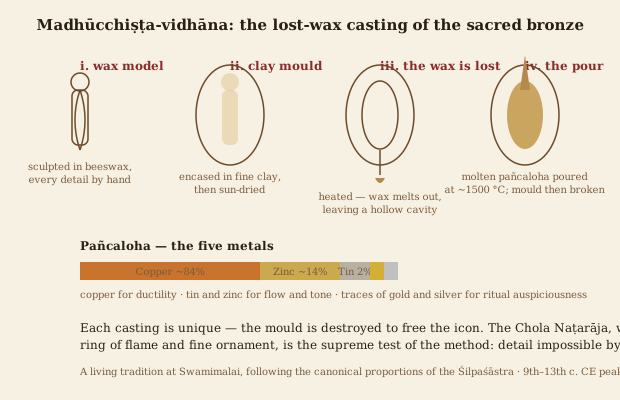
The lost-wax method (madhūcchiṣṭa-vidhāna). A model is sculpted in wax, encased in clay, and heated until the wax runs out; molten pañcaloha — the five-metal alloy of roughly 84% copper, 14% zinc, 2% tin with traces of gold and silver — is poured into the cavity at around 1500 °C, and the mould is broken to free a unique image.
The method is the lost-wax casting the Sanskrit texts call madhūcchiṣṭa-vidhāna, and its discipline is total. The image is first sculpted entire in beeswax, every ornament and gesture and fold worked by hand, following the canonical proportions laid down in the śilpaśāstra. This wax form is then encased in fine clay and dried. When the clay is heated, the wax melts and runs out through a vent — it is "lost" — leaving a hollow mould that holds the exact negative of the sculptor's work. Into that cavity the molten metal is poured, heated to around fifteen hundred degrees; and when it has cooled and set, the clay mould is shattered and discarded. Every casting is therefore unique: the mould cannot survive the making of the image, and no two are ever the same. The open ring of flame around the Naṭarāja, the fine jewellery, the poised and fluid limbs — these are forms that no other casting method could capture, and they are won at the cost of a mould destroyed for each one.
मधूच्छिष्टेन विधिना पञ्चलोहं विनिर्मितम् । प्रतिमां जीवसदृशीं शिल्पी कुर्यात्प्रयत्नतः ॥ — madhūcchiṣṭena vidhinā pañca-lohaṃ vinirmitam; pratimāṃ jīva-sadṛśīṃ śilpī kuryāt prayatnataḥ. — "By the method of the lost wax, from the five metals, let the craftsman with all care make an image like unto the living." — — editorial verse in the idiom of the śilpaśāstra on bronze image-casting [VERIFY: Editorial composition; replace with an attested śilpaśāstra verse on madhūcchiṣṭa-vidhāna or keep marked as composed before publishing.]
The alloy itself is a deliberate composition, the pañcaloha or "five metals": principally copper, with around a seventh part zinc and a small portion of tin, and traces of gold and silver added for ritual auspiciousness. The choice is not arbitrary. Copper gives the ductility that lets fine detail flow into the mould and survive the finishing; the tin and zinc adjust the melting behaviour, the flow, and the resonance of the finished bronze; the precious metals carry a sacral meaning. That this five-metal recipe, tuned for both casting performance and consecration, has been transmitted by hereditary craft for a thousand years and is still practised at Swamimalai today is itself a testament to the depth and continuity of the tradition.
Where it was used. The cast bronze icons of the temple — Śiva, Viṣṇu, the consorts and the saints — both the fixed image and the processional deity carried through the festival streets; a sacred art and a living ritual technology.
Investment casting (cire-perdue), the same lost-wax principle now used for turbine blades and precision components, together with deliberate multi-element alloying tuned for castability — the Chola achievement in modern industrial dress.
A thousand-year unbroken transmission of a five-metal recipe and a canon of proportion, each image a unique casting from a destroyed mould, is a knowledge system sustained as living craft, not relic.
The Chola lost-wax bronze tradition, the pañcaloha composition, and its continuity at Swamimalai are well documented; precise alloy ratios vary across analysed pieces and periods. Settled
The science recorded in verse
It would be a mistake to imagine all this as mere craft, knowledge held only in the hands and passed by imitation. The metallurgy of Bhārata was also a literature. The tradition of rasaśāstra — the science of substances, mineral and metallic — set down in disciplined Sanskrit the processing of metals, the design of furnaces and apparatus, the preparation of alloys and compounds. The thirteenth-century Rasaratnasamuccaya describes the very zinc-distillation apparatus that excavation would later confirm at Zawar. Earlier still, the Arthaśāstra of Kauṭilya legislates for the state's mines and metalworks, the assaying of metals, the office of the superintendent of mining — the administration of a metallurgical economy. The śilpaśāstra and the āgama texts set down the casting of bronze images by the lost-wax method, an art whose products fill the museums of the world.
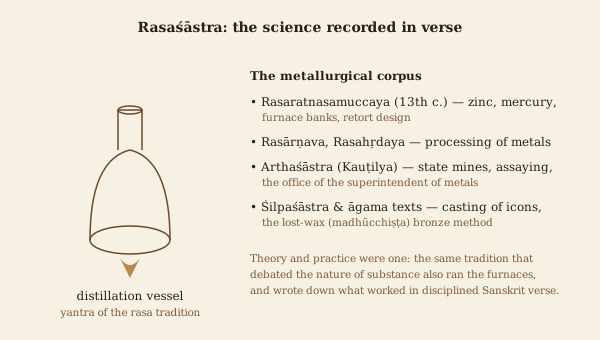
Theory and practice as one tradition. The rasaśāstra literature — the Rasaratnasamuccaya, Rasārṇava, and others — together with the Arthaśāstra's administration of mines and the śilpaśāstra's casting methods, recorded metallurgical practice in disciplined verse, the same civilization running the furnaces and writing down what worked.
This union of doing and recording matters. It means the achievements described here were not isolated flashes of craft genius but the expression of a systematic, transmitted, textually preserved body of knowledge — a knowledge system in the full sense, with its theory, its vocabulary, its apparatus, and its institutions. The same intellectual culture that produced the grammar of Pāṇini and the astronomy of Āryabhaṭa produced also a metallurgy that could capture a boiling metal and forge a rust-proof iron, and it wrote that metallurgy down.
Nowhere is this union of theory and practice more striking than in the handling of mercury — pārada, called in the tradition the king of metals. Mercury is a liquid metal, volatile and toxic, and the rasaśāstra developed for it an elaborate sequence of processing steps, the saṃskāras — eight in the basic scheme, eighteen in the full — by which the raw metal was purified, ground, heated, quenched, and sublimed through stage after stage. The avowed purpose was to render the mercury fit for medicine: to detoxify it, stabilize it, and reduce it to a fine ash, a bhasma, that could be taken into the body. Whatever one makes of the therapeutic claims, the chemistry is real and the control is fine.
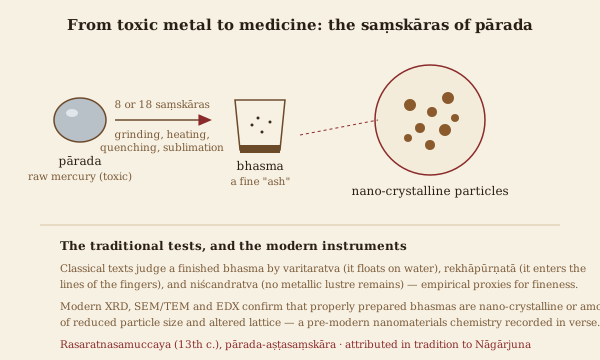
The processing of mercury into bhasma through the saṃskāras. Classical texts judged a finished bhasma by empirical tests — that it floats on water, enters the lines of the fingers, and shows no metallic lustre. Modern XRD, SEM/TEM and EDX analysis confirms that properly prepared bhasmas are nano-crystalline or amorphous, of reduced particle size: a pre-modern nanomaterials chemistry recorded in verse.
The most arresting confirmation comes from the modern laboratory. The classical texts judged a properly finished bhasma by a set of empirical tests — that it should float upon water, that it should enter the fine lines of the fingers when rubbed, that it should show no remaining metallic lustre. These are practical proxies for one thing: extreme fineness of particle. And when modern researchers examined properly prepared bhasmas with X-ray diffraction, electron microscopy, and energy-dispersive analysis, they found exactly that — nano-crystalline and amorphous structures, particles reduced toward the nanometre scale, with altered crystal lattices. The tradition had developed, by repeated grinding and calcination and by empirical tests for fineness, a chemistry of nanoscale metallic and mineral particles, and had written its methods and its quality criteria down in verse, centuries before the instruments existed that could see what it had made.
वारितरं रेखापूर्णं निश्चन्द्रं च यदा भवेत् । तदा भस्म सुसिद्धं स्याद्योग्यं देहरसायने ॥ — vāritaraṃ rekhā-pūrṇaṃ niścandraṃ ca yadā bhavet; tadā bhasma su-siddhaṃ syād yogyaṃ deha-rasāyane. — "When it floats upon water, fills the lines of the fingers, and is without lustre, then the ash is well-perfected, fit for the rejuvenation of the body." — — in the idiom of the rasaśāstra bhasma-parīkṣā (tests of the ash) [VERIFY: Editorial composition rendering the classical bhasma tests; verify against a critical edition or keep marked as composed before publishing.]
Bhārata and the world
It is worth setting these achievements against the wider record, plainly and without exaggeration, to see where they stand.
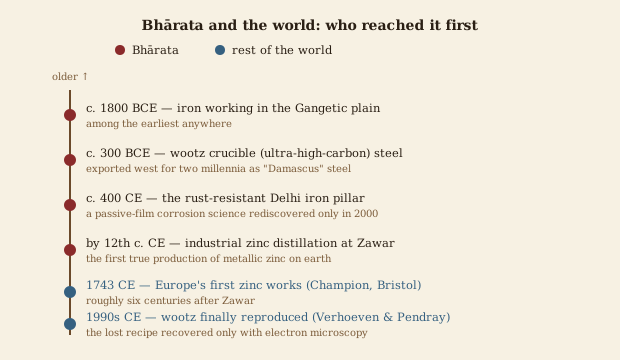
The comparative record. Across iron, steel, corrosion-resistant ironwork, and zinc, Bhārata reached the summit early and held it long — the zinc of Zawar preceding Europe's first zinc works by roughly six centuries, and the wootz recipe recovered in the West only with the electron microscope.
The pattern is consistent across every metal it touched. In iron-working, Bhārata stands among the earliest anywhere. In crucible steel it led the world for two thousand years and was not equalled until the modern era. In corrosion-resistant ironwork it achieved, by the fifth century, a result whose science was written down only in the year 2000. In gold it drove some of the deepest mines of the ancient world and codified the assaying of the metal in a treatise on statecraft. In high-tin bronze it worked an alloy others thought unworkable into mirrors and vessels of astonishing fineness, and in cast bronze it produced images counted among the supreme art of any civilization. In the handling of mercury it reached, by empirical method, a chemistry of nanoscale particles. And in zinc it did what no one else on earth could do, six centuries before Europe managed it. This is not the record of a civilization that borrowed its metallurgy. It is the record of a civilization that, for most of recorded history, defined the summit of the art.
The deliberate undoing
And then, within the span of a single century, this living industry was destroyed. The destruction was not the natural death of an outdated craft overtaken by a better one. It was, in significant part, the result of policy — the policy of a colonial power that found it more profitable to turn Bhārata from a maker of metal into a supplier of raw ore and a captive market for finished goods.
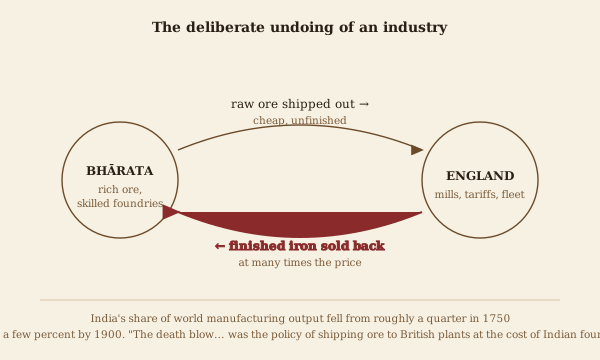
The colonial reversal. Rich ore and skilled foundries were turned into a one-way supply of cheap raw material; finished iron, smelted in distant mills, was sold back to the land that produced the ore at many times the price. India's share of world manufacturing output fell from roughly a quarter in 1750 toward a few percent by 1900.
The mechanism was simple and effective. Indian iron and steel making depended on a dispersed network of small, skilled foundries, working local ore with local fuel and centuries of accumulated technique. Colonial policy worked against them from several directions at once. The traditional patrons — the courts and princely states whose demand sustained the armourers and the fine smiths — were dismantled or impoverished, and with them went the market for the highest-quality work. Discriminatory tariffs and the machinery of imperial trade made British factory iron artificially cheap in Indian markets while Indian finished goods were shut out. And, most pointedly, the raw ore of Bhārata was shipped to the furnaces of Britain, smelted there, and the finished metal sold back into Bhārata at a great markup — the ore leaving cheap and unfinished, the iron returning dear. A study of the period puts it bluntly: the death blow to the Indian metal industry was the colonial policy of shipping ore to British plants at the cost of the Indian foundries. The country that had armed three continents with its steel was reduced to buying back, at a premium, iron made from its own earth.
What was lost was not only an industry but a continuity of knowledge. When the foundries closed and the craftsmen scattered, the chains of transmission that had carried technique from master to apprentice for a hundred generations were broken. The wootz recipe was lost so completely that recovering it took the West two centuries and an electron microscope. The downward-distillation zinc works fell silent. The living tradition that had written the Rasaratnasamuccaya and forged the Delhi pillar was not refuted or surpassed — it was starved, and its memory had to be reconstructed, in the modern era, by archaeology and laboratory science working backward toward what the texts had plainly stated all along.
The deliberate, policy-driven dimension of the destruction of Indian iron and steel making is supported by historical scholarship, even as the relative weight of colonial policy versus broader economic forces remains debated. Contested The scale of India's deindustrialization between 1750 and 1900 is well established. Settled
The pinnacle, and what it implies
A reflection in the author's voice.
What follows is offered not as demonstrated fact but as the considered conviction of one who has spent long years among these matters. Everything set down above can be checked. The Delhi pillar stands; one may walk to it and see the iron that has not rusted. The wootz blades survive in the world's museums, and their nanostructure has been imaged. The zinc retorts of Zawar have been dug from the ground and their chemistry confirmed. These are not articles of faith. They are objects and measurements, and they say something that the modern mind, schooled to imagine technological progress as a single line ascending from West to present, finds hard to absorb: that the summit of metallurgy, for most of recorded history, stood in Bhārata.
Consider what the zinc alone demands of us. To extract metallic zinc, one must grasp that a substance can exist in a vapour phase, that a metal can be reduced and yet escape as gas, that this gas will re-oxidize on contact with air, and that the remedy is to lead the vapour away from the oxidizing zone and condense it in isolation. That is a chain of physical and chemical reasoning of real depth. The smiths of Zawar acted upon it correctly, at industrial scale, six centuries before European chemistry could follow — and they recorded the method in their texts. If a civilization understood the vapour-phase behaviour of metals well enough to build the downward-distillation furnace, what else did it understand that we have not yet thought to look for, or have looked for and failed to recognize?
This is the pattern that should give the honest mind pause. Again and again, a claim of the Bhāratīya tradition has been dismissed as exaggeration until the evidence forced a reversal. The rust-proof pillar was thought a fable of dry air until the chemistry of its phosphate film was traced. The wootz steel was thought metallurgical romance until trace vanadium and carbon nanotubes were found in the blades. The zinc of the texts was thought impossible until the retorts were excavated. In every case the knowledge was there, recorded plainly in the products and often in the verses, and the world's ability to credit it arrived late — sometimes by centuries. The texts did not overstate. The modern eye understated, because it could not yet see.
It is in this spirit that the metallurgy of Sanātana Bhārata deserves to be read: not as a collection of isolated wonders, but as the visible, verifiable peak of a knowledge system whose full depth we are still, slowly, learning to measure. The iron that did not rust, the steel that armed the world, the metal won from its own burning vapour — these are not the limits of what was known. They are the portion of it that happened to survive in forms our instruments could finally read. As those instruments mature, it is the conviction of this author that more of what was recorded will be recognized for what it always was: knowledge, exact and hard-won, set down by a civilization that understood its materials to a depth the world is only now equipped to confirm. The fire that did not rust still stands in Delhi. We are still learning what its makers knew.
*Sources and further reading. R. Balasubramaniam, "On the Corrosion Resistance of the Delhi Iron Pillar," Corrosion Science 42 (2000): 2103–2129; and Story of the Delhi Iron Pillar (Foundation Books, 2005). J. D. Verhoeven and A. H. Pendray, "Studies of Damascus Steel Blades," Materials Characterization 29 (1992): 304–355. M. Reibold, P. Paufler et al., "Carbon Nanotubes in an Ancient Damascus Sabre," Nature 444 (2006): 286. Sharada Srinivasan and S. Ranganathan, India's Legendary Wootz Steel: An Advanced Material of the Ancient World (2004). P. T. Craddock et al., on the Zawar zinc-distillation excavations (British Museum). Rasaratnasamuccaya (13th c.), on zinc and apparatus. Kauṭilya, Arthaśāstra, on state mines and assaying. On deindustrialization: Angus Maddison, The World Economy: A Millennial Perspective (2001); and the scholarship on colonial-era Indian iron and steel.*