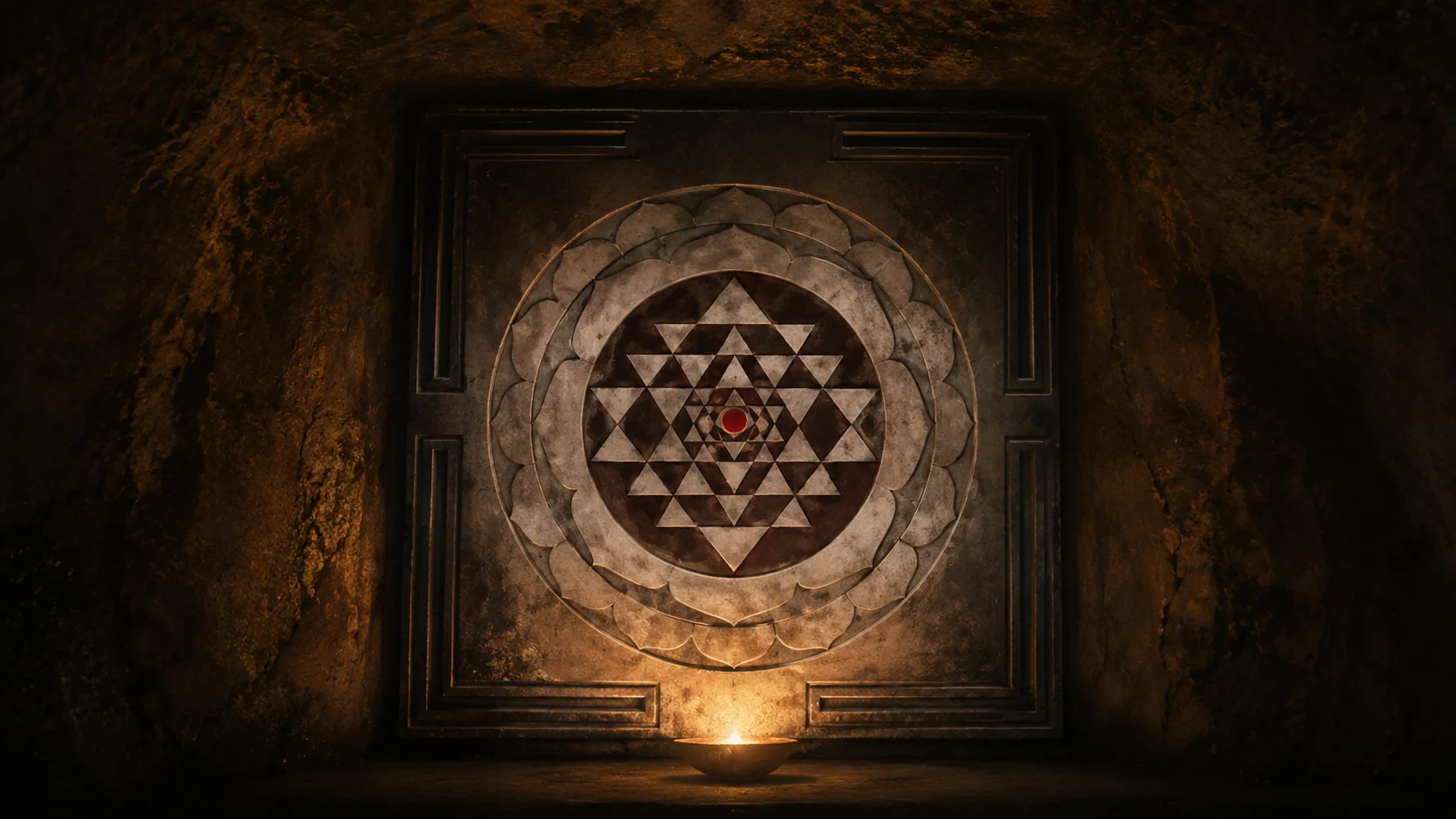
Two of the most concentrated devotional texts in the Sanskrit tradition describe the same hidden diagram, from opposite directions. In the Kuñcitāṅghri-stava, the dīkṣitar-priest Umāpati Śivācārya looks at the dancing Naṭarāja in the golden hall of Cidambaram and sees, beneath the bronze, a yantra — a precise ritual geometry of triangles and a central point, upon which the Lord dances. In the Saundaryalaharī, Ādi Śaṅkara looks at the Goddess and describes that same geometry as Her body — the Śrīcakra, the supreme diagram of Śrīvidyā, built of nine interlocking triangles resolving into forty-three. One poet is gazing at Śiva in motion; the other at Śakti as form. They are describing, it turns out, a single object. The dance and the diagram are the same reality, read kinetically in one text and statically in the other.
This essay sets the two side by side. It is a smaller piece than a full study of either text would require — a single thread pulled from both and tied together: that the forty-three-triangle figure Śaṅkara contemplates as the Devī's Śrīcakra is the very yantra Umāpati places under Naṭarāja's lifted foot, and that this identity is not a modern harmonisation but something the texts themselves assert.
The Yantra Beneath the Dancer
Umāpati does not wait to introduce the theme. The very first verse of his three-hundred-and-thirteen-verse hymn already places the dance not on a stage but upon a diagram — and not just any diagram, but the yantra-rāja, the "king of yantras," which in the Śrīvidyā tradition is a standard name for the Śrīcakra.
तद्वैराजान्तरङ्गे विलसति हृदयाम्भोरुहे दक्षिणाग्रे ।
मध्ये सम्मेलनाख्ये मुनिवरमनसा भाविते यन्त्रराजे
यश्शक्त्या नृत्यतीशस्तमपि नटपतिं कुञ्चिताङ्घ्रिं भजेऽहम् ॥
tad-vairājāntaraṅge vilasati hṛdayāmbhoruhe dakṣiṇāgre |
madhye sammelanākhye muni-vara-manasā bhāvite yantra-rāje
yaś śaktyā nṛtyatīśas tam api naṭa-patiṃ kuñcitāṅghriṃ bhaje 'ham ||
Two words do the work. The dance happens yantra-rāje, "upon the king of yantras," and it happens śaktyā, "by means of His Śakti." Already in the opening lines the Naṭarāja of Cidambaram is fused with the geometry and the goddess of Śrīvidyā: the dancer stands on the diagram, and the diagram is animated by the very Power who, in the Śākta texts, is the diagram.
Umāpati makes the identification explicit later, when he describes what is actually inscribed on the wall and floor of the Cit Sabhā. In the hundred-and-tenth verse he draws the Śrīcakra in words — the forty-three-angled figure, the encircling lotus-rings, the earth-square, and the central bindu on its jewelled seat — and says the Lord, worshipped by the Goddess, dances seated upon it.
बिन्दौ सन्तानकल्पद्रुमनिकरयुते रत्नसौधे मनोज्ञे ।
ब्रह्माद्याकारपादे शिवमयफलके स्वर्णमञ्चे निषण्णो
देव्या यः पूज्यते तं हरिमुखविबुधैः कुञ्चिताङ्घ्रिं भजेऽहम् ॥
bindau santāna-kalpadruma-nikara-yute ratna-saudhe manojñe |
brahmādyākāra-pāde śiva-maya-phalake svarṇa-mañce niṣaṇṇo
devyā yaḥ pūjyate taṃ hari-mukha-vibudhaiḥ kuñcitāṅghriṃ bhaje 'ham ||
Read the components: traicatvāriṃśad-aśra — "forty-three-angled" — is the technical signature of the Śrīcakra, whose nine interlocking triangles generate exactly forty-three smaller triangles around the central bindu. The "lotuses of eight and sixteen petals" (vasu-nṛpa-kamale, eight-and-sixteen) are the Śrīcakra's two petal-rings; the "circular earth-ring" is its outer bhūpura enclosure; the bindu is its centre. Umāpati is not gesturing vaguely at "sacred geometry." He is naming the Śrīcakra, component by component, and placing Naṭarāja at its bindu — worshipped, he adds, by the Goddess Herself.
And lest the Śrīvidyā framing be doubted, the very next stretch of the hymn invokes the mantra. In verse 112 he names the ṣoḍaśākṣarī, the sixteen-syllable mantra-king of Śrīvidyā, joined to the five-syllabled Bālā seed, recited by Brahmā, Viṣṇu and the rest to obtain the five cosmic powers — the same pañcakṛtya that the Naṭarāja icon embodies.
बीजैर्यन्मन्त्रराजं मुहुरजकमलानाथरुद्रेशशर्वाः ।
जप्त्वा संसृष्टिरक्षालयसकलतिरोधानकानुग्रहाद्याः
सिद्धीरापुस्तमीशं शुभकरनयनं कुञ्चिताङ्घ्रिं भजेऽहम् ॥
bījair yan mantra-rājaṃ muhur aja-kamalā-nātha-rudreśa-śarvāḥ |
japtvā saṃsṛṣṭi-rakṣālaya-sakala-tirodhāna-kānugrahādyāḥ
siddhīr āpus tam īśaṃ śubha-kara-nayanaṃ kuñcitāṅghriṃ bhaje 'ham ||
The convergence is total. The dancing Lord stands on the Śrīcakra (v. 110); He is worshipped by the Goddess who is that cakra; His dance is animated śaktyā (v. 1); and the very mantra that unlocks the cakra yields the five cosmic acts that His four arms and two feet perform. For Umāpati, Naṭarāja and Śrīcakra are not two devotions placed politely side by side. They are one teaching: the dance is the Śrīcakra in motion.
One poet gazes at Śiva in motion, the other at Śakti as form. They are describing a single object — the dance is the diagram set moving; the diagram is the dance held still.
Śaṅkara's Diagram — the Śrīcakra as the Goddess's Body
Now turn the object around and look at it from the Śākta side, through the Saundaryalaharī attributed to Ādi Śaṅkara — the foundational poem of Śrīvidyā, whose first forty-one verses (the Ānandalaharī, "wave of bliss") are devoted to the Goddess as dynamic power, mantra, cakra and inner meditation. The poem opens with the same premise that governs Umāpati's first verse: that Śiva is inert without Śakti, that all motion is Her.
न चेदेवं देवो न खलु कुशलः स्पन्दितुमपि ।
अतस्त्वामाराध्यां हरिहरविरिञ्चादिभिरपि
प्रणन्तुं स्तोतुं वा कथमकृतपुण्यः प्रभवति ॥
na ced evaṃ devo na khalu kuśalaḥ spanditum api |
atas tvām ārādhyāṃ hari-hara-viriñcādibhir api
praṇantuṃ stotuṃ vā katham akṛta-puṇyaḥ prabhavati ||
This is the doctrinal hinge that makes the two texts speak to each other. Śaṅkara says Śiva cannot so much as quiver (spanditum) without Śakti; Umāpati says Naṭarāja dances śaktyā, by that very Power. The dance — the supreme image of divine spanda, vibration — is, on both accounts, Śakti's doing. The dancer's stillness is Śiva; the motion is the Goddess.
Then, in the eleventh verse, Śaṅkara constructs the Śrīcakra explicitly — the only place in the poem where the diagram is drawn in full — and it is precisely the figure Umāpati named at Cidambaram.
प्रभिन्नाभिः शम्भोर्नवभिरपि मूलप्रकृतिभिः ।
चतुश्चत्वारिंशद्वसुदलकलाश्रत्रिवलय-
त्रिरेखाभिः सार्धं तव शरणकोणाः परिणताः ॥
prabhinnābhiḥ śambhor navabhir api mūla-prakṛtibhiḥ |
catuś-catvāriṃśad vasu-dala-kalāśra-trivalaya-
tri-rekhābhiḥ sārdhaṃ tava śaraṇa-koṇāḥ pariṇatāḥ ||
Set this against Kuñcitāṅghri-stava 110 and the match is exact. Śaṅkara: four upward and five downward triangles — Śiva and Śakti interlocked — nine in all, resolving with the petal-rings and enclosures into the figure of forty-three (the textual variant reads forty-four, counting the bindu). Umāpati: traicatvāriṃśad-aśra, the forty-three-angled figure with its eight- and sixteen-petalled lotuses and earth-ring. The two poets, one a Śaiva priest of the Tamil south and the other the great Advaitin, are drawing the identical diagram. Śaṅkara calls it the Goddess's śaraṇa, Her dwelling and refuge; Umāpati calls it the floor of the dance.
Why the triangles matter. The Śrīcakra's nine triangles are explicitly gendered in the tradition: the four "Śrīkaṇṭha" triangles pointing upward are Śiva, the five pointing downward are Śakti. Their interpenetration — neither set complete without the other — is the geometric statement of the same non-duality that the Naṭarāja icon makes anatomically, with the still Śiva-face at the centre of the Śakti-driven whirl of limbs. The diagram and the bronze encode one doctrine in two media: line and pose.
Śaṅkara's Dancer — the Tāṇḍava at the Mūlādhāra
The corroboration runs deeper than shared geometry, because Śaṅkara does not leave the Śrīcakra static either. He maps it onto the subtle body — the six cakras through which the kuṇḍalinī rises — and in the climactic verse of the Ānandalaharī, the fortieth-into-forty-first, he places at the base of that ascent not a diagram at all but a dance. In verse 9 he traces the ascent; in verse 41 he names the dancer.
स्थितं स्वाधिष्ठाने हृदि मरुतमाकाशमुपरि ।
मनोऽपि भ्रूमध्ये सकलमपि भित्वा कुलपथं
सहस्रारे पद्मे सह रहसि पत्या विहरसे ॥
sthitaṃ svādhiṣṭhāne hṛdi marutam ākāśam upari |
mano 'pi bhrū-madhye sakalam api bhittvā kula-pathaṃ
sahasrāre padme saha rahasi patyā viharase ||
The Goddess rises through the elemental centres to unite with Śiva at the crown — and where does Śaṅkara locate the beginning of this whole movement? At the Mūlādhāra, the root, which in the final verse of the Ānandalaharī he reveals to be a stage for the cosmic dance.
नवात्मानं मन्ये नवरसमहाताण्डवनटम् ।
उभाभ्यामेताभ्यामुदयविधिमुद्दिश्य दयया
सनाथाभ्यां जज्ञे जनकजननीमज्जगदिदम् ॥
navātmānaṃ manye nava-rasa-mahā-tāṇḍava-naṭam |
ubhābhyām etābhyām udaya-vidhim uddiśya dayayā
sanāthābhyāṃ jajñe janaka-jananī-maj jagad idam ||
Here Śaṅkara — the supposed dry non-dualist — gives us, in his own hand, Naṭarāja: the mahā-tāṇḍava-naṭa, the great tāṇḍava-dancer of the nine rasas, dancing at the root of the subtle body with the Goddess performing the answering lāsya, and from their joined dance the world is born "with a father and a mother." This is the same ānanda-tāṇḍava Umāpati's hymn celebrates in the golden hall — the same pairing of the fierce masculine tāṇḍava with the gentle feminine lāsya that the Cidambaram tradition enshrines in Naṭarāja and Śivakāmasundarī. Śaṅkara locates that dance in the Mūlādhāra; Umāpati places it on the Śrīcakra in the Cit Sabhā. But the Cit Sabhā is a Śrīcakra (v. 110), and Umāpati elsewhere says the dance occurs equally in the heart-cave, the dahara. The temple hall and the root-cakra of the body are the same stage at two scales — and the same two dancers occupy it.
One Vision in Two Idioms
What emerges when the two texts are laid together is not a forced synthesis but a recovered unity. The Śaiva Siddhānta priest and the Advaitin Śākta poet, working in different centuries and different theological registers, describe one configuration:
The Goddess is the Śrīcakra — Śaṅkara builds Her body out of its nine triangles (SL 11) and rises through its cakras to unite with Śiva (SL 9). The dancing Śiva stands upon that same Śrīcakra — Umāpati inscribes its forty-three angles, its lotus-rings, its bindu on the floor of the Cit Sabhā and seats Naṭarāja there, worshipped by the Goddess (KS 110). The motion of the dance is the Goddess — both poets insist Śiva cannot stir without Śakti (SL 1; KS 1, śaktyā nṛtyati). And the dance itself appears in both texts as the masculine tāṇḍava answered by the feminine lāsya — explicit in Śaṅkara's Mūlādhāra verse (SL 41), enshrined in Cidambaram's Naṭarāja-and-Śivakāmasundarī, and threaded through Umāpati's hymn, where the Jñāna-śakti, named Kāmasundarī, beholds the dance from the left (KS 60, 77).
The two artefacts of contemplation — the bronze and the diagram — are therefore one teaching in two media. The Śrīcakra is the dance stilled into line: its interlocking triangles are the frozen geometry of Śiva-and-Śakti, the upward and downward sets neither complete alone, exactly as the still face and the flying limbs are neither complete without the other. The Naṭarāja is the diagram set moving: the bindu becomes the still centre of the dancer, the triangles become the whirl of the four arms and two feet, and the encircling bhūpura becomes the prabhāmaṇḍala, the ring of fire that bounds the manifest cosmos. To worship the Śrīcakra is to meditate on the dance held still; to worship Naṭarāja is to meditate on the diagram set free.
This is why the curtain of the Cidambaram rahasya hangs over empty space, and why the Śrīcakra finally resolves into a single dimensionless point. Both traditions are pointing past their own beautiful objects — past the bronze, past the triangles — to the same thing: the consciousness, cit, in which both the dance and the diagram arise. Śaṅkara's Goddess sports "in secret" (rahasi) at the crown; Umāpati's Lord dances on the yantra-rāja contemplated only "in the minds of the great sages." The diagram and the dance are doors. What stands behind both is the same still awareness — the cit-ambara, the sky of consciousness, that gives Cidambaram its name and the Śrīcakra its centre.
Kuñcitāṅghri-stava of Umāpati Śivācārya (c. early 14th c.), 313 verses. Verses 1, 110, 112 quoted in full (Devanāgarī/IAST from the Śrī Naṭarāja-stava-mañjarī recension, sanskritdocuments.org); translations the author's. Śrīcakra/Śrīvidyā references also at vv. 5 (the 96 tattvas and pentad within the hall), 60 and 77 (the dance beheld by the Jñāna-śakti, named Kāmasundarī), and 109 (the eight-petalled lotus and the thousand-chambered Śiva-mantra cakra). Standard study and complete translation: David Smith, The Dance of Śiva (Cambridge, 1996).
Saundaryalaharī attributed to Ādi Śaṅkara, 100 (+3) verses; Ānandalaharī = vv. 1–41. Verses 1, 9, 11, 41 quoted in full (Devanāgarī/IAST from sanskritdocuments.org, ed. transliterated by A. Pandey, proofed S. Hattangadi); translations the author's. Verse 11 reads catuś-catvāriṃśad ("forty-four," counting the bindu) in this recension; many editions and commentaries read traiś-catvāriṃśad / forty-three to match the standard Śrīcakra count — the variant is noted in the source text itself. Further Śrīcakra/cakra material at vv. 8 (the Goddess on Śiva's couch in the maṇidvīpa), 14 (the solar rays of the six cakras), 31 (the sixty-four tantras and Śrīvidyā), 35 (Śiva-Śakti as the elements and consciousness).
The Śrīcakra's nine triangles: four upward "Śrīkaṇṭha" (Śiva) and five downward "Śiva-yuvatī / Śivā" (Śakti), generating 43 small triangles around the central bindu, enclosed by the 8- and 16-petalled lotuses, three rings (trivalaya) and the square bhūpura (vṛtta-bhū-cakra in KS 110). Standard in the Śrīvidyā / Tripurā tradition (cf. the Tripurā Rahasya, Lalitā-sahasranāma commentaries).
Tāṇḍava (the vigorous, masculine dance) paired with lāsya (the gentle, feminine dance): explicit in Saundaryalaharī 41 (lāsya-parayā … mahā-tāṇḍava-naṭam) and enshrined at Cidambaram in Naṭarāja with the consort Śivakāmasundarī ("she whose desire is Śiva"). The doctrine that Śiva is inert without Śakti: Saundaryalaharī 1 (śivaḥ śaktyā yukto … spanditum api) and Kuñcitāṅghri-stava 1 (śaktyā nṛtyati); cf. the Śaiva doctrine of spanda.
Cidambaram = cit-ambaram, "sky of consciousness"; the Cidambara-rahasya (empty curtained space) and the Śrīcakra's central bindu as parallel pointers to formless awareness (cit). The dance located equally in the temple hall and in the dahara / heart-cave: Kuñcitāṅghri-stava 273.