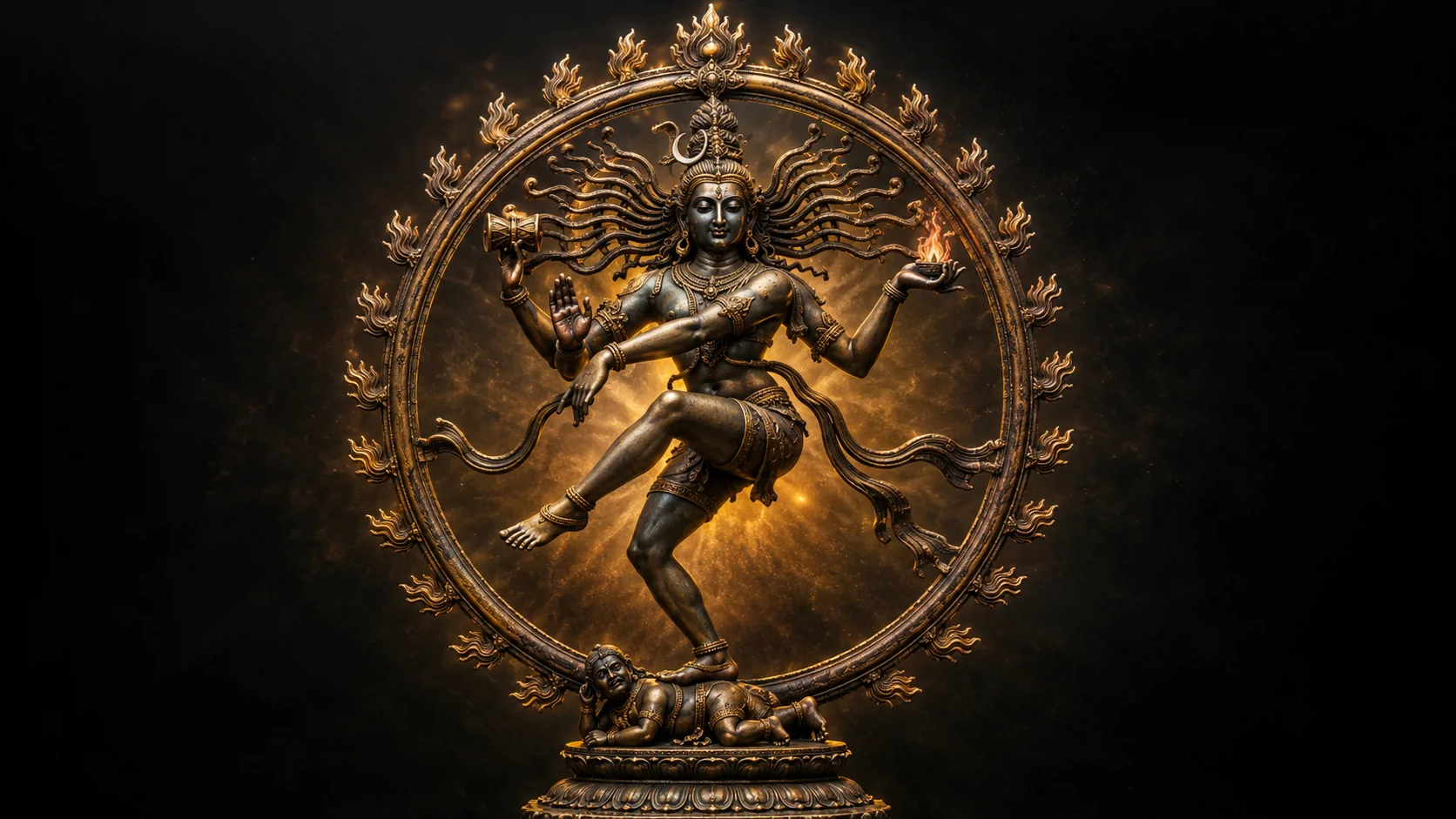
There is a poem at Cidambaram in which three hundred and thirteen verses end on the same two words. The poet was Umāpati Śivācārya — a dīkṣitar priest, one of the three thousand brahmins who alone perform the worship of the dancing Lord in the golden hall, and the last of the four great teachers of the Tamil Śaiva Siddhānta. He wrote in long, sweeping Sanskrit metres, and he built his whole hymn around a single image: not the drum, not the fire, not the encircling flame, but the one foot that Naṭarāja lifts. The refrain never changes — kuñcitāṅghriṃ bhaje 'ham, "I worship the curved, uplifted foot" — and in his closing verse Umāpati tells us that having uttered this "king of hymns of three hundred and thirteen verses" (trayodaśādhikya-śata-trayānvitam), he then beheld the dance of the Lord of the hall face to face. The poem is the Kuñcitāṅghri-stava, the "Praise of the Bent Foot," and it is the most concentrated scripture we possess on the meaning of the cosmic dance.
Begin there, with the lifted foot, and the whole familiar bronze begins to reorganise itself. We have all seen the image — on book jackets, abstracted into logos, cast two metres high outside CERN in Geneva as the West's chosen emblem of a universe in process. Familiarity has flattened it. We read it as decoration, or as a vague gesture toward "cosmic energy." But the icon was never made to be looked at. It was made to be read — limb by limb, gesture by gesture, each part a syllable in a sentence whose grammar is given in the Āgamas, the Upaniṣads, the Tamil hymns of the Nāyanārs, and above all in Umāpati's hymn to the foot. What follows reads it that way, slowly, with the texts open.
The Hymn That Worships a Foot
Umāpati opens not with the dancer but with the cosmos he dances inside. The first verse places the dance within the body of the universe — the brahmāṇḍa, the cosmic egg — and locates its stage in the lotus of the heart.
तद्वैराजान्तरङ्गे विलसति हृदयाम्भोरुहे दक्षिणाग्रे ।
मध्ये सम्मेलनाख्ये मुनिवरमनसा भाविते यन्त्रराजे
यश्शक्त्या नृत्यतीशस्तमपि नटपतिं कुञ्चिताङ्घ्रिं भजेऽहम् ॥
tad-vairājāntaraṅge vilasati hṛdayāmbhoruhe dakṣiṇāgre |
madhye sammelanākhye muni-vara-manasā bhāvite yantra-rāje
yaś śaktyā nṛtyatīśas tam api naṭa-patiṃ kuñcitāṅghriṃ bhaje 'ham ||
The dance is simultaneously the largest thing there is — coextensive with the cosmos — and the most intimate, occurring in the heart-lotus of the contemplative, upon the yantra that for Umāpati the priest is the literal ritual geometry installed beneath the icon. And the Lord dances śaktyā, "by His Power" — by Śakti, the energy inseparable from Him. He does not move the world from outside; the world is His movement.
Then comes the verse that should silence anyone who imagines the Naṭarāja image to be folk piety unconnected to scripture. In the fourth verse, Umāpati describes the golden pillars of the hall — and tells us what they are.
स्वान्तर्गूढोत्तरांशाश्शिवमुख भवनाश्चागमाः कामिकाद्याः ।
अष्टाविंशानुसङ्ख्या धृतकनकमय स्तम्भरूपाः स्तुवन्ति
स्तुत्यं तं नृत्तमूर्तिं श्रुतिशतवितुतं कुञ्चिताङ्घ्रिं भजेऽहम् ॥
svāntar-gūḍhottarāṃśāś śiva-mukha bhavanāś cāgamāḥ kāmikādyāḥ |
aṣṭāviṃśānusaṅkhyā dhṛta-kanaka-maya stambha-rūpāḥ stuvanti
stutyaṃ taṃ nṛtta-mūrtiṃ śruti-śata-vitutaṃ kuñcitāṅghriṃ bhaje 'ham ||
The twenty-eight Śaiva Siddhānta Āgamas — Kāmika, Yogaja, Cintya, Kāraṇa, Ajita and the rest — are the literal load-bearing columns of the hall, and the dancer is "extolled by a hundred branches of the Veda." This is the central claim of Umāpati's Śaiva Siddhānta: that the Āgamas, issuing "from the mouth of Śiva," and the Vedas together hold up the dance. The image of the cosmos is not a deviation from scripture; it is what scripture is for.
On the Āgamas as iconographic authority. This is not Umāpati's invention. The dancing form is prescribed in the Śaiva Āgamas themselves — the Aṃśumadāgama and the Uttara-Kāmikāgama are the texts traditionally cited for the canonical proportions and attributes of the Naṭarāja icon, from which the śilpa and pratimā literature derive their measurements. When a sthapati casts a Naṭarāja today, the lifted foot, the four arms, the dwarf underfoot, the flaming arch are not artistic liberties; they are scriptural specifications. Umāpati names the Āgamas again near the hymn's end (v. 107), describing the dīkṣitars who worship "reciting the Kāmika and the other Āgamas, which reveal their majesty through the divisions of caryā, kriyā, yoga and jñāna."
Creation From Sound — the Drum and the Alphabet
Why does creation issue from a drum? The answer is the deepest stratum of Indian cosmology, and Umāpati states it with startling precision. In the sixty-third verse he describes what happens at the upper right hand, where the ḍamaru is held — and it is not merely that the drum "makes a sound." The drum emits the alphabet, and from the alphabet the entire body of knowledge unfolds.
त्रैचत्वारिंशदर्णं चतुरधिकदशालङ्कृतं सूत्रजालम् ।
जातं यत्तद्गृहीत्वा पणनसुतमुखाः शब्दशास्रादिगर्भं
तत्तच्छास्राण्यकुर्वन्दरहसितमुखं कुञ्चिताङ्घ्रिं भजेऽहम् ॥
traicatvāriṃśad-arṇaṃ catur-adhika-daśālaṅkṛtaṃ sūtra-jālam |
jātaṃ yat tad gṛhītvā paṇana-suta-mukhāḥ śabda-śāstrādi-garbhaṃ
tat-tac-chāstrāṇy akurvan dara-hasita-mukhaṃ kuñcitāṅghriṃ bhaje 'ham ||
The drum sounds, and out of the sound come the mātṛkā — "the little mothers," the phonemes of the Sanskrit alphabet, the matrices of all manifestation. From those phonemes the grammarians (Pāṇini, here "the son of Paṇana," and the rest) drew the śabda-śāstra, the science of language itself, and every science that follows from language. This is the doctrine that the world unfolds from nāda, primal vibration: creation is, quite literally, a sounding-forth, and the alphabet is the masonry of the cosmos. (Umāpati makes the same point architecturally in verse 3, where the very walls of the hall are built "from the golden stone of the mātṛkā-syllables.") When Naṭarāja strikes the drum, language begins; and where there is language, there is a world.
The drum does not merely make a noise. It emits the alphabet — and from the alphabet, every science, every scripture, every world that can be named.
The Five Acts — Read From the Limbs
The doctrinal heart of the icon is the pañcakṛtya, the "five acts" — the five cosmic functions the Śaiva tradition assigns to the dancing figure. These are the verbs of divinity: sṛṣṭi (emission, creation), sthiti (maintenance), saṃhāra (reabsorption), tirobhāva (concealment, the veiling power), and anugraha (grace, the revealing and liberating power). The icon does not show these one after another, as a story. It shows all five at once, as a single posture — because for the Śaiva they are not events along a timeline but the permanent, simultaneous activity of consciousness.
Umāpati does not leave the assignment to later tradition. He states the five functions outright, distributing them across the five deities of the Śaiva pentad, in the hundred-and-second verse.
संहृत्यै रुद्रमूर्तिं त्वथ निखिलतिरोधानहेतोर्महेशम् ।
तल्लोकानुग्रहार्थं हिमगिरितनयासक्तसादाख्यमूर्तिं
यस्सृष्ट्वाऽऽनन्दनृत्तं सदसि वितनुते कुञ्चिताङ्घ्रिं भजेऽहम् ॥
saṃhṛtyai rudra-mūrtiṃ tv atha nikhila-tirodhāna-hetor maheśam |
tal-lokānugrahārthaṃ hima-giri-tanayāsakta-sādākhya-mūrtiṃ
yas sṛṣṭvānanda-nṛttaṃ sadasi vitanute kuñcitāṅghriṃ bhaje 'ham ||
There is the pañcakṛtya in the poet's own words: creation, preservation, dissolution, concealment, grace — five functions, five forms, one dancer. Now read them off the body. The traditional mnemonic maps each act onto a feature of the figure, and Umāpati himself confirms the mapping in his iconographic verses.
Sṛṣṭi — creation — the drum (upper right)
The ḍamaru, as verse 63 has shown, is the alphabet sounding the world into being. Creation is the first act, and it begins in vibration.
Sthiti — preservation — the abhaya hand (lower right)
The lower right hand is raised, palm outward, in abhaya-mudrā — the gesture that says do not be afraid. This is maintenance: the holding of the created world steadily in being, and the reassurance of the soul caught inside it. Creation without preservation would be a spark that gutters out; the open palm is the standing promise that the world, once spoken, will be upheld.
Saṃhāra — dissolution — the fire (upper left)
In the upper left hand burns agni. This is destruction — but never nihilistic annihilation. The fire is the structural counterpart of the drum: where the drum draws the world out of the unmanifest, the fire draws it back. The two raised hands hold creation and dissolution in exact equilibrium — the systole and diastole of being. Umāpati names Śiva again and again as the single cause "of the creation, maintenance, and dissolution of the worlds" (loka-sṛṣṭi-sthiti-laya-karaṇe, v. 32).
Tirobhāva — concealment — the planted foot
The right foot presses upon a small twisting figure: Apasmāra, in Tamil Muyalaka — the dwarf of avidyā, of heedlessness, the spiritual amnesia (the word means "loss of memory") by which the infinite forgets its own nature. This is the veiling power, tirobhāva: the act by which consciousness conceals itself within the finite, and so makes limited individual experience possible at all. Crucially, the dwarf is not killed but pinned — held in place, governed, never destroyed — because the whole drama of bondage and liberation requires that the veil be real. Without forgetting there is no remembering; concealment is not the enemy of grace but its precondition.
Anugraha — grace — the uplifted foot
And here is the secret of the entire image, and the reason Umāpati wrote three hundred and thirteen verses about it. The left foot is lifted, drawn up and across the body, weightless; the lower left arm sweeps across in the gaja-hasta, the "elephant-trunk" gesture, the hand pointing down past the crushed dwarf toward the raised foot. This raised foot is anugraha, grace — the liberating uplift, the place of refuge. The four other acts describe what the Lord does to the universe; this fifth describes what He does for the soul that turns toward Him. And the pointing hand is an instruction, a teacher's finger directing the eye: here, at the uplifted foot, is shelter.
Umāpati makes the meaning of the lifted foot wholly explicit. In the sixty-fourth verse he reads the entire figure — fire, drum, fearlessness, the bent foot lifted from the swinging hand — and states what that foot is for.
योऽन्यस्मिन्वामपादं सरसिजसदृशं कुञ्चितं डोलहस्तात् ।
भुक्तेर्मुक्तेश्व दाने निपुणमिदमिति प्राणिनां दर्शयित्वा
नृत्यन्तं चित्सभायां श्रुतिशिखरनुतं कुञ्चिताङ्घ्रिं भजेऽहम् ॥
yo 'nyasmin vāma-pādaṃ sarasija-sadṛśaṃ kuñcitaṃ ḍola-hastāt |
bhukter mukteś ca dāne nipuṇam idam iti prāṇināṃ darśayitvā
nṛtyantaṃ cit-sabhāyāṃ śruti-śikhara-nutaṃ kuñcitāṅghriṃ bhaje 'ham ||
The lifted foot, the poet says, is nipuṇam bhukter mukteś ca dāne — "skilful in granting both enjoyment and liberation." It does not offer escape alone; it offers the whole human good, the worldly and the ultimate together. This is why Umāpati cannot end his refrain on the drum or the fire, but only on the foot. For the devotee, the single most important fact about the cosmic dance is not that it spins universes into being and burns them away, but that in the lifted foot it offers a place to stand.
He says it once more, in the language of the four puruṣārthas, the four aims of human life, in verse 104:
कामं दत्वाऽभयेन स्वपदसरसिजान्मोक्षरूपं पुमर्थम् ।
दत्वा लोकान् समस्तानवति नटपतिः नायकश्चित्सभायाः
तं देवं नृत्तमूर्तिं विसदृशचरितं कुञ्चिताङ्घ्रिं भजेऽहम् ॥
kāmaṃ datvā 'bhayena sva-pada-sarasijān mokṣa-rūpaṃ pumartham |
datvā lokān samastān avati naṭa-patiḥ nāyakaś cit-sabhāyāḥ
taṃ devaṃ nṛtta-mūrtiṃ visadṛśa-caritaṃ kuñcitāṅghriṃ bhaje 'ham ||
Each limb gives one of the four aims of life, and the foot gives the highest, liberation. The bronze is, among everything else it is, a complete map of what a human being may rightly seek — and where to seek the last of it.
Cidambaram — the Sky of Consciousness
The dance has a precise home, mythic and geographic: Cidambaram in the Tamil country, whose old name Tillai (after the mangrove that once stood there) is overlaid by the Sanskrit Cidambaram — cit-ambaram, "the expanse, the sky, of consciousness." Its inner sanctum is the Cit Sabhā, the "Hall of Consciousness," and beside the bronze hangs the most famous mystery in Indian temple architecture: the Cidambara-rahasya, the "Secret of Cidambaram." Behind a black curtain hung with golden bilva leaves there is — nothing. Empty space. No image at all.
The lesson is deliberate. The ultimate object of worship is not the form but the formless awareness — cit — within which all forms, including the beloved dancing god, arise and subside. The curtain is drawn back to reveal that there was never an idol behind the idol; there was only the space of consciousness, the same cit-ambara that is the inner meaning of the place-name and the inner reality of the worshipper's own heart. The form is a gift to those who need a form to love; the empty chamber is the truth toward which the form points.
The mythic charter is the legend of the Tillai forest, preserved in the Koyil Purāṇa (the Cidambara Māhātmya) and woven all through Umāpati's hymn. Śiva came to the forest of pine to humble a community of proud sages who believed ritual action alone, without grace, could compel the cosmos. He came with Viṣṇu in the form of the enchantress Mohinī, and with the serpent Ādiśeṣa. The enraged sages conjured weapons from their sacrificial fires — a tiger, a serpent, a dwarf-demon, a deluding host. Śiva took the tiger's skin as His garment, wound the serpent on His arm, set His foot on the dwarf, and — smiling — began to dance. Their magic became His ornaments; their assault became His icon. And the two sages who recognised Him and received the eternal vision of the dance were Patañjali (in serpent form) and Vyāghrapāda ("tiger-footed," given a tiger's claws to climb the trees and gather flowers before the dew touched them). Umāpati gives this its own verse, anchoring the dance to its festival and its first witnesses.
भित्तौ श्रीचित्सभायां मुनिवरतपसा दत्त वाक्पूर्तये यः ।
नृत्तं कृत्वाऽवसाने फणधरवपुषं व्याघ्रपादं महर्षिं
चाहूयाभ्यां अदात् यो नियतनिवसतिं कुञ्चिताङ्घ्रिं भजेऽहम् ॥
bhittau śrī-cit-sabhāyāṃ muni-vara-tapasā datta vāk-pūrtaye yaḥ |
nṛttaṃ kṛtvā 'vasāne phaṇa-dhara-vapuṣaṃ vyāghrapādaṃ maharṣiṃ
cāhūyābhyāṃ adāt yo niyata-nivasatiṃ kuñcitāṅghriṃ bhaje 'ham ||
This is the festival the dīkṣitars still keep: the great Ārdrā-darśana (Tamil Tiruvādirai) in Mārgaśīrṣa, when the abhiṣeka of Naṭarāja is performed and the cosmic dance is ritually re-presented. The icon at Cidambaram is unique in South India: it is a mūla-mūrti, the holy of holies, that is itself mobile — carried out in festivals, moved between the Cit Sabhā and the Kanaka Sabhā — whereas in every other temple the central image is fixed stone. The god of motion is, fittingly, the one image that moves.
The Sarvasvam and the Hundred-and-Eight Dances
How many dances does Śiva dance? The answer is preserved in the ritual literature peculiar to Cidambaram, foremost the Śrī Chidambara Kṣetra Sarvasvam — "the Complete Compendium of the Holy Field of Cidambaram" — a text associated with the dictates of the sage Patañjali, which lays out in exhaustive detail the rituals performed before Naṭarāja in the Tillai hall. (Umāpati himself shows deep familiarity with this ritual order: verses 17 through 25 of his hymn walk through the dīkṣitars' sixfold daily worship — the puṇyāha, the purifications and nyāsa, the bathing of the crystal liṅga and the dancing form, the flag-raising of the Brahmotsava — in liturgical detail.)
Within this tradition is an aṣṭottara-śata-nāmāvalī, a litany of one hundred and eight names — but with a remarkable twist. Each is coined to describe a distinct dance of the Lord, classified by four questions: what the dance accomplished, when, for whom, and where. The implication, drawn out explicitly in the tradition, is that there are at least one hundred and eight dances of Śiva, with a parallel reckoning of thirty-eight. The single bronze in the Cit Sabhā is therefore not a dance but the synthesis of an entire grammar of dances — the ānanda-tāṇḍava, the "dance of bliss," being the supreme form, danced eternally in the hall of consciousness.
A note on sources. The hundred-and-eight-names tradition and the Patañjali ritual frame are well attested in the documented Cidambaram literature (Nagaswamy; B. Natarajan, The City of the Cosmic Dance). The reader who wishes to study the litany verse by verse should consult the Sarvasvam text together with the temple's published nāmāvalī; this essay cites the tradition as documented rather than reproducing the full litany, which deserves its own dedicated study.
The multiplicity matters theologically: the dance is not a frozen pose but a living range — fierce and gentle, destructive and tender, public and secret. The vigorous masculine dance is the tāṇḍava; the soft lyrical dance of the Goddess is lāsya. At Cidambaram the consort Śivakāmasundarī ("she whose desire is Śiva") is enshrined to witness the dance, so that the cosmic performance is never a solo — and indeed Umāpati's iconographic verses repeatedly place the dance "together with the Goddess" (devyā sākaṃ sabhāyām, v. 108). The fierce raudra-tāṇḍava among the ashes and the blissful ānanda-tāṇḍava of the golden hall are two registers of one movement.
The Tamil Witness — Tirumūlar and Māṇikkavācakar
If the Āgamas give the dance its architecture and Umāpati its Sanskrit metaphysics, the Tamil Śaiva saints — the Nāyanārs — give it its pulse and its tears. For them the dance is not an abstraction to be decoded but a beloved to be longed for. The four pre-eminent saints, the Nālvar — Sambandar, Appar, Sundarar, Māṇikkavācakar — sang the dancer of Tillai centuries before Umāpati systematised him, establishing that Naṭarāja worship is older than the seventh century.
The Tirumantiram of Tirumūlar, the foundational philosophical poem of Tamil Śaiva Siddhānta and the tenth book of the Tirumuṟai canon, gives the most precise Tamil statement of the dance's interior dimension — and is also its great democratiser: the dancer is not gated behind erudition.
ஒப்பிலி வள்ளலை ஊழி முதல்வனை
எப்பரிசாயினும் ஏத்துமின் ஏத்தினால்
அப்பரிசீசன் அருள்பெறலாமே
oppili vaḷḷalai ūḻi mutalvaṉai
epparicāyiṉum ēttumiṉ ēttiṉāl
apparicu īcaṉ aruḷ peṟalāmē
The phrase epparicāyiṉum — "in whatever manner you can" — is the warm counterweight to the surgical precision of the Āgamas. The same Lord whose five acts the priests parse syllable by syllable is available to anyone who praises Him at all. Strikingly, Umāpati's Sanskrit reaches the same place: the lifted foot, he says in verse 64, is "skilful in granting both enjoyment and liberation," and in his own yogic verses he locates the dance not only in the golden hall but in the dahara, the heart-cave — "within the lotus-house of the small cavity of consciousness He fashions the dance" (dahara-kuhara-cit-puṇḍarīkākhya-veśmani… racayati naṭanam, v. 273).
Māṇikkavācakar, whose Tiruvācakam is among the most emotionally molten devotional works in any language, sings of the dancer of the ciṟṟambalam, the "little hall," with a longing that crosses into anguish — the Lord who has danced into his heart and stolen his very self. Where Umāpati builds a cathedral of doctrine around the foot, Māṇikkavācakar throws himself beneath it. Both, the tradition insists, are correct readings of the same bronze.
The Cidambara-rahasya
Why It Must Be a Dance
One might fairly ask why the supreme reality should be imagined as dancing rather than seated in the perfect stillness of Dakṣiṇāmūrti, the silent guru who teaches through silence alone. The answer lies at the root of Śaiva metaphysics: reality is intrinsically dynamic. Spanda — vibration, throb, the subtle quiver of consciousness becoming aware of itself — is the very nature of the absolute. A static god could create only a world set over against Himself, external and other. A dancing god creates the world as His own movement, never for an instant separate from Him. The world is not a thing Śiva makes and surveys from a distance; it is what Śiva is doing. The dance is the doctrine of non-dual immanence made visible: no gap between the dancer and the dance, between consciousness and its appearances.
This is why rhythm — tāla — is not ornamental but doctrinal. The drum sets the beat; the beat is time; time is the medium in which the five acts unfold and recur. The icon is therefore also a profound statement about music and measure: the cosmos is a composition, and its composer is also its rhythm and its dancer. The Carnatic and broader Indian musical traditions take this seriously — the science of tāla is understood as a participation in the cosmic measure that Naṭarāja keeps. To keep time is to join, however faintly, the dance that keeps the worlds. Umāpati's own verses are full of the sound of it — the drum's beat "conquering the roar of the great ocean" (v. 9), the tānā-tānā of the lutes and the dhimi-dhimi of the drumheads ringing through the burning-ground dance (vv. 150–151).
Motion in the Motionless — and the Self That Sees It
For all the whirl of limbs, the face of Naṭarāja does not change. Whatever the hands are doing — drumming the world into being, sheltering it, burning it back, veiling the infinite, lifting the foot of grace — the countenance shows neither strain nor triumph, only an unbroken, faintly smiling stillness (Umāpati's recurring smitāsya, dara-hasita-mukha). This is the deepest stratum of the icon, and it is pure Upaniṣad: the still witness, the sākṣin, the unmoved awareness within which all motion occurs.
The Śvetāśvatara Upaniṣad — the most theistic of the principal Upaniṣads, where Rudra-Śiva is the single power behind all manifestation — supplies the premise on which the whole dance stands.
वर्णाननेकान्निहितार्थो दधाति ।
वि चैति चान्ते विश्वमादौ स देवः
स नो बुद्ध्या शुभया संयुनक्तु ॥
varṇān anekān nihitārtho dadhāti |
vi caiti cānte viśvam ādau sa devaḥ
sa no buddhyā śubhayā saṃyunaktu ||
Read it beside the bronze and the correspondence is exact. The "one without colour" who "ordains many colours" is the still face at the centre of the coloured whirl. The "deployment of His powers" is Umāpati's śaktyā nṛtyati — He dances by His Śakti. And the universe that "gathers at the beginning and dissolves at the end" is the prabhāmaṇḍala, the ring of fire framing the figure, the boundary of the manifest cosmos within which emergence and dissolution are made one.
The truest one-line caption is from the Īśāvāsya — the paradox the sculptor cast in metal.
तदन्तरस्य सर्वस्य तदु सर्वस्यास्य बाह्यतः ॥
tad antar asya sarvasya tad u sarvasyāsya bāhyataḥ ||
"It moves and It moves not" — the flying limbs and the still face. "It is far and It is near" — the cosmic Lord of all the worlds and the self closer than one's own breath. "Within all this and outside all this" — the consciousness that contains the universe yet is not contained by it. The sculptor was not depicting a god in motion; he was depicting the relationship between motion and the motionless ground that allows it.
This is also where Umāpati turns, near the climax of his hymn, from describing the dance to describing the one who realises it. In the ninety-fifth verse he places the great Advaita recognition in the mouth of the liberated sages who behold the dance — and the contemplation that the dancer enacts becomes the worshipper's own.
धर्माधर्मौ च, दुःखं सुखमपि, करणं नैव मत्तः परोऽन्यः ।
सोऽहं ब्रह्मास्मि नित्यो, नहि जनिमरणे, निर्वृतोऽहं सदेति
स्वान्ते पश्यन्ति बोधाद्यमपि यतिवराः कुञ्चिताङ्घ्रिं भजेऽहम् ॥
dharmādharmau ca, duḥkhaṃ sukham api, karaṇaṃ naiva mattaḥ paro 'nyaḥ |
so 'haṃ brahmāsmi nityo, nahi jani-maraṇe, nirvṛto 'haṃ sadeti
svānte paśyanti bodhād yam api yati-varāḥ kuñcitāṅghriṃ bhaje 'ham ||
The Naṭeśa-dhyāna tradition closes the same circle from the other side, beginning its meditation with the bare Upaniṣadic formula for Brahman before it lets the absolute "assume a form" and dance.
सान्द्रानन्दरसैकविग्रहमजं नित्यं निरालम्बनम् ।
नृत्यन्तं परिकल्पितेन वपुषा यद्भाति चिद्व्योमनि
तं वन्दे करुणानिधिं गुरुगुहं नटेशमानन्ददम् ॥
sāndrānanda-rasaika-vigraham ajaṃ nityaṃ nirālambanam |
nṛtyantaṃ parikalpitena vapuṣā yad bhāti cid-vyomani
taṃ vande karuṇā-nidhiṃ guru-guhaṃ naṭeśam ānanda-dam ||
The grammar enacts the theology. The opening words, satyaṃ jñānam anantam, echo the Taittirīya Upaniṣad's great definition, satyaṃ jñānam anantaṃ brahma. The absolute is named first, in its formless purity; only then is the dancing image acknowledged as parikalpita vapus, an "assumed body" — a gracious concession for the worshipper who needs a form to love, shining "in the sky of consciousness," the cid-vyoman that is the same cit-ambara as the temple's name and the empty chamber's secret.
Reading the Bronze, at Last
Return now to the figure, and see how much it has gained. The drum in the upper right is the alphabet sounding the world into being — the mātṛkā from which every science and scripture is drawn. The fire in the upper left is the flame that gathers the world back; between them, in exact balance, creation and dissolution beat like a heart. The lower right hand, palm outward, tells everything that exists: do not be afraid. The lower left arm sweeps across in the elephant-trunk gesture and points, like a teacher's finger, to the one place of refuge — the uplifted left foot, the kuñcita-pāda, "skilful in granting both enjoyment and liberation," the foot Umāpati could not stop praising. Beneath the planted right foot, Apasmāra — forgetfulness — writhes but is not slain, because the play requires both the veil and its lifting.
Around it all curves the prabhāmaṇḍala, the arch of fire that is the edge of the manifest cosmos. The matted hair flies outward, and woven into it are the crescent moon, the descending Gaṅgā, the cobra, a skull, a flower — the whole vocabulary of Śiva gathered into the whirl. The twenty-eight Āgamas stand as golden pillars; a hundred branches of the Veda sing; the Goddess watches; serpent-bodied Patañjali and tiger-footed Vyāghrapāda gaze on in their eternal dwelling. And in the small hall behind the bronze, a black curtain hangs over empty space.
And the face is still.
That is the teaching the bronze was made to deliver — what the Āgamas, the Upaniṣads, Umāpati's three hundred and thirteen verses, and the Tamil saints' tears all circle in their different idioms. That the universe is not an accident and not a machine but a dance. That the dance has five movements — four of cosmic governance and one of pure grace — and grants by its very limbs the whole of what a human being may seek, down to liberation in the lifted foot. That the dancer is the consciousness within which the dance appears, dynamic to its core, vibration and rhythm and throb, never frozen, never other than its own appearances. And that this same consciousness is no further away than the still point at the centre of one's own experience — the cit-ambara, the sky of awareness, in which the whole bright, terrible, tender dance is, and has always been, taking place.
The dīkṣitar priests draw the curtain aside to show empty space because the final object of the worship was never the metal. It was the awareness that, even now, is reading these words. In his last verse Umāpati says he kept uttering the Lord's name, kept reading the hymn aloud, kept drinking the nectar of the lotus-foot with his tongue and worshipping with his mind, until — prabuddho 'smi — "I have awakened." Kuñcitāṅghriṃ bhaje 'ham. I worship the foot that is lifted: the one that crushes nothing, that points to no throne, that simply rises, weightless, and waits.
The Kuñcitāṅghri-stava ("Praise of the Bent/Uplifted Foot") of Umāpati Śivācārya (c. early 14th c.), last of the four santāna-ācāryas of Tamil Śaiva Siddhānta and a dīkṣitar priest of Cidambaram. By the poet's own colophon (v. 315) the hymn comprises 313 verses (trayodaśādhikya-śata-traya), every verse closing with the refrain kuñcitāṅghriṃ bhaje 'ham; the poet states that on completing it he beheld the dance directly. Verses 1, 4, 8, 63, 64, 95, 102, 104 quoted in full from the recension in the Śrī Naṭarāja-stava-mañjarī (text: sanskritdocuments.org); translations the author's. The standard scholarly study and complete English translation is David Smith, The Dance of Śiva: Religion, Art and Poetry in South India (Cambridge University Press, 1996).
The 28 Śaiva Siddhānta Āgamas (Kāmika, Yogaja, Cintya, Kāraṇa, Ajita …) as golden pillars: Kuñcitāṅghri-stava 4; named again with the caryā / kriyā / yoga / jñāna divisions in v. 107. Iconographic prescriptions for the Naṭarāja form derive from the Aṃśumadāgama and Uttara-Kāmikāgama (cf. T. A. Gopinatha Rao, Elements of Hindu Iconography, vol. II).
Creation from sound: Kuñcitāṅghri-stava 63 — the ḍamaru emitting the mātṛkā of 43 phonemes (plus 14) from which the śabda-śāstra arises; cf. v. 3 (walls built of mātṛkā-syllables). The doctrine of nāda and the mātṛkā as matrices of manifestation is shared with the tantric and grammatical traditions.
The five acts (pañcakṛtya): stated explicitly as five deities/functions in Kuñcitāṅghri-stava 102 (Brahmā–creation, Hari–protection, Rudra–dissolution, Maheśa–concealment, Sadāśiva–grace); the four puruṣārthas from the limbs in v. 104; the full iconographic dhyāna in vv. 64 and 108 (fire, drum, abhaya, the bent foot lifted from the ḍola-hasta, the planted foot on Apasmāra, "together with the Goddess in the hall").
Apasmāra / Muyalaka as the personification of avidyā (the word means "loss of memory, the falling-sickness"); the planted foot enacts tirobhāva (concealment), the uplifted foot anugraha (grace) — and, per v. 64, "the skilful giver of both enjoyment and liberation."
Cidambaram = cit-ambaram, "sky of consciousness"; ancient Tamil name Tillai. The Cidambara-rahasya: the empty, curtained space beside the bronze signifying formless awareness. The interior dance in the dahara / heart-cave: Kuñcitāṅghri-stava 273; the unique mobile mūla-mūrti of Cidambaram: Smith, op. cit., ch. 1.
The Tillai-forest / Dāruvana legend and the sages Patañjali (serpent-form) and Vyāghrapāda ("tiger-footed"): Koyil Purāṇa / Cidambara Māhātmya; summarised in A. K. Coomaraswamy, "The Dance of Śiva," and B. Natarajan, The City of the Cosmic Dance: Chidambaram. The Mārgaśīrṣa Ārdrā festival: Kuñcitāṅghri-stava 8; the dīkṣitars' sixfold daily ritual: vv. 17–25.
Śrī Chidambara Kṣetra Sarvasvam (Patañjali ritual tradition): contains an aṣṭottara-śata-nāmāvalī of 108 names, each denoting a distinct dance classified by act, time, recipient and place — hence "at least 108 dances," with a parallel tradition of 38. Documented in the Chidambaram ritual literature and surveys (R. Nagaswamy; B. Natarajan).
Tirumūlar, Tirumantiram (Tirumuṟai, Book 10); the verse cited illustrates epparicāyiṉum — grace accessible through praise "in any manner." Māṇikkavācakar, Tiruvācakam, on the dancer of the ciṟṟambalam ("little hall").
Upaniṣadic loci: Śvetāśvatara 4.1; Īśāvāsya 5 (tad ejati tan naijati); Taittirīya 2.1 (satyaṃ jñānam anantaṃ brahma), echoed in the Naṭeśa dhyāna-śloka. The Advaita realisation placed in the seers' mouths: Kuñcitāṅghri-stava 95 (cf. also v. 242, brahmaivāhaṃ śivo'haṃ…). Spanda as the dynamic nature of the absolute: Kashmir Śaiva and broader Āgamic doctrine.