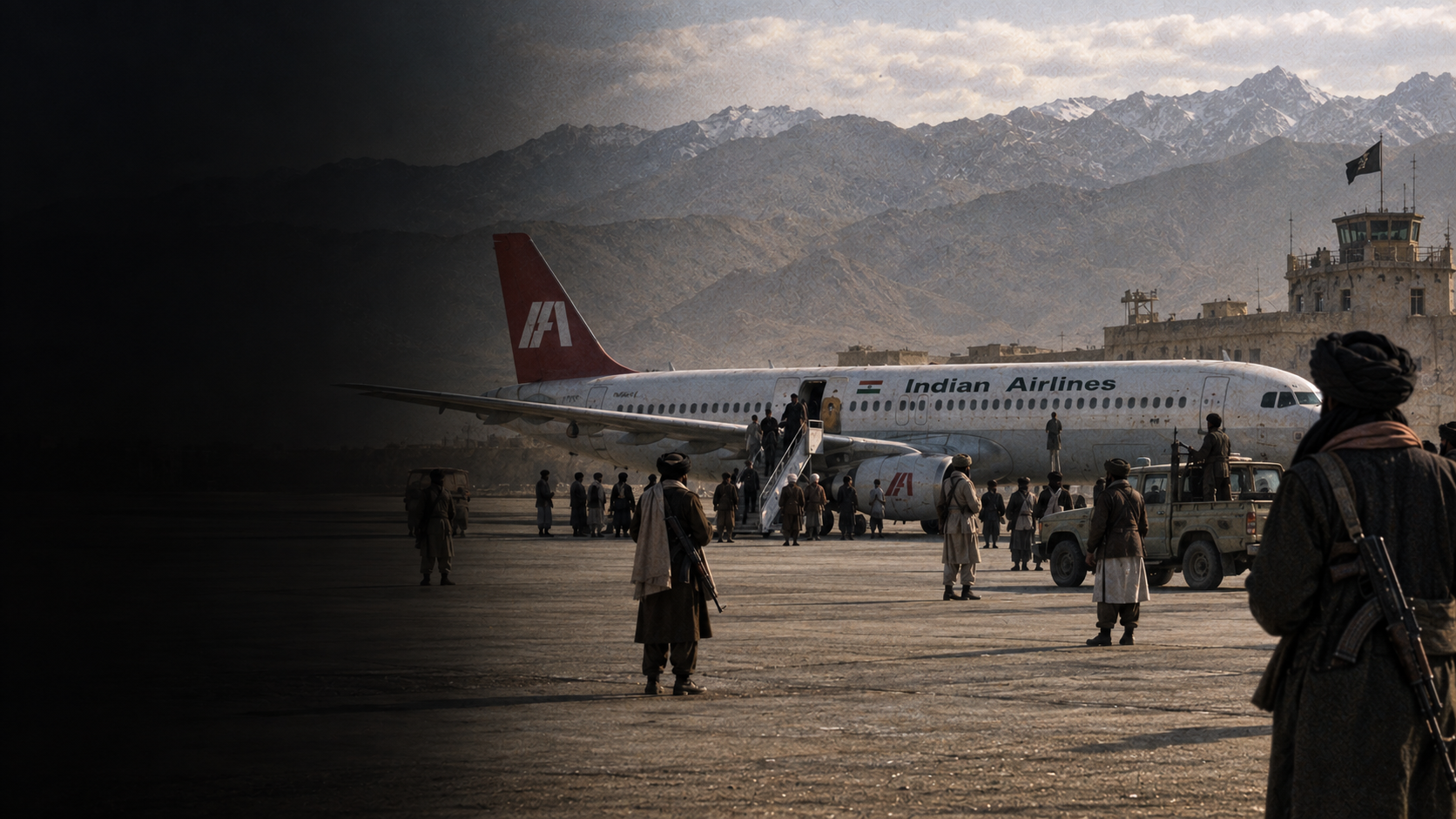
I. Gohana
The town of Gohana sits in Sonepat district, eighty kilometres north-west of Delhi, and in 1999 it was the kind of place where a family knew which houses their daughter could be married into before anyone made an enquiry.
Rachna was the youngest child and the only girl, with two elder brothers ahead of her. She had been raised close. She finished her degree at Rohtak University and came home, and her parents began the work that Haryana parents began at that point: they started looking.
They looked at a number of boys. It took a while. Rachna was twenty and had not particularly wanted to be married yet, though she was not against it either, and whatever her parents decided was going to be acceptable to her, which is what she said then and what she said afterwards.
Then somebody mentioned a family in Gurgaon.
II. Gurgaon
Chander Mohan Katyal had two children. His daughter Riru was already married and living in the United States. His son Rupin was twenty-five, educated, quiet, easy-tempered, and, in the language of matrimonial negotiation, a very good-natured boy.
The Katyals were comfortable. Nobody in either family was going to need anything from the other. Rupin had been to the Rotary Public School in Gurgaon and had gone into business afterwards. His mother Kusum ran the house. They were the kind of family whose reputation reached a town like Gohana before their car did.
Both sides were satisfied. The wedding was fixed without a single difficulty, which is rarer than it sounds.
Rachna met Rupin and liked him at once. That is a small sentence and it deserves to be sat with, because in an arranged match it is not guaranteed and it does not always arrive. She liked him immediately. They went out together a few times in the weeks before the ceremony, learning what the other one found funny.
They were married on the third of December 1999. It was a large wedding. Neither household spared anything.
III. Kathmandu
They flew to Nepal for the honeymoon.
There is a photograph from that week. Two young people standing close together in the thin winter light of the Kathmandu valley, dressed for cold, looking at a camera held by somebody they had probably just met. It is the ordinary photograph that every couple takes and nobody looks at again for thirty years.
They were still in the first fortnight of knowing each other. He had habits she had not catalogued yet. She had a laugh he was still learning to provoke. They had a flat waiting and a life to arrange and a whole set of first things ahead of them, first Diwali, first anniversary, first argument about money.
On the twenty-fourth of December they packed to come home for the new year.
IV. Tribhuvan, 24 December
The flight was late.
That was ordinary. Indian Airlines 814 out of Kathmandu was often late, and the departure hall at Tribhuvan on Christmas Eve had the loose, cheerful crowding of a holiday. It was the last week of the century and everybody had been reading about the millennium for a year. There were businessmen coming back from meetings and families coming back from holidays and a Japanese woman on her way to a conference in India, and there were eight newly married couples going home from honeymoons in Nepal, almost all of them married by arrangement within the last few weeks, most of them still finding out who they had married.
There were also five men.
Kathmandu was, by the end of the nineties, the softest door into Indian airspace anywhere on the subcontinent. Indian intelligence had understood the airport for years as a working station of Pakistan's Inter-Services Intelligence, the ISI. Weapons reached the five men inside the building. The screening did not find a revolver, a grenade or the knives.
Eighty-four days earlier, on the twenty-ninth of September, a businessman in Shillong had written to the Chief Secretary of Meghalaya to report that he had been told of a plan to hijack an aeroplane out of Kathmandu, Nepal. He had it from a former ISI operative. The letter travelled no further than the state government. The operative who talked was found dead in August 2000.
Settled
The aircraft was an Airbus A300, registration VT-EDW. On the flight deck was Captain Devi Sharan, thirty-seven, with First Officer Rajinder Kumar in the right-hand seat and Flight Engineer Anil Kumar Jaggia at the panel behind them. One hundred and seventy-nine passengers boarded, and eleven crew. The block time to Delhi was under two hours.
It lifted off a little after four in the afternoon and turned west into a clear sky.
V. 17:30
Somewhere over Uttar Pradesh, not far from Lucknow, a man in a black balaclava came through the cockpit door with a revolver in one hand and a grenade in the other.
In the cabin the reaction was not fear. It was embarrassment. Trays were still down. People were still eating. A steward pushing a drinks cart up the aisle saw a man wave a pistol at him and kept pushing the cart, because the pistol was obviously a prop, because this was obviously one of those millennium stunts, because things like this did not happen on the Kathmandu sector on Christmas Eve.
One passenger, travelling with his younger brother who was in his final year of MBBS at Patiala, decided the sensible thing was to go on eating his meal and wait for the pilot to announce the joke.
The intercom clicked.
Captain Sharan's voice came through flat and slow and very careful. The aircraft had been hijacked. It was in everyone's interest to cooperate.
Nobody ate anything after that.
VI. The Rearrangement
What happened next was not chaos. It was procedure, and the fact that it was procedure was the first genuinely frightening thing about it.
The trays were taken and thrown down. Passengers were told to bend forward over their knees and stay bent. The cabin crew were ordered to open every overhead bin and pull out every bag and drop it into the aisles, then to drag all of it forward into executive class. The executive class passengers were pushed back into economy and made to sit wherever there was room. Within twenty minutes the front of the aeroplane was a storeroom and the back of it was a holding pen.
Then the crew were told to blindfold the men.
There were no blindfolds, so they used the cloth covers off the seat headrests, tying them round the eyes of every male passenger, working down the aisle, doing it badly because their hands were not steady. The women were left. Every man was searched.
The lights went out.
In the dark, the brothers whispered to each other. There were two visible, both in black balaclavas, one pistol each. One of them was holding a grenade in a way that indicated he had been taught how. Then a third appeared with a knife.
Under his blindfold the elder brother counted footsteps and gave his brother a running commentary on where each man was and what each man was doing, which is what a frightened person does when the only thing left to control is information.
The hijackers talked among themselves about the millennium flight. The millennium was still a week away.
VII. Delhi, 17:35
The Air Traffic Control tower at Delhi knew within minutes of the transponder change and the captain's transmission. What the Indian state did with those minutes is the part of this that has never improved with retelling.
India had a Crisis Management Group. It was a standing inter-ministerial body that existed precisely so that a hijacking would not require anybody to invent a response. The airport did not hold current telephone numbers for the officials who were supposed to be summoned to it. When they were eventually located, several of them had no clear idea what their own role was.
The Prime Minister was in the air. Atal Bihari Vajpayee, freshly returned to office for a third time, was flying from Patna to Delhi on an Air Force Boeing with his aides around him. He landed at twenty past five. He called his colleagues together at twenty-five to six. The Crisis Management Group settled on meeting at six o'clock.
The aircraft had been under the hijackers' control for half an hour by then and was about to enter Punjab.
The Director General of Police of Punjab, the man whose commandos and whose airfield were about to become the last chance the Republic of India had, did not hear about the hijacking from the Government of India.
He heard about it on television.
Settled
Punjab had done this twice in 1993, out of the same airport, and done it well. Six years later nothing survived except the memory of people who happened to still be posted there.
VIII. 18:04
The men in the cockpit wanted Lahore.
Captain Sharan asked Lahore for permission to enter Pakistani airspace and land. Lahore said no. He asked again. Lahore went on saying no, because Lahore had worked out what was on the aircraft and did not want it.
At four minutes past six he transmitted to Indian control that he had one hour of fuel left and that Pakistan had refused him.
That was the whole negotiation, and it was arithmetic rather than diplomacy. He turned to the men standing behind his seat and told them the numbers. Without fuel there was no Lahore. Without fuel there was nothing at all. There was one airfield inside range.
They let him put down at Amritsar.
IX. Raja Sansi, 19:01
The wheels touched at one minute past seven.
He did not taxi to the apron. The hijackers would not permit it. He stopped the aircraft out on the runway, kept the engines turning, and asked the tower for immediate refuelling.
The tower told him to stand by.
Nobody explained why to him, and he could not explain anything to the men standing over his shoulder, because he did not know anything. Behind him, in the dark, one hundred and seventy-four blindfolded people felt the aeroplane stop moving and heard nothing happen.
On the ground, the intention was right. Hold the aircraft. Burn the clock. Get the National Security Guard onto the field.
The National Security Guard, the NSG, is India's federal counter-terrorist force, raised in 1984 and based at Manesar. Under the standing procedure of that period it was the only body in the country authorised to storm an aircraft. State police commandos had no role in a hijacking and were not trained for one. That had been settled doctrine since 1993 and nobody disputed it then or disputes it now.
The intention was right. Everything after the intention failed.
X. The Bowser
There was no fuel bowser at Raja Sansi.
No flight was scheduled in or out of Amritsar at that hour of a winter evening, so no tanker was standing by, so one had to be found and brought to the field. That took about thirty-five minutes.
Somewhere in the middle of those thirty-five minutes the telephone rang at the airport and a man identified himself as an official of the Ministry of Civil Aviation in Delhi and instructed the Amritsar authorities to refuel the aircraft and release it.
The call was false. Nobody has ever established who made it. It bought roughly twenty minutes of confusion at the precise moment when confusion was the most expensive commodity in India.
Two plans were made while the minutes went.
The first was to hide police personnel on the fuel bowser as it approached the aircraft and have them puncture the tyres. An A300 sitting on flat tyres does not go anywhere, and it does not need to be stormed in a hurry either; it can be starved out over days by people who have the luxury of time. It was a good plan.
The second came from the tower, and it cancelled the first: drive the bowser across the front of the aeroplane and physically block the runway.
The bowser started moving. Three companies of the Border Security Force came onto the airfield. Punjab Police worked forward to within three hundred metres of the aircraft. The message from Delhi to the tower said that the plane must be prevented from taking off.
It did not say how. Nobody at any level put that in writing, because nobody at any level had decided it.
Settled
And on the tarmac, sitting in the dark inside a stationary aeroplane with the engines running and nothing happening, five men were reading the delay as something else entirely.
XI. The Executive Class
They came down the aisle picking.
They were not picking at random and the passengers understood that immediately. They were choosing the men who looked strongest, the ones whose shoulders filled a seat, the ones who might in some future scenario be a problem. One by one they were pulled up and walked forward into executive class, which was now empty of its own passengers and full of everybody's luggage, and which had a curtain, and which could not be seen from economy.
Rupin Katyal was in the group.
He and Rachna were sitting together in economy. He was taken forward and she was left where she was and that was the last time she saw him.
One of the men taken forward with him worked out, correctly, that being in that compartment was worse than being anywhere else on the aeroplane. He asked to use the lavatory, and on the way back he pretended to faint into an empty economy seat and stayed there. It saved him.
Rupin Katyal stayed forward.
XII. What Was Done There
Three passengers were stabbed on that aircraft. Two survived.
Satnam Singh was cut across the neck and lived. A third man was wounded and lived.
What was done to Rupin Katyal was done in front of the other men in the compartment, deliberately, so that they would carry it back into the cabin and so that the tower at Amritsar would understand what the delay was costing. One of the witnesses, a businessman returning from Nepal, described it afterwards in a single flat sentence and never elaborated, and the sentence was that they wanted to make an example.
The First Information Report registered later in Delhi recorded the injuries on the body. One stab wound to the abdomen. Four to the chest. Two to the neck, where the jugular vein had been opened. Six to the face. One abrasion on the nose.
He did not die of it immediately.
A blanket was thrown over him. It was not the aircraft's blanket. It was a shawl or a rug that another passenger had bought in Kathmandu as a souvenir a few days earlier, the sort of thing a person carries home from a holiday, and it was put over his face and body while he was still conscious.
He asked for water.
He was twenty-five years old and he was bleeding out on the floor of a business-class cabin on a runway in his own country, and what he said, again and again, for as long as he could say anything, was papa pani. Papa, water.
Nobody brought him any.
Some time during that Christmas night, in the dark, under a stranger's souvenir, he stopped.
His father would carry those two words into a hotel suite in Delhi four months later and put them in front of the President of the United States, with the page marked.
XIII. 19:49
In the cockpit they told Captain Sharan that they were killing passengers and that he was taking off now.
He passed it to the tower. The tower did not believe it. There had been no confirmation of any killing, and the people in the tower were watching an aeroplane sitting on their runway with a fuel bowser finally moving into position, and the last thing they were prepared to accept was that the situation had already gone past them.
Sharan told them again. He said the hijackers were killing passengers. He said he had to go.
Then he did something that no one on the ground had considered possible. He pushed the throttles forward on an aircraft that had not been refuelled, with a fuel state that gave him almost nothing, on a runway with a tanker rolling across it.
The A300 accelerated. The bowser was in front of him. He went past it close enough that the people watching thought they were about to see a collision, and did not hit it, and got the nosewheel up, and flew.
Forty-nine minutes past seven.
The aircraft had been on Indian soil for forty-eight minutes.
Nobody in the control tower had thought he would go. The tyres had not been punctured. The bowser had not blocked him. The National Security Guard had not arrived; the assessment written afterwards put their margin at twenty-six minutes, and put the total elapsed time from Delhi ATC learning of the hijacking to the NSG reaching Amritsar at three hours and twenty minutes.
As the aircraft climbed away into the dark, Devi Sharan transmitted one last message to the field he was leaving.
He said they were all dying.
XIV. The Darkened Runway
Lahore is fifty kilometres from Amritsar. Four or five minutes in an airliner.
He called them again and asked to land. Pakistan refused him again.
Then Pakistan turned off the lights.
Not metaphorically. Lahore extinguished the runway lighting, the approach lighting and the navigational aids, so that an aircraft in the dark with no fuel could not find the airfield. The reasoning, insofar as it has ever been offered, was that Pakistan did not want an Indian aircraft full of Indian hostages on Pakistani soil and did not want the diplomatic weight that would come with it.
So this was the position at roughly eight o'clock on Christmas Eve. An A300 at low altitude over Punjab in winter darkness. Fuel measured in minutes. One hundred and eighty-nine people aboard. A dead man under a blanket in executive class. A widow in economy who did not know she was one. Five armed men. And beneath the aircraft, a country that had chosen to become invisible.
Devi Sharan began an approach onto ground he could not see.
There is one honest description of what he was doing, and it is that he had decided to put the aeroplane down on whatever was underneath it, because the alternative was to run the tanks dry at altitude, and between a crash he was flying and a crash he was not, he would take the one he was flying.
The lights came on.
Lahore had done the arithmetic too, and had understood that the alternative to letting the aircraft land was a wide-body airliner going into the ground inside Pakistan, in the dark, with a hundred and eighty-nine people on it, in front of every camera on earth. The runway lit up. He landed.
And Lahore refuelled him.
That refuelling is the hinge on which this entire episode turns, and it is worth stating without decoration. Until Lahore, IC-814 was a machine that could not leave the subcontinent. It could be starved, cornered, negotiated with, waited out. After Lahore it had range, and range meant that every option India possessed now belonged to somebody else.
Settled
XV. Al Minhad
They wanted Kabul. Kabul had no night landing capability.
So the aircraft crossed the Gulf in the small hours of Christmas morning and came down at Al Minhad air base outside Dubai, where the Emiratis had no interest whatever in a protracted siege on their runway and were prepared to buy their way out of one.
This was the only real negotiation of the eight days, and India was not party to it.
In exchange for fuel and food, the hijackers released twenty-seven people. Thirteen women. Eleven children. Two elderly men. One badly wounded man.
And they gave back the body.
Rupin Katyal was carried down onto the tarmac at Al Minhad in the dark and loaded onto an Indian Airlines relief aircraft that had been sent to collect the released passengers. That aircraft landed in Delhi at about eleven at night on the twenty-fifth of December. The Civil Aviation Minister, Sharad Yadav, came home on it.
The arrival hall was a crush. Relatives, friends, photographers, airline staff and police all shoving against one another, people shouting names, cameras going off. Somewhere in the middle of it, moving through the noise, was a wooden casket.
Sunil Arora, then running Indian Airlines, sat with the Katyal family through that night. It is a small thing and it belongs in the record because of what the rest of the state did not do.
IC-814 took off from Al Minhad again at half past one in the morning.
Rachna Katyal was still on it.
XVI. What Rachna Was Told
For two days she cried where she sat.
She had last seen her husband when they took him forward on the first evening. She had felt the aircraft land twice and take off twice and land again and she did not know where she was or where he was. She asked. The hijackers avoided her, walking past her seat, finding something to do at the other end of the cabin.
The passengers around her looked after her. Most of them were newly married themselves, on their own way back from their own honeymoons, and one of them, a young dentist, stayed near her. There is very little that can be done for a person in that condition inside a metal tube with no water and no news, and they did it anyway.
On the third day the man in black came and sat down next to her.
He told her to think of him as her elder brother. He told her that her husband had been hurt, and that because he had been hurt he had been released at Dubai, and that he was in a hospital there being looked after, and that he was safe. He told her she should be glad about it.
She believed him.
She had no reason not to and no possible way to check. Men had been released at Dubai; she knew that much was true. And so for the remaining five days of the hijacking, Rachna Katyal was the only person in that aeroplane who did not know that she was already a widow.
Some of the passengers knew. Every man who had been in executive class on the first night knew.
Not one of them told her.
That was, on balance, mercy. It is also the cruellest arrangement of facts in this entire story, and it did not end when the aircraft did.
XVII. Kandahar, 08:33
The aircraft came down at Kandahar on the morning of the twenty-fifth of December. It did not move again for six days.
Kandahar was the working capital of the Taliban, who by the end of 1999 held almost all of Afghanistan and were recognised by three governments on the planet, none of them in Delhi. India had no embassy in Afghanistan, no consulate, no back channel, no trade, no contact of any kind with the men who now controlled the ground beneath one hundred and fifty-five of its citizens.
Within the hour, Taliban armour and heavy weapons were positioned in a ring around the aeroplane.
Their public line was that they would not permit killing on Afghan soil, and their Foreign Minister, Wakil Ahmed Muttawakil, said so to the press. Their practical position was expressed by the direction the gun barrels were pointing, which was outward.
Settled
That cordon has been described ever since as protection for the hostages. It was not. It was the removal of the last military instrument India possessed, and it is the reason that what followed was not a negotiation at all. It was a price discussion, conducted by a party with nothing to bid.
XVIII. The Inside of the Aeroplane
Six days is a very long time inside a sealed A300.
The water went first. The galleys were emptied and the cabin crew handed out what was left, then beer, then tonic water. Passengers were told to hold on to their glasses because no more glasses were coming. After that people began rationing what was in front of them, drinking half and keeping half.
Then the lavatories failed.
There were four. With no water in the taps and no flush, two became unusable within about thirty hours and then a third did, and the smell came out of the rear galley area and moved forward through the cabin one row at a time until it owned the aeroplane. The passengers in the last rows lived inside it. People who had to use the one remaining lavatory came back carrying it on their clothes.
So the passengers stopped drinking, in order not to have to go. Which meant that a cabin of a hundred and fifty-five dehydrated people got more dehydrated on purpose.
Food came up from the airfield when it came at all, and it came late, because it was Ramzan and the kitchens on the ground kept different hours from the people they were feeding. Rice with a little dried fruit scattered on it. Naan with scrambled eggs swimming in oil. On the days there were oranges, one orange between two people.
The spoons were handed up first with an instruction to keep them, because no more spoons were coming. They were stamped with the name of Afghanistan's national airline. One of the brothers turned his over, trying to remember which country that airline belonged to, and saw a line of Arabic beneath the English, and read the two words in it, and that was how a passenger on IC-814 discovered on the second day which country he was being held in.
Nobody had told them. The window shades had been down since Kathmandu.
Later there were soft drinks, one can shared between two, and the cans said that they had been made in Pakistan.
XIX. What Was Outside the Window
Below the drawn shades, IC-814 was the most photographed object on earth.
Camera crews for CNN and the BBC had a permanent line of sight onto the fuselage from across the airfield. Indian television carried effectively nothing else for a week. Every one of those passengers had a family somewhere watching the outside of the aeroplane they were sitting in, hour after hour, learning nothing.
A message was circulated from Kandahar control and reported to the world, stating that the aircraft was being cleaned regularly and that the passengers were being provided with food, water and entertainment.
Every element of it was false.
Inside, the Japanese passenger who had been on her way to a conference continued preparing for the conference. She had an alarm clock and she set it every night and got up when it went off. She did some exercises in the space by her seat. She had a bottle of vodka hidden at the back of the cabin and would go to the lavatory in order to have a swig from it. When the hijackers told her to sit down she ignored them, and when they physically sat her down she waited and got up again, and when they refused to let the women go to the back to smoke she smuggled a cigarette into the lavatory instead. Eventually they gave up on her and let her run her own life. There is no other passenger in any account of those eight days who managed that.
One of the brothers, on the first morning, took the laminated emergency card out of the seat pocket and read the instructions for opening the overwing exit, and kept it. Just in case. He read it several times.
By the third day he was vomiting and could not stop. He got a tablet from the doctor travelling among the passengers, took it with as little water as he could manage, and brought that up too. He lay back in his seat, and what he thought about was not himself. It was that whatever happened to him and his brother would happen quickly, and that what was happening to their parents at home was going to go on and on. He had suggested the Kathmandu trip. He had brought his younger brother along. He lay in the seat with that.
XX. The Method
The five men on that aircraft understood exactly what six days of sensory deprivation does to a group of frightened people, and they worked it with some skill.
The one in black was the instrument. The passengers called him by the name he gave them, which was Burger, and no one has ever established why.
He walked the aisles with a pistol and stopped to chat. He recited Urdu poetry, and the adults listened. The children called him uncle. He ran a game of antākṣarī down the length of the cabin, one passenger singing part of a film song and the next taking the last syllable and starting another, and there was laughter in it. He told a joke about a man in a helicopter who feels cold and switches off the fan, and the passengers laughed weakly, and then he got the captain of the aeroplane to tell one too. When a newly married woman had a birthday in captivity, he bought a shawl from a Nepali passenger who dealt in them and gave it to her.
And then, on a schedule of his choosing, he would come into economy and deliver a lecture on Kashmir and what the Indian Army had done there, and then a bulletin on how the Government of India regarded these passengers as an irrelevance, and how the foreign governments had already sent delegations for their nationals while Delhi had sent nobody. Almost none of that was true. All of it landed, because there was no other source of information in the aircraft and had not been for days.
One of the hostages described him afterwards, precisely: a man who could go from very sweet to ready to shoot a person inside a few seconds, and whose eyes were smiling right up until they narrowed.
It worked. By the fifth day passengers were telling the hijackers they were ashamed to be Indian. Some of them promised that once they were released they would do something for the Kashmiri cause. One of the two brothers had a word for what he was watching happen around him, and the word was Stockholm.
Food given by the man who did the starving, on the day he chooses, is not food. It is an instrument, and it has a literature.
They tried to stay out of it. They spoke to the hijackers only when they had to.
The men who had been in executive class on the first night could not join in at all. They had seen what these people were and they could not say it, and there were a hundred and fifty passengers around them singing film songs with the man who had ordered it. One of them, moved during a reshuffle away from the passengers he had been sitting near, broke apart. He got hold of a hijacker and asked to be shot. He said he could not carry the suspense any longer and would rather it happened now.
The hijacker told him he would be sent home safely, and gave him his word on it as a Muslim. The same man who had spent the morning explaining that he was about to start killing people one at a time.
The brothers went and sat with him in turns, first one and then the other, for the rest of that day. He told them he had a four-month-old daughter at home. By nightfall he was steadier.
XXI. Delhi, in Public
On the ground in India, the government was coming apart in front of the cameras.
The relatives of the hostages had almost no information, and what they were given they had stopped believing on about day two. They came to the airport and to the ministries and they were told nothing that helped. So they stopped asking.
Twice they forced their way physically into official briefings and meetings to demand answers. They called their own press conferences to attack the government. On the twenty-sixth of December the External Affairs Minister was in the middle of a press conference when the families came through the doors and took the room.
What they demanded was not ambiguous, and it was not unreasonable coming from the mouths it came from. Give the hijackers whatever they are asking for. Some of them said in public, on camera, that Kashmir itself would be a fair trade for a hundred and fifty-five lives. The opposition read the country's mood correctly and amplified all of it.
Settled
This is the portion of the episode that later commentary has been least willing to look at directly, because there is no villain available in it. Nobody in Indian public life that week was arguing that the passengers should be sacrificed. There were mothers whose sons were sitting in that aeroplane. And there was a government that had spent forty-eight minutes on a runway in Amritsar failing to immobilise an aircraft, and had thereby forfeited every option it had that did not end in payment.
The bill for Amritsar came due at Kandahar. It was always going to.
XXII. The Delegation
On the twenty-seventh of December an Indian aircraft landed at Kandahar carrying the negotiating team.
A.R. Ghanshyam, a counsellor from the Indian mission in Islamabad, had gone in a day ahead and opened the first contact anyone from India had ever had with the Taliban. The team itself was led by Vivek Katju, Joint Secretary in the Ministry of External Affairs. From the Intelligence Bureau came Ajit Doval and Nehchal Sandhu. From the Research and Analysis Wing came C.D. Sahay and one other officer.
And in the same aircraft, out of sight, came roughly twenty commandos.
They never got out.
The Taliban had made the position clear before the wheels stopped turning. There would be no assault on that aeroplane. The armour parked around IC-814 was not ornamental and the men in it were not spectators. An Indian attempt to storm the aircraft would have meant a firefight with the Afghan state as well as with five hijackers, several hundred kilometres from the nearest Indian anything, with no extraction that survived first contact and no diplomatic ground to stand on afterwards.
So twenty men who had come to end this by force sat inside a parked aeroplane on the far side of an airfield for four days, close enough to see the aircraft, and watched.
Ajit Doval had spent seven years operating undercover in Pakistan. He had talked armed men down in Mizoram and in Punjab and in Kashmir, face to face, more times than the public record contains. He was, by any honest measure, the most capable operational negotiator the Indian state had.
At Kandahar he was a man sent to win a hand in which the other side held every card, and the table belonged to them, and the room belonged to them, and the building was surrounded by their tanks.
Polemical
Nothing that happened at Kandahar was a failure of negotiation. There was no leverage for negotiation to use. The failure had already happened on a runway at Amritsar on the evening of the twenty-fourth, and every hour after 19:49 that night was the administration of a defeat that had already been suffered.
XXIII. The Price
The opening demand was built to be refused.
Thirty-six men released from Indian prisons. Two hundred million American dollars. And the exhumed body of Sajjad Afghani, a Harkat commander killed earlier in 1999 during an attempted jailbreak in Jammu, dug up and handed over for burial.
The money was theatre and went early. The body was withdrawn. What the demand had always been about was one name on the list of thirty-six.
Masood Azhar had been picked up in Anantnag in south Kashmir in February 1994, having entered India through Bangladesh on a Portuguese passport. He was not a fighter. He was an organiser and a preacher and a fundraiser, and in Indian custody he had talked almost immediately. The officer who interrogated him has said publicly that a single slap from an army jawan was enough to start him, after which he gave up the structure of the organisations operating out of Pakistan in considerable detail.
Which makes what happened next remarkable. Because this cheap and unimpressive prisoner was worth, to the ISI, three separate attempts to get him out.
In 1994 a group kidnapped Western tourists in Delhi to trade for him. It collapsed when the man running it was arrested; his name was Ahmed Omar Saeed Sheikh, and he went into Tihar jail. In July 1995 an outfit calling itself Al-Faran took five foreign trekkers hostage in Kashmir and demanded Azhar's release. One was beheaded. One escaped. Three were never seen again. The Indian government did not move.
IC-814 was the third attempt, and it was a family enterprise. Ibrahim Athar, on board with a pistol, was Masood Azhar's elder brother. Abdul Rauf Asghar, who planned it from Pakistan, was another brother. Yusuf Azhar, named in the eventual chargesheet, was his brother-in-law.
Over six days the demand came down. Thirty-six became a handful. A handful became three.
The three men released in exchange for the hostages of IC-814
| Name | Held at | Background | What followed his release |
|---|---|---|---|
| Maulana Masood Azhar | Jammu | Harkat-ul-Ansar organiser, held since 1994 | Founded Jaish-e-Mohammed in Karachi within weeks |
| Ahmed Omar Saeed Sheikh | Tihar, Delhi | London-born, LSE, held since 1994 for kidnapping Western backpackers | Kidnapped and murdered the journalist Daniel Pearl in 2002 |
| Mushtaq Ahmed Zargar | Srinagar | Coppersmith's son, founded Al-Umar Mujahideen in 1990 | Ran infiltration and recruitment into Kashmir from across the line |
XXIV. 29 December
They were woken early, which had never happened before.
It was about eight in the morning. The hijackers came down the aisles rousing people who were asleep, and they were angry, and one of them said that they had slept enough.
Then they told them.
All talks had broken down. The Government of India was not interested in these passengers. Delhi treated the whole thing as a joke. And so, in order to demonstrate to the Government of India what was in store, the hijackers were going to begin killing the hostages, one at a time, starting shortly.
Then they opened the doors of the aeroplane.
The cold came straight down the aisles, the first outside air in four days, and after it the smell of the cabin went out into Afghanistan. It was a relief. Nobody understood at that point why the doors had been opened, and it was only afterwards that they learned the reason, which was that the men did not want to do the shooting inside a sealed cabin.
Everyone was told to put their heads down. Anyone who moved would be killed first.
They stayed like that for hours.
There was no sound in the aircraft except weeping. The dentist held her husband's hand and did not let go. Every single person in that cabin spent the morning working out the order, and the men travelling alone had already worked out that it began with them. One of the brothers had said as much two days earlier, and now the men travelling alone were sitting there with it.
In the middle of the afternoon a hijacker came back through the cabin and said that the Amir had asked them to resume talks, and that they respected him too much to refuse.
The doors were closed. The smell came back. It was welcome.
The Taliban had intervened, and the intervention was real, and it is precisely why what came afterwards was a total surrender. A regime that could halt an execution with a polite request could have ended the hijacking on any of six mornings. It did not. It preserved the hostages and it preserved the hijackers and it kept both of them on the board until the exchange was made, on its territory, under its guns, with its Foreign Minister presiding.
XXV. Srinagar, 30 December
On the thirtieth the Taliban told the Indian team that their patience was finished and that if this was not closed the aircraft would be made to leave Afghan airspace.
That evening A.S. Dulat, then Secretary (Research) and head of the Research and Analysis Wing, flew to Srinagar. Two of the three men were in central custody. The third was not. Mushtaq Ahmed Zargar was held by the state of Jammu and Kashmir, which meant that releasing him required the signature of a state government, and that state government was Farooq Abdullah's.
An objection was raised from Srinagar and it did not survive the evening.
What Zargar was, and what he would do the moment he crossed over, was not in dispute in any file in Srinagar or in Delhi. He was the founder and commander of Al-Umar Mujahideen. He had gone across for arms training in 1988 and come back to run murder and abduction in the valley through the worst years it had. Nobody in that decision needed to be told.
The signature was given. Zargar went.
The objection cost nothing and changed nothing, and the arrangements around it stayed exactly as they were. Farooq Abdullah's own son was at that moment a minister in the Union government taking the decision, Omar Abdullah holding Commerce as Minister of State in Vajpayee's council of ministers, and he remained in it. Farooq Abdullah remained Chief Minister. The National Conference remained inside the alliance for another two years.
Nor was the price a new one in that state. In December 1989 five men had been released from custody in Jammu and Kashmir to secure the return of Rubaiya Sayeed, the kidnapped daughter of Mufti Mohammad Sayeed, who was at the time the Home Minister of India. Farooq Abdullah was Chief Minister then as well. The relatives of the IC-814 hostages knew that precedent and used it as a weapon through the last week of December 1999: if India had traded prisoners for the daughter of its own Home Minister, no minister was in a position to explain why it would not trade them for a hundred and fifty-five ordinary citizens.
What the record of Srinagar on the thirtieth of December finally contains is one document, and the document is a release order with a state government's authority on it. Whatever was said on the telephone that evening was not written down, was not acted upon, and did not detain the transaction by a single hour.
Zargar crossed the border within the week and worked against India for the next twenty-five years.
Settled
XXVI. The Ladder
On the last morning of the twentieth century the passengers were rearranged for what they hoped was the final time.
The hijackers had them collect their own luggage out of executive class and check it, item by item, to confirm that nothing had been stolen from it. This was insisted upon. The women were told to cover their heads before getting off.
The night before there had been food, and the food had arrived in red and orange boxes instead of the blue polythene bags, and inside each box was a burger, a salad, an apple juice and a small pie. The two brothers had offered to share one box. The hijacker made them take one each and told them to eat as much as they wanted. After a week of one orange between two, almost nobody could get more than a few mouthfuls down. Most of that food was left in the boxes.
A special aircraft came in from Delhi carrying the External Affairs Minister, Jaswant Singh, and three prisoners.
The decision that the Minister would personally fly with them was defended at the time on the ground that the exchange had to happen under visible Indian authority and that the safety of a hundred and fifty-five people could not be trusted to a handover at arm's length. The photograph that resulted, of the Foreign Minister of India arriving at Kandahar as escort to Masood Azhar, has never been repaired and will not be.
Jaswant Singh met Muttawakil on the airfield and pressed the Taliban to arrest the hijackers and try them under Afghan law. He was refused.
The hijackers left the aeroplane first.
One of them stopped at the top of the ladder, turned round to the people he had held for eight days, and apologised for what they had done. He said that they would meet again. He waved.
Somebody asked him, half joking, whether if he saw them in an airport lounge while he was on another job he would tip them off so they could stay off the flight. He promised that he would.
Then he went down the ladder to a car, and the car took him away, and the Taliban escorted all five of them and all three of the released men across the border into Pakistan.
A delegate came aboard and told the passengers to check their bags for explosives, and praised their patience, and said the ladder was coming.
They came off in order. The men first. Then the women with their heads and faces covered. Then the crew, who were thanked by everybody. They walked out into Afghanistan and were met by men in Afghan dress carrying automatic weapons, watching them with open curiosity, and were driven across the airfield to a waiting Indian Airlines aircraft where Jaswant Singh was standing.
He went through that cabin and spoke to every single passenger, without exception, and told them they would be home shortly.
The flight to Delhi was short and loud. People who had wept and starved together for eight days were going back to their ordinary lives in a couple of hours and could not stop talking.
One hundred and fifty-four hostages and the crew landed in Delhi on the last night of the century.
Rachna Katyal walked off that aeroplane believing that her husband was in a hospital in Dubai.
XXVII. Gurgaon
Chander Mohan Katyal was at the airport to meet her.
He had cremated his only son five days earlier. He stood in the arrivals area with the rest of the family and did not let any of it reach his face.
They got her into a car and out of the terminal before the cameras could reach her, and drove her to Gurgaon, and closed the gates of the house, and asked the press to stay away from them. When she asked about Rupin they told her that he was in hospital. They went on telling her that while the family doctor came and went and she was sedated. They went on telling her while the kriyā was performed, the rites a Hindu family completes for the dead over the days that follow a cremation.
She was not present at her husband's funeral rites. She was in the house, sedated, asking after him.
She kept asking. Days went by and she kept asking, and there came a point at which it could not be maintained any longer, and she was becoming hysterical, and the family had run out of road.
Her father-in-law took her to a large photograph of his son on the wall.
He said that this was her Rupin. He said that this was all they had of him.
Om Prakash Chautala had attended the last rites on behalf of the Haryana government. The state later named a road in Gurgaon for the dead man. It carries the spelling the family used at home: Shaheed Ripan Katyal Marg.
From the Government of India, nobody came.
Not the President's office. Not the Prime Minister's Office. Not the Ministry of External Affairs, which had negotiated for eight days. Not the Ministry of Home Affairs. No representative of the Republic of India attended the cremation of the only person killed in the hijacking of an Indian aircraft. No letter of condolence was sent to the house. In the twenty-five years since, no Indian government has ever briefed the family on the investigation into their son's murder.
Settled
In eight days the state had found three men it was willing to release for him. In the years since it has not found one official to stand at his cremation.
XXVIII. The Rebuilding of Rachna Katyal
What the Katyals did next is the reason this account is worth writing.
She was twenty-one years old. She had been married for twenty-one days. She had grown up in a small town in a protected house, had never worked, had never lived alone, and by every convention available to her in Haryana in the year 2000 the next fifty years were going to be spent as a widow in her parents' home, quietly, out of the way.
Her father-in-law and her mother-in-law decided otherwise, and they decided it in the middle of their own grief, which is the part that is hard to hold. Their son was three weeks dead. They sat down together and worked out that this girl was not going to spend her life in mourning, and then they told her so.
What they said, to anyone who asked, was that all they had left was Rachna, that she was their daughter now, and that their remaining work was to rebuild her life.
Chander Mohan Katyal went to Indian Airlines and asked them to employ his son's widow. He asked specifically for a desk posting rather than any field role, because she had never worked in her life and the hours in the field would be unpredictable and he was not going to hand her another kind of chaos. The airline agreed to all of it.
On the first of March 2000 she began work as an office assistant in the human resources department at Airlines House in Connaught Place, New Delhi.
There was no financial reason for any of it. The family was comfortable, and Indian Airlines had paid nine lakh rupees in compensation under the Warsaw Convention, the international treaty that fixes an air carrier's liability for the death of a passenger. She said so herself, flatly, when people asked whether she needed help: she had no need of financial assistance, her in-laws had given her emotional security and had opened their home, and there was nothing anybody needed to send.
The job was not money. It was a prescription written by a grieving man for a girl he had decided to save.
Then he pushed her back into study. She enrolled for an MBA by correspondence at the Institute of Management Technology in Ghaziabad and attended weekend classes near the house while working through the week. Her mother-in-law took the entire running of the household off her so that she would not have to think about a single domestic thing.
A year later she said that she had become a different person from the woman who existed on the first of January 2000. She said that a job gives a person a world. She said that if she had not started working she would have wasted away into a recluse asking why this had happened to her. And she said that she had come to understand that every question does not have an answer.
In 2001 the Katyals arranged her second marriage.
Her father-in-law performed the kanyādāna. In a Hindu wedding the kanyādāna, the giving away of the bride, is the office of the girl's own father and of nobody else. Chander Mohan Katyal performed it for his dead son's wife.
Her first child was born in 2002. She rose over the following years to assistant manager in the airline. She never went back to her parents' house, not for a day, not once, and she was explicit about why: this was her home, these were her people, and she was both son and daughter in it.
Her father-in-law had one remaining wish a year after the murder. He wanted a merit scholarship instituted in his son's name at the Rotary Public School in Gurgaon, where the boy had studied.
He wanted the name kept somewhere it would go on being read out by children.
XXIX. Chandragupta Suite, 21 March 2000
On the sixteenth of March the telephone rang in Gurgaon and it was the American Ambassador.
Richard Celeste told Chander Mohan Katyal that the President of the United States wished to meet him, his wife Kusum, and his son's widow.
Bill Clinton was making the first visit to India by an American President in twenty-two years, and the schedule was cut to the minute. Somewhere inside that schedule, somebody had decided that fifteen minutes belonged to a family in Gurgaon.
Katyal consulted his wife and the rest of the family and accepted. When the embassy offered to send a car out to Gurgaon he declined it, because Gurgaon was far from the venue and he did not want to put anyone to that trouble, and asked instead to be collected from a hotel near the airport. That detail is worth keeping. Three months after his only son was murdered, invited to meet the most powerful man alive, the thing on his mind was not inconveniencing the embassy's driver.
On the evening of the twenty-first a man from the embassy came to the hotel half an hour before the meeting. At the Maurya Sheraton, Celeste met them himself at the porch and walked them up to the Presidential suite, which was called Chandragupta.
The meeting ran from seven o'clock to a quarter past.
Clinton offered his condolences on the death. All three of them broke down while telling him what had happened, and none of them managed to get through it. Rachna told him how the hijackers had kept her from knowing, how they had told her again and again that her husband was injured and in a hospital in Dubai.
Then her father-in-law took out a book.
He had brought it with him and he had marked certain pages before he came. He put it in front of the President of the United States and asked him to read the passages he had marked. They were the pages describing how his son had gone on asking for water, and how instead of water a blanket had been thrown over his face.
Clinton took the book and read the marked pages.
Then he listened, and he went on listening. He said that the American government would do everything in its power to see the hijackers found and punished, and that his son's killers would not be spared. Katyal raised with him the killing of thirty-five Sikh villagers in Kashmir and asked him how long the madness was going to continue. Clinton said the administration was doing what it could to stop the killing of innocents.
The family gave him a photograph of Rupin. He wrote on it by hand, there in the room: with respect and regrets, to Mrs Rachna Katyal, Chandermohan Katyal and Kusum Katyal.
He did not ask them how their names were spelled, and he did not misspell them.
A photograph and a letter came afterwards from the White House, repeating the undertaking to work with India to find and prosecute the men who had murdered him.
Three and a half months after the killing, not one Indian minister had come to the house in Gurgaon.
Clinton, the father said, did what no Indian minister had bothered to do.
That sentence has been sitting in the Indian public record for a quarter of a century, and nothing has ever been done to make it untrue.
The American undertaking was not kept either. Katyal said so publicly on the fourteenth anniversary of the hijacking. The greatest power on earth had promised him his son's killers and had not produced them. He was seventy-one by then, still in Haryana, still asking why the men were not being tried in India and hanged under Indian law. He had refused to meet Pervez Musharraf when the Pakistani President came to India, because he did not consider them trustworthy people. He said that terrorists went on attacking India because India's rulers lacked the will to refuse them anything. He said he was an ordinary Indian who had found it possible to say no to injustice, and he wanted to know why the men who governed the country could not.
XXX. The Harvest
Masood Azhar was in Karachi within days.
In the last week of January 2000 he addressed a crowd of thousands in that city and told them that Muslims should not rest until India was destroyed. Within weeks he had broken from Harkat-ul-Mujahideen and founded his own organisation with the resources of the Pakistani establishment behind him. He called it Jaish-e-Mohammed.
What that organisation did with those resources is the return on the transaction at Kandahar.
Attributed operations of Jaish-e-Mohammed and of the men released at Kandahar
| Date | Event | Consequence |
|---|---|---|
| December 2001 | Armed assault on the Indian Parliament, New Delhi | Nine killed; India and Pakistan mobilised for ten months on the edge of war |
| January 2002 | Abduction of Daniel Pearl in Karachi by Omar Sheikh | The Wall Street Journal bureau chief was murdered on video the following month |
| 2003 | Two assassination attempts on President Pervez Musharraf | The organisation turned on the establishment that had raised it |
| January 2016 | Assault on the Pathankot air base | Seven Indian security personnel killed |
| September 2016 | Assault on the army camp at Uri | Nineteen soldiers killed; India struck across the Line of Control in reply |
| February 2019 | Suicide bombing of a CRPF convoy at Pulwama | Forty personnel killed; India struck the camp at Balakot in reply |
| April 2025 | Killing of tourists at Baisaran, Pahalgam | Twenty-six civilians killed; weapons traced to the network of the hijack planner |
Ahmed Omar Saeed Sheikh travelled further from Kashmir than any of them.
In January 2002 Daniel Pearl was in Karachi as South Asia bureau chief of The Wall Street Journal, working on the connections between Pakistan's intelligence establishment and the jihadist organisations it had built. He was introduced to a man who offered to arrange an interview with a cleric. That man was Omar Sheikh, out of Tihar jail for twenty-four months. Pearl was taken on the twenty-third of January. The video of his murder was released in February. Sheikh was convicted in Pakistan and sentenced to death later that year.
He did not hang. In April 2020 a bench of the Sindh High Court commuted the sentence to seven years. In December 2020 the same court ordered his release outright. In January 2021 the Supreme Court of Pakistan dismissed the appeals against the acquittal and ordered him freed. Pakistani authorities have kept him under detention orders in Punjab province while the matter continues to grind.
There is one further claim attached to his name, and it needs stating with precision rather than with appetite.
In October 2001, within weeks of the attacks on New York and Washington, American and Pakistani news organisations reported that the Federal Bureau of Investigation had traced a wire transfer of about one hundred thousand dollars to Mohamed Atta, the operational leader of the nineteen hijackers, and had identified the sender as Ahmed Omar Saeed Sheikh operating under an alias. The same reporting held that the transfer had been made at the instruction of Lieutenant General Mahmud Ahmed, then Director General of the ISI. General Mahmud was removed from his post on the seventh of October 2001. A retired Indian police officer has separately traced part of that money to a kidnapping ransom collected in Kolkata and passed to Sheikh.
The 9/11 Commission examined the question and concluded in its final report that the ultimate source of the money moved to the hijackers was unknown, and that the question was of little practical significance to its findings.
Contested
What is not contested is narrower and entirely sufficient. A man released by the Government of India on the thirty-first of December 1999 in order to save the passengers of IC-814 was, within twenty months, named by American investigators as a financial conduit into the deadliest terrorist operation ever conducted, and within twenty-five months had personally arranged the abduction and beheading of an American journalist.
Mushtaq Ahmed Zargar crossed into Pakistan-occupied Kashmir and spent the next quarter of a century there, running recruitment and infiltration into the valley, murder and abduction and the financing of both.
In April 2022 the Government of India formally designated him a terrorist under the Unlawful Activities (Prevention) Act. He was the thirty-fifth individual so designated. It had taken the Republic twenty-two years to put on paper what the file signed in Srinagar had already conceded.
XXXI. Akhtar Colony, 1 March 2022
There is a shop in Akhtar Colony, in the east of Karachi, that sold furniture. It traded under the name Crescent Furniture. The man who owned it was in his forties, unremarkable, known in the lanes around it as a businessman, and his name was Zahid Akhund.
On the first of March 2022 two men came into the shop.
They had arrived on a motorcycle. They wore helmets and their faces were covered. The closed-circuit cameras in the colony had picked them up earlier making a pass through the area, unhurried, looking at the frontage. Now they walked in.
They shot the owner twice in the head at point-blank range and walked out, and got on the motorcycle, and were gone before anybody in the lane understood what the noise had been.
The Karachi police recorded a fatal shooting near a shop in Akhtar Colony. The victim was logged as Zahid, aged forty-four. The Senior Superintendent of Police for Karachi East said the initial investigation indicated personal rivalry.
At the funeral prayer, the mourners included Abdul Rauf Asghar, operational chief of Jaish-e-Mohammed and brother of Masood Azhar.
Because Zahid Akhund had not been called Zahid Akhund for the first twenty-five years of his life.
He was Zahoor Ibrahim Mistry. On the hijacked aircraft the other four had used a code name for him and the code name was doctor, and the passengers had called him Burger and had never learned why. He was the man who had recited Urdu poetry in the aisle, and run the singing game, and bought a shawl for a girl with a birthday, and told Rachna Katyal to think of him as her elder brother and that her husband was safe in a hospital in Dubai.
He was the man who had gone into the executive class of IC-814 on Christmas Eve 1999 with a knife.
Twenty-two years, two months and five days later, two men on a motorcycle walked into his furniture shop in Karachi and shot him in the head, and nobody has ever been arrested, and nobody has ever claimed it.
XXXII. The Ledger Nobody Signs
He was not the only one.
Since 2020 a particular kind of death has been occurring in Pakistan with a regularity that has stopped looking like coincidence to anybody, in any country, including Pakistan. Men on wanted lists. Men with Interpol notices against their names. Men who had spent two decades living openly under changed names in Karachi and Lahore and Rawalpindi and Sialkot, protected, unbothered, occasionally addressing rallies.
Shot on morning walks. Shot at their own gates. Shot inside mosques. Shot at close range, almost always twice, almost always by two men on a motorcycle who are never found and who never say anything afterwards.
On the fourth of April 2024 The Guardian published an account of it. The newspaper had interviewed intelligence operatives in both India and Pakistan, and said it had seen documentation. Its report stated that India's Research and Analysis Wing had been directly involved in roughly twenty killings inside Pakistan since 2020, that the approach had changed after the Pulwama bombing of February 2019 towards striking hostile elements outside the country before they could act, that the operations were run through sleeper cells based largely in the United Arab Emirates, and that local criminals or poor men were paid to do the shooting, some of them recruited through religious framing so that they believed they were killing unbelievers.
The Government of India rejected the account without qualification. The Ministry of External Affairs called it false and malicious anti-India propaganda, and pointed to the External Affairs Minister's standing position that targeted killing in other countries is not the policy of the Government of India.
That denial is on the record and it is not a formality. It is the position of the Republic of India, stated by its Foreign Minister, and it remains unrebutted by any court anywhere on earth.
Contested
And it sits next to the fact that in the same month, asked about the same report, the Defence Minister of India said in a television interview that if terrorists tried to disturb India from Pakistan they would receive a reply in kind, and that India would go into Pakistan to kill those who ran there.
Both things are true at once. India denies the campaign and India will not pretend to grieve about the deaths.
Nothing in Pakistan is provable. No arrest has been made in any of these killings that has produced anything. No forensic chain leads anywhere. No Pakistani prosecution has survived contact with a courtroom. The killings are attested by bodies and by nothing else, and bodies do not carry a return address.
The two places where the shadow did produce paper are not in Pakistan.
In June 2023 Hardeep Singh Nijjar was shot dead outside a gurdwara in Surrey, British Columbia. In September the Prime Minister of Canada told his Parliament that Canadian agencies were pursuing credible allegations of a link between agents of the Indian government and the killing, and the diplomatic relationship collapsed. Canadian police subsequently charged four Indian nationals with the murder. India rejected the allegation as absurd and motivated.
In November 2023 the United States Department of Justice unsealed an indictment alleging a plot to murder the Sikh separatist leader Gurpatwant Singh Pannun in New York. A man named Nikhil Gupta was charged. The indictment described an unnamed Indian government employee directing the operation, and in October 2024 the Department named him: Vikash Yadav, a former officer. India constituted a high-level committee to examine the American information.
Those are documents. Those are courts. Those are a different order of evidence entirely from a motorcycle in Akhtar Colony, and collapsing all of it into a single narrative is precisely the move that makes such a narrative easy to take apart.
What can be stated with confidence is small, and it is this.
Something has changed. Men who lived for twenty years in Pakistan under state protection, untouchable, are no longer untouchable. The five men who took IC-814 were never tried and never will be; two of them are now dead, one shot in a Karachi furniture shop and one killed at Bahawalpur when Indian missiles came down on the Jaish complex there in May 2025. Whether those two deaths belong to the same ledger, and whose hand wrote in it, is not established and may never be.
A killing that cannot be proved and cannot be denied is not justice. It is what a state reaches for when justice has been made impossible, and it should be recognised as the second thing rather than mistaken for the first.
Chander Mohan Katyal spent a quarter of a century asking for the first thing. He wanted the men who murdered his son extradited, tried in an Indian court under Indian law, convicted on evidence, and hanged. He said so on every anniversary that anybody bothered to ask him. He wanted a verdict with his son's name in it.
He did not get a verdict. What arrived instead, twenty-two years later, was a police report in Karachi recording that a furniture dealer had been shot dead in a case of suspected personal rivalry.
XXXIII. The Accounting
The failures of December 1999 were not one failure. They were a chain, and every link was made of a different metal.
The chain of failures in the hijacking of IC-814
| Point | What went wrong |
|---|---|
| Kathmandu | A known ISI station airport; weapons cleared screening; a written warning ninety days earlier had gone nowhere |
| Delhi, 17:30 to 18:00 | The Crisis Management Group could not be convened because the airport held no current telephone numbers, and officials did not know their own roles |
| Punjab | The Director General of Police learned of the hijacking from television rather than from the Government of India |
| Amritsar, 19:01 to 19:49 | No fuel bowser on the field; thirty-five minutes to bring one; a false call ordering release; two contradictory immobilisation plans; neither executed |
| The NSG | Three hours and twenty minutes from first notification to arrival, against an aircraft that was on the ground for forty-eight |
| Lahore | Once refuelled outside India, every remaining option belonged to somebody else |
| Kandahar | No channel of any kind to the Taliban; twenty commandos who never left their own aircraft |
The decisive lapse was Amritsar, and everything downstream of it was consequence rather than choice. An aircraft that cannot fly cannot be flown to Kandahar. India had that aeroplane on its own soil, engines running, with its own police three hundred metres away and its own air force base within reach, for forty-eight minutes, and could not get a fuel tanker across a runway.
The men who were there have said so since. A former head of the Research and Analysis Wing stated publicly that no clear instruction was ever given to the police at Amritsar and that the response was botched, which is why the aircraft ever reached Kandahar. A former Director General of Punjab Police, one of the most experienced counter-insurgency officers the country has produced, wrote the failures up the following year and found the reasons for the delay comical and disastrous in equal measure.
What followed the humiliation was, in fairness, real institutional repair. Anti-hijacking procedure was rewritten from the ground up. The National Security Council apparatus was built out. Aviation security was consolidated. And the doctrine that India does not trade prisoners for hostages hardened into something close to law, and it has held: no Indian government since that night has released a prisoner to a hijacker.
The bill was paid in advance, by one hundred and fifty-five people in a stinking aeroplane and by one family in Gurgaon.
The three released men were never recaptured. The five hijackers were never tried. Interpol Red Notices were issued against seven accused in 2000 and remain live. Abdul Rauf Asghar was arrested in Chile in 2011 and was not extradited. Yusuf Azhar was reported to be at the Balakot camp when Indian aircraft struck it in February 2019. Masood Azhar has been arrested by Pakistan and released by Pakistan more than once.
The men who killed Rupin Katyal have been dying one at a time, in Pakistan, twenty-two and twenty-five years late, without a court, without a charge, and without a name on the file.
XXXIV. Twenty-One Days
He was married on the third of December and killed on the night of the twenty-fourth.
Twenty-one days.
He was on that aircraft because two families had done everything properly, because the match had been good, because the girl had liked him at once, because the honeymoon had gone well, and because it was time to come home for the new year.
He was not a soldier. He had not volunteered for anything. He was chosen out of a seat because of the width of his shoulders and walked forward through a curtain into a cabin full of other people's luggage, and killed to send a message to an air traffic control tower that had not decided what it was going to do. He was conscious for some time afterwards, on the floor, under a shawl somebody had bought as a holiday souvenir, asking his father for water.
His wife spent the following eight days being comforted about his absence by the man who had ordered his death, and the two weeks after that asking after a husband who had already been cremated.
His parents buried their only son and then turned around and spent the rest of their lives rebuilding the twenty-one-year-old girl he had left behind, and gave her away at her second wedding with their own hands.
The state that could not put a fuel tanker across a runway released three men into the world instead. One built an organisation that has killed Indians in every decade since. One arranged the beheading of an American journalist and was named by American investigators as a conduit into the eleventh of September. One went back to the work he had been imprisoned for and did it for twenty-five more years.
That was the exchange rate at Kandahar on the last day of the twentieth century. It bought one hundred and fifty-four people who came home, and it was right that they came home, and every one of them had somebody standing in an arrivals hall that night with their hands over their mouth.
What was never bought, and has never been paid for, is the boy in the executive class.
He asked for water. Nobody gave him any. And in twenty-five years the country he was flying home to has still not sent anybody to the house.
This account is built from contemporary reporting in The Tribune through the last week of December 1999 and the first days of January 2000; from the New York Times interviews with released hostages published in early January 2000 and syndicated in the Taipei Times; from the Rediff interviews with Rachna Katyal and with Chander Mohan Katyal published in January 2001; from Captain Devi Sharan's Flight into Fear, written with Srinjoy Chowdhury, and from the account of flight engineer Anil K. Jaggia; from the first-person diary of a passenger travelling in economy with his younger brother, published subsequently; from the research paper on the crisis written by K.P.S. Gill, former Director General of Punjab Police, in 2000, from the later public statements of A.S. Dulat, former Secretary (Research), and from the account of the Punjab officer who worked the 1993 Amritsar hijackings; from the Central Bureau of Investigation chargesheet in the hijacking case and the Interpol Red Notices issued in 2000; from the reporting of CNN, The Wall Street Journal and Dawn in October 2001 on the wire transfer investigation, set against the final report of the National Commission on Terrorist Attacks Upon the United States; from the judgments of the Sindh High Court and the Supreme Court of Pakistan in the Daniel Pearl case; from Indian and Pakistani press reporting of the Karachi killing of March 2022; from The Guardian report of 4 April 2024 and the Ministry of External Affairs response to it; from the indictment unsealed by the United States Department of Justice in November 2023 and the naming of a former Indian officer in October 2024, and from the statements of the Government of Canada and the charges laid by Canadian police in the Surrey case; and from Indian government statements and press reporting on the Parliament attack of 2001, Pathankot and Uri in 2016, Pulwama and Balakot in 2019, Pahalgam and the strikes of May 2025.
0 responses