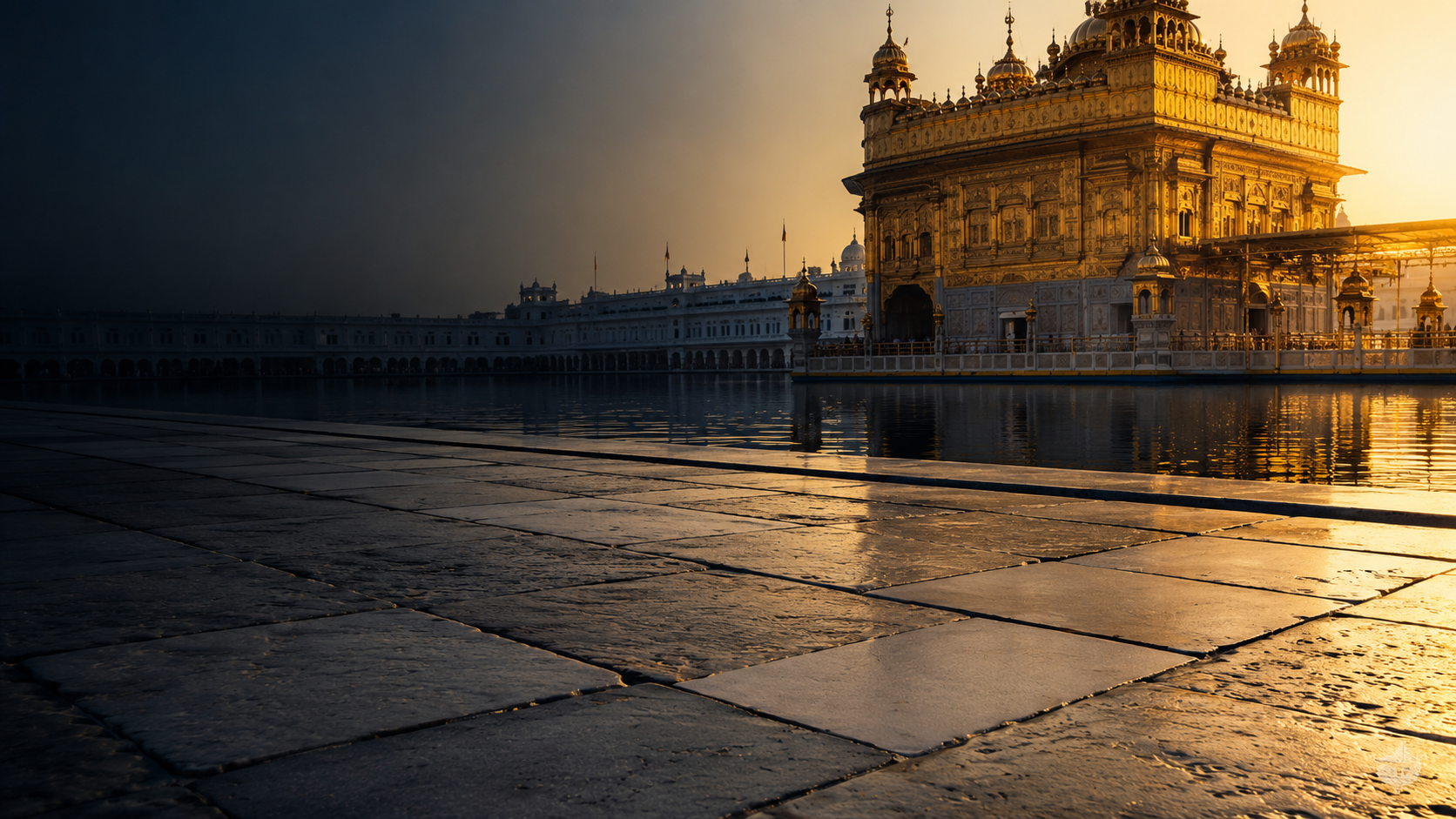
At about ten o'clock on the morning of 18 May 1988, men began walking out of the Harmandir Sahib complex at Amritsar with their hands above their heads.
They came out in daylight, in front of assembled cameras, filthy and unshaven, and surrendered on the marble to officers of the Punjab Police - a police force that was itself, overwhelmingly, Sikh. Five days later the kirtan resumed. The gold on the sanctum was untouched. Nobody had entered the shrine.
The man who had arranged it stood in the parikrama and watched. Kanwar Pal Singh Gill, Director General of Police, Punjab, was fifty three years old and had been in the post for a matter of weeks.
Four years earlier, on almost exactly that ground, tanks had been driven into the parikrama and the Akal Takht had been reduced to rubble. Two years before that the complex had been cleared by commandos and reoccupied within the year. In 1762 an Afghan invader had blown the shrine up entirely and filled the sarovar with filth.
The same twenty metres of stone. Occupied, desecrated, stormed, rebuilt. Occupied, desecrated, stormed, rebuilt.
This is the story of that wheel - of the ground it turns on, of what was done to Punjab each time it came round, and of how it was finally stopped.
The First Turn
Before the wheel, the ground - and before the ground, the reason there is anything at Amritsar worth taking.
Punjab is not one province among twenty eight. It is the gate.
Every invasion of Bharata from the north west for a thousand years came through it first - Arab, Turkic, Ghaznavid, Ghurid, Mongol, Afghan, Mughal, Persian, Durrani. Whatever the plains of the interior suffered, Punjab suffered it before them and for longer, because Punjab is where the road from Kabul comes down onto flat ground. Everything the rest of the subcontinent was spared, Punjab absorbed on its behalf.
Guru Nanak, born in 1469 at Talwandi, watched Babur's men come down that road and wrote what he saw into the Bani itself - a testimony of burned towns, women dragged from their homes, and the wealth of Hindustan carried away. That testimony sits inside the Guru Granth Sahib to this day. It is the earliest eyewitness indictment of the Mughal arrival in the subcontinent, and it was written by a Punjabi.
What followed over the next two centuries is the central fact of Sanatana resistance in the north.
Guru Arjan Dev, who compiled the Adi Granth, was tortured to death at Lahore in 1606 under Jahangir for refusing to alter it. His son Guru Hargobind raised the Akal Takht in the same year and wore two swords, miri and piri, temporal power and spiritual authority together, because a tradition that will not defend itself does not survive contact with a conqueror.
Guru Tegh Bahadur was approached in 1675 by Kashmiri Brahmanas, led by Kirpa Ram, who were being converted at the point of the sword under Aurangzeb. They were not of his path. He went to Delhi on their behalf and was beheaded at Chandni Chowk for refusing to abandon them. There is no comparable act in the recorded history of any civilisation - the head of one tradition giving his life for the sacred thread of another, both of them limbs of the same body. Every argument that Sikhs and Hindus are separate peoples with separate interests dies at that spot, which is why Gurdwara Sis Ganj stands where it stands.
His son, Guru Gobind Singh, raised the Khalsa at Anandpur in 1699. His two elder sons fell at Chamkaur. His two younger sons, aged nine and seven, were bricked alive into a wall at Sirhind for refusing conversion. His mother died on hearing of it. He lost his father, his mother and all four sons to the same empire, and he did not stop.
A tradition that produces Tegh Bahadur, and then produces his son, and then produces the four boys, does not require anybody's certificate of belonging to Bharata. It is what Bharata is made of.
Banda Singh Bahadur broke Sirhind in 1710 and was executed at Delhi in 1716 with hundreds of his companions, every one of whom was offered his life for conversion and refused it. Through the middle of the eighteenth century the Khalsa was hunted with a price on every Sikh head, and endured the two great massacres remembered as the Chhota and the Vadda Ghallughara, the second of which - Ahmad Shah Abdali's slaughter of 1762 - killed something in the order of twenty five to thirty thousand in a single day. In the same campaign Abdali blew up the Harmandir Sahib and defiled the sarovar. The Khalsa rebuilt it, as it had rebuilt it before and would rebuild it again.
Then the misls, and then Ranjit Singh, and then the thing nobody had managed since the eleventh century: under Hari Singh Nalwa the Sikh armies took Peshawar, held Jamrud, and closed the Khyber. From that point until the British, no invader came down that road again. The gate through which Bharata had been entered for eight hundred years was shut by Punjabis, and it stayed shut.
One body, not two
The idea that Hindu and Sikh are rival communities with rival histories is a recent manufacture, and it collapses on contact with any part of the record.
The Guru Granth Sahib contains the bani of Kabir, Namdev, Ravidas, Jaidev and other bhagats of the wider Sanatana stream, set alongside the compositions of the Gurus. The Khalsa was raised to defend a civilisation, not a sect, and its founding act was a Guru dying for Brahmanas. Ranjit Singh, who gold-plated the Harmandir Sahib, also endowed Kashi Vishwanath and sent gifts to Jagannath at Puri, and ran a court in which Hindus, Sikhs and others served without distinction.
In the villages of Punjab the two were not experienced as separate things at all. Families worshipped at gurdwaras and at mandirs in the same week. Marriages ran across the line as a matter of course. For generations Hindu households in Punjab raised a son into the Khalsa, and the arrangement was so ordinary that nobody thought to write it down until people began denying it had happened.
There is no Bharata without the Sikhs. There is no Sikh panth outside Sanatana Bharata. Every project that has tried to separate the two - colonial, political or terrorist - has had to begin by falsifying the history, because the history will not support the separation.
The wheel, first turn
In 1757 Ahmad Shah Abdali's men filled the sarovar and damaged the shrine, and Baba Deep Singh went to Amritsar at the age of seventy five to answer for it and died on that road. In February 1762 came the greater blow - the Vadda Ghallughara, in which something in the order of twenty five to thirty thousand Sikhs were cut down in a single day. Later that year Abdali returned to Amritsar, blew up the Harmandir Sahib with gunpowder, and defiled the tank with the carcasses of cattle.
He then went home, as they all did.
The Khalsa came back to the wreckage, cleared the tank, and rebuilt. Within four decades the shrine stood again, and Ranjit Singh's craftsmen put gold on it.
That is the shape of the thing, and it is worth naming its beats before they recur, because they recur exactly.
The ground is occupied by armed men. The ground is desecrated - by them or in the course of removing them, and usually both. The ground is stormed. The ground is rebuilt by hands that will not accept help with it.
Four beats. In 1762 the wheel took two hundred years to come round again. In the 1980s it came round three times in five years.
The Long Interval
For two centuries after Abdali the wheel stood still, and the province did what it does when nobody is burning it, which is produce.
Then it was cut in half.
The land that was cut in half
Punjab paid for Partition more than any other part of the subcontinent, and it paid twice.
In 1947 the line was drawn through the middle of it. Lahore, which was the cultural capital of the Punjabi language and the seat of Ranjit Singh's darbar, went to Pakistan. So did Nankana Sahib, the birthplace of Guru Nanak. So did Panja Sahib and Kartarpur Sahib. So did the canal colonies of Lyallpur, Montgomery and Sargodha - land that Punjabi Sikh and Hindu settlers had turned within two generations into the most productive irrigated agriculture in Asia, and which was, at the moment it was handed over, the richest farmland on the subcontinent.
What followed was not a migration. It was a clearance, and it ran both ways with a ferocity the rest of India has never fully absorbed. Trains arrived at Amritsar with nobody alive on board. The Sikh and Hindu population of West Punjab was reduced, within months, to effectively nothing. Millions crossed on foot. The dead have never been counted with any precision and the estimates run to the high hundreds of thousands. Settled
The province that received them had lost its capital, its shrines, its best land and half its people, and had gained several million destitute refugees with nothing but their hands.
Within twenty years it was feeding India.
That is the second fact, and it is the one that matters. Punjabi farmers took the new wheat varieties in the mid-1960s, and Punjab, holding a little over one and a half per cent of the land area of the country, became the single largest contributor to the national foodgrain pool and stayed there for decades. It carried the highest per capita income of any Indian state through the 1970s. It sent its sons into the armed forces in a proportion far beyond its share of the population, and they died on every front India has fought on since 1947.
The land whose richest half had been amputated and given to a hostile state, whose people arrived as refugees with nothing, fed the country that had failed to protect it. Then, in the late 1970s, that same country's ruling party set about breaking it for votes.
The fracture that was manufactured
Two things had to be true before Punjab could be set alight. Somebody had to want it, and there had to be a fault line to strike.
The fault line was made.
The categories themselves were hardened by the colonial census. From 1871 the British enumerated, classified, ranked and fixed communities that had until then been fluid, overlapping and locally defined, and having created the boxes they then invited people to compete inside them. What had been a continuum of practice - the same family with a Sikh son and a Hindu son, the same village with a gurdwara and a mandir, the same festivals kept by everybody - became, on paper, two discrete populations with two sets of numbers and two sets of claims. Nicholas Dirks was describing exactly this machinery when he wrote that the census had effects on the social realities it claimed only to record. Settled
The British then encouraged the friction. Sikh and Hindu revivalist movements of the late nineteenth century, which in an undisturbed setting would have argued theology and got on with it, were pushed by an administration that had every reason to prefer two competing constituencies to one.
The second and more damaging act was Indian, and it was political. Punjabi is the mother tongue of Punjab, of Sikhs and Hindus alike; it is the language of the Gurus and equally the language of Punjabi Hindu households. In the census exercises of the 1950s and early 1960s, Punjabi Hindus were urged by political actors to record Hindi as their mother tongue - a manoeuvre in the fight over the reorganisation of the state.
Large numbers did. The effect was catastrophic and permanent. A shared language, the one thing that had held the province together across every other difference, was converted into a marker of communal loyalty. It handed the separatists the single most useful line they ever had - that Hindus of Punjab had disowned Punjab itself - and it wounded Punjabi Hindus, who had done nothing except follow a political instruction, in a way they are still paying for.
Neither community authored this. It was authored by parties in search of blocs, working with categories the colonial state had already carved for them.
This is the point at which the standard account goes wrong, and it goes wrong in a way that serves the people who set Punjab on fire. There was no ancient Hindu-Sikh enmity waiting to be released. There were two limbs of one civilisational body, separated on paper by an imperial counting exercise and then set against each other by politicians who needed the arithmetic. The killing of the 1980s did not grow out of a rivalry. It grew out of a manufactured one, tended for a century, and finally armed.
The Second Turn: The Occupation
The ground is occupied by armed men.
It took six years, and it was not done by an invader. It was done by a preacher who was manufactured in Delhi, financed in part from across a border, and protected by everyone who should have stopped him.
The problem the province actually had
Punjab in the 1970s was the most prosperous agricultural region in Asia. It had absorbed the Green Revolution, it had fed a hungry country, and its politics ran along an entirely ordinary axis: the Akali Dal, drawing on rural Sikh sentiment and on control of the gurdwara establishment, against the Congress, drawing on urban Hindu and Dalit support. The Anandpur Sahib Resolution of 1973 was a federalist wish list - river waters, Chandigarh, greater powers for the state. It was a bargaining document of a kind every Indian state has produced at some point, and it was negotiable.
What turned a negotiable document into a decade of massacres was a decision taken in Delhi. After the Emergency and the Congress rout of 1977, the party set out to break the Akali hold on Punjab from the inside by sponsoring a rival religious figure who would split the Akali constituency and make the Akali leadership look feeble and irrelevant to its own base. The man selected was a preacher from the Damdami Taksal named Jarnail Singh Bhindranwale. How that was done, and what it produced, is set out below.
The wider allegation - that Sanjay Gandhi personally ran the operation, that money moved from Congress hands to Bhindranwale's, that the design was mapped out in the party's Delhi offices - has been asserted by participants, by intelligence officers and by journalists across four decades, and denied by the party. Contested The narrower facts do not require the wider allegation to be true. They are damning on their own.
The preacher who was made
Jarnail Singh Brar was born on 2 June 1947 at Rode in Moga district, the youngest of several sons of a farming family, and was sent as a boy to the Damdami Taksal, the seminary founded in the tradition of Baba Deep Singh for the training of preachers and the correct recitation of scripture. He was married at nineteen and had two sons. He was not a scholar of any distinction and his critics inside the Taksal never pretended otherwise. What he possessed was voice, physical presence, an unerring instinct for the grievance in a room, and a total absence of any restraining calculation.
In 1977, on the death of the incumbent, he was installed as head of the Taksal and took the name by which the world would know him. He was thirty years old.
His subject was not politics. It was decline - drink, tobacco, hair-cutting, apostasy, the drift of rural Sikh youth away from observance. That was a real anxiety in Punjab in the 1970s and it had nothing to do with secession. He preached it in villages, and the villages listened, because a man denouncing intoxicants to farmers whose sons were already being lost to them is saying something true.
What converted a revivalist preacher into an armed political instrument was the discovery, by people in Delhi, that he was useful.
What the Congress did
The party's problem in Punjab after 1977 was arithmetical. It could not beat the Akali Dal on the rural Sikh vote. The solution devised was to fracture that vote by elevating a religious figure who would attack the Akalis from a position they could not answer, which was the position of greater piety.
Giani Zail Singh, who had been Congress Chief Minister of Punjab and who understood the ground better than anyone in Delhi, was the architect. Mark Tully and Satish Jacob recorded that the bill for the press conference which launched the separatist Dal Khalsa onto the public stage was settled by Zail Singh himself, and that when he later disputed the account the journalist replied that he still had the receipt. Settled
The pattern over the following six years is a matter of documented behaviour rather than inference.
In April 1978 thirteen of Bhindranwale's followers were killed in a clash with the Nirankaris at Amritsar. The prosecution of the case collapsed and the acquittals were not seriously contested by the state. In September 1981 the province's most prominent newspaper proprietor, who had been the preacher's most relentless critic, was assassinated near Ludhiana. Bhindranwale was named in the case. He withdrew to Chowk Mehta, surrendered on his own terms in a spectacle staged for his followers, and was released within weeks for want of evidence, whereupon a Union minister flew to Punjab and was photographed with him. He toured with an armed escort. He was permitted to use government guest houses and, on occasion, government aircraft.
Every one of those decisions was taken by a Congress administration in Delhi or in Chandigarh, and every one of them was taken for the same reason: that a preacher hurting the Akalis was worth the cost of the bodies.
A party that manufactures a demagogue to split its rivals acquires no mechanism to switch him off. The people he is aimed at are never the people who end up dying.
By 1982 the arithmetic had gone the other way. Bhindranwale had outgrown his sponsors, joined the Akali-led Dharam Yudh Morcha in August of that year on his own terms, and made himself its centre of gravity, so that the moderates who had launched the agitation found themselves hostages inside it. He moved into the Guru Nanak Niwas within the Harmandir Sahib complex. Weapons began to accumulate. Men wanted for murder began to live there.
Pakistan's second front
By 1980, Rawalpindi had drawn the obvious conclusion from 1971: that Bharata could not be dismembered by armour and infantry, but might be dismembered from within at a fraction of the cost. Under Zia-ul-Haq, the Inter-Services Intelligence built the doctrine that has defined the subcontinent ever since - proxy war, sponsored through religious identity, deniable, cheap, and indefinitely sustainable.
Punjab was the prototype. Training camps for Sikh militants operated in Pakistani Punjab. Weapons crossed the border in volume, and the profile of what crossed tells the story with no need for commentary: Chinese and Soviet-pattern assault rifles, rocket-propelled grenades, plastic explosive of military manufacture. No village grievance about river waters produces RDX. Sanctuary was provided to commanders on the run. The riverine and marshy stretches of the international border in Amritsar and Ferozepur districts became a highway. Settled
The traffic ran in both directions. Money came from the diaspora - from organisations in Britain, Canada and the United States that had discovered they could raise funds and status in comfortable suburbs for a war fought entirely by other people's sons in villages they would never visit. Jagjit Singh Chauhan announced his government-in-exile from London. Babbar Khalsa built its financial and organisational spine in Canada.
What that money and that shelter eventually produced is dealt with in full further on. It produced the largest mass murder in Canadian history, and the deadliest act of aviation terrorism anywhere in the world before 11 September 2001.
The steps: Avtar Singh Atwal
The moment at which the Indian state's authority in Punjab visibly ceased has a date and a place.
On 25 April 1983, Avtar Singh Atwal, Deputy Inspector General of Police for the Jalandhar range, went to the Harmandir Sahib to pray. He was forty years old, he was unarmed, and he was in plain clothes with the karah prasad still in his hands when he was shot on the steps as he came out. A boy in the crowd was killed in the same burst and others were wounded. The gunman walked back into the complex.
Atwal's official car and his escort were metres away. The Punjab Armed Police were posted within sight. Nobody moved. His body lay where it fell for hours, in the open, in front of the holiest shrine of his own faith, because no policeman in Punjab was willing to step across an invisible line to recover a Deputy Inspector General of Police. Settled
The message was received exactly as intended, by every constable in the province and by every household. There was now a sovereign inside that complex, and it was not the Republic of India.
The killing did not stop. In October 1983 a bus was stopped near Dhilwan, Hindu passengers were separated from the others and shot, and a second attack the same day killed more. The Congress government of Darbara Singh was dismissed, President's rule was imposed, and the situation did not improve for a single day thereafter, because the problem had never been the state government.
In December 1983, Bhindranwale moved from the Guru Nanak Niwas into the Akal Takht itself, the seat of temporal authority of the Sikh panth, and made it his headquarters and his arsenal.
The war on the press
One institution refused to be silenced, and the price it paid deserves to be recorded in full, because it is almost never told.
Lala Jagat Narain had gone to jail with the freedom movement, had served as a minister and a member of parliament, and had founded the Hind Samachar group - the Urdu Hind Samachar, the Hindi Punjab Kesari and the Punjabi Jag Bani, the loudest newspapers in the province. He was the most persistent critic of the preacher and of the politics protecting him, and he had stood as a witness in the prosecution arising from the Nirankari clash.
On 9 September 1981, at eighty two years of age, he was travelling from Patiala towards Jalandhar when gunmen on a motorcycle drew alongside his car near Ludhiana and shot him dead. Bhindranwale was named in the case, arrested at Chowk Mehta, and released within weeks for want of evidence. Settled
The papers did not soften a line. His son Ramesh Chander took over, established a fund for the families of terror victims in 1983, and was himself assassinated in May 1984.
Then the killers went after everyone else. Editors, district reporters, sub-editors, delivery drivers, news agents and the hawkers who carried the bundles into the villages at five in the morning. Over the following decade the Hind Samachar group lost sixty two of its staff, agents and hawkers to terrorism. Settled
Not one edition was missed.
Consider what that actually required. A man in a border village, on a bicycle, in the dark, distributing a newspaper that had already had sixty of his colleagues murdered, for a wage that would not cover his own funeral. Nobody built him a memorial. There is no film about him. He is not mentioned in any of the international literature on the Punjab conflict, which is voluminous and which has room for everything except him.
The fortification
The man who turned the complex into a defensive position was not a preacher. He was Major General Shabeg Singh, a decorated officer of the Indian Army who had raised and trained the Mukti Bahini for the liberation of Bangladesh in 1971, and who had been dismissed from service on the eve of his retirement on corruption charges he insisted were fabricated. He brought to Amritsar four decades of professional soldiering and a personal grievance against the state.
He did the job properly. Firing positions were built into the parikrama buildings and the surrounding houses, with interlocking arcs covering every approach. The Akal Takht was sandbagged and reinforced. Light machine guns and Chinese-made rocket launchers were emplaced. The eighteenth-century Ramgarhia bungas, which dominate the complex, were turned into strongpoints. Tunnels and covered routes were prepared. Weapons came in over the border in quantity, and came into the complex in the vehicles of pilgrims and in the trucks of the langar.
Between April 1983 and May 1984 the Indian state watched an armed base being constructed inside the most sacred precinct of the Sikhs and did nothing, in the same period in which its own senior police officer had been shot on those steps and left lying there.
There had been a plan. Operation Sundown was drawn up to lift Bhindranwale out of the complex by commando snatch, with minimal force and no assault. It was rejected by the Prime Minister on the assessment of likely collateral casualties. Negotiations were preferred, and negotiations failed, as they had failed every previous time. Settled
Every option that remained by May 1984 was worse than every option that had been discarded, and this is the single most important sentence that can be written about how Punjab was lost.
The Second Turn: The Tanks
The ground is desecrated. The ground is stormed.
By the spring of 1984 the position had become intolerable, and every remaining option was bad.
Blue Star
The Army was asked for an assault plan. Lieutenant General S.K. Sinha, then Vice Chief and in line to command the Army, advised against entering the complex and urged that another route be found. He was passed over, and General A.S. Vaidya was appointed Chief. Vaidya, with Lieutenant General K. Sundarji, planned the operation. Major General Kuldip Singh Brar was summoned from his division at Meerut on 31 May to command the assault. Brar was a Jat Sikh from a village a few miles from Bhindranwale's own, and Shabeg Singh had been his instructor at the Indian Military Academy. Four of the six generals directing the operation were Sikhs, and when Brar offered his men the option of standing out of an action inside their own holiest shrine, not one of them took it. Settled
The cordon closed on 3 June. That was the martyrdom anniversary of Guru Arjan Dev, the single most crowded day in the calendar of the shrine, and thousands of ordinary pilgrims and their families were inside the complex when the curfew came down and the province was sealed. That decision, more than any other detail of the operation, is what made the aftermath unmanageable.
The assault went in on the night of 5 June. It went in frontally, against a defence prepared over fourteen months by a professional soldier, and it went in expecting resistance of an entirely different order from what it met. Infantry crossing the open parikrama were cut down from the interlocking positions Shabeg Singh had sited. Armoured personnel carriers were disabled by rocket fire. By the early hours it was clear that the Akal Takht could not be taken by infantry at any acceptable cost, and tanks were brought into the parikrama and used, in the small hours of 6 June, against the seat of temporal authority of the Sikh panth.
Bhindranwale, Shabeg Singh and Amrik Singh of the Sikh Students Federation died inside on 6 June. The complex was under control by the morning of 7 June, and the wider operation - the countryside sweeps run under the name Operation Shop - continued after that.
The Akal Takht was wrecked. The Sikh Reference Library, holding manuscripts, hukamnamas of the Gurus and irreplaceable records of the panth's own memory, was lost. In civilisational terms that loss is permanent and unquantifiable, and no military account of the operation has ever adequately reckoned with it.
The government's White Paper put the dead at 493, of whom 309 were described as pilgrims, along with 83 soldiers killed. Independent estimates, and later statements by senior political figures, have run far higher, and the true civilian figure has never been credibly established because no serious count was ever attempted. Contested
What followed in the countryside compounded it. Operation Woodrose swept the rural districts, and large numbers of young Sikh men were picked up on suspicion, held without process and in an unknown number of cases never returned. Whatever the operational justification, its effect on the villages was to convert a crisis over one man in one building into a general grievance across an entire rural population. Settled
The military objective was achieved and the political objective was lost in the same week. Gill himself held, in later years, that the Prime Minister had been badly advised - that the operation should not have been fought in that form, on that date, with that many civilians inside, and that a siege would have produced the same result at a fraction of the cost. Four years later, on the same ground, he proved the point in front of the world's cameras.
The fallout
The reaction ran through the Army itself. In the days after the assault, soldiers in several units, including men of the Sikh Regiment at Ramgarh in Bihar, left their cantonments and set out for Amritsar on hearing that tanks had been used inside the complex; a brigadier was killed in the course of it. The men were rounded up, court-martialled and dismissed, and many spent years afterwards petitioning for reinstatement. The Indian Army had never experienced anything comparable, and it has never experienced it since. Settled
General Vaidya, who had commanded the Army during the operation, was shot dead in Pune on 10 August 1986, after his retirement, by two gunmen who were later hanged for it.
And on 31 October 1984, Indira Gandhi was assassinated in the garden of her own residence by two of her Sikh bodyguards.
The account of Indira Gandhi
The Prime Minister's part in this cannot be reduced to the week of the assault, and it cannot be waved away by either of the two available pieties.
Her party cultivated the preacher to split the Akali vote, and she presided over that decision. Her government watched him build an armoury inside the Harmandir Sahib complex for four years and did not act. Her ministers negotiated with him, flew him about, and freed him after a murder. When a plan existed to lift him out of the complex with minimal force, she rejected it. When she finally moved, she moved with an armoured assault on the martyrdom anniversary of Guru Arjan Dev, with the complex full of pilgrims, against a defence prepared by a professional soldier, after every cheaper option had been thrown away by her own administration.
She was then murdered by two of her own guards, and in the days that followed, functionaries of her party organised the killing of three thousand Sikhs in her capital.
That is the sequence. A political calculation begun for a state election ended with a Prime Minister dead in her garden, a shrine wrecked, three thousand citizens burned in the lanes of Delhi, and a decade of war. Every step of it was avoidable, and at every step the avoidance was rejected because a party's arithmetic came first.
The Delhi killings
What followed in Delhi and across northern India was not a spasm. Between 1 and 3 November 1984, Sikh homes, shops and gurdwaras were attacked in an organised sweep. Voter lists and ration records were used to identify Sikh households. Kerosene was distributed. Men were dragged out and burned alive in their lanes, in front of their wives and children, while the police of the national capital stood by, and in places assisted. Something close to three thousand Sikhs were killed in Delhi alone, and more across other states.
The organisation was not anonymous. Successive inquiries, culminating in the Nanavati Commission, named Congress functionaries as having led and directed the killing in specific localities. It took thirty four years for a court to convict Sajjan Kumar and sentence him to life imprisonment. Most of the dead have still received nothing that any honest language would call justice. Settled
The consequence was strategic. The party that had built Bhindranwale to divide the Akalis now handed the militants the one thing they had never been able to generate for themselves: a genuine and enormous grievance. Recruitment, which had been a matter of a few hundred armed men, became a flood of thousands. Every subsequent year of killing in Punjab was fertilised by those three days in Delhi.
Two separate propositions are true at once, and both must be held. The Khalistani project was a foreign-sponsored terrorist campaign against Bharata that murdered civilians by the tens of thousands and had no legitimate claim on the Sikh panth. And the killing of Sikhs in Delhi in November 1984 was a crime organised under political protection, for which the Indian state owed a reckoning it has still not delivered. Neither fact cancels the other, and any account of Punjab that suppresses either one is propaganda.
Excursion: The Atlantic
Once, and only once, the wheel threw something five thousand miles clear of the ground it turns on.
Emperor Kanishka
Air India named its Boeing 747s after emperors. The aircraft registered VT-EFO carried the name Emperor Kanishka, after the Kushan sovereign under whom Gandhara and the north west flowered, whose coins carried the Buddha and Siva together, and whose empire ran from the Oxus to Varanasi.
On the morning of 23 June 1985 it was torn apart by a bomb at thirty one thousand feet over the Atlantic, forty five minutes short of London, and everyone aboard was killed. Three hundred and twenty nine people. Eighty two of them were children.
It is the largest mass murder in Canadian history. It was the deadliest act of aviation terrorism in the world until 11 September 2001. It was conceived, financed, assembled and dispatched from Canadian soil, by men living in Canadian cities, against passengers most of whom were Canadian citizens - and forty years later, one man has been convicted of anything connected to it. Settled
The plan
The organisation was Babbar Khalsa. The central figure, on the assessment of Indian and Canadian investigators alike, was Talwinder Singh Parmar, its founder in Canada, a man wanted in India for the murder of policemen who had built a following in British Columbia and who spoke openly about revenge for June 1984.
The device was built with the help of Inderjit Singh Reyat, an electrician in Duncan on Vancouver Island, who bought the components locally - a Sanyo tuner, a detonator, dynamite, a timer - a purchase trail that would later be reconstructed shop by shop.
On 4 June 1985, Parmar and Reyat drove into the woods outside Duncan and set off a test explosion. They were under surveillance at the time by the Canadian Security Intelligence Service, which was watching Parmar. The officers in the woods heard a loud report, took it for a gunshot, and did not understand what they had just witnessed until after three hundred and thirty one people were dead. Settled
Nineteen days later the operation went.
The bags
The design was simple and it exploited exactly one weakness: an airline will carry a passenger's suitcase to a destination the passenger does not travel to.
On 22 June, at Vancouver airport, two tickets were bought under the names M. Singh and L. Singh. Neither man boarded anything. Each checked a suitcase, and each insisted - in one case over an argument at the counter, because the passenger held only a standby booking with no confirmed onward seat - that the bag be interlined all the way through to an Air India flight.
One bag went on a Canadian Pacific flight to Tokyo, to be transferred at Narita to Air India Flight 301 for Bangkok. The other went east to Toronto, to be transferred to Air India Flight 182 for London, Delhi and Bombay.
At Toronto the explosives detection dog was not available. The X-ray machine used for the Air India bags failed. Staff fell back on a hand-held sniffer they had almost no training on, ran it over the luggage, got a reading nobody could interpret with confidence, and loaded the aircraft. Settled
Both bags flew without their passengers. Nobody stopped either one.
The morning
The two bombs of 23 June 1985, times given in Greenwich Mean Time
| Time | Place | Event |
|---|---|---|
| 06:19 | Narita Airport, Tokyo | Bag explodes during transfer to Air India Flight 301 |
| 07:14 | Atlantic Ocean, off south west Ireland | Air India Flight 182 destroyed at thirty one thousand feet |
The Narita bomb went off fifty five minutes early, in a baggage transfer area, because of a miscalculation over time zones. It killed two Japanese baggage handlers, Hideo Asano and Hideharu Koda, who had never heard of Punjab and had no part in anybody's quarrel. Had it functioned as intended, a second Air India aircraft with several hundred more people aboard would have gone down over the Andaman Sea.
Fifty five minutes later, off the coast of County Cork, Flight 182 disappeared from the radar screens at Shannon in the middle of a routine transmission.
Irish fishermen, the Irish Naval Service ship Aisling, and helicopters out of Shannon reached the position and found wreckage, luggage and bodies spread across miles of open water. One hundred and thirty one bodies were recovered. One hundred and ninety eight were never found and remain in the Atlantic.
The town of Cork took in the dead and the families who came for them. Irish nurses, priests, police and ordinary householders sat through the identifications with people who had flown in from Toronto and Montreal and Delhi to look at bodies. Forty years on, the families still speak of what the Irish did for them, and the memorial at Ahakista, on the water, is where many of them return every June.
Who was on board
The passenger list of Flight 182 in late June is the passenger list of every Indian summer.
Children going to grandparents for the holidays. Mothers travelling with three and four children, taking the annual leave the family had saved for. Doctors and engineers who had emigrated in the 1960s and 1970s and were making the trip home. Students. Newly married couples. Eighty two children under the age of thirteen, six of them infants.
Among them were Manjari Sankurathri and her two small children, Srikiran and Sarada, flying from Ottawa to India for the summer. Her husband, Chandra Sekhar Sankurathri, a scientist with the Canadian government, was to follow a month later. Their bodies were never recovered.
He gave up his life in Canada, returned to his wife's home town of Kakinada in Andhra Pradesh, and built - out of nothing but that grief - a foundation in her name, a free school named for his daughter, and a free eye hospital named for his son. The hospital has since performed surgeries by the hundred thousand on people who could not have paid for sight. He was awarded the Padma Shri in 2023. Settled
That is the answer of a civilisation to a bomb, and it deserves to be recorded next to the crime, because the crime has had far more written about it than the reply.
The failure
The government of India had warned Canada. Repeatedly, formally, and with names. Through 1984 and into 1985 it passed on assessments about Babbar Khalsa, about specific individuals, about the threat to Air India in particular, and it asked for protective measures.
The warnings were discounted. The prevailing view in Ottawa was that this was an immigrant community's imported quarrel, an Indian problem playing out on Canadian streets, and that Indian requests were probably exaggerated for political reasons.
What followed was catalogued twenty five years later by a Commission of Inquiry under Justice John Major, and its findings are not disputable.
Parmar was under active surveillance and was let go. The test blast was heard and misread. CSIS erased more than a hundred and fifty wiretap tapes as a matter of routine transcription policy, destroying the primary evidence of the conspiracy before anyone could use it in a courtroom. CSIS and the Royal Canadian Mounted Police were fighting each other over jurisdiction and shared almost nothing. Threat assessments did not reach the people running airport security. The security response at Toronto was inadequate in the specific ways described above. Major called it a cascading series of errors. Settled
Then there was the response afterwards, which the families have never forgiven and which the Commission itself criticised. The Prime Minister of Canada offered condolences to the Prime Minister of India. Two hundred and sixty eight of the dead were Canadian citizens. For twenty years the bombing was discussed in Canada as a foreign tragedy that had happened to somebody else's people, and the families of the dead - Canadian taxpayers who had buried Canadian children - were treated as claimants from abroad rather than as the bereaved of the largest massacre in the country's history. Canada apologised for that in 2010. Settled
The justice that never came
Inderjit Singh Reyat is the only person ever convicted in connection with either bomb. He was convicted in 1991 for the Narita explosion and sentenced to ten years. In 2003 he pleaded guilty to manslaughter for Flight 182 and received five years, on an understanding that he would testify. He then went into the witness box and lied, comprehensively, and was convicted of perjury in 2011 and sentenced to nine years - the longest sentence for perjury in Canadian history. He was released in 2016. Settled
Ripudaman Singh Malik, a Vancouver businessman, and Ajaib Singh Bagri, a mill worker from Kamloops, were arrested in 2000 and charged with mass murder. The trial was the longest and most expensive in Canadian history, running into hundreds of millions of dollars in public money, including the defence costs. On 16 March 2005, Justice Ian Josephson acquitted both men on all counts, finding the Crown's witnesses unreliable. Settled
Parmar had been arrested in Canada in 1985 and released. He left, resurfaced in Pakistan, and was eventually killed by the Punjab Police in October 1992. Canadian and Indian accounts of his death differ, and the circumstances have been disputed ever since. Contested
So the arithmetic is this. Three hundred and thirty one people murdered. One man convicted, chiefly for the smaller bomb and then for lying about the larger one. Two acquitted. The mastermind dead in a police operation on another continent. The evidence erased by the intelligence service of the country where the crime was planned.
What it left behind
Two things came out of it that outlast the case.
The first is technical and global. After Kanishka, the matching of every checked bag to a boarded passenger became standard practice in international civil aviation. Every traveller in the world who has ever had a flight delayed while a bag was pulled from the hold because a passenger did not board is living inside a rule written in the Atlantic on 23 June 1985.
The second is political and unresolved. The men who planned this did not live in Punjab, did not fight in Punjab, and did not die in Punjab. They lived in Canadian suburbs, raised funds in Canadian institutions, and killed Canadian families - and in the decades since, Parmar has been commemorated as a martyr in gurdwaras and parade floats in the same country, while the families of the dead have watched it happen. Malik himself was shot dead in a Surrey car park in July 2022, thirty seven years after the bombing and seventeen after his acquittal. Settled
This is the substance of the argument that Bharata has made to Western governments for forty years and has generally lost: that a separatist campaign hosted, funded and lionised abroad is not a matter of free expression among a diaspora, because it does not stay abroad and it does not stay expressive. It sends bags.
Three hundred and twenty nine people went into the Atlantic in retaliation for an operation in Amritsar in which none of them had any part, ordered by men who had never seen it, executed against children going home for the summer. That is the whole of the Khalistan project, in one aircraft, on one morning.
The Sorting
Away from the ground, in the districts, the killing had acquired a method.
The roll
The terror in Punjab is often described in the language of a community at war with a state. The casualty pattern says something else entirely, and the method says it more plainly still.
The method was sorting. A bus was stopped or a train was halted with the emergency chain. Identities were established by turban, beard, name, accent, or the answer given at gunpoint. The people who passed were told to step aside. The people who did not were taken off and shot on the verge, or shot where they sat.
Set out in one place, the roll is difficult to read and it is not usually set out in one place.
Selected mass killings of civilians by Khalistani terrorist groups, 1983 to 1991
| Date | Place | What happened |
|---|---|---|
| 5 October 1983 | Dhilwan, Kapurthala | Bus stopped, six Hindu passengers separated and shot |
| 29 March 1986 | Mallian, Jalandhar | About twenty migrant labourers killed |
| 25 July 1986 | Muktsar | Women, children and visibly Sikh passengers ordered off; fifteen shot |
| 30 November 1986 | Khuda, Hoshiarpur | Bus hijacked, twenty four Hindu passengers ordered down and shot |
| 6 July 1987 | Lalru | Chandigarh-Rishikesh bus hijacked, thirty eight killed including five women and four children |
| 7 July 1987 | Near Fatehabad | Two buses attacked, thirty four killed |
| 25 June 1989 | Moga | Firing from a van on a morning gathering at Nehru Park, about twenty five killed |
| 12 November 1990 | Kothe Lal Singh | Eight Hindu villagers shot |
| 15 June 1991 | Baddowal and Sohian, Ludhiana | Two trains halted on one night, about one hundred and ten passengers killed |
| 21 November 1991 | Basarke, Amritsar | Eighteen members of a wedding party shot at the celebration |
| 26 December 1991 | Sohian, Ludhiana | Train boarded, more than fifty passengers killed |
Three of those entries deserve to be lifted out of the list.
At Lalru on the night of 6 July 1987, a Haryana Roadways bus running from Chandigarh towards Rishikesh was cut off by a car, driven off the road, and its passengers - pilgrims, labourers, families - were herded into the middle of the vehicle and fired on from both ends. Thirty eight died in about five minutes. Among them was a twenty eight year old woman named Savitri Devi, who covered her husband and her five month old daughter with her own body and was killed doing it. Both of them lived. Settled
On 21 November 1991 at Basarke in Amritsar district, gunmen walked into a wedding and killed eighteen people. Not a convoy, not a police post, not a political meeting. A marriage party. Whole families were dismantled in an evening that had been years in the planning by the people who were celebrating it. Settled
On 15 June 1991, on the eve of an election, two trains were stopped within half an hour of each other near Ludhiana and about a hundred and ten passengers were murdered in their seats and beside the tracks. It remains the largest single night of killing of the entire conflict, and it was carried out for one purpose, which was to make voting impossible. Settled
And the Sikhs who died with them
There is a part of this record that Punjab knows and the literature does not.
At Muktsar in July 1986, the gunmen ordered women, children and visibly Sikh passengers off the bus before opening fire on those who remained. One of the men they killed was a Sikh - a Sikh who kept his beard shaved, and who therefore did not read as one to men sorting human beings by facial hair at gunpoint. He died because the machinery of identification that the whole ideology rested on could not even perform its own primary function. Settled
In the train carriage near Sohian in June 1991, forty nine people were murdered and two of the dead were Sikhs. Settled
Across the villages the pattern repeats without ever being recorded. Sikh families hid Hindu neighbours in their houses, their cattle sheds and their standing crops through nights when sheltering them was a capital offence - exactly as Hindu families in Delhi in November 1984 hid Sikh neighbours while the killers came street by street with the voter lists. Bus conductors did not point. Village elders lied to armed men about who lived in which house. Sikh policemen died in numbers no other group of Sikhs died in, hunting Sikhs who were murdering Sikhs.
None of these people were organised and almost none of them were named. They were ordinary Punjabis who declined, at short notice and at the cost of their lives, to accept the proposition that their neighbour belonged to a different nation. Both ideological edifices - the one that says Khalistan spoke for the Sikhs, and the crude one that answers it with Hindu-Sikh enmity - are refuted by a conductor who would not point.
The turn inward
Then the killing turned on the community it claimed, as it always does.
Sikh moderates were shot for saying that Khalistan was a fantasy. Gurdwara officials were shot for refusing to hand over collection money. Editors, doctors, bus drivers, panches, sarpanches and rural schoolteachers were shot for the offence of continuing to function. Sikh policemen were shot in front of their families, and their families were shot for having sheltered them. Landholders were dispossessed by armed boys quoting scripture. Migrant labourers from Bihar and eastern Uttar Pradesh - men with no politics, no property and no protection, who had come to cut Punjab's wheat - were murdered in batches in the fields and the brick kilns simply because they were killable and their deaths would frighten everyone else.
By the early 1990s the surviving groups were an extortion economy with a theological letterhead. Their conduct in the villages - the levies, the abductions, the sexual violence - did more to destroy them than any operation ever did.
The dead of Punjab were, in their great majority, Sikhs. That is the fact the Khalistan lobby abroad has spent four decades arranging its literature to avoid.
The Third Turn: The Rebuilding, and the Retaking
The ground is rebuilt by hands that will not accept help with it. Then it is occupied again.
The fourth beat of the wheel and the first beat of the next turn happened, this time, in the same fortnight.
The Sarkari Takht
Bhindranwale died on 6 June 1984. The problem he represented did not, and the four years that followed are the answer to the question of what Gill was actually up against when he took charge.
A dead man is far more useful to an armed movement than a living one. Living, he could be argued with, embarrassed, contradicted and made to answer for the bodies. Dead in the Akal Takht with tanks in the parikrama, he became unanswerable, and every group that emerged after 1984 claimed his mantle - one of them took his name outright.
And the complex itself was retaken. Repeatedly.
By the beginning of 1986 the Harmandir Sahib complex was again under the control of the Damdami Taksal and the armed groups. On 26 January 1986 a Sarbat Khalsa was convened at the Akal Takht, drawing an enormous gathering, which passed a series of resolutions: that the Akal Takht rebuilt with government money by Baba Santa Singh of the Budha Dal, at the instance of the union home minister, be pulled down and rebuilt by the panth's own kar seva; that the Sikh leaders who had supported the Rajiv-Longowal Accord be declared traitors; that the SGPC be dissolved and replaced by a Panthic Committee; and that a new Jathedar be installed. On 29 April 1986 a written declaration of Khalistan was issued from the Akal Takht, naming the Khalistan Commando Force as its army. The following day the security forces entered the complex in the first Operation Black Thunder and cleared it in eight hours. Within months the armed men were back. Settled
The Akal Takht episode is worth understanding precisely, because it is usually misread. The demolition of the government-built structure was not vandalism and it was not separatism. It was the panth refusing to accept its holiest seat of authority as a gift from the administration that had shelled it, and insisting on rebuilding it with its own hands and its own money. That instinct was sound. What the armed groups did was ride it, capture the assembly that expressed it, and convert a legitimate act of self-respect into a platform for a declaration of secession.
Why the panth could not simply expel them
The question that outsiders always ask - how could the Sikhs allow their own shrine to be turned into an arsenal - has a precise and unhappy answer, and it is not indifference.
First, the men in occupation were armed and the sangat was not. Every Sikh who publicly demanded their removal was marking himself. Longowal signed an agreement and was shot inside a gurdwara. Moderate gurdwara officials were murdered. A serving Deputy Inspector General was shot on the steps and left lying there. In an environment where objection carried a death sentence, silence is not consent.
Second, the institutional authority that could have acted had been captured. The SGPC and the Akali leadership had spent decades building their positions on control of the shrines, and every one of them was terrified of being the man denounced from the Akal Takht as the one who called the police into the Darbar Sahib. Barnala did the necessary thing in 1986 and was ostracised for it, and later performed service at the shrine in atonement. Every politician in Punjab watched that and drew the obvious conclusion.
Third, the state gave the panth nothing to work with. Delhi had spent four years demonstrating that it would protect the occupiers rather than the objectors, and then it sent tanks. After that, any Sikh who suggested calling in the government could be answered with a single word, and the word was 1984.
The occupation was not permitted by the panth. It was imposed on the panth by armed men who had made objection lethal and who were shielded by politicians in Amritsar and in Delhi for opposite reasons. This distinction is the whole of the matter, and both the Khalistan lobby and its crudest opponents have an interest in blurring it.
The order of battle
The groups themselves are worth naming, because the vocabulary of a single monolithic movement is one of the enduring falsifications of this period.
The Khalistan Commando Force emerged after 1984 under Manbir Singh Chaheru and then Labh Singh, and was for a time the most capable of the armed formations. The Khalistan Liberation Force under Avtar Singh Brahma and later Gurjant Singh Budhsinghwala worked the Majha belt. The Bhindranwale Tiger Force of Khalistan under Gurbachan Singh Manochahal claimed the mantle of the dead preacher. Babbar Khalsa, under Talwinder Singh Parmar and Sukhdev Singh Babbar, was the most ideologically rigid and the most internationally connected, with its financial and organisational base in Canada and Britain. The International Sikh Youth Federation ran the overseas recruitment and propaganda apparatus. Above them sat successive Panthic Committees, each claiming to be the legitimate command authority, each disputed by the others.
They fought each other almost as readily as they fought the state. They issued conflicting edicts, executed each other's men as informers, and split repeatedly over money and precedence. By 1990 the number of groups claiming the Khalistani label had passed a hundred, most of them small extortion outfits with a flag. This was not a national liberation movement acquiring the machinery of a state. It was a fragmenting criminal ecology feeding on a terrorised population, and Gill read it correctly while the political class in Delhi was still looking for someone to negotiate with.
Everything that was thrown away, 1985 to 1988
Between the catastrophe of 1984 and Gill's appointment as Director General in 1988 lie four years in which every remaining opportunity to settle Punjab politically was taken up and thrown away.
On 24 July 1985 the Rajiv-Longowal Accord was signed. Harchand Singh Longowal, the Akali leader who had spent the previous years being outflanked by Bhindranwale, accepted terms on Chandigarh, on river waters and on the transfer of territory, and in exchange the agitation was to end. It was the moderate settlement that had been available for a decade. Twenty seven days later, on 20 August 1985, Longowal was shot dead inside a gurdwara at Sherpur while addressing a congregation.
That killing was the whole logic of the period in a single act. The terrorists did not fear the Indian Army. They feared a Sikh leader who could deliver a settlement, because a settlement would have ended them. Every moderate voice in Punjab understood the message, and most of them fell silent.
Elections were held in September 1985 and the Akali Dal took power under Surjit Singh Barnala. The Accord was then not implemented. The transfer of Chandigarh was deferred, then deferred again, then abandoned; the commissions on river waters produced nothing usable. Delhi had signed an agreement and then declined to pay for it, which destroyed the one Punjab government that had staked its existence on the proposition that agreements with Delhi were worth signing.
In April 1986 armed men again occupied the Harmandir Sahib complex and declared Khalistan from within it. Barnala sent in the security forces in the first Operation Black Thunder, which cleared the complex in eight hours with a single death. For that act, taken to protect the shrine from those who had turned it into an arsenal, he was ostracised and later required to perform service at the shrine in atonement. The lesson absorbed across Punjab's political class was that no politician could survive doing the necessary thing.
In May 1987 the Barnala government was dismissed and President's rule imposed. Julio Ribeiro, brought in as Director General in 1986, restored a measure of aggression with the doctrine he summarised as bullet for bullet, and survived an assassination attempt on his own headquarters. His approach was necessary and insufficient, because it was retaliation rather than architecture: it answered attacks without dismantling the organisations that generated them, and it left the terrorists in possession of the two assets that mattered, which were the shrines and the story.
By early 1988 the killing had crossed into a new register. In the first six months of that year one thousand two hundred and sixty six civilians were murdered, an average of two hundred and eleven a month, and in May alone the figure reached three hundred and forty three.
That was the month K.P.S. Gill became Director General of Police, Punjab.
The Fourth Turn: Ten Days in May
The ground is occupied by armed men, again, fortifying the same buildings, again.
This time the wheel did not complete, and the reason it did not has a name and a biography.
The man who came to the ground
Kanwar Pal Singh Gill was born on 29 December 1934 at Ludhiana, into a Jat Sikh family of comfortable standing. His father, Rachpal Singh Gill, was a senior government engineer. His mother, Amrit Kaur, died while he was still a boy, and those who knew him in later life traced a certain unreachable hardness in him to that loss.
He was twelve when the subcontinent was cut. Punjab took the deepest wound of the Partition, and the boy watched from close range as a province with a shared language, shared soil and shared festivals discovered that it could be persuaded to butcher itself along a line drawn in an office. He carried the image for the rest of his life. Decades later, explaining to a journalist why he took Punjab's second bleeding so personally, he said he had seen what secularism could have been and, in the same years, "what communalism did".
He read English literature at Panjab University. This mattered more than it sounds. Gill was not a constable who rose by physical courage alone; he was a reader, and later a collector of paintings, a man with opinions about prose style, and eventually the author of a book that remains the sharpest single-volume account of how Punjab was set alight. His enemies would call him many things over the next fifty years. Nobody ever called him stupid.
He entered the Indian Police Service in 1958 and was allotted the Assam-Meghalaya cadre. He was twenty three years old, a Punjabi posted two thousand kilometres east, and he would stay there, more or less, for twenty eight years.
Twenty eight years in the north east
The Punjab campaign is often told as though Gill descended on Amritsar out of nowhere. He did not. Everything he did in Punjab between 1988 and 1995 was assembled, piece by piece, in the North-East between 1958 and 1984.
Assam and Meghalaya in those decades were the laboratory of every problem the Indian state would later face everywhere else: porous international borders, demographic transformation by infiltration, ethnic mobilisation, student movements that shaded into armed movements, sanctuary across a frontier, and a civil administration that habitually preferred a committee to a decision. Gill rose through it as Superintendent, as Deputy Inspector General, and by 1980 as Inspector General of Police in Assam.
He served through the Assam Agitation of 1979 to 1985, the mass movement against illegal immigration led by the All Assam Students Union, and through the horror of Nellie in 1983. He formed views there that he never abandoned: that unchecked demographic change across an international border is a security question and not merely a sociological one; that an insurgency is sustained by its political sponsors far more than by its gunmen; and that the decisive theatre in an internal war is not the jungle but the police station.
He also learned to work with the Army without being swallowed by it. That lesson would prove worth more than any tactic. He acquired a reputation for aggression, for informality, for personal physical courage, and for an indifference to procedure that generated as many enemies as admirers. An accusation from those years - that he had kicked a demonstrator to death - reached the courts and ended in his acquittal by the Delhi High Court. The pattern of his whole career is visible already: extraordinary results, and a permanent trailing cloud of allegation.
In January 1984 he was posted as Inspector General of the Border Security Force at Jammu. He held that charge until September. Which is to say that when the Indian Army entered the Harmandir Sahib complex in June 1984, K.P.S. Gill was not in Punjab, had no part in the decision, and inherited its consequences without having contributed to them.
The force he inherited
Gill was brought into Punjab as Inspector General of Police (Operations), and then elevated to Additional Director General. He arrived into a police force in an advanced state of collapse.
The condition of the Punjab Police in the mid-1980s is difficult to overstate. Station house officers had stopped patrolling. Constables travelled home in civilian clothes because a uniform on a bus was a death sentence. Informants had been systematically identified and killed, so that intelligence had effectively ceased to exist below district level. Police families were being murdered in their villages as a matter of policy. Cases collapsed because witnesses would not appear and magistrates would not sit. In whole tracts of Majha and Malwa the writ of the state extended as far as the perimeter wall of the police lines and no further.
Gill's diagnosis was that this was not a morale problem to be solved with speeches. It was a structural one. A force cannot fight what it cannot see, and it had been blinded at the base; a constable will not take risks for a state that will not bury him with honours or defend him afterwards; and a police station that has stopped patrolling has already surrendered its district whatever the flag over the building says.
He also concluded something that separated him from almost every senior officer of the period: that the shrines had to be taken back not by force but in front of witnesses, and that the decisive weapon in Punjab was not the rifle but the photograph.
Black Thunder
Roughly one hundred and fifty armed men were again in occupation of the Harmandir Sahib complex, fortifying buildings and firing from vantage points. On 9 May 1988, a militant inside the complex shot and wounded Sarabdeep Singh Virk, a CRPF Deputy Inspector General who was supervising the demolition of an unauthorised wall the occupiers had raised. The exchange that followed became the opening of Operation Black Thunder II.
Everything about what Gill then did was the deliberate inversion of June 1984.
He did not send troops in. He cordoned the complex and sat on it. Water and power were cut. Pilgrims were evacuated - some eight hundred of them came out on the second day. NSG snipers took the surrounding heights and the tall buildings, engaging only armed men who exposed themselves, and the commandos worked inward from the outer structures - the water tank, the Teja Singh Samundri Hall, the SGPC offices, the niwas buildings, the two eighteenth-century Ramgarhia bungas that dominated the ground - without a single soldier entering the sanctum. Loudspeakers ran continuous appeals to surrender. A ceasefire was declared on 13 May to let men come out.
And then Gill did the thing that no Indian security establishment had ever done, and which no textbook had taught him.
He invited the press.
Hundreds of journalists were given positions around the perimeter, with sightlines into the complex. Cameras were allowed to record what was happening in real time. The Indian state, which by reflex classifies, denies and obstructs, chose in this instance to make the entire operation visible.
The effect was annihilating. On 15 May, after appeals broadcast by the Inspector General (Border) and the Deputy Commissioner, one hundred and fifty one people walked out with their hands raised, women and children among them. On 18 May the remainder came out in daylight, filthy, unshaven and beaten, and surrendered to the Punjab Police in front of the world's cameras. Around forty three had been killed over the ten days. The shrine was structurally untouched. Kirtan resumed on 23 May.
Blue Star had made martyrs of men who fortified a place of worship. Black Thunder made them walk out with their hands in the air, on camera, in daylight, and be seen for exactly what they were.
Journalists admitted into the complex the following day described what the occupiers had done to the precinct they claimed to be defending - the filth, the ammunition stacked in rooms of prayer, the human waste in the parikrama. It was reported everywhere. No sermon could have done a fraction of the same work.
The man in the rickshaw
The operation ran on intelligence about the interior of the complex - how many men, where sited, with what weapons, and how far their morale had already gone - and that intelligence came in part from an officer of the Intelligence Bureau named Ajit Doval, then a joint director, who worked the ground around the Harmandir Sahib before the assault and was afterwards awarded the Kirti Chakra, the first police officer to receive it. Settled
The account that has since become famous - that he went in as a rickshaw puller, made contact with the men inside by presenting himself as a Pakistani agent sent to help them, and came out with their strength and their positions two days before the operation - rests on later journalistic reconstruction rather than on contemporaneous record, and the detail has been questioned. Contested What is not in question is that the operation was preceded by penetration of the militants' own network, that the NSG went in knowing what it was facing, and that this is precisely why nobody had to fight their way through the parikrama a second time.
There is a further point in it. The story the militants told about themselves was that they were the panth in arms, sealed off and sanctified, impossible to infiltrate. In fact a man could walk into their command post by claiming to be from an ISI handler and be welcomed. That is not a national movement. That is a proxy operation, and it behaved like one in the moment of being tested.
How the wheel was broken
The complex had been retaken by armed men in 1982, in 1984, in 1986 and in 1988. It was never retaken again, and the reasons are worth separating out because they are the actual content of Gill's reputation.
The occupation depended on three things: that the shrine could not be entered without a massacre, that the men inside would be seen as defenders of the faith, and that the panth could not be seen to have called them out. Black Thunder removed all three in ten days. The complex was cleared without the security forces entering the sanctum, so the massacre argument was gone. The occupiers surrendered on camera and the state of the precinct was photographed, so the defenders-of-the-faith argument was gone. And it was Punjab Police, mostly Sikh, standing in the parikrama at the end of it, which meant the panth had not been asked to hand anything to an outside army.
After that Gill kept the ground. Access was controlled, the gurdwara administration was restored to people who wanted to administer gurdwaras, and any attempt to reconstitute a base inside the complex was interrupted long before it could become a siege. The shrine went back to being what it is, and the war moved out into the villages, which was exactly where Gill wanted to fight it.
Black Thunder ended the era of the shrine-fortress. No militant group ever again succeeded in holding a gurdwara as a base, because the surrounding society had seen what that occupation actually looked like, and would no longer supply the sympathy that made it possible.
Gill was awarded the Padma Shri in 1989.
Off the Ground
The shrine was finished as a fortress. The war was not, and for the next seven years it was fought where it had always actually lived, which was in the villages.
The interregnum and the abyss
He was moved out of Punjab in December 1990 and made Director General of the Central Reserve Police Force, a post he held from 19 December 1990 to 8 November 1991. The reasons were the usual ones: he was abrasive, he was unmanageable by Governors and advisers who preferred a quieter officer, and a new dispensation in Delhi wanted its own arrangements.
The eleven months of his absence were the worst of the entire conflict.
Militant groups, no longer under sustained pressure, reconstituted themselves and pushed into the space. Terrorist violence in 1991 killed on the order of five thousand people. The June 1991 general election in Punjab was cancelled outright after candidates were assassinated - twenty four in a single week - which meant that the Indian Republic had, in effect, conceded that it could not conduct a poll on its own territory. The two train massacres near Ludhiana fell in the same week as that cancelled poll, and were meant to. Districts were run at night by armed groups issuing edicts on dress, on marriage, on tobacco, on what women could wear and where they could go.
By the autumn of 1991 the Indian state was, for the first and only time in its history, in genuine danger of losing a border province to an internal war.
Gill was sent back as Director General of Police, Punjab, in November 1991.
The Doctrine
What followed over the next twenty four months is the most instructive counter-terrorist campaign in the modern history of the subcontinent, and it is worth setting out as a system, because it was one. Gill's reputation rests on toughness. His actual contribution was architecture.
Police primacy
The single most consequential decision was that this would be a police war, not an Army war.
The reasoning was precise. An army occupies terrain; a police force lives in it. A soldier posted to Tarn Taran knows nothing of Tarn Taran; a head constable from Tarn Taran knows which house has a new motorcycle, whose nephew has stopped coming home, which shopkeeper has begun paying a levy and to whom. Insurgency is defeated by knowledge, and knowledge is local.
The Army and paramilitary forces were therefore given the outer cordon and the area domination tasks, while the Punjab Police - a force overwhelmingly composed of Punjabi Sikhs - carried the actual operations. Gill had built the personal relationships to make that work, notably with the corps commander at Jalandhar, and the Army played its part with a discipline that deserves acknowledgement: it accepted the supporting role and let the police take the credit, which is the hardest thing any army is ever asked to do.
This also settled the political question the terrorists most needed answered in their favour. An army deployment would have looked like occupation. A Sikh police force operating in its own districts looked like what it was: Punjab refusing to be taken hostage by two thousand armed men.
Intelligence rebuilt from the thana upward
Gill's judgment was that intelligence had failed not because of any shortage of agencies but because the police station had stopped functioning as a collection point. He rebuilt from there - district intelligence cells, dedicated officers, rewards for information, and the systematic protection and cultivation of sources.
The most controversial element was the use of surrendered and turned militants, known in the force by a single word that has passed into Punjab's vocabulary and that this account will not romanticise. They supplied identifications, contacts, safe house locations, courier routes and the internal politics of every group. A turned commander could unravel a district network in a fortnight, and several did.
This was operationally decisive and morally corrosive in exactly equal measure. A man who has been given his life back on condition that he keeps producing results will produce results. Some of those results were genuine, and some were innocent men identified to satisfy a handler. The same instrument that broke the Khalistan Commando Force also produced a proportion of the disappearances for which the Punjab Police was later prosecuted. It is not possible to give an honest account of the victory without recording both halves of that sentence, and Gill's own refusal to record the second half is the largest single stain on his professional judgment.
Small teams, permanent pressure
The static picket was replaced by the mobile team. Small, heavily armed, highly mobile groups operated on short-notice intelligence, at night, continuously, so that no militant commander could sleep twice in the same house. The premium was on tempo. A hideout identified at dusk was hit before dawn, before the information could decay.
The force itself
Behind the operations lay an expansion and re-equipping of the Punjab Police that is rarely discussed and was probably as decisive as any tactic.
The force was enlarged substantially, and the recruitment was deliberately local. Special Police Officers were raised in the villages, often from families that had already lost someone. Automatic weapons replaced the obsolete rifles that had made a police picket a soft target. Vehicles, radios and bulletproofing arrived in quantity for the first time. Commando units were raised and trained within the state police rather than borrowed from Delhi. Casualty compensation and jobs for the families of the dead were pushed through, because a constable weighs what happens to his widow before he weighs anything else.
The most consequential of these measures was the arming and organisation of village defence. A hamlet that had been paying a monthly levy in silence, and handing over its young men on demand, acquired weapons and the authority to use them. The armed groups had spent a decade relying on the certainty that a village could not shoot back. When that certainty went, their entire logistical base went with it, because an insurgency does not live in the forest; it lives in the kitchens of people who are too frightened to refuse it food.
The attrition of leadership
Gill understood that these organisations were not mass movements but small hierarchies with charismatic tops, and that removing a commander cost the organisation far more than removing thirty foot soldiers.
The results came quickly. Gurjant Singh Budhsinghwala of the Khalistan Liberation Force was killed in July 1992. Talwinder Singh Parmar of Babbar Khalsa, the man at the centre of the Kanishka bombing, was killed in October 1992. Gurbachan Singh Manochahal of the Bhindranwale Tiger Force, the last commander with any real standing, was killed in February 1993. Within eighteen months the entire senior command of every major group had been eliminated or captured, and the successor generation had neither the authority nor the networks to replace them.
Command, morale and the politics of the constable
None of the above would have functioned with the force Gill inherited, because that force had stopped believing it could win.
He addressed this with an intensity that his subordinates remembered for the rest of their lives. He appeared in the districts constantly. He attended the funerals of constables. He promoted out of turn and pushed gallantry awards through a system designed to obstruct them. He made it known that an officer who took risks would be defended, publicly and without qualification, by the Director General personally.
He also expanded a system of cash rewards for operations against listed militants. This did what he intended - it drove initiative down to the station level, where the war was actually fought. It also did what he did not acknowledge until much later, if ever: it attached a price to a body, in an environment with no functioning courts, and thereby built the incentive structure that produced the worst crimes of the campaign. Settled
Political cover
In February 1992 Punjab went to the polls under a militant boycott and an Akali boycott. Turnout was under a quarter of the electorate. The government that emerged, under Beant Singh, was on any conventional reading a weak one.
It was also exactly what Gill needed. Beant Singh took the decision that no Punjab politician had been willing to take for a decade: he backed his police force completely, publicly and without hedging, and he did not flinch when the pressure came. He had come from the villages, he knew what the militants had done to them, and he was entirely without illusions.
He paid for it. On 31 August 1995, a human bomb of Babbar Khalsa International walked up to his car outside the Punjab Civil Secretariat in Chandigarh and detonated, killing the Chief Minister and sixteen others.
Denial of legitimacy
The last element was the least visible and possibly the most important. Gill fought the story as hard as he fought the gunmen.
He refused, in public and in private, to concede that there had ever been a coherent popular movement for Khalistan, arguing instead that there had been a criminal enterprise draped in a religious vocabulary, sustained by external money and by the cowardice of Indian politicians. He was contemptuous of negotiations, on the grounds that negotiating conferred the one asset the terrorists could not seize by force, which was standing. He worked to return gurdwara management to people who wanted to run gurdwaras. He arranged for surrendered militants to be seen and heard by the public they had terrorised.
And he grasped, earlier than anyone in Delhi, that villages would turn against armed groups the moment those groups became predators rather than protectors - and that by 1992 they had. He accelerated the process by arming and organising village defence, so that a hamlet which had been paying a levy in silence acquired the means to shoot back.
The Numbers
The arithmetic of terrorism in Punjab, compiled from official and open-source records
| Measure | Number |
|---|---|
| Civilians killed by terrorists, 1978 to 1989 | 5070 |
| Civilians killed by terrorists, 1990 and 1991 alone | 5058 |
| Civilians killed across the whole conflict | 11690 |
| Sikhs among those civilian dead | 7139 |
| Security force personnel killed | 1714 |
| Terrorists killed | 7946 |
Read the first two rows together. Terrorism in Punjab killed as many civilians in the two years of Gill's absence, 1990 and 1991, as it had killed in the entire twelve years before them. That is what the interregnum cost. Settled
Then read the fourth row. Of the civilians murdered by the men who claimed to be liberating the Sikh nation, roughly six in every ten were Sikhs. Gill himself put the proportion at about sixty one per cent. Some four and a half thousand Hindu civilians were killed within Punjab across the same period, which is a catastrophe on its own terms and still a minority of the total. There is no arrangement of this data that produces a war of Sikhs against Bharata. It produces a war of an armed faction against Punjab. Settled
The reversal itself was the sharpest recorded in any counter-insurgency of the era. Terrorist violence killed on the order of five thousand people in 1991; the toll for 1993 was under five hundred, and by 1994 and 1995 civilian killings had fallen to single and low double figures. Twenty four months separated a state that could not hold an election from a state where nothing was happening at all. Settled
More than seventeen hundred policemen and paramilitary men died holding that line, most of them Punjabi, most of them Sikh, most of them constables and head constables killed within a few kilometres of the villages they were born in. Their names are on a memorial almost nobody outside the force has ever visited.
The Killing of Beant Singh
At about ten past five on the afternoon of 31 August 1995, the Chief Minister of Punjab walked out of the Punjab Civil Secretariat at Chandigarh towards his car. A young man in the uniform of the Punjab Police came forward and detonated the explosives strapped to his body. Beant Singh was killed instantly, along with sixteen others - security men, staff, people who happened to be standing there at the end of an ordinary working day.
The bomber was Dilawar Singh, a serving Punjab Police constable. A second man, Balwant Singh Rajoana, had been positioned as the backup bomber and was to have gone forward if Dilawar failed. The operation was mounted by Babbar Khalsa International; Jagtar Singh Hawara was later convicted for organising it, and Rajoana's death sentence has still not been carried out. Settled
The choice of target says everything about the state of the movement in 1995. Militancy had been broken as a fighting force for two years. It could no longer hold a district, run an edict, stop a bus or mount an operation against a police station. What it retained was the capacity to kill one man, and the man it chose was not a general or a policeman but the elected Chief Minister of Punjab - a Jat Sikh from a village family, who had won an election under a boycott and then done the one thing no Punjab politician had been willing to do since 1978, which was to back his police force in public and refuse to negotiate.
He knew what it would cost him. He had been told repeatedly, he travelled with the knowledge, and he did not change course. Punjab has produced no shortage of political courage and remarkably little acknowledgement of it, and Beant Singh's is the case in point: he is remembered chiefly in the arguments about how the campaign was fought, and hardly at all as a man who accepted an assassination in order to finish it.
Gill retired four months later.
The Cost
An honest account cannot stop at the victory, because the victory was purchased in a currency the Republic has still not finished paying.
The campaign in its most intense phase involved the abduction of suspects who were never produced before a magistrate, custodial torture on a scale that was systematic rather than incidental, killings staged as armed encounters, and the disposal of bodies as unclaimed and unidentified through municipal crematoria. This is not the allegation of one interest group. It is the finding of the Central Bureau of Investigation, of the National Human Rights Commission, of the courts, and in a number of specific cases it has resulted in the conviction of police officers. Settled
The pivotal case is that of Jaswant Singh Khalra.
Khalra was a bank employee in Amritsar who began examining municipal cremation records after a colleague disappeared. What he found in the registers of three crematoria in Amritsar district was a large number of bodies logged as unidentified and cremated by the police, many of them in periods and patterns that did not correspond to any acknowledged action. He published his findings, took them abroad, and refused to stop. On 6 September 1995 he was abducted from outside his own house in Amritsar. He was never seen again and his body has never been found.
The CBI concluded that Khalra had been illegally detained and murdered. In 2005 six Punjab policemen were convicted for his abduction and murder; the sentences of several were later enhanced to life imprisonment on appeal. The CBI's inquiry into the cremation records themselves established more than two thousand cremations of unidentified bodies in Amritsar district alone, a matter which the Supreme Court then referred to the National Human Rights Commission, where it ground on for the better part of two decades. Settled
The far larger figures that circulate - tens of thousands of disappearances across Punjab - rest on extrapolation from those district records rather than on documentation of comparable quality, and remain disputed. Contested
Gill was never charge-sheeted in the Khalra case and denied any knowledge of it to the end of his life. Whether the Director General of a state police force can be personally implicated in a specific murder is a question about evidence. Whether he built and presided over a system in which such a murder became possible, and in which the men who committed it expected to be protected, is a different question, and on that one the record is not ambiguous.
The structural judgment is the one that matters. When a state refuses for a decade to give its police a lawful, resourced, functioning instrument of counter-terrorism - working courts, witness protection, admissible evidence rules, secure custody, honest political backing - and then discovers it is losing a province, it does not get a lawful campaign. It gets an unlawful one, conducted by underpaid constables whose own families are being murdered, and it then prosecutes those constables while the ministers who created the crisis retire with security details. That is not a defence of what was done. It is a description of how it became inevitable.
The reckoning that followed
When the shooting stopped, the litigation began. By May 1997, over a thousand petitions had been filed in the courts and something like twelve hundred cases stood registered against police officials, with dozens of CBI and judicial inquiries running simultaneously.
Ajit Singh Sandhu had been Senior Superintendent of Police at Tarn Taran - the single most dangerous district in Punjab - at a time when no officer of the Indian Police Service was willing to take the post. He was also, on the documented record, responsible for grave crimes, including the use of villagers as human shields. Facing prosecution and public disgrace, he stepped in front of the Himalayan Queen on 23 May 1997. He left a note saying that "It is better to die than live in humiliation."
Gill's response was characteristic and revealing. He wrote to the Prime Minister describing the proceedings against his men as "an unprecedented and unprincipled inquisition", and demanded a constitutional commission - not into the police, but into the judiciary, to identify the judges who had failed to hold trials, failed to protect witnesses and failed to function at all while the state burned. He observed, correctly, that the campaign of writ petitions had achieved what the terrorists had never managed, which was to kill a serving Senior Superintendent of Police.
Both things are true. The courts in Punjab did collapse; judges were murdered, witnesses were murdered, and prosecutions became impossible, which is precisely why the police substituted their own methods. And a police force that substitutes its own methods kills innocent men, and the state that ordered it into that position then abandons it.
Gill defended his men to the end of his life, without qualification, including men who did not deserve it. That loyalty was the same quality that made the campaign work in 1992. It is not possible to have one without the other, and this is the permanent problem such men present to any republic.
The Man
He was physically enormous by the standards of his service, and carried himself with a hauteur that his admirers called presence and his critics called arrogance. He was a serious reader, a collector of art, a formidable and often abrasive conversationalist, and a heavy drinker in a hard-drinking service.
His personal courage was not in question and was not performed for the press. He travelled the worst districts of Punjab at the height of the killing, walked into villages where he was by a wide margin the highest-value target within fifty kilometres, and stood in the open at funerals that everyone present knew were being watched by men with rifles. Officers who served under him remember two things above all: that he knew their names, and that when a decision went wrong he took the consequences publicly instead of distributing them downwards. In a service whose default behaviour under scrutiny is to sacrifice the junior-most person available, that alone bought him a loyalty that outlasted his death.
He was also imperious, unable to tolerate contradiction, contemptuous of civil servants and politicians as a class, and entirely convinced that his judgment on any operational question was better than anyone else's. It usually was. That is what made the habit dangerous.
He was also, in 1988, guilty of an offence for which he was convicted, and which no account of him is entitled to omit.
At a dinner party on 18 July 1988 at the Chandigarh residence of the Punjab Financial Commissioner, Gill - then Director General of Police - assaulted Rupan Deol Bajaj, a senior officer of the Indian Administrative Service, by slapping her on the buttocks in front of other guests. She complained. She was told, by seniors and by peers, to let it go: he was the man holding Punjab together, and there were larger considerations.
She refused. Her husband, also a senior IAS officer, filed his own complaint. What followed was seventeen years of litigation against a man with the entire weight of the security establishment behind him. The Supreme Court in 1995 ordered that the prosecution proceed. He was convicted in 1996 under the sections dealing with outraging the modesty of a woman and insulting her by word or gesture. The High Court upheld the conviction. In July 2005 the Supreme Court upheld it finally, converting the custodial sentence to probation and a fine of two lakh rupees. He served not a day. Bajaj declined the money, which was directed to a women's organisation.
Bajaj later argued that his Padma Shri should be withdrawn. It was not. Senior figures of the bar defended him publicly on the ground that acts of courage had to be weighed against what one of them called a minor blemish.
It was not a minor blemish. It was a conviction, sustained through every level of the judiciary, for the assault of a colleague who had done nothing but attend a party, and it was followed by a decade and a half of institutional pressure on her to withdraw. The most useful thing to say about it is the plainest: the same absolute confidence in his own judgment that allowed Gill to override a collapsing system and win a war also allowed him to believe that ordinary rules did not apply to him in a garden in Chandigarh. Those were not two men. They were one, and the country that needed the first got the second in the same body.
After the Uniform
Gill retired on 31 December 1995, after a series of extensions granted because the Punjab government could not conceive of replacing him.
He did not retire quietly. He founded the Institute for Conflict Management in Delhi and served as its president, and with Ajai Sahni built the South Asia Terrorism Portal and the journal Faultlines - between them, the most complete open-source archive of political violence in the region, and a resource that scholars, journalists and officers across South Asia have relied on for a quarter of a century. Whatever else is contested about Gill, this is not: he institutionalised the serious study of terrorism in a country that had preferred to improvise.
In 1997 he published Punjab: The Knights of Falsehood, and it remains the sharpest single-volume account of how the province was set alight.
Its argument is not the one his admirers expect. Gill does not begin in 1984, or in 1978, or with Pakistan. He begins with the capture of religious institutions by political entrepreneurs across the whole of the twentieth century - with the consolidation of gurdwara management into a single powerful body, with the discovery by successive generations of politicians that control of that body delivered money, patronage and an unanswerable moral vocabulary, and with the resulting competition in which each contender had to prove himself more devout, more aggrieved and more uncompromising than the last.
Once faith becomes the currency of politics, he argued, the most extreme bidder always wins, and the moderate is not defeated at the polls but delegitimised as a traitor to the faith. That is precisely what happened to Longowal, who signed an agreement and was shot in a gurdwara for it. It is what happened to Barnala, who protected a shrine from the men occupying it and was declared an apostate for it. And it is what allowed a preacher of no great learning to become, within four years, the arbiter of who in Punjab was permitted to live.
He named the Akali leadership of the 1980s directly. He named the Congress. He was contemptuous of the intellectuals who had supplied the vocabulary of grievance from a safe distance and then discovered a conscience about police methods once the killing stopped. All of them hated him for it, and the book is still the least comfortable text in the literature for every party involved.
He served on the National Security Advisory Board between 1998 and 1999. In 2000 the government of Sri Lanka consulted him on its war against the LTTE. In 2002 he was appointed security adviser to the government of Gujarat after the riots, arriving more than two months into the violence, and asked for the deployment of specially trained riot police from Punjab. In 2013 he assessed the Gujarat violence bluntly as a failure of policing.
In 2006 he was appointed adviser to the government of Chhattisgarh on the Maoist insurgency. This did not work, and the reasons are instructive. Punjab had been a compact, prosperous, densely connected state with excellent roads, a literate population, an economy worth protecting, a police force recruited from the affected districts, and an enemy whose social base had already collapsed. Bastar had none of these things. The 2007 attack at Rani Bodli, in which dozens of policemen and special police officers were killed, made the gap plain. The Punjab formula was not a portable template, and Gill's own later writing conceded that the Maoist problem required development and governance alongside policing.
His longest post-retirement association was also his unhappiest. He was president of the Indian Hockey Federation from 1994, and held the office for fourteen years. Indian hockey declined steadily throughout, and in March 2008 the national team failed to qualify for the Olympic Games for the first time in its history. In April 2008, after a sting operation recorded the federation's secretary discussing money for team selection, the Indian Olympic Association suspended the federation. Gill resisted, litigated, and blamed everyone but himself.
The judgment there is uncomfortable but fair. The qualities that made him extraordinary in a police emergency - absolute personal authority, contempt for process, refusal to yield ground - are exactly the qualities that ruin an institution which requires succession planning, transparent selection and patient development. He could rebuild a shattered police force in eighteen months. He could not run a sport.
He remained a public voice to the end - scathing about the response to the Mumbai attacks of 2008, scathing about political interference in policing, scathing about the intellectual quality of India's security establishment.
Death
He was admitted to Sir Ganga Ram Hospital in Delhi on 18 May 2017, recovering from peritonitis. On the afternoon of 26 May his heart stopped. He was eighty two.
The obituaries divided along lines that had been fixed for twenty five years. The Prime Minister recorded that Gill would be remembered for his service in policing and security. The Chief Minister of Punjab and figures across the political spectrum sent condolences. Human rights organisations issued statements noting that he had died without ever facing trial for what was done under his command. Families in Amritsar and Tarn Taran who had been searching for sons since 1993 said what they had been saying for a quarter of a century.
In 2026, the release of a feature film centred on Jaswant Singh Khalra reopened the whole argument with a new generation, most of whom were not alive when any of it happened.
The Afterlife Abroad
One further fact belongs in any assessment of what Gill accomplished, because it is the clearest available control on the argument.
Khalistan did not survive in Punjab. It survives abroad.
Thirty years after the last commander was killed, no political party in Punjab campaigns for secession, no measurable constituency exists for it, and the districts that were the heartland of the armed groups return governments concerned with fertiliser subsidies, groundwater, unemployment and emigration. The Sikh community of Punjab settled this question by experience, having buried more of its own than anyone else.
What continues is an overseas apparatus: referendum exercises conducted in car parks in Western cities, gurdwara committees captured by activists whose families left before the killing started, memorials erected to men who murdered bus passengers, and a steady supply of funding, legal cover and political sympathy in countries whose politicians find a concentrated vote bank more legible than a foreign massacre. Behind a portion of it, as in 1984, stands the same interested party across the western border, for whom a Sikh separatist campaign has never been about Sikhs. Settled
The distance between the two - a dead cause in the land it claims and a healthy franchise five thousand miles away - is itself the measurement of what was done in Punjab between 1991 and 1993. A movement with roots does not behave this way. A movement that was always an operation does.
And the diaspora wing is not the harmless half. It is the half that killed three hundred and twenty nine people over the Atlantic, from an address in British Columbia, having never set foot in the districts it claimed to be liberating.
The Fifth Turn That Did Not Come
The ground has been taken four times and it has not been taken since. Thirty years is now the longest interval of ordinary peace at Amritsar in the modern history of the shrine.
That is a fact about policing, and it is also the only case in the second half of the twentieth century of an insurgency that a democratic state defeated outright - not managed, not frozen into a ceasefire, not settled by conceding half the demand and calling it peace. The organisations broken, the commanders dead or in custody, the pipelines cut, the recruitment ended, the territory returned to ordinary law and never lost again.
The temptation with a figure like Gill is to reach for the balanced summary - a great officer with serious flaws - and stop there. That is not an assessment. It is an evasion. The judgment worth making is structural.
First: he was right about the nature of the enemy, and almost everyone else was wrong. The prevailing view in Delhi through the 1980s was that Punjab was a political problem with a violent fringe, soluble by accommodation. Gill's view was that it was an armed criminal enterprise wearing religious clothing, financed and directed from across a hostile border, whose demands could not be met because they were not the point. Everything since has confirmed him. Khalistan has no organic existence in Punjab today. It survives as a fundraising franchise in foreign suburbs and as an instrument of Pakistani state policy, which is what it was in 1984.
Second: the campaign was won by Sikhs, and this is the fact that destroys the entire propaganda edifice. The Director General was a Sikh. The force was overwhelmingly Sikh. The Chief Minister who backed it was a Sikh and died for it. The village defence committees that turned the countryside were Sikh. The great majority of those murdered by the terrorists were Sikh. A campaign in which a community defends itself, its shrines and its country against armed men claiming to act in its name is not a war of a state against a religion. The Khalistan lobby abroad requires the opposite story because without it there is no story at all.
Third: the guru's own inheritance was inverted by the men who claimed it. The Khalsa was raised as the armed defence of dharma against tyranny. Guru Tegh Bahadur gave his head at Delhi for the sacred thread of Kashmiri Brahmanas who were not of his own path. Guru Gobind Singh's sons were bricked into a wall at Sirhind rather than convert. That inheritance is the sword arm of Sanatana Bharata itself, and it belongs to the whole civilisation. What the militants of the 1980s did with it was to point it at bus passengers, at village schoolteachers, at Sikh granthis who would not hand over collection money, and at families in their own districts. The inversion was total, and Punjab's own people recognised it long before the analysts did.
Fourth: the state manufactured the crisis and then charged the constable for the cost of solving it. A party in Delhi built a demagogue to split its rivals. Governments watched an armoury accumulate inside a shrine for four years. When the shrine was finally stormed, it was stormed in the worst possible way on the worst possible date. When the assassination came, the same party's functionaries organised the killing of three thousand Sikhs in the national capital and handed the terrorists a decade of recruitment. Only after all of that was a police force ordered to retrieve the province, without functioning courts, without witness protection, without adequate law, and with a bounty system standing in for a justice system. When it succeeded, twelve hundred cases were opened against its men.
Fifth: the abuses were real, they were grave, and naming them is not a concession to anybody. Jaswant Singh Khalra was murdered for opening a register. Men convicted of that murder wore the uniform of the Punjab Police. Thousands of families were left without a body to cremate. A civilisation confident in itself does not need to deny this; it records it, prosecutes it, and refuses to let it be traded against the eleven thousand civilians the terrorists killed, because neither column is payment for the other.
Sixth: Punjab was the rehearsal. The apparatus that Rawalpindi built for Punjab - the camps, the couriers, the money channels, the theological cover, the diaspora front organisations - did not disappear when Punjab was lost to it. It was moved east into Kashmir in 1989 and 1990 and run again with the same doctrine. Whoever wants to understand the Valley should first read Punjab, and whoever wants to understand why Bharata treats separatist financing abroad as a national security matter rather than a free speech question should count the coffins that came off Flight 182.
There is one insurgency in modern history that a democracy destroyed outright, and it was destroyed by a police force fighting in its own villages, in its own language, among its own people, with a political leadership that was willing to be killed rather than negotiate. That is the entire lesson, and it has never been improved upon.
K.P.S. Gill was not a saint and would have been contemptuous of anyone who called him one. He was an instrument, and a formidable one, and a flawed one, produced by a state that had run out of alternatives. He held the line when the Republic had nearly conceded that the line could not be held, and he handed back a province that had been slipping out of the country's hands.
Punjab today sends its harvest and its soldiers to the rest of Bharata, and its young people argue about jobs and drugs and emigration, which is what people argue about in a place at peace. That peace has now lasted thirty years. It is the achievement of many people, a great many of whom died anonymously in fields near Tarn Taran with no medal and no memorial.
But somebody had to decide that it could be done at all, and then build the machine that did it. That was Gill.
What the Stone Knows
Set the whole thing at its proper length and the decade of the killing shrinks to what it was: one more assault on the gate, and not the worst.
Punjab has been invaded from the north west for a thousand years and held. It gave a Guru's head for Brahmanas who were not of his path. It gave four boys at Chamkaur and Sirhind. It was hunted with a price on every head and endured two massacres that would have ended a smaller people. It rebuilt the Harmandir Sahib after Abdali blew it up. It shut the Khyber. It lost its capital, its shrines and its richest land in 1947, buried its dead in numbers nobody has counted, absorbed millions of destitute refugees, and then fed the country that had failed it.
Against that, a preacher armed by a political party in Delhi and financed from Rawalpindi is a small thing, and it lasted a small time.
The Harmandir Sahib stands. The kirtan has not stopped. The Akal Takht was rebuilt by the panth's own hands, as it has been rebuilt after every previous attempt to erase it. The men who fortified it are dead, and the movement they claimed to lead now exists chiefly as a fundraising letterhead in cities where none of the dying was done. The province they said they were liberating buried more of its own than any other part of India and then declined to give them a single constituency.
Punjab has always led Bharata. It fed it, guarded it, and took the first blow on its behalf every time the road from Kabul filled up. The last two hundred years have tested that province beyond anything it should have been asked to bear - the Company, the annexation, the amputation of 1947, the manufactured fracture, the decade of the gun - and none of it has produced the outcome its enemies wanted.
That is not luck, and it is not an accident of policing. It is what happens when a people know what they are and refuse the story being told about them. Dharma is not a promise that the assault will not come. It is the fact that the assault does not finally succeed. It did not succeed under Abdali. It did not succeed under Aurangzeb. It did not succeed in 1984.
Dharmo rakshati rakshitah. Punjab has been protecting it for five hundred years, and it has been protecting Punjab in return.
Go back to the ground.
The marble of the parikrama has been walked on by pilgrims for four centuries and by men with rifles for parts of five years. It was blown up in 1762 and relaid. It carried tank tracks in 1984 and was relaid. It was demolished by the panth's own hands in 1986 rather than be accepted as a gift from the people who had shelled it, and relaid again.
On the morning of 18 May 1988 it carried a line of men walking out with their hands above their heads, and it has carried nothing but pilgrims since.
The stone does not remember any of this. That is the work of the people who keep coming back to it, in every generation, with buckets and lime and gold leaf, and refusing to leave the wheel where it stopped.
0 responses