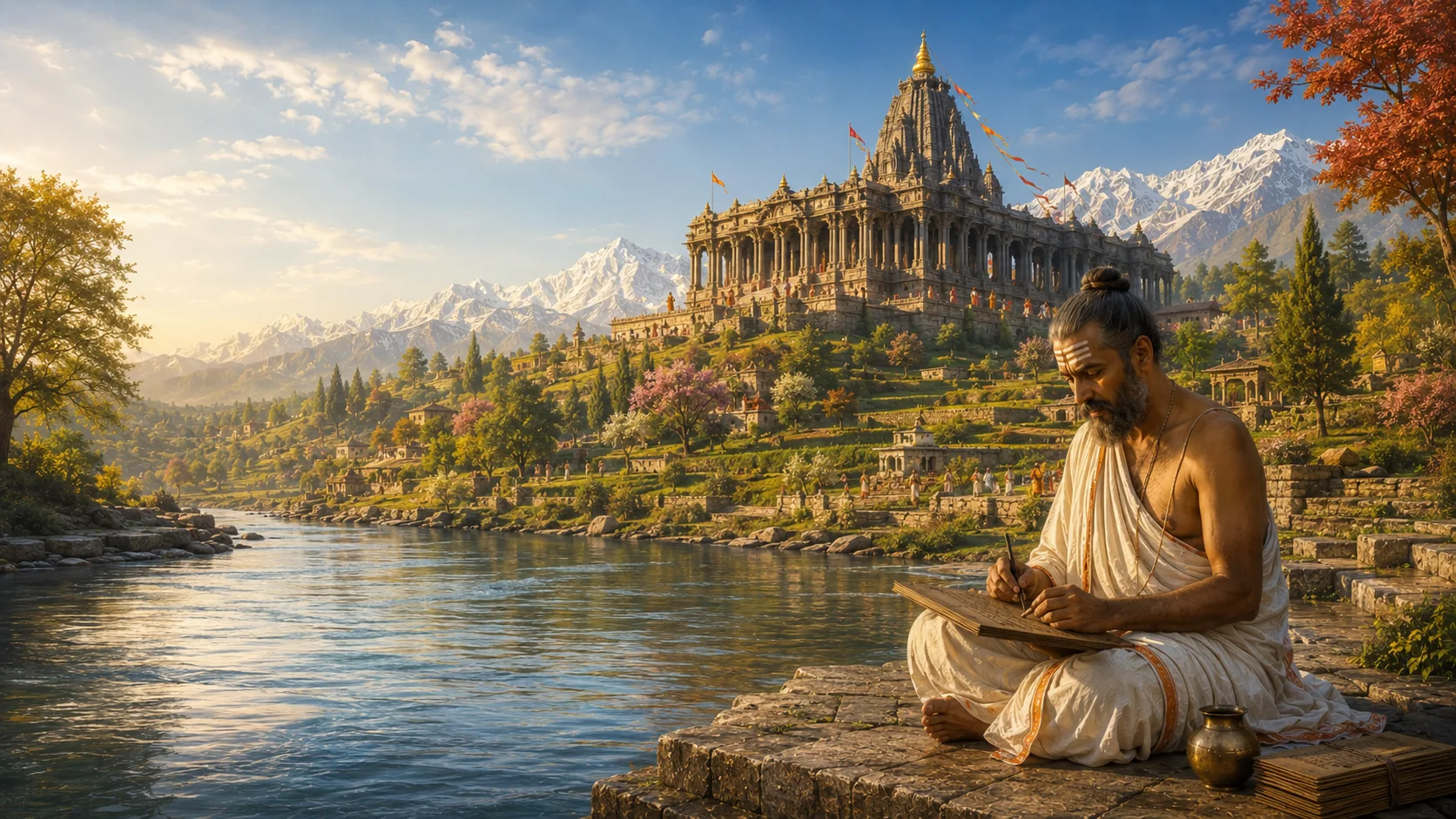
It was a settled conviction of colonial scholarship that India had produced no history of its own. The Orientalists and Indologists of the nineteenth century held that the Hindu mind, for all its metaphysics and poetry, had never developed the historical sense — that it left behind scripture and epic and genealogy, but no genuine record of events in time. The intellectual foundation for this contempt was laid by James Mill, whose History of British India (1817) — written by a man who never set foot in the country and knew none of its languages, and who counted that ignorance a guarantee of his objectivity — became the textbook on which the Company's officers were trained, and which the historian Thomas Trautmann would later call the single most important source of British hostility toward India. On this view, India was a static society with only cyclic time and no use for recording its past, and the one apparent exception merely proved the rule. That exception had a name. Colonial scholarship conceded that a single Indian text could be granted the status of "history" — and it was the twelfth-century Sanskrit chronicle of Kashmir, Kalhaṇa's Rājataraṅgiṇī. The concession was double-edged, meant to isolate the work as a freak in an otherwise ahistorical literature. But the work itself will not be reduced to a curiosity. In the middle of the twelfth century, in the valley of Kashmir, a Brahmin poet named Kalhaṇa sat down to write the chronicle of his land — a continuous account of its rulers stretching back, by his reckoning, across millennia — and produced something no honest critic has ever been able to dismiss.
That work is the Rājataraṅgiṇī. This essay is an invitation into it: what it is, who made it, what it contains, why it matters, and why it deserves to be read by anyone who cares about how Bhārata remembered itself.
The Name and the Structure
The name carries its own image. Taraṅgiṇī is built from taraṅga, "wave" — and the work is divided not into chapters or books in the dry sense but into taraṅgas, waves. There are eight of them. This is no idle ornament: Kalhaṇa means us to feel the procession of rulers as something fluid and unceasing, each reign cresting and breaking, the current itself outlasting every wave it carries. A dynasty rises, glitters, and is gone; the valley remains; the chronicler stands on the bank and watches the water go by. The form of the book is its philosophy — the impermanence of kings against the permanence of the land and the faithful record.
The Rājataraṅgiṇī is composed in Sanskrit verse — 7,826 ślokas across its eight cantos — in the flowing anuṣṭubh metre that carries most of Sanskrit narrative poetry, broken at moments of high feeling by longer, more ornate measures. It is at once a history and a mahākāvya, a great poem. Kalhaṇa never lets us forget that he is a poet, even when his subject is taxation, treachery, and the price of grain.
To call it merely a "chronicle" undersells it. It is the only surviving work of its kind from pre-modern Bhārata that sustains a genuinely historical ambition across such a span — a single author working from documents, inscriptions, coins, monuments, and earlier texts to construct a continuous, critical, and morally serious account of his country's political past. There are other historical sources in the Sanskritic tradition — dynastic genealogies, praśastis, biographical kāvyas like Bāṇa's Harṣacarita or Bilhaṇa's Vikramāṅkadevacarita. But these are court panegyrics, written for a living patron, bound to flatter. The Rājataraṅgiṇī answers to no living king. Its author wrote, by his own account, after the dynasty of his own patrons had fallen, and he wrote with a freedom that shows on every page.
Kalhaṇa: The Man Behind the River
We know Kalhaṇa almost entirely from his own work, but what it tells us is enough to see him clearly. He was the son of Caṇpaka, a Brahmin who had served as a minister — a dvārapati, lord of the gate — to King Harṣa of Kashmir, the ill-fated ruler whose spectacular reign and squalid end Kalhaṇa would later narrate with the intimacy of a man recounting a tragedy that touched his own family. Caṇpaka's loyalty to Harṣa, and the disasters that followed Harṣa's fall, seem to have closed the door of court office to his son. Kalhaṇa never held high office himself. This exclusion was the making of him as a historian.
He wrote in the years around 1148–1150 CE, during the troubled reign of Jayasiṃha. He tells us his own date of composition with a precision rare in Sanskrit literature, anchoring it to a specific year in the laukika era. A man shut out of power, watching his valley convulse under weak and grasping kings, with a father's memory of a vanished golden moment and a scholar's library at his disposal — this is the figure who undertook to write down everything.
Worthy of praise is that rare poet whose word, like the sentence of a judge, stands free of love and hatred in the recording of things past.
That sentence — a paraphrase of the most famous verse in the entire work — is Kalhaṇa's statement of purpose, and it is astonishing for its time and place. He sets the standard of the impartial witness, the stheya or arbiter whose judgement is trusted precisely because he has no stake in the outcome. We will return to this verse, because it is the hinge on which the whole work's claim to greatness turns.
How Kalhaṇa Worked: The Method
Before he tells a single story, Kalhaṇa tells us how he found his stories — and this prologue is the most extraordinary thing in the book. He does not claim to have received his history by inspiration or to have copied it from a single ancient scroll. He describes, instead, a deliberate gathering of evidence.
He had read, he says, the works of eleven earlier authors who had written on the kings of Kashmir — among them a certain Nīlamuni, and a scholar named Helārāja said to have composed a vast chronicle in twelve thousand verses, and the partial accounts of Padmamihira and Śrī Chavillākara. Their works were scattered, incomplete, and often contradictory. He had also consulted the Nīlamata Purāṇa, the sacred account of the valley's origin and its holy geography.
But Kalhaṇa did not stop at books. He went to the things themselves.
How Kalhaṇa gathered his evidence
| Source | What Kalhaṇa drew from it |
|---|---|
| Earlier chronicles | Eleven prior works, reconciled and corrected against one another |
| Inscriptions (śāsana) | Royal edicts on copper and stone recording grants, foundations, and acts |
| Coins | Issues of past kings, used to fix names and sequence |
| Monuments and ruins | Temples, towns, and vihāras whose builders he names and dates |
| Land-grant records | Endowments establishing who founded which shrine and when |
| Oral and local tradition | Stories preserved at sacred sites and among the learned |
This is recognisably a historian's toolkit. He reads a temple's foundation slab to learn which king built it; he uses a coin to settle a disputed name; he weighs one chronicle against another and tells the reader where his predecessors went wrong. In one celebrated passage he criticises an earlier writer for assigning impossibly long reigns to the valley's first kings and quietly corrects the chronology. He is doing source-criticism, in Sanskrit, in the twelfth century, more than six hundred years before the discipline acquired its German name.
It was this methodological seriousness that astonished the work's great European editor, Sir Marc Aurel Stein, who spent years in Kashmir tracing the very sites Kalhaṇa names and found, again and again, that the poet's topography was exact. Stein walked the valley with the Rājataraṅgiṇī in hand and used it as a reliable map of a vanished landscape — the surest proof that Kalhaṇa was reporting, not inventing.
This does not mean the Rājataraṅgiṇī flattens everything into bare chronicle. Its earliest reigns belong to the sacred deep-time of itihāsa and purāṇa, where the deeds of kings are bound up with the acts of gods, and where dreams, omens, and the working of karma are reported as the real forces they were held to be. Kalhaṇa believed in the moral order of the cosmos — in karma working itself out across reigns, in the Goddess presiding over the valley, in vision and omen as true causes — and he was right to, for that is the order his civilisation knew itself to live within. What he adds to it is method: as the narrative nears his own century, he tightens it into sober, checkable, and repeatedly verified fact, until the last waves become among the most detailed political narratives to survive from anywhere in the medieval world. The sacred frame and the documentary rigour are not at war in him; they are two registers of one truthful telling.
The Sanskrit Voice: Reading Kalhaṇa's Own Words
To understand what kind of book this is, one must hear it. Here is how it opens — the benedictory verse, in which Kalhaṇa salutes the form of Śiva-as-Ardhanārīśvara, the Lord who is half the Goddess, before turning to his human kings:
नमः प्रलीनमुक्ताय हरकल्पमहीरुहे ॥ १ ॥
namaḥ pralīna-muktāya hara-kalpa-mahīruhe
It is dense, ornamented, deliberately difficult — the signature of high kāvya. But within a few verses Kalhaṇa shifts register and tells us, plainly and unforgettably, what he intends to do. This is the verse on which his reputation as a historian rests:
भूतार्थकथने यस्य स्थेयस्येव सरस्वती ॥ ७ ॥
bhūtārtha-kathane yasya stheyasy-eva sarasvatī
bhūtārtha-kathane — "in the telling of what actually happened." With that single compound, Kalhaṇa names the historian's vocation eight centuries before it was named in the West.
He knows the difficulty of what he attempts. The records are partial; the earlier poets contradict each other; even the best of them stumbled. He says so:
प्रशस्तिपट्टैः शास्त्रैश्च शान्तोशेषभ्रमक्रमः ॥ १५ ॥
praśasti-paṭṭaiḥ śāstraiś ca śānto-'śeṣa-bhrama-kramaḥ
This is the verse that gives us the inventory of his sources in his own hand: the śāsanas (royal charters), the praśasti-paṭṭas (inscribed panegyric slabs), the śāstras (learned texts). It is the methodological heart of the prologue, and it is the reason the Rājataraṅgiṇī cannot be classed with the chronicles of bards and flatterers.
The Land Itself: Kashmir as a Sacred Country
Before the kings, there is the kingdom. Kalhaṇa pauses, early in the first wave, to praise Kashmir itself — and the passage tells us how the valley understood itself within the sacred order of Bhārata. This was not a frontier or an afterthought; it was a holy country, fashioned by the gods, presided over by the Goddess as Śāradā, ringed by mountains that were the very limbs of the divine.
सरोन्तर्दृश्यते यत्र हंसरूपा सरस्वती ॥ ३५ ॥
saro'ntar dṛśyate yatra haṃsa-rūpā sarasvatī
He praises Kashmir as a country whose people seek both bhukti and mukti — worldly enjoyment and final liberation — a land of learning, of saffron and grapes and cool waters, where the sacred and the prosperous meet. The famous verse declares the valley a place that cannot be conquered by the force of arms but only won by spiritual merit, guarded as it is by the Goddess:
परलोकात्ततो भीतिर्यस्मिंस्त्रिवसतां परम् ॥ ३९ ॥
para-lokāt tato bhītir yasmiṃs trivasatāṃ param
This is the self-image of a civilisational heartland: a land defended less by its passes than by its sanctity, where the deepest anxiety is not of invasion but of one's own karma. It is worth holding this verse in mind, because the later waves of the chronicle record exactly how a country can be undone — not from without, at first, but from within, by the slow corruption of its own rulers.
The Eight Waves: A Map of the Whole
The Rājataraṅgiṇī's architecture mirrors the history it tells: the early waves move fast across deep time and thin evidence, the later waves slow almost to a daily reckoning as Kalhaṇa nears his own age. Here is the shape of the river.
The eight taraṅgas of the Rājataraṅgiṇī
| Wave | Span Covered | What It Holds |
|---|---|---|
| Taraṅga I | The deep past | The earliest kings from Gonanda onward in the age of the Mahābhārata, the Gonandīya line, the coming of the Mauryas and the Buddhist age — Aśoka founds Śrīnagarī, his line falters, the valley passes through later hands |
| Taraṅga II | Early historical kings | The obscure dynasties, the rise of figures the chronicle can begin to date, the consolidation that prepares the great age to come |
| Taraṅga III | The Kārkoṭa dawn | The founding of the Kārkoṭa dynasty under Durlabhavardhana — the line that would raise Kashmir to imperial greatness |
| Taraṅga IV | The age of Lalitāditya | The conquests of Lalitāditya Muktāpīḍa, Kashmir's greatest king, and the building of the Sun-temple at Mārtāṇḍa |
| Taraṅga V | Avantivarman and Suyya | The Utpala dynasty, the engineer-saint Suyya who tamed the Vitastā and ended famine, a golden age of works and letters |
| Taraṅga VI | Decline and Queen Diddā | The slide into faction, the rise of the formidable Diddā, the chaos of the Tantrin soldiery |
| Taraṅga VII | The first Lohara kings and Harṣa | The reign and ruin of Harṣa — splendour, cruelty, iconoclasm, and a terrible end |
| Taraṅga VIII | Kalhaṇa's own century | Uccala, Sussala, Jayasiṃha — the politics of the poet's own lifetime, recorded almost as journalism |
What follows is a walk along this river, pausing at the bends where the current runs strongest.
The First Waves: The Deep Past of the Valley
The opening wave begins where the valley's own memory begins — with Gonanda, the first lord of Kashmir, a contemporary of Kṛṣṇa and Jarāsandha in the age of the Mahābhārata, who reigned where the Goddess and Śiva hold their seat:
दिशा कैलासहासिन्या प्रतापी पर्युपास्यत ॥ ५७ ॥
diśā kailāsa-hāsinyā pratāpī paryupāsyata
This deep past reaches back into the same antiquity as the Mahābhārata and the Purāṇas — it is itihāsa, the remembered history of the land, not the fable that colonial scholarship was always eager to call it. And Kalhaṇa, far from receiving it uncritically, works it with a scholar's care. Where an earlier chronicler had stranded the first kings by mis-reckoning the regnal years, Kalhaṇa corrects the count, reconciling the received tradition against the records and the reasoning of the śāstras. This is the historian at work within his own civilisation's frame: not doubting that his land has an ancient and sacred past, but determined to set its sequence and its dates as exactly as the evidence allows.
Into this early stretch comes one solid landmark — Aśoka. Kalhaṇa knows him as a great king who embraced the Buddhist teaching, suppressed an older order, and founded the city of Śrīnagarī, the ancestor of modern Srinagar. The Buddhist centuries leave their mark on the chronicle: stūpas and vihāras rise and fall, monks and ministers move through the narrative, and the valley becomes one of the great seats of Buddhist learning in Bhārata. Kalhaṇa, a Śaiva Brahmin, records all this without rancour — the religions of the valley pass before him as part of the single fabric of its history, and he notes the foundations of Buddhists and Śaivas alike with the same antiquarian care.
The early waves preserve, in passing, some of the most important landmarks of Bhārata's ancient history as Kashmir remembered them. The Mauryan age leaves its imprint through Aśoka and his foundations. After him, Kalhaṇa recalls the coming of the Turuṣka kings — the rulers we know as the Kuṣāṇas, the Huviṣka and Kaniṣka of the inscriptions — under whom Buddhism flourished and great convocations of monks gathered in the valley. The tradition that the famous fourth Buddhist council was held in Kashmir under Kaniṣka echoes through this stratum of the chronicle. Kalhaṇa is recording, in other words, the very period in which Kashmir became one of the supreme seats of Buddhist scholarship in the world — the valley from which the Dharma would travel north over the passes into Central Asia and on to China.
What is striking is the absence of sectarian rancour in his telling. Kalhaṇa is a Śaiva Brahmin of the Smārta tradition, but he chronicles the Buddhist centuries as an integral part of his country's story. He notes the vihāras and stūpas founded by Buddhist kings and ministers with the same care he gives to the Śiva and Viṣṇu temples of the Brahmanical rulers. Where a king suppresses one tradition in favour of another, Kalhaṇa records the act and its consequences within his moral framework — but he does not himself wield the chronicle as a sectarian weapon. The religions of the valley are, for him, threads in a single civilisational fabric, all of them belonging to the sacred country the Goddess protects. This catholicity is itself a feature of the Sanātana order he inhabited: the valley could be at once a Śaiva holy land, a Buddhist seat of learning, and a Vaiṣṇava pilgrimage centre without contradiction, because all were understood as expressions of the one dharma rooted in the soil of Bhārata.
By the second wave the ground firms underfoot. The reigns shorten toward credibility, the kings acquire faces, and the chronicle begins to read as connected political narrative rather than king-list. Then, in the third wave, the river reaches its first great cataract.
Lalitāditya: The Conqueror King
If the Rājataraṅgiṇī has a hero in the old epic sense, it is Lalitāditya Muktāpīḍa of the Kārkoṭa dynasty, who reigned in the eighth century and whom Kalhaṇa raises into legend. Here the chronicle swells into full mahākāvya: Lalitāditya is the world-conqueror, the digvijayin, who marches out of the valley and subdues kingdom after kingdom across the breadth of northern Bhārata and beyond — into the Gangetic plain, against the powers of the east, into the highlands of Central Asia, returning laden with the wealth and craftsmen of conquered lands.
How much of Lalitāditya's digvijaya is sober fact and how much is the poet's amplification, historians still debate. But the core is solid: Lalitāditya was a real and formidable king whose power reached far beyond Kashmir, remembered even in sources outside the valley. Kalhaṇa, writing four centuries later, gives us the figure as Kashmiri memory had shaped him — the moment when a mountain kingdom became, briefly, an empire.
His monument survives in the chronicle and, in ruin, on the ground: the great Sun-temple of Mārtāṇḍa, raised by Lalitāditya on a plateau above the valley, its colonnaded courtyard and towering shrine among the masterworks of early medieval Indian architecture. Kalhaṇa lists the king's foundations with a builder's pride — new towns, shrines to Viṣṇu and the Sun and Śiva, images of gold, endowments without number. The conqueror was also a maker, and the chronicle honours both. Even the irrigation channels cut in his reign, Kalhaṇa notes, were still carrying water in his own day, four centuries later:
अद्यापि कुन्तवाहिन्यः प्रवहन्त्युत्तरापथे ॥ ३०६ ॥
adyāpi kunta-vāhinyaḥ pravahanty-uttarā-pathe
That adyāpi — "even today" — is the recurring signature of the chronicler who has walked the ground. Again and again Kalhaṇa points to a town, a temple, a canal still standing or still flowing, and names the king who made it. The past, for him, is not a story but a landscape one can still touch.
Lalitāditya is also the occasion for one of Kalhaṇa's most quoted reflections — the dying king's counsel to his successors, a meditation on how a frontier kingdom must hold itself: keep the people neither too rich nor too poor, watch the mountain tribes, never let a subject grow powerful enough to rival the throne. Whether the counsel is Lalitāditya's or Kalhaṇa's own political philosophy placed in a great king's mouth, it shows the chronicle's deeper purpose. This is not entertainment. It is a mirror for princes, a sustained inquiry into how power is won, held, and lost.
Avantivarman and Suyya: The Engineer-Saint
After the Kārkoṭas fade, the fifth wave brings a different kind of greatness. Avantivarman of the Utpala dynasty presided over a golden age not of conquest but of cultivation — of poets, of temples, of public works. And at the centre of this age stands one of the most remarkable figures in all of Kalhaṇa's gallery: Suyya, a man of obscure, even foundling, origin who rose to become the kingdom's great hydraulic engineer.
Kashmir's prosperity and its misery both ran in the channel of one river, the Vitastā — the Jhelum. When the river silted and flooded, the valley starved; famine and the ruinous price of grain recur through the chronicle like a refrain. Kalhaṇa describes one such catastrophe under Avantivarman with a political economist's eye — the floods came, the harvest failed, and the price of grain soared, enriching the very ministers and dealers who should have relieved the people:
मन्त्रिणः क्ष्मापतेः प्रापुस्त्रिणश्च धनाढ्यताम् ॥ २७४ ॥
mantriṇaḥ kṣmāpateḥ prāpus triṇaś ca dhanāḍhyatām
Into this crisis steps Suyya. Kalhaṇa tells us he understood the problem as no one before him had. He cleared the obstructions that choked the river's course, regulated its flow, raised the villages, and built the stonework that drained the floods and watered the fields. The result was transformation: grain that had cost a fortune fell to a fraction of its price; the valley, which had lived at the mercy of the water, was given mastery over it.
Kalhaṇa, the political historian, never forgets the price of grain. In a chronicle full of kings and battles, he tracks the cost of a khārī of rice as the truest index of a people's welfare — and he honours the engineer who fed them above many a king who merely ruled them.
The story of Suyya is one of the glories of the Rājataraṅgiṇī precisely because it is so unexpected in a "chronicle of kings." Here the hero is not a warrior but a man who read a river and saved a country. It is a measure of Kalhaṇa's breadth that he saw such a man and gave him his due.
The Long Decline: Faction, Soldiers, and a Formidable Queen
The sixth wave turns dark. The golden age does not end in catastrophe but in something slower and more corrosive — the steady decay of the political order into faction. Two forces dominate this long decline. The first is the ḍāmara problem: the rise of overmighty landed lords whose private power begins to rival the crown's. The second, and more dangerous, is the Tantrin soldiery — the standing infantry corps who discover that they, and not the king, hold the real power in the valley, and who proceed to make and unmake rulers for pay, plunging Kashmir into a long agony of military anarchy.
Out of this turmoil rises one of the great figures of the chronicle: Queen Diddā. Kalhaṇa draws her without sentiment and without misogyny — as a ruler of formidable will who came to power as a regent, outmanoeuvred every rival, crushed the ḍāmaras and the Tantrins by turns through war, bribery, and ruthless intrigue, and held the throne for decades by sheer political mastery. The chronicle shows her, fearless, installing her own chosen heir and bending the succession to her will:
चक्रे संग्रामराजाख्यं युवराजमशङ्किता ॥ ३५५ ॥
cakre saṃgrāmarājākhyaṃ yuvarājam-aśaṅkitā
She is cruel where she must be and shrewd always. Kalhaṇa neither excuses her crimes nor denies her greatness; he simply records the woman as she was — a study in power that stands comparison with anything in the world's political literature. She ends the Utpala line and inaugurates, through her chosen heir, the Lohara dynasty into which the chronicle's final, most personal waves will flow.
Diddā is a test case for the impartiality Kalhaṇa promised in his seventh verse. A lesser chronicler, writing of a queen who murdered her way to security, would have moralised her into a villainess or, if she were a patron's ancestor, whitewashed her into a saint. Kalhaṇa does neither. He gives us the politics whole — the calculation, the cruelty, the competence — and lets the reader judge. This is bhūtārtha-kathana in practice.
Harṣa: The Tragedy at the Heart of the Chronicle
The seventh wave brings the chronicle to the reign that touched Kalhaṇa's own family, and it is the work's great tragedy. King Harṣa — not to be confused with the earlier emperor Harṣa of Kanauj — began in brilliance. He was learned, accomplished, generous, a connoisseur and a patron; Kalhaṇa, whose father served him, paints the early reign in colours of genuine splendour. And then, with the remorseless logic of tragedy, the same king descends into cruelty, paranoia, extravagance, and ruin.
The turn comes through money. Harṣa's lavishness empties the treasury, and an empty treasury drives him to monstrous expedients. To refill it he turns on the one source of accumulated wealth the valley held — its temples. Kalhaṇa records, with the controlled horror of a man describing a sacrilege, how Harṣa stripped the shrines of the wealth that generations of kings had given them:
सर्वेगीर्वाणवेश्मभ्यो लुब्धवृद्धिरपाहरत् ॥ १०९० ॥
sarve gīrvāṇa-veśmabhyo lubdha-vṛddhir apāharat
And when even that was exhausted, he created a special office for the plunder of the sacred images themselves — a title Kalhaṇa records with cold precision, and which has never lost its power to appall:
चकारोद्धरणाराज्याख्यं देवोत्पाटननायकम् ॥ १०९१ ॥
cakāra... rājyākhyaṃ devotpāṭana-nāyakam
devotpāṭana-nāyaka — "the officer for the uprooting of gods." That a Kashmiri king, of Kashmiri stock, should institutionalise the plunder of his own people's temples — Kalhaṇa records it not as foreign invasion but as the deepest self-betrayal a ruler could commit. The Goddess who could not be conquered by armies was being robbed by the man sworn to protect her.
The reign collapses into terror and ends in slaughter. Harṣa, hunted and abandoned, meets a squalid death; his line is extinguished. Kalhaṇa narrates the fall with the intimacy of one whose own family was bound up in it — and with a tragic grandeur that lifts the passage into the highest reaches of Sanskrit narrative poetry. The lesson is the chronicle's deepest: that a kingdom is destroyed first from within, that the corruption of its sacred order is the true wound from which the political wound flows, and that no king is so gifted that he cannot ruin himself and his country together.
The Final Wave: History as It Happens
The eighth and longest wave brings Kalhaṇa into his own time — the reigns of Uccala, the turbulent Sussala, and finally Jayasiṃha, under whom Kalhaṇa wrote. Here the chronicle changes character once more. The deep perspective of the early waves is gone; in its place is the dense, granular, almost overwhelming detail of contemporary politics seen up close. Factions, conspiracies, the endless wars of the ḍāmaras, the shifting loyalties of ministers and soldiers, the assassinations and reprisals — Kalhaṇa records them with a fullness that has made this section an indispensable source for the political history of medieval Kashmir.
It is also, by common judgement, the most exhausting part of the work to read — the very fullness that makes it valuable as a record makes it dense as a narrative. But it is here that Kalhaṇa's claim to be a historian is most completely vindicated. He is writing of events he lived through, of men he may have known, in a valley convulsed by the same anarchy whose roots he traced through the earlier waves. The chronicle that opened in the sacred deep-time of Gonanda's age closes in the cold light of the chronicler's own day, and the man on the bank is no longer recounting the remembered past but bearing witness to what he has seen with his own eyes.
The Poet's Eye: Kalhaṇa as Writer
It is easy, in summarising the events of the chronicle, to lose sight of the fact that the Rājataraṅgiṇī is, first and last, a poem — and a great one. Kalhaṇa is a master of the high Sanskrit kāvya idiom, and his command of it is not ornamental but expressive. When he describes the splendour of Lalitāditya's court, the language thickens into gold and incense; when he narrates Harṣa's fall, it tightens into something stark and terrible; when he praises the valley, it opens into landscape. He uses the full repertoire of Sanskrit poetics — simile, metaphor, the long descriptive compound, the sudden shift of metre to mark a heightening of feeling — but always in the service of his matter.
He tells us at the outset what he hopes to give the discerning reader: not mere amusement, but something of lasting worth.
तदत्र किंचिदस्त्येव वस्तु यत्प्रीतये सताम् ॥ ६ ॥
tad atra kiṃcid asty eva vastu yat prītaye satām
That phrase — prītaye satām, "for the delight of the good" — names his ideal audience. He writes not for the crowd or the patron but for the sat, the discerning and the virtuous, those capable of receiving a true account of the past and learning from it. It is the same austere standard as his verse on impartiality, transposed from the writer to the reader.
And running beneath the whole, giving the chronicle its peculiar gravity, is the Sanātana sense of impermanence. Kalhaṇa watches king after king grasp at permanence — through conquest, through monuments, through hoarded treasure — and he watches each one swept away. The towns founded with such pride fall to ruin; the golden images are melted by a later king's greed; the dynasty that seemed eternal is extinguished within a wave. He does not preach this; he simply lets the waves of his title carry the lesson. Every reign is a wave: it rises, it gleams, it breaks. What the poet offers against that universal dissolution is the one thing that can outlast a wave — the faithful word, the bhūtārtha truly told. In a civilisation that located its deepest permanence not in stone or empire but in memory rightly preserved, Kalhaṇa's act of remembrance is itself a kind of dharma.
Why the Rājataraṅgiṇī Matters
It would be easy to value the Rājataraṅgiṇī merely as a refutation — proof, against the colonial charge, that Bhārata could and did write history. There is a trap in that, and it is worth naming: the nineteenth-century scholars who praised the work as the one Indian text worthy of the name "history" were not conceding the point so much as fortifying it, holding up Kalhaṇa as the lone exception that proved the rule of Indian "ahistoricity." To read the Rājataraṅgiṇī only as the exception is to accept the frame and lose the argument. Its real greatness is not that it is unlike the rest of the Sanskrit tradition, but that it grows directly out of it — and it lies in three things.
Why the Rājataraṅgiṇī matters
| Dimension | What the Rājataraṅgiṇī achieves |
|---|---|
| As history | A continuous, source-critical account of a single kingdom across a vast span, built from inscriptions, coins, monuments, and prior texts, increasingly accurate as it nears the author's own age — verified again and again by modern archaeology |
| As literature | A mahākāvya of the first rank, in which political narrative is raised by a true poet's command of Sanskrit into something of lasting beauty and moral weight |
| As philosophy of power | A sustained meditation, across eight waves, on how kingdoms rise and fall — on dharma and its violation, on the corruption that destroys from within, on the duties and temptations of rule |
There is, beneath the politics, a vision — and it is a recognisably Sanātana one. Kalhaṇa sees the procession of kings within a moral cosmos. Their fortunes are not random; they answer to dharma. The king who plunders the gods is destroyed; the engineer who feeds the people is honoured above conquerors; the land protected by the Goddess punishes those who betray her trust. This is not naïve piety imposed on the facts — Kalhaṇa is far too clear-eyed an observer of real politics for that. It is, rather, a conviction that history has a moral shape, that the rise and fall of power is legible as something more than chaos. The "waves" of his title are not merely a pretty figure. They carry the deep Sanātana intuition that all worldly glory is impermanent, that every cresting reign must break, and that what endures is the land, the Goddess, the dharma — and the chronicler's faithful word.
Kalhaṇa's three successors — Jonarāja, Śrīvara, and the joint authors Prājyabhaṭṭa and Śuka — continued the Rājataraṅgiṇī across the following centuries, carrying the chronicle of Kashmir down into the Sultanate period and beyond. The river kept flowing after its first poet laid down his pen. But it is Kalhaṇa's eight waves that remain the masterwork, the foundation on which all the rest was built.
How to Read It: A Note for the Newcomer
For the reader meeting Kalhaṇa for the first time, a few words of orientation. The standard gateway in English remains the translation and commentary of Sir Marc Aurel Stein, whose two volumes pair a faithful rendering with a vast apparatus of notes, a memoir on the historical geography of the valley, and the fruits of his own travels tracing Kalhaṇa's sites on the ground — a labour that remains, more than a century on, the indispensable companion to the work. The Sanskrit text itself, in the edition prepared by Durgāprasāda from which the verses in this essay are drawn, is the foundation for serious study.
Do not expect a smooth, novelistic read. The early waves move through the sacred deep-time of the valley's origins, where the reckoning of years is reckoned differently; the late waves drown the reader in the detail of forgotten faction-fights. The pleasures are elsewhere: in the great set-pieces — Lalitāditya's conquests, Suyya and the river, Diddā's mastery, Harṣa's fall; in the sudden flashes of the poet's moral vision; and above all in the astonishing fact of the thing itself — that nearly nine hundred years ago, in a mountain valley, a Brahmin shut out of power sat down to recover, weigh, and set in faithful verse the entire remembered past of his land.
The Ninth Wave: The One Kalhaṇa Did Not Live to Write
There is a wave the chronicle does not contain, because its poet died eight centuries too soon to witness it. Kalhaṇa stopped at the troubles of his own century — faction, famine, the squalid deaths of bad kings — and even at his most despairing he wrote within a world that was still, recognisably, his: a Sanātana valley where the Goddess kept her seat, where Brahmins disputed the Upaniṣads on the riverbank, where Śāradā was worshipped and the Sun still rose over Mārtāṇḍa. He could not have imagined what was coming. It is left to us to write the ninth wave, and there is no kāvya in it — only the plain accounting of what was done to Kaśyapa's land, and by whom.
Begin with the geography, because geography is destiny here. Kashmir is not a corner of Bhārata; it is the crown of it — Śāradā-deśa, the head of the body, where the civilisation kept its highest learning. From this valley came the grammarians and the aestheticians, the Pratyabhijñā philosophers and the Śaiva tantra that bears the valley's name. Here stood Śāradā Pīṭha, one of the supreme seats of learning and one of the Śakti Pīṭhas, so central to the Sanātana intellect that the very script of the region — Śāradā — was named for the Goddess of that shrine, earning the valley the title Śāradā-deśa, the Land of Śāradā; scholars across Bhārata spoke of attaining the Śāradā-pīṭha as the summit of erudition. To injure Kashmir is not to lose a province. It is to take the head off the body. And the head has been taken off.
Śāradā Pīṭha — the temple-university whose name became a synonym for learning itself across the subcontinent, probably raised by the same Lalitāditya who built Mārtāṇḍa — stands today in ruins in the Neelum valley of so-called "Azad Kashmir," the portion of the valley seized by Pakistan in 1947–48 and held by it since. The seat from which a civilisation drew its highest knowledge lies on the wrong side of a line of control, in the hands of the very power that has spent eight decades trying to erase what it means.
Consider what has actually happened, stated without the anaesthetic of "complexity." The valley that Kalhaṇa knew as a Sanātana heartland was invaded — first by Turkic and Persianate Muslim arms, then by sultans who made it policy to break temples and convert by the sword, and at last, in our own age, by a campaign of terror that finished what the medieval iconoclasts had begun. The shrines Kalhaṇa lovingly catalogued — this king built that Viṣṇu, that queen endowed this Śiva — were smashed in century after century. The Sun-temple of Mārtāṇḍa, Lalitāditya's masterwork, the glory of the fourth wave, was deliberately demolished on the orders of Sultan Sikandar — the iconoclast his own subjects called Butshikan, "the idol-breaker" — whose reign of temple-destruction was recorded by none other than Jonarāja, the very scholar who continued Kalhaṇa's chronicle. It stands now as a field of broken columns, a skeleton on its plateau, photographed by tourists who are rarely told that it was not ruined by time but destroyed by a sultan's hammers, its demolition so massive that it is said to have taken a year. The tradition of Kashmir Śaivism — the Pratyabhijñā, the most sophisticated non-dual philosophy the human mind has produced — survives today not in Kashmir but in the diaspora and the academy, a living river reduced to a manuscript. There is no maṭha on the Vitastā where it is still taught as a living faith by the people of its own birth.
And the people themselves — the Kashmiri Paṇḍits, the unbroken line of the Brahmins whose disputations Kalhaṇa joined, the very community that produced the Rājataraṅgiṇī — were driven out. In the early months of 1990, under a campaign of murder, rape, and the loudspeaker-threat from the mosque, the Hindus of the valley were given to understand the choice of conversion, flight, or death; and between January and March, by the careful estimates of scholars, on the order of a hundred thousand Paṇḍits — out of a population of perhaps a hundred and forty thousand — fled a homeland their community had held since before the Mahābhārata. The valley of Kaśyapa, the valley of Abhinavagupta, the valley that wrote the only history the colonisers would grant the name, was emptied of very nearly all its Hindus — ethnically cleansed, in the plain meaning of the words, while a world that invents the language of human rights for every other dispossessed people could not find it in itself to name this one. Kalhaṇa's Kashmir, the land the Goddess was said to guard, today has almost no one left to worship her.
The valley that produced the only rigorous history written in Sanskrit no longer contains the people who wrote it. Let that sentence sit. The community that gave Bhārata its one undeniable historian was driven from its home in living memory — and the descendants of that historian now read his chronicle of their homeland in exile.
Who is responsible? Here the chronicle's own rule applies — bhūtārtha-kathana, the telling of what actually happened, free of the cowardice that calls itself balance. The medieval sultans and their iconoclasm are responsible. The two-nation theory and the state of Pakistan, built on the proposition that Muslims could not share a country with kāfirs, are responsible — it was Pakistan's tribal invasion of 1947 that severed Śāradā's valley from Bhārata and holds it still; it is Pakistan that has armed, trained, and sanctified the terror that emptied the valley of its Hindus. And responsible too — in a way that should never be softened into mere "error" — is the Indian leadership that mismanaged the inheritance it was handed. When Maharaja Hari Singh signed the Instrument of Accession and Kashmir became legally, fully, and finally a part of the Indian Union like any other princely state, the war was being won on the ground. It was Jawaharlal Nehru who halted the army short of victory, who took a domestic matter of Indian territory to the United Nations as though it were a dispute between equals, who accepted a ceasefire that froze a third of the state in Pakistani hands — the very third where Śāradā stands — and who fathered the special-status arrangement that walled the valley off from the rest of Bhārata and incubated, for seventy years, the separatism that consumed it. The man who could quote Persian couplets about Kashmir's beauty could not summon the resolve to keep its head attached to its body. The romance of the statesman cost the Paṇḍits their homeland.
None of this is to indulge the lazy slander that runs the other way — that the valley's Hindu and Buddhist kings were themselves tyrants no better than what followed, or that Sanātana Kashmir was some dark age awaiting "reform." That is the colonial and Islamist libel, and it is false. Kalhaṇa, the most honest witness we have, shows us a civilisation arguing with itself, building and endowing, philosophising at the highest pitch the species has reached. Its kings were flawed men — he says so, unsparingly — but they did not run an office for the uprooting of gods as a permanent institution of state. When Harṣa did exactly that for a few desperate years, Kalhaṇa recorded it as the unspeakable crime it was. What came after Kalhaṇa made Harṣa's devotpāṭana the settled policy of centuries. The difference between a civilisation's worst king and its conquerors' ordinary day is the whole moral distance of this history.
This, then, is the use of reading Kalhaṇa now — and it is not antiquarian. He left us the proof of what Kashmir was: not a contested borderland with two equal claimants, not a "Muslim-majority region" whose history conveniently begins in the fourteenth century, but the Sanātana crown of Bhārata, documented shrine by shrine, king by king, in the one indigenous history rigorous enough that even its enemies cannot dismiss it. Every page of the Rājataraṅgiṇī is a deed of title. To read it is to know exactly what was stolen, and from whom, and to refuse the forgetting that the thieves require. Kalhaṇa wrote so that the past could not be erased. Eight centuries later, against people working very hard to erase it, that is no longer a literary virtue. It is a weapon.
The river is still running — but it runs now through a valley that has forgotten its own name for itself. Kalhaṇa stands on the bank still, holding out the record of what was. Step in, and take it from his hand.
Notes & Sources
Mill and British Indophobia — On James Mill's The History of British India (London: Baldwin, Cradock & Joy, 1817) and its role as the foundational text of British Indophobia, see Thomas R. Trautmann, Aryans and British India (1997), who describes Mill's work — especially the long essay "Of the Hindus" — as the single most important source of British Indophobia and hostility to Orientalism. Mill never visited India and knew none of its languages, a fact he presented in his preface as a guarantee of objectivity; the work nonetheless served as the standard reference on Indian history for much of the nineteenth century and as a training textbook for East India Company officers at Haileybury College.
The "lone exception" thesis — On colonial scholarship's denial of an Indian historical tradition, and its treatment of the Rājataraṅgiṇī as the lone exception, see Romila Thapar, who observes that British colonialism held the only text reflecting history to be the twelfth-century Rājataraṅgiṇī of Kalhaṇa, and said that it was an exception. See also Chitralekha Zutshi, Landscapes of the Past: Rajatarangini and Historical Knowledge Production in Late-Nineteenth-Century Kashmir (in I. Sengupta & D. Ali, eds., Knowledge Production, Pedagogy, and Institutions in Colonial India, Palgrave Macmillan, 2011), who notes that even as colonial Indologists and Orientalists denied India both a history and a tradition of historical writing, they set about establishing a new historical method that designated most precolonial Indian texts as mere "sources."
The standard translation and text — M. A. Stein, Kalhaṇa's Rājataraṅgiṇī: A Chronicle of the Kings of Kaśmīr, 2 vols. (Westminster, 1900) — translation, commentary, and the accompanying memoir on the historical geography of Kashmir, based on Stein's own fieldwork in the valley. The Sanskrit text cited in this essay is the edition of Durgāprasāda (Bombay, 1892), Vol. I, Taraṅgas I–VII, from which every Devanāgarī verse here was transcribed and verified.
Śāradā Pīṭha — On Śāradā Pīṭha as a Śakti Pīṭha and ancient temple-university, the Śāradā script, and the title Śāradā-deśa ("Land of Śāradā"): the shrine is counted among the holiest sites of the Kashmiri Paṇḍits alongside the Mārtāṇḍa and Amarnāth temples, and is generally held to have been commissioned by Lalitāditya Muktāpīḍa in the eighth century.
The demolition of Mārtāṇḍa — The destruction of the Mārtāṇḍa Sun-temple is attributed to Sultan Sikandar Shāh Mīrī (r. 1389–1413), known as Butshikan, "the idol-breaker," and is recorded by Jonarāja — Kalhaṇa's own continuator — in his Rājataraṅgiṇī, which describes the systematic breaking of temples across Kashmir in that reign. The structure's scale was such that its destruction is said to have taken roughly a year.
The exodus of the Paṇḍits — Scholarly estimates hold that roughly 90,000–100,000 Paṇḍits, out of an estimated valley population of 120,000–140,000, fled between January and March 1990, with some estimates of the total displacement reaching approximately 150,000. The targeted killings, the public threats broadcast from mosque loudspeakers, and documented cases of rape and mutilation of Paṇḍit women — among them the widely recorded killing of Girija Tickoo — precipitated the flight and are recorded in the standard accounts of the period.
Śāradā in occupied territory — Śāradā Pīṭha lies in the village of Sharda in the Neelum (Kishanganga) valley of Pakistan-occupied Kashmir, roughly 150 km from Muzaffarabad and about 10 km from the Line of Control — territory seized by Pakistan in the war of 1947–48 and held since.
Dhārā · Sanātana Bhārata