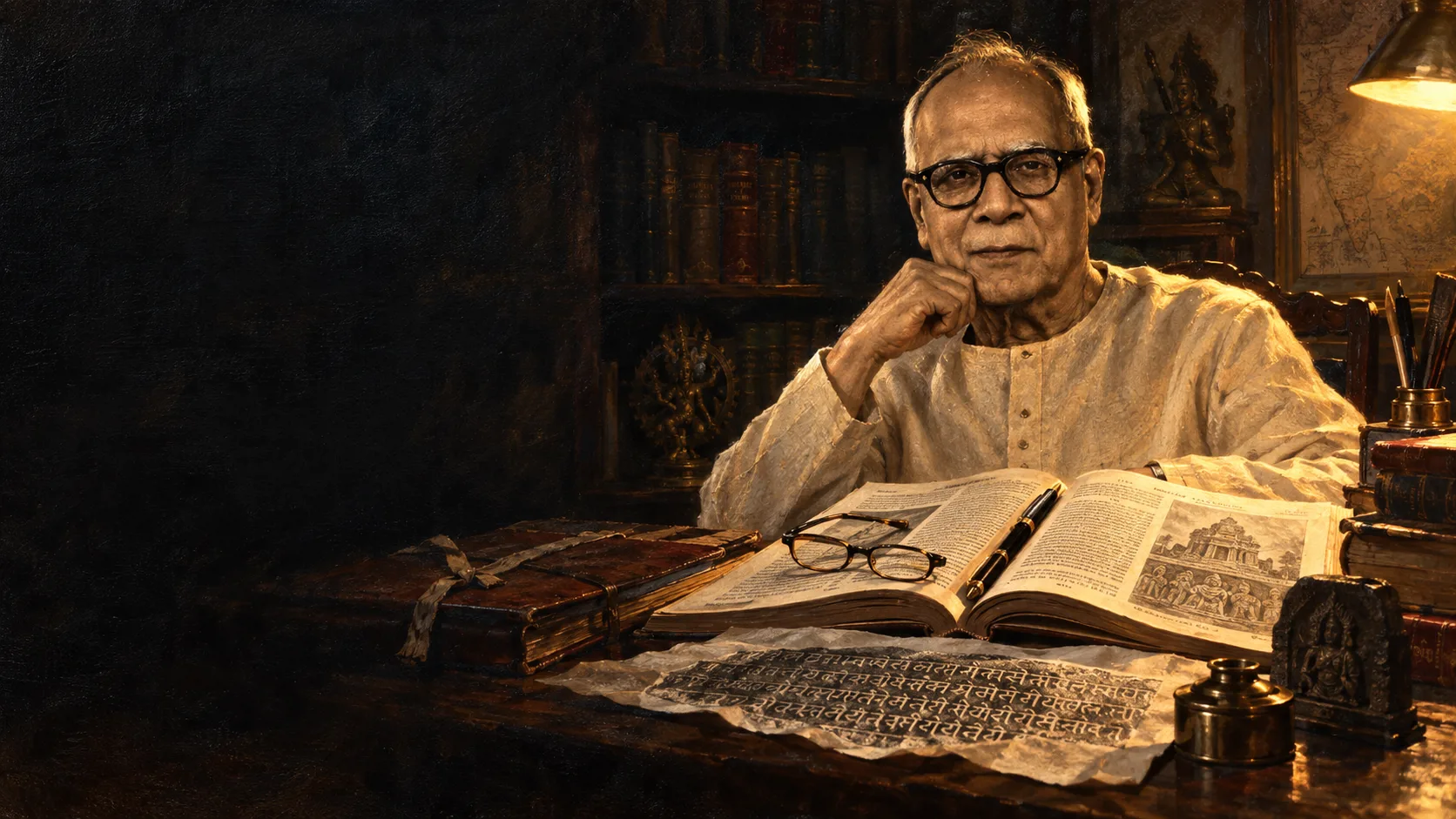
The Swan Song
In 1960, at the Institute of Historical Studies in Kolkata, a man of seventy-two stood to deliver an address and used a word that historians do not usually use about their own trade. He called what he was about to say his swan song, which in the European figure means the last song of a dying bird. He was not dying. He had twenty more years of work in him and would finish the largest history of India ever attempted by Indians. But he had understood something about the country he was living in, and he wanted it on the record before the record closed.
What he said was that a new habit was spreading among Indian historians. Facts that embarrassed the politics of the hour were being softened, moved to a footnote, or left out. The habit had begun as a wartime convenience, a way of holding two communities together against the British, and it had outlived the war and become a method. He named the danger plainly and ended with a sentence that has outlived every other sentence he wrote.
History, divorced from truth, does not help a nation.
The man was Ramesh Chandra Majumdar. He had already been removed from the government project he himself had proposed, the official history of India's freedom struggle. He had already published, at his own cost and under his own name, the book on 1857 that the removal had made impossible to publish any other way. He was midway through the eleven volumes of The History and Culture of the Indian People, which would take twenty-six years and finish when he was eighty-eight.
He lost the argument in his lifetime. The institutions went the other way, and went further than he had feared. What he left instead was a body of work large enough and documented well enough that the argument could be reopened whenever anyone cared to open it. That is the whole of his achievement, and it is not a small one.
The Standard
The measure Majumdar held himself to was not imported. It was set down in Sanskrit in the twelfth century by Kalhaṇa of Kashmir, in the opening verses of the Rājataraṅgiṇī, the chronicle of the kings of Kashmir. Kalhaṇa states what makes a chronicler worth reading before he writes a word of chronicle.
Chandas: Anuṣṭubh. This is the commonest Sanskrit metre, four quarters of eight syllables each, the metre of the epics.
भूतार्थकथने यस्य स्थेयस्येव सरस्वती ॥
bhūtārthakathane yasya stheyasyeva sarasvatī ||
whose speech in the telling of what actually happened stands clear of attachment and hatred, as a judge's speech does.
भूत-अर्थ-कथने । यस्य । स्थेयस्य । इव । सरस्वती ॥
bhūta-artha-kathane | yasya | stheyasya | iva | sarasvatī ||
in the telling of what has actually been | of whom | of a judge | like | speech
Padartham
Word by word gloss of Rajatarangini 1.7 with Sanskrit grammar, Bengali and English
| पदम् | व्याकरणम् | বাংলা | English |
|---|---|---|---|
| श्लाघ्यः | कृत्यप्रत्ययान्तम्, पुंलिङ्गम्, प्रथमा एकवचनम् | প্রশংসার যোগ্য | worthy of praise |
| सः | सर्वनाम, पुंलिङ्गम्, प्रथमा एकवचनम् | তিনি | he |
| एव | अव्ययम् | কেবল, ই | alone, precisely |
| गुणवान् | मतुप्प्रत्ययान्तम्, पुंलिङ्गम्, प्रथमा एकवचनम् | গুণসম্পন্ন | possessed of merit |
| रागद्वेषबहिष्कृता | बहुव्रीहिसमासः, स्त्रीलिङ्गम्, प्रथमा एकवचनम् | রাগ ও দ্বেষ থেকে মুক্ত | cast out from attachment and hatred |
| भूतार्थकथने | तत्पुरुषसमासः, नपुंसकलिङ्गम्, सप्तमी एकवचनम् | যা প্রকৃতপক্ষে ঘটেছে তার বর্ণনায় | in the telling of what has actually happened |
| यस्य | सर्वनाम, पुंलिङ्गम्, षष्ठी एकवचनम् | যাঁর | of whom |
| स्थेयस्य | पुंलिङ्गम्, षष्ठी एकवचनम् | বিচারকের | of a judge |
| इव | अव्ययम् | মতো | like |
| सरस्वती | स्त्रीलिङ्गम्, प्रथमा एकवचनम् | বাণী | speech |
Tatparyam
Purport of the verse in Bengali and English
| বাংলা | English |
|---|---|
| ইতিহাসকারের একমাত্র পরীক্ষা তাঁর পাণ্ডিত্য নয়, তাঁর বাণীর নিরপেক্ষতা। বিচারক যেমন বাদী বা বিবাদী কারও প্রতি টান বা বিদ্বেষ রাখেন না, ইতিহাসকারের বাণীও তেমনই হওয়া চাই। যিনি ঘটে যাওয়া সত্য বলার সময় নিজের রাগ ও দ্বেষ সরিয়ে রাখতে পারেন, কেবল তিনিই প্রশংসার যোগ্য। | The test of a chronicler is not his learning but the impartiality of his speech. A judge holds neither pull nor grudge towards either party, and the chronicler's speech must stand in the same place. He who can set his own attachment and hatred aside while telling what actually happened, he alone deserves praise. |
The word Kalhaṇa chooses for the standard is stheyas, the arbitrator, the man appointed to decide between two parties who both want the decision to go their way. He does not ask the chronicler to have no views. He asks that the views be kept out of the telling of what happened. And he pairs the demand with bhūtārtha, the thing that has actually been, as against the thing that would be convenient.
That is the standard. Majumdar quoted Kalhaṇa with respect and held that Bhārata had produced, in the Rājataraṅgiṇī, a work of history in the full sense centuries before Europe developed its own critical method. The charge that Indians had no sense of history was one he spent his life answering with evidence rather than assertion.
Khandarpara
Ramesh Chandra Majumdar was born on 4 December 1888 at Khandarpara, a village in the Faridpur district of eastern Bengal, now in the Gopalganj district of Bangladesh. His father was Haladhar Majumdar and his mother Bidhumukhi. He was the youngest of three brothers, after Prakash Chandra and Satish Chandra, and there were two sisters, Sashimukhi and Promoda.
The family was poor. His mother died when he was about eighteen months old, and he was raised by an aunt along with his brothers and sisters. The village school he was admitted to at five or six had one room, a thatched roof, and benches. He got through two classes there and could not sit the Minor Examination that would have taken him further. The eldest brother, Prakash Chandra, found a government post in an English medium school in Kolkata at seventy-five rupees a month, and that salary is the hinge on which the whole life turns. It bought the younger brother's schooling.
He studied in schools in Dhākā and Kolkata, and in 1905 passed the Entrance Examination from Ravenshaw College in Cuttack. In 1907 he took the First Arts examination from Ripon College with a first class scholarship, and on that scholarship entered Presidency College in Kolkata. He graduated with Honours in History in 1909 and took his M.A. from the University of Calcutta in 1911.
The year 1905 deserves a note, because it is the year he passed his Entrance and also the year the British partitioned Bengal. The agitation that followed, the Banga Bhanga movement, was the first mass political movement in modern Bhārata, a boycott of British goods and institutions carried by students and householders rather than by petitioners in committee rooms. Majumdar was seventeen and in Cuttack. Fifty years later, when he came to write the history of the freedom movement, he would place its true beginning in that year and in that movement, and the placement would turn out to be one of the reasons a government did not want his history.
The Apprenticeship
Research, for a historian of ancient Bhārata in 1911, meant inscriptions and coins. The written chronicles of the early centuries were few, the Puranic material needed sifting, and the hard evidence was cut into stone and copper plates scattered across the subcontinent and beyond it. Epigraphy, the study of inscriptions, was the discipline that decided whether a claim about the ancient past could be made at all.
Majumdar began his research under Mahāmahopādhyāya Haraprasad Shastri, the Sanskritist who had recovered the Charyāpada manuscripts in Nepal and given Bengali literature its oldest surviving text. In 1912 the University of Calcutta awarded him the Premchand Roychand Studentship, the highest research award the university had, endowed by a Bombay merchant and given for original work, for a dissertation on the Andhra and Kushāṇa period.
He began teaching in 1913 at the Teachers' Training College in Dhākā. In July 1914 Āśutoṣ Mukhopādhyāy, then Vice-Chancellor of the University of Calcutta and the man who had built its postgraduate departments out of nothing, brought him to the university as a lecturer in the new department of Ancient Indian History and Culture. He stayed seven years.
Corporate Life in Ancient India
His doctoral thesis was published by the University of Calcutta in 1919 under the title Corporate Life in Ancient India, and it remains the book that made his name. It is worth setting out what it argued, because the argument was a direct answer to the standing European account of Bhārata.
That account, given its most influential form by James Mill in his History of British India, held that Indians had always lived under unbroken despotism, had produced no political institutions of their own, and possessed no capacity for self-government. Mill wrote that the Hindu, like the eunuch, excels in the qualities of a slave, and that human nature in India had gained considerably by passing from Hindu to Muhammadan government. He had never been to India and knew no Indian language. His book was the standard textbook of Indian history in England for the better part of a century and formed the men who came out to govern.
Majumdar answered it with inscriptions. He assembled the evidence for corporate bodies in ancient Bhārata, associations that held property, made rules, and bound their members. He treated the gaṇa-saṅghas, the republics of the north, kingless states governed by assemblies whose procedures the Buddhist texts record in working detail. He treated the śreṇī, the craft and trade guild, which set standards, held deposits, acted as a banker, and had legal standing the king's courts recognised. He treated the village assembly, the temple committee, the corporation of a town.
The point of the book is not that ancient Bhārata was a democracy in the modern sense. Majumdar was careful about that, and grew more careful with age. The point is that political life in Bhārata was organised through institutions with rules and records, and that those institutions were Indian in origin and continuous in operation for a thousand years. The despotism thesis was not an interpretation of the evidence. It had been arrived at without the evidence, and the evidence contradicted it.
Dhaka
In July 1921 the University of Dhākā was founded and Majumdar joined it as Professor of History. He was thirty-two. He would spend twenty-one years there, the settled and productive middle of his life, and the institution he served would be in another country when he left it.
He headed the department of History and served as Dean of the Faculty of Arts. From 1924 to 1936 he was Provost of Jagannath Hall, the residential hall for Hindu students. From the beginning of 1937 to the middle of 1942 he was Vice-Chancellor of the university.
The administrative record matters for one reason. A man who has run a university for five and a half years knows exactly how institutions work, who appoints whom, how a committee is packed, how a project is starved, and how a decision already taken is made to look like the outcome of a discussion. When the same machinery was turned on him in Delhi in 1955, he recognised every step of it and wrote it down as it happened.
The History of Bengal
While at Dhākā he planned a full history of Bengal in three volumes. He would edit the first himself, covering the ancient period; the second and third, covering the medieval period, were to be edited by Jadunath Sarkar, the greatest archival historian Bhārata had then produced and the man whose History of Aurangzib had established the record of that reign from Persian court sources.
The University of Dhākā published the first volume in 1943. It was received as the first comprehensive account of ancient Bengal ever assembled, and it is still cited. The later volumes did not appear as planned; the years that followed took the project apart.
The 1943 volume was built from land grants, copper plates, temple inscriptions, and coins, and it established the Pāla and Sena periods as a continuous political and cultural order with its own records rather than as a dark gap before the Turkish conquest. For a province about to be cut in half, it was also a statement of what the province had been.
The Eastern Reach
Majumdar's other great body of research took him out of Bhārata altogether, to the countries east of the Bay of Bengal where Indian religion, script, law, and architecture had taken root a thousand years and more before.
In 1926 the Greater India Society was founded at Kolkata, with Kalidas Nag among its founders, to study this eastward extension systematically. Majumdar became its most substantial scholar. He travelled, and in the late 1920s worked on the collections at the British Museum in London, the Kern Institute at Leiden, and the Bibliothèque Nationale in Paris, where the French colonial administration in Indochina had deposited the epigraphic record of Champa and Cambodia.
The series he produced was called Ancient Indian Colonies in the Far East. The first volume, Champa, appeared at Lahore in 1927 and dealt with the Hindu kingdom in what is now central and southern Vietnam. The second, Suvarṇadvīpa, came out from Dhākā in two parts in 1937 and 1938, and dealt with the Indianised states of Sumatra, Java, and the Malay peninsula, the golden island of Sanskrit geography. Kambuja-desa, on Cambodia, was published from Madras in 1944 out of a course of six lectures. In 1953 the Asiatic Society published his Inscriptions of Kambuja, a corpus of the Sanskrit epigraphs of the Khmer country with text and translation, which is the kind of book that outlives every argument built on it because it is the evidence itself.
What the evidence showed was this. Over centuries, traders, priests, scholars and settlers from Bhārata crossed to the east. The states that arose there took Sanskrit as their language of record, took Śaiva and Vaiṣṇava and Buddhist forms of worship, took Indian law codes and Indian court ritual, built in Indian temple architecture, and recorded their kings in Sanskrit verse of high quality. Angkor Wat and Prambanan stand at the end of that process. No army went with it. There is no record of an Indian conquest of Southeast Asia, and Majumdar did not claim one.
The word colony, which he used, has since been read as a claim of empire. What he was describing was cultural transmission carried by settlement and prestige rather than by force, and the description is borne out by the inscriptions he edited. Of the Ānanda temple at Pagan in Burma he wrote that everything in it, from the tower down to the basement, from the stone sculptures in the corridors to the terracotta on the terraces, carries the stamp of Indian craftsmanship, so that though built in a Burmese capital it is an Indian temple. That judgement rests on the fabric of the building.
This is among his lasting gifts to Bhārata's understanding of itself. The civilisation had a reach, exercised without conquest, that no European power's cultural influence has matched in duration. The record of it was lying in French, Dutch, and British institutional collections, unassembled. He assembled it.
Nineteen Forty-Seven
In 1942 he left the Vice-Chancellorship. In 1947 Bengal was partitioned and Dhākā, where he had worked for twenty-one years, was in Pakistan. The university he had run was a foreign institution. The eastern Bengal of his birth, Khandarpara and Faridpur, was across a border.
He was fifty-eight at Partition. Most of the work for which he is now known was still ahead of him. Every large project he undertook after that date, the eleven volumes, the three volumes on the freedom movement, the 1857 book, the lectures on historiography, was begun after an age at which most scholars have stopped beginning things.
Partition also settled the question he would spend the rest of his life being attacked for raising. He had lived in eastern Bengal through the Dhaka riots and through the communal politics of the 1930s and 1940s. He did not accept the account, then becoming official, that Hindu and Muslim had lived in harmony until the British arrived and taught them to quarrel. He held that the relation had a long and documented history of its own, that it had been difficult for centuries, that the leadership of the national movement had chosen not to look at it, and that the refusal to look was among the causes of the Partition. He wrote that he yielded to no one in wanting communal peace, and that he had told the unpleasant truth about the past precisely so that leaders might draw a lesson from it.
That position is the reason everything that follows happened.
The Proposal of 1948
In February 1948, at the first meeting of the Indian Historical Records Commission held after Independence, a resolution was passed that an authentic and comprehensive history of the Indian struggle for freedom should be prepared. The proposal was Majumdar's.
The logic was plain. The British had their own account of the transfer of power and would publish it from their archives. The Indian side of those events existed in the papers and the memories of men who were still alive, and would not exist for long. A national history of the movement, built from Indian sources while the sources could still be reached, was work that had to be done at once and could only be done with government backing, because only a government could open the records.
The resolution went to the Ministry of Education, then under Maulana Abul Kalam Azad. It sat there. It moved only after Rajendra Prasad, the President, pushed it forward. In 1952 the ministry appointed a Board of Editors for the compilation of the history. The Board appointed Majumdar its Director, and gave him the work of collecting and sifting the material and preparing the draft.
He was sixty-four and had just been handed the largest documentary project in the country. He did what he had always done and began with a plan. A detailed scheme with the division into chapters was circulated in 1954, and in January 1955 the Board met at Ahmedabad and approved it. Majumdar's insistence in that plan was simple: the movement for political freedom was to be the central theme, and everything else was to be ancillary to it. He prepared the first draft of the first volume. The Board approved it.
The Rupture
Then the ministry produced a different plan.
Before one of the Board's meetings, Tara Chand, a historian who had been Secretary of the Ministry of Education and was at that time India's ambassador to Tehran, circulated a note of his own on how the history of the freedom movement should be prepared. The note proposed an entirely different approach. It began with the settlement of the primitive races in India and the evolution of cultures from the palaeolithic to the modern Western. It was, in substance, a general survey of the political, social and cultural history of India, inside which the freedom movement would be one late chapter.
Majumdar saw what the reframing did. If the story begins with the palaeolithic and arrives at the freedom movement as the culmination of a long cultural evolution, then the subjection of Bhārata becomes a short recent episode, two centuries of British rule interrupting an otherwise continuous national life. If the story is written as he had planned it, the loss of independence is older, larger, and did not begin with the British at all.
He put the objection in writing later, and it is the sharpest thing he ever wrote about the official project.
The official history of the freedom movement starts with the premise that India lost independence only in the eighteenth century and had thus an experience of subjection to a foreign power for only two centuries. Real history, on the other hand, teaches us that the major part of India lost independence about five centuries before, and merely changed masters in the eighteenth century.
This is the fault line, and it is worth stating plainly because everything in the later quarrel over Indian history runs along it. If Bhārata's subjection begins in the eighteenth century, then the medieval centuries were a period of Indian rule under Indian dynasties who happened to be Muslim, the freedom struggle is an anti-British affair, and the national story is two hundred years old. If the subjection begins in the thirteenth century, then the resistance is seven hundred years long, the Vijayanagara empire and the Marathas and the Sikhs are part of the same continuous struggle as 1857 and 1942, and the nation is very much older than the Congress.
Majumdar held the second. The government wanted the first. There was no version of the project in which both could be written.
Questions were asked in Parliament about the project. In October 1955 Majumdar cut his connection with it. By the end of 1955 the Board of Editors was dissolved. The government's public position was that the Board had contained both politicians and scholars and had not been able to function harmoniously.
For more than a year afterwards nothing was done. Then the work was transferred to a single scholar, and the ministry's choice fell on Tara Chand. The official History of the Freedom Movement in India began to appear from 1961, published by the government. In his preface Tara Chand does not refer to the Board or its work at all. He states that the idea of writing a history of the freedom movement came from Maulana Azad, who asked him to take up the work.
The man who had proposed the project in 1948, been appointed to direct it in 1952, and written the first volume by 1955, had been removed from his own history and from the account of how it came to exist.
On the question of whose career was ruined. Majumdar was not silenced, impoverished, or driven out of scholarship. He went on to run a college, teach in American universities, preside over the Asiatic Society, and complete the largest history of Bhārata ever produced. What was taken from him was the state. The archives, the budget, the official imprint, the school syllabus, the sentence beginning "the Government of India has published", all of that passed to men who would write what the government of the day found convenient, and it stayed with them for fifty years. He kept his work. He lost the country's official memory, and the country lost it with him.
The Centenary Book
There was a second collision inside the first, and it is the one usually remembered.
The centenary of 1857 fell in 1957. The government intended to mark it, and the commemoration required a settled position on what 1857 had been. The position the government wanted was that it had been the First War of Independence, a national uprising of the Indian people against British rule.
Majumdar had studied the evidence and did not reach that conclusion. He set out his reasoning in The Sepoy Mutiny and the Revolt of 1857, which he finished at Nagpur in February 1957 and published at his own initiative through a Kolkata house, in time for the centenary and ahead of the government's own volume.
His method in that book is worth following, because it shows what he meant by the standard. He asked three questions and answered each from the documents. Was there a definite plan and organisation behind the outbreak, and if so what was its object? What motives brought the different groups who joined into it? Why did it fail?
On the first he found no evidence of a prior national organisation. On the second he found the motives various and mostly particular: the grievances of the Bengal army over service conditions and the greased cartridges, the fury of dispossessed talukdars in Awadh at the annexation and the revenue settlement, the dynastic ambitions of houses the Company had displaced, and in many districts a general rising of the countryside against the new order. On the object, he found that where those who had risen proclaimed anything, they proclaimed the restoration of an old dynasty rather than the independence of a nation. He concluded that the rising was a mutiny of sepoys which in several regions became a genuine popular revolt, and that the description of it as a planned national war of independence was a later reading carried back into the event.
On the third question, the causes of failure, he was unsparing and the analysis holds. The rising had no single command and no agreed object, so that the columns that took Delhi could not be directed and the provinces rose and were crushed one after another rather than together. It had no plan for what to do with the country once taken. Large parts of Bhārata stayed out of it, and some of the best fighting material in the subcontinent was on the other side. The British held the telegraph and the river steamers and could move faster than the rising could spread. And the men who had displaced dynasties to restore had aims that did not combine into a common aim, so that every early success was spent on local objects.
He did not write it as an apology for the British. The same book sets down the atrocities of the suppression alongside the massacre at Kanpur, and he says in the preface that he has given an account of the atrocities perpetrated on both sides. The hangings, the villages burned, the men blown from guns, are in his pages. His quarrel was with the label, not with the courage of the men who fought.
What he affirmed instead was that the freedom movement proper began with the Banga Bhanga agitation of 1905, in the English-educated middle class and the revolutionary societies that grew out of it, and ran from there. It is a narrower claim about 1857 and a wider claim about everything before it, since he also held that the resistance to foreign rule in Bhārata was seven centuries old and that 1857 sat inside a much longer story.
This remains the most contested of his conclusions, and it is contested by scholars who are not his enemies. It is also the conclusion that made him impossible for the government of 1957. The official centenary volume was Surendra Nath Sen's Eighteen Fifty-Seven, published in May 1957 by the Publications Division with a foreword by Azad. Sen's book is serious work and reaches a more sympathetic verdict on the national character of the rising. Two books, two conclusions, one of them carrying the seal of the Government of India.
In the preface to his own book Majumdar explained, for the first time in public, why he was no longer associated with the official history. He had kept quiet until then, he wrote, so that his silence might not affect the publication of the History; now that the government had practically shelved the whole thing, he felt it his duty to give the public some inkling of the inner affair.
The Three Volumes
Having been removed from the project, he wrote it anyway.
Between 1962 and 1963 he published, in three volumes, History of the Freedom Movement in India. He had no ministry, no archival staff, no budget, and no access to the government papers he had been collecting as Director. He was in his middle seventies. The three volumes appeared years before the official history was complete.
They are built on primary material: contemporary newspapers, pamphlets, the memoirs and private papers of participants, police and government records that were publicly available, and the proceedings of the bodies involved. The interpretation runs against the settled account at several points. It gives the revolutionary societies and the armed struggle a weight the Congress narrative did not give them. It treats the Moderates and the Extremists as a genuine division of aim rather than of temperament. It examines the communal question in the movement without protective vagueness. It does not treat any leader as beyond assessment.
In the Introduction and an Appendix to the first volume he recorded the full history of the official project: the 1948 resolution, the ministry's inaction, Rajendra Prasad's intervention, the Board, his own appointment, the approved plan, the draft, the dissolution, and the transfer to Tara Chand. That record is the reason the episode is known at all. The men who removed him did not leave an account. He did.
The Eleven Volumes
The work that will outlast all of it began in a different place, with a different kind of patron.
K. M. Munshi, who had founded the Bhāratīya Vidyā Bhavan at Mumbai in 1938, wanted a complete history of Bhārata from the Vedic period to 1947, written by Indians, to a single plan, at full scholarly weight. He set up the Bhāratīya Itihāsa Samiti within the Bhavan to carry it. For general editor he needed a scholar with the range to cover ancient, medieval and modern, the standing to command contributions from specialists across the country, and the stamina for a project measured in decades. He chose Majumdar.
Work began in 1951. The first volume, The Vedic Age, came out that year, published in London by George Allen and Unwin because the conditions of the years after Partition made it impossible to produce a book of that size in India. Twenty-seven chapters by eleven contributors; three chapters and part of a fourth written by Majumdar himself.
The last volume, Struggle for Freedom, appeared in 1977. Majumdar was eighty-eight. Between those two dates lie eleven volumes, something near nine thousand pages, and the work of more than sixty specialist contributors, each writing in his own field and all of it edited to one standard by one man.
The eleven volumes of The History and Culture of the Indian People
| Volume | Title | Period covered |
|---|---|---|
| I | The Vedic Age | Prehistory to about 600 BCE |
| II | The Age of Imperial Unity | 600 BCE to about 320 CE |
| III | The Classical Age | about 320 to 750 CE |
| IV | The Age of Imperial Kanauj | about 750 to 1000 CE |
| V | The Struggle for Empire | about 1000 to 1300 CE |
| VI | The Delhi Sultanate | about 1300 to 1526 CE |
| VII | The Mughul Empire | 1526 to 1707 CE |
| VIII | The Maratha Supremacy | 1707 to 1818 CE |
| IX | British Paramountcy and Indian Renaissance, Part I | 1818 to 1905 CE |
| X | British Paramountcy and Indian Renaissance, Part II | 1818 to 1905 CE |
| XI | Struggle for Freedom | 1905 to 1947 CE |
Majumdar did not merely preside. In the sixth volume, on the Delhi Sultanate, published in 1960, six chapters and parts of four others are his. Across the series he wrote a substantial fraction of the whole while editing the rest.
What makes the set matter is not its size. It is that this was the first full history of Bhārata written by Indians working from the sources themselves, to a plan of their own devising, answerable to no imperial framework. Every general history of India in circulation before it had been written by Europeans or built on the periodisation Europeans had imposed. This one was assembled from the epigraphy, the numismatics, the archaeology, the Sanskrit and Prakrit and Persian and Tamil sources, by scholars who could read them.
The volumes are not uniform in quality, since sixty hands never are, and parts of the earliest volumes have been overtaken by later archaeology, as any work of 1951 must be. The Vedic chapters in particular carry the framework of their period. None of that touches the achievement. The set remains the largest single scholarly undertaking in the history of Indian historiography, and nothing since has replaced it.
There is a coda to the eleven volumes that belongs to the story of what happened afterwards. In the years when V. K. R. V. Rao was Education Minister, a project was begun to translate the Bhavan series into the Indian languages, so that the account would reach readers who did not read English. Rao was replaced before it could be carried out, and the translation project was dropped. The volumes stayed in English, in libraries, at a price, and the field was left to the school textbook.
The Company He Kept
Majumdar did not work alone, and the generation he belonged to deserves naming, because it was the strongest generation of historians Bhārata has produced and it was displaced together with him.
Jadunath Sarkar was the senior figure and the one Majumdar treated as a master. Sarkar spent his life in the Persian court chronicles, the Rajasthani records at Jaipur and Bikaner, and the Marathi papers, and produced the five volumes of the History of Aurangzib, the four volumes of the Fall of the Mughal Empire, and the study of Shivāji and his times. He read the sources in their own languages and quoted them at length, which is why his conclusions on the religious policy of Aurangzeb have never been overturned by anyone willing to work from the same documents. He was Vice-Chancellor of the University of Calcutta in the 1920s, and he was to have edited the medieval volumes of Majumdar's history of Bengal. He died in 1958, the year after the centenary quarrel.
With Sarkar worked Govind Sakharam Sardesai, who edited the Peshwa Daftar, the archive of the Maratha state at Pune, into forty-five volumes of selections, and wrote the New History of the Marathas from it. The pair of them put the Maratha century on a documentary footing for the first time, in the teeth of an administration that had no interest in the archive of a power it had destroyed.
Hemchandra Raychaudhuri, who held the Carmichael chair at Kolkata, wrote the Political History of Ancient India, the book that established the dynastic sequence from the Bharata war to the Guptas from inscriptions and coins, and he joined Majumdar and Kalikinkar Datta in the Advanced History that taught the subject to a generation of students.
Radha Kumud Mookerji wrote on ancient Indian education, on local government, and on the fundamental unity of Bhārata, and it is worth pausing on that last subject because it is precisely the proposition the later school denied. Mookerji assembled the evidence for it from the pilgrimage network, the geographical conception of the land in the Sanskrit texts, the uniform structure of law and learning across the subcontinent, the shared calendar and the shared reckoning of sacred space. Whatever one makes of the argument, it was made from material, and the material is still there.
Kāñcīpuram Ayyāswāmi Nilakanta Sastri did for the south what Sarkar did for the Mughal north. The Cōḷas, built from the temple inscriptions of Tamil country, remains the standard work on the most thoroughly documented administrative system in pre-modern Bhārata, with its village assemblies, its elections by lot, its audited accounts and its irrigation committees, all recorded on stone by the communities themselves. A History of South India gave the peninsula a narrative of its own rather than an appendix to a northern one.
Hasmukh Dhirajlal Sankalia, the archaeologist who wrote the stone age chapter of the first volume of the Bhavan series, built Indian prehistory as a field, excavating at Nevasa and Langhnaj and training the men who came after him. Vasudev Vishnu Mirashi edited the inscriptions of the Kalachuri and Vākāṭaka dynasties to a standard that later epigraphists work from. A. D. Pusalker carried much of the editorial weight of the eleven volumes beside Majumdar.
And behind the whole enterprise stood K. M. Munshi, who was not a professional historian at all but a lawyer, a novelist in Gujarati, a minister, and the founder of the Bhāratīya Vidyā Bhavan. Munshi supplied what scholarship cannot supply for itself, which is money, an institution, and a plan large enough to be worth a lifetime. The eleven volumes exist because one man decided they should and then spent thirty years making it possible.
What that list amounts to is a school. It had a method, which was to go to the primary source in its own language and stay there. It had a subject, which was Bhārata's own past treated as a continuous whole. It had no political line to serve and its members disagreed with each other in print. It trained students, held chairs, and filled the journals. And within a generation of Majumdar's death it had been almost entirely displaced from the institutions that decide what is taught, not because its work was refuted but because the funding, the appointments and the syllabus went elsewhere.
What He Would Not Do
It is necessary to say clearly what kind of historian Majumdar was, because the label attached to him since, that he was a communal or Hindu nationalist writer, is applied in a way that suggests he wrote to a brief. He did not, and the evidence that he did not is in his own books.
In Historiography in Modern India, the lectures he delivered in 1967 and published in 1970, he takes up the defects of Indian history writing, and he divides his criticism evenly. He goes through James Mill and the British school and shows where their conclusions ran ahead of their evidence and where their contempt did the work of argument. Then he turns on the Indian side.
He criticises Indian writers who glorify the ancient past without warrant. He names the habit of claiming that democracy was invented in ancient Bhārata, and rejects it. He is severe about history written to serve a nationalist purpose, and treats it as the same offence as history written to serve an imperial one. He held that the correct answer to a false European account was a true Indian one, and that a false Indian account was worth nothing and would collapse under examination, taking the true parts down with it.
This is the position of a man whose loyalty was to the record. He defended ancient Bhārata where the record supported the defence, which is over a very wide field, and he refused to defend it where the record did not. The same principle that made him assemble the evidence for corporate institutions against Mill made him reject inflated claims from his own side. A historian who will not do the second cannot be trusted on the first.
His view of what history is for was old-fashioned and he knew it. Truth was the standard, the past was to be recovered as it had been, and the historian's use to his nation lay in telling it accurately rather than usefully. He did not think history had a goal beyond that.
The Suppression He Named
The 1960 address at the Institute of Historical Studies set out the problem in general terms. Fourteen years later he returned to it with particulars, and the later statement is the one that shows how far the thing had gone by the middle of the 1970s.
He wrote that the habit of perverting history to suit political views was no longer confined to politicians and had spread among professional historians. He identified a deliberate attempt to rewrite the whole chapter of the bigotry and intolerance of the medieval rulers towards Hindu religion. He noted that a history written under the auspices of the Indian National Congress had sought to repudiate the charge that Hindu temples had been broken, and had asserted instead that those rulers were the most tolerant in matters of religion. He observed that a noted historian had set out to exonerate Mahmud of Ghazni, and that several writers had come forward to defend Aurangzeb against the charge of religious intolerance that Jadunath Sarkar had established from the Persian sources. He noted that in the revised Encyclopaedia of Islam the article on Aurangzeb had been rewritten to describe the breaking of Hindu temples as a disputed point.
On that last item he made the remark that settles the matter. If the temple-breaking policy of Aurangzeb is a disputed point, he asked, is there a single fact in the whole recorded history of mankind that may be taken as undisputed? Settled
The destruction is not inferred. It is recorded by the rulers' own chroniclers, in Persian, as an achievement, with numbers, dates and the names of the shrines. It is corroborated by the physical fabric of the sites and by the building material reused in the structures raised over them. There is no evidentiary problem here. There was a political problem, and the political problem was solved by treating settled evidence as open.
He had explained the origin of the habit in 1960. Political necessity during the last phase of British rule had made an alliance between the two communities important, and the alliance was to be smoothed by glossing over the differences and creating an imaginary history of the past. He accepted the wartime motive as a motive. He denied that it could go on being a method after the war it was invented for had been won, and he pointed out what the method had already cost: ignorance of the actual relation between the communities through history, deliberately encouraged, may in the end prove to have been the single most important factor that led to the Partition.
Majumdar's own words on the charge of communalism, from the same passage: he yields to none in a genuine desire to promote communal harmony and amity, and if he has violated the political convention of the day by revealing the very unpleasant but historical truth about the relations between the communities, he has done so to explain the course of events, with the hope that the country's leaders would draw some useful lessons for the future.
The School That Followed
What happened after him is a matter of institutional record and can be stated without speculation.
The removal of 1955 created a vacancy at the centre of the state's relationship with history, and the vacancy was filled. On 27 March 1972 the Indian Council of Historical Research was established, under an Education Minister who was himself a historian of the new school. Its stated purpose was to give a national direction to objective and scientific history writing. It became the country's funding body for historical research: fellowships, grants, conferences, projects, journals, appointments. Its chairman was chosen by the government of the day, and that arrangement has never been altered by anyone who has held it.
In its first year the Council approved the project that became its largest and longest, a multi-volume documentary series on the last decade of British rule, conceived as the Indian answer to the British Transfer of Power volumes. Fifty years later it was still incomplete, still funded, and still the subject of periodic public inquiries into what had become of the money and the manuscripts. Two of its volumes were withheld from publication in 2000 by a later government, which produced a season of public quarrelling in which each side accused the other of the same offence, with justice on both sides. What neither side disputed was that the history of the freedom movement was a thing governments now decided.
The school that held the field for those decades can be described by its positions, and its positions are what matter.
On the period after the thirteenth century, it held that the establishment of Turkish and Mughal rule was a change of dynasty comparable to other changes of dynasty, that the destruction of temples was exaggerated, politically motivated where it occurred, and not religious in character, and that the invaders became Indian by residence and should be assessed as Indian rulers. On the Mughal state it produced a large and technically accomplished literature on revenue systems and agrarian relations, within which the religious policy of the state receded until it was a minor variable. On the arrival of the British it held that the colonial encounter, whatever its exploitation, brought rationality and modernity to a society that lacked both.
On the antiquity of Bhārata it held that the nation was a modern construction, a product of the anti-colonial struggle and of print and railways, that there had been no political or cultural unity before it, and that any claim of continuity from the ancient past to the present was a nationalist invention of the nineteenth century. On the earliest period it held to the theory of an Aryan entry from outside, and treated the Vedic corpus as the literature of that entry rather than as the record of a people in their own land, so that the oldest thing in Bhārata became the property of somebody else.
On the traditional learning of Bhārata it held that the gurukula system was a machinery of exclusion and little else, that the guardianship of the Sanskrit corpus was a monopoly maintained against the rest of society, and that what was preserved in that corpus is of interest chiefly as evidence of the social arrangements that preserved it. The content, which is the largest body of philosophical, grammatical, mathematical, medical and literary work produced by any pre-modern civilisation, was left largely unexamined by the historians who dismissed its custodians.
On the four-fold varṇa order, the occupational jāti, and the rigid hereditary hierarchy that the colonial census produced by fusing and freezing both, it made no distinction. It treated the last as the timeless nature of the first, and read the whole of Bhārata's social history backwards through a category that the British administration had constructed for its own purposes in the nineteenth century.
This is the account that entered the school textbook and stayed there for two generations. Its effect was not that Indian children were taught that their civilisation was wicked. The effect was subtler and worse. They were taught that it was not theirs, that it had no continuity worth the name, that its learning was a fraud maintained by a few, and that whatever was good in the country's present had arrived from outside, in the baggage of whoever had arrived last.
Majumdar had predicted the direction in 1960 and described the arrival in 1974. He was ninety-one when he died and the school was at the height of its institutional power.
The Last Years
The record of his later life is the record of a working scholar who never stopped.
In 1955, the year of the rupture in Delhi, he became founder-principal of the College of Indology at Nagpur University. In 1958 and 1959 he taught Indian history at the University of Chicago and the University of Pennsylvania. He was elected General President of the Indian History Congress, and from 1950 to 1969 served as Vice-President of the International Commission for a History of the Scientific and Cultural Development of Mankind, set up by UNESCO, the body producing the world history of that generation. He presided over sessions of the All India Oriental Conference and over the Indology section of the International Congress of Orientalists.
He was President of the Asiatic Society at Kolkata from 1966 to 1968, the institution founded in 1784 where the European study of Sanskrit had begun, and President of the Bangīya Sāhitya Pariṣad, the Bengali literary academy, from 1968 to 1969. He served as Sheriff of Kolkata from 1967 to 1968. The Asiatic Society gave him its William Jones, B. C. Law and Jagattarini gold medals. The Royal Asiatic Society of Great Britain and Ireland made him an honorary fellow, and the Bhandarkar Oriental Research Institute at Pune an honorary member.
Alongside the eleven volumes he continued to produce single-volume work. An Advanced History of India, written with H. C. Raychaudhuri and Kalikinkar Datta and first published in 1946, ran through edition after edition and taught Indian history to several generations of undergraduates. Ancient India remains in print. He wrote in Bengali throughout, including a history of Bengal for Bengali readers, and his last book was a memoir, Jīvaner Smṛtidvīpe, the islands of memory in a life.
He died at Kolkata on 11 February 1980, aged ninety-one. He had published his last volume of the great series three years earlier.
What Stands
The contributions that survive him can be stated simply, and they are of different kinds.
The first is evidentiary. Corporate Life in Ancient India, the History of Bengal, the Champa and Suvarṇadvīpa and Kambuja volumes, and the Inscriptions of Kambuja are collections and readings of primary material. A corpus of inscriptions, edited and translated, does not go out of date the way an interpretation does. Scholars who disagree with every opinion Majumdar held still work from his texts.
The second is the recovery of Bhārata's eastern reach. Before the Greater India work, the Indian element in the civilisations of Champa, Cambodia, Java and Sumatra was known to European specialists and to almost no one in Bhārata. Majumdar gave it back, with the epigraphic proof attached. Any Indian who understands today that Angkor was built to a Sanskrit plan owes the understanding in part to him.
The third is The History and Culture of the Indian People. Eleven volumes, twenty-six years, more than sixty scholars, the first full account of Bhārata's past assembled by Indians from the sources, and still without a successor.
The fourth is the History of the Freedom Movement in India, written after the state had taken the project away from him, and the only account of the movement from that generation built from the primary record by a scholar who owed nothing to any party.
The fifth is the documentation of his own removal. Without his Introduction and Appendix the episode of 1948 to 1957 would be a rumour. Because he wrote it down, with dates and documents, it is a case.
The sixth is the standard itself. His formulation of it, delivered at seventy-two to a room of historians who were about to go the other way, is the single most quoted sentence in the argument over Indian history, and the argument has not moved past it. History, divorced from truth, does not help a nation.
The seventh is the demonstration that the work could be done. A man in his sixties and seventies, without a ministry, without a budget, without archival privilege, and against the settled opinion of the institutions of his own country, produced more history of higher quality than the institutions produced with all of it. Settled That is a fact about him, and it is also a standing answer to the claim that serious history requires the patronage of the state.
The Corpus
Majumdar's own works: Corporate Life in Ancient India, published by the University of Calcutta in 1919; Champa, being Ancient Indian Colonies in the Far East volume one, Lahore, 1927; Suvarṇadvīpa, Dhākā, 1937 and 1938; The History of Bengal volume one, University of Dhākā, 1943; Kambuja-desa, or An Ancient Hindu Colony in Cambodia, Madras, 1944; An Advanced History of India, with H. C. Raychaudhuri and Kalikinkar Datta, 1946; Inscriptions of Kambuja, the Asiatic Society, Kolkata, 1953; The Sepoy Mutiny and the Revolt of 1857, Firma K. L. Mukhopadhyay, Kolkata, 1957, with the author's preface dated Nagpur, February 1957; History of the Freedom Movement in India in three volumes, Kolkata, 1962 and 1963, with the Introduction and Appendix to volume one recording the history of the official project; Historiography in Modern India, the Heras Institute lectures, Asia Publishing House, 1970; The History and Culture of the Indian People in eleven volumes, Bhāratīya Vidyā Bhavan, 1951 to 1977, particularly volume one, The Vedic Age, volume six, The Delhi Sultanate, and volume ten of British Paramountcy and Indian Renaissance; and his address to the Institute of Historical Studies, 1960.
For the biography and the institutional record: the entry on Ramesh Chandra Majumdar in Banglapedia by Narendra Nath Bhattacharyya; the records of the University of Dhākā for the Vice-Chancellorship of 1937 to 1942 and the Provostship of Jagannath Hall; the proceedings of the Indian Historical Records Commission for February 1948; B. N. Pandey's review of the first volume of the History of the Freedom Movement in India, which sets out the sequence of the Board of Editors, its dissolution at the end of 1955, the year the scheme lay idle, and the transfer of the work; the preface by Tara Chand and the foreword by Humayun Kabir to the official History of the Freedom Movement in India, volume one, 1961; and Surendra Nath Sen's Eighteen Fifty-Seven, Publications Division, May 1957, with its foreword.
For the later historiographical quarrel: the founding records of the Indian Council of Historical Research of 27 March 1972 and the public record of its Towards Freedom project; Sita Ram Goel's The Calcutta Quran Petition, 1986, which preserves and quotes at length Majumdar's statements of 1960 and 1974 on the suppression of the medieval record; Koenraad Elst's Decolonizing the Hindu Mind, 2014, for the passage from the first volume of the History of the Freedom Movement on the dating of Bhārata's loss of independence; and Arun Shourie's Eminent Historians, 2014, for the documentary history of the Towards Freedom project.
For the verse that sets the standard: the Rājataraṅgiṇī of Kalhaṇa, first taraṅga, verse seven.
0 responses