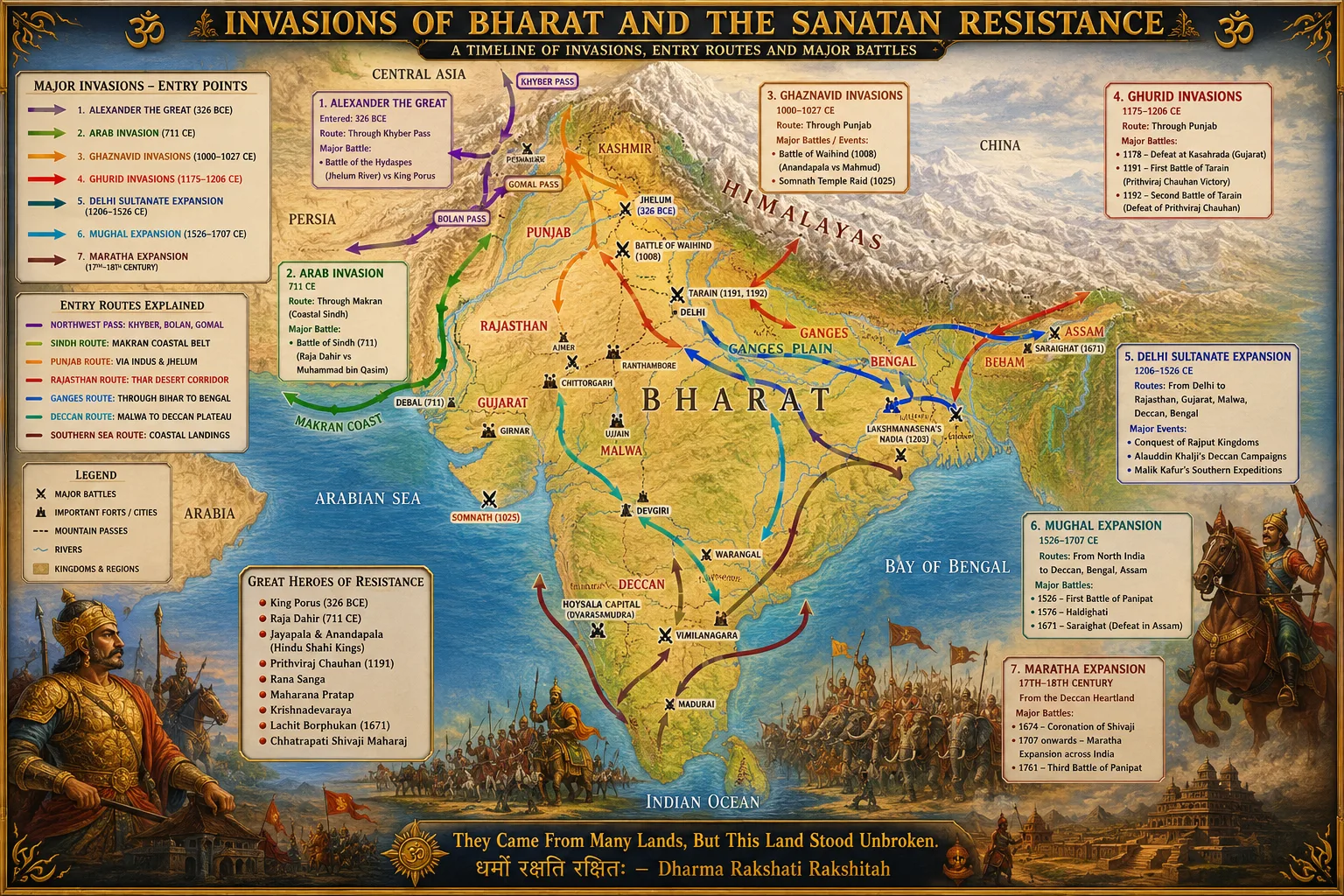
Sanatan Resistance: Bharat’s Civilizational Defense Against Invasions
Introduction
The history of Bharat cannot be written merely as a list of invasions, nor as a sentimental story of survival. It must be studied as a long military, political, and civilizational struggle across frontiers: the northwest passes, Sindh, Punjab, Rajasthan, Gujarat, the Gangetic plain, Bengal, the Deccan, Assam, and the southern peninsula.
Invaders entered Bharat through specific corridors. They were confronted at specific river crossings, forts, plains, deserts, and mountain routes. Some won through mobility, cavalry tactics, surprise, internal division, or superior timing. Some were defeated because Hindu rulers understood terrain, used elephants, fort warfare, naval power, guerrilla methods, and regional alliances. The real history lies in those details.
1. Alexander’s Invasion, 326 BCE
Alexander entered northwestern India after crossing through the regions of Afghanistan and the Indus frontier. His major confrontation in India was against King Porus, or Puru, at the Battle of the Hydaspes, fought near the Jhelum River in 326 BCE. Alexander’s empire reached “from Greece to part of India,” but not across India itself. ([Encyclopedia Britannica][1])
Porus’ strategy relied heavily on war elephants, infantry, and defensive deployment along the river. Alexander used deception, night movement, and a river crossing away from the expected point to surprise Porus. Alexander won tactically, but the battle exhausted his army.
The decisive civilizational point is this: Alexander did not conquer Bharat. His troops refused to proceed beyond the Beas/Hyphasis region, fearing further campaigns against larger Indian powers. His invasion ended at the frontier.
2. Muhammad bin Qasim and Sindh, 711 CE
The first major Islamic conquest into Bharat came through Sindh in 711 CE under Muhammad bin Qasim. He entered from the west through Makran into Sindh and confronted Raja Dahir’s forces. Bin Qasim’s campaign established Islamic rule in Sindh, and he served as governor there after the conquest. ([Wikipedia][2])
The major confrontation was around Debal, Nerun, Sehwan, and finally the battle against Raja Dahir near Aror/Rawar. Bin Qasim’s advantage came from organized Arab cavalry, siege methods, and political exploitation of local divisions. Raja Dahir fought as a frontier defender, but Sindh was vulnerable because it stood exposed on the western edge, far from immediate large-scale reinforcement by other Indian powers.
The Arab victory was real, but it did not become a rapid conquest of Bharat. After Sindh, deeper Arab expansion was checked by Indian powers in Rajasthan and Gujarat.
3. Gurjara-Pratihara Resistance, 8th Century CE
After Sindh, Arab forces attempted to move deeper into western India. Their natural routes were through Sindh into Rajasthan and Gujarat. Here they encountered the Gurjara-Pratiharas and allied regional powers.
The Pratiharas, especially Nagabhata I, are remembered as a major force that checked Arab expansion. The strategy was frontier containment: prevent the invader from moving from Sindh into the Gangetic and western Indian heartlands.
The reason this resistance succeeded was geography plus political will. Desert routes, supply difficulties, fortified settlements, and local cavalry resistance made deep penetration difficult. Bharat did not fall like Persia because the invader could not easily convert a frontier conquest into a subcontinental conquest.
4. Hindu Shahis: Jayapala and Anandapala, c. 986–1010 CE
The Hindu Shahis guarded the Kabul–Punjab frontier, one of the most important gateways into Bharat. Jayapala confronted Sabuktigin and later Mahmud of Ghazni. His son Anandapala continued the struggle.
The entry route of the Ghaznavids was through Afghanistan into the Punjab. The major confrontation zones were around the frontier forts, Peshawar, Waihind, and Punjab approaches.
Mahmud’s first large campaign into India began in 1001, and his campaigns continued until 1026. ([Encyclopedia Britannica][3]) Jayapala’s defeat came partly because the Ghaznavids had highly mobile cavalry, strong mounted archery, and better frontier-war experience. Hindu Shahi forces fought bravely but were exposed, and coalition support came too late or lacked unified command.
Anandapala later attempted a broader confederacy. The idea was strategically correct: no frontier kingdom alone could permanently absorb Ghaznavid pressure. But coordination among Indian rulers remained inconsistent.
5. Mahmud of Ghazni and Somnath, 1025–1026 CE
Mahmud’s invasions were not a single campaign but repeated raids and military expeditions. His final major campaign reached Somnath in Gujarat. Britannica notes that Mahmud led roughly 17 expeditions into India, beginning in 1001 and ending in 1026, and that the last reached Somnath in present-day Gujarat. ([Encyclopedia Britannica][3])
His route to Somnath avoided predictable northern resistance. He moved through Multan and desert routes toward Gujarat, using speed, cavalry mobility, and logistical preparation. The defenders faced the difficulty of responding to a fast raid aimed at a sacred and wealthy target.
Mahmud won because he controlled the pace of the campaign. He chose the target, route, and timing. The defenders fought locally, but the response was not a coordinated subcontinental military interception. Yet Mahmud did not annex Gujarat into a stable empire. His aim was plunder, prestige, and symbolic victory.
6. Muhammad Ghori and the Battles of Tarain, 1191–1192 CE
Muhammad Ghori entered India through the northwest, targeting Punjab and the routes toward Delhi and Ajmer. Before Tarain, he also suffered defeat in Gujarat in 1178, showing again that invasion routes into Bharat were contested.
The First Battle of Tarain in 1191 was fought near Taraori in present-day Haryana. Prithviraj Chauhan defeated Ghori. The Rajput advantage lay in battlefield shock, heavy cavalry, and direct assault. Ghori was wounded and forced to retreat.
In 1192, Ghori returned. Britannica calls the Second Battle of Taraori/Tarain a watershed in medieval Indian history. ([Encyclopedia Britannica][4]) This time Ghori used more flexible mounted cavalry tactics, repeated attacks, and likely feigned retreats to disrupt Rajput formations. Prithviraj’s side suffered from overconfidence, insufficient adaptation, and lack of a deeper strategic pursuit after the first victory.
The lesson is important: the first battle was won by courage and shock power; the second was lost because the enemy returned with tactical learning and better operational planning.
7. Bengal and the Sena Kings, Early 13th Century
The invasion of Bengal by Bakhtiyar Khalji came through Bihar into Bengal. The major route was not the northwest frontier but the eastern Gangetic corridor. The Sena king Lakshmana Sena ruled Bengal at the time.
The fall of Nadia is often presented too simplistically. Bakhtiyar’s strength was speed, surprise, and small mobile cavalry. The Sena weakness was not civilizational exhaustion but military unpreparedness for sudden mounted raids deep into administrative centers.
Bengal did not become culturally erased. The Sena political structure was shaken, but Hindu society, Sanskrit learning, temple traditions, and later Bhakti currents continued.
8. Alauddin Khalji and the Deccan, 1296–1316 CE
Alauddin Khalji’s expansion moved from Delhi into Rajasthan, Gujarat, Malwa, and the Deccan. The routes varied: Rajasthan through forts such as Ranthambore and Chittor; Gujarat through western approaches; Deccan through Malwa toward Devagiri.
The major Hindu powers confronted included the Rajputs, the Yadavas of Devagiri, the Kakatiyas of Warangal, and the Hoysalas.
Khalji’s strategy was systematic: isolate kingdoms, strike rapidly, demand tribute, use experienced generals such as Malik Kafur, and exploit lack of unity among regional powers. The Hindu kingdoms often fought locally and bravely but separately. Forts resisted, but they were not always connected into a coordinated anti-Delhi alliance.
The result was not total cultural defeat. The pressure from Delhi helped create the later need for a southern Hindu imperial response — Vijayanagara.
9. Kakatiyas, Hoysalas, Yadavas, and Southern Resistance
The Kakatiyas of Warangal, the Hoysalas of Karnataka, and the Yadavas of Devagiri were major defenders of the Deccan. Their confrontation zones were fortified capitals: Devagiri, Warangal, Dwarasamudra, and surrounding regions.
Warangal’s fortifications were strong. Kakatiya resistance relied on fort defense, regional military networks, and a wealthy agrarian-temple economy. Delhi’s armies used siege pressure, repeated campaigns, and political extraction.
The defeat of these kingdoms came not from lack of courage but from repeated northern pressure, resource exhaustion, and the difficulty of each southern power fighting separately.
10. Vijayanagara, 1336–1565 CE
Vijayanagara arose in 1336 as a direct civilizational and political response to the collapse of older southern powers. Its founders, Harihara and Bukka, built a state that defended the southern peninsula and protected temple-centered civilization.
Its strategic strength came from fortified geography, revenue organization, cavalry procurement, war elephants, strong infantry, and control of rich agrarian zones.
Under Krishnadevaraya, 1509–1529 CE, Vijayanagara reached a high point. His campaigns against the Gajapatis of Odisha and the Deccan Sultanates showed strong field command, siegecraft, and administrative consolidation.
The Battle of Talikota in 1565 was disastrous. Vijayanagara’s defeat came from a combination of Deccan Sultanate coalition-building, battlefield betrayal or defection by key commanders as traditionally reported, artillery/cavalry coordination, and overdependence on a decisive field engagement. But even after Talikota, the civilization did not disappear. Nayaka states carried forward the legacy.
11. Ahom Resistance and Saraighat, 1671 CE
The Mughal route into Assam followed the Brahmaputra valley. The Ahoms understood riverine warfare better than the invading forces.
At the Battle of Saraighat in 1671, Lachit Borphukan used terrain, naval tactics, local knowledge, and defensive patience. The Mughals had numerical strength, but the Ahoms had superior adaptation to the river environment.
This was a classic case where terrain defeated imperial scale.
12. Marathas: Shivaji and Strategic Resurgence, 17th–18th Centuries
Shivaji Maharaj transformed resistance into statecraft. The main confrontation zones were the Western Ghats, Deccan forts, Konkan coast, and Mughal-Adil Shahi frontier.
His strategy was not reckless open battle. It was mobility, intelligence, hill forts, surprise attacks, naval defense, selective engagement, and administrative legitimacy. He avoided fighting the enemy on the enemy’s terms.
The Marathas succeeded because they turned geography into strategy. Forts such as Rajgad, Raigad, Pratapgad, and Sinhagad were not just defensive structures; they were nodes in a political-military network.
Later Maratha expansion under the Peshwas weakened Mughal power across India. Their setbacks, including Panipat in 1761, came from overextension, supply challenges, northern coalition failure, and fighting far from their strongest geographic base.
Conclusion
A serious history of Sanatan resistance must avoid both defeatism and empty glorification. Bharat lost battles. Bharat won battles. Some rulers failed strategically. Others showed extraordinary foresight. Invaders sometimes won because of cavalry mobility, surprise, siegecraft, internal divisions, or better adaptation. Hindu powers won when they used terrain, forts, elephants, naval power, alliances, and decentralized resilience effectively.
The real greatness of Bharat is not that she never lost. The greatness is that no defeat became final.
From Porus on the Jhelum to Raja Dahir in Sindh, from Jayapala on the northwest frontier to Prithviraj at Tarain, from the Senas in Bengal to the Kakatiyas of Warangal, from Krishnadevaraya at Vijayanagara to Lachit at Saraighat, from Maharana Pratap in Mewar to Shivaji in the Sahyadris — the story is not passive survival.
It is resistance, adaptation, renewal, and civilizational continuity.
[1]: https://www.britannica.com/biography/Alexander-the-Great?utm_source=chatgpt.com "Alexander the Great | Empire, Death, Map, & Facts"
[2]: https://en.wikipedia.org/wiki/Muhammad_ibn_al-Qasim?utm_source=chatgpt.com "Muhammad ibn al-Qasim"
[3]: https://www.britannica.com/biography/Mahmud-king-of-Ghazna?utm_source=chatgpt.com "Maḥmūd | Afghan Ruler & Conqueror"
[4]: https://www.britannica.com/event/Battle-of-Taraori-Second-1192?utm_source=chatgpt.com "Battle of Taraori | Second [1192]"