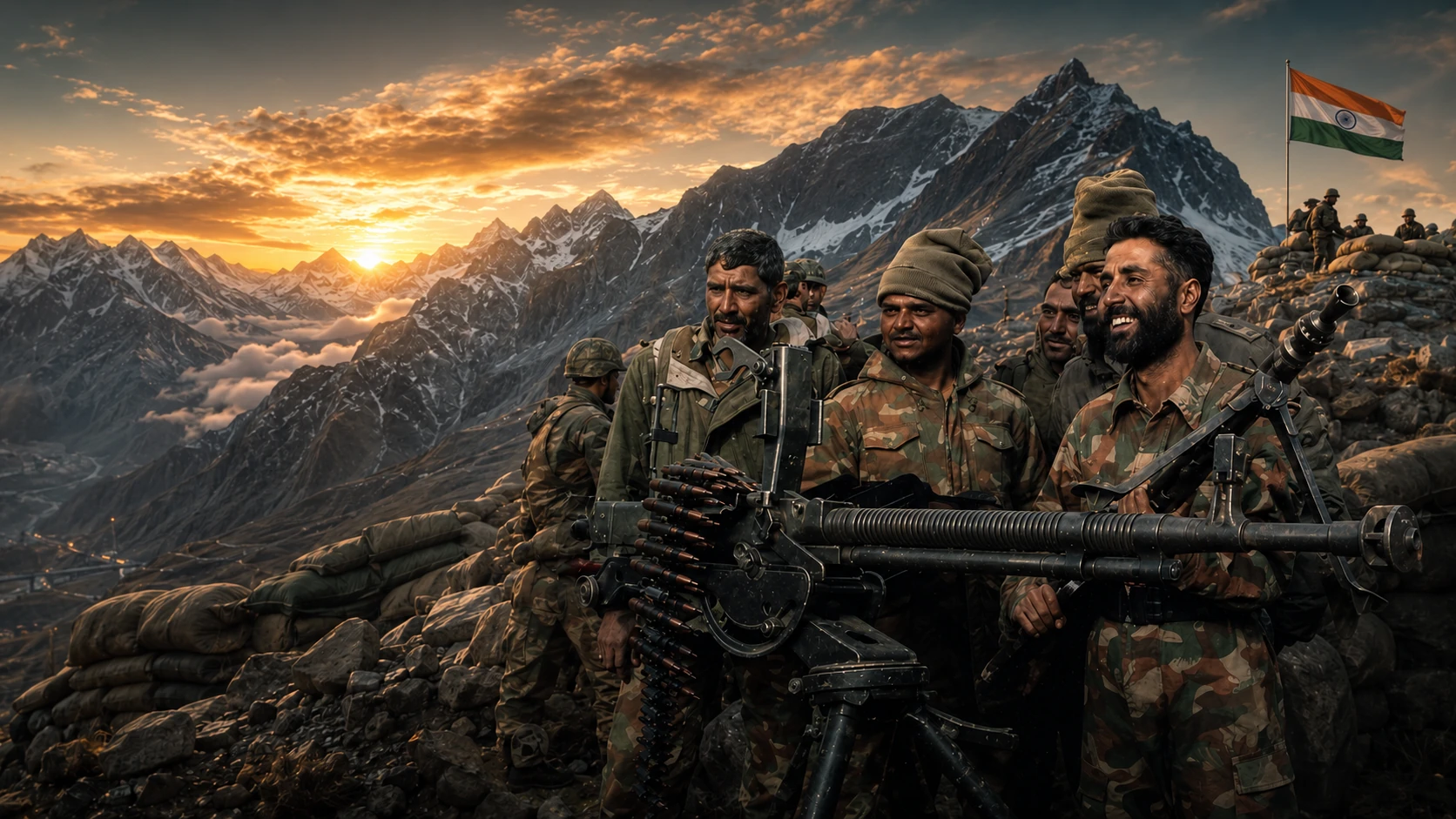
Chapter One - The Bus of Flowers, the Knife of Snow
On the evening of the twenty-first of February, 1999, a bus painted like a bridegroom's carriage crossed the border at Wagah and rolled into Lahore, and for a few lamplit hours it seemed the old century might at last let the subcontinent go in peace. Inside it sat Atal Bihari Vajpayee, Prime Minister of India -- poet, elder, patient man -- come to close half a century of blood with nothing more than a gesture and a signature. He and Pakistan's Nawaz Sharif signed the Lahore Declaration, a covenant between two nations that had each, only months before, split the atom and made the earth afraid of them. There were flowers. There were poems read aloud. The bus itself became a symbol, photographed a thousand times, a vessel of the tender and improbable hope that the two halves of a torn land might yet learn to be neighbours.
It was a beautiful thing, and it was a lie -- not Vajpayee's lie, for he meant every word, but a lie already moving in the dark behind the other man's smile. For even as the motorcade threaded the bright streets of Lahore, other men were climbing. North and east of all that ceremony, on ridgelines that belonged to India, soldiers were hauling themselves up through snow that had not yet begun to dream of melting. They wore no badges. They carried Pakistani rifles and Pakistani bread and orders signed by Pakistani generals -- and it had already been decided that when they died, their own country would look upon their frozen faces and call them strangers. The bus of flowers was the scabbard. The knife was already in the snow.
That betrayal India's own Prime Minister would name without flinching. Weeks later, addressing the nation, Atal Bihari Vajpayee -- the man who had ridden that bus in good faith -- pronounced his verdict upon what Pakistan had done to the peace he offered:
It was a pre-planned operation. It is a repudiation of the letter and spirit of the Lahore Declaration. It is a violation not just of one article of the Shimla Agreement, but an eight-fold violation of that solemn Agreement. -- Atal Bihari Vajpayee, Address to the Nation, 7 June 1999
This is a novel, though every word of it is true. It is the story of five rivers and the mountains that made them; of a conspiracy and the country that has made conspiracy its habit; of five young men who walked toward a summer they could not see, and of the nation that keeps their names the way a temple keeps a flame.
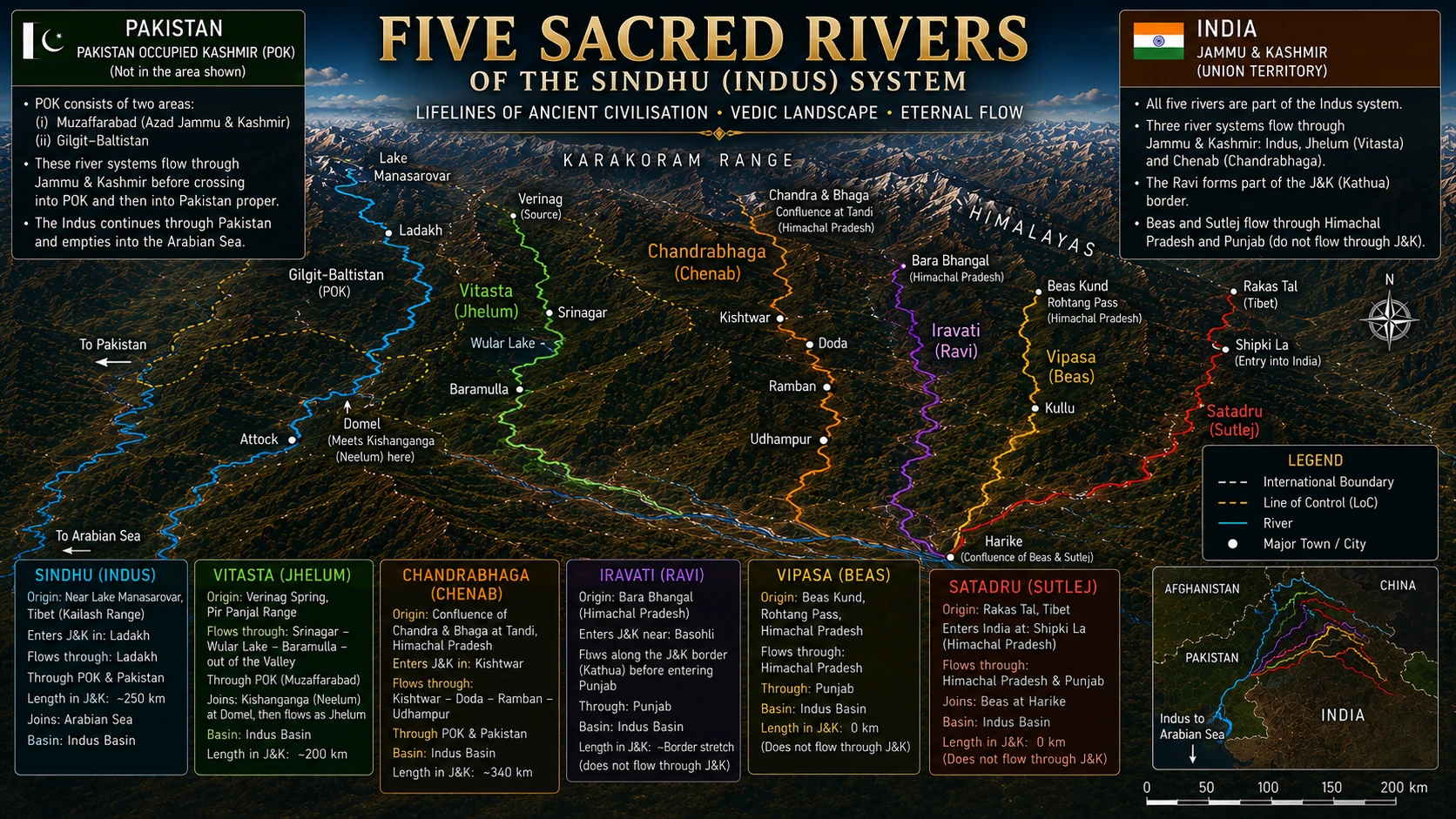
The old land calls itself, in its oldest tongue, by its waters. Five great rivers pour down out of the Himalaya to make the plains of Bharata green -- Sindhu the mighty trunk, and her sisters Vitasta, Iravati, Vipasa, and Satadru -- each born in some high and holy place, each with a nature all her own: this one slow and deep, that one wild and unfettered, this one gathered from a hundred mountain streams, that one running red with the memory of an ancient war. To speak of these five rivers is to speak of the land itself. And in the summer of 1999 the old metaphor turned literal and terrible, for five sons of this land -- each a river, each with a source in some quiet place, each carrying the character of his waters -- would run their separate courses toward a single confluence in the mountains. A sangama, our word for the meeting of rivers, the holiest geography we know: it is where the Ganga meets the Yamuna and the hidden Sarasvati at Prayaga that the pilgrim goes to be cleansed. This is the story of another confluence, higher and colder, where the waters of Bharata were asked to climb back up into the rock that bore them -- and would not be turned. Let us begin, as all rivers do, high up, with the cold.
Chapter Two - The Country Born of Betrayal
Pakistan's coup-culture, the general who loved a gamble, and the pass he wagered on
To understand the knife in the snow, one must understand the hand that held it, and the country that forged the hand. India did not begin this war. India has never needed to; she is old and vast and busy simply being herself. The wound of Kargil was made by a particular kind of state -- one in which the army is not the servant of the nation but its master, and in which the settling of scores has, again and again, been placed above the keeping of peace.
Consider the pattern, for it is not an accident but a habit. A country carved out in 1947 upon a promise, which within a decade had swallowed its own democracy: Ayub Khan's coup in 1958, the general replacing the ballot. Then Yahya Khan, and under him the horror of 1971, when the army turned its guns upon its own eastern citizens and lost half the country in the birthing of Bangladesh. Then Zia-ul-Haq, who hanged the elected prime minister Bhutto and ruled by the noose and the pulpit for eleven years. Time after time the same wheel turns: a civilian government rises, the generals tire of it, the tanks roll out at dawn, and the men in uniform explain to the people that they have been saved. It is a land where the army does not defend the state so much as own it -- and an army that owns a state must, every so often, justify itself with a war.
Into this inheritance, in the last year of the century, stepped General Pervez Musharraf, Chief of the Army Staff -- a commando by training and by temperament, a lover of the audacious stroke, a hardliner on Kashmir whom even his own colleagues thought a man determined to humble India once and for all. He took up an old fantasy that the planners had cherished for years: those winter-empty heights above Kargil, and the road they overlooked. Where cautious men had always set the fantasy aside as impossible, Musharraf, with his Chief of General Staff Lieutenant General Mohammed Aziz and a tight ring of confidants, resolved to make it real. He gave it a pious name -- Operation Badr, after the battle in which the outnumbered faithful once triumphed against the odds -- as though piety could sanctify a theft.
The old rule of the mountains, and the road below
The plan turned upon a mercy that the two armies had honoured for years, though neither had ever written it down. Along that stretch of the Line of Control the winter is a killer more certain than any enemy, and so when the snows came in November, both sides walked down off the highest posts and let the mountains have them, and in the soft of May each climbed back to its own line. No human being can hold the roof of the world through a Himalayan January. It was survival, not trust, but it held -- and Musharraf's design was to break it, to send his men up early, in the dead of winter, to seize the vacant Indian heights before their owners returned.
And what those heights overlooked was everything. Threadlike and grey, clinging to the mountainsides far below, ran National Highway 1A, the single artery binding Srinagar to Leh -- India's only overland road to Ladakh, and beyond it to the glacier-war at Siachen. Seize the peaks above that road and you need never fire at India's soldiers directly; you need only drop shells upon the convoys and close the artery, and a whole frontier begins to starve. The peaks stand above the highway the way a line of archers stands above a valley path. That was the prize.
Zoji La: the gate the general wagered would stay shut
But between the Kashmir Valley and all that high country stands a single gate, and upon that gate the whole conspiracy was staked. Zoji La -- the pass whose very name the hill people render as the pass of blizzards -- sits astride the highway at some eleven and a half thousand feet, and it is the snowiest, cruellest stretch of the whole road. Even when the higher passes beyond it lie clear, Zoji La chokes with snow, and for months in winter it is sealed shut, so that Ladakh is cut off from the Valley and reachable only by air. To cross it in winter is to drive between walls of ice taller than a man.
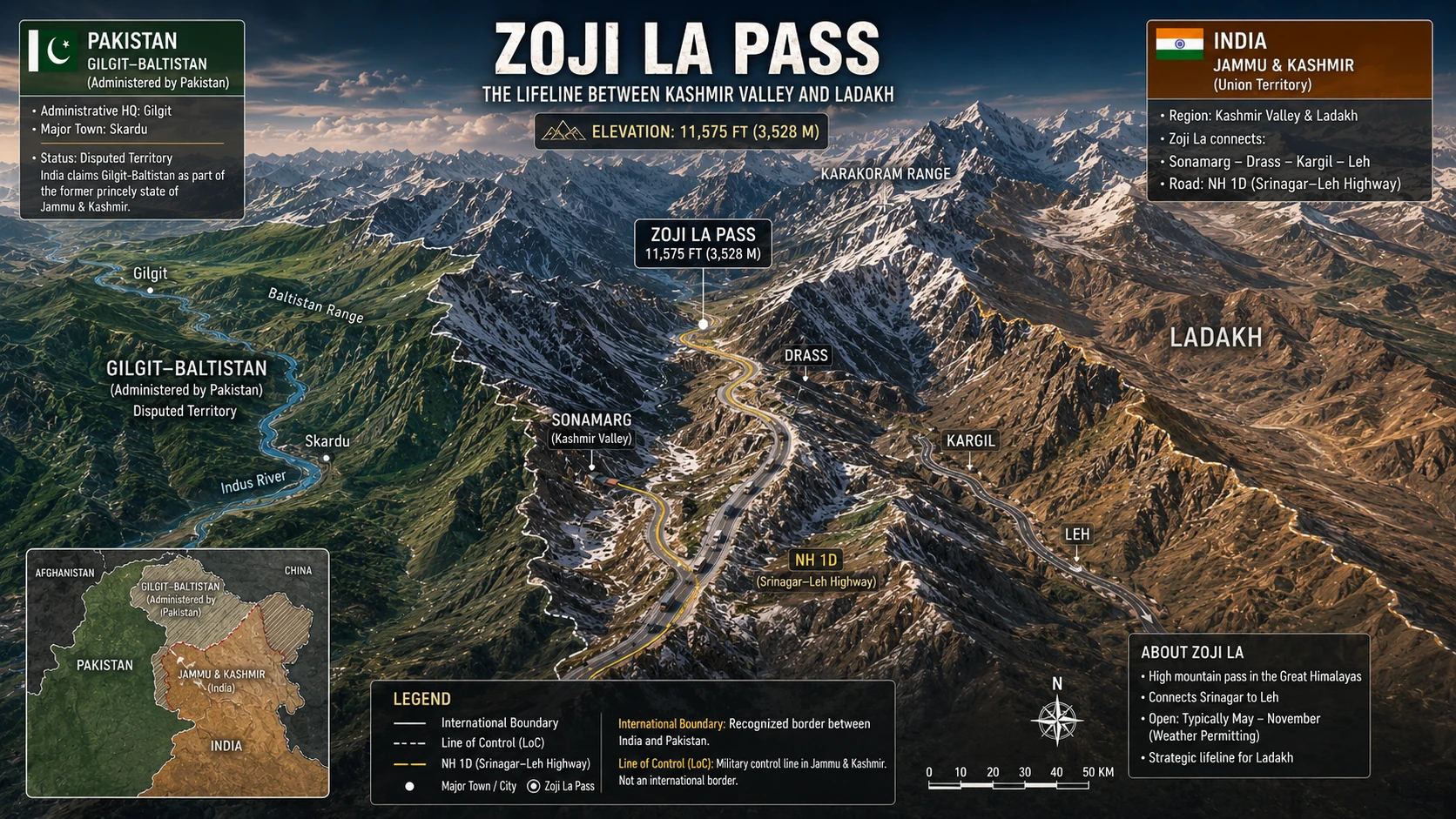
This pass has decided wars before. In the first Kashmir war of 1947 and 1948, Gilgit irregulars and Pakistani forces seized Zoji La in their drive to swallow Ladakh -- and it was here, in November of 1948, that the Indian Army astonished them by hauling tanks up to eleven thousand feet, ground no one believed armour could reach, and retook the pass in the assault called Operation Bison, saving Ladakh. Musharraf knew this history. He knew, too, that Zoji La normally does not open until the end of May or the beginning of June, and his whole timetable rested upon that certainty: even were the intrusion discovered in early May, India could not push troops and guns across a frozen pass in time, and by the summer the invaders would be set in concrete upon the peaks, impossible to dislodge. The gate would hold the reinforcements back; the theft would become permanent.
And here is the last, coldest detail of the design, the one that tells you everything about the country that bred it: Musharraf did not tell his own Prime Minister. Nawaz Sharif -- the elected head of a nuclear state, the man who had just embraced Vajpayee before the cameras -- was briefed only in vague principle, without the scale, without the true objective. The generals lit a war in the name of a leader they did not trust with the knowledge of it. That is not an army serving a nation. That is an army that is the nation, wearing the elected government as a mask to be discarded at convenience. Musharraf would discard it within months. But that is the end of our story. For now, hold this in mind: the war was a conspiracy, hatched in secret, built upon a lie, sprung from a state that has never quite decided to be ruled by its own people. India would not choose this fight. She would merely be given no choice but to win it. And the frozen gate of Zoji La, upon which the whole gamble rested, would betray the gambler -- for that spring, it opened early.
A nation whose army owns it must feed that army wars. Kargil was one more meal.
Chapter Three - The Beauty
A hymn to the roof of the world
Before the men, the mountains. And before the killing, the beauty -- for it must be told first, and told truly, or nothing that follows will mean what it should.
There is no cathedral on earth like the high Himalaya at first light. Stand in the cold blue hour before the sun and watch the topmost snows catch fire while the valleys still lie in shadow: a line of burning gold laid along the ridge-crests, sliding downward as the sun climbs, until the whole range stands revealed, peak beyond peak beyond peak, white and rose and impossible, marching away past the curve of sight. The air is so clear it deceives the eye; a summit a day's climb away seems close enough to touch. The silence is not the absence of sound but a presence in itself, vast and attentive, broken only by wind and by the far-off sigh of settling snow. This is the country our ancestors called the abode of the gods, and they were not speaking in decoration. They meant it. They looked up at this and knew themselves in the presence of the sacred.
These are the mountains from whose ice the five rivers are born. Somewhere among these silences is Kailasa, the mountain of Siva himself, and the lake below it from which the waters run; somewhere here the Ganga is said to fall from heaven and catch in the god's matted hair before she is loosed upon the plains. Every river that feeds a Bharatiya field, every drop that a farmer blesses and a pilgrim pours, began as snow upon these heights. The mountains are the source. They are the father of the waters and the roof of the world and the throne of the divine, and the men who would climb them that summer were, though few of them would have said it so, climbing home -- back up into the very ice that had, in the beginning, given their rivers birth.
Hold that beauty in your mind. Hold the gold light on the snow and the temple-silence and the sacred source of the waters. Because the same mountain that is a god at dawn is, by the logic of altitude and cold and the guns of men, also a beast -- and it is to the beast that we must now, unwillingly, turn.
Chapter Four - The Beast
The killing ground, and the fortresses upon it
The beauty does not love you. That is the first thing the mountain teaches, and it teaches it without malice, the way fire is not cruel when it burns. Above fifteen thousand feet the human body begins, quietly, to fail. The air holds barely half the oxygen it holds at the sea, so that every step is a small drowning and a fit man gasps to lift his own boots; the mind goes slow and stupid; a wound will not clot as it should; sleep comes thin and broken, full of the body's animal panic. Simply to exist up here, before a single shot is fired, is to be ground down a little more with each passing hour. Men must climb in slow stages merely to let their blood thicken to the thinness of the air, and even then the mountain takes its toll in frostbite, in snow-blindness, in the drowning sickness that fills the lungs and the swelling that crushes the brain.
The cold runs past forty below in the deep winter, and the wind arrives off a thousand miles of ice with nothing to slow it. Water freezes in the canteen held against the chest. Bare steel takes the skin from a bare hand. There are no trees to soften the wind or hide a man -- only scree and boulder and the hard blue shine of glaciers older than memory. And a body that falls in this country does not rot and return to the earth; it waits, perfect and patient in the cold, for a summer that may or may not give it back.
Now set upon this killing ground the guns of a waiting enemy, and understand the cruel geometry the Indian soldier would face. The man who holds a Himalayan peak holds every advantage the earth can give. He sits behind a sangar -- a breastwork of piled stone, roofed and reinforced -- upon the summit, and below him the slope falls away naked and open. The attacker cannot walk; he must climb, sixty and seventy and eighty degrees of rock and ice, sometimes a sheer face, hauling twenty-five kilograms of weapon and ammunition on his back, in that drowning air, with nowhere on the bare slope to hide. He moves at the crawl of an exhausted mountaineer, black against the snow, while above him a machine-gunner waits at leisure and chooses his moment. The books say an attacker should outnumber a dug-in defender by three to one. On these slopes it was not nearly enough.
The peaks that ruled the road
And these were the particular thrones from which the intruders looked down upon the highway, each one a name that the summer would write in blood.
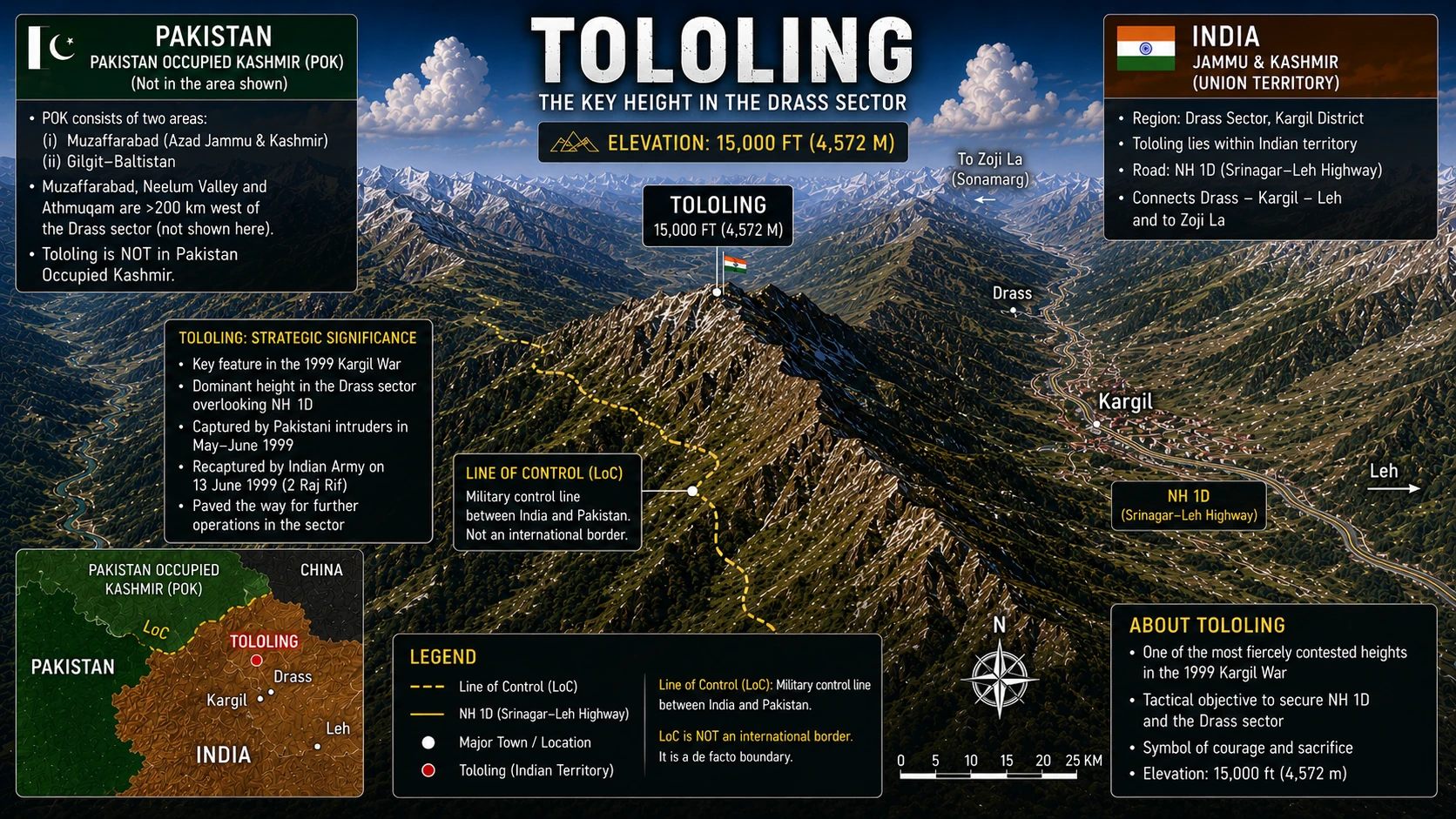
There was Tololing, a bare brutal shoulder of rock rising to some sixteen thousand feet directly above the town of Dras, and above the highway itself. A single steep track zig-zagged to its top with no cover anywhere upon it; from their bunkers the enemy could see every inch of the approach. So long as Tololing stood, the road below lay under the enemy's guns and the whole Indian effort was throttled. It would have to be taken first, whatever the cost, or nothing else could be taken at all.
Above Tololing, higher on the same ridgeline, stood Point 5140 -- a summit near sixteen thousand nine hundred feet, the most formidable feature in the whole Dras sector, its top a nest of stone sangars looking down a slope built for slaughter. And in the Mushkoh Valley beyond rose Point 4875, a great glaciated ridge whose knife-edge crest, with sheer drops to either side, dominated thirty and forty kilometres of the national highway at a stretch; from its heights the enemy's gunners could watch Indian convoys, camps, and gun-lines and rain fire upon them at will. Its capture was not a choice but a necessity.
Northward, in the Batalik sector, the ground reared up even more remote and trackless, and there the key was Khalubar, the hub of the enemy's whole position in that sector, reachable only by hours of climbing on near-vertical rock. And tallest and most symbolic of all stood Tiger Hill, the great peak that lorded over the Dras heights -- so central, so visible, that its recapture would one day be carried live upon the nation's television screens, a whole country holding its breath as its sons climbed into the sky.
Tololing. Point 5140. Point 4875. Khalubar. Tiger Hill. Learn the names, for they are the stations of the cross of that summer. Each was a fortress in the sky; each dominated the thin grey lifeline of the road; each would be taken, in the end, by men climbing straight up into the guns because their country had forbidden them the easier path of crossing the Line. And to each of them, presently, a river would come.
Chapter Five - The Discovery
How a nation learned, in two places at once, what had been stolen from it
Great wars, for all their generals and their guns, sometimes turn upon the smallest and gentlest of people. This one turned, in part, upon a man who had lost an animal.
In the first days of May 1999, a shepherd named Tashi Namgyal, of the village of Gharkon near Batalik, climbed into the high pastures after a stray yak. It was the most ordinary of errands, the kind a hill man does a thousand times without thought. Sweeping the ridgelines with his binoculars for the shape of his lost beast, he found instead a thing that made no sense in the world he knew: men. Men in Pathan dress and in army uniform, up on the empty Indian heights, breaking stone and clearing snow, building. And below them, no footprints climbing from the Indian side. They had come the other way. They had come over the wall.
He came down and told the Army. And here the tale holds a small bitter truth about how great news is first received: the officer did not believe him. Such rumours came in with every spring thaw. The man half-threatened the shepherd -- a reward if it were true, a reckoning if it were a lie -- and then, to be sure, sent a patrol of some twenty soldiers up the mountain with him to look. What they found was no rumour. It was a dug-in enemy, armed and waiting, holding the sky in strength. In the Batalik sector, the theft had been seen.
But the mountains are wide, and the truth was surfacing in more than one place at once. Far to the west, in the Kaksar sector, another patrol had gone up in those same mid-May days -- not because of any shepherd, but on the ordinary spring errand of checking whether the snow had cleared enough for the old posts to be reoccupied. It was led by a young lieutenant, twenty-two years old and only months into his first posting, and it would not come back whole. His name was Saurabh Kalia, and what befell him and his men is a chapter of its own -- the first and cruellest price of the war, paid before the war had even been declared. It is enough to say here that between the shepherd's sighting in Batalik and the vanished patrol in Kaksar, in the second and third weeks of May, the unthinkable became undeniable: regular Pakistani soldiers, in strength, were dug into the heights on India's side of the line, across a front of more than a hundred and sixty kilometres. The old mercy of the mountains had been betrayed. The gate of Zoji La, which was to have held India back, had opened early. And the rivers of Bharata began, from their scattered sources, to run toward the confluence.
As for the shepherd -- he wanted no medal and received none for most of his life. He went back to his flock. Only in his last years did Ladakh honour him at last, and the Army raise a small memorial to him in the sector where he had walked; he died in the winter of 2024, an old man who had, one May morning with binoculars raised for a lost yak, helped to change the course of his nation's history. Let his name stand among the soldiers'. The rivers would do the fighting. But it was a shepherd who first saw the poison in the water, and had the plain courage to say so.
And when the truth was fully known, the nation's answer was not doubt but duty. India did not ask whether she had the right; she knew she had the obligation. Her Prime Minister put it in words that left no room for hesitation:
No government can tolerate such an incursion -- our Government certainly will not. It is our duty to rid our sacred Motherland of every single intruder. No one should entertain the slightest doubt: they shall not stop till they have completely attained their objective. -- Atal Bihari Vajpayee, Address to the Nation, 7 June 1999
Chapter Six - Vitasta, the Spring That Saw First
The Jhelum, born of the Verinag spring -- and Lieutenant Saurabh Kalia
Of all the five rivers, begin with the one that rises within the very land being fought over. The Vitasta -- the river the world now calls the Jhelum -- is unlike her sisters in her very birth. She is not the slow gathering of a glacier's melt but the sudden welling of a single sacred spring, the deep blue artesian eye of Verinag in the Kashmir Valley, where cold clear water rises straight out of the earth as though pushed up from the heart of the land itself. From that one spring she becomes the river of the Valley -- gentle at first, deep and unhurried, coiling in great slow loops through the Kashmir plain, mirroring the chinar and the mountain; and then, past the Valley, she narrows into fierce gorges and runs hard and broken through the rock. Gentle at the source and brutalized in the narrows: it is the shape of a particular life. To the spring-born river of the wounded Valley belongs the young man who saw the wound first, from inside it, and was broken in the narrows before any battle was fought -- Saurabh Kalia.
He was born on the twenty-ninth of June, 1976, a scholarship boy, first-class in the sciences, the gentle and brilliant sort of young man who could have chosen any comfortable life. He chose the hardest one. Commissioned into the 4 Jat Regiment in December of 1998, he was sent for his very first posting to the Kargil sector -- new to the cold, proud simply to be handed a piece of the frontier to guard. Like the Vitasta at Verinag, he rose clear and sudden into a hard country. And in the first two weeks of May, on that ordinary patrol into the Kaksar heights to see whether the snow had cleared, he became the first Indian officer to look through his glasses upon the impossible and understand it: men where no men should be, on India's side of the line, dug in and armed. The spring had seen the poison enter the water.
For that seeing, the price exacted was so cruel that it must be set down plainly, without flinching, because to look away would be a second betrayal of him. On the fifteenth of May, Kalia and five soldiers of his regiment -- Sepoys Arjun Ram, Bhanwar Lal Bagaria, Bhika Ram, Moola Ram, and Naresh Singh -- were caught in a firefight near Bajrang Post. They fought until the last round was gone. Then, encircled, cut off, with no reinforcement able to reach them across that ground in time, they were taken alive.
For some twenty-two days they were held. When their bodies were at last returned, on the ninth of June, the doctors who examined them recorded what had been done in that captivity: burns from cigarettes and hot irons; ears pierced through with hot rods; teeth and bones broken; eyes put out; limbs and bodies mutilated -- grievous, deliberate torture, worked slowly upon helpless prisoners, before each was finally shot in the head. It was a naked violation of every law of war that Pakistan itself had signed its name to. And it tells you, more than any battlefield could, the character of the thing India was made to fight: not soldiers who erred in the heat of combat, but a cruelty done coldly, at leisure, to bound men who could no longer lift a hand.
His first month's salary and the news of his death reached the family home on the very same day.
Grieve for him fully. Grieve for the boy who was proud to be sent into the cold; for the scholar who chose the harder road; for the father who has spent more than two decades since carrying his son's photograph into courtrooms and before the councils of the world, asking only that the crime be named a crime. Saurabh Kalia was not among the four who would wear the highest medal. His was a different martyrdom -- the martyrdom of the first witness, the one who suffers before the nation has even understood there is a war. But no telling of Kargil that has a soul in it can begin its roll of honour anywhere but here, at the blue spring of the Vitasta, with the young man who saw first, and suffered first, and whose suffering woke a country. Everything that follows -- every peak retaken, every river that climbed the rock -- is, in a sense, the answer his brothers gave to what was done to him.
Two names history must never confuse. The officer tortured to death as a prisoner was Captain Saurabh Kalia of the 4 Jat. The officer whose radio cry "Yeh Dil Maange More" became the anthem of the war was Captain Vikram Batra of the 13 JAK Rifles. Both were sons of Himachal Pradesh; both were barely more than boys; both belong now to the ages. Popular memory sometimes fuses them into one. This telling keeps them apart, and gives each his own chapter, because each earned his own.
Chapter Seven - Sindhu, the Lion of Palampur
The Indus, great trunk that names a civilisation -- and Captain Vikram Batra
Every river system has its trunk: the one great water into which all the others finally pour, the river that gives the whole land its name. Among the five, that river is the Sindhu herself -- the Indus, mother of a civilisation, the river from whose name the very words India and Hindu descend. She rises near Kailasa, the mountain of Siva, and of all the five she alone runs bodily through the Ladakh of this story, broad and commanding, past the very battlefield, the mainstream that carries the name of everything. And among these five men there is one whose own name became the anthem of the war, the current into which all the courage of that summer seems to flow: Vikram Batra, the Lion of Palampur, whom the enemy themselves learned to call by his war-name, Sher Shah.
He was born in the tea-green hills of Palampur on the ninth of September, 1974, and even his beginning reads like a small verse. His mother, Kamal Kanta, a schoolteacher and a devotee of Rama, bore twin sons and named them for the twin sons of her god -- Luv and Kush. Vikram was Luv, the elder, born fourteen minutes before his brother Vishal: a whole lifetime's seniority measured in the span of a single prayer. He grew into a boy who overflowed whatever vessel life offered him -- a champion at the table-tennis board, a green belt in karate, the finest air cadet of the whole North Zone, a paratrooper before he was twenty -- and he grew up, tellingly, upon the televised stories of the Param Vir Chakra, the tales of the highest bravery, the way other boys grow up on the deeds of cricketers.
The world offered him ease, and he refused it with a sentence his family would carry forever. In 1995 a Hong Kong shipping company offered him a berth in the merchant navy -- good money, a soft life, the uniform stitched, the passage booked. He gave it back. "Money is not everything in life," he told his mother. "I have to do something bigger -- something great, something extraordinary, which may bring fame to my country." He turned from the sea to the mountains, entered the Indian Military Academy, and was commissioned into the 13 Jammu and Kashmir Rifles. The trunk-river had found its bed.
Point 5140, and the cry a nation kept
When the war called, it called him to Point 5140, that most formidable throne on the Tololing ridgeline. Batra was Delta Company's commander now, and he refused to feed his men straight up the killing slope into the guns. On the night of the nineteenth of June he swung his company wide, skirting the mountain from the east, climbing a near-vertical face through the dark to arrive within a spear's throw of the enemy, unseen. There is a story told of that night that the soldiers swore was true: that an enemy officer, hearing the call-sign on the captured radio net, taunted him -- Why have you come, Sher Shah? You will not go back. And Batra answered him down the wire: We shall see, within the hour, who remains on top.
Then he sprang. In the hand-to-hand fighting on that summit he killed the enemy at arm's length, and his men poured over the top behind him like a river through a broken dam. The peak fell -- and it fell, astonishingly, without costing a single Indian life. At half past three in the dark of the morning, his voice came crackling down the mountain to the command post, and the words he spoke -- half a soldier's report, half a boy's pure joy -- became the sound the whole nation would forever fasten to that war:
"Chanakya... it's Sher Shah reporting. We've captured the post. Yeh Dil Maange More!"
Yeh Dil Maange More -- this heart wants more. The fall of 5140 broke a dam indeed: Point 5100 followed, then Point 4700, Junction Peak, the Three Pimples, a cascade of captured summits. Batra was made a Captain upon the spot. The Army chief himself telephoned to congratulate him. His grinning, handsome face filled the television screens of a country that had not had a hero to love in a long while, and overnight a boy from Palampur became the living face of the war.
Point 4875, and the going-home
But the trunk-river runs on toward the sea, and Batra's course now bent toward its mouth. His battalion was moved to the Mushkoh Valley for the hardest task of all: Point 4875, the glaciated knife-edge that ruled forty kilometres of the highway. The assault went in under a storm of Bofors and rocket fire on the night of the fourth of July; by the fifth, A and C Companies had clawed onto the feature, and where the advance stalled fifty metres short under sniper and machine-gun fire, the commanding officer, Lieutenant Colonel Joshi, fired two Fagot missiles with his own hands from the firebase and blew the bunker open. Point 4875 was taken by afternoon -- but the enemy, from the adjacent crag called Area Flat Top, launched a furious counterattack in the night, and there a young officer named Naveen Nagappa, holding the ledge with a small force, was gravely wounded by a shell.
Batra was ill by then -- feverish, hollowed out by altitude and fighting, ordered by his colonel to rest in his sleeping bag by the Mushkoh nullah. He would not rest. He volunteered to lead Delta Company up to retake Flat Top and rescue Naveen's men. Before the climb he wrote a letter to his twin, to Kush: take care of mother and father; anything can happen here.
Up the narrow ledge he went, where the enemy held sangars echeloned one behind the next. With covering fire from his men he charged a fortified sangar and killed five of the enemy in hand-to-hand fighting at point-blank range, and his troops gained the ledge; the enemy, taken by surprise, began to break. Then Batra reached the wounded Naveen and dragged him from the bunker under fire. There is a line the soldiers remembered from that moment, an argument between two young men in the middle of a battle: Naveen, bleeding, begging to be left so he could keep fighting, and Batra refusing him -- You have a wife and children; get back -- and pulling him out of the fire regardless. One machine-gun nest still swept the ledge; Batra charged it alone and killed all four of its crew. And then, moving to drag yet another wounded soldier to cover, he was struck in the chest by a sniper's bullet at close range, and a heartbeat later a splinter from a rocket-propelled grenade took him in the head. He fell beside the man he was trying to save.
He was twenty-four years old. His last cry, flung up at the sky, was his regiment's own: "Durga Mata ki Jai" -- victory to the Mother. Inspired past all fear by what they had seen him do, his men fell upon the enemy and took the peak, and the mountain was renamed for him -- Batra Top -- so that the map of India itself now carries his name into the sky. He had made a vow, before the war, to one who told him to be careful:
"Either I will come back after hoisting the Tricolour, or I will come back wrapped in it -- but I will come back for sure."
He came home wrapped in it. Ten thousand people walked in his funeral through the little town of Palampur, dignitaries and strangers together, all of them weeping for a boy most had never met and all had somehow loved. The trunk-river had reached the ocean. But a river that reaches the sea does not end; it rises again as cloud, and returns as rain upon the mountains, and runs forever. So it is with him. Every time the Tricolour lifts upon a mountain wind, there is the roar of Sher Shah in it still.
Chapter Eight - Vipasa, the Boy Who Could Not Be Bound
The Beas, the unfettered that turned an emperor back -- and Grenadier Yogendra Singh Yadav
Of all the five, the Vipasa carries the proudest meaning in her very name -- the unfettered, the freed-from-bonds, the one that cannot be held. She is the youngest and wildest of the sisters, tumbling fast and white out of the high Himalaya, and history set upon her banks a moment that the whole world remembers: for it was at the Vipasa, the river the Greeks called Hyphasis, that the army of Alexander -- who had conquered from Macedon to the Indus and thought himself the master of the earth -- looked eastward across her waters at the vastness of Bharata beyond, and refused to go one step further. The unfettered river became, for all time, the water that turned an emperor back. To her belongs the boy who could not be stopped by anything the enemy possessed -- not by a cliff, not by a machine gun, not by fifteen bullets in his body: Grenadier Yogendra Singh Yadav.
He was born on the tenth of May, 1980, into a family already made of soldiering -- his father had carried a rifle through the wars of 1965 and 1971 -- in a farming village of Bulandshahr. He did not even wait to become a man before he answered the call: he enlisted with the 18 Grenadiers at the age of sixteen years and five months, a boy among grown soldiers, and won his way into the Ghatak platoon, the razor commando-edge of the battalion, the ones sent first into the dark. When the war came for him he was nineteen years old -- and, a detail that breaks the heart with its ordinariness, newly married, days from a honeymoon he would set aside to climb a mountain.
Tiger Hill, and the cliff no one could climb
They gave his platoon the tallest and most symbolic prize of the whole Dras sector: Tiger Hill, the great peak whose recapture the nation would watch live upon its screens. And the plan turned upon an impossibility. The obvious approaches were swept by the enemy's guns; so a Ghatak party would climb a sheer cliff at the rear of the mountain, an approach so lethal and so vertical that the enemy had scarcely troubled to guard it, certain in their arrogance that no human being could come that way.
First up that vertical rock, fixing the ropes with his own hands so the men behind him could follow, went Yogendra Singh Yadav -- nineteen years old, in the dark, in the killing cold, on a cliff the enemy had deemed unclimbable. Partway up, the mountain erupted at them. Fire from the bunkers above killed the platoon commander and two others outright and pinned the survivors against the rock. Yadav was hit -- and kept climbing. He reached the top. He crawled through a storm of bullets to the first enemy bunker and silenced it with grenades and point-blank fire; and when a second sangar opened up, he rose and rushed it with two comrades, killing its occupants in a close and savage hand-to-hand fight. He was struck again, and again, and again -- by the accounts as many as fifteen bullet wounds in his body, one arm shattered to uselessness by a burst that he bound up with a makeshift tourniquet and fought on -- and still, bleeding, broken, half-dead, he held the position and sent word back that let the rest of the assault come through.
He did not die. That is the astonishment of the Vipasa -- the unfettered river runs on. He was left for dead upon that height and lived; he spent sixteen months in hospital, his body slowly knitting back what the mountain had torn from it; and he lived to become, at nineteen, the youngest man ever to wear the Param Vir Chakra in the whole history of the Republic. By the eighth of July the entire feature was cleared, and the nation, which had watched Tiger Hill upon its screens, wept and cheered as the Tricolour rose upon the summit. The boy who could not be bound had turned back an army, as his river once turned back an emperor.
Chapter Nine - Satadru, a Hundred Streams, Thrice Refused
The Sutlej, hundred-channelled river from sacred Kailasa -- and Rifleman Sanjay Kumar
The Satadru -- the Sutlej -- carries in her very name the number of her waters: sata, a hundred, the river of a hundred streams, the hundred-channelled. She rises farthest and highest of all the sisters, away beyond the main wall of the Himalaya near the sacred lakes below Kailasa itself, the mountain of Siva; and she is the most turbulent and the most persistent of the five, gathering a hundred small mountain streams to her and cutting the deepest gorges in the land, refusing every barrier, wearing through the very rock rather than be stopped. She is the river of the humblest and most scattered beginnings, gathered by sheer persistence into an unstoppable flood. To her belongs the man whom the Army turned away three times, and who came back a fourth -- Rifleman Sanjay Kumar.
He was born on the third of March, 1976, the youngest of six children in a Dogra family of very little means in Bilaspur, in the Himachal hills. He left school at matriculation -- his parents could not pay for more -- and went down to Delhi to drive a taxi, sending home what he could, a young man threading the traffic of the capital with a mountain in his heart. For an uncle of his had died wearing the badge of the Jammu and Kashmir Rifles in the war of 1965, and that regiment -- that exact regiment -- was the only future Sanjay Kumar would have. He applied. They refused him. He applied again. Refused. A third time. Refused. Most men would have read the message and kept the taxi and the safe small life. He came back a fourth time -- a hundred streams that will not stop coming -- and in June of 1996 they took him at last, into the 13 JAK Rifles: the very same battalion, though neither man could have dreamed it then, as a table-tennis-playing officer from Palampur named Vikram Batra. Two rivers born a world apart had begun, all unknowing, to run in the same bed.
Area Flat Top, and the seizing of the enemy's own gun
On the fourth of July 1999, on that same terrible peak of Point 4875 where the Lion of Palampur was fighting his last fight, Sanjay Kumar volunteered for the place of greatest danger: leading scout of the attacking column against the enemy stronghold called Area Flat Top. As the column clawed its way up, automatic fire from a sangar tore into it and stalled it dead upon the open slope. And the taxi-driver who had been told no three times looked at that gun, and made his answer.
He charged it -- alone, uphill, into the muzzle, across ground with no cover at all. Bullets took him in the chest and the forearm and he did not stop. He reached the first sangar and killed three of the enemy in a hand-to-hand fight at the mouth of the bunker; and as the crew of a second position broke and ran, they left their Universal Machine Gun behind -- and Sanjay Kumar caught it up in his bleeding hands and turned their own gun upon them, cutting down the fleeing enemy with their own weapon. Bleeding profusely, he refused to be evacuated. And his brothers, seeing what one refused man would do, rose off that slope and carried the peak.
Refused three times by the regiment he loved, he answered a machine gun with his own body -- and lived to be saluted by generals.
He lived. Like Yadav, he is among the rare few given the highest medal while still breathing to receive it. The humblest source of all -- a village too poor to keep him in school, a taxi in the Delhi heat, three rejection letters folded away -- had risen, as the Satadru rises from the roof of the world and wears through mountains, to the very highest place a soldier of Bharata can stand.
Chapter Ten - Iravati, the War-River of the Gorkha
The Ravi, war-river of the Battle of Ten Kings -- and Lieutenant Manoj Kumar Pandey
The Iravati -- the Ravi, which the Rgveda knew as Parusni -- is, above all the sisters, the war-river of our oldest memory. It was upon her banks that the Dasarajna, the Battle of the Ten Kings, was fought and decided -- the great foundational war of the Vedic age, in which a righteous king, set upon by a confederacy of ten, prevailed against the odds and secured his people. She is not the broadest of the five, but she is fierce and decisive, the river whose name is bound up forever with a battle that made a people. To her belongs the young man who wanted, more purely and more openly than any of the others, to be a warrior, and who said so aloud when wiser boys would have kept silent -- Manoj Kumar Pandey.
He was born on the twenty-fifth of June, 1975, in the village of Rudha in Sitapur, into a Brahmin household of modest means, the eldest son of a small trader. He blazed through the Sainik School at Lucknow upon brilliance and boxing and an iron will, refusing to lay any burden upon his father's thin purse. And when he sat at last before the Services Selection Board, and they asked him the question they ask every hopeful -- why do you wish to join the Army? -- most boys give the safe answer, the modest answer. Manoj Pandey gave the naked, dangerous, true one:
"I want to win the Param Vir Chakra."
He wrote in his diary the lines of a young man already in conversation with his own fate: Some goals are so worthy, it is glorious even to fail. And, more terribly: If death strikes before I prove my blood, I swear I will kill death. He was commissioned into the 1/11 Gorkha Rifles, a battalion raised upon the Mesopotamian sands in 1918, and before Kargil he served upon the Siachen Glacier -- so that when the high war came, he already knew, in his own lungs and fingers, exactly what the altitude does to a man.
Khalubar, and the keeping of the vow
In the far Batalik sector, at Khalubar, the enemy's activity was thickest and the ground the cruellest, reachable only by hours of climbing on near-vertical rock. On the night of the second of July, as his platoon toiled toward its objective, it was caught in a crossfire from the heights on either hand, pinned in the open and in peril of being caught by the daylight. Pandey did not wait. He surged ahead of his own men and charged the enemy bunkers with the war-cry of his regiment ringing off the stone -- "Jai Mahakali, Ayo Gorkhali!" -- the Gorkhas are upon you. He cleared one bunker in a rush of grenade and khukri and rifle; and a second. A burst of fire caught him in the shoulder and the leg; he did not stop. He pressed on to a third position, and to a fourth, and as he destroyed that last bunker with a grenade, a machine-gun burst struck him full in the forehead.
He had cleared the way. Through the gap that his body had opened, his battalion poured, and Khalubar was taken. He was twenty-four years old, and he had done exactly, precisely, what he had promised a roomful of officers he would do, years before, in a plain room across a plain table: he had killed death itself to reach his goal, and won the highest honour his country can bestow -- though it was laid, as too many of these honours are, upon a folded flag rather than a living breast. The war-river of the Ten Kings had run true.
And so the five rivers had reached the mountains, and climbed them, and would not be turned. Vitasta the spring who saw first and suffered first. Sindhu the lion whose cry became the anthem. Vipasa the unfettered boy who took fifteen bullets and lived. Satadru the hundred streams that wore through the rock. Iravati the war-river who kept his terrible vow. Four of them wear the Param Vir Chakra -- Batra, Yadav, Sanjay Kumar, Pandey -- two living, two ascended; and the fifth, Kalia, wears the older and quieter crown of the first witness. Around them, uncounted here but never unhonoured, stood five hundred and more: Major Vivek Gupta who fell taking Tololing; Captain Anuj Nayyar and Captain Vijayant Thapar; the gunners of the Bofors batteries who broke the sangars open; and all the names cut into the cold wall at Dras. The waters of Bharata had come home to the high places. Now the world had to decide what it would do about the thief.
Chapter Eleven - The Confluence at Blair House
Where the lie drowned, and the liar was shamed before the world
While the rivers climbed and bled upon the rock, the conspiracy that had loosed them was drowning in its own current far below. The whole scheme had rested upon a single lie -- that the men on the peaks were wild and independent Kashmiri freedom-fighters, nothing to do with the Pakistan Army -- and a lie cannot survive the evidence of the dead. The documents found upon the fallen. The bodies, unmistakably, of Northern Light Infantry regulars in their own uniforms. The radio traffic intercepted in the clear voices of Pakistani officers. And at the last, the admissions of Pakistan's own leaders. The United States, reading its own intelligence, concluded that the great mass of the men who had crossed the line were Pakistani soldiers -- and, for the first time in the whole long half-century of the quarrel, said so aloud, and stood with India. Musharraf's grand gamble had misjudged the one player he could least afford to misjudge.
And now watch the architect's mask -- Nawaz Sharif, the man kept in the fog by his own generals -- as the whole edifice comes down upon him. President Bill Clinton wrote, then telephoned, making one thing granite-plain: there would be no American help of any kind until Pakistan withdrew, wholly and unconditionally, behind the Line of Control -- and a hundred-million-dollar loan that Pakistan desperately needed might quietly vanish if it did not. Sharif flew to Beijing to beg comfort of Pakistan's oldest friend; China, too, told him to withdraw. Alone in all the world, watching his country's isolation close around him like the cold around a stranded climber, the Prime Minister grew frantic to end a war he had never truly authorised and could no longer control.
He begged for a meeting. Clinton granted it upon one condition, stated in advance: the withdrawal must be immediate and unconditional; there would be no reward for aggression. And so Nawaz Sharif landed in Washington on the fourth of July, 1999 -- the American Independence Day, uninvited, arriving cap in hand upon the one afternoon of the year least disposed to grant a supplicant any favour at all.
Contrast the two men. Clinton had also telephoned Vajpayee, inviting him too to Washington to sit across from Sharif. But where the Pakistani begged for a meeting, the Indian declined one -- for India would not be summoned to bargain over her own stolen soil, and would not treat while a single intruder remained upon it. Vajpayee said so plainly, and never softened it:
During the Kargil war, Clinton called me and said the Pakistan Prime Minister is here, and invited me to the US to talk to him. So I did not go. I was under no pressure. -- Atal Bihari Vajpayee, in Parliament
Three hours at Blair House
The meeting ran three hours. On its very eve, American intelligence had caught signs that Pakistan might be readying its nuclear weapons -- and Clinton's own adviser, Bruce Riedel, the sole American in the room for part of the talks, would write afterward that the President believed the world stood nearer to nuclear war that day than at any time since the Cuban Missile Crisis, and, more chilling still, that the two prime ministers did not seem to grasp how close to that edge they truly stood. Clinton had ordered his staff to prepare two statements in advance. One would praise Sharif as a peacemaker for restoring the sanctity of the Line of Control. The other would name Pakistan, before all the world, as the aggressor who had lit the fire. Sharif would be allowed to choose which one the world would read.
By every account, the American President lost his temper with the Pakistani Prime Minister that day; warned him plainly that he was gambling with the end of the world; and offered him not one shred of the face-saving concession on Kashmir that he had crossed an ocean to seek. Sharif capitulated utterly. Everything the generals had stolen in the snow, the politician now signed away in a drawing-room in Washington. On the eleventh of July the withdrawal began; on the fourteenth, India declared her victory; and on the twenty-sixth of July, 1999, the war was formally ended -- the day India keeps forever after as Kargil Vijay Diwas, the day of victory.
The wheel turns once more
And the coup-state ran true to its nature to the very end. Nawaz Sharif came home not as a peacemaker but as a humiliation, blamed by the very generals who had started the war behind his back for the surrender they had forced him to sign. The rift between the drawing-room and the barracks could not be healed. On the twelfth of October, 1999 -- barely three months after the guns fell silent -- Pervez Musharraf, the architect of the whole catastrophe, overthrew Sharif in a military coup and seized Pakistan entirely for himself. The general who had stolen a mountain range without telling his Prime Minister finished by stealing the Prime Minister's country. The wheel that had turned for Ayub and Yahya and Zia turned once again, precisely on schedule, and the conspiracy that had poured itself out upon the rock of Kargil circled back at last and swallowed its own source. India had defended her land and won. Pakistan had gambled, lost, lied -- and then, as ever, devoured its own.
Chapter Twelve - Where the Rivers Meet the Rock
A coda
Kargil endures as one of the very few full conventional wars ever fought between two nuclear-armed nations -- a live and dreadful test of whether the bomb forbids war or only makes it more terrible to wage. India's answer was written in discipline: she fought with everything she had and yet never once crossed the Line of Control, never widened the fire, never gave the world a reason to call her anything but the wronged party defending her own soil. That restraint, purchased at a fearful price upon the slopes, won her something she had long been denied -- the sympathy of nations, and the first true warmth of a friendship with America that has only deepened in the quarter-century since. India did not start this war. India had every right to end it. She did both with honour.
And in the end, the verdict upon Kargil was pronounced not only by India but by Pakistan's own leader. Years afterward, Nawaz Sharif -- the Prime Minister whom his generals had kept in the dark -- would stand before his own party and confess what the whole world already knew: that the hand of friendship had been offered, and that Pakistan had struck it away.
Vajpayee Sahib came here and made a peace agreement with us -- but we violated it, and it was our fault. -- Nawaz Sharif, recalling the Lahore Declaration and Kargil
But the meaning of Kargil does not finally live in the ledgers of diplomacy. It lives where the five rivers met the rock. It lives in a shepherd raising his binoculars for a lost yak and seeing, instead, an invasion. In a twenty-two-year-old's first month's pay arriving at his father's door on the same morning as the news of his torture. In a boy of nineteen, married the week before, fixing a rope up a cliff the enemy swore no man could climb, and climbing it with fifteen bullets in him. In a taxi-driver refused three times, seizing the enemy's own gun with a bullet in his chest and turning it round. In a Gorkha's son keeping, with his life, a promise made lightly across a plain table to an interview board. And in a captain's voice at dawn -- Yeh Dil Maange More -- a voice that three weeks later gave its regiment's cry to the sky as it fell, lifting a wounded friend out of the open.
They climbed into the thin killing air, up slopes where merely to stand upright is a small victory over the earth, and one frozen metre at a time they took back every stolen peak -- Tololing, and Point 5140, and Tiger Hill, and Batra Top, and Khalubar. The mountains that were meant to be a fortress for the thief became, instead, a monument to those who threw him down. At the memorial at Dras, beneath the great shoulder of Tololing, there is carved a line of the poet Makhanlal Chaturvedi -- the wish of a flower not to fall in some pampered garden, but to be scattered upon the path where soldiers march to lay down their lives for the land. It is the truest epitaph these hills could bear.
The rivers of Bharata rise in the mountains, and run down to make the plains green, and pour at last into the sea -- and then, being water, being eternal, they rise again as cloud and return as rain and snow upon the high places, and begin once more. So it is with these five. Sindhu and Vitasta, Iravati, Vipasa, Satadru -- they climbed home into the ice that had borne them, in the summer of 1999, and gave that ice their blood, and rose again into the memory of a nation that will not let them fall. This was their sangama: not the gentle meeting of waters upon a warm plain, but a confluence in the sky, where five rivers of one land came together upon the rock and, meeting, could not be moved. Above the clouds, where the air is too thin for ordinary breath, they are breathing still.
Where the rivers meet the rock, the rock remembers. And so do we.
Kargil Vijay Diwas is observed every year on the twenty-sixth of July. Jai Hind.
A note on sources and on the telling. This is a work of narrative non-fiction: every event, name, date, quotation, and place is drawn from the historical record, while the imagery, the structure, and the language are the author's. It rests upon the official Indian Army and Param Vir Chakra citations and battalion war diaries; the documented lives of Captains Vikram Batra, Manoj Kumar Pandey, and Saurabh Kalia, and of Subedar Majors Yogendra Singh Yadav and Sanjay Kumar; General V. P. Malik's account of Operation Vijay and Bruce Riedel's record of the Blair House summit; and retrospectives from The Tribune, Dawn, the Brookings Institution, and standard reference works on the war and its battles at Tololing, Tiger Hill, Point 5140, Point 4875, and Khalubar.
On the rivers. The five hero-rivers follow classical usage: Sindhu (Indus), Vitasta (Jhelum, born of the Verinag spring), Iravati or Parusni (Ravi, of the Dasarajna), Vipasa (Beas, the Hyphasis at which Alexander turned back), and Satadru (Sutlej, the hundred-channelled, from below Kailasa). The confluence -- sangama -- is offered as a symbol of five sons of one civilisation meeting upon the heights, not as a claim of hydrology.
On Zoji La. The pass was seized by Gilgit irregulars in the war of 1947-48 and retaken by the Indian Army in November 1948 in Operation Bison, in which tanks were used at an altitude thought impossible; in 1999 its early opening allowed the induction of troops that Pakistan's plan had counted on being delayed.
On the quotations. Prime Minister Vajpayee's words are drawn from his Address to the Nation of 7 June 1999 (Prime Minister's Office archive) and from his remarks in Parliament. The closing admission is Nawaz Sharif's own, made publicly to his party years after the war, confirming that Pakistan violated the Lahore Declaration; India took note of the remark.
On two names. Where popular memory fuses Captain Saurabh Kalia and Captain Vikram Batra, this telling keeps them distinct, as the record requires -- and gives each the chapter he earned.