There is a habit in the writing of Indian history by which the centuries between the Mauryas and the Guptas are treated as an intermission -- a stretch of confusion to be crossed quickly on the way to something grander. It is a habit that survives because the sources are difficult, because the coins are of lead rather than gold, and because the chief actors wrote in Prākṛt rather than Sanskrit and left no court chronicle. It is also wrong. Those centuries contain the single most consequential political fact of early historic Bhārata after the Mauryas: the emergence, from the black-soil uplands between the Godāvarī and the Kṛṣṇā, of a dynasty that held the Dakṣiṇāpatha for something close to four hundred and fifty years, that alone among Indian powers of its age broke the Śaka advance and reversed it, and that in doing so converted the Deccan from a corridor between north and south into the political and commercial centre of the subcontinent.
This essay is an attempt at a full account of that dynasty: what preceded it, how it began, how it grew, how it fought, what it made, how it ended, and what it left. The account is built where possible from primary material -- the rock-cut inscriptions of Nāneghāṭ, Nāsik, Kārle, Kanheri, Amarāvatī and Nāgārjunakoṇḍa; the coin hoards of the Deccan; the Purāṇic dynastic lists; the Gāthāsaptaśatī; and the accounts of the Yavana traders and geographers who came to their ports. Where the evidence is contested, it is marked as contested and the competing readings are set out. Where the tradition speaks and the epigraph is silent, the tradition is reported as tradition, in its own terms.
A note on the two languages -- please read before the epigraphs
The Sātavāhanas did not write in Sanskrit. Every record they issued across four centuries, from Kaṇha's at Nāsik to the last of the third century, is in Prākṛt. The Śaka satraps who fought them wrote Sanskrit -- Rudradāman's Junāgaḍh praśasti of 150 CE is the founding monument of Sanskrit epigraphy. That contrast is not incidental to this essay; it is the argument of Part X.
Every epigraph below is therefore printed in the register of the stone it is cut into, and each is labelled Prakrit or Sanskrit at its source line. Wherever a Prākṛt form is analysed in the running prose, the Sanskrit equivalent is supplied immediately after it, marked Skt. -- so the reader never has to guess which language a form belongs to.
Prākṛt is not corrupted Sanskrit. It is a distinct chancery and literary language with a regular phonology of its own, and the forms below are what its rules produce:
One sibilant -- Sanskrit ś, ṣ and s all fall together as s -- hence saka (śaka), nisūdana (niṣūdana), yasa (yaśas), niravasesa (niravaśeṣa)
Conjuncts simplify -- tri → ti; samudra → samuda; pra → pa; kṣ → kh; ṣṭh → ṭh
Metathesis -- pahlava → palhava
Endings -- Genitive singular -sya → -sa; final consonants and visarga drop -- yaśaḥ → yasa
So patiṭhāpana is correct in Prākṛt and pratiṣṭhāpana is correct in Sanskrit, and each is an error in the other's register. Readers who come to this material through Sanskrit should expect every Prākṛt form on this page to look wrong as Sanskrit. It is meant to.
On normalisation. Prākṛt is given as cut, not tidied. The Nāsik mason routinely omits anusvāra, so the stone reads khakharāta-vasa- where Sanskrit would require kṣaharāta-vaṃśa-; the same applies at saṃkara, cātuvaṇa and elsewhere. These are the readings of the standard editions -- Senart for Nāsik and Kārle, Bühler for Nāneghāṭ, Kielhorn for Junāgaḍh -- and they have not been silently emended.
The title of this essay -- Tri-samudra-toya-pīta-vāhana -- gives the Sanskrit form of the epithet. The stone at Nāsik reads tisamuda-toya-pīta-vāhanasa.
Part I -- Bhārata Before the Sātavāhanas
The janapada order, the Mauryan reach into the Dakṣiṇāpatha, and the fracture that followed.
To understand why the rise of a Deccan power in the last two centuries before the Common Era was a structural event rather than a dynastic accident, one has to begin with the shape of Bhārata as it stood before them. That shape was not a blank waiting to be filled. It was the janapada order -- an old, dense, articulated map of peoples-with-territories, each with its own assembly-forms, its own nigama towns, its own coinage in punch-marked silver, and its own place in the ritual and legal geography set out in the Dharmasūtras and the Purāṇic bhuvanakośa.
By the sixth century BCE the tradition and the Buddhist and Jaina registers agree in counting sixteen mahājanapadas -- great consolidations that had absorbed their neighbours. Of these sixteen, fifteen lay north of the Vindhya. Exactly one, Aśmaka (Assaka), lay south of it, on the upper Godāvarī with its capital at Potana or Potali -- a site most plausibly identified with the region of later Pratiṣṭhāna and Bodhan. Contested Immediately adjoining it was Mūlaka, with its centre near Pratiṣṭhāna itself. These two names matter enormously, because four centuries later they appear, in Prākṛt, at the head of the territorial list of the Sātavāhana empire at Nāsik: asika, asaka, mulaka. The Deccan imperium was not built on empty ground. It was built on the oldest political units of the south.
The Mauryan reach and its limit
The Nandas of Magadha are remembered in the tradition as the first to press an imperial claim southward, and the Hāthīgumphā inscription of Khāravela preserves, in a damaged passage, a memory of a Nanda king (Nandarāja) and a canal cut in Kaliṅga three centuries before Khāravela's own reign. Contested Whatever the Nandas achieved, it was Candragupta Maurya and his successors who converted the southern claim into administration.
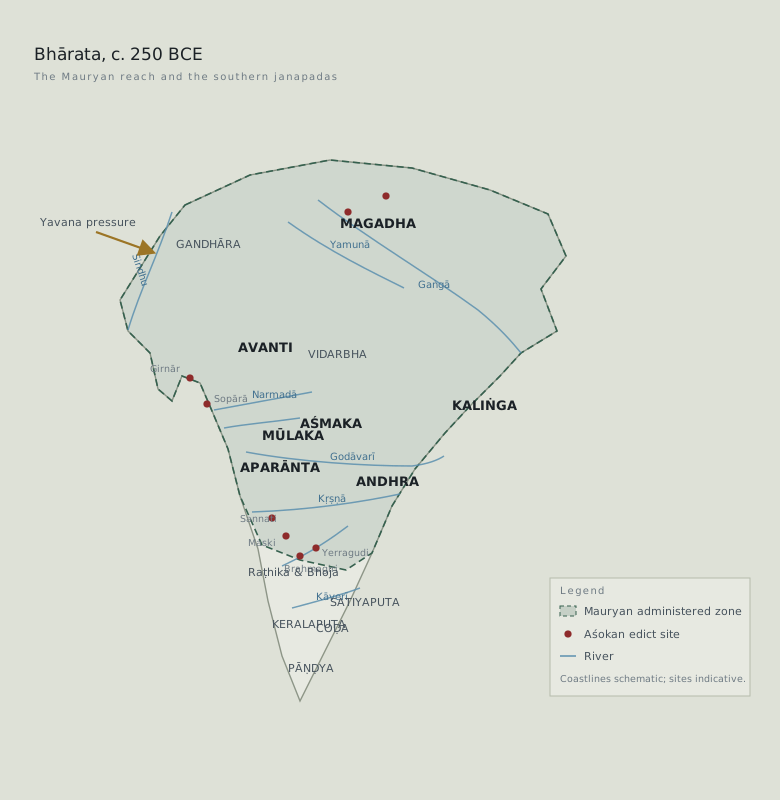
The evidence is unusually good, because it is carved in rock and it is located. The Minor Rock Edicts of Aśoka appear at Maski, Brahmagiri, Siddāpura, Jaṭiṅga-Rāmeśvara, Nittūr, Uḍegoḷam (all in the Raichur-Chitradurga-Bellary belt of northern Karnataka), at Yerragudi and Rājula-Maṇḍagiri in Kurnool, and at Sannati on the Bhīmā in Kalaburagi -- where a Major Rock Edict series, including the Separate Edicts, was recovered from beneath a temple floor in 1989. Settled Northward and westward, the same imperial hand is at Sopārā on the Konkan and at Girnār in Surāṣṭra. The Mauryan writ therefore ran, demonstrably, from the Arabian Sea to the Kṛṣṇā-Tuṅgabhadrā doab.
Where it stopped is equally instructive. Rock Edict XIII names, as neighbours outside the imperial territory but within diplomatic reach, the Coḍa, Pāṇḍya, Satiyaputa, Keralaputa, and Tāmraparṇī. Within the empire, but as distinct peoples enjoying their own standing, the same edict and Rock Edict V name the Raṭhika (Rāṣṭrika), Bhoja, Petenika (Paiṭhānika -- the people of Pratiṣṭhāna), Andhra and Pulinda. Two of those terms -- Rāṣṭrika and Bhoja -- survive into the Sātavāhana epigraphs as the titles Mahārathi and Mahābhoja, borne by the great feudatory houses of the western Deccan. The Sātavāhana state was assembled out of the aristocracy that the Mauryas had already found in place and recognised.
Figure 1
The Mauryan administered zone reached the Kṛṣṇā-Tuṅgabhadrā doab and stopped there; beyond it lay the Coḍa, Pāṇḍya, Keralaputa and Satiyaputa, named in Rock Edict XIII as neighbours rather than subjects. The Raṭhika and Bhoja peoples of the western Deccan, named in Rock Edicts V and XIII, reappear four centuries later as the Mahārathi and Mahābhoja feudatories of the Sātavāhanas.
The Deccan before the dynasty: iron, megaliths, and towns
Beneath the political surface, the Deccan of the last centuries BCE was in the middle of a transformation that archaeology records far better than any text. Across the peninsula -- from Vidarbha through Telangana to the Karnataka uplands and into Tamiḻakam -- lie tens of thousands of megalithic burials: cists, dolmens, cairn circles, pit-burials and the distinctive urn interments, associated with a Black-and-Red Ware pottery and with an iron industry of remarkable quality. Sites such as Māski, Brahmagiri, Hallūr, Māhurjhari and Naikund in Vidarbha (where iron-smelting furnaces were excavated) show a Deccan already possessing the two things an imperial economy requires: metal and surplus.
Overlying and succeeding this horizon are the early historic towns. Kauṇḍinyapura and Pauni in Vidarbha; Ter (Tagara) and Nevāsā and Pratiṣṭhāna on the Godāvarī system; Kotalingala, Peddabankūr and Dhūlikaṭṭa in the Godāvarī valley of Telangana; Dhānyakaṭaka, Bhaṭṭiprolu and Vaḍḍamānu on the lower Kṛṣṇā; Banavāsi and Sannati in Karnataka. Nearly all of these yield Northern Black Polished Ware in their early levels, punch-marked silver, and locally struck copper -- and several of them yield, in stratified contexts, the earliest Sātavāhana coins. The dynasty did not create the urban Deccan. It inherited it and unified it.
On the word Andhra
The Purāṇas call this dynasty Āndhra or Āndhra-bhṛtya; their own inscriptions and coins never once use the word. They call themselves Sātavāhana and their kings Sātakarṇi, Pulumāvi, Hāla. The Purāṇic usage almost certainly reflects the region from which the compilers knew the line, or the region it held when the lists were fixed -- not a self-description. Contested The term bhṛtya, "servitor," is best read as recording that the family had earlier been officers under a paramount power, most plausibly the Mauryas or their successors in the Deccan -- a status they then transcended. It is not a slur, and it is not evidence of ethnic origin.
The fracture in the north
The imperial structure broke from the centre. The tradition records that Bṛhadratha, last of the Mauryas, was killed by his own commander-in-chief Puṣyamitra during a review of the army, around 185 BCE, and that the Śuṅga line succeeded at Vidiśā and Pāṭaliputra. Puṣyamitra's own claim to authority rested on the restoration of Vedic sovereignty: the tradition and the Mālavikāgnimitra of Kālidāsa both record his performance of the Aśvamedha, and the Ayodhyā inscription of Dhanadeva names him dvir-aśvamedha-yājin, twice-performer of the horse sacrifice. Settled That template -- imperial legitimacy asserted through the great śrauta rites -- is precisely the one the Sātavāhanas would adopt at Nāneghāṭ.
But the Śuṅgas could not hold the whole. Three things came apart at once:
- The northwest was occupied. The Indo-Greek houses descending from the Baktrian satrapies pushed through the passes. Patañjali's Mahābhāṣya, composed within living memory of the events, gives the two celebrated examples of the imperfect used for a recent event witnessed by the speaker: aruṇad Yavanaḥ Sāketam and aruṇad Yavano Mādhyamikām -- "the Yavana besieged Sāketa," "the Yavana besieged Madhyamikā." The Yuga Purāṇa section of the Gārgī Saṃhitā records the same advance to Kusumadhvaja (Pāṭaliputra) and the disorder it produced. These were foreign armies inside the Gaṅgā plain.
- The east asserted itself. In Kaliṅga, Khāravela of the Cedi/Mahāmeghavāhana line cut the Hāthīgumphā inscription at Udayagiri, recording campaigns in every direction, the recovery of a Jina image carried off by a Nanda king, and -- critically for our purpose -- a westward expedition in his second regnal year in which, the record says, he sent a large army westward without regard for Sātakaṃni. Contested That single Prākṛt phrase is the earliest datable external notice of a Sātavāhana king, and the whole chronology of the dynasty has been argued around it for a century.
- The Śakas and Pahlavas came. Behind the Yavanas came the Śaka waves -- first into Sīstān and the Indus, then through Sindh into Surāṣṭra and Mālava, establishing the satrapal houses whose Kṣatrapa and Mahākṣatrapa titles are Iranian in origin and whose coins are struck on Greek weight standards with corrupt Greek legends on the obverse. By the first century of the Common Era, the entire western seaboard from the Indus to the Narmadā, and the trunk routes inland to Ujjayinī, were in the hands of foreign satraps. This is the situation into which the Sātavāhanas were born, and against which they defined themselves.
The Kāṇvas, who displaced the Śuṅgas at Magadha around 73 BCE, held on for some forty-five years and were themselves extinguished. The Purāṇas are explicit about who extinguished them: "Suśarman the Kāṇva will be destroyed, together with his servitors, by the Āndhra of great power, Śiśuka (Simuka)." Whatever one makes of that statement as literal history -- and there are strong reasons to doubt a Deccan army at Pāṭaliputra Contested -- it tells us what the compilers of the dynastic lists understood: that the imperial succession, the rāja-paramparā of Bhārata, passed at that moment from the Gaṅgā to the Godāvarī.
Part II -- The Sources and Their Silences
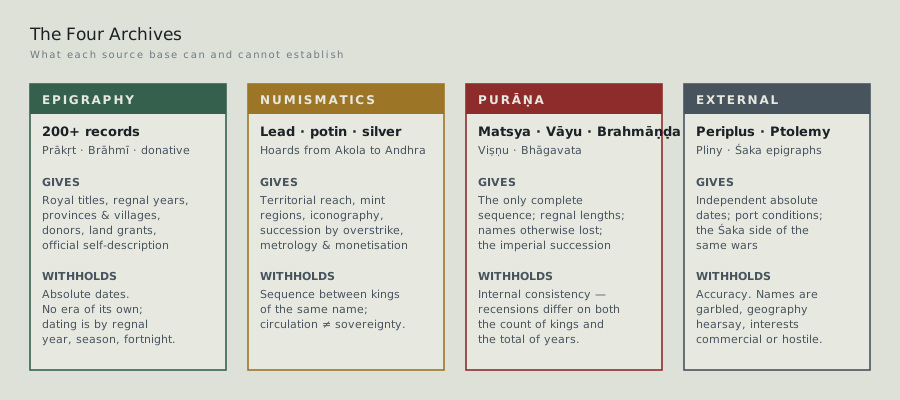
Four archives, each authoritative for something and mute about everything else.
No Sātavāhana king left a court chronicle. No copper-plate genealogy of the classical type survives from them. They did not found an era in their own name that can be securely traced. Contested Every date in this essay is therefore a reconstruction, and the honest procedure is to say at the outset what kind of evidence supports what kind of claim.
1 · The epigraphic archive
Rather more than two hundred inscriptions of the Sātavāhana period survive, overwhelmingly in Prākṛt and in Brāhmī. They cluster at the rock-cut monastic sites of the Western Ghāṭs -- Nāsik (Pāṇḍulena), Kārle, Bhājā, Bedsā, Junnar (the largest concentration of rock excavations in Bhārata, upwards of two hundred cells across the Manmoḍī, Śivneri, Lenyādri and Tuḷjā groups), Kanheri, Kuḍā, Śelārvāḍī, Pitalkhorā, Kārad -- and at the great stūpa sites of the Kṛṣṇā, above all Amarāvatī. To these must be added the Nāneghāṭ gallery, the Sāñcī gateway record, the Myakadoni inscription in Bellary, the Sannati material, and the Nāsik and Kārle royal grants.
What this archive gives with authority: royal names and titles in the kings' own words; regnal years; the names of provinces, districts and villages; the machinery of donation; the identity of donors across every stratum of society; and, in the two great praśastis, an official self-account of the dynasty. What it cannot give: absolute dates, since almost every record is dated only by regnal year, season and fortnight.
2 · The numismatic archive
The Sātavāhans struck more coins, in more metals, over a wider area, than any Indian power before the Kuṣāṇas -- but overwhelmingly in lead and potin, with copper, and with silver reserved for a small and precious portrait series. Hoards and site-finds from Tarhāla in Akola, Kondāpur, Kotalingala, Peddabankūr, Nevāsā, Junnar, Chandā, Amarāvatī and the Coromandel coast give the geography of circulation. The types -- the elephant, the humped bull, the horse, the lion, the Ujjayinī symbol, the tree-in-railing, the six-arched hill, the svastika, and the celebrated two-masted ship -- give an iconographic vocabulary. And the restrikings give history: when one king's silver is systematically overstruck by another's dies, we are looking at a conquest.
3 · The Purāṇic dynastic lists
The Matsya, Vāyu, Brahmāṇḍa, Viṣṇu and Bhāgavata all carry the Āndhra king-list in the future tense of the bhaviṣya convention. They disagree: the Matsya gives about thirty kings and a total of some four hundred and sixty years; the Vāyu gives about seventeen and roughly three hundred. Several names in the lists are confirmed by coins and inscriptions -- Simuka, Kṛṣṇa, Sātakarṇi, Āpīlaka, Hāla, Pulumāvi, Yajña Śrī -- which is a strong argument that the lists preserve a genuine register, transmitted with the corruptions any long oral-manuscript tradition acquires. They are the only source that attempts a complete sequence, and no reconstruction that discards them has ever produced a better one.
4 · The external accounts
The Greek-language Periplus of the Erythraean Sea, written by a working merchant in the mid-first century CE, describes the western ports and the political condition of the coast. Ptolemy's Geographia, compiled around 150 CE, names Baithana (Pratiṣṭhāna) as the seat of Siriptolemaios -- Śrī Pulumāvi -- and Ozene (Ujjayinī) as the seat of Tiastanes, the Śaka Caṣṭana. Pliny records, with the irritation of a Roman moralist, the annual haemorrhage of bullion from Rome to the East. These are outsiders' notices, imprecise and often garbled, but they are independently dated, and they are therefore the pegs on which Indian chronology is hung.
Figure 2
The evidentiary situation. Every Sātavāhana date in circulation is a triangulation across these four archives; where they conflict, this essay says so rather than choosing silently.
Part III -- Beginnings
Simuka, Kaṇha, Sātakarṇi I -- and the stone gallery above a mountain pass in which the dynasty declared what it was.
The name
They called themselves Sātavāhana. The coins say so; the Nāneghāṭ label beneath the first portrait says Rāyā Simuka-Sātavāhano sirimāto -- "King Simuka Sātavāhana, the illustrious." The commonest personal name in the line, borne by at least six kings, is Sātakarṇi, rendered in the Prākṛt of the inscriptions as sātakaṇi or sādakaṇi. The relation between the two words, and the meaning of either, is unresolved. Contested Derivations have been proposed from sāta in the sense of the sharp or the swift, from a personal or clan name Sāta borne on a vāhana, and from an underlying Prākṛtic form later Sanskritised. None commands assent, and the honest position is that we do not know.
The tradition of the Deccan and of the Prākṛt poets knows the line as Śālivāhana of Pratiṣṭhāna, and holds that a king of that name broke the Śakas and that the era of 78 CE bears his name. That the reckoning is called Śālivāhana Śaka across the whole of southern and western Bhārata down to the present pañcāṅga is a fact of continuous usage, not a scholarly conjecture; whether the era's institution is to be assigned to a Sātavāhana or to a Śaka ruler is genuinely disputed, and is taken up in Part XIV. Contested
Where did they begin?
There are two serious candidate homelands and a third minority position.
- The western case -- Pratiṣṭhāna and the Ghāṭs. The earliest monumental self-representation of the dynasty is at Nāneghāṭ, at the head of the pass above Junnar. Ptolemy places the royal seat at Baithana, which is Pratiṣṭhāna on the Godāvarī, modern Paiṭhaṇ. The densest early epigraphic cluster is western. On this reading the family rose among the Mahārathi aristocracy of the Aśmaka-Mūlaka country and expanded eastward down the Godāvarī.
- The eastern case -- the Telangana Godāvarī valley. Excavations at Kotalingala in Karimnagar district, and at the neighbouring sites of Peddabankūr and Dhūlikaṭṭa, produced coins reading Chimuka (Simuka) and Kaṇha in early levels -- and, more strikingly, coins of a set of otherwise unknown local rulers (read as Gobhada, Nārana, Kaṃvāya, Samagopa) in strata beneath or alongside them. On this reading the Sātavāhanas emerged as one house among several petty powers in the middle Godāvarī and moved west. Contested
- The Karnataka case. A minority position, resting on the Bellary and Sannati material and on the concentration of Cuṭu-related coinage, places the origin in the northern Karnataka uplands. It has the weakest independent support.
The disagreement is not idle. It determines whether the dynasty is read as a western power that conquered the east, or an eastern power that conquered the west -- and therefore how one reads the later shift of the dynasty's centre of gravity to the Kṛṣṇā delta after Gautamīputra. The prudent position, and the one adopted here, is that the family's earliest attestation is bivalent: the Godāvarī is a single corridor from Nāsik to the sea, and a lineage arising anywhere along it could plausibly leave the traces we have at both ends.
The chronological quarrel
Two reconstructions have contended for a century, and the difference between them is roughly two hundred years.
The long and the short chronology
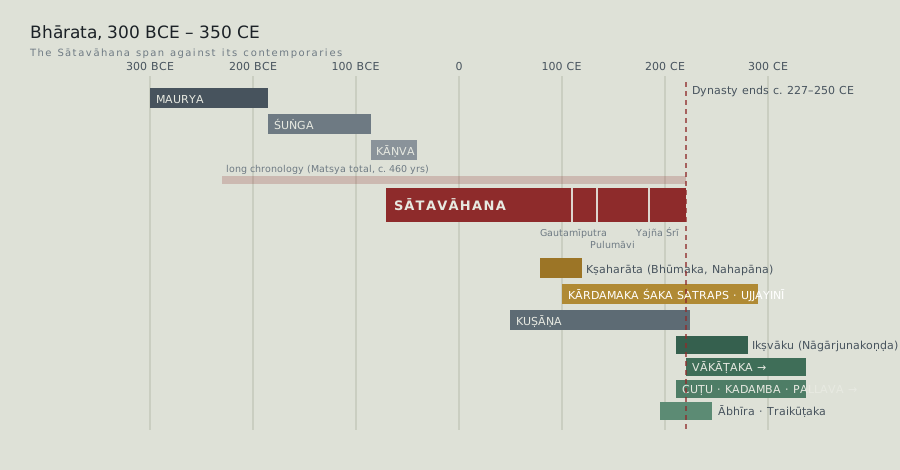
The long chronology takes the Matsya's total of about 460 years at face value, works backward from the dynasty's securely attested end in the early third century CE, and places Simuka around 235-230 BCE -- that is, immediately in the wake of Aśoka. Its strongest external support is the Hāthīgumphā record, if Khāravela is dated to the mid-second century BCE and his "Sātakaṃni" is Sātakarṇi I.
The short chronology takes the Purāṇic statement that Simuka displaced the last Kāṇva, dates that displacement to around 30-28 BCE, and reads the Nāneghāṭ palaeography as belonging to the first century BCE rather than the third. It treats the Matsya total as an accumulation of overlapping collateral reigns rather than a single sequence.
Neither is refuted. The balance of present opinion inclines to a compromise: an origin in the later second or first century BCE, with the Matsya list preserving genuine names of collateral and regional Sātavāhana branches whose reigns ran in parallel rather than in series. Contested This essay uses that compromise, and flags every date accordingly.
Simuka and Kaṇha
Simuka is the founder in every list. The Purāṇas give him twenty-three years. He appears at Nāneghāṭ as the first of the royal portraits, and on coins from the Telangana sites. Beyond that, almost nothing: a Jaina tradition preserved in the Digambara commentarial literature records a king of that name at Pratiṣṭhāna who first patronised and then turned against the ascetic orders and was in consequence deposed -- a notice too late and too partisan to be used as history, but worth recording as the only narrative anyone preserved about him. Speculative
Kaṇha -- Kṛṣṇa -- is named in the lists as Simuka's brother and successor, with eighteen years. He is the subject of what is very probably the earliest Sātavāhana inscription we possess, cut in Cave 19 at Nāsik:
sādavāhana-kule kaṇhe rājini nāsikakena / samaṇena mahāmāteṇa leṇaṃ kāritaṃ
"In the reign of Kaṇha, of the Sātavāhana family, the cave was caused to be made by the Mahāmātra in charge of the ascetics, at Nāsik."
Prākṛt · Nāsik, Cave 19 (Pāṇḍulena) · reign of Kaṇha · c. 1st cent. BCE
Two words in that short record carry a great deal. kule -- "in the family of" -- shows that Sātavāhana is already a lineage name and not a personal one. And mahāmāta -- Sanskrit mahāmātra -- is the Mauryan high office, the title Aśoka used for his dhaṃma-mahāmātas. The new Deccan state was staffing itself with the administrative grammar of the empire it had replaced. That is what continuity looks like in the epigraphic record: not a claim, but a job title.
Sātakarṇi I and the gallery at Nāneghāṭ
With the third ruler the dynasty steps out of obscurity and into monumentality. Sātakarṇi I married Nāganikā (Nāyanikā), daughter of the Mahārathi Traṇakayira of the Aṅgiya kula -- that is, into precisely the Raṭhika aristocracy that the Aśokan edicts had named a century and more before. It is the classic move of a rising house: not conquest of the old nobility but marriage into it.
Above the Nāneghāṭ pass -- the steep staircase route by which goods from the Konkan ports of Kalyāṇa and Sopārā were carried up the Sahyādri escarpment to Junnar and the Deccan plateau -- a cave was cut into the rock, its side walls carved with a row of standing royal figures, each with its name incised above it. The figures are gone, weathered or broken away; the labels survive. They read, in sequence:
- rāyā simuka-sātavāhano sirimāto -- King Simuka Sātavāhana, the illustrious
- devī nāyanikāya raño ca siri-sātakaṇino -- Queen Nāyanikā, and of King Śrī Sātakarṇi
- kumāro bhāya... -- Prince Bhāya[la?]
- mahāraṭhi traṇakayiro -- the Mahārathi Traṇakayira
- kumāro hakusiri -- Prince Hakusiri (Śaktiśrī)
- kumāro sātavāhano -- Prince Sātavāhana
This is the earliest known dynastic portrait gallery in Bhārata: king, queen, the queen's father, and the princes, standing together in stone above the pass that carried the wealth of the coast to the plateau. The placement is the argument. Sovereignty is asserted at the point where the revenue is collected.
On the two side walls of the same cave runs a long inscription in the queen's name, damaged at the beginning but substantially legible. It opens with an invocation, and the invocation is the single most important religious datum of the early Deccan:
oṃ namo prajāpatino dhammasa / namo iṃdasa · namo saṃkaṃsaṇa-vāsudevānaṃ / caṃda-sūriyānaṃ · mahimāvatānaṃ cataṃ ca / lokapālānaṃ · yama-varuṇa-kubera-vāsavānaṃ namo
"Oṃ. Homage to Dharma, lord of creatures; homage to Indra; homage to Saṃkarṣaṇa and Vāsudeva, and to the Moon and the Sun, who are possessed of majesty; and homage to the four Lokapālas -- Yama, Varuṇa, Kubera and Vāsava."
Prākṛt · Nāneghāṭ · principal inscription of Devī Nāganikā · c. 1st cent. BCE
Saṃkarṣaṇa and Vāsudeva -- Balarāma and Kṛṣṇa -- are invoked by name, in a royal record, at the head of the Deccan's earliest imperial document. The Bhāgavata worship that the Heliodoros pillar at Vidiśā attests for the north in the same century is here attested for the south, in the mouth of a reigning queen. Indra, the Lokapālas and Prajāpati Dharma stand beside them. This is not a syncretism assembled after the fact; it is the ordinary Vedic-Paurāṇic religious world of the period, stated as a matter of course.
The body of the record is an account of śrauta sacrifices performed and the dakṣiṇā paid for each. It is the closest thing we have to a fiscal document from the early Deccan.
Table 1 · The sacrifices of the Nāneghāṭ record and their recorded dakṣiṇā
| Rite | Character | Dakṣiṇā as recorded |
|---|---|---|
| Agnyādheya | Establishment of the sacred fires -- the entry rite of the yajamāna | 12 cows, 1 horse |
| Anvārambhaṇīya | Inaugural offering | Cattle |
| Aptoryāma | Seventh and most elaborate form of the Soma sacrifice | 10,000 cows |
| Rājasūya | The royal consecration; the classic assertion of paramountcy | Recorded, figure damaged |
| Aśvamedha (first) | The horse sacrifice; claim to unchallenged sovereignty | Elephants, silver vessels, villages, 24,400 kārṣāpaṇas |
| Aśvamedha (second) | Repeated -- the mark of an empire, not an aspiration | Horses with trappings, chariots, villages |
| Gargatrirātra | Three-night Soma rite | 301 cows |
| Gavāmayana | The year-long sattra of the cows | 1,101 cows |
| Aṅgirasāmayana | Year-long sattra of the Aṅgirases | 1,101 cows |
| Śatātirātra | Hundred overnight Soma rites | Cows and gold |
| Chandogapavamānātirātra | Atirātra of the Chandoga (Sāmavedin) school | 1,001 cows |
| Trayodaśarātra, Daśarātra, / Saptadaśarātra, Ekatriṃśarātra | The graduated series of multi-night sattras | Cows, horses, elephants, villages, cash |
Look at what this list actually establishes. First, that within a few generations of its founding the house was performing the Rājasūya and two Aśvamedhas -- the highest claims available in the śrauta system, and claims that only a paramount sovereign was entitled to make. Second, that the resources involved were imperial in scale: tens of thousands of cattle, elephants, chariots, whole villages, and coined money by the ten-thousand. Third, that the Vedic ritual establishment of the Deccan was intact, staffed and capable of mounting year-long sattras. Fourth -- and this is easy to miss -- that the record is in the queen's name. Nāganikā speaks as the sacrificer's consort and, on the most natural reading of the damaged opening, as regent for a minor son. Female royal agency is not an exception in the Sātavāhana record; it is a structural feature of it, and we shall meet it again in Gautamī Balaśrī.
Sātakarṇi I bears at Nāneghāṭ two titles that fix his standing: *Dakṣiṇāpathapati -- Lord of the Southern Route, the whole of the Deccan understood as a single political object -- and Apratihata-cakra*, "he whose wheel is unobstructed." From this reign forward, the Deccan is claimed as a unit.
The Sāñcī gateway
On the southern toraṇa of the Great Stūpa at Sāñcī, an inscription records the gift of the architrave by Ānaṃda, son of Vāsiṭhī, foreman of the artisans of rājan Siri Sātakaṇi. If the king named is Sātakarṇi I, the reach of the dynasty extended to the Vidiśā region -- the old Śuṅga heartland -- in the first century BCE. Contested The identification is not secure, and a later Sātakarṇi cannot be excluded; but the record remains the single strongest indication that the early dynasty operated well north of the Narmadā.
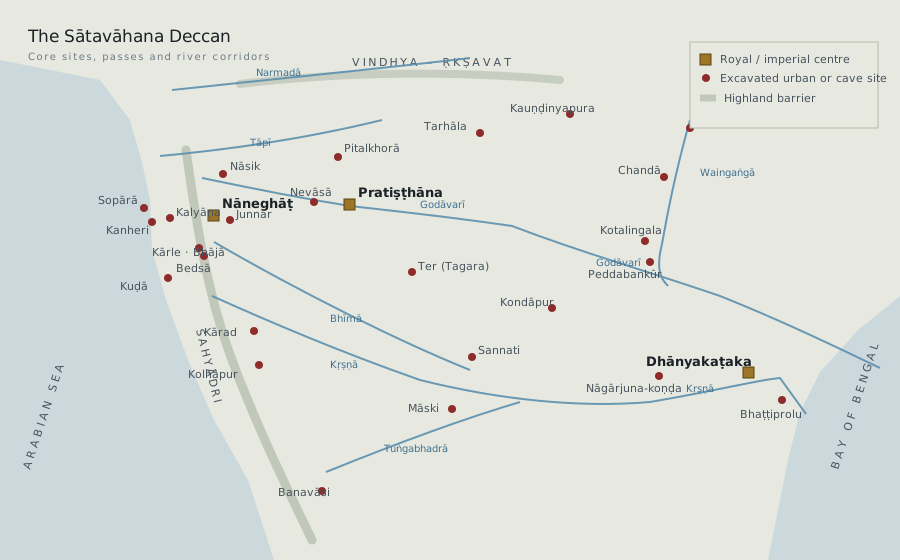
Figure 3
The Deccan as the Sātavāhanas found and organised it. The Godāvarī is a single corridor from Nāsik in the west to the Bay of Bengal; the Nāneghāṭ is the staircase by which the Konkan ports fed the plateau. The two poles of the dynasty -- Pratiṣṭhāna in the west and Dhānyakaṭaka on the lower Kṛṣṇā -- sit at either end of that corridor.
The long middle: the kings we barely know
Between Sātakarṇi I and the crisis of the early second century CE lies a stretch of perhaps a dozen or more reigns which the Purāṇas name and the epigraphs largely ignore. It is the least satisfactory section of Sātavāhana history and it must be reported as such.
- Āpīlaka -- known from a copper coin found in the Chandā region of eastern Vidarbha, reading rāño Sivi Āpīlakasa. The find-spot matters: it puts a named Purāṇic king in the far east of the Deccan.
- Kuntala Sātakarṇi -- remembered outside the dynastic lists entirely. Vātsyāyana in the Kāmasūtra cites him by name as a cautionary instance of force in intimacy, and Vāmana's Kāvyālaṅkāra-sūtra-vṛtti preserves an anecdote of his court concerning the choice between Sanskrit and Prākṛt. The name Kuntala is a territory -- the Karnataka-southern Mahārāṣṭra country -- and its attachment to a Sātakarṇi suggests a period of southern consolidation. Contested
- Hāla -- seventeenth in the Matsya list, given five years, and by far the most famous of the middle rulers, because to him is attributed the Gāthāsaptaśatī. He is taken up in Part X.
- Meghasvāti, Skandasvāti, Mṛgendra, Kuntala, Svātikarṇa, Puḷumāvi I, Ariṣṭakarṇa, Sundara Sātakarṇi, Cakora Sātakarṇi -- names with regnal lengths and no other content. Some are attested numismatically at Kondāpur and in the Deccan hoards; several are not attested at all outside the lists.
What the coinage does show, across this obscure middle, is a steady widening of circulation and a hardening of type. By the first century CE the Sātavāhana lead issue is the ordinary money of the Deccan from Vidarbha to the Kṛṣṇā delta. Whatever the dynastic detail, the economy was integrating.
And then, at the western end of that economy, the ground gave way.
Part IV -- The Śaka Interruption
The Kṣaharāta satraps take the western seaboard, the passes and the mints -- and for perhaps two generations the House of Sātavāhana is driven from its own country.
The Śaka penetration of western Bhārata was not a raid and not a migration. It was an occupation, conducted by satrapal houses which had come through Sīstān and the Indus into Sindh, Surāṣṭra and Mālava, and which governed with the titles, the coin standards and the administrative apparatus of the Iranian world they came from: kṣatrapa and mahākṣatrapa, from Old Persian xšaça-pāvan. Their earliest coins in western India carry corrupt Greek legends inherited from the Indo-Greek issues they displaced, with Kharoṣṭhī and Brāhmī on the reverse. Nothing about them was indigenous.
The house that concerns us is the Kṣaharāta. Its first attested ruler in the west is Bhūmaka, whose copper coins bear the arrow, the discus and the vajra, with legends in Kharoṣṭhī and Brāhmī. He was followed by Nahapāna, and under Nahapāna the Kṣaharāta position became a dominion.
On the name Kṣaharāta
The name appears in three forms and it is worth keeping them straight. On the coins of Bhūmaka and Nahapāna the Brāhmī legend gives Khaharāta, with Kharoṣṭhī alongside; Uṣavadāta's records at Nāsik Cave 10 and at Kārle use the same Prākṛt form; the Nāsik Cave 3 praśasti of Gautamī Balaśrī has Khakharāta. Kṣaharāta is the Sanskritised form used in modern writing.
It is a clan name, and it is not an Indic compound. No satisfactory Sanskrit derivation exists and none should be sought: like kṣatrapa, from Old Persian xšaça-pāvan, it belongs to the Iranian onomastic world from which the house came, and it entered Indian script as a foreign proper noun. Contested The temptation to resolve such names into Sanskrit elements after the fact should be resisted; it produces etymologies that are pleasing, unfounded, and -- in this instance -- flatly at odds with the clause the word stands in, which records the lineage's annihilation.
What Nahapāna took
The extent of the Kṣaharāta seizure is recoverable in detail, because Nahapāna's son-in-law Uṣavadāta (Ṛṣabhadatta) -- himself a Śaka, married to Nahapāna's daughter Dakṣamitrā -- cut a series of long inscriptions at Nāsik, Kārle and Junnar recording his benefactions. Read as what they are, these are the records of an occupying power purchasing standing in conquered country. Read for their geography, they are an inventory of what the Sātavāhanas had lost:
- The Konkan ports and their hinterland: Sopāraka (Sopārā), the Kalyāṇa coast.
- The Ghāṭ passes: Junnar and the Nāneghāṭ approaches, Kārle, and Nāsik itself -- the Sātavāhana heartland, in which Kaṇha had cut Cave 19 generations before.
- The Govardhana āhāra around Nāsik, the Māmāla āhāra around Kārle, and the districts of Sopāraka.
- Northward, the crossings of the Ibā, Pārāda, Damaṇa, Tāpī, Karabeṇā and Dāhānukā rivers, and the country as far as Puṣkara in Rājasthān and the Barṇāsā.
The Uṣavadāta inscriptions record the endowment of thirty-two thousand coconut trees at Nāṅgaṇola, the gift of sixteen villages to Brāhmaṇas, the feeding of a hundred thousand Brāhmaṇas annually, the provision of free ferries and rest-houses at the river crossings, and the investment of capital with the guilds of Govardhana as a permanent endowment. He also records that he was sent by Nahapāna's order to relieve the Uttamabhadras, who were being besieged by the Mālayas, and that he defeated them.
How to read a conqueror's charity
These donations are frequently cited as evidence of Śaka tolerance and assimilation. They are nothing of the sort, and the inference runs backwards. Endowments to Brāhmaṇas, to guilds and to monastic establishments were the standard currency by which any power in the western Deccan converted military possession into legitimate authority. They were made because they were required, in the idiom the country understood, by a house whose right to rule was not otherwise recognised. What the inscriptions record is documented fact: the gifts were made and the country was occupied. Both stand. The occupation is not softened by the gifts, and the record of the gifts does not require us to supply a motive of benevolence that no source states.
The Periplus at the moment of loss
The Periplus of the Erythraean Sea, writing in the mid-first century CE, catches the western coast at exactly this point of transition. Of the port of Kalliena -- Kalyāṇa -- it reports that in the time of the elder Saraganus it had been a lawful and open market, but that after it came into other hands it was obstructed, and Greek vessels putting in there were taken under guard to Barygaza. Saraganus is Sātakarṇi. The passage is the clearest single testimony we have that a working Sātavāhana port economy was disrupted by the new masters of the coast, and that the disruption was noticed as far away as the Red Sea. Settled
The Periplus also names the two great inland marts of the Deccan -- Paithana (Pratiṣṭhāna) twenty days south from Barygaza, and Tagara (Ter) ten days east of Paithana -- and describes the caravans bringing onyx from the one and cotton cloth from the other down to the coast. The Deccan interior was still producing. It was the outlet that had been captured.
The measure of the humiliation
How far the Sātavāhanas were pushed back is not directly recorded. What is recorded is the language in which their recovery was afterwards described. Gautamī Balaśrī's praśasti calls her son the man who re-established the fame of the House of Sātavāhana -- sātavāhana-kula-yasa-patiṭhāpana-kara, Sanskrit sātavāhana-kula-yaśaḥ-pratiṣṭhāpana-kara. One does not re-establish what was never lost. The dynasty's own official account concedes an interruption; the only question is its depth, and the coin evidence suggests it was severe. In the western districts, for a period, the currency in circulation was Kṣaharāta silver.
Part V -- Gautamīputra: The Reconquest
One reign in which the Kṣaharāta line is extinguished, the western seaboard recovered, and the empire restated in a single sentence of Prākṛt.
The reign of Gautamīputra Sātakarṇi is the hinge of Deccan history. Its dates are disputed within a range of some four decades -- the two principal reconstructions place him roughly 60-85 CE or roughly 106-130 CE, the latter now more commonly preferred on the strength of the Śaka satrapal synchronisms. Contested What is not disputed is what he did.
He is named, as Indian kings of this line invariably are, by his mother: Gautamī-putra, son of the lady of the Gautama gotra. The metronymic is a Sātavāhana constant -- Vāsiṣṭhīputra, Māḍharīputra, Hāritīputra, Kauśikīputra -- and it is worth pausing on. It does not indicate a matrilineal succession; succession was from father to son. What it indicates is that the mother's gotra was a datum of public rank, recorded because it identified the maternal house with which the dynasty had allied. In a polity built on marriage into the Mahārathi and Mahābhoja aristocracies, the mother's line was political information.
The praśasti at Nāsik
In Cave 3 at Nāsik -- the great vihāra excavated on the dowager queen's order, and still called the Gautamīputra cave -- his mother Gautamī Balaśrī caused to be cut, in the nineteenth regnal year of her grandson Vāsiṣṭhīputra Pulumāvi and therefore after Gautamīputra's death, the fullest official statement the dynasty ever made about itself.
rāño gotamīputasa... sātakaṇisa / āgama-nilayasa · eka-bamhaṇasa / khatiya-dapa-māna-madanasa / saka-yavana-palhava-nisūdanasa / vinivatita-cātuvaṇa-saṃkarasa / dija-kuṭuṃba-vivadhanasa / khakharāta-vasa-niravasesa-karasa / sātavāhana-kula-yasa-patiṭhāpana-karasa / tisamuda-toya-pīta-vāhanasa
"Of King Gautamīputra Sātakarṇi: the abode of traditional learning; the unique Brāhmaṇa; crusher of the pride and conceit of the Kṣatriyas; destroyer of the Śakas, Yavanas and Pahlavas; who caused the confusion of the four varṇas to cease; increaser of the households of the twice-born; who made the Kṣaharāta lineage without remainder; who re-established the fame of the House of Sātavāhana; whose mounts drank the water of the three oceans."
Prākṛt · Nāsik, Cave 3 · praśasti of Gautamī Balaśrī · yr 19 of Vāsiṣṭhīputra Pulumāvi
Every clause here is doing work, and several have been badly mishandled in the secondary literature.
*saka-yavana-palhava-nisūdana* Skt. *śaka-yavana-pahlava-niṣūdana*
The three foreign powers are named together and the verb is nisūdana (niṣūdana) -- destruction, annihilation. This is not diplomatic language and it was not meant to be. The Kṣaharāta line disappears from the record after Nahapāna; no Kṣaharāta ruler is ever heard of again. niravasesa-kara (niravaśeṣa-kara) -- "made without remainder" -- is a literal description of what happened to a dynasty.
*vinivatita-cātuvaṇa-saṃkara* Skt. *vinivartita-cāturvarṇya-saṃkara*
He caused the mixing of the four varṇas to cease. This clause is routinely, and wrongly, translated into the vocabulary of caste and then read as evidence of social oppression by a Brāhmaṇa-backed monarchy. Polemical Two corrections are required, and they are corrections of fact, not of sentiment.
First, the word in the stone is vaṇa -- Sanskrit varṇa. It is not caste. There is no Sanskrit or Prākṛt word that means caste, because the thing does not exist in the indigenous vocabulary; casta is a Portuguese word, applied by outsiders, and the rigid birth-locked enumerated hierarchy it names was manufactured much later, by the colonial census from 1871 onward and by the ethnographic apparatus built around it. What the inscription refers to is varṇa: the fourfold functional order of the śāstra, in which no order stands above another in worth, and jāti: the local community. To translate cātuvaṇa (cāturvarṇya) as "the four castes" is to import into a second-century Prākṛt record a category that would not exist for another seventeen hundred years.
Second, varṇa-saṃkara in classical usage means the collapse of the functional and ritual order -- the condition the Gītā names when Arjuna foresees the consequence of the destruction of a society's structure. A king who has just expelled a foreign occupation is claiming, in the exact idiom available to him, that he has restored the working social order that the occupation disrupted. That is the claim. It is a claim about the reversal of disorder, and it belongs beside sātavāhana-kula-yasa-patiṭhāpana-kara in the same list, which is where the stone puts it.
*eka-bamhaṇa* Skt. *eka-brāhmaṇa*
Rendered variously as "the unique Brāhmaṇa," "the peerless Brāhmaṇa," or "the sole supporter of Brāhmaṇas." Taken with āgama-nilaya ("abode of the received lore") and dija-kuṭuṃba-vivadhana -- Sanskrit dvija-kuṭumba-vivardhana, "increaser of the households of the twice-born" --, the sense is unambiguous: the restoration of the learned and priestly establishment is presented as an achievement of the same order as the destruction of the Kṣaharātas. The transmission of knowledge and the sovereignty of the land are treated by the record as one project -- which, under a foreign occupation, they are.
*khatiya-dapa-māna-madana* Skt. *kṣatriya-darpa-māna-mardana*
Crusher of the pride of the Kṣatriyas. This is directed at the rival ruling houses of the period -- the satrapal powers claiming Kṣatriya standing, and the independent Kṣatriya lineages of the north-west and Mālava -- and asserts paramountcy over them.
*tisamuda-toya-pīta-vāhana* Skt. *tri-samudra-toya-pīta-vāhana*
The finest phrase in early Indian epigraphy, and the title of this essay. His mounts drank the waters of the three seas. The three seas are the Arabian Sea, the Bay of Bengal, and the southern ocean at the peninsula's foot. Whether taken as a literal claim of campaigning to three coasts or as the formal assertion of cakravartin status, its content is the same: the Deccan is now the master of the whole peninsula between the oceans.
The empire, listed
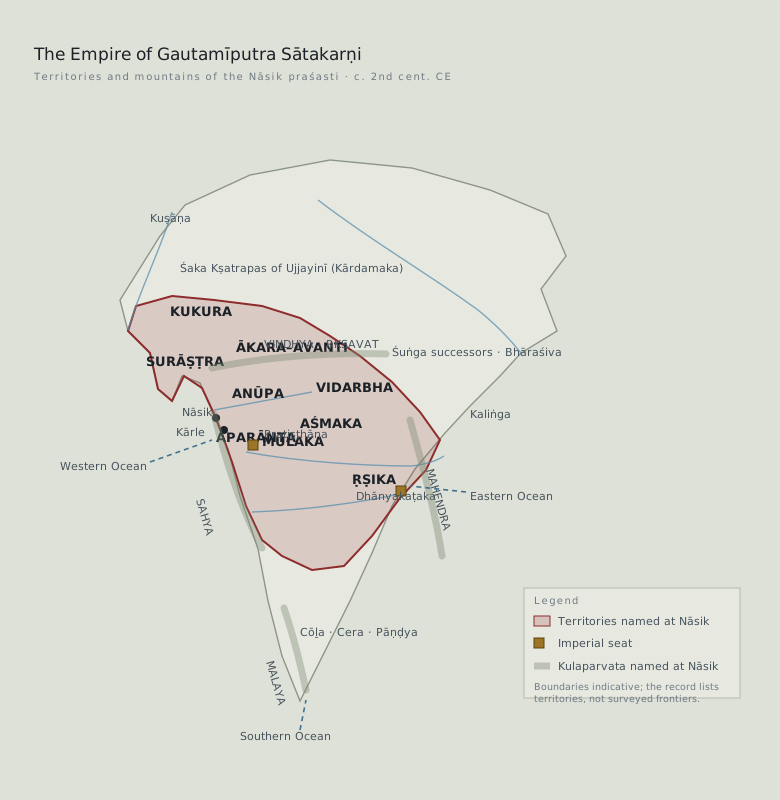
The same praśasti gives the territories. It is the earliest detailed inventory of an Indian empire in the empire's own words, and it is worth setting out with identifications.
Table 2 · The territories of Gautamīputra Sātakarṇi as listed at Nāsik
| As cut (Prākṛt) | Sanskrit | Region |
|---|---|---|
| Asika | Ṛṣika | The country of the middle Kṛṣṇā and Godāvarī watershed; identification debated Contested |
| Asaka | Aśmaka | Upper Godāvarī -- the old mahājanapada, around Bodhan and Pratiṣṭhāna's north |
| Mulaka | Mūlaka | The Pratiṣṭhāna (Paiṭhaṇ) country on the Godāvarī |
| Suraṭha | Surāṣṭra | Kāṭhiāvāḍ peninsula -- taken from the Kṣaharātas |
| Kukura | Kukura | Eastern Rājasthān, the Mewāḍ-Ābū country |
| Aparaṃta | Aparānta | The northern Konkan seaboard, with Sopārā and Kalyāṇa |
| Anupa | Anūpa | The Narmadā valley about Māhiṣmatī |
| Vidabha | Vidarbha | Eastern Mahārāṣṭra -- Kauṇḍinyapura, Pauni, Māhurjhari |
| Ākarāvaṃti | Ākara + Avanti | Eastern Mālava (Vidiśā, Daśārṇa) and western Mālava (Ujjayinī) |
And then the mountains, which are given as a separate list -- vijha, chavata, parichata, sahya, kaṇhagiri, maca, siriṭana, malaya, mahida, seṭagiri, cakora: the Vindhya, the Ṛkṣavat (Sātpuḍā), the Pāriyātra, the Sahyādri, Kṛṣṇagiri, Macha, Śrīstana, the Malaya, the Mahendra of the eastern seaboard, Śvetagiri and Cakora. A list of mountains is not decoration. In the Purāṇic geography of Bhārata the kulaparvatas are the frame of the land itself, and to claim lordship of them is to claim the frame.
Figure 4
The nine territories and eleven mountains of the Nāsik praśasti. The claim runs from Surāṣṭra and Mālava in the north-west to the Kṛṣṇā mouth in the east, and the mountain list encloses it within the kulaparvata frame of Bhārata itself. Note what the list implies: Gautamīputra held, simultaneously, the Arabian Sea ports, the Ujjayinī trunk route and the Kṛṣṇā delta.
The evidence in metal: Jogalthembi
Praśastis are official. Coins are not. In 1905 a hoard was recovered at Jogalthembi in Nāsik district containing some thirteen thousand silver coins of Nahapāna -- and a very large proportion of them had been overstruck with the dies of Gautamīputra Sātakarṇi, the Kṣaharāta's portrait and legend hammered flat and the Sātavāhana type driven over it. Settled
This is the single most eloquent object in Sātavāhana history. It is a conquest recorded not in adjectives but in physical fact: the treasury of the defeated power taken intact, demonetised, and reissued under the victor's authority in the same coin, in bulk, as a matter of fiscal administration. It also tells us the conquest was total enough to deliver Nahapāna's reserves, and organised enough to restrike them systematically rather than melt them.
The grants: Cave 3 at Nāsik, years 18 and 24
Two royal orders of Gautamīputra himself survive on the same cave wall, and they are the earliest well-preserved land grants of the dynasty. In the eighteenth year, from the victorious camp of the army at Vejayanti, the king and the dowager queen grant to the ascetics dwelling in the cave on Mount Tiraṇhu a field in the village of Kakhaḍi, formerly enjoyed by Uṣavadāta -- that is, land confiscated from the defeated Śaka establishment and re-granted. In the twenty-fourth year a further field of two hundred nivartanas in the crown village of Sāmalipada is granted in its place, with immunities.
The formulae repay attention. The grant is issued through named officers -- the amātya Sivagupta, later Syāmaka -- is to be entered in the record by the nibandhakāra, and is registered at the nigama-sabhā, the town assembly. A conquest state that was merely predatory would not need a registrar and a town assembly. This one did.
A note on the Kārdamakas
Gautamīputra destroyed the Kṣaharāta house. He did not destroy the Śaka presence in western India as such. A second satrapal family -- the Kārdamakas, founded by Caṣṭana at Ujjayinī, whom Ptolemy knows as Tiastanes -- was rising in Mālava in the same generation, and it was this house, not the Kṣaharātas, that would contest the western territories with Gautamīputra's successors. The reconquest was decisive against one enemy and inaugural against another.
Part VI -- Zenith and Contest: Pulumāvi to Yajña Śrī
The empire's widest reach, its long duel with the Kārdamaka satraps, and its slow migration east to the Kṛṣṇā.
Gautamīputra's son Vāsiṣṭhīputra Pulumāvi reigned at least twenty-four years -- the regnal dates run to year 19 and 22 at Nāsik and year 24 at Kārle -- and under him the Sātavāhana state reached its administrative maturity. It is his name that Ptolemy heard, in the middle of the second century CE, as Siriptolemaios, seated at Baithana: Śrī Pulumāvi at Pratiṣṭhāna. It is in his reign that his grandmother's praśasti was cut. And it is in his reign that the dynasty's centre of gravity begins its decisive shift eastward.
The evidence for the shift is the sudden density of Sātavāhana royal names in the lower Kṛṣṇā. At Amarāvatī -- Dhānyakaṭaka, the greatest stūpa of the eastern Deccan -- inscriptions of Pulumāvi's reign record the building programme of the Mahācaitya's outer railing. At Chinna Ganjam on the coast, at Alluru, at Nāgārjunakoṇḍa's precursor sites, his coins and records appear. The western caves continue, but the great new construction is in the delta.
The Kārdamaka duel
Meanwhile the north-western territories that Gautamīputra had listed at Nāsik were being lost again -- not to the extinguished Kṣaharātas but to the second Śaka house, the Kārdamakas of Ujjayinī.
The decisive document is on a boulder at Junāgaḍh in Surāṣṭra -- the same rock that already bore Aśoka's Major Rock Edicts. In the Śaka year 72, corresponding to 150 CE, Rudradāman I caused a long record to be cut on it, commemorating the reconstruction of the dam of the Sudarśana lake after a catastrophic breach. It is the first substantial inscription in Bhārata composed in ornate literary Sanskrit prose -- and the fact that a Śaka satrap, not an indigenous dynasty, produced it is a point about legitimation, not about culture. The Sātavāhanas, secure in their own country, went on writing Prākṛt for another century.
The record notes, in passing and with entire clarity, the following:
...dakṣiṇāpatha-pateḥ sātakarṇer / dvir api nirvyājam avajityāvajitya / sambandhāvidūratayā anutsādanāt / prāpta-yaśasā...
"...who, having twice in fair fight utterly defeated Sātakarṇi, the Lord of Dakṣiṇāpatha, obtained fame by not destroying him, on account of the nearness of their connection."
Sanskrit · Junāgaḍh rock · Rudradāman I · Śaka 72 = 150 CE
Three things follow from this sentence, and they must be kept distinct.
1. It is the satrap's own account. The Junāgaḍh record is a legitimation document, composed for a foreign house governing a country it had seized, and every claim in it -- including the celebrated boast of rebuilding the dam from his own treasury without recourse to forced labour or fresh imposts -- is self-testimony in a text designed to establish a right to rule that was not otherwise conceded. It is evidence of what Rudradāman wished to be believed. It is not neutral.
2. The defeat is nonetheless real. No Sātavāhana source contests it, and the northern territories of the Nāsik list -- Surāṣṭra, Kukura, Ākara-Avanti, Anūpa -- do not appear in later Sātavāhana records. The imperial high-water mark of Gautamīputra was not held.
3. The *sambandha* is the interesting word. A marriage alliance existed between the houses. A fragmentary inscription from Kanheri records the gift of a cistern by the queen of Vāsiṣṭhīputra Sātakarṇi, described as the daughter of the Mahākṣatrapa Ru(dra) --. The Sātakarṇi twice defeated is therefore most probably Vāsiṣṭhīputra Sātakarṇi, Rudradāman's own son-in-law. Contested
The dynastic marriage did not prevent the wars; it merely determined how they ended. That is a normal condition of Indian political history and needs no special explanation. What it does establish is that after Gautamīputra the Deccan and Mālava were locked in a contest neither could finish, and that the Sātavāhanas increasingly turned east because the north-west was closed.
Sudarśana: a note on what the dam records
The Junāgaḍh inscription's real historical value lies elsewhere. It states that the Sudarśana reservoir was originally constructed under Candragupta Maurya by his provincial governor Puṣyagupta the Vaiśya, and that conduits were added under Aśoka by the Yavana king Tuṣāspha. This is our only evidence for either fact, and it establishes that a major hydraulic work in Surāṣṭra was built, extended and maintained by successive states for more than four centuries. The engineering continuity of the Indian state is the buried subject of that inscription. Settled
Yajña Śrī Sātakarṇi: the last great reign
After a sequence of short or poorly attested reigns -- Vāsiṣṭhīputra Sātakarṇi, Śivaśrī Pulumāvi, Śivaskanda Sātakarṇi -- the dynasty produced one more ruler of the first rank: Gautamīputra Yajña Śrī Sātakarṇi, conventionally placed in the last quarter of the second century CE and credited by the Purāṇas with twenty-nine years. His regnal dates are attested to year 27.
His coins circulate more widely than any other Sātavāhana issue: from Sopārā and the northern Konkan, through Nāsik and Junnar, across Vidarbha and the Chandā country, into the Kṛṣṇā delta, and -- in a small but real quantity -- in Kāṭhiāvāḍ. The distribution is the argument for a partial recovery of the western territories lost to the Kārdamakas. Contested His inscriptions are at Nāsik, Kanheri and Chinna Ganjam: west coast, west coast, east coast.
And it is Yajña Śrī who put a ship on the coinage.
The ship coin
A distinct lead and potin series of Yajña Śrī carries, on the obverse, a vessel with two masts, a high stem and stern, and rigging clearly indicated -- the earliest representation of a sea-going ship on an Indian coin issued by an Indian sovereign. The type is found chiefly on the eastern seaboard. Whatever it commemorates, it is a deliberate statement of maritime authority by a Deccan power over the Bay of Bengal, and it belongs with the earlier boast of mounts drinking the water of three seas. A land empire does not put a ship on its money by accident.
Figure 5
The Sātavāhana span set against its contemporaries. The pale bar shows the reach of the long chronology, which takes the Matsya's 460-year total as a single sequence; the solid bar shows the securely attested imperial phase. Note the overlap: for its entire mature existence the dynasty was in simultaneous contact with a Śaka satrapy in Mālava and a Kuṣāṇa empire in the north.
Part VII -- The Machinery of the State
Provinces, districts, feudatories, guilds and endowments -- the working structure that the donative inscriptions accidentally preserve.
Because no Sātavāhana administrative manual survives, everything we know about how the empire actually ran is a by-product. A monk records a gift; to record it he must name the district it lies in, the officer who registered it, the assembly that witnessed it, and the guild that holds the capital. From several hundred such incidental notices a state can be reassembled.
Territorial division
The basic unit of administration is the *āhāra -- a district under a governor, generally named from its principal town. The inscriptions name, among others, the Govardhana āhāra (Nāsik), Māmāla āhāra (the Kārle-Māval country), Soparaka āhāra (Sopārā), Kapurāhāra, and -- in the Myakadoni record of Pulumāvi in Bellary -- Sātavāhani āhāra, a district bearing the dynasty's own name. Below the āhāra lie the grāma and the nigama, the village and the market town; and the town has its own nigama-sabhā*, an assembly with a real function, since royal grants are registered before it.
Officers
- Amātya -- the executive minister or district officer, through whom royal orders are issued; named individually in the Nāsik grants (Sivagupta, Syāmaka).
- Mahāmātra -- the high Mauryan office, retained from the earliest reign (Kaṇha's Nāsik record) and specialised, in that instance, to oversight of the ascetic orders.
- Bhāṇḍāgārika -- the treasurer; heraṇika -- the officer of gold or the money-changer; lekhaka -- the scribe; nibandhakāra -- the registrar who enters the grant in the record.
- Senāpati and mahāsenāpati -- the military command, which in the later reigns becomes hereditary and territorial, and is therefore the seedbed of the successor kingdoms.
The great feudatory houses
The empire was not a uniform bureaucratic surface. Beneath the crown stood a hereditary aristocracy whose titles the Aśokan edicts had already recorded three centuries earlier as peoples:
- Mahārathi (from Rāṣṭrika) -- the house into which Sātakarṇi I married at Nāneghāṭ. Mahārathis of the Aṅgiya kula appear at Nāneghāṭ, and others at Kārle, Bhājā and Kanheri. Some struck their own coins.
- Mahābhoja (from Bhoja) -- concentrated in the Konkan; the Kuḍā caves preserve a series of Mahābhoja records, including several by women of the family in their own names.
- Mahāsenāpati -- the military governors, whose descendants at Nāgārjunakoṇḍa and in Vidarbha would take crowns of their own.
This is a structure of layered sovereignty, not of delegation: the great houses were partners, and their loyalty was a matter of marriage, grant and prestige rather than of appointment. It gave the empire enormous reach at low administrative cost, and it is precisely why the empire dissolved along its internal seams rather than being conquered from outside.
The endowment economy
The most sophisticated instrument in the Sātavāhana fiscal world is the *akṣaya-nīvī -- the permanent, non-consumable endowment. A donor deposits capital with a named guild; the guild trades with it; the fixed monthly return, and only the return, is applied in perpetuity to the stated purpose. The Nāsik record of Uṣavadāta sets out an early example: two thousand kārṣāpaṇas deposited with the weavers' guild at Govardhana at one per centum monthly, and one thousand with a second weavers' guild at three-quarters per centum*, the interest to provide cloth and provisions for the monks of the cave.
Consider what this requires to work. Guilds durable enough to be trusted with perpetual capital. Rates of return stable and public enough to be inscribed. A legal understanding of principal and interest. An assembly to witness. And a monastic institution capable of being a perpetual beneficiary. The Deccan of the first and second centuries CE possessed all five. This is a monetised, contract-bearing commercial economy, recorded in stone because the parties expected the arrangement to outlast them -- and in the case of the caves, it did, by nineteen hundred years.
Part VIII -- Ships, Ports and the Yavana Gold
Why a landlocked plateau dynasty became rich: the Ghāṭ passes, the two-ocean coastline, and the largest bullion transfer of the ancient world.
The Sātavāhana empire sat across a geographical accident of extraordinary value. The Deccan plateau is the only landmass in Bhārata with a short overland reach to two oceans. From Pratiṣṭhāna a caravan could be at the Arabian Sea in under three weeks and at the Bay of Bengal along the Godāvarī. Whoever controlled the plateau and the Ghāṭ passes controlled the transfer between the western and eastern maritime worlds -- and in the first two centuries CE both of those worlds were expanding at once.
The western trade
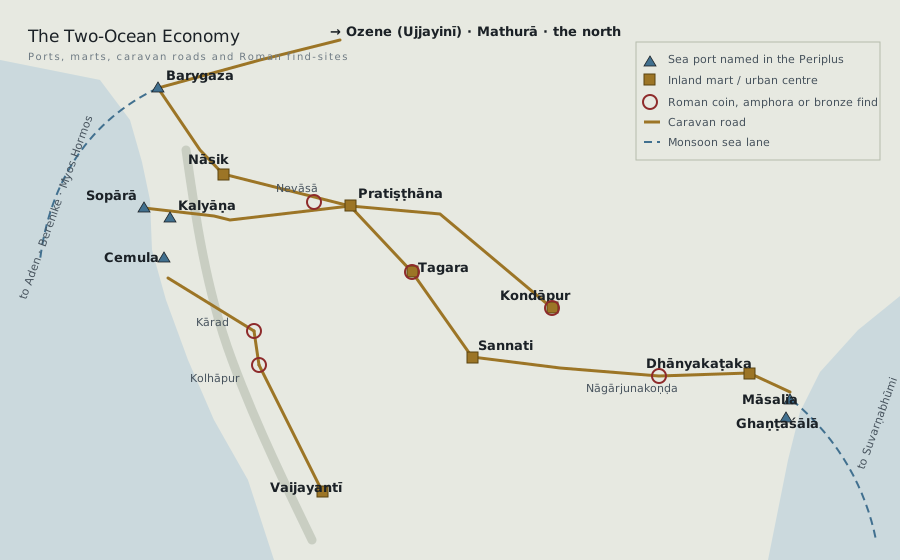
The Periplus describes the mechanics with a working man's precision. Barygaza (Bharukaccha, Broach) at the mouth of the Narmadā was the great emporium, its approach so treacherous with shoals and bore-tides that the king maintained pilot boats to bring vessels in. From Barygaza the goods went inland to Ozene (Ujjayinī) and thence north; and down the coast lay Souppara (Sopārā), Kalliena (Kalyāṇa), Semylla (Cemula, Cheul), and a string of lesser roadsteads on the Konkan.
Behind them stood the two great inland marts, and the Periplus names both: Paithana, twenty days south of Barygaza, sending down onyx and agate; and Tagara -- Ter, in the Osmanabad country -- ten days east of Paithana, sending down cotton cloth of ordinary and fine quality in great bulk, along with goods brought from the further interior. The archaeological confirmation at Ter is complete: an ancient dyeing and textile quarter, Mediterranean amphora sherds, ivory work, and beads in quantity.
Outbound from these coasts went pepper and long pepper, spikenard and costus, bdellium and lycium, ivory, agate and carnelian, cotton textiles of every grade, silk brought overland, and, from the south, pearls and gems. Inbound came Italian and Arabian wine, copper, tin and lead, coral, glass, realgar and antimony, fine textiles for the courts, and -- the item that mattered most -- Roman gold and silver coin, in bulk, as bullion.
Pliny's complaint
The scale of that bullion flow is recorded from the losing end. Pliny the Elder, writing in the 70s CE, gives two figures which have been argued over ever since: that India alone drained the Roman empire of some fifty million sesterces annually, and that India, the Seres and the Arabian peninsula together took a hundred million. Contested The figures are rhetorical and Pliny is a moralist complaining about luxury imports, but the direction of the flow is not in doubt, and the archaeology confirms it: Roman coin hoards, overwhelmingly of Julio-Claudian aurei and denarii, are found across peninsular Bhārata in quantities found nowhere else outside the Roman world itself.
In the Deccan proper the finds cluster at Kolhāpur -- where the Brahmapurī excavation produced, along with Roman coins, a cast bronze figure of Poseidon and a Mediterranean bronze mirror -- and at Nevāsā, Ter, Akkanapalle and Nāgārjunakoṇḍa. Roman amphorae, Arretine-type wares and rouletted pottery appear along the same corridor. The traffic ran the other way too: the distinctive rouletted ware of the Andhra coast has been recovered from Bali, Java, Vietnam and Thailand, which is to say that the eastern seaboard under Sātavāhana authority was already exporting into South-East Asia.
The Yavanas in the caves
The most striking evidence of how deeply this trade penetrated Deccan society is not commercial but religious. At Kārle, several of the great pillars of the caitya hall were given by donors who describe themselves as Yavana -- Greeks or, more broadly, westerners -- resident at Dhenukākaṭa. Their names as inscribed are Indian or Indianised: Sihadhaya, Dhammadhaya, Cita, Irila, Yasavadhana. Similar Yavana donations appear at Junnar and Nāsik.
These were not envoys or garrisons. They were settled merchants of foreign origin who had lived long enough in the Deccan to take local names, join local donative networks, and pay for pillars in a monastic hall alongside their neighbours. That is what an open commercial society looks like in the epigraphic record, and it stands in exact contrast to the satrapal occupation of the same coast.
The guilds
The cave inscriptions name the śreṇīs of the Deccan by trade with a specificity no literary source approaches: kolika (weavers, Skt kaulika), tilapiṣaka (oil-pressers, tilapeṣaka), vāsakāra (bamboo-workers, vaṃśakāra), odayantrika (workers of water-machines -- hydraulic engineers), kāsakāra (braziers, kāṃsyakāra), dhaññika (corn-dealers, dhānyika), gandhika (perfumers), suvaṇṇakāra (goldsmiths, suvarṇakāra), lohavāṇija (iron-merchants, lohavaṇij), mālākāra (garland-makers), selavaḍhakī (stone-masons, śailavardhakin), and the great mercantile negama (naigama) corporations. Several guilds appear as bankers holding perpetual endowments; several as donors in their own corporate name.
Figure 6
The structural advantage of the Deccan: two coastlines, a short overland transfer, and the Ghāṭ passes as the toll points between them. The Nāneghāṭ gallery, the Kārle hall and the Junnar cave complexes all sit on this line -- which is why a dynasty that farmed the black soil could pay for the largest rock-cut architecture in the ancient world.
Part IX -- Yajña and Vihāra: The Religious Settlement
Kings who performed the Aśvamedha and endowed monasteries in the same reign -- and why that is not a contradiction.
The commonest error in the popular treatment of this dynasty is to describe it as Buddhist, on the ground that most of its surviving inscriptions are in Buddhist caves. This confuses the survival of evidence with the distribution of belief. Rock-cut monastic halls survive because they are cut into basalt cliffs; the timber and brick temples of the same centuries do not. What the record actually shows is a court whose sovereign ritual was Vedic and śrauta, whose personal devotion included Bhāgavata and Śaiva forms, and whose patronage extended as a matter of policy to the saṅgha as one among the recipients of royal support.
The śrauta core
The Nāneghāṭ record settles the question at the outset. Rājasūya, two Aśvamedhas, the Aptoryāma, the year-long Gavāmayana and Aṅgirasāmayana sattras, the Atirātra series -- this is the full apparatus of śrauta sovereignty, performed with dakṣiṇās in the tens of thousands of cattle. Gautamīputra's titles four centuries later run in the same channel: āgama-nilaya, eka-bamhaṇa, dija-kuṭuṃba-vivadhana. The dynasty that founded itself with the Rājasūya described itself at its height as the increaser of the households of the twice-born. There is no discontinuity to explain.
Saṃkarṣaṇa and Vāsudeva
The Nāneghāṭ invocation names Dharma-Prajāpati, Indra, the four Lokapālas, and -- before the Lokapālas -- Saṃkarṣaṇa and Vāsudeva. This is the earliest royal invocation of the Vṛṣṇi brothers in the Deccan, and it is contemporary with the Heliodoros pillar at Vidiśā in the north and with the Ghosuṇḍī and Hāthībāḍā records in Rājasthān. The Bhāgavata tradition in the last century BCE was not a regional cult but a pan-Indian royal devotion, and the Sātavāhanas were in it from the beginning. Sātavāhana coins carry, among their reverse symbols, the nandipada, the svastika, the tree-in-railing, the six-arched hill and the Ujjayinī symbol; the bull, the elephant, the horse and the lion run through the obverses. The iconographic world is entirely the common Indic one.
The Śaiva strand
Royal names in the later dynasty are explicit: Śivaśrī Pulumāvi, Śivaskanda Sātakarṇi, Skandasvāti. The Kārle and Junnar regions have Śaiva associations of long standing, and the Gāthāsaptaśatī opens -- as Prākṛt anthologies of the period regularly do -- with a benedictory verse to Śiva, and elsewhere invokes Gaurī. The Deccan's Śaiva and Śākta life in this period is under-documented rather than absent.
The monastic endowments
And alongside all of this, continuously and on a very large scale, the crown and the aristocracy endowed the saṅgha. Kaṇha's officer cut Cave 19 at Nāsik. Gautamīputra granted the field of Kakhaḍi and later Sāmalipada to the monks of Mount Tiraṇhu. Vāsiṣṭhīputra Pulumāvi's reign saw the great construction at Amarāvatī. Yajña Śrī's records are at Nāsik, Kanheri and the Kṛṣṇā coast. Queens, princes, Mahārathis, Mahābhojas, guilds, merchants, physicians, scribes, gardeners and resident Yavanas gave cells, cisterns, pillars, railings and perpetual endowments.
To a modern reader trained to expect confessional exclusivity, this looks like inconsistency. It is not. The king's ritual obligation -- the maintenance of the sacrificial order on which the realm's welfare depends -- and the king's duty of dāna to all worthy recipients within the realm are distinct obligations, and both are owed. The same pattern is visible in the Ikṣvāku successors at Nāgārjunakoṇḍa with unusual clarity: Vāsiṣṭhīputra Cāṃtamūla performed the Agniṣṭoma, the Vājapeya and the Aśvamedha, and gave hundreds of thousands of cows and gold; his sister Cāṃtiśrī and the women of the household built the Mahācaitya and the monasteries. One household, both programmes, no tension recorded by anyone at the time.
Against a familiar misreading
It is sometimes suggested that Deccan kings patronised the saṅgha under commercial pressure from merchant communities, and that Vedic ritual was a residual formality. The epigraphy will not support this. The Vedic rites at Nāneghāṭ and Nāgārjunakoṇḍa are recorded with their dakṣiṇās itemised, which is how a state records real expenditure; the sacrificial establishment was maintained, at very great cost, over four centuries; and the royal titulary at the dynasty's highest point of self-assertion is Vedic and Brāhmaṇical throughout. The correct description is a plural society under a Vedic sovereignty, which is the ordinary condition of classical Bhārata and requires no special theory.
Part X -- Prākṛt, Gāthā and the Sātavāhana Literary Order
A dynasty that chose the spoken language for the language of state -- and, in doing so, made possible one of the great books of Bhārata.
Every Sātavāhana inscription, from Kaṇha's at Nāsik to the last records of the third century, is in Prākṛt. This was a choice, and its significance becomes visible only by contrast. The Śaka satraps who fought them wrote in Sanskrit -- Rudradāman's Junāgaḍh praśasti of 150 CE is the founding monument of Sanskrit epigraphy, and it was composed by a foreign house that needed the prestige of the learned language to establish a right it did not otherwise possess. The Sātavāhanas, who performed the Rājasūya and the Aśvamedha and called themselves the abode of the received lore, felt no such need. They spoke to their subjects in the language their subjects spoke.
The consequence for literature was enormous. Prākṛt in the Deccan became not merely a chancery medium but a court literary language of the first rank, and its high achievement is a book that bears a Sātavāhana king's name.
The Gāthāsaptaśatī
Seven hundred single-verse poems in the āryā metre, in Māhārāṣṭrī Prākṛt, gathered under the name of Hāla -- seventeenth in the Purāṇic list. The collection announces itself as an anthology: seven hundred selected, it says, out of a crore, by Hāla, the lover of poets. Over three hundred poets are named across the recensions, and a substantial number of them are women -- Revā, Rohā, Mādhavī, Anulakṣmī, Pahaï, Śaśiprabhā and others -- which makes the Gāthāsaptaśatī the earliest surviving Indian anthology in which women's authorship is recorded on this scale.
Its subject is the countryside of the Deccan: the Godāvarī and the Revā, the Vindhya slopes, the cotton fields and the threshing floors, the village well, the traveller's departure at the start of the rains, the wife alone, the husband's mother, the co-wife, the young woman at the river, the hunter, the farmer watching his crop. There is almost no court in it, and almost no king. The verses are short, closed, and built entirely on suggestion: what the poem says is never what the poem means.
This is why the Gāthāsaptaśatī matters far beyond its own charm. When Ānandavardhana in ninth-century Kashmir set out to demonstrate that the soul of poetry is dhvani -- suggested rather than stated meaning -- he reached again and again for Hāla's gāthās as his proof-texts. A Deccan anthology of village verses in the spoken language became the standing evidence for the central doctrine of Sanskrit poetics. The whole later tradition of Indian short lyric, in Sanskrit, in Prākṛt, and eventually in every regional literature of the subcontinent, descends from this book.
A note on the language of the Deccan
The Prākṛt of these gāthās is called Māhārāṣṭrī -- named for the country, and regarded by the Prākṛt grammarians as the finest of the Prākṛts for verse. Its vocabulary includes a stratum of words shared with the southern languages of Bhārata, and the personal and place names in the inscriptions of the eastern Deccan are drawn from the whole linguistic wealth of the peninsula. The interchange runs in every direction and across every register; it is the ordinary condition of a single civilisational space in which several language families have coexisted, borrowed and enriched one another for as long as there are records. It is not evidence of strata, layers, or arriving populations, and it has repeatedly been misused as such. Polemical
Guṇāḍhya and the Bṛhatkathā
The tradition holds that at the court of a Sātavāhana king of Pratiṣṭhāna there lived a poet named Guṇāḍhya, and that having bound himself by a vow to renounce Sanskrit, Prākṛt and the regional speech, he composed his great cycle of tales in Paiśācī -- a seven-hundred-thousand-verse work called the Bṛhatkathā. The original is lost. What survives are three later recastings, all of which name Guṇāḍhya as their source: the Bṛhatkathāślokasaṃgraha of Budhasvāmin, preserved in Nepāl, and the two great Kashmiri redactions of the eleventh century, Kṣemendra's Bṛhatkathāmañjarī and Somadeva's Kathāsaritsāgara.
If the attribution is sound -- and the three independent recensions agreeing on the frame are a serious argument that it is Contested -- then the entire narrative literature of Bhārata that descends from the Bṛhatkathā, which is to say a very large part of it, originates at a Sātavāhana court.
Sarvavarman and the Kātantra
Attached to the same court in the tradition is the origin of the Kātantra, also called Kalāpa: a short, practical Sanskrit grammar composed by Sarvavarman, said to have been undertaken because the king required a way to command the language quickly. Whatever the occasion, the work itself is real and consequential. The Kātantra became the standard elementary grammar over an enormous territory -- Kashmir, Bengal, Bihar, Nepāl, and later Tibet, where it was translated and studied for centuries. Beside Pāṇini's system it is a modest thing; as an instrument for teaching Sanskrit to beginners across half of Asia, it has few rivals.
Later Prākṛt literature kept returning to this court as a setting: Kouhala's Līlāvaī, a Prākṛt verse romance, takes a Sātavāhana king of Pratiṣṭhāna as its hero, and Rājaśekhara in the Kāvyamīmāṃsā treats the Sātavāhana court as a standing example of literary patronage. Four centuries and more after the dynasty ended, it was still what an Indian writer meant when he wanted to say "a great court of letters."
Part XI -- Stone: Kārle, Amarāvatī and the Deccan Idiom
The largest rock-cut architecture in the ancient world, and the sculptural school that carried the Deccan's visual language across the Bay of Bengal.
The Sātavāhana centuries produced two bodies of work of the first importance, and they are at opposite ends of the empire and made of opposite materials: the basalt caitya-gṛhas and vihāras of the Western Ghāṭs, cut into the living rock; and the pale Palnad limestone reliefs of Amarāvatī on the lower Kṛṣṇā, carved onto slabs and assembled.
The rock-cut hall
The apsidal caitya-gṛha is one of the most disciplined architectural forms in Indian history, and its evolution can be watched at a series of sites within eighty kilometres of each other. It begins at Bhājā, where the rock is cut to imitate a timber building so faithfully that actual wooden ribs were fixed into the vault -- some of them still in place after twenty-one centuries -- and the pillars rake inwards exactly as the posts of a wooden hall would. It continues through Kondāṇe, Pitalkhorā, Ajaṇṭā caves 9 and 10, Bedsā and Nāsik, growing in scale and shedding the timber vocabulary as the masons gained confidence in stone. And it culminates, in the early second century CE, at Kārle.
Figure 7
The Kārle hall, schematically. Its dedication records the gift of Bhūtapāla, a śreṣṭhin of Vaijayantī (Banavāsi); several of its pillars were paid for by resident Yavana merchants of Dhenukākaṭa. A trading economy, a monastic institution and an imperial peace are all required simultaneously to produce a building of this size, and the Sātavāhana Deccan supplied all three.
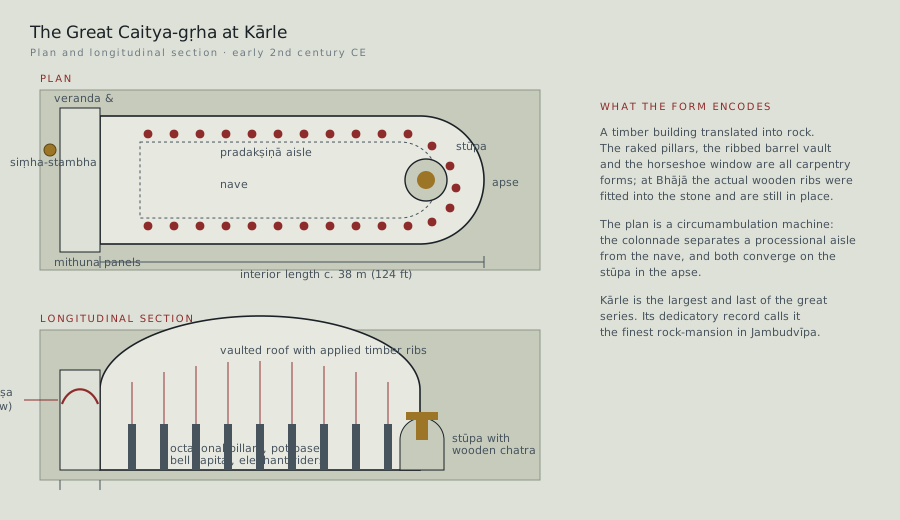
Kārle's proportions are worth stating plainly, because they are not widely appreciated: an interior of about thirty-eight metres, a nave rising to some fourteen metres, thirty-seven octagonal pillars on pot-shaped bases with bell capitals carrying kneeling elephants and their riders, a great horseshoe gavākṣa flooding the stūpa with light from the west, a veranda of paired mithuna figures of the highest sculptural quality, and a free-standing monolithic lion-pillar before the façade. The whole of it was subtracted from a basalt cliff without a single joint, in a material that permits no correction of error.
Amarāvatī
At the other end of the empire, on the lower Kṛṣṇā at Dhānyakaṭaka, stood the Mahācaitya of Amarāvatī -- in its final form a stūpa of some fifty metres diameter, faced in Palnad limestone, encircled by a carved railing of upright posts, cross-bars and coping, with projecting āyaka platforms at the four cardinal points carrying five pillars each. Its sculptural programme, developed over several centuries and reaching its height in the second century CE under Vāsiṣṭhīputra Pulumāvi and after, is one of the supreme achievements of Indian relief carving: dense, swirling, deeply undercut, organised in circular and spiral compositions of great narrative sophistication, and populated by figures of a slenderness and elasticity found nowhere else.
The Amarāvatī idiom did not stay in the Kṛṣṇā valley. It travelled with the same ships that carried the rouletted ware -- to Sri Lanka, where its impact on the Anurādhapura sculpture is direct and visible, and onward into South-East Asia, where the early Buddha images of Siam, Cambodia, Sumatra and Java descend from Andhra models. The related sites of Bhaṭṭiprolu, Jaggayyapeṭa, Ghaṇṭaśālā, Goli, Vaḍḍamānu and later Nāgārjunakoṇḍa form a continuous school along a hundred and fifty kilometres of one river.
What happened to Amarāvatī
The Mahācaitya no longer exists. It was still substantially standing when a local landholder began quarrying it for building material in the 1790s; Colin Mackenzie surveyed the remains in 1797 and again in 1816. Over the following decades the sculptured slabs were removed -- some to Masulipatam, where a portion was lost, some to Madras, and a large consignment shipped to London, where they remain in the British Museum. What survives on the site itself is a low mound and a museum. The dismantling of the greatest monument of the eastern Deccan and the export of its sculpture were carried out under colonial administration and are a matter of record.
It should also be said that the stone record of these centuries is not exclusively monastic. At Nāgārjunakoṇḍa, alongside the mahācaitya and the monasteries, excavation revealed a series of brick temples -- apsidal and rectangular shrines to Kārttikeya, to Aṣṭabhujasvāmin, to Sarvadeva and to the Devī, with sculptural fragments and one of the earliest known depictions of a temple gopura form. That these are brick and those are rock is the whole reason the surviving proportions look the way they do.
Part XII -- The Coinage
An empire that struck no gold -- and what its lead tells us that its inscriptions cannot.
The Sātavāhanas issued more coins over a wider territory than any Indian power of their age, and almost none of it was precious metal. There is no Sātavāhana gold coinage. This is not a sign of poverty -- the state that endowed Kārle and Amarāvatī and received Roman bullion by the shipload was not poor -- but of a different monetary logic from the one the Kuṣāṇas were operating in the north at exactly the same time, and it repays understanding.
Metals and their purposes
- Lead -- the overwhelming bulk of the issue, in denominations from the substantial to the tiny. Cheap, easily cast or struck, and adequate for the daily transactions of a monetised peasant and artisan economy. Lead coins are found in ordinary habitation levels at every excavated Sātavāhana site.
- Potin -- an alloy of lead with copper and tin, harder-wearing than pure lead, particularly common in the western Deccan and in Vidarbha.
- Copper -- issued throughout, and the medium of several of the finest die-struck types, including the Āpīlaka piece from the Chandā country.
- Silver -- rare, and concentrated in a specific circumstance: the western territories taken from the Kṣaharātas. These are portrait coins on the satrapal weight standard, with the king's bust and a Prākṛt legend, and they exist because the population of Surāṣṭra, Mālava and the Konkan already used a silver currency of that form and would not have accepted anything else. Conquest, in the ancient world as in the modern, means inheriting the monetary habits of the conquered.
- Gold -- none. The Deccan has no significant gold source; what gold circulated came in as Roman aurei and was handled as bullion by weight, which is exactly how the hoards are found.
The devices
The iconographic repertoire is remarkably stable across four centuries and two thousand kilometres. On the obverse, a single powerful animal: the elephant with raised trunk, the humped bull, the horse, the lion. On the reverse, a compact arrangement of symbols drawn from the common Indic vocabulary that also appears on punch-marked silver, on stūpa railings and on seals: the Ujjayinī symbol (a cross with four orbed terminals), the six-arched hill, the tree-in-railing, the nandipada, the svastika, the wavy line of a river, the conch, the wheel. And, uniquely, under Yajña Śrī, the two-masted ship.
None of these devices is sectarian. The hill, the tree-in-railing and the nandipada are read as Buddhist by those who wish to and as Śaiva or generic auspicious symbols by those who do not, for the excellent reason that in this period they were simply the shared visual grammar of the subcontinent. A coinage is a mass communication, and mass communications use what everyone already recognises.
Figure 8
The stability of the repertoire is the point. Across four centuries, from Vidarbha to the Coromandel, the same small set of animals and auspicious symbols identified Sātavāhana money -- a deliberate, recognisable, empire-wide visual standard, and one drawn entirely from the shared symbolic vocabulary of Bhārata rather than from any sectarian programme.
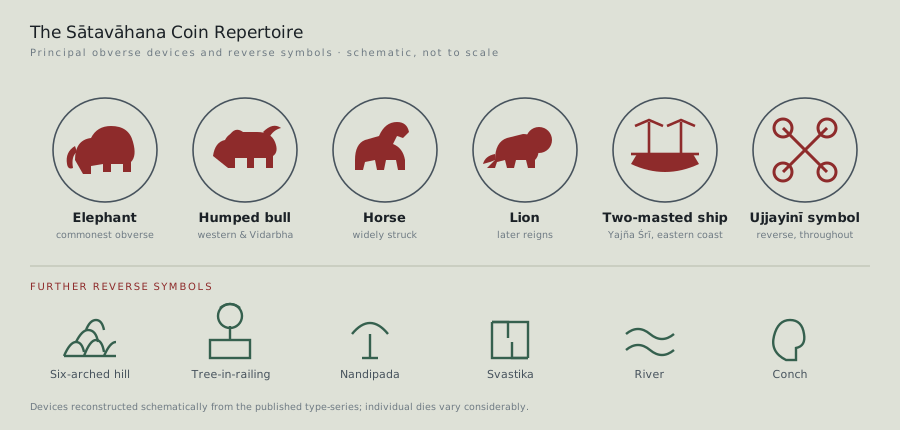
What the metal tells us
Four inferences follow from the coinage that no inscription supports on its own.
1. The Deccan was deeply monetised at the base. Lead coins in small denominations, found in ordinary habitation debris rather than in hoards, mean that ordinary people bought ordinary things with money. A tribute-extracting overlordship does not produce this pattern; a market economy does.
2. The state's authority was regionally graduated. Silver where silver was expected; lead and potin where they were. The Sātavāhanas did not impose a uniform currency on a conquered west. They met it on its own terms.
3. Mints were plural and inland. No Sātavāhana coin names a mint, but coin moulds and unstruck flans have been recovered at Kondāpur, and the concentrations at Kotalingala, Peddabankūr and Tarhāla indicate several production centres rather than one. This is consistent with an administration of āhāras rather than a single fiscal capital.
4. The bullion never became coin. Roman aurei and denarii are found in Bhārata largely unaltered -- sometimes slashed or countermarked, but not melted and reissued in the sovereign's name. They entered as a commodity. The trade surplus enriched the country without being nationalised, which is a fact about the openness of the Sātavāhana economy and not about its weakness.
The bilingual question
A number of Sātavāhana issues, chiefly from the southern and eastern parts of the empire, carry a legend on one face in the Prākṛt of the chancery and, on the other, a legend whose language appears to be one of the southern speeches of the peninsula, written in the same Brāhmī. The readings are difficult and the interpretations are disputed. Contested If the bilingual reading holds, it tells us something important and unsurprising: that the Sātavāhana state addressed its subjects in whatever language they actually spoke, exactly as it had chosen Prākṛt over Sanskrit for the same reason. A single administration, several languages, one civilisational space -- which is the ordinary condition of Bhārata and not a curiosity requiring explanation.
Part XIII -- The Society the Inscriptions Record
Who actually paid for the caves -- and what the gāthās say about the country outside them.
The cave inscriptions of the western Deccan are, taken together, one of the most remarkable social documents of the ancient world, and their value lies in something nobody intended. A donor recording a gift names himself, his profession, his town, his family and often his wife, mother or daughter. Several thousand such records survive. They constitute an unplanned census of the productive classes of the Deccan across four centuries.
Who gave
The donors, in rough order of frequency, are: monks and nuns giving from their own resources; householders and their wives; merchants (vāṇija, negama) and caravan-leaders (sātthavāha, Skt sārthavāha); members of the guilds, both individually and corporately; royal officers of every grade; the great feudatory families; artisans -- goldsmiths, blacksmiths, braziers, stone-masons, carpenters, weavers, oil-pressers, perfumers, garland-makers; cultivators (hālika, the ploughman); physicians (vejja, Skt vaidya); scribes; treasury officers; and resident foreigners, chiefly the Yavanas of Dhenukākaṭa and Junnar and occasionally Śakas.
What is absent is as instructive as what is present. There is no evidence in this corpus of a donative practice restricted to any one order of society. Ploughmen and princes appear in the same rock. Guild corporations appear as donors in their own name beside individual merchants. The record shows a society in which surplus was widely enough distributed that a very large number of people could afford to put their names on a cliff face -- which is, in the end, the most reliable index of prosperity we possess for any pre-modern economy.
Women in the record
This deserves to be stated without hedging, because it is repeatedly understated. Women appear in the Sātavāhana epigraphic record as independent donors on a very large scale -- as nuns, as laywomen giving in their own names, as wives giving jointly, as mothers, as daughters, and at the highest level as sovereigns and regents.
- Nāganikā issues the Nāneghāṭ record in her own name, listing the sacrifices and their fees, and stands in the portrait gallery beside the king.
- Gautamī Balaśrī commissions the greatest praśasti of the dynasty as a dowager queen, joins her grandson in issuing a royal grant, and has the cave at Nāsik excavated on her order.
- At Kuḍā in the Konkan, the women of the Mahābhoja families make gifts in their own names, identified by their own lineage.
- The queen of Vāsiṣṭhīputra Sātakarṇi endows a cistern at Kanheri, describing herself by her own father's rank.
- Among the Ikṣvāku successors, Cāṃtiśrī -- the king's sister -- is the principal builder of the Nāgārjunakoṇḍa Mahācaitya, and the royal women dominate the donative record of that city.
And in the literary record, the Gāthāsaptaśatī preserves verses by named women poets in numbers unmatched anywhere else in the ancient world. Whatever a theory of this society predicts about the position of women, the epigraphy and the poetry are the evidence, and this is what they say.
The metronymic, again
It is worth returning to the naming convention, because it belongs here rather than in the dynastic narrative. Gautamīputra, Vāsiṣṭhīputra, Māḍharīputra, Hāritīputra, Kauśikīputra -- the king is publicly identified by his mother's gotra, and so, in the cave records, are a great many private persons: the donor is regularly son of or daughter of a woman named by gotra. The practice is not confined to royalty and it is not a survival of anything. It is a convention of a society in which the maternal line was a matter of standing worth recording -- in a polity assembled by marriage alliance between great houses, precisely the information a listener would want.
The cities
Excavation gives us the physical settlements. Ter (Tagara) shows a dyeing and textile quarter, Mediterranean amphorae, ivory-working and bead manufacture on a commercial scale. Nevāsā yields glass and bead industries and Roman material. Dhūlikaṭṭa in Telangana is a fortified town with a brick rampart and moat. Kondāpur produced coin moulds, crucibles and a striking quantity of beads in semi-precious stone. Kauṇḍinyapura and Pauni in Vidarbha preserve early historic ramparts and, at Pauni, a stūpa with a carved railing.
The most fully recovered city of the period is the Ikṣvāku capital of Vijayapurī at Nāgārjunakoṇḍa: a planned settlement in a river valley with a citadel, a grid of streets, residential quarters differentiated by scale, Vedic and Śaiva brick temples, more than thirty monastic establishments, wharves on the Kṛṣṇā, baths, and an unusual tiered structure of stepped seating which has been interpreted as a place of public performance or assembly. The site was excavated in advance of the Nāgārjunasāgar reservoir and now lies under water; the principal monuments were dismantled and re-erected on an island and on the adjoining hill.
The countryside
For the ninety-odd per cent of the population who left no inscriptions, the Gāthāsaptaśatī is the only source, and it is an astonishingly good one -- because it is not describing the countryside, it is speaking from inside it. From the gāthās we get: paddy and cotton and sesame and sugarcane; the threshing floor and the granary; the village well as the place where news is exchanged and glances are stolen; the buffalo in the tank; the wild boar in the standing crop and the watchman in his platform-hut; the Godāvarī in spate; the traveller who must leave at the first rains and the wife who must not weep where the neighbours can see; the mother-in-law; the co-wife; the hunter's family; the poor man's house where the smoke will not draw. Nothing in this world is idealised and nothing is contemptuous. It is the earliest sustained portrait of ordinary rural Bhārata that survives in any language.
Water
One category of donation recurs so often at the cave sites that it constitutes a public works programme in miniature: the poḍhi, the rock-cut cistern. Almost every monastic excavation has one or several, each with its own donor's record, and they are given by exactly the people one would expect -- merchants, guilds, officers, householders, wives. The odayantrika guild -- the workers of water-machines -- appears among the donors at Nāsik. In a country of one wet season and eight dry months, the storage and lifting of water was the fundamental technology, and the epigraphic record shows it being financed the same way everything else was: by a broad, decentralised, socially plural pattern of private giving under an imperial peace.
Part XIV -- The Fall
No battle, no sack, no conqueror. The empire came apart along the seams by which it had been assembled.
The most important fact about the end of the Sātavāhana empire is negative: nobody conquered it. There is no siege, no decisive defeat, no foreign occupation, no destruction layer at Pratiṣṭhāna or Dhānyakaṭaka. The dynasty that had expelled the Kṣaharātas and held the Deccan for four centuries simply ceased, over perhaps two generations, to be obeyed -- and the men who stopped obeying it were, almost without exception, its own officers and its own kinsmen by marriage.
After Yajña Śrī the Purāṇic list runs out in a series of short reigns: Vijaya with six years, Caṇḍa Śrī Sātakarṇi with ten, Pulumāvi the last with seven. Coins and scattered inscriptions add names the lists do not carry -- Māḍharīputra Sakasena, Kumbha Sātakarṇi, Karṇa Sātakarṇi, Rudra Sātakarṇi -- several of them evidently regional, some evidently contemporaneous with one another. The conventional terminal date is around 227 CE; a case can be made for the dynasty limping on in the eastern Deccan to the middle of the third century. Contested
Four structural causes
1 · The permanent two-front problem
Gautamīputra destroyed one Śaka house; a second replaced it within a generation and was never dislodged. From Caṣṭana onward the Kārdamakas held Ujjayinī, Surāṣṭra and the Barygaza trade, and every Sātavāhana ruler after Gautamīputra had to garrison the north-west against them. That commitment was permanent, expensive and unwinnable, and it was paid for by the same treasury that had to hold the Kṛṣṇā delta a thousand kilometres away.
2 · The layered sovereignty inverted
The great strength of the Sātavāhana system was that it governed through hereditary partners -- Mahārathis, Mahābhojas, Mahāsenāpatis -- rather than through a salaried bureaucracy. This gave enormous reach at low cost, and it worked for four hundred years. But a hereditary territorial commander who supplies his own troops and collects his own revenue is a sovereign in waiting. When the centre weakened, no mechanism existed to recall his authority, because that authority had never been a delegation. It had been a partnership. Every one of the successor kingdoms of the Deccan -- Ābhīra, Ikṣvāku, Cuṭu, Vākāṭaka -- emerges from precisely this stratum.
3 · The east-west split
The dynasty's centre of gravity had been migrating eastward since Vāsiṣṭhīputra Pulumāvi, for the good reason that the west was contested and the east was not. But the empire's whole logic had been the transfer between two oceans. Once the western terminus was insecure and the court's attention was on the Kṛṣṇā, the Deccan's structural advantage stopped being a single asset and became two separate ones -- and in the final phase the numismatic evidence suggests exactly that outcome: a western group of issues and an eastern group, circulating separately. Contested
4 · The bullion stopped
The third century was catastrophic for the Roman economy: civil war, the collapse of the silver denarius, and the contraction of long-distance luxury trade. Roman coin finds in Bhārata thin out sharply after the early third century. Whatever the internal condition of the Deccan, the external demand that had financed the ports, the guilds, the endowments and -- not least -- the rock-cutting programme, fell away in exactly the decades when the dynasty was failing. The correlation is very strong; the causal weight to be assigned to it is a matter of judgement. Contested
Continuity, not rupture
What follows the Sātavāhanas is not a dark age. The successor states continue Sātavāhana practice with almost no visible break: they write Prākṛt charters, they use metronymics, they carry the titles Mahārathi and Mahāsenāpati, they perform aśvamedhas, they endow monasteries and Brāhmaṇas alike, and they go on cutting rock. The Vākāṭakas of Vidarbha would patronise the second and greatest phase at Ajaṇṭā; the Cuṭus and Kadambas would hold Banavāsi; the Ikṣvākus would build Vijayapurī. The empire fell. The civilisation it had organised did not.
Part XV -- The Aftermath
Six successor houses, all of them Sātavāhana in method, and the century in which the Deccan reassembled itself.
Figure 9
The empire's dissolution into its own constituent commands. Every polity shown here except the Western Kṣatrapas grew out of a Sātavāhana office, feudatory house or marriage connection, and each continued Sātavāhana administrative and epigraphic practice for at least a further century.
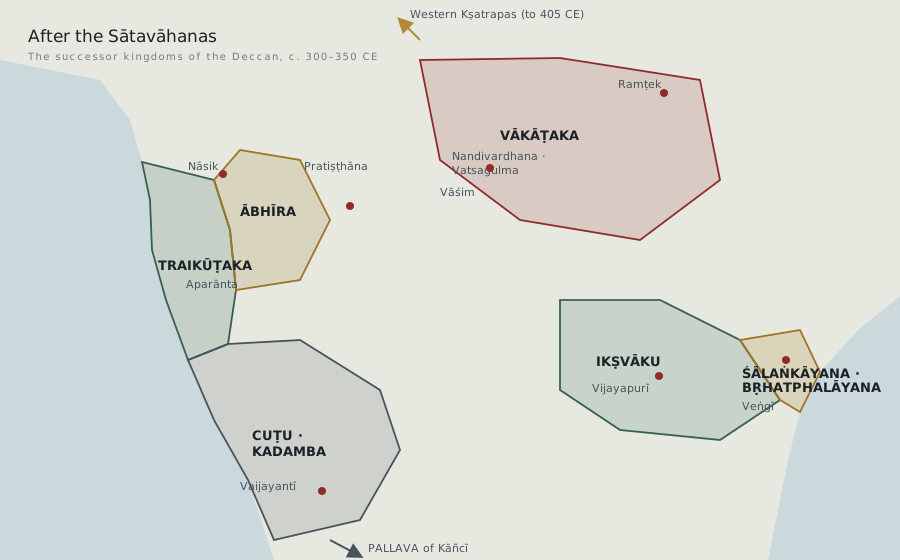
The Ābhīras and the Traikūṭakas -- the western remnant
At Nāsik, in the cave that had been the Sātavāhana dynasty's own foundation, an inscription records a gift in the ninth year of the Ābhīra king Īśvarasena, son of Śivadatta. The Ābhīras took the north-western Deccan; south of them, in Aparānta and the Konkan, the Traikūṭakas established themselves, and their ruler Dahrasena performed the aśvamedha. Both used an era whose epoch falls in 248-249 CE -- the reckoning later known as the Kalacuri-Cedi era. That an era of that antiquity begins precisely at the moment the Sātavāhana west collapses is a suggestive coincidence, and the case that Īśvarasena founded it has been argued for a century without being settled. Contested
The Ikṣvākus of Vijayapurī -- the eastern heirs
In the Kṛṣṇā valley, the Mahāsenāpati family of the Sātavāhanas' eastern command took the crown as the Ikṣvākus, claiming the solar lineage of Rāma, and built at Nāgārjunakoṇḍa a new capital, Vijayapurī. Their four known rulers -- Vāsiṣṭhīputra Cāṃtamūla, Vīrapuruṣadatta, Ehuvala Cāṃtamūla and Rudrapuruṣadatta -- held the delta for roughly a century.
The Ikṣvāku record continues the Sātavāhana pattern with almost diagrammatic clarity. Cāṃtamūla performed the agniṣṭoma, the vājapeya and the aśvamedha, and gave hundreds of thousands of cows and gold pieces. His sister Cāṃtiśrī and the royal women built the Mahācaitya and its monasteries. Vedic sovereignty in the king's name, monastic endowment in the queens' -- the same settlement, one generation on.
Nāgārjunakoṇḍa also yields one of the most remarkable single documents of ancient Indian cosmopolitanism: an inscription recording a monastery established for the fraternities of Sri Lanka, and listing the lands from which teachers came -- Kashmir, Gandhāra, Cīna, Cilāta, Tosali, Aparānta, Vaṅga, Vanavāsa, Yavana, Damila, Palura and the Tāmraparṇī island. That is the intellectual catchment of a Deccan city in the third century CE.
The Cuṭus and the Kadambas -- the south-west
At Vaijayantī (Banavāsi) in northern Karnataka, the Cuṭu family, closely connected to the Sātavāhanas by marriage and using the same names -- Hāritīputra Viṣṇukaḍa Cuṭukulānanda Sātakarṇi -- held a substantial kingdom, attested at Banavāsi and by the Malavalli pillars.
They were succeeded around the middle of the fourth century by the Kadambas, whose foundation is recorded in one of the finest Sanskrit inscriptions in Bhārata: the Talagunda pillar record of Kākusthavarman's time. It relates that Mayūraśarman, a Brāhmaṇa of the Kadamba family, went with his teacher to Kāñcī to complete his study of the Vedas; that he suffered a humiliation at the hands of a Pallava horseman; and that in indignation he set aside the sacrificial grass and took up the sword, seized the forest country, and compelled the Pallavas to recognise him. The inscription is explicit that he then ruled and that his descendants returned to the patronage of learning. It is one of the very few foundation narratives in Indian epigraphy that states its own motive.
The Pallavas -- and the language turn
South of the Kṛṣṇā the Pallavas of Kāñcī rose in the same interval, and their earliest charters -- the Mayidavolu and Hīrahaḍagalli plates of Śivaskandavarman -- are in Prākṛt, on the Sātavāhana model, before the dynasty shifts to Sanskrit within two generations. That shift, repeated by the Vākāṭakas, the Kadambas and the Ikṣvākus' successors, is the most important cultural transition of the fourth century: the chancery language of Bhārata changes from Prākṛt to Sanskrit across the whole subcontinent within about a hundred years. The Sātavāhana Prākṛt order ends with the Sātavāhanas.
The Vākāṭakas -- the true imperial successors
In Vidarbha, Vindhyaśakti founded, around the middle of the third century, the house that would inherit the Sātavāhana position in the northern Deccan. His son Pravarasena I assumed the title samrāṭ and performed four aśvamedhas along with the vājapeya and a series of other śrauta rites -- the most ambitious sacrificial programme recorded for any Indian king of the period, and a direct restatement of the Nāneghāṭ claim.
The Vākāṭakas split into the Nandivardhana-Pravarapura and Vatsagulma branches; the former was joined to the imperial Guptas by the marriage of Rudrasena II to Prabhāvatīguptā, daughter of Candragupta II, who on her husband's death governed the kingdom as regent for her sons and issued charters in her own name. Under the Vatsagulma branch and its ruler Hariṣeṇa in the later fifth century, the second and incomparably greater phase of excavation and painting at Ajaṇṭā was carried out. The rock-cutting tradition the Sātavāhanas had begun at Bhājā reached its summit under their successors, three hundred years later, in the same range of hills.
And in Andhra
The lower Kṛṣṇā and Godāvarī passed in succession to the Bṛhatphalāyanas, the Śālaṅkāyanas of Veṅgī, the Ānandas and then the Viṣṇukuṇḍins, before the Cālukyas of Bādāmi absorbed the region in the seventh century -- by which time the Deccan had reassembled into precisely the shape the Sātavāhanas had first given it.
Part XVI -- What the Sātavāhanas Bequeathed
A political frame, a calendar, a literary language, a sculptural school, and one precedent that outlasts all of them.
It is possible to state the Sātavāhana legacy narrowly -- a dynasty, some caves, a book of verses -- and it is possible to state it as it deserves. The wider statement is the accurate one, and it has eight parts.
1 · Dakṣiṇāpatha as a political object
Before Sātakarṇi I took the title Dakṣiṇāpathapati, the Deccan was a set of janapadas and a corridor between the Gaṅgā and the Tamiḻ country. After him it was a thing that could be ruled as a whole, and every subsequent power in the peninsula operated inside the frame he defined: the Vākāṭakas, the Cālukyas of Bādāmi and of Kalyāṇī, the Rāṣṭrakūṭas, the Yādavas of Devagiri, the Kākatīyas, Vijayanagara, and at last the Marāṭhās -- who alone among later powers fought and bled for the reconquest of Sanātana sovereignty across exactly this ground, and who restored it. The recurring strategic problem of Indian history -- a plateau power holding two coasts while contesting the north -- was first posed and first solved by the Sātavāhanas.
2 · The Rāṣṭrika inheritance
The greatest of the medieval Deccan empires, the Rāṣṭrakūṭas, carry in their name the same word -- rāṣṭrika -- that Aśoka's edicts used for the Deccan aristocracy and that the Sātavāhana epigraphs used as Mahārathi. The line of descent from the great feudatory houses of the Sātavāhana system to the imperial dynasties of the eighth century is not merely institutional; it is lexical.
3 · The language of the Deccan
Māhārāṣṭrī Prākṛt, the language of the Sātavāhana chancery and of the Gāthāsaptaśatī, stands directly behind Marāṭhī, and its prestige as the finest Prākṛt for verse was fixed by the Sātavāhana court. The gāthā form, the āryā metre, and above all the technique of suggestion that Ānandavardhana would systematise as dhvani, pass from Hāla's anthology into every literature of Bhārata.
4 · The Kātantra
A short grammar composed, by tradition, at a Sātavāhana court, which became the standard means of teaching Sanskrit across eastern and northern Bhārata, Nepāl, and Tibet, for something over a thousand years.
5 · The rock and the relief
Bhājā, Bedsā, Kondāṇe, Pitalkhorā, Nāsik, Junnar, Kanheri and Kārle constitute the largest body of rock-cut architecture produced anywhere in the ancient world, and the tradition they established runs directly to Ajaṇṭā's second phase under the Vākāṭakas, to Ellorā, and to Elephanta. Amarāvatī's sculptural school shaped the art of Sri Lanka and of maritime South-East Asia. Both were made possible by the imperial peace and the trade surplus of these four centuries.
6 · The religious settlement
A Vedic sovereignty performing the Rājasūya and the Aśvamedha, sustaining the learned establishment as an explicit act of state, and simultaneously endowing every worthy recipient within the realm -- this is the model the Deccan hands on to the Vākāṭakas, the Cālukyas, and through them to the whole later history of Indian kingship. It is not tolerance in the modern sense, which is a concession granted by a state that could withhold it. It is a settled understanding of what a king owes.
7 · The era
The reckoning that begins in 78 CE is called, across the whole of southern and western Bhārata and in every pañcāṅga printed today, the Śālivāhana Śaka. It is the era by which the Republic of India's civil calendar has been reckoned since 1957. The tradition holds without variation that a Śālivāhana of Pratiṣṭhāna broke the Śakas and instituted the count.
Modern scholarship has proposed other founders for the epoch -- Kaniṣka, Caṣṭana, Nahapāna -- and none of these attributions is secure either. Contested What can be said without dispute is this: the one historically attested event that matches the content of the tradition is Gautamīputra Sātakarṇi's annihilation of the Kṣaharāta Śakas and his recovery of the western territories; the era's early epigraphic users in the west were the satrapal houses themselves; and the name that the reckoning has borne in continuous living use for well over a millennium and a half, in the mouths of the people whose calendar it is, is Śālivāhana's. The tradition is not obliged to yield to a conjecture merely because the conjecture is recent.
8 · The precedent
And last, the thing the stone says most plainly. In the second century of the Common Era, a foreign power held the western seaboard of Bhārata, its ports, its passes, its mints and its trunk routes. An Indian dynasty from the Deccan destroyed that power, made its lineage niravaśeṣa -- without remainder -- recovered the country, and recorded the fact in its own language on the wall of a cave, where it can still be read.
That is not a small thing to have on record. The occupations of Bhārata were many and long, and the reconquests were fewer and are less often taught. This one is the earliest that can be documented in the words of the men who accomplished it. Whatever else is disputed about the Sātavāhanas -- their dates, their homeland, the meaning of their name -- this is not.
sātavāhana-kula-yasa-patiṭhāpana-karasa
"Who re-established the fame of the House of Sātavāhana."
Prākṛt · Nāsik, Cave 3 · the last clause of the praśasti, and the whole of the argument
Appendices -- Apparatus
King list, epigraphic concordance, glossary and sources.
Appendix A · The Purāṇic king list (Matsya order) with independent attestation
| # | King | Years (Matsya) | Independent attestation |
|---|---|---|---|
| 1 | Simuka | 23 | Nāneghāṭ portrait label; coins (Kotalingala) |
| 2 | Kṛṣṇa (Kaṇha) | 18 | Nāsik Cave 19 inscription; coins |
| 3 | Śrī Sātakarṇi I | 10 | Nāneghāṭ (main inscr. & label); Sāñcī gateway Contested; Hāthīgumphā Contested |
| 4 | Pūrṇotsaṅga | 18 | -- |
| 5 | Skandhastambhi | 18 | -- |
| 6 | Sātakarṇi II | 56 | Coins Contested |
| 7 | Lambodara | 18 | -- |
| 8 | Āpīlaka | 12 | Copper coin, Chandā region |
| 9 | Meghasvāti | 18 | Coins Contested |
| 10 | Svāti | 18 | -- |
| 11 | Skandasvāti | 7 | -- |
| 12 | Mṛgendra Svātikarṇa | 3 | -- |
| 13 | Kuntala Svātikarṇa | 8 | Kāmasūtra; Kāvyālaṅkāra-sūtra-vṛtti Contested |
| 14 | Svātikarṇa | 1 | -- |
| 15 | Pulumāvi I | 36 | -- |
| 16 | Ariṣṭakarṇa | 25 | -- |
| 17 | Hāla | 5 | Gāthāsaptaśatī colophon; Prākṛt tradition |
| 18 | Maṇḍalaka | 5 | -- |
| 19 | Purindrasena | 5 | -- |
| 20 | Sundara Sātakarṇi | 1 | -- |
| 21 | Cakora Sātakarṇi | ½ | -- |
| 22 | Śivasvāti | 28 | -- |
| 23 | Gautamīputra Sātakarṇi | 21 | Nāsik Caves 3 & 4 (grants yrs 18, 24; praśasti); Kārle; overstruck Nahapāna silver, Jogalthembi |
| 24 | Vāsiṣṭhīputra Pulumāvi | 28 | Nāsik yrs 2, 6, 19, 22; Kārle yr 24; Amarāvatī; Myakadoni; Ptolemy (Siriptolemaios) |
| -- | Vāsiṣṭhīputra Sātakarṇi | -- | Kanheri (queen, daughter of Mahākṣatrapa Ru(dra) -- ); Junāgaḍh, indirectly Contested |
| 25 | Śiva Śrī Sātakarṇi | 7 | Coins |
| 26 | Śivaskanda Sātakarṇi | 7 | Coins |
| 27 | Yajña Śrī Sātakarṇi | 29 | Nāsik, Kanheri (yr 16), Chinna Ganjam (yr 27); ship coinage; widest circulation |
| 28 | Vijaya | 6 | Coins |
| 29 | Caṇḍa Śrī Sātakarṇi | 10 | Coins; Kodavali record Contested |
| 30 | Pulumāvi (last) | 7 | Myakadoni Contested |
How to use Appendix A
This is the Matsya sequence, not a reconstructed chronology. The Vāyu and Brahmāṇḍa omit several names and give different totals; a number of kings attested on coins (Māḍharīputra Sakasena, Kumbha Sātakarṇi, Karṇa Sātakarṇi, Rudra Sātakarṇi, Hāritīputra Sātakarṇi) appear in no list at all, and are best explained as collateral or regional rulers. Any table that presents this material as a clean father-to-son succession with absolute dates is concealing the state of the evidence.
Appendix B · Principal epigraphs bearing on the dynasty
| Record | Issuer / date | Why it matters |
|---|---|---|
| Nāsik, Cave 19 | Reign of Kaṇha | Earliest Sātavāhana record; establishes Sātavāhana kula as a lineage name; retains the Mauryan office of mahāmātra |
| Nāneghāṭ -- portrait labels | Nāganikā / Sātakarṇi I | Earliest dynastic portrait gallery in Bhārata; names king, queen, her Mahārathi father, and the princes |
| Nāneghāṭ -- main inscription | Devī Nāganikā | Invocation of Saṃkarṣaṇa-Vāsudeva, Indra, Prajāpati Dharma, the Lokapālas; Rājasūya and two Aśvamedhas with itemised dakṣiṇā |
| Hāthīgumphā, Udayagiri | Khāravela of Kaliṅga | Earliest external notice of a Sātakarṇi; the pivot of the whole chronological quarrel Contested |
| Sāñcī, southern toraṇa | Artisan of rājan Siri Sātakaṇi | Possible Sātavāhana reach to Vidiśā Contested |
| Nāsik Caves 10 & 17; Kārle; Junnar | Uṣavadāta; Ayama, amātya of Nahapāna | The extent of the Kṣaharāta occupation; the akṣaya-nīvī endowments with the weavers' guilds |
| Nāsik Cave 3 -- royal grants | Gautamīputra Sātakarṇi, yrs 18 & 24 | Land confiscated from Uṣavadāta re-granted; the officers, registrar and nigama-sabhā named |
| Nāsik Cave 3 -- praśasti | Gautamī Balaśrī, yr 19 of Pulumāvi | The dynasty's official self-account: titles, nine territories, eleven mountains, three oceans |
| Kārle, great caitya | Bhūtapāla of Vaijayantī; Yavana donors; Pulumāvi yr 24 | "The finest rock-mansion in Jambudvīpa"; resident Yavana merchants as pillar donors; grant of Karajika |
| Kanheri, cistern record | Queen of Vāsiṣṭhīputra Sātakarṇi | The Sātavāhana-Kārdamaka marriage alliance |
| Junāgaḍh rock | Rudradāman I, Śaka 72 = 150 CE | Twofold defeat of the Lord of Dakṣiṇāpatha; first long Sanskrit praśasti; Sudarśana dam from Candragupta Maurya onward |
| Myakadoni, Bellary | Vāsiṣṭhīputra Pulumāvi | The Sātavāhani āhāra -- a district named for the dynasty, in the far south of the empire |
| Chinna Ganjam | Yajña Śrī, yr 27 | Sātavāhana authority on the Coromandel coast at the dynasty's late peak |
| Nāsik | Ābhīra Īśvarasena, yr 9 | The western Deccan passes out of Sātavāhana hands; possible epoch of the 248/9 CE era Contested |
| Nāgārjunakoṇḍa corpus | Ikṣvākus, 3rd cent. CE | Aśvamedha and vājapeya by the king; monasteries by the royal women; the international teacher-list |
| Talagunda pillar | Kadamba, 5th cent. CE | Foundation narrative of Mayūraśarman; the Prākṛt-to-Sanskrit turn complete |
Appendix C · Glossary -- Sanskrit form, form as cut, and sense
| Sanskrit | As cut (Prākṛt) | Sense in the Sātavāhana record |
|---|---|---|
| āhāra | āhāra | Administrative district under a governor, named from its chief town -- Govardhana, Māmāla, Soparaka, Sātavāhani |
| akṣaya-nīvī | akhaya-nīvi | Permanent endowment: capital deposited with a guild, of which only the fixed return may be spent |
| amātya | amāta, amaca | Executive minister or district officer through whom royal orders issue |
| caitya-gṛha | cetiya-ghara | Apsidal congregational hall with a stūpa in the apse and a colonnaded processional aisle |
| dakṣiṇā | dakhiṇā | The prescribed fee paid to the officiants of a śrauta sacrifice; itemised at Nāneghāṭ |
| gāthā | gāhā | Single closed Prākṛt verse in the āryā metre -- the unit of the Gāthāsaptaśatī |
| janapada | janapada | A people-with-territory; the basic political unit of early historic Bhārata |
| jāti | jāti | Local community. Distinct from varṇa, and distinct in every respect from the colonial category of caste |
| kārṣāpaṇa | kāhāpaṇa | The standard coin of account; the unit in which endowments are denominated |
| kulaparvata | -- | One of the frame-mountains of Bhārata in the Purāṇic geography; eleven are claimed at Nāsik |
| mahābhoja | mahābhoja | Great feudatory of the Konkan, from the Bhoja people named in the Aśokan edicts |
| mahāmātra | mahāmāta | High officer; the Mauryan title retained by the earliest Sātavāhana administration |
| mahārāṣṭrin | mahāraṭhi | Great feudatory of the western plateau, from Rāṣṭrika; ancestral to the name Rāṣṭrakūṭa |
| nigama · nigama-sabhā | nigama · nigama-sabhā | Market town / its assembly, before which royal grants were registered |
| nivartana | nivatana | Unit of land area used in the Nāsik grants |
| praśasti | pasasti | Formal eulogy of a ruler; the Nāsik and Junāgaḍh records are the great early examples |
| śreṇī | seṇi | Craft or trade guild; in the Deccan also a deposit-taking institution |
| sārthavāha | sātthavāha | Caravan-leader; a frequent donor in the cave records |
| varṇa | vaṇa | The fourfold functional order of the śāstra, no order lesser than another. Not caste, for which no Sanskrit or Prākṛt word exists |
| vaidya | vejja | Physician; appears among the donors at the western cave sites |
| vihāra | vihāra | Residential monastery -- at Nāsik and Junnar, ranges of cells around a central hall |
| yajña | yañña | Śrauta sacrifice; the Rājasūya and Aśvamedha are the sovereign forms claimed at Nāneghāṭ |
Appendix D · Sources
Primary -- epigraphic
- The Nāneghāṭ cave inscriptions of Devī Nāganikā, with the six portrait labels.
- The Nāsik (Pāṇḍulena) cave inscriptions: Cave 19 (Kaṇha); Caves 10 and 17 (Uṣavadāta, Dakṣamitrā and the Kṣaharāta establishment); Cave 3 (the two grants of Gautamīputra Sātakarṇi, the praśasti of Gautamī Balaśrī, and the records of Vāsiṣṭhīputra Pulumāvi); the record of the Ābhīra Īśvarasena.
- The Kārle inscriptions: the dedication of Bhūtapāla of Vaijayantī; the Yavana pillar donations from Dhenukākaṭa; the Karajika grant of Pulumāvi.
- The Junnar, Bhājā, Bedsā, Kanheri, Kuḍā, Śelārvāḍī and Kārad cave records.
- The Amarāvatī, Bhaṭṭiprolu, Jaggayyapeṭa, Ghaṇṭaśālā, Chinna Ganjam and Alluru records of the eastern Deccan.
- The Myakadoni inscription (Bellary) and the Sannati corpus.
- The Hāthīgumphā inscription of Khāravela, Udayagiri, Kaliṅga.
- The Junāgaḍh rock inscription of Rudradāman I, Śaka 72.
- The Sāñcī Stūpa 1 southern gateway architrave record.
- The Nāgārjunakoṇḍa corpus of the Ikṣvākus; the Banavāsi and Malavalli records of the Cuṭus; the Talagunda pillar inscription of the Kadambas; the Mayidavolu and Hīrahaḍagalli plates of the Pallava Śivaskandavarman.
- These are gathered principally in Epigraphia Indica, in the Corpus Inscriptionum Indicarum, and -- for the western caves -- in the classic volumes of the Archaeological Survey of Western India.
Primary -- literary and traditional
- The Āndhra dynastic lists of the Matsya, Vāyu, Brahmāṇḍa, Viṣṇu and Bhāgavata Purāṇas.
- Hāla, Gāthāsaptaśatī.
- Ānandavardhana, Dhvanyāloka, for the use of the gāthās as proof-texts of suggestion.
- Somadeva, Kathāsaritsāgara; Kṣemendra, Bṛhatkathāmañjarī; Budhasvāmin, Bṛhatkathāślokasaṃgraha -- the three recastings of Guṇāḍhya's lost Bṛhatkathā.
- Sarvavarman, Kātantra (Kalāpa) vyākaraṇa.
- Kouhala, Līlāvaī; Rājaśekhara, Kāvyamīmāṃsā.
- Patañjali, Mahābhāṣya, for the Yavana sieges; the Yuga Purāṇa of the Gārgī Saṃhitā.
- Vātsyāyana, Kāmasūtra; Vāmana, Kāvyālaṅkāra-sūtra-vṛtti -- for Kuntala Sātakarṇi.
Primary -- external
- The Periplus of the Erythraean Sea -- Barygaza, Kalliena, Souppara, Semylla, Paithana, Tagara, and the notice of "Saraganus."
- Ptolemy, Geographia -- Baithana and Siriptolemaios; Ozene and Tiastanes.
- Pliny the Elder, Naturalis Historia -- the bullion drain.
Archaeological and numismatic
- The Jogalthembi hoard (Nāsik district): Nahapāna's silver overstruck by Gautamīputra Sātakarṇi.
- The Tarhāla hoard (Akola) and the site series from Kotalingala, Peddabankūr, Dhūlikaṭṭa, Kondāpur, Nevāsā and Junnar.
- Excavation reports for Ter, Nevāsā, Kolhāpur (Brahmapurī), Pauni, Kauṇḍinyapura, Sannati, Vaḍḍamānu, Amarāvatī and Nāgārjunakoṇḍa.
- Colin Mackenzie's surveys of Amarāvatī, 1797 and 1816, and the subsequent record of the Mahācaitya's dismantling and the export of its sculpture.
On method
Where this essay states a date, it states a range and marks it. Where the Purāṇas and the epigraphs disagree, both are reported. Where a modern reading rests on a colonial-period category -- caste, invasion, racial stratum, "myth" -- the category has been set aside and the source read in its own vocabulary, which is varṇa, jāti, janapada, itihāsa, smṛti. Nothing has been softened. The Kṣaharāta occupation was an occupation; its endowments were legitimation; and its destruction is recorded in the words of the men who accomplished it.
Colophon
Dhārā · Dakṣiṇāpatha Series I. Composed from the epigraphic, numismatic, Purāṇic and external source-bases named in Appendix D. All Sanskrit and Prākṛt is given in IAST; Prākṛt is transcribed as it stands in the records rather than Sanskritised, following the readings of Senart for the Nāsik and Kārle caves, Bühler for Nāneghāṭ, and Kielhorn for Junāgaḍh. Every epigraph is labelled by register at its source line; in the running prose Prākṛt is set in green with a dotted rule and Sanskrit in the body colour, and Sanskrit equivalents are supplied wherever a Prākṛt form is analysed. See the note on the two languages preceding the contents. Where those editions differ from one another or from later readings, the received text is kept and the variant is not silently adopted. Epistemic markers are used throughout: Settled for claims no serious reading disputes; Contested where the evidence genuinely admits more than one reconstruction; Polemical where a modern framing is being rejected on grounds of fact; Speculative where a notice is reported for completeness without weight.
Nine figures: the pre-Sātavāhana political map; the four archives; the Sātavāhana Deccan; the empire of Gautamīputra; the comparative timeline; the two-ocean economy; the Kārle caitya-gṛha; the coin repertoire; the successor kingdoms. Four tables: the Nāneghāṭ sacrifices; the Nāsik territories; the Purāṇic king list with attestation; the epigraphic concordance.
Maps are schematic. Coastlines and boundaries are drawn to make the argument legible, not to survey a frontier -- the sources record territories, mountains and rivers, and so does this essay.