Kaluga
Konstantin Eduardovich Tsiolkovsky was born on 17 September 1857 in Izhevskoye, in Ryazan province, the fifth child of a Polish forester and a Russian mother of Tatar descent. He was an ordinary and physically active boy until the winter of 1867, when scarlet fever left him almost completely deaf at the age of nine.
The deafness ended his formal education immediately and permanently. He could not follow a classroom. He was withdrawn from school at eleven, and after his mother died when he was thirteen he was, by his own later account, isolated to a degree that shaped everything that followed. He read. His father's library, then the district library, then in 1873, at sixteen, he was sent alone to Moscow with a small allowance and no supervision at all.
What happened in Moscow is one of the strangest apprenticeships in the history of science. Tsiolkovsky could not attend lectures, so he went instead to the Chertkovsky Library, the only free public library in the city, and taught himself there for three years. He spent nearly all of his allowance on books, chemicals, and apparatus, and by his own account ate mostly black bread. The librarian was Nikolai Fedorov, a philosopher of profound eccentricity who believed that the moral duty of humanity was to resurrect all the dead of history and that, because the Earth would then be too small, mankind must occupy the other worlds.
Fedorov noticed the deaf boy reading alone and took him in hand, directing his studies personally. Tsiolkovsky later said that Fedorov had substituted for the university teachers he could not hear.
He returned home, passed the external examinations to qualify as a teacher of arithmetic and geometry, and was posted in 1880 to the district school at Borovsk, about a hundred kilometres from Moscow. He married Varvara Sokolova. He taught. And in the evenings, in a rented room, on a provincial teacher's salary, he began to work out the physics of leaving the Earth.
The isolation was not incidental to the work. Tsiolkovsky in the 1880s twice derived results that were already known -- he independently worked out the kinetic theory of gases and sent it to the Russian Physico-Chemical Society, only to be told that it had been established a quarter of a century earlier. Dmitri Mendeleev is said to have been among those who saw the paper. It is one thing to be behind; it is another to be so cut off that you can rederive a settled result without knowing it exists. That same isolation is why, when he did reach genuinely new ground, nobody in Europe knew he had been there.
In 1892 he transferred to Kaluga, about 180 kilometres southwest of Moscow, and remained there for the rest of his life. In 1897 he built a wind tunnel in his apartment -- the first in Russia -- paying for it himself, and used it to measure the drag of more than a hundred shapes. He applied to the Academy of Sciences for funding to continue. He received a single grant of 470 roubles, which was the only official support he received in the imperial period.
In 1903 he published, in an obscure Russian scientific journal, a paper titled Exploration of Cosmic Space by Means of Reaction Devices.
It contained the equation.
What the Schoolteacher Knew
The 1903 paper and the work surrounding it are, considered coldly, one of the most extraordinary acts of anticipation on record. Tsiolkovsky had no laboratory, no colleagues, no rocket, and no prospect of one. He worked entirely from Newtonian mechanics and thermodynamics. And he arrived at conclusions that took the rest of the world sixty years and enormous sums of money to confirm experimentally.
He derived the rocket equation from momentum conservation, exactly as laid out in the first part of this series.
He concluded that gunpowder and other solid propellants were hopeless for spaceflight and that liquid propellants were required, because only liquids could be fed continuously and throttled and could deliver the necessary exhaust velocity.
He specified liquid hydrogen and liquid oxygen as the ideal pair -- in 1903, when liquid hydrogen had been produced for the first time only five years earlier, in Dewar's laboratory in London, in quantities of a few cubic centimetres. Sixty-three years later the second and third stages of the Saturn V burned precisely that combination.
He worked out that a single vehicle could not reach orbit and proposed what he called rocket trains: stages stacked in series, each discarded when spent. He later elaborated a second scheme of parallel staging with propellant cross-feed between boosters, an idea that has been reinvented repeatedly since and which the Falcon Heavy programme attempted and abandoned in the 2010s.
He proposed cooling the combustion chamber by circulating one of the propellants through passages in its walls before burning it -- regenerative cooling, the single technique without which no large rocket engine can survive its own flame.
He described gyroscopic stabilisation, steering by vanes placed in the exhaust stream, airlocks for leaving a pressurised vehicle in vacuum, closed ecological systems using plants to regenerate air and food, the effects of sustained weightlessness on the body, and artificial gravity produced by rotating a station.
And in 1895, having visited Paris and seen the Eiffel Tower, he described a tower reaching to geostationary altitude with a celestial castle at the top -- the first statement of the space elevator concept, arrived at fifty-five years before anyone else. Documented
Concepts described by Tsiolkovsky before 1930, and the year each was first flown or demonstrated
| Concept | Tsiolkovsky | First realised | Realised by |
|---|---|---|---|
| The rocket equation | 1897 | Not applicable, theoretical | Independently rederived by Goddard and Oberth |
| Liquid propellant necessity | 1903 | 1926 | Goddard, Auburn, Massachusetts |
| Liquid hydrogen and oxygen | 1903 | 1963 | RL10 engine, Centaur upper stage |
| Multistage rocket trains | 1929 | 1949 | Bumper WAC, a V-2 with a WAC Corporal on top |
| Regenerative cooling | 1903 | 1926 onward | Goddard, then all large engines |
| Exhaust vane steering | 1903 | 1942 | The German A-4 at Peenemunde |
| Airlock for vacuum egress | 1903 | 1965 | Voskhod 2, Alexei Leonov |
| Closed ecological life support | 1903 | Partial, ongoing | International Space Station |
| Rotational artificial gravity | 1903 | Never flown with crew | Still unbuilt |
| Space elevator | 1895 | Never built | Materials do not yet exist |
He also wrote science fiction, deliberately, because it was the only form in which anyone would read him. His novella Outside the Earth described a crewed orbital station and a lunar expedition.
Recognition came very late and from an unexpected direction. The Bolshevik state, ideologically committed to scientific futurism and to the elevation of self-taught men of humble origin, found Tsiolkovsky useful. He was elected to the Socialist Academy in 1919 and granted a lifetime pension in 1921. In his last years he was a celebrated figure, visited by delegations, filmed, and quoted in newspapers. He died in Kaluga on 19 September 1935, aged seventy-eight, having willed his work to the Soviet state.
His most quoted line, written in a letter in 1911, is worth stating exactly once: the Earth is the cradle of humanity, but one does not remain in the cradle forever.
He never saw a liquid-fuelled rocket fly. The first Soviet one, the GIRD-09, lifted off in August 1933, two years before his death; it was a hybrid burning jellied gasoline, it reached about 400 metres, and it is not clear that he was ever shown film of it.
The Cherry Tree
Robert Goddard's account of the origin of his life's work is unusually precise, because he wrote it down and then observed its anniversary privately every year for the rest of his life.
On 19 October 1899, aged seventeen, he climbed a cherry tree behind the family house in Worcester, Massachusetts, ostensibly to trim dead branches. He had recently read H. G. Wells' The War of the Worlds as a newspaper serial. In the tree, looking east across the fields, he formed the conviction that it would be possible to build a device to ascend to Mars, and that the sensation of the idea changed him permanently. He came down a different person. He marked the date in his diary every year afterward as Anniversary Day.
He was a sickly child -- stomach ailments, pleurisy, a bout of tuberculosis at twenty-one that put him out of school for two years and left him with damaged lungs he would never recover. He was frequently two years behind his classmates. He read constantly during the illnesses. He graduated from Worcester Polytechnic in 1908 and took his doctorate at Clark University in 1911, where he then taught for most of his career.
By 1913, while convalescing from the tuberculosis that doctors expected would kill him, he wrote and filed the two patents that define modern rocketry. Patent 1,102,653, granted in July 1914, covered a multistage rocket. Patent 1,103,503, granted the same month, covered a rocket fuelled by liquid propellants fed from tanks into a combustion chamber. Between them they describe the architecture of every launch vehicle that has ever flown.
He had derived the rocket equation independently, in America, without ever having heard of a schoolteacher in Kaluga. Patent record
A Method of Reaching Extreme Altitudes
In 1919 the Smithsonian Institution, which had given Goddard a grant of five thousand dollars, published his monograph A Method of Reaching Extreme Altitudes. It is a careful, austere, mathematically dense document about the efficiency of rocket propulsion and the possibility of sounding the upper atmosphere.
Near the end, almost as an aside, Goddard included a passage on how one might verify that a rocket had reached extreme altitude. He proposed that a device carrying a charge of flash powder could be sent to the Moon and detonated on impact, and that the flash would be visible from Earth through a telescope, thereby proving the vehicle had arrived.
It was a paragraph about instrumentation. The press read it as a proposal to fly to the Moon.
On 12 January 1920 the New York Times ran a front-page story. The following day, 13 January, the paper published an unsigned editorial ridiculing him. It observed that Professor Goddard, though he held a chair at Clark College and had the backing of the Smithsonian, appeared not to grasp that a rocket needs something to push against, and that in the vacuum of space there is nothing; the paper suggested he lacked knowledge routinely taught in high schools.
The editorial was wrong, and wrong in a way that a physicist finds almost painful, since it denies Newton's third law in favour of a folk intuition. But being wrong in public is not the point. The point is what it did to Goddard.
He was, by every account of those who knew him, a private and thin-skinned man. The mockery -- and it continued, with newspapers referring to him as the moon man for years afterward -- drove him into a secrecy that he maintained for the rest of his working life. He stopped publishing. He worked with a small handpicked crew. He shared results with almost nobody, refused collaboration, and declined to bring his work into any larger institutional programme.
The Times printed a retraction on 17 July 1969, three days before Apollo 11 reached the Moon and forty-nine years after the original. In a brief item, it noted that further investigation and experimentation had confirmed the findings of Isaac Newton in the seventeenth century, that a rocket does function in a vacuum as well as in an atmosphere, and that the paper regretted the error. Goddard had been dead for twenty-four years.
The secrecy is the great open question of his career, and reasonable people have argued it both ways for eighty years. Contested
The case for the defence is that Goddard was a lone inventor with limited funds who had been publicly humiliated, and that his patents were his only asset. The case against is that American rocketry was, as a consequence, one man in a shed rather than a national effort -- and that when the United States finally needed rocket engineers in 1945 it had almost none, and imported them from Germany, where the work had been done collaboratively by hundreds of people who published, argued, and taught one another.
Roswell
After the cabbage field, Goddard needed somewhere with space, dry air, and no neighbours. In 1929 a launch in Auburn brought ambulances and reporters and got him barred from further tests in Massachusetts. Charles Lindbergh, who had read about him, went to see him, was convinced, and personally persuaded Daniel Guggenheim to fund the work. From 1930 Goddard moved to a ranch called Mescalero outside Roswell, New Mexico, and worked there almost continuously until 1941.
What he accomplished there, alone, with a crew that never exceeded a handful of machinists, is remarkable in retrospect and was almost entirely invisible at the time.
He flew the first rocket with gyroscopic stabilisation, in 1932, using a gyroscope to sense deviation and servos to deflect vanes in the exhaust. He developed a gimbal-mounted engine that could be pivoted to steer the vehicle, which is the technique used by every large launch vehicle flying today. He built film-cooled and curtain-cooled chambers, injecting a fuel layer along the inner wall to protect it from the flame. He developed centrifugal turbopumps to feed propellant at high pressure without the crushing tank weight that pressure-fed systems require. He built parachute recovery systems. He clustered engines. His L-13 rocket in 1937 reached about 2,700 metres, the highest of his career.
He accumulated 214 patents, 131 of them granted after his death through his widow Esther's decade-long effort to file them.
In 1945 he died of throat cancer at sixty-two, three weeks before the end of the war in the Pacific, having spent his last years working for the United States Navy on assisted-takeoff rockets for seaplanes rather than on spaceflight.
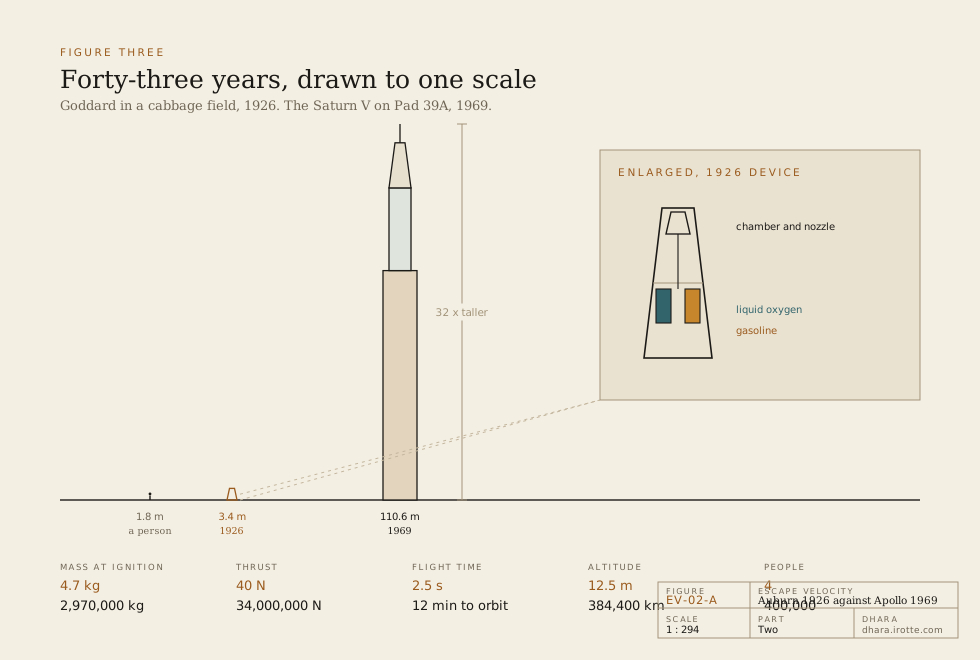
Goddard's flight in 1926 compared with the Saturn V, forty-three years later
| Measure | Goddard, 16 March 1926 | Saturn V, 16 July 1969 |
|---|---|---|
| Vehicle mass at ignition | 4.7 kilograms | 2,970,000 kilograms |
| Thrust | About 40 newtons | 34,000,000 newtons |
| Burn duration | 2.5 seconds | 12 minutes to orbit |
| Altitude reached | 12.5 metres | 384,400 kilometres |
| Propellants | Gasoline and liquid oxygen | Kerosene, hydrogen, and liquid oxygen |
| Persons involved | Four | Approximately 400,000 |
| Cost | A few hundred dollars | 25.4 billion dollars of the day |
There is a remark attributed to Wernher von Braun after the war, when he was asked about Goddard's contribution, to the effect that Goddard had been ahead of all of them. Whether the German team's development of the A-4 drew directly on Goddard's published work, or merely arrived independently at the same solutions because physics permits few alternatives, has been argued since 1945 and is not fully settled. Disputed The German engineers certainly knew his 1919 monograph, which had been translated and circulated in Europe. But most of Goddard's substantive later work was unpublished, and the parallel developments are also explicable as convergent engineering.
In 1960 the United States government paid one million dollars to Esther Goddard and the Guggenheim Foundation to settle claims on his patents -- at the time the largest such settlement the government had ever made. Nearly every American rocket flying had infringed something he had filed from a sickbed in Worcester.
Transylvania
The third man is the one Americans know least, and he mattered more to what eventually happened in Alabama than either of the others.
Hermann Julius Oberth was born on 25 June 1894 in Hermannstadt -- now Sibiu, in Romania, then a town of Transylvanian Saxons in the Austro-Hungarian Empire. His father was a physician. At eleven, given a copy of Jules Verne's From the Earth to the Moon by his mother, he read it, by his own account, five or six times until he had it nearly memorised, and then began checking Verne's arithmetic. He concluded, aged about fourteen, that Verne's cannon would kill its passengers instantly through acceleration, and that a rocket that accelerated gradually and shed its own mass was the only workable approach.
He was studying medicine in Munich when the First World War began. He served as a medical orderly on the Eastern Front, and in the hospital he continued the calculations. He also conducted an experiment on himself and others in the ward, immersing subjects in water to simulate the effects of weightlessness on the body.
In 1922 he submitted a doctoral dissertation on rocket propulsion to the University of Heidelberg. It was rejected as utopian and outside the boundaries of any recognised discipline.
He published it himself the following year, at his own expense, as a ninety-two-page book: The Rocket into Interplanetary Space. In 1929 he expanded it enormously into a 429-page volume, Ways to Spaceflight, which won the first Robert Esnault-Pelterie and Andre Hirsch prize and became the standard technical reference on the subject in Europe.
Oberth's books did something that neither Tsiolkovsky's obscure journal papers nor Goddard's silence could do. They created a movement.
The Society, and the Film
In 1927 a group of German enthusiasts founded the Society for Space Travel, an amateur organisation of engineers, students, and cranks who read Oberth, argued, raised money, and built things in a disused military ammunition dump outside Berlin that they grandly named the Rocket Airfield. At its peak it had roughly 1,000 members. It flew small liquid-fuelled rockets, mostly badly, from 1930 onward.
Among the young men who joined was an eighteen-year-old aristocrat from Prussia, an indifferent student who had recently discovered that he needed mathematics in order to build spaceships and had therefore begun to study seriously. His name was Wernher von Braun. He became Oberth's assistant.
Two years earlier, in 1929, the director Fritz Lang had hired Oberth as technical adviser on a film about a lunar expedition, Woman in the Moon. Lang wanted an actual rocket launched as publicity for the premiere; Oberth attempted to build one and failed, and an explosion during the work cost him the hearing in his left ear and injured his eye.
The film itself did something more durable than any rocket it failed to launch. Lang, wanting to build tension in the launch sequence, had the characters count backwards to zero.
Nobody had ever done that. Every countdown ever conducted, in every language, at every launch site on Earth, descends from a dramatic device invented for a silent-era German film in 1929. Settled
Oberth's later life was long and complicated. He worked at Peenemunde during the war on the programme his former assistant now directed, though in a peripheral role. Afterwards he worked in Switzerland and Italy, and from 1955 to 1958 in Huntsville, Alabama, under von Braun at the Army Ballistic Missile Agency -- the master now employed by the pupil. He returned to Germany, and lived to be ninety-five. He was present at Cape Canaveral in July 1969 as von Braun's personal guest, and watched the Saturn V lift the crew of Apollo 11 off the pad. Of the three men in this article, he is the only one who saw it. He died in December 1989, three weeks after the Berlin Wall opened.
Three Derivations, One Equation
Consider what happened here, because it is unusual even by the standards of scientific history.
Between roughly 1897 and 1922, in three countries, three men with no knowledge of one another's work derived the same relationship between exhaust velocity, mass ratio, and achievable velocity change. All three concluded that liquid propellants were necessary. All three concluded that staging was necessary. All three identified hydrogen and oxygen as the theoretical optimum. All three understood that the destination was not the upper atmosphere but the Moon and the planets.
The three independent originators of astronautical theory
| Measure | Tsiolkovsky | Goddard | Oberth |
|---|---|---|---|
| Born | 1857, Ryazan province, Russia | 1882, Worcester, Massachusetts | 1894, Hermannstadt, Transylvania |
| Derived the equation | 1897 | About 1912 | About 1917 |
| Published | 1903, obscure journal | 1919, Smithsonian monograph | 1923, self-financed book |
| Institutional response | One grant of 470 roubles | Public ridicule in the press | Doctorate rejected as utopian |
| Built hardware | None | Yes, alone and in secret | Little, and mostly unsuccessful |
| Principal legacy | The complete theoretical scheme | 214 patents and the first flight | A generation of German engineers |
| Saw a rocket reach space | No, died 1935 | No, died 1945 | Yes, watched Apollo 11 launch |
That three men should independently reach the same result is not mysterious. The physics was available. Newton's third law was two hundred years old, the calculus required is elementary, and the question -- what happens to a vehicle that throws away part of itself -- was simply not one that many people had bothered to ask. The equation was lying in the open. It required only somebody sufficiently obsessed to pick it up.
What is genuinely striking is the response each received. A single small grant. A front-page mockery. A rejected dissertation. Three institutions, in three different scientific cultures, looked at correct work on the most consequential engineering problem of the coming century and declined it.
The equation was not hard. Believing it was hard.
What They Could Not Supply
Theory, however, is the cheap part, and it is important to be honest about how little the three of them actually solved.
Not one of them could build a large engine. Goddard's biggest produced perhaps 4,000 newtons of thrust. The F-1 produced 6,770,000. That is not a difference of degree; it is a difference of kind, and it required a set of technologies that none of the three possessed and none could have developed alone.
They could not build turbopumps capable of moving three tonnes of propellant per second at high pressure. Goddard built small ones and understood the principle, but the F-1's pump extracted 41,000 kilowatts from a turbine the size of a dustbin, and that is a problem in high-speed rotating machinery, bearing metallurgy, and cavitation that belongs to a different industrial era.
They could not solve combustion instability, and they did not know it existed. When a chamber grows large, the burning gas inside it can couple with the acoustic modes of the chamber volume and oscillate at kilohertz frequencies with pressure swings violent enough to destroy the engine in a fraction of a second. Small chambers do not do this. It cannot be discovered in a shed.
They had no materials. Nickel superalloys capable of surviving in hot oxidising gas, brazing techniques for joining hundreds of thin-walled tubes into a pressure vessel, weldable high-strength aluminium alloys for cryogenic tankage -- all of this belonged to the metallurgical revolution of the 1930s and 1940s, mostly driven by aero engines and turbines.
They had no computing and no guidance. Steering a vehicle through a trajectory that minimises gravity and drag losses, in real time, with the vehicle's mass changing every second, is a control problem that could not be solved with the instruments of the 1920s.
And above all, none of them had money at any relevant scale. Goddard's total lifetime funding, across a career of nearly thirty years, was on the order of a few hundred thousand dollars.
The gap between the pioneers and the machines they imagined
| Requirement | State of the art in 1930 | Required for a lunar vehicle |
|---|---|---|
| Engine thrust | About 4,000 newtons | 6,770,000 newtons per engine |
| Propellant flow rate | Grams per second | 2,600 kilograms per second |
| Chamber pressure | A few atmospheres | 70 atmospheres and above |
| Vehicle mass | Tens of kilograms | Millions of kilograms |
| Funding available | Thousands of dollars | Billions of dollars |
| People involved | Fewer than ten | Approximately 400,000 |
The gap between the equation and the machine was a factor of a million in almost every dimension, and it could only be closed by an industrial state that wanted it closed and would pay whatever it cost.
The Terrible Answer
In the 1930s exactly one institution on Earth was willing to supply money at that scale for rocket development.
It was not a university, a foundation, or a scientific academy. It was the German Army Ordnance Office, and its interest in rockets was neither exploratory nor scientific. The Treaty of Versailles restricted German artillery. It said nothing whatever about rockets, because in 1919 nobody believed rockets mattered.
Captain Walter Dornberger was assigned to find out whether they might. In 1932 he went to the amateurs at the Rocket Airfield outside Berlin, watched their crude launches, and recruited the most capable of them. Von Braun, then twenty, took a salaried position with the Army and wrote his doctoral thesis on liquid-propellant rocket engines; the thesis was classified immediately and not published until 1960.
The amateur society collapsed shortly afterward. The Gestapo eventually banned civilian rocketry entirely.
This is the hinge of the whole story, and this series will not soften it. The theoretical foundation of spaceflight was laid by three isolated idealists who wanted to reach the Moon and the planets, and every one of whom framed the enterprise in terms of human destiny and exploration. The engineering foundation was laid by a rearmament programme, on a Baltic island, using forced labour, to build a weapon for the deliberate bombardment of European cities. Author's judgement
Both things are true. They cannot be separated, and the American programme that put men on the Moon inherited directly from both.
What Comes Next
The next part goes to Peenemunde, on the island of Usedom on the Baltic coast, where between 1937 and 1945 the largest engineering establishment ever devoted to rocketry turned Tsiolkovsky's mathematics into a machine that worked.
It will cover the physics honestly: why the A-4 burned ethanol diluted with water and what that dilution was actually protecting; how a steam turbopump driven by decomposing hydrogen peroxide fed the chamber; why graphite vanes were placed in the exhaust and how quickly they eroded; how a gyroscopic platform held the vehicle's attitude; and what it meant that on 3 October 1942 a machine built by human beings crossed eighty kilometres of altitude and touched space for the first time.
It will also cover the tunnels at Mittelbau-Dora in the Harz mountains, where the production line was moved underground after the British bombed the coast, and where prisoners from Buchenwald were worked to death assembling the vehicles.
Roughly 2,700 people were killed by V-2s falling on London, Antwerp, and elsewhere. Roughly 20,000 people died building them.
More people died making the weapon than the weapon killed. There is no version of this story that goes around that fact, and the men who ran that programme came to Alabama in 1945 and built the machine that carried Americans to the Moon.
0 responses