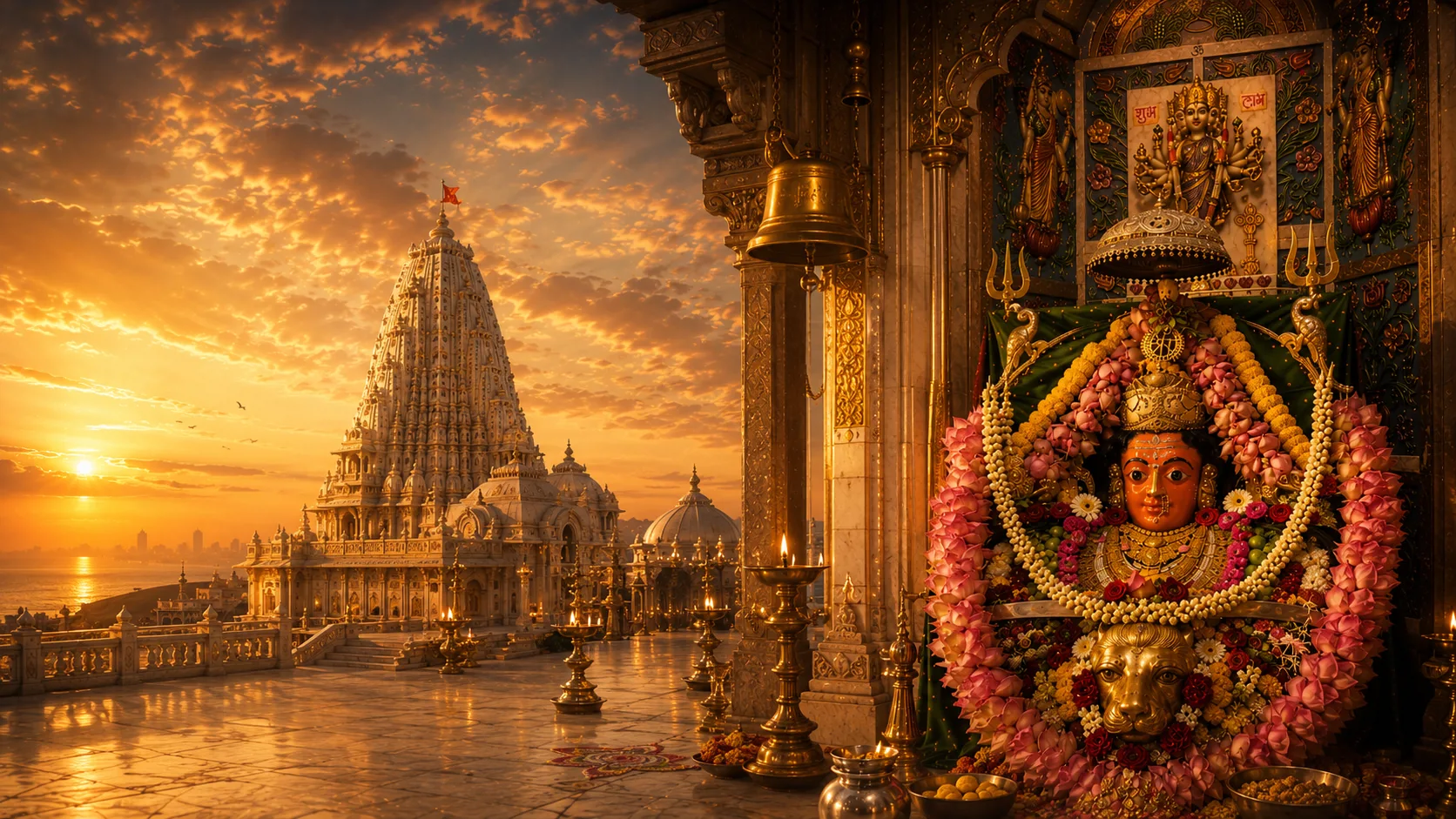
Before the Name
Stone-Age shore, Mauryan port, and the black mountain of the monks
Long before it was a stock exchange, before it was a studio, before it was called anything at all, it was a scatter of low islands in a warm sea — seven of them, wooded and tidal, where the Arabian Sea worked its way into the Konkan coast. The sea came in twice a day over mudflats and mangrove; the hills behind were forest; and the channels between the islands filled and emptied with a rhythm that governed every life lived on them. People were here in the Stone Age. In 1939 the geologist K. R. U. Todd found worked stone tools in Pleistocene sediments near Kandivali on Salsette — flint and chert shaped by human hands, lying in ground laid down before any city, any language, any god that can now be named. There is no writing at this level, only the tools. But they establish the first fact of Mumbai, which is that its human story is not a few centuries deep but tens of thousands of years deep, older than every name in this essay.
The first people whose names still survive are the Kolis, the fisherfolk, and the Āgrī, the salt-gatherers — Marathi-Konkani peoples who read water for a living. The Koli name is drawn from the Marathi for one who works the nets, and the settlements they built along the shore, the koliwadas, are still there: Worli, Mahim, Sion, Versova, Khar Danda, Chimbai, Colaba. Their villages predate every fort and every treaty in the story that follows. It was the Kolis who named the islands' deity and, through her, the city; and it is worth saying plainly at the outset that the oldest continuous human community in Mumbai is not any of the merchant or colonial populations who arrived later, but the fishing families who were on this shore when it was still only a shore.
The islands enter written history through trade. Up the coast stood Sopārā — Sanskrit Śūrpāraka, the Suppāraka of the Buddhist Jātakas, the Supara of Greek writers and the Subara of the Arabs — capital of the northern Konkan and one of the great ports of the ancient western world. Ships out of Sopārā carried Indian cotton and pepper to Rome and returned with gold, horses, wine and glass. By the third century BCE this coast had been drawn into the widest embrace an Indian polity had yet achieved: the Maurya Empire under Aśoka, whose rock edict stands at Sopārā to this day — the south-westernmost of all the Ashokan inscriptions, the Dhamma carried in Prakrit to the very lip of the sea. Around 150 CE the Greek geographer Ptolemy, cataloguing the known world from Alexandria, marked this cluster on his map and called it Heptanesia — "the seven islands." The number that Bombay's later masters imagined their own discovery had been written in Greek seventeen centuries before them.
Kṛṣṇagiri: the black mountain of the monks
What the Mauryan and post-Mauryan centuries left behind is not ruins but rooms — hundreds of them, cut into the living basalt of the islands' hills. The greatest concentration is at Kanheri, in what is now the Sanjay Gandhi National Park at Borivali, and the name is itself a relic: Kṛṣṇagiri or Kaṇhagiri, "the Black Mountain," for the dark stone from which more than a hundred caves were carved. Excavation began around the first century BCE and continued for nearly a thousand years, into the tenth century CE — one of the longest continuously worked monastic complexes anywhere in India.
What makes Kanheri extraordinary is that its dates are not inferred but read. The Great Chaitya, Cave 3, carries on the jamb of its veranda an inscription of the Sātavāhana king Yajña Śrī Sātakarṇi, about 170 CE; a foundation record names the two merchant brothers, Gajasena and Gajamitra, who paid for it. That detail is worth pausing on: the hall was funded not by a king but by traders, private men endowing the Dharma out of commercial wealth — the same instinct that would build this city's temples, hospitals and colleges eighteen centuries later. Other inscriptions record gifts of caves, water-cisterns and coin from monks, householders, guilds and royalty alike; one names the queen of Vāsiṣṭhīputra Sātakarṇi, a princess descended from the Kṣatrapa king Rudradāman, so that the marriage-politics of the second-century Deccan sit frozen in rock above a rainwater tank. The donors are listed by their home towns — Śūrpāraka, Kalyāṇ, Chemula, Vasai — the whole necklace of Konkan ports feeding one hill.
Kanheri was also a feat of engineering. Channels cut into the rock gathered the monsoon and fed great cisterns, so that a community could live year-round on a dry hill; there are benches, steps, drains, and a colossal standing Buddha. It was known far beyond India: when the Chinese pilgrim Xuanzang passed through in the seventh century the monastery was a living seat of learning, and tradition holds that Sanskrit manuscripts and an image of Avalokiteśvara travelled from here to China. Mumbai was an international university of the Dharma a thousand years before it was a stock exchange — and the caves at Mahākālī in Andheri, at Jogeshwari, at Mandapeshwar, say the same thing in smaller voices across what are now suburbs.
Around and after the Sātavāhanas the islands passed through one indigenous house after another: the Ābhīras, who held western Maharashtra for some 167 years; the Vākāṭakas of Vidarbha, patrons of Ajanta; the Kalachuris, devout Śaivas, of whom much more shortly; the Konkan Mauryas, their feudatories, under whom the Jogeshwari caves were cut around 520–550; the Chālukyas, when Pulakeśin II took this coast about 610; the Rāṣṭrakūṭas after Dantidurga's conquest in 749–750; and finally the Śilāhāras, who ruled from roughly 810 to 1240 and issued their charters in Sanskrit engraved on copper in early Devanāgarī. For some fifteen hundred years the islands passed from one Hindu and Buddhist house to another, and each left something in the stone.
Key figures
| 7 | islands — "Heptanesia" to Ptolemy, c.150 CE |
|---|
Mumbā Āī — The Great Mother
The Goddess who gave the city her name, and the people who kept her
The city's true beginning is not a fort or a treaty but a shrine. Its name is Marathi, the language of this coast and this people: मुंबा देवी, Mumbā Devī, joined to आई — āī, "mother" — to give Mumbā-āī, "Mother Mumbā," from which the modern name descends. She is the kuladevatā of the Koli fisherfolk and the grāma-devatā of these islands, and she is understood as a form of the Devī, the Mother-Goddess herself. The standard reading takes Mumbā as a worn-smooth form of Mahā-Ambā, "Great Mother"; a parallel Koli tradition remembers a fisherwoman named Munga who raised the first shrine, so that the deity was called Mungā-chī Ambā, Munga's Ambā. Contested Both roads arrive at the same door — the Goddess, and her people, present here before every flag.
The itihāsa of the Goddess has the shape such accounts always have, and its ending is unusual enough to be worth attending to. A demon named Mumbāraka terrorised the islanders. In answer to their prayers a Goddess was brought forth — eight-armed in one telling — to destroy him. She overcame him; and then, defeated and at her feet, he begged a strange boon. He asked that she take his name, and that he be permitted to raise a temple in her honour. She granted it. So the name of this city encodes not merely a victory but an absorption: the vanquished evil folded into the name of the power that overcame it, its destructive energy converted into a shrine. It is a story about a place that takes what comes for it and makes it part of itself, and the whole subsequent history of these islands can be read as a commentary on that one remembrance.
A second tradition, older-feeling and salt-worn, tells that Śiva once came to these waters in the form of a fisherman and, not knowing who she was, married the Goddess; when her identity was revealed, the fisherfolk begged her to remain among them always, and she stayed as their village-mother, their Mumbā-āī. It is a Koli story, and it says something the copper plates cannot: that on these islands the divine did not descend from a remote heaven but rose, wet and near, out of the same sea the fishermen worked. The city's oldest theology is a marriage between God and the shore.
The demon asked that his conqueror take his name, and she granted it. The city has been keeping that bargain ever since — absorbing what came for it, and turning even its defeats into its own. — On the itihāsa of Mumbā Devī
The shrine that kept moving
The temple's own history is a record of the city's disturbances. The first shrine, the fisherfolk's own, is said to have stood near Bori Bunder, by the creek landing — ground on which Victoria Terminus would later rise, so that the trains which are now the city's arteries begin from the site of its first altar. Devotion to Mumbādevī is attested from at least the fifteenth century, and a temple is recorded at Bori Bunder around 1675. That shrine was dismantled around 1737 in the course of colonial building and the deity moved to Phansi Talao; further destruction followed between roughly 1739 and 1770; and the temple was re-established at Bhuleshwar, in what is now Zaveri Bazaar, where it stands today. Three times displaced in a single century, and never once abandoned.
In the sanctum the Goddess is a black stone image, robed, with a silver crown, a nose-stud and a gold necklace, flanked in her shrine by attendant deities. She is petitioned for health and prosperity, for victory in contests, for eloquence, for children. Navrātri fills the lanes around her. And the setting is itself an argument: the temple sits at the dead centre of the steel, cloth and jewellery markets, so that one reaches the Mother of the city by pushing through the commerce of the city — porters, handcarts, brokers, the shout of trade on every side. Mumbai has never separated its wealth from its worship, and Mumbādevī in her market is the plainest statement of that fact.
The Koli world
Her people are still here. The koliwadas persist as urban villages inside the metropolis — Worli, more than five hundred years old, surrounded by sea on three sides beneath the Bandra-Worli Sea Link; Mahim, Sion, Versova, Madh, Gorai, Chimbai in Bandra, Machhimar Nagar at Cuffe Parade — narrow lanes, bright boats drawn up, nets spread to dry, the smell of the day's catch. The old place-names of the city are Koli names: Kolbhat, the Kolis' place, became Colaba; Palva Bunder became Apollo Bunder. Their great festival is Nārali Pūrṇimā, the coconut full-moon at the close of the monsoon, when coconuts are offered to the sea, boats are worshipped, and the fishing season opens with song — san aaila go narali punvecha. They keep Shimgā, their Holi, and Ganeshotsav, and their women, independent and formidable, are among the most recognisable people in the city, boarding the local trains at dawn in bright nine-yard sarees with baskets of fish, taking no nonsense from anybody.
Under Portuguese rule many Kolis were converted, producing the Christian Koli community that still lives alongside its Hindu kin in the same koliwadas, keeping the same sea festivals — Nārali Pūrṇimā observed by both, because the sea does not ask a man his religion before it takes him. Today the koliwadas are under the heaviest pressure in their history, not from muskets but from land values: fishing villages sitting on some of the most expensive coastline on earth, their creeks polluted, their catch declining, their tenure contested. The oldest community in Mumbai is now among its most precarious.
Rāma on the Shore
The Rāmāyaṇa in Mumbai — the sand-liṅga, the arrow, and the little Vārāṇasī
On Malabar Hill, the highest ground in the city, stands the oldest surviving sacred complex in Mumbai — and it is a Rāmāyaṇa site. The tradition holds that Rāma, journeying south with Lakṣmaṇa in search of Sītā after her abduction, halted on these islands. A ṛṣi who found the two young men on the shore heard their story and counselled Rāma to worship Śiva before continuing. Lakṣmaṇa was sent to Kāśī to bring a liṅga. He was long in returning; and Rāma, unwilling to delay the worship further, took the sand of the beach in his hands and shaped a liṅga from it. That image is Vālukā-Īśvara — vālukā, sand; īśvara, lord — the Lord of Sand, worn in Marathi speech to Walkeshwar. The liṅga worshipped in the temple today is held to be that one.
The second half of the story gives the place its water. The worship completed, Rāma was thirsty; and though the sea lay all around, there was no sweet water anywhere. In the most widely told version Lakṣmaṇa — who had already kept his brother waiting once and would not do so twice — set an arrow to his bow and loosed it into the ground, and fresh water sprang up where it struck: a tributary of the Gaṅgā herself, answering an arrow a thousand miles from her bed. Hence Bāṇa-gaṅgā, Bāṇagangā — the Ganga of the arrow. In other tellings the arrow is Rāma's own; in another the shaft is loosed by Paraśurāma, who by Konkan tradition raised this entire coast from the sea, and who has his own temple at the tank's edge. A pole and a saffron flag stand today in the middle of the water marking the spot where the arrow is said to have struck. Smrti
A liṅga made of sand because the true one had not come in time; a river summoned by an arrow because the sea was undrinkable. The Rāmāyaṇa's memory of these islands is a memory of improvisation under pressure — which is the city's own genius, four thousand years early. — On Walkeshwar and Bāṇagangā
Behind what the tradition holds stands hard history. The temple and the tank were built in 1127 CE by Lakṣmaṇ Prabhu, a minister at the court of the Śilāhāra kings of Thane, who then ruled these islands. The tank is spring-fed, which is the quiet miracle of the place: a body of sweet water a few dozen metres from the Arabian Sea, which has never gone salt and has never run dry. It is rectangular, stepped on all four sides with stone ghats, some thirty-three feet deep, with carved dīpastambhas — lamp-pillars — at its entrances in a style that mixes Konkan and Deccan work.
For centuries pilgrims came here from across western India by sea, mooring at Lakdi Bunder — today's Chowpatty — climbing the stepped pathway then called Sidi Road, and walking the ridge of the hill down to the tank to perform their rites. It became a tīrthakṣetra, a place of pilgrimage in its own right, and around it grew a whole sacred quarter. In the sixteenth century the Portuguese destroyed the temple. In 1715 it was rebuilt with a donation from Rāma Kāmath, a Gauḍ Sāraswata Brāhmaṇa merchant and philanthropist — the "Kamati" of British records — and the tank was restored with it. By 1860 ten to twenty further temples and some fifty dharmaśālās had gathered around the water.
Today the complex holds around a dozen temples and shrines, owned and maintained by the Gauḍ Sāraswata Brāhmaṇa trust, whose priestly families still live within it. Among them are the Śrī Kāśī Maṭha and the Śrī Kaivalya (Kavale) Maṭha, with the samādhis of their past heads; the Paraśurāma temple; the Venkateśvara Balājī temple of 1789, in Maratha style, which is the kuladaivat of the Koli community; and the Rāmeśvara temple of about 1825. The samādhis of the Advaita teachers Siddharāmeśvara Mahārāj, Raṇjit Mahārāj and Nisargadatta Mahārāj are here — so that a twentieth-century lineage of non-dual teaching, known now across the world, rests beside a Tretā-Yuga remembrance.
The rites have never stopped. Pūjā, śrāddha for the ancestors, naming ceremonies, parikramā around the tank; funeral rites on the ghats, at a crematorium within the complex. At Dev Dīpāvalī in November the steps fill with lamps until the whole tank is ringed with flame, and the resemblance to the Ganga āratī at Vārāṇasī is so strong that Mumbaikars simply call this their little Vārāṇasī. Each January the Bāṇagangā festival brings classical music to the ghats. And all of it sits perhaps two hundred metres from Malabar Hill's towers, in the most expensive real estate in India — a Rāmāyaṇa tīrtha on the roof of the modern city, still spring-fed, still lit.
यतो धर्मस्ततो जयः
"Where there is Dharma, there is victory." For a thousand years these islands were a place where the Dharma was carved into the hills and endowed by merchants who signed their gifts in Brahmi — a sea-power's sanctuary long before they were anyone's colony.
Ghārāpurī — The City of Caves
Who built Elephanta, why, what it holds, and how one reaches it
Out in the harbour, an hour from the Gateway of India, lies the island the people of this coast call Ghārāpurī, and on it stands the single greatest thing Mumbai possesses. The Elephanta Caves are not built; they are subtracted — hewn out of solid basalt hillside, so that the halls, the pillars, the shrines and the colossal figures are all one continuous piece of rock with the island itself. Seven excavations survive: five Hindu caves on the western hill, two Buddhist on the eastern, with stupa mounds and water cisterns attesting to a monastic presence on the island from perhaps the second century BCE. The site was inhabited long before the caves; coins of the Sātavāhanas, the Kalachuris and the Konkan Mauryas, many bearing maritime symbols, have been recovered from it.
Who cut them, and why
No dedicatory inscription survives inside the caves — a Brahmi panel is said to have stood over the entrance to Cave 1 and to have been removed and lost by the Portuguese, an act of vandalism that erased the site's own testimony about itself. In its absence the builders are argued from style, from architecture and above all from coin. The strongest case, made by the epigraphist V. V. Mirashi and supported by the art historian Walter Spink, credits the Kalachuri dynasty and specifically the king Kṛṣṇarāja, dozens of whose copper coins have been excavated on the island. Contested The Kalachuris ruled from Māhiṣmatī on the Narmadā; they were the one power in this region with the resources for an undertaking of this scale in the sixth century; and, decisively, they were committed Pāśupata Śaivas.
That last point explains the caves. Pāśupata Śaivism is the earliest known Hindu sect to worship Śiva as the supreme reality, traced to the sage Lakulīśa — held to be the twenty-eighth and final incarnation of Śiva — whose figure is carved into these walls and into the related caves at Jogeshwari and Mandapeshwar. Elephanta is not a village shrine that grew; it is a royal theological statement, a Pāśupata cathedral cut by a dynasty that held Śiva to be everything, placed on an island in the greatest natural harbour of the western coast, where every ship entering these waters would know it was there. The main cave's plan is close kin to the Dhumar Lena (Cave 29) at Ellora, and the same hands or the same school clearly worked at Jogeshwari and Mandapeshwar on the main islands.
Its political importance is legible too. The Aihole inscription of the Chālukya emperor Pulakeśin II praises the taking of a place called Purī, "the Fortune of the Western Sea," in a great naval assault — and for over a century historians have argued that this maritime Purī is Ghārāpurī. A Chālukya copper plate found on the island itself, and recent Archaeological Survey excavations at Morabandar on its shore, have not settled the question but have placed Ghārāpurī firmly inside the political and naval world of coastal India. Contested This quiet island was once a sea-power's prize, worth a fleet.
Inside the Great Cave
Cave 1, the Great Cave, runs about 39 metres from the entrance to the back wall; the main hall, excluding the porticos on three open sides, is a 27-metre square carried on rows of six columns each, their cushion capitals fluted. The plan follows a maṇḍala conception, shrines and panels placed in symmetry around a centre. There are three open sides, so that light enters from north, east and west and moves across the sculpture as the day turns — but the core shrine itself has no natural light, and was lit by lamps and torches, the figures emerging and receding as the flames moved.
At the centre stands a free-standing square shrine holding the Śiva-liṅga, raised on a high plinth, with four doorways aligned to the cardinal directions, each flanked by pairs of dvārapālas four and a half metres tall, leaning on dwarf attendants. Around the walls, in deep recesses carved almost in the full round, are the great narrative panels — one of the most important sculptural cycles in India:
Naṭarāja, Śiva as the cosmic dancer, limbs curved in the rhythm of creation and dissolution, one surviving hand holding fire, another raised in abhaya, protection. Ardhanārīśvara, the composite half-male, half-female form, five metres high, the body set in tribhaṅga, the triple bend, so that one half of the figure reads as Śiva and the other as Pārvatī, a mirror in the upper left hand, the lower right resting on Nandi — the single most economical statement of the union of the masculine and feminine principles in Indian art. Gaṅgādhara, Śiva receiving the descending Gaṅgā in his matted hair to spare the earth the shock of her fall. Kalyāṇasundara, the wedding of Śiva and Pārvatī. Yogīśvara, Śiva seated in padmāsana in meditation, attended by Brahmā and Viṣṇu. Andhakāsura-vadha, the slaying of the demon Andhaka, the fiercest panel in the cave. Rāvaṇānugraha, Rāvaṇa straining beneath Kailāsa to shake it, and Śiva pressing it down with one toe. A panel of the Saptamātṛkās, the seven mothers, near the eastern opening. And Lakulīśa, the sect's founder, marking whose caves these are.
And on the south wall, facing the entrance on the north-south axis, the Trimūrti Sadāśiva — the Maheśamūrti. Between five and six metres high, three faces emerging from the rock: Aghora or Bhairava on the left, fierce, the destroyer; Tatpuruṣa or Mahādeva at the centre, full-face, serene, the preserver; Vāmadeva or Umā on the right, gentle and feminine, the creator. It is not a portrait of three gods but of one reality in three aspects, and it is carved so that the whole vast hall is oriented toward it. Whatever a visitor expects on the boat over, this is generally not it. Standing before it is the moment most people who come here remember for the rest of their lives.
The name: why "Elephanta," and what it displaced
The island's own name is Ghārāpurī — घारापुरी — read as "the city of caves," or by an older derivation Agrahāra-purī, the town of the agrahāra, the land-grant settled on Brāhmaṇas for learning and worship. Either reading names a civilisation: a settlement, a sacred seat, a community of priests and sculptors. It is the name the people of this coast have used for as long as there is record; it remains the name in Marathi — घारापुरीची लेणी, the caves of Ghārāpurī — and it is the name of the village that stands on the island today.
"Elephanta" is not a translation of that name, nor a corruption of it, nor related to it in any way. When the Portuguese came in the sixteenth century, there stood near the southern landing-place a colossal free-standing basalt sculpture of an elephant. They named the island after that object — Ilha Elefante, "Elephant Island" — and the label passed into English as Elephanta. The caves, carved a thousand years before any Portuguese ship existed, took the name of the island's new label.
The substitution is worth weighing precisely, because it is the whole colonial habit in a single word. Ghārāpurī describes what the place is: a city of caves, a granted seat of the sacred. "Elephanta" describes what a stranger noticed from the water — one stone animal at the shoreline, unconnected to Śiva, to the Trimūrti, to the Pāśupata theology worked into every wall, to anything the sculptors intended or the pilgrims came for. A name about devotion was replaced by a name about a beast, and the replacement held for five centuries because those who imposed it drew the maps.
The last turn of the story is almost too apt. The Portuguese afterwards attempted to carry the elephant itself away; the attempt failed and the sculpture broke. It was eventually removed to the mainland and set up in the Jijamata Udyan at Byculla, where it stands today, far from the island it named. So Ghārāpurī now carries in the world's atlases the name of an animal that is no longer even on it — while its own name, the one that means something, survives in Marathi speech, in the village, and in the notices of the Archaeological Survey. There is a growing argument, and a sound one, that the older name should be restored to common and official use. Ghārāpurī did not need a Portuguese ship to give it a name. It had one.
The journey: an hour across the harbour
Reaching the caves is part of what they are, and the way has changed less than one might expect. There is no road and no railway to the island; the only approach is by water, as it was for every pilgrim who ever came. Boats leave from the Gateway of India in Colaba — from Jetty No. 5, the Taj Mahal Palace standing at one's back — the first around nine in the morning, then every half hour or so, the last outbound in the early afternoon. The caves keep the Archaeological Survey's hours and are closed on Mondays, when no ferries run at all. Through the monsoon, when the sea turns rough and the high tides come, crossings are delayed or suspended altogether; the best months are the cool ones, November to March.
The crossing takes about an hour over some ten or eleven kilometres of Mumbai Harbour. The city falls away behind — the arch, the hotel, the cranes and gantries of the docks, the anchored freighters, the naval yard — and for a stretch in the middle there is only water, the low green line of the island ahead, and the gulls that follow the boats the whole way, hanging off the stern and taking scraps out of the air. It is the one hour in which Mumbai loosens its grip. Passengers who boarded talking generally stop.
The boat comes in at the island jetty, and from there a causeway runs about a kilometre to the foot of the hill. It can be walked in ten or fifteen minutes along a path lined with stalls — wooden carvings, beads, cold drinks, cut fruit — or covered on the small open-carriage toy train that runs the length of the pier for a few rupees. Then the climb: 120 stone steps up the hillside, shaded under tarpaulin, flanked the whole way by more stalls and by monkeys entirely unbothered by human beings, who will take an unguarded packet of food without hesitation. For those who cannot manage the stairs, palanquin-bearers wait at the base and carry visitors up as they have always done. There is a village on the island, and its people have lived from these visitors, and from fishing, for generations.
Then the steps end, the hillside opens, and one walks out of the heat and the noise of the stalls into the Great Cave — into cool, dim, enormous stone; the pillars receding, the dvārapālas at the shrine, and at the far wall the three faces emerging from the rock. Each February the Elephanta Festival brings classical music and dance to the site. And on Mahāśivarātri the old rite returns to the cave as it has done without a single break through Portuguese muskets, colonial neglect, and modern tourism alike.
Key figures
| mid-6th c. | cut under the Kalachuri king Kṛṣṇarāja |
|---|
The Sacred Geography
Mahālakṣmī raised from the sea, Siddhivināyaka, Babulnāth, and the deities who would not leave
Beyond Mumbādevī, Walkeshwar and Ghārāpurī, the islands carry a dense sacred geography, and several of its shrines have origin stories that say something exact about the city's history — particularly about what was hidden to survive invasion, and what was recovered afterwards.
Mahālakṣmī: the goddesses raised from the sea
The most telling of these belongs to the Mahālakṣmī temple at Breach Candy, and it joins the sacred and the engineering history of Mumbai in a single episode. In the late eighteenth century the British Governor William Hornby undertook the Hornby Vellard, the great causeway intended to dam the Worli breach and stop the sea flooding the low ground between the islands at every high tide — the project that began the physical welding of the archipelago into one landmass. It failed repeatedly; the sea wall was breached and carried away more than once, and the work stalled.
The chief engineer on the works was Rāmjī Śivjī Prabhu, a Pāṭhāre Prabhu — of the community Rājā Bimb had settled on these islands five centuries earlier. Tradition holds that the Goddess appeared to him in a dream and told him that three images lay on the seabed off Worli, and that the sea wall would hold only when they were raised and housed on the hillock above. He gathered boats, and with the help of the local Koli fishermen — who knew that water as no one else did — cast nets into the sea. Three images were brought up: Mahālakṣmī, Mahākālī and Mahāsarasvatī, the Tridevī of the Devī Māhātmya. A temple was raised for them on the hill; the Vellard was completed without further collapse; and Hornby granted Prabhu the land.
What the tradition says about the images is the historically pointed part: they had been placed in the sea, generations earlier, to hide them from invaders — and they lay underwater for decades until the Goddess called them up again. Whether one reads that literally or as folk memory, it records something true about this coast: that in the centuries of destruction, images were concealed — buried, sunk, walled up, carried away — and that a great deal of what stands in Mumbai's temples today is material that survived by being hidden. The temple was enlarged in 1831 by the merchant Dhākjī Dādājī into the structure known today, its three goddesses in the sanctum adorned with gold and pearl, Mahālakṣmī at the centre holding lotuses. Navrātri here fills the whole hillside above the sea.
Siddhivināyaka, Prabhādevī, Babulnāth
At Prabhādevī stands Śrī Siddhivināyaka, consecrated on 19 November 1801 by Laxman Vithu and Deubāī Pāṭil — a Koli woman, childless herself, who endowed a temple so that other women's prayers for children might be answered. It began as a small structure housing a black stone Gaṇeśa two and a half feet wide, whose trunk turns to the right — the siddha form, held especially potent and especially demanding. From that modest shrine it has become the most visited temple in the city, its Tuesday queues running for hours and on occasion for a day, drawing industrialists, film stars, cricketers and hundreds of thousands of ordinary devotees who come before beginning anything that matters.
A few lanes away is the temple that gave the neighbourhood its name: Prabhādevī, whose image — Śākambharī Devī, a form of the Mother — is held to date from the twelfth century and to have been the kuladevī of Rājā Bimb himself, brought by him when he founded Mahikāvatī. Through the centuries of invasion the image was moved and hidden repeatedly; it was re-enshrined in its present form in 1715 by members of the Pāṭhāre Prabhu community after a vision. Bimb's dynasty is gone, his kingdom is a memory in a Marathi chronicle, and his family goddess is still receiving flowers in a lane in central Mumbai.
At the foot of Malabar Hill, above Chowpatty, stands Babulnāth, the Śiva temple whose foundation is credited to Bimb's time and whose name comes from the babūl trees of the forest that once covered this low ground. The liṅga here is held to be svayambhū, self-manifested, found by a cowherd whose cow gave her milk each day at one spot in the scrub. Its spire rises over Marine Drive; its long flight of steps is climbed at dawn by people who will spend the day in the towers behind it, and on Mahāśivarātri the queue runs down the hill to the sea road. The causeway the Goddess is said to have secured still carries the traffic of the city past her hill, every hour of every day.
Nor are these the whole of it. Mahālakṣmī, Mumbādevī and Walkeshwar are the three great anchors — the Goddess of wealth above the sea, the Mother who named the city in the heart of its market, and the Lord of Sand on its highest ground — but around them the islands carry a full Sanātana landscape. The Mahālakṣmī hillside and the Mumbādevī lanes fill for Navrātri. Śrī Siddhivināyaka at Prabhādevī draws the longest queues in the city. The Walkeshwar complex holds a dozen shrines around Bāṇagangā — the Paraśurāma temple to the ṛṣi who by Konkan tradition raised this coast from the sea; the Venkateśvara Balājī temple of 1789 in Maratha style, kuladaivat of the Koli community; the Rāmeśvara temple of about 1825; the Śrī Kāśī Maṭha and Śrī Kaivalya Maṭha of the Gauḍ Sāraswata Brāhmaṇas with the samādhis of their ācāryas. Across the water at Ghārāpurī, Śiva in the basalt. In the north, the Jogeshwari caves — Yogeśvarī, the Goddess of yoga, cut in the sixth century and still worshipped — and Mandapeshwar, and the Mahākālī caves at Andheri. At Matunga the Kāśī Viśveśvara temple preserves what the original Siddhivināyaka looked like. And in every ward, in lanes with no name a visitor would recognise, the small Gaṇeśa and Hanumān and Devī shrines that a neighbourhood has kept for two centuries and will not give up for any price offered.
What binds these shrines is not architecture — they are of many periods and styles — but a single pattern repeated across eight centuries: displacement and return. Mumbādevī moved three times and stayed. Walkeshwar was razed and rebuilt. Prabhādevī was hidden and re-enshrined. Mahālakṣmī's images were sunk in the sea and raised. The sacred geography of this city is not a set of monuments that survived intact; it is a record of things concealed, carried, recovered and put back — by communities who kept doing it, generation after generation, whoever happened to be ruling.
The Last Hindu King, and the Sultanates
Bimb of Mahikāvatī, Nāgardev's last stand, and 186 years
As the Śilāhāra age closed and the Yādavas of Devagiri rose, a king remembered as Rājā Bimb — Bhīmadeva — crossed into the Konkan. The fifteenth-century Marathi chronicle Mahikāvatīchī Bakhar, the single most important source for this period of the islands, gives his story; Persian records of 1436 and 1495 corroborate parts of it, naming a "Bimbashah," son of Rāmadeva of Devagiri, who fled to this coast after his father's defeat by Alāuddīn Khaljī and took possession of the coastal territories. A donation record of 1299 shows king Bimbadeva granting land in present-day Mumbai to his rājaguru, Puruṣottam Pant Kavle.
On the island of Māhīm he founded a city he called Mahikāvatī — whence Mahim — and the Gazetteer's description of what he found is haunting: "a desert island, washed by the waters of the western sea and sparsely peopled by families of Koli fishermen." There he built a city, a palace, and a hall of audience and justice at Naigaum in what is now Dadar. The region came to be called Bimbasthāna, the realm of the Bimba line. He raised a temple to his family goddess Prabhādevī, and is credited with the Babulnāth Śiva temple, named for the babūl trees of the island forest — he had come from the country of Somnāth and carried that Śaiva devotion with him.
Most consequentially, he brought people. The Pāṭhāre Prabhus, the Yajurvedī Brāhmaṇas, the Bhaṇḍārīs who were toddy-tappers and seamen, the Vāḍvals who were gardeners — the administrative, priestly and cultivating communities who would form the backbone of these islands for the next six centuries. He is said to have introduced fruit-bearing trees, and the coconut palm that would come to define the Konkan shoreline. The scholarly view is that this settlement was not one dramatic migration but a process spread across the whole Śilāhāra period, with Bimb's reign marking its culmination rather than its beginning. Either way the effect is the same: a functioning Hindu polity, with a court, a law-court, temples, and settled communities of Brāhmaṇas and administrators, existed on these islands three centuries before any European held them. And when Bimb arrived, the chronicle notes, only two temples stood on the main island — Walkeshwar and Mumbā Devī — and both were already old.
1347: the last stand at Māhīm
The end came in 1347. Bimb's line had passed to his son-in-law Nāgardev, who ruled the islands from about 1331. In that year a general of the Delhi Sultanate, Nika Malik, launched a three-pronged assault on Thāṇā, Māhīm, and Rāṛjāpore near Marol. Nāgardev fell defending his capital. His queen took up the fight after him, and was killed in her turn. With those two deaths ended, after some fifteen hundred years, the sovereignty of Hindu rulers over the islands of Mumbai. It is a fact worth stating plainly, because it is almost never told: the last defence of independent Mumbai was made by a king and a queen who both died with weapons in their hands, and no monument in the city marks it.
From 1348 the islands were under Muslim rule, and would remain so for one hundred and eighty-six years. That rule was not one settled dominion but a long contest fought over the islands' heads. The Muzaffarids held them first; in 1391, with the founding of the Gujarat Sultanate, a governor was appointed over Māhīm. Under Ahmad Shāh I (1411–1443) the revenue system was tightened and extraction organised. Early in the fifteenth century the Bhaṇḍārīs — one of the very communities Bimb had settled — rose and seized Māhīm from the Sultanate, holding it for eight years before Rai Qutb reconquered it: a forgotten local revolt that deserves to be remembered. By 1429 the Persian historian Firishta records that the Gujarat Sultanate had moved its seat of government in north Konkan from Thāṇā to Māhīm, and the islands were then fought over between Gujarat and the Bahmani Sultanate of the Deccan, taken and retaken by siege and naval blockade, with fleets sent from Diu and Khambhat.
The old order was not merely displaced but administratively overwritten. The temple endowments and copper-plate grants of the Śilāhāra centuries gave way to a governor's revenue roll; the shrines passed out of royal patronage into the keeping of their communities alone — which is precisely why the pattern of hiding, moving and rebuilding images, traced in the previous movement, begins in this period and continues for centuries. The great mosques and dargāhs of the islands date from this era, Māhīm's among them. Then, in 1534, a Gujarat sultan pressed by the expanding Mughals made the bargain that changed everything.
The Desecrations
Muskets at Ghārāpurī, demolition by decree on the coast
By the Treaty of Bassein, signed on 23 December 1534 aboard the galleon São Mateus, Bahādur Shāh of Gujarat ceded Bassein and its dependencies — Salsette, Mombaim, Parel, Wadala, Sion, Worli, Mazagaon, Thāṇā, Bandra, Māhīm, Karanja — to the Portuguese. They named the harbour Bom Bahia, "good bay," which English mouths turned into "Bombay." Under Lisbon came forts, friaries, a shipyard, churches, and a colonial administration that would hold this coast for two centuries. It also brought the most systematic assault on the islands' sacred landscape in their history.
When Ghārāpurī passed to the Portuguese, the island's thousand-year life as a living Śiva sanctuary ended. Soldiers, seeing idolatry where the sculptors had seen the cosmos, used the great reliefs of the main cave for target practice. The evidence is on the walls still: shattered lower panels, hands struck off, faces mutilated, bullet-marks in the basalt. Settled The dvārapālas, whose whole purpose was to keep the ill-intentioned from the shrine, did not perform their duty in those years. The dedicatory Brahmi inscription over the entrance to Cave 1 was removed and lost — so that the site was robbed not only of its images but of its own testimony about who made it and why, which is the reason its builders must now be argued from coins. The island's population declined; after a thousand years of worship the caves stood empty; and of the old ritual life only Mahāśivarātri survived. The colossal Trimūrti was largely spared the muskets — though even it faced attempts at disfigurement as late as 1865, under the next flag.
Portuguese soldiers used the reliefs of Śiva in the main cave for target practice, sparing only the Trimūrti. The stone gatekeepers, whose task was to keep the ill-intentioned away, did not perform their duty in those years. — On the desecration of Ghārāpurī after 1534
What happened at Ghārāpurī was not the accident of undisciplined soldiers; on the wider coast it was policy. In the Portuguese-held ring around the islands — Salsette, Bassein, Bandra, Thāṇā — the sixteenth and seventeenth centuries brought the Inquisition, forced conversion, and the razing of temples. Christian and Portuguese sources themselves recorded the scale. Non-Christians were barred from public office; decrees forbade the building of new temples and the repair of old ones; and a royal letter of 1569 recorded that Hindu temples in the Portuguese Indian possessions had been demolished and burnt — desfeitos e queimados. Settled In the History of Christianity in India the count for Salsette alone runs to 280 temples destroyed. Walkeshwar, the Rāmāyaṇa temple on Malabar Hill, was among the casualties. Many Pāṭhāre Prabhu families fled to Salsette and to Maratha-held territory rather than convert, returning only after the English took the islands. Many Kolis, unable to leave the shore they lived from, converted where they stood — which is why Christian Koli families keep Nārali Pūrṇimā beside their Hindu kin to this day.
A note on a contested record
The scale of Portuguese temple-destruction on this coast is documented in Christian and Portuguese sources alike, which is why it can be stated firmly. A few present-day writers argue that some razed shrines belonged to local cults later absorbed into Hinduism, and it is true that Maratha campaigns in the following century destroyed Portuguese churches in turn. Neither qualification alters the central, sourced fact: a living sacred landscape was attacked by decree, and its people were made to convert or flee.
The Marathas at the Harbour's Edge
Shivaji's fleet, the fort built under the guns of Bombay, and the reconquest
The Portuguese held this coast for two centuries, and when their grip finally broke it was not the English who broke it but the Marathas — whose story runs directly up to Bombay's shore, and whose founder took a documented, personal interest in this harbour.
Chhatrapati Shivaji Maharaj and the sea
Alone among the Indian powers of his age, Chhatrapati Shivaji Maharaj grasped that a coast cannot be defended from the land. When he took Kalyāṇ and Bhiwandī in the 1650s and made the Konkan a centre of his power, he did what no Deccan sovereign had done: he built a navy. The first Maratha vessels were laid down in the creeks near Kalyāṇ around 1654 — the neighbouring forests supplying the timber, Kalyāṇ being already a shipbuilding centre — and a Portuguese despatch of the period, alarmed, reports that "a son of Shahji, rebel captain," had made himself master of the lands near Bassein and Chaul and was building ships of war at Bhiwandi, Kalyāṇ and Panvel, ordering their captain not to let them out to sea. It is the earliest reference to Shivaji's fleet, and it comes from a frightened rival.
He built naval bases along the whole coast and organised two fleets, at their height numbering some two hundred vessels of various sizes — fast, shallow-draught grabs and gallivats that could not match European broadsides in open water and were never meant to, being designed instead for gaṇimī kāvā, the guerrilla method, carried onto the sea. His crews came largely from the Koli and Bhaṇḍārī fisherfolk of this coast, men born to the water; his admirals were Maynak Bhandari, Daulat Khan and Daryāsāraṅg. It was said of him that Shivaji carried the capital of his empire on the high seas.
Khanderi: a fort under the guns of Bombay
This brought him to the doorstep of English Bombay. On 28 November 1670 Shivaji personally surveyed the island of Khanderi, some eleven miles off the harbour mouth, spending three days on it with a large force and deciding to fortify it. The English watched with mounting anxiety — a letter of 9 September 1671 reports his intention to build there; their correspondence frets for years over "Henery Kenery," their mangling of Khanderi and Underi. The island's position was the point: it sat between the Siddi stronghold of Janjira and the English harbour, and a fort on it would command the sea route into Bombay and cut English reinforcement of the Siddi. An initial attempt in 1672 was abandoned under English and Siddi pressure.
He returned in earnest. The foundation ceremony was performed on 14 August 1678, and in August 1679 Shivaji sent Maynak Bhandari with arms, ammunition, three hundred picked soldiers and three hundred labourers to build the fort in the middle of the monsoon. The English demanded he stop, claiming the island had come to them with Bombay from the Portuguese. Bhandari's reply is preserved, and deserves to be better known than it is: "I am a servant of Shivaray. Who are you to give me orders? I cannot stop the work until my master bids me stop."
"I am a servant of Shivaray. Who are you to give me orders?" — Maynak Bhandari to the English officers who demanded he halt the fortification of Khanderi, 1679. — The Maratha admiral at Bombay's doorstep
The English deputed the warship Hunter and others to blockade the island and stop the supplies. Daulat Khan brought reinforcements through on 11 September. The English fleet of eight ships fought an action against some fifty Maratha sail and could not dislodge them; and on 17 November 1679 the Marathas captured an English vessel, the Dove. The East India Company called the war off. The Siddi admiral, joining the English as a Mughal ally, then seized and fortified neighbouring Underi for himself — the English commander having realised the Siddi had no intention of handing over anything he took — and the two island forts glared at each other across the water for decades. Khanderi remained Shivaji's while he lived. A Maratha fort had been built and held within sight of Bombay, against the will and the guns of the East India Company.
After Shivaji's death in 1680 the fleet declined under pressure, was carried on by Sambhaji, and was then revived spectacularly by Kanhoji Angre, who took command in 1699 and from his base at Kolaba held the entire coast from Savantwadi to Bombay, checking English, Portuguese and Siddi naval power alike for the next four decades. To the European companies he was a pirate; to this coast he was the last sovereign of its own waters.
The reconquest: Chimājī Appā and Vasai, 1739
The decisive blow to Portuguese power fell in 1739. Under Peshwa Bājīrāo I, his brother Chimājī Appā led a campaign against the Portuguese strongholds ringing the islands — a force of some 40,000 infantry, 25,000 cavalry, four thousand men trained in laying mines, with camels and war elephants. The Portuguese had for two centuries removed Hindus from office and destroyed temples across Sashti and Bardesh; the campaign was understood on this coast as a reckoning for that.
Through 1737 and 1738 the outposts fell — Thāṇā, Parsik, Marol, Uran, Arnala, Kamandurg — while Manaji Angre blockaded the sea. By April 1739 Bandra, Versova and Dharavi were taken and Bassein was encircled by land and water. The siege of Vasai itself began on 1 May 1739 with mines laid beneath the tower of Remedios. Under heavy fire the Marathas pressed the walls for days; on 3 May a mine brought down the tower of São Sebastião and four thousand men stormed the breach. On 5 May 1739 the Portuguese surrendered, and on 23 May the saffron flag flew over Vasai. Two centuries of Portuguese rule on this coast were over; their Indian presence was reduced thereafter essentially to Goa, Daman and Diu.
And Chimājī Appā did something the region has never forgotten. He took the church bells of Vasai as spoils and hung them in Hindu temples across Maharashtra — at the Khaṇḍobā temple at Jejuri, at the Tuḷjā Bhavānī temple, among others. They hang there still, and they still ring. For a people whose temples had been pulled down by decree for two hundred years, the sound of those bells in their own shrines was the plainest possible statement that the account had been settled.
Key figures
| 1654 | Shivaji lays down his first fleet at Kalyāṇ |
|---|
The Merchant City
A dowry, a governor's charter, and the making of a cosmopolis
The islands came to England not by conquest but by marriage. In 1661 Charles II wed Catherine of Braganza, daughter of the King of Portugal, and the seven islands of Bombay were handed over as part of her dowry — bundled almost as an afterthought with Tangier, trading privileges, two million crowns, and a chest of tea that would introduce England to the drink. The Portuguese authorities in Goa obstructed the handover for years, arguing the treaty covered only Bombay island and not Salsette; the first English governor sent to take possession died on Anjediva without ever landing. The crown found the place a costly nuisance, and in 1668 Charles leased the lot to the East India Company for a nominal ten pounds a year.
What the Company understood, and the crown had not, was the harbour: deep, sheltered, and shielded from land attack in a way no rival port on this coast could match. But a harbour is not a city, and what turned one into the other was a decision about people. The second governor, Gerald Aungier (1669–1677), who called Bombay "the city which by God's assistance is intended to be built," made religious freedom and property rights the explicit inducement for settlement — and issued them under the Company's seal.
The results were immediate and are worth setting out concretely. A Gujarati merchant of Diu named Nima Parak agreed to settle on condition that his community might practise its religion without interference; the patent was granted on 22 March 1677, and the door opened. Bhimji Parak, one of Surat's most eminent merchants, migrated to Bombay in flight from pressure to convert under the Mughal governor of Surat — and brought the first printing press. Seventy families of silk weavers were brought from Chaul. Special inducements drew Parsis from Navsari and Surat to build the shipbuilding and weaving trades; the first agiary was founded in the Fort in 1671, and in 1673 Aungier granted land on Malabar Hill for the first Tower of Silence. In 1676 similar terms brought Armenian merchants, and an Armenian church rose inside the Fort. Baghdadi Jews, Dāūdī Bohras, Khojas, Hindu Baniyās, Gauḍ Sāraswata Brāhmaṇas, Pāṭhāre Prabhus returning from exile — all came, and all stayed.
Within a single decade the population rose from about 10,000 to 60,000, revenue tripled, and the Company resolved that half its shipping from London should load directly for Bombay without touching Surat. Aungier established a mint, admiralty courts, the first courts of justice, and a militia raised from Bhaṇḍārī youth — the local seafaring community — which would evolve in time into the Bombay Police. In 1692, when plague killed most of the Europeans on the island and a hostile force gathered to take it, it was a Parsi, Rustomji Dorabji, who raised a militia from the local population and repelled the attack, for which the British granted his family the hereditary title of Patel.
This is the origin of what Mumbai still is. The city was assembled, deliberately, out of people who came from somewhere else and were promised they could keep their gods — and it was defended, from the beginning, by those same people. A Scottish historian summed up Aungier's achievement as welding many communities into one mass. Note what it was not: it was not a British city with Indians in it. From its foundation the commercial life was Indian — Parsi shipwrights, Gujarati and Marwari financiers, Bohra and Khoja traders, Konkani and Marathi labour — and the great civic benefactions came from Indians. Jagannath Shankarsheth and Sir Jamsetjee Jeejeebhoy founded schools, hospitals, roads and libraries; the Wadias built the ships, including vessels for the Royal Navy. The city's wealth was made here, by these communities, and much of it was given back here.
Key figures
| 1661 | handed to England as Catherine's dowry |
|---|
Cotton, Chawl and Plague
The mill city, the festival that became a nation's, and the fight for freedom
Across the eighteenth and nineteenth centuries the sea between the islands was filled in. The Hornby Vellard — the project whose failures brought up the Mahālakṣmī images — and successive reclamations joined island to island, until by 1845 the seven had become a single landmass. The map of Mumbai is not a natural object; it is a work of engineering laid over an archipelago, which is why the sea still returns to certain low places every monsoon, remembering where the channels were.
Then came cotton. The first mill, the Bombay Spinning and Weaving Company, was established at Tardeo in 1854 by the Parsi entrepreneur Cowasji Nanabhai Davar. When the American Civil War cut off Southern cotton from the world's looms in the 1860s, Bombay cotton filled the gap and the city grew violently rich — a speculative mania that made and destroyed fortunes in months. The mills multiplied: ten by 1865, seventy by 1875, over 130 by 1900. The mill district — Girangaon, "the village of mills," running through Byculla, Lalbaug, Parel, Worli, Sewri, Naigaum, Prabhadevi — became the industrial heart of India, and at its height in 1980 some 300,000 people worked in an area of about 600 acres.
The chawl
Those workers came mostly from the drought-prone Konkan districts — Ratnagiri, Satara, Kolaba — and they needed housing. The answer was the chawl: two- and three-storey blocks of single rooms with lofts, opening onto a common corridor, with shared water and shared latrines, three or four buildings grouped around an open space. Men came alone first and later brought their families; a single room might hold eight or ten people; the mill siren governed the day, dawn to dusk with a fifteen-minute break.
What grew in that impossible density was not squalor alone but one of the most remarkable civic cultures in India. Because there was no private space, life became public: the corridor, the courtyard, the common tap. Weddings, funerals, games, plays, political meetings and festivals all happened in the shared ground between the buildings. Neighbours raised each other's children and buried each other's dead. The chawl produced Marathi theatre and tamāśā, the Dalit Panthers, generations of trade unionists, and the particular Mumbai instinct — which survives now in glass towers and on train platforms — that whatever happens, it happens to all of us together.
It also produced the festival that became a national institution. In 1893, defying a British ban on public assembly, Bal Gangadhar Tilak transformed Gaṇeśa Chaturthī from a household rite into a sārvajanik utsav, a public festival — because a religious procession could not be banned the way a political meeting could. Mumbai's oldest public maṇḍal began at the Keshavji Naik Chawl in Girgaon, and Tilak himself graced its dais in 1901. The pandals became meeting-places where freedom was discussed under cover of devotion. Mill workers and fisherfolk pooled wages to commission idols far too large for their one-room homes — a statement as much as a prayer: we may be poor, but our god is grander than any landlord's. In 1934 the fisherfolk and traders displaced from the Peru Chawl market vowed a public installation if they were granted land to rebuild; the land came, and they kept the vow. That idol is Lalbaugcha Rājā, sculpted by the Kambli family for over eight decades, dressed in its first years as a fisherman, and now drawing queues that last a full day and more.
Plague, and the freedom struggle
In September 1896 the bubonic plague arrived through the port. Before it burned out it killed on the order of 25,000 people in the city, and as many again fled. The mills emptied. The colonial state's response — house-to-house search, forcible segregation, the invasion of homes and of women's quarters by troops — generated a resentment that fed directly into the nationalist movement. Density had made the city rich; density now made it lethal; and the manner of the state's intervention taught a political lesson that was not forgotten.
Bombay was central to the freedom struggle from the beginning. The Indian National Congress was founded in this city in December 1885 — brought into being with A. O. Hume, a retired officer of the British civil service, and designed at its origin as a safety valve: a channel through which Indian political energy might be gathered, managed and contained rather than allowed to gather into something the empire could not control. Settled What its founders intended and what its rank and file later forced it to become were two different things, and the distance between them is much of the political history of modern India. Tilak worked here; the mill unions became a mass political force; and on 8 August 1942, at the Gowalia Tank Maidan, the All India Congress Committee adopted the Quit India Resolution and Gandhi gave the call that every Indian schoolchild still learns — karo yā maro, do or die. The leadership was arrested the next morning; Aruna Asaf Ali hoisted the flag in their absence; and Kasturba Gandhi, going to address the meeting at Shivaji Park that her husband could not, was arrested there, with hundreds of women lathi-charged. The ground is now called August Kranti Maidan, the Ground of the August Revolution. India's final mass movement against British rule was launched from a park in central Mumbai.
Two Peoples, Two States, One City
The Samyukta Maharashtra struggle, and how Mumbai came to Maharashtra
Of everything in this history, the episode hardest to write about with a whole heart is the one that gave Mumbai its present political form. Between 1955 and 1960 Indians fought Indians over this city — Marathi against Gujarati, both against Delhi — and people died in the streets of Bombay and of Ahmedabad. Anyone who loves this country would rather it had been settled by agreement. It was not; and because it happened, and because it made modern Mumbai, it has to be told, and told fairly to both peoples.
How it began
The principle was old and it was the Congress's own. At its Nagpur session in 1920 and Ahmedabad in 1921 the Congress had accepted that provinces should be reorganised on linguistic lines, and organised its own provincial committees on that basis; Tilak had argued for education in the mother tongue; the Nehru Committee of 1928 endorsed a separate Maharashtra. The party had given its word for a quarter of a century. After Independence it broke it. The J.V.P. Committee of 1949 — Nehru, Patel and Pattabhi Sitaramayya — created Andhra for Telugu speakers but declined the Marathi demand, and proposed keeping Bombay city apart on the ground that Marathi speakers were not a majority within its limits.
A necessary chronological point follows, and it matters for where responsibility lies. Sardar Vallabhbhai Patel died in December 1950. Every decision on which this struggle actually turned came after him: the States Reorganisation Commission of 1953–55, the three-state formula of October 1955, the firing at Flora Fountain a month later, the broadcast making Bombay a Union Territory, the years of arrests, the hundred and six deaths, and the concession of 1960. Whatever was settled at the JVP stage, the handling of Samyukta Maharashtra from 1955 onward belonged to Jawaharlal Nehru and to the Bombay Congress under Morarji Desai and S. K. Patil. Patel was five years in his grave.
It is worth pausing on the man who was absent, because the contrast is the whole point. Patel was the architect of the Union whose map the Commission was arguing over. As Deputy Prime Minister and Home Minister, working with V. P. Menon, he brought some 565 princely states — nearly a third of the subcontinent's people and close to half its land area — into India, in barely two years, chiefly by negotiation, and by force only where negotiation had visibly failed. Junagadh, whose Nawab acceded to Pakistan over an overwhelmingly Hindu population, was resolved by blockade, popular revolt and then a plebiscite that returned some ninety-nine per cent for India. Hyderabad, the largest and richest state, sitting in the middle of the peninsula, whose Nizam sought independence while the Razakar militia terrorised his own Hindu subjects, was integrated in five days by Operation Polo in September 1948. Jodhpur, courted by Pakistan with ports and arms, was brought in over a single tense night. There is no comparable achievement in the history of modern state-building, and every Indian who takes the shape of the country for granted is living inside Patel's work. This is the man the Congress organisation had wanted at its head.
For in 1946, with independence certain and the Congress president certain to be invited to form the interim government — and so to become the first Prime Minister — the party's own provincial committees made their choice, and it was not Nehru. Of fifteen Pradesh Congress Committees, twelve nominated Patel. The remaining three nominated nobody. Not one nominated Nehru. By the Congress's own constitution the presidency was decided on the recommendations of those committees, and by that rule the matter was closed. Nehru's name was then put forward, after the nomination deadline had passed, by a handful of Working Committee and Delhi members who formed no electoral college at all. Gandhi told Nehru plainly that no PCC had proposed his name; Nehru answered with silence. Informed that Jawaharlal would not take second place, Gandhi asked Patel to withdraw — and Patel, who had never in his life put himself above the movement, signed the withdrawal at once. Rajendra Prasad remarked that Gandhi had once again sacrificed his most trusted lieutenant to the glamour of Nehru. Even Michael Brecher, among the most sympathetic of Nehru's biographers, concluded that by the rotation of the presidency and by the overwhelming choice of the provinces the post was Patel's, that Nehru's election was owed to Gandhi's intervention, and that but for that intervention Patel would have been the first premier of India. Settled
The judgment is left to the reader, but the facts admit of little ambiguity: the organisation wanted Patel, the country got Nehru, and the difference was one man's preference exercised against his own party's declared will. What Maharashtra then met across the table from 1955 was the temperament that decision installed at the head of the Indian state.
That last point was the crux, and it must be stated honestly because it is the reason the dispute was genuine rather than merely stubborn. Bombay city by the 1950s was a cosmopolis: Marathi speakers were the largest single group and the surrounding region was overwhelmingly Marathi, but the city's commerce and much of its capital were substantially Gujarati, Parsi, Marwari and Sindhi. Marathi Maharashtra held that a city built on Marathi land, worked by Marathi labour, named for a Marathi goddess and surrounded on every side by Marathi districts could not be severed from its own hinterland. Gujarat held that the community which had financed the mills, the trade and the banks had a stake no arithmetic of language could dismiss. Both cases had force. That is what made it a tragedy rather than a simple injustice.
In 1955 the States Reorganisation Commission recommended linguistic states for Andhra, Kerala and Karnataka — but a bilingual Bombay State for Marathi and Gujarati speakers together, and separately proposed keeping Vidarbha out of Maharashtra. On 19 October Nehru floated a three-state formula: Maharashtra, Mahagujarat, and Bombay city as a separate entity. The Congress Working Committee accepted it on 8 November. To Marathi Maharashtra this was the amputation of its heart.
1955–1957: the streets
The reaction was immediate and enormous. A strike closed Bombay on 18 November. On 20 November the Chief Minister Morarji Desai and the Bombay Congress leader S. K. Patil held a rally at Girgaon Chowpatty to face down the demand — Desai declaring that Bombay would not go to Maharashtra "for the next five thousand years," and the crowd meeting them with black flags. On 21 November 1955 a morchā marched on the state legislature. Police stopped it at Flora Fountain and opened fire. Fifteen died that day and some two hundred were injured.
Out of that firing the Samyukta Maharashtra Samiti was born, formally founded at the Tilak Smārak Mandir in Pune on 6 February 1956 under Keshavrao Jedhe, with S. A. Dange as president, T. R. Naravane as vice-president and S. M. Joshi as general secretary. It was not a Congress movement — it was a coalition of everyone the Congress had lost: Communists, Socialists, Congress dissidents, and Hindu nationalists, held together by one demand. Its figures were extraordinary. Ācārya P. K. Atre, the great Marathi writer and orator, turned his papers Marāṭhā and Navayug into weapons, savaging Nehru, Desai and S. K. Patil in editorials still quoted for their ferocity. Prabodhankar Thackeray, the social reformer — father of Bal Thackeray — gave it its moral vocabulary. Senapati Bapat, the veteran of the Mulshi Satyagraha, gave it a conscience. Shāhīr Amar Shaikh and the śāhīrs carried it into every village and mill-gate in ballads that people could sing — a Muslim balladeer singing Marathi patriotism, which says something about the movement that the later politics of the city sometimes forgets. N. G. Gore, Bhāī Uddhavrāo Pāṭīl, Maina Gawankar and many others gave it organisation.
Repression followed. In January 1956 Desai's government arrested the leadership — Prabodhankar Thackeray, Nana Patil, Lalji Pendse and hundreds of others; some ten thousand satyagrahis were jailed across the agitation. Between 16 and 22 January 1957 alone, ninety people died in police firing. Nehru went on the radio to announce that Bombay would be taken from both claimants and administered centrally as a Union Territory — a declaration that a city could be governed from Delhi against the express will of the people around it, and one that poured petrol on the fire. Across 1955–57 the toll reached 106 dead — remembered ever since as the 106 Hutātmās, the hundred and six martyrs. C. D. Deshmukh, Nehru's own Finance Minister, resigned in January 1956 over the government's handling of the Marathi claim — a resignation on principle that carried enormous weight. Yashwantrao Chavan said that if forced to choose between Samyukta Maharashtra and Nehru, he would choose Nehru; the sentence was never forgotten.
Ahmedabad, and the other martyrs
The same fire burned at the other end of the state, and honesty requires it be given the same weight. On 8 August 1956 college students went to the Congress House at Lal Darwaza in Ahmedabad to demand a separate Gujarat. They were fired upon, and between five and eight students were killed. The veteran nationalist Indulal Yagnik — Indu Chacha — came out of retirement to lead the Mahagujarat Janata Parishad, founded that September, and Gujarat observed Independence Day 1956 as a day of mourning. Yagnik and others were arrested and imprisoned; Morarji Desai, facing the movement in his own linguistic community, went on a week-long fast. A martyrs' pillar was raised, uprooted by police in a dawn raid, and fought over through a Shahīd Smārak Satyāgraha until it was finally allowed to stand.
So: Marathi students and workers shot at Flora Fountain; Gujarati students shot at Lal Darwaza. Both sets of families buried children. Both movements were led by men of genuine idealism who had given their youth to the freedom struggle. The bitter irony of the whole episode is that the two peoples were making the identical argument — that a people has the right to be governed in its own language — and were made enemies by having to make it about the same city.
The resolution
The politics moved. In the general election of 1957 the Samiti routed the Congress in Maharashtra, taking 101 of 133 seats and winning in Bombay city itself — proof at the ballot box that the demand was not the work of agitators but the settled will of the electorate. Morarji Desai was replaced by Yashwantrao Chavan. Pressure mounted from both linguistic regions simultaneously, and it became clear that the bilingual state was ungovernable.
Only then, with the electorate against him, both linguistic regions in revolt, his own Finance Minister resigned on the issue and a hundred and six people dead, did Nehru give way — advised at the last by President Rajendra Prasad and Vice-President S. Radhakrishnan. The concession was not granted; it was extracted. On 19 April 1960 Parliament passed the Bombay Reorganisation Act, and on 1 May 1960 the bilingual state was divided: Gujarat, with Jivraj Mehta as its first Chief Minister and its capital at Ahmedabad, later at the new city of Gandhinagar; and Maharashtra, with Yashwantrao Chavan as its first Chief Minister — and with Mumbai as its capital. The Mahagujarat Janata Parishad dissolved itself, its work done. Flora Fountain was renamed Hutatma Chowk, the Martyrs' Square, where a bronze figure holds an eternal flame in the middle of the financial district; a Shahīd Smārak stands at Bhadra in Ahmedabad.
That is how Mumbai came to Maharashtra: not by decree from Delhi, and not by any court's ruling, but by five years of agitation, one general election, and a hundred and six deaths — with a parallel movement and its own dead at the other end of the state. Both peoples got their states on the same day, and both now keep 1 May as their foundation day. The two states have been, ever since, the two strongest engines of the Indian economy, and the Gujarati community that feared exclusion from Bombay remains one of the most substantial and most at-home populations in the city. The wound closed. But it is worth remembering, in a country that argues about language still, that a hundred and six Marathi and a handful of Gujarati young people paid for a settlement that everyone now takes for granted — and that not one of them need have died had the principle their own Congress accepted in 1920 simply been honoured by the men who inherited it.
The Mills Die, the Name Returns
Girangaon's end, the land, and the restoration of Mumbā-āī
The mill city that had built modern Bombay came apart in a single struggle. On 18 January 1982, some 250,000 workers across sixty-five mills walked out under the union leader Datta Samant, demanding higher wages and permanent status for casual badlī workers. It became the longest and largest industrial action in Indian history, running more than eighteen months. It was also, in retrospect, unwinnable: many mills were already sick, undercut by powerlooms and synthetic fibre, their machinery obsolete, their owners in some cases more interested in the land beneath the sheds than in the sheds. Neither side moved. The strike simply ended, without settlement.
The consequences shaped everything that followed. Roughly sixty mills closed; some 150,000 workers were permanently out of work; Girangaon — the village of mills, the chawl culture, the world of the siren and the maṇḍal — was gutted as a working society. And six hundred acres of central Mumbai, some of the most valuable land in Asia, lay suddenly idle with a contested question over it: who owned the gains? Mill owners, workers, unions, developers and the state fought it out for two decades. Into that vacuum of money and desperation moved the underworld, and the gang wars over mill-land through the 1990s — with people connected to mill properties murdered, and Datta Samant himself assassinated in 1997 — grew directly from it. The towers and malls that now stand on those acres are built over that history, and a generation of families who had worked cotton for three generations never recovered.
Against that backdrop the city recovered its name. In 1995 Bombay was formally renamed Mumbai. There was politics in it, and there is a real argument about the politics. But at its core the change was a restoration: the shedding of the Portuguese "good bay" and the return of the name the Kolis had always used, the name of the Mother whose shrine stood on the ground where the trains now begin. In their own speech the Hindus of these islands had never called it anything else — Mumbai, Mambai, Mommai — through Portuguese Mombaym and English Bombay alike. Gujarati Mumbai had used the name too: the city's oldest newspaper, the Parsi-founded Mumbai Samāchār, had carried it on its masthead since 1822. The city did not adopt a new name in 1995. It stopped answering to a foreign one.
The Genius of the Ordinary
The locals, the dabbāwālās, and the discipline that looks like courtesy
Mumbai's soul in motion is the suburban local train. India's first railway ran from Bori Bunder to Thane in 1853 — the beginning not only of this city's arteries but of the Indian railway itself. Today the network carries some seven to eight million passenger journeys a day on three lines, at densities that have no parallel anywhere: fifteen people standing where a European system would carry four, men riding in open doorways with one hand on the frame, the whole thing running to a timetable measured in minutes and largely keeping it.
The trains are the truest fact about the city, because everyone is on them. Suketu Mehta called them a great social laboratory, and the phrase is exact: in that compartment there is no VIP, no protocol, no bypass. The clerk, the diamond merchant, the college student and the fisherwoman with her basket are pressed into the same square metre and must work out, wordlessly and every single morning, how to share it. And what emerges is not chaos but an astonishing unwritten order — the choreography of boarding and alighting, the seat given up without discussion, a stranger's bag passed hand over hand above the heads to the rack, the "fourth seat" squeezed onto a bench built for three, and the hands that reach down from a moving doorway to pull a running man aboard. That is a civic discipline so deep it no longer needs to be spoken. It survives precisely because the pressure is unbearable and the people have collectively decided to be decent under it.
Nothing embodies this better than the dabbāwālās — some five thousand men who, using a code of colours and letters that requires no literacy, bicycles, handcarts and those same trains, carry roughly two hundred thousand home-cooked lunches across the city each day and return the empty tins by evening. In 1998 Forbes studied them and found a Six Sigma reliability, an error rate on the order of one in several million. Through monsoon that floods the tracks, through riot, recession and pandemic, the dabbā arrives hot and on time, and the Jain dāl never once mixes with the Parsi curry. Management schools study them. But underneath the marvel is something older and more Indian than logistics: sevā, service raised to a discipline, a whole community's word kept two hundred thousand times a day, by men who will tell you it is simply their duty and see nothing remarkable in it at all.
The Trials
1993, 2005, 2006, 2008 — fire, water, and what refused to break
In fifteen years the city was struck four times, twice by men and twice by the sea and sky, and each time the same thing happened afterwards.
Black Friday — 12 March 1993
On the afternoon of 12 March 1993, over about two hours, thirteen coordinated bomb blasts tore through Bombay: the Bombay Stock Exchange, the Air India building, Zaveri Bazaar, Century Bazaar, Plaza Cinema, the Sea Rock hotel, the airport. 257 people were killed and more than 700 injured — at the time the deadliest coordinated bombing anywhere in the world. The conspiracy was traced to the network of Dawood Ibrahim and executed by Tiger Memon, with RDX and rifles landed by sea along the same coast that once received Roman cargo at Sopārā; the courts found the plot organised in meetings abroad with the involvement of Pakistan's intelligence apparatus. It came weeks after the communal riots that followed the Babri Masjid demolition, in which the city had already torn at itself and roughly nine hundred people had died — the worst self-inflicted wound in Mumbai's modern history, and one no honest account can leave out. The bombs were framed as revenge for those riots; they killed, as such things always do, whoever happened to be standing there.
26/7 — the deluge of 2005
On 26 July 2005 the sky opened. 944 millimetres of rain — some thirty-seven inches — fell on Mumbai in twenty-four hours, 644 of them between eight in the morning and eight at night, meeting a high tide that gave the water nowhere to go. The city stopped completely: trains dead, roads impassable, the airport shut, telephones down. Across Mumbai, Thane and Raigad the floods killed on the order of a thousand people. The causes were both natural and man-made — a coastline whose creeks and mangroves had been built over, storm drains laid in the nineteenth century, rivers narrowed to gutters, and the simple fact that this is a reclaimed archipelago on which the sea has a long memory.
And that night the city did something that people who were there still describe with wonder. Hundreds of thousands of strangers were stranded in the water in the dark. Slum residents along the tracks came out and led commuters into their own homes. Mosques, temples and gurudwaras opened. Restaurants gave away their stock. On the stalled buses and the flooded roads, people boarded every few minutes handing out biscuits, tea, milk, vada pav, dhokla, water, paracetamol — to anyone, asking nothing, for hours. Nobody organised it. There was no authority functioning to organise it. That is the answer, if one is ever needed, to what the "spirit of Mumbai" actually means.
11 July 2006 — the trains
On the evening of 11 July 2006, in eleven minutes during the rush hour, seven pressure-cooker bombs of RDX and ammonium nitrate exploded in first-class compartments on the Western line — at Khar, Bandra, Mahim, Matunga, Jogeshwari, Borivali and Mira Road. 209 people were killed and more than 700 injured. The attackers had chosen the one target that touches every single person in the city. Rescue began before any official arrived: passengers and people from the neighbouring slums pulled the injured out and carried them to the road in the rain. And the following morning — this is the fact that matters — the trains ran, and they were full. Not from bravado. Because that is how people get to work, and because refusing to stop is the only reply available to those who have no other weapon.
26/11 — the three-day siege of 2008
On the night of 26 November 2008, ten terrorists of Lashkar-e-Taiba, dispatched from Karachi and directed by handlers in Pakistan over satellite phone, came ashore from a hijacked trawler and split into teams. Over roughly sixty hours they attacked Chhatrapati Shivaji Terminus — the old Victoria Terminus, the very ground of Mumbā Devī's first shrine — along with the Taj Mahal Palace, the Oberoi-Trident, Leopold Café, Cama Hospital and the Nariman House Jewish centre. When it ended, 166 people were dead, including foreign nationals and twenty security personnel, and more than 300 injured. Nine attackers were killed; Ajmal Kasab was taken alive, tried, and hanged in 2012.
What that siege revealed was the city's character under maximum pressure. Police officers went toward the guns with obsolete weapons and died doing it. The NSG commando Gajendra Singh was killed abseiling onto Nariman House. And the staff of the Taj — waiters, kitchen hands, telephone operators, many of whom could have walked out through doors they alone knew — stayed, and led guests out through service corridors in the dark, and a number of them died shielding people they had met that evening. Not one of them had been trained for it. They simply did not leave. When it was over, the hotel, gutted and blackened, announced it would rebuild; and the city put out its dead and opened its shutters.
A note on a heavy subject
These are among the most painful days in the city's memory. The account above keeps to what is established in court judgments and the public record. Behind every number were people, and the point of remembering precisely is to honour them.
Twins, Neighbours, and the Dream Factory
Navi Mumbai, Pune, and a cinema born from dharma
By 1971 the old constraint had returned in a new form: a city welded onto a peninsula can grow only north, and Greater Mumbai's population had doubled in twenty years. The answer was audacious — a second city across the harbour, on the mainland. This is why it is "Navi" — New — Mumbai: not a suburb but a deliberate twin, a counter-magnet to draw pressure off the southern tip. It was conceived by the architect Charles Correa, the planner Shirish Patel and the architect Pravina Mehta, and executed by CIDCO from March 1971 across some 344 square kilometres of marsh and creek between Thane and Raigad, on land gathered from eighty-six villages. It was laid out in nodes — Vashi, Nerul, Belapur, Airoli, Kharghar, Panvel — each meant to be complete in itself. The Vashi bridge opened in 1973; the wholesale agricultural market and the rail link of 1992 finally gave the twin its own economic life. It is among the largest planned cities ever built, an attempt to answer geography with design.
Up the ghats, Pune is the older sibling of the spirit. Where Bombay was the colonial port, Pune was the seat of the Peshwās, the Maratha and Sanskrit heartland, the city of the Śanivārwāḍā and of scholarship. The Samyukta Maharashtra Samiti was founded there, at the Tilak Smārak Mandir. The two cities have leaned on each other ever since — Pune the intellectual and cultural reservoir, Mumbai the commercial engine — bound now by the expressway into something close to a single Maharashtrian civilisational unit.
And it is fitting beyond coincidence that the world's largest film industry was born here, and born from dharma. In 1913, Dhundirāj Govind Phalke — Dādāsāheb Phalke, a Marathi Chitpāvan Brāhmaṇ — released *Rājā Hariśchandra, generally held to be India's first full-length feature, shot partly in a studio in Dādar and premiered in Bombay. Its subject was not romance but the Satyavādī Rājā Hariśchandra of the epics — the king who surrendered kingdom, wife and son rather than break his word, and whom the gods restored. Phalke had been moved to his vocation by a film on the life of Christ, and resolved to put India's own gods on the moving screen; he followed it with Mohinī Bhasmāsura, Satyavān Sāvitrī, Laṅkā Dahan, Śrī Kṛṣṇa Janma, Kāliya Mardan* — ninety-five features in nineteen years. The word "Bollywood" would not be coined until the 1970s; the thing itself began as sacred storytelling in the Mother's city.
What became of that beginning is one of the sharper cultural arguments in India today, and it deserves its facts separated from its slogans. What is not in dispute is that the language of the screen and the language of the gods on the screen parted company over the twentieth century. As the industry matured in Bombay, its dialogue and above all its song-writing came to lean heavily on the Urdu-Hindustani register — the ghazal, the nazm, the courtly Persianate vocabulary — because that register carried unmatched lyric prestige and because many of the finest lyricists and dialogue-writers worked in it. The golden-age songbook of Hindi film is to a real degree an Urdu-Hindustani achievement, and that is literary history, not accusation.
What is genuinely contested is how to read that shift. One view holds it a natural and enriching syncretism: Hindustani was the shared spoken tongue of north India, and the films used the most musical instrument to hand. Another holds that over time the civilisational and Sanskritic root — the Hariśchandra root, the Purāṇic wellspring Phalke tapped — was crowded out; that Hindu festival, idiom and itihāsa thinned on screen while one register dominated the lyric; and that a correction back toward the industry's own dharmic origins is overdue. The term "Urduwood" belongs to this second argument. Polemical It is a polemical charge rather than a neutral description and should be named as such — but the concern beneath it is not frivolous, and it is held by serious people. The position this essay takes is the one its whole length has argued by example: the origin was rooted, and a civilisation is entitled to ask that its storytelling remember its own headwaters — without denying the beauty the Hindustani lyric brought, or the many Muslim artists who gave Hindi cinema some of its greatest songs. The demand is not erasure but root-memory and balance, which is the same act the city performed when it took back the name of its Goddess.
वसुधैव कुटुम्बकम्
"The world is one family." No city in India has been asked to live this out more literally, or under greater pressure, or with less room — and none has managed it for so long.
What This City Is
The enigma of Mumbai, and the making of a Mumbaikar
Everything above is history, and history is only the frame. The thing itself — what makes a person who has lived here carry it for the rest of their life, what makes those who arrive to make money end up unable to leave — is harder to set down, because it is not made of events. It is made of a quality this city has and others do not.
Begin with the plainest fact: Mumbai lets you in. It is the least interrogating city in India. It does not ask where a person is from, what caste they were born into, what language their mother spoke, whose son or daughter they are. It asks one question — can you do the work? — and if the answer is yes, it makes room. This is not a modern liberal virtue grafted onto the place; it is the city's founding condition, written into its charter in 1677 when the terms of settlement were religious freedom and property rights, and honoured continuously since by Parsi shipwrights, Gujarati financiers, Konkani labourers, Malayali nurses, Bihari drivers, Sindhi refugees, Tamil clerks and Marwari traders, none of whom were asked to stop being what they were. A city that was itself assembled out of arrivals cannot easily turn on arrival as a category. It has tried, in its worst hours, and it has always come back to type.
From that follows the second thing: anonymity as a form of mercy. In a village a person is what their family is. In Mumbai a person is what they do this morning. The city is indifferent in a way that reads at first as coldness and reveals itself, over years, as the deepest kind of freedom — the freedom to fail without the whole world knowing, to remake oneself at forty, to marry outside the community, to be an artist or a nobody or a fool, and be left alone about it. Millions of Indians have come here not to get rich but to get free, and the city is what it is because it has never charged admission for that.
Third: the city is a democracy of pressure. Nothing levels like a 9:05 fast to Churchgate. The billionaire's son and the mill-hand's daughter are in the same crush, and the crush does not care. Mumbai has the most billionaires and the largest slums in India, and both ride the same trains and pray in the same lanes and are equally undone by the same rain. That shared physical experience — being squeezed, soaked, delayed and exhausted together, daily, for decades — produces something no policy could manufacture: a working assumption that we are all in this, and a corresponding intolerance for people who behave as though they are not.
On the flooded roads of 26 July, strangers boarded the stalled buses every ten minutes with biscuits, tea, vada pav, water, paracetamol — for anyone, asking nothing, for hours. Nobody organised it. Nobody could have. That is the whole city in one image. — On the night of the deluge
Fourth: the city runs on time in a country that does not. The dabbā arrives at one o'clock. The 8:17 is the 8:17. The shutters go up. There is a compact here, unwritten and fiercely held, that one's word about time is one's word — and it is kept by men with no education and no technology, in monsoon, in mourning, in the week after bombings. Punctuality in Mumbai is not efficiency. It is a moral posture: whatever else has happened, I said I would come.
Fifth: the courtesy is real, and it is not softness. Ask directions on a platform and three strangers will argue over the best route for you and one will walk you to the right foot-over-bridge. A man who has just fought for his footing will still put a hand down for the next. This is a hard city, and its people can be abrupt, and it is precisely because life here is difficult that helpfulness has survival value and has been kept up as a habit. Kindness in Mumbai is not decorative. It is infrastructure.
Sixth: the utsava calendar governs the year. Mumbai keeps the Sanātana year with a completeness that no other metropolis in India manages, and it keeps it in public. Gaṇeśotsav is the city's own — the festival Tilak made public here, sustained by mill workers and fisherfolk who pooled their wages for it, and now ten days in which the roads belong to the maṇḍals, the lanes of Lalbaug and Girgaon are impassable, and the visarjana processions move down to Girgaon Chowpatty through the night with the drums going and a million people on the sand. Navrātri fills the hillside at Mahālakṣmī and the market lanes at Mumbādevī, nine nights of the Devī in the middle of the commercial capital. Mahāśivarātri returns the old rite to the caves at Ghārāpurī, unbroken through every century that tried to end it. Dev Dīpāvalī lights the ghats of Bāṇagangā until the tank is ringed with flame and Malabar Hill answers Kāśī. Nārali Pūrṇimā opens the fishing season at the koliwadas, when the coconut goes to the sea and the boats are worshipped. And through the year: Rāma Navamī, Kṛṣṇa Janmāṣṭamī with the dahi-handi towers rising in every ward, Guḍī Pāḍvā when the Marathi year turns and the guḍī stands at every doorway, Holī — Shimgā to the Kolis — Dattātreya Jayantī, Vaṭa Pūrṇimā, Kārtika Pūrṇimā, and Dīpāvalī itself, when the whole skyline burns.
What matters is not merely that these are observed but where they are observed. The sacred here is not sequestered into a temple hour and then put away. It is on the street, in the traffic, at the office door — the pūjā shelf in the shop, the lemon and chillies on the taxi, the haldi-kumkum at the threshold of a trading floor, the priest doing bhūmi-pūjā before a tower is raised, the queue at Siddhivināyaka on a Tuesday morning made of people going on to work. A city that was told for two centuries that its gods were idols and its śāstra superstition answered by putting the Devī at the centre of its steel market and keeping her there. That is not nostalgia. That is a civilisation declining to be edited.
And seventh, underneath all of it: this city is very old and it knows it. The towers of Malabar Hill stand two hundred metres above a tank where the Rāmāyaṇa is remembered, spring-fed, still lit at Dev Dīpāvalī. The trains begin from the ground of the Mother's first shrine. An hour across the harbour, Śiva's three faces have been looking out of the basalt since the sixth century, through Kalachuri patronage and Portuguese muskets and colonial neglect and the ferry crowds of this morning. Mumbādevī receives flowers in the middle of the steel market. That is the enigma people feel and cannot name: that the most modern, most restless, most future-facing city in India is standing on a floor of very deep time, and that both are entirely at ease with each other. Nothing here has been put in a museum. It is all still working.
What is a Mumbaikar, then? Someone who has been formed by all of this — fast in speech and step, unimpressed by grandeur, allergic to self-pity, quick to help and slow to intrude, at home with crowds, capable of enormous work, and possessed of a loyalty to a difficult place that outsiders find hard to credit. It is not a birth. Nobody is born a Mumbaikar; the Kolis excepted, everyone's family came from somewhere. It is a thing the city makes out of whoever shows up and stays — and it makes it out of Marathi and Gujarati and Tamil and Malayali and Bihari and Parsi and Bohra alike, without asking permission of any of them.
People who have lived here fall in love with it, and the reason is not the sea at Marine Drive, though the sea helps. It is that Mumbai gives a person two things that almost never come together: a chance, and company. The chance is real — this city has made more ordinary people into something than any other place in India. And the company is real too — in the compartment, in the chawl corridor, in the queue at Siddhivināyaka, in the hands that come down out of a moving train door. A place that offers both, and asks only that one work and not make trouble for the person beside you, will be loved by whoever understands what it is offering.
Seven islands, a fishing people, a Goddess who took her enemy's name. Mauryan monks cutting a black hill. A Kalachuri king raising Śiva out of basalt. A minister of the Śilāhāras walling a spring on the highest ground. A king and a queen dying at Māhīm. Muskets in the caves, and the bells brought home to Jejuri. A charter promising strangers their gods. Cotton, chawl and siren. Karo yā maro at Gowalia Tank. A hundred and six dead at Flora Fountain so that a state might speak its own language. Bombs, flood, bombs, siege — and the trains full again the next morning. There is no other city with this story, because there is no other city that has been asked to be so many things and has refused to give up any of them.
The Great Mother still stands in her market sanctum, robed and crowned, at the exact centre of the city she named — and around her, in every direction, fifteen million people are getting on with it.
Two and a half millennia in one column
Timeline of Mumbai
| Year | Event |
|---|---|
| Stone Age | Kolis & Āgrī on the seven islands; Mumbā Devī their guardian. |