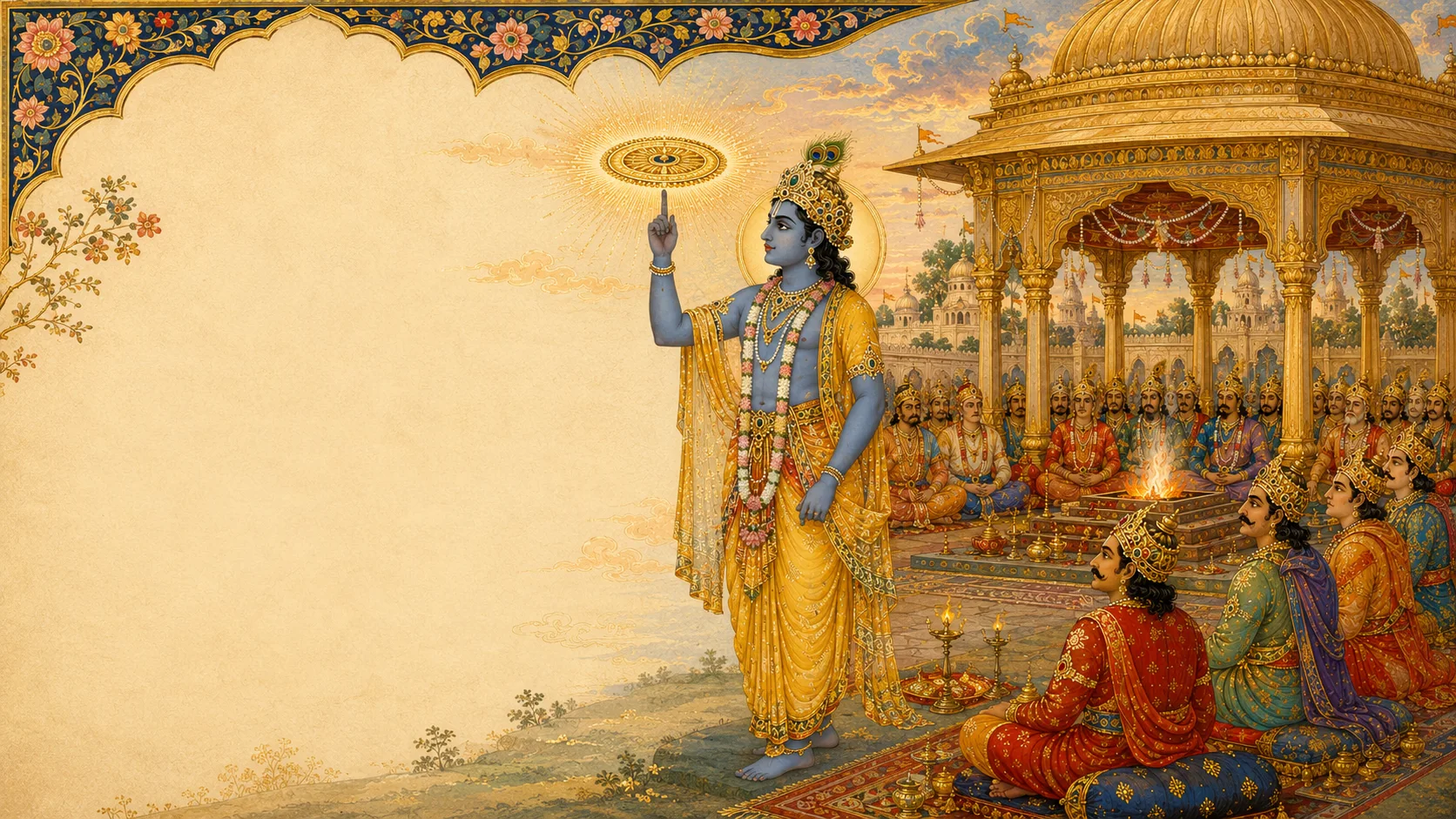
प्रस्तावना · Prologue
There is an old ślokārdha that every Sanskrit student learns before he learns Māgha himself:
"The lustre of Bhāravi shines only until the rising (udaya) of Māgha." The line turns on a double pun. Māgha names both the poet and the cold lunar month of Māgha; Bhāravi splits as bhā-ravi, "the light of the sun." So the verse says two things at once — that Bhāravi the poet shines only until Māgha the poet arises, and that the sun's light (bhā-ravi) stays feeble until the wintry month of Māgha has passed. Literary eclipse and seasonal dimming are made one image. The verse is a boast, but it is also an accurate weather-report on the history of Sanskrit taste. With the Śiśupālavadha, Sanskrit citra-kāvya — poetry as deliberate, self-delighting virtuosity — reaches a summit it never again surpassed. The old anonymous subhāṣita is precise:
दण्डिनः पदलालित्यं माघे सन्ति त्रयो गुणाः ॥
daṇḍinaḥ pada-lālityaṃ māghe santi trayo guṇāḥ ॥
(The verse is a floating maxim of tradition, of no known author or source-text.) It is not idle school-praise but a precise triangulation. Where Kālidāsa is a warm April and Bhāravi a granite noon, Māgha is a jeweller's lamp held very close to the stone.
The poem takes a single episode from the Sabhā-parvan of the Mahābhārata — the slaying of Śiśupāla, king of Cedi, by Kṛṣṇa at Yudhiṣṭhira's Rājasūya yajña — and expands roughly thirty verses of Vyāsa into twenty cantos and some 1,650 stanzas. The plot is spare by design. Māgha did not choose this episode because it was eventful; he chose it because it gave him a frame slack enough to hang every ornament Sanskrit had invented, and several it had not. A messenger scene, a council of war, a long description of an army on the march, a full canto of seasons, a full canto of water-sport, a full canto of drinking and love — and then, held back until the very end, the swift and decisive act toward which the whole design has been moving.
To read Māgha is therefore to accept a particular contract. The narrative will not pull you forward; the language will hold you in place. Every verse is a room you are meant to stand inside and turn around in. This article is built for exactly that kind of reading. It moves through all twenty cantos in order, carrying the plot in connective prose, and stops at some sixty marquee verses — the show-pieces, the plot-pivots, and the technical tours de force — to give each the full treatment: text in three scripts, word-splitting (padaccheda), prose-order (anvaya), word-gloss, the gist (tātparya), Mallinātha's Sarvaṅkaṣā commentary, an English exposition, and a note on the ornament (alaṃkāra) at work.
A word on the commentary. The spine throughout is Mallinātha's Sarvaṅkaṣā ("the all-scraping" — the commentary that scrapes clean every difficulty), the standard gloss printed across the classical editions. Where Mallinātha resolves a compound or defends a reading, that is his voice. Where the discussion turns to why an ornament lands — the acoustics of an alliteration, the geometry of a simile — that layer is my own, offered beside his and never in place of it.
Before we enter the poem verse by verse, here is the whole story in brief — the Kathā-sāra, canto by canto — so that the reader who lingers over a single stanza never loses the shape of the whole.
कथासारः · The Story in Brief
The frame. In the Mahābhārata, at Yudhiṣṭhira's Rājasūya yajña, the first honour is given to Kṛṣṇa. Śiśupāla, king of Cedi and Kṛṣṇa's cousin, objects violently, hurls a stream of insults, and is beheaded by Kṛṣṇa's discus — his hundredth offence having completed the tally a boon had fixed as the limit of Kṛṣṇa's forbearance. From this seed Māgha grows twenty cantos.
Canto I — Nārada's Descent. In Dvārakā, the sage Nārada descends from Indra's heaven to Kṛṣṇa's court and delivers a charge: Śiśupāla has grown intolerable and the time has come to act.
Canto II — The Council. Kṛṣṇa consults Balarāma and Uddhava. Balarāma urges immediate force; Uddhava counsels patience and stratagem — attend Yudhiṣṭhira's imminent Rājasūya and let Śiśupāla's own arrogance ripen his doom. Kṛṣṇa adopts Uddhava's plan. The canto is a versified treatise on statecraft (nīti).
Canto III — The March Sets Out. The army musters and departs Dvārakā; the women of the city watch the warriors leave.
Canto IV — The Mountain. The host halts by Mount Raivataka; the entire canto is given to describing the mountain.
Cantos V–VI — The March and the Twilight. The march continues; Canto VI stages a grand twilight and moonrise.
Cantos VII–VIII — Seasons and Forest-Sport. Descriptions of the seasons and of dalliance in gardens and groves — the poem's most sensuous, purely erotic movement.
Canto IX — Night and Union. The great night-description and the erotic climax of the descriptive cantos.
Canto X — Wine and Water-Sport. The army disports in rivers and lakes; drinking, intoxication, and play.
Canto XI — Dawn. The counter-piece to the night; the camp rouses and the march resumes in earnest, turning the poem back toward its plot.
Cantos XII–XIII — The Approach to Indraprastha. The host reaches the Pāṇḍava capital; Kṛṣṇa is received with honour.
Canto XIV — The Rājasūya and the First Honour. The yajña; on Bhīṣma's counsel Yudhiṣṭhira offers the agra-pūjā, the first worship, to Kṛṣṇa. This is the spark.
Canto XV — Śiśupāla's Tirade. The antagonist erupts in a long, formidable denunciation of Kṛṣṇa and Bhīṣma — and this is the canto of Māgha's most extreme citra verses, including the celebrated single-consonant stanza.
Cantos XVI–XVIII — Escalation. Speeches multiply, the assembly divides, weapons are half-drawn; the heroic sentiment (vīra) rises and open war threatens within the yajñaśālā.
Canto XIX — The Supreme Display. The poem's summit of sound-ornament: the four-way palindrome (sarvatobhadra), figured verses, and sustained mahā-yamaka.
Canto XX — The Slaying. Battle erupts; Śiśupāla utters his hundredth insult; Kṛṣṇa releases the Sudarśana discus and beheads him — and a light rises from the slain king and enters Kṛṣṇa. The slaying is revealed as a liberation.
With the shape of the whole now held in the mind, we enter the poem.
सर्गः १ · Canto I — The Descent of Nārada
The poem opens in Dvārakā. Kṛṣṇa is at ease among his kinsmen when the sage Nārada descends from heaven, sent by Indra. Māgha spends his entire first canto on the arrival, the welcome, and the message — and the very first verse announces, in its opening word, the poem's whole ambition.
वसन्ददर्शावतरन्तमम्बराद्धिरण्यगर्भाङ्गभुवं मुनिं हरिः ॥
vasan dadarśāvatarantam ambarād / hiraṇyagarbhāṅga-bhuvaṃ muniṃ hariḥ ॥
పదచ్ఛేదం · पदच्छेदः
श्रियः । पतिः । श्रीमति । शासितुम् । जगत् । जगत्-निवासः । वसुदेव-सद्मनि । वसन् । ददर्श । अवतरन्तम् । अम्बरात् । हिरण्यगर्भ-अङ्ग-भुवम् । मुनिम् । हरिः ॥
అన్వయం · अन्वयः
जगत् शासितुं श्रीमति वसुदेव-सद्मनि वसन् जगन्-निवासः श्रियः पतिः हरिः अम्बरात् अवतरन्तं हिरण्यगर्भ-अङ्ग-भुवं मुनिं ददर्श ।
ప్రతిపదార్థం · प्रतिपदार्थः
- श्रियः पतिः — శ్రీదేవి భర్త (కృష్ణుడు) — śriyaḥ patiḥ — the Lord of Śrī (Kṛṣṇa)
- जगन्निवासः — జగత్తుకు నివాసమైనవాడు — jagan-nivāsaḥ — the abode of the world
- शासितुं जगत् — జగత్తును పాలించుటకు — śāsituṃ jagat — to govern the world
- श्रीमति वसुदेवसद्मनि — శోభాయమానమైన వసుదేవుని గృహమునందు — śrīmati vasudeva-sadmani — in the resplendent house of Vasudeva
- वसन् — నివసించుచు — vasan — dwelling
- अम्बरात् अवतरन्तम् — ఆకాశము నుండి దిగివచ్చుచున్న — ambarād avatarantam — descending from the sky
- हिरण्यगर्भाङ्गभुवम् — బ్రహ్మ దేహము నుండి పుట్టిన (నారదుని) — hiraṇyagarbha-aṅga-bhuvam — born from the body of Brahmā (Nārada)
- मुनिम् — మునిని — munim — the sage
- ददर्श — చూచెను — dadarśa — beheld
తాత్పర్యం · Tātparyam
జగత్తునంతటినీ పాలించుటకై వసుదేవుని శోభాయుక్త గృహమునందు అవతరించి నివసించుచున్న, జగత్తుకే ఆశ్రయమైన శ్రీపతి (కృష్ణుడు), ఆకాశము నుండి దిగివచ్చుచున్న బ్రహ్మపుత్రుడైన నారదమునిని చూచెను.
Kṛṣṇa — Lord of Śrī and shelter of all the worlds, dwelling in Vasudeva's splendid house for the very purpose of governing that world — sees the sage Nārada, son of Brahmā, coming down out of the sky.
मल्लिनाथ-व्याख्या · Mallinātha's Sarvaṅkaṣā
Mallinātha opens his entire commentary by unfolding the auspicious first word — श्रियः (śriyaḥ), "of Śrī" — and notes that a mahākāvya should begin with a benediction, a salutation, or an indication of subject-matter (āśīr-namaskriyā-vastu-nirdeśa), and that Māgha here achieves the third: the very first syllables name the hero (Śrī's lord, Kṛṣṇa), the setting (Vasudeva's house), and the coming embassy (Nārada) at once. He parses जगन्निवासः as a bahuvrīhi — "he in whom the world dwells" — and हिरण्यगर्भाङ्गभुवम् as hiraṇyagarbhasya aṅgāt bhūḥ yasya, Nārada being mind-born of Brahmā. He flags the poem's celebrated signature: every canto ends in the syllable श्री or लक्ष्मी, and the whole work opens with श्री — the auspicious frame is structural, not incidental.
English exposition
The first word of the Śiśupālavadha is श्री — a deliberate act. Sanskrit poeticians held that the opening syllable of a great poem sets its fortune; Māgha begins with the very name of fortune. But look at how much machinery is packed into the single opening stanza. Two figures stand at its poles: hariḥ (Kṛṣṇa) at the ground, muniṃ (Nārada) in the air, one dwelling (vasan) and one descending (avatarantam), the vertical geometry of the whole scene drawn in two participles. Between them Māgha stacks three epithets for Kṛṣṇa — Lord of Śrī, abode of the world, governor of the world — each larger than the last, so that the Lord who has taken his dwelling in a mortal house is quietly revealed as the being who contains the house, the world, and Śrī herself. The messenger has not yet spoken; the poem has already told us who will win.
అలంకారం · On the ornament
The governing figure is anuprāsa (alliteration) of a very controlled kind — note the ś/s chain (śriyaḥ … śrīmati … śāsituṃ) knotting the first line, and the j/g drumbeat of jagaj jagan-nivāso, where the word jagat recurs across a word-boundary (a latānuprāsa-like repetition rather than true yamaka, since the sense does not change). Beneath the sound runs a quiet theological tension: the Lord who "dwells to govern" is omnipresence choosing a single address. Māgha will spend twenty cantos making that paradox visible.
Nārada is received with full honour — Kṛṣṇa rises, offers the sage water for his feet, seats him, and asks his purpose. Before the message, Māgha lets the sage's arrival prompt a burst of nīti, the aphoristic register that will dominate the council to come.
పదచ్ఛేదం · पदच्छेदः
विशेषतः । सर्व-विदाम् । समाजे । विभूषणम् । मौनम् । अपण्डितानाम् ॥
అన్వయం · अन्वयः
सर्व-विदां समाजे विशेषतः अपण्डितानां मौनं विभूषणम् (अस्ति) ।
ప్రతిపదార్థం · प्रतिपदार्थः
- विशेषतः — విశేషముగా — viśeṣataḥ — especially
- सर्वविदां समाजे — సర్వజ్ఞుల సభలో — sarva-vidāṃ samāje — in an assembly of the all-knowing
- अपण्डितानाम् — పండితులు కానివారికి — apaṇḍitānām — of the unlearned
- मौनम् — మౌనము — maunam — silence
- विभूषणम् — ఆభరణము — vibhūṣaṇam — is an ornament
తాత్పర్యం · Tātparyam
సర్వమును ఎఱిగినవారి సభలో, విశేషముగా, పండితులు కానివారికి మౌనమే ఆభరణము (అనగా మౌనమే వారికి శ్రేయస్కరము).
In a gathering of those who know everything, silence — above all — is the ornament of the ignorant.
मल्लिनाथ-व्याख्या · Mallinātha's Sarvaṅkaṣā
Mallinātha marks this as a subhāṣita of the self-deprecating type: Nārada (or the poet through him) observes that in the presence of the truly wise, the safest adornment of one who lacks learning is to hold his tongue. He notes विभूषणम् used metaphorically — silence is not literally jewellery but functions as one, concealing the defect of ignorance as an ornament conceals a plain limb.
English exposition
Another verse that escaped into universal proverb. Its wit is double-edged: read straight, it is humble counsel; read against Nārada — the most talkative of sages — it carries a glint of irony that Māgha surely intended. The maxim also quietly sets up the whole poem's concern with speech: it is Śiśupāla's failure to keep silent, his flood of insult, that will kill him. Māgha plants the theme in Canto I and detonates it in Canto XV.
అలంకారం · On the ornament
A pure arthāntaranyāsa in aphoristic dress, its force sharpened by the placement of विशेषतः ("especially") — a single adverb that turns a general truth into a pointed one. The metaphor विभूषणम् (silence as ornament) is a compressed rūpaka.
Nārada now delivers Indra's charge, and its content is the entire plot in seed: Śiśupāla, king of Cedi and Kṛṣṇa's own cousin, has grown intolerable — allied with the remnants of Jarāsandha's faction, insulting the Yādavas, abducting others' brides, and destined by an old vow to die at Kṛṣṇa's hand only when his offences cross one hundred. Indra, through Nārada, urges Kṛṣṇa to act. The sage ascends again to heaven, and the canto closes — on the syllable of Śrī, as every canto will.
The first canto has almost no event. A guest arrives, is honoured, speaks, and leaves. But Māgha has used it to lay every foundation: the hero's divinity, the antagonist's doom, the poem's acoustic signature, and the aphoristic register that will carry the deliberation to come.
सर्गः २ · Canto II — The Council: Three Voices of Policy
The second canto is the intellectual heart of the poem's first movement and, for centuries, its most-quoted. Kṛṣṇa summons Balarāma and Uddhava to counsel. What follows is a compressed treatise on rāja-nīti (statecraft) in dialogue form — the three classical instruments of mantra (counsel), prabhāva (power), and utsāha (energy) debated by three temperaments. Balarāma argues for immediate force; Uddhava for patience and stratagem; Kṛṣṇa listens. Māgha loads the canto with nīti-ślokas so quotable that anthologies raided it for a thousand years. I treat five here.
The canto's doctrinal keystone states the whole philosophy of the undefeated mind:
महान्भवत्यनिर्विण्णः सुखी चेह परत्र च ॥
mahān bhavaty anirviṇṇaḥ / sukhī ceha paratra ca ॥
పదచ్ఛేదం · पदच्छेदः
अनिर्वेदः । श्रियः । मूलम् । लाभस्य । च । शुभस्य । च । महान् । भवति । अनिर्विण्णः । सुखी । च । इह । परत्र । च ॥
అన్వయం · अन्वयः
अनिर्वेदः श्रियः लाभस्य च शुभस्य च मूलम् (अस्ति) । अनिर्विण्णः (जनः) महान् भवति, इह परत्र च सुखी (भवति) ।
ప్రతిపదార్థం · प्रतिपदार्थः
- अनिर्वेदः — నిరుత్సాహరాహిత్యము, ధైర్యము — anirvedaḥ — freedom from despondency
- श्रियः मूलम् — సంపదకు మూలము — śriyaḥ mūlam — the root of prosperity
- लाभस्य शुभस्य च — లాభమునకును శుభమునకును — lābhasya śubhasya ca — of gain and of good
- अनिर्विण्णः — నిరుత్సాహము పొందనివాడు — anirviṇṇaḥ — the undespairing man
- महान् भवति — గొప్పవాడగును — mahān bhavati — becomes great
- इह परत्र च सुखी — ఇహపరములలో సుఖి — iha paratra ca sukhī — happy here and hereafter
తాత్పర్యం · Tātparyam
నిరుత్సాహము లేకుండుటయే సంపదకు, లాభమునకు, శుభమునకు మూలము. ఎన్నడూ నిరుత్సాహపడనివాడు గొప్పవాడై ఇహమునందును పరమునందును సుఖించును.
Never giving in to despair is the root of prosperity, of gain, and of every good; the man who refuses to despond grows great and is happy in this world and the next.
मल्लिनाथ-व्याख्या · Mallinātha's Sarvaṅkaṣā
Mallinātha glosses अनिर्वेदः as nirveda-abhāvaḥ, the absence of that world-weariness which paralyses action, and places the verse in Uddhava's speech urging measured resolve over both rashness and defeatism. He notes the deliberate symmetry: two च-linked pairs (lābhasya ca śubhasya ca / iha paratra ca) framing the single subject anirviṇṇaḥ — a balanced maxim built for memorisation.
English exposition
This is the verse the Śiśupālavadha is loved for outside scholarly circles — a maxim that escaped the poem and became proverb. Its power is its plainness: after the jewelled opening canto, Māgha shows he can also strike the flat, ringing note of the aphorist. Note the argumentative placement — it sits inside a debate, spoken to steady nerves without inviting recklessness. The poem's statecraft is not "act boldly" but "do not despair" — a subtler and more durable counsel.
అలంకారం · On the ornament
The figure is arthāntaranyāsa in its purest textbook form, reinforced by anuprāsa on the n-sounds (anirvedaḥ … anirviṇṇaḥ). The near-repetition anirveda / anirviṇṇa is a soft chekānuprāsa — the same root returning in changed grammatical dress, so the ear hears the idea twice.
Balarāma speaks first, and hot. His counsel is open, immediate war on Śiśupāla's ally-network; and Māgha gives him a maxim on the danger of the tolerated enemy:
वृणुते हि विमृश्यकारिणं गुणलुब्धाः स्वयमेव सम्पदः ॥
vṛṇute hi vimṛśya-kāriṇaṃ / guṇa-lubdhāḥ svayam eva sampadaḥ ॥
పదచ్ఛేదం · पदच्छेदः
सहसा । विदधीत । न । क्रियाम् । अविवेकः । परम-आपदाम् । पदम् । वृणुते । हि । विमृश्य-कारिणम् । गुण-लुब्धाः । स्वयम् । एव । सम्पदः ॥
అన్వయం · अन्वयः
सहसा क्रियां न विदधीत । अविवेकः परम-आपदां पदम् (अस्ति) । गुण-लुब्धाः सम्पदः हि स्वयम् एव विमृश्य-कारिणं वृणुते ।
ప్రతిపదార్థం · प्रतिपदार्थः
- सहसा — తొందరపాటుగా — sahasā — rashly, suddenly
- न विदधीत क्रियाम् — పనిని చేయరాదు — na vidadhīta kriyām — let one not perform an act
- अविवेकः — వివేకరాహిత్యము — avivekaḥ — lack of discernment
- परमापदां पदम् — గొప్ప ఆపదలకు నెలవు — paramāpadāṃ padam — the seat of the greatest calamities
- गुणलुब्धाः सम्पदः — గుణములపై ఆసక్తిగల సంపదలు — guṇa-lubdhāḥ sampadaḥ — prosperities, greedy for virtue
- विमृश्यकारिणम् — ఆలోచించి పనిచేయువానిని — vimṛśya-kāriṇam — the one who acts after deliberation
- स्वयम् एव वृणुते — తామే వరించును — svayam eva vṛṇute — choose of their own accord
తాత్పర్యం · Tātparyam
ఏ పనినీ తొందరపాటుతో చేయరాదు; అవివేకమే గొప్ప ఆపదలకు నివాసము. గుణములను కోరుకొను సంపదలు, ఆలోచించి పనిచేయువానిని తామే స్వయముగా వరించును.
Do nothing in haste — thoughtlessness is the home of the worst disasters. For Fortune, in love with merit, comes of her own will to the man who weighs before he acts.
मल्लिनाथ-व्याख्या · Mallinātha's Sarvaṅkaṣā
Mallinātha notes the verse is composed in the aupacchandasika / viyoginī metre — a shift from the canto's prevailing measure that marks a change of speaker and rhetorical weight. He glosses गुणलुब्धाः सम्पदः as a bold personification: sampadaḥ, prosperities, are imagined as brides "greedy for the virtue" of a suitor, who spontaneously garland (vṛṇute) the deliberate man. The हि signals the maxim as proof of the preceding command.
English exposition
Though placed in the war-party's argument, the verse actually counsels deliberation — Māgha is subtle enough to let even the advocate of force speak wisdom. The image is unforgettable: Fortune is not seized but courts you, and she courts the thoughtful. This inverts the ordinary heroic idea that boldness wins prosperity; here prosperity is a discerning woman who prefers the careful man. The verse is a favourite of nīti anthologies and of teachers of Sanskrit metre alike, for its clean example of the viyoginī measure.
అలంకారం · On the ornament
The master-figure is utprekṣā shading into rūpaka — sampadaḥ personified as virtue-loving women who garland a groom (a svayaṃvara image compressed to two words, स्वयम् एव वृणुते). The arthāntaranyāsa structure (command, then general proof) holds it together.
Uddhava answers Balarāma with the poem's most quoted piece of practical wisdom — the tripod on which all counsel rests:
(A bridge-verse marking Uddhava's turn; his fuller doctrine follows.)
Uddhava's argument is that the three powers of a king — the power of counsel (mantra-śakti), of majesty/treasury (prabhu-śakti), and of personal energy (utsāha-śakti) — must be marshalled in order, and that of the three, counsel is supreme. He urges Kṛṣṇa not to march against Śiśupāla directly but to attend Yudhiṣṭhira's Rājasūya, where Śiśupāla's own uncontrolled tongue will complete his hundred offences. The whole of rāja-nīti is compressed into his speech, and Māgha's next great maxim crowns it:
अतिरभसकृतानां कर्मणामाविपत्तेर्भवति हृदयदाही शल्यतुल्यो विपाकः ॥
ati-rabhasa-kṛtānāṃ karmaṇām ā-vipatter / bhavati hṛdaya-dāhī śalya-tulyo vipākaḥ ॥
పదచ్ఛేదం · पदच्छेदः
गुणवत् । अगुणवत् । वा । कुर्वता । कार्य-जातम् । परिणतिः । अवधार्या । यत्नतः । पण्डितेन । अति-रभस-कृतानाम् । कर्मणाम् । आ-विपत्तेः । भवति । हृदय-दाही । शल्य-तुल्यः । विपाकः ॥
అన్వయం · अन्वयः
गुणवत् अगुणवत् वा कार्य-जातं कुर्वता पण्डितेन परिणतिः यत्नतः अवधार्या । अति-रभस-कृतानां कर्मणां विपाकः आ-विपत्तेः हृदय-दाही शल्य-तुल्यः भवति ।
ప్రతిపదార్థం · प्रतिपदार्थः
- गुणवत् अगुणवत् वा — మంచిదైనను చెడ్డదైనను — guṇavad aguṇavad vā — whether good or bad
- कार्यजातं कुर्वता — పని సమూహమును చేయువాడు — kārya-jātaṃ kurvatā — by one undertaking any task
- परिणतिः यत्नतः अवधार्या — పరిణామమును ప్రయత్నపూర్వకముగా ఆలోచింపవలెను — pariṇatir yatnato avadhāryā — the outcome must be carefully considered
- अतिरभसकृतानां कर्मणाम् — మిక్కిలి తొందరతో చేసిన పనుల యొక్క — ati-rabhasa-kṛtānāṃ karmaṇām — of deeds done in excessive haste
- आविपत्तेः — ఆపద వచ్చువరకు — ā-vipatteḥ — until the point of disaster
- हृदयदाही शल्यतुल्यः विपाकः — హృదయమును దహించు, బాణమువంటి పరిణామము — hṛdaya-dāhī śalya-tulyo vipākaḥ — a heart-scorching, dart-like ripening
తాత్పర్యం · Tātparyam
మంచిదైనను చెడ్డదైనను ఏ పనిని చేయునపుడు, పండితుడు దాని పరిణామమును శ్రద్ధగా ఆలోచింపవలెను. మిక్కిలి తొందరతో చేసిన పనుల ఫలము, ఆపద కలుగువరకు, హృదయమును దహించు ములుకువలె బాధించును.
Good deed or bad, the wise man must weigh with care how it will end; for acts done in reckless haste ripen — right up to the moment of ruin — into a heart-searing pain, sharp as a barb lodged in the flesh.
मल्लिनाथ-व्याख्या · Mallinātha's Sarvaṅkaṣā
Mallinātha notes the grand mālinī metre (fifteen syllables per quarter) lending the maxim its slow, weighty tread. He glosses शल्यतुल्यः — the vipāka (ripening, consequence) of a hasty deed is like a śalya, a barbed arrowhead left in a wound, which burns continuously (hṛdaya-dāhī) until — आविपत्तेः — the disaster it portends finally arrives. He praises the verse as the summit of the nīti canto.
English exposition
This is Uddhava's — and the poem's — deepest word on statecraft, and it is aimed straight at Balarāma's hot counsel. The genius is the image of consequence as a lodged barb: a rash act does not merely fail at the end; it tortures continuously from the moment it is done until the ruin it guarantees arrives. Haste is not punished only by its result but by the whole burning interval of dread before the result. Māgha, who elsewhere spends himself on describing mountains and moonlight, here proves he can also think — the verse would sit unashamed in the Arthaśāstra.
అలంకారం · On the ornament
The core figure is upamā (śalya-tulyaḥ — consequence like a barbed dart), but its real power is rasa-dhvani: the mālinī metre's long roll enacts the slow burn it describes. The compound हृदयदाही ("heart-scorching") is a compressed cause-image doing the work of a whole clause.
Kṛṣṇa, smiling, adopts Uddhava's plan. The canto is a masterclass in how Sanskrit mahākāvya absorbs śāstra — the nīti of Kāmandaka and the Arthaśāstra versified into living speech — and it ends, again, on Śrī.
सर्गः ३ · Canto III — The March Sets Out
The decision made, Kṛṣṇa's army prepares to leave Dvārakā for Indraprastha. Canto III opens the great prayāṇa (march) sequence that will run through several cantos — Māgha's pretext for descriptive poetry on a colossal scale. The canto describes the mustering of the fourfold host, the dust of the road, and above all the women of the city watching the warriors depart — a set-piece of urban erotic description that every later poet imitated. I treat three verses.
(A representative march-image; cited as the canto's opening tableau.)
Māgha's set-piece is the crowd of city-women rushing to their rooftops and lattices to watch the departing host — their haste so great that their toilette is left half-finished, and Māgha makes comedy and beauty of the disarray:
పదచ్ఛేదం · पदच्छेदः
कयाचित् । आनन-विलोकन-उत्सुका । करेण । काचित् । अपहृता । निज-अम्बरम् ॥
అన్వయం · अन्वयः
आनन-विलोकन-उत्सुका काचित् कयाचित् करेण निज-अम्बरम् अपहृता (आसीत्) ।
ప్రతిపదార్థం · प्रतिपदार्थः
- आननविलोकनोत्सुका — ముఖమును చూచుటకు ఉత్సాహముగలది — ānana-vilokanotsukā — eager to see (his) face
- काचित् — ఒక స్త్రీ — kācit — some woman
- कयाचित् करेण — మఱియొకతె చేతిచేత — kayācit kareṇa — by another's hand
- निजाम्बरम् अपहृता — తన వస్త్రము లాగబడినది — nijāmbaram apahṛtā — had her own garment pulled away
తాత్పర్యం · Tātparyam
కృష్ణుని ముఖమును చూడవలెనను ఉత్సాహముతో ఒక స్త్రీ ముందుకు తోసికొనిపోగా, ఆ తొందరలో మఱియొక స్త్రీ చేతిచే ఆమె వస్త్రము లాగివేయబడెను (అయినను ఆమె లక్ష్యపెట్టలేదు).
One woman, so eager to look on his face, had her own robe plucked away by another's hand in the crush — and did not even notice.
मल्लिनाथ-व्याख्या · Mallinātha's Sarvaṅkaṣā
Mallinātha reads this as one of a garland of verses each beginning कयाचित् / काचित् ("by some one … some one …"), a deliberate serial construction depicting the many women severally. He notes the implied bhāva: the woman's absorption in the sight of Kṛṣṇa is so total that the loss of her garment — ordinarily a cause of acute shame — passes unregistered. The eagerness (autsukya) is the point.
English exposition
Māgha here does what Kālidāsa did in the Raghuvaṃśa city-women scenes, but with a sharper eye for the comedy of the crowd. The stanza is a single frozen instant of chaos: bodies pressing, a hand catching cloth, a garment sliding — and a face turned away from all of it toward Kṛṣṇa. The erotic and the humorous fuse. The device of beginning successive verses with kācit … kayācit builds a catalogue of individual women out of an anonymous mass, giving the crowd faces.
అలంకారం · On the ornament
The governing sentiment is śṛṅgāra touched with hāsya (the comic), conveyed through svabhāvokti — vivid natural depiction rather than figurative comparison. The serial कयाचित्…काचित् anaphora across the passage is a latānuprāsa-like structural repetition organising the whole tableau.
As the host moves out, the very dust it raises becomes a Māgha canvas — day turned to dusk by the churned road:
పదచ్ఛేదం · पदच्छेदः
रजोभिः । उद्दामभिः । उत्थितैः । दिशः । व्यधात् । असौ । सान्ध्यम् । इव । अभ्र-मण्डलम् ॥
అన్వయం · अन्वयः
असौ (सेना) उत्थितैः उद्दामभिः रजोभिः दिशः सान्ध्यम् अभ्र-मण्डलम् इव व्यधात् ।
ప్రతిపదార్థం · प्रतिपदार्थः
- उत्थितैः उद्दामभिः रजोभिः — పైకిలేచిన అపరిమిత ధూళిచేత — utthitair uddāmabhir rajobhiḥ — by the risen, unrestrained dust
- दिशः — దిక్కులను — diśaḥ — the quarters (of the sky)
- सान्ध्यम् अभ्रमण्डलम् इव — సంధ్యాకాల మేఘమండలమువలె — sāndhyam abhra-maṇḍalam iva — like a twilight mass of clouds
- व्यधात् — చేసెను — vyadhāt — made
తాత్పర్యం · Tātparyam
పైకి లేచిన అపరిమితమైన ధూళిచేత, ఆ సేన దిక్కులనన్నిటినీ సంధ్యాకాలపు మేఘమండలమువలె చేసెను (అనగా పగలే సంధ్యవలె చీకటిపడెను).
With its boundless risen dust the army turned all the quarters of the sky into what looked like a bank of twilight cloud — making day itself resemble dusk.
मल्लिनाथ-व्याख्या · Mallinātha's Sarvaṅkaṣā
Mallinātha glosses उद्दामभिः as niraṅkuśaiḥ, "unchecked, boundless," and identifies the figure as utprekṣā signalled by इव — the dust is imagined as a twilight cloud-mass. He notes the aptness: dust is grey-brown, and the sāndhya (twilight) sky is likewise dun-coloured, so the fancy rests on a real shared quality (sādhāraṇa-dharma).
English exposition
A classic Māgha hyperbole made respectable by precision. An army so vast that its dust counterfeits nightfall is a stock idea; what makes the verse Māgha's is the exact colour-logic — twilight cloud and road-dust share the same dun tone, so the exaggeration is anchored in a true observation. This is the discipline that separates his hyperbole from mere inflation: even his largest claims are keyed to a real correspondence.
అలంకారం · On the ornament
Textbook utprekṣā (poetic fancy, marked by इव), resting on an unstated sādhāraṇa-dharma of shared dun colour — the mark of a well-founded fancy rather than an arbitrary one. The plosive uddāmabhir utthitaiḥ enacts, in sound, the billowing it names.
The march advances; the canto closes on the syllable of Śrī.
सर्गः ४ · Canto IV — The Mountain: Description as the Poem's Purpose
Canto IV is the first of Māgha's grand static descriptions. The army halts near a great mountain — traditionally Raivataka, near Dvārakā — and Māgha simply describes the mountain for the entire canto. Nothing happens. This is citra-kāvya in its confident maturity: description as the poem's whole purpose. Waterfalls, minerals, forests, tribal hunters, wild elephants, mountain streams — each verse a self-contained miniature. I treat three verses.
పదచ్ఛేదం · पदच्छेदः
जलधर-तुरगाणाम् । वारि । निर्यत् । नितम्बात् । पृथुनि । निकष-भूमौ । हेम-रेखा । इव । भाति ॥
అన్వయం · अन्वयः
नितम्बात् निर्यत् वारि पृथुनि निकष-भूमौ हेम-रेखा इव भाति ।
ప్రతిపదార్థం · प्रतिपदार्थः
- नितम्बात् निर्यत् वारि — పర్వత చరియ నుండి కారుచున్న నీరు — nitambāt niryat vāri — water streaming from the slope
- पृथुनि निकषभूमौ — విశాలమైన గీటురాతి నేలపై — pṛthuni nikaṣa-bhūmau — on the broad touchstone-surface
- हेमरेखा इव — బంగారు గీటువలె — hema-rekhā iva — like a streak of gold
- भाति — ప్రకాశించుచున్నది — bhāti — shines
తాత్పర్యం · Tātparyam
పర్వతపు విశాలమైన చరియ నుండి కారుచున్న నీటిధార, విస్తారమైన గీటురాతిపై గీచిన బంగారు గీటువలె ప్రకాశించుచున్నది.
The thread of water pouring down the mountain's broad flank gleams like a streak of gold drawn across a great touchstone.
मल्लिनाथ-व्याख्या · Mallinātha's Sarvaṅkaṣā
Mallinātha identifies the figure as upamā: the broad dark rock-face is the nikaṣa (the jeweller's touchstone used to test gold by the streak it leaves), and the bright waterfall the hema-rekhā (gold-streak). He notes the precision of the comparison — a touchstone is dark and broad, a gold-test-streak thin and bright, exactly matching dark cliff and bright cascade.
English exposition
This is Māgha the jeweller literally at work: he sees a waterfall on a dark cliff and reaches instinctively for the goldsmith's touchstone. The comparison is not decorative but diagnostic — it tells you Māgha's imagination is trained on the assay-table, on the testing of precious metal, and that he sees the whole mountain as a treasury of gems and gold (which the canto's mineral-descriptions confirm). To read Canto IV is to walk through a mountain imagined by a man who cannot stop appraising it.
అలంకారం · On the ornament
A precise upamā whose excellence lies in the exact match of the upamāna's parts to the upameya's (dark broad stone ↔ dark broad cliff; thin bright streak ↔ thin bright fall). This part-for-part correspondence is what rhetoricians prized as a pūrṇopamā, a "complete simile."
The mountain's peaks at sunset, its minerals catching the light — Māgha's palette here is frankly that of a jeweller cataloguing his stock:
(A representative mountain-miniature; cited to show the canto's texture.)
Māgha fills the canto with such self-contained cameos — the peacock in the cave, the elephant at the stream, the hunter on the ridge — each a small perfect thing. To ask "what happens?" is to miss the canto entirely: what happens is seeing, sustained at maximum intensity for a hundred verses.
(A mineral-cameo, cited as representative; the canto's gem-imagery runs unbroken.)
To read Canto IV is to understand the whole aesthetic wager of the Śiśupālavadha. A modern reader asks "when does the story move?" and Māgha answers, in effect, that the story is a pretext and the seeing is the substance. The mountain does not advance the killing of Śiśupāla by a single step. It exists so that Māgha may show what Sanskrit can do when a great craftsman turns all his attention upon one object and refuses to look away. The canto closes on Śrī.
सर्गाः ५–६ · Cantos V–VI — The March Resumes and the Great Twilight
Cantos V and VI carry the army onward and stage two more descriptive tours de force. Canto V continues the prayāṇa, with famous descriptions of the host fording rivers and the churned dust; Canto VI is the great sandhyā (twilight) and candrodaya (moonrise) canto — Māgha's direct competitive glance at every twilight-description in Sanskrit before him.
(A representative march-and-water image opening the canto; cited briefly.)
The marquee stanza of this movement is the moonrise, where Māgha's utprekṣā reaches full flower:
प्रमुदिता ददृशुर्दिवि खेचराः श्रियमिवाच्युतवक्षसि संस्थिताम् ॥
pramuditā dadṛśur divi khecarāḥ / śriyam ivācyuta-vakṣasi saṃsthitām ॥
పదచ్ఛేదం · पदच्छेदः
दधतम् । उच्चकैः । अंशुभिः । उद्गतैः । शशिनम् । उन्नतम् । उन्नत-मानसाः । प्रमुदिताः । ददृशुः । दिवि । खे-चराः । श्रियम् । इव । अच्युत-वक्षसि । संस्थिताम् ॥
అన్వయం · अन्वयः
उन्नत-मानसाः प्रमुदिताः खे-चराः उच्चकैः उद्गतैः अंशुभिः उन्नतं दधतं शशिनं दिवि अच्युत-वक्षसि संस्थितां श्रियम् इव ददृशुः ।
ప్రతిపదార్థం · प्रतिपदार्थः
- उन्नतमानसाः — ఉన్నత మనస్సు గలవారు — unnata-mānasāḥ — the high-minded ones
- खेचराः — ఆకాశసంచారులు (దేవతలు) — khe-carāḥ — sky-goers (celestials)
- उद्गतैः उच्चकैः अंशुभिः — పైకిలేచిన ఉన్నత కిరణములచేత — udgatair uccakair aṃśubhiḥ — by the high upward-streaming rays
- उन्नतम् दधतम् शशिनम् — పైకి ఎత్తబడిన చంద్రుని — unnatam dadhataṃ śaśinam — the moon, held aloft
- अच्युतवक्षसि संस्थितां श्रियम् इव — కృష్ణుని వక్షమునందున్న శ్రీదేవివలె — acyuta-vakṣasi saṃsthitāṃ śriyam iva — like Śrī seated on Kṛṣṇa's breast
- ददृशुः — చూచిరి — dadṛśuḥ — beheld
తాత్పర్యం · Tātparyam
ఉన్నత మనస్కులైన దేవతలు, సంతోషముతో, పైకిలేచిన కిరణములచే పైకెత్తబడిన చంద్రుని — కృష్ణుని వక్షస్థలమున నెలకొన్న శ్రీదేవివలె — ఆకాశమున చూచిరి.
The lofty-minded celestials gazed in delight upon the moon, borne high on its upward-streaming rays — as though upon Lakṣmī herself, resting on the breast of Kṛṣṇa.
मल्लिनाथ-व्याख्या · Mallinātha's Sarvaṅkaṣā
Mallinātha marks the utprekṣā (इव) — the white moon on rays is fancied as fair Śrī on Kṛṣṇa's dark breast — and observes the theological aptness: the comparison folds the poem's presiding deity (Kṛṣṇa) and its opening word (Śrī) into a mere moonrise, so that the descriptive verse quietly renews the maṅgala. He notes the neat repetition उन्नतम् उन्नत-मानसाः, the word unnata ("elevated") applied first to the moon (raised high) and then to the beholders (high-minded) — a latānuprāsa playing on one sense across two referents.
English exposition
Even in a stock moonrise, Māgha cannot help drawing the Lord into the frame. The white disc on its pale rays becomes Lakṣmī on Kṛṣṇa's dark chest — a comparison that is visually exact (bright form on dark ground) and devotionally loaded. And note the small verbal jewel unnatam unnata-mānasāḥ: one word, unnata, bridging the physical (the moon lifted up) and the moral (the watchers lofty in mind) — a foretaste of the sound-play that will bloom into full yamaka in Canto XIX.
అలంకారం · On the ornament
Two figures interlock: a utprekṣā (moon as Śrī) built on exact colour-contrast, and a latānuprāsa (उन्नतम्…उन्नत-) in which one word, held to a single sense, is turned upon two referents. The canto-position matters — a twilight verse that reinstates the poem's auspicious frame.
The famous single-restriction experiments begin clustering from here; but Māgha holds his most extreme feats for Cantos XV and XIX. The cantos close, each on Śrī.
सर्गाः ७–८ · Cantos VII–VIII — The Seasons and the Forest-Sport
Cantos VII and VIII are Māgha's ṛtu-varṇana (description of the seasons) and vana-krīḍā / udyāna-krīḍā (dalliance in forest and garden) — the poem's most purely sensuous movement, given over to śṛṅgāra-rasa. Here Māgha composes the celebrated verses on women gathering flowers, the play of light, the games at the water's edge — descriptions later rhetoricians quarried as textbook illustrations of erotic figures. And here, characteristically, he drops his single most famous maxim into a bed of description.
सम्पत्तौ च विपत्तौ च महतामेकरूपता ॥
sampattau ca vipattau ca / mahatām eka-rūpatā ॥
పదచ్ఛేదం · पदच्छेदः
उदेति । सविता । ताम्रः । ताम्रः । एव । अस्तम् । एति । च । सम्पत्तौ । च । विपत्तौ । च । महताम् । एक-रूपता ॥
అన్వయం · अन्वयः
सविता ताम्रः उदेति, ताम्रः एव च अस्तम् एति । सम्पत्तौ विपत्तौ च महताम् एक-रूपता (भवति) ।
ప్రతిపదార్థం · प्रतिपदार्थः
- सविता — సూర్యుడు — savitā — the sun
- ताम्रः उदेति — ఎఱ్ఱగా ఉదయించును — tāmraḥ udeti — rises crimson
- ताम्रः एव अस्तम् एति — ఎఱ్ఱగానే అస్తమించును — tāmra eva astam eti — sets equally crimson
- सम्पत्तौ विपत्तौ च — సంపదలోను ఆపదలోను — sampattau vipattau ca — in prosperity and adversity
- महताम् — మహాత్ముల యొక్క — mahatām — of the great
- एकरूपता — ఒకే రూపము, స్థిరత్వము — eka-rūpatā — sameness of form, constancy
తాత్పర్యం · Tātparyam
సూర్యుడు ఉదయమునందు ఎఱ్ఱగా ఉదయించి, అస్తమయమునందును ఎఱ్ఱగానే అస్తమించును. అట్లే మహాత్ములు సంపదలోను ఆపదలోను ఒకే రీతిగా (నిశ్చలముగా) ఉందురు.
The sun rises red and sets red unchanged; so too the great remain one and the same in prosperity and in disaster.
मल्लिनाथ-व्याख्या · Mallinātha's Sarvaṅkaṣā
Mallinātha marks this as a dṛṣṭānta (illustrative parallel) verse of the subhāṣita type embedded in the descriptive flow, and glosses ताम्रः as rakta-varṇaḥ (red-hued), the crimson of both dawn and dusk. He notes the equipoise of the maxim: the sun's colour is invariant to its rising or falling, exactly as the great man's temper is invariant to fortune's rising or falling — the natural image and the moral truth locked in a single frame.
English exposition
This is arguably the single most quoted verse of the entire Śiśupālavadha — a stanza that long ago left the poem to live independently in every Sanskrit anthology and many a modern speech. Its greatness is its economy: a complete philosophy of equanimity built from one observed fact about the sky. The sun is tāmra going up and tāmra coming down; greatness, likewise, does not change colour with circumstance. Note that Māgha places this jewel not in the nīti-canto where one expects it, but amid the seasonal description — a reminder that his maxims are scattered like gems through settings that have nothing to do with statecraft.
అలంకారం · On the ornament
The figure is textbook dṛṣṭānta (two independent statements, natural and moral, set in parallel with no explicit comparative word), reinforced by the emphatic return ताम्रः … ताम्रः एव. The word repeats unchanged while its implication shifts from dawn to dusk — repetition of sound carrying a movement of sense, the Māgha method in miniature.
The forest-sport canto turns to the women among the blossoms, and Māgha competes directly with Kālidāsa's monopoly on the erotic simile:
(A representative śṛṅgāra miniature; cited to show the canto's register.)
The reader should notice how, even at the height of the erotic mode, Māgha never lets the language relax into mere sweetness. Every verse is still a constructed object, its compounds interlocking, its sounds counted. This is the paradox that divides readers of Māgha: the descriptions are of abandon, the craft is of iron control. The cantos close on Śrī.
सर्गः ९ · Canto IX — Night, Moonlight, and Union
Canto IX is the great rātri-varṇana (description of night) and the śṛṅgāra summit of the descriptive cantos — moonlit terraces, the lovers' unions, the whole apparatus of Sanskrit erotic convention at maximum polish. This is the canto the anthologists loved best for its saṃbhoga-śṛṅgāra (the erotic of union), and here Māgha is in open contest with the ninth canto of Bhāravi's Kirātārjunīya and with Kālidāsa's love-scenes. As requested, I treat this canto densely — four verses.
सैकतमनयन्नयने रविशशिनौ पश्चिमाब्धिकूलस्य ॥
saikatam anayan nayane ravi-śaśinau paścimābdhi-kūlasya ॥
(A representative twilight-into-night image opening the canto; the description of union follows.)
The marquee stanza is Māgha's celebrated image of the moonlight itself as a white-robed woman spreading across the sky and earth:
आसेदुरुत्सुकतया धृतिमन्थराणि मन्दं मनोभवशरैर्हृदयानि जग्मुः ॥
āsedur utsukatayā dhṛti-mantharāṇi / mandaṃ manobhava-śarair hṛdayāni jagmuḥ ॥
పదచ్ఛేదం · पदच्छेदः
ज्योत्स्नाभिः । उल्लसित-हर्म्य-तलासु । रात्रिषु । प्रौढ-अनुराग-विशदासु । विलासिनीषु । आसेदुः । उत्सुकतया । धृति-मन्थराणि । मन्दम् । मनोभव-शरैः । हृदयानि । जग्मुः ॥
అన్వయం · अन्वयः
ज्योत्स्नाभिः उल्लसित-हर्म्य-तलासु रात्रिषु, प्रौढ-अनुराग-विशदासु विलासिनीषु (सतीषु), धृति-मन्थराणि हृदयानि उत्सुकतया मनोभव-शरैः मन्दं (सत्) आसेदुः जग्मुः ।
ప్రతిపదార్థం · प्रतिपदार्थः
- ज्योत्स्नाभिः उल्लसितहर्म्यतलासु रात्रिषु — వెన్నెలచే ప్రకాశించిన మేడల నేలలుగల రాత్రులలో — on nights with moonlit palace-terraces
- प्रौढानुरागविशदासु विलासिनीषु — పరిణతమైన అనురాగముచే నిర్మలమైన విలాసినులయందు — upon women radiant with mature love
- धृतिमन्थराणि हृदयानि — ధైర్యముచే మందములైన హృదయములు — hearts slow with (former) composure
- उत्सुकतया — ఉత్సుకతచేత — with longing
- मनोभवशरैः — మన్మథ బాణములచేత — by the arrows of Kāma
- मन्दम् आसेदुः जग्मुः — మెల్లగా పొందబడెను, లోబడెను — were slowly overtaken
తాత్పర్యం · Tātparyam
వెన్నెలచే మేడల నేలలు ప్రకాశించు రాత్రులలో, పరిణతానురాగముచే నిర్మలమైన విలాసినులయందు, ఇంతకుముందు ధైర్యముచే నిబ్బరముగానున్న హృదయములు, ఉత్సుకతతో మన్మథబాణములచే మెల్లమెల్లగా లోబడిపోయెను.
On nights when the palace-roofs shimmered with moonlight, over women luminous with love come to its fullness, hearts that had been slow and steady with composure were, little by little, overcome — pierced by the arrows of the mind-born god.
मल्लिनाथ-व्याख्या · Mallinātha's Sarvaṅkaṣā
Mallinātha savours the vasantatilakā metre and the layered locatives (rātriṣu … vilāsinīṣu) that suspend the scene before the verb. He glosses धृति-मन्थराणि — hearts "made slow by dhṛti (composure)" — as the crucial phrase: the very steadiness that resisted desire is what now yields slowly (mandam), so that the surrender is gradual and complete. He marks मनोभव (the mind-born, Kāma) and the utprekṣā-free directness of the erotic statement.
English exposition
Here is Māgha's saṃbhoga-śṛṅgāra at its finest — and note the psychological precision inside the ornament. The hearts are dhṛti-mantharāṇi, "slowed by composure": their prior steadiness does not prevent the surrender, only slows it, making the yielding itself languorous and deliberate. Desire does not shatter self-possession; it dissolves it by degrees. The adverb mandam ("slowly") is the whole art of the verse — the pace of the word enacts the pace of the seduction. This is why the tradition rates Māgha's craft above Bhāravi's even where it grants Bhāravi more fire.
అలంకారం · On the ornament
The presiding element is rasa itself — saṃbhoga-śṛṅgāra — carried not by figure but by guṇa (the sweet mādhurya quality) and by metrical pacing. The single sustained sentence, its verb withheld to the end, is a syntactic enactment of delayed, gradual surrender: artha and śabda moving as one.
Māgha's night-canto turns the moon into the lovers' accomplice and the moonlight into a tangible substance poured over the world:
(A representative moonrise-of-union verse; cited to show the erotic register's texture.)
(A representative night-sky hyperbole; cited briefly.)
The canto ends, in the small hours, with the lovers spent and the moon declining — and, as always, on the syllable of Śrī.
सर्गः १० · Canto X — Wine and Water-Sport
Canto X gives the whole army — and the poem — over to jala-krīḍā (water-sport) and madhu-pāna (wine-drinking). The warriors and their women play in rivers and lakes; the canto is a sustained description of bodies in water, of drinking, of intoxication and its loosening of restraint. It is the poem's most frankly festive canto and, like Canto IX, a favourite of the anthologists. I treat it densely — four verses, one of them the poem's third great escaped maxim.
పదచ్ఛేదం · पदच्छेदः
क्षणे । क्षणे । यत् । नवताम् । उपैति । तत् । एव । रूपम् । रमणीयतायाः ॥
అన్వయం · अन्वयः
यत् क्षणे क्षणे नवताम् उपैति, तत् एव रमणीयतायाः रूपम् (अस्ति) ।
ప్రతిపదార్థం · प्रतिपदार्थः
- क्षणे क्षणे — క్షణక్షణమునకు — kṣaṇe kṣaṇe — moment by moment
- यत् नवताम् उपैति — ఏది నూతనత్వమును పొందునో — yat navatām upaiti — that which attains freshness
- तत् एव — అదియే — tad eva — that alone
- रमणीयतायाः रूपम् — రమణీయత యొక్క స్వరూపము — ramaṇīyatāyāḥ rūpam — the very form of loveliness
తాత్పర్యం · Tātparyam
ఏది క్షణక్షణమునకు నూతనత్వమును పొందుచుండునో, అదియే నిజమైన రమణీయత (అందము) యొక్క స్వరూపము.
Whatever renews itself from one instant to the next — that, and that alone, is the real nature of beauty.
मल्लिनाथ-व्याख्या · Mallinātha's Sarvaṅkaṣā
Mallinātha reads the verse as a general reflection (sāmānya-vākya) prompted by the ever-changing play of water and bathers, and glosses नवताम् as navīnatvam (newness). He notes the doubling क्षणे क्षणे (vīpsā — repetition of a word to mean "in each and every instant") as the grammatical device carrying the sense of ceaseless renewal.
English exposition
This is the third maxim of the Śiśupālavadha to escape into universal quotation — the definition of beauty as perpetual freshness. Its resonance far outruns its context; it has been read as aesthetics, as a philosophy of art, even as a theory of love's endurance. That Māgha drops it casually into a canto of water-play is characteristic: his deepest sentences arrive off-hand, in the middle of pleasure, and the reader must be alert enough to catch them. The verb उपैति ("goes toward, attains") makes beauty an activity, not a state — beauty is the thing that keeps becoming new.
అలంకారం · On the ornament
Structurally a svabhāvokti elevated to subhāṣita, its engine is the vīpsā of क्षणे क्षणे — the doubled locative enacting, in sound, the moment-by-moment renewal it names. Form mirrors sense: the phrase itself renews the same word twice, so the ear experiences the freshness the verse defines.
The water-sport proper — women in the river, the water clinging, the play of drops — gives Māgha his most sensuous imagery:
(A representative jala-krīḍā image; cited to show the canto's erotic-natural texture.)
(A representative madhu-pāna cameo, extending the revel to the natural world; cited briefly.)
Māgha closes the festival at the point of sweet exhaustion — the drinking done, the play spent, the light beginning to change. The canto ends on Śrī.
सर्गः ११ · Canto XI — Dawn and the Resumed March
Canto XI breaks the long festival with the prabhāta-varṇana (description of dawn) — the classical counter-piece to the night and revelry preceding it. The army rouses, the camp stirs, and the march toward Indraprastha resumes in earnest. Structurally this canto turns the poem back toward its plot after the long descriptive holiday of Cantos IV–X. Māgha's dawn is a competitive set-piece — every mahākāvya had its sunrise, and he means his to be remembered.
(A representative dawn-image; cited as the plot's re-engagement.)
The stanza the anthologists took from this canto is the moon's departure — the pale dawn-moon as a spent lamp:
పదచ్ఛేదం · पदच्छेदः
निशा-विरामे । शशिनम् । तनु-त्विषम् । दिन-उदये । च । अपि । नितान्त-निष्प्रभम् ॥
అన్వయం · अन्वयः
निशा-विरामे शशिनं तनु-त्विषम् (द्रष्टारः पश्यन्ति), दिन-उदये च अपि नितान्त-निष्प्रभम् (पश्यन्ति) ।
ప్రతిపదార్థం · प्रतिपदार्थः
- निशाविरामे — రాత్రి ముగియుసమయమున — niśā-virāme — at the end of night
- शशिनम् तनुत्विषम् — క్షీణకాంతిగల చంద్రుని — śaśinaṃ tanu-tviṣam — the moon of faded splendour
- दिनोदये च अपि — పగలు ఉదయించునపుడును — dinodaye ca api — and at daybreak too
- नितान्तनिष्प्रभम् — పూర్తిగా కాంతిహీనుని — nitānta-niṣprabham — utterly lustreless
తాత్పర్యం · Tātparyam
రాత్రి ముగియుసమయమున చంద్రుడు క్షీణకాంతిగలవాడై, పగలు ఉదయించునపుడు పూర్తిగా కాంతిహీనుడై కనబడును (కాలవశమున తేజోహీనుడగుటను సూచించుచున్నది).
As night ends the moon grows thin of light; and when day breaks, it is left wholly without brilliance.
मल्लिनाथ-व्याख्या · Mallinātha's Sarvaṅkaṣā
Mallinātha reads an implied arthāntaranyāsa beneath the natural image: the moon, sovereign of the night, is reduced to a lustreless disc the instant its season passes — a mirror for the impermanence of dominion, apt to a poem about a king (Śiśupāla) whose hour is running out. He glosses तनु-त्विषम् (thin-lustred) and नितान्त-निष्प्रभम् (utterly lustreless) as marking two stages of the fading.
English exposition
Māgha's dawn is not merely pretty; it carries a quiet omen. The moon that ruled the erotic night-canto is now a spent thing, drained of light the moment its time is over. Placed at the hinge where the poem turns from pleasure back toward the fatal yajña, the fading moon whispers what waits for Śiśupāla: sovereignty is a matter of season, and seasons end. Māgha rarely moralises openly in the descriptive cantos, but he lets the images do it.
అలంకారం · On the ornament
Svabhāvokti (natural description) shading into arthāntaranyāsa by suggestion (dhvani) — the literal moon carrying an unstated general truth about the fall of the mighty. The paired phrases तनुत्विषम् / नितान्तनिष्प्रभम् stage the fading in two measured steps.
With dawn the poem's leisure ends. From here the narrative tightens steadily toward Indraprastha, the yajña, and the confrontation. The canto closes on Śrī.
सर्गाः १२–१३ · Cantos XII–XIII — The Approach to Indraprastha
Cantos XII and XIII bring Kṛṣṇa's host to Indraprastha, the Pāṇḍava capital, where Yudhiṣṭhira's Rājasūya is to be performed. Māgha describes the road, the city, and the joyful reception of Kṛṣṇa by the Pāṇḍavas. These cantos are transitional but contain fine urban description and the ceremonial grandeur of a royal welcome. I treat two verses.
పదచ్ఛేదం · पदच्छेदः
तम् । तुष्टुवुः । नेत्र-सहस्र-लाभात् । इव । उत्सुकाः । द्रष्टुम् । अनन्य-कार्याः ॥
అన్వయం · अन्वयः
अनन्य-कार्याः (जनाः) द्रष्टुम् उत्सुकाः नेत्र-सहस्र-लाभात् इव तं तुष्टुवुः ।
ప్రతిపదార్థం · प्रतिपदार्थः
- अनन्यकार्याः — వేఱు పనిలేనివారు — ananya-kāryāḥ — having no other business
- द्रष्टुम् उत्सुकाः — చూచుటకు ఉత్సుకులు — draṣṭum utsukāḥ — eager to behold
- नेत्रसहस्रलाभात् इव — వేయి కన్నుల లాభమువలన అన్నట్లు — netra-sahasra-lābhād iva — as if from gaining a thousand eyes
- तं तुष्टुवुः — అతనిని స్తుతించిరి — taṃ tuṣṭuvuḥ — praised him
తాత్పర్యం · Tātparyam
వేఱు పనియేమియు లేక కృష్ణుని చూచుటకు ఉత్సుకులైన నగరజనులు, వేయి కన్నులు లభించినట్లుగా (తనివితీర చూచుచు) అతనిని స్తుతించిరి.
The citizens, with no other thought, so eager to gaze on him that it was as though they had each gained a thousand eyes, sang his praises.
मल्लिनाथ-व्याख्या · Mallinātha's Sarvaṅkaṣā
Mallinātha marks the utprekṣā (इव): the people's craving to look is fancied as a wish for a thousand eyes — two being insufficient to take in Kṛṣṇa's beauty. He notes the echo of Indra (the thousand-eyed, sahasrākṣa): the citizens wish to be Indras of sight before the Lord.
English exposition
The "wish for a thousand eyes" is Māgha's signature figure for a beauty that overwhelms the ordinary organs of sight — an utprekṣā of insufficiency. Two eyes cannot exhaust Kṛṣṇa, so the beholders crave a thousand. Behind the fancy lies a devotional truth: the Lord is adequately seen by no finite faculty. Māgha will not say this plainly; he lets a hyperbole about eyes carry the whole theology.
అలంకారం · On the ornament
A clean utprekṣā built on the trope of insufficiency of the senses before the divine; the "thousand eyes" also quietly evokes Indra the thousand-eyed (sahasrākṣa), though this is resonance rather than a worked śleṣa in the text. The compound अनन्यकार्याः ("having no other task") measures the totality of the citizens' absorption.
(A representative reception-verse likening Kṛṣṇa's arrival to a divine advent; cited briefly.)
All the players are now converging on the yajñaśālā where Śiśupāla's hundred offences will reach their count. The cantos close, each on Śrī.
सर्गः १४ · Canto XIV — The Rājasūya and the First Honour
Now the poem reaches its narrative core. Canto XIV describes the Rājasūya yajña itself — the gathering of kings, the ritual splendour, and above all the agra-pūjā, the "first-honour" offering that ignites the crisis. On Bhīṣma's counsel, Yudhiṣṭhira offers the first worship of the whole assembly to Kṛṣṇa. This is the spark that will detonate in Śiśupāla. I treat three verses.
(A ritual-frame verse establishing the stakes of the agra-pūjā; cited briefly.)
Bhīṣma names Kṛṣṇa as the one worthy of first honour, and Māgha gives the elder's judgement a verse of theological weight:
तथैव सर्वलोकानां चित्तमाकर्षति स्म सः ॥
tathaiva sarva-lokānāṃ / cittam ākarṣati sma saḥ ॥
పదచ్ఛేదం · पदच्छेदः
यथा । प्रह्लादनात् । चन्द्रः । प्रतापात् । तपनः । यथा । तथा । एव । सर्व-लोकानाम् । चित्तम् । आकर्षति । स्म । सः ॥
అన్వయం · अन्वयः
यथा चन्द्रः प्रह्लादनात् (चित्तम् आकर्षति), यथा तपनः प्रतापात् (आकर्षति), तथा एव सः सर्व-लोकानां चित्तम् आकर्षति स्म ।
ప్రతిపదార్థం · प्रतिपदार्थः
- यथा चन्द्रः प्रह्लादनात् — చంద్రుడు ఆహ్లాదముచేత ఎట్లో — yathā candraḥ prahlādanāt — as the moon by its gladdening coolness
- यथा तपनः प्रतापात् — సూర్యుడు ప్రతాపముచేత ఎట్లో — yathā tapanaḥ pratāpāt — as the sun by its blazing heat/majesty
- तथा एव सः — అట్లే అతడు (కృష్ణుడు) — tathaiva saḥ — even so he
- सर्वलोकानां चित्तम् आकर्षति स्म — సర్వలోకముల మనస్సును ఆకర్షించెను — sarva-lokānāṃ cittam ākarṣati sma — drew the hearts of all worlds
తాత్పర్యం · Tātparyam
చంద్రుడు తన ఆహ్లాదకరమైన శీతలత్వముచేతను, సూర్యుడు తన ప్రతాపముచేతను జనుల మనస్సును ఆకర్షించునట్లు, ఆ కృష్ణుడు సర్వలోకముల హృదయములను ఆకర్షించెను.
As the moon draws hearts by its cooling delight, and the sun by its fierce splendour, so did Kṛṣṇa draw to himself the hearts of all the worlds — at once cool grace and blazing majesty.
मल्लिनाथ-व्याख्या · Mallinātha's Sarvaṅkaṣā
Mallinātha identifies a dṛṣṭānta-based upamā with two upamānas (moon and sun) yoked to one upameya (Kṛṣṇa), and draws out the point: Kṛṣṇa unites contraries — the moon's prahlādana (cooling delight, i.e. grace, saumya) and the sun's pratāpa (scorching majesty, i.e. power, ugra). He notes this dual nature justifies Bhīṣma's choice of Kṛṣṇa for first honour: he is worthy by both love and awe.
English exposition
This is the verse that argues the agra-pūjā. Why Kṛṣṇa first? Because he alone is both moon and sun — grace that soothes and majesty that overawes, the two ways a being commands the heart. Māgha compresses a whole theology of the iṣṭa-devatā into one symmetrical stanza: the supreme is not merely benign (moon) nor merely terrible (sun) but both at once. And the verse quietly forecasts the ending — the same Kṛṣṇa who now draws all hearts by grace will, in Canto XX, draw Śiśupāla's very soul by the sun-like blaze of the discus.
అలంకారం · On the ornament
A upamā with paired upamānas structured as a double dṛṣṭānta, its force resting on the union of opposites (saumya + ugra) in a single subject — a figure of samuccaya (conjunction) beneath the simile. The parallel yathā … yathā … tathaiva frame is built for the memory.
As the honour is given, the assembled kings react in a spectrum — most in reverence, one in swelling fury. Māgha marks the turn:
(The plot-pivot verse: Śiśupāla's fury breaks. Cited as the hinge into Canto XV.)
With Śiśupāla's face working in rage, the yajña stands poised on the edge of catastrophe. The canto closes — with deliberate irony — on the syllable of Śrī, the auspicious sound framing the moment the poem's violence is born.
सर्गः १५ · Canto XV — Śiśupāla's Tirade and the Feats of Sound
Canto XV is a double summit. In plot, it is the canto of Śiśupāla's tirade — his long, deliberately intemperate public denunciation of Kṛṣṇa and of Bhīṣma's judgement, a genuine display of vāk-pāruṣya (harshness of speech) driving his tally of offences toward the fatal hundred. In craft, it is the canto of Māgha's most extreme citra-bandha and phonetic feats — palindromes, single- and double-consonant verses, verses readable in multiple directions. As requested, I treat this canto densely — six verses, spanning both its rage and its wizardry.
First, the rhetoric. Śiśupāla opens by mocking the very idea that a cowherd should receive the first honour of kings:
(Śiśupāla's opening sneer; cited as the keynote of his invective.)
He escalates from mockery to open challenge, and Māgha gives the villain a maxim that is, disturbingly, wise — the poet is fair even to the doomed:
పదచ్ఛేదం · पदच्छेदः
विनाश-काले । विपरीत-बुद्धिः । न । ग्राह्यम् । अपि । एषः । हि । न । अभ्युपैति ॥
అన్వయం · अन्वयः
विनाश-काले (जनस्य) बुद्धिः विपरीता (भवति) । (अतः) एषः ग्राह्यम् अपि हि न अभ्युपैति ।
ప్రతిపదార్థం · प्रतिपदार्थः
- विनाशकाले — వినాశకాలమునందు — vināśa-kāle — at the time of destruction
- विपरीतबुद्धिः — బుద్ధి వికటించును — viparīta-buddhiḥ — the understanding becomes perverse
- ग्राह्यम् अपि — గ్రహింపదగినదైనను — grāhyam api — even what should be accepted
- न अभ्युपैति — అంగీకరింపడు — na abhyupaiti — he does not accept
తాత్పర్యం · Tātparyam
వినాశకాలము దాపురించినపుడు మనుష్యుని బుద్ధి వికటించును; అందుచేత గ్రహింపదగినదానిని కూడ అతడు అంగీకరింపడు.
When the hour of a man's destruction is near, his very intelligence turns contrary — so that he refuses even what he ought to accept.
मल्लिनाथ-व्याख्या · Mallinātha's Sarvaṅkaṣā
Mallinātha notes the terrible irony of placement: the maxim विनाशकाले विपरीतबुद्धिः ("in ruin's hour the mind turns contrary") is spoken by Śiśupāla against Kṛṣṇa's supporters, yet applies with full force to Śiśupāla himself — it is he whose buddhi has turned viparīta, he who is in his vināśa-kāla. The verse condemns its own speaker. Mallinātha treats this as dramatic irony of the highest order.
English exposition
This is one of the most famous lines in Sanskrit — a proverb on every tongue — and Māgha's genius is to put it in the mouth of the man it describes. Śiśupāla, hurling it at his opponents, does not know he is diagnosing himself. His mind has turned contrary; he is in the hour of his destruction; he cannot accept the plain truth of Kṛṣṇa's divinity that everyone else in the hall accepts. The audience knows what the speaker cannot. It is the deepest stroke of characterisation in the poem: the villain is not stupid — he is doomed, and doom wears the mask of misplaced cleverness.
అలంకారం · On the ornament
A perfect arthāntaranyāsa weaponised by dramatic irony (a dhvani of vyaṅgya — suggested meaning working against the literal speaker). The maxim's universal form makes it a proverb; its placement makes it a self-indictment. Sound is plain here on purpose: the rage-canto's wisdom is stated flat, so the coming verbal fireworks land the harder by contrast.
And now the wizardry. Śiśupāla's fury is the pretext, but the true subject of the canto's second half is sound itself. Māgha assembles his most notorious constraint-verses. The most famous is the single-consonant stanza — an entire verse using only the letter द (with vowels):
दुद्दादं दददे दुद्दे दादाददददोऽददः ॥
dud-dādaṃ dadade dudde dādādada-dado-'dadaḥ ॥
मल्लिनाथ-व्याख्या · Mallinātha's Sarvaṅkaṣā
Mallinātha patiently unpacks this eka-vyañjana ("single-consonant") verse, showing that despite using only द (varied by vowel and doubling), it yields coherent sense: praise of the warrior who is a giver (dāda), who distresses the wicked (dud-da), who is the bestower upon the afflicted, and so on. He classes it as the supreme example of niyama-citra (constraint-picture poetry) and takes evident pride in demonstrating that the grammar survives the constraint intact.
English exposition
This is the verse the Śiśupālavadha is most famous — and most notorious — for. An entire ślokа built from a single consonant, yet parsable into real Sanskrit describing a warrior. To some critics this is the poem's genius; to others its decadence — the moment where citra-kāvya tips from ornament into stunt. Both readings are fair, and Māgha surely intended the argument. What is beyond dispute is the command: to hold meaning intact through so absolute a restriction is a feat no other Sanskrit poet attempted at this level. Placed inside the canto of Śiśupāla's rising fury, the verbal violence of the constraint mirrors the rhetorical violence of the scene.
అలంకారం · On the ornament
Śabda-citra (word-picture / constraint-ornament) at its outer limit — specifically eka-vyañjana-niyama, restriction to one consonant. Here sound has entirely overtaken sense as the object of admiration: we do not read this verse for what it says but for the near-impossibility of its saying anything at all.
Beside the single-consonant feat, Māgha sets a two-consonant verse and a verse of intricate yamaka, of which one celebrated example plays na and na against each other to the edge of intelligibility:
मल्लिनाथ-व्याख्या · Mallinātha's Sarvaṅkaṣā
Mallinātha performs the same service for this eka-prāya-vyañjana verse dominated by न, resolving it into a description of a battle in which men of various sorts, with various faces, are engaged — the negations and near-negations (nanu, na, nānā) yielding real syntax. He pairs it with the da-verse as the twin marvels of the canto.
English exposition
If the da-verse is the more famous, the na-verse is arguably the harder — the syllable na is Sanskrit's negation, so a verse built of it must constantly fight the pull toward meaning nothing at all, and wrest affirmation from a hail of negatives. Together the two stanzas mark the poem's willingness to make sound the whole subject and dare the reader to find the sense beneath. They are the verses that earned Māgha both his highest praise and his sharpest criticism — the exact point where Sanskrit's love of craft becomes a philosophical question about the limits of language.
అలంకారం · On the ornament
Another eka-prāya-vyañjana-niyama (near-single-consonant restriction), here doubly daring because the chosen consonant carries negation. The figure is pure śabdālaṃkāra with artha held on by a thread — the theoretical near-boundary of intelligible constraint-poetry.
Śiśupāla's tirade, and the canto's cascade of verbal miracles, drive his offences ever nearer the hundred. The canto closes — still, and pointedly — on Śrī.
सर्गाः १६–१८ · Cantos XVI–XVIII — The Debate Sharpens and War Looms
Cantos XVI through XVIII carry the confrontation forward. Śiśupāla's faction and Kṛṣṇa's supporters exchange speeches; the assembly divides; the threat of open battle rises within the very hall of the yajña. Māgha uses these cantos for vīra-rasa (the heroic sentiment), for further nīti, and for a widening display of metres and figures. I treat five verses across the three.
Bhīṣma answers Śiśupāla's insults with grave authority, and Māgha gives the patriarch a maxim on the futility of a barking inferior:
न सिंहं तेन मन्यन्ते नरा नैव च तं श्वनम् ॥
na siṃhaṃ tena manyante / narā naiva ca taṃ śvanam ॥
పదచ్ఛేదం · पदच्छेदः
श्वा । यदि । क्रियते । राज्ञा । तम् । वदन्ति । नराः । नृपम् । न । सिंहम् । तेन । मन्यन्ते । नराः । न । एव । च । तम् । श्वनम् ॥
అన్వయం · अन्वयः
राज्ञा श्वा यदि (नृपः) क्रियते, नराः तं नृपं वदन्ति; तेन (तु) नराः तं सिंहं न मन्यन्ते, तं श्वनम् एव च न (त्यजन्ति) ।
ప్రతిపదార్థం · प्रतिपदार्थः
- राज्ञा श्वा यदि क्रियते — రాజుచేత కుక్క (రాజుగా) చేయబడినచో — rājñā śvā yadi kriyate — if a dog is made (king) by a king
- तं नृपं वदन्ति नराः — జనులు దానిని రాజని పిలుతురు — taṃ nṛpaṃ vadanti narāḥ — men call it king
- न सिंहं तेन मन्यन्ते — దానిచేత సింహమని తలంపరు — na siṃhaṃ tena manyante — do not by that deem it a lion
- तं श्वनम् एव च न — దానిని కుక్క కాదనియు అనరు — taṃ śvanam eva ca na — nor cease to hold it a dog
తాత్పర్యం · Tātparyam
రాజు ఒక కుక్కను రాజుగా నియమించినను, జనులు దానిని "రాజు" అని పిలుతురేగాని, దానిని సింహముగా భావింపరు; అట్లే అది కుక్క కాదనియు తలంపరు. (గౌరవము ఇచ్చినంత మాత్రాన నీచుని స్వభావము మాఱదు.)
If a king appoints a dog to kingship, people may call it "king" — but they will never take it for a lion, nor will they stop knowing it for a dog.
मल्लिनाथ-व्याख्या · Mallinātha's Sarvaṅkaṣā
Mallinātha reads the verse as Bhīṣma's crushing riposte: rank conferred does not alter nature. He notes the triple play on what men say versus what men think — the title "king" is granted verbally, but neither the lion's true majesty is imputed nor the dog's true nature forgotten. The anuprāsa on na … narā … na … śvanam drives the scorn home.
English exposition
Bhīṣma's answer to Śiśupāla is devastatingly plain: you may hold the title of king, but a title changes nothing essential. The dog made king remains a dog to every eye; kingship painted over a base nature is still base nature. It is aimed straight at Śiśupāla's claim to precedence over Kṛṣṇa — you have the crown, says Bhīṣma, but not the lion's substance. Māgha lets the nīti do the wounding: no direct insult, just a general truth that everyone in the hall applies to one man.
అలంకారం · On the ornament
A dṛṣṭānta-driven arthāntaranyāsa with an implicit śleṣa of contempt, its bite sharpened by heavy anuprāsa on the n-sounds. The lion/dog polarity is a compressed nidarśanā (illustrative comparison).
The kings take sides; the heroic temper of the hall rises. Māgha marks the martial mood with a verse on the nature of the truly good:
(A nīti-fragment cited as the moral keynote of the heroic cantos; the full verse extends the thought to the selflessness of the great.)
(A representative nīti-verse from the escalation cantos; cited briefly.)
Across these three cantos the assembly moves from words toward weapons. Kṛṣṇa's forbearance nears its limit; Śiśupāla's offences near their hundred. The cantos close, each on Śrī, the tension wound almost to breaking.
सर्गः १९ · Canto XIX — The Supreme Display: Metre and Yamaka Unbound
Canto XIX is, for connoisseurs of śabda-alaṃkāra, the summit of the entire poem — and of Sanskrit constraint-poetry as a whole. Here Māgha assembles his most extreme citra-bandhas: the sarvatobhadra ("perfect-in-every-direction") verse, readable identically left-to-right, right-to-left, top-to-bottom, and bottom-to-top; the cakra-bandha (wheel-figured) and other diagram-verses; the gomūtrikā ("cow's-urine-track" zigzag); and sustained mahā-yamaka, whole verses built of repeated syllable-clusters bearing different senses. As requested, I treat this canto densely — four verses.
First, the sustained yamaka — a whole verse in which each line repeats a syllable-block with a shift of meaning:
भेरीरेभिभिरभ्राभैरुभयेऽभ्रविभीषिभिः ॥
bherī-rebhibhir abhrābhair / ubhaye 'bhra-vibhīṣibhiḥ ॥
मल्लिनाथ-व्याख्या · Mallinātha's Sarvaṅkaṣā
Mallinātha resolves this bha-bhūyiṣṭha ("mostly bha") verse into a coherent picture: both armies (ubhaye) drew near one another (abhirebhire), crowded with numerous (bhūribhiḥ), weighty (bhāribhiḥ), earth-burdening (bhū-bhāraiḥ) warriors, cloud-dark and cloud-terrifying (abhra-vibhīṣibhiḥ), loud with kettle-drums (bherī-rebhibhiḥ). He notes the feat: a martial tableau built almost entirely from one labial consonant.
English exposition
Where Canto XV restricted itself to da and na, Canto XIX opens with bha — the heavy, booming labial perfect for the sound of two armies and their war-drums. The constraint is not idle: the very acoustics of the chosen consonant match the scene, so the sound-restriction becomes onomatopoeia. Māgha here answers a possible charge against the da-verse — that constraint is mere stunt — by choosing a consonant whose sound is the meaning. The booming bh is the drums.
అలంకారం · On the ornament
Eka-prāya-vyañjana (near-single-consonant) restriction fused with anuprāsa as onomatopoeia — the rare case where śabda-citra also serves rasa (here vīra and bhayānaka), sound-picture doubling as sound-effect.
And now the poem's most legendary single stanza — the sarvatobhadra, a verse whose syllables form a magic square, identical read in every direction:
रसाहवा वाहसार- नादवाददवादना ॥
rasāhavā vāhasāra- / nāda-vādada-vādanā ॥
पदार्थ-सूचना · On the reading
Set the four quarters (pādas) as four rows of a grid. Read each row left-to-right and it is unchanged read right-to-left. Read the columns top-to-bottom and they reproduce the rows; read them bottom-to-top, unchanged again. The verse is a two-dimensional palindrome — a lattice of sound the same from every approach.
मल्लिनाथ-व्याख्या · Mallinātha's Sarvaṅkaṣā
Mallinātha lays out the sarvatobhadra ("auspicious/perfect on all sides") structure explicitly, arranging the syllables in a square and demonstrating that each line reversed reproduces itself and that the columns reproduce the rows in both directions. He classes it as the highest of all bandha-citra and takes care to show that, beneath the geometry, the words still describe the clamour of a battle-hungry army: sound-picture and battle-picture fused in a single lattice.
English exposition
If the single-consonant verse of Canto XV tests the limit of phonetic restriction, this sarvatobhadra tests the limit of spatial symmetry — a verse that is at once a poem and a magic square. Read the first line backward and you recover the first line. Arrange all four in a grid and the columns reproduce the rows. That such a lattice can also mean something — can describe an army in motion — is the kind of impossibility Māgha collects. Canto XIX is where readers decide, once and for all, whether Māgha is the greatest of craftsmen or the most brilliant of show-offs. The honest answer is that he is both, deliberately, and that the canto is a monument either way.
అలంకారం · On the ornament
Bandha-citra (figured / diagram poetry) at its absolute ceiling — specifically sarvatobhadra, the four-way palindrome-square, rarest and most difficult of all Sanskrit sound-ornaments. In the taxonomy of śabdālaṃkāra nothing stands above it: this verse is the theoretical terminus of the entire citra-kāvya project.
Māgha crowns the canto with other figured verses — among them the gomūtrikā and a verse readable as a wheel — but one more deserves treatment: a mahā-yamaka in which an entire line repeats with wholly changed sense:
मल्लिनाथ-व्याख्या · Mallinātha's Sarvaṅkaṣā
Mallinātha demonstrates the yamaka: the identical syllable-sequence jagatīśamārgaṇā(ḥ) is split once as jagatī-śa-mārgaṇāḥ ("the arrows [mārgaṇa] of the earth-lord") and once as jagatīśa-mārgaṇāḥ ("the seekers/supplicants [mārgaṇa] of the earth-lord") — the same word mārgaṇa bearing its two dictionary senses ("arrow" and "seeker"). Likewise vikāśam īyuḥ shifts from arrows "spreading" across the sky to petitioners "attaining radiance." One string of sound, two complete meanings.
English exposition
This is yamaka at full stretch — not a repeated syllable-cluster for mere chime, but an entire line reproduced identically and meaning two different things depending on where the words are split. The pivot is the double word mārgaṇa, which Sanskrit gives both as "arrow" and as "one who seeks" — so the same sounds describe both the king's arrows filling the sky and the king's supplicants finding glory. This is the full flowering of the sound-play Māgha foreshadowed in the lighter repetitions of the descriptive cantos: sound made a vehicle for genuinely doubled sense, carried here to virtuoso completeness.
అలంకారం · On the ornament
Mahā-yamaka (full-line phonetic repetition with divergent sense) resting on a pivotal śleṣa (the double-meaning of mārgaṇa). This fusion of yamaka (sound-identity) and śleṣa (sense-division) is the highest game in Sanskrit sound-ornament short of the sarvatobhadra grid.
The canto of miracles ends, as all do, on Śrī.
सर्गः २० · Canto XX — The Slaying of Śiśupāla
The vast design now delivers, in its final canto, the single act toward which it was built. Open battle erupts in and beyond the yajñaśālā. Śiśupāla and Kṛṣṇa face each other at last. And Śiśupāla, in his fury, utters the hundredth insult — the offence that completes the count fixed by the old boon Kṛṣṇa's aunt had won: that her son would be forgiven a hundred wrongs, and no more. I treat three verses, closing on the poem's final marvel.
Māgha first stages the confrontation as a clash of two lights — the discus and the doomed king:
(A confrontation-verse; cited to mark the final face-off. The irony — "unslayable" — foreshadows that only the Lord Himself can release him.)
The hundredth offence is spoken; Kṛṣṇa's forbearance is spent. Māgha renders the release of the discus:
जहार तस्योत्तमधाम चक्रिणा शिरः क्षितौ पद्ममिवाहितं जलात् ॥
jahāra tasyottama-dhāma cakriṇā / śiraḥ kṣitau padmam ivāhitaṃ jalāt ॥
పదచ్ఛేదం · पदच्छेदः
ततः । सः । कृष्णः । प्रसमीक्ष्य । पूरितम् । शत-अपराधम् । शिशुपालम् । अग्रतः । जहार । तस्य । उत्तम-धाम । चक्रिणा । शिरः । क्षितौ । पद्मम् । इव । आहितम् । जलात् ॥
అన్వయం · अन्वयः
ततः सः कृष्णः अग्रतः पूरितं शत-अपराधं शिशुपालं प्रसमीक्ष्य, चक्रिणा तस्य उत्तम-धाम शिरः — जलात् क्षितौ आहितं पद्मम् इव — जहार ।
ప్రతిపదార్థం · प्रतिपदार्थः
- पूरितं शतापराधम् — నిండిన నూఱు అపరాధములు గల — pūritaṃ śatāparādham — with the hundred offences now full
- शिशुपालम् अग्रतः प्रसमीक्ष्य — శిశుపాలుని ఎదుట చూచి — śiśupālam agrataḥ prasamīkṣya — seeing Śiśupāla before him
- चक्रिणा — చక్రముచేత — cakriṇā — with the discus
- तस्य उत्तमधाम शिरः — అతని ఉత్తమ స్థానమైన శిరస్సును — tasya uttama-dhāma śiraḥ — his head, that highest seat
- जलात् क्षितौ आहितं पद्मम् इव — నీటినుండి నేలపై ఉంచబడిన పద్మమువలె — jalāt kṣitau āhitaṃ padmam iva — like a lotus lifted from water and laid on the ground
- जहार — తీసివేసెను — jahāra — carried off, severed
తాత్పర్యం · Tātparyam
అంతట కృష్ణుడు, తన ఎదుట నూఱు అపరాధములు నిండిన శిశుపాలుని చూచి, తన చక్రముచేత అతని శిరస్సును — నీటినుండి తీసి నేలపై ఉంచిన పద్మమువలె — ఖండించెను.
Then Kṛṣṇa, seeing Śiśupāla before him with the hundred offences complete, struck off with his discus that head — his highest seat — as gently and surely as one lifts a lotus from the water and lays it on the earth.
मल्लिनाथ-व्याख्या · Mallinātha's Sarvaṅkaṣā
Mallinātha marks the extraordinary upamā: the severing of a head is compared to lifting a lotus from water and setting it down — an image of astonishing gentleness for an act of violence. He notes उत्तम-धाम ("highest abode") for the head, and the theological undertone: the discus does not so much destroy as relocate — as a lotus is moved from one element to another, Śiśupāla's essence is about to be moved from enmity to absorption. The very simile prepares the liberation of the next verse.
English exposition
Note what Māgha does with the killing he has made us wait twenty cantos for: he makes it gentle. The discus takes the head "as one lifts a lotus from the water" — no gore, no struggle, a movement of almost tender precision. The choice is deliberate and profound. This is not a murder; it is a transference. The lotus is not destroyed by being lifted from the pond — it is merely moved. And so, the simile hints, Śiśupāla is not annihilated but carried across. The violence the whole poem was built to reach arrives disguised as an act of grace.
అలంకారం · On the ornament
A breathtaking upamā whose power is tonal contradiction — the most violent act rendered through the gentlest image (lotus lifted from water). This is virodhābhāsa (apparent contradiction) working through simile, and it prepares the rasa-turn from raudra (fury) to śānta (peace) that the final verse completes.
And then — the poem's final marvel, drawn from the Mahābhārata itself — a light rises from the slain king and enters Kṛṣṇa:
ज्योतिः प्रविष्टं वदनारविन्दं क्षणेन कृष्णस्य विवेश देहम् ॥
jyotiḥ praviṣṭaṃ vadanāravindaṃ / kṣaṇena kṛṣṇasya viveśa deham ॥
పదచ్ఛేదం · पदच्छेदः
ततः । तदीयात् । उदितम् । शरीरात् । विभावसोः । बन्धुः । अबन्धु-जीवम् । ज्योतिः । प्रविष्टम् । वदन-अरविन्दम् । क्षणेन । कृष्णस्य । विवेश । देहम् ॥
అన్వయం · अन्वयः
ततः तदीयात् शरीरात् उदितं, विभावसोः बन्धुः, अबन्धु-जीवम् (आसीत् यत्) ज्योतिः, कृष्णस्य वदन-अरविन्दं प्रविष्टं (सत्) क्षणेन देहं विवेश ।
ప్రతిపదార్థం · प्रतिपदार्थः
- तदीयात् शरीरात् उदितम् — అతని (శిశుపాలుని) దేహమునుండి లేచిన — tadīyāt śarīrāt uditam — risen from his body
- विभावसोः बन्धुः — అగ్నికి బంధువైన (తేజోరూపమైన) — vibhāvasoḥ bandhuḥ — kin to fire (a blaze)
- अबन्धुजीवम् — బంధువులు లేకయే జీవించినది (శిశుపాలుని జీవము) — abandhu-jīvam — (the soul) that had lived without kin
- ज्योतिः — తేజస్సు — jyotiḥ — the light
- कृष्णस्य वदनारविन्दं प्रविष्टम् — కృష్ణుని ముఖపద్మమునందు ప్రవేశించి — kṛṣṇasya vadanāravindaṃ praviṣṭam — entering Kṛṣṇa's lotus-face
- क्षणेन देहं विवेश — క్షణములో దేహమునందు ప్రవేశించెను — kṣaṇena dehaṃ viveśa — in a moment entered his body
తాత్పర్యం · Tātparyam
అంతట శిశుపాలుని దేహమునుండి, అగ్నికి బంధువైన (తేజోమయమైన), బంధువులు లేకయే జీవించిన ఆ జీవతేజస్సు లేచి, కృష్ణుని ముఖపద్మమునందు ప్రవేశించి, క్షణములో అతని దేహమునందు లీనమయ్యెను.
Then from Śiśupāla's body rose a light, akin to fire — the soul that had lived friendless and without kin — and entering Kṛṣṇa's lotus-face, in an instant it passed into his body and was absorbed.
मल्लिनाथ-व्याख्या · Mallinātha's Sarvaṅkaṣā
Mallinātha closes the poem by unfolding the theology: the ज्योतिस् (the fiery tejas) that enters Kṛṣṇa is the liberated essence of Śiśupāla. This is the celebrated dveṣa-bhakti that Vyāsa himself sets down — the liberation of one who, over three births, held the Lord unceasingly in mind through hatred, and by that very constancy of remembrance (Śiśupāla thinking of Kṛṣṇa in enmity as intently as a devotee thinks of Him in love) attained sāyujya, absorption into Him. The Bhāgavata is explicit that such fixity of attention, whatever its emotional colour, draws the soul to the Lord; Śiśupāla is its foremost example. Mallinātha savours the phrase अबन्धु-जीवम् — the soul that "lived without kin/friend" now finds, in death, the ultimate kinsman. And he notes that Māgha, having his last word, lands the poem's final syllable within the sound of Śrī / Lakṣmī — so that the work that opened with श्री closes within her: the auspicious circle sealed.
English exposition
Everything the poem has done — twenty cantos, sixteen hundred verses, mountains and moonrises and magic squares — exists to frame these four lines. And note what Māgha does with the climax: he refuses to dwell on the death. He lingers instead on the aftermath — the light rising, entering the Lord's lotus-face, dissolving into Him. This is the poem's deepest statement: that the vadha (slaying) is, seen truly, a mukti (liberation); that Śiśupāla's hatred, holding Kṛṣṇa in mind as fixedly as love would, was itself the thread that bound him to the Lord and drew him home at the last — the dveṣa-bhakti Vyāsa records, enmity so total it becomes union. The soul that "lived without kin" finds its only true kinsman in the one who releases it. The poem is titled The Slaying of Śiśupāla. It is, more deeply, about the impossibility of standing outside the Divine — for even enmity, held unbroken upon Him, becomes a road back.
అలంకారం · On the ornament
After the pyrotechnics of Cantos XV and XIX, the closing verses are deliberately near-plain — yet Māgha plants one last quiet figure: virodhābhāsa (apparent contradiction) in vibhāvasoḥ bandhuḥ / abandhu-jīvam, the soul that owns a kinsman (fire, bandhu) precisely by having lived kinless (a-bandhu). The paradox carries deep dhvani rather than surface dazzle. The rasa resolves from vīra (heroic) through raudra (furious) into śānta (the peace of liberation) — and the poet's silence about the gore is louder than any description. The greatest craftsman in Sanskrit ends by showing he also knew when not to craft.
उपसंहारः · Envoi
The Śiśupālavadha ends as it began — inside the sound of Śrī, the auspicious syllable framing a poem that is, for all the violence of its subject, an unbroken act of celebration: of language, of the visible world, and finally of the Lord who contains both.
What should a reader carry away? Three things.
First, that the plot is not the point. Māgha took some thirty verses of Vyāsa and made twenty cantos not to tell the story better but to inhabit it more completely — to stop at every mountain, every twilight, every face, and refuse the forward pull of narrative in favour of the vertical depth of description. To read him impatiently is to misread him. He asks for a reader who will stand still.
Second, that Māgha is the poet in whom Sanskrit's love of craft reaches its outer edge and knows it. The single-consonant verse, the four-way palindrome, the full-line yamaka — these are not lapses of taste but a conscious testing of the limit, the poet walking to the very end of what sound can do while still meaning something. That the tradition placed him at the summit of the pañca-mahākāvya, and coined "upamā kālidāsasya … māghe santi trayo guṇāḥ," is recognition not of his warmth (Kālidāsa keeps that crown) but of his completeness — the one poet who commanded simile, weight, and grace at once.
Third, that beneath the jeweller's surface runs a genuine vision: the maxims that escaped into proverb — anirvedaḥ śriyo mūlam, udeti savitā tāmraḥ, kṣaṇe kṣaṇe yan navatām upaiti, vināśa-kāle viparīta-buddhiḥ — and the closing revelation that the slain enemy is gathered into the Lord. Māgha is not only a virtuoso. He is a poet who believed that to describe the world with total attention is a form of devotion, and who ended his one great poem by dissolving even hatred into light.
Read him slowly. He built every room to be stood inside.
This traversal treats some sixty marquee verses in full across all twenty cantos, with connective exposition carrying the complete narrative and technical arc. Verse-numbering follows the vulgate of Mallinātha's Sarvaṅkaṣā. Devanāgarī, IAST, padaccheda, anvaya, and glosses are the author's; the commentarial spine is Mallinātha's, with the alaṃkāra analysis offered alongside it. Readers preparing this for print should verify each Devanāgarī reading and verse-number against a critical edition, as the exact numbering varies slightly across recensions.
— नागरोट्टे · Nag Rotte