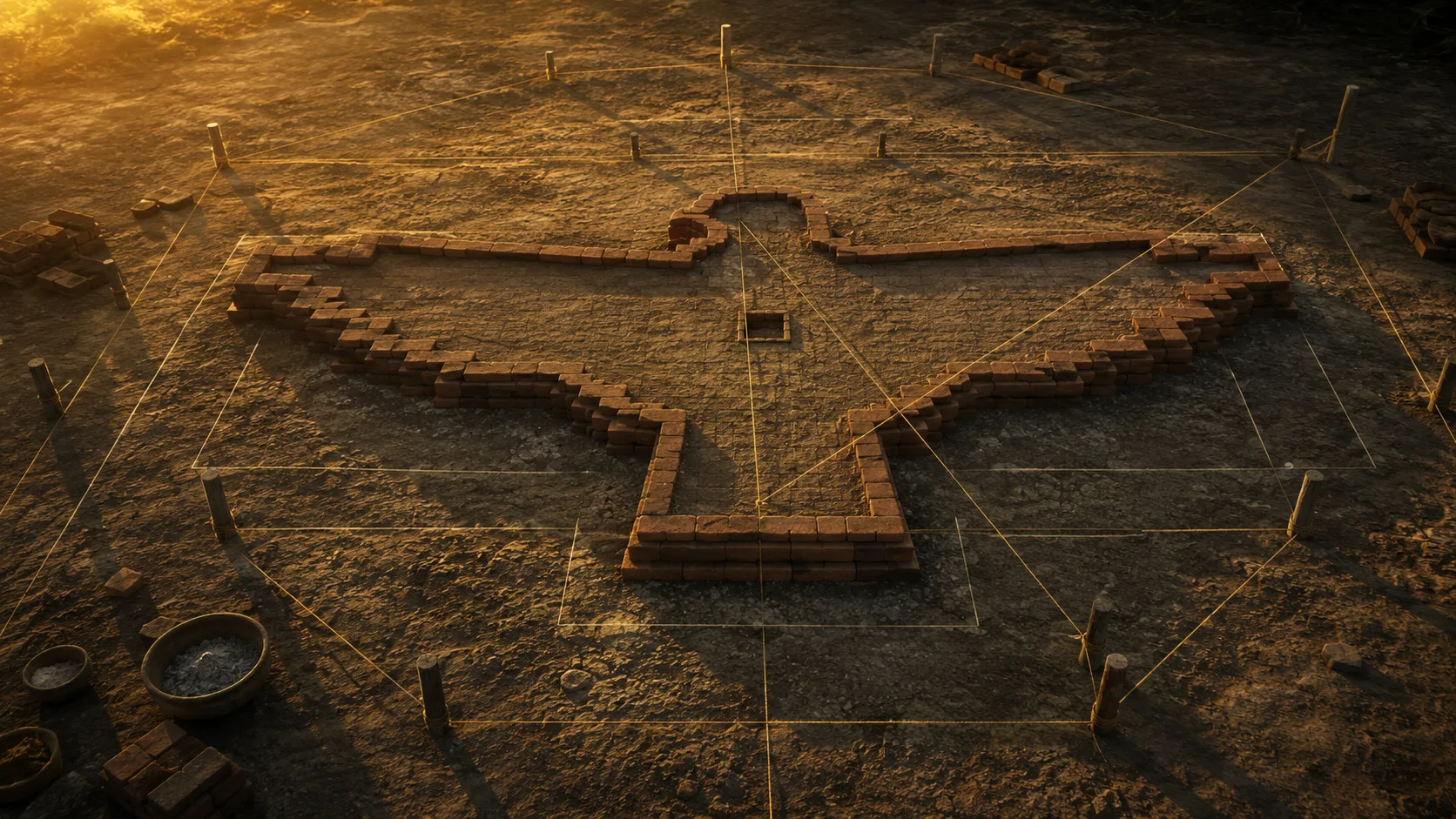
The word is śulba: a cord, a rope, a length of measuring string drawn taut between two pegs driven into the earth. From that single humble instrument an entire geometry was raised — a geometry not of the drawn diagram and the abstract postulate, but of the stretched line, the pegged corner, the figure built upon the ground so that it could not be other than true. The Śulba Sūtras, the geometric manuals embedded within the Kalpa Vedāṅga and appended to the Śrauta Sūtras, are the oldest surviving mathematical texts of Bhārata, and they stand among the oldest geometrical documents anywhere in the world.
They were composed across a long span, reaching from perhaps the eighth century down to the second before the common era, in the terse aphoristic sūtra idiom that compresses a complete procedure into a single breath of Sanskrit — a form built for memory, where each word is a knot in a cord of instruction. Nothing is wasted; nothing is explained twice. The reader is assumed to be a practitioner who will unfold the compressed rule into action with cord and peg upon the prepared ground.
The occasion was ritual. The Vedic yajña demanded altars — the vedi of packed earth, the great agni of fired brick — built to exact specifications of shape, of orientation toward the cardinal directions, and above all of area. A falcon-winged altar had to enclose a stipulated measure to the finger's breadth. A rite that multiplied the offering demanded an altar of multiplied area yet unchanged form. These were not approximations to be judged by the eye and passed. The efficacy of the sacrifice was held to rest upon geometric exactness, and so the priests became, of necessity, geometers of the first rank. What began as the handmaid of ritual grew, within its own discipline, into a science pursued for the sake of its own precision.
Four principal recensions survive entire — those of Baudhāyana, Āpastamba, Kātyāyana, and Mānava — with Baudhāyana's the oldest and most comprehensive of them. Smaller texts bearing the names of Maitrāyaṇa, Varāha, Vādhūla, and Hiraṇyakeśin complete the corpus. Taken together they form not a loose miscellany of rules of thumb but a coherent body of constructive geometry, furnished with general theorems, with exact solutions where exactness is possible and high approximations where it is not, and — most tellingly — with a clear awareness of the difference between the two.
To read them is to enter a world in which mathematics has not yet been separated from the working life that gave rise to it. There is no figure of the geometer as a man apart, contemplating forms in the abstract. There is instead the adhvaryu, the officiating priest, kneeling on the prepared ground with his measuring cord, his bamboo gnomon for the cast of the sun's shadow, and his store of bricks cut to prescribed shapes. The geometry is inseparable from the hand that performs it and the purpose that requires it. And yet — this is the wonder of the texts — out of that wholly practical setting there emerges, unbidden, a body of genuine mathematical knowledge: general relations, exact constructions, and approximations refined far past any practical need. The science grows within the craft like grain within the husk.
A word on their place in time. The dating of the Śulba Sūtras is bound to the dating of the larger Śrauta literature to which they belong, and the scholarly estimates place their composition across several centuries before the common era, with the oral tradition behind them reaching back further still into the Vedic age. Whatever the precise figures — and they remain a matter of careful argument rather than settled fact — the texts are unquestionably older than the systematic geometry of the Greek world as it survives in Euclid, and the mathematical relations they contain are older than the names by which the West would later know them.
The right angle, pegged into the ground
Begin where the altar-builder begins: with the need for a true right angle and a true orientation. Before any figure can be raised, the east–west line must be laid and a perpendicular dropped across it, for the altar faces the directions and its geometry follows from that cross. The Śulba priest needs no protractor, no graduated instrument. He needs only a cord marked into known lengths, and a theorem.
The cord is divided by knots into twelve equal parts. Pegged into the earth as a closed loop with corners at the third, the seventh, and the twelfth knot, it is forced — by nothing but its own measured lengths — into a triangle whose sides stand in the ratio three to four to five. And a triangle of those sides has, of necessity, a right angle between the shorter two. The perpendicular is not estimated; it is compelled by the cord.
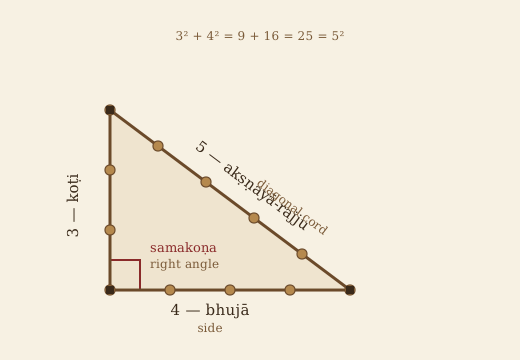
The knotted cord of twelve units, pegged into a 3–4–5 triangle. The right angle (samakoṇa) between the koṭi and the bhujā is compelled by the measure of the cord alone: 3² + 4² = 5².
This is the foundational act, and it already contains the seed of everything that follows. The builder has used a numerical fact — that three, four, and five squared stand in the relation nine plus sixteen equals twenty-five — to produce a geometrical certainty. Number governs figure; figure realizes number. The two are one discipline, and the cord is the instrument that binds them.
Where it was used. Laying the perpendicular cross-axis of every fire-altar, and beyond ritual: squaring the foundations of temples and houses, setting the cardinal grid of planned towns, and fixing the right-angled corners of fields, tanks, and the great brick step-wells.
As we know it today. The converse of the Pythagorean theorem: a triangle whose sides satisfy a² + b² = c² must contain a right angle. Modern students meet it as a corollary; the builder reached for it first, as his primary tool.
The deeper reading. The cord did not test for a right angle — it compelled one. A construction that forces its own correctness is the ideal toward which constructive geometry still reaches.
The 3–4–5 cord construction and its use to lay perpendiculars for altar orientation is explicit in the Baudhāyana and Āpastamba Śulba Sūtras, which also enumerate further integer-sided right triangles. Settled The texts and their datable place within the Śrauta tradition are not in scholarly dispute.
Facing the directions: the gnomon and the sun
Before the altar can be raised at all, it must be turned toward the directions of the sky, and this orientation is itself a problem of exact construction. The Śulba texts solve it by the shadow of the gnomon. A straight pin is fixed upright on levelled ground, and a circle is described about its foot. As the sun climbs, the shadow's tip shortens until noon and then lengthens; it touches the circle twice, once in the forenoon and once in the afternoon. The line joining those two points runs true east and west. From it, by the cord, the north–south perpendicular follows. The first lines of the sacred figure are thus fixed not by guess but by the sun and the cord acting together — astronomy and geometry meeting on the prepared earth, each disciplining the other.
शङ्कुं निखाय तदग्रच्छायया मण्डलं लिखेत् । यत्र लेखां स्पृशति तत्र प्राच्यपराची ॥ — śaṅkuṃ nikhāya tad-agra-cchāyayā maṇḍalaṃ likhet; yatra lekhāṃ spṛśati tatra prācyaparācī. — "Having fixed a gnomon, describe a circle with the length of its shadow's tip; where the shadow touches the line, there run the east and the west." [VERIFY exact Śulba wording and reference against Sen & Bag before publishing.]
Where it was used. Orienting every altar to true east; aligning temples, town grids, and the cardinal axes of planned settlements to the directions of the sky — the foundation of Vāstu orientation.
As we know it today. Finding true (not magnetic) north from the sun's shadow — the gnomon or "Indian circle" method, surviving now mainly in surveying and field astronomy, replaced for most by the magnetic compass and the satellite signal.
The deeper reading. What we now look up from a table or a satellite, the builder constructed each dawn from a pin and a circle in the dust. Stored result versus living construction — the signature of the whole tradition.
The theorem of the diagonal, in full generality
The single most celebrated proposition of the corpus is Baudhāyana's rule for the diagonal of a rectangle. Rendered into plain speech, it states that the rope stretched along the diagonal of a rectangle produces an area equal to the sum of the areas produced by its two sides — the length-wise and the breadth-wise — taken together.
दीर्घचतुरश्रस्याक्ष्णया रज्जुः पार्श्वमानी तिर्यङ्मानी च यत्पृथग्भूते कुरुतस्तदुभयं करोति ॥ — dīrgha-caturaśrasyākṣṇayā rajjuḥ pārśvamānī tiryaṅmānī ca yat pṛthag bhūte kurutas tad ubhayaṃ karoti. — "The diagonal cord of an oblong produces both the areas which the side and the breadth produce separately." — Baudhāyana Śulba Sūtra 1.48
This is the proposition the Western tradition would later name for Pythagoras, set down here not for a single triangle but for any rectangle whatever, in its general form, and standing in a text older than the Greek geometer. The Śulba authors did not rest at the statement. They put it to work, and they recorded the integer-sided right triangles by which the rule could be realized exactly with knotted cords: the three-four-five, then five-twelve-thirteen, eight-fifteen-seventeen, seven-twenty-four-twenty-five, twelve-thirty-five-thirty-seven, and others. These are the triples that satisfy the relation in whole numbers, and their tabulation reveals that the rule was held not as an isolated marvel but as a general instrument with a known inventory of exact cases.
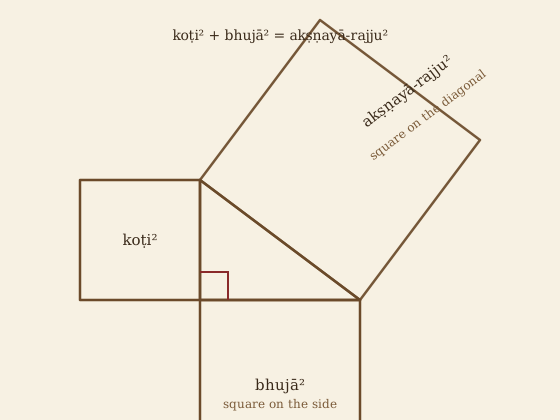
The diagonal theorem made visible. The square on the diagonal cord (akṣṇayā-rajju) equals the squares on the two sides — koṭi and bhujā — combined. The figure is the proof.
It is worth pausing on what kind of knowledge this is. The relation is stated as a universal truth about all rectangles, then instantiated in particular integer cases that can be built with a measured cord. The Śulba geometer thus holds simultaneously the general law and its concrete realizations — the very pattern of mature mathematical thought, in which a theorem and its examples illuminate one another. That the demonstration is constructive rather than deductive, that the figure is built rather than argued, does not lessen the achievement. It is a different temperament of proof, not a lesser one.
Where it was used. Computing the diagonal of any rectangular altar or courtyard without measuring it; enlarging an altar to a required area while holding its shape; and throughout temple and tank geometry wherever a slanting length had to be found from two straight ones.
As we know it today. The Pythagorean theorem, a² + b² = c² — the most universally taught proposition in school geometry. The Baudhāyana statement, by the plain dating of the texts, is the older.
The deeper reading. The modern student possesses the theorem as a formula; the Śulba builder enacted it as a figure on the ground. Same mathematics, two wholly different ways of knowing.
Whether the Śulba authors possessed a general proof of the diagonal relation, or held it as an empirically certain construction principle, is debated. Contested No deductive proof in the Euclidean manner survives in these texts. What is not in doubt is the explicit, general statement of the relation and its correct application — both predating the Greek formulation.
Doubling the square, and the approximation of √2
To double a square — to construct a square whose area is exactly twice that of a given one — the side of the new square must be laid off as the diagonal of the old. And that diagonal stands to the side as √2 to one, a magnitude that no ratio of whole numbers can capture. Here the Śulba authors met the incommensurable face to face, and they did not flinch. They produced an approximation of √2 whose accuracy startles anyone who first encounters it.
Baudhāyana's rule, unfolded from its sūtra compression: increase the measure by its own third part; increase that third part by its own fourth; then diminish the result by the thirty-fourth part of that fourth.
प्रमाणं तृतीयेन वर्धयेत्तच्च चतुर्थेनात्मचतुस्त्रिंशोनेन सविशेषः ॥ — pramāṇaṃ tṛtīyena vardhayet tac ca caturthenātma-catustriṃśonena saviśeṣaḥ. — "Increase the measure by its third part, and that third again by its own fourth, less the thirty-fourth part of that fourth; this is the diagonal, with a small excess remaining." — Baudhāyana Śulba Sūtra 1.61–62 [VERIFY exact Devanāgarī orthography and sūtra numbering against Sen & Bag before publishing.]
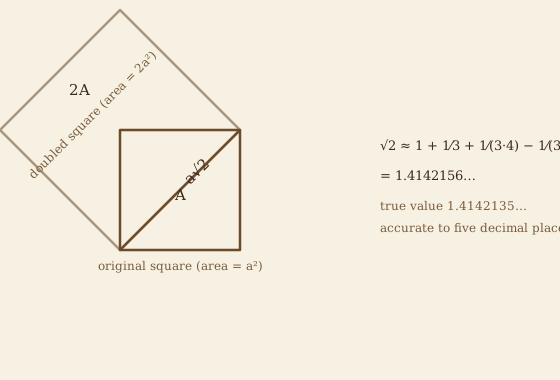
Doubling the square. The diagonal of the original square (side a) becomes the side of a square of exactly twice the area — length a√2. The Śulba rule for √2 is accurate to five decimal places.
The rule, worked out. Written as a sum of fractions, the prescription reads √2 ≈ 1 + 1⁄3 + 1⁄(3·4) − 1⁄(3·4·34), which evaluates to 1 + 0.33333… + 0.08333… − 0.00245… = 1.4142156…. The true value is 1.4142135…. The Śulba estimate is correct to the fifth decimal place — an error of roughly two parts in a million. No derivation accompanies the result, but the structure of the three correction terms, each refining the last, points to a deliberate and iterative method rather than a fortunate guess.
This is the threshold at which the merely useful gives way to the genuinely scientific. A rope-stretcher needs perhaps two decimal places to raise an altar that will pass the inspecting eye. Five decimal places is the labour of a mind interested in the number for its own sake — in how nearly the incommensurable can be pinned against the rational. The approximation is the fingerprint of a mathematical sensibility working far beyond the practical demand that first set it in motion. The altar required an answer; the geometer pursued the truth of the magnitude.
Where it was used. Doubling the area of a square altar — a common ritual requirement — by laying its diagonal as the new side; and anywhere a builder had to mark a length of √2 times a known measure on the ground.
As we know it today. Irrational numbers and the real number line; √2 = 1.41421356…, a length no fraction can express. The Śulba's three-term correction mirrors the iterative refinement of modern numerical method — the Newton-Raphson idea.
The deeper reading. The Greeks were said to be disturbed by the irrational and to hide it. The Śulba authors simply pinned it down to five decimals — untroubled, as if the incommensurable were merely another length to be measured.
The √2 approximation and its five-decimal accuracy are present verbatim in Baudhāyana and Āpastamba and are uncontested. Settled The method of its original derivation is unrecorded and remains a matter of reasoned reconstruction.
Transformation of areas: the central art
The recurring task of the Śulba geometer is transformation — to change a figure into another of different shape but identical area, or to add and subtract areas at will. This is precisely the domain that Greek geometry would later name the application of areas, and the Śulba authors address it not as a scattering of tricks but as a system. Several of their constructions deserve to be followed step by step, for the reasoning in each is exact and the method general.
Combining two squares into one
To build a single square equal in area to two given squares together, the diagonal theorem is turned from a statement into a tool. Along the side of the larger square, the side of the smaller is laid off; a cord is then stretched from that marked point to the far corner. By the theorem, that cord has the length √(a² + b²), and the square raised upon it holds exactly the combined area of the two. The same principle that fixed the right angle now adds the areas — one truth, many uses.
समस्य द्विकरणी ॥ — samasya dvi-karaṇī … nānā-caturaśre samasyann yat ūnaṃ tasya karaṇyā varīyo 'paracchindyāt. — "When combining two squares of different size, cut off from the larger a portion with the side of the smaller; the diagonal cord of that portion makes the side of the combined square." — after Baudhāyana Śulba Sūtra 1.50–51 [PARAPHRASE — restore exact Devanāgarī and IAST from Sen & Bag before publishing.]
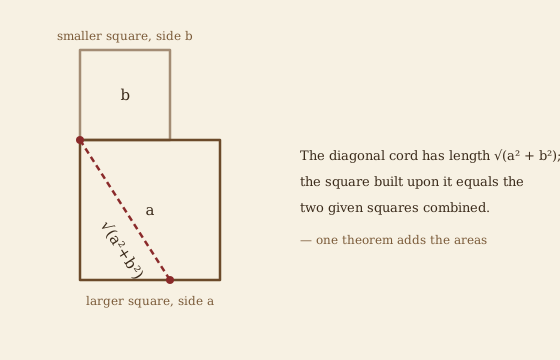
Two squares made one. With the smaller side laid along the larger square, the diagonal cord spans √(a² + b²); the square built on that cord equals both given squares combined.
Where it was used. Merging two altars of differing size into a single altar of their combined area; assembling a required total area from prescribed component squares of brick, course by course.
As we know it today. The same diagonal theorem turned into a tool: the cord spans √(a² + b²). Modern mathematics names the underlying idea equidecomposability — figures equal in area by cutting and reassembly — central to Hilbert's third problem.
The deeper reading. A schoolchild adds areas as numbers. The Śulba adds them as figures, never leaving geometry for arithmetic — closer in spirit to twentieth-century dissection theory than to the modern classroom.
Turning a rectangle into a square
The converse art — to render a rectangle as a square of the same area — is the more intricate, and the more revealing. A square is first cut from one end of the rectangle. The strip that remains is halved; one half is carried to an adjacent side and set against it. This very nearly completes a larger square, but for a small square missing at the corner where the two moved pieces meet. That deficiency is made good by the difference-of-squares construction — the relation later written a² − b² = (a + b)(a − b) — supplied here entirely through cord and peg, with no symbol but with the full force of the algebraic identity behind it.
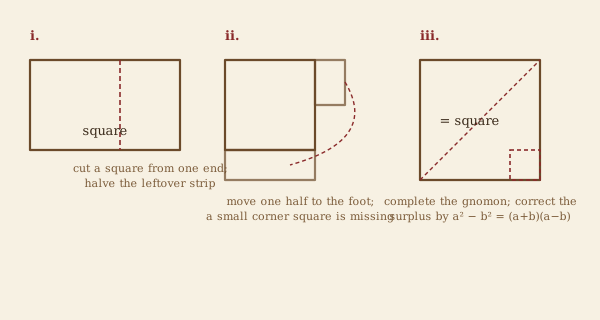
Rectangle into square, in three movements: cut a square from one end and halve the remainder; carry one half to the foot; complete the gnomon and correct the missing corner by the difference of two squares.
What deserves notice is that the procedure is not a single clever cut but a sequence of reasoned steps, each justified by an underlying identity, assembled into a method that works for any rectangle whatever. The difference of two squares is not stumbled upon; it is deployed, knowingly, as the instrument that closes the construction. Algebra lives here, dressed in the garment of geometry.
The difference of two squares, as the cord performs it. To construct a square equal to the difference of two given squares — the larger of side a, the smaller of side b — the larger square's side is taken as a cord and swung as an arc until its far end meets the line of the smaller side extended. The segment so cut off has length √(a² − b²), and the square upon it is exactly the larger square diminished by the smaller. In modern symbols the construction realizes a² − b² = (a + b)(a − b), but the Śulba builder needs no symbol: the arc of the cord and the meeting of two lines deliver the result directly.
Where it was used. Reducing one square altar by the area of another; correcting the small surplus left when a rectangle is reshaped into a square; trimming a figure to an exact required area.
As we know it today. The factorization a² − b² = (a + b)(a − b), among the first identities of school algebra — here performed by cord and arc, predating the algebraic notation by which it is now taught.
The deeper reading. The modern student manipulates letters; the Śulba geometer manipulated lengths — and the lengths obeyed the very same law the letters obey. Algebra in the garment of geometry.
Squaring the circle, and the circle squared
The altars demanded passage between the straight-edged and the round, and so the Śulba authors confronted the squaring of the circle — the construction of a square and a circle of equal area, the very problem the Greeks would pursue for centuries and which much later mathematics would prove impossible to solve exactly by straightedge and compass. Untroubled by an impossibility no one had yet imagined, the Śulba authors gave a workable construction in both directions, and with it an implied value of π.
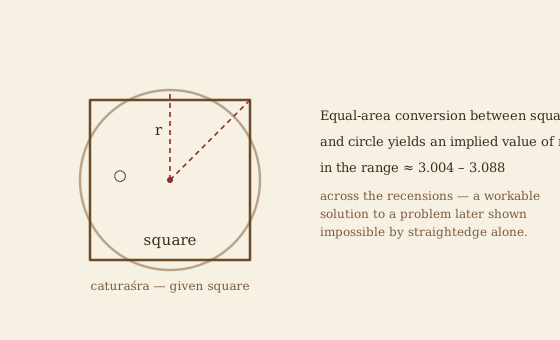
Circling the square: a circle constructed equal in area to a given square (caturaśra). The equal-area conversions imply a value of π between roughly 3.004 and 3.088 across the recensions.
The implied values — in the neighbourhood of three and a small fraction, varying with the recension and the direction of the conversion — do not match the precision the same civilization would later reach with Āryabhaṭa and the Kerala school. But that is not the measure to apply. The point is that the problem was posed, engaged, and given a constructive answer, by people who had no reason to suspect it could not be solved exactly — and who, in the attempt, once more handled a number that lies beyond the reach of any ratio.
Where it was used. Converting between square and circular altars of equal area — the round altar and the square altar had to hold the same measure — and wherever ritual demanded a circle matched to a given square or the reverse.
As we know it today. The squaring of the circle, proved impossible by straightedge and compass only in 1882, when Lindemann showed π to be transcendental. The Śulba conversions imply π ≈ 3.004–3.088.
The deeper reading. Not a failure but the right response to a problem no one could yet know was unsolvable: recognize it, engage it constructively, approximate honestly. The student is told it cannot be done; the builder did the most honest geometry allows.
The exact π-values implied by the Śulba circle constructions vary by text and by reconstruction method, and modern estimates differ in the last figures. Contested What is firm is that equal-area square-and-circle conversions were attempted and reduced to repeatable constructions.
Which faculties of mathematics the Śulba Sūtras command
It is worth naming, in the language of the present, the mathematical territory these texts already occupy — not to dress the ancient in borrowed modern robes, but to make plain how wide their reach had grown while the rest of the world's geometry was still in its infancy.
Plane geometry is the evident homeland: the construction of perpendiculars and squares, the properties of the rectangle and the right triangle, the transformation and equivalence of areas. The theory of numbers enters through the systematic listing of Pythagorean triples — integer solutions to a quadratic relation, sought and recorded as a class. The theory of irrational magnitudes stands revealed in the explicit, high-precision approximation of √2 and in the implicit handling of π: an early and unflinching grasp of quantities that fall outside the rational numbers altogether. Elementary algebra is present in substance though not in symbol, for the identities of the difference and the sum of squares are wielded as construction principles. And beneath all of these runs a discipline of constructive demonstration — a figure is never merely asserted to possess a property; it is built so that, by the geometry of its making, it cannot fail to possess it.
What is absent speaks as clearly as what is present. There is no axiomatic scaffold in the Euclidean manner, no chain of theorems descending from stated postulates. The Śulba geometry is operational and constructive: it tells the practitioner how to make the figure, and the making is the proof. This is a different cast of mathematical mind from the Greek — a geometry of the hand and the stretched cord rather than the contemplated diagram — yet it arrives at the same theorems, and in the case of √2 at a numerical precision the early Greek tradition did not attain. To call it less rigorous is to mistake a difference of method for a difference of depth.
The Śulba way. Theorems exhibited by construction: to know a figure has a property, build it so that it must. Knowledge enacted with cord and peg on prepared ground.
As we know it today. Two living currents: Euclid's axiomatic-deductive geometry, taught in most schools, and the constructive tradition — prove a thing exists by showing how to build it — now central because a computer can only ever construct.
The deeper reading. Long judged the more primitive, the constructive question — not does it exist but how is it made — is now seen as the deeper. By that measure the Śulba was ahead of a recognition the discipline took millennia to recover.
The framing of Śulba geometry as "constructive rather than axiomatic" is an interpretive lens, useful for situating it beside the Greek tradition. Speculative It should not be read as implying the Śulba authors could not reason generally — only that their surviving texts record method and result in the operational idiom proper to a manual of practice.
The altar and its purpose
All of this geometry served an end, and the end was the fire-altar. The most demanding of the constructions, the śyena-citi or falcon-shaped altar, gathered the whole science into a single sacred figure: a great bird of fired brick, wings outspread, built course upon course to a prescribed area and oriented to the directions of the sky. To raise it, the builder had to lay perpendiculars, transform areas, preserve a fixed total measure while altering the form across successive layers, and combine the figures of bird and wing and tail into one coherent whole — every art described above, brought to bear at once upon the ground.
श्येनचितं चिन्वीत सुवर्गकामः ॥ — śyena-citaṃ cinvīta suvarga-kāmaḥ. — "Let one who desires heaven build the falcon-shaped fire-altar." — Taittirīya Saṃhitā 5.4.11 [VERIFY exact citation and orthography against the Saṃhitā before publishing.]
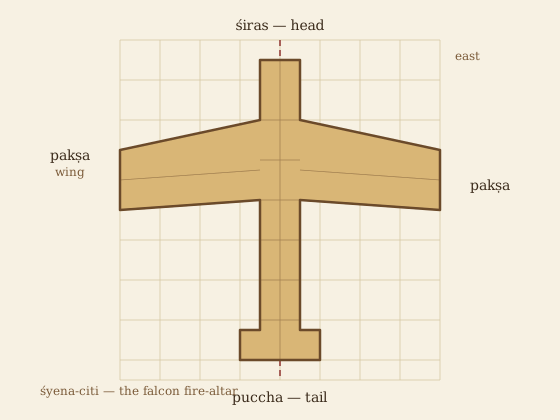
Plan of the śyena-citi, the falcon fire-altar, upon its measuring grid. Head (śiras), wings (pakṣa), and tail (puccha) compose one figure of fixed area, oriented to the east. The whole science of the cord converges in its construction.
That the most exacting geometry of the age was developed in the service of the altar is not incidental to its character; it is the key to it. The demand for exactness came from the rite, and the rite would tolerate no slackness. A geometry born to satisfy the sacred could afford no approximation where exactness was possible, and where exactness was impossible — at √2, at the circle — it pressed the approximation as far as patience and method allowed. The seriousness of the worship became the seriousness of the science.
An unbroken line
The Śulba Sūtras are not a solitary brilliance that flared once and went dark. They stand at the head of a continuous tradition, the first surveyed line of a mathematical civilization that would run, unbroken, for more than two thousand years. The constructive geometry of the altar passes into the classical mathematics of Āryabhaṭa in the fifth century, with his table of sines and his treatment of indeterminate equations; into Brahmagupta in the seventh, with the first systematic reckoning of zero as a number in its own right and of negative quantities besides; into the decimal place-value system that the whole world now uses without recalling whence it came; and onward into the Kerala school of the fourteenth to sixteenth centuries, where Mādhava and those who followed him unfolded infinite series for the sine, the cosine, and for π — reaching, two centuries before Newton and Leibniz, results that the later European calculus would independently rediscover.
Seen in that long sweep, the cord stretched across the Vedic altar is the opening line of a single immense argument carried across millennia. The priest who pegged a right angle into the earth with a knotted rope and the mathematician who summed an infinite series to compute π are labourers within one continuous inheritance, the one tradition deepening upon itself age after age. The Śulba Sūtras are where that inheritance, in written form, begins — geometry already exact, already general, already reaching past the whole number toward the deeper order of magnitude that the rational alone can never hold.
It is sometimes said, by those who would diminish the achievement, that the Śulba geometry was a closed and practical thing, sufficient unto the altar and incapable of growth. The long record refutes the charge. The same civilization that pegged the falcon-altar into the ground went on to give the world the decimal numeral, the symbol and concept of zero, the systematic algebra of Brahmagupta, the trigonometry of Āryabhaṭa, and at last the infinite series of the Kerala mathematicians — a continuous deepening across two millennia, each age building upon the recorded labour of the last. The Śulba constructions are not the whole of that edifice, but they are its foundation course, laid true and laid early, upon which everything after could rise. To trace Bhāratīya mathematics to its source is to arrive, in the end, at a priest with a knotted cord, drawing the first exact line across the earth in the service of the sacred fire.
The undeciphered inheritance
A reflection in the author's voice. What follows is offered not as demonstrated fact but as considered conviction.
Everything set down above can be checked. The √2 of Baudhāyana evaluates, on any calculator, to five correct decimal places. The diagonal rule holds for every rectangle one cares to draw. The constructions build the figures they claim to build. These are not matters of faith; they are matters of arithmetic and geometry, and they have been verified again and again. And precisely because the verifiable portions of the Śulba corpus keep proving exact, a question presses itself upon the honest mind: what of the portions not yet verified — the passages dismissed as obscure, the claims set aside as exaggeration, the techniques whose rationale has not survived?
The history of the encounter between modern science and the older knowledge of Bhārata follows a recurring pattern. A statement in the texts is first dismissed as myth or poetic excess; later, as instruments and understanding mature, the same statement is found to hold a precision no one had credited. The decimal place-value system was once thought a late convenience; it is now known to be the foundation of all modern computation. Zero was treated as a philosophical curiosity; it is now the keystone of every calculation a machine performs. The infinite series of the Kerala mathematicians were long unknown to the West and, when found, were assumed to be a local accident; they are now recognized as genuine anticipations of the calculus. In each case the knowledge was there first, recorded plainly, and the world's ability to recognize it arrived centuries late.
It is in this spirit, and with this caution, that one may consider the wider claim. The literature of Sanātana Bhārata speaks of things the modern mind is quick to file under fable — the Puṣpaka vimāna of the Rāmāyaṇa that moved through the air at the will of its rider; the references in the Atharvaveda and elsewhere to forces, instruments, and capacities that read, to a careless eye, as mere imagination. The honest position is neither the credulous one nor the dismissive one. It is not claimed here that the Wright brothers read the Rāmāyaṇa, nor that a machine of the ancient world has been recovered and flown. What is claimed is narrower and harder to refute: that a civilization which provably reached five-decimal precision in the age of the altar, which gave the world zero and the decimal and the infinite series, was operating at a depth our present instruments and assumptions are not yet equipped to fathom — and that the contested or undeciphered portions of its inheritance therefore deserve patience rather than contempt.
The flying machine was mentioned long before the nineteenth century gave the world its first aircraft. No one need argue that the one produced the other to feel the force of the coincidence: that the human imagination, in Bhārata, was describing flight while the rest of the world had not yet conceived it, and that the same civilization which imagined the vimāna was, in its mathematics, demonstrably ahead of its age by millennia. Where the imagination ran so far ahead, and the mathematics ran so far ahead, prudence counsels against assuming that everything between the two was empty invention. As the instruments of the present continue to mature, it is the conviction of this author that the depth and the breadth of the Indian knowledge system will be understood by humankind more fully than it is today — and that much now dismissed as fable will be recognized, as the decimal and the zero and the series were recognized, as knowledge that was simply recorded too early for the world to read. The technology of the present has not yet attained the maturity required to decode, or even to fathom, the whole of what was written. The cord was stretched across the earth long ago. We are still learning to read the line it drew.
Sources and further reading. S. N. Sen and A. K. Bag, The Śulbasūtras of Baudhāyana, Āpastamba, Kātyāyana and Mānava (Indian National Science Academy, 1983) — text, translation, and mathematical commentary. Bibhutibhushan Datta, The Science of the Śulba: A Study in Early Hindu Geometry (University of Calcutta, 1932). Kim Plofker, Mathematics in India (Princeton University Press, 2009). T. A. Sarasvati Amma, Geometry in Ancient and Medieval India (Motilal Banarsidass, 1979). George Gheverghese Joseph, The Crest of the Peacock: Non-European Roots of Mathematics (Princeton University Press, 3rd ed., 2011).