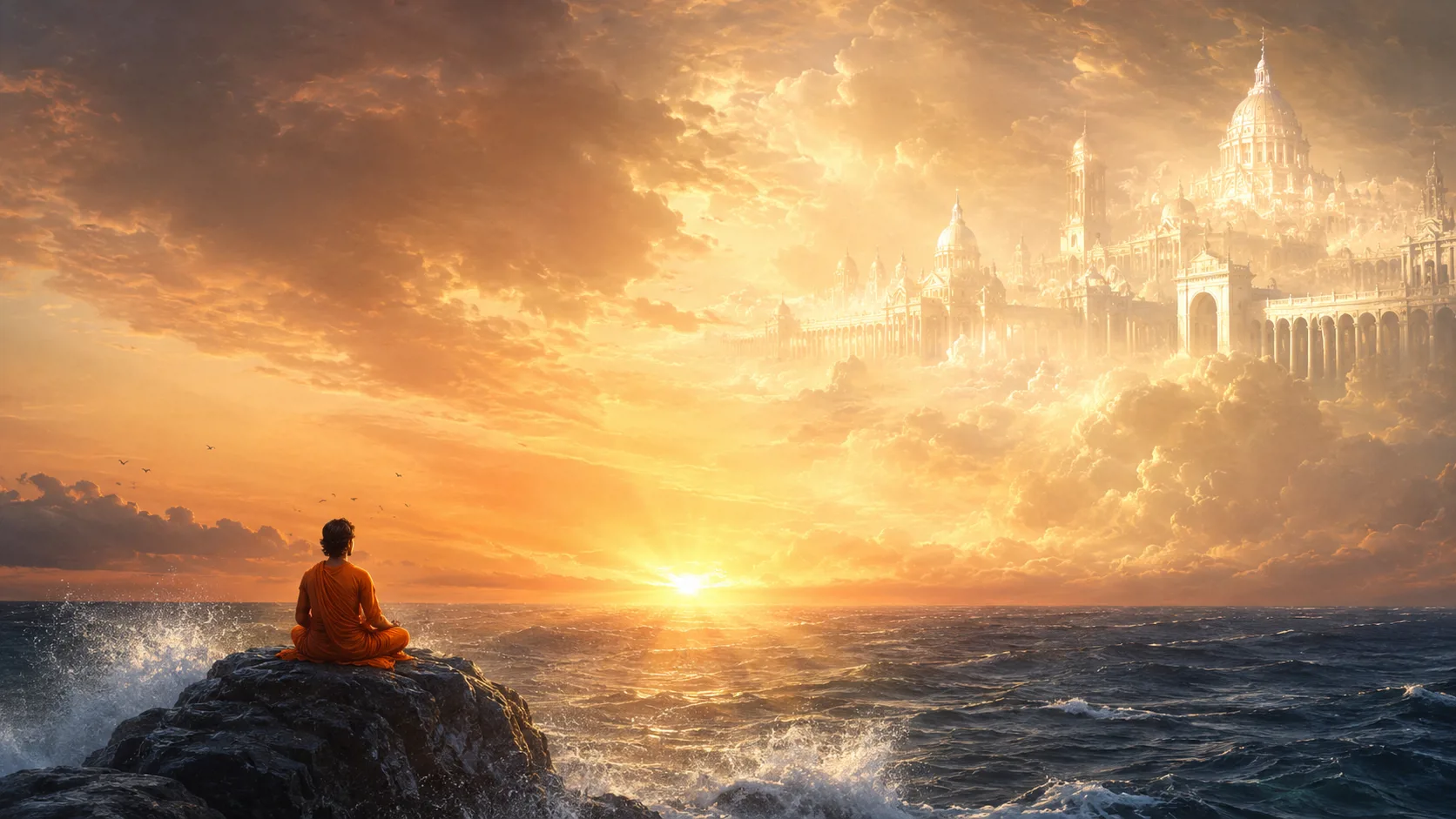
There are men who are born into history, and there are men into whom history is born. Narendranath Datta belonged to the second kind. When he stood up in a hall in Chicago on the eleventh of September, 1893, and opened his mouth to speak five ordinary words — Sisters and Brothers of America — he did not know that he was about to compress into a single breath the answer of a wounded civilization to the question the modern world had been asking it for two centuries: Are you still alive?
He was alive. And in him, so was Bhārata.
This is the story of how a sceptical Calcutta youth who once demanded of every holy man he met, "Sir, have you seen God?", became the wandering monk who carried the Upaniṣads to the West, who told a fasting, conquered, ridiculed India that it was not the refuse of the earth but the spiritual teacher of humanity — and who burned himself out doing it before he was forty.
I. The Child of Two Inheritances
Narendranath Datta was born in Calcutta on 12 January 1863, on the festival of Makara Saṅkrānti, into the Datta family of Simla (Simulia), a prosperous and cultured kāyastha household. The dating to the saṅkrānti is not incidental to those who tell his story: a child born on the day the sun turns north, uttarāyaṇa, the auspicious gate of the year.
He inherited two temperaments, and the war between them is the key to the man.
From his father, Vishwanath Datta, an attorney at the Calcutta High Court, he received the rationalist's edge — a love of argument, English literature, music, a wide and generous worldliness, and a certain aristocratic indifference to small pieties. Vishwanath was learned in Persian and Arabic, recited Hafiz, and kept a liberal, sceptical, free-spending house.
From his mother, Bhuvaneshwari Devi, a woman of grave devotion and a memory steeped in the Rāmāyaṇa and Mahābhārata, he received the other half: the inwardness, the hunger for the absolute, the iron will. He would say later, with the bluntness that was his signature, that whatever he was, he owed to his mother. "It is the mother who moulds the life of the child."
Even as a boy he was ungovernable in the particular way that saints and revolutionaries are ungovernable — restless, fearless, physically powerful, magnetic to other children, and possessed of a strange habit: he could fall, at will, into a luminous concentration, a stillness so deep that as a small child he would meditate himself into a kind of light, and once, the family lore says, was so absorbed that he did not notice a cobra that had entered the room. The instinct for samādhi was in him before he had a word for it.
He grew into a brilliant student. He read voraciously and against the grain — Western philosophy, John Stuart Mill, Hume, Herbert Spencer, Auguste Comte, the rationalists and the agnostics; and simultaneously the Sanskrit darśanas. He had a powerful, trained singing voice and a serious grounding in Hindustani classical music. He could box, swim, organize, lead. He was, in the precise sense, an aristocrat of the spirit who had not yet found his kingdom.
And he was, by his late teens, in crisis.
II. "Sir, Have You Seen God?"
The crisis was not poverty — that came later, and brutally, when his father died in 1884 and left the once-rich family destitute, with creditors at the door and Narendra tramping the streets of Calcutta looking for work, sometimes going hungry so that his mother and siblings could eat. The deeper crisis was metaphysical, and it had begun earlier.
He had passed through the Brāhmo Samāj, the reformist movement of Keshab Chandra Sen and Debendranath Tagore — a rational, monotheistic, socially reforming theism that satisfied his ethical hunger but not his ontological one. He wanted proof. He had read all the philosophy the age could offer, Eastern and Western, and it had left him with a single, scalding, unanswerable demand. He began going from one religious teacher to another and asking each of them the same question, point-blank:
"Sir, have you seen God?"
And every one of them flinched. They spoke of scripture, of inference, of faith, of the impropriety of the question. None could say yes and look him in the eye.
Until he was taken — half-curious, half-contemptuous — to a half-mad, illiterate temple priest at Dakṣiṇeśvar, on the bank of the Gaṅgā north of Calcutta, who served the Goddess Kālī, who wept and laughed and fell into trances, and whose name was Ramakrishna.
III. The Guru: Fire Meeting Fire
Narendra asked him the question.
And Sri Ramakrishna answered without hesitation, without rhetoric, the way a man answers when he is reporting a fact: "Yes, I see God, just as I see you here, only in a much intenser sense. God can be seen. One can talk to Him as I am talking to you."
No one had ever said it. The teacher claimed not belief but sight — pratyakṣa, direct perception, the highest pramāṇa. The proud young rationalist did not surrender; he resisted for years. He suspected hallucination, monomania, hysteria. He tested the old man mercilessly, argued, mocked, withdrew, returned. And Ramakrishna — who declared from the first meeting that this boy was no ordinary soul but a portion of the eternal, a nara-nārāyaṇa — loved him with a ferocity that frightened Narendra and bound him.
What Ramakrishna did to him cannot be reduced to instruction. He transmitted a state. There is the famous account of the touch: Ramakrishna placed his foot or his hand upon Narendra, and the room dissolved — walls, furniture, the universe itself rushing into a roaring void, the young man crying out in terror, "What are you doing? I have my parents at home!" It was the first crack in the shell of his hard, bright, separate ego.
But the master would not let him rest in mere experience. Narendra had been a fierce nondualist in argument while refusing nondualism in fact — he found the Advaitic teaching that he himself was the Absolute, that the self and Brahman are one, to be near-blasphemy. Ramakrishna laughed and pushed. And then came the day, recorded by witnesses, when the touch took, and the nirvikalpa samādhi — the highest, formless, subject-object-less absorption that the tradition holds to be the rarest of attainments, sometimes the work of lifetimes — opened in him and held him. He had asked for proof. He was given the thing itself.
When his father died and the family fell into ruin, the contrast became unbearable and clarifying: the world he had been groomed to conquer had collapsed, and the only solid ground left under his feet was the one the old man at Dakṣiṇeśvar had shown him. Ramakrishna, dying of throat cancer in 1886, gathered the young disciples around Narendra, gave Narendra charge of them, and — the disciples believed — handed over his own spiritual power to him before he passed. "Naren will teach others," he said. "He will shake the world to its foundations."
He was not exaggerating.
IV. The Wandering Monk
After the master's death, the young men took monastic vows and gathered in a half-ruined, reputedly haunted house at Baranagar — the seed of what would become the Ramakrishna Order. Narendranath took the name by which the world would know him only later; in these years he wandered under several monastic names before settling on Vivekananda — the bliss of discerning wisdom, viveka being the very faculty of discrimination between the real and the unreal that is the first qualification of the seeker.
Then, from roughly 1888 to 1893, he did something that has no real Western parallel and that made him: he became a parivrājaka, a wandering mendicant, and walked across the whole of India.
He walked from the Himālaya to Kanyākumārī. He stayed in the palaces of mahārājas and in the huts of untouchables. He talked Sanskrit philosophy with paṇḍitas and sat with pariahs whom caste society would not touch. He saw, at ground level and without illusion, what India had become: spiritually the richest soil on earth, and materially a ruin — millions in degrading poverty, ground down, fatalistic, divided, taught by centuries of subjugation to believe themselves contemptible.
And out of this walking came the conviction that organized his entire remaining life — a conviction that fused the two halves of his inheritance, his mother's God and his father's reason, into a single fire. He would put it in words that still scandalize the merely pious: religion is not for empty bellies. A starving man cannot be preached to about the Self. India's spirituality was real and supreme — and India's spirituality was useless if it could not lift the fallen, feed the hungry, and restore to the lowest man the knowledge that he too was divine. Daridra-Nārāyaṇa — God in the form of the poor. Service of man as worship of God.
The wandering ended at the southernmost rock of India. At Kanyākumārī, on the last stone of Bhārata where three seas meet, Vivekananda swam out to a rock offshore and sat in meditation for three days, on the night of, by tradition, the December of 1892. There, looking back north across the whole sleeping subcontinent, the scattered intuitions fused into a single resolve. He would later say it was there that he received his commission. India had to be awakened. And — here the plan took its astonishing turn — to awaken India, which despised itself and worshipped the West, he would first have to make the West acknowledge India's spiritual greatness, and carry that acknowledgement home.
He had heard that a great assembly of the world's religions was to convene, far away, in a city called Chicago.
V. How a Penniless Monk Crossed the World
This is the part of the story that, told plainly, sounds impossible.
Vivekananda was a sannyāsī. He owned nothing — by vow. He had no organization behind him, no church, no funds, no official credentials, no invitation, and at first not even a settled name that the Parliament's organizers would recognize. He proposed to travel from South India to the United States to address a world parliament — and he had not the price of the passage.
What carried him was people who had met him. All across his wandering, men had encountered this monk and been unable to forget him. In Madras, a circle of educated young disciples — the men who would found the magazines and the work — were electric with the conviction that he must go and must speak for India. They began raising money. The poor gave coins. And crucially, princes who had hosted him intervened: the disciples and admirers in the South, together with the Mahārāja of Khetri, Ajit Singh — who had become his devoted friend and patron, and whose son's birth Vivekananda had blessed — furnished the funds for the voyage. It was the Mahārāja of Khetri who also gave him the ochre robe and turban that became his public image, and, by the most durable account, the very name Vivekananda under which he sailed.
He embarked from Bombay on 31 May 1893, travelling east — Colombo, Singapore, Hong Kong, Canton, Nagasaki, across Japan, then by ship across the Pacific to Vancouver, and down by train to Chicago, arriving in mid-July 1893.
And there the plan nearly died.
VI. Chicago: Stranded, Penniless, Nearly Defeated
He arrived to discover a chain of disasters.
First: he was early — the Parliament would not open until September, and he had to survive nearly two months in one of the most expensive cities in the world during a World's Fair, with his small funds bleeding away faster than he had ever imagined money could vanish. The opulence appalled and instructed him.
Second, and far worse: when he made inquiries, he learned that one could not simply walk in and address the Parliament. A delegate needed credentials — official sponsorship from a recognized organization — and the deadline for registration had already passed. He had crossed the planet to speak for India and discovered he had no standing to speak at all. He had a name, a robe, and a conviction, and the world's bureaucracy had no slot for them.
His money dwindling, he was advised that Chicago was unaffordable and went to Boston to wait and economize. And it was on this leg — stranded, anxious, his great mission apparently collapsing for the most ignominious of reasons — that providence, or what the devout simply call grace, intervened through the kindness of strangers, and above all of American women, who across his whole American sojourn would prove his staunchest friends and supporters.
On the train and in Boston he was noticed. A wealthy, cultured Massachusetts woman, Miss Kate Sanborn, struck up acquaintance with the striking orange-robed monk, was captivated by his learning and his conversation, and took him into her circle — feeding him, hosting him, introducing him to the New England intelligentsia. Through this circle he was brought to the notice of Professor John Henry Wright of Harvard, a distinguished Greek scholar. Wright spent hours with Vivekananda, recognized at once that here was a mind of the first order, and when the question of credentials arose, brushed it aside with the line that has become part of the legend: that asking this man for his credentials was like asking the sun for its right to shine. Wright wrote letters of introduction to the Parliament's organizing committee, vouched for him personally, and bought him his railway ticket back to Chicago.
Even then the comedy of obstacles was not finished. Returning to Chicago, Vivekananda lost the address of the committee, found himself unable to make himself understood, spent a night — by his own and his biographers' account — sleeping in a large empty boxcar or crate in a railway yard, penniless and hungry, and the next morning wandered the wealthy lakeshore streets begging, in vain, for food and direction, turned away from door after door. Exhausted, he sat down on the kerb and, in effect, surrendered the outcome to the Divine Mother. And a woman across the street — Mrs. George W. Hale, who with her family would become among his closest American hosts — saw the dignified, weary foreigner, came out, asked if he were a delegate to the Parliament, fed him, and personally took him to the committee.
So it was: a monk who owned nothing, sponsored by the coins of the South Indian poor and the purse of a Rajput prince, rescued from anonymity by the kindness of American women and a Harvard Hellenist, slept in a freight-yard the night before, and walked into the Parliament of the World's Religions the next morning as a man with no church behind him at all — to represent the oldest living religious tradition on earth.
VII. The Parliament: What It Was, and Why It Mattered
The World's Parliament of Religions opened on 11 September 1893 in the Hall of Columbus of the new Art Institute building, on the shore of Lake Michigan, as part of the World's Columbian Exposition — the colossal World's Fair celebrating the four-hundredth anniversary of Columbus's voyage, the fair of the "White City," of electric light and engineering and the triumphant self-display of industrial America at its zenith.
The Parliament was the first formal gathering of its kind in modern history: representatives of the great religions of the world — Christianity in its many denominations, Judaism, Islam, Buddhism, Jainism, Shinto, Zoroastrianism, Confucianism, and Hinduism — convened on one platform to present themselves to one another and to the public. For all that it was conceived within a confident, often patronizing Protestant frame — many of its organizers privately expected the assembly to demonstrate the superiority of Christianity and the picturesque inadequacy of the "heathen" faiths — its very existence was unprecedented: the official, public admission, on American soil, that the religions of the East had a right to a hearing.
Into that frame walked Vivekananda. And the frame did not survive the encounter.
He had a further private terror that morning that ought to be recorded, because it makes what followed more human and more astonishing: he had never addressed a large Western audience in his life, and when the session opened and senior, robed, eminent delegates rose one after another to read prepared papers, Vivekananda — who had prepared nothing, who meant to speak from the heart — was seized with stage fright and let his turn pass again and again, deferring until the afternoon. He bowed to Sarasvatī, the goddess of speech and learning, and finally rose.
VIII. The Words As They Were Spoken
What he actually said first, on that afternoon of 11 September 1893, was not an argument. It was an address — a form of address — and that is the whole secret of it. The other delegates had said "Ladies and gentlemen." Vivekananda opened:
"Sisters and Brothers of America."
That was all. He got no further for a long time.
Because the seven thousand people in the Hall of Columbus rose to their feet as one and broke into an ovation that, by the contemporary reports, thundered on for two full minutes. Some accounts say three. No one in the hall could afterward fully explain it. There had been no oratory yet, no doctrine, no eloquence — only five words and a tone. But the tone was the thing. The other speakers had addressed an audience. This man had addressed a family. In a vast assembly built on the careful distances of denomination and nation and race, he had, with two nouns, simply abolished the distance — claimed kinship, called strangers his own blood — and seven thousand Americans felt it land in the body before the mind could examine it.
When the storm finally subsided, he gave his short address. He thanked them in the name of the most ancient order of monks in the world, in the name of the mother of religions, and in the name of the millions of Hindu people of all classes and sects. He told them he was proud to belong to a religion which had taught the world both tolerance and universal acceptance — and he drew the sharp distinction that is the heart of the Vedāntic claim: not mere toleration, which still secretly believes the other to be in error and merely endures him, but acceptance, the conviction that all paths truly lead to the same Real.
He quoted the Veda — the line from the hymn that holds that as different streams, rising in different places, all pour their waters into the sea, so the different paths men take, crooked or straight, all lead to the Divine. He quoted the verse in which the Lord declares: Whosoever comes to Me, through whatsoever form, I reach him; all men are struggling through paths that in the end lead to Me. He named sectarianism, bigotry, and their child, fanaticism, as the demons that had drenched the earth in blood and filled it with the ashes of civilizations — and he expressed the hope that the bell that had tolled that morning to open the Parliament might be the death-knell of all fanaticism, of all persecution with the sword or the pen, and of all uncharitable feeling between people walking toward the same goal.
It is a short speech. One can read it aloud in three minutes. But it inverted, in three minutes, the entire premise of the assembly. The "heathen" had not come to be tolerated. He had come to teach tolerance and acceptance to those who imagined they were extending it to him.
IX. The Aftermath: A Sensation
The effect was instantaneous and total. By the next morning Vivekananda was the most talked-of figure of the Parliament. The American press, which had come to cover a curiosity, found itself reporting a phenomenon. The newspapers called him the greatest figure of the Parliament; one widely repeated verdict held that after hearing him, one felt how foolish it was to send missionaries to this learned nation. Crowds came to the later sessions specifically to hear the Hindu monk; organizers, it is said, kept his appearances for the late sessions to hold the audience in their seats. He gave several further addresses over the seventeen days of the Parliament, including his masterly "Paper on Hinduism," in which he laid out the architecture of the tradition — the eternal soul, the law of karma, the goal of liberation, the divinity already and always within every being, and the refusal of the very category of "sinner": "Ye are the children of God, the sharers of immortal bliss, holy and perfect beings. Ye divinities on earth — sinners! It is a sin to call a man so."
Overnight, a penniless monk who had slept in a boxcar became a celebrity across the United States.
X. The Opulence of America and a Monk's Lament
And here the story darkens and deepens, and we reach the part that explains why Vivekananda matters to India more than to the West.
He had come into the wealthiest display the modern world had yet staged — the White City, electric and gleaming; the mansions of Chicago and Boston and New York; a nation drunk on its own productive power, its railways and steel and light. After his triumph he travelled and lectured across America for years (and then Britain), founding Vedānta Societies, teaching, gathering disciples Eastern and Western. He saw American abundance from the inside.
And it produced in him not envy but a terrible, clarifying grief. For he carried in his memory, always, the other image — the India he had walked: the skeletal poor, the starving, the degraded millions of his own people, the richest spiritual civilization on earth reduced to begging. The contrast between American opulence and Indian misery was, for him, an open wound. He is recorded again and again in this anguish — that he could not enjoy the comfort and plenty around him while his own people starved; that the very thought of the Indian masses, naked and hungry, gave him no rest; that he had no patience for any spirituality that could look upon such poverty and call it the will of God.
His lament was not that India lacked God. India had God to spare. His lament was that India had let the practical energies rot — that a civilization which had understood the Self better than any other had failed to feed its children, organize its strength, lift its fallen, and stand on its own feet in the material world. The West had mastered matter and lost the soul; India had kept the soul and lost the world. His mission, fully formed now, was an exchange: India must give the West her spirituality, and learn from the West its science, its organization, its this-worldly energy — and turn all of it to the service of the daridra-nārāyaṇa, the God who waits, hungry, in the poor.
This is why his message to the West and his message to India were finally one message wearing two faces. To the West he said: the Self is divine. To India he roared something fiercer — get up, stand up, you are not weak, you are not contemptible, you are the children of immortal bliss; strength is religion and weakness is death; make iron muscles and nerves of steel; serve man as God; arise, awake, and stop not till the goal is reached.
XI. The Return: Awakening the Motherland
He came home to India in January 1897, landing at Colombo and travelling up through the South to Calcutta, and the homecoming was a national event. The penniless monk who had left unknown returned as the man who had conquered the West with India's own wisdom — and India, which had been taught for a century to be ashamed of itself, found in him the first modern voice that told it, with overwhelming authority and from the heart of the victorious West itself, that it had nothing to be ashamed of and everything to give.
His lectures of this period — the addresses from Colombo to Almora — are among the most galvanizing words ever spoken to a colonized people. He did not flatter India; he scourged it for its weakness, its loss of nerve, its degrading treatment of its own poor and women, its "don't-touchism" and dead ritualism. But he did so in order to raise it, by holding before it the vision of its own greatness and its world-mission. He told a beaten people that they were the spiritual teachers of mankind, and that their fall was temporary and self-inflicted and could be reversed by strength, self-respect, education, and service.
In 1897 he founded the Ramakrishna Mission, and in 1898 established Belur Math on the Gaṅgā — the institutional body that would carry the work forward: a monastic order fused, for the first time on this scale in Hindu history, with organized humanitarian service — schools, hospitals, famine and plague relief, the lifting of the masses — ātmano mokṣārtham jagad-hitāya ca: for one's own liberation and for the welfare of the world. He made the service of the poor and the sick a form of worship and a path to God, and he built an order to do it. That fusion — Vedāntic realization wedded to fearless social service — is his structural contribution to the tradition, and it endures.
XII. The Death of a Young Man
He had burned at a rate no body could sustain. The wandering, the fasting of the early years, the relentless lecturing across two continents, the diabetes and the heart and kidney trouble that came on him young — all of it had spent him. He had said more than once that he would not live to be forty, and that he had a great work yet to do that the world would not understand for a long time.
On 4 July 1902, at Belur Math, after a normal day in which he taught Sanskrit and Vedānta philosophy to the young monks, discussed plans for the future, and walked and talked as usual, he sat in meditation in his room in the evening — and passed into the final samādhi from which he did not return. He was thirty-nine years old. The Mahāsamādhi, the disciples called it: the great and conscious laying-down of the body by one who had already seen what lay beyond it. The medical men spoke of a burst blood-vessel in the brain; the order spoke of a yogī departing by his own will through the brahmarandhra. He had, by then, done in nine years of public life what most civilizations do not accomplish in a century.
XIII. The Legacy: The Fire That Did Not Go Out
What did this man, dead at thirty-nine, leave behind?
He left Vedānta as a world philosophy, dislodged from the assumption that the spiritual leadership of mankind belonged to the West by right. He made it possible, for the first time in the modern age, for an Indian to be proud of being Indian — and that single psychological reversal lit the long fuse of the national awakening. Nearly every major figure of India's freedom struggle and renaissance acknowledged a debt to him; the patriots read him, the revolutionaries carried his books, Gandhi said his love for India grew a thousandfold from reading him, Subhas Bose called him his spiritual teacher and the maker of modern India, Tagore told visitors that to understand India they should study Vivekananda, in whom everything was positive and nothing negative.
He left the Ramakrishna Math and Mission, which has spent more than a century doing exactly what he commanded — running schools and colleges and hospitals, feeding the hungry in every famine and flood, lifting the lowest, and teaching Vedānta from the Himālaya to the West, with centres now across the world.
He left a literature — the Complete Works in many volumes — of lectures, letters, and the four great practical expositions of the yogas: Jñāna-Yoga, Bhakti-Yoga, Karma-Yoga, and Rāja-Yoga — which together translated the entire architecture of Indian spiritual practice into a language the modern world could receive, without diluting it.
And he left the idea of the divinity of man and the service of man as God — jīve dayā nahe, jīve sevā, not pity for the creature but service to the creature, because the creature is God — which remains his living signature on the tradition.
His birthday, 12 January, is observed across India as National Youth Day, because of all his messages the one India most needed to hear, and still does, was addressed to the young: that they are not weak, not sinful, not the helpless refuse of history, but the heirs of immortal strength, and that the work of their lifetime is to arise, awake, and stop not till the goal is reached.
He had once asked every holy man a single brutal question — Sir, have you seen God? — and walked away unsatisfied from all of them, until one half-mad priest of Kālī said yes. Vivekananda's whole life was the answer he finally gave the world to his own question: not a doctrine, not a proof on paper, but a man so utterly transformed by the seeing that an entire civilization, looking at him, remembered what it was.
The sun, said the Harvard professor, does not need to show its credentials. Nor, it turned out, did he.
Arise. Awake. And stop not till the goal is reached.
A Note on Sources
This account draws on the standard biographical and primary record: Swami Vivekananda's own Complete Works (the Chicago addresses of September 1893, the "Paper on Hinduism," the "Lectures from Colombo to Almora," and his letters); the Life of Swami Vivekananda by His Eastern and Western Disciples (Advaita Ashrama); the reminiscences and records of the Ramakrishna Order; The Gospel of Sri Ramakrishna (M.) for the years at Dakṣiṇeśvar; and the contemporary American press coverage of the World's Parliament of Religions, Chicago, 1893. Readers wishing to go to the wellspring should read the Chicago addresses and Karma-Yoga in his own words; no paraphrase survives contact with them.