Why It Wins
The exhaust velocity available from a combustion reaction depends on two things and only two. It rises with the temperature of combustion, and it falls with the molecular weight of the exhaust -- roughly as the square root of temperature divided by molecular weight.
Hydrogen wins on the second term overwhelmingly.
Burn kerosene with oxygen and the products are carbon dioxide at molecular weight 44 and water at 18. Burn hydrogen with oxygen and the only product is water at 18. That is before the real trick.
Every hydrogen engine is run deliberately fuel-rich. The stoichiometric ratio for hydrogen and oxygen is 8 to 1 by mass. The J-2 ran at 5.5 to 1 and could be adjusted down to 4.5. A large surplus of hydrogen therefore passes through the chamber without finding an oxygen atom to burn with and leaves as free hydrogen gas at molecular weight 2.
The exhaust ends up with an average molecular weight around ten to thirteen, against roughly twenty-two for kerosene. Running fuel-rich lowers the combustion temperature, which by the first term ought to hurt, and it improves performance regardless, because the molecular weight term dominates completely.
Kerosene against hydrogen as an upper-stage propellant
| Property | RP-1 kerosene with oxygen | Liquid hydrogen with oxygen |
|---|---|---|
| Vacuum specific impulse, typical upper stage | 304 seconds | 421 seconds |
| Vacuum exhaust velocity | 2,981 metres per second | 4,129 metres per second |
| Advantage in exhaust velocity | Reference | About 38 percent |
| Average exhaust molecular weight | About 22 | About 12 |
| Fuel density | 810 kilograms per cubic metre | 70.8 kilograms per cubic metre |
| Boiling point at one atmosphere | 490 kelvin | 20.3 kelvin |
| Tank volume for the same fuel mass | Reference | About 11 times larger |
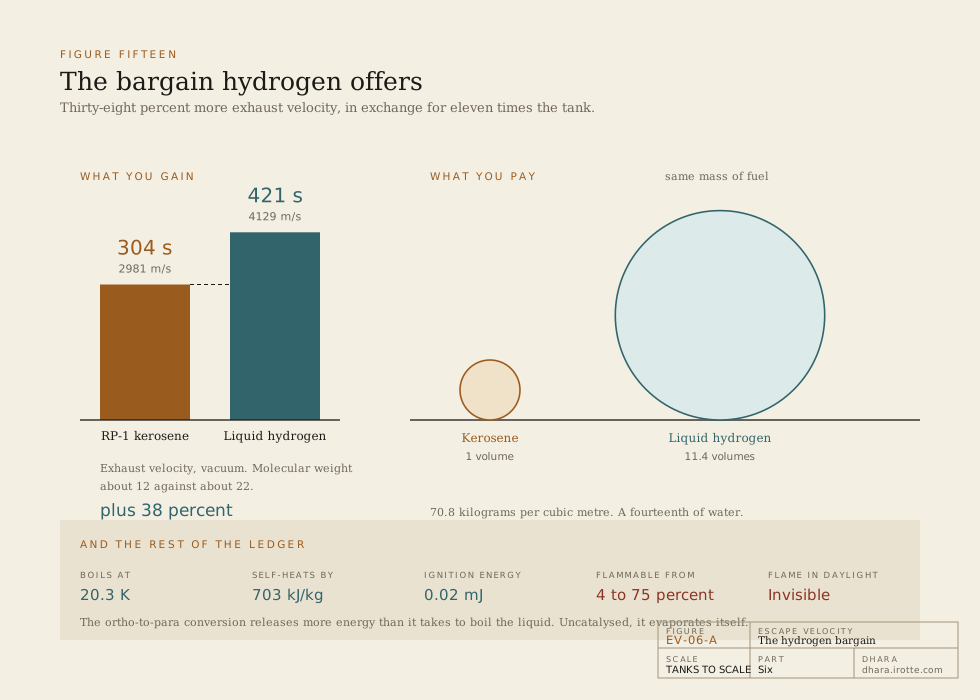
Now put that thirty-eight percent inside the rocket equation, where it does not act linearly.
The S-IVB third stage had to deliver about 3,050 metres per second of trans-lunar injection to a stack of roughly sixty-two tonnes. With hydrogen, the required mass ratio is about 2.1. With kerosene it rises to about 2.8. That sounds modest and is not. It means the propellant load must rise by roughly half, so the stage grows, so the stage beneath it must lift a larger stage, so the stage beneath that must lift both.
Compounded through three stages, the vehicle either closes or it does not. With hydrogen upper stages the Saturn V weighed 2,970 tonnes. The all-kerosene Nova-class vehicles studied for the same mission were never built, because nobody could see how to build them. Settled
Why It Hurts
Now the other side of the ledger, and it is long.
It is barely dense enough to call a liquid. Liquid hydrogen weighs 70.8 kilograms per cubic metre. Water weighs 1,000. Kerosene weighs 810. A tank holding a given mass of hydrogen must be about eleven times the volume of one holding the same mass of kerosene. The S-II's hydrogen tank occupied roughly 1,060 cubic metres against about 340 for its oxygen. Nearly all the visible bulk of the Saturn V's upper stages is empty space filled with an extremely light liquid.
It boils at 20.3 kelvin. Only helium is colder as a liquid. Everything else in the universe, including the air around the tank, is solid at that temperature. Air touching an uninsulated hydrogen line does not merely condense; it freezes onto the pipe, and the oxygen in it liquefies preferentially, leaving a film of oxygen-enriched liquid on the outside of a hydrogen line. That is a detonable arrangement waiting for a spark.
It boils off constantly. The latent heat of vaporisation of liquid hydrogen is about 446 kilojoules per kilogram, against water's 2,260. Very little heat leakage evaporates a great deal of propellant. The S-IVB vented continuously on the pad and in orbit, and its tank pressure had to be actively managed through the entire coast before the lunar burn.
It heats itself. This one is genuinely strange, and it cost the industry years.
Molecular hydrogen exists in two forms distinguished by the relative spin of the two nuclei: ortho-hydrogen with parallel spins, para-hydrogen with opposed spins. At room temperature the equilibrium mixture is about 75 percent ortho. At 20 kelvin it is 99.8 percent para. Liquefy hydrogen quickly and you produce liquid that is still mostly ortho, which then converts slowly to para in the tank -- and that conversion is exothermic, releasing about 703 kilojoules per kilogram. That is more than the latent heat of vaporisation. Uncatalysed liquid hydrogen therefore boils itself away from the inside, losing roughly half its contents in ten days with nothing leaking in at all. The fix is to force the conversion during liquefaction by passing the gas over a catalyst, usually hydrous ferric oxide, so that what enters the tank is already para. Every hydrogen plant in the world does this, and the reason is a quantum mechanical property of nuclear spin. Physics
It leaks through everything. The hydrogen molecule is the smallest there is. Joints and welds that are gas-tight against helium will sometimes pass hydrogen. Fittings that hold nitrogen indefinitely weep hydrogen steadily.
It attacks metal. Atomic hydrogen diffuses into the crystal lattice of steel, accumulates at grain boundaries and internal voids, and recombines there into molecular hydrogen at very high local pressure, cracking the metal from within. In carbon-bearing steels it can also form methane and blow internal cavities. Hydrogen embrittlement ruled out most conventional structural steels outright and forced the use of austenitic stainless steels, specific aluminium alloys, and nickel superalloys.
It ignites at nothing. Hydrogen is flammable in air from roughly 4 to 75 percent by volume, against gasoline vapour's narrow few percent. Its minimum ignition energy is about 0.02 millijoules, an order of magnitude below gasoline. A static discharge from a person crossing a floor is enough.
And you cannot see it burn. A hydrogen flame in daylight emits almost nothing visible. It is hot, it is large, and it is invisible. Ground crews at hydrogen facilities historically walked forward holding a broom or a length of straw at arm's length, and watched to see whether it caught fire.
The Engine
The J-2 was ordered from Rocketdyne in 1960, before anyone had flown a hydrogen stage at all, and it had to do something no engine had ever done: shut down in orbit and start again in vacuum ninety minutes later.
Rocketdyne J-2 engine, principal characteristics
| Parameter | Value |
|---|---|
| Thrust in vacuum | 1,023,000 newtons |
| Propellants | Liquid hydrogen and liquid oxygen |
| Mixture ratio, adjustable in flight | 4.5 to 5.5 to 1 |
| Specific impulse, vacuum | 421 seconds |
| Chamber pressure | 30 bar |
| Cycle | Gas generator, open |
| Nozzle expansion ratio | 27.5 to 1 |
| Dry mass | 1,580 kilograms |
| Restart in vacuum | Yes |
| Engines on the second stage | Five |
| Engines on the third stage | One |
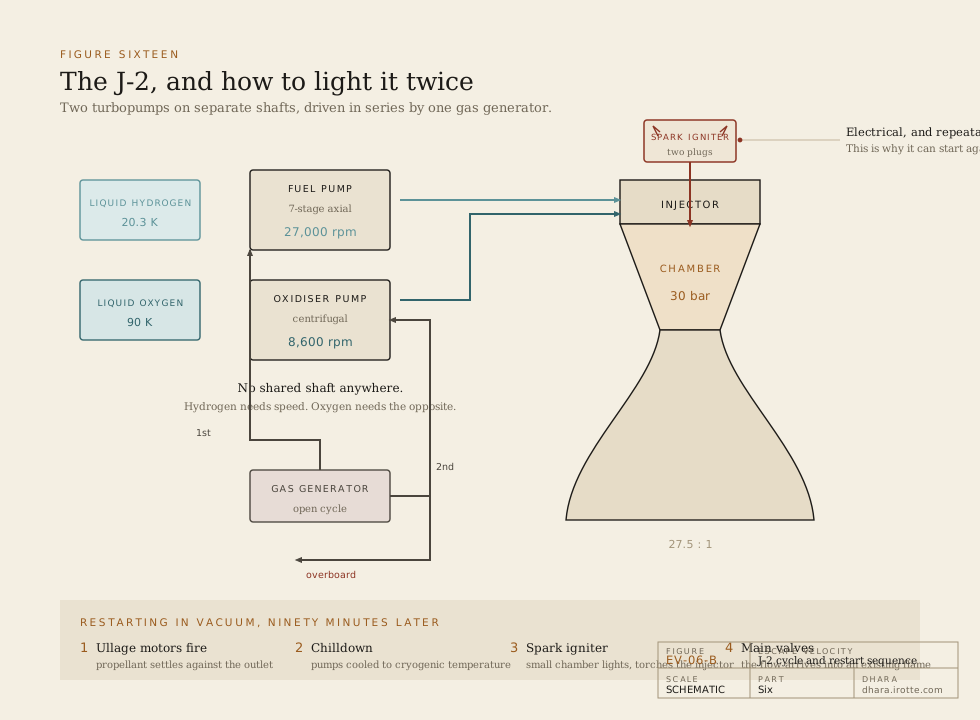
Three features solve problems the F-1 never faced.
Separate turbopumps, driven in series. The F-1 put both impellers and the turbine on one shaft, with the interpropellant seal stack standing between kerosene and liquid oxygen. The J-2 did not. It used two entirely independent turbopumps -- a seven-stage axial pump for hydrogen turning at about 27,000 revolutions per minute, and a centrifugal pump for oxygen turning at about 8,600 -- sharing no shaft anywhere. The gas generator's exhaust passed through the hydrogen turbine first and the oxygen turbine second before being dumped. Hydrogen's low density demands an axial pump and enormous speed; oxygen's high density demands the opposite. One shaft was never possible, quite apart from the seal problem.
The augmented spark igniter. The F-1 was lit by a one-shot cartridge of pyrophoric chemicals, which is adequate for an engine that fires once. An engine that must fire twice needs an igniter that can be commanded repeatedly. The J-2 carried a small auxiliary chamber with its own hydrogen and oxygen supply and two spark plugs. On command the plugs fired, the small chamber lit, and its flame torched through a port into the centre of the main injector. It was electrical, it was repeatable, and it is the direct ancestor of the igniters on hydrogen engines flying today.
Chilldown. The least glamorous item and possibly the most important. Admit liquid hydrogen at 20 kelvin into a pump sitting at ambient temperature and it flashes instantly to gas, the pump cavitates, and the engine does not start. So before every start the propellants were circulated through the pumps and lines and vented overboard, purely to bring the metal down to cryogenic temperature. On the S-IVB, in orbit, this had to be done again before the lunar burn, using recirculation pumps, on propellant that had been gently boiling for ninety minutes.
There was one further problem peculiar to restarting in weightlessness. In free fall, propellant does not sit at the bottom of the tank. It floats in whatever shape surface tension gives it, and the pump inlet may be looking at gas. So the S-IVB carried small solid-propellant ullage motors on its aft skirt, fired shortly before restart, whose only purpose was to accelerate the stage gently forward until the propellant settled against the outlet and the pumps had liquid to draw.
Apollo 6
On 4 April 1968 the second uncrewed Saturn V flew, and it went wrong in a way that turned out to be extremely instructive.
Severe longitudinal oscillation shook the vehicle during first-stage flight. On the second stage, engine number two lost thrust and shut down -- and the instrument unit then cut off engine number three as well, because a wiring error had crossed the two shutdown circuits. The remaining three J-2s burned longer to compensate. The third stage reached orbit, and when commanded to restart for a simulated trans-lunar injection, refused.
One root cause lay behind both failures, and it is a superb illustration of why ground testing is not sufficient.
The augmented spark igniter was fed by a small hydrogen line containing a flexible bellows section to accommodate movement. On the ground, in atmosphere, that line ran so cold that air condensed and froze onto the outside of the bellows, and the layer of frost mechanically damped its vibration. In vacuum there is no air, so no frost, so no damping. The bellows resonated freely, fatigued, and split, venting hydrogen and starving the igniter.
Every ground test had passed. The failure mode could not exist on the ground. Root cause
The fix was to delete the bellows and run a rigid line with a bend to take up the movement. The next Saturn V to fly was Apollo 8, and it carried three men around the Moon.
The Bulkhead
The S-II second stage was the hardest thing North American Aviation ever built, and its defining feature very nearly could not be manufactured.
A conventional two-propellant stage has two tanks with two domes facing each other and a cylinder between them, and the space between the domes is dead volume. The S-II eliminated it. It used one dome, shared: the bottom of the hydrogen tank is the top of the oxygen tank.
The consequence is a structure with liquid hydrogen at 20 kelvin on one face and liquid oxygen at 90 kelvin on the other, a difference of about 70 kelvin, held apart across a few centimetres.
It was built as a sandwich: two facing sheets of aluminium alloy 2014 with a phenolic-impregnated honeycomb core bonded between them, tapering from about 125 millimetres at the centre. The honeycomb was both structure and insulator. The whole assembly, ten metres across, had to be bonded in a single operation in a vacuum bag and cured -- and one void in that bond line would have been a catastrophic failure with no possibility of inspection afterwards.
What the common bulkhead bought and cost
| Measure | Value |
|---|---|
| Mass saved against separate domes | About 3,600 kilograms |
| Length saved on the vehicle | About 3 metres |
| Temperature difference across the bulkhead | About 70 kelvin |
| Thickness at the centre | About 125 millimetres |
| Diameter | 10.1 metres |
| Consequence of a bond failure | Loss of vehicle |
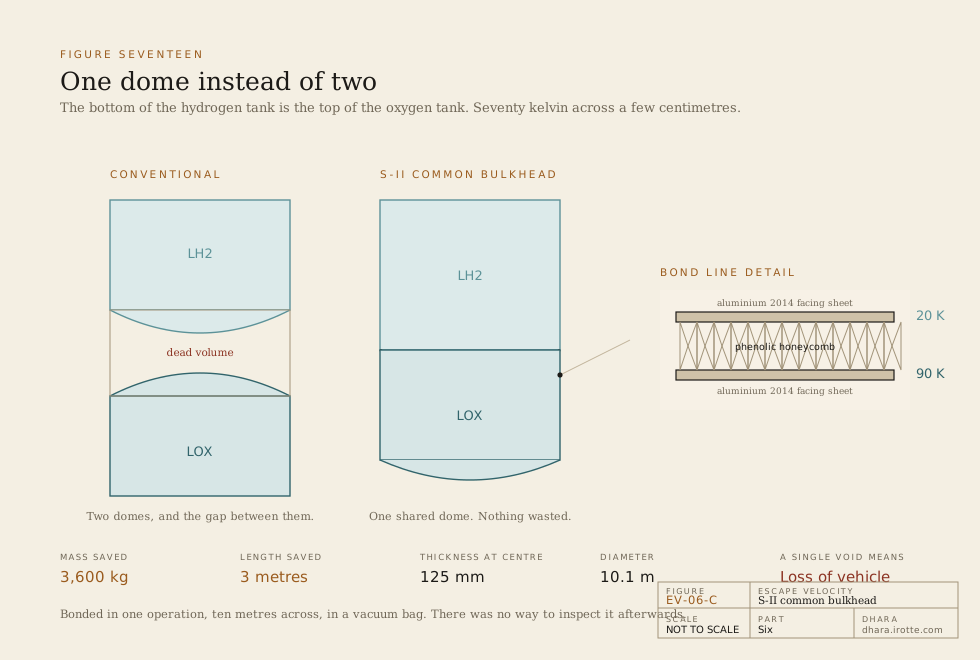
Three and a half tonnes saved on the second stage is better than three and a half tonnes of payload, because mass removed from an upper stage does not have to be lifted by the stage below carrying its own propellant to do so. By the compounding logic of the rocket equation, the bulkhead was worth roughly a tonne of lunar payload.
The S-II's external insulation is a footnote here and a chapter later in this series. The hydrogen tank was originally insulated with bonded honeycomb panels applied to the outside, which proved prone to debonding and were a persistent problem through development. The eventual solution was spray-on foam applied directly to the tank wall. Foam applied to the outside of a cryogenic tank, shedding in flight, is exactly the failure mode that destroyed Columbia thirty-five years later. The physics was understood in 1966. The consequences were not. Author's judgement
What Comes Next
We now have every piece separately: the equation, the pioneers, the first machine that worked, the American families that followed, the engine that lifted the stack, and the propellant that carried it the rest of the way.
The next part assembles them.
It walks the Saturn V from the flame trench to the escape tower: the 2219 aluminium and the milled isogrid; the instrument unit and the ST-124-M3 inertial platform floating on gas bearings; the Launch Vehicle Digital Computer with its triple-redundant voting logic and its two kilobytes of core memory; and Iterative Guidance Mode, which did not follow a stored trajectory but continuously recalculated the optimal remaining path in flight, which is why Apollo 6 reached orbit on three engines.
It covers the hold-down arms and the tapered release pins, the water deluge that existed to absorb sound rather than heat, and the nine seconds between ignition and commitment.
And it covers the eight and a half minutes from release to orbit second by second: maximum dynamic pressure at eighty seconds, centre engine cutoff at 135 seconds to hold acceleration below four times gravity, staging, interstage jettison, and the moment the vehicle stopped climbing and started going sideways.
0 responses