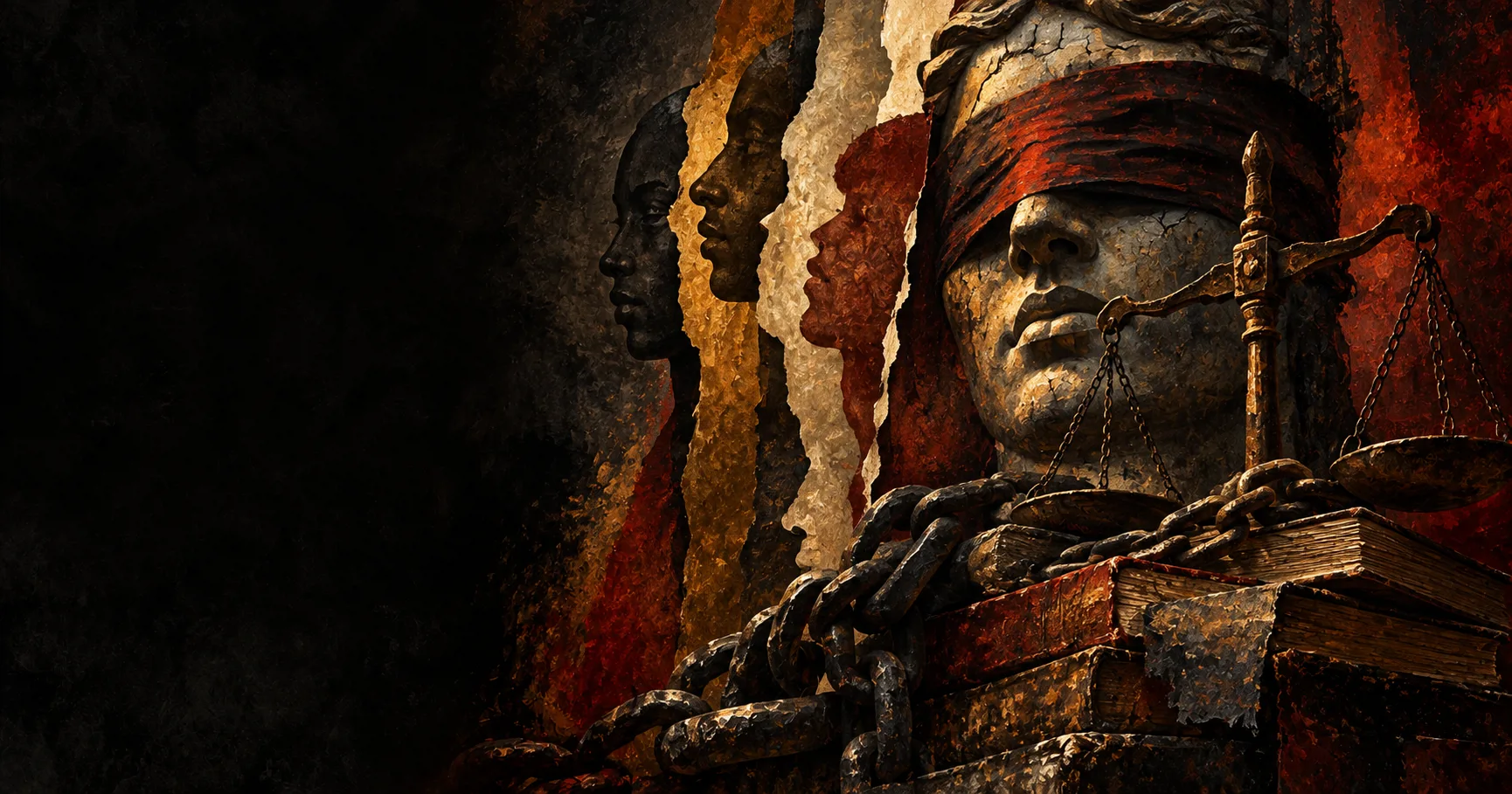
At a quarter to five in the morning, in a village of the Godāvarī delta, an archaka unlocks the door of a small Śiva temple that has stood for three hundred years. He sweeps the maṇḍapa himself because there is no one else to sweep it. He draws water from the well, bathes the liṅga, recites the Rudram from memory, and offers the rice his wife cooked at four. For years the state paid him and the temple together 2,500 rupees a month under the Dhūpa Dīpa Naivedyam scheme, the government grant that keeps small village shrines alive. His son drives a share-auto in the town. His daughter cleared her engineering entrance with a rank that, in her category, bought her no seat at all.
On the same day, eight thousand miles away, a slide goes up in a university seminar room in the United States. It carries a triangle. At the top sits the word Brahmin. Under it, in a sentence meant to sound like science, the slide explains that caste is a form of inherited capital, that Brahmins hold it, that merit is its disguise, and that the modern Indian engineer in Silicon Valley is the latest carrier of a three-thousand-year-old system of oppression.
The archaka in the delta has never heard of the seminar. He is its subject.
The claims on that slide can be tested one at a time. Each theory can be defined in plain words, given a simple example, and checked against the record. Where a claim holds, it deserves to be granted. Where it fails, the failure can be shown.
The Charge Sheet
The accusation has many forms, but its core can be stated in a few sentences. Indian society, it says, was built by Brahmins for Brahmins. The Vedas and the Manusmṛti were the legal and religious instruments of that design. Untouchability, the poverty of the rural labourer, the low status of women, the exclusion of tribes, the violence of landlords, and in some versions even the failures of the Indian state, all trace back to one source, which critics call Brahmanism or the Brahmanical order.
In the newer academic form, the charge has three additions. First, caste is said to work like race in America, so the tools built to study American racism can be carried over whole. Second, caste is said to work like capital, a stock of advantage that is inherited, invested and passed on, so that a Brahmin's success in an examination is not his own. Third, merit itself is said to be a caste idea, a story that the privileged tell to protect what they already hold.
Each of these three additions is a claim that can be tested. The word Brahmanical, used as a label for everything the speaker dislikes, cannot be tested at all, and that is the first warning sign. A word that explains every bad outcome explains none of them.
The Words, Defined
A scholarly argument needs its terms fixed before it starts. The debate turns on a small set of words, and each has a plain meaning.
Key terms used in the debate on caste, with plain meanings and simple examples
| Term | Plain meaning | Simple example |
|---|---|---|
| Varṇa | The fourfold division of social function described in the Veda and the Gītā: brāhmaṇa (learning and teaching), kṣatriya (protection and rule), vaiśya (trade and farming), śūdra (craft and service) | A teacher performs the brāhmaṇa function; a soldier performs the kṣatriya function |
| Jāti | A birth community, usually tied to a region, an occupation and marriage within the group; India has several thousand | Reddy, Kamma, Nadar, Ezhava, Mahar and Iyer are jātis |
| Caste | A Portuguese word, casta, meaning breed or lineage, applied by Europeans to jāti and later fixed by the British census into a single ranked table | A census officer in 1901 assigns each jāti a rank in a provincial table |
| Dalit | A modern self-chosen name, meaning broken or pressed down, for communities once treated as untouchable | A Mahar or Mala family today may call itself Dalit |
| Scheduled Caste (SC) | A legal category: communities listed in a presidential order under Article 341 of the Constitution for protection and reservation | About 16.6 percent of India's people in the 2011 Census |
| Scheduled Tribe (ST) | A legal category for listed tribal communities under Article 342 | About 8.6 percent of India's people in the 2011 Census |
| Other Backward Classes (OBC) | A legal category for socially and educationally backward communities that are not SC or ST | The Mandal Commission of 1980 estimated them at about 52 percent of the population |
| EWS | Economically Weaker Sections: a 10 percent reservation for poor families outside the SC, ST and OBC lists, added by the 103rd Amendment in 2019 | A poor Brahmin, Vaishya or Kapu family can apply |
| Reservation | A share of seats in education, government jobs and legislatures set aside for a listed category | Out of 100 medical seats, 15 go to SC candidates under central rules |
| Creamy layer | The better-off families within a reserved category who are excluded from the benefit | The child of an OBC officer earning above the income limit loses OBC reservation |
| Percentile | The share of candidates who scored below a given candidate; a 90th-percentile score beats 90 percent of the field | Zero percentile means the lowest score in the whole examination qualifies |
| Meritocracy | A system in which places are given by measured ability and effort, not by birth, money or connection | The rank list of an open entrance examination |
Two terms need a further note. Varṇa and jāti are different things, and most modern writing on caste treats them as one. Varṇa is a scheme of four social functions; jāti is a living community of birth. A single varṇa label was never a single community. There were hundreds of Brahmin jātis alone, many of them poor, many of them farmers, cooks and temple servants. Treating "the Brahmin" as one class with one interest is the first error in the charge sheet.
The second note concerns the word Brahmanical. In the older Indological writing it meant simply "belonging to the Brahmin textual tradition", as in Brahmanical ritual or Brahmanical law. In current activist and academic usage it has become a moral label, used to describe any hierarchy, any patriarchy, any exclusion anywhere in South Asia, including among Muslims and Christians. When a word stretches that far, it stops describing Brahmins at all. It becomes a way of naming a community as the cause of whatever is being attacked.
Critical Race Theory, Tenet by Tenet
Critical Race Theory is a school of thought that began in American law schools in the 1970s and 1980s. Its founders were legal scholars who felt that the civil rights laws of the 1960s had removed open racial discrimination from the statute book but had not changed the position of Black Americans. They built a set of claims to explain why. Those claims later spread into education, sociology and corporate diversity training, and from there into the study of caste. Each claim can be stated as its supporters state it, given a simple example, and then tested.
Tenet one: racism is ordinary
The claim is that racism is the normal state of American life, built into its institutions, and so it does not need a racist individual to operate. A simple example: a bank uses a lending formula with no racial words in it, but the formula relies on neighbourhood property values, and the neighbourhoods with low values are mostly Black because of past segregation. The formula produces racial outcomes with no racist in the room.
As a description of how old injustice can echo through neutral rules, the claim has force. Its weakness is what it becomes when it is made universal. If racism is present in every institution by definition, then no evidence can ever show its absence. A fair outcome proves that racism has hidden itself; an unfair outcome proves that it is at work. When this tenet is carried to India as "casteism is ordinary", the same trap follows. Every Brahmin success is proof of caste; every Brahmin failure is ignored.
Tenet two: race is a social construction
The claim is that race has no basis in biology and was invented by societies to sort people for power. A simple example: the same person could be counted as white in one American census and as a different race in another, because the categories kept changing.
This tenet is worth keeping in mind, because it cuts against the people who carry it to India. If race was a social construction invented to sort people for power, then the most important construction to examine in India is the one the British made. The colonial state measured Indian noses, ranked jātis by "social precedence", and divided Indians into Aryan and non-Aryan races. Critical Caste Studies takes that colonial construction and treats it as the permanent truth of Indian society. It applies the tenet to everyone except the colonizer.
Tenet three: interest convergence
The claim is that the powerful group allows progress for the weaker group only when that progress also serves the powerful. A simple example: some American historians argue that school desegregation came in the 1950s partly because segregation embarrassed the United States in its Cold War propaganda abroad.
Applied to India, the tenet would predict that Brahmins accepted reservations, temple entry and the abolition of untouchability only because these served Brahmin interests. The record does not fit. The Constitution that abolished untouchability in Article 17 and created reservations was debated and adopted by an assembly whose members, Brahmin and non-Brahmin alike, accepted both. At Vaikom in 1924, caste-Hindu volunteers marched across Travancore in support of the temple road satyāgraha. A theory that must find a hidden selfish motive behind every reform cannot be refuted, and a claim that cannot be refuted is not knowledge.
Tenet four: colour-blindness and merit are masks
The claim is that treating everyone the same, and rewarding measured performance, only protects the advantages the dominant group already has. A simple example: a university that admits purely on test scores will admit more children of educated families, because those children had better schools and tutors, so "merit" repeats the past.
This is the tenet that matters most for India. One observation about it is enough at this point. The tenet says that if an outcome is unequal, the rule that produced it is unjust. It does not ask whether the rule was fair to each individual who took the test. It measures justice by group averages and treats the individual as a carrier of his group.
Tenet five: the voice of lived experience
The claim is that personal stories from the oppressed group carry a kind of truth that statistics and neutral scholarship miss, and that such stories should be given special weight. A simple example: a Black employee's account of daily slights at work is treated as evidence of workplace racism even when no formal complaint was ever filed.
Stories matter, and no honest writer on caste should dismiss them. But this tenet has a hidden rule: stories from one side are evidence, while stories from the other side are defensiveness. In the caste debate, the story of a Dalit engineer who was insulted is treated as proof of a system. The story of the Brahmin archaka living on a village grant, or of the Brahmin student with a higher score and no seat, is treated as privilege complaining. A method that accepts testimony from only one side is advocacy, not scholarship.
Tenet six: intersectionality
The claim is that a person can belong to several disadvantaged groups at once, and that the disadvantages combine in ways that neither alone explains. A simple example: a Black woman may face treatment that neither a white woman nor a Black man faces.
The idea is reasonable in itself. Applied honestly to India, it would demand attention to the poor Brahmin widow, the landless Brahmin cook, and the Dalit officer's son who holds a car, a flat and a reserved seat. It is rarely applied that way. In practice the intersections are counted only in one direction.
Tenet seven: every disparity is discrimination
The claim, found more in the popular spread of the theory than in its founding papers, is that if any group is under-represented anywhere, discrimination is the cause. A simple example: if a company's engineers are 30 percent Indian and 3 percent Black, the company must be discriminating.
This is the tenet that does the most work in the caste debate, and it is the weakest. Groups differ in age, region, language, family size, urban share, occupation and the value placed on schooling. Disparities arise from all of these. In India itself, Marwaris dominate trade, Sikhs are heavily present in the army and in transport, Nadars built a commercial network across Tamil Nadu, and Patels came to own a large share of American motels. None of these patterns is explained by Brahmin discrimination. A theory that reads every gap as a crime has decided the verdict before hearing the case.
The Transplant: From Race to Caste
Around the 2010s a set of writers in American universities and activist groups began to carry Critical Race Theory into the study of caste. The move is simple. Brahmins, and more loosely all "savarna" or upper-caste Hindus, are placed in the position that white Americans hold in the American theory. Dalits are placed in the position of Black Americans. Hinduism is placed in the position of the institutions of white supremacy. The American vocabulary then follows: caste privilege, caste fragility, caste supremacy, Brahmin supremacy.
The transplant fails on its own terms. Race in America is visible; a person's race is known at a glance. Caste in America is invisible; no American employer, landlord or policeman can tell a Brahmin from a Dalit by looking. Race in America was enforced by law until 1964 with segregation statutes and bans on intermarriage. Caste in independent India was outlawed by the Constitution in 1950, with the state required to give preference to the formerly excluded. The American theory was built for a society where the law once enforced the hierarchy. It is being applied to a society where, for seventy-six years, the law has pushed against it.
There is a deeper irony. The idea that Indian castes are races was itself a colonial idea. In the 1880s and 1890s, colonial ethnographers measured the width of Indian noses and claimed that the higher castes had narrower, more "Aryan" noses and the lower castes broader, more "aboriginal" ones. The 1901 Census, under its commissioner Herbert Risley, tried to rank every jāti in each province by social precedence and tied that ranking to racial type. That race science has been discarded everywhere else. The modern claim that Brahmins are "the whites of India" repeats it in new language.
Caste as Capital, Examined
The second academic addition to the charge is the idea that caste works as capital. The idea borrows from Pierre Bourdieu, a French sociologist who argued in the 1970s and 1980s that people inherit not only money but other stocks of advantage. He named several forms.
Forms of capital in Bourdieu's scheme, with plain meanings and simple examples
| Form | Plain meaning | Simple example |
|---|---|---|
| Economic capital | Money, land and property | A family's savings pay for coaching classes |
| Social capital | Useful relationships and networks | An uncle in a software firm passes on a job opening |
| Cultural capital | Habits, knowledge and tastes learned at home that schools reward | A child who hears English at the dinner table writes better English essays |
| Symbolic capital | Prestige and recognition | A family name that commands respect in a village |
The caste-as-capital thesis says that upper-caste families, and Brahmins most of all, hold all four forms as a birthright. Their children then convert this inherited stock into examination ranks and call the result merit. A simple example as the thesis would tell it: a Brahmin boy in Chennai grows up in a house of books, among relatives who are engineers, learns mathematics as a family habit, clears an entrance examination, and then describes himself as self-made.
Parts of this are true. Families pass on habits. A home that values study produces more children who study. Networks help. None of this is controversial, and none of it is special to caste. The same is true of a Jewish family in New York, a Chinese family in Singapore, a Sikh family in Ludhiana and a Dalit family in Nagpur whose parents are government officers.
The thesis can be tested the way any scientific claim is tested. The philosopher of science Karl Popper argued that a claim is scientific only if some possible observation could show it to be false. A claim that fits every possible outcome tells nothing about the world. The question is what observation would falsify caste-as-capital. If a Brahmin succeeds, capital explains it. If a Brahmin fails, the thesis is silent, or says his capital was local and did not travel. If a non-Brahmin succeeds, he is an exception, or has acquired upper-caste capital. If a Dalit officer's son takes a reserved seat, his inherited stock is not counted, because he is Dalit. There is no outcome the thesis cannot absorb. By Popper's test it is not a finding. It is a way of reading every finding.
The next test is the pattern of success in India. If caste were capital, and Brahmins held the most of it, Brahmins would lead the fields where inherited capital matters most: land, business and politics. They do not. The great business families of India are overwhelmingly Marwari, Gujarati Bania, Parsi, Sindhi, Chettiar, Punjabi Khatri and, in the south, Reddy, Kamma, Naidu, Nadar and Gounder. Political power across the Hindi belt has for decades sat with Yadavs, Jats, Kurmis and other landed OBC communities, and in the south with Reddys, Kammas, Vokkaligas, Lingayats, Nairs and Ezhavas. Land in rural India is held mainly by the dominant cultivating castes, very few of which are Brahmin. The single field where Brahmins are over-represented relative to their numbers is the one that depends on examinations and study. That is the opposite of what a theory of inherited capital predicts. It is what a theory of family priority on learning predicts.
The last test is the poor Brahmin. The archaka in the delta, living on a village temple grant, holds a Sanskrit education, a respected name and a network of other archakas equally poor. Where is his capital, and why has it not converted? His son drives an auto. The thesis has no answer except that he is an exception. When the exceptions number in the lakhs, the rule is wrong.
Why Caste in America?
The question that most exposes the transplant is the simplest one. If caste were capital, how would it work in America?
Capital needs a market in which it is recognised. A family name is symbolic capital only where people know what it means. In Houston, Seattle or San Jose, an American hiring manager cannot tell an Iyer from a Paswan, and does not care. An American admissions officer at Harvard has no caste column on the form. The only people in America who can read a surname for caste are other South Asians, and among Indian Americans the practice is fading. In the representative 2024 Indian American Attitudes Survey, conducted with YouGov, 32 percent of respondents said they did not identify with any caste at all.
What then carries Indian families to success in America? The same things that carry Korean, Nigerian, Chinese and Vietnamese immigrant families: selective immigration of the educated, two-parent households, a strong priority on schooling, and long working hours. Indian immigrants of every community have risen. Patels from Gujarat built a motel empire from nothing. Punjabi Sikhs dominate long-haul trucking in California. Telugu and Tamil engineers from every background, including many from reserved categories who studied at Indian institutes, fill American software firms. If caste capital were the engine, the non-Brahmin success in America would not exist.
How much caste discrimination is actually reported in America? Two surveys give very different answers. A 2018 survey by an activist organisation found that 67 percent of Dalit respondents reported unfair treatment at American workplaces. That survey used snowball sampling, in which respondents recruit other respondents, and researchers at the Carnegie Endowment noted that this method can skew results towards people with strong views. The 2020 Indian American Attitudes Survey, run by researchers from the Carnegie Endowment, Johns Hopkins and the University of Pennsylvania on a sample built to represent the whole community, found that 5 percent of Indian Americans reported caste discrimination in the past year. The same survey found that the reported discriminators were split almost evenly into thirds: Indians, non-Indians, and both. The researchers themselves called this a puzzle, since non-Indians cannot see caste. By contrast, 30 percent reported discrimination on the basis of skin colour.
The American legal record follows the same shape. In June 2020 the California civil rights agency sued Cisco and two of its engineers, alleging that the engineers had discriminated against a Dalit colleague. The case became the foundation of a national campaign. In April 2023 the state voluntarily dismissed its claims against the two engineers, while continuing its case against the company. In February 2023 Seattle became the first American city to add caste to its anti-discrimination law, and the California State University system had done the same in 2022. In September 2023 the California legislature passed Senate Bill 403 to add caste to state civil rights law. In October 2023 the governor vetoed it, on the ground that existing protection against discrimination by ancestry already covered any such case.
The veto message identified the real problem, though it did not say so directly. American civil rights law already forbids discrimination by ancestry, religion and national origin. A separate category of caste adds nothing to the protection of any individual. What it adds is a legal label that attaches to one diaspora and one religion. Every Hindu of Indian origin in an American workplace becomes a possible suspect under a category that no other community carries. That is the transplant completing itself: a theory of group guilt has reached the statute book.
Merit, and What Replaces It
Meritocracy has a history older than any modern theory. The Chinese imperial state chose its officials by written examination for more than a thousand years. The British civil service moved to open competitive examination in the 1850s precisely to end appointment by patronage, and the Indian Civil Service followed. In India, the open entrance examination for engineering and medicine became, after independence, the single most important route by which the children of clerks, farmers and small traders entered the professions. The examination does not know the candidate's surname. It does not know his father's job. It knows his answers.
Critics are right that preparation is unequal. A child in a Hyderabad coaching centre has advantages over a child in a village school. But the conclusion does not follow that merit is a caste instrument. The inequality they describe is an inequality of schooling, money and place. It cuts across every community, and the answer to it is better schools, scholarships and coaching for the poor of every community. When merit is weakened, what fills the gap is never pure fairness. It is money, influence and category, and those always favour the already organised.
The record of medical postgraduate admission shows where the weakening leads. NEET-PG is the national entrance examination for MD and MS seats, scored out of 800, with negative marking for wrong answers. For years the qualifying percentile was 50 for general candidates and 40 for SC, ST and OBC candidates. In September 2023, with about 13,000 of roughly 63,000 seats vacant after the second round of counselling, the Union Health Ministry cut the qualifying percentile to zero for all categories. The minimum qualifying mark fell from 291 out of 800 for general candidates, and 257 for reserved candidates, to effectively the lowest score in the country. A doctors' federation said that merit had died that day.
For the 2025 examination, with about 18,000 seats vacant, the cut was made again, this time along category lines. The general and EWS qualifying percentile fell from the 50th to the 7th. For reserved categories it fell to zero, so that a candidate with minus 40 marks out of 800 became eligible. In the third round of counselling, according to the published allotments, a candidate with minus 8 marks was allotted a postgraduate seat in biochemistry under a reserved or disability category. Settled
Every patient in India has a stake in this. A postgraduate seat in a clinical or para-clinical subject produces a specialist who will one day examine blood reports, perform surgery and sign death certificates. The question is not whether a Dalit candidate should become a doctor. Dalit doctors are many and many are excellent; they earned their places with high scores. The question is whether any candidate, of any category, who answered more questions wrongly than rightly, should hold a seat that a candidate who answered correctly does not. That has nothing to do with caste. It is the simple test of whether an examination still examines.
The Examination Hall
In September 2026 a second-year engineering student at IIT Bombay was found dead in his hostel room. Days earlier, during a mid-semester examination, his professor had taken his phone from him in the hall. The institute's first public statement said the student had uploaded the question paper to ChatGPT, that he had been counselled by the instructor and the head of department, and that no disciplinary action had been started. Two days later the institute withdrew that statement and apologised, saying it had been wrong to describe the circumstances before the investigation was complete. The professor's deanship was suspended. On the parents' complaint, the police registered a case against the professor and others for abetment of suicide and under the SC/ST (Prevention of Atrocities) Act. The parents say their son faced caste discrimination on campus; the institute says he never complained to its SC/ST cell. Exam-hall footage that has circulated on social media, and has not been officially released, appears to show the student handing his phone to the invigilator and then leaving. Contested
The death of a young man of twenty-two is a grief to his family and to every family that sends a child to a hostel far from home. That grief deserves respect, and no side has the right to turn it into a weapon.
Within hours of the news, the case had been given a meaning. In one telling, a Brahmanical institution had hounded a Dalit student to his death. The caste charge came first, and the evidence was expected to follow. The opposite telling appeared just as quickly: a professor caught a cheat and was destroyed for doing his job. On the record available in September 2026, neither telling is proven. The institute itself withdrew its account of cheating. The charge of caste discrimination is so far an allegation. The honest course is to wait for the investigation and to judge the professor and the institution on what it finds.
What can be said now is a matter of principle, and it does not depend on the outcome of this case. An examination has one set of rules. A phone in an examination hall breaks those rules for every candidate. An invigilator who acts on it, without knowing and without asking the candidate's caste, is doing the duty the examination requires, and would have done the same had the candidate been a Brahmin. Excusing a breach because of the candidate's category would insult every Dalit student who sat the same paper honestly. If an invigilator's enforcement can be recast as caste oppression the moment the candidate turns out to be Dalit, every invigilator in the country learns to look away, and the examination stops examining. If, on the other hand, the investigation finds that a student was harassed or humiliated because of his caste, that is a crime and must be punished as one. One rule, applied to every side, is the whole of the principle.
Seventy-Six Years: How Long?
Reservation was written into the Constitution in 1950 as a remedy for a real exclusion. Its framers expected the remedy to work and, in time, to end. The record of how it was meant to work, and what it became, is worth setting out.
Reservation in legislatures for SC and ST members was placed in Article 334 with a fixed term of ten years. It was extended every decade. The 104th Amendment in 2019 extended it again, to January 2030. Reservation in education and government jobs, under Articles 15(4) and 16(4), was never given a term at all. In the Constituent Assembly, Ambedkar himself argued that reservations in services should be confined to a minority of posts, so that the general rule of equal opportunity would not be swallowed by the exception. The Supreme Court later fixed a 50 percent ceiling on reservations in the Indra Sawhney judgment of 1992, which also required that the creamy layer of the OBC category be excluded.
That creamy-layer rule was not applied to SC and ST reservation. For decades, the child of an SC family whose parents were both senior civil servants stood in the same reserved queue as the child of a landless SC labourer. Predictably, the benefit gathered in the families and sub-communities that had advanced first. Within the SC list of many states, one or two larger communities took most of the reserved seats and posts, while smaller and poorer ones stayed where they were.
On 1 August 2024 a seven-judge bench of the Supreme Court, in State of Punjab v. Davinder Singh, ruled by six to one that states may sub-classify the Scheduled Castes, so that the most backward groups within the list can be given a separate share. It overruled the 2004 judgment that had treated the Scheduled Castes as a single uniform group. Four of the seven judges went further and said the state must develop a policy to identify a creamy layer among SC and ST families as well and exclude them from reservation. The leading opinion on that point was written by Justice B. R. Gavai, himself from a Scheduled Caste family and later Chief Justice of India.
This answers the question of logic that the reservation debate so often avoids. The purpose of reservation was to lift families out of exclusion. A family that has been lifted, whose parents are doctors, engineers, IAS officers or business owners, is no longer excluded. Continuing its reservation does not help the excluded. It takes the seat from the landless SC child who still needs it, and from the poor general-category child who never had it. A remedy that never ends for anyone stops being a remedy and becomes an entitlement by birth. That is the very thing the Constitution set out to abolish.
A sensible reform follows from the court's own reasoning. Reservation should reach the first generation of any family, measured by parental education, income and assets, and should end for families that have already crossed. Sub-classification should ensure that the most backward communities within each list are not crowded out. The same means-test that the EWS reservation of 2019 applies to poor families outside the lists, upheld by the Supreme Court in 2022, should apply inside them. None of this requires anyone to blame a Brahmin.
The Law and Its Use
The Scheduled Castes and Scheduled Tribes (Prevention of Atrocities) Act of 1989 was passed to deal with real crimes: the beating of Dalit labourers, the burning of homes, the parading and assault of women, the denial of wells and roads. Those crimes have not vanished, and the Act remains necessary for them. The question raised by recent cases is a different one: whether the Act is also being used in disputes that have nothing to do with caste, where the only link to caste is that one party is Dalit.
The Supreme Court has faced that question directly. In March 2018, in Subhash Kashinath Mahajan v. State of Maharashtra, a case that arose from a service dispute in a government college in Maharashtra, the Court accepted that the Act was being misused in some cases to settle personal and service scores. It ordered a preliminary inquiry before an FIR and prior approval before an arrest. Parliament reversed the judgment the same year by adding Section 18A, which removed the preliminary inquiry and the need for approval, and restored the bar on anticipatory bail. In February 2020, in Prathvi Raj Chauhan v. Union of India, the Court upheld the amendment, while holding that the High Courts may still quash a case where the complaint does not make out an offence on its face.
The Court has also fixed the test for the offence itself. Hitesh Verma v. State of Uttarakhand, decided in November 2020, arose from a dispute over land. The Court held that an insult or intimidation is not an offence under the Act merely because the person insulted belongs to a Scheduled Caste. It must be made because of that caste, and in the case of an insult, in public view. A quarrel over land, money, a theft or a grade does not become an atrocity because one of the parties is Dalit. The law as the Supreme Court has read it is clear on this point. The trouble lies in how it is applied at the police station.
The figures show the scale. National Crime Records Bureau data placed before Parliament in July 2026 show between about 46,000 and 53,000 cases registered under the Act each year from 2020 to 2024, 5,192 cases ending in conviction in 2024, and 287,694 cases pending trial at the end of that year. These figures are read in two ways. Those who defend the Act read the low number of convictions as proof of weak investigation, hostile witnesses and pressure on victims. Those who criticise it read the same figures as proof that many cases should never have been filed. Both readings hold some truth, and the figures alone do not decide between them.
What is not in doubt is the weight of the process. Anticipatory bail is barred where a case is made out on the face of the complaint, and a trial may take years. For an accused whose case later fails, the FIR, the arrest or the fear of it, the lawyers' fees and the years of waiting are themselves the punishment. A law that punishes before it judges will, in the hands of some complainants, become a weapon, and every false case weakens the protection the Act gives to genuine victims.
In August 2026 a well-known Hindu commentator on YouTube was booked under the Act in Delhi, on a complaint by a political party, over remarks in a live broadcast about a Dalit Member of Parliament and about Ambedkar. The complaint alleges a caste slur. The commentator denies using casteist language and says he was reacting to a provocation about his sister. A Delhi court rejected his plea for anticipatory bail in September, after the police told the court that registration of the case did not mean he would be arrested, and he has since moved the High Court. Whether his words meet the test laid down in Hitesh Verma is a question for the courts, to be decided on the recording and not on the politics of either side.
The remedy for misuse lies in procedure, and repeal of the Act is no part of it. A quick check that the complaint alleges a caste motive at all, time-bound trials, real penalties for knowingly false complaints, and full seriousness toward genuine atrocities would protect both the victim and the falsely accused. None of this requires anyone to fear an ordinary conversation, a grade or a disagreement with a Dalit colleague. It requires the police and the lower courts to apply the law as the Supreme Court has already read it.
The Poor Brahmin
The charge sheet has no place for the poor Brahmin.
He is the village archaka, the purohita who performs weddings and funerals for a fee that has not kept pace with prices, the cook in a temple kitchen, the clerk, the Sanskrit teacher in a government school that no longer teaches Sanskrit. In undivided Andhra Pradesh, a priest in a small temple under the Dhūpa Dīpa Naivedyam scheme received 2,500 rupees a month for himself and the temple's daily rituals together. Telangana raised the grant to 6,000 rupees in 2015 and to 10,000 rupees in 2023, of which 6,000 is the priest's honorarium. Andhra Pradesh raised its grant to 10,000 rupees a month for about 5,600 temples in 2025. These are the figures that governments themselves published when they raised them, and they describe a livelihood near the poverty line.
The state has recognised this poverty in law. The EWS reservation exists because Parliament accepted that poor families outside the SC, ST and OBC lists, including poor Brahmins, face real barriers. Several states have set up welfare corporations for poor Brahmins, funding scholarships, small loans and support for priests. No government sets up a welfare corporation for a community that holds all the capital.
The village priest now also faces competition for his low-paid post, and that competition is welcome in principle. Kerala's Travancore Devaswom Board, which runs about 1,250 temples, recruited priests by written test and interview in 2017 and appointed 36 non-Brahmins among 62, six of them Dalits, for the first time in its history. Tamil Nadu appointed 24 trained archakas from various communities in 2021. A Dalit who has learned the Āgamas and the mantras, and performs the pūjā with devotion, is an archaka. There is nothing in the tradition that forbids a qualified devotee to serve the deity, and the tradition should say so plainly. But the scene should be seen for what it is. A poor Brahmin and a trained Dalit are now competing for the same underpaid job in a village temple. That is not a picture of Brahmin supremacy.
The Beautiful Tree
The historical core of the charge is that Brahmins kept learning to themselves, and that the lower castes were shut out of education until the British and the Christian missions let them in. This claim can be checked against the British government's own records.
In 1822 Sir Thomas Munro, Governor of the Madras Presidency, ordered every district collector to survey the indigenous schools of his district: how many schools, how many pupils, and the caste of each pupil under four heads, namely Brahmin, Vaishya, Shudra and "other castes", the last broadly corresponding to today's Scheduled Castes. The returns came in between 1822 and 1825 from nearly every district of the Presidency, which then covered Tamil, Telugu, Kannada, Malayalam and Odia country. The Gandhian historian Dharampal later brought these returns together in his book The Beautiful Tree, published in 1983.
The returns overturn the claim. Across the Tamil districts, pupils from the Shudra and "other castes" heads formed about 70 percent of those in school in Salem and Tinnevelly and over 84 percent in South Arcot. In Tinnevelly, Brahmin pupils were 21.8 percent, Shudra pupils 31.2 percent and pupils from the "other castes" 38.4 percent. In the Odia district of Ganjam, the returns counted 808 Brahmin pupils, 243 Vaishya pupils, 1,001 Shudra pupils and 888 from the other castes. Settled In most districts, Brahmin pupils were a minority of the school-going population.
Two further points complete the picture. First, the survey counted only schools; much Brahmin learning happened at home and in pāṭhaśālās for advanced Sanskrit, which were counted separately as "colleges". Brahmins did dominate higher Vedic and Śāstric study, as a community devoted to that study would. But elementary literacy and numeracy, the education that mattered for most working lives, was widely spread across communities. Second, these figures describe a system already in decline after decades of disruption. The indigenous schools were then left without support by the new colonial education system, and many had vanished by the end of the century. The literacy gap between castes that later census reports recorded was in large part a product of that collapse.
How the Colonial State Made Caste
The word caste itself is not Indian. Portuguese traders of the sixteenth century used casta, meaning breed or lineage, for the communities they met on the coast. The word was a foreign lens, and what the British later did with it turned the lens into a structure.
In 1772 the Governor of Bengal, Warren Hastings, laid down that in matters of inheritance, marriage, caste and religious usage, Hindus would be governed by "the laws of the Shaster". To find those laws, the Company employed pandits to compile a digest, which was translated into English in 1776 as A Code of Gentoo Laws. In 1794 William Jones published an English translation of the Manusmṛti under the title Institutes of Hindu Law. A text that had been one Smṛti among many, read alongside commentaries and local custom, became in British courts something like a statute book.
The Manusmṛti itself did not claim that role. In its eighth chapter, verse 41, it instructs the king, when he judges a case, to take into account the dharma of the jāti, of the region, of the guild and of the family, and to decide accordingly. The text defers to local custom. Pre-colonial justice in India was largely settled in caste councils, village assemblies and guild bodies, each following its own usage. No pre-colonial Indian kingdom is known to have run its courts from the Manusmṛti as a code. The British did.
Critics quote the harshest verses of the Manusmṛti on the śūdra as proof of a Brahmin design. Those verses exist and should be faced honestly. But the text survives in many manuscripts that differ from one another, it carries layers from different periods, and its commentators disagreed on how much of it applied in their own age. A single text read as a law code for all of India, in all periods, is a colonial reading. It is not how the tradition read itself.
The census completed the work. From 1871, and most of all in 1901 under Risley, the colonial census required every Indian to be entered under one jāti, and tried to rank those jātis in a single order of precedence for each province. The effect was immediate. Caste associations formed to petition the census for a higher rank, and communities that had moved up and down in local status over generations found themselves fixed in a printed table. Categories that had been local, flexible and argued over became national, rigid and official. When modern critics speak of "the caste system" as a single ladder, they are describing the census table.
What the Tradition Says
The tradition's own texts describe varṇa by quality and action. Two verses show this directly.
Bhagavad Gītā 4.13
Chandas. Anuṣṭubh (śloka): four pādas of eight syllables each, in two lines.
तस्य कर्तारमपि मां विद्ध्यकर्तारमव्ययम् ॥
tasya kartāram api māṃ viddhy akartāram avyayam ||
तस्य कर्तारम् अपि माम् विद्धि अकर्तारम् अव्ययम् ॥
tasya kartāram api mām viddhi akartāram avyayam ||
तस्य कर्तारम् अपि माम् अकर्तारम् अव्ययम् विद्धि ॥
tasya kartāram api mām akartāram avyayam viddhi ||
Padartham for Bhagavad Gita 4.13: each word with its grammar and meaning in Telugu and English
| पदम् | व्याकरणम् | తెలుగు అర్థం | Meaning |
|---|---|---|---|
| चातुर्वर्ण्यम् | नपुंसकलिङ्गम्, प्रथमा विभक्तिः, एकवचनम् | నాలుగు వర్ణాల వ్యవస్థ | the fourfold order |
| मया | अस्मद्-शब्दः, तृतीया विभक्तिः, एकवचनम् | నా చేత | by Me |
| सृष्टम् | सृज्-धातुः, क्त-प्रत्ययः, नपुंसकलिङ्गम्, प्रथमा, एकवचनम् | సృష్టించబడింది | was created |
| गुणकर्मविभागशः | गुण-कर्म-विभाग इति समासः, शस्-प्रत्ययान्तम् अव्ययम् | గుణాల, కర్మల విభజనను అనుసరించి | according to the division of quality and action |
| तस्य | तद्-शब्दः, पुंलिङ्गम्, षष्ठी विभक्तिः, एकवचनम् | దానికి | of it |
| कर्तारम् | कर्तृ-शब्दः, पुंलिङ्गम्, द्वितीया विभक्तिः, एकवचनम् | కర్తను | the maker |
| अपि | अव्ययम् | అయినప్పటికీ | though |
| माम् | अस्मद्-शब्दः, द्वितीया विभक्तिः, एकवचनम् | నన్ను | Me |
| विद्धि | विद्-धातुः, लोट्-लकारः, मध्यमपुरुषः, एकवचनम् | తెలుసుకో | know |
| अकर्तारम् | नञ्-तत्पुरुषः, पुंलिङ्गम्, द्वितीया विभक्तिः, एकवचनम् | కర్త కాని వాడిగా | the non-doer |
| अव्ययम् | विशेषणम्, पुंलिङ्गम्, द्वितीया विभक्तिः, एकवचनम् | నాశనం లేని వాడిగా | the imperishable |
Tātparyam. గుణాలు, కర్మలు అనే విభజనను అనుసరించి నాలుగు వర్ణాల వ్యవస్థను భగవంతుడు ఏర్పాటు చేశాడు. మనిషి స్వభావం, అతను చేసే పని అతని వర్ణాన్ని నిర్ణయిస్తాయి. ఈ వ్యవస్థకు తానే కర్త అయినా, భగవంతుడు కర్మలకు అతీతుడు, ఎప్పటికీ మార్పు లేనివాడు.
The fourfold order was set up by the Lord according to quality and action. A person's nature and the work he does decide his varṇa. The Lord is its maker, and yet He remains untouched by action and unchanging.
The verse names two measures, guṇa and karma: the qualities of a person's nature and the work he does. It does not name birth. Śaṅkara, commenting on the verse, reads the four varṇas through the three guṇas: the brāhmaṇa is the one in whom sattva predominates, the kṣatriya the one in whom rajas leads with sattva beneath it, and so on down. That is a description of human temperament and vocation. Read this way, the same person moves across these functions in the course of a single day. When he studies, teaches, reflects and meditates, he acts as a brāhmaṇa. When he defends his family and his town, he acts as a kṣatriya. When he trades, he acts as a vaiśya. When he grows grain, builds a wall or cuts meat for the household, he acts as a śūdra. Society needs all four functions, and each is honourable in its place.
Manusmṛti 10.65
Chandas. Anuṣṭubh (śloka): four pādas of eight syllables each, in two lines.
क्षत्रियाज्जातमेवं तु विद्याद्वैश्यात्तथैव च ॥
kṣatriyāj jātam evaṃ tu vidyād vaiśyāt tathaiva ca ||
क्षत्रियात् जातम् एवम् तु विद्यात् वैश्यात् तथा एव च ॥
kṣatriyāt jātam evam tu vidyāt vaiśyāt tathā eva ca ||
क्षत्रियात् जातम् वैश्यात् च तथा एव एवम् तु विद्यात् ॥
kṣatriyāt jātam vaiśyāt ca tathā eva evam tu vidyāt ||
Padartham for Manusmriti 10.65: each word with its grammar and meaning in Telugu and English
| पदम् | व्याकरणम् | తెలుగు అర్థం | Meaning |
|---|---|---|---|
| शूद्रः | पुंलिङ्गम्, प्रथमा विभक्तिः, एकवचनम् | శూద్రుడు | a śūdra |
| ब्राह्मणताम् | स्त्रीलिङ्गम्, द्वितीया विभक्तिः, एकवचनम् | బ్రాహ్మణత్వాన్ని | brāhmaṇa-hood |
| एति | इण्-धातुः, लट्-लकारः, प्रथमपुरुषः, एकवचनम् | పొందుతాడు | attains |
| ब्राह्मणः | पुंलिङ्गम्, प्रथमा विभक्तिः, एकवचनम् | బ్రాహ్మణుడు | a brāhmaṇa |
| च | अव्ययम् | మరియు | and |
| शूद्रताम् | स्त्रीलिङ्गम्, द्वितीया विभक्तिः, एकवचनम् | శూద్రత్వాన్ని | śūdra-hood |
| क्षत्रियात् | पुंलिङ्गम्, पञ्चमी विभक्तिः, एकवचनम् | క్షత్రియుడి నుంచి | from a kṣatriya |
| जातम् | जन्-धातुः, क्त-प्रत्ययः, नपुंसकलिङ्गम्, द्वितीया, एकवचनम् | పుట్టినదానిని | one born |
| एवम् | अव्ययम् | ఈ విధంగా | thus |
| तु | अव्ययम् | నిజంగా | indeed |
| विद्यात् | विद्-धातुः, विधिलिङ्-लकारः, प्रथमपुरुषः, एकवचनम् | తెలుసుకోవాలి | one should know |
| वैश्यात् | पुंलिङ्गम्, पञ्चमी विभक्तिः, एकवचनम् | వైశ్యుడి నుంచి | from a vaiśya |
| तथा | अव्ययम् | అలాగే | likewise |
| एव | अव्ययम् | కూడా | just so |
Tātparyam. శూద్రుడు బ్రాహ్మణత్వాన్ని పొందగలడు, బ్రాహ్మణుడు శూద్రత్వానికి దిగిపోగలడు. క్షత్రియుల నుంచి, వైశ్యుల నుంచి పుట్టినవారి విషయంలోనూ ఇదే నియమం వర్తిస్తుంది. వర్ణం కదిలే స్థితి.
A śūdra can rise to the state of a brāhmaṇa, and a brāhmaṇa can fall to the state of a śūdra. The same holds for those born of kṣatriyas and vaiśyas. Varṇa is a state that moves.
The classical commentators, Medhātithi and Kullūka among them, read this verse together with the verse before it, which speaks of a change of varṇa across seven generations of marriage. Even on their reading, the text that critics hold up as the charter of a frozen hierarchy states in its own words that the boundary between brāhmaṇa and śūdra can be crossed in both directions. The Mahābhārata goes further. In the Vana Parva, when the serpent Nahuṣa asks Yudhiṣṭhira who a brāhmaṇa is, Yudhiṣṭhira answers that a brāhmaṇa is known by truthfulness, generosity, forbearance, good conduct, gentleness, austerity and compassion; and that if these marks are found in a śūdra and absent in one born a brāhmaṇa, the śūdra is no śūdra and the brāhmaṇa is no brāhmaṇa.
The tradition's own saints make the same case in living form. Vālmīki, the ādikavi, was a hunter before he became a sage. Vyāsa, the compiler of the Vedas and author of the Mahābhārata, was the son of Satyavatī, a fisherman's daughter. Vidura, the wisest counsellor of the Kuru court, was born of a servant woman. Among the Nāyaṉmār saints of the Tamil Śaiva tradition, Kaṇṇappa was a hunter and Nandanār came from a community then treated as untouchable; both are worshipped in Śiva temples to this day. Among the Āḻvārs of the Vaiṣṇava tradition, Tiruppāṇ Āḻvār came from the Pāṇar community of wandering singers and is honoured at Śrīraṅgam. Ravidās, a leather worker of Vārāṇasī, was a guru of Mīrābāī, and his verses stand in the Guru Granth Sahib. A tradition that placed such figures at its centre did not regard birth as the measure of a soul.
The role of the Brāhmaṇa in this tradition was custodianship. He carried the Veda by memory across three thousand years, often in poverty, with no army and no treasury behind him. He preserved the texts that every Hindu, of every community, now reads as his own inheritance, including the Gītā, the Rāmāyaṇa and the Upaniṣads. That custody was a service to the whole of Bhārata, and it is the reason those texts survived the destruction of the great universities and libraries by invaders.
The Ambedkar Question
The critics most often cite Ambedkar. His position deserves an accurate account.
On 13 October 1935, at a conference of the depressed classes at Yeola in Nashik district, Ambedkar declared that though he had been born a Hindu, he would not die one. The statement came after years of struggle, including the satyāgraha at the Chavdar tank in Mahad and the attempt to enter the Kalaram temple at Nashik, and it reflected real wounds. For the next twenty-one years he studied which path his followers should take.
He considered Islam and Christianity and set them aside. His writings and speeches of the period show that he was concerned about what conversion to a religion rooted outside India would do to the nation and to the converts' place in it. On 14 October 1956 at Nagpur he took dīkṣā in Buddhism, a tradition born in Bhārata, from the same civilisational soil as the Veda. Hundreds of thousands followed him. His choice was a protest, but it was a protest that stayed within Bhārata's own family of traditions.
Seventy years later the movement runs in the other direction in many places. Dalit students learn the Vedas and the Āgamas, train as archakas, and seek appointment to temples. Kerala and Tamil Nadu have appointed them. This is good, and it should be welcomed without reservation. But it also exposes the contradiction at the heart of the modern charge. If the Vedic tradition were the root of all oppression, no Dalit would want its priesthood. The desire to serve the deity in the sanctum, to chant the Rudram and perform the abhiṣeka, shows that the tradition belongs to the Dalit as fully as to anyone. People do not seek the priesthood of a religion they believe is their enemy. The Dalit who becomes an archaka has answered the charge sheet more completely than any argument can.
The Fault Line and Those Who Work It
A society's divisions are not only suffered. They are also used. The caste line in Bhārata is the line along which the most determined outside efforts to break Hindu society have worked, and the record of those efforts is public.
In July 2022, the Bihar Police seized an internal document of the Popular Front of India at Phulwari Sharif in Patna. The organisation was banned by the Union Government in September 2022, and the National Investigation Agency later relied on the document in its chargesheets. As described by the police and the agency, the document set out a plan to establish Islamic rule in India by 2047. One of its stages was to win over SC, ST and OBC communities by projecting Hindu organisations as serving only upper-caste Hindus, and to use the national flag, the Constitution and the name of Ambedkar to shield its real intent. The Ghazwa-e-Hind propaganda spread by jihadist networks, which promises a final holy war for the conquest of India, works on the same ground. These are specific organisations and ideologies. They stand condemned by what they have written and done, and the ordinary Muslim neighbour is not their author.
Organised conversion campaigns work the same line by a different method. Some evangelical mission databases divide India's population into thousands of separate caste and tribal "people groups", each with its own profile and each marked as a target for mission. The method treats caste as the unit of conversion. It does not end caste. Dalit Christians in India continue to report caste separation within churches, in cemeteries and in marriage, and have campaigned for decades for SC status within the Christian fold. Conversion carries the jāti along with the convert.
Every campaign of this kind needs a villain inside Hindu society to point at. The Brahmin, and the word Brahmanical, supply that villain. The academic theory and the conversion campaign are separate things, made by different people for different reasons. But they meet at the same point. Both need the Dalit to believe that the Hindu tradition is his oppressor and that his liberation lies outside it.
Why the Dalit Is Central to Bharata's Future
The Dalit is not a guest in Hindu society. He is its own flesh.
Scheduled Castes are about 16.6 percent of India's people, Scheduled Tribes about 8.6 percent, and the Other Backward Classes about half by the Mandal Commission's estimate, and around two-fifths or more by later national sample surveys. Together they are the clear majority of Bhārata. The future of Sanātana Dharma, and of India's unity, depends on this majority standing within the tradition as its full owners. Any force that separates the Dalit from the Hindu fold separates Bhārata from itself.
The Dalit contribution to Bhārata is written into its foundation. Ambedkar chaired the drafting committee of the Constitution that governs every Indian. Mahar soldiers have served from the hill forts of the Maratha kingdom to the regiments of the Republic. Dalit saints composed some of the most loved devotional poetry of Marathi, Tamil, Kannada and Hindi. Dalit scientists, officers, athletes, industrialists and teachers now fill every field. They did this with the talent and effort that any community holds.
The conclusion is simple. The Dalit and the Brahmin are equally Hindu, equally heirs of the Veda, equally responsible for the dharma. Where untouchability survives in any village, every Hindu is shamed by it and every Hindu is bound to end it. Where a Dalit learns the Veda and serves the deity, every Hindu should rejoice. And where any theory, campaign or document tries to set the Dalit against the Brahmin, both should recognise the hand that is doing it. Bhārata is one, and the tradition has always said so: the same person is a brāhmaṇa when he studies and teaches, and a śūdra when he tills and builds.
One Standard
Speeches and slogans often claim that Brahmins did not let Dalits drink water for five thousand years. The exclusion of some communities from public wells and tanks was real in many regions, and within living memory. Ambedkar led the satyāgraha at the Chavdar tank at Mahad in 1927 to assert the right of the depressed classes to drink from a public tank. Five thousand years, however, is a slogan and not a historical finding. No source shows one unchanging practice across that span of time and across the whole of India. The school returns of the 1820s, the saints of every community and the Smṛti's own verse on the movement of varṇa all describe a society more varied than the slogan allows.
The misuse of the Atrocities Act brings a temptation of its own, and it has to be resisted. If a false complaint by one person is used to condemn Dalits as a community, the error is the same one that condemns Brahmins by birth. The wrongs done by some upper-caste men in some villages do not make every Brahmin guilty. The false case filed by one complainant, or pushed by one political outfit, does not make every Dalit guilty either. Most Dalits in India are poor people with no stake in anyone's FIR. Guilt is personal, on both sides, or it is nothing.
The answer to hatred is one standard. Cheating is punished whoever cheats. A caste slur is punished whoever utters it. A knowingly false complaint is punished whoever files it. Poverty is relieved whoever suffers it, and the hungry Brahmin priest and the landless Dalit labourer have the same claim on the conscience of Bhārata. A humanism that sees suffering in only one community is no humanism at all. It is a party line.
Objections Answered
A fair argument must meet the strongest reply. Four replies are made most often.
The first reply is that untouchability was real and brutal, and that denying it is dishonest. This is correct, and it is not in dispute. Untouchability was a real practice in many regions, and those who suffered it carried the wound for generations. The question is its source and its remedy. Hindu reformers fought it long before and alongside the state: Śrī Nārāyaṇa Guru consecrated a Śiva liṅga at Aruvippuram in 1888 for communities barred from temples; Savarkar opened the Patit Pāvan Mandir at Ratnagiri in 1931 to Hindus of every community; the Travancore Temple Entry Proclamation of 1936 opened the state's temples to all Hindus. Article 17 of the Constitution abolished untouchability and made its practice a crime. Blaming one community by birth for a practice that many communities practised, and that Brahmin and non-Brahmin reformers together dismantled, is not history.
The second reply is that representation in elite institutions is still uneven. This is also true in places, and it has many causes: region, schooling, urban access, family income and the first-generation disadvantage of families new to higher education. The remedy that follows from those causes is better schooling and support for the poor of every community, and a reservation system targeted at those still excluded. Unevenness alone does not show discrimination, as the case of every community that is over- or under-represented in any field shows.
The third reply is that the Madras survey data have been read differently by other historians, who argue that the Shudra category hid large differences and that the "other castes" pupils were few in some districts. The variation is real, and Vizagapatam and Tinnevelly give very different mixes. But no reading of the returns supports the claim that Brahmins held a monopoly on schooling. In district after district they were a minority of the pupils.
The fourth reply is that caste discrimination in America is under-reported because victims fear exposure. That may be so for some individuals. But a representative survey found a rate of 5 percent, with a third of the reported discriminators being non-Indians who cannot see caste; existing American law already forbids discrimination by ancestry and religion; and the one prominent prosecution of individuals was dropped by the state that brought it. A new legal category that attaches only to one diaspora, justified by a snowball survey, is not a measured response to that evidence.
The Verdict
The charge sheet against the Brahmin rests on three borrowed ideas. The American race theory, when it is carried to India, fails on its own terms: caste in India has been opposed by law for seventy-six years, and caste in America is invisible. The French idea of inherited capital, applied to caste, cannot be falsified and does not fit the pattern of who holds land, business and political power in India. The colonial census, which fixed jāti into a single ranked table, is being mistaken for the ancient order it replaced.
What remains when those three ideas are set aside is the ordinary work of a just society. The excluded are helped, measured family by family, until they are no longer excluded. Examinations stay honest, so that a seat goes to the candidate who answered correctly. Untouchability is ended wherever a trace of it survives. Every Hindu of every community is welcomed into every role the tradition offers, including the sanctum. The same rule governs the examination hall and the police station: one standard for every candidate, every complaint and every accused. None of this requires a villain.
At dusk in the Godāvarī delta the archaka closes the temple door. The grant arrives late this month, as it often does. His daughter has taken a seat in a private college on a loan. On the far side of the world, the slide with the triangle goes up again in another seminar room. The man it describes has never held the power it says he holds. He holds a key to a small temple, a memory of the Rudram, and a duty he has kept without reward. That is the whole of his capital.
The Corpus
The historical material on indigenous education is drawn from the Madras Presidency survey returns of 1822 to 1825 as compiled and tabulated in Dharampal's The Beautiful Tree: Indigenous Indian Education in the Eighteenth Century, with district figures for Salem, Tinnevelly, South Arcot, Ganjam and Vizagapatam, and from later studies of those returns on the community profile of primary education in the Presidency.
The account of colonial codification rests on the Judicial Plan of Warren Hastings of 1772, Nathaniel Halhed's A Code of Gentoo Laws of 1776, William Jones's Institutes of Hindu Law of 1794, and the Census of India of 1901 under Herbert Risley, together with the standard histories of the colonial census.
The textual material is drawn from the Bhagavad Gītā 4.13 with the bhāṣya of Śaṅkara, the Manusmṛti 8.41, 10.64 and 10.65 with the commentaries of Medhātithi and Kullūka, and the Nahuṣa episode of the Vana Parva of the Mahābhārata.
The constitutional and legal record is drawn from Articles 15(4), 16(4), 17, 334, 341 and 342 of the Constitution of India; the 103rd and 104th Constitutional Amendments; the Constituent Assembly Debates on reservation in services; Indra Sawhney v. Union of India (1992); Janhit Abhiyan v. Union of India (2022); E. V. Chinnaiah v. State of Andhra Pradesh (2004); and State of Punjab v. Davinder Singh (2024), including the concurring opinions on the creamy layer.
The admissions record is drawn from the Medical Counselling Committee notices and Union Health Ministry orders on the NEET-PG qualifying percentile for 2023 and for 2025, and from published third-round allotment data and press reporting of them.
The American record is drawn from the California civil rights agency's filings in the Cisco matter of 2020 and its voluntary dismissal of the claims against the two engineers in April 2023; the Seattle City Council ordinance of February 2023; the California State University policy change of 2022; California Senate Bill 403 and the governor's veto message of October 2023; the Indian American Attitudes Surveys of 2020 and 2024 by the Carnegie Endowment for International Peace with Johns Hopkins SAIS, the University of Pennsylvania and YouGov; and the 2018 activist survey on caste in the United States, with the Carnegie researchers' comments on its sampling method.
The account of the IIT Bombay case is drawn from the institute's public statements of September 2026, including its withdrawal and apology, press reporting of the FIR registered on the parents' complaint, and press reporting of the exam-hall footage that circulated unofficially. The account of the Atrocities Act rests on the SC/ST (Prevention of Atrocities) Act, 1989 and its Amendment Act of 2018 adding Section 18A; Subhash Kashinath Mahajan v. State of Maharashtra (2018); Prathvi Raj Chauhan v. Union of India (2020); Hitesh Verma v. State of Uttarakhand (2020); National Crime Records Bureau data for 2020 to 2024 placed before the Rajya Sabha in July 2026; and press and law reporting of the FIR and anticipatory bail proceedings against a YouTube commentator in Delhi in August and September 2026. The account of the Mahad satyāgraha of 1927 follows the standard histories of Ambedkar's movement.
The material on temples and priests is drawn from Government Orders and published announcements of the Telangana and Andhra Pradesh Endowments Departments on the Dhūpa Dīpa Naivedyam scheme; the Travancore Devaswom Recruitment Board's appointments of 2017; and the Tamil Nadu Hindu Religious and Charitable Endowments Department's appointments of August 2021.
The material on organised efforts to exploit the caste line is drawn from the Bihar Police disclosures of July 2022 on the Popular Front of India document recovered at Phulwari Sharif, the Union Government's notification banning the organisation in September 2022, and the National Investigation Agency's subsequent chargesheets.
The definitions of Critical Race Theory are drawn from the founding legal scholarship of the movement and its standard introductory texts; the scheme of capital from Pierre Bourdieu's essay on the forms of capital; and the test of falsifiability from Karl Popper's work on the logic of scientific discovery. The population figures are from the Census of India 2011 and the Report of the Backward Classes Commission of 1980.
0 responses