Prologue
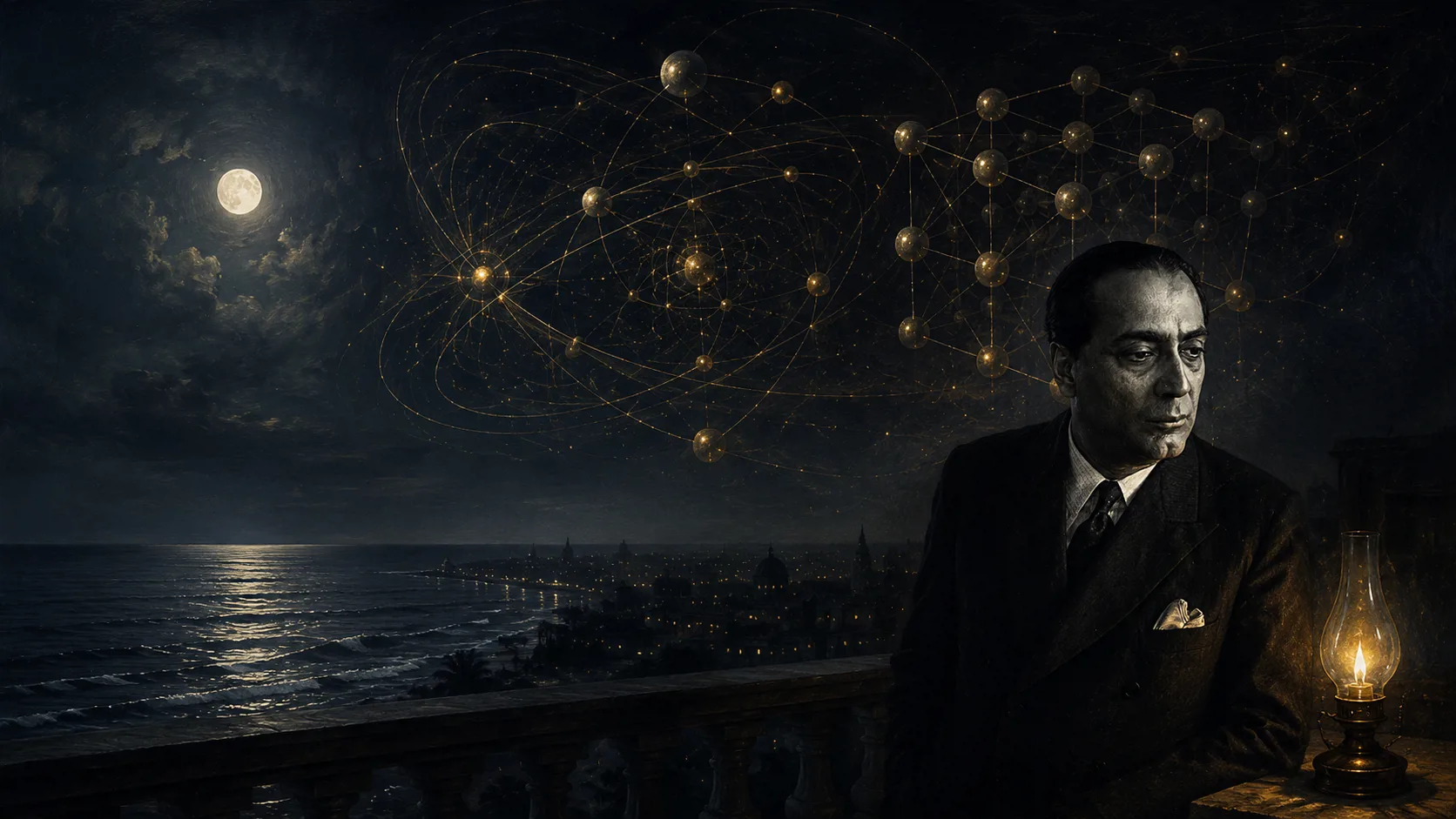
A Verandah in Bangalore, 1944
A thirty-five-year-old physicist sat down to write a letter that should have been absurd. India was not a country. It was a possession. It had no industry worth the name, no power grid that reached its villages, a literacy rate in the low teens, and a famine in Bengal so vast that corpses were being collected from Calcutta streets by municipal carts. The British Raj still had three years to run, and no one in 1944 could say with confidence that what followed would be a nation rather than a wreckage.
And Homi Jehangir Bhabha was writing to the Sir Dorabji Tata Trust to propose that India build, from nothing, a school of fundamental physics capable one day of releasing the energy of the atomic nucleus.
He did not hedge. He wrote, with a confidence that reads now as either madness or prophecy, that when nuclear energy was successfully harnessed for power production — in a couple of decades from now — India would not have to look abroad for its experts. It would have them at home. He was asking for money to build the experts before there was a single reactor, a single gram of fissile material, a single trained reactor engineer anywhere on the subcontinent. He was asking the future to arrive on credit.
He was not asking for a laboratory. He was asking for the right to a future that the world had already decided was not India's to have.
This is the story of that vow — the dare a brilliant, aristocratic, almost impossibly self-assured man made on behalf of a nation that did not yet exist, and how that nation, once born, carried the dare forward through poverty, embargo, ridicule, the death of its founder in a fireball over the Alps, three wars, two prime ministerial assassinations, and the unanimous disapproval of every great power on earth — until one afternoon in May 1998, in a desert in Rajasthan, the ground rose and the world's monitoring stations registered an India that could no longer be told what it was allowed to become.
It is also the story of the science: the real, hard, beautiful physics and chemistry of why India chose the path it did — why thorium and not uranium, why heavy water, why a reactor design the rest of the world had largely abandoned. That science is not waved at here but opened up in full — the actual nuclear physics of cross-sections, breeding ratios, neutron economy, and the chemistry of plutonium separation, set down as rigorously as the subject demands and woven into the narrative wherever the history turns on it.
Part One · The Founder
The Prince Who Chose the Nucleus
Homi Jehangir Bhabha was born on the 30th of October, 1909, in Bombay, into the highest reaches of the Parsi industrial aristocracy. To understand Bhabha one must first understand that almost nothing about his beginning predicted a life of national sacrifice. He was born into comfort so total it was a kind of weather he lived inside without noticing.
His father, Jehangir Hormusji Bhabha, was an Oxford-educated barrister. His mother, Meherbai, came from money and cultivation. But the truly decisive fact of his lineage was the Tata connection: his aunt Meherbai was married to Dorabji Tata, son of Jamsetji Tata, the founder of the Tata industrial empire. The Bhabhas and the Tatas were bound by blood and by the dense, intermarried fabric of Bombay's Parsi elite. This mattered enormously later — when Bhabha needed institutions built, he could reach directly into the one Indian fortune large enough to build them.
The child was raised among books, paintings, and music in a household where European high culture was simply the air. Bhabha grew into an aesthete of genuine accomplishment — a gifted painter, a serious student of Western classical music, an architect of taste who would later personally specify the gardens, the art, and the very curtains of the institutions he founded. He was, by every account, magnetic: tall, handsome, imperious, charming, and utterly certain of himself. People who disliked his arrogance still could not stop talking about him.
Cambridge, and the swerve toward physics
In 1927 he was sent to Cambridge — to Caius College — to read mechanical engineering. This was the family plan: Homi would take an engineering degree and return to a respectable, lucrative position in the Tata steel works at Jamshedpur. His father had spelled it out. It was a sensible, prosperous future, and Bhabha had no intention of living it.
At Cambridge he discovered that the great drama of the twentieth century was unfolding not in factories but in the physics laboratories — and that Cambridge itself, at the Cavendish under Rutherford, was the very center of that drama. The atom was being broken open. Quantum mechanics was being written in real time. Bhabha wrote to his father, in a now-famous exchange, to plead his case: business and engineering were not what he was made for; physics was. He extracted a compromise — pass the engineering tripos first, his father insisted, and then, if the marks were good, he could go on to physics. Bhabha passed the mechanical engineering tripos with first class in 1930. The door opened. He walked through it and never looked back at the steel works.
What followed was a decade as a working theoretical physicist of the first rank — not an administrator who had once done physics, but a genuine contributor to the central problems of the field. He took his doctorate at Cambridge. He worked and corresponded with the towering figures of the age: Niels Bohr in Copenhagen, Wolfgang Pauli, Enrico Fermi, Paul Dirac, whose company at Cambridge he kept. His scientific output in the 1930s was substantial and is the reason his name still appears in physics, quite apart from anything he built in India.
The Science — What Bhabha actually discovered: "Bhabha scattering" and the cascade theory of cosmic rays Settled
Bhabha was a real physicist, and two results carry his name or his hand. Both matter for understanding the man's mind — he thought natively in the language of particles and probabilities, which is exactly the language a nuclear program speaks.
Bhabha scattering (1936). In quantum electrodynamics, when an electron meets its antiparticle, the positron, and they scatter off one another, the process is governed by a specific cross-section that Bhabha derived. The interaction proceeds through two distinct quantum pathways that interfere. The first is ordinary scattering: the two particles exchange a virtual photon and fly apart. The second is uniquely possible because they are particle and antiparticle: they can momentarily annihilate into a single virtual photon, which then re-materializes as a fresh electron–positron pair. Quantum mechanics demands that one add the amplitudes of both pathways and square the sum, so the two interfere. To this day, particle accelerators that collide electrons and positrons — most famously the LEP collider at CERN — use Bhabha scattering at small angles as the standard candle for measuring luminosity, because the prediction is so clean and exact. Every time a collider calibrates itself, it is using Bhabha's 1936 arithmetic.
The Bhabha–Heitler cascade theory (1937). With Walter Heitler, Bhabha explained what happens when a single high-energy cosmic ray strikes the upper atmosphere. A fast electron radiates a high-energy photon; that photon converts into an electron–positron pair; each of those radiates more photons; and so the single primary particle multiplies into a vast shower of secondary particles, doubling at each step until the energy per particle drops too low to continue. Bhabha and Heitler computed the mathematics of this multiplication. This is why cosmic rays became Bhabha's first experimental love when he returned to India.
Why this matters for the story: a nuclear chain reaction is a cascade — one neutron causes a fission that releases more neutrons that cause more fissions. Bhabha had already spent a decade thinking rigorously about multiplicative cascades in particle physics before he ever touched a reactor. The intuition transferred.
Stranded by a war, and a letter that built a nation's science
In 1939 Bhabha was home in India for what was meant to be a holiday. Then the Second World War broke out and travel back to Europe became impossible. He was stranded — a Cambridge theoretician marooned in a country with essentially no apparatus for the physics he practiced. Most men of his class and talent would have waited out the war and returned to Europe. Bhabha did something else: he took a post at the Indian Institute of Science in Bangalore, under the chemist and Nobel laureate C. V. Raman, and he began to think not about how to escape India's scientific poverty but about how to end it.
From Bangalore, in March 1944, he wrote the letter — to the Sir Dorabji Tata Trust — proposing a dedicated institute for fundamental research in physics. It is one of the founding documents of modern India, and its audacity is the whole point. He argued that India must not remain a place where talented physicists were trained only to emigrate; it must build, at home, a school of research strong enough to keep them and, when atomic energy became practical, to exploit it. The Trust agreed. In 1945 the Tata Institute of Fundamental Research was founded in Bombay, with Bhabha as director. He called it, later, the "cradle" of India's atomic energy program — and it was. Every major figure of the early Indian nuclear effort passed through it.
Other nations built their bombs and then their institutes. Bhabha built the institute first, and trusted that the rest would come. It is the single most characteristic decision of his life.
Part Two · The Dare
Convincing a Poor Nation to Reach for the Atom
The thing that has to be explained — the thing that is genuinely hard to believe — is the speed and the priority. India became independent on the 15th of August, 1947, a bleeding, partitioned, refugee-flooded, near-bankrupt country. And on the 12th of April, 1948, less than eight months later, Bhabha had a memorandum in front of the government proposing an Atomic Energy Commission. By 1948 the Atomic Energy Act was passed and the Atomic Energy Commission was established, with Bhabha as chairman.
How? The answer is a relationship — one of the most consequential in modern Indian history — between two aristocratic, Cambridge-shaped, romantic-rationalist men who understood each other instantly: Homi Bhabha and Jawaharlal Nehru.
Bhabha and Nehru
Nehru was a man who believed, with almost religious intensity, that science was the instrument by which a humiliated civilization would lift itself back into history. He spoke of dams and laboratories as the "temples of modern India." He distrusted the idea that India should remain forever a supplier of raw materials and a buyer of others' technology. In Bhabha he found the perfect vessel for that faith: a world-class scientist who was also a patriot, an aristocrat Nehru's social equal, a man of taste and vision who spoke Nehru's language of civilizational self-respect.
And Bhabha, for his part, understood something most scientists never learn: that the laboratory's real battles are fought in the corridors of government, and that to do great science in a poor country one must capture the state's imagination and protect the enterprise from the ordinary churn of bureaucracy and budgets. He secured for the atomic program a unique constitutional position. The Department of Atomic Energy, when it was created in 1954, was placed directly under the Prime Minister — not under a ministry, not subject to normal interdepartmental scrutiny, with its own ring-fenced funding and an unusual degree of secrecy. Bhabha answered to Nehru and to almost no one else.
This structure — the atomic establishment as a sovereign island within the state, reporting to the apex of political power — is Bhabha's institutional masterstroke, and it is why the program survived. It made the program nearly impossible to starve, slow, or kill through the normal mechanisms by which ambitious projects die. It also concentrated immense trust in a tiny group of men, which had consequences both magnificent and troubling for decades.
No power is costlier than no power.
The vision: energy first, and the keys to the kingdom
It is essential to be honest about what Bhabha was building and why, because the popular telling collapses everything into "the bomb," and that is not how Bhabha thought, at least not at first. Bhabha's overriding, stated, repeated vision was electricity. He looked at India — vast, energy-starved, with hundreds of millions of people whose lives were capped by the simple absence of power — and he saw atomic energy as the only path to the kind of abundant electricity that could lift the whole civilization. His famous formulation: the rise in the standard of living of a people is tied directly to the energy available per head.
But — and this is the hinge of the entire Indian story — Bhabha also understood from the very beginning that the science of peaceful atomic power and the science of an atomic weapon are very nearly the same science. A nation that masters reactors, masters uranium, and masters the chemistry of plutonium has, whether it builds a weapon or not, acquired the option of a weapon. Bhabha pursued mastery of the full fuel cycle. He kept the option open. He was once reported to have said, in effect, that given the materials, India could produce a weapon within a short span of time — a claim that was part scientific estimate and part deliberate strategic signaling. He wanted the world, and India's leaders, to know that the door was there even if India chose, for the moment, not to walk through it.
Bhabha's genius was to build a single machine that could power villages or, if the world ever forced India's hand, defend them — and to let no one outside India decide which.
Part Three · The Thorium Doctrine
Why Thorium, and Not Uranium
Here is the geological fact that shaped everything. India is poor in uranium and extraordinarily rich in thorium. The black sands of the Kerala and Tamil Nadu coasts — the monazite beaches — hold one of the largest thorium reserves on earth, while India's uranium deposits are modest in quantity and often poor in quality. Any nuclear program built on imported or scarce uranium would leave India once again dependent, once again at the mercy of foreign suppliers who could turn off the tap. Bhabha looked at the map and the geology and drew a conclusion of breathtaking ambition: India would build its energy future on thorium, the fuel it had in abundance.
There was only one problem, and it is a deep one. Thorium is not, by itself, a nuclear fuel. One cannot simply load thorium into a reactor and split it the way one splits uranium-235. Thorium is "fertile," not "fissile" — it must first be transmuted, inside a reactor, into something that is fissile. Bhabha's answer to this problem is the famous Three-Stage Nuclear Programme, and it is one of the most elegant long-range technical strategies any nation has ever committed itself to.
The Science — Fissile vs. fertile: why you cannot just "burn" thorium, and what fission actually is Settled
Fission is the splitting of a heavy atomic nucleus into two lighter nuclei, releasing energy and, crucially, two or three free neutrons. Those neutrons are the entire game: if on average more than one of them goes on to split another nucleus, the result is a self-sustaining chain reaction.
A fissile nucleus is one that will split when struck by a slow ("thermal") neutron. There are only three that matter: uranium-235, plutonium-239, and uranium-233. Of these, only U-235 occurs in nature — and it makes up just 0.7% of natural uranium; the other 99.3% is U-238, which is not fissile by slow neutrons. Pu-239 and U-233 do not exist in nature in usable amounts; they must be manufactured inside reactors. This single fact — that nature gives only a trace of usable fuel — is why the whole elaborate machinery of enrichment and breeding exists.
A fertile nucleus is one that cannot itself sustain a chain reaction, but which, after absorbing a neutron and undergoing radioactive decay, becomes a fissile nucleus. There are two of importance. U-238, after absorbing a neutron, becomes Pu-239. And thorium-232, after absorbing a neutron, becomes U-233. Thorium-232 is the only isotope of natural thorium, and it is fertile, not fissile. To extract energy from thorium, one must first breed it into U-233 — and to do that, one needs a source of neutrons, which means one needs an existing stock of fissile material to get the cycle started. Thorium can only be unlocked by a key forged from uranium or plutonium first. This is the precise reason Bhabha's plan had to have three stages and could not have one. One cannot start with thorium. One must earn one's way to thorium.
An analogy that is exact rather than loose: U-238 and Th-232 are like logs that will not catch from a match. One needs kindling — U-235 or Pu-239 — to build a hot enough fire; only then will the logs themselves transmute into a fuel that burns. The three-stage plan is a strategy for using a tiny amount of natural kindling to ignite an effectively limitless supply of Indian logs.
The Three-Stage Plan
Bhabha's architecture, laid out in the 1950s and still the official skeleton of Indian nuclear policy today, runs as follows. Each stage produces the fuel for the next, so that India bootstraps itself, step by step, from its small uranium endowment to its vast thorium wealth.
Bhabha's Three-Stage Nuclear Programme
| Stage | Reactor | What it does |
|---|---|---|
| I | Pressurised Heavy Water Reactors | Burn natural uranium (U-235) to make electricity — and breed plutonium-239 from the U-238 as a by-product. Builds the plutonium stockpile. |
| II | Fast Breeder Reactors | Burn the Stage-I plutonium. Wrap the core in a "blanket" of thorium and U-238, breeding fresh U-233 and more plutonium — more fuel than is consumed. |
| III | Thorium / U-233 Reactors | Run on the U-233 bred in Stage II, sustained by India's enormous thorium reserves. The destination: centuries of energy independence. |
The Science — The full three-stage breeding chain, written out as nuclear reactions Settled
Here is the actual nuclear bookkeeping of Bhabha's plan, stage by stage. Follow the neutrons.
Stage I — the plutonium harvest. A heavy-water reactor runs on natural uranium. The fissile U-235 sustains the chain reaction and produces heat, and thus electricity. Meanwhile, the abundant U-238 quietly absorbs spare neutrons and transmutes through a two-step beta decay into plutonium-239: U-238 plus a neutron becomes U-239, which decays to neptunium-239, which decays to Pu-239. The spent fuel is then chemically reprocessed — dissolved in acid and separated through the PUREX solvent process — to extract that Pu-239. This is the seed corn for Stage II.
Stage II — breeding more than you burn. A fast breeder reactor burns the Pu-239 with fast, un-moderated neutrons. Fast fission of Pu-239 releases more neutrons per fission than thermal fission does — and that surplus is the whole point. The extra neutrons are captured in a surrounding blanket of fertile material. Where the blanket is thorium, Th-232 plus a neutron becomes Th-233, which decays to protactinium-233, which decays to U-233. The reactor thus produces more fissile material than it consumes — a breeding ratio greater than one. This is the magic step that converts India's thorium mountain into usable fuel. It also takes a very long time to build up the necessary plutonium inventory, which is the chief reason India is, even now, only at the threshold of Stage II.
Stage III — the thorium economy. Finally, reactors run on the U-233 bred from thorium, continually topped up from India's vast Th-232 reserves. Because thorium is so abundant in India, Stage III represents — in principle — energy security measured in centuries.
There is a deep physical reason thorium works at all in a thermal reactor. The key quantity is eta: the average number of new neutrons released per neutron absorbed by the fuel. To breed, one needs eta greater than two — one neutron to sustain the chain, one to convert fertile to fissile, plus margin for losses. U-233 has the highest eta of all three fissile isotopes in the thermal-neutron range; it stays above two where U-235 and Pu-239 sag. This is why the thorium/U-233 cycle is the only breeding cycle that works well with thermal (slow) neutrons, and it is the physical fact that makes Bhabha's whole dream plausible rather than merely patriotic.
The catch, and it is real: U-233 is always born contaminated with traces of U-232, whose decay chain emits hard, penetrating gamma radiation from thallium-208. This makes U-233 fuel difficult and dangerous to handle and fabricate — a self-protecting feature that complicates both reactor engineering and, incidentally, weapons use. Thorium is a beautiful fuel that fights you the whole way.
Understand what this plan really is. It is a multi-generational strategy for sovereignty. Bhabha was not merely choosing a fuel; he was choosing a future in which India would never again depend on another nation's permission or supply for the energy of its civilization. The plan would take not years but generations — and indeed, three-quarters of a century later, India is only now approaching the threshold of Stage II, with the thorium-fueled Stage III still on the horizon. The dream remains, in the most literal sense, unfulfilled. But it has never been abandoned. It is the longest continuous strategic commitment in the history of the Indian state.
The Science — Why heavy water? The CANDU/PHWR design and how it differs from the rest of the world Settled
Most of the world's power reactors are Light Water Reactors, which use ordinary water both to cool the core and to moderate (slow down) the neutrons. India's Stage-I workhorse is different: the Pressurised Heavy Water Reactor, derived from the Canadian CANDU design. The choice was not aesthetic. It was forced by physics and by sovereignty, and it is the most important reactor-design decision India ever made.
Neutrons released by fission are fast. Slow neutrons are far more likely to cause the next fission in U-235. A moderator is a material that slows neutrons down by letting them bounce off light nuclei, without absorbing too many of them in the process. The ideal moderator slows neutrons efficiently while eating as few as possible.
Ordinary ("light") water is a superb slower of neutrons — but it has a vice: the ordinary hydrogen in it absorbs a meaningful fraction of neutrons. That loss is tolerable only if one compensates by making the fuel richer in U-235 than nature provides. That is exactly why light-water reactors require enriched uranium — uranium artificially boosted from 0.7% U-235 to three to five percent. And enrichment requires gigantic, expensive, technologically forbidding facilities — gaseous diffusion or centrifuge cascades — that, in the 1950s and 60s, India could neither build nor be sold.
Heavy water is water in which the hydrogen is deuterium, a hydrogen isotope with an extra neutron already in its nucleus. Deuterium is nearly "full"; it barely absorbs further neutrons. So heavy water slows neutrons almost as well as light water while wasting far fewer of them. The neutron economy is so much better that a heavy-water reactor can sustain a chain reaction on natural, unenriched uranium — the 0.7% U-235 that comes straight out of the ground. For India this was decisive on three counts at once: no enrichment plant was needed, so there was no dependence on a technology the West would not sell; the reactor ran on natural uranium, using India's modest uranium directly; and it was excellent at breeding Pu-239, feeding Stage II exactly as the three-stage plan required.
A heavy-water reactor also looks fundamentally different inside. A light-water reactor uses a single giant steel pressure vessel holding the whole core under pressure. A heavy-water reactor instead uses hundreds of individual horizontal pressure tubes, each holding fuel bundles, with the moderator sitting in a low-pressure tank — the calandria — around them. This has a profound operational consequence: such reactors can be refuelled while running, pushing fresh bundles in one end and spent ones out the other without shutting down. That same feature, it must be said, also makes it easier to remove fuel at the precise, low burn-up that yields weapons-grade plutonium — a dual-use property that sat quietly at the center of India's entire strategic posture.
So when people ask whether India's reactor design is different from other countries' — yes, and the difference is the whole story. The West standardized on enriched-uranium light-water reactors. India, locked out of enrichment and determined to use its own uranium and breed its own plutonium, built its program on natural-uranium heavy-water reactors. The design was the strategy.
Part Four · The World That Said No
The Scenario Bhabha Was Reading
The United States dropped atomic weapons on Hiroshima and Nagasaki in August 1945 — the year TIFR was founded. The Soviet Union tested in 1949, Britain in 1952, France in 1960, and the People's Republic of China — India's neighbor, and after 1962 its conqueror in a humiliating Himalayan war — in October 1964. That last test changed everything for India. A nation that had just defeated India in battle now possessed the ultimate weapon. The strategic ground shifted under New Delhi's feet.
Bhabha responded immediately and publicly. In a now-famous radio broadcast shortly after the Chinese test, he declared that India had the capability to build a nuclear weapon and could do so within a remarkably short time — and he spoke openly about the economics, arguing the cost of a deterrent was within India's reach. This was Bhabha at his most strategic: using his scientific authority to signal, to China and to the world, that India's restraint was a choice, not an incapacity.
And then the world moved to close the door. Through the 1960s the great powers negotiated the Nuclear Non-Proliferation Treaty, which opened for signature in 1968. The NPT did something India found, and still finds, fundamentally unjust: it divided the world into five "nuclear-weapon states" — precisely those who had tested before 1967 — who were permitted to keep their arsenals, and everyone else, who was permanently forbidden. It froze the hierarchy. It told India, in effect, that the five who got there first could keep their weapons indefinitely while India must forswear them forever. India refused to sign — and has never signed to this day — on the grounds that the treaty was discriminatory: nuclear apartheid, in the phrase India's diplomats would later make famous.
India's objection was never to non-proliferation. It was to a non-proliferation that permitted the powerful to keep their fire while forbidding the poor even the option of it.
This is the world scenario that Bhabha was reading and that his successors inherited: a hardening international order designed to make India's nuclear position permanent and subordinate. The refusal to accept that subordination — the insistence that no foreign body would decide what India was allowed to become — is the through-line of the entire story, from Bhabha's vow to the present day.
Part Five · The Fireball Over the Alps
The Death of the Founder
On the 24th of January, 1966, Air India Flight 101, a Boeing 707 named Kanchenjunga, was descending toward Geneva when it struck Mont Blanc, near the summit, in clear violation of its cleared altitude. All 117 people aboard were killed. Among them was Homi Jehangir Bhabha, traveling to a meeting in Vienna. He was fifty-six years old.
The loss is almost impossible to overstate. Within eleven days, India had lost both Bhabha and — on the 11th of January — Prime Minister Lal Bahadur Shastri, who died in Tashkent. In a fortnight the Indian nuclear program lost its scientific founder and the country lost its head of government. It was a shattering moment.
Bhabha's death has never fully escaped the shadow of conspiracy. The collision occurred in good weather; the aircraft was where it should not have been; and the Cold War context — India's emerging nuclear potential, the interests of powers who would have preferred that potential never mature — has fed decades of speculation, including claims, never substantiated by any official inquiry, that the crash was engineered to decapitate India's program. The investigations attributed the disaster to a navigational misunderstanding between the pilot and Geneva air traffic control regarding the aircraft's position relative to the mountain. What is beyond dispute is the consequence: at the very moment the program needed its founder most — with the Chinese bomb fresh, the NPT looming, and the decision to weaponize still unmade — Bhabha was gone. Contested
The baton did not fall. That it did not is the proof that Bhabha had built something larger than himself.
The baton passes: Vikram Sarabhai
The man who took the chairmanship of the Atomic Energy Commission after Bhabha was Vikram Sarabhai — himself a giant, the father of the Indian space program, a physicist and industrialist of vision. But Sarabhai's instincts differed sharply from where the program was drifting. Sarabhai was, by deep conviction, committed to the peaceful uses of atomic energy and was uneasy about weaponization. For several years under his leadership the explicit weapons question was, in a sense, restrained even as the underlying capability — the plutonium, the reprocessing, the reactor expertise — continued to mature. Sarabhai died young too, in 1971. The program had now lost two of its founding titans within five years.
And yet the machine Bhabha built kept running. The reactors operated. The chemists separated plutonium. A cadre of brilliant scientists — trained at TIFR and at the new atomic research establishment at Trombay — carried the work forward. This is the deepest vindication of Bhabha's institution-first philosophy: he had built not a personality cult but a capability, distributed across people and institutions, that could survive the death of any individual, even its founder.
Part Six · The Smiling Buddha
Pokhran, 1974 — The First Test
By the early 1970s the pieces were in place. The CIRUS reactor at Trombay — a research reactor supplied by Canada, using heavy water supplied by the United States, both under peaceful-use understandings — had been producing plutonium since 1960. India's chemists had mastered reprocessing. And the political will had arrived in the formidable person of Prime Minister Indira Gandhi, daughter of Nehru, who in 1971 had led India to a crushing victory over Pakistan and the creation of Bangladesh — during which the United States had sent the nuclear-armed carrier USS Enterprise into the Bay of Bengal as a gesture of intimidation. The lesson of that gunboat was not lost on New Delhi.
A small, tightly-held team of scientists — led by figures including Raja Ramanna, Homi Sethna, then AEC chairman, and a young engineer named P. K. Iyengar, among others — designed and built a plutonium implosion device. On the 18th of May, 1974 — the Buddha's birthday, Buddha Purnima — it was detonated underground at the Pokhran test range in the Thar Desert. The code phrase relayed to Indira Gandhi was "The Buddha is smiling."
The Science — How a plutonium implosion device works, and why it is so much harder than a uranium gun Settled
There are two fundamentally different ways to assemble a critical mass of fissile material fast enough to produce a nuclear explosion rather than a fizzle. India's 1974 and 1998 plutonium devices used the harder one — implosion — for reasons of physics.
A nuclear explosion requires assembling a supercritical mass — enough fissile material, densely enough packed, that the neutron chain reaction grows explosively. The catch: as the reaction begins, it releases energy that tries to blow the assembly apart. If the material disassembles before enough generations of fission have occurred, the result is a feeble fizzle. So the entire engineering problem is to assemble supercriticality faster than the bomb can blow itself apart — in less than a millionth of a second.
The simplest design fires one sub-critical piece of U-235 down a barrel into another, slamming them into a supercritical whole. This is the Hiroshima design. It is so reliable it was used in war without testing. But it only works with uranium. It cannot be used with plutonium, because reactor-bred plutonium always contains the isotope Pu-240, which fissions spontaneously, spraying stray neutrons. In a slow gun-assembly, those stray neutrons start the chain reaction too early — "pre-initiation" — and the device fizzles before full assembly. Plutonium is simply too neutron-noisy for the gun method.
So plutonium demands implosion. A sub-critical sphere of plutonium is surrounded by a precisely shaped shell of conventional high explosives — explosive lenses. When detonated, these must produce a perfectly symmetrical, inward-rushing shockwave that crushes the plutonium core to a fraction of its original volume in microseconds. Compressing the plutonium to far higher density drives it supercritical so fast that pre-initiation cannot spoil the explosion. The engineering demands are brutal: the explosive lenses must be machined and timed to a precision of fractions of a microsecond, detonated simultaneously at many points, so that the shockwave converges as a near-perfect sphere. Any asymmetry and the core squirts out sideways instead of compressing. This is why implosion devices must be tested — and why India's mastery of it, demonstrated at Pokhran in 1974, was a genuine scientific achievement, not a borrowed design.
The plutonium for the 1974 device came from the CIRUS research reactor. Because India used the device to declare a "peaceful nuclear explosion," and because CIRUS had been supplied under peaceful-use understandings, the test triggered a global backlash that reshaped the entire nonproliferation regime and gave rise to the Nuclear Suppliers Group.
India called it a Peaceful Nuclear Explosion — a device for civil engineering, mining, earth-moving. The world did not buy it for a moment. The test made India the sixth nation to detonate a nuclear device, and it detonated something else as well: the comfortable assumption of the nuclear powers that the club could be kept closed. The reaction was swift and lasting. Canada cut off nuclear cooperation. The United States tightened controls. And a group of supplier nations came together to form the Nuclear Suppliers Group — an entire international cartel created, in large part, specifically to prevent another India. India had used materials supplied for peace to demonstrate a capability for war, and the supplier nations resolved it would never happen again.
India now entered the long wilderness: technologically capable, internationally isolated, embargoed, and — strangely — paralyzed. Because after 1974, India did not test again for twenty-four years. It had shown it could. Then it stopped.
Part Seven · The Long Silence
The Years Between the Tests
The twenty-four years of silence were not empty. They were a period of maturation, of repeated near-decisions, and of a parallel program that would prove just as important as the warheads themselves: missiles. A bomb that cannot be delivered is a museum piece. For deterrence to mean anything, India needed the means to deliver a warhead reliably to a distant target — and that meant rockets.
The Missile Man
Here a common confusion must be corrected and the right man honored. The scientist universally known as India's "Missile Man" — and later the eleventh President of India — was Dr. A. P. J. Abdul Kalam (1931–2015). He is sometimes conflated with Maulana Abul Kalam Azad, India's first Education Minister and a freedom-movement leader of the 1940s and 50s; they are entirely different people. It was Abdul Kalam, an aerospace engineer of humble origins from Rameswaram in Tamil Nadu — the son of a boat-owner, who sold newspapers as a boy — who became the public face and driving force of India's missile and, later, weapons effort.
Kalam had cut his teeth at India's space program before being asked to lead the Integrated Guided Missile Development Programme, launched in 1983. Out of this program came the missiles whose names every Indian now knows: Prithvi, the short-range battlefield missile, and, above all, the Agni series — the long-range, nuclear-capable ballistic missiles named for fire itself, Agni, the Vedic god of the sacrificial flame. The Agni missiles are the land leg of India's eventual nuclear triad: the ability to deliver a warhead across the subcontinent and, in later versions, across continents.
By the late 1990s, then, the two halves of a true deterrent were converging: a weapons capability that had been demonstrated and quietly refined since 1974, and a missile force, built largely under Kalam, capable of delivering it. What remained was a political decision — and the nerve to make it in the teeth of certain global punishment.
Part Eight · The Decision
Narasimha Rao, Vajpayee, and the Quiet Handover
In the mid-1990s, Prime Minister P. V. Narasimha Rao — the Congress leader who had already transformed India by liberalizing its economy in 1991 — brought India to the very brink of testing. In 1995, preparations at Pokhran were well advanced. Then American spy satellites detected the activity. Washington applied intense, direct pressure. Rao, weighing the cost of sanctions against a fragile, newly-opening economy, pulled back. The tests were called off. India remained, for the moment, silent.
What happened next is the part that ordinary accounts leave out, and it is genuinely moving. When Rao's government fell and Atal Bihari Vajpayee of the BJP — a political opponent from a rival party — was poised to become Prime Minister, Rao is widely reported to have quietly passed the torch. The story, recounted by Vajpayee himself and corroborated by others, is that Rao sent word to Vajpayee in effect: the bomb is ready; you take it forward. One version has Rao telling Vajpayee, "Saamagri taiyaar hai" — the material is ready. Contested
In a country famous for the viciousness of its politics, the most important strategic decision in its modern history was handed, in confidence, from one party's leader to his rival — because both understood it belonged to India, not to either of them.
This continuity is the hidden spine of 1998. The Indian bomb was not a partisan project. It was a national one, carried forward across the deepest political divide by men who agreed on almost nothing else. When Vajpayee took office and gave the order to test, he was completing work that Nehru had authorized, that Bhabha had made possible, that Indira Gandhi had first demonstrated, and that Narasimha Rao had brought to the very edge. Five prime ministers and four decades stood behind the button he finally pressed.
Part Nine · Operation Shakti
Pokhran-II — The Deception That Fooled the World
After the 1995 near-miss, the Indian scientific and military establishment had learned a hard lesson: the United States was watching Pokhran with a constellation of reconnaissance satellites whose cameras could resolve objects on the ground in fine detail, and whose analysts knew exactly what test preparations looked like. To test in 1998, India would have to do the seemingly impossible — assemble devices, dig and prepare shafts, move scientists and equipment and the army's specialist engineers into the open desert, and lower nuclear devices into the ground — all without a single tell-tale sign being caught by the satellites passing overhead on their known, predictable orbits.
The operation was code-named Operation Shakti (śakti — power, the divine feminine energy). The scientific effort was led by Dr. R. Chidambaram, then chairman of the Atomic Energy Commission, and the weapons design and development by Dr. A. P. J. Abdul Kalam as head of the DRDO and scientific adviser to the government, working with Dr. K. Santhanam and the team at the Bhabha Atomic Research Centre. The concealment plan was extraordinary, and its details have become legend.
How they evaded the watchers
The Operation Shakti concealment measures
| Measure | What it meant |
|---|---|
| Work only at night | Critical movements and shaft work were timed around the known overhead passes of US reconnaissance satellites, whose orbital schedules were predictable. |
| Restore the desert by dawn | Excavated sand was shaped to mimic natural, wind-formed dune patterns; equipment was covered or removed so that morning satellite images showed an undisturbed desert. |
| Hide in plain sight, in uniform | Scientists moved on the base dressed in army fatigues, using military aliases, so that no influx of identifiable nuclear personnel could be detected. |
| Absolute compartmentalization | The circle of those who knew was kept tiny. Even much of the senior government and bureaucracy was unaware until it was done. |
On the 11th of May, 1998, three devices were detonated simultaneously, followed by two more on the 13th — five tests in all. The yields, as announced by India, spanned a fission device, a low-yield device, and — the great prize and the great controversy — a thermonuclear (hydrogen bomb) device. The Prime Minister's coded message of success came back as a phrase that has entered Indian history: "The Buddha has smiled again."
The Science — Fission vs. fusion: what a "thermonuclear" or hydrogen bomb actually is Settled
The 1974 device and the simplest 1998 devices were fission weapons: they split heavy nuclei (plutonium). A thermonuclear or hydrogen bomb adds a second, far more powerful stage based on fusion — joining light nuclei together — and it is a different order of weapon entirely.
Fusion is the process that powers the Sun: light nuclei, isotopes of hydrogen — deuterium and tritium — are forced together to form helium, releasing enormous energy. But fusion requires temperatures of tens of millions of degrees to overcome the electrical repulsion between nuclei. There is only one practical way on Earth to reach such temperatures instantly: a fission bomb.
A thermonuclear weapon therefore works in two stages. The primary is a fission bomb. When it detonates, a burst of radiation — X-rays — is channeled to compress and ignite a secondary stage containing fusion fuel, typically lithium deuteride. The fission primary acts as the match; the fusion secondary is the vastly larger fire. This staging allows yields far beyond what fission alone can reach: fission weapons top out in the range of tens of kilotons before becoming impractical; thermonuclear weapons can reach megatons.
India announced that one of the 11 May devices was a thermonuclear design. Years later, a senior member of the test team, Dr. K. Santhanam, publicly questioned whether the thermonuclear secondary had fully ignited, arguing from seismic yield estimates that it may have under-performed — a fizzle of the fusion stage. Other senior scientists, including Chidambaram and Kalam, firmly maintained the test was a full success. The debate has never been fully resolved in public, because resolving it definitively would require disclosing exact yields and design details India keeps secret. What is not in dispute: India demonstrated a working fission arsenal and the components of thermonuclear capability.
A "boosted" fission weapon — where a small amount of fusion fuel is added to the fission core to inject extra neutrons and increase efficiency — is an intermediate step between pure fission and full two-stage thermonuclear. India is generally understood to have demonstrated boosting as well. The distinctions matter enormously for yield and for how compact a warhead can be made to fit atop a missile.
The world's reaction was thunderous. The United States, Japan, and others imposed sanctions. The UN Security Council condemned the tests. And then, seventeen days later, on the 28th and 30th of May 1998, Pakistan responded with its own tests in the Chagai Hills — six detonations, matching and symbolically exceeding India's five. South Asia now had two openly nuclear-armed adversaries, and the strategic landscape of the subcontinent was permanently transformed.
Part Ten · The Doctrine
How India Decided to Hold the Fire
A bomb without a doctrine is just a danger. In the months and years after 1998, India did something most nuclear powers never do so openly: it wrote down, and largely published, the philosophy governing when and how it would use nuclear weapons. The intellectual architect of that doctrine was not a soldier or a politician but a civilian strategic thinker of immense influence, K. Subrahmanyam — often called the doyen of Indian strategic studies, and, as it happens, the father of S. Jaishankar, who would later serve as India's foreign minister.
A draft doctrine was produced by the National Security Advisory Board in 1999, and a formal version was adopted by the Cabinet Committee on Security in 2003. Its pillars are clear and, by the standards of nuclear states, strikingly self-limiting.
The pillars of India's nuclear doctrine
| Pillar | What it means |
|---|---|
| No First Use (NFU) | India will not be the first to use nuclear weapons. They exist only to retaliate against a nuclear attack on Indian territory or forces. |
| Massive Retaliation | Any nuclear attack on India will be met with retaliation so massive as to inflict "unacceptable damage." The threat is total, to make any first strike irrational. |
| Credible Minimum Deterrent | India will build only as much as deterrence requires — not parity, not an arms race, but enough to make attack unthinkable. |
| Civilian Control | Only the political leadership — the Prime Minister, through the Nuclear Command Authority — can authorize use. Never the military alone. |
| The CBW caveat | The 2003 refinement reserved the right to respond with nuclear weapons to a major chemical or biological attack — a conditioning of the no-first-use pledge. |
Two nuclear powers in the world formally maintain No First Use: China and India. It is a posture of deliberate restraint, and it carries real strategic logic — by renouncing first use, India removes the pressure to launch on warning, reduces the risk of accidental or unauthorized use, and casts itself as a responsible power. It has been questioned at home — some strategists argue an NFU posture lacks credibility, especially against Pakistan, which explicitly rejects NFU and has developed battlefield "tactical" nuclear weapons for early use. Defence ministers have hinted that "circumstances" could one day change India's stance. But the 2003 doctrine remains formally in place, reaffirmed by India at the United Nations as recently as 2025. Settled
Part Eleven · The Triad
Land, Air, and the Silent Boats Beneath the Sea
No First Use makes a specific, demanding promise: we will absorb the first blow and still strike back. That promise is only believable if a meaningful part of one's nuclear force can survive a surprise attack. The solution every major nuclear power has reached is the triad — the ability to deliver nuclear weapons from three independent platforms: land, air, and sea. Destroy one leg and the others remain. India has spent the decades since 1998 painstakingly building all three.
The land leg is the Agni family of ballistic missiles, the legacy of Kalam's program — now extending to the Agni-V, with a range exceeding 5,000 kilometers and, in its latest tested form, the ability to carry multiple independently-targetable warheads, letting a single missile strike several targets at once. The air leg is India's fighter-bomber aircraft, configured to deliver nuclear gravity bombs and stand-off weapons.
But the crown of the triad — and the form a nuclear deterrent takes beneath the sea — is the sea leg, and it is the most strategically important of the three, because it is the most survivable. A nuclear-powered submarine carrying ballistic missiles, an SSBN or "boomer," can vanish into the depths of the ocean for months, undetectable, ready to launch a retaliatory strike even if every land base and airfield in India has been destroyed. It is the ultimate guarantor of No First Use: the assurance that retaliation is always possible, and therefore that a first strike is always futile.
The Science — India's sea leg today: the Arihant-class SSBNs and the K-series missiles Contested
India is the only nation outside the five permanent UN Security Council members to design and operate its own nuclear-powered ballistic missile submarine. This grew out of the decades-long, highly secret Advanced Technology Vessel project, begun in 1984.
The Arihant-class (arihant, "destroyer of enemies") submarines are India's boomers. As of 2026 the fleet stands roughly as follows. INS Arihant (S2), commissioned 2016, first deterrent patrol 2018, around 6,000 tonnes, four launch tubes. INS Arighaat (S3), commissioned August 2024, with design refinements over Arihant. INS Aridhaman (S4), commissioned 2026, a stretched hull of around 7,000 tonnes with eight launch tubes. S4-star, to be named INS Arisudan, in sea trials, expected around 2027, with the highest indigenous content. And the next-generation S5-class, around 13,500 tonnes, construction begun, first boat expected in the early 2030s.
The submarines carry the K-series of submarine-launched ballistic missiles. The K-15 (Sagarika) has a range of about 750 km, forcing patrols close to enemy coasts. The K-4 has a range of about 3,500 km, tested from INS Arihant and INS Arighaat in late 2025, letting boats patrol far out in safe waters and still strike deep inland. The K-5 and K-6 are in development, with ranges of roughly 5,000 and 6,000 km, the latter intended to be capable of carrying multiple warheads.
A submarine-launched ballistic missile is "cold-launched": expelled from its vertical tube by gas pressure or a steam generator while the submarine is still submerged, so the missile breaches the surface before its rocket motor ignites. This protects the boat and preserves its concealment. The submarine never has to surface — it can fire from beneath the waves and disappear. That is, quite literally, the nuclear deterrent beneath the sea.
Why the sea leg completes the doctrine: India's land and air forces could in principle be located and struck. A submarine on patrol in the vastness of the Indian Ocean cannot be reliably found. Its survival — and therefore the survival of India's ability to retaliate — is assured. This is what makes "No First Use / Massive Retaliation" credible rather than a bluff. Bhabha's reactors made the fuel; Kalam's rockets made the reach; the Arihant boats made the promise unbreakable.
Part Twelve · The Neighbor
What It Did to Pakistan
The Indian test of 1974 lit a fire in Pakistan that has never gone out. After the trauma of 1971 — the loss of East Pakistan and the birth of Bangladesh, a defeat Pakistan blamed in part on Indian power — Prime Minister Zulfikar Ali Bhutto made a vow that became famous: that Pakistan would build the bomb even if its people had to eat grass to pay for it. India's 1974 explosion turned that vow into a national program.
Pakistan's path to the bomb differed sharply from India's in both technology and ethics. Where India bred plutonium in indigenous heavy-water reactors, Pakistan pursued the uranium enrichment route, built around the figure of A. Q. Khan — a metallurgist who had worked at the European URENCO enrichment consortium and took with him the centrifuge designs that became the seed of Pakistan's program. Khan later became the center of the most notorious nuclear-proliferation scandal in history, running a clandestine network that sold enrichment technology and weapons designs to Libya, Iran, and North Korea. The contrast is stark: India built in defiant isolation and never exported its technology; Pakistan's program was built on stolen Western designs and became a wholesale supplier of proliferation.
Strategically, Pakistan's doctrine is the inverse of India's. Pakistan rejects No First Use. Facing a larger conventional Indian army, Pakistan explicitly reserves the right to use nuclear weapons first — including battlefield "tactical" nuclear weapons, like the short-range Nasr missile, designed to stop an Indian armored advance early. This "full spectrum deterrence" lowers the nuclear threshold dangerously and is precisely the development that has led some Indian strategists to question whether India's NFU posture remains adequate. As of the mid-2020s, India and Pakistan are estimated to hold roughly comparable arsenals — on the order of 170 to 180 warheads each — locked in a stable-unstable standoff beneath which conventional skirmishes continue to flare.
India built the bomb to be free of others' permission. Pakistan built it to be free of India's superiority. The first is a doctrine of restraint; the second, of constant brinkmanship.
Part Thirteen · The Reckoning
From Pariah to Partner
For a quarter century after 1974, India paid for its defiance in isolation: cut off from nuclear commerce, denied technology, treated as a proliferation pariah for refusing to sign a treaty it considered unjust. And then, in one of the great diplomatic reversals of the modern era, the world blinked. In 2005–2008, the United States, under President George W. Bush, negotiated the U.S.–India Civil Nuclear Agreement — the "123 Agreement" — which, together with a special waiver from the Nuclear Suppliers Group in 2008, allowed India to resume civilian nuclear trade with the world without signing the NPT.
Read that again. The NSG — the cartel created specifically in response to India's 1974 test — granted India, and India alone, an exemption to trade in nuclear materials while remaining outside the NPT. India had refused to bend for thirty years, and in the end it was the regime that bent. The terms required India to separate its civilian reactors, placed under international safeguards, from its military ones, kept sovereign and unmonitored — preserving India's weapons program entirely while reopening the door to fuel and technology for its energy program. It was a tacit acknowledgment by the world's powers that India was now, in fact, a responsible nuclear state, and that the fiction of its exclusion could no longer be maintained.
Bhabha's wager — that India should never let a foreign body decide what it was permitted to become — had paid out in full. The young, poor nation that wrote a letter in 1944 asking the future to arrive on credit had collected.
Epilogue
The Unfinished Vow
There is one last thing to say, and it is the truest and the most poignant. For all its triumphs — the tests, the triad, the silent boats beneath the sea, the diplomatic vindication — Bhabha's original dream remains unfinished. The three-stage plan that was the whole point, the thorium economy that would free India's civilization from the energy poverty Bhabha hated, is still, three-quarters of a century later, only approaching its second stage. The Prototype Fast Breeder Reactor — the gateway to Stage II — has been long delayed. Stage III, the thorium age, the destination Bhabha drew on the map in the 1950s, remains over the horizon.
And yet no Indian government, of any party, across every transition from Nehru to the present, has ever abandoned it. The official skeleton of Indian nuclear policy is still Bhabha's three stages. The state still pursues the breeder reactors. The thorium fuel work continues. The vow a thirty-five-year-old physicist made on a verandah in Bangalore, on behalf of a country that did not yet exist, is still being kept — slowly, stubbornly, across generations of scientists most of the world will never hear of.
That is the deepest lesson of this story, and the most Indian one. Bhabha did not build a bomb. He built an institution, and an idea, and a refusal — and he trusted them to outlive him. They have. The dare endures. The flame, Agni, still burns at the altar of a sacrifice that is not yet complete.
When nuclear energy has been successfully applied for power production in, say, a couple of decades from now, India will not have to look abroad for its experts but will find them ready at hand. — Homi J. Bhabha, in his 1944 letter to the Sir Dorabji Tata Trust
He was wrong about the timeline. He was right about everything else.