In the autumn of 1965 India stood, for a few hours, on the eastern bank of a canal within artillery range of Lahore. Pakistan had spent the preceding months assuring itself that this could never happen, which is precisely the sort of thing one says shortly before it happens. The war had been Pakistan's idea. It had been planned by Pakistan, launched by Pakistan, and named by Pakistan with the sort of grand historical branding that ambitious failures always seem to attract. By the end of that autumn it had cost Pakistan its best armour, its favourite strategic assumptions, and eventually its president. This is the account of how that came to pass, told with the respect the subject deserves, which is to say very little.
The man on the Indian side was Lal Bahadur Shastri, five feet two inches of Gangetic-plain seriousness, a devout Hindu of the Kashi country who had spent nine years in British prisons and taken Rama's name in his last conscious minutes on earth. The Western press could not decide whether to call him a stopgap or a mistake. Pakistan's high command made the same assessment and staked a war on it. Both were wrong, though only one of them lost an army finding out.
The Ground Before the Fire
To understand 1965 you must first appreciate the remarkable confidence with which Pakistan misunderstood everything.
Three articles of faith had convinced Rawalpindi that the hour had come. First, the 1962 war with China had bruised India's military reputation, from which Pakistan's generals concluded, with the caution for which they would become famous, that the entire Indian Army was made of paper. Settled Second, Nehru was dead and the small vegetarian who replaced him surely could not be a serious man. Third, in the spring of 1965 the two countries had scuffled in the salt marsh of the Rann of Kutch, where Pakistan pressed hard at one contested position before the British arranged a ceasefire. Settled The clash was inconclusive, and the arbitration would later award India roughly nine-tenths of the disputed ground. None of this troubled Rawalpindi. Pakistan looked at a draw it had mostly lost on paper and saw in it the proof that the Indian soldier would not fight. It was a magnificent piece of self-flattery, and Pakistan promptly built an entire war on top of it. Settled
Presiding over this festival of optimism was Field Marshal Muhammad Ayub Khan, who had made himself president in a 1958 coup and his army the custodian of a comforting doctrine: that one Muslim soldier was worth several Hindu ones, that Kashmir's Muslims were a coiled spring awaiting only a spark, and that a quick, deniable operation could pocket the whole of Jammu and Kashmir before sleepy India noticed. The plan was christened Operation Gibraltar, after the rock from which the eighth-century Muslim conquest of Spain had been launched, because nothing steadies a shaky military plan like naming it after a glory from twelve centuries earlier. The name told you everything about the frame of mind. This was to be a conquest with a civilisational soundtrack.
The one small flaw in Gibraltar was that its entire premise, that Kashmiri Muslims would rise the instant armed strangers appeared among them, was false. Settled Everything Pakistan suffered that autumn flowed from this single, load-bearing delusion.
Gibraltar: The Infiltration That Failed
In early August 1965, Pakistan sent thousands of soldiers out of uniform across the ceasefire line, somewhere between seven and thirty thousand of them, organised into columns named after the heroes of early Islamic conquest, to raise a general uprising among a people who had not been consulted about wanting one. If the scheme has a familiar ring, it should: Pakistan had run essentially the same play in 1947, when Operation Gulmarg pushed tribal lashkars, stiffened with regular Pakistani soldiers disguised as tribesmen and backed by a division held in reserve, into Kashmir under the fiction of a spontaneous tribal uprising. That first attempt had ended with the Maharaja acceding to India, the Indian Army airlifted into Srinagar, and Pakistan losing the war it had started. Settled Undeterred by eighteen years and one lost war, Rawalpindi simply refreshed the costume, dressed its own regulars as a homegrown Kashmiri rebellion this time rather than as Pashtun raiders, and tried again. There was even a clandestine radio station, Sada-e-Kashmir, the "Voice of Kashmir," broadcasting the enthusiasm of a rebellion that did not exist. Settled
The Kashmiris, presented with their liberators, responded by reporting them to the Indian authorities. Settled The population whose seething resentment was the sole premise of the entire operation turned out to prefer handing Pakistan's agents to the very army Pakistan had come to save them from. By the last week of August the columns had been rolled up, killed or captured, and India, warming to the occasion, crossed the ceasefire line and began taking ground of its own.
Haji Pir: The Pass India Bled For
The prize that mattered most was the Haji Pir Pass, and it is worth dwelling on, because everything bitter about Tashkent flows from what happened here.
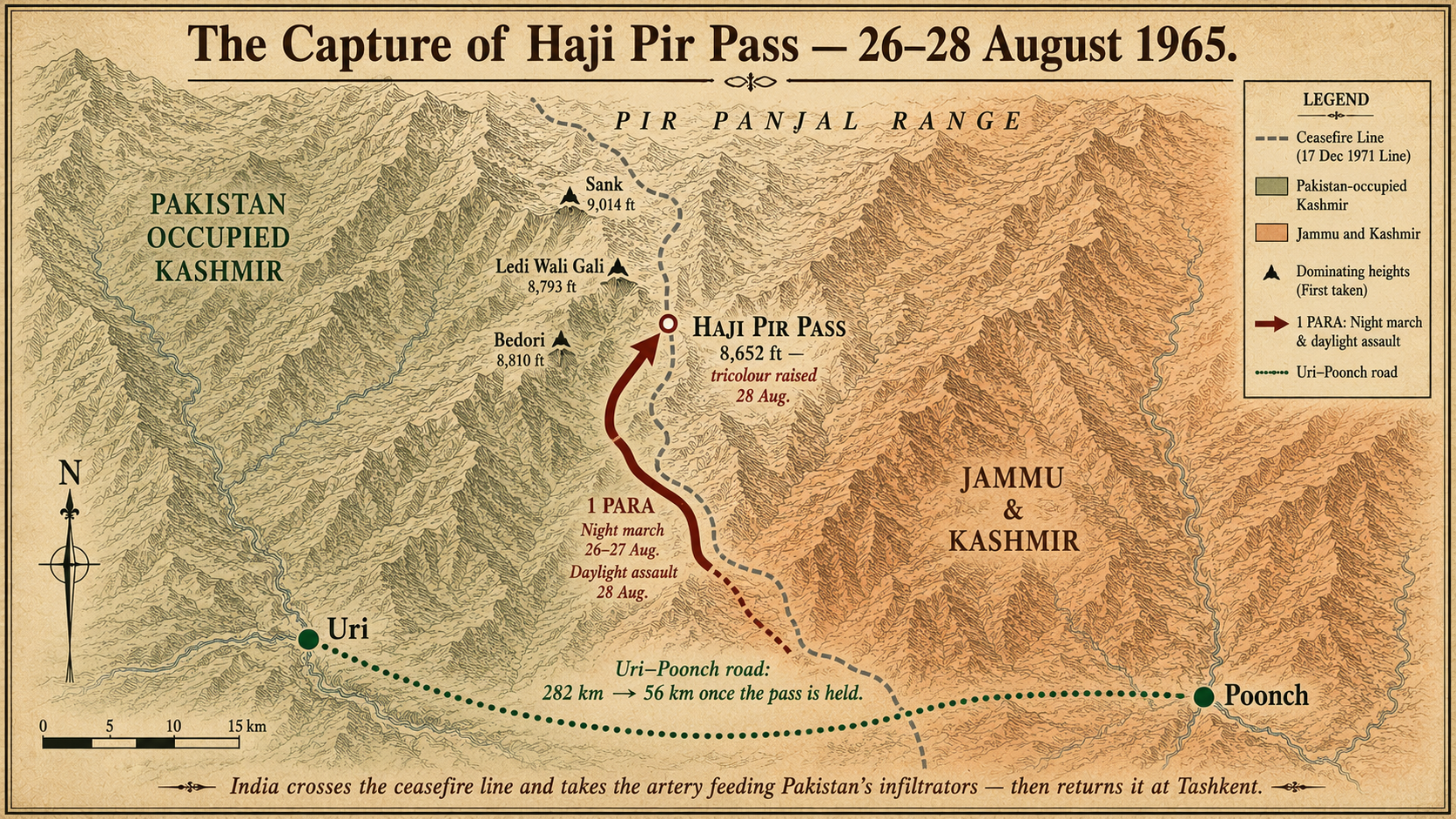
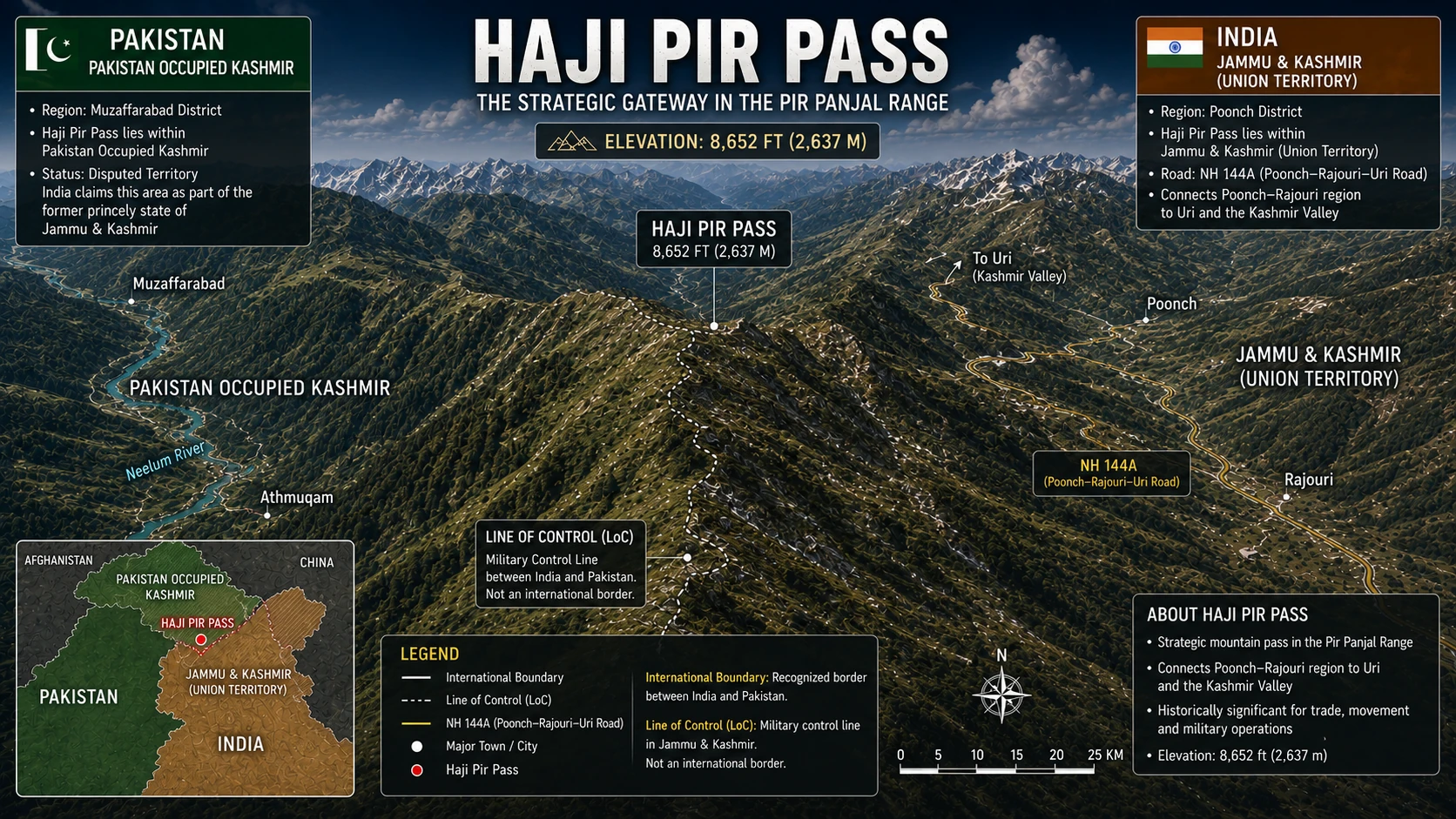
Haji Pir sits at 8,652 feet in the Pir Panjal range, a high saddle that was the principal artery down which Pakistan fed its infiltrators into the Valley. It also dominated the road between Uri and Poonch: hold the pass and the road distance between those two towns dropped from 282 kilometres to a mere 56. Settled Take Haji Pir and you did two things at once, cut the infiltration at its source and shorten your own logistics enormously. It was, in short, exactly the ground worth fighting for.
The fighting for it was brutal, and it was won in conditions that would have justified failure. Under Lieutenant General Harbaksh Singh's Western Command and Brigadier Zorawar Chand Bakshi's 68 Infantry Brigade, the assault fell to 1 Para and its supporting battalions across a cluster of dominating heights, Sank, Ledi Wali Gali, Bedori, taken one by one in driving monsoon rain across near-vertical, mud-slicked terrain, against well-entrenched defenders. Settled Bakshi himself led from the front and took Sank in the small hours of 27 August, the Pakistani defenders fleeing and leaving their heavy weapons behind.
Then Major Ranjit Singh Dyal of 1 Para did the thing that put the battle in the textbooks. Given the chance to press on to the pass itself, he took it. His men moved through the night up the Hyderabad nullah on nothing but damp shakarparas and biscuits, were fired on, were saved by a sudden downpour, captured a party of Pakistani soldiers along the way and cheerfully press-ganged them into carrying the loads the rest of the way up. Climbing some four thousand feet on foot and appearing behind the enemy defences at first light, Dyal launched a daylight assault up the western shoulder of the pass that the defenders could not stand. They abandoned their weapons and fled down the hill. By 1030 hours on 28 August 1965, the tricolour flew over Haji Pir. Settled A Pakistani brigade counterattacked on 29 August; 1 Para threw it back and, over the following days, took further features and consolidated the whole bulge.
Both Bakshi and Dyal received the Maha Vir Chakra. 1 Para earned the Battle Honour of Haji Pir and the Theatre Honour of Jammu and Kashmir. This was the moment Gibraltar died on the ground: its supply line was now in Indian hands, on a pass India had climbed a mountain in the rain to take. Settled
Remember all of this. Remember the four thousand feet on foot, the biscuits, the daylight assault, the two Maha Vir Chakras. It matters again at Tashkent, where India, having taken the pass at this cost, will hand it straight back to Pakistan across a negotiating table, and where infiltrators will resume using it for the next sixty years. Hold that thought.
Grand Slam: The Gamble at Akhnoor
Faced with a failed infiltration and a lost pass, a prudent command might have paused to reflect. Pakistan escalated. On 1 September 1965 it launched Operation Grand Slam, a conventional armoured thrust in the Chhamb sector aimed at Akhnoor and its bridge over the Chenab. Settled
Credit where due: the target was well chosen. Akhnoor was the neck through which all Indian supply to Kashmir passed, the point Ayub Khan himself is said to have called India's "jugular vein." The opening was genuinely dangerous. Pakistan's 12th Division rolled forward with M47 and M48 Patton tanks, the finest armour in the subcontinent, routed the Indian 191 Brigade, took Chhamb, and by 2 September stood a few miles from Akhnoor with almost nothing in the way. Settled
And here Pakistan performed the manoeuvre that its own historians have spent sixty years failing to explain. At the precise moment of success, it stopped. General Akhtar Hussain Malik, who had driven the attack to the edge of victory, was relieved of command mid-stride and replaced by General Yahya Khan, a man whose chief future contribution to history would be losing half his country in 1971. The handover cost the better part of a day, the momentum evaporated, the effort wandered off toward secondary objectives, and the jugular Pakistan had so cleverly located was left thoughtfully uncut. Settled Pakistani accounts blame timidity at headquarters, confusion of command, and the serene assumption that there was plenty of time. Whatever the cause, Pakistan had found India's throat and then, at the decisive instant, decided to hold a meeting about it.
The halt was a gift, and India accepted it. If Pakistan could lunge across the ceasefire line whenever it pleased, India would simply change the board. It would strike where Pakistan least expected and could least afford to lose: the Punjab, and Lahore.
When the enemy reaches for your throat and then pauses to reorganise his command structure, you do not thank him. You march on the city he loves most and make him choose.
6 September: India Crosses the Border
Before dawn on 6 September 1965, the Indian Army crossed the international border into West Punjab, on the orders of the small vegetarian Pakistan had written off. Settled The man who had never worn a uniform sent three divisions toward Pakistan's second city, and the war Pakistan had started in Kashmir arrived, uninvited, on Pakistan's own doorstep.
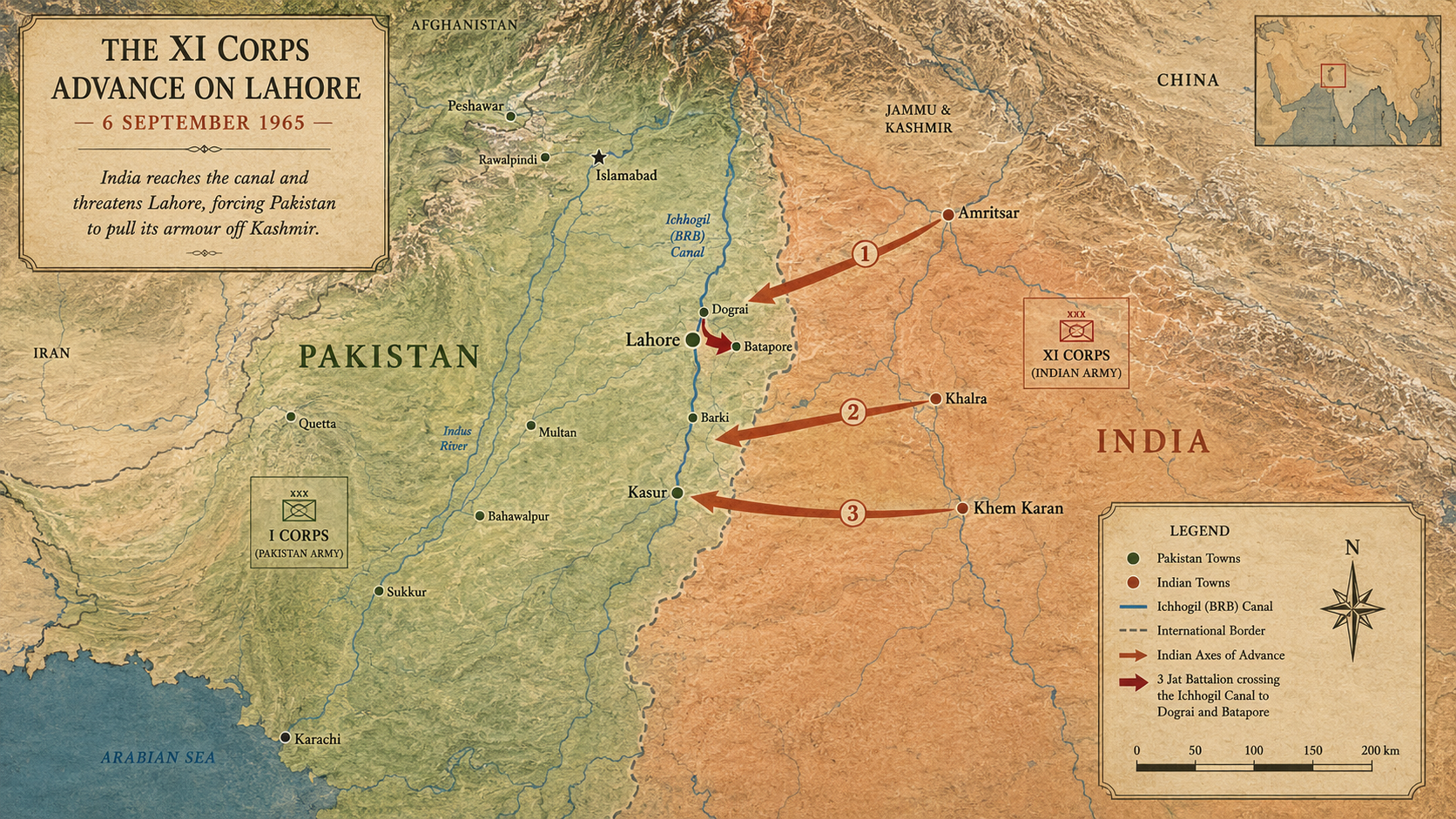
The logic was exact. Rather than sit in Kashmir absorbing blows, India threatened something Pakistan could not bear to lose. Lahore sits astonishingly close to the border, barely twenty-five kilometres, shielded on its eastern approach by the Ichhogil Canal, a wide anti-tank ditch the Pakistanis had thoughtfully dug in advance and would shortly be very glad of. Settled
Indian XI Corps advanced on three axes, from Amritsar, from Khalra through Barki, and from Khem Karan through Kasur. The Pakistani forward divisions, having been assured by their own commanders that India would never dare, discovered that India dared, and fell back in a sequence of improvisations that the official histories would later describe with considerable generosity. Settled By that first morning, Indian infantry and armour stood within striking distance of Lahore, roughly eight hours after crossing a frontier the Pakistani plan had assumed would stay quiet. On the northern axis the 3 Jat battalion crossed the canal and took Batapore and Dograi on the city's very outskirts. Settled Indian soldiers stood across the most formidable obstacle Pakistan possessed, looking at Lahore, on the morning after a war Pakistan thought it was winning in Kashmir.
Why India Did Not Take Lahore
Two myths must be cleared away here, and clearing them away happens to be great fun.
The first is the Pakistani myth: that Lahore was heroically defended and India hurled back from its gates. The second is a strain of Indian self-flagellation: that India lost its nerve and fumbled a city lying open. Both are wrong, and the truth is more useful than either.
The truth is that taking Lahore was never the plan. Settled The orders were to reach the Ichhogil Canal, establish bridgeheads, and menace Lahore badly enough that Pakistan would rip its armour off the Kashmir offensive to come home and defend its own second city. Storming and holding a metropolis would have chewed up divisions in street fighting to no purpose the mere threat did not already serve. Reaching the canal also handed India a ready-made anti-tank wall, courtesy of Pakistani engineering. Settled
So when the forward battalion pulled back from Batapore and Dograi that first day, it was not routed and it was not defeated. It had simply outrun its own supply, advancing faster and deeper than the reinforcement behind it could follow, and the Pakistan Air Force made it pay for the exposed gap. Settled This was the price of audacity, not of failure. A battalion that crosses the enemy's strongest water obstacle eight hours after crossing an international border has not blundered; it has embarrassed the defenders and then been asked to hold ground its own army has not yet caught up to. India learned the lesson, corrected it, and returned before the month was out to take Dograi properly, in one of the hardest infantry actions in its history. Nothing about the first day supports the Pakistani tale of a glorious repulse, and everyone involved knew it.
And the actual objective succeeded completely. Pakistan, seeing its beloved second city under Indian guns, did exactly what India had wagered it would: it pulled its punch in Kashmir and rushed armour and infantry home to save the Punjab. Settled Grand Slam died twice, once at Akhnoor by Pakistan's own hand, and again at Lahore, because India had made Pakistan afraid for something it valued more than the prize it had gone to war to seize.
India did not fail to take Lahore. India declined to keep a city it had already rendered useless to its owner. Sixty years of hand-wringing has managed to miss the distinction.
Dograi: The Bayonet on Lahore's Doorstep
The battalion turned back from Dograi on the first day did not sulk; it took notes. Between 6 and 20 September the Pakistan Army turned Dograi into a fortress, ringed it with concrete pillboxes and overlapping fire, garrisoned it with the 16 Punjab and others, and settled in behind the Grand Trunk Road that ran to Lahore, a few kilometres off. By late September it was among the most heavily defended positions on the front, and its defenders were reportedly confident. Settled
On the night of 21 September the 3 Jat, the same battalion under the same commander, Lieutenant Colonel Desmond Hayde, was ordered to take it. Hayde was one of the war's more striking figures: of Irish descent, born to an Anglo-Indian railway family, a man who neither smoked nor drank, who knew his soldiers by name and village and led from the front without ever taking cover. To his men before the assault he gave two instructions the regiment has never forgotten: not a single man will turn back, and dead or alive, we meet in Dograi. Settled
Roughly five hundred and fifty men marched eight kilometres through the dark to assault a fortress held by perhaps twice their number, backed by armour and artillery. What followed was among the hardest infantry actions the Indian Army has ever fought: house by house, bunker by bunker, into grenade-work and the bayonet and hand-to-hand fighting in the alleys, through the night and into the dawn of 22 September. Settled
By morning the impregnable fortress was Indian. Over three hundred Pakistani soldiers lay dead, the defending commander of the 16 Punjab, Lieutenant Colonel Golwalla, was taken alive along with a hundred-odd of his men, and 3 Jat had paid a heavy price of its own, some fifty-eight killed and over a hundred and fifty wounded, for the ground. Settled The captured Pakistani commander, surveying the wreck of his invincible position, is said to have offered the only honest after-action report of the campaign: there had simply been no way of stopping the Jats. Hayde was awarded the Maha Vir Chakra. Settled
Dograi is the standing answer to the Lahore mythology. The very battalion "thrown back" on day one walked back at the end and took the fortress barring the road to the city, with the bayonet, on Lahore's doorstep. The defenders had all the concrete, all the warning, and the better numbers. It was not enough.
They gave 3 Jat the whole fortress, every pillbox, weeks to prepare, and the numbers. The Jats walked eight kilometres in the dark and took it anyway. The defending colonel's verdict stands as the fairest summary of Pakistan's whole war.
Asal Uttar: The Graveyard of the Pattons
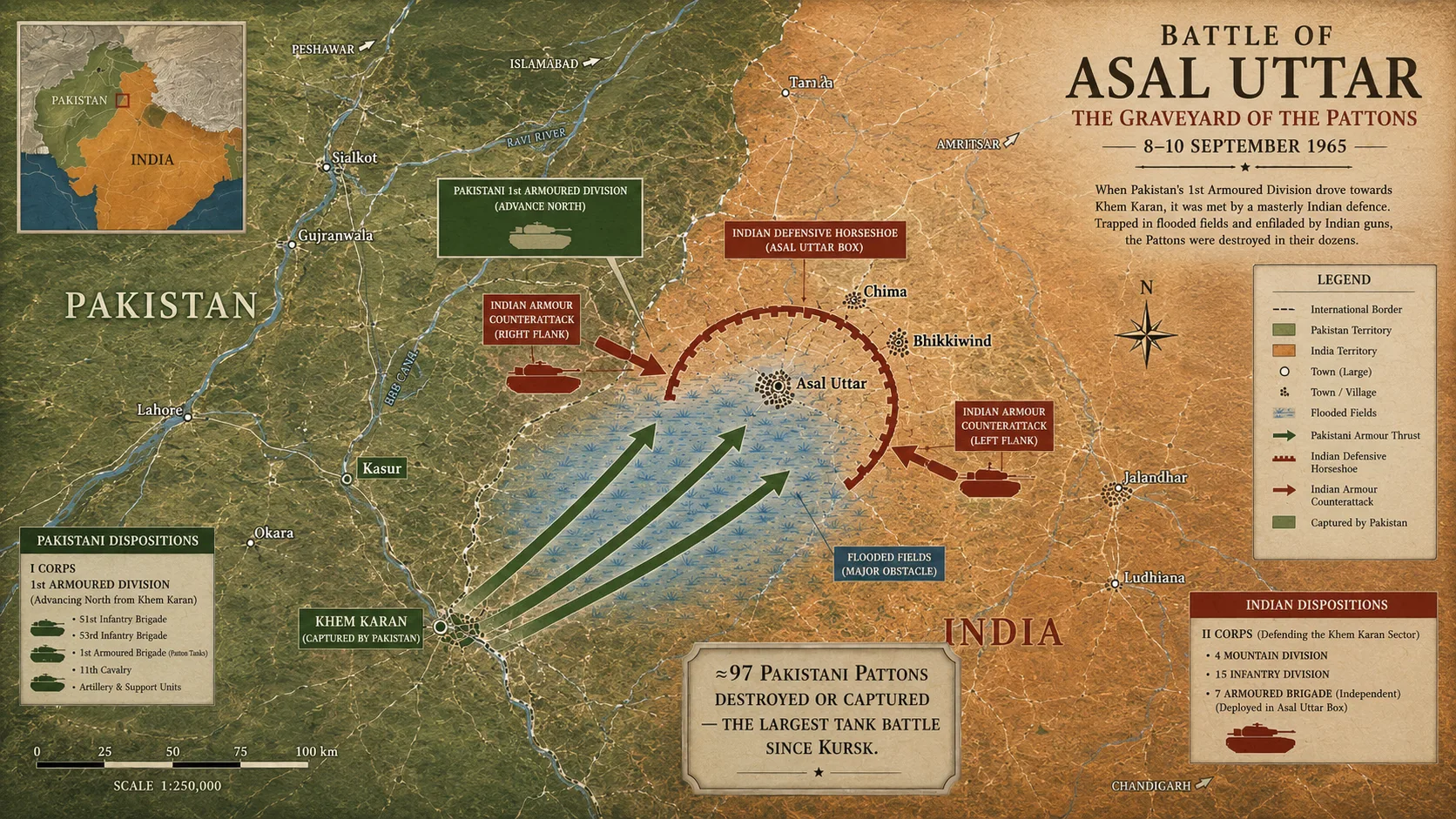
If one field decided the war, it is a stretch of sugarcane near a village called Asal Uttar, and it deserves to be told in full, because it is where Pakistan's finest armour went to be catalogued.
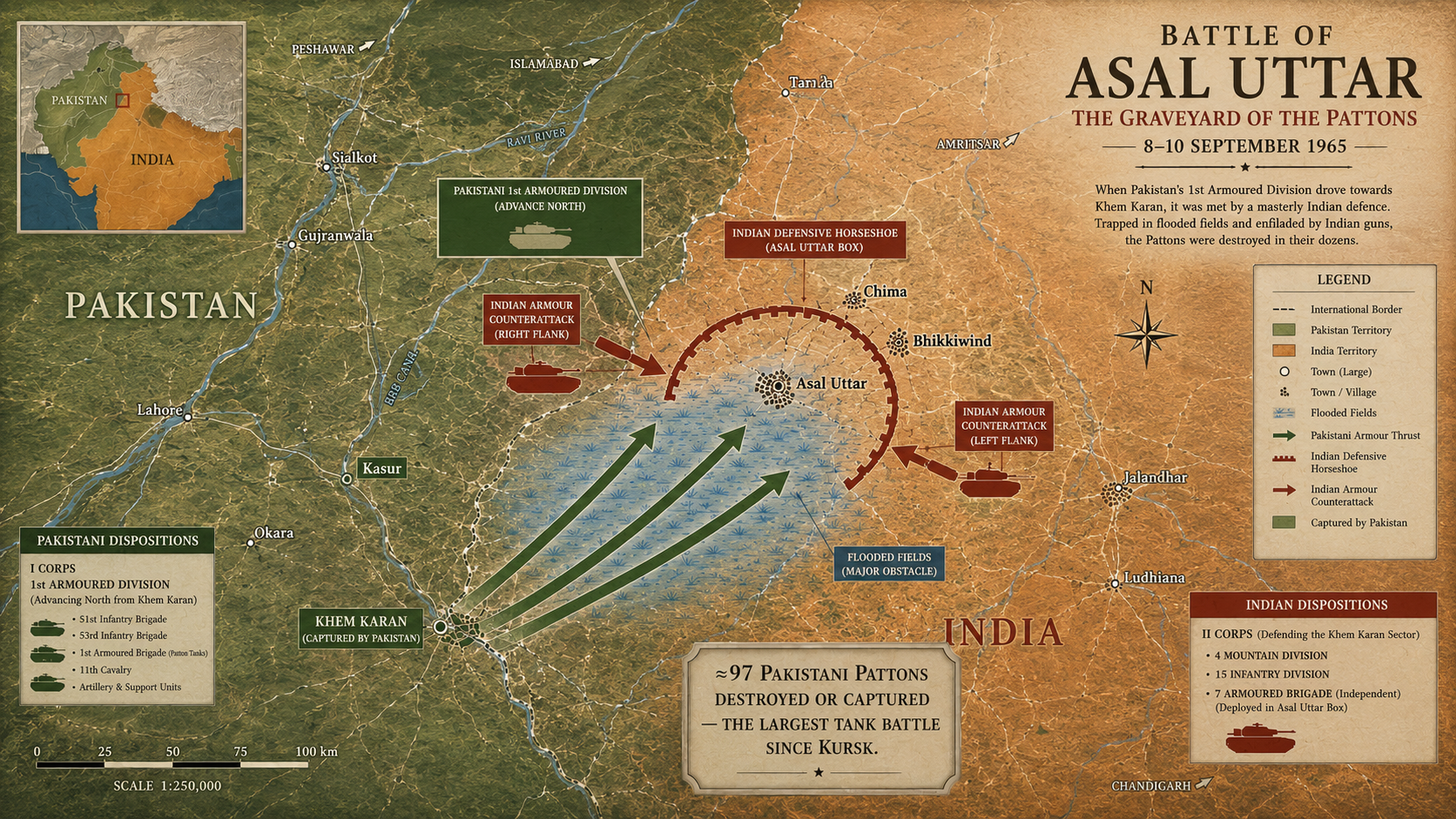
Pakistan's answer to the Indian thrust was to unleash its pride and joy, the 1st Armoured Division, some three hundred Patton tanks, forty-six-ton machines with 90mm guns and a hundred millimetres of steel plate, the most advanced armour in the subcontinent and the object of considerable national affection. Supported by the 11th Infantry Division, it smashed across the border, took Khem Karan on 8 September, and prepared to break out toward Amritsar and the Beas and split Indian Punjab open. Settled
Against this India fielded distinctly older iron: good British Centurions, but also Sherman tanks of Second World War vintage and light French AMX-13s whose 75mm guns could not, on paper, punch through a Patton's face except at knife-fighting range. Pakistan outnumbered India roughly two and a half to one and outgunned it decisively. On paper, it was no contest. Pakistan appears to have read the paper and stopped there. Settled
The Indian commander, Major General Gurbaksh Singh of the 4th Mountain Division, declined to fight the battle the Pattons wanted. Instead of meeting the charge in the open, where the American guns would rule, he folded his force into a horseshoe anchored on Asal Uttar, hid his tanks and recoilless guns in the tall unharvested cane, and, on the night before, opened the irrigation channels and flooded the fields, turning the approach into a bog. Settled
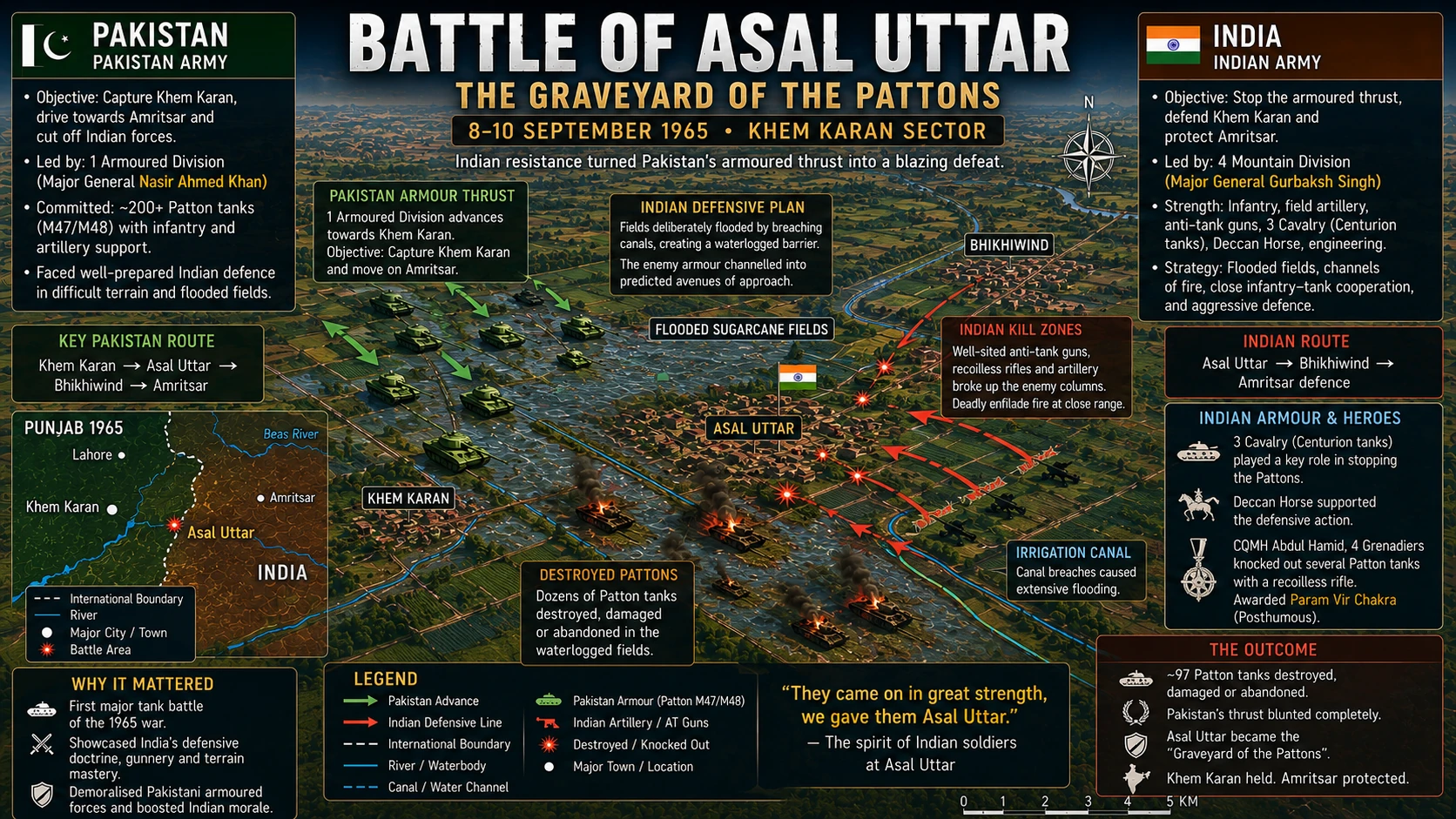
On 8, 9 and 10 September the pride of the Pakistan Army drove into the horseshoe with great confidence and very little reconnaissance. The result was less a battle than a harvest. The heavy Pattons sank in the mud, slewed to a halt, and presented their flanks to gunners hidden in the cane at point-blank range, where even the elderly Indian guns did the job nicely. When it was over, something like ninety-seven Pakistani tanks lay wrecked or captured, a good number simply abandoned intact by crews who had discovered urgent business elsewhere, against Indian losses of around ten. Settled The Pakistani commander of the leading formation, Major General Nasir Ahmed Khan, was killed. So many Pattons were taken that the Indians parked them in rows and the site acquired the name it still carries: Patton Nagar, the City of Pattons, the subcontinent's largest collection of gently used American armour, assembled by Pakistan and curated by India. Settled
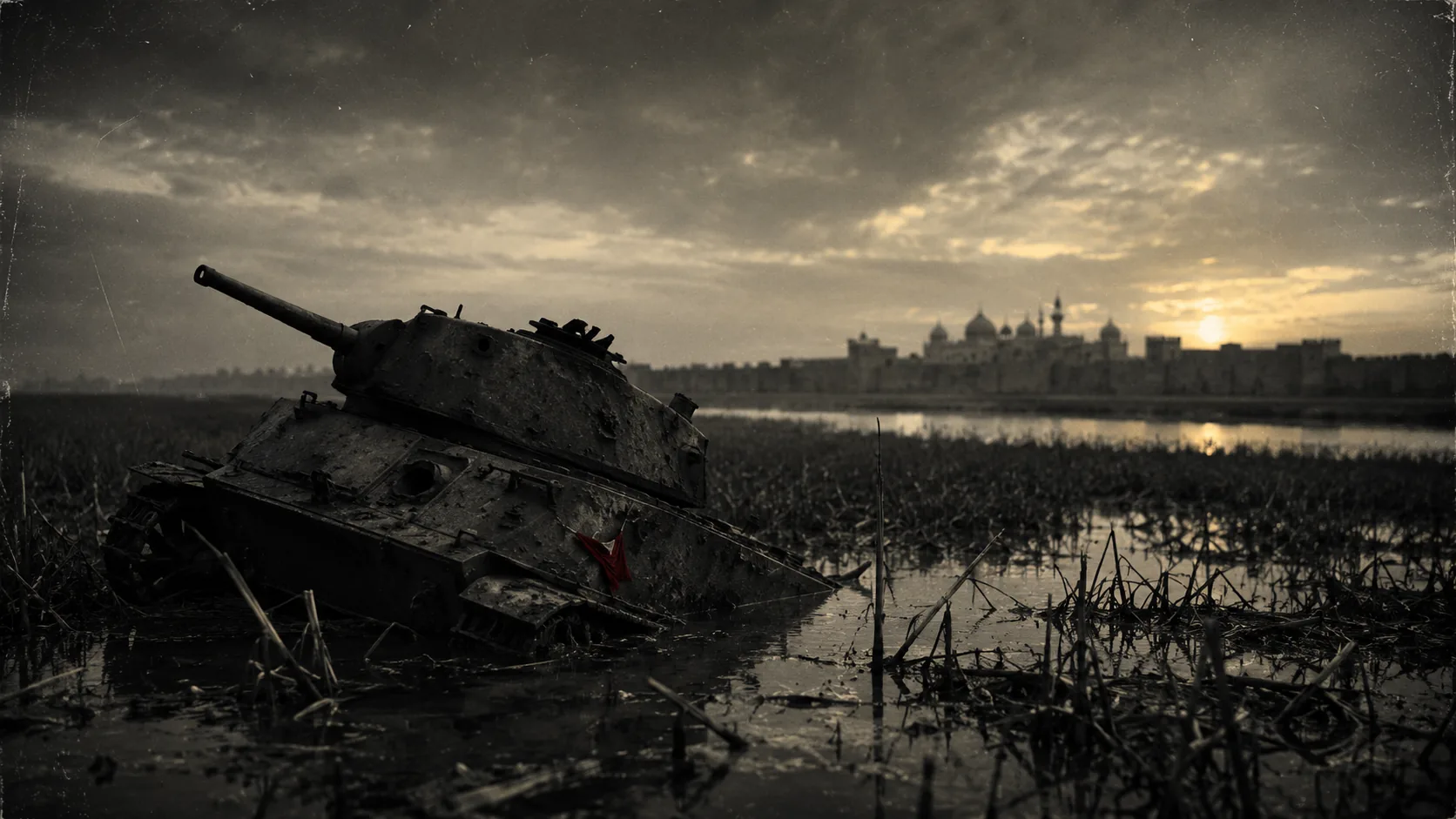
It is among the largest tank battles since the Second World War and one of the great defensive victories in the history of armour. Settled History has kept one footnote: among the young Pakistani artillery officers on the field that day was a lieutenant named Pervez Musharraf, who would go on to seize his own country, a career trajectory that tells you something about the standard of judgement on display. Settled
At the centre of it stands one man who must be named plainly, without a shred of sarcasm, because he has earned that much. Company Quartermaster Havildar Abdul Hamid of the 4th Grenadiers, on a jeep with a recoilless gun, hunted Pattons through the cane at ranges where a miss meant death. He destroyed seven before an enemy shell found and killed him on 10 September 1965. Settled He was awarded the Param Vir Chakra, India's highest honour for valour, posthumously. He was a Muslim from Ghazipur, and he died holding the line for India against an army that had come, in the name of religion, to break it. His name is the permanent, unanswerable refutation of the two-nation theory that sent those Pattons across the border. This account names him before it names a single general.
The doctrine held that one of theirs was worth several of ours. A quartermaster from Ghazipur, alone on a jeep, sent seven of their best tanks into the mud and retired the doctrine.
Chawinda: Where India Returned the Favour
An honest account does not pretend the war was all Indian triumph, and the north is where India got to feel the frustration it had been dealing out. North of Lahore, India launched its own great armoured stroke and made a fair number of Pakistan's mistakes for itself.
India's 1 Corps, built around the 1st Armoured Division, the pride of the Indian Army, crossed into the Sialkot sector from 7 September to cut the Sialkot-Lahore road and roll up the Pakistani north. The approach went beautifully. At Phillora, from 10 to 12 September, the Indian armour beat the Pakistani 6th Armoured Division and forced it back at a lopsided cost in tanks, and the road toward Chawinda lay open. Settled
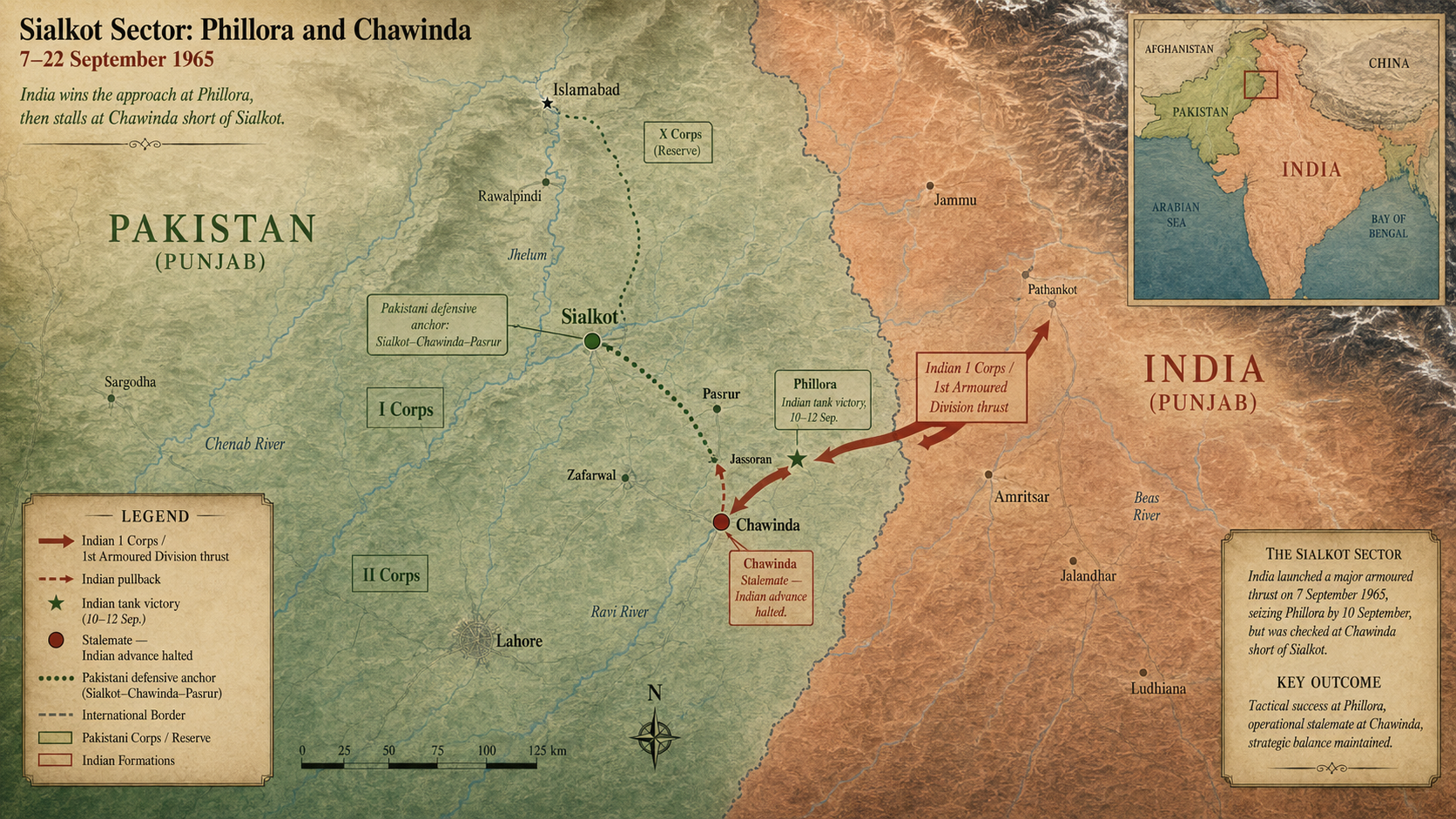
Then India demonstrated that bad generalship is not a Pakistani monopoly. The offensive stalled at Chawinda. Indian corps and division command turned hesitant, whole formations sat uselessly in reserve while the front called for them, thrusts went in piecemeal, and the advance was pushed back from its furthest point with heavy losses in armour. Settled This is the honest debit in India's ledger for 1965: it won the approach at Phillora and then threw away the breakthrough through sheer indecision, in terms its own official histories and its own Western Command commander record with unusual bluntness. A civilisation confident in its own worth does not hide its stalemates, and this was one. India held its Phillora gains at the ceasefire, but the clean cut to Sialkot died at Chawinda. Pakistan is entitled to that one, and to the reminder that the Indian generals who lost the plot at Chawinda were nonetheless not required to erase the battle from their history books afterward. Settled
The War in the Air, and the Very Brief War at Sea
The air war was hard-fought and its scoreboard is genuinely disputed, each side claiming more kills than the other will admit, which is the usual arrangement. Contested The Pakistan Air Force, on American F-86 Sabres and a handful of F-104 Starfighters, was professional and fought well, and in the opening days it punished Indian ground columns that had rolled forward without air cover. The Indian Air Force, larger and flying Hunters, Mysteres and Gnats, absorbed the shock and carried the fight back over Pakistan. The tiny Indian Folland Gnat became such a menace to the Sabre that it earned the nickname "Sabre Slayer." Contested The last major air combat was on 23 September, and the precise loss figures remain a matter of national arithmetic on both sides, which is a polite way of saying nobody's numbers should be trusted without a receipt. Contested
At sea, Pakistan achieved its most economical operation of the war. On the night of 7 September a flotilla of seven ships crept up to the coastal temple town of Dwarka and shelled it for roughly four minutes. Pakistan later promoted this into a "Navy Day" and announced that it had destroyed a radar station and killed dozens. The Indian record is that the shells mostly landed in open fields, the radar was untouched, and no one was killed. Settled It is a rare thing for a nation to found an annual commemoration on four minutes of gunnery that missed, but the 1965 war was, throughout, a triumph of Pakistani optimism over Pakistani results.
The Ceasefire and the Shape of the Victory
By the third week of September both armies were tiring and low on shells and armour, and the great powers were nervous. Washington, which had armed Pakistan, and Moscow, which had ambitions of its own, both pressed for a stop. The UN Security Council called for a ceasefire, and it took hold on 23 September 1965. Settled
So what actually happened, once you strip away both governments' press releases?
Pakistan had gone to war with a clear and ambitious shopping list: seize Kashmir by infiltration and armoured surprise. It came home with none of it. Gibraltar failed, the rising never came, Grand Slam froze at Akhnoor, the beloved armoured stroke was itemised at Asal Uttar, and at the ceasefire India held more Pakistani ground than the reverse, several hundred square kilometres along the Lahore and Sialkot fronts against a modest Pakistani toehold at Khem Karan. Settled The most eloquent verdict on the war was delivered by Pakistan itself: its official military history, produced by its own Inter-Services Public Relations, is so pained by the record that it quietly omits Operations Gibraltar and Grand Slam altogether and opens the story with the Indian crossing of 6 September, as though a war Pakistan planned and launched were an unprovoked Indian aggression. Settled When a country has to delete the first three weeks of a war from its own textbooks, it has filed a confession.
By every measure that counts, the aims, the ground, the destruction of the enemy's main striking force, 1965 was an Indian victory, Chawinda and all. It was the first time independent India fought Pakistan to a clear decision and sent it home with nothing it had come for. Settled And it was won under the political direction of the small man from Mughalsarai, who held his nerve, ordered the border crossed at the decisive hour, and gave the country the words that carried it: Jai Jawan, Jai Kisan. Settled
Tashkent: The Peace That Gave It Back
And then, in the peculiar arithmetic of the subcontinent, India signed the victory away.
The Soviet Union, keen to install itself as the region's referee, offered to host. Shastri and Ayub Khan went to Tashkent, where Premier Alexei Kosygin presided, and on 10 January 1966 the two men signed the Tashkent Declaration. Settled
The central term was simple: both sides would pull back to the lines held before 5 August 1965, done by 25 February 1966. Settled In plain language, India would return what its soldiers had taken. The belt along the Ichhogil Canal went back. And Haji Pir, the pass Indian troops had bled to seize, the very key that had broken Gibraltar's back, was handed to Pakistan. India returned a strategic pass commanding the infiltration routes into Kashmir and received, in exchange, a written assurance of good-neighbourliness, which Pakistan would honour right up until it next found a convenient moment not to. Settled
The reaction at home was anguish, and correct anguish. When Shastri telephoned Delhi after signing, his own family told him plainly that the country hated it; his daughter said so to his face. Settled The men who had taken Haji Pir would spend the coming decades watching infiltrators walk back through the ground they had won and been ordered to surrender. Giving back Haji Pir is, in the long accounting of India's defence of its own north, a wound inflicted at a negotiating table rather than on a battlefield, and it should be named as such without a trace of levity.
The soldier takes the pass with his blood. The diplomat returns it with his pen. The infiltrator strolls back through it within the decade. Tashkent is the clearest chapter in that recurring tragedy.
The Night in the Villa
Here the sarcasm stops, because a man died.
Lal Bahadur Shastri never came home from Tashkent alive. Hours after signing the Declaration on 10 January 1966, in the small hours of 11 January, he died in the villa the Soviets had provided. The official cause was a heart attack. He was sixty-one. Settled The reconstructed facts of the night are these: he signed in the afternoon, attended Kosygin's reception in the evening, seemed well, returned to his dacha, ate a light meal, spoke to his family in Delhi, and retired. Some time after one in the morning he woke in acute distress. The room had no telephone and no bell, and he was housed apart from the rest of the Indian delegation. He made his way to another room to raise the alarm; by the time his physician, Dr R. N. Chugh, reached him, he was dying, and he died there, by the account that has come down, with Rama's name on his lips. Contested
Here an honest Dhārā account parts from the official record and says what that record will not.
There was no post-mortem. Settled A sitting Prime Minister of India died suddenly on foreign soil, hours after a diplomatic act of the highest sensitivity, and no autopsy was performed, not in Tashkent, not in Delhi when his body came home. That single omission is why the question has never closed. When the body returned, members of his family reported marks a simple heart attack does not leave: the face and body darkened, discoloured deep blue or black, what looked like cut marks, signs the family read as poisoning. His son Anil Shastri, seventeen at the time, has said across the decades that his father's face had turned blue and bore white spots and froth, and that the family's suspicion has never been laid to rest. His widow, Lalita Shastri, died believing her husband had been killed. Contested
The Government of India has never satisfactorily explained the death. Requests under the Right to Information Act to open the records have been refused, citing, remarkably, harm to India's foreign relations, which is a strange sensitivity to attach to the natural death of an old man with a weak heart. Settled Dr Chugh, who attended him, and a personal attendant, both witnesses to that night, later died in a road accident the family found disturbing. Contested
Let this be exact about what it claims. That Shastri was murdered cannot be proven, and perhaps never will be. Contested The absence of a post-mortem means the evidence that would have settled it was never gathered, and sixty years have closed most other doors. But this publication will not do what the polite histories do, intone "heart attack" and move along as if the surrounding facts were ordinary. They are not. A victorious Prime Minister, at the height of his authority, having just been made to sign away a hard-won pass under foreign mediation, died in a single night in a foreign country with no doctor at hand and no autopsy after, his body came home discoloured, and the state has kept the files shut for six decades. Settled
We hold, without hedging, that the balance of these circumstances makes the official story of an ordinary natural death difficult to accept at face value, and that the refusal of successive governments to open the records is itself a kind of answer. Contested The poisoning is marked contested because honesty demands the word: it is not proven. But we refuse to call the suspicion unreasonable, because the circumstances make it entirely reasonable. The nation is owed those files. It has been owed them for sixty years.
The Aftermath
Shastri's death redirected the Republic. The Congress, needing a successor, reached for Nehru's daughter, Indira Gandhi, then an untried information minister, on the same assumption the party had once made about Shastri, that she would be easy to manage. She disproved it more comprehensively than he ever had, and ruled India for a generation. In one night in Tashkent the line of Indian leadership swung from a plain, incorruptible Gandhian to the founding of a dynasty. Settled
For Pakistan, 1965 was the beginning of the end of the Ayub era. The war it had launched in the certainty of victory had failed, and the manufactured myth of triumph could only paper over the ground for so long. The strains told, the eastern wing drifted further away, and within six years the very same Yahya Khan who had stalled the attack at Akhnoor would preside over the catastrophe of 1971, when Pakistan lost half its population and its entire eastern half became Bangladesh, and India delivered the unambiguous, uncontested verdict that 1965 had only sketched. Settled Haji Pir, so graciously returned at Tashkent, has never come back to India, and infiltration through that country has been a fixture of the Kashmir conflict ever since, a gift that keeps on giving. Settled
But the deepest meaning of 1965 lies not in the territory or the treaty. It lies in what the war did to the two ideas that fought it. Pakistan came certain that faith would do its fighting for it, that Kashmiri Muslims would rise, that Hindu morale would shatter at the first blow, that one kind of soldier outweighed another by virtue of religion. Every one of those beliefs was tested that autumn and every one of them failed. The Kashmiris did not rise. The morale did not shatter. And the man who destroyed seven Pattons at Asal Uttar and won India's highest honour doing it was a Muslim named Abdul Hamid, dying for a civilisation whose attackers had come in the name of his own religion to break it. Settled
That is the verdict of 1965 that no treaty could sign away and no assassin, if there was one, could poison. India was never a religion with a state bolted on. It was a civilisation, old and plural and stubborn, that a small vegetarian from Kashi could lead to the gate of the enemy's second city and that a quartermaster from Ghazipur could die defending. They took the pass back at Tashkent. They may have taken his life in the villa. They did not take the thing he had proven.
Jai Jawan. Jai Kisan.
A Note on Sources and What Remains Contested
The military narrative here, the dates, the operations, Asal Uttar and Chawinda, the 6 September crossing, the seizure and return of Haji Pir, the terms of the Tashkent Declaration, rests on the settled, well-documented record and is marked Settled. Air-war loss figures are genuinely disputed between the two states and are marked Contested. The reading of the first-day withdrawal from Dograi reflects the documented Indian critique of a coordination failure and is marked where the internal judgement is a matter of military-historical debate. Contested
The circumstances of Shastri's death are the gravest contested matter, and this publication states its position plainly rather than hiding behind false balance: the poisoning cannot be proven and is marked Contested; the surrounding facts, the absent post-mortem, the sealed files, the family's consistent testimony across sixty years, are settled and marked Settled. The tone of the rest of this piece has been frankly merciless toward the Pakistani high command, and unapologetically so, because the strategic follies of 1965 earned every word. That register was set aside entirely for the death of Lal Bahadur Shastri, which is not a subject for sarcasm. The demand of this piece is narrow and reasonable: open the files.