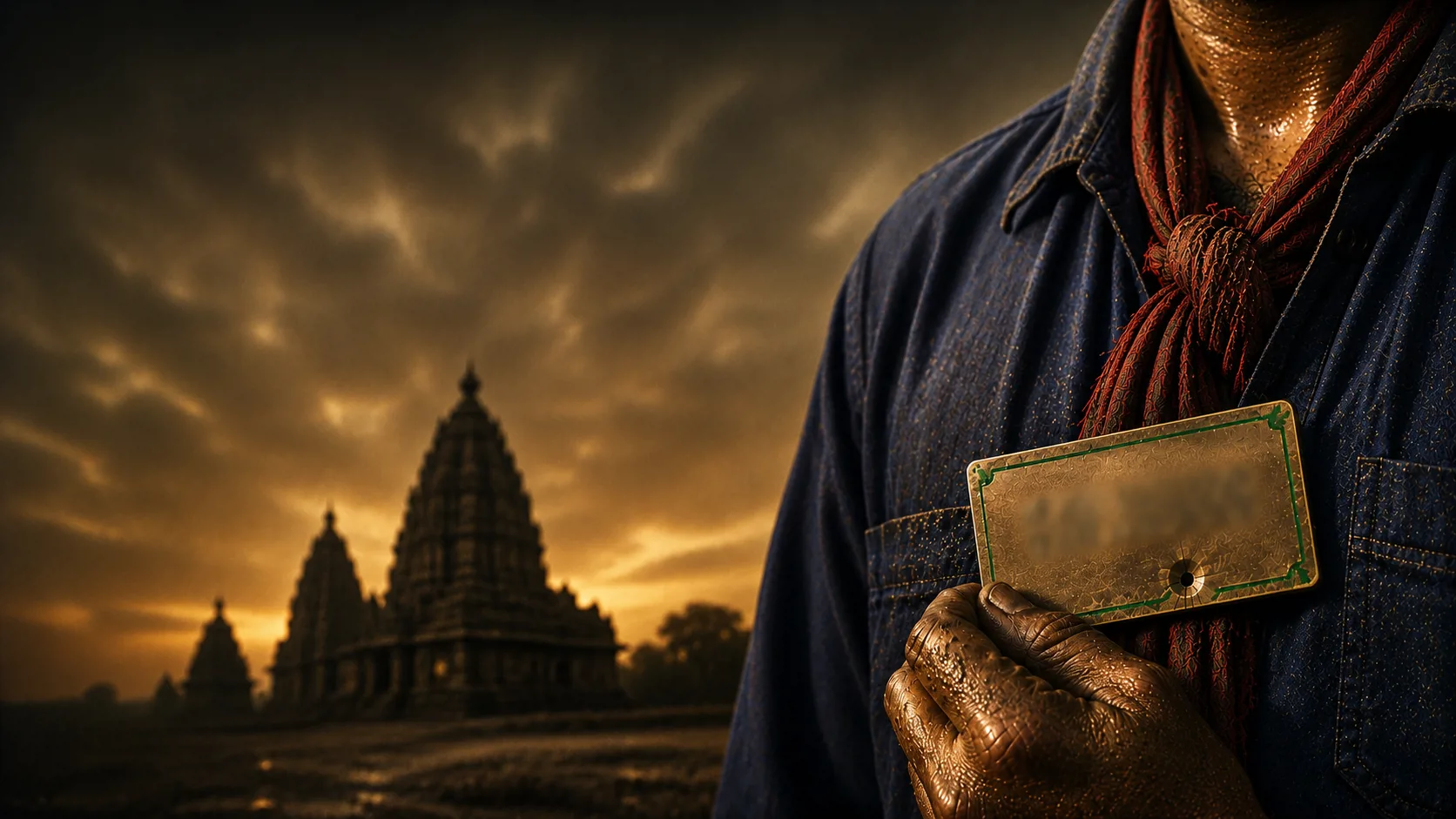
In Yash Chopra's Deewaar (1975) — a film routinely ranked among the greatest the Hindi industry has ever produced — the hero Vijay is a dockworker who receives, from a kindly older Muslim comrade, a brass badge stamped with the number 786. The number is the Islamic abjad equivalent of Bismillah, "in the name of Allah." The elder explains its protective power in words consciously echoing a maulvi's sermon. From that moment the badge becomes the hero's guardian. When he is shot, the badge in his breast pocket stops the bullet. Again and again it saves him. And at the film's climax, in the one scene where the badge has fallen from his pocket, the bullets find him at last. He staggers, dying, into a Śiva temple — his devout Hindu mother's temple, the temple at which she has prayed faithfully all her life — and there he dies.
Read the film's theology as the film itself constructs it. The mother's lifelong devotion to Śiva earns her a criminal son, a house divided, and a corpse. The Muslim badge earns the hero a charmed life for as long as he keeps it. Śiva is the god who does not answer; 786 is the number that protects. The hero's prayer inside the temple is not devotion but desperation — and even that goes unanswered. The single most beloved "angry young man" film of the age is built, at the level of its deep structure, on a contrast between a Hindu faith that fails and a Muslim faith that saves.
Once you have seen the pattern in Deewaar, you cannot un-see it across the rest. The same screenwriters gave the same star, in Coolie (1983), a Muslim hero named Iqbal whose holy chadar stops a bullet, who keeps a falcon named Allahrakha, and who advances on the minarets of Haji Ali reciting the name of God after the shot fails to kill him. Years later a Muslim prisoner in Veer-Zaara is number 786 again. The talisman travels from film to film, decade to decade, always meaning the same thing: divine protection has an address, and the address is not the temple.
This essay is about that grammar — the settled, unexamined rules by which Hindi cinema has, for the better part of a century, coded Hindu religiosity as suspect while extending to every other faith a dignity it withholds from its own majority. I will name the tropes and, this time, name the films. I will trace the machinery to its sources: the colonial portrait of the Hindu, the literary culture of the men who built the industry, and the missionary self-image that supplied the merciful padre as the exact complement of the fraudulent pandit. And I will meet the strongest defences head-on, because a case worth making is a case that can survive its best objections.
Let me be clear about what is not being claimed. Sanātana Dharma has never asked art to flatter it. A tradition that produced the Cārvāka, that canonised debate, that argued with itself for three millennia, does not need protection from a screenplay. A venal Hindu priest is as fair a subject for cinema as any other. What is owed is not deference but symmetry — the same even hand the industry reliably extends to the maulvi and the padre, extended at last to the pujari. It is the absence of that symmetry, repeated across a hundred films, that turns individual scenes into a pattern and a pattern into an indictment.
I. The Reverent Birth
It is essential to begin with a fact that by itself refutes any claim that the distrust was primordial: Indian cinema was born reverent. The film widely held to be India's first, Dadasaheb Phalke's Raja Harishchandra (1913), tells a story from Hindu scripture — the trial of the truth-keeping king, drawn from the epics — and it was made as an act of worship. Phalke was a Chitpavan Brahmin, the son of a Sanskrit scholar, a devotee of Viṣṇu, and his conscious purpose was to bring the gods to the screen. He drew his visual language from Raja Ravi Varma's paintings of the deities; audiences reportedly received his images as darśana, the devotional beholding of the divine. His subsequent output — Mohini Bhasmasur, Satyavan Savitri, Lanka Dahan, Shri Krishna Janma, Kaliya Mardan — established the mythological as the founding genre of the entire industry.
And this reverence was itself a nationalist gesture. Phalke worked in a colonial atmosphere that redefined Indian civilisation as backward and superstitious; his answer was to put the Hindu sacred on the modern screen with pride, to make the new Western technology a vehicle for the oldest Indian stories. Whatever came later, the industry did not begin by holding the Hindu at arm's length. It began on its knees before him. The suspicion we are tracing is therefore not an origin but an acquisition — and because it was acquired, it can be dated, and its carriers can be named.
II. The Turn Was Not a Single Moment
It is tempting to locate the shift in one place — to say the reverent cinema of Phalke gave way, in the early 1970s, to the irreligious "angry young man," and leave it there. That story is too clean, and the truth is both messier and more damning for the industry. The centering of one sacred world and the sidelining of another did not arrive in a single year or with a single pair of hands. It came in layers, across half a century, which is precisely why it proved so durable: no one decision can be blamed, and so none was ever revisited.
The prestige of the Muslim social (1950s–1960s)
Long before the vigilante hero, an entire genre — what the industry itself called the "Muslim social" — had already installed the refined Muslim world as the screen's image of sincerity, sophistication, and high feeling. Flourishing through the 1950s and 1960s, it employed a remarkable concentration of Muslim producers, directors, screenwriters, lyricists, and composers, and it made the nawabi culture of Awadh — its tehzeeb, its nazaaqat, its ghazals and Urdu shayari — the very benchmark of cultural elegance in Hindi cinema. This was the era of Mirza Ghalib, Chaudhvin Ka Chand, and, at the summit, Pakeezah (1972), the opulent tawaif elegy written in Kamal Amrohi's poetic Urdu — a film widely called the finest of its genre. The point is not that these were bad films; several are glories of the form. The point is that the sincere, sophisticated sacred-and-refined world the industry lavished its prestige upon was, by settled convention, the Muslim one — and that no remotely comparable genre, the "Hindu social" celebrating the refinement of a Brahmin or Vaidika high culture, was ever accorded the same status.
And already in this era the sanitised-conqueror trope stood fully formed. Mughal-e-Azam (1960) — for fifteen years the highest-grossing film ever made in India — renders Akbar a suffering, magnanimous patriarch and Prince Salim a gentle romantic, though the historical Salim is documented as a heavy drunk who beat men to death; the film even invents Akbar celebrating Janmāṣṭamī to burnish his image as the tolerant secular sovereign. The romance of the benevolent Muslim ruler, his violence softened into statecraft, was thus a mature convention of Hindi cinema by 1960 — more than a decade before the "angry young man" was ever conceived. This is why Jodhaa Akbar (2008), half a century later, could reach for the same template without inventing anything: the template was already ancient.
The irreligious hero (1970s onward)
What the 1970s added was not the prestige of the Urdu-Persianate world — that was already in place — but a new and complementary element: the hero who is actively estranged from Hindu faith. The screenwriting duo Salim–Javed, arriving with Zanjeer (1973) and Deewaar (1975), replaced the devotional and romantic leads of the previous era with the brooding, anti-establishment outsider who takes justice into his own hands and rejects, in one telling of it, institutional faith itself. They too wrote in Urdu, transcribed into Devanāgarī for the reader; Javed Akhtar is by his own long public declaration an atheist and rationalist who has made the critique of religious dogma a central cause. The result, laid over the inherited aesthetic, produced exactly the configuration we saw in Deewaar: the Muslim talisman that protects, filmed with an aura of grace the genre had spent twenty years perfecting, and the Śiva temple where the hero goes only to rage and, at last, to die.
So the correct picture is a layering, not a hinge. Reverence at the founding; then, across the 1950s and 60s, the elevation of the refined Muslim world as the screen's standard of sincerity and the maturing of the benevolent-ruler romance; then, from the 1970s, the arrival of the hero estranged from his own faith; and finally, in the streaming era, the hardening of all this into open hostility. Each layer settled atop the last, and none was ever cleared away. That is what makes the pattern so resistant to a single rebuttal: point to any one film or decade or writer and a defender can say "but that is only this one" — while the accumulation, layer upon layer for a century, is the very thing no single defence can address.
The industry did not choose, in one year, to distrust the Hindu. It built the distrust in strata, decade by decade, until the distrust became the ground everyone simply stood on.
The colonial palette beneath it all
Beneath every layer lay the older portrait — the caricatures the camera did not invent. The British administrator and the missionary arrived with a settled picture of the Hindu: the Brahmin cunning and parasitic, the ascetic a charlatan or a madman, the temple a house of superstition and concealed vice, idol-worship the proof of a civilisation arrested in infancy. This was the organising logic of an apparatus of governance, education, and evangelism, and it left in the culture a ready-made rogues' gallery — the despotic Thakur, the parasitic Baniya, the cunning pandit — that any storyteller could reach for without inventing. Phalke's generation refused that palette and painted against it. The generations that remade the industry afterward reached for it, decade upon decade, and are reaching for it still.
III. The 786 Machine and the One-Way Street
Return now to the badge, because it repays a closer look. In the idiom the post-1970s industry made its own, the vocabulary of the divine came dressed in one wardrobe. Khuda, Allah, the chadar, the dargah, the namaz filmed as a moment of hush and grace — these carried an automatic aura of sincerity. The Muslim saint, the kindly maulvi, the pious elder became reflexive shorthand for spiritual authenticity. The Hindu sacred, by contrast, was the thing held at arm's length, examined, questioned, and more often than not found wanting. The mandir was where the hero went to argue with God; the dargah was where he went to be healed by Him. The asymmetry was baked into the very grammar of devotion the films spoke.
This is the deeper meaning of the 786 machine. It is not merely that one film gave a Hindu hero a Muslim talisman. It is that the gesture felt right to writer and audience alike — that a Muslim numeral protecting a Hindu body registered as touching rather than strange, while the reverse, a Hindu talisman filmed as the true protector of a Muslim hero, is almost unimaginable in the same cinema. The one-way flow is the tell. Protection, grace, and sincere faith move from the minority tradition to the majority hero; scepticism, superstition, and villainy flow the other way.
The one-way street called ganga-jamuni tehzeeb
The industry has a name for its self-image on these questions: ganga-jamuni tehzeeb, the syncretic "composite culture" it endlessly celebrates. Examined honestly, the on-screen version of this ideal is a one-way street. In film after film, "unity" is achieved by the Hindu's accommodation and dramatised through the Muslim's virtue. It is the Muslim character who is pious, wronged, and forgiving; the Hindu who must shed his rigidity, his ritual, his suspicion, to meet him. Harmony is the reward the Hindu earns by giving ground. One rarely sees the mirror image — the Muslim character who must surrender something of his own certainty so that the Hindu may be met halfway. The tehzeeb is real as an aspiration, but its cinematic form quietly encodes the same hierarchy as everything else: the minority faith as the moral standard, the majority faith as the thing that must soften.
The archetype recurs across the classic melodramas: when the plot orphans its hero, it is a Muslim or a Christian who takes him in — the skullcap and the cassock functioning as instant, unquestioned signals of decency — while the temple that shelters the foundling and the Brahmin who raises him as his own is conspicuous by its rarity. In the industry's moral shorthand, minority faith means shelter; Hindu faith, more often than not, means something to escape.
IV. The Missionary Mirror
So far the argument has moved along the Hindu–Muslim axis, because that is where the industry's most celebrated films stage their theology. But to stop there is to miss half the machine. The distrust of the Hindu sacred has a second reflection, older than the Muslim social and rooted in the same colonial soil: the tender, reflexive reverence Hindi cinema extends to the Christian institution — the merciful padre, the sheltering convent, the mission school — an image that maps with uncanny precision onto the self-portrait the missionary enterprise painted of itself.
Consider how instantly the cassock signals goodness. When the melodrama needs a refuge for its orphaned hero, the church door opens and the Christian father takes the child in without a question asked — the Amar Akbar Anthony arrangement, in which one of three separated brothers is raised by a priest, is only the most famous instance of a convention that runs through decades of Hindi film. When the plot needs sanctuary for the hunted, it is the convent that hides them: nuns shelter a mother and child from a murderous mob, their religious habit functioning as an unquestioned emblem of mercy. The mission school civilises; the padre counsels; the sister nurses. The Christian institution appears on screen almost exclusively in its charitable aspect — as rescuer, educator, healer, keeper of orphans — and the audience is trained to relax the moment it appears, the way it is trained to tense the moment the saffron does.
Note the precision of the claim. I am speaking of the Christian institution — the Church as an organised presence of priest, convent, and mission — not of every individual Christian character, who may be drawn in many registers. It is specifically the institutional Church that receives the reflexive glow: the collar, the habit, the mission compound, the confessional. And it is exactly this institutional image — the Church as the merciful civiliser stooping to rescue the Indian child — that should give us pause, because we have seen it before. It is the missionary's own advertisement for himself.
The benevolent padre and the fraudulent pandit are not two separate stereotypes. They are the front and back of a single colonial coin: the missionary as saviour requires the Hindu priest as the darkness he saves from.
Recall the root the essay has already named. The colonial portrait of the Hindu — the parasitic Brahmin, the temple of superstition and vice — was not merely an administrative prejudice; it was, in large part, a missionary product, manufactured and circulated by an evangelical enterprise whose entire justification depended on it. The mission could present itself as light only against a background it had painted as darkness. The cunning pandit and the merciful father were composed together, by the same hands, for the same purpose: the one existed to make the other necessary. To rescue the benighted Hindu from his priests was the whole moral drama the missionary staged, and it required both actors — the villain in saffron and the saviour in the collar.
What Hindi cinema did, reaching for the ready-made colonial palette, was to inherit both halves of the same picture at once. It took the fraudulent pandit and it took the merciful padre, and it never noticed that they were painted as a pair — that the goodness it reflexively granted the Church was the exact complement of the suspicion it reflexively granted the temple. The two are not independent data points that happen to point the same way. They are one composition. The industry did not separately decide to distrust the Hindu priest and to trust the Christian one; it absorbed, entire and unexamined, a colonial diptych in which those two judgments were always meant to be read together.
This is why the Christian dimension is not a footnote to the Muslim one but its structural twin. The Muslim social lent the screen its image of sincere, sophisticated faith; the missionary narrative lent it its image of merciful, civilising institution. Between them they occupied both of the roles — the sincere and the charitable — that a whole and honest cinema might have allowed the Hindu tradition to fill. The temple could have been a place of grace; the ashram could have been a shelter; the guru could have been a rescuer of the lost. That these possibilities feel faintly implausible even to state — that the Hindu sacred as refuge sounds like special pleading where the Christian convent as refuge sounds like common sense — is the exact measure of how completely the colonial diptych has been absorbed. The wallpaper has two panels, not one. We were trained not to see either.
V. Two Later Hardenings
If the founding layers were the reverent mythological, the prestige of the Muslim social, and the arrival of the irreligious hero, two further hardenings carried the pattern to the present.
The communal turn (1990s)
As questions of nation and community moved to the centre of public life, a cycle of films codified a moral choreography that has proved durable: in the riot film, the aggressor is the Hindu mob and the innocent is the other. The Hindu's grievance is left unexamined or treated as the seed of fanaticism, while the other community's suffering is filmed with tender particularity. This era also perfected the "secular" hero — the protagonist who wears his rejection of Hindu ritual as a badge of virtue, who declares his disbelief inside the temple, whose enlightenment is measured precisely by his distance from his own inherited faith.
The streaming era (2010s–present)
The current era has intensified the pattern while shedding the old subtlety. Freed by streaming from the family audience and the censor's certificate, a wave of series and films has made the saffron-clad figure not merely suspect but actively sinister — the temple as the site of conspiracy, the sadhu as the face of menace, the observant Hindu as the designated fanatic in dystopian fables of majoritarian tyranny. What was once insinuated through a costume choice is now the explicit thesis of entire productions. Curiously, this same era also began flaunting the Brahmin surname as a marker — the janeu on display, the Tiwari and the Mishra and the Tripathi — but as a sign of comic pomposity, entitlement, or menace rather than of dignity. The tuft returns to the screen not to be honoured but to be labelled.
Across every layer the underlying grammar never changed — only its intensity and its permissible explicitness. The moneylender who prayed, the mob that was always Hindu, the sadhu who is now a conspirator: the same sentence spoken in three accents. A bias that persists through such different political and technological conditions, preserving its structure while changing its surface, is not a passing fashion. It is a fixed feature of the industry's sensibility.
VI. The Catalogue
Argument by assertion persuades no one. What follows is the evidence, organised by trope rather than film — because the single film is trivially defensible ("it is only one character") while the trope, once named and instanced, cannot be un-seen. For each I name representative films. The list is illustrative, not exhaustive; a complete one would fill a volume.
1. The Muslim talisman that protects the Hindu hero
Deewaar (1975) · Coolie (1983) · Veer-Zaara (2004)
The badge, the chadar, the number 786 — a token of Muslim faith that repeatedly saves the protagonist's life, its power filmed as literal and reliable, in direct contrast to the Hindu prayer that goes unanswered. In Deewaar the hero lives while he holds the badge and dies the instant he loses it, expiring in a Śiva temple whose deity never helped his devout mother. Divine protection is given a religion, and it is not the hero's own.
2. The predatory priest
Ram Teri Ganga Maili (1985) · and a long tradition besides
The man of God whose devotion masks appetite. The pujari who chants "Om Namaḥ Śivāya" in the very scene of a molestation; the temple functionary whose piety is the film's cue for menace rather than reassurance. The sacred act and the vile one are deliberately laid side by side, so that the mantra becomes the villain's theme music.
3. The villain who prays — to a Hindu god
Mother India (1957) · Dabangg (2010)
The antagonist's Hindu devotion is filmed as devotion immediately before his crime. Sukhi Lala at worship before his cruelty; the villain Chedi Singh praying to Hanumān before ordering a murder. The visual grammar delivers its message whatever the writer intended: Hindu piety and Hindu evil are at home in the same body. Devotion is not a check on villainy; it is its companion.
4. The fraudulent godman, never balanced by the true sage
PK (2014) · OMG – Oh My God! (2012)
The industry believes it performs a public service in exposing the charlatan baba — and genuine charlatans exist. But the trope never supplies its counterweight: the authentic guru, the real renunciate. Across the output the spiritual teacher exists in essentially one flavour, fraud, so that the guru-śiṣya relationship itself — a load-bearing structure of the entire civilisation — is reduced to a mechanism of deception. To satirise the false guru while never once depicting the true one is not reform. It is erasure dressed as reform.
5. The deity played for laughs
PK (2014)
A man costumed as Śiva is chased through the streets and into a public toilet, sacred iconography deployed purely as a gag's setup. The protagonist interrogates temple ritual and idols in exhaustive detail — and stops, as if at a wall, before the icons of any other faith. The "universal" critique of superstition turns out, on inspection, to have a very particular address.
6. The sacred festival hollowed into spectacle
numerous item-numbers and set-pieces across the decades
Holi becomes a drunken, leering free-for-all; the devotional rāsa of Rādhā and Kṛṣṇa is flattened into an item number; Karva Chauth is repurposed as flirtation; the name of Rādhā set to lyrics about a "sexy body." A practice dense with devotional meaning is hollowed out and refilled with spectacle — the sacred emptied so the salacious can move in.
7. The markers of observance as signs of the fool or the fanatic
Ready (2011) · and the shikhā/janeu/tilaka tradition broadly
The outward signs of Hindu practice — the tuft, the sacred thread, the caste-mark, saffron cloth — are made to function as shorthand. The shikhā snipped off as a punchline (in Ready, tied to a circumcision joke); the tilaka increasingly the brand of the bigot; saffron the uniform of the mob. The very emblems a devout Hindu wears with reverence become signals that the audience should expect either foolishness or danger.
8. The caste-villain taxonomy
a genre unto itself: the Thakur, the Seth, the Brahmin, the Rājput
Hindu society is supplied with a ready-made rogues' gallery, each type a fixed villain. The Thakur or zamindar who seizes land and rapes the poor man's daughter. The Seth/Baniya moneylender, greedy and bloodless, squeezing the village dry. The Brahmin priest, casteist and scheming, occasionally carrying weapons into the temple he defiles. The proud Rājput, filmed as rigid and patriarchal where a Muslim contemporary is filmed as progressive and romantic. These are not observations of Indian life in its variety; they are the colonial portraits — the despotic Thakur, the parasitic Baniya, the cunning pandit — still hanging on the wall, still supplying the industry its antagonists on demand.
9. The caste-sermon as blanket indictment
the reformist-realist mode, broadly
Caste injustice is real and its depiction indispensable. But observe how it is deployed: not as a specific abuse to be reformed from within the tradition, but as a wholesale indictment of the tradition as such, with the Brahmin as permanent villain and Hindu scripture as the assumed source of every cruelty. The saints who rejected hierarchy, the philosophies that denied it, the tradition's own long history of dissent — almost never shown. The critique of a genuine evil is quietly converted into a delegitimisation of the whole civilisation that produced, among other things, the critique.
10. The secular hero who scolds the gods
Deewaar (1975) · 3 Idiots (2009) · the "angry at God" tradition
The hero enters the temple not to worship but to rebuke — to announce his disbelief, to lecture the deity, to declare that science or self-reliance, not prayer, will save him. The film presents this not as one worldview among several but as maturity, the natural destination of any intelligent person, with continued devotion marked as the condition of the childish and the fearful. Faith in the specifically Hindu context becomes the thing the smart character has outgrown.
11. The renamed hero of the real
the "based on a true story" adaptation
A real-life figure who was Hindu in fact is quietly rechristened for the screen, virtue and victimhood relocated onto a preferred community. The historical Hindu is written out; a fictional substitute written in. A small edit, invisible unless you know the source — and for that reason a clear view of the machinery: even reality is adjusted when it inconveniently assigns the sympathetic role to a Hindu.
12. The sanitised conqueror
Mughal-e-Azam (1960) · Jodhaa Akbar (2008) · the historical romance broadly
When the industry turns to the past, the conqueror who razed temples is reimagined as a romantic, a progressive, a lover ahead of his time; his documented violence softened into statecraft or edited out. This is no recent development: Mughal-e-Azam (1960), for fifteen years the highest-grossing Indian film ever made, renders Akbar a suffering, magnanimous patriarch and Prince Salim a gentle romantic — though the historical Salim is documented as a heavy drunk who beat men to death — and even invents Akbar celebrating Janmāṣṭamī to burnish his tolerant image. The Hindu resistance to conquest, meanwhile, is filmed as rigidity or fanaticism, or simply omitted. The destroyer is humanised, the defender made a bigot or a ghost. Whatever one's reading of the record, the direction of the industry's sympathy is never in doubt — and it never points toward the Hindu whose shrines were broken.
VII. The Counter-Arguments, and Why They Fail
An honest case must meet the strongest objections, not the weakest.
"It is only demographics."
The most sophisticated defence: in an industry whose audience, financiers, and stars are overwhelmingly Hindu, most heroes, villains, and priests will be Hindu by simple arithmetic. The predominance of the Hindu villain is a statistical inevitability, not a bias.
This is the best objection, and it fails for a precise reason: it explains the wrong thing. Demographics can account for the sheer number of Hindu characters, good and bad. It cannot account for the asymmetry of role assignment — that religious devotion is coded sinister when Hindu and saintly when not. Arithmetic predicts Hindus will fill most roles; it does not predict that the pious Hindu will be the fraud while the pious Muslim is the sage, or that the protective talisman handed to a Hindu hero will be a Muslim one. If villainy were distributed by population share alone, we would expect the occasional luminous Hindu priest to balance the occasional venal maulvi. Instead we get a near-monopoly. Demographics is colour-blind; the pattern is not. The numbers explain the crowd, not the casting.
"It is anti-superstition, not anti-Hindu."
The second defence casts the industry as heir to a proud rationalist tradition: to attack the fraudulent baba is not to attack Hinduism but to defend its victims.
Authentic reform distinguishes the abuse from the tradition, and does so by showing both — it exposes the false guru because it honours the idea of the true one. Hindi cinema's "reformism" performs only the first half: it supplies the fraud and withholds the sage, the exploitation and never the grace, until the audience is left with the impression that the faith is nothing but its abuses. A critique that never once shows the thing it claims to reform in a healthy state is not reform. It is demolition in reform's clothes. And tellingly, this scrupulous rationalism rarely turns its instruments on the superstitions of other communities with the same energy. The scalpel is sharp, but it only ever cuts one way.
"You are cherry-picking; counter-examples exist."
Of course they exist — devotional films, sincere Hindu heroes, songs of genuine bhakti. No pattern in a body of work this vast is without exceptions. But the existence of exceptions does not refute a pattern; it is the nature of patterns to admit them. The question is not whether a noble Hindu priest has ever appeared, but whether he appears in anything like the proportion his community occupies — and whether his tribe has grown or thinned. More tellingly, sympathetic portrayals of Hindu faith are frequently met with critical condescension, dismissed as propaganda in a way the reverse films never are. Sympathy for the Hindu is "propaganda"; suspicion of him is "realism." The reflex reveals what the industry treats as neutral and what it treats as agenda.
"Where is the conspiracy? Nobody coordinated this."
This I concede entirely — and it is where the argument becomes strongest, not weakest. Bias does not require conspiracy; it requires only a shared, unexamined set of assumptions held widely enough that everyone reaches for the same image without being told to. The colonial template was absorbed into the sensibility of the storytelling class and passed down as craft, as "what works," as the obvious way to signal menace or critique backwardness. Each filmmaker inherited the grammar and wrote fluent sentences in it, the way one inherits a mother tongue and never questions its structure. That is how the deepest biases operate — not as plots but as reflexes. To demand a conspiracy before acknowledging a bias is to misunderstand how bias works. The most powerful prejudices are precisely the ones no one has to organise.
"This is censorship dressed as criticism."
The gravest objection, because it recruits a real value in defence of the pattern: to criticise these portrayals is to threaten the artist's freedom.
But criticism is not censorship; it is the exercise of the same freedom the artist claims. To argue that a body of work is biased is to answer speech with speech — exactly what a free culture is for. The filmmaker remains at liberty to portray the pujari as a fraud; the critic remains equally at liberty to observe that he always does, and to ask why. What the "censorship" charge really attempts is to place the industry's choices beyond examination — to claim for the powerful storyteller the freedom to shape a civilisation's self-image while denying that civilisation the freedom to notice and object. That is not a defence of artistic liberty; it is a demand for critical immunity, and it should be refused. The remedy proposed here is not the banning of a single frame. It is the withdrawal of the audience's consent to be trained.
VIII. Why It Matters
One might grant all this and still ask: so what? They are only films.
Popular cinema is among the most efficient instruments ever devised for transmitting attitude below the level of argument. It does not persuade; it habituates. It does not tell the viewer what to think about the Hindu priest; it shows him the Hindu priest, a hundred times, always slightly sinister, until the association forms beneath conscious notice and hardens into intuition. By the time a child raised on these films becomes an adult, the equation of saffron with menace and temple with fraud is not an opinion he holds but a feeling he has — installed too early and too often to be recognised as something that was put there.
For a civilisation this is no trivial injury. A people's image of itself is partly a gift of the stories it is told, and for three generations the dominant story-machine of the subcontinent has told the Hindu that his priests are frauds, his rituals superstition, his devotion foolish or dangerous, his festivals an excuse for excess, and the protective hand of God, when it appears at all, belongs to someone else. A young Hindu absorbs this and learns a quiet embarrassment about his own inheritance — learns to see the temple through the coloniser's eyes, to find the sadhu faintly ridiculous, to experience his own tradition as the thing the enlightened have moved beyond. This is the deepest harm: not that the films insult the Hindu, but that they teach the Hindu to insult himself.
The colonised mind is not built by force. It is built by repetition, in the dark, twenty-four frames a second, until a man mistakes another's contempt for his own good sense.
There is a further reach, beyond the domestic. Hindi cinema is among the subcontinent's great exports, and for much of the world it is the primary lens through which Hinduism is encountered at all. The distant viewer who has never entered a temple acquires, from these films, the manufactured impression: the fraud in saffron, the superstition dressed as devotion. The colonial portrait, having colonised the Hindu's image of himself, is thereby exported to colonise the world's image of him too. A civilisation of extraordinary philosophical depth is introduced to the planet through the figure of the conniving pandit. The slander travels first-class, subtitled, wearing the credibility only entertainment can confer.
This is why the matter cannot be waved away as the thin-skinned grievance of the majority. The point is not that sentiment has been wounded — sentiment recovers. The point is that a false and inherited picture, manufactured under foreign rule to justify subjugation, has been laundered through the most beloved popular art of independent India and sold back to its own people as entertainment, and outward to the world as fact. That the audience paid for the privilege of being taught to distrust itself is not evidence the teaching was fair. It is evidence of how well the machinery works. The most effective propaganda is the kind the target queues up to watch, laughs along with, and recommends to a friend — never suspecting it was propaganda, because it arrived not as an argument to be resisted but as a story to be enjoyed.
IX. What Symmetry Would Look Like
The remedy is not the mirror-image error. It would betray everything argued here to demand a cinema in which every Hindu priest is a saint and every villain wears a skullcap. That is merely the old bias flipped. Sanātana Dharma does not ask to be flattered. It asks to be seen whole.
Symmetry, not sanctification, is the standard. Let the fraudulent godman appear — and the true sage beside him, in life's proportion. Let the venal pujari have his scene — and the pujari who spends his life in genuine service have his. Let Holi be revelry where the story calls for revelry — and devotion where devotion is its meaning. Let the Hindu mob be shown when it is the aggressor — and the Hindu victim be shown, uncounted no longer, when he is the one who bled. Let the protective talisman sometimes be the one the hero was born to. Let the same even hand always extended to the faith of the minority be extended at last to the faith of the majority. That is not a demand for propaganda. It is the withdrawal of a privilege one worldview has quietly enjoyed — the privilege of being the default, the neutral, the "realism" against which everything else is agenda.
The test is simple, and I state it plainly so anyone may apply it to any film. Take the scene that portrays Hindu faith as fraud, foolishness, or menace, and imagine it re-shot with the sacred markers of another community in the same role, played the same way, for the same laugh or the same shudder. If the imagined version would never be filmed — if it would draw the notices, the edits, the withdrawal, the industry's instinctive flinch — then the original was not fearless satire of superstition. It was the exploitation of the one target that could be counted on not to strike back. The flinch is the confession.
None of this requires the industry to love the Hindu. It requires only that it stop making a discipline of distrusting him — that it examine, at last, the grammar it inherited without asking, and recognise in the cunning pandit and the lustful Thakur and the fraudulent baba not the faces of Indian life but the old portraits of a departed empire, still hanging on the wall, still shaping the light in which a civilisation is asked to see itself. To take those portraits down would not be an act of piety. It would be an act of honesty — the first the industry has managed on this subject in a very long time.
The scene is still playing. The hero still clutches the badge that is not his own; the mother still prays to the god who does not answer; the man in saffron still sits before the deity, and the audience still knows, without being told, to expect the worst of him. That knowledge was manufactured. It can be un-manufactured — but only once we agree to see the wallpaper again, to notice the pattern we were trained to overlook, and to ask, finally, who painted it, and why we ever agreed to live inside it.