PROLOGUE — Ten-Thirty in the Morning
There is a hill south of Beaumont that the locals call Big Hill, though it is barely a swelling in the flat Texas earth, the kind of rise you'd miss if you blinked driving past. On the cold morning of January 10, 1901, a crew of exhausted men stood on that hill, staring down a hole they had been fighting for months.
Then the ground began to breathe.
A tremor ran up through the boots of the drillers. The whole rig shuddered. Deep beneath them, something ancient and pressurized was waking up, and it did not intend to ask permission. Mud came belching out of the pipe. The men looked at each other — and then they ran, because six tons of four-inch drilling pipe came screaming out of the earth like a spear thrown by God, launching hundreds of feet into the sky before crashing back down in splinters.
Silence.
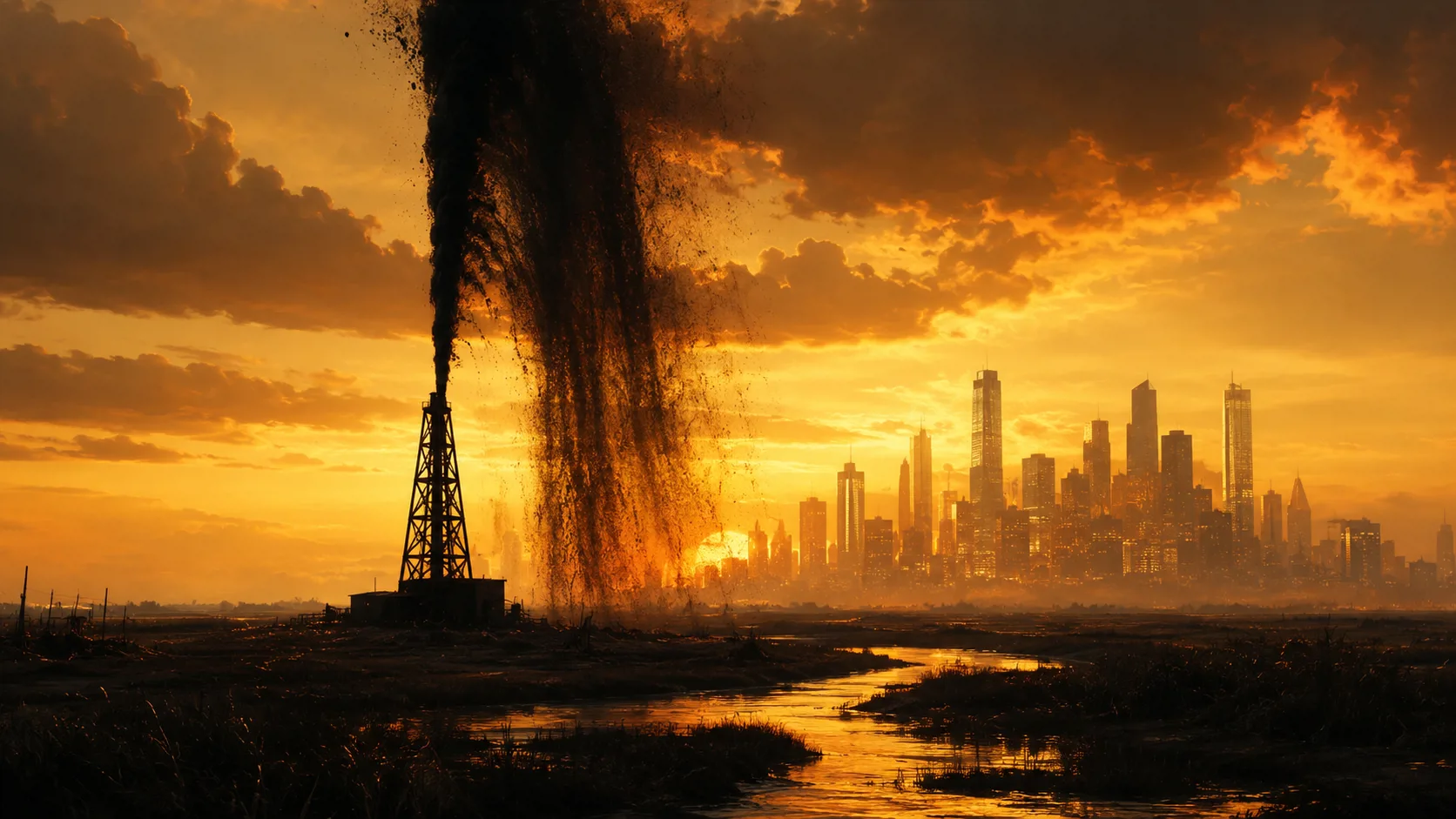
The bravest of them crept back toward the wellhead. More silence. Then a low rumble, felt in the chest before the ears. A gout of mud. Gas hissing. And then, with a roar that would echo through the entire twentieth century, a black column of oil erupted from the ruined derrick and climbed — fifty feet, a hundred, a hundred and fifty feet into the Texas morning — and just kept coming.
It would rain oil for nine days. A hundred thousand barrels a day, more than every other well in America combined. Captain Anthony Lucas, the man who had believed when no one else would, stood in the black rain and could barely speak.
Eighty-five miles to the west, in a mosquito-bitten town on a muddy bayou, nobody yet understood that their entire future had just come out of the ground in somebody else's backyard.
But they would. Oh, they would.
PART ONE — THE GAMBLE
Chapter 1: The Town That Was a Promise
Sixty-five years before the gusher, two brothers stepped off the frontier and looked at a swamp.
Augustus and John Kirby Allen were New Yorkers — sharp-eyed, silver-tongued, the kind of men who could sell you the weather. It was August of 1836. Texas had just torn itself free from Mexico in a war that ended in eighteen bloody minutes at San Jacinto, and the whole young Republic was up for grabs. Land was cheap. Ambition was cheaper. And the Allen brothers had exactly one commodity that mattered: nerve.
They paid five thousand dollars to a widow named Elizabeth Parrott for a stretch of sodden, tree-choked ground along Buffalo Bayou. What they bought was mosquitoes and mud. What they saw was a capital city.
Here is the audacious part — the part that tells you everything about the character of the place that would grow here. They didn't build anything first. Four days after buying the swamp, before a single street existed, before a single board was nailed, they took out an advertisement.
The town of Houston, the ad announced — named, shrewdly, for Sam Houston, the war hero they were betting would be elected president. The ad promised a thriving inland port, a place "which nature appears to have designated for the future seat of Government." It was, in the plainest terms, a leap of faith dressed as fact. There was no town yet. There was a paper town — a city that existed first as a vision, in newsprint and in the imagination of two brothers who could see a metropolis where everyone else saw a swamp. What sets the Allens apart is not that they exaggerated; it is that, in the end, they made every word come true.
And people came.
Chapter 2: The Steamboat and the Bluff
The critics laughed. Buffalo Bayou, navigable? That vine-choked ditch? You could barely paddle a canoe up it, let alone dock a ship.
So the Allens did what the Allens always did: they staged a spectacle. They paid the captain of the steamship Laura a thousand dollars to fight his way upstream to the "great city of Houston." The captain nearly missed it entirely — he chugged right past the scatter of tents, not realizing that was the metropolis he'd been hired to reach — and had to reverse his engines back down to a spot where two bayous met. Allen's Landing, they called it. It is still there. It is still, officially, the birthplace of the city.
And the gamble paid off. That November, the Texas Congress needed a capital. Fourteen other locations competed. But John Allen was down in Columbia, working the legislators like a gambler works a table, promising to build the government's halls for free, whispering the right words in the right ears. On the fourth ballot, the paper town won.
In 1837 the Congress of an entire nation convened in a city that barely existed — a handful of raw buildings in a clearing, surrounded by a wilderness so wild that the naturalist John James Audubon wandered through painting the birds.
Chapter 3: The Price of the Swamp
But the land does not forgive easily, and the swamp exacted its toll.
Yellow fever came in clouds of mosquitoes off the bayou. In 1839 it killed roughly one in every eight people in town. The floods came too, and the heat that pressed down like a wet hand. That same year, the fickle Congress packed up and moved the capital to Austin, and Houston — the town built to be the capital — suddenly had to find another reason to live.
And John Kirby Allen, the younger brother, the charmer, the engine of the whole scheme — he died in 1838, before any of it came true. Twenty-eight years old.
Yet the bones held. A grid of wide streets named for the heroes of the revolution — Travis, Fannin, Rusk. Wharves along the bayou. Cotton and hides and lumber moving down to Galveston and out to the world. A stubborn, unkillable belief, baked into the town's foundation from the very first advertisement, that this particular bayou town was destined to be enormous.
It is worth pausing here, as any honest telling must, to remember at whose cost that early city rose. The backbreaking work of clearing the swamp and raising the first buildings was done in significant part by enslaved people, whose names the promotional pamphlets never printed. Their labor is as much a part of Houston's foundation as the Allens' ambition — and any full account of the city owes them that acknowledgment.
They had no idea how the rest would happen. The thing that would make them a world capital was still sleeping underground, eighty-five miles to the east, waiting for a one-armed dreamer to come wake it up.
(And long before any of them — before the Allens, before the fever, before the first advertisement — the Karankawa and the Atakapa had lived on these bayous for centuries. The land the world would later be told was a fresh beginning was never empty ground. It never is, and the people who came first deserve to be named first.)
PART TWO — THE FIRE UNDERGROUND
Chapter 4: The Man They Called a Fool
His name was Pattillo Higgins, and everyone knew he was mad.
He had one arm — he'd lost the other to a gunshot in a wild youth — and a burning, unshakeable conviction that beneath Big Hill, south of Beaumont, lay an ocean of oil. He wasn't a geologist. His reasoning was half-wrong. But he was right, and being right when everyone calls you a fool is the loneliest thing in the world.
Through the 1890s he drilled. Three times. Three times his bits sank into the hill and drowned in four hundred feet of "heaving sands," a treacherous, shifting layer that swallowed drilling pipe and spat back nothing. The investors fled. The experts smirked. Higgins was ruined and mocked, a cautionary tale told in Beaumont saloons.
Then came Captain Anthony Lucas — an Austrian-trained engineer who studied salt domes, the strange geological bubbles that Higgins's hill turned out to be. Lucas believed Higgins was right, even if for the wrong reasons. And Lucas, with the ingenious Hamill brothers, did the thing no one else had managed: he invented a way through the sand, pumping mud down the hole to hold the walls open, gnawing downward inch by inch.
By January 1901 they were over a thousand feet down and stuck. On the morning of the tenth, they lowered fresh pipe into the hole.
You already know what happened next. The earth breathed. The pipe flew. And the twentieth century began.
Chapter 5: Boomtown
Spindletop, they named the gusher. And it broke the world open.
Overnight, Beaumont went from ten thousand people to fifty thousand. Land that a man couldn't give away for a hundred and fifty dollars sold for fifty thousand within minutes — and the buyer flipped it for more before the ink dried. By the end of the following year, more than five hundred companies had formed on that one hill. Fortunes were made at breakfast and lost by supper.
And out of the black chaos, giants were born — companies whose names would straddle the century: Gulf. Texaco. The Texas Company. Humble Oil, which would one day be called Exxon. Before Spindletop, oil was a thing you burned in a lamp. After Spindletop, oil was cheap enough and vast enough to move ships and trains and a strange new contraption called the automobile. The age of oil didn't dawn gently. It erupted, at ten-thirty on a January morning, out of a hill everyone had sworn was empty.
Chapter 6: The Gateway and the Vision
Now — here is where the story turns, and where the founders' great gamble finally collects on a bet placed sixty-five years earlier.
The oil was in Beaumont. Logic said Beaumont should become the great city. It already had ports on the Neches River. It didn't need to dig anything. For a while, Houston was billed in newspapers as nothing more than "the gateway to Beaumont."
But Houston had something Beaumont didn't: that founding gene of relentless, visionary ambition.
While other towns — Corsicana, Ranger, Kilgore, Odessa — flared and faded, a new generation of Houston men made a shrewd and far-sighted bet. They would not merely pump the oil. They would build the place where everything happened to it after it left the ground. They would finance it, ship it, refine it, and — most cleverly of all — become the city where every oil company on earth chose to plant its headquarters.
The greatest of these operators was a developer named Jesse Jones, a man who seemed to buy half of downtown Houston on a whim. When the Texas Company was looking for a home, Jones simply offered them a brand-new building for two thousand dollars a month. The company's owner, Joseph Cullinan, wrote a line that would prove prophetic: "Houston seems to me to be the coming center of the oil business."
He was right. Texaco came. Humble came. And once the first dominoes fell, the rest followed for the next seventy years.
Chapter 7: The Ditch That Beat the Sea
But you cannot be an oil capital without a way to the ocean, and Houston had a maddening flaw: it sat fifty miles inland, on a bayou you could barely float a barge down.
So Houston did the most Houston thing imaginable. It decided to drag the sea to itself.
The scheme was called the "Houston Plan" — the city would split the staggering cost of dredging with the federal government, an unheard-of arrangement at the time that the whole country would later copy. Men like Tom Ball and Jesse Jones pushed the bonds through, sold them, and set the dredges chewing. They carved Buffalo Bayou and Galveston Bay into a deepwater channel wide and deep enough for oceangoing tankers.
On November 10, 1914, President Woodrow Wilson opened the Houston Ship Channel — by pressing an ivory button on his desk in the White House, wired to fire a cannon a thousand miles away in Houston. The blast rolled across the water. A mayor's daughter scattered white roses into the channel. "Hither the boats of all nations may come," she called out.
And they came. The refineries rose along the banks like a steel forest — Humble's colossal Baytown works foremost among them, a plant so vast it remains the largest in the United States to this day. Cheap land, fresh water, natural gas to burn, and crude flowing in from the whole Southwest: it was the perfect place to turn oil into money. By 1930 the channel bristled with refineries. Today it is the second-largest petrochemical complex on the planet, and the murky water the Allen brothers oversold in 1836 carries the wealth of nations.
The bayou town had beaten the sea. The vision had become a kingdom.
PART THREE — THE PRAIRIE AND THE GAS
Chapter 8: Cane Island
Twenty-five miles to the west, out on the flat coastal prairie where the longhorns and the wolves and the wild geese still roamed the old Karankawa hunting grounds, there was a creek lined with cane. The settlers called the place Cane Island.
Then the railroad came — the Missouri-Kansas-Texas line, the first to reach down into Texas from the north. On the boxcars its initials read MKT. Men spoke it aloud as "the K-T," and the K-T became, in the easy slur of Texas speech, the Katy. When they platted a town along the tracks in 1895, that is the name that stuck. (Though old-timers will still tell you, with a wink, that it was really named for a saloonkeeper's wife.)
Katy grew rice. The floodplain of Buffalo Bayou — which is born, as it happens, right out there near Katy — was perfect for it. Rice replaced cotton and peanuts and corn, and the town prospered quietly around its depot and its rice driers, the great concrete towers that still stand like monuments on the prairie.
Chapter 9: The Night the Sky Fell (a Warning from the Coast)
Then, on September 8, 1900, the prairie learned what the coast already feared.
The Great Galveston Hurricane came ashore so monstrous that its winds reached all the way inland to Katy and flattened nearly every building in the little town. Only three of the original homes survived the night. When the sun rose, the people of Katy did not pack up and leave. They rebuilt. That, too, is the character of this place.
But what the storm did to Galveston — that is a darker chapter, and we will come to it.
Chapter 10: What Was Under the Rice
For decades Katy was a rice town and nothing more. And then, in 1934, in the teeth of the Great Depression, a drill bit sank into the prairie and found the real treasure.
Gas.
Not a little. An ocean of it. The Katy Gas Field spread beneath the rice fields across thirty thousand acres — and when the Second World War came, the size of those reserves and the nearness of Houston's hungry refineries made Katy the single most important gas-condensate field in the entire United States. Humble Oil built a plant to strip the liquid riches out of the gas. The town's population doubled. Workers and their families lived right there on the plant grounds, sleeping above the very fortune they were pulling from the ground.
So when you drive through Katy today and wonder where the gas is — it's beneath you. It always was. The neighborhoods sit on a ninety-year-old fortune, and the pipelines still thread quietly through the subdivisions like veins.
Chapter 11: The Wave from the East
The last transformation came not from underground, but from the highway.
In 1966 they laid Interstate 10 through Katy, and Houston — that insatiable, ever-hungry city to the east — came pouring west along it like a slow flood. The rice fields became Cinco Ranch and Cross Creek and Seven Meadows. The depot town became a metropolis of master-planned communities, malls, and Friday-night football under stadium lights. Old Towne Katy is still there, small and stubborn at the heart of it. But the prairie is gone, paved over by the same westward drive that has propelled this place since two brothers first dreamed a city out of a bayou.
PART FOUR — SECRETS, GHOSTS, AND KINGS
Chapter 12: The Oil in the Backyard
Here is a secret that most Houstonians never learn.
In 1934 — the same year Katy struck gas — a man named C.B. Bunte ignored every expert who told him he was crazy and drilled a well in the Houston Heights, right near the corner of Bevis and West 18th, in the middle of a residential neighborhood. It came in on the twenty-second of November. They called it the Eureka Heights field.
Its biggest backer was a millionaire not yet thirty years old, a young man whose family had grown rich inventing a revolutionary drill bit. His name was Howard Hughes.
For decades afterward, oil derricks and storage tanks stood in the yards between houses in the Heights. Wells reached down through what are now quiet tree-lined streets. Ordinary homeowners who happened to hold the mineral rights beneath their lawns grew suddenly, giddily rich. The field pumped from 1934 until 1979 — ten million barrels of oil, perhaps a trillion cubic feet of gas — right there among the bungalows.
So the old fantasy — the farmer who wakes up to find oil in his backyard — was true in Houston, more or less. Except it wasn't a farm. It was a neighborhood, and the tank sat between the houses.
Chapter 13: The New York of the Gulf, and How It Fell
Now we return to the coast, to the ghost city, to the great might-have-been of Texas.
In the year 1900, the star of Texas was not Houston. It was Galveston.
Picture it: a glittering island port, the richest city per capita in nearly all of America, the first city in Texas with electric lights and telephones. It had just surpassed New Orleans as the greatest cotton port in the nation. Steamships ran straight from its wharves to Europe. The wealthy built mansions along Broadway. They called it the New York of the Gulf, and they believed — with good reason — that Galveston was destined to become the great metropolis of the American South.
The island sat barely nine feet above the sea. It had no seawall. It had no barrier. And on September 8, 1900, the sea came to collect.
The hurricane that struck Galveston that day remains, to this hour, the deadliest natural disaster in the history of the United States. A storm surge fifteen feet high swept clean across the island in the dark. Somewhere between six and twelve thousand people died in a single night — whole families, whole streets, gone. Three thousand six hundred homes were splintered into matchwood. Debris became a moving wall that crushed everything in its path.
Galveston, wounded almost past belief, did something magnificent: it raised the entire city by several feet and built a seventeen-foot seawall to face down the Gulf forever after. But the verdict of history had already been rendered. An exposed sandbar in a hurricane sea could never be trusted to hold the future of a region.
And fifty miles inland, safe from the storm surge, a certain young city with a certain unkillable ambition took note — and doubled down on its plan to dredge a port of its own. Galveston's catastrophe became Houston's opportunity, and the two cities' fortunes traded places through no fault of Galveston's own — only the cruel arithmetic of geography. Within a few short years, the New York of the Gulf had passed the crown, unwillingly, to the city on the bayou.
Chapter 14: The Oil Aristocracy
Every kingdom breeds its royalty, and Houston's kings did not inherit thrones — they drilled for them.
In the 1920s and '30s, as the oil money rolled in, a new aristocracy rose. There was Hugh Roy Cullen, a rough-and-tumble wildcatter turned colossal philanthropist, who told his architect he wanted simply "a big white house" and got an English Regency mansion built for throwing legendary parties. There were the Hoggs — Will, Mike, and the beloved Miss Ima, children of a Texas governor, cultured and civic-minded, who dreamed of building a neighborhood finer than anything Texas had seen. There were the Browns, the Mecoms, and the Hughes family with their drill-bit fortune.
The Hoggs' dream became River Oaks — eleven hundred acres of winding streets and grand estates, laid out with obsessive care, deed-restricted to keep it forever elegant. A century later it is still the wealthiest address in the city, its mansions running from one million dollars to more than twenty. When people ask where the old oil money lives, this is the answer, and has been for a hundred years.
Chapter 15: The City With No Rules
Houston never did learn to follow the ordinary rules of cities, and it never wanted to.
To this day it is the only major city in America with no zoning — no map dividing the town into where you may and may not build. Three times the citizens were asked to vote it in — 1946, 1962, 1993 — and three times they refused. The result is a city that can reinvent itself block by block, where a parking lot becomes an apartment tower overnight, where housing is thrown up at three times the pace of New York, and where — not coincidentally — waves of immigrants from every corner of the earth found cheap homes and open opportunity. Houston became, in its lawless sprawling way, the most diverse major city in America. The mansions of River Oaks stay mansions not because of law, but because of private deed restrictions — the rich making their own rules, as they always have.
Chapter 16: Where the Trains Went to Die
And here is the last strange ghost in the story — one you can drive over today without ever knowing it's there.
Houston devoured its own railroads. It fed them to its freeways.
The Katy Freeway, Interstate 10, was built along the old MKT line — the very "Katy" railroad — and swallowed it whole; the tracks only reappear out in the town that still bears the railroad's name. The Gulf Freeway, Interstate 45, runs where a sleek electric interurban once raced between Houston and Galveston, once the fastest such railway in the nation, dead and gone by the 1930s.
And then there is the Westpark Tollway — narrow, tight, often climbing up onto stilts, hemmed in on both sides as though squeezed through a keyhole. There is a reason for that, and it is a ghost.
Beneath that toll road runs the bed of an old railway, the San Antonio & Aransas Pass line, dating back to the 1880s. In 1992 the transit authority bought the whole hundred-foot-wide rail corridor, dreaming of commuter trains gliding into downtown. Then they changed their minds, tore out the rails, and in 1999 sold off half of it — just fifty feet — to the toll road builders, keeping the other fifty in reserve for a light-rail line that has been argued about ever since and mostly never built.
So the Westpark is narrow because it is only half a railroad. Every time you drive it — cashless, electronic, the first all-electronic toll road in America — you are riding along the grave of a train that was promised and never came. The ghost is right there under your wheels.
PART FIVE — THE CITY THAT OUTGREW ITS OWN LEGEND
Chapter 17: The Voice from the Moon
By 1961, the bayou city had a new hunger. Oil had made it rich; now it wanted to be legendary.
Far away, President Kennedy stood before Congress and made an impossible promise: a man on the Moon before the decade was out. NASA needed a home for the effort — a nerve center to design the spacecraft, train the astronauts, and run the missions. The requirements were exacting: a thousand acres of land, deep water to barge in giant machines, an all-weather airport, mild year-round weather, utilities, and a great research university close by.
Houston, of course, could supply all of it. But the real machinery was not geological. It was political, and it was pure Houston.
The Vice President of the United States, Lyndon Johnson, chaired the Space Council. The congressman who controlled NASA's money, Albert Thomas, was a Houston man. And working the back rooms was George R. Brown, of the mighty Brown & Root construction empire — Rice University's board chairman and Albert Thomas's old college roommate. When Rice offered NASA a thousand acres of coastal prairie southeast of the city — land that had been given to the university by Humble Oil, so that even this was watered by petroleum money — the deal was done.
Tampa had been the favorite. Houston took it anyway. In September 1961, out on a cattle pasture at Clear Lake still littered with debris from a hurricane that had blown through ten days earlier, the future landed.
Here is the riddle that puzzles every newcomer: if this is Space City, why do no rockets ever rise from it? The answer is the same cold logic that governs everything in this story. Rockets must be flung eastward over open ocean, near the equator, where the spinning Earth lends them speed and the falling debris hurts no one — and that means Florida. Houston didn't want the launchpad. Houston wanted the command. Florida would light the candle. Alabama would build the rocket. But the missions themselves — every triumph, every terror, every held breath — would be run from a room of men in white shirts and headsets on the Texas prairie.
And so, when a human being first set his boot upon another world and spoke back to the Earth, the first word he uttered was not a prayer or a poem. It was the name of the place that ran the mission. "Houston." The bayou city had earned its place among the legends at last.
Chapter 18: The City of Medicine, Built on Cotton
But oil was never the only fortune buried in this soil. There was another, softer and whiter, and it built something even oil could not: a city dedicated to keeping death waiting at the door.
His name was Monroe Dunaway Anderson, and he did not drill for anything. He traded cotton — Anderson, Clayton & Company, which grew into the largest cotton firm in the world. He was a quiet, careful bachelor who trusted almost no one, and when he died in 1939 he left no wife, no children, and a fortune of nineteen million dollars to a foundation with only the vaguest of instructions: spend it for the good of mankind.
The men who held that money were watching Austin. In 1941 the Texas Legislature voted half a million dollars to build a cancer hospital — somewhere, no city named. Anderson's trustees moved like the shrewd Houstonians they were. They would match every dollar — on one condition. The hospital must rise in Houston, and it must bear Monroe Anderson's name.
That is why, to this day, the world's sick travel to the MD Anderson Cancer Center in a city where a cotton merchant never planned a single hospital ward.
Houston's citizens voted to sell a slab of parkland near Rice and Hermann Hospital. The great oil families piled their money on top of the cotton money — Hugh Roy Cullen alone gave a million dollars in 1945, spreading it across the young hospitals. Surgeons arrived who would become titans: Michael DeBakey, who invented the grafts that repair broken hearts; Denton Cooley, who held human hearts in his hands as though it were ordinary work. What began as one cancer hospital grew — in the best possible way — into the Texas Medical Center, the largest concentration of healing on planet Earth: sixty institutions, a hundred and twenty thousand workers, ten million patients a year, a skyline of its own. A second superpower, rising beside the oil, built on the profits of cotton and the open-handed generosity of men who had struck it rich and chose to give much of it back.
Chapter 19: The Soldiers' Field and the Mansions of Memory
There is a road on the west side that the wealthy call home, lined with estates behind iron gates and towering oaks. Memorial Drive, they named it. Few who cruise it in their German cars know that it is named for the dead.
In 1917, as the world went to war, the Army leased a stretch of forested land along Buffalo Bayou and built Camp Logan, where seventy thousand soldiers trained before shipping out to the trenches of France.
That August, the camp was also the scene of one of the era's great tragedies. Black soldiers of the 24th Infantry, stationed there and subjected to the daily cruelties of a segregated city, reached a breaking point after abuse by local police — and a night of violence followed that left men dead on both sides and led to some of the harshest military trials in American history. It is a painful chapter, and it deserves to be remembered plainly rather than glossed over: a reminder that the same ground that became a serene park and a millionaires' row was, for the men who trained there, a place of both service and injustice. When the war ended and the tents came down, the land fell silent.
And here — again — come the Hoggs. Will and Mike Hogg, the same brothers who dreamed up River Oaks, bought the old camp and sold it to the city at cost, asking no profit, on the condition that it become a park to honor the men who had trained there. Memorial Park, they called it — nearly twice the size of Manhattan's Central Park. Their sister, the indomitable Miss Ima Hogg, appointed herself its guardian for half a century, beating back every scheme to despoil it — including, tellingly, proposals to drill for oil beneath its trees. Even here, in a memorial to the dead, the derricks came sniffing.
The road that ran beside the park drew the rich the way the bayou once drew merchants. The mansions clustered into their own little independent kingdoms — Piney Point, Hunters Creek, Bunker Hill, the Memorial Villages — cities-within-the-city with their own mayors and their own police, where the executives of the oil companies retreated each night from the towers of the Energy Corridor. When you drive Memorial and marvel at the houses, you are driving through a soldiers' memorial that became a millionaires' row — the living wealth of the city sheltering in the shade of the war dead.
Chapter 20: Where the Oil Went
And now, the question that haunts every resident who ever went looking: if there was oil everywhere — under the Heights, under Katy, under half of Southeast Texas — where did it all go? Is it gone?
It is not gone. It moved, and it learned to hide.
The old shallow fields simply ran dry. The Heights pumped its last in 1979; the derricks came down, the tanks were hauled off, and bungalows and coffee shops paved over the wells as though they had never existed. This is the fate of every boomtown field — it gives everything, and then it gives nothing, and the world moves on and forgets.
The center of the hunt drifted west, into the harsh emptiness of the Permian Basin around Midland and Odessa — five hundred miles from Houston, out where no one is watching. For a while even that great basin was pronounced dead. Then, around 2005, the sorcery of horizontal drilling and hydraulic fracturing raised it from the grave, and today the Permian alone gives up more than six million barrels a day — roughly forty percent of all the oil in America — from ground that experts had written off. More oil flows offshore, too, from platforms standing far out in the Gulf.
And the drilling itself went quiet. Where once a forest of wooden derricks blackened the horizon, now a single modern well reaches sideways for miles beneath the earth, sipping from rock a man could never have touched a century ago. What's left on the surface is a lonely nodding pump jack, or a squat cluster of valves they call a Christmas tree — easy to miss at seventy miles an hour.
So the oil did not abandon Houston. It only stopped needing to be in Houston. The crude arrives now by pipeline from the west and the Gulf, flows into the refineries lining the ship channel, and departs on tankers to the whole world. The city was never really about the hole in the ground. Houston kept the parts that don't require a derrick: the boardrooms, the engineers, the traders, the port, the refineries, the ingenuity. The oil field is in the desert. The kingdom is still on the bayou.
That was the genius all along, if you think about it. The Allen brothers never had a harbor either, and they built one. Their heirs never had oil beneath them, and they made themselves stewards of the world's anyway. Houston's brilliance was never in owning the thing. It was in mastering everything that happened to the thing — and in giving people from every corner of the earth a reason to come to a bayou and build a life.
Chapter 21: The Town That Lit the Match
There is one more place we owe a visit before the end — the hill where it all began, and the city that grew up beside it.
Beaumont never became Houston. It was never going to. But it would be a mistake, and an unkindness, to think of it as a place that failed. Beaumont is the town that struck the match that lit the century.
Walk it today and you find a proud, working city of a little over a hundred thousand people on the banks of the Neches, eighty-five miles east of the giant it helped create. It anchors the Golden Triangle — with Port Arthur and Orange — one of the greatest concentrations of refineries and petrochemical plants on Earth. The ExxonMobil refinery in Beaumont is now the largest in the United States. The Port of Beaumont hums with tonnage. Lamar University fills the town with fifteen thousand students from more than sixty countries. The thing that roared out of Spindletop Hill in 1901 still, a century and a quarter later, pays the wages and lights the homes.
It has known hard weather, in every sense — oil busts that emptied the boom, and hurricanes named Rita and Ike and Harvey that came for it out of the same warm Gulf that made it rich. Its population has drifted gently downward in recent years; its people work hard for modest livings. But it endures, and it remembers. On the campus of Lamar University stands the Spindletop-Gladys City Boomtown Museum, where, on special days, the staff still "blows the gusher" — a plume of water roaring skyward from a replica derrick, and a crowd gathered to feel, for one moment, what those drillers felt on that cold January morning.
There is a quiet dignity in Beaumont's story. Houston caught the fire and became a world capital; Beaumont held the flame and became its faithful keeper. One city dreamed itself enormous. The other simply did the work — and still does. Both are Texas. Both deserve their honor.
EPILOGUE — The Bayou Remembers
Buffalo Bayou still runs through the heart of downtown Houston, murky and slow, the same water the Allen brothers oversold in a newspaper ad in 1836. It begins out near Katy, where the gas sleeps under the subdivisions. It winds past the glass towers of the fourth-largest city in America, past the medical center that is the largest in the world, past the invisible seam where oil derricks once stood in people's backyards, and out toward the ship channel that a swamp town dredged in defiance of the sea.
None of it should exist. There was no harbor here — they built one. There was no oil here — they went and got it, and made themselves stewards of the world's. There was no obvious reason for a great city to rise from a low, marshy townsite on a sluggish bayou fifty miles from the coast.
There was only the belief that it could — a vision so bold and so relentless that, in the end, it simply refused to be anything but true. That belief drew millions of people from everywhere on Earth, and together they made it real.
And the first word ever spoken from the surface of the Moon, when a man set foot upon another world, was not a poem, and not a prayer.
It was the name of this improbable place — dreamed up by a handful who would not take no for an answer, and built real by the millions who came after and made it their home.
"Houston."
Based entirely on real history. Every gusher, hurricane, gamble, ghost railroad, moon-shot, cotton fortune, and vanished oil field in these pages actually happened — the triumphs and the shadows alike, told with respect for all who lived them.