On the evening of 19 December 1961, in the town of Vasco da Gama, a Portuguese general signed a piece of paper in defiance of a direct order from Lisbon to burn the city around him and die in the rubble. The signature ended four hundred and fifty-one years of Portuguese rule on the Konkan coast - the longest colonial occupation any part of Bharata ever endured, longer than the British Raj by three centuries, and by a considerable distance the most violent thing that was ever done to a single district of India in the name of a god.
Within twenty-four hours, the four largest colonial powers in the world were on their feet in the Security Council of the United Nations, explaining that India was the aggressor.
This is the account of what was taken, how it was taken, what was done to the people who lived there for four and a half centuries, who did it, and how it was taken back.
I. Gomantaka, Before the Sail
The land now called Goa was called Gomantaka, and before that Gove, Govapuri, Gopakapattana. The Sahyadrikhanda of the Skanda Purana records its making: Parasurama, having taken the earth from the Kshatriyas, sought a place beyond reproach, and from the crest of the Sahyadri loosed an arrow into the western ocean, and the sea withdrew from where it fell. The tradition holds that he then settled Brahmanas on the reclaimed shore, at Kushasthali and at Mathagrama, and established the fire-altars from which the ritual life of the coast descended. The Konkan coast preserves this account not as decoration but as title deed: the ganvkari villages of Goa held their land in corporate trust for close to two millennia, and their founding charters open by naming Parasurama.
The Sarasvata Brahmanas of Gomantaka carry in their name the memory of the river on whose banks they lived before the Sarasvati failed. Their movement south and west along the Indian coast is a movement inside Bharatavarsha, from one of its river systems to another - not an arrival from outside it, and no honest reading of the Sahyadrikhanda, the Puranic geography, or the Konkani language itself supports any other account. By the time the first Portuguese sail was sighted, the Sarasvatas had been in Gomantaka long enough for the land to be organised around their fire-altars and for their kuladevatas to be older than most of Europe's cathedrals.
The village republics
What the Portuguese found on this coast was not a peasantry waiting for administration. It was a network of self-governing agrarian corporations - the ganvkari, which the Portuguese would rename comunidades and then spend four centuries failing to dismantle. Land was held collectively by the founding clans, leased annually by open auction, and the surplus divided as zonn among the shareholders after the temple's share, the artisans' share, and the village servants' share had been set aside first. The temple was not an adjunct to this economy. It was its accounting centre. Devasthan lands funded the priest, the drummer, the garland-maker, the oil-presser, the dancer, the sweeper. To take the temple's land was not to make a theological point. It was to cut the artery of the village.
This is the single fact that explains everything the Portuguese did after 1540, and it is the fact that most accounts of the Goa Inquisition leave out. The destruction of the temples was not a fit of religious enthusiasm that happened to have economic consequences. The confiscation of devasthan lands, ordered in 1541 and executed over the following decades, transferred the endowments of Goa's temples to the treasury of the Confraria da Conversao dos Infieis - the fund for converting the unbelievers. The temples were demolished with the proceeds of their own estates. The conversion of Goa was, from the first, self-financing.
Gopakapattana and the Kadambas
The Kadambas of Goa made Gopakapattana their capital in the eleventh century and ruled from it for some two hundred and fifty years. Their inscriptions are in Kannada and Sanskrit; their coinage carries the lion of the Kadambas; their harbour handled Arabian horses inbound and Malabar pepper outbound, and Arab and Persian merchants had quarters in the city under royal protection long before any European sail appeared. Jayakeshi I endowed a mosque for the merchant Chhadama at Gopakapattana in 1053 - a fact worth holding steady in the mind against everything that followed, because when the Portuguese arrived they arrived into a port that had extended protection to strangers of another faith for four and a half centuries as a matter of routine.
The Kadambas' tutelary deity was Saptakoteshvara, whose shrine stood on the island of Divadi - Dvipavati, the island of the temple. Kamaladevi, queen of Jayakeshi, is remembered as its patron. The temple was sacked in the fourteenth century during the Delhi and Bahmani incursions and restored under Vijayanagara. What the Portuguese eventually did to it will be described in its place. For the moment it is enough to note that the Adil Shah's gate still standing in the grounds of St. Cajetan's church at Old Goa is, by the assessment of every architectural historian who has examined it, a transplanted Kadamba temple doorway. The Sultan built his palace out of a temple. The Portuguese built the Inquisition out of the Sultan's palace. The stones were reused twice.
Of all the temples that stood in Goa in 1510, exactly one survives on its original site with its original fabric: the Mahadeva temple at Tambdi Surla, black basalt, twelfth-century Kadamba work, in a forest clearing in Sanguem so remote that no Portuguese demolition party ever reached it. One temple. Everything else in this article follows from that number.
II. The Sail
Kappad, May 1498
Vasco da Gama made landfall near Kappad in Calicut on 20 May 1498, having been guided across the Arabian Sea by a pilot he took on at Malindi. He came into a trading world that had operated for a thousand years on a simple principle: the sea was open, and merchants of every nation used it. He came to end that principle. Within four years the Portuguese Crown had issued its first cartazes - passes that Indian and Arab ships were required to buy in order to sail in their own waters, on pain of seizure. A trading system that had never known a naval policeman acquired one, uninvited, armed, and taking a commission.
On his second voyage, in 1502, da Gama intercepted the Miri off the Malabar coast, a ship carrying some two to four hundred Muslim pilgrims returning from Mecca, including women and children. He stripped it, refused ransom, and burned it with the passengers aboard over several days while they fought to save themselves. Portuguese sources - Gaspar Correia, Tome Lopes, who was present - record it without embarrassment; Lopes describes the mothers holding their infants up at the rail. Settled This was the first act of the Portuguese state in Indian waters that can properly be called a massacre, and it was committed by the man whose name the Portuguese would later give to Goa's second city.
Cabral and Almeida
Pedro Alvares Cabral, arriving at Calicut in 1500, seized ten Arab merchant vessels in the roads, killed their crews, and then bombarded the city for two days when the Zamorin's people responded. Francisco de Almeida, the first Viceroy, established the doctrine that would govern the next century: Portugal would not seek territory but would seek the choke points, and would hold them by terror. After his son Lourenco was killed at Chaul in 1508, Almeida sacked Dabhol so completely that Dabholica - to be Dabhol-ed - entered the coastal vocabulary as a word for annihilation. He then destroyed the combined Gujarati-Egyptian fleet at Diu in February 1509 and, by his own account, had his prisoners' hands and feet cut off before he burned them.
None of this is disputed. All of it is in the Portuguese chronicles, written by Portuguese chroniclers, for the glory of the Portuguese Crown. It is worth stating plainly at the outset that this article introduces no charge that the perpetrators did not first make on their own behalf.
III. Afonso de Albuquerque
The two takings of Goa
Afonso de Albuquerque took Goa twice in 1510. The first time, in March, he took it almost without a fight, on the invitation and with the fleet of Timmayya - Timoja to the Portuguese - a Hindu corsair-chieftain of Honavar operating under Vijayanagara's licence, who saw in the Portuguese a lever against the Adil Shah of Bijapur. Yusuf Adil Shah had held Goa only since 1489, when Bijapur broke from the Bahmani sultanate; his own hold was two decades old. Timmayya's calculation was that a naval power with no land ambitions might be used and then dismissed. It was the last time an Indian ruler would underestimate the Portuguese on those particular grounds.
In May the Adil Shah's son Ismail returned with an army and drove Albuquerque out. Albuquerque spent the monsoon at sea in appalling conditions, refused to withdraw to Cochin, and came back on 25 November 1510 - St. Catherine's day - with reinforcements. He stormed the city, and then he ordered what followed.
The order, in his own hand
Albuquerque wrote to King Manuel I describing what he had done. He had given orders, he said, that no Muslim was to be spared, and that they were to be killed wherever they were found; the slaughter continued for four days; the mosques were filled and burned with the people inside them; the bodies choked the streets and the river. He put the number of dead at around six thousand. Settled He noted with satisfaction that his men had made a great deal of blood, and that this would serve as an example.
He spared the Hindus of the city, and this is regularly cited as evidence of Portuguese discrimination in the good sense. It was not mercy and it was not policy toward Sanatana Dharma. It was arithmetic. Albuquerque needed the ganvkars to bring in the harvest, the Sarasvata scribes to run the revenue, and Timmayya's ships to hold the harbour, and he said so. Within thirty years, the moment the Portuguese position was secure enough not to need them, the same population would be subjected to the most systematic programme of religious destruction ever attempted in India.
Albuquerque also instituted the policy of casados - encouraging his soldiers to marry local women, who were baptised first. The Portuguese state's first act of conversion in Goa was performed on women taken in a city where the men had just been killed. It was called a marriage policy.
What the empire was for
It is necessary to be exact about what Portugal was doing in the Indian Ocean, because the standard account softens it into commerce. Portugal was a kingdom of roughly one million people. It could not manufacture anything India wanted. It had no goods to trade of any consequence - the presents da Gama offered the Zamorin were laughed at in Calicut as unworthy of the poorest merchant. What it had was ocean-going gun platforms and a papal grant.
That grant was Romanus Pontifex, issued by Nicholas V in 1455, which authorised the Portuguese Crown to invade, conquer, subdue and subjugate the lands of unbelievers, to seize their goods, and to reduce their persons to perpetual servitude. Inter caetera followed in 1493, and the Treaty of Tordesillas in 1494 divided the unvisited world between two Iberian crowns as though the peoples living in it were the furniture of an unoccupied house. Under the Padroado Real, the Crown of Portugal was made patron of the Church in all territories east of the line, with the right to appoint bishops, collect tithes, and direct missions. Church and Crown in the Estado da India were not two institutions in alliance. They were one apparatus with two account books.
The proposition, stated without ornament, was this: a small Atlantic kingdom with nothing to sell arrived in the richest trading system on earth, discovered it could not compete, and elected instead to tax it at gunpoint under a licence issued by a bishop in Rome. Everything that happened in Goa for the next four hundred and fifty-one years is contained in that sentence.
IV. The Machinery
The destruction of Sanatana Goa was not a riot. It was legislation. What follows is the statute book, in order, with the men who drafted and signed each instrument named.
1541: the endowments
In 1540 the Vicar General Miguel Vaz Coutinho and the Franciscan Diogo de Borba conducted the first systematic demolition of temples in Tiswadi, the island of Goa itself. In 1541 the temple lands of the destroyed shrines were confiscated by the state and settled on the Confraria da Conversao dos Infieis, later the Colegio de Sao Paulo. The contemporary Portuguese record is unambiguous: from 1540 onward, in Tiswadi, there were no temples left standing and no murtis left intact.
The number usually cited for Tiswadi is around one hundred and sixteen temples destroyed. Contested The figure comes through Portuguese administrative correspondence and later compilations and cannot be audited village by village. What is not contested, in any source of any persuasion, is the outcome: a district whose ritual life had been continuous for a thousand years was cleared of every functioning shrine within a single decade.
1546: the letter
On 16 May 1546, Francisco Javier - Francis Xavier, Jesuit, later canonised, whose body lies in the Basilica of Bom Jesus at Old Goa and is displayed to pilgrims once a decade - wrote to King Joao III of Portugal requesting that the Holy Inquisition be established in Goa, on the grounds that the converts were reverting and that the machinery of the faith needed teeth in India. Settled The letter exists. It is in the published Jesuit correspondence. It was written by a man who had already, in his own letters from the Fishery Coast and from Goa, described with satisfaction the destruction of shrines and the whipping of children who resisted catechism, and who complained to Lisbon that officials were insufficiently zealous.
He died in 1552 and did not see the request granted. It was granted eight years later.
1559-1567: the statutes
1559. King Sebastiao decreed that Hindu orphans be taken by the state and delivered to the College of St. Paul for baptism and indoctrination. Under Portuguese law a child with a living mother could be declared an orphan if the father had died, and the definition was applied with enthusiasm. Hiding such a child made one liable to arrest. Families smuggled their children over the border into Bijapuri and Sonde territory by night. Records from the following century show children with living mothers taken anyway, along with the family's property, with no legal recourse of any kind.
1560. Brahmanas were ordered expelled from Goa - the specific removal of the class that carried the transmission. The reasoning was stated openly in the correspondence: destroy the temple and you close a building; remove the Brahmana and you close the tradition. This is the point at which the Portuguese campaign became something other than a religious persecution. It became an attempt to break a civilisation's memory at the point of transfer.
1566. Viceroy Antao de Noronha decreed that no temple might be built anywhere in Portuguese territory and no existing temple repaired without licence, on pain of demolition and confiscation of contents.
1567. The demolition campaign in Bardez. Around three hundred temples destroyed. Contested In the same year the qadis were ordered out of Portuguese India, and Hindus resident in Christian-majority villages had their ganvkari rights curtailed - the corporate share, the zonn, the vote in the village assembly, all of it made conditional on baptism.
4 December 1567. The First Provincial Council of Goa issued its decrees. Hindu marriage rites were prohibited. The investiture of the yajnopavita was prohibited. Cremation was prohibited. Public performance of any Hindu rite was prohibited. Every person above fifteen was compelled to attend Christian preaching, with punishment for absence.
1570. Converts exempted from land tax for fifteen years. In the same decree, the prohibition of Hindu names and surnames. The Sarasvata Prabhu became Prabhu Verekar became Pereira; the Shenvi became Sequeira; the Naik became Nunes. A great many Goan Catholic surnames on the Konkan coast today are the receipt for a fine paid in 1570.
1684. Konkani suppressed by order, Portuguese made compulsory, with penalties for use of the local tongue. The language of the Sahyadrikhanda's coast was made a criminal act in its own country for the next two centuries.
The instrument usually described as the forty-one point programme of Diogo de Borba and Miguel Vaz - a schedule of measures for the systematic disabling of Hindu life, from the exclusion of Hindus from public office to the prohibition of Hindu music at festivals - is transmitted principally through the nineteenth and twentieth century compilations, above all through A. K. Priolkar and through the Jesuit historian Teotonio R. de Souza. Contested The individual measures it lists are each independently documented in the Portuguese statute record. The document as a single numbered schedule is a reconstruction.
Destroy the temple and you close a building. Remove the Brahmana and you close the tradition.
V. The Big House
2 March 1560
The Inquisition of Goa was constituted by order of the Inquisitor-General Cardinal Henrique, dated 2 March 1560. Its first inquisitors were Aleixo Dias Falcao and Francisco Marques Botelho, secular canonists sent from Lisbon. They took as their premises the palace of the Adil Shah at Old Goa - the building raised, in part, out of the stones of Saptakoteshvara - and they took it so completely that the Viceroy of Portuguese India was obliged to move to a smaller residence. The tribunal answered to no authority in India. It reported to Lisbon. In practice, for two hundred and fifty-two years, it was the highest power in the Estado da India.
The Goans called it the Vaddlem Ghor. The Big House.
Its first act was to prohibit the open practice of Sanatana Dharma on pain of death.
What the tribunal did
The procedure was sealed. A denunciation, which could be anonymous, was sufficient to arrest. The accused was not told the charge, was not told the accuser, and was not permitted counsel. He was held in the cells of the Big House - the records speak of hundreds of cells, kept full - and interrogated at intervals that could stretch across years, and was invited repeatedly to confess without being told what he was to confess to. Confession under torture was ratified the following day, when the prisoner was required to affirm that he had confessed freely.
Property was sequestered at the moment of arrest and did not return with an acquitted prisoner. The tribunal was funded from confiscation. This is the structural fact that governs the whole institution: an inquiry that eats what it convicts will always find more to convict.
The offences included practising Sanatana rites in secret, keeping a murti, observing a fast, refusing beef, wearing the tulsi, cooking rice without salt in the manner of the ancestors, using Konkani, and refusing to eat pork. The Inquisition of Goa prosecuted people for what they had cooked.
The eyewitness account is that of Charles Dellon, a French physician arrested in Daman in 1673, held in the Big House, tried, and sentenced to the galleys, who published his Relation de l'Inquisition de Goa in Leiden in 1687 after escaping to France. Dellon describes the cells, the interrogations, the manner in which prisoners were brought to the auto-da-fe in the Se Cathedral in the sanbenito, the processions, and the reading of sentences. His book was banned by the Portuguese Crown and became one of the most widely read exposures of the institution in Europe. In 1808, when the British occupied Goa during the Peninsular War, the Reverend Claudius Buchanan of Fort William College went to Old Goa with Dellon's book in his pocket, obtained entry to the Inquisition palace, and confirmed the layout of the cells against the description. His account is in Christian Researches in Asia, London 1811.
The numbers, and what they hide
Most of the records of the Goa Inquisition were destroyed in 1812 on the orders of the Portuguese authorities before the archives could pass to other hands. What remains are summary lists sent to Lisbon.
From those, H. P. Salomon and Isaac S. D. Sassoon establish that between 1561 and the suspension of 1774, some 16,202 persons were brought to trial before the tribunal at Goa. Of these, 57 were burned in person and 64 in effigy. Settled These are the figures that appear in every serious modern treatment and they are the figures this article uses.
They are also the figures routinely deployed to argue that the Goa Inquisition was a modest affair. That argument fails on its own terms, for four reasons.
First, 16,202 is the count of formal trials in a territory whose entire population in the relevant period was in the low hundreds of thousands. Proportionally it is enormous.
Second, the burnings are the smallest category of outcome and the least important. The characteristic sentence of the Goa Inquisition was not the stake. It was confiscation, public humiliation, flogging, perpetual penance, the galleys, and exile - and above all, the terror of neighbours, since the denunciation system made every household a potential informer against every other. An institution that executes fifty-seven people and terrifies a province into silence for two hundred and fifty years has not been mild. It has been efficient.
Third, the trial figure counts only those who reached the tribunal. It does not count those killed in the demolition campaigns, those who died in the cells before sentence, those seized as orphans, or those driven into exile - and the exiles are the mass casualty of this history, running into the tens of thousands.
Fourth, and decisively: the records were burned by the institution that made them. Every argument from the surviving numbers is an argument from a file that the accused's own lawyers curated. Settled
Pombal, and the end
The Marquis of Pombal suppressed the Inquisition in 1774 as part of his campaign against the Jesuits, whom he had already expelled from the Portuguese dominions in 1759. Queen Maria I restored it in 1778. It was finally abolished by royal decree in 1812, with British troops in occupation of Goa and Portugal itself under French invasion. The Big House stood empty until 1829, when it was demolished. Nothing remains of it above ground except rubble and the Adil Shah's gate a short distance away, which is Saptakoteshvara's gate, which is the oldest object in Old Goa and the only one that was there before any of it began.
VI. The Flight of the Gods
The most important thing that happened in sixteenth-century Goa is not in the Portuguese archive, because the Portuguese did not know it was happening.
While the demolition parties worked through Tiswadi, Bardez and Salcete, the ganvkars of the doomed villages took their kuladevatas out at night, over the rivers, into the hill country of Antruz - the Ponda taluka - which lay outside Portuguese jurisdiction under the Adil Shah, and later under the Rajas of Sonde and the Marathas. They carried the murtis, the temple vessels, the copperplate grants, the endowment records, and the priestly families. In many cases they carried nothing else. They rebuilt in the hills, sometimes in a hut, sometimes under a tree, and they kept the ritual calendar without a break.
This is why Goa still has its gods.
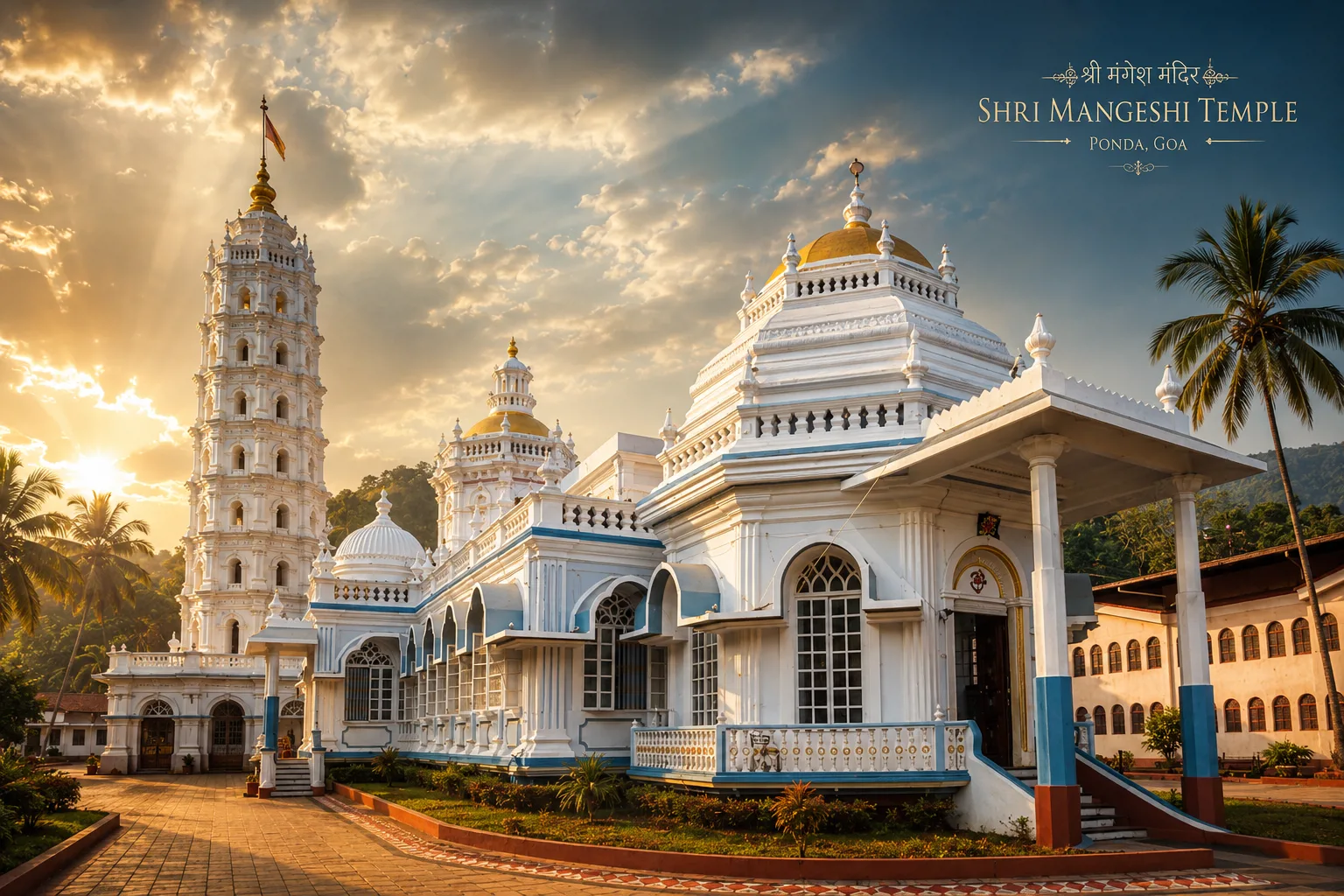
Shri Mangesha - Kushasthali, Cortalim (Salcete) . Priol, Ponda . The linga carried out on 1 May 1560 by Sarasvatas of the Vatsa gotra
Shri Shantadurga - Quelossim (Salcete) . Kavale, Ponda . Present temple built 1738 with Maratha patronage under Naro Ram Mantri, minister of Shahu
Shri Mahalasa Narayani - Verna (Salcete) . Mardol, Ponda
Shri Ramanatha - Loutolim (Salcete) . Bandode, Ponda . The original site now carries a museum
Shri Nagesha - Bandivade . Bandode, Ponda
Shri Mahalakshmi - Colva (Salcete) . Bandode, Ponda
Shri Lakshmi-Narasimha - Salcete . Velinga, Ponda . Deity removed 1567, the year of the Bardez campaign
Shri Kamakshi - Raia (Salcete) . Shiroda, Ponda
Shri Saptakoteshvara - Divadi (Tiswadi), later Narve . Narve, Bicholim . Rebuilt by Chhatrapati Shivaji Maharaj in 1668
Shri Vijayadurga - Sancoale . Keri, Ponda . Displaced in the demolitions carried out by Diogo Rodrigues, captain of Rachol
Shri Shantadurga Kunkolikarin - Cuncolim (Salcete) . Fatorpa, Quepem . Removed after the reprisals of 1583
Shri Devaki-Krishna - Chorao (Tiswadi) . Marcel, Ponda . The only shrine in India where Krishna is worshipped with Devaki
Read the second column and the third together and the whole geography of the persecution becomes legible in one glance. Everything left Tiswadi, Bardez and Salcete. Everything went east and north, into the hills. The Portuguese cleared the coastal plain and the gods went uphill and waited them out.
The architecture of the rebuilt temples records the emergency. Goan temple design after 1560 is unlike anything else in India: a domed shikhara, a naubat khana over the gate, deep verandahs, whitewashed walls, an octagonal or hexagonal lamp-tower - the deepastambha - standing free in the courtyard. It has been called Indo-Portuguese, which gets the causation backwards. These are buildings raised in a hurry, by refugee communities, in a border district, using the only masons and the only vocabulary available. The dome is not a surrender to the conqueror's taste. It is what a community builds when the men who knew how to raise a Kadamba shikhara have been scattered across four coasts.
Chhatrapati Shivaji Maharaj funded the new Saptakoteshvara at Narve in 1668. The Peshwas granted the village of Mangeshi to the Mangesha temple in 1739, at the suggestion of their sardar Ramchandra Malhar Sukhtankar, for whom Mangesha was kuladevata. Naro Ram Mantri, minister to Chhatrapati Shahu, endowed Shantadurga at Kavale in 1738. Every major surviving temple in Goa stands on Maratha money. The reconstruction of Sanatana Goa was a Maratha public works programme, and it was carried out while the Marathas were simultaneously fighting the Mughal empire in the Deccan.
VII. Where the Brahmanas Went
The order of 1560 expelling Brahmanas from Portuguese Goa was the most precisely targeted instrument the Estado da India ever issued, and it is the one least discussed.
A temple can be rebuilt in a season. A tradition of Vedic recitation, of ritual competence, of Sanskrit grammar and Dharmashastra and jyotisha and the manuscript libraries that carry them, takes three generations to establish and one to destroy. The Portuguese understood this, and the correspondence shows they understood it: the Brahmana was identified not as a rival priest but as the mechanism by which the thing they were trying to erase reproduced itself. The order was aimed at the transmission.
The Gauda Sarasvata Brahmanas of Goa dispersed. They went south down the Kanara coast to Honavar, Bhatkal, Kumta, Karwar, Mangalore and Udupi. They went further, into Cochin and Travancore. They went north into the Konkan and the Deccan. They took their kuladevatas' names with them as surnames and their temple affiliations as identity, and the Konkani-speaking Sarasvata communities of Mangalore, Karwar and Cochin exist today because a viceroy in Old Goa signed a removal order in 1560. The Kavale matha, the Gokarna Partagali matha and the Kashi matha carried the samsthana of the community through the centuries of exile. When the Sarasvatas of Mangalore endow a temple to Mangesha or Shantadurga today, they are endowing a deity whose home address is a village in Salcete that their ancestors were driven out of four hundred and sixty years ago and that they have never seen.
Those who remained and converted did not stop being what they had been. The Goan Catholic community organised itself, and organises itself still, along the lines of the jatis it was baptised out of: the Bamonn from the Brahmana families, the Chardo from the Kshatriya, the Sudir, the Gaudde. Families retained gotra memory across generations of Catholicism. Marriages were arranged within the old lines under new names. The Portuguese Church, which had prohibited every external form of Sanatana life, found after two centuries that it had converted the people without touching the society - and the Goan Catholic community's persistent internal organisation is the fossil record of a conversion that went exactly as deep as the law could reach and no deeper.
There is a further point that has to be made without hedging, because the colonial historiography inverted it and the inversion is still taught.
The Brahmanas of Goa were not an oppressing class that the Portuguese liberated anybody from. They were the first target, the most systematically pursued, the most completely dispossessed, and the group that lost most in absolute terms - their lands, their libraries, their liturgies, their homes and their country. They were hunted precisely because they were the custodians. The same pattern would be repeated by the British across India three centuries later, with Sanskrit learning and Brahmana institutions attacked through education policy, revenue policy and the census - and for the same reason, which is that a civilisation dies when its teachers are broken. Any account of Goa that presents the Portuguese as reformers arriving to correct an indigenous hierarchy has the direction of the violence exactly backwards. Polemical
And a related correction. The rigid, enumerated, birth-locked hierarchy that Europeans called casta - a Portuguese word, which entered Indian discourse from Goa, of all places - is not varna and is not jati. Varna is a functional order and no varna in the shastra stands above another in worth. Jati is local community. Caste is the third thing: the fixed, ranked, census-registered artefact that European administration produced and then claimed to have discovered. It reached India through Portuguese Goa in the sixteenth century and was completed by the British enumerators of 1871 and after. The word arrived on a Portuguese ship. It is worth remembering where it landed.
VIII. Forty Rebellions
Goan historiography accounts for more than forty risings against Portuguese rule. The colonial record calls them disturbances. They were a four-century insurgency.
Cuncolim, 1583
The five villages of Cuncolim, Assolna, Velim, Ambelim and Veroda in Salcete were among the last holdouts in the Old Conquests. Their temples had been marked for destruction; several had already been razed. On 15 July 1583 a Jesuit party entered Cuncolim to select a site for a church and to mark out the ground of the destroyed shrines. The Gaonkars of the village - the Kshatriya founding clans - attacked and killed five Jesuits including Rodolfo Acquaviva, who had previously served at Akbar's court, together with one Portuguese layman and fourteen local converts.
The Portuguese response is the part of this story that matters.
The captain-major at Assolna destroyed the orchards and fields of the five villages - the economic base of the ganvkari - and then sent word that he wished to negotiate. The Gaonkar chieftains were reluctant. An envoy of the Adil Shah was persuaded to act as guarantor. On the strength of that guarantee, sixteen chieftains came unarmed to the fortress at Assolna on the bank of the Sal, as required, for talks. The gates were shut behind them and they were killed. Fifteen died. One, remembered as Kalgo Naik, went out through the latrine shaft into the river and swam to Karwar, which is the only reason the account survives at all. Settled
The lands of the five villages were confiscated and granted to the Condado de Assolna, an aristocratic estate held by the Marquis of Fronteira. The villagers responded with a tax strike that they maintained for generations. Shantadurga Kunkolikarin was carried out to Fatorpa, where she remains. A church now stands where the fortress stood.
The five priests killed at Cuncolim were beatified. The fifteen men killed at Assolna under a guarantee of safe conduct have a memorial in their own village, erected in the last thirty years. 15 July is now marked by the Government of Goa.
The Pinto Conspiracy, 1787
Two centuries later the resistance had changed shape. In 1787 a group of Goan Catholic clergy and army officers - the conspiracy is named for the Pinto family of Candolim, at whose house they met - planned to overthrow Portuguese rule in Goa. Their grievance was that native-born clergy, however qualified, were systematically barred from senior office in the Church of Goa in favour of men sent from Portugal, and that Goans were excluded from command in their own country. Among the leaders were the priests Jose Antonio Gonsalves, Caetano Francisco do Couto and Jose Custodio Faria of Candolim - father of the Abbe Faria, who would later become one of the founders of the scientific study of hypnosis in France and whose statue stands today in Panjim.
The conspiracy was betrayed. Forty-seven were arrested. Fifteen were executed, some by hanging and some, the record indicates, by being blown from cannon; others were deported to Portugal and Mozambique and died in prison. Settled The point is worth holding: the Portuguese were now executing their own converts, the Catholic clergy of Goa, for the offence of wanting Goans to run Goa. Four hundred and fifty years of Christianisation did not buy a single Goan a bishopric.
The Ranes of Sattari
The Ranes, a Maratha-descended chieftain lineage of Sattari in the New Conquests, rose against the Portuguese fourteen times between 1755 and 1912. The revolt of Dipaji Rane, beginning in 1852, ran for three years and ended with the Portuguese conceding terms. Dada Rane rose in 1895; the Portuguese had to bring troops from Mozambique. The last of the Rane risings was in 1912. In two hundred and fifty years the Estado da India never established uncontested control of its own interior.
IX. The Marathas
The Portuguese survived in India for four and a half centuries. They came within days of not surviving at all, twice, and both times the men at the gate were Marathas.
Shivaji
Chhatrapati Shivaji Maharaj rebuilt Saptakoteshvara at Narve in 1668, on ground he had taken and held. In November 1667 his forces entered Bardez. In 1683 the Portuguese viceroy Francisco de Tavora, Conde de Alvor, would write that the Chhatrapati had been more dangerous to Goa in peace than in war - a judgement passed on a man who had made the reconstruction of destroyed temples an instrument of state policy. By 1680 Shivaji's army was positioned for a march on Goa itself. News of the Chhatrapati's death reached the camp before the order to move did, and the Viceroy in Old Goa is recorded as having declared that the state was now free from anxiety.
He was wrong by three years.
Sambhaji, 1683
Chhatrapati Sambhaji Maharaj took the war into Portuguese Goa in 1683. His forces moved into the Portuguese Konkan in the spring, took Chaul under siege in June, and moved through the northern territories around Vasai and Daman. The campaign was not a raid and it was not for plunder. It was the reconquest of Sanatana territory from a power that had spent a hundred and forty years demolishing its shrines, and the Portuguese themselves understood it in exactly those terms.
In November the Viceroy Tavora attempted a strike on the Maratha fort at Ponda - the fort that shielded the very district into which the gods of Goa had been carried. Ponda was held by Yesaji Kank, outnumbered, with the walls being breached. On 9 November 1683 Sambhaji Maharaj arrived at speed with eight thousand cavalry and, at the moment of the breach, went into the fort himself at the head of six hundred horse. The Portuguese assault collapsed and Tavora withdrew.
Sambhaji then went after Goa itself. Later that month a party of forty Marathas crossed into Santo Estevao in disguise, killed the Portuguese captain and signalled the main force. The island fell. Tavora, with the Maratha army across the water from his capital and no line of defence remaining, went to the church where the body of Francis Xavier lay, had the casket opened, and laid his baton, his royal credentials and a written petition on the corpse.
What saved Portuguese Goa was not the corpse. It was Aurangzeb. A Mughal army under Shah Alam moved into the Konkan, and Sambhaji Maharaj - fighting the largest empire on the subcontinent on one front - broke off and withdrew on 2 January 1684. The Portuguese were left in possession of a capital they had been unable to defend, preserved by the intervention of an emperor who would, six years later, capture Sambhaji Maharaj, torture him for a fortnight, and execute him at Tulapur for refusing to convert.
The Estado da India survived because the two powers that between them might have ended it were busy destroying each other. This is the whole of the Portuguese achievement in the seventeenth century and it deserves to be recorded in exactly those words.
Chimaji Appa, 1739
The account is completed at Vasai.
Chimaji Appa, brother of Peshwa Bajirao I, laid siege to the Portuguese fortress of Bassein on 17 February 1739. He had first taken Thane, Bandra, Mahim, Dharavi, Versova and Uran, cutting the fortress off by land; the Angre fleet closed it off by sea. He brought forty thousand infantry, twenty-five thousand cavalry and four thousand men trained in mining. When the walls proved too strong for artillery, the miners went under them through the sand.
On 3 May 1739 the mine under the tower of San Sebastian was fired and the tower came down. The Marathas went in through the breach. The garrison surrendered on 5 May and was given safe passage to Goa. On 23 May the Zari Patka was raised over Vasai.
The Portuguese lost their entire Northern Province. What remained of the Estado da India was Goa, Daman and Diu - three enclaves and nothing else, for the next two hundred and twenty-two years. Chimaji Appa built the Vajreshvari temple in thanksgiving. The bells taken from the churches of Vasai were sent to Bhimashankar, Menavali, Omkareshvara and the Ramlinga temple at Shirur, where they hang today.
There is no ambiguity about what happened at Vasai and no reason to accept the framing the Portuguese chronicles gave it. A Hindu power destroyed a colonial fortress that had presided over two hundred years of forced conversion on the Konkan coast, and gave the surrendered garrison its life. That is the record.
The New Conquests, and the two Goas
The Portuguese acquired the rest of what is now Goa between 1763 and 1788 - Ponda, Sanguem, Quepem, Canacona, Bicholim, Sattari, Pernem - not by conquest from their inhabitants but by treaty, cession and default from the Raja of Sonde and the Bhonsles of Sawantwadi, mostly under Maratha pressure elsewhere. These are the Novas Conquistas.
By the time they were acquired, the Inquisition was in its last decades, Pombal was in power in Lisbon, and the Crown had neither the will nor the means for another campaign of demolition. The temples of the New Conquests were left standing.
That accident of chronology is the reason Goa is a Hindu-majority state today. Everything the Portuguese held in the sixteenth century they converted almost completely - over ninety per cent of the Velhas Conquistas was Catholic by 1700. Everything they acquired in the eighteenth century they left alone. The line between the two Goas can still be drawn on a map by counting temples.
X. Salazar's Province
On 15 August 1947 the British left India. The Portuguese did not.
Antonio de Oliveira Salazar, who had ruled Portugal since 1932 through the Estado Novo, took the position that Goa was not a colony. In 1951 he amended the Portuguese constitution to abolish the category of colony altogether and reclassify Goa, Daman, Diu, Angola, Mozambique and the rest as ultramar - overseas provinces, constitutionally identical to the Algarve. The legal manoeuvre had three purposes: it removed Portugal from the reach of the United Nations Charter's provisions on non-self-governing territories; it made any Indian claim an attack on Portuguese metropolitan soil; and it brought the question, in Lisbon's argument, under the NATO guarantee.
The argument advanced in support was that Portugal had held Goa since 1510 and that the Republic of India had not existed at that date, and therefore had no standing to ask for it. India had proposed negotiations on 27 February 1950. Lisbon refused to negotiate on the grounds that there was nothing to negotiate. India withdrew its legation from Lisbon on 11 June 1953 and closed the Portuguese consulate in Panjim in 1955.
What Goans got, in the same period, was PIDE - Salazar's political police, extended to Goa - censorship of the press, the prohibition of political association, and the fortress prison of Aguada, into which Goan nationalists disappeared for terms measured in decades. Some were shipped to Portugal and held there.
The Goan resistance
The Goan freedom movement is not an Indian invention of 1961. It is older than the Indian National Congress's own agitation in Goa and it was made by Goans.
Tristao de Braganca Cunha, born at Chandor in 1891, educated in France, founded the Goa Congress Committee in 1928 and wrote in 1944 the pamphlet Denationalisation of Goans, which remains the sharpest analysis anyone has produced of what four hundred years of Portuguese cultural policy did to the Goan mind. He was arrested in 1946, tried by a military tribunal, sentenced to eight years and deported to Peniche prison in Portugal. He is the father of Goan nationalism and he is a name that ought to be as familiar in India as any.
On 18 June 1946, Ram Manohar Lohia, in defiance of the ban on assembly, addressed a public meeting at Margao. He was arrested. The date is Goa Revolution Day. Dr. Pundalik Gaitonde was arrested for objecting publicly to the claim that Goa was Portuguese. Telo Mascarenhas, Purushottam Kakodkar, Laxmikant Bhembre, Vishwanath Lawande, Prabhakar Sinari, Mohan Ranade - the roll of Goans imprisoned, tortured and deported by the Estado Novo runs into the thousands. Mohan Ranade, arrested in 1955 after the Betim police post action, spent fourteen years in Portuguese prisons, six of them in solitary at Fort Caxias in Lisbon, and was not released until 1969 - eight years after Goa was free.
In 1954 the Azad Gomantak Dal and the United Front of Goans took Dadra and Nagar Haveli by direct action, with Indian volunteers and Goan fighters, and the Portuguese lost the enclaves in a matter of days. Nehru's government did not send troops; it declined to let Portuguese reinforcements cross Indian territory, and the enclaves administered themselves as free territory until formal merger.
On 15 August 1955 - Indian Independence Day - several thousand unarmed satyagrahis, Indians and Goans, walked toward the Goa border at multiple points to court arrest. Portuguese police opened fire. Between twenty-one and thirty were killed and many more wounded. Contested They were unarmed and they were shot in the open. That day ended the argument in India about whether the question could be settled by petition.
The Hague, 1960
Portugal took India to the International Court of Justice over the right of passage between Daman and the enclaves of Dadra and Nagar Haveli. Judgment was delivered on 12 April 1960. The Court found that Portugal had a right of passage for private persons, civil officials and goods, but expressly no right of passage for armed forces, armed police, arms or ammunition, and that India had not acted contrary to its obligations in refusing military transit in 1954.
Portugal had gone to the highest court in the world to be told that it might send a clerk to Dadra but not a soldier. It never recovered the enclaves.
XI. Operation Vijay
The order of battle
The Government of India ordered military action to begin on 17 December 1961. Overall command lay with Lieutenant General J. N. Chaudhuri, GOC-in-C Southern Command. Ground operations against Goa were directed by Major General K. P. Candeth, GOC 17 Infantry Division.
The advance went in on three axes. 50 Independent Parachute Brigade under Brigadier Sagat Singh came in from the north through Bicholim and Banastarim; 63 Infantry Brigade under Brigadier Dhillon advanced through Ponda; 48 Infantry Brigade under Brigadier Gurbux Singh came up from the south-east toward Margao and Vasco. Armour was provided by 7 Cavalry and 8 Cavalry. Separate forces went into Daman and Diu.
At sea, the Indian Navy under Rear Admiral B. S. Soman deployed the cruiser INS Mysore, the frigates INS Trishul, INS Betwa, INS Beas, INS Cauvery and INS Kirpan, and the carrier INS Vikrant offshore. In the air, the Indian Air Force flew Canberras of 6 and 16 Squadrons and Hunters and Vampires, and put the runway at Dabolim out of action on the first morning while deliberately sparing the terminal.
Against this the Estado da India had approximately 3,500 men in Goa, no armour, no anti-tank weapons of consequence, one operational warship, and no possibility of reinforcement. Lisbon had denied the garrison modern equipment for years precisely in order not to provoke Delhi. Salazar had built a defence that could neither fight nor surrender.
The telegram
On 14 December 1961, with the Indian build-up complete and unmistakable, Salazar cabled Governor-General Manuel Antonio Vassalo e Silva. He did not foresee, he wrote, the possibility of a truce or of Portuguese prisoners, because there would be no surrendered ships; he felt that there could only be soldiers and sailors victorious or dead. The garrison was to fight to the last man and, before the end, to destroy Goa - the port, the bridges, the installations, the town - so that it should not be taken intact. Settled
That is the last order the Portuguese Empire issued in India after four hundred and fifty-one years: burn it down.
Thirty-six hours
The columns crossed before dawn on 18 December. Portuguese engineers blew the bridges at Banastarim and elsewhere; Sagat Singh's paratroopers crossed anyway and were in Panjim by the afternoon of the 18th. The Portuguese fell back on Vasco da Gama under the plan called Sentinela, intending to hold the harbour until relief arrived from Lisbon, which was never coming.
In the harbour at Mormugao the sloop NRP Afonso de Albuquerque, under Captain Antonio da Cunha Aragao, came out and engaged INS Betwa and INS Beas. She was hit repeatedly, took fire, lost her steering, was beached at Bambolim and struck her colours. She was the last warship of the Estado da India and she was destroyed inside two hours by ships of a navy that had existed for fourteen years.
Off Anjadip Island, the Portuguese garrison ran up a white flag and then opened fire on the landing party from INS Mysore, killing seven Indian sailors and wounding nineteen. The island was taken after bombardment. In the same sector Portuguese shore batteries at Dabolim fired on and damaged the Indian passenger vessel Sabarmati.
Daman was taken on 19 December after fighting at the airstrip. Diu fell on the same day after the fortress was bombarded from sea and air.
At 2030 hours on 19 December 1961, at Vasco da Gama, Governor-General Vassalo e Silva signed the instrument of unconditional surrender. He had disobeyed a direct order from his head of government. He had refused to destroy the city or to expend his garrison. Brigadier Sagat Singh took the surrender of the Portuguese forces at Bambolim.
Indian dead: 22 in Goa, with a further 12 in Daman and Diu. Portuguese dead: about 30. Prisoners taken: approximately 4,668. Contested
Four hundred and fifty-one years, ended in thirty-six hours, at a cost in Indian lives that would not fill a village bus.
Goans came out into the streets to meet the columns. There is film of it. Nobody who watches it argues about the word liberation afterwards.
What Lisbon did to its own commander
Vassalo e Silva was held as a prisoner of war and returned to Portugal in May 1962. Salazar had him expelled from the army, stripped of rank and pension, and denied him the right to reside in Portugal. He lived in exile until the Estado Novo fell. He published his defence in 1975 under the title A Recusa do Sacrificio Inutil - the refusal of a useless sacrifice. He was restored to his rank after the Carnation Revolution and returned to Goa in 1988, where he was received with honour by the people whose city he had refused to burn.
Salazar also refused, for four months, to accept the return of his own prisoners of war, leaving several thousand Portuguese soldiers in Indian camps after Nehru had offered to release them unconditionally, because acknowledging them would have meant acknowledging the defeat. He then kept the Goan seats in the Portuguese National Assembly formally occupied, and Portugal continued to print maps showing Goa as Portuguese territory, until the dictatorship fell in 1974. Diplomatic relations were restored and the transfer recognised only after that - by the revolutionary government, not by the regime that lost it.
XII. The Council Chamber
Portugal went to the Security Council. The complaint had been lodged on 8 December, before a shot was fired, alleging Indian aggression.
The Council met on 18 December 1961 - its 987th and 988th meetings. The agenda was adopted by the bare minimum of seven votes: the United States, the United Kingdom, France, Turkey, Chile, Ecuador and Nationalist China. The Soviet Union and Ceylon opposed. The United Arab Republic and Liberia abstained.
Portugal's delegate, Vasco Vieira Garin, told the Council that Portugal had shown nothing but peaceful intent, that its forces were vastly outnumbered by an invading army, and that they were fighting a delaying action and destroying communications to slow the enemy. He did not mention that his own head of government had ordered the destruction of Goa.
The United States delegate was Adlai Stevenson. He said that the Council was faced with the first act of armed aggression by a state that had preached non-violence, and warned that the League of Nations had died when its members ceased to resist the use of force and that the United Nations would die the same way. Sir Patrick Dean spoke for the United Kingdom in support.
India's delegate was C. S. Jha. His reply set out the position that has stood ever since: that the elimination of the last remnants of colonialism in India was an article of faith for the Indian people; that the Charter's prohibition on the use of force could not be read to freeze a colonial occupation in place in perpetuity; that Portugal had no sovereignty in Goa to be violated, because sovereignty acquired by conquest and held by the Inquisition, by the gallows and by the political police is not sovereignty; and that the Council was being asked to defend the fourth-largest empire in Africa in the name of peace.
A four-power draft resolution was tabled by the United States, the United Kingdom, France and Turkey, calling on India to withdraw immediately to the positions of 17 December. It received seven votes in favour - the four sponsors, plus Chile, Ecuador and Nationalist China - and four against: the Soviet Union, Ceylon, the United Arab Republic and Liberia. The Soviet representative, Valerian Zorin, cast a veto. The resolution failed. Settled
Some arithmetic is worth setting beside that vote.
Portugal - Ruling Angola, Mozambique, Guinea-Bissau, Cape Verde, Sao Tome, Timor; had begun the massacres in Angola in February 1961, with civilian dead running into the tens of thousands
France - In the eighth year of the Algerian war; the Paris massacre of Algerians took place on 17 October 1961, eight weeks before this debate
United Kingdom - Had concluded the Kenya Emergency, with the Hola camp killings of 1959 four years past and the detention system still fresh
United States - Had landed at the Bay of Pigs in April 1961
Turkey - Had joined the Cyprus settlement of 1960 under terms permitting military intervention
These were the powers that instructed India on the impermissibility of using force to change a territorial situation. The lecture was delivered eight weeks after the Seine, ten months after Angola, and eight months after Cuba.
The vote also disposes of the phrase that has attached itself to December 1961 in Western writing. Annexation is what a state does to territory that belongs to another people. What India did in Goa was recover territory that had been taken from it by force under a papal grant, held by an inquisition, and retained after every comparable European power had gone. Goa was not annexed. Goa was returned.
XIII. What Came Back
The Opinion Poll, 1967
There is one further fact that settles the question of consent, and it is a fact that no other decolonised territory in the world can produce.
On 16 January 1967, the people of Goa voted in a referendum - the Opinion Poll - on whether to merge with Maharashtra or to remain a separate unit of the Indian Union. This was five years after liberation, under a free press, with Portuguese-era politicians campaigning openly. Goa voted to remain Goa: 172,517 against merger, 138,170 for it.
The significance is not the result. It is that the question asked was which part of India Goa wished to be. Nobody, in a free vote held five years after the event, proposed a third option.
Goa became the twenty-fifth state of the Indian Union on 30 May 1987. Konkani - proscribed by decree in 1684, penalised for two centuries, and spoken anyway - was made the official language of the state in 1987 and entered the Eighth Schedule of the Constitution in 1992. The tongue the Estado da India tried to legislate out of existence is now constitutionally protected in the country that took Goa back.
The demographic answer
It is often said that Goa's Hindus were converted entire and that nothing survived. That is what the Portuguese intended and it is not what happened, and the failure is the most important thing in this history.
In the Velhas Conquistas - Tiswadi, Bardez, Salcete, Mormugao - the project very nearly succeeded. Over ninety per cent of that population was Catholic by 1700, and in 1851 Christians were about sixty-four per cent of the whole territory against thirty-five per cent Hindu. Settled
Today Goa is 66.08 per cent Hindu, 25.10 per cent Christian and 8.33 per cent Muslim by the 2011 census. Settled
The reversal has three causes, and none of them is reconversion. The first is the New Conquests, acquired too late to be cleared, which kept their temples and their population. The second is that the exiles came home: the Sarasvata families driven to Kanara and the Konkan returned in the eighteenth and nineteenth centuries once the Inquisition was dead, and continued returning after 1961. The third is that the Catholic Goan community, which the Portuguese had made the most educated and most mobile population on the coast, emigrated in very large numbers to Bombay, to British India, to East Africa, to the Gulf and to Portugal itself - a diaspora that began under Portuguese rule and continues today, with roughly one in three Goan Catholic families having an emigrant.
The gods that went uphill in 1560 came back down. Mangesha is in Priol and has been for four hundred and sixty-six years. Shantadurga is at Kavale. Mahalasa is at Mardol. Saptakoteshvara is at Narve on ground Shivaji Maharaj reconsecrated. The jatras run. The palkhi of Shantadurga Kumbharjuvekarin still travels back to her old village for fifteen days a year, because the community that carried her out never accepted that the move was permanent, and after four hundred years it is still going home annually to make the point.
The Hindus of Goa were killed, expropriated, prosecuted, deported, forcibly converted, forbidden their language, their thread, their marriages and their dead. They are two-thirds of Goa. The Inquisition burned its own records in 1812 to hide what it had done. The temples it could not find are still open.
XIV. The Ledger
Nicholas V - Pope, 1447-1455 . Romanus Pontifex, 1455: authorised the Portuguese Crown to subjugate unbelievers and reduce them to perpetual servitude
Vasco da Gama - Admiral . Burned the pilgrim ship Miri with its passengers aboard, 1502
Pedro Alvares Cabral - Captain-Major . Seized and burned Arab merchantmen at Calicut with their crews, 1500; bombarded the city
Francisco de Almeida - First Viceroy . Sack of Dabhol, 1508; mutilation and burning of prisoners after Diu, 1509
Afonso de Albuquerque - Governor . Ordered the four-day massacre at Goa, November 1510; approximately 6,000 dead by his own account
Miguel Vaz Coutinho - Vicar General . Directed the destruction of the temples of Tiswadi, 1540; architect of the disabling statutes
Diogo de Borba - Franciscan . Co-author of the programme of measures against Hindu life
Diogo Rodrigues - Captain of Rachol . Demolition of the temples of Salcete, including Sancoale
Francis Xavier - Jesuit . Requested the establishment of the Inquisition in Goa, letter of 16 May 1546
Cardinal Henrique - Inquisitor-General . Constituted the Goa tribunal, order of 2 March 1560
Aleixo Dias Falcao - First Inquisitor . Prohibited the practice of Sanatana Dharma on pain of death
Francisco Marques Botelho - First Inquisitor . Co-founder of the tribunal
Antao de Noronha - Viceroy . Decree of 1566 prohibiting construction or repair of any temple
Sebastiao I - King . Decree of 1559 seizing Hindu orphans for forced baptism
Provincial Council of Goa - Ecclesiastical . Decrees of 4 December 1567: prohibition of Hindu marriage, yajnopavita and cremation
Antonio de Oliveira Salazar - Prime Minister . Refused all negotiation; ordered the destruction of Goa and the death of his own garrison, 14 December 1961; punished the officer who refused
Vasco Vieira Garin - Ambassador to the UN . Told the Security Council that Portugal's intentions had been peaceful throughout
And one name on the other side of the ledger, which belongs there:
Manuel Antonio Vassalo e Silva, Governor-General of the Estado da India, who was ordered to burn a city and did not, and was broken for it by the state he served.
XV. A Note on the Sources
The Portuguese record is the backbone of this account, and that is deliberate. Albuquerque's massacre at Goa is described in Albuquerque's own letters and in the Comentarios compiled by his son. The Miri is in Gaspar Correia's Lendas da India and in the eyewitness account of Tome Lopes. The statutes of 1559, 1566, 1567, 1570 and 1684 are in the Portuguese legal record of the Estado da India. Xavier's request for the Inquisition is in the published Jesuit correspondence.
For the Inquisition itself, the essential primary text is Charles Dellon, Relation de l'Inquisition de Goa, Leiden 1687, the account of a man who was inside it. Claudius Buchanan's Christian Researches in Asia, London 1811, records the 1808 inspection of the building. The Italian traveller Filippo Sassetti, resident in India between 1578 and 1588, describes the destruction of the temples and the flight of the population in his letters.
The modern scholarship rests on A. K. Priolkar, The Goa Inquisition, Bombay 1961, which remains the standard work and reprints Dellon and Buchanan in full; on the Jesuit historian Teotonio R. de Souza, whose Medieval Goa and subsequent essays are the most unsparing account of the period written by a Catholic priest; on Antonio Jose Saraiva, The Marrano Factory, in the Brill edition of 2001, whose appendix by H. P. Salomon and I. S. D. Sassoon establishes the trial figures used here; and on Anant Ramkrishna Dhume and the Goan temple historians for the record of the displaced deities.
For the Kadamba period and the pre-Portuguese temples, the epigraphic record published by the Archaeological Survey and the Sahyadrikhanda of the Skanda Purana. For 1961, the Security Council records S/PV.987 and S/PV.988, the ICJ judgment in Right of Passage over Indian Territory of 12 April 1960, and the Indian official history of the Goa operations.
Where the numbers are contested they have been marked contested and the contest has been described rather than resolved. Where the acts are documented they have been stated without softening, because the men who committed them wrote them down and saw no reason to soften them, and it would be a strange kind of scholarship that offered them a discretion they never asked for.
The Big House is gone. The gate of Saptakoteshvara is still standing in the churchyard at Old Goa, holding up nothing, which is the most accurate monument in India.
0 responses