The Toy That Names the Play
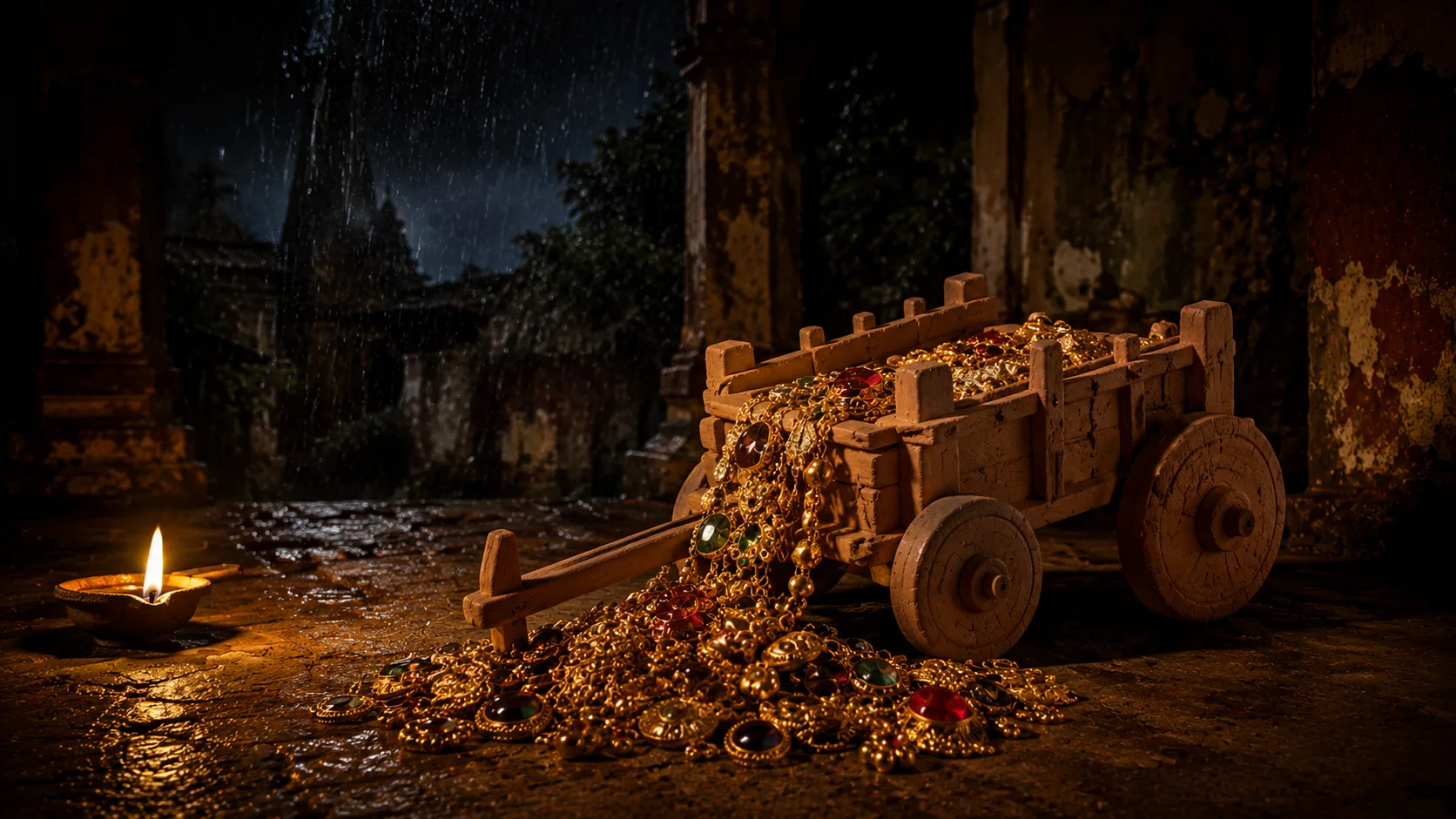
There is a moment near the heart of the Mrcchakatika that no other surviving Sanskrit play would dare to stage. A boy is weeping — Rohasena, the small son of Carudatta, a Brahmin of Ujjayini once wealthy and now so wholly impoverished by his own generosity that thieves no longer trouble to rob him. The child weeps for a trivial, unbearable reason: a neighbour's boy has a little cart of gold, and he has only one of baked clay. Watching, hidden in the ruined courtyard, is the courtesan Vasantasena, who loves the boy's father. She does not console him with words. She strips the jewels from her own throat and arms and heaps them into the hollow of the clay toy until it brims. Take this, she tells him, and buy a cart of gold.
The play is named for that toy. Not for a god, not for a dynasty, not for a great war or an abducted queen — the reliable subjects of Sanskrit high drama — but for a child's clay cart filled with a courtesan's jewellery so that a bankrupt man's son will stop crying. Mrcchakatika: mrd, clay; sakatika, little cart. To understand why that title is among the boldest gestures in classical Indian literature, we must understand what a Sanskrit play was supposed to be — and then watch a forgotten king refuse, with enormous skill, almost every part of it.
He spends the most exalted poetry in the language on its least exalted people — and dares us to find them smaller for it.
The Play and Its Maker
The Mrcchakatika is a prakarana — not the grand nataka of gods and kings, but the form Bharata's Natyasastra reserves for invented stories of ordinary citizens: merchants, Brahmins, courtesans, the people of a real city living a plausible life. Its hero need not be royal; and Sudraka pressed that licence to its furthest edge. He gives us a bankrupt Brahmin as hero, a courtesan of independent wealth as heroine, a burglar-Brahmin, a gambler-turned-monk, a venal court, and — as the moral centre of the final act — a pair of outcaste executioners. He shows on stage what the high drama would only narrate: a brawl, a burglary, a strangling, a march to the stake.
And he braids many tongues. The Sanskrit theatre maps society in language: the high speak Sanskrit; women, servants, children, and the low speak the softer Prakrits. The Mrcchakatika obeys the convention and turns it into music — a polyphonic city in which a courtesan's Prakrit reasons more justly than a judge's Sanskrit.
Who wrote it we do not truly know. The prologue ascribes the play to a king named Sudraka and then describes him, in the past tense, as already dead — a poet consumed on his own funeral pyre cannot recite his own praise, so the frame collapses the instant one presses it. The figure is over-attested rather than obscure: a great king Sudraka appears in the Skanda-purana, in Dandin's Avantisundari-katha as a Brahmin king of Ujjayini and master poet, in the Kathasaritsagara, the Kadambari, the Harsacarita, and Kalhana's Rajatarangini, where he stands beside Vikramaditya as a type of the ideal sovereign.
The honest verdict is that the play is among the very oldest Sanskrit dramas we possess — a near-contemporary or even a predecessor of Kalidasa — and that Buddhism appears in it not as a memory but as a living, flourishing institution. The dating turns on hard threads: the still-current memory of a herdsman's revolution against a named tyrant of Ujjayini, and a literary manner markedly less ornate than the high classical style. These point earlier rather than later. And antiquity matters for how we read the play's daring: this is not a late, decadent experiment straining against an exhausted tradition, but an early, confident work made at the tradition's living source — a foundational text, not a rebellious footnote to one.
The play did not spring from nothing. Behind it stands an older, shorter, unfinished work — the Carudatta of Bhasa, recovered only in the twentieth century, which tells the opening movement of the same story and breaks off after four acts. Sudraka took that fragment and did not merely finish it; he reworked the early acts, preserving Bhasa's sharpest wit while amplifying what was thin, and then carried the story on through six further acts of his own devising — the storm, the exchanged carriages, the strangling, the trial, the march to the stake, the revolution. The cart Bhasa shaped from clay, Sudraka did not gild; he filled it.
The Story · Kathasarah
The scene is Ujjayini, under the tyrant Palaka. Carudatta — whose name, caru-datta, means 'he who gives nobly' — is a Brahmin whose merchant ancestors amassed a fortune he has wholly spent on charity, so that he is now honourably destitute. He loves, and is loved by, Vasantasena, a wealthy and high-minded courtesan. Against this gentle pair stands Sakara (Samsthanaka), the boorish brother-in-law of the reigning tyrant.
Act I — The Deposit
After the benediction and prologue, Carudatta laments a poverty born of his own charity. That night Vasantasena, fleeing Sakara through the dark, shelters in his house and entrusts to him a casket of ornaments — the deposit on which the whole plot will turn.
Acts II-IV — The Gambler, the Thief, and the Circle of Generosity
A gambler ruined at dice is saved by Vasantasena, who pays his debt because he once served Carudatta; shamed, he turns Buddhist monk. Sarvilaka, a Brahmin turned burglar to ransom the maid he loves, breaks into Carudatta's bare house and can steal only the deposited casket. The jewels are recognised and returned; Vasantasena frees the maid Madanika to marry Sarvilaka; Carudatta sends his own wife's pearl-necklace to cover the loss. Generosity answers generosity, beneath the notice of the powerful.
Act V — The Storm
Through the first monsoon storm, Vasantasena comes to Carudatta as an abhisarika — the woman who goes by night to her beloved — and the lovers are united in the rain. It is the lyric summit of the play.
Acts VI-VII — The Cart and the Exchanged Carriages
The morning brings the clay-cart scene that names the play. Then a fatal confusion of bullock-carts delivers Vasantasena into the wrong carriage, while the herdsman Aryaka, escaped from prison, flees in Carudatta's, sheltered on his honour.
Act VIII — The Strangling
The exchange brings Vasantasena into Sakara's garden; spurned, he strangles her and leaves her for dead. She survives, revived by the very monk she once saved — and Sakara, believing her dead, resolves to accuse Carudatta of her murder.
Acts IX-X — The Trial and the Wheel Turned Back
The court, knowing Carudatta innocent but fearing the king's kinsman, condemns him to death. On the execution-ground the outcaste headsmen delay; Sakara's own chained servant denounces him; Vasantasena arrives alive; word comes that Aryaka has overthrown Palaka. The new king gives Carudatta a kingdom, raises Vasantasena to the rank of wife, and Carudatta — true to himself — pardons even Sakara. The play closes with a blessing on all the world.
The kings of Sanskrit drama lose kingdoms and recover them. Carudatta loses only his good name — and a courtesan, an outcaste, and a converted gambler give it back.
The Title, and the Woman Who Fills the Cart
Why a clay cart? The Sanskrit canons hold that a play's title should name its bija, its seed — the small thing from which the whole grows. Sudraka obeys, and chooses the least likely seed imaginable. A mrc-chakatika is a child's toy of baked earth, cheap, breakable, worth nothing. Fill it with a courtesan's jewels and it becomes the hinge on which the plot turns: the wealth that is freely given rather than hoarded, the love that crosses every line the city has drawn. The title tells us where to look — not at the palace but at the courtyard, not at the gold cart the rich child owns but at the clay one the poor child loves. And it tells us what the play believes about wealth: that its worth lies wholly in the giving. Carudatta's very name encodes the creed — caru-datta, 'nobly given' — and his greatness is measured not by what he has but by what he has parted with.
And it is Vasantasena who fills it. She is among the most remarkable figures in Sanskrit drama: a courtesan by birth and trade, yet the moral and emotional centre of the play, wealthy in her own right and free in her own choices, who loves a ruined man precisely because he can offer her nothing but his character. Sudraka makes her constancy the steel against which every other character is tested, and lets the play end by raising her, through the new king's decree, to the honoured rank of a wedded wife. The point is exact and unmissable: her dignity was never the king's to grant. The decree only ratifies what the audience has known, beyond all doubt, for ten acts.
The Verses, Read Closely
What follow are thirteen verses transcribed from the Vimala Sanskrit-Hindi edition of Acarya Jagadis Candra Misra, each with its mula (Devanagari), IAST, and translation, chosen to walk the whole arc of the play from the opening benediction to the closing blessing. The prose carries the naturalistic dialogue of a living city; the verse lifts, at the charged moments, into kavya — the distilled speech in which a culture stores its deepest feeling. To read the play through its slokas is to read it where it is most itself.
The Prologue — Benediction and the Poet
Every Sanskrit play is begun, not merely begun: the sutradhara lifts his hands, the nandi is spoken, and only then may the world of the drama exist. Sudraka opens not with a triumph but a stillness — the yogic samadhi of Siva — and then, in a prologue that quietly cancels its own frame, has the stage-manager praise a poet-king already dead.
The play opens, as Sanskrit drama must, with a benediction. Śūdraka chooses not a triumph but a stillness — the yogic samādhi of Śiva — and the long compounds enact the very binding and sealing they describe.
The prologue's self-cancelling frame: a poet already consumed on his pyre cannot be reciting his own praise. The edition itself notes the oddity — how could any poet know the exact measure of his life? — and treats it as evidence that the historical Śūdraka and the play's author are not simply one.
A table of contents in a single verse: love, polity, the failure of legal procedure, villainy, and fate — the five strands the play will braid.
A four-fold meditation on śūnyatā that culminates, pointedly, in poverty: of all emptinesses, the poor man's is total. It sets the key for Cārudatta's great lament to come.
Act I — The Anatomy of Poverty
The action proper opens on a man counting the cost of his own goodness. What frightens Carudatta is not hunger but the social death of the man who can no longer give. Sudraka makes poverty itself the subject of his most piercing verse.
By the edition's own analysis this verse turns on apostrophe (aprastuta-praśaṁsā) and paradox: to have known plenty and then lose it is a living death. It prepares the harsher verse that follows.
Maitreya has just asked which Cārudatta dreads more, death or poverty. The answer is unflinching: death wounds once; poverty wounds for as long as one lives.
Act III — The Brahmin Who Turned Liberator
The middle acts belong to the street. Sarvilaka — a Brahmin who has turned thief for love, and now turns rescuer — is one of the play's great inversions of who, in this city, actually acts nobly.
Śarvilaka resolves to free the captured Āryaka, likening him to the eclipsed moon gripped in the demon Rāhu's jaws — the Brahmin-burglar turned liberator, another of the play's inversions of who acts nobly.
Act V — The Storm
The fifth act is the lyric summit: the first monsoon, seen from a poor man's courtyard, through which Vasantasena comes to her beloved. Sudraka pours the full apparatus of kavya onto the rising cloud — and then lets the act turn, in its close, toward the tangle of deceit that will undo Carudatta.
The edition marks the figure as a full simile (pūrṇopamā), the rain-streams likened to jewel-arrows striking a freshly greened earth.
One of the play's most admired storm-verses: the rising monsoon cloud is welcomed by peacocks, embraced by cranes, watched anxiously by swans (who must now depart for Mānasa), darkening the horizons like black eye-paint.
Cārudatta reflects on the tangle of the jewels: the lie told to cover the stolen casket returns to ensnare him. The line 'satyaṁ viḍambanā' — 'truly, a mockery' — foreshadows the cruel reversals of the trial to come.
Act IX — The Trial
Then the laughter curdles. Accused by the king's own kinsman, Carudatta is tried by a court that knows him innocent and condemns him anyway. His last protest is addressed not to the judge but to the moral order itself.
Cārudatta's last protest before sentence, in the stately Mālinī metre. The edition pairs it with Manu's dictum that the king who punishes the guiltless, or fails to punish the guilty, himself goes to hell — the moral frame within which the play stages the court's failure.
Act X — The Wheel Turns Back
On the execution-ground, the outcaste headsmen delay; the truth arrives in the person of Vasantasena, alive; the tyrant is overthrown by the very herdsman Carudatta once sheltered; and the play closes, as every Sanskrit play must, with a blessing flung wide over the whole world.
The political subplot closes: Āryaka, the herdsman whom Cārudatta sheltered, has overthrown and slain the despot Pālaka. The cart that once carried the fugitive now, in memory, carries the whole turning of the wheel of dharma.
The bharata-vākya, in the grand Sragdharā metre, that closes every Sanskrit play with a blessing flung over the entire world. The edition's colophon follows: 'thus ends the tenth act, called The Conclusion (saṁhāra).' Note the order of the blessing — cattle, earth, rain, all peoples, Brahmins, the good, the dharma-keeping king — the whole social and natural order wished into wellbeing at once.
Why It Is Not Subversion
It is fashionable to call the Mrcchakatika 'subversive' — a crack in an oppressive edifice, a poet ahead of his own world. This is precisely backwards. The prakarana form that licenses a commoner-hero is Bharata's own; the multilingual stage is the tradition's settled convention; the doctrine of rasa the play extends to gamblers and courtesans is the tradition's own theory of the heart; and the moral order in which an innocent's agony is redeemed and dharma restored is the deep grammar of the civilisation's self-understanding. The very verse with which Carudatta meets his sentence is grounded by the editor in Manu's own dictum that the king who slays the guiltless falls into hell — the indictment of the court is mounted from within the tradition's law, not against it.
A culture incapable of self-examination could not have staged the failure of its own courts so unsparingly, and then dramatised their correction. To indict the king while affirming dharma, to give an outcaste headsman the moral high ground while never abandoning the city's deepest order, is not a contradiction the tradition tolerated. It is a sophistication the tradition cultivated.
Conscience, in a mature civilisation, is not an insurgency. It is an institution.
For a reader formed in the Telugu tradition, this is not an abstract point. The very instruments Sudraka pioneered — the dignified commoner, the morally serious courtesan, the city as a living character, the braiding of high diction with the speech of the street — became, centuries later, the central tools of the Telugu stage. Gurajada Apparao's Kanyasulkam gives us in Madhuravani a courtesan who is the most lucid moral intelligence on the stage, and in Girisam a Sanskrit-quoting fraud who is Sakara's pretension reborn. And Gurajada completed the very revolution Sudraka's multilingual stage had prepared: where the Mrcchakatika set Sanskrit against Prakrit to ask whose speech may carry the truth, Gurajada set the living spoken Telugu of the people against the dead grammar of the pundits. It is the same revolution, on the same axis, two thousand years apart — and it descends, in a straight line, from a play named for a clay cart.
Sudraka poured a whole civilisation's sense of justice and human worth into the hollow of a child's broken toy, and the toy held. A hundred years and ten days, said his prologue, and then the fire. He knew how little time anyone is given, and how much can be carried, even so, in something small and breakable and freely filled. He named his masterpiece for it.
Sources: all thirteen verses are transcribed verbatim from Mrcchakatikam of Sudraka with the 'Vimala' Sanskrit-Hindi commentary of Acarya Jagadis Candra Misra; the anvaya and padartha follow that edition's own commentary, and the English translations are the author's. The play survives in ten acts and is conventionally ascribed to king Sudraka, almost certainly a literary persona; its descent from Bhasa's incomplete Carudatta and a date among the oldest extant Sanskrit dramas are the settled findings of the standard introductions (Kale; Ryder).