The verdict the state spent seventeen years trying to avoid
There is a simple test for whether a criminal case was ever real. Give it to the most powerful investigative machinery in the country. Give that machinery seventeen years, two agencies, 323 witnesses, and a government that wants a conviction. Then see what is left standing.
In the Malegaon case, nothing was left standing. Settled
On 31 July 2025, Special Judge A.K. Lahoti acquitted all seven accused — Pragya Singh Thakur, Lt Col Prasad Shrikant Purohit, Major (retd) Ramesh Upadhyay, Ajay Rahirkar, Sudhakar Dwivedi, Sudhakar Chaturvedi, and Sameer Kulkarni. The Maharashtra ATS built the case. The National Investigation Agency inherited and ran it. Between them these are the two most resourced counter-terror bodies India possesses, and across seventeen years they could not prove that any of these seven people did anything at all. Settled
When the state wants a conviction, holds every lever, and takes a decade — and still comes back empty — the emptiness is the verdict.
That is not a technicality. That is the whole of it. A case that cannot survive seventeen years of its own prosecutors was never a case. It was an accusation dressed as one.
What they could not prove
Set out plainly what the two agencies failed to establish, because the length of the list is the argument.
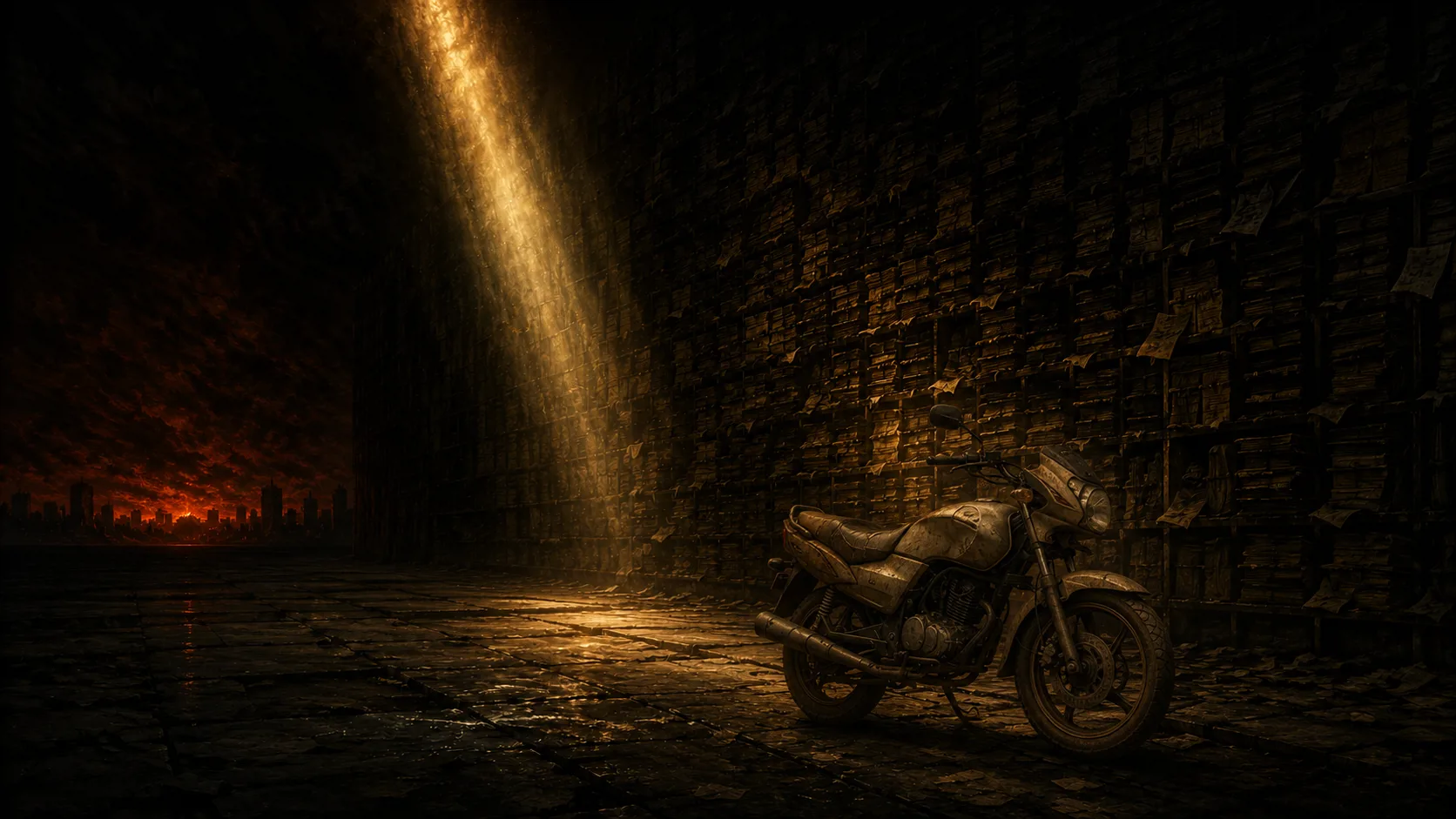
They could not prove the motorcycle. The single physical thread tying Thakur to Malegaon was an LML Freedom bike the ATS said was hers. The court held it was not proved the motorcycle was registered to her — and not even established that the blast came from a bomb on that bike at all. Settled
They could not prove the explosive. The ATS said Purohit brought RDX from Jammu and Kashmir and had it assembled at Sudhakar Chaturvedi's house in Deolali. The court found no evidence for the source of the explosives, none for their transport, none for their handling, and no evidence of storage or assembly at Purohit's home. Settled
They could not prove the conspiracy. The prosecution's spine was a planning meeting at Bhopal in April 2008. The court found not one reliable witness could establish any of the alleged meetings. Settled
They could not prove the money. Twenty-one lakh rupees supposedly raised to fund the blast, one lakh spent on grenades — and no financial record, no witness, nothing. Settled
They could not even hold the crime scene together. No sketch of the spot in the panchnama. No fingerprints. No dump data. Contaminated forensic samples that could not be relied on. Sanction orders under the UAPA that were legally defective, so the UAPA did not even apply. Settled
This is not a case that was strong and narrowly lost on a point of law. Every load-bearing element — the bomb, the explosive, the meeting, the money, the scene — failed independently. A frame does not fail this way by accident. It fails this way because there was nothing underneath it.
Two agencies, two different bombs
The clearest proof that no one actually knew what happened is that the two agencies could not agree on the crime.
The ATS said the IED was assembled at Chaturvedi's house in Deolali by Purohit. The NIA said it was assembled in Indore and carried to Malegaon through the Sendhwa bus stand. These are not two versions of one story. They are two different crimes, in two different cities, by two different sets of hands — offered to the same court, about the same bomb. Judge Lahoti noted the agencies were at loggerheads on crucial points, and threw out the NIA's Indore theory for want of any evidence. Settled
When the prosecution itself cannot decide where the bomb was built, there is no bomb-builder. There is only a name the state decided to attach to a blast, and then could not make stick to any coherent account of it.
The RDX that walked in on its own
And then the fact that turns failure into something the state should answer for — a fact that did not come from the defence, but surfaced when the NIA re-examined witnesses who had first deposed before an Army Court of Inquiry.
Two Army personnel, a major and a subedar, testified that on 3 November 2008, ATS officer Shekhar Bagde entered Sudhakar Chaturvedi's residence while Chaturvedi was away, behaved suspiciously, and left traces of RDX there — telling them to say nothing. Two days later an ATS team raided that same house, and with cotton swabs recovered traces of a substance it declared to be the Malegaon explosive. Settled
The ATS offered no explanation. It produced nothing to deny that its officer was in the house, in the owner's absence, two days before the discovery. The court found his conduct raised the plain question of why he was there at all, and concluded the sequence pointed to the likelihood of evidence being planted. Judge Lahoti ordered an inquiry and sent the judgment to the DGP Maharashtra, the DG of the ATS, and the DG of the NIA. Settled
Shekhar Bagde is today an Assistant Commissioner of Police. The inquiry the judge ordered has produced no public result.
None of this was fresh in 2025. The Supreme Court had already flagged it in August 2017 when it granted Purohit bail — recording that the Army inquiry told a different story of the IED's assembly, and that NIA re-examination had surfaced witnesses who found Bagde suspiciously in that house. The highest court in the country saw the planting question in 2017. The trial then ground on for eight more years before an acquittal that was, by then, a formality. Settled
The confession the state's own agency made
On what was done to the people in custody, the most damning admission did not come from the accused. It came from the NIA.
NIA officer Anil Dubey, under cross-examination, admitted that the ATS had tortured and illegally detained not only witnesses but some of the accused. The successor agency, on the record, in open court, conceded the coercion. Settled
The pattern around it is consistent. Yashpal Bhadana, a prosecution witness to the supposed Bhopal meeting, retracted — saying he had never attended any such meeting and did not know who was there, and that the ATS grilled him for five days to extract his statement. Of 323 witnesses, thirty-eight turned hostile, many alleging their statements were beaten or coerced out of them. Settled
And the ATS forged the injured. The court found injury certificates for six of the 101 claimed victims had been signed by unlicensed practitioners and altered at the ATS's instance, rejected them as fake, and ordered an investigation. An agency that would forge medical certificates to inflate a casualty count is an agency whose entire evidentiary output must be read as suspect — because a forged certificate convicts no bomber. It exists only to make the accusation heavier. Settled
Pragya Thakur has said, publicly and by name, that she endured twenty-four days of sustained torture; she has named former Mumbai Police Commissioner Param Bir Singh as the principal, accused named officers of coercion, and said she was pressured to implicate Yogi Adityanath and RSS figures. Her account has never been tested in court — but it no longer stands alone. The NIA has already conceded, on the record, that the ATS tortured people in this case. Her charge is the detail on a fact the state itself admitted. Contested
It happened on their watch — and they still failed
Here is the point the secular commentariat works hardest to walk past.
This case was born, built, and run through its formative years under the UPA. The ATS assembled it under a Congress-led Maharashtra government and a Congress-led Centre. The political class of that moment did not merely permit the investigation — it embraced the theory, gave the country the phrase "saffron terror," and made a national project of the idea that the danger came from Hindu organisations. Polemical
So consider what that means. The government that wanted this case to succeed was the same government that controlled the machinery meant to prove it. It had the ATS. It had the prosecutors. It had the years. It had every institutional incentive to deliver a conviction that would vindicate its own political narrative. A state in that position, if there had been a real case, does not come away with contaminated swabs and contradictory bomb sites and not one witness to a single meeting. Polemical
They had the motive, the machinery, and the mandate. If the evidence existed, they would have produced it. They produced a frame instead — and the frame fell apart.
The most revealing witness on this is Rohini Salian, the veteran Chief Public Prosecutor who vetted the chargesheet — thirty-two years at the bar, no friend of the accused. She has said the case was doomed once the true evidence was never laid out, and called the collapse a failure of institutional and political integrity rather than any mere procedural slip. When the prosecutor who built the file says there was no honest case underneath it, the argument is over. Contested
What the acquittal cost
An acquittal is meant to restore a person. Here it returned wreckage.
Prasad Purohit was a serving Military Intelligence officer. He spent nearly nine years in judicial custody before the Supreme Court granted bail in 2017 over material contradictions in the chargesheet. He stayed suspended until 2020. A Discipline and Vigilance ban froze his career for some sixteen years; when he came up for Colonel in 2021 his result was sealed away, and he learned he had been passed over only after his acquittal. Settled
His account was always that he had penetrated Abhinav Bharat as part of his intelligence duties and reported upward — and the Army's own record backed him. A Court of Inquiry in April 2009, and communications from the Director General of Military Intelligence and Integrated Defence HQ in 2018, 2019 and 2023, affirmed that he had run a source network and behaved as expected of him. He was never dismissed and never court-martialled for the blast. An army that quietly discards compromised officers did neither. Settled
After the acquittal the vindication came in the language of the tribunals. Promoted to Colonel in September 2025. In March 2026 the Armed Forces Tribunal stayed his retirement, finding prima facie that an illegal, fabricated implication had denied him fair consideration — the tribunal's own words. On 10 April 2026 he was cleared for Brigadier, on the strength of seven unblemished service reports since 2018. Settled
A tribunal of the Indian state has now called his implication illegal and fabricated. That is not the accused talking. That is the state, correcting the state.
He would long since have been a Brigadier, in line for higher rank. He received it at the very end, by order, with almost no service left to spend it in. Pragya Thakur gave nine years and her health, was handed a clean chit by the NIA in 2016 and kept on trial anyway for nine more years. The others — Upadhyay, Rahirkar, Dwivedi, Chaturvedi, Kulkarni — lost the same years with no rank to restore and no press conference to hold.
What the court would not quite say
One line in the judgment gets quoted by those who want the frame to survive its own collapse. Lahoti wrote that failure to prove the charges does not, by itself, mean the charges were baseless.
Read it for what it is: a judge who has just dismantled the prosecution's every pillar, softening the blow to the agencies whose conduct he was simultaneously sending for inquiry. It is the reflex of a system reluctant to say out loud that its own investigators fabricated a terror case against seven citizens. Strip the cushioning and look at what the same judgment did — found the explosive unproved, the meetings unproved, the money unproved, the scene mishandled, the samples contaminated, an officer likely to have planted RDX, and certificates forged. A caveat does not survive its own paragraph. The findings are the ruling. The hedge is the etiquette. Settled
The plain conclusion
Seven Hindus were accused of a bombing. Two of India's most powerful agencies, backed by a government that wanted them guilty, were given seventeen years to prove it. They proved nothing — not the bomb, not the explosive, not the meeting, not the money. Along the way one of those agencies conceded torture, a judge flagged planted evidence, and the state's own tribunal called the implication of its lead accused illegal and fabricated. Settled
That is not a case that failed on a technicality. That is a frame that was exposed. The only reason it took seventeen years is that the machinery which built it was in no hurry to admit what it had done — and, having been caught, has still held no one to account. Shekhar Bagde made ACP. The forgers were never named. The ATS answered for none of it.
The demand is simple: the inquiry the judge ordered, in public, with names. Nothing less than that is justice, and nothing so far has been delivered.
The accused have their acquittal, and Purohit has his stars. What remains owed is the accounting — from the agencies that manufactured a terror case against seven of their own citizens and, when it fell apart in their hands, walked away as though nothing had been built at all.
Sources: judgment of Special Judge A.K. Lahoti, NIA Special Court, Mumbai, 31 July 2025 (1,036 pages); Supreme Court bail order in Purohit's case, August 2017; Armed Forces Tribunal orders, March–April 2026; and contemporaneous reporting in The Week, ThePrint, Newslaundry, Business Standard, Outlook, Free Press Journal and The Wire. The allegations of custodial torture made by Pragya Singh Thakur, and the account of the case's prosecution given by Rohini Salian, are reported here as the statements of their makers.