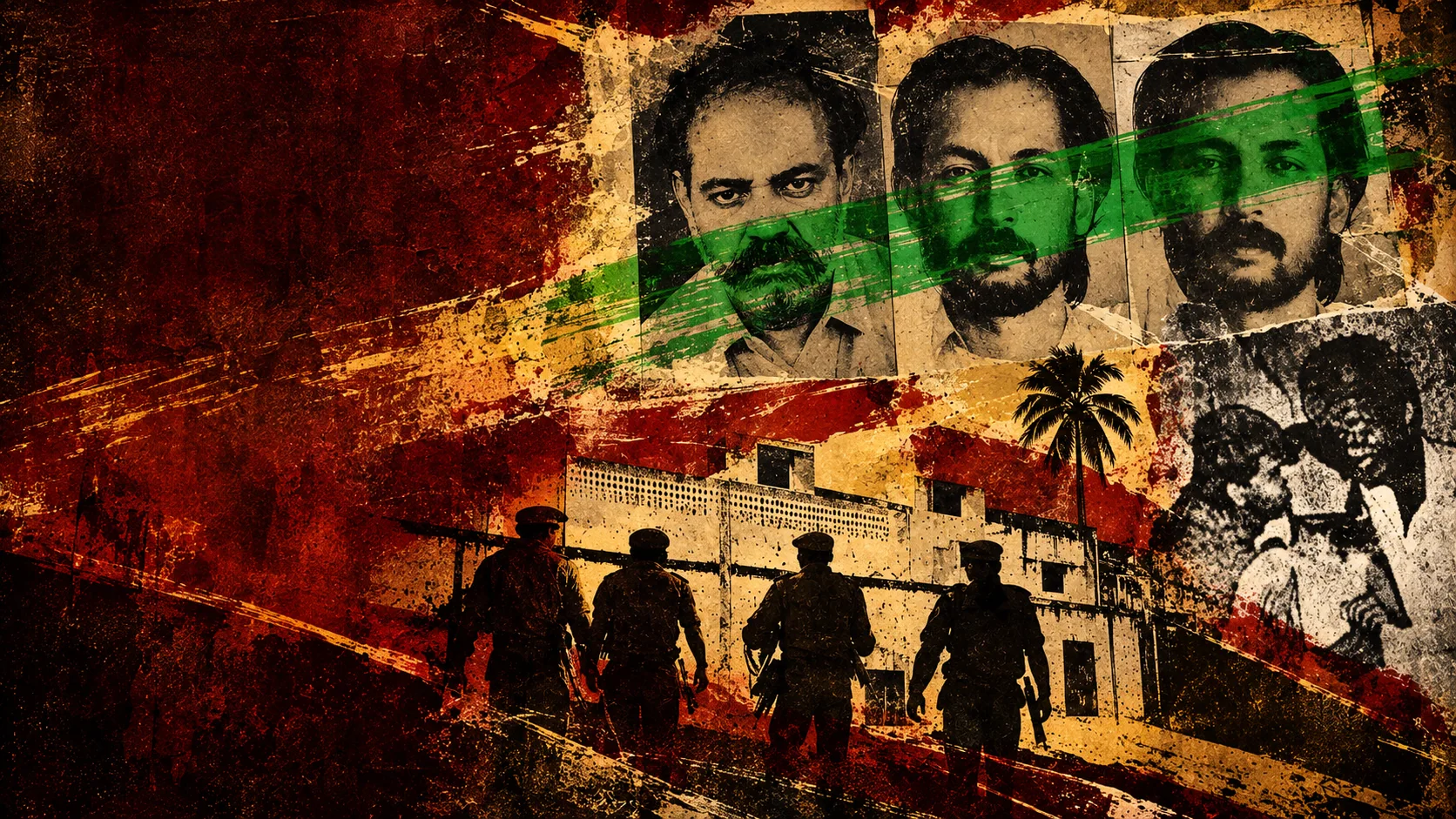
A Photograph, Blurred, On A Morning Front Page
On the morning of 15 May 1992, readers of Dainik Navajyoti in Ajmer opened their paper to a photograph that had been deliberately spoiled. The faces had been obscured. What remained legible was a young woman, and on either side of her, two men. The image was grainy, printed on newsprint, reproduced from a colour print that had itself been copied more than once.
It was a bad photograph in every technical sense. It was also the single most consequential object in the modern criminal history of Rajasthan. Within seventy-two hours, Ajmer had shut down completely. Within twelve days, the state had issued detention warrants under a law reserved for threats to national security. Within a fortnight, a First Information Report existed. Within six months, chargesheets had been filed against eighteen men.
And then the matter entered the courts of Bhārata, where it remained for thirty-two years.
The arithmetic of that delay is the real subject here. A criminal conspiracy operating in a mid-sized city for roughly two years produced, on the state's own estimate, more than a hundred victims. The first trial court judgment came in 1998. The last one came in August 2024. Between those two dates sat one Supreme Court judgment, two High Court benches, a fast-track court that took ten years, six accused who simply left and stayed gone, and one man who was never tried at all because he acquired another country's passport and no extradition request has ever been documented.
In August 2025, four of the six men convicted the previous year were released on bail pending appeal. As of September 2026 the appeals have not been decided. That is where the matter stands.
Much of the popular retelling of this case, including several details repeated in national outlets and in the 2023 film, is not supported by the judicial record and is contradicted by it in at least three significant places. Where the courts have found a fact, that finding governs. Where journalism is the only source, it is marked. Where a figure in wide circulation has no traceable basis, it is named as such rather than repeated. No victim is named. Ajmer has spent thirty-four years failing to protect these identities, and there is nothing to be gained by adding to that.
What Daṇḍa Is For
The Sanātana tradition does not treat punishment as an unfortunate necessity that a sufficiently advanced society might one day outgrow. It treats it as the constitutive act of governance itself. Daṇḍa, literally the rod or the staff, is the coercive power of the ruler, and the śāstric literature is unembarrassed about its centrality.
दण्डः सुप्तेषु जागर्ति दण्डं धर्मं विदुर्बुधाः ॥
daṇḍaḥ supteṣu jāgarti daṇḍaṃ dharmaṃ vidur budhāḥ ||
Chandas: Anuṣṭubh.
दण्डः । सुप्तेषु । जागर्ति । दण्डम् । धर्मम् । विदुः । बुधाः ॥
daṇḍaḥ | supteṣu | jāgarti | daṇḍam | dharmam | viduḥ | budhāḥ ||
बुधाः दण्डं धर्मं विदुः ॥
budhāḥ daṇḍaṃ dharmaṃ viduḥ ||
Padartham for Manusmriti 7.18, with Hindi and English gloss
| पदम् | व्याकरणम् | अर्थ | Meaning |
|---|---|---|---|
| दण्डः | पुंलिङ्गम्, प्रथमा, एकवचनम् | दण्ड, राजा की दण्डशक्ति | danda, the ruler's coercive power |
| शास्ति | लट्, परस्मैपदम्, प्रथमपुरुषः, एकवचनम् | शासन करता है | governs, rules |
| प्रजाः | स्त्रीलिङ्गम्, द्वितीया, बहुवचनम् | प्रजाजन | the subjects, the people |
| सर्वाः | विशेषणम्, द्वितीया, बहुवचनम् | सब, समस्त | all, every one |
| एव | अव्ययम् | ही, निश्चय ही | alone, indeed |
| अभिरक्षति | लट्, परस्मैपदम्, प्रथमपुरुषः, एकवचनम् | भलीभाँति रक्षा करता है | protects thoroughly |
| सुप्तेषु | क्तान्तम्, सप्तमी, बहुवचनम् | सोए हुओं में | among those asleep |
| जागर्ति | लट्, परस्मैपदम्, प्रथमपुरुषः, एकवचनम् | जागता रहता है | stays awake, keeps watch |
| धर्मम् | पुंलिङ्गम्, द्वितीया, एकवचनम् | धर्म | dharma |
| विदुः | लिट्, परस्मैपदम्, प्रथमपुरुषः, बहुवचनम् | जानते हैं | they know |
| बुधाः | पुंलिङ्गम्, प्रथमा, बहुवचनम् | विद्वान्, बुद्धिमान् | the wise, the discerning |
जब प्रजा निद्रा में होती है, तब दण्ड जागता है। इसीलिए मनु दण्ड को धर्म के समान कहते हैं, क्योंकि रक्षा के बिना धर्म का पालन सम्भव नहीं।
Vyākhyā. The verse makes a claim that modern constitutional language struggles to state so bluntly: the protective and the punitive are the same faculty. A state that cannot punish cannot protect, and a state that punishes thirty-two years late has not punished at all in the sense Manu intends, because the watch was not kept while the people slept. The Ajmer record is, from beginning to end, a study in daṇḍa asleep. It sleeps in the police station that does not register a report. It sleeps in the administration that weighs communal arithmetic against a child's body. It sleeps in the appellate court that reduces a life sentence in a single unexplained line. And it sleeps for the twenty-six years during which a convicted man's co-accused simply lived elsewhere under his own name.
Ajmer Before The Photographs
Ajmer sits in a bowl in the Aravalli range, roughly 130 kilometres south-west of Jaipur, with the Ana Sagar lake on one side and the hill of Taragarh above it. It is an old city with an unusually dense concentration of institutions for its size: a cantonment, a railway division, a clutch of well-regarded schools, and the shrine that has defined it in the outside imagination for eight centuries.
That shrine is the dargāh of Moinuddin Chishti. A dargāh is a tomb-shrine built over the grave of a Sufi figure, functioning as a pilgrimage site where offerings are made and intercession sought. The Ajmer dargāh is the principal such site in the subcontinent, and the pilgrim traffic it draws has supported a hereditary service economy around it for generations.
The men who staff that economy are the khādims. A khādim, in this specific Ajmer sense, is a hereditary attendant of the shrine, one of a body who conduct pilgrims through the ritual, receive offerings on their behalf, and maintain the relationships that bring pilgrims back. The khādims of Ajmer are organised as the Anjuman Syedzadgan, registered as a society since 1947 and carrying the fuller formal designation Anjuman Moinia Fakhriya Chishtiya Khuddam Khwaja Saheb. Membership runs to roughly two thousand. The body is distinct from the statutory Dargah Committee constituted under the Dargah Khwaja Saheb Act, and distinct again from the Dewan or sajjādanashīn, a separate hereditary line that has been in prolonged dispute with the khādims over precedence and revenue. Many khādim families carry the surname Chishti.
What matters for the record is not the theology of the institution but its social physics. Hereditary custodianship of a major pilgrimage economy produces wealth, and in a city of Ajmer's size it produces something more useful than wealth, which is reach. The crime reporter who eventually broke the case put the mechanism plainly in a later interview, describing men whose hands pilgrims kissed at the shrine, and adding that from the station house officer up to the superintendent of police, everyone telephoned them to discuss First Information Reports.
Journalism
That sentence is the whole architecture of the case in miniature. It is not an allegation about a faith. It is an observation about what happens when a family's social standing makes the registration of a criminal complaint a matter for negotiation rather than procedure.
The Political Layer
Onto that hereditary standing, by 1990, a second layer had been fitted. The Congress party's youth organisation in Ajmer had become a vehicle for precisely the same set of young men.
Farooq Chishti held the presidency of the Ajmer Youth Congress. Nafees Chishti and Anwar Chishti held office in the Ajmer Congress, the first as vice-president and the second as joint secretary. Reporting differs on whether the latter two posts sat in the youth wing or the district unit, and one account transposes the presidency itself to Nafees rather than Farooq.
Contested detail
None of these designations appear in any of the three appellate judgments. The courts tried men, not office-bearers, and the judgments are silent on political affiliation throughout. The designations rest entirely on journalism, and they have been stable in that journalism for thirty years.
The relevance is mechanical rather than partisan. A young man with a hereditary claim on a pilgrimage shrine and a party office in the ruling national party of the preceding decades possessed two independent channels into the local administration. Where those channels converge on a single set of individuals, the ordinary friction that protects an ordinary citizen from an ordinary predator disappears. The lure most frequently reported in the victims' accounts was not money. It was the offer of political connection, of introductions, of a future.
The Year
The other fact about Ajmer in 1992 is the calendar. The Ram Janmabhoomi mobilisation had been running at full pitch since the rath yātrā of September and October 1990, which passed through Rajasthan. Communal violence across Bhārata in the autumn of 1990 was severe, with Jaipur among the worst affected cities. The demolition at Ayodhya lay seven months in the future when Navajyoti printed the photograph. Rajasthan was governed by a Bhāratīya Janatā Party administration under Bhairon Singh Shekhawat.
Into that setting arrived a case in which the victims were overwhelmingly Hindu schoolgirls and the accused were overwhelmingly Muslim men attached to the most visible Islamic institution in the state, several of them office-bearers of the Congress, under a BJP government, in the shrine city itself.
Every account of official hesitancy in 1992, without exception, attributes it to fear of what the case would ignite. That fear was not imaginary. Neither was it a justification. A state that declines to register a rape complaint because prosecuting it might cause a riot has already conceded the riot's central premise, which is that some bodies are negotiable.
The Method
Here the record is firm, because the Supreme Court set it out.
The scheme, in the Court's own characterisation, was an organised plan to lure innocent and unsuspecting girls by a display of affluence and pretended friendship. The approach was social. Young men with cars, money and political access befriended schoolgirls and college students, offered introductions and outings, and moved them by stages from public settings to private ones.
The second stage was assault. The third stage, and the one that made this conspiracy structurally different from ordinary predation, was the camera. In the High Court's formulation, the girls, after being sexually abused, would be photographed in compromising positions to facilitate their continual exploitation, both physical and mental. The Supreme Court put the same finding more compactly: the girls were photographed in obscene poses and thereafter blackmailed by the threat of exposure.
The photograph was not a record of the crime. It was the instrument by which the crime was made to repeat itself, and by which each victim was converted into a recruiter.
That last clause is the engine. A victim in possession of a photograph of herself, in a society where the photograph's circulation would destroy her family's standing and her own prospects of marriage, is not merely silenced. She can be directed. The documented instruction was to produce friends. The Supreme Court found that the photographs were used both to coerce continued exploitation and to recruit additional victims, and every subsequent account of the case turns on that cascade. One girl became three. Three became a dozen. A closed social network of schoolgirls in a small city, each link forged under threat, propagated the conspiracy outward at almost no cost to the men running it.
The Locations
The judgments name several sites rather than one. The High Court record lists a farm house, a poultry farm belonging to Salim, a house on Fie Sagar Road, and the J. P. Tourist Village resort. The Supreme Court adds a poultry farm near Hatundi and ruins near the dargāh. Foy Sagar Road, rendered Fie Sagar in the judgment, is the location of a bungalow associated with Farooq Chishti. Journalism adds Pushkar Road.
Court record
The popular retelling has compressed these into a single infamous farmhouse. The record does not support that compression. What it describes is a distributed set of venues, some of them commercial, used over a period of roughly two years. That distribution is itself evidence of organisation rather than opportunism.
How It Began
Two incompatible accounts circulate about the first victim. The better-supported version holds that Farooq Chishti assaulted and photographed a senior secondary student, then used the photographs to compel her to bring others. A second version, appearing in a smaller number of outlets, holds that the gang first compromised a teenage boy and worked outward from him.
Disputed
The High Court judgment describes no male victim compromised at the outset. On the available record the first version stands and the second does not, and an article that reports both as equally weighted would be misrepresenting the evidence rather than respecting it.
The Instrument
A detail of 1992 technology deserves stating, because it has been quietly lost and without it the case does not make sense.
There was no digital photography. An image existed as a latent chemical pattern on a roll of film, and it became visible only when that roll was processed in a laboratory by a technician who necessarily saw every frame. Prints were made from negatives, and a negative could produce unlimited prints. There was no way to take an intimate photograph without handing it to a stranger, and no way to make a copy without handing it to a stranger again.
This produced two consequences that shaped everything.
The first is that the conspiracy required a processing channel, and the prosecution believed it had found one. The second is that the same requirement contained the mechanism of exposure. A crime that depends on photographs depends on photo labs, and photo labs employ people.
The Correction The Record Demands
This is the first of three places where the judicial record contradicts the story as it is usually told, and it is the most complete contradiction of the three.
Two of the eighteen accused were photo-laboratory men. Harish Tolani was a partner in Ajmer Colour Lab. Mahesh Ludhani was a partner in Bharosa Colour Lab. The prosecution case was that the obscene photographs had been printed and developed at these premises. Both men were convicted by the Sessions Judge in 1998 and sentenced to life imprisonment.
Both were acquitted by the Rajasthan High Court in 2001, and the acquittals were affirmed by the Supreme Court in 2003.
The High Court held that there existed no reasonable grounds to believe that Ludhani and Tolani had conspired with the other accused, and stated flatly that the prosecution had produced no evidence to establish that the photographs in evidence had been printed or developed at Ajmer Colour Lab or Bharosa Colour Lab. The Supreme Court recorded that no obscene photograph was recovered from the premises, and that no incriminating article was found pursuant to the disclosure statements said to have been made.
Court record
The provenance of the photographs, in other words, was never judicially established. Popular accounts that describe Tolani as the studio manager where the images were processed, stated as fact, are describing a man the courts of Bhārata acquitted for want of any evidence at all. He spent years as an accused in the country's most notorious sexual blackmail conspiracy and was found, at the end of it, to have had nothing proved against him.
The further consequence is that the convictions in this case do not rest on the photographs. They rest on the testimony of the women who came to court. The images that made the scandal, that triggered the bandh, that forced the state's hand and that gave the case its name, did not convict anybody. Every conviction obtained in thirty-two years was obtained on the word of a survivor who agreed to speak.
The Months The City Knew
The photographs did not surface because the state found them. They surfaced because a man could not stop talking.
The chain most consistently reported runs through a film developer named Purushottam, variously rendered Babli and Bubna, who was himself later charged among the eighteen. He is said to have boasted about the photographs to a neighbour, who made copies and carried them in two directions at once: to Dainik Navajyoti, and to the local unit of the Vishva Hindū Pariṣad, which took them to the police.
Journalism
Purushottam died by suicide after being granted bail. Accounts differ on the year, with 1994 more widely reported and 2 February 1998 given more precisely by two later reconstructions. The circumstances are not documented anywhere.
Unresolved
The Circulation
Beyond that chain, a second account describes prints multiplying informally. In the fullest version, technicians with no connection to the conspiracy ran off eight to ten extra copies while processing, and these entered general circulation in the city, after which people wholly unconnected to the original gang began blackmailing victims and their families on their own account.
Single source
The specific figure and the mechanism come from one editor's recollection given thirty-two years after the events, and no document supports them. The general claim that copies circulated in Ajmer's markets before publication appears more widely and is plausible on the technology alone. The version placing prints in schools before publication has no source at all and should not be repeated.
What The State Knew, And When
Several distinct claims exist here, of sharply differing strength, and they are worth separating rather than merging into a single indictment.
The strongest is Navajyoti's own. Among the paper's headlines that spring was a direct allegation that the Criminal Investigation Department had passed on information five months earlier. That is a contemporaneous charge made in print by the outlet that broke the case, and it is a claim about a specific interval.
The paper's editor is separately quoted, in a later account, saying local authorities had known for almost a year. The underlying interview has not been traceable.
Journalism
A further claim, that the state's Home Minister saw the photographs ninety days before public disclosure and did not act, and that the Inspector General publicly dismissed the scandal as smaller than reported, appears in a single politically aligned outlet without sourcing and has no independent corroboration.
Unverified
Set against these is one fact that requires no source at all, because it is on the face of the judgment. No First Information Report existed until 30 May 1992. The photographs had been in the paper for a fortnight. The first report, when it came, followed a secret enquiry conducted by the Deputy Superintendent of Police, Ajmer North, whose report was submitted to the Superintendent of Police on that date, whereupon First Information Report 107 of 1992 was registered at Police Station Ganj.
A secret enquiry is what a police force conducts when it is not prepared to open a public one. The existence of that procedure, at that date, is the state's own admission that it knew enough to investigate and had chosen a form of investigation that generated no record and no obligation. Whether the interval was five months or twelve, the structure is the same: the information was held, and the machinery did not move until a newspaper made holding it impossible.
The most candid explanation on the record comes from later Hindi reporting, which states that the police went easy in the early period for two reasons, the first being that the accused came from influential families and the second being that action risked spreading communal tension.
Journalism
The Expose
Dainik Navajyoti was founded in Ajmer in 1936 by Captain Durga Prasad Chaudhary, a figure of the freedom movement. By 1992 it was a Hindi daily with a genuine local franchise and a press that ran a few thousand copies an hour on cylinder machines. Demand during the scandal is reported to have pushed its print run toward sixty thousand.
The reporter was Santosh Gupta, the paper's crime correspondent. The editor who carried the story was Deenbandhu Chaudhary, today the paper's chief editor. The precise division of labour between them is not documented in any accessible account, and the two men are credited separately in different retellings without either being contradicted.
Journalism
Gupta's role, unusually, is corroborated by the judicial record itself. The High Court judgment lists Santosh Gupta as prosecution witness 47, describing him as a press reporter of a daily newspaper, testifying on the authentication of the photographs. A journalist entering the witness box to authenticate the evidence he obtained is the strongest available confirmation of his centrality, and it is worth more than any number of retrospective profiles.
Two Reports, Not One
The literature is confused about the date of publication, and the confusion dissolves once it is recognised that there were two stories, not one.
The two Dainik Navajyoti reports of 1992 and their effect
| Date | What ran | Effect |
|---|---|---|
| 21 April 1992 | Text only, no photographs | Almost none |
| 15 May 1992 | The blurred photograph | Complete shutdown of Ajmer within three days |
The first report, on 21 April 1992, carried the allegations in words alone. It sank without trace. The second, on 15 May, carried the image. Writers who date the case to April are dating the journalism; writers who date it to May are dating the detonation. Both are correct about different things. A minority of accounts give 22 April and 16 May respectively, a one-day variance of no consequence.
The headlines that ran in Navajyoti that spring have survived in later Hindi reporting, and they are worth setting down because they show a newspaper that understood exactly what it was doing. The first announced that the daughters of prominent people were victims of blackmail. The second demanded to know how those blackmailing schoolgirls had remained at liberty. The third asserted that the Criminal Investigation Department had passed on the information five months earlier.
Journalism
The mapping of individual headlines to individual dates is not reliably established, and they are better read as the paper's campaign of that spring than as a dated sequence.
What The Paper Did, And What It Failed To Do
Navajyoti published the photograph with the faces obscured. That was the protective measure available to a newsroom in 1992, and it was inadequate, though the inadequacy was not primarily the paper's doing. The same blurred image was sufficient for the police to identify and locate a survivor. What obscures a face to a national readership does not obscure it to a neighbour.
The identification catastrophe that followed was largely the work of other outlets, and it is the part of this case that the press has been least willing to examine.
Matsya-Nyaya
The classical literature has a name for what Ajmer became in the interval between the crime and the daṇḍa, and it is not a metaphor invented for the occasion. It is a technical term of the political śāstra.
शूले मत्स्यानिवापक्ष्यन् दुर्बलान् बलवत्तराः ॥
śūle matsyān ivāpakṣyan durbalān balavattarāḥ ||
Chandas: Anuṣṭubh.
शूले । मत्स्यान् । इव । अपक्ष्यन् । दुर्बलान् । बलवत्तराः ॥
śūle | matsyān | iva | apakṣyan | durbalān | balavattarāḥ ||
बलवत्तराः दुर्बलान् शूले मत्स्यान् इव अपक्ष्यन् ॥
balavattarāḥ durbalān śūle matsyān iva apakṣyan ||
Padartham for Manusmriti 7.20, with Hindi and English gloss
| पदम् | व्याकरणम् | अर्थ | Meaning |
|---|---|---|---|
| यदि | अव्ययम् | यदि, अगर | if |
| प्रणयेत् | विधिलिङ्, परस्मैपदम्, प्रथमपुरुषः, एकवचनम् | प्रयोग करे, लागू करे | should inflict, should apply |
| राजा | पुंलिङ्गम्, प्रथमा, एकवचनम् | राजा, शासक | the king, the ruler |
| दण्ड्येषु | कृत्यप्रत्ययान्तम्, सप्तमी, बहुवचनम् | दण्ड के योग्य लोगों पर | upon those deserving punishment |
| अतन्द्रितः | विशेषणम्, प्रथमा, एकवचनम् | आलस्यरहित, सतर्क | unwearied, vigilant |
| शूले | पुंलिङ्गम्, सप्तमी, एकवचनम् | शूल पर, सींक पर | upon a spit |
| मत्स्यान् | पुंलिङ्गम्, द्वितीया, बहुवचनम् | मछलियों को | fish |
| इव | अव्ययम् | के समान | like, as |
| अपक्ष्यन् | लृङ्, परस्मैपदम्, प्रथमपुरुषः, बहुवचनम् | भून डालते | would roast |
| दुर्बलान् | विशेषणम्, द्वितीया, बहुवचनम् | निर्बलों को | the weak |
| बलवत्तराः | विशेषणम्, प्रथमा, बहुवचनम् | अधिक बलवान् लोग | the stronger ones |
मनु कहते हैं कि यदि राजा दण्ड देने में प्रमाद करे, तो मनुष्यसमाज भी उसी जल के समान हो जाता है।
ध्यान देने योग्य शब्द है अतन्द्रितः, अर्थात् बिना आलस्य के। दण्ड का होना पर्याप्त नहीं; उसका समय पर होना आवश्यक है।
Vyākhyā. Matsya-nyāya, the law of the fishes, is the śāstric name for the condition of statelessness, in which the only operative principle is relative strength. The Ajmer conspiracy is an unusually exact instance. The men involved were stronger in every dimension that mattered locally: hereditary standing, party office, money, mobility, and access to the police. Their victims were schoolgirls whose entire social position depended on a reputation that a single photograph could destroy. Between those two parties there was no protective authority in operation for roughly two years, and by the strict reading of the verse, none in operation for a great many years afterwards either.
The State Moves
When the machinery finally engaged, it engaged out of order, and the sequence is revealing.
Sequence of official action, May to November 1992
| Date | Action |
|---|---|
| 27 May 1992 | Detention warrants issued against eight men under the National Security Act, 1980 |
| 30 May 1992 | Report of the secret enquiry submitted; First Information Report 107 of 1992 registered at Police Station Ganj, Ajmer |
| 31 May 1992 | Superintendent of Police N. K. Patni takes over the investigation for the Criminal Investigation Department, Crime Branch |
| 3 September 1992 | First chargesheet filed, against twelve accused |
The National Security Act is a preventive detention statute. It permits the state to hold a person without trial, on the satisfaction of the executive rather than a court, where detention is thought necessary to prevent prejudice to the security of the state or the maintenance of public order. It is an instrument of order maintenance, not of criminal justice, and it produces no conviction.
The state reached for it three days before it registered a criminal complaint.
That ordering is the clearest single statement of official priority in the entire file. Preventive detention removed eight men from circulation and calmed a city that had shut down completely on 18 May. It did not advance a prosecution by a single day. The criminal process proper began only when the secret enquiry could no longer be kept secret.
Two claims frequently attached to this period do not survive checking and are set aside here. The first is that a curfew was imposed in Ajmer. No source supports it. What is documented is a bandh, a voluntary and enforced shutdown called by organisations including the Vishva Hindū Pariṣad, Śiv Senā and Bajraṅg Dal, complete across the city on 18 May 1992, with some accounts describing three days. A bandh is a shutdown called by political or social organisations; a curfew is an order of the state restricting movement. They are opposite in authorship and should not be conflated. The second claim is that the Ajmer District Bar Association proposed invoking the National Security Act to defuse communal anger. Extensive search in English and Hindi produces nothing for it. It appears in later compilations without a source and is not repeated here.
The Investigation
Rajasthan's Bhāratīya Janatā Party government transferred the case from the Ajmer district police to the Criminal Investigation Department, Crime Branch. The transfer date is given variously as 20 and 30 May; the High Court judgment records the transfer without a date.
Unresolved
The officers who appear in the judgment as investigating witnesses are M. N. Dhavan, Janardan Sharma, Mohan Singh Madhur, described in the judgment as the investigating officer, and N. K. Patni. Omendra Bhardwaj, then Deputy Inspector General at Ajmer and later Director General of Police for Rajasthan, is the officer most quoted in retrospectives, observing that the accused were in a position of influence both socially and financially, which made persuading the girls to come forward harder still. He is not named anywhere in the judgments.
The High Court records that four chargesheets were filed in the court of the Chief Judicial Magistrate, Ajmer, that the cases were consolidated, and that the consolidated trial ran to 148 prosecution witnesses, 20 material articles and 175 documents. The consolidated case number is given as Sessions Case 40 of 1992 in the High Court judgment and as Sessions Case 110 of 1992 in the Supreme Court judgment, a discrepancy internal to the record itself.
Chargesheets continued to be filed for decades as absconders were taken, in 2001 against four men and in 2018 against two more, each new chargesheet starting a fresh trial that re-examined witnesses already examined years earlier.
The Second Predation
The part of the Ajmer story that has received the least attention is what the press did after the story broke, and it is not a creditable record.
Once the scandal was public, reporters in Ajmer began identifying victims on their own account. Students of the two principal girls' institutions were named or implied as victims whether or not they had any connection to the case. Reporters staked out the homes of schoolgirls. The crime correspondent who broke the story has himself acknowledged, in a later interview, that journalists promised justice to families and extracted money from them, and a second reporter has admitted monitoring students' residences.
Journalism
The investigating officers describe the consequence in operational terms. One has stated that the media was watching the police twenty-four hours a day and that recording victim statements had become almost impossible, so that statements were taken in moving cars, at poultry farms, and in Jaipur, simply to escape reporters.
Journalism
That detail deserves to sit for a moment. The evidentiary foundation of the entire prosecution, the statements on which every conviction in thirty-two years would eventually rest, had to be gathered in vehicles and outbuildings because the press had made the police station unusable for the purpose.
Madan Singh
The threat and violence that attended the case fell not on the reporter who broke it but on a different man entirely.
Madan Singh published a small sheet in Ajmer called Lehron ki Barkha, running to two and a half pages. When the scandal broke he began printing victims' names outright, and in doing so misidentified two young women as victims who were in fact the sisters of one of the principal accused. He is reported to have intended to publish the photographs in colour and to name the perpetrators.
He was shot in the abdomen on 4 September 1992. Eight days later he was shot again, in hospital, and died.
Journalism
The case is a genuine moral knot and is not improved by simplification. Madan Singh was killed for what he was about to print, which places him among those silenced for reporting this conspiracy. He was also doing the single most damaging thing any journalist did in Ajmer in 1992, which was to publish the names of rape victims, and he had already named two women who were not victims at all. Both statements are true. The case cost this city a journalist's life, and the journalist it cost was one whose work was actively harming the people the coverage existed to serve.
A claim that the reporter who broke the story faced death threats and editorial pressure to drop it appears in later commentary without sourcing, and is absent from the most detailed profile of the journalists involved. It is not asserted here. The documented violence in this case is the murder of Madan Singh.
What The National Press Did
A position widely advanced is that the national press suppressed the Ajmer case because of the community of the accused. The honest statement of the evidence does not support that as a finding, and does not refute it either.
What is established is that the case was driven almost entirely by the local Hindi press, and that Navajyoti sustained it when nobody else would. What is also established is that at least one national magazine carried a feature on the scandal in October 1992 and separately profiled the reporter who broke it, which is inconsistent with a blackout.
The 1992 archives of the major national dailies are not accessible through ordinary search, and the actual volume of contemporaneous national coverage is therefore not documented in any reachable source.
Not established
The defensible statement is the narrower one, and it is damning enough: a conspiracy involving more than a hundred victims was exposed by a city newspaper and sustained in public attention by that newspaper, and the national attention it received in 1992 cannot be reconstructed. What can be reconstructed is that the case then disappeared from national view for roughly three decades while the trials ground on, and that it returned to prominence only when a film was made about it.
The First Trial
The consolidated trial before the Sessions Judge at Ajmer ran for close to six years. The judgment came on 18 May 1998. Eight men were convicted.
Convictions and sentences at the Sessions Court, Ajmer, 18 May 1998
| Accused | Convicted under | Sentence |
|---|---|---|
| Moijullah alias Puttan | IPC 376, IPC 376 read with 120-B, IPC 120-B, IPC 292 read with 120-B | Life imprisonment |
| Ishrat Ali | IPC 376, IPC 376 read with 120-B, IPC 120-B, IPC 292 read with 120-B | Life imprisonment |
| Sayed Anwar Chisti | IPC 376 read with 120-B, IPC 120-B, IPC 292 read with 120-B | Life imprisonment |
| Shamsuddin alias Meradona | IPC 376 read with 120-B, IPC 120-B, IPC 292 read with 120-B | Life imprisonment |
| Parvez Ansari | IPC 376 read with 120-B, IPC 120-B, IPC 292 read with 120-B | Life imprisonment |
| Mahesh Ludhani | IPC 376 read with 120-B, IPC 120-B, IPC 292 read with 120-B | Life imprisonment |
| Kailash Soni | IPC 376 read with 120-B, IPC 120-B, IPC 292 read with 120-B | Life imprisonment |
| Harish Tolani | IPC 376 read with 120-B, IPC 120-B, IPC 292 read with 120-B | Life imprisonment |
Section 376 of the Indian Penal Code is the offence of rape. Section 120-B is criminal conspiracy, and a charge framed as 376 read with 120-B convicts a man of the rape committed in furtherance of the conspiracy he joined, whether or not he personally committed that act. Section 292 concerns obscene material. The conspiracy charge is what allowed a single trial to reach men occupying different roles in the same scheme, from those who committed assaults to those who drove vehicles and arranged premises.
Nine of the original eighteen never reached this judgment. One, Farooq Chishti, had his trial separated in 1997. One, Purushottam, was dead or would shortly be. The remainder had absconded.
The Witnesses Who Did Not Speak
The trial's central difficulty is recorded in both appellate judgments and it is the difficulty that has defined every stage of this case since.
The High Court identifies seven prosecutrices who were declared hostile, meaning that they resiled in the witness box from the statements they had given during investigation. A witness declared hostile can be cross-examined by the side that called her, and her testimony is thereafter of limited value.
Among 148 prosecution witnesses, the Supreme Court in the end relied on the evidence of five women.
That is the true evidentiary scale of the Ajmer case. Against an estimate of more than a hundred victims, seventeen gave statements during investigation, most of whom later resiled, and the convictions that have survived appellate scrutiny rest on the testimony of five.
The Supreme Court did not treat this as a weakness in the prosecution. It treated it as a fact about the society in which the prosecution was taking place, observing that a victim girl would be extremely hesitant to depose, and would attempt to save her own honour by denying the entire prosecution case, because deposing exposed her and would adversely affect her future life. The High Court reasoned in the same direction when it credited the women who did speak, observing that girls in a tradition-bound and non-permissive society would be extremely reluctant to invent such allegations against themselves.
Seventeen women gave statements. Five carried the case. That ratio is not a failure of investigation. It is a measurement of what the disclosure of the photograph cost each of them.
The High Court, 2001
The appeals were decided on 20 July 2001 by a single judge of the Rajasthan High Court.
Four convictions were confirmed. Moijullah alias Puttan and Ishrat Ali stood convicted under Section 376 and under 376 read with 120-B, and Sayed Anwar Chisti and Shamsuddin alias Meradona under 376 read with 120-B, all four remaining under sentence of life imprisonment. Their convictions under the standalone conspiracy and obscenity charges were set aside.
Four men were acquitted outright: Parvez Ansari, Kailash Soni, Mahesh Ludhani and Harish Tolani.
Why The Four Were Acquitted
The reasoning matters, and it is not a technicality.
As to Parvez Ansari and Kailash Soni, the case rested on a single prosecutrix. In the witness box she stated categorically that she had neither been raped by nor photographed with either man, and she rejected the photographs put to her. The High Court asked how, once the sole prosecutrix had disowned both the assault and the photographs, a conviction could be sustained on the testimony of three police officers and one press reporter. It could not.
As to Mahesh Ludhani and Harish Tolani, the finding has already been set out: no evidence connected them to the conspiracy and none established that the photographs had been processed at their laboratories.
The Supreme Court affirmed all four acquittals in 2003.
Court record
Four men were sentenced to life imprisonment for a crime of this gravity and were subsequently found, by two levels of appellate court, to have had nothing proved against them. They spent the years between 1998 and 2001 in prison under that sentence, and the years between 1992 and 1998 as accused in it. Whatever else the Ajmer file demonstrates, it demonstrates that a prosecution conducted under the pressure of a city in uproar will sweep in men against whom there is no case, and that this too is a cost of daṇḍa arriving late and in a panic.
The Supreme Court, 2003
The appeals reached the Supreme Court as Criminal Appeals 459 to 462 of 2002, filed by the convicted men, and 463 to 469 of 2002, filed by the state against the acquittals. A bench of N. Santosh Hegde and B. P. Singh delivered judgment on 19 December 2003.
The Court affirmed the four acquittals. It upheld the four convictions. It then reduced the sentence of the four convicted men from life imprisonment to ten years of rigorous imprisonment.
This is the second place where the record contradicts the popular account, and it is the more serious of the two, because the popular account has simply not registered it at all.
The Reasoning
The Court's stated ground for reducing the sentence, in its entirety, is that having regard to the facts and circumstances of the case, the ends of justice would be met if the sentence were reduced to ten years.
That is the whole of it. There is no discussion of mitigating circumstance, no consideration of the age of the accused or their conduct in custody, no weighing of the gravity of the offence against anything at all. A finding that these men participated in an organised conspiracy to rape and photograph schoolgirls, and to use those photographs to compel the victims to produce further victims, was met with a single sentence removing the life sentence that two courts below had imposed.
The men had by then served close to the reduced term. They were released.
The Passage Immediately Before It
What makes the sentence reduction remarkable is not that it is unreasoned in isolation. Appellate courts of that period frequently reduced sentences in short compass. It is that the same judgment, a few pages earlier, contains one of the more humane statements in Indian rape jurisprudence about why the victims of this particular conspiracy could not be brought to testify.
The Court set out, with evident sympathy, that a victim would deny the prosecution case in order to save her honour, and that deposing would damage her future life. It characterised the conspiracy as a well thought out plan to entice young girls from schools and colleges by a show of affluence and pretended friendship. It accepted that the photographs were used to coerce and to recruit.
Having understood the mechanism that precisely, and having credited the five women who overcame it, the Court reduced the punishment to ten years without explanation.
The Supreme Court described exactly what these men had done and exactly what it had cost the women who testified, and then, in one sentence carrying no reasoning at all, halved what it cost the men.
That is not a procedural quibble. In the logic of the seventh chapter of Manu, it is the precise failure the verse describes. Daṇḍa was not absent. It was applied without atandrita, without vigilance, at the last stage and by the highest court, after every earlier stage had already been slow.
Farooq Chishti
The man named in every account as the principal accused followed a separate path entirely, and his file is the third place where the record and the retelling part company.
Farooq Chishti was not among the eight convicted in 1998, because in June 1997 his trial had been separated from that of his co-accused.
The separation was ordered on 18 June 1997, on a plea advanced on his behalf that he was suffering from a mental ailment. The timing is significant. The plea was raised at the stage of his examination under Section 313 of the Code of Criminal Procedure, which is the point, after the prosecution evidence has closed, at which the accused is put to the incriminating circumstances appearing against him and invited to explain them. In other words the plea arrived after the prosecution had completed its case against him in the joint trial, and it removed him from the judgment that was then a year away.
His separate trial concluded on 1 February 2007 before the Additional Sessions Judge, Fast Track Court No. 1, Ajmer, in Sessions Case 91 of 2002, arising from 110 of 1992. He was convicted under Section 376 and under 376 read with 120-B and sentenced to life imprisonment on each count, to run concurrently.
On 10 September 2013 a division bench of the Rajasthan High Court upheld the conviction and reduced the sentence to the period already undergone, recording that he had served more than eleven years and nine months computed from the date of his arrest. He was released.
Two Corrections
The first correction concerns his mental state. It is widely reported that Farooq Chishti was declared schizophrenic, and that he was deemed mentally unfit for imprisonment.
The 2013 judgment of the Rajasthan High Court contains no finding of insanity. It contains no reference to a medical board, no mental hospital record, and no adjudication of unfitness. It recites the 1997 plea of a mental ailment as the reason the trial was separated, and nothing further.
Unsupported by the record
A plea raised by an accused is not a judicial finding, and the distance between the two is the distance between a claim and a fact. What the record establishes is that a plea of mental ailment, advanced after the prosecution had closed its evidence, removed the principal accused from a trial that convicted eight of his co-accused, and delayed his own conviction by nine years.
The second correction concerns the time he served. It is widely reported that Farooq Chishti spent six and a half years in prison. The High Court judgment that released him records more than eleven years and nine months.
Court record
The Arithmetic Of Absconding
The single greatest contributor to the thirty-two-year delay was not judicial slowness in the ordinary sense. It was flight, and the procedural consequence of flight.
Six of the accused absented themselves, some for a few years and some for a quarter of a century. Each time one was taken, a fresh chargesheet was filed and a fresh trial commenced. A fresh trial means that witnesses already examined must be examined again. The women who had given evidence in the 1990s were recalled in the 2000s, and recalled again in the 2010s, and again for the trial that concluded in 2024.
The absconding accused and the dates of their return to custody
| Accused | Status |
|---|---|
| Nafees Chishti | Absconding until arrested in 2003 |
| Iqbal Bhati | Evaded arrest until 2005 |
| Salim Chishti | Arrested 4 January 2012 |
| Sohail Ghani | Absconding for over two decades; surrendered 15 February 2018 |
| Syed Zameer Hussain | Chargesheeted in 2018 |
| Naseem alias Tarzan | Absconding from 1994 |
| Syed Almas, called Almas Maharaj | Absconding since 1992; never tried |
Journalism
Alongside flight ran the ordinary attrition of a long file. Twelve public prosecutors handled the case across its life. Station house officers, superintendents, deputy inspectors general and directors general turned over continuously. Five state governments came and went. Jurisdiction moved from the District Sessions Court to the High Court to the Supreme Court to a fast-track court to a court designated for offences against women and finally to a court designated under the Protection of Children from Sexual Offences Act.
Each of those transfers required a new judge to read a file that had by then grown to a size no single reading could absorb, and each of them required the surviving witnesses to be available again.
Almas Maharaj
One accused has never been tried.
Syed Almas, universally called Almas Maharaj, has been absconding since 1992. An Interpol Red Notice bearing control number 2005-51592 was issued for him, naming Syed Almas Maharaj, born 19 November 1962 at Ajmer, of Indian nationality. The notice remains on the published list. A Red Notice is a request circulated to member countries to locate and provisionally arrest a person pending extradition; it is not an international arrest warrant and it obliges no country to act.
He is reported to have reached the United States and to have acquired citizenship there, with one account placing him in New Jersey.
Journalism
No formal extradition request from Bhārata to the United States in his case is documented in any accessible source. What exists is a Red Notice issued thirteen years after he fled, and the demands of survivors and campaigners that something further be done.
Not established
Thirty-four years after the conspiracy, one of its accused has never answered a charge, and the state that issued a notice for him in 2005 has not, so far as any public record shows, asked for him back.
The Verdict Of 2024
On 20 August 2024, Special Judge Ranjan Singh, sitting in the Special Court constituted under the Protection of Children from Sexual Offences Act at Ajmer, convicted six men and sentenced each to life imprisonment with a fine of five lakh rupees.
The six men convicted on 20 August 2024 and their reported dates of return to custody
| Convicted | Returned to custody |
|---|---|
| Nafees Chishti | 2003 |
| Naseem alias Tarzan | Absconding from 1994 |
| Salim Chishti | 4 January 2012 |
| Iqbal Bhati | 2005 |
| Sohail Ghani | Surrendered 15 February 2018 |
| Syed Zameer Hussain | Chargesheeted 2018 |
The prosecution was conducted by Virendra Singh Rathore, whose designation is given variously across reports as Additional Director of Prosecution, Assistant Director of Prosecution and Special Public Prosecutor. The court is reported to have directed compensation of seven lakh rupees per victim, with the fines to be distributed among the survivors.
Journalism
A Legal Point Almost Universally Reported Wrongly
A large number of outlets described these six men as convicted under the Protection of Children from Sexual Offences Act. That is not possible, and the error is worth correcting because it obscures something real about the case.
The Act was enacted in 2012. Article 20 of the Constitution of Bhārata prohibits conviction for an offence except under a law in force at the time the act was committed. An offence committed in 1990 or 1992 cannot be tried under a statute passed twenty years later.
What happened is that the trial was allotted to a court designated as a Special Court under that Act, which exercised its ordinary sessions jurisdiction to try offences under the Indian Penal Code. The convictions are reported as being under Section 376 and Section 120-B, the same provisions under which the first eight were convicted in 1998.
Court record and reporting
The distinction is not pedantry. The existence of a POCSO court in Ajmer in 2024, and the absence of any equivalent in 1992, is a measure of how much the statutory protection of children has changed in the intervening period. The Ajmer victims received none of it. They were tried by a system that had no special procedure for child witnesses, no in-camera default, no bar on disclosure of identity with teeth in it, no victim compensation scheme, and no provision for recording evidence in a manner that would spare a witness repeated appearances. Every one of those protections now exists. All of them arrived too late for the women whose case did more than most to demonstrate why they were needed.
Why Thirty-Two Years
The causes are now fully visible and they are worth stating together, because the delay is usually described as though it were weather.
Flight was the primary cause, operating through the requirement that each newly arrested accused receive a fresh trial on a fresh chargesheet, with the witnesses re-examined.
The separation of the principal accused's trial in 1997 on a plea of mental ailment cost a further nine years to conviction and sixteen to final appeal.
Repeated changes of jurisdiction moved the file through six different forums.
Continuous turnover of prosecutors, investigating officers and governments removed institutional memory at every level.
And underneath all of it ran witness attrition. Women married, moved, changed names, and declined to return. Of thirty-two survivors identified in 1992, sixteen could be traced for the final trial. Six appeared. Three of those turned hostile.
Journalism
And Then They Walked Out
In August 2025, less than a year after the verdict, the Rajasthan High Court at Jaipur suspended the sentences of four of the six men and released them on bail pending the disposal of their appeals.
Nafees Chishti, Iqbal Bhati, Salim Chishti and Syed Zameer Hussain left Ajmer Central Jail on 12 August 2025.
The reasoning reported is that as to two of them there was no evidence of identification by the survivors, that two others had not been named in the First Information Reports, and that two had already served close to nine years, with the court observing that disposal of the appeals would take considerable time.
Journalism
Accounts differ on whether the order issued on 8 or 9 August 2025, and on whether it came from a single judge or a division bench of two. The appeal status of the remaining two convicted men, Naseem alias Tarzan and Sohail Ghani, is not reported anywhere.
Unresolved
No hearing, order or disposal in these appeals has been reported at any point since. The appeals appear to remain pending before the Rajasthan High Court.
Pending
That is the position as it stands. Of eighteen men chargesheeted in 1992: four were acquitted on appeal and remain acquitted; four were convicted and served ten years following the Supreme Court's reduction; one was convicted and released on time served after eleven years and nine months; one was convicted under a separate provision and his subsequent history is not documented in any accessible source; one died by suicide; six were convicted in 2024, of whom four are at liberty on bail; and one has never been tried and is believed to hold the citizenship of another country.
The Victims
The most-cited number in this case is the least defensible, and the numbers that can be defended are the ones nobody cites.
Victim figures in circulation and the basis for each
| Figure | Origin | Standing |
|---|---|---|
| Around 1,000 | Repeated in a small number of outlets | Almost certainly a corruption of 100; not usable |
| Around 250 | Widely repeated; the framing used by the 2023 film | No methodology stated anywhere |
| More than 100 | The most common figure; an estimate by the investigating police | An estimate, and described as one in the better reporting |
| Around 80 | A smaller number of reports | Alternative estimate |
| 30 to 32 identified | Investigation stage | Traceable to the investigation |
| 16 to 17 statements recorded | Investigation stage | Documented |
| Around 12 complaints filed | Complaint stage | Documented |
| 5 prosecutrices relied upon | Supreme Court, 2003 | On the face of the judgment |
The figure of more than a hundred is a police estimate and should always be described as one. It is not implausible; a cascade mechanism of the kind the courts found is precisely the sort of thing that produces numbers of that order. But an estimate is what it is, and the figure of two hundred and fifty, which the film's publicity carried into general circulation, has no stated basis whatsoever.
The reported age range of eleven to twenty comes from a single outlet. Others give seventeen to twenty, and one account following six survivors gives sixteen to seventeen. That the 2024 trial proceeded in a court designated under the child protection statute establishes that minors were among the victims. It does not establish that any victim was as young as eleven.
Single source
The Question Of The Suicides
The claim that a number of victims took their own lives is among the most repeated facts about the Ajmer case, and it is the most poorly supported thing in the entire file.
The counts in circulation range from three to about twelve. One widely used encyclopaedic source gives about six and hedges it. One national outlet gives about a dozen. Another gives six from a single school. Another gives eight. None of them states a basis.
The only figure attributed to a named official is different in kind from all of these. A station house officer is quoted stating that at least three victims attempted suicide after testifying in court. That is a statement about attempts, not deaths, and about the aftermath of testimony rather than the aftermath of the crime.
And one retrospective account states the position that is almost certainly the truth of the matter: that Ajmer was rife with rumours that a number of victims had committed suicide.
Rumour-derived
Rumour hardening into a cited figure through thirty years of repetition is a recognisable process, and it appears to be what has happened here. The honest position is that reports of victim suicides circulated in Ajmer from 1992, that no source identifies a documented basis for any specific count, that a contemporaneous account describes them as rumours, and that the only figure attributable to an official concerns attempts following court testimony.
This is not a small matter of arithmetic. A false or inflated number is not a harmless tribute. It substitutes a dramatic and unfalsifiable claim for the documented harm, which is severe enough and which nobody disputes.
The Documented Harm
What the survivors have described publicly, in the small number of interviews they have given, is more specific than any suicide count and far more difficult to read.
Testimony across three separate trials spanning three decades. One survivor asked a judge why she was still being summoned when thirty years had passed and she was now a grandmother. One woman was eighteen when she was assaulted and roughly fifty when the verdict of 2024 was delivered.
A marriage that ended four days after it began, when the husband learned of her history. Another ended in divorce and the loss of custody of an infant son, the mother afterwards living in a storeroom and renting out her own house. One survivor has described repeated pregnancies, a miscarriage, an infant death, psychiatric hospitalisation and a proposed course of electroconvulsive therapy.
The terror of re-exposure running through all of it. A survivor located by police for the later trial suffered what was described as a panic attack, fearing her husband's family would learn of it. Another asked the officers not to destroy her family. A survivor's brother attempted to jump from a roof after people recognised his sister from a television interview given in 2023.
Journalism
And one line, from a survivor given two hundred rupees after an assault and told to buy cosmetics with it, that requires no commentary.
Of thirty-two survivors identified in 1992, sixteen could be traced for the final trial. Six came to court. Three of them, standing in the witness box for the third time in thirty years, could not do it, and turned hostile.
What It Did To The City
The damage did not stop at the victims, and this is the part of the Ajmer story that explains why the city has never wanted to discuss it.
The two principal girls' institutions in Ajmer, Sophia and Savitri, both closed their hostels after 1992, in Savitri's case permanently. Neither recovered the standing it had held. Parents withdrew daughters. Enrolment fell.
Beyond the schools, the effect propagated into the marriage market and stayed there for a generation. Families left Ajmer. Girls from Ajmer, as a category, and regardless of any connection whatever to the case, became difficult to marry. Reporting describes families arriving at newspaper offices into the 2000s carrying photographs of their daughters, asking to have it confirmed in print that the girl was not among the victims.
Journalism
That is the deepest wound the blackmail inflicted, and it was inflicted by the exposure rather than by the assaults. A conspiracy that worked by threatening disclosure was defeated by disclosure, and the price of that defeat was paid by every young woman in the city, including the overwhelming majority who had never encountered any of these men.
It is the reason the reporting practices of 1992 matter so much in the moral accounting, and the reason a sheet that printed names, and misidentified two innocent women as victims, did harm that no conviction can repair.
The Film, And What The Survivors Said About It
A Hindi film titled Ajmer 92, directed by Pushpendra Singh and produced by Umesh Kumar Tiwari, released on 21 July 2023. It returned roughly one crore rupees.
On 5 June 2023 the president of the Jamiat Ulama-i-Hind wrote to the central government seeking a ban, stating that a film made to defame the dargāh at Ajmer should be banned immediately and that those attempting to divide society along communal lines should be discouraged. The Raza Academy joined the demand. The secretary of the Anjuman also sought a ban, objecting that the case had been attached to the Chishti name, noting that only twelve girls had filed complaints, and linking the film's timing to the Rajasthan elections.
The director's reply was that the intention was to show what the girls had faced and that the film was not propaganda.
No legal challenge, certification dispute or state ban is documented. The film released on schedule.
Not established
The Response That Went Unheard
Lost in an argument conducted entirely between organisations and film-makers was the only constituency with a direct interest in the question.
A survivor, asked about the film, wanted to know whether her face would be shown in it, and observed that people were publishing the photographs she had seen in court. Reporting at the time described the arrival of the film, and of streaming interest in the case, as opening a fresh privacy struggle for the survivors.
Journalism
The women at the centre of this case did not greet the dramatisation as vindication. They met it as a further instalment of the thing that had been done to them in 1992, which was the conversion of their private catastrophe into public property, by people who had decided on their behalf what the public interest required.
A position advanced in some quarters holds that the case should not be publicly examined at all, because examining it inflames. The record answers that position without assistance. Thirty-four years of not examining it produced six absconders, one untried accused abroad, an unreasoned halving of sentence at the apex court, and four convicted men at liberty within twelve months of conviction. Silence was tried at length. It protected nobody except the accused.
The survivors' objection is of a different order entirely and deserves more respect than it has received. It is not that the case should be buried. It is that the women who bore it should not have to bear it again each time somebody else decides the story needs telling. Those are not the same claim, and treating them as the same has allowed the second one to be ignored while the first is argued about.
What The Record Teaches
Five findings emerge from the file that do not emerge from the retelling, and they are worth setting down together.
The photographs convicted nobody. Their provenance was never established, the two laboratory men accused of processing them were acquitted at two levels, and no obscene photograph was ever recovered from either laboratory. Every conviction in thirty-four years rests on the testimony of women who chose to speak.
The apex court halved the punishment without reasons. In the same judgment in which it described with precision how the conspiracy worked and why its victims could not be made to testify, the Supreme Court reduced four life sentences to ten years in a single sentence containing no reasoning at all.
The principal accused was never judicially found to be of unsound mind. A plea of mental ailment, raised after the prosecution had closed its evidence against him, removed him from the trial that convicted eight of his co-accused, and the judgment that eventually released him records no finding of insanity whatsoever. It records eleven years and nine months served, not the six and a half years commonly reported.
The convictions of 2024 were not under the child protection statute. They could not have been, and describing them so conceals the fact that the Ajmer victims were prosecuted through a system that possessed none of the protections that statute now provides.
And the scale of the case, as proved, is far smaller than the scale as alleged, without any of the alleged scale being thereby disproved. More than a hundred victims is a police estimate. Seventeen statements were recorded. Five women carried the case through the Supreme Court. The distance between one hundred and five is not evidence that the estimate was wrong. It is a measurement of what disclosure cost, and of how completely the conspiracy's central instrument continued to work on its victims long after the men who devised it were in custody.
Dharma Protected
The Sanātana position on this is not consolation. It is a statement of mechanism, and it cuts in the direction of obligation rather than comfort.
तस्माद्धर्मो न हन्तव्यो मा नो धर्मो हतोऽवधीत् ॥
tasmād dharmo na hantavyo mā no dharmo hato'vadhīt ||
Chandas: Anuṣṭubh.
तस्मात् । धर्मः । न । हन्तव्यः । मा । नः । धर्मः । हतः । अवधीत् ॥
tasmāt | dharmaḥ | na | hantavyaḥ | mā | naḥ | dharmaḥ | hataḥ | avadhīt ||
तस्मात् धर्मः न हन्तव्यः । हतः धर्मः नः मा अवधीत् ॥
tasmāt dharmaḥ na hantavyaḥ | hataḥ dharmaḥ naḥ mā avadhīt ||
Padartham for Manusmriti 8.15, with Hindi and English gloss
| पदम् | व्याकरणम् | अर्थ | Meaning |
|---|---|---|---|
| धर्मः | पुंलिङ्गम्, प्रथमा, एकवचनम् | धर्म, न्याय | dharma, the right order |
| हतः | क्तान्तम्, प्रथमा, एकवचनम् | नष्ट किया हुआ, मारा हुआ | destroyed, slain |
| हन्ति | लट्, परस्मैपदम्, प्रथमपुरुषः, एकवचनम् | नष्ट करता है | destroys |
| रक्षति | लट्, परस्मैपदम्, प्रथमपुरुषः, एकवचनम् | रक्षा करता है | protects |
| रक्षितः | क्तान्तम्, प्रथमा, एकवचनम् | रक्षा किया हुआ | protected, guarded |
| तस्मात् | अव्ययम् | इसलिए | therefore |
| हन्तव्यः | कृत्यप्रत्ययान्तम्, प्रथमा, एकवचनम् | नष्ट करने योग्य | to be destroyed |
| मा | अव्ययम् | मत, न हो | let it not |
| नः | सर्वनाम, षष्ठी, बहुवचनम् | हमारा, हमें | us, our |
| अवधीत् | लुङ्, परस्मैपदम्, प्रथमपुरुषः, एकवचनम् | नष्ट कर दे | should destroy |
जो समाज धर्म की रक्षा करता है, धर्म उसकी रक्षा करता है; और जो समाज उसे हनन होने देता है, वही हनन अन्ततः उसी समाज पर लौटता है।
मनु यहाँ कोई नैतिक उपदेश नहीं दे रहे, वे एक कार्यकारण नियम बता रहे हैं।
Vyākhyā. The Ajmer file is the second half of the verse worked out in a city over three decades. Dharma was not attacked in 1992 by men with photographs. It was let go, by a police force that preferred a secret enquiry, by an administration that computed communal risk against the bodies of schoolgirls, by a press that discovered the crime and then fed on it, by courts through which flight was a viable strategy for twenty-six years, and by an apex court that understood the case entirely and reduced the sentence in one line.
What came back was not a punishment visited on those responsible. It was visited on the city. Every family in Ajmer paid, in hostels closed, in schools emptied, in daughters who could not be married, in the grotesque procession of parents to newspaper offices with photographs asking to be told their child was not on a list. The verse says hato dharmaḥ naḥ avadhīt, dharma destroyed destroys us, and the pronoun is plural for a reason. The damage does not confine itself to the guilty, and it does not confine itself to the wronged.
Where It Stands
As of September 2026, thirty-four years after the first report and thirty-two after the first chargesheet:
Four of the original accused stand acquitted, and the acquittals are final.
Four served ten years, the Supreme Court having reduced their life sentences without stating a reason.
One served eleven years and nine months and was released on time served, his conviction upheld.
One was convicted under a separate provision, and his sentence, appeal and present status are not documented in any accessible source.
Not established
One died by suicide, in a year the sources do not agree upon.
Six were convicted on 20 August 2024 and sentenced to life imprisonment with a fine of five lakh rupees each. Four of those six walked out of Ajmer Central Jail on bail on 12 August 2025, their sentences suspended pending appeal. Those appeals have not been heard, so far as any public reporting shows.
Pending
And one, Syed Almas, has never stood trial. He is the subject of an Interpol Red Notice issued in 2005. He is believed to hold United States citizenship. No extradition request has been documented in thirty-four years.
The women who made the convictions possible are in their fifties. The youngest of the survivors identified in 1992 would now be in her mid-forties. Sixteen of the thirty-two could still be found when the last trial needed them. Six came. Three could speak.
Daṇḍaḥ supteṣu jāgarti. Daṇḍa keeps watch while they sleep. In Ajmer it slept, and the girls kept watch, and they have been keeping it for thirty-four years.
The Corpus
Primary judicial sources. The judgment of the Rajasthan High Court in Harish Tolani versus State of Rajasthan, delivered 20 July 2001, disposing of the appeals against the Sessions Court judgment of 18 May 1998, which supplies the First Information Report number and police station, the secret enquiry and its date, the sections charged, the witness and exhibit counts, the venue list, the hostile prosecutrices, the acquittal of the four, and the reasoning on the photo laboratories. The judgment of the Supreme Court in Moijullah alias Puttan versus State of Rajasthan, delivered 19 December 2003 by N. Santosh Hegde and B. P. Singh in Criminal Appeals 459 to 469 of 2002, which supplies the characterisation of the conspiracy, the finding on the use of photographs to coerce and recruit, the observation on why victims did not depose, the prosecutrices relied upon, the affirmation of the acquittals, and the sentence reduction. The judgment of the Rajasthan High Court in Farookh Chisty versus State, Criminal Appeal 657 of 2007, decided 10 September 2013 by Mohammad Rafiq and Nisha Gupta, which supplies the date and ground of the separation of his trial, the fast-track court conviction of 1 February 2007, the case numbers, and the period served.
Contemporary reporting and later reconstruction. Dainik Navajyoti, for the reports of 21 April and 15 May 1992 and the headlines of that spring, as preserved in later Hindi reporting. Ground reporting by ThePrint on the survivors, the journalists and the conduct of the press in 1992, including the interviews with the reporter who broke the case and with investigating officers. Reporting by 101Reporters and by Crime and Punishment on the survivor cohort, the chargesheet sequence and the 2024 trial. Hindi reporting by India Today, AajTak, ETV Bharat, Amar Ujala, Times Now and Zee News on the leak chain, the headlines, the schools, the bandh and the aftermath in the city. Outlook and Deccan Herald on the 2024 verdict and the victim figures. The Tribune and LawBeat on the sentence and fine of 20 August 2024. ETV Bharat and Amar Ujala on the suspension of sentences and the release of four convicts in August 2025. Organiser and OpIndia, used only where corroborated, and identified in the text where they are the sole source.
Institutional and reference sources. The published Interpol Red Notice list, for control number 2005-51592. Material on the Anjuman Syedzadgan and the khādim institution at Ajmer. The published record of the Ram Rath Yātrā of 1990 and of the communal violence that accompanied it. The institutional histories of the Sophia and Savitri schools at Ajmer.
Śāstric sources. Manusmṛti 7.18, 7.20 and 8.15, with padaccheda, anvaya and padārtha newly prepared, the gloss column in Hindi following the region of the subject.
Beyond reach. The 1992 archives of the national English dailies and of India Today are not publicly accessible, and are what would be required to establish the volume of contemporaneous national coverage. The judgment of the Sessions Court of 18 May 1998 and the judgment of the POCSO court of 20 August 2024 are unpublished. The appeal numbers and the text of the order of August 2025 are unreported. Claims that bear on these gaps carry an epistemic pill rather than a filled-in answer.